Stress gradient, strain gradient and inertia gradient beam theories for
the prediction of flexural wave dispersion in carbon nanotubes
Dario De Domenico 1*, Harm Askes 2
1 Department of Engineering, University of Messina, Contrada Di Dio, 98166 Sant’Agata, Messina, Italy 2 Department of Civil and Structural Engineering, University of Sheffield, Mappin Street, Sheffield S1 3JD, UK
* Corresponding author: Dario De Domenico, University of Messina. Email: [email protected]
ABSTRACT
Flexural wave propagation in carbon nanotubes (CNTs) can be described through higher-order elasticity theories so as to capture the dispersive behavior induced by the inherent nanoscale heterogeneity. Motivated by experimental dispersion characteristics of metal nano-structured crystals, a new three-length-scale gradient formulation has been recently developed by the authors. In addition to the Laplacian of the strain, this model incorporates two higher-order inertia gradients for an improved dispersion behavior. A discrete medium with some degree of distributed mass at the microlevel is introduced here to provide a micro-mechanical background to the proposed three-length-scale gradient model. The next aim of this paper is to assess the ability of this model to capture flexural wave dispersion occurring in CNTs. We employ gradient-enriched Euler-Bernoulli and Timoshenko beam theories incorporating either stress gradients, or a combination of both strain gradients and inertia gradients – the latter leading to novel gradient-enriched beam theories. It is demonstrated that the proposed three-length-scale gradient elasticity formulation is able to capture the wave dispersion characteristics arising from Molecular Dynamics simulations with high accuracy for a wide range of wave numbers. Advantages over alternative formulations of higher-order beam theories with stress gradients or combined strain-inertia gradient enrichments are discussed for comparative purposes.
KEY WORDS: Carbon nanotubes; Wave dispersion; Nonlocal elasticity; Gradient elasticity; Internal length scale; Euler-Bernoulli beam; Timoshenko beam; Stress gradient; Strain gradient; Inertia gradient.
1. INTRODUCTION
Due to the inherent nanoscale heterogeneity, flexural wave propagation in carbon
nanotubes (CNTs) is dispersive. To account for the long-range interactions occurring within
the CNT nanostructure that are responsible for the wave dispersion, molecular/atomistic
models may be resorted to, by modeling every single microstructural component individually.
However, these models may be computationally prohibitive or too demanding on memory
resources. As an alternative, higher-order continuum theories [1], including nonlocal
elasticity [2], [3], [4], [5], [6], [7], [8], [9], [10], [11], [12] and gradient elasticity [13], [14],
[15], [16] have been developed to bridge the gap between atomistic models and classical
elasticity theory. In particular, gradient elasticity theories are based upon generalized
constitutive equations that are enriched with higher-order spatial derivatives of relevant state
variables (such as strains, stresses and/or accelerations). The higher-order terms are
accompanied by length-scale parameters, which reflect the underlying material
microstructure.
Gradient elasticity has been successfully used to overcome a few drawbacks of classical
elasticity, for example to describe the stress field around crack tips [17], defects [18], [19] or
dislocations [20], [21] without singularities, to capture size effects [22], [23], [24] and to
model wave dispersion [25], [26], [27], [28], [29], [30], [31], [32], [33], [34], [35]. Of
particular relevance to the present paper, gradient-enriched beam theories have been
previously used to describe the dynamic behavior of CNTs [36], [37], [38], [39], [40]. In
particular, various formats of gradient-enriched beam theories have been employed in the
literature [41], [42], [43], [44], [45], [46], [47], [48], [49], [50], which involve either
Eringen’s stress gradients, or a combination of both strain gradients and inertia gradients, the
spatial-temporal derivatives is essential to capture the dispersive character of the wave
propagation in CNTs. Building on these insights, a new three-length-scale gradient
formulation has been recently developed by the authors [51], [52], [53], which includes the
Laplacian of the strain [17], [54] and two micro-inertia terms multiplying the second-order and the fourth-order spatial derivative of the acceleration field in the equations of motions.
The improved performance of this model has been demonstrated with regard to longitudinal
waves [51], [52], but further assessment with regard to flexural waves is missing to date and
has motivated this research work.
More specifically, the main aims and novel contributions of this paper are threefold. The
first aim is to provide a micro-mechanical background to the new three-length-scale gradient
model. A discrete medium with a set degree of distributed mass at the microlevel is here
introduced, and the governing equations of the new three-length-scale model are derived by
“continualization” of the equations of motion of the nonlocal lattice. In this way, the three
length scale parameters are directly linked to the geometrical and mechanical properties of
the microstructure. The second aim is to formulate gradient-enriched (Euler-Bernoulli and
Timoshenko) beam theories, based on the three-length-scale parameter gradient elasticity
continuum model, that can be employed for describing the flexural wave dispersion occurring
in CNTs. The third and final aim is to assess the dispersive capabilities of the new
three-length-scale gradient model with regard to flexural waves in CNTs. To this end, the
dispersion of flexural waves propagating in armchair (5,5) and (10,10) single-walled CNTs is
simulated by the proposed gradient elasticity model and compared to associated molecular
dynamics (MD) results [37], [38]. It is found that the proposed three-length-scale formulation
in conjunction with both Euler-Bernoulli and Timoshenko beam theories provides an
2. MOTIVATIONS FOR A THREE-LENGTH-SCALE GRADIENT MODEL
A new gradient elasticity formulation with three higher-order terms has been proposed by
the authors recently [51]. In this formulation, in addition to the Laplacian of the strain field,
two micro-inertia contributions have been introduced that multiply the second-order and
fourth-order spatial derivatives of the acceleration field as follows
where, for dimensional consistency, the three gradient terms are accompanied by three
distinct factors related to the length scale that characterizes the underlying material
microstructure. The three dimensionless coefficients adjust the relative magnitudes
between the various length scales appearing in the strain gradient term and in the
micro-inertia contributions. The term is the gradient enrichment of the 1992 Aifantis strain
gradient theory [15], [17], [18], whereas the higher-order inertia contributions multiply two
additional factors and , respectively. A simpler model incorporating one
micro-inertia term and one micro-stiffness term has been extensively used in the literature,
see e.g. [13], [25], [28], [29], [55], [56], and also employed in the context of CNTs [36], [39],
[40].
1.1. Experimental observations
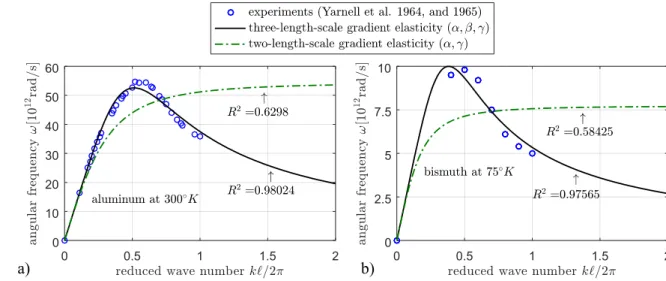
The additional micro-inertia contribution in the proposed formulation, namely the
term in , has been introduced to improve the description of wave dispersion as observed in
materials with a lattice structure [57], [58], [59], [60]. Indeed, the inclusion of the
fourth-order acceleration gradient is essential to capture the inflexion that may be observed in a few
experimental dispersion curves for phonons propagating in the longitudinal crystallographic
direction in an aluminum crystal at and in bismuth at are depicted. These
curves were derived by Yarnell and co-workers in the mid-sixties via neutron scattering
experiments [59], [60]. The analytical dispersion curves from gradient elasticity theory (that
is, the one-dimensional format of Eq. ) have been superimposed in the graphs, with the
length-scale parameters found as a result of a non-linear least square minimization procedure.
It is clearly seen that the inclusion of the additional term significantly improves the
description of the experimental dispersion curve, with a coefficient of determination
equal to and in the two cases. The coefficients identified from the minimization
procedure are , and for aluminum, and ,
and for bismuth, which highlights the importance of including the second micro-inertia
term. On the contrary, the two-length-scale formulation without the term is not able to
capture the inflexion point experimentally observed.
0 0.5 1 1.5 2
0 10 20 30 40 50 60
0 0.5 1 1.5 2
0 2.5 5 7.5 10
a) b)
1.2. Micro-mechanical background from a lattice model
In many studies, gradient elasticity formulations have been derived from the
continualization of the response of a discrete medium, see e.g. [26], [27], [30], [55], [61],
[62], [63], [64]. In order to provide a micro-mechanical background to the proposed model
with three length scales, a non-local lattice model is presented here.
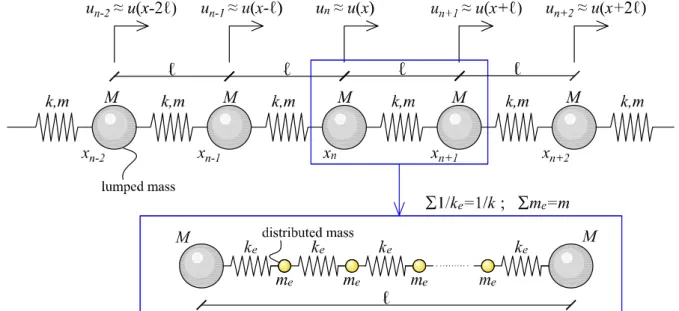
Figure 2 Non-local lattice model with both distributed and lumped mass
The starting geometry is a material whereby some portion of the mass is distributed and the
remainder is lumped. Referring to Figure 2, let us assume a bar schematically represented by
a chain of lumped mass particles being connected to each other by springs of stiffness .
The discrete masses are located at equal particle spacing that may be interpreted as the
unit cell of a non-homogeneous material, having (macroscale) mass density ,
with denoting the cross-sectional area of the bar. Similarly, the stiffness of the springs is
expressed via Hooke’s law as , with denoting the Young’s modulus. In addition
to the lumped masses, the material is also endowed with a certain degree of distributed mass,
represented by a mass density which may be interpreted as a micro-mass distribution of
distribution may be thought of as a discrete set of small masses , located between two
particles , connected with each other through springs of stiffness , and such that
and .
The stiffness matrix of the unit cell is well known, i.e.,
On the contrary, for the mass matrix various options exist. The so-called higher-order mass matrix [65] is known to offer best accuracy compared to both lumped mass matrix and consistent mass matrix when used to approximate the distributed mass (related to the
micro-mass distribution in this case). In addition, a lumped micro-mass matrix is used for the discrete point
masses (macro-mass distribution) at the nodes. That is, we use
to represent the distributed mass and the lumped mass, respectively. With the stiffness and
mass matrices of the unit cell derived, the equation of motion of the nth degree of freedom
(located at ) can be written as
Continualization is carried out by converting the response of the discrete particle into the
continuous displacement , cf. Figure 2. For the neighboring particles, this means
By using Taylor expansions for the and terms, after some straightforward
algebra Eq. can be rewritten as
where the primes denote derivatives with respect to the spatial coordinate x, i.e., .
The expansion terms in Taylor series are truncated in order to make Eq. asymptotically
accurate up to . Omitting the space dependence of the displacement, that is, ,
and introducing the so-called “total density” leads to the following compact
equation
where is the gradient operator. Within the gradient series, the second-order term is known
to be unstable [13], [51], but this can be remedied using Padé approximation of the
differential operator, that is
Eq. is thus re-written as
which can be shown to be stable [51].1
1 Note that the factor 1/12 on the right-hand-side of Eq. results from the assumption of the higher-order mass
Next, we wish to replace the last term on the right-hand-side with an equivalent higher-order
strain gradient. Eq. is rewritten as
Taking the second derivative of Eq. and multiplying with yields
and finally substituting Eq. back to Eq. leads to
where all contributions up to order have been retained. Comparing Eq. with the
one-dimensional counterpart of Eq. leads to a clear, one-to-one identification of the
constants of the proposed three-length-scale gradient elasticity formulation
Consequently, the three coefficients can be given a proper physical meaning based on
geometrical and mechanical properties of the microstructure with the aid of the developed
lattice model.
We emphasize that we do not claim the above derivation to be the only motivation of the
suggested model with strain gradients and multiple inertia gradients. What we have used is
the link between the notion of lumped masses at different scales of observation and the
combination of lumped mass and distributed mass at a single scale of observation. Since the
distributed mass is represented by a non-diagonal mass matrix in the discrete model,
motivations may equally be possible.
3. OVERVIEW OF DIFFERENT GRADIENT-ENRICHED BEAM THEORIES
Gradient elasticity theories have been employed within the framework of Euler-Bernoulli
or Timoshenko beam theory [66] to capture the dispersive characteristics of flexural waves,
e.g. in carbon nanotubes (CNTs) [36], [37], [38], [39]. In the sequel, a single-walled CNT is
referred to, having tube radius , wall thickness , Young’s modulus , Poisson’s ratio ,
shear modulus , mass density , cross-sectional area and second moment of area .
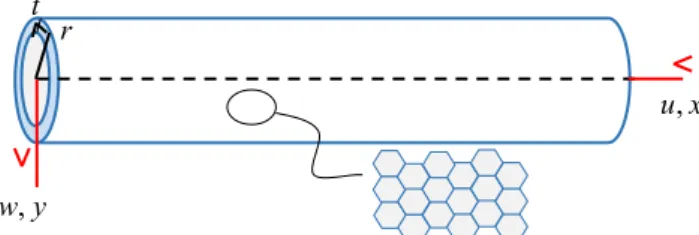
For thin-walled circular cross sections and . An coordinate system is
considered, cf. Figure 3, with axial coordinate x and transverse coordinate y, while
and denote the axial and shear stress, respectively. The bending moment and shear
force are expressed in terms of stresses
with the shear correction factor.
,
u x
,
w y
r
t
Figure 3 Schematic model of a single-walled carbon nanotube
Different gradient elasticity formulations for describing the flexural wave dispersion in CNTs
are reviewed below. As compared to an earlier paper [36], we here extend the discussion by
gradient elasticity formulation. Furthermore, in the spirit of Eq. , the gradient enrichments are
introduced by expanding not only the stiffness side of the equations, as made in [36], but also
the inertia side. This has made it possible to develop novel Euler-Bernoulli and Timoshenko
beam formulations equipped with higher-order combined strain-inertia gradient terms, which
are different from the gradient theories proposed in [36]. In the below derivations, the
dispersive behavior is described in terms of a phase velocity versus wave number
relationship.
1.3. Euler-Bernoulli beam theory
In classical elasticity, the axial stress-strain law (with denoting the axial
strain) leads to the bending moment-curvature relationship
with denoting the beam curvature and the second moment of area.
The comma notation is adopted for the spatial derivatives with respect to the longitudinal axis
. The corresponding transverse equation of motion without distributed forces is
In the spirit of Eq. , both the stiffness and inertia side of Eq. are expanded with higher-order
strain and inertia gradients of the relevant kinematic state variables, respectively. This yields
Substituting a trial solution into (where is the amplitude,
where is the elastic bar velocity and is the gyration radius. Eq.
underlies a novel gradient-enriched Euler-Bernoulli beam theory, different from the one
proposed in [36].
On the other hand, the stress gradient formulation of the Euler-Bernoulli beam theory
leads to the following phase velocity relationship (see [36] for the derivations)
1.4. Timoshenko beam theory
In the Timoshenko beam, rotary inertia and shear deformation are included in the
formulation. In addition to the axial stress-strain law , the shear stress-strain law is
, where is the shear modulus and is the elastic shear strain. The rotation of
the cross section is given by so that the bending moment and shear force
from are expressed as
The two coupled equations of motion related to transverse displacements and rotations are
Similarly to Euler-Bernoulli beam theory, in the spirit of Eq. , both the stiffness and inertia
kinematic state variables, respectively. This yields
Simultaneous solutions and are
substituted into , and after elimination of the amplitudes and a quartic equation in
terms of the phase velocity normalized by is obtained
This equation has two solutions for , the higher of which represents the optical mode and
the lower of which is the acoustic mode. Therefore, only the lower branch of Eq. is of
relevance for flexural waves, while the upper branch regards the shear waves. Eq. underlies a
novel gradient-enriched Timoshenko beam theory, different from the one proposed in [36].
On the other hand, the stress gradient formulation of the Timoshenko beam theory leads to
a quartic equation in terms of the phase velocity normalized by as follows (see [36] for
the complete derivations)
from which, once again, it is possible to solve for and to determine the lower branch,
4. QUALITATIVE ANALYSIS
It is well known that the phase velocity of Euler-Bernoulli beam theory according to
classical elasticity is unbounded [36], [37]; this is clearly physically unrealistic and should be
avoided with the use of gradients. Inspection of Eq. shows the following:
1. Similarly to classical elasticity, the strain gradient formulation obtained by taking
and results in infinitely large phase velocities for high wave numbers;
2. The simplest gradient-extension of classical Euler-Bernoulli theory that leads to
bounded phase velocities is obtained by taking and . The result is
monotonically increasing phase velocities approaching a non-zero asymptote of
‒ a very similar shape is obtained by the stress gradient formulation ;
3. The combination , and leads to unbounded phase velocities and is
thus not permissible;
4. On the other hand, the combination of , and leads to bounded
phase velocities with a zero asymptote;
5. Finally, the most general case of , and yields bounded phase
velocities but permits monotonic increase of the phase velocity as well as a
non-zero asymptote at .
Although the above observations hold for Euler-Bernoulli theory only and Timoshenko
theory is known to dispense of unbounded phase velocities without needing gradient
enrichment, for consistency we have used the same four special cases of gradient extensions
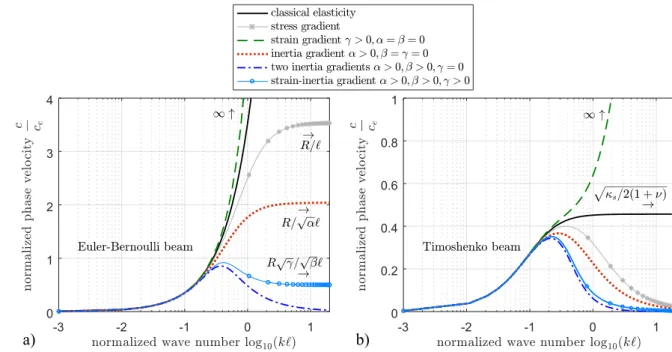
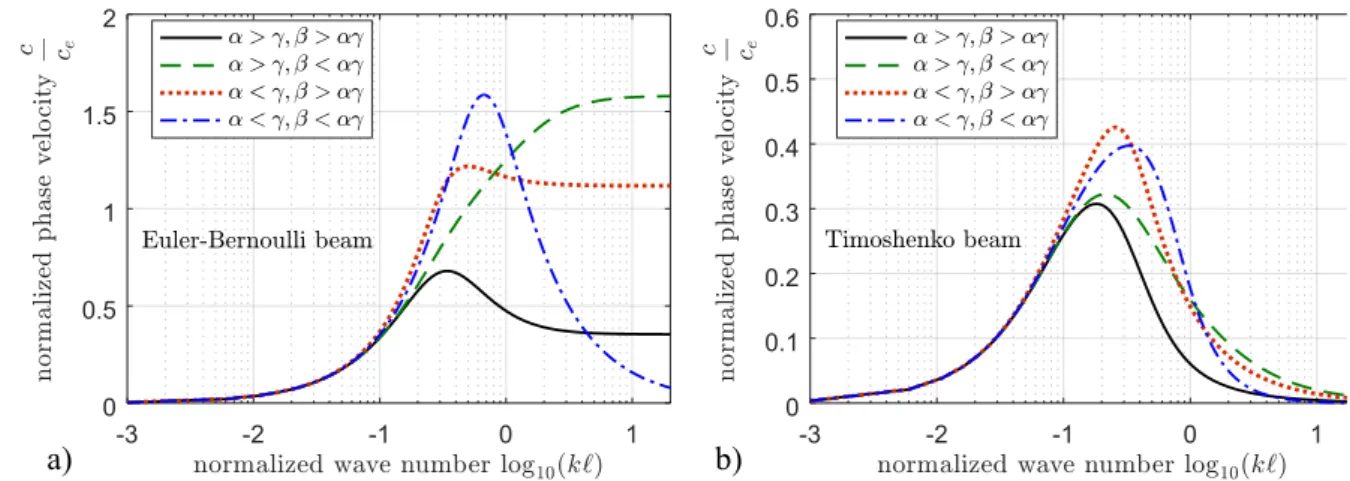
for both beam theories. The results are plotted in Figure 4: the curves are shown in
dimensionless form with in vertical axis and in abscissa, adopting logarithmic
ratio of tube radius over length scale as , a Poisson’s ratio and a shear
factor are assumed. Based on these graphs, it emerges that at least two inertia
gradients are necessary in the gradient-enriched Euler-Bernoulli beam theory to predict
increasing phase velocities for small-to-medium wave numbers, and decreasing phase
velocities for medium-to-large wave numbers. This trend is often observed in
micromechanical data of CNTs, as shown next. The key role is played by the additional
higher-order inertia gradient term, proportional to the coefficient in , without which this
trend cannot be captured. On the other hand, this trend can be well described by any of the
gradient-enriched Timoshenko beam formulations (except strain gradient), but the presence
of additional gradients yields enhanced versatility and flexibility of the dispersion curve,
which is desirable for curve-fitting purposes against experimental findings.
-3 -2 -1 0 1
0 1 2 3 4
-3 -2 -1 0 1
0 0.2 0.4 0.6 0.8 1
a) b)
Figure 4 Qualitative flexural wave dispersion predicted by different versions of gradient-enriched beam formulations: a) Euler-Bernoulli beam theory; b) Timoshenko beam theory
In Figure 5 a few possible combinations of the three length scale gradient formulation are
investigated, depending on the relative magnitudes of , and . For the Euler-Bernoulli
behavior is different in the medium-to-high wave numbers. For the cases in which
the curves reach a maximum and then decrease until approaching a non-zero asymptote; for
the trend depends upon the ratio: for the phase velocities monotonically
increase approaching a non-zero asymptote, whereas for the curve shows a maximum
and then tends to zero for the larger wave numbers. For the Timoshenko beam theory, the
relative magnitudes of , and do not qualitatively alter the shape of the dispersion
curve, as all the combinations lead to a first increasing and then decreasing trend, with a zero
asymptote for large wave numbers. It is evident that the proposed three-length-scale model
incorporates all the previous formulations as special cases, therefore it is really versatile as it
allows, for a proper choice of the three constants , and , to capture a broad variety of
qualitative trends of dispersion curves that may be observed in experiments.
-3 -2 -1 0 1
0 0.5 1 1.5 2
-3 -2 -1 0 1
0 0.1 0.2 0.3 0.4 0.5 0.6
a) b)
Figure 5 Qualitative flexural wave dispersion predicted by three-length-scale gradient elasticity formulations: a) Euler-Bernoulli beam theory; b) Timoshenko beam theory
5. FLEXURAL WAVE DISPERSION IN SINGLE-WALLED CARBON
NANOTUBES
The dispersion characteristics of flexural waves propagating in single-walled CNTs are
investigated below. The different gradient elasticity theories illustrated in Section 3. are used
is to scrutinize the effectiveness of the proposed three-length-scale gradient formulation to
capture the flexural wave dispersion in CNTs. Advantages over alternative formulations of
gradient elasticity are also discussed for completeness.
1.5. Comparison with molecular dynamics simulations
Wang and Hu [37] performed MD simulations of armchair (5,5) and armchair (10,10)
single-walled CNTs in an attempt to validate beam models for studying flexural wave
dispersion. To take into account the dispersion of flexural waves in CNTs, they employed
both Euler-Bernoulli and Timoshenko beam theory in conjunction with gradient elasticity.
Continualization of the response of a discrete chain of masses and springs [13], [61], [67]
leads to a particular format of gradient elasticity with a positive second-order gradient of the
strain field entering the constitutive equation as follows
The above format of gradient elasticity is a special case of the three-length-scale formulation
presented in Section 3. with zero micro-inertia terms ( ) and with a negative
value, i.e., . This simple strain gradient elasticity model was adopted by Wang and Hu
[37] to describe the flexural wave dispersion in the two analyzed CNTs. The length scale
parameter can be related to the inter-particle distance or unit-cell size, which reflects the
influence of the internal CNT microstructure. In particular, if represents the axial distance
between two rings of atoms in the CNT, the strain gradient length scale can be expressed
as , see also [68]. The drawback of the (unstable) strain gradient formulation has
already been pointed out by Askes and Aifantis [36] and concerns its destabilizing behavior,
which results in imaginary phase velocities for wave numbers . This shortcoming
proposed by Wang and Hu [37] because the MD simulations did not involve such
medium-to-large wave numbers characterized by .
8 9 10 11
0 2000 4000 6000 8000
8 9 10 11
0 2000 4000 6000 8000
a) b)
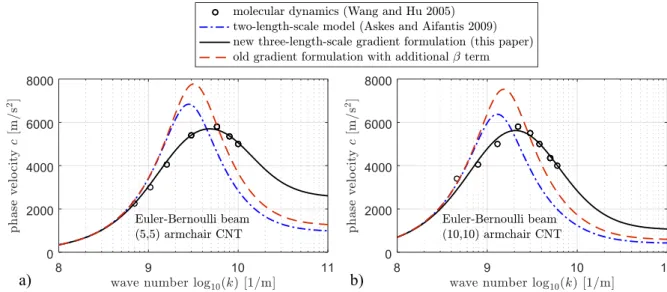
Figure 6 Flexural wave dispersion in single-walled CNTs predicted by Euler-Bernoulli beam theory, against MD results by Wang and Hu [37]
The proposed three-length-scale gradient formulation can be viewed as an expanded
version of the model with strain and inertia gradients proposed in [36], with an additional
micro-inertia term. However, as compared to the two-length-scale model proposed in [36],
here gradient enrichments are introduced both in the stiffness side and in the inertia side in
the spirit of Eq. . It is of interest to assess how the description of the MD simulations may be
improved by incorporating such additional micro-inertia term in the new gradient-enriched
beam formulations. In Figure 6 the flexural wave dispersion resulting from the
Euler-Bernoulli beam theory in conjunction with the two gradient elasticity formulations is
illustrated against the MD results. Other formats of gradient elasticity, for instance stress
gradient and strain gradient, are not reported in this plot since they produce results that are far
less accurate than the two illustrated theories. According to the study by Wang and Hu [37],
we have considered two CNTs having wall thickness , cf. Figure 3. For the (5,5)
armchair CNT we have set a Young’s modulus and a Poisson’s ratio
as and in line with the study in [37]. Considering the axial
distance between two rings of carbon atoms , the following length scale is
computed , while the mass density for both the CNTs is [37]
and the shear correction factor in the Timoshenko beam is assumed as , which is
appropriate for thin-walled cylinders. The tube radius is calculated from the
armchair indices [69], with and is the
length of the C-C bond [70]. By inspection of Figure 6, it is observed that the combination of
strain gradient and inertia gradient is essential to obtain a reasonable qualitative fit of the MD
results for small-to-mid-range wave numbers. Indeed, the MD simulations follow an
increasing trend in the small-to-medium wave numbers, and then a decreasing trend after a
maximum point is reached. This is in line with the qualitative shape of dispersion curve
reported in Figure 4 for strain-inertia gradient Euler-Bernoulli beam theory. For the
two-length-scale model of the gradient elasticity formulation proposed in [36] we have assumed
the same preliminary estimates of the length scales as given in [36], which correspond to
constants and for the (5,5) and (10,10) CNT, respectively. For the new
three-length-scale model, the coefficients are found from a non-linear least square
minimization procedure. It can be noted that the three-length-scale formulation considerably
improves the fitting of the MD results in the medium wave numbers as compared to the
two-length-scale model proposed in Askes and Aifantis [36]. For the two CNTs the corresponding
values found from the minimization procedure are and , therefore
roughly similar to the ones estimated for the strain-inertia gradient formulation in [36], while
the best-fitting values are and . The associated coefficient of
three-length-scale formulation. This improved behavior of the gradient-enriched
Euler-Bernoulli formulation is mainly due to the incorporation of the gradient terms both in the
stiffness and inertia side of the equation, rather than to the inclusion of the additional term.
To demonstrate this, we have repeated the curve fitting for the old gradient formulation
proposed in [36], but including this additional inertia term, according to an expanded
three-length-scale formulation. As can be seen in Figure 6, the results are not appreciably improved
by the additional term in the old gradient formulation.
8 9 10 11
0 2000 4000 6000 8000
8 9 10 11
0 2000 4000 6000 8000
a) b)
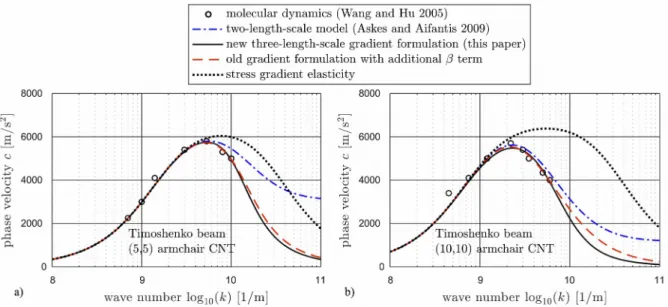
Figure 7 Flexural wave dispersion in single-walled CNTs predicted by Timoshenko beam theory in conjunction with various gradient elasticity formulations, against MD results by Wang and Hu [37]
Quantitatively and qualitatively different are the conclusions drawn from the analysis of
Figure 7, in which the Timoshenko beam theory is employed by including the rotary inertia
and the shear deformation. Indeed, the associated flexural dispersion curve of simpler version
of gradient elasticity beam theories (e.g. stress gradient) is closer to the MD results. This is
reasonable since Timoshenko beam theory is particularly suitable for the modelling of
relatively short beams, which in the present investigation means that this theory is appropriate
for the modelling of relatively short wave lengths in CNTs. Although the trend of stress
some discrepancies are still observed, especially in the higher wave numbers. Conversely, the
combination of strain and inertia gradients provides a very good fit of the MD results. Once
again, for the two-length-scale model we have assumed the preliminary estimates of the
length scales as provided in [36], which correspond to constants and for the
(5,5) and (10,10) CNT, respectively. This two-length-scale model is able to capture the MD
results in the entire range of wave numbers. However, improved predictions can be obtained
with the proposed three-length-scale gradient formulations. The corresponding values
from the minimization procedure are and for the (5,5) and (10,10) CNT,
respectively, while the values are and . The ratio of the micro-inertia
length-scale in the two CNTs is equal to for the Euler-Bernoulli beam and
for the Timoshenko beam theory, which approximately resembles the ratio between the
radii of the two CNTs. The analogous ratio of the length scale in the two CNTs is
and for the Euler-Bernoulli and Timoshenko beam theory, respectively. Unlike the
Euler-Bernoulli beam discussed above, the improved behavior of the proposed formulation is
here mainly ascribed to the presence of the additional constant in the model. Indeed, the
old gradient formulation proposed in [36] equipped with the additional term still provides
an excellent fit of the MD results.
Based on the results presented both in Figure 6 and in Figure 7, we conclude that the
additional micro-inertia term along with the new gradient enrichment of both stiffness and
inertia side significantly improves the prediction of the flexural wave dispersion in CNTs.
Unlike earlier variants of gradient-enriched beam theories, we have proposed a formulation
through which not only the Timoshenko beam, but also the Euler-Bernoulli beam can
Although these results are restricted to chiralities of armchair type, they confirm the
effectiveness of the proposed three-length-scale formulation in predicting the wave dispersion
and the improvements over alternative gradient models present in the literature. Another
important observation emerges from the analysis of Figure 7: the three-length-scale
formulation seems to describe the MD results more accurately in the medium range of wave
numbers as compared to the two-length-scale model. By inference, it is expected that this
improved dispersive behavior would be more pronounced in the larger wave numbers where
no MD results are here presented and available, which certainly deserves further
investigation.
6. CONCLUDING REMARKS
In the framework of higher-order continuum theories, gradient enrichments of the classical
elasticity equations can be used to account for long-range interactions that affect the
dispersive behavior of materials and systems with internal lattice microstructure. A new
three-length-scale gradient elasticity formulation has been recently developed by the authors
to improve the prediction of wave dispersion. This enhanced model incorporates one strain
gradient and two micro-inertia terms. Three length scale material parameters accompany the
higher-order terms, and the relative magnitudes between these three length scales are scaled
by three coefficients that are termed in this paper. The term is associated with the
Laplacian of the strain field, while the and coefficients are related to the second-order
and the fourth-order space derivative of the acceleration field in the equations of motion.
While the effectiveness of this new model with regard to longitudinal wave dispersion has
been demonstrated in earlier studies, similar assessments with regard to flexural wave
dispersion were lacking to date. To this aim, the new model has been here used to capture the
heterogeneity. As a first novel contribution of this paper, the new model with three length
scales is given further micro-mechanical background on the basis of a nonlocal lattice model
in which some portion of the mass is distributed and the remainder is lumped. Then, an
overview of gradient-enriched beam theories has been presented, incorporating either stress
gradients, or a combination of both strain gradients and inertia gradients including the new
three-length-scale model. Both Euler-Bernoulli and Timoshenko beam theories are addressed
for comparative purposes. Novel gradient-enriched beam theories (Euler-Bernoulli and
Timoshenko) have been developed by expanding both the stiffness side and the inertia side of
the equations of motion. This is a novelty as compared to earlier research work [36] in which
only the stiffness side was expanded. These novel gradient-enriched beam theories have been
validated against results from molecular dynamics (MD) simulations regarding the flexural
wave dispersion in an armchair (5,5) and in an armchair (10,10) single-walled CNT. It has
been found that significant improvements in the prediction of the flexural wave dispersion in
CNTs are achieved by the new three-length-scale gradient elasticity formulation as compared
to alternative gradient models previously presented in the literature. In particular, an excellent
fit of the MD results over a wide range of wave numbers has been obtained by coupling the
new three-length-scale gradient formulation with the Timoshenko beam theory. Furthermore,
it has been highlighted that for the Euler-Bernoulli beam, the new gradient enrichment of the
equations of motion leads to phase velocity relationships that are much more accurate than
the previous ones proposed in the literature [36], [37], regardless of the additional term.
As to the identification of length scales of the new gradient elasticity formulation, the strain
gradient length scale has been related to the axial distance between two rings of atoms, while
the micro-inertia length scales seem to be somehow connected to the radius of the CNT.
Further investigation in this regard is certainly deserved, along with extension to other
References
[1] Maugin GA, Metrikine AV (eds.) Mechanics of Generalized Continua One Hundred Years After
the Cosserats. Springer: New York, 2010.
[2] Eringen AC. On differential equations of nonlocal elasticity and solutions of screw dislocation and surface waves. Journal of Applied Physics 1983; 54:4703–4710.
[3] Fuschi P, Pisano AA, De Domenico D. Plane stress problems in nonlocal elasticity: finite element solutions with a strain-difference-based formulation. Journal of Mathematical Analysis
and Applications 2015; 431:714–736.
[4] Polizzotto C, Fuschi P, Pisano AA. A nonhomogeneous nonlocal elasticity model. European
Journal of Mechanics A/Solids 2006; 25:308–333.
[5] Apuzzo A, Barretta R, Luciano R, Marotti de Sciarra F, Penna R. Free vibrations of Bernoulli-Euler nano-beams by the stress-driven nonlocal integral model. Composites Part B: Engineering
2017; 123,105–111.
[6] Barretta R, Feo L, Luciano R, Marotti de Sciarra F. Application of an enhanced version of the Eringen differential model to nanotechnology. Composites Part B: Engineering 2016; 96, 274– 280.
[7] Fuschi P, Pisano AA. Ultimate load prediction of MMNCs structures. Composites Part B:
Engineering 2017; 125:175–180.
[8] Barretta R, Čanadija M, Feo L, Luciano R, Marotti de Sciarra F, Penna R. Exact solutions of inflected functionally graded nano-beams in integral elasticity. Composites Part B: Engineering
2017; 142: 273–286.
[9] Benvenuti E, Simone A. One-dimensional nonlocal and gradient elasticity: closed-form solution and size effect. Mechanics Research Communications 2013; 48: 46–51.
[10] Benvenuti E. Electromechanical behavior, end enhancements and radial elasticity of single-walled CNTs: A physically-consistent model based on nonlocal charges. International Journal of
Solids and Structures 2015; 72, 190–205.
[11] Challamel N, Rakotomanana L, Le Marrec L. A dispersive wave equation using nonlocal elasticity. Comptes Rendus Mécanique 2009; 337(8):591–595.
[12] Pisano AA, Fuschi P. Closed form solution for a nonlocal elastic bar in tension. International
Journal of Solids and Structures 2003; 40(1):13–23.
[13] Askes H, Aifantis EC. Gradient elasticity in statics and dynamics: an overview of formulations, length scale identification procedures, finite element implementations and new results.
International Journal of Solids and Structures 2011; 48:1962–1990.
[14] Mindlin R. Micro-structure in linear elasticity. Archive for Rational Mechanics and Analysis
1964; 16:51–78.
[15] Aifantis EC. On the role of gradients in localization of deformation and fracture. International
Journal of Engineering Science 1992; 30:1279–1299.
[16] Aifantis EC. Update on a class of gradient theories. Mechanics of Materials 2003; 35(3-6):259– 280.
[17] Ru CQ, Aifantis EC. A simple approach to solve boundary-value problems in gradient elasticity.
Acta Mechanica 1993; 101:59–68.
[18] Altan B, Aifantis EC. On some aspects in the special theory of gradient elasticity. Journal of the
Mechanical Behavior of Materials 1997; 8:231–282.
[19] Bažant ZP, Jirásek M. Nonlocal integral formulations of plasticity and damage: survey of progress. Journal of Engineering Mechanics 2002; 11:1119–1149.
[20] Gutkin M, Aifantis EC. Screw dislocation in gradient elasticity. Scripta Materialia 1996;
35:353–1358.
[21] Gutkin M, Aifantis EC. Edge dislocation in gradient elasticity. Scripta Materialia 1997; 36:129– 135.
[23] Ansari R, Gholami R, Shojaei MF, Mohammadi V, Sahmani S. Size-dependent bending, buckling and free vibration of functionally graded Timoshenko microbeams based on the most general strain gradient theory. Composite Structures 2013; 100:385–397.
[24] Sahmani S, Ansari R. On the free vibration response of functionally graded higher-order shear deformable microplates based on the strain gradient elasticity theory. Composite Structures 2013;
95:430–442.
[25] Askes H, Aifantis EC. Gradient elasticity theories in statics and dynamics – a unification of approaches. International Journal of Fracture 2006; 139:297–304.
[26] Metrikine AV, Askes H. One-dimensional dynamically consistent gradient elasticity models derived from a discrete microstructure. Part 1: Generic formulation. European Journal of
Mechanics – A/Solids 2002; 21:555–572.
[27] Metrikine AV, Askes H. An isotropic dynamically consistent gradient elasticity model derived from a 2D lattice. Philosophical Magazine 2006; 86:3259–3286.
[28] Askes H, Bennett T, Aifantis EC. A new formulation and C0-implementation of dynamically
consistent gradient elasticity. International Journal for Numerical Methods in Engineering 2007;
72:111–126.
[29] Papargyri-Beskou S, Polyzos D, Beskos DE. Wave dispersion in gradient elastic solids and structures: A unified treatment. Int Journal of Solids and Structures 2009; 46:3751–3759. [30] Askes H, Metrikine AV, Pichugin A. Bennett T. Four simplified gradient elasticity models for
the simulation of dispersive wave propagation. Philosophical Magazine 2008; 88:3415–3443. [31] Barati MR, Zenkour A. A general bi-Helmholtz nonlocal strain-gradient elasticity for wave
propagation in nanoporous graded double-nanobeam systems on elastic substrate. Composite
Structures 2017; 168:885–892.
[32] Reda H, Rahali Y, Ganghoffer JF, Lakiss H. Analysis of dispersive waves in repetitive lattices based on homogenized second-gradient continuum models. Composite Structures 2016; 152:712– 728.
[33] Reda H, Rahali Y, Ganghoffer JF, Lakiss H. Nonlinear dynamical analysis of 3D textiles based on second order gradient homogenized media. Composite Structures 2016; 154:538–555.
[34] Reda H, Karathanasopoulos N, Rahali Y, Ganghoffer JF, Lakiss H. Influence of first to second gradient coupling energy terms on the wave propagation of three-dimensional non-centrosymmetric architectured materials. International Journal of Engineering Science 2018;
128:151–164.
[35] Challamel N, Zorica D, Atanacković TM, Spasić DT. On the fractional generalization of Eringenʼs nonlocal elasticity for wave propagation. Comptes Rendus Mécanique 2013;
341(3):298–303.
[36] Askes H., Aifantis EC. Gradient elasticity and flexural wave dispersion in carbon nanotubes.
Physical Review B 2009; 80:195412- 1–8.
[37] Wang L., Hu H. Flexural wave propagation in single-walled carbon nanotubes. Physical Review B 2005; 71:195412-1–8.
[38] Wang L., Hu H., Guo W. Wave Propagation in Carbon Nanotubes. Wave Propagation in
Materials for Modern Applications 2010, Andrey Petrin (Ed.), ISBN: 978-953-7619-65-7.
[39] Ansari R, Gholami R, Rouhi H. Vibration analysis of single-walled carbon nanotubes using different gradient elasticity theories. Composites: Part B 2012; 43:2985–2989.
[40] Güven U. Transverse vibrations of single-walled carbon nanotubes with initial stress under magnetic field. Composite Structures 2014; 114:92–98.
[41] Challamel N. Variational formulation of gradient or/and nonlocal higher-order shear elasticity beams. Composite Structures 2013; 105:351–368.
[42] Challamel N, Reddy JN, Wang CM. Eringen’s stress gradient model for bending of nonlocal beams. Journal of Engineering Mechanics 2016; 142(12):04016095.
[43] Barretta R, Diaco M, Feo L, Luciano R, Marotti de Sciarra F, Penna R. Stress-driven integral elastic theory for torsion of nano-beams. Mechanics Research Communications 2017; 87:35–41. [44] Barretta R, Brčić M, Čanađija M, Luciano R, Marotti de Sciarra F. Application of gradient
elasticity to armchair carbon nanotubes: Size effects and constitutive parameters assessment.
[45] Barretta R, Faghidian SA, Luciano R, Medaglia CM, Penna R. Stress-driven two-phase integral elasticity for torsion of nano-beams. Composites Part B: Engineering 2018; 145:62–69.
[46] Papargyri-Beskou S, Tsepoura KG, Polyzos D, Beskos DE. Bending and stability analysis of gradient elastic beams. International Journal of Solids and Structures 2003; 40(2):385–400. [47] Polizzotto C. A gradient elasticity theory for second-grade materials and higher order inertia.
International Journal of Solids and Structures 2012; 49(15-16): 2121–2137.
[48] Polizzotto C. Stress gradient versus strain gradient constitutive models within elasticity.
International Journal of Solids and Structures 2014; 51(9):1809–1818.
[49] Polizzotto C. A unifying variational framework for stress gradient and strain gradient elasticity theories. European Journal of Mechanics-A/Solids 2015; 49:430–440.
[50] Challamel N. Higher-order shear beam theories and enriched continuum. Mechanics Research
Communications 2011; 38(5):388–392.
[51] De Domenico D, Askes H. A new multi-scale dispersive gradient elasticity model with micro-inertia: formulation and C0-finite element implementation. International Journal for Numerical
Methods in Engineering 2016; 108(5): 308–333.
[52] De Domenico D, Askes H. Computational aspects of a new multi-scale dispersive gradient elasticity model with micro-inertia. International Journal for Numerical Methods in Engineering
2017; 109(1): 52–72.
[53] De Domenico D, Askes H, Aifantis EC. Gradient elasticity and dispersive wave propagation: Analytical versus experimental findings on concrete and layered composites, International
Journal of Solids and Structures (under review).
[54] Triantafyllidis N, Aifantis EC. A gradient approach to localization of deformation. I. Hyperelastic materials. Journal of Elasticity 1986; 16:225–237.
[55] Polyzos D, Fotiadis DI, Derivation of Mindlin’s first and second strain gradient elastic theory via simple lattice and continuum models. Int Journal of Solids and Structures 2012; 49:470-480. [56] Dontsov EV, Tokmashev RD, Guzina BB. A physical perspective of the length scales in gradient
elasticity through the prism of wave dispersion. International Journal of Solids and Structures
2013; 50:3674–3684.
[57] Warren J, Yarnell J, Dolling G, Cowley R. Lattice dynamics of diamond. Physical Review 1967;
158:805–808.
[58] Yarnell J, Warren J, Wenzel R. Lattice vibrations in diamond. Physical Review Letters 1964;
13:13–15.
[59] Yarnell J, Warren J, Wenzel R, Koenig S. Phonon dispersion curves in bismuth. IBM Journal of
Research and Development 1964; 8:234–240.
[60] Yarnell J, Warren J, Koenig S. Experimental dispersion curves for phonons in aluminium. In
Lattice Dynamics – Proceedings of An International Conference, Wallis RF (ed.). Pergamon
Press: Oxford (UK), 1965; 57–61.
[61] Chang CS, Gao J. Second-gradient constitutive theory for granular material with random packaging structure. International Journal of Solids and Structures 1995; 32:2279–2293.
[62] Lombardo M, Askes H. Elastic wave dispersion in microstructured membranes. Proceedings of the Royal Society of London A: Mathematical, Physical and Engineering Sciences 2010; doi:10.1098/rspa.2009.0516.
[63] Lombardo M, Askes H. Higher-order gradient continuum modelling of periodic lattice materials.
Computational Materials Science 2012; 52(1): 204–208.
[64] Challamel N, Wang CM, Elishakoff I. Nonlocal or gradient elasticity macroscopic models: a question of concentrated or distributed microstructure. Mechanics Research Communications
2016; 71:25–31.
[65] Hughes TJR. The Finite Element Method: Linear Static and Dynamic Finite Element Analysis. Dover: NY, USA, 2000.
[66] Han SM, Benaroya H, Wei T. Dynamics of transversely vibrating beams using four engineering theories. Journal of Sound and Vibration 1999; 225(5):935–988.
[67] Suiker A, de Borst R. Chang CS. Micro-mechanical modelling of granular material. Part 1: derivation of a second-gradient micro-polar constitutive theory. Acta Mech 2001; 149, 161–180. [68] Gitman IM, Askes H, Aifantis EC. The representative volume size in static and dynamic
[69] Yengejeh SI, Kazemi SA, Öchsner A. A Primer on the Geometry of Carbon Nanotubes and Their Modifications. SpringerBriefs in Applied Sciences and Technology 2015. ISSN 2191-5318. [70] Dresselhaus MS, Dresselhaus G, Saito R. Physics of carbon nanotubes. Carbon 1995; 33:883–
891.
[71] Papanicolopulos SA. Chirality in isotropic linear gradient elasticity. International Journal of