Reusable Non-Interactive Secure Computation
Melissa Chase∗
Microsoft Research, Redmond
Yevgeniy Dodis† New York University Yuval Ishai‡
Technion
Daniel Kraschewski§ TNG Technology Consulting Tianren Liu¶
MIT
Rafail Ostrovskyk UCLA Vinod Vaikuntanathan∗∗
MIT
Abstract
We consider the problem of Non-Interactive Secure Computation (NISC), a 2-message “Sender-Receiver” secure computation protocol that retains its security even when both parties can be malicious. While such protocols are easy to construct using garbled circuits and general non-interactive zero-knowledge proofs, this approach inherently makes a non-black-box use of the underlying cryptographic primitives and is infeasible in practice.
Ishai et al. (Eurocrypt 2011) showed how to construct NISC protocols that only use parallel calls to an ideal oblivious transfer (OT) oracle, and additionally make only a black-box use of any pseudorandom generator. Combined with the efficient 2-message OT protocol of Peikert et al. (Crypto 2008), this leads to a practical approach to NISC that has been implemented in subsequent works. However, a major limitation of all known OT-based NISC protocols is that they are subject to selective failure attacks that allows a malicious sender to entirely compromise the security of the protocol when the receiver’s first message is reused.
Motivated by the failure of the OT-based approach, we consider the problem of basing
reusable NISC on parallel invocations of a standard arithmetic generalization of OT known as oblivious linear-function evaluation (OLE). We obtain the following results:
• We construct an information-theoretically secure reusable NISC protocol for arithmetic branching programs and general zero-knowledge functionalities in the OLE-hybrid model. Our zero-knowledge protocol only makes an absolute constant number of OLE calls per gate in an arithmetic circuit whose satisfiability is being proved. As a corollary, we get reusable NISC/OLE for general Boolean circuits using any one-way function.
• We complement this by a negative result, showing that reusable NISC/OT is impossi-ble to achieve, and a more restricted negative result for the case of the zero-knowledge functionality. This provides a formal justification for the need to replace OT by OLE. ∗
E-mail: [email protected] †
E-mail: [email protected] ‡
E-mail: [email protected] §
E-mail: [email protected]. Work mostly done while at Technion. ¶
E-mail: [email protected] k
E-mail: [email protected] ∗∗
• We build a universally composable 2-message OLE protocol in the CRS model that can be based on the security of Paillier encryption and requires only a constant number of modular exponentiations. This provides the first arithmetic analogue of the 2-message OT protocols of Peikert et al. (Crypto 2008).
• By combining our NISC/OLE protocol and the 2-message OLE protocol, we get protocols with new attractive asymptotic and concrete efficiency features. In particular, we get the first (designated-verifier) NIZK protocols where following a statement-independent preprocessing, both proving and verifying are entirely “non-cryptographic” and involve only a constant computational overhead.
1
Introduction
Non-interactive secure computation (NISC) refers to the problem where Rachel wishes to publish an encryption of her inputx, in such a way that Sam, who holds an input y, can send her a single message conveying the valuef(x, y) and nothing more. In the semi-honest setting, there are several solutions to this problem including (i) garbled circuits [Yao86,LP09] combined with two-message oblivious transfer (OT) protocols (e.g., [NP01,AIR01,PVW08]) and (ii) fully homomorphic encryp-tion [RAD78,Gen09]. One could compile these protocols to be secure against malicious parties by using general non-interactive zero-knowledge (NIZK) proofs in the common reference string (CRS) model [BFM88]; however, this requires making non-black-box use of the underlying cryptographic primitives, and is generally infeasible in practice. A recent line of work [IKO+11, AMPR14] has come up with efficient maliciously secure NISC protocols in the OT-hybrid model (which we re-fer to as NISC/OT protocols) that make black-box use of efficiently implementable cryptographic primitives such as a pseudorandom generator.
In general, the paradigm of designing protocols in the OT-hybrid model that are either uncondi-tionally secure or make use of symmetric cryptographic primitives, and plugging in fast implemen-tations of OT, has paid great dividends in cryptography for several reasons. First, we have efficient OT implementations under standard assumptions; and secondly, OT is self-reducible, so the cryp-tographic cost of implementing it can be pushed to an offline phase, and it can be implemented with information-theoretic security given correlated randomness. In short, combining efficient NISC/OT protocols with efficient 2-message OT implementations, we can get efficient “public-key” non-interactive variants of secure computation, as was recently accomplished in [IKO+11, AMPR14]. This approach is beneficial even in simpler special cases such as (designated-verifier) NIZK. For such cases (and more generally for functionalities computed by log-depth circuits or polynomial-size branching programs) such NISC/OT protocols can be made information-theoretic.
The starting point of this work is that this rosy picture belies a major defect of all known NISC/OT protocols. To see this, imagine that Rachel wants to publish a reusable encryption of her inputx, obtain messages from anyone in the world with inputs yi, conveying to her the value
of f(x, yi). In the semi-honest setting, all the old NISC/OT protocols work just fine. However,
in all known NISC/OT protocols (including [IKO+11, AMPR14]), a malicious Sam can mount a “selective failure attack”, feeding malformed OT messages to Rachel and checking whether she aborts or not, and using this information to violate both the secrecy of her input and the correctness of her output. Indeed, we show that this is inherent: our first result is that there is no information-theoreticreusably secureimplementation of NISC/OT for general functions. We also prove a similar result for zero-knowledge functionalities, though in a more restricted “black-box” framework.
if we replace OT by an arithmetic extension of OT known as oblivious linear function evaluation (OLE). The OLE functionality maps sender inputs (a, b) and receiver input x to receiver output
ax+b, where a, b, x are taken from some (typically large) field or ring. The main result of this paper is a general-purpose reusable non-interactive secure computation protocol that only makes parallel OLE callsover a large ring. We denote such a protocol by rNISC/OLE.
Our rNISC/OLE protocol is information-theoretic and does not rely on any cryptographic as-sumptions. Its complexity is polynomial in the size of an arithmetic branching program being computed. This is sufficient to capture arithmetic log-depth (NC1) circuits. However, in the im-portant special case of zero-knowledge functionalities, where verification can always be done by a shallow circuit, our NISC/OLE protocol is still information-theoretic and only makes a constant number of OLE calls per gate in an arithmetic circuit whose satisfiability is being proved. (Minimiz-ing this constant, which we did not attempt to optimize, is an interest(Minimiz-ing future research direction that can be motivated by practical implementations.) As a corollary, we can also get reusable NISC/OLE (beyond zero-knowledge) for general boolean circuits using any one-way function.
We complement our rNISC/OLE protocol by proposing an efficient secure implementation of the OLE oracle which is compatible with our efficiency goals. Concretely, assuming the security of Paillier’s encryption scheme [Pai99], we construct a universally secure 2-message OLE protocol in the CRS model (over the ring ZN for an RSA modulus N). The communication cost of the
protocol involves a constant number of group elements and its computational cost is dominated by a constant number of exponentiations. This protocol provides the first arithmetic analogue of the 2-message OT protocol of PVW [PVW08], which is commonly used in implementations of secure two-party computation (in particular, it is used by the non-interactive ones from [AMPR14]). Our efficient OLE protocol is independently motivated by other applications of OLE in cryptography; see [ADI+17,GNN17] and references therein.
The switch from OT to OLE has some unexpected efficiency benefits. Beyond the reusability issue, OT-based protocols in the malicious security model use a “cut and choose” approach that has considerable (super-constant) overhead in communication and computation. While there are effective techniques for amortizing the communication overhead (cf. [IPS08]), these come at the expense of a super-constant computational overhead and apply only in the boolean setting. Other approaches that employ OLE and apply to the arithmetic setting, such as the ones from [GIP+14, DGN+17], are inherently interactive.
The combination of our information-theoretic rNISC/OLE and the Paillier-based OLE im-plementation yields NISC and designated-verifier NIZK protocols with attractive new efficiency features. As discussed above, for general NISC there was no previous approach that could offer reusable security, even for the case of boolean circuits, without applying general-purpose NIZK on top of a semi-honest secure NISC protocol.
Even for the special case of zero-knowledge, where many other competing approaches are known, our approach is quite unique. In particular, we are the first to construct any kind of (reusable-setup) NIZK protocol where one can pushall of the cryptographic operationsto an offline phase; using the self-reducibility of OLE, we can have an online phase that involves only arithmetic computations in the “plaintext domain” and its security (given the preprocessed information) is unconditional. Moreover, the online phase satisfies a strong notion of constant computational overhead in the sense that both the prover and verifier only need to perform a constant number of addition and multiplication operations for each gate of the arithmetic verification circuit, in the same ring ZN
this highly efficient online phase consists only of a constant number of exponentiations per gate, and its security relies on a conservative, “20th century” assumption.
To summarize, the main positive results we prove about reusable NISC in the OLE-hybrid model are the following.
Theorem 1. There exists a statistically secure rNIZK/OLE protocol (i.e., rNISC for zero-knowledge functionalities) with O(1) OLE calls per gate.
Theorem 2. There exists a statistically secure rNISC/OLE protocol for (arithmetic or boolean)
branching programs and NC1 circuits.
Theorem 3. If one-way functions exist, there exists an rNISC/OLE protocol for circuits.
We optimize the concrete efficiency of our rNIZK/OLE protocol in Section 5.6, so that proving knowledge of a satisfying assignment of an arithmetic circuit costs 7 OLE calls per addition gate and 44 OLE calls per multiplication gate. We stress that since the protocol is information-theoretic in the OLE-hybrid model, each OLE involves only a small number of field operations (without any exponentiations) in the online phase.
1.1 Related Work
We briefly discuss several recent works that are relevant to the asymptotic efficiency features of our protocol. As discussed above, a distinctive efficiency feature of our rNIZK/OLE protocol for arithmetic verification circuits (more generally, rNISC/OLE for constant-depth arithmetic circuits) is that, in an offline-online setting, its online phase is non-cryptographic and has a constant compu-tational overhead. Moreover, the offline phase only requires a constant number of exponentiations per arithmetic gate.
Bootle et al. [BCG+17] construct zero-knowledge protocols for arithmetic verification circuits with constant computational overhead in the plain model, i.e., without any offline phase. However, this protocol relies on constant-overhead implementations of cryptographic primitives (a plausible but standard assumption), it requires multiple rounds of interaction (but can be made non-interactive via the Fiat-Shamir heuristic) and, most importantly in the context of our work, the cryptographic work in this protocol cannot be preprocessed. Finally, this protocol does not directly apply in the more general setting of secure computation.
Applebaum et al. [ADI+17] obtain (again, under plausible but non-standard assumptions) secure two-party protocols for evaluating arithmetic circuits that have constant computational overhead in the plain model. However, these protocols are inherently interactive (even when restricted to constant-depth circuits) and are only secure against semi-honest parties.
2
Overview of the Techniques
In this section we provide a high level overview of the proofs of our main results.
2.1 Impossibility of rNISC/OT
We show several negative results, which highlight the hardness of reusable secure computation. The first negative result shows that: for non-interactive two-party computation protocols, prefect security against malicious sender does not imply reusable security. In particular, previous works about NISC/OT do not immediately implies rNISC/OT.
We further show that OLE is strictly stronger than OT in the sense that there exists no information-theoretic rNISC/OT protocol for OLE functionality with composable security. Fi-nally, assuming the existence of one-way functions, in the OT hybrid model, there are no general resettably sound, non-interactive zero-knowledge proofs with black-box simulation.
Standard security does not imply reusability. Reusable security is not free. A perfectly
secure, 2-party computation protocol can be totally broken if the receiver uses the same randomness in two protocol runs. A counter example functionality is easy to find. Assume the sender’s input domain has to special symbols >, ⊥, such that the receiver will output a random string if the sender’s input is either >or⊥. Thus if the receiver use fresh randomness in each protocol run no information about his input will be leaked when the sender’s input is either> or⊥.
In one possible secure implement, the receiver samples a random string r, and outputs r if the sender’s input is >, outputsx⊕r if the sender’s input is⊥. Herex is the receiver’s input. If the receiver uses the same input x and randomness r in at least two protocol runs, then a malicious sender can make him outputr and x⊕r, which together reveal the receiver’s secret input x.
OT is not sufficient for reusability. We show the impossible of reusable non-interactive
two-party computation protocol under OT hybrid model for two different problems and settings, while such protocols exist if we switch to OLE hybrid model. The weakness of OT is that a malicious sender can learn the receiver’s choice bits if the receiver uses the same randomness in different protocol runs. Consider the following scenario: The receiver uses the same randomness and input in two protocol runs. This means that the receiver’s secret OT choice bits have been fixed in a set-up phase. In the first protocol run, a malicious sender feeds (a[i], b[i]) to thei-th OT instance. In the second protocol run, the malicious sender feeds (a0, b0) to the OT instances such that (a0, b0) and (a, b) are identical except for one bit. Say a[j]6=a0[j] is the only index where they differs. If the receiver outputs differently in these two protocol runs, the malicious sender can deduce that in the receiver’s choice bit in the j-th OT instance equals 1.
Moreover, if the receiver outputs differently in two protocol where the sender chooses OT-input strings (a, b) and (a0, b0) respectively. The malicious sender modifies (a, b) to equal (a0, b0) by a sequence of single-bit modifications. By observing the receiver’s output when the sender feeds these intermediate OT-input strings, the malicious sender can always learn the sender’sj-th choice bit for some j such that (a[j], b[j])6= (a0[j], b0[j]).
difference between (a, b) and (a0, b0) and the receiver outpus differently in these two protocol runs. Given the above information, the malicious sender can only deduce that x[j] 6= −ab[[jj]]−−ba00[[jj]]. Such
knowledge contains little information ifx[j] has large min entropy.
For example, in Section4.2we show the impossibility of an information-theoretic non-interactive reusable OLE/OT protocol. The intuition behind our impossibility proof relies on a commitment protocol (Figure 3). There is a statistically reusable commitment protocol in OLE hybrid model: The receiver first samples a random x ∈ F as his OLE-input. To commit si ∈ F, the sender
samples random ri ∈ F and feed (si, ri) to rOLE, so that the receiver gets rOLE-output yi = si·x+ri. To unveil thei-th commitment, send (si, ri) to the receiver. Such a protocol is statistically
reusable secure in OLE hybrid model. We show that in an OT-based implementation of the rOLE-primitive, a corrupted sender can recover the receiver’s secret input x after polynomially many rounds. The corrupted sender repeats the following so that either he recovers x or he learns more about receiver’s OT choice bits. The sender samples an honest run in which the sender chooses (s, r, a, b), then samples (s0, r0, a0, b0) from the same distribution subject to the condition that (a0, b0) agrees with (a, b) on the known receiver’s choice bits. The sender can test whether (s0, r0) and (s, r) are consistent with the same x, i.e. whether s0x+r0 = sx+r, by testing whether the receiver accepts (s0, r0) as an unveil message when the sender’s OT-input stirngs are a, b. If so, the sender recoversx=−r−r0
s−s0 and thus finish the attack (s6=s0with high probability becausesis statistically
hidden in the receiver’s view). Otherwise, the receiver would reject (s0, r0) as an unveil message when the sender’s OT-input strings area, b, while accept it when the sender’s OT-input strings are
a0, b0. The sender will be able to learn at least one more receiver’s choice bit from such difference. In Section4.3we show that there is no UC secure rNISC/OT protocol for genearl zero-knowledge proof functionality (Figure 4). Suppose such protocol exists. This means the sender can prove statements x ∈L just by transforming a corresponding witness w into sender’s OT-input strings. By assuming the existence of one-way functions, we can define the language such that it is easy to sample a random no instance y /∈ L or to sample a random yes instance x ∈ L together with a witnessw, while it’s computational hard to distinguish a random yes instance with no instance. Now how can a malicious sender (prover) find some y /∈L but still convince the receiver to accept
y? He just samples a true statement (x, w) and starts off flipping bits in the corresponding OT-input strings, then checks each time if the receiver still accepts. Of course, the sender only flips the part of OT-input strings where he does not know the receiver’s choice bits yet. As soon as the receiver starts rejecting, the malicious prover find out one more receiver’s choice bit. This process can be repeated until the malicious prover has learned sufficiently many of the receiver’s choice bits. There are so few indexes where the malicious prover doesn’t know the choice bits — denote these indexes by U — such that even if the OT-input strings are replaced with random bits on indexes in U, the receiver will still accept with high probability. Then by the UC security, if the sender instead samplesy /∈L, generates OT-input strings using the black-box simulator, and replaces the generated OT-input strings with random bits on indexes in U, the receiver will also accept with high probability.
2.2 Construction of Information-Theoretic rNISC/OLE
Semi-honest NISC/OLE Our rNISC/OLE construction is a complicated object with many
Then we will outline how to obtain security against malicious parties.
Let x denote the receiver’s input and lety denote the sender’s input. We consider arithmetic functionalities, i.e. bothx,yare vectors over a given finite ring, the functionality is also arithmetic over this ring. We describe the construction for an arithmetic functionality defined by anarithmetic branching programs, which is described as follows (see [IK02] for a more formal description). A
t-node arithmetic branching program is specified by affine functionsg1,1, g1,2, . . . , gt,t; the branching
program maps input vectors x,yto the determinant of
g1,1(x,y) · · · g1,t(x,y)
−1 . ..
. .. ... ...
−1 gt,t(x,y)
.
Let G(x,y) denote the matrix. Branching programs can efficiently simulate arithmetic formulas and arithmetic NC1 circuits. E.g. the formulax1y1+x2y2+x3y3 can be computed by branching program
x1y1+x2y2+x3y3= det
x1 x2 x3
−1 y1
−1 y2
−1 y3
.
The technique for securely reducing a branching program computation to parallel OLE can be viewed as an arithmetic analogue of Yao’s garbled circuit technique [AIK14]. Sample two random upper triangular matrixesR1, R2with diagonal all one, then the matrixR1G(x,y)R2is arandomized
encoding of detG(x,y) as
• detG(x,y) can be computed from R1G(x,y)R2 as multiplying R1, R2 doesn’t change deter-minant;
• the distribution ofR1G(x,y)R2 merely depends on detG(x,y).
Therefore, if the receiver gets R1G(x,y)R2, he will learn no information other than detG(x,y). In the semi-honest NISC/OLE construction, the OLE allows secure evaluation of affine func-tions, so the receiver choosesxas its input, then the sender feed the affine functionx7→R1G(x,y)R2 to the OLE oracle. Let us denote this affine function byG0, i.e.G0(x) :=R1G(x,y)R2. Eventually, the receiver getsR1G(x,y)R2, which leaks detG(x,y) but perfectly hides all other information.
This NISC/OLE based on randomized encoding is actually perfectly secure against malicious receivers, as the protocol doesn’t leave the receiver with any room for cheating. Thus the receiver is effectively forced to be semi-honest.
Intermediate Primitive: Certified OLE Based on the above discussion about semi-honest NISC/OLE, a perfectly secure NISC can be built upon a specialized OLE. In such a specialized OLE, the sender can prove that the coefficients she chose satisfies some arithmetic conditions. We name this specialized OLE as certified OLE and it is exactly what we are going to construct as an intermediate primitive. More precisely, we define certified OLE as a primitive that allows
• the receiver to learn the outputs of affine functions, where the inputs in chosen by the receiver and the coefficients is chosen by the sender;
• the sender to convince the receiver that the sender-chosen coefficients satisfy arbitrary arith-metic constraints.
We implement a CertifiedOLE/OLE construction, whose security is both information-theoretic and reusable.
Intermediate Primitive: Replicated OLE Certified OLE allows the sender to prove that her
coefficients satisfy arbitrary arithmetic constraints. In particular, the sender can prove an equality constraint, i.e., to prove two of the coefficients she choose are equal. We isolated this ability as another primitive called replicated OLE. More precisely, we define replicated OLE as a primitive that allows
• the receiver to learn the outputs of affine functions, where the inputs in chosen by the receiver and the coefficients is chosen by the sender;
• the sender to convince the receiver that some of the sender-chosen coefficients are equal.
Be definition, replicated OLE is not as powerful as certified OLE. In section5, we first construct replicated OLE directly from OLE1, then construct certified OLE from replicated OLE. For now, let us assume that we already have reusable replicated OLE, and we will construct certified OLE by using replicated OLE as a black box.
It’s sufficient for certified OLE to only support the following atomic operations.
1. Revealax+bto the receiver, wherea, b∈Fare coefficients chosen by the sender,x∈Fis an
input chosen by the receiver,F is a finite field.
In this overview, all coefficients chosen by the sender will be denoted by the first a few letters in the alphabet such asa, b, cand inputs chosen by the receiver will be denoted by the last a few letters in the alphabet such as x, y, z.
2. Allow the sender to convince the receiver that two coefficients are equal.
3. Allow the sender to convince the receiver that three coefficientsa, b, c satisfiesa+b=c.
4. Allow the sender to convince the receiver that three coefficientsa, b, c satisfiesab=c.
The first two atomic operations are already offered by replicated OLE. The later two atomic operations are translated into replicated OLE calls.
The third atomic operation, i.e. provinga+b=c, is implemented as the following. The receiver samples an randomx ∈F and chooses it as an extra input. The sender samples random a0, b0 ∈F
1
and let c0 = a0 +b0. The replicated OLE is used to revealax+a0, bx+b0, cx+c0 to the receiver. Finally, the receiver is convinced if and only if (ax+a0) + (bx+b0) = (cx+c0). In case a+b6=c
(ora0+b0 6=c0), the receiver can detect with overwhelming probability.
The last atomic operation, i.e. proving ab=c, is implemented using similar idea. The receiver samples random x, y ∈ F, let z = xy and choose x, y, z as extra inputs. Notate that a malicious receiver might choosez 6=xy and the sender can never detect. Therefore, we design a mechanism that can “enforce” honest receiver behavior. More precisely, our mechanism will prevent the receiver from learning any information in case he choose z 6= xy. The detail of such mechanism will be explained later. For now, let us simply assume the receiver choosesz=xy.
The sender samples random a0, b0, c0 ∈ F, chooses d= ab0, e =a0b and samples d0, e0 ∈F such thatd0+e0 =a0b0−c0. The replicated OLE is used to revealax+a0, by+b0, cz+c0, dx+d0, ey+e0to the receiver. The receiver is convince if and only if (ax+a0)(by+b0)−(cz+c0) = (dx+d0) + (ey+e0). Notice that if both sender and receiver are honest, then
(ax+a0)(by+b0)−(cz+c0) =a0by+b0ax+a0b0−c0 = (dx+d0) + (ey+e0).
In case the sender behaves maliciously, eitherc6=abor the values ofd, e, d0, e0 deviate the protocol, the receiver can detect with overwhelming probability.
Intermediate Primitive: Half-Replicated OLE Our replicated OLE is constructed on top
of what we calledhalf-replicated OLE. In each OLE calls, the sender chooses two coefficients. We distinguish them by calling them multiplicative coefficient and additive coefficient respectively. Half-replicated OLE only supports two operations:
1. Reveal ax+b to the receiver, where x ∈ F is an input chosen by the receiver, a ∈ F is a multiplicative coefficient chosen by the sender, b∈Fis an additive coefficient chosen by the
sender.
2. Allow the sender to convince the receiver that twomultiplicative coefficients are equal.
By definition, half-replicated OLE is even weaker than replicated OLE. We construct replicated OLE on top of half-replicated OLE as the following: The receiver samples random y and chooses it as an extra input. For each receiver-chosen input x, the receiver let x0 =xy and chooses it as an extra input. Notice that the sender cannot detect whether x0 is generated honestly, we design a mechanism that can enforce x0 = xy which will be explained later. For now, just assume the receiver choosesx0 = xy honestly. Then the sender uses the replicated OLE to reveal ax+b and
ax0 +by to the receiver. (More precisely, the sender should also samples random c and reveals
ax+b, ax0+c, by−cto the receiver.) The receiver then uses the equation (ax+b)·y= (ax0+by) to check whether the sender behaves honestly.
Intermediate Primitive: Half-Replicated OLE Allowing CDS Operations Our
in certified OLE, the sender can encrypt his messages using one-time pad, and disclose the pad if and only if the receiver choosesz=xy honestly.
As a first trial, in order to disclose secreta∈Fto the receiver if and only if z=xy, the sender
samples randomb, c∈Fand uses the half-replicated OLE to disclose
y z
1 x b c
+
a
0
to the receiver. (More precisely, this means the sender should also sample random b0, c0 that
b0+c0 =a, and use the half-replicated OLE to discloseby+b0, cz+c0, cx+b.) Ifz=xy is satisfied, then the receiver can recover aas
(1,−y)·
y z
1 x b c
+
a
0
=a.
It’s easy to verify the security against malicious receiver. Whenz 6=xy, matrix [y z1x] is invertible, in which case all information aboutais erased by one-time padding. But this protocol is not secure against malicious sender: As the protocol is built on top of half-replicated OLE, the sender can deviate the protocol by changing the additive coefficients. In particular, the sender can choose a non-zerod∈Fand uses the half-replicated OLE to disclose [y z1x][bc] + [
a
d] to the receiver. Then the
receiver will recover (1,−y)·([y z1x][b c] + [
a
d]) =a−dy, which is a function of the receiver’s inputs.
An easy way to solve this problem is to rely on the fact that the receiver samples y∈F uniformly at random2. The sender samples a random a0 as an extra coefficient and the above insecure CDS protocol to disclosea0 ifz=xy. If the sender is malicious, then the receiver getsa0−d0y. But the receiver can detect any malicious behaviour, by sampling a random w ∈F as an extra input and asking the sender to discloseaw+a0 using OLE.
Back to Half-Replicated OLE The last missing piece is how to construct half-replicated OLE
in OLE hybrid model. The key idea of the construction is the followings.
The receiver samples a random w ∈ F and chooses w as an input. For each multiplicative coefficienta∈F, the sender has to sample a randoma0 ∈Fand use OLE to discloseaw+a0. This
OLE call works essentially as a commitment ofa, this idea can be used to build a statistically secure commitment protocol (Figure3). For each half-replicated OLE inputx∈F, the receiver translates it into two OLE inputsy, z ∈F such thaty is sampled uniformly at random, andz=x−wy.
For each half-replicated OLE call ax+b, it can be translated into three OLE calls using the idea from equation
ax+b=a(wy+x−wy) +b
=awy+az+b
=y(aw+c)−(cy+d) + (az+b+d),
(1)
where c, d are arbitrary numbers. More precisely, the sender should sample random c, d ∈F and use the OLE to discloseaw+c,cy+dandaz+b+dto the receiver. Finally, the receiver computes the right output using equation1.
Such a half-replicated OLE protocol is correct and enforces the receiver to be honest. When the sender deviates the protocol, the receiver will output a random number. The randomness comes
2In the main body,y doesn’t need to be random. Moreover, we consider the general case where the arithmetic
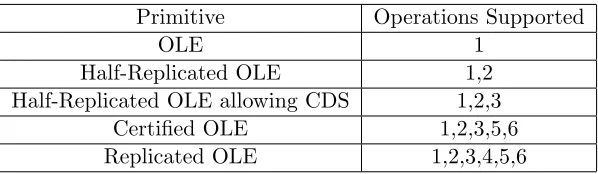
Primitive Operations Supported
OLE 1
Half-Replicated OLE 1,2 Half-Replicated OLE allowing CDS 1,2,3
Certified OLE 1,2,3,5,6 Replicated OLE 1,2,3,4,5,6
Table 1: Primitives and Their Supporting Operations
from wand y, i.e., in case the sender deviates the protocol, even conditioned on the sender’s view and x, the receiver’s output is statistically close to uniform distribution. Therefore it is not too hard embed a mechanism to detect any malicious sender with overwhelming probability. We leave the detail to Section 5.2.
Roadmap Starting from reusable OLE, we define and construct a sequence of increasingly more
powerful primitives, the last of which eventually supports all of the following operations.
1. Reveal ax+b to the receiver, where x ∈ F is an input chosen by the receiver, a ∈ F is a multiplicative coefficient chosen by the sender, b∈Fis an additive coefficient chosen by the
sender.
2. Convince the receiver that twomultiplicative coefficients are equal.
3. Disclose a message to the receiver if receiver-chosen inputsx, y, z satisfies z=xy.
4. Convince the receiver that two coefficients are equal.
5. Convince the receiver that three multiplicative coefficientsa, b, c satisfiesa+b=c.
6. Convince the receiver that three multiplicative coefficientsa, b, c satisfiesab=c.
Such a primitive readily implies reusable NIZK and reusable NISC. The intermediate primitives are sorted in Table 1by dependence. Each of them only supports a subset of the operations.
2.3 Paillier-based 2-Message OLE Protocol
Consider a simplified OLE scheme as follows: The CRS will contain an ElGamal public key (b, B0= bsk0) in a Paillier group. (Paillier allows us to get additive homomorphism, while ElGamal means
that the receiver will be able to construct related key pairs.) On inputα, the receiver forms another related public key b, B1, such that it knows the secret key corresponding to (b, B1B0α). It sends this key pair to the sender. On input z0, z1, the sender encrypts z0 under (b, B0) and z1 under (b, B1), using the same randomness, and sends both ciphertexts to the receiver. The receiver can then combine the ciphertexts to obtain an encryption of αz0+z1 under (b, B1B0α), which it can decrypt.
Recall that in a Paillier group for N = (2p+ 1)(2q+ 1) all elements can be decomposed into a component in a subgroup of order 2p0q0, and a component of orderN, call themG2p0q0 andGN;
from one wherebis only inG2p0q0, butB0 has a component inGN. Then suppose that the receiver
chooses B1 whoseGN component is (1 +N)α (and note that a simulator can recover this α using
the factorization ofN). TheGN components of the resulting ciphertexts can be shown information
theoretically to depend only on z0α+z1, while theG2p0q0 components are independent of z0, z1.3
Security against a corrupt sender is more challenging, because it could send invalid ciphertexts (i.e., ciphertexts in which decryption produces an element not inGN). In particular, an adversarial
sender could form a pair of ciphertexts that decrypt correctly under a specific α and incorrectly otherwise, and thus perform a selective failure attack. To prevent this, we need a way for the receiver to identify bad ciphertext pairs that can’t be predicted based onα. Suppose the receiver runs the scheme twice, once with a random input γ, and once with input 2α−γ, while the sender uses inputs z0, w for random w in the first instance and z0, z1 −w in the second; combining the results of the two schemes would allow the receiver to decryptz0γ+w+z0(α−γ)+z1−w=z0α+z1. This would prevent the selective failure attack: we argue that (under appropriate, indistinguishable CRS)B1information theoretically hidesγ, so the probability that the resulting linear combination of two invalid ciphertexts decrypts correctly is negligible.4 Of course, we must ensure that the malicious sender uses the same z0 in both instances; thus we require that all the ciphertexts are related, using the same randomness.
3
Preliminaries
We consider sender-receiver functions that take inputs from a sender Sam and a receiver Rachel and deliver the output to Rachel. Two simple but useful examples for such functions are OT and OLE. In this work, we consider the reusable extension of such sender-receiver functions, allowing Sam to invoke the function on polynomially many inputs, where Rachel’s input is fixed. In each such invocation, Rachel obtains a separate output. We will sometimes use an r-prefix (as in rOT, rOLE, or rNISC) to stress that we consider the reusable variant.
3.1 Sender-receiver Functions & Reusable Two-party Computation
In this section we give a generic definition of reusable non-interactive secure computation (rNISC). Our complete rNISC construction for arbitrary functions is quite complex. To make it as modular as possible, we define intermediate functionalities, namely rNISC for arithmetic circuits (see SectionA) and linear functions (see Section 3.2).
Notation 4(Sender-receiver functions). Asender-receiver functionis specified by three setsRin, Sin, Rout and a mapping f : Rin×Sin → Rout. The intuition is that we have two parties: a receiver
Rachel and a sender Sam. Rachel chooses an input x ∈ Rin, Sam chooses an input y ∈ Sin, and
Rachel learns the corresponding output z:=f(x, y)∈Rout.
We emphasize that it is not enforced that the receiver’s inputxis fixed before the sender chooses an inputyfor a corresponding send phase. Neither do we forbid that the receiver provides an input (sid0, x) after having learned an output (sid, z, i), as long as sid6=sid0. Our main application just
3This is because the first component of the ciphertext,brcontains no information aboutr modN. 4
There is a minor subtlety here, where because G2p0q0 has an order 2 subgroup an extra component in this
Functionality FrNISC(F)
Parametrized by a sender-receiver functionF = (Rin, Sin, Rout, f) in the sense of Notation4.
Choice phase:
• Upon receiving input (sid, x) from Rachel wherex∈Rin andsidis a session identifier, store (sid, x),
send (sid,initialized) to the adversary, and ignore any further inputs (sid,˜x) from Rachel with the same session identifiersid.
Send phases:
• Upon receiving input (sid, y, i) from Sam where (y, i)∈Sin×Nandsidis a session identifier, record
(sid, y, i), send (sid,sent, i) to the adversary, and ignore any further inputs (sid,y, i˜ ) from Sam with the same session identifiersidand the same value ofi.
• Upon receiving a message (sid,Delivery, i) from the adversary, verify that there are stored inputs (sid, x) from Rachel and (sid, y, i) from Sam; else ignore that message. Next, computez:=f(x, y), send (sid, z, i) to Rachel, and ignore further messages (sid,Delivery, i) from the adversary with the same session identifiersid and the same value ofi.
Figure 1: Generic ideal functionality for reusable non-interactive secure computation.
provides a setting where all receiver inputs are chosen before the sender takes any action, but this is not required for the security proofs of our protocols.
The ideal functionality for reusable NISC tailored to arithmetic circuit evaluation is in Ap-pendix A.
3.2 Reusable Oblivious Linear Function Evaluation
We aim at an OLE-based implementation ofFrNISC(Φ) for arbitrary arithmetic circuits Φ over a given ringR, where the ring size|R|is determined by a statistical security parameter. More particularly, the security parameter is log|R|. However, we will need to restrict ourself to circuits Φ that are given as collections of formulas (i.e., the underlying graphG is a forest).
The primitive we take for granted lets Rachel pick an inputx∈ Rand then Sam send her tuples (a, b)∈ R×R, such that she learns the corresponding OLE-outputsa·x+b. In particular, Sam can send several tuples (a, b) for the same receiver inputx. In other words, the ideal functionality for oblivious linear function evaluation with reusable receiver input (see Figure 18) is another special instance of the functionalityFrNISC(F) from Figure1, namely with Sin=R×R,Rin=Rout =R, and f :Rin×Sin→Rout,(x,(a, b))7→a·x+b.
4
Separations and Impossibility Results
FunctionalityFrOLE(R)
Parametrized by a finite ringR.
Setup/choice phase:
• Upon receiving input (sid, x) from Rachel wherex∈ R andsidis a session identifier, store (sid, x), send (sid,initialized) to the adversary and ignore any further inputs from Rachel with the same session identifiersid.
Send phases:
• Upon receiving input (sid, a, b, i) from Sam where (a, b, i)∈ R×R×Nandsid is a session identifier, store (sid, a, b, i), send (sid,sent, i) to the adversary, and ignore any further inputs from Sam with the same session identifiersidand the same value ofi.
• Upon receiving a message (sid,Delivery, i) from the adversary where i ∈ N and sid is a session identifier, verify that there are stored inputs (sid, x) from Rachel and (sid, a, b, i) from Sam; else ignore that message. Next, compute z := a·x+b, send (sid, z, i) to Rachel, and ignore further messages (sid,Delivery, i) from the adversary with the same session identifier sid and the same value ofi.
Figure 2: Ideal functionality for reusable oblivious linear function evaluation over a ringR.
this is not true, because a corrupted sender could still cause some relations between the receiver’s outputs that reveal secret information (see Section4.1).
We further show that OLE is strictly stronger than OT in the sense that there exists no rNISC/OT protocol for the OLE functionality with composable security (see Section 4.2). Fi-nally, assuming that one-way functions exist, we show that in the OT hybrid model there are no general resettably sound zero-knowledge proofs with black-box simulatability of malicious verifiers (see Section4.3). In contrast, our certified OLE construction (see Section5.4) immediately implies such zero-knowledge proofs in the (reusable) OLE hybrid model.
4.1 Standard Security (even if Perfect) does not Imply Reusability
We show now that reusing the receiver’s messages in a general solution for secure computation can cause severe security problems. More particularly, we show that any protocol for general secure computation can be turned into a protocol with the following property: If the receiver uses fresh randomness in each protocol run, than the transformed scheme is still secure, but if the receiver uses the same input and randomness in two protocol runs with a malicious sender, then his complete input can be efficiently reconstructed from his corresponding outputs. The transformed scheme achieves the same level of security (computational, statistical, or perfect) as the original scheme, as long as the receiver uses fresh randomness in every protocol run.
Protocol Π(COMF)
Parametrized by a finite fieldF, which is also the base field of the underlying rOLE-primitive. The security parameter is`:= log|F|.
Setup phase:
• Receiver: Pickx∈Funiformly at random and input it into the underlying rOLE-primitive.
Commit phases:
1. Sender: Letsi ∈F be the sender’si-th input. Pickri ∈F uniformly at random and input (si, ri) into the underlying rOLE-primitive.
2. Receiver: Record the corresponding rOLE-outputyi=si·x+ri.
Unveil phases:
1. Sender: To unveil thei-th commitment, send (si, ri) to the receiver.
2. Receiver: Ifyi=si·x+ri, outputsi; otherwise reject (i.e., output a special symbol⊥).
Figure 3: Protocol for statistically secure commitments in the reusable OLE (rOLE) hybrid model.
uses one of these special input symbols. The resulting protocol takes input (x, r)∈ {0,1}∗×{0,1}∗
with|x|=|r|from the receiver andy∈ {0,1}∗∪ {>,⊥}from the sender, and the receiver’s output
z is defined as:
z=
f(x, y) ify ∈ {0,1}∗
r ify =>
x⊕r ify =⊥
For secure evaluation off(x, y), the receiver just needs to input (x, r) with some uniformly random
r of appropriate length, and the sender is supposed to input y. Obviously, the modified protocol is as secure as the original scheme as long as the receiver uses fresh randomness for each protocol run. If, however, the receiver uses the same (x, r) in at least two protocol runs, then a malicious sender can make him outputr and x⊕r, which together reveals the receiver’s secret input x.
4.2 Impossibility of Composable rNISC/OT for the OLE Functionality
We show that reusable OLE cannot be implemented from reusable OT, if the sender can learn certain predicates about the receiver’s OLE-output. The intuition behind our impossibility proof relies on the commitment protocol of Figure 3. We want this construction to be secure even if a corrupted sender learns whether an unveil was accepted by the receiver or not. This can be formulated as the following game. The receiver first fixes his rOLE-input x ∈ F uniformly at random. The sender then picks tuples (si, ri),(˜si,r˜i)∈F×Fand learns whethersi·x+ri= ˜si·x+ ˜ri.
The intuition is here that (si, ri) stands for the sender’s rOLE-input in a commit phase and (˜si,r˜i)
based on polynomially many (reusable) OT-instances. For a concise presentation we denote the
i-th element of a stringsby s[i] and a corresponding substring indexed by I ass[I]. A malicious sender can recoverx by the following attack.
1. Initialize Q0, R0 := ∅ and j := 1. The intuition is that Qj will contain indices where the
receiver’s choice bits are 0 andRj will contain indices where the receiver’s choice bits are 1.
2. Sample an rOLE-input (sj, rj) ∈ F×F uniformly at random. According to the presumed
rOLE-protocol, generate corresponding OT-input strings aj, bj in the sense that aj[i], bj[i]
is the input for the i-th OT-instance. Sample (˜sj,r˜j,˜aj,˜bj) with the same distribution but
subject to the condition that ˜aj[Qj−1] =aj[Qj−1] and ˜bj[Rj−1] =bj[Rj−1].
3. Test whethersj·x+rj = ˜sj·x+ ˜rj, i.e., the receiver accepts (sj, rj) as well as (˜sj,r˜j) as an
unveil message for a commitment where the sender’s OT-input strings are aj, bj. If so and
moreoversj 6= ˜sj, recoverx=−srjj−−rs˜˜jj and thus finish the attack.
4. Repeat the following two sub-steps until there are no more changes ofaj and bj.
(a) If there exists an index i /∈ Qj−1 such that aj[i] 6= ˜aj[i] and the receiver still accepts
(sj, rj) as an unveil message for a commitment where the sender’s OT-input strings are aj, bj with aj[i] replaced by ˜aj[i], change the value of aj[i] to the value of ˜aj[i].
(b) If there exists an index i /∈ Rj−1 such that bj[i] 6= ˜bj[i] and the receiver still accepts
(sj, rj) as an unveil message for a commitment where the sender’s OT-input strings are aj, bj with bj[i] replaced by ˜bj[i], change the value ofbj[i] to the value of ˜bj[i].
5. SetQj :=Qj−1∪
iaj[i]6= ˜aj[i] and Rj :=Rj−1∪
ibj[i]=˜6 bj[i] , increase j by 1, and go
to step 2.
We just have to show now that the attack finishes (on average) after polynomially many iterations over j. For every possible tuple (sj, rj, aj, bj) let Vaj,bj(sj, rj) =>denote that the verifier would
accept (sj, rj) as an unveil message for a commitment where the sender’s OT-input strings areaj, bj
and let Vaj,bj(sj, rj) = ⊥ denote that the verifier would reject. Our estimation of the expected
number of iterations overj is based on the following two observations.
• Due to the completeness of the commitment scheme (i.e., correctness of the underlying rOLE-protocol) it happens in each iteration overjonly with small probability thatVaj,bj(sj, rj) =⊥.
Thus we can condition the whole attack to the event that always Vaj,bj(sj, rj) =>, as this
changes the expected number of iterations overj only by a small factor.
• In each iteration over j we have only a small probability ρj := Pr[sj = ˜sj]. The reason
for this is that −log2(ρj) is an upper bound for the collision entropy of sj conditioned on
the receiver’s view in the corresponding commit phase of Π(COMF) . If ρj was not small, the
commitment would not be hiding (or in other words, the underlying rOLE-protocol had no sender privacy). Thus we can condition the whole attack to the event that alwayssj 6= ˜sj, as
this changes the expected number of iterations overj only by a small factor.
We are now ready to estimate the probability that the j-th iteration of the attack yields nothing, meaning that the attack is not finished in this iteration and afterwards it still holds thatQj =Qj−1 and Rj =Rj−1. Note that Vaj,bj(sj, rj) = > and sj 6= ˜sj by assumption. Hence, the event that
the attack is not finished means thatVaj,bj(˜sj,r˜j) =⊥. The event thatQj =Qj−1 and Rj =Rj−1
means that V˜a
j,˜bj(sj, rj) =>. However, (sj, rj, aj, bj) and (˜sj,r˜j,˜aj,
˜bj) are identically distributed
by construction. Hence, PrVaj,bj(˜sj,r˜j) =⊥ ∧ Va˜j,˜bj(sj, rj) =>
Putting things together, it finally follows that the expected number of iterations overj is upper bounded polynomially in the number of OT-instances used in the presumed rOLE-protocol.
4.3 Impossibility of rNISC/OT for General Black-Box Zero-Knowledge
The impossibility result presented in this section consists of two parts. We first show that certain probabilistically checkable proofs (PCPs) do not exist. Then we derive from this the aimed at impossibility result for the OT hybrid model. We give only a very weak definition for zero-knowledge PCPs in this section, because this yields the strongest possible impossibility result we can come up with. In particular, we require soundness, completeness, and the zero-knowledge property only to hold with respect to PPT-adversaries (i.e., adversaries that have probabilistic polynomial time complexity).
Notation 5. Given any domainDand any subsetS⊆D, we setSC:=D\S. Byx←Dwe denote thatx is sampled uniformly at random from the domainD. Given some probabilistic algorithm A, we denote byx←A(y) thatx is generated by runningAon inputy with fresh internal randomness; the distribution of x in this case is denoted {A(y)}. Given any bit-string s, we denote its i-th bit as s[i]and its substring indexed by some index set I as s[I].
Definition 6(Problems that are hard on average). The membership problem of any given language
L ⊆ {0,1}n is hard on average, if∅ 6=L 6={0,1}n and for every PPT-distinguisher D it holds:
Pr
D(x) =acceptx← L
≤ Pr
D(x) =acceptx← LC
+n−ω(1)
Or in other words, the uniform distributions over Land LC are computationally indistinguishable.
Definition 7 (Zero-knowledge PCPs). A zero-knowledge PCP (ZKPCP) scheme for an NP
-language L ⊆ {0,1}n consists of a prover P and a verifier V, both PPT-algorithms. Given any
word x ∈ L and a corresponding witness w, the prover generates a proof π ∈ {0,1}m, which we
denote π ←P(x, w). The proof length m is a parameter of the scheme. The verifier takes as input anyx∈ {0,1}nandπ ∈ {0,1}m and either accepts or rejects, which we denote asV(x, π) =accept
or V(x, π) =reject respectively. The following conditions must hold.
Completeness: For every PPT-computable tuple (x, w) where x ∈ L and w is a corresponding witness, we have that Pr
V(x, π) =acceptπ ←P(x, w)
≥1−n−ω(1). Soundness: For all PPT-computable(x, π)∈ LC×{0,1}m we have Pr
V(x, π) =accept≤n−ω(1). PCP property: The verifier V reads only some part of π: Once x andV’s internal randomness are fixed, we have a sequence of queries q1, . . . , qt∈ {1, . . . , n}such that each qi deterministically
depends on (x, π[q1, . . . , qi−1]) and it holds thatV(x, π) =V(x, π0) for allπ, π0 ∈ {0,1}m with π[q1, . . . , qt] =π0[q1, . . . , qt]. The number t of queries is a parameter of the PCP scheme.
If the query setQ:={q1, . . . , qt}is independent ofπ, we say that the scheme is nonadaptive.
If Q is independent ofx, we say that the scheme is input-oblivious.
Zero-knowledge property: For every corrupted PPT-algorithm V∗ there exists a PPT-simulator S
such that for every PPT-computable tuple (x, w) where x ∈ L and w is a corresponding witness, the distributions specified by S(x) and V∗(x,P(x, w)) are computationally indistin-guishable.
are answered by S with proof bits π˜[qi] computed from (x, q1, . . . , qi−1), then we say that the
scheme has black-box simulatability.
If it is assumed that a corrupted verifier V∗ still respects the aforementioned query bound t
(i.e., V∗ reads at most tbits of π :=P(x, w)), we speak of bounded-query zero-knowledge.
Definition 8(Resettable soundness). A ZK-PCP scheme is resettably sound, if no PPT-adversary
P∗ with oracle access to the verifier functionality V (with randomly fixed internal randomness) can compute with non-negligible success probability some xˆ∈ LC and πˆ ∈ {0,1}m such that V(ˆx,πˆ) = accept.
Theorem 9. Let L ⊆ {0,1}n be an NP -language such that one can PPT-sample from L as well
as from LC with computationally close to uniform distribution. Moreover, let the sampling in the
former case be constructive in the sense that it also provides a witness. If the membership problem of L is hard on average, thenL has no resettably sound input-oblivious nonadaptive bounded-query ZK-PCP scheme with black-box simulatability.
Proof. Assume that L is hard on average and has an input-oblivious nonadaptive bounded-query ZK-PCP scheme with black-box simulatability. We show that this scheme cannot be resettably sound. Before we can present an attack, we have to construct a basic building block for it. Let S∗ denote the following functionality, which takes as input anyx∈ LandQ⊆ {1, . . . , m}with|Q| ≤t
and outputs some π∈ {0,1}m.
1. Construct the black-box simulatorSfor a corrupted verifier that queries the proof bits indexed by Qand then just outputs π[Q].
2. Sampleπ[Q]←S(x), fillπ[QC] with uniform randomness, and outputπ.
We argue that due to the hardness of L the algorithm S∗ must still have polynomial runtime for inputx← LC and the distributions
S∗(x, Q) x←L and
S∗(x, Q) x←LC must be computationally
indistinguishable for any PPT-computableQ⊆ {1, . . . , m}of size at mostt. We further argue that
S∗(x, Q)[Q∩Q0] x←L andS∗(x, Q0)[Q∩Q0] x←L must be computationally indistinguishable for any PPT-computableQ, Q0 ⊆ {1, . . . , m} of size at mostt, as they are both indistinguishable from
P(x, w)[Q∩Q0] x←L wherew is an arbitrary witness forx∈ L.
We are now ready to present our efficient (in the sense of PPT) attack, by which a malicious prover P∗ can break resettable soundness. It works as follows.
1. Initialize Q0:=∅ andj := 1.
2. Sample ˆxj ← LC and ˆπj ←S∗(ˆxj, Qj). IfV(ˆxj,πˆj) =accept, output (ˆxj,πˆj) and terminate.
3. Sample xj ← L together with a corresponding witness wj and sample πj ← P(xj, wj) and
˜
πj ← {0,1}m. IfV(xj, πj) =reject, give up.
4. As long as there exists some index i /∈Qj−1 such that πj[i]6= ˜πj[i] andV(xj,·) still accepts πj with thei-th bit flipped, flip πj[i]. Then set Qj :=Qj−1∪
i∈ {1, . . . , m}πj[i]6= ˜πj[i] ,
increase j by 1, and go to step 2.
Due to the the completeness property, we have for each iteration overj thatP∗ gives up in Step 3 only with negligible probability. Therefore it suffices to show that the attack needs only polynomi-ally many iterations over j before it terminates. Consider the following sequence of experiments.
Experiment 1: This is the attack as stated above.
Experiment 2: The same as Experiment 1, except that the sampling of ˆxj in Step 2 is replaced
by ˆxj ← L. It follows by the hardness of L that this changes the runtime complexity of
FunctionalityFZK
Implicitly parametrized by anNP-languageL ⊆ {0,1}n, where nis a security parameter. 1. Await an input (x, w) from the sender. Store (x, w) and send (sent) to the adversary.
2. Await a message (verify) from the adversary. Then, if w is a witness forx∈ L, send (x,accept) to the verifier; else send (x,reject).
Figure 4: Ideal functionality for zero-knowledge proofs.
Experiment 3: The same as Experiment 2, except that the sampling ofπj in Step 3 is replaced
byπj ←S∗(xj, Q), whereQdenotes the actual set ofV’s queries. Note thatQis well-defined,
because the assumed ZK-PCP scheme is input-oblivious and nonadaptive. SinceVreads only bits indexed byQand the new distribution of these bits is computationally indistinguishable from their original distribution, this changes the runtime complexity of the attack only up to some negligible statistical distance, at least if either Experiment 2 or Experiment 3 has polynomial runtime complexity.
We show now that Experiment 3 actually has polynomial runtime complexity, which concludes the proof. In Experiment 3 we have the following situation:
ˆ
xj ← L πˆj ←S∗(ˆxj, Qj)
xj ← L πj ←S∗(xj, Q)
Recall that ˆπj[Qj] andπj[Qj] are computationally indistinguishable by the properties ofS∗.
More-over, ˆπj[QCj] is uniformly random by construction ofS∗and in Step 4 of our attack we replace the bits
ofπj[QCj] successively with uniform randomness. Let ¯πj denote the bit-string that equalsπj on all
entries indexed byQj and equals ˜πj on all other entries, i.e., ¯πj[Qj] =πj[Qj] and ¯πj[QCj] = ˜πj[QCj].
Hence, the event that thej-th iteration of the attack yields nothing (meaning, V(ˆxj,πˆj) =reject
and Qj = Qj−1) implies that V(ˆxj,πˆj) = reject and V(xj,π¯j) = accept. Since (ˆxj,πˆj) and
(xj,¯πj) are computationally indistinguishable, this may happen at most with probability 12 +o(1).
It follows that Experiment 3 terminates with overwhelming probability after polynomially many iterations.
Corollary 10. If one-way functions exist, then there are instantiations of the functionality FZK (see Figure4) that have no rNISC/OT protocol with black-box simulation of a corrupted receiver.
Proof. Since one-way functions imply pseudorandom number generators (PRGs), we can define
L as the set of all length-n pseudorandom strings that can be generated from length-bn2c seeds (with respect to some given family of PRGs). One can close to uniformly sample from LC just by sampling uniformly from {0,1}n and the average hardness of L’s membership problem is just
5
Reusable NISC via Parallel Reusable OLE
In this section, we describe our main constructions, namely protocols for reusable (designated verifier) NIZK and NISC for branching programs, both information-theoretically secure in the reusable OLE hybrid model.We also show how to obtain a reusable secure computation protocol for arbitrary functions in the reusable OLE hybrid model, in addition making black-box use of a pseudorandom generator.
Our construction proceeds bottom-up, starting from reusable OLE and building stronger and stronger primitives, leading up to reusable non-interactive zero-knowledge first (in Theorem 5.6) and reusable secure computation right after (in Theorems5.8and 5.9). A general theme that runs through our constructions is that each functionality builds on the previous one by restricting the “cheating space” of either the sender or the receiver; in doing so, it introduces some room for cheating by the other party. The next one reverses the role, and so forth. We converge in a small number of such steps and first construct our reusable NIZK protocol. Secure computation follows suit with some more work.
We first proceed to describe our functionalities, and realizing them shortly after.
5.1 Our Ideal Functionalities
We describe, in a high level, the sequence of our functionalities. The full functionality is somewhat complex and is described in Figure 15.
Half-replicated OLEF1
2repOLE. The reusable OLE functionality allows the receiver to commit to a numberx∈Fand allow a sender to transmit valuesaix+bi to the receiver for arbitraryai, bi ∈F.
By the definition of the functionality, the sender is assured that the receiver uses the samex in all these iterations (just because he used the same receiver message to compute his response); however, there are no restrictions on the sender side.
Our final stop is zero-knowledge where the sender has to prove some relation among a set of number he chooses. There are two major gaps in getting there: (1) forcing consistency on the sender as opposed to the receiver; and (2) allowing for complex predicates on the sender input, instead of just replication constraints (which say that certain subsets of the sender’s numbers are the same).
Our first functionality, F1
2repOLE, takes one step in this direction. Namely, it allows the receiver to commit to a set of numbers{xi}and also the sender to commit to a set{aj}. In each invocation
subsequently, the sender can “point to” two of these numbers (i, j) and produce a new number
b∈Fand transmit to the receiver aixj+b. “Half replicated” because there are constraints on the
sender’s choice of “a” but no constraints on the “b”.
Half-replicated OLE with CDS F1
2repOLE,CDS. It is intuitively clear that it is easier to check the consistency of the receiver’s input than the sender’s. Roughly speaking, the receiver sends her input along without even having to see anything from the sender; however, the sender necessarily has to see the receiver’s commitment to compute his response.
Our next functionality ups the ante by additionally allowing the sender to disclose a secret
s∈Fto the receiver if and only if the receiver’s input{xj}satisfies a condition (thus, conditional
consistency condition is more than mere replication, but it is the receiver’s input whose consistency is being checked.
Half-replicated OLE with CDS and ProofF1
2repOLE,CDS,proof. Our next functionality flips this around and shows what is necessary for zero-knowledge. Namely, it gives a way for the sender to prove that his chosen input satisfies a given predicate encoded as an arithmetic branching program. Realizing this functionality already proves Theorem 5.6. Throughout this process, we keep track of the number of (reusable) OLE calls made and show that at the end, the overhead is an absolute constant for every gate of the verification circuit. This is the type of guarantee you get for NISC/OT except we additionally achieve reusability.
Replicated OLE (+CDS+Proof ) FrepOLE,CDS,proof. Our final step closes the loop and
con-structs a fully replicated OLE where the receiver can commit to {ai} and at any time, point to
(i, i0, j) and transmit to the receiver aixj +ai0 ∈ F. This closes the last bit cheating space the
sender has, and combined with randomized encodings for arithmetic branching programs, allows us to achieve reusable NISC/OLE for arithmetic NC1. Additionally, using garbled circuits, we can also obtain such a protocol for all ofP at the cost of a computational assumption, namely making black-box use of a PRG.
A final remark is in order. Our implementation of reusable OLE in the next section will work over Z∗N which is not a field. Fortunately, it is a pseudo-field, in the sense that either (a) any
protocol will work just as well over Z∗N as over a field; or (b) the protocol will stumble upon the
factorization of N. Since (b) is computationally hard, we obtain protocols that work well over the ring.
FunctionalityF1 2repOLE
Choice phase: Upon receiving input (sid, x) from the receiver where x∈ F and sid ∈N is a session
identifier, store (sid, x), send (sid,input-init) to the adversary and ignore any further input from the receiver with the samesid.
Send phase (choose coefficients): Upon receiving input (cid, a) from the sender wherea∈Fand
cid ∈ N is a coefficient identifier, store (cid, a), send (cid,coeff-init) to the adversary and ignore any further input from Sam with the samecid.
Send phase (half replicated OLE):
• Upon receiving input (1
2repOLE,sid,cid, b, i) from Sam, record ( 1
2repOLE,sid,cid, b, i), send
(1
2repOLE,sid,cid,send, i) to the adversary, and ignore any further inputs from Sam with the same
(sid,cid, i).
• Upon receiving a message (1
2repOLE,sid,cid,Delivery, i) from the adversary, verify that there are
stored inputs (1
2repOLE,sid,cid, b, i),(cid, a) from Sam and (sid, x) from Rachel; else ignore that
message. Next, compute z = ax+b, send (1
2repOLE,sid,cid, z, i) to Rachel, and ignore further
messages (1
5.2 Constructing Half-Replicated OLE from Reusable OLE
FunctionalityF1 2repOLE
Choice phase: Upon receiving input (sid, x) from the receiver where x∈ F and sid ∈N is a session
identifier, store (sid, x), send (sid,input-init) to the adversary and ignore any further input from the receiver with the samesid.
Send phase (choose coefficients): Upon receiving input (cid, a) from the sender wherea∈Fand
cid ∈ N is a coefficient identifier, store (cid, a), send (cid,coeff-init) to the adversary and ignore any further input from Sam with the samecid.
Send phase (half replicated OLE):
• Upon receiving input (1
2repOLE,sid,cid, b, i) from Sam, record (12repOLE,sid,cid, b, i), send
(1
2repOLE,sid,cid,send, i) to the adversary, and ignore any further inputs from Sam with the same
(sid,cid, i).
• Upon receiving a message (1
2repOLE,sid,cid,Delivery, i) from the adversary, verify that there are
stored inputs (1
2repOLE,sid,cid, b, i),(cid, a) from Sam and (sid, x) from Rachel; else ignore that
message. Next, compute z = ax+b, send (1
2repOLE,sid,cid, z, i) to Rachel, and ignore further
messages (1
2repOLE,sid,cid,Delivery, i) from the adversary with the same (sid,cid, i). Figure 6: ideal functionality of half-replicated OLE
We start with the definition of the half-replicated OLE functionality F1
2repOLE in Figure 6. In reusable OLE, the receiver commits to values xi ∈ F, and the sender can transfer to the receiver
a tuple (i, ajxi+bj) for any aj, bj ∈ F of his choice. In other words, all the transmissions of the
sender with the sameiare guaranteed to be consistent with a singlexi, but the sender’s coefficients aj andbj are completely unconstrained.
Roughly speaking, half-replicated OLE allows the receiver to commit to values xi ∈F(just as
in reusable OLE) but in addition, also has a mechanism for the sender to commit to valuesaj ∈F.
The sender can later transfer to the receiver a tuple (i, j, ajxi+b) for an arbitrary choice ofb∈F,
simply by “pointing to” an appropriate i and j. In other words, when the receiver obtains two tuples (i1, j, z1) and (i2, j, z2), he will be sure that both executions used the same multiplicative factor aj.
We construct a protocol that achieves this functionality F1
2repOLE in the FrOLE-hybrid model. Our construction proceeds in two steps.
A First Try: The ProtocolΠα-1
2repOLE. Protocol Πα -1
2repOLE(Figure7) is a protocol attempting to implement half replicated OLE (Figure 6). As a first trial, Πα-1
2repOLE is only secure against malicious receiver. Note that reusable OLE can also be viewed as an implementation of Π1
2repOLE that is secure against malicious receiver, and secure against semi-honest sender if we simply believe that the sender use the same multiplicative factors! What makes Πα-1
random even conditioned on sender’s view and environment’s view. In protocol Πα-1
2repOLE, the receiver inputs to the underlying reusable OLE an extra numberα that is sampled uniformly random from F. Whenever the sender want to choose a new coefficient
a, a rOLE evaluation ofaα+ris required, wherer is a fresh random number chosen by the sender. Such an evaluation serves as a commitment on the coefficient chosen by the sender.
Implementing F1
2repOLE (First Try): Protocol Πα-12repOLE
Choice phase:
The receiver, at the outset, samples α∈ Fand send the pair (sidalpha, α) to FrOLE. Then, upon receiving
input (sid, x) from the environment, it samplesh∈Fand sends (sid||0, h),(sid||1, x−αh) toFrOLE.
Send phase (choose coefficients):
Upon receiving input (cid, a) from the environment, the sender samples a uniformly random r ∈F, and sends (sidalpha, a, r,cid) toFrOLE.
Upon receiving a message (sidalpha,ˆa,cid) fromFrOLE, the receiver stores (sidalpha,ˆa,cid).
Send phase (half replicated OLE):
Upon receiving input (sid,cid, b, i) from the environment, the sender verifies that (sidalpha, a, r,cid) was sent to FrOLE. If yes, send (sid,cid, i) to the receiver, and send both (sid||0, r, w, i) and (sid||1, a, b+w, i) to
FrOLE.
Upon receiving (sid,cid, i) from the sender and receiving (sid||0, z0, i),(sid||1, z1, i) fromFrOLE, the receiver
verifies that there is a stored message (sidalpha,a,ˆ cid) from FrOLE. Next, compute z = ˆah−z0+z1 and
output (sid,cid, z, i) to the environment.
Figure 7: Protocol Πα-1
2repOLE for half-replicated OLE in the FrOLE-hybrid model, secure against malicious receiver and “half-secure” against malicious sender (see Lemma 5.1, Lemma 5.2 for the formal definition of “half-security”)
Lemma 5.1. The protocol Πα-1
2repOLE implements the functionality F12repOLE in the FrOLE-hybrid model against a malicious receiver and a semi-honest sender.
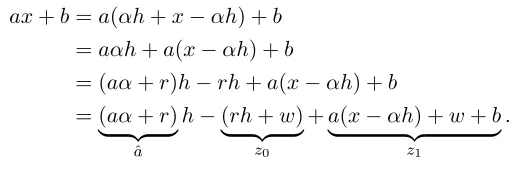
Proof. Correctness follows directly from the fact that
ax+b=a(αh+x−αh) +b
=aαh+a(x−αh) +b
= (aα+r)h−rh+a(x−αh) +b
= (aα+r)
| {z }
ˆ
a
h−(rh+w)
| {z }
z0
+a(x−αh) +w+b
| {z }
z1
.
There is a straight-line simulator for any (potentially malicious) receiver Rb:
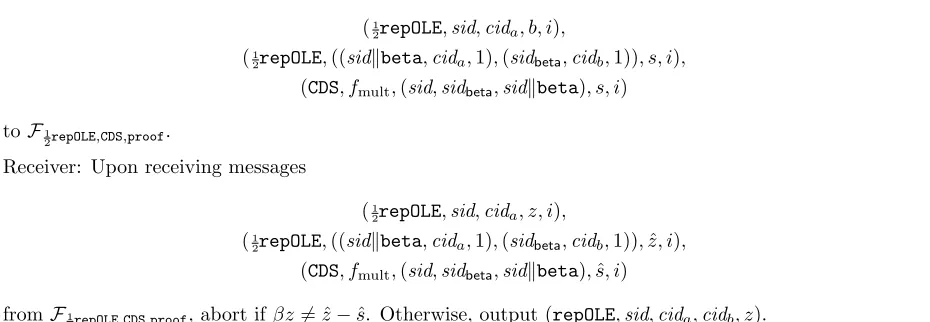
• Storeαwhen the receiver outputs (sidalpha, α). Whenever the receiver has outputted (sidk0, hsid)
and (sidk1, ysid), store hsid and send (sid, αhsid+ysid) to ideal functionality F1