Cryptanalysis of Ascon
Christoph Dobraunig1, Maria Eichlseder1, Florian Mendel1, and Martin Schl¨affer2
1
IAIK, Graz University of Technology, Austria [email protected]
2 Infineon Technologies AG, Austria
Abstract. We present a detailed security analysis of the CAESAR can-didateAscon. Amongst others, cube-like, differential and linear crypt-analysis are used to evaluate the security of Ascon. Our results are practical key-recovery attacks on round-reduced versions ofAscon-128, where the initialization is reduced to 5 out of 12 rounds. Theoretical key-recovery attacks are possible for up to 6 rounds of initialization. More-over, we present a practical forgery attack for 3 rounds of the finalization, a theoretical forgery attack for 4 rounds finalization and zero-sum distin-guishers for the full 12-roundAsconpermutation. Besides, we present the first results regarding linear cryptanalysis ofAscon, improve upon the results of the designers regarding differential cryptanalysis, and prove bounds on the minimum number of (linearly and differentially) active S-boxes for theAsconpermutation.
Keywords: Ascon, CAESAR initiative, cryptanalysis, authenticated encryption
1
Introduction
The CAESAR competition [20] is an ongoing cryptographic competition, where numerous authenticated encryption schemes are challenging each other with the goal of finding a portfolio of ciphers, suitable for different use-cases. Currently, more than 45 ciphers are still participating in the competition. In the near fu-ture, this portfolio will be further reduced to focus the attention of the crypto community on a few candidates. Therefore, analyzing the security of the can-didate ciphers is of great importance to enable the committee to judge them adequately.
Asconis a submission by Dobraunig et al. [11] to the CAESAR competition.
In the submission document, the designers discuss the design rationale for the cipher and give first cryptanalytic results, in particular on the differential prop-erties of theAsconpermutation. Since the cipher was only recently presented,
results of external cryptanalysis are scarce so far. Jovanovic et al. [15] prove the security of Ascon’s mode of operation under idealness assumptions for the
permutation.
Our contribution. We present a detailed security analysis of the CAESAR candidateAscon-128. Based on the low algebraic degree ofAscon, we are able
to construct a zero-sum distinguisher with complexity 2130for the full 12-round
Ascon permutation in Section 3. In Section 4, we use similar algebraic
prop-erties to construct a distinguisher based on cube testers. We also use cube-like techniques to obtain a key-recovery attack for a round-reduced version ofAscon
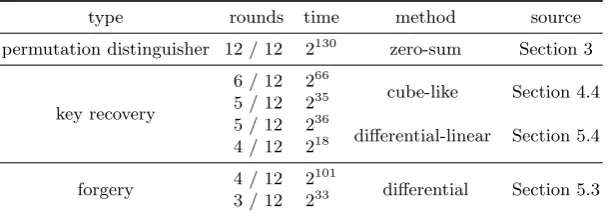
with 5-round initialization with practical complexity. Theoretical key-recovery attacks are possible for up to 6 rounds of initialization. Moreover, in Section 5, we present the first results on linear cryptanalysis, and improve the results by the designers on differential cryptanalysis. Our results include linear and differ-ential characteristics obtained with heuristic search, as well as a computer-aided proof of security bounds against linear and differential cryptanalysis (minimum number of active S-boxes). Using our results on linear-differential analysis, we present a practical forgery attack for 3 rounds of the finalization and a theoretical forgery attack for 4-round finalization. Our results are summarized in Table 1.
Table 1.Results forAscon-128. Attacks performed on the initialization or finalization.
type rounds time method source
permutation distinguisher 12 / 12 2130 zero-sum Section 3
key recovery
6 / 12 266
cube-like Section 4.4 5 / 12 235
5 / 12 236
differential-linear Section 5.4 4 / 12 218
forgery 4 / 12 2
101
differential Section 5.3 3 / 12 233
2
Ascon
Asconis a submission by Dobraunig et al. [11] to the ongoing CAESAR
com-petition. It is based on a sponge-like construction with a state size of 320 bits (consisting of five 64-bit wordsx0, . . . , x4).Asconcomes in two flavors,Ascon -128 andAscon-96, with different security levels and parameters, as summarized
in Table 2. The analysis in this paper is focused onAscon-128. In the following,
we give a brief overview about the mode of operation and the permutation of
Ascon. For a complete description, we refer to the design document [11].
Mode of operation. Ascon’s mode of operation is based on
Table 2.Parameters forAscon[11].
name bit size of rounds
key nonce tag data blockpa pb
Ascon-128 128 128 128 64 12 6
Ascon-96 96 96 96 128 12 8
variantpa is used for initialization and finalization, whilepb is used in the data processing phases.
const
KkN r
c pa
⊕
0∗kK
c
⊕
r A1
pb
⊕
As
c p
b
⊕
0∗k1
c
⊕
r
P1C1
pb c
⊕
Pt−1Ct−1
pb
⊕
PtCt
r
⊕
Kk0∗
c
pa
⊕
K k
T
Initialization Associated Data Plaintext Finalization
Fig. 1.The encryption of Ascon[11].
The initialization takes as input the secret keyKand the public nonceN. The initialization ensures that we start with a random-looking state at the beginning of the data procession phase for every new nonce. In the subsequent processing of the associated data, r-bit blocks are absorbed by xoring them to the state, separated by invocations of pb. If no associated data needs to be processed, the whole phase can be omitted. Plaintext is processed in r-bit blocks in a similar manner, with ciphertext blocks extracted from the state right after adding the plaintext. For domain separation between associated data and plaintext, a constant is xored to the secret part of the internal state. After all data is processed, the finalization starts and thek-bit tagT is returned.
Table 3.The S-box of Ascon[11].
x 0 1 2 3 4 5 6 7 8 9 10 11 12 13 14 15
S(x) 4 11 31 20 26 21 9 2 27 5 8 18 29 3 6 28
x 16 17 18 19 20 21 22 23 24 25 26 27 28 29 30 31
Permutation. Asconuses the two permutations pa and pb. Both iteratively apply the same round function p: a rounds for pa, and b rounds for pb. The round transformation p consists of a constant addition tox2, followed by the application of a nonlinear substitution layer and a linear layer.
The substitution layer uses a 5-bit S-box (Table 3), which is affine equivalent to the Keccak [2]χ mapping. TheAsconS-box is applied 64 times in parallel
on the state. Each bit of the 5 64-bit words (x0, . . . , x4) contributes one bit to each of the 64 S-boxes, wherex0 always serves as most significant bit.
The linear layer is derived from theΣ-function of SHA-2 [19]. TheΣ-function is applied to each of the 5 state-words and uses different rotation values for each word:
Σ0(x0) =x0⊕(x0≫19)⊕(x0≫28) Σ1(x1) =x1⊕(x1≫61)⊕(x1≫39) Σ2(x2) =x2⊕(x2≫ 1)⊕(x2≫ 6) Σ3(x3) =x3⊕(x3≫10)⊕(x3≫17) Σ4(x4) =x4⊕(x4≫ 7)⊕(x4≫41)
3
Zero-sum distinguishers
In this section, we apply zero-sum distinguishers used in the analysis of Kec-cak [1,6,7] toAscon. Zero-sum distinguishers have been used to show non-ideal
properties of round-reduced versions for the Keccak permutation. With the help of zero-sum distinguishers, Boura et al. have have been able to distinguish the full 24-round Keccak permutation from a random permutation. Since the core of theAsconS-box corresponds to the Keccak S-box, we are able to construct
distinguishers for the full 12 rounds (or up to 20 rounds) of theAscon
permu-tation.
Algebraic model of Ascon. As the name zero-sum distinguishers suggests, we search for a set of inputs and corresponding outputs of ann-bit permutation which sum to zero overFn2. To create this set of input-output pairs, we start in the middle of the permutation and compute outwards. Furthermore, we keep a set of 320−dbits constant and vary the otherdbits through all possible assignments. Thus, we get 2dpossible intermediate states. For all these 2dintermediate states, we calculate the respective outputs. If the degree of the function determining the output bits is strictly smaller thand, the resulting outputs will sum to zero overFn2 [1, 6]. After that, we calculate the input values of the permutation using the 2dintermediate states. Again, if the degree of the inverse function is smaller thand, the inputs sum to zero over Fn2. The result is a zero-sum distinguisher, or rather, a family of zero-sum distinguishers.
To apply the technique toAscon, we have to bound the degree of multiple
Ascon S-box is 2, with respect to F2, and can be easily determined from its algebraic normal form (ANF):
y0=x4x1+x3+x2x1+x2+x1x0+x1+x0 y1=x4+x3x2+x3x1+x3+x2x1+x2+x1+x0 y2=x4x3+x4+x2+x1+ 1
y3=x4x0+x4+x3x0+x3+x2+x1+x0 y4=x4x1+x4+x3+x1x0+x1
Here, x0, x1, x2, x3, x4, and y0, y1, y2, y3, y4 represent the input, and output of an S-box, withx0/y0representing the most significant bit. The S-boxes in one substitution layer are applied in parallel to the state, and the linear layer and constant addition do not increase the algebraic degree. Consequently, the overall degree of one Asconpermutation round is 2, and the degree ofrrounds is at
most 2r.
To determine the degree of the inverse permutation, we use the ANF of the inverseAsconS-box:
x0=y4y3y2+y4y3y1+y4y3y0+y3y2y0+y3y2+y3+y2+y1y0+y1+ 1 x1=y4y2y0+y4+y3y2+y2y0+y1+y0
x2=y4y3y1+y4y3+y4y2y1+y4y2+y3y1y0+y3y1+y2y1y0 +y2y1+y2+ 1 +x1
x3=y4y2y1+y4y2y0+y4y2+y4y1+y4+y3+y2y1+y2y0+y1 x4=y4y3y2+y4y2y1+y4y2y0+y4y2+y3y2y0+y3y2+y3
+y2y1+y2y0+y1y0
The algebraic degree of the ANF of the inverse AsconS-box is 3. Therefore,
the degree for anr-round inverseAsconpermutation is at most 3r.
Basic distinguisher for 12 rounds. To create a zero-sum distinguisher for the 12-roundAsconpermutation that is used for the cipher’s initialization and
finalization, we target the intermediate state after round 5. Thus, we attack 5 backward (inverse) rounds and 7 forward rounds. An upper bound for the degree of the 7-round permutation is 27 = 128, while for the 5 inverse rounds, an upper bound is 35= 243. So we choose d= 244, fix 320
−244 = 76 bits of the intermediate state and vary the remaining 244 bits to create a set of 2244 intermediate states. For all these states, we calculate 7 rounds forward and 5 rounds backward. The sum of all the resulting input and output values overFn2 is zero. A similar attack is possible for 11 = 4 + 7 rounds (withd= max{81,128}+ 1 = 129) and for 13 = 5 + 8 rounds (withd= max{243,256}+ 1 = 257).
Walsh spectrum and applying the techniques by Boura and Canteaut [6]: If the Walsh spectrum of a function F : Fn2 → F
n 2 is 2
`-divisible, then for any G:Fn2 →F
n
2, we have
deg(G◦F)≤n−`+ deg(G).
As Boura and Canteaut show, the Walsh spectrum of the Keccak S-box is 23 -divisible. The affine linear preprocessing and postprocessing that the Ascon
S-box adds compared to the Keccak S-box does not change this number. The same holds true for the inverse S-box. The Asconnonlinear layer applies this
S-box 64 times in parallel. The Walsh spectrum of a parallel composition is the multiplication of the individual Walsh spectra [6]. Thus, the Walsh spectrum of the complete nonlinear layer is divisible by 23·64= 2192. Letpdenote one round of theAsconpermutation, andp−1its inverse. A closer bound on the degree of
5 rounds of the inverse permutation,p−5, is then obtained by deg(p−5) = deg(p−4
◦p−1)
≤320−192 + deg(p−4)
≤320−192 + 81 = 209. Thus, d = max{209,128}+ 1 = 210 is sufficient for 12 = 5 + 7 rounds of the
Asconpermutation.
Adding a free round in the middle. Additionally, as Boura and Canteaut [6] observe, an additional round can be added to the attack (almost) for free as follows: The original attack requires an intermediate state wheren−dbits are fixed to a constant, while d bits loop through all possible valuations. Now, we set d to be a multiple of the 5-bit S-box size and furthermore, choose the d variable bits such that they always include complete S-boxes. Then, the inputs (and consequently outputs) of some boxes are constant, while the other S-boxes have their inputs (and consequently outputs) loop through all possible values. If we look at the output of the nonlinear layer after this intermediate step, we observe it adheres to the same pattern as the input: n−d bits are fixed anddbits enumerate through all their possible values. We can now use the original intermediate step as the starting point for the backwards rounds, and the output of the nonlinear layer as the starting point for the forward rounds (plus an additional, free linear layer). This way, we can extend the previous attacks by one round each, with the only additional cost of choosing das a multiple of 5. We get zero-sum distinguishers on 12, 13, and 14 rounds withd= 130, 210, and 260, respectively.
More rounds. Finally, the results of Boura et al. [7, Theorem 2] are also directly applicable to our previous results to distinguish up to 20 permutation rounds withd= 319 (using 9 backward rounds with degree≤318 and 11 forward rounds with degree≤317, no free middle round possible).
that the permutation is not ideal and are aware of such distinguishers. The non-ideal properties of the permutation do not seem to affect the security ofAscon.
In particular, the complexity of 2130is above the cipher’s claimed security level.
4
Cube attacks
Recently, Dinur et al. [9] published various cube and cube-like attacks on sev-eral keyed primitives using the Keccak permutation. Those cube-like attacks include cube testers, which can serve as distinguishers, and also cube-like at-tacks to recover the secret key. In this section, we apply two atat-tacks presented by Dinur et al. [9] toAscon.
4.1 Brief description of cube attacks
The cube attack is an algebraic attack developed by Dinur and Shamir [10]. This algebraic attack builds on the fact that for most ciphers, each output bit can be represented as a polynomial over Fn2 in algebraic normal form (ANF). The variables xi of this polynomial may be single bits of plaintext, key-bits, or constants. Dinur and Shamir made the following observation: If a carefully chosen set of plaintext bits is varied over all possible values and the other bits are kept constant, the sum of one bit of the output (cube sum) might be the result of a linear polynomial (called superpoly) consisting solely of bits of the secret key. By gathering many of these linear polynomials, the secret key can be found.
To perform such a cube attack on a cipher, two things have to be done. First, an attacker has to find such cubes (variables to vary and the resulting linear key relations). This is done in an offline preprocessing phase. Here, the attacker determines the cubes by selecting the cube variables randomly and check if the resulting superpoly is linear and contains the key. This preprocessing phase has to be carried out once for each cipher. In an online phase, the attacker uses the knowledge of the cubes to recover the secret key of his target. To perform the attack, the attacker has to be able to choose the plaintext according to his needs and obtain the corresponding ciphertext outputs.
4.2 Cube attack on Ascon
Now we want to investigate the potential threat of cube attacks to Ascon.
If we look at the different phases of Ascon, the only phase where a
nonce-respecting adversary can easily keep some inputs of the permutation constant and deterministically influence others is the initialization. In this scenario, the key is kept secret and the attacker has the ability to choose the nonce according to his needs.
As evaluated in Section 3, the degree of a 5-round initialization of Asconis
have to look for cubes with at most 63 variables, for 7 rounds with at most 127 variables and so on. So it is likely that a practical cube attack on 6 rounds is already hard to achieve. However, we have not searched for cubes, but instead performed cube-like attacks on Asconto recover the secret key in Section 4.4.
4.3 Distinguishers using cube testers
Below, we describe a cube tester for 6 rounds of the Asconpermutation with
the property that the generated output bits sum to zero overF2. Moreover, this cube tester has a practical complexity of only 233, although the expected degree for 6 rounds of theAsconpermutation is about 64. To achieve this, we have to
take a closer look at the internal structure of Ascon.
The permutation of Asconstarts with the substitution layer. In this layer,
the 5-bit S-box is applied 64 times in parallel to the internal state of Ascon.
Each of the five 64-bit words of the internal state contributes exactly one bit to each instantiation of a 5-bit S-box. So if all cube variables lie within the same word of the state, they do not appear together in one term after the application of the S-box layer. Hence, after 5 more rounds, at most 32 variables of one state-word appear together in one term. As a consequence, selecting a cube of 33 variables of the same state-word definitely results in an empty superpoly and all 233generated outputs sum to zero.
This distinguisher can be used to distinguish the key-stream generated by As-con-128 in a nonce-misuse scenario, where the attacker can keep the nonce
con-stant while varying the plaintext. ForAscon-128, 64-bit blocks of plaintext are
xored with the state-word x0. Thus, the attacker can vary 33 bits of the first plaintext block, while keeping the remaining 31 bits and the bits of a second plaintext block constant. The resulting 233 second ciphertext blocks will sum to zero. However, the designers of Ascon strictly forbid nonce reuse, and no
security claims are made for such a scenario.
Similar cube testers can be applied to reduced versions of Asconwith only
6 rounds (instead of 12 rounds) of initialization. Then, an attacker with con-trol over the nonce can observe the first key-stream block. In contrast to the nonce-misuse scenario, attacks on round-reduced versions of Asconin a
nonce-respecting scenario give insight in the expected security ofAsconand are
there-fore of more value. Next, we will show how to extend the observations made in this section to a key-recovery attack on round-reduced versions of Ascon.
4.4 Key recovery using cube-like attacks
Dinur et al. [9] published a key recovery attack where the superpoly does not necessarily have to be a linear function of the secret key bits, but can also be non-linear. Such attacks are also possible for round-reduced versions of Ascon,
with the initialization reduced to 5 or 6 out of 12 rounds. The attack on 5 rounds has practical complexity and has been implemented. We will discuss the working principle of the attack by means of a 5-round version of Ascon-128. For a
two steps, each with an online and an offline phase, and relies on the following two observations.
Observations. The first observation has already been discussed in the context of cube testers: If all cube variables are located within one state-word, they do not appear in the same term of the output polynomial after one application of the substitution layer.
To discuss the second observation, we have to take a look at the ANF of the S-box and consider the positions of the initial values. During the initialization, the constantCis written tox0, the first wordK1of the key tox1, the second key wordK2 tox2, the first wordN1of the nonce tox3, and the second nonce word N2 tox4. We use the ANF of the S-box to get the relations for the state words x0, . . . , x4after the first call of the substitution layer. The indexirepresents the corresponding bit position of the 64-bit word.
x0[i] =N2[i]K1[i] +N1[i] +K2[i]K1[i] +K2[i] +K1[i]C[i] +K1[i] +C[i] x1[i] =N2[i] +N1[i](K2[i] +K1[i]) +N1[i] +K2[i]K1[i] +K2[i] +K1[i] +C[i] x2[i] =N2[i]N1[i] +N2[i] +K2[i] +K1[i] + 1
x3[i] =N2[i]C[i] +N2[i] +N1[i]C[i] +N1[i] +K2[i] +K1[i] +C[i] x4[i] =N2[i]K1[i] +N2[i] +N1[i] +K1[i]C[i] +K1[i]
Observe thatN2[i] is only combined nonlinearly with key bitK1[i], andN1[i] only withK1[i] andK2[i]. As demonstrated by Dinur et al. [9], we can make use of this fact to build a so-called borderline cube. For instance, we selectN2[0..15] as our cube variables. The rest of the nonce is kept constant. After round 1, our cube variables only appear withK1[0..15] in one term and definitely not together with the other bits of the secret key. After 4 more rounds, all of the cube variables may appear together in one term, possibly combined with a selection of the key bits K1[0..15], but never together with the rest of the key bits. Thus, the cube sum depends on K1[0..15], but it does not depend on K1[16..63], or K2[0..63]. This fact leads to the following attack.
Step 1. In the first step, we recover the key-wordK1in 16-bit chunks. Therefore, we select 4 different borderline cubes with 16 variables inN2and probe the online oracle with each of these 4 sets. So we get 4 sums of key-stream blocks, each dependent on 16 different key bits ofK1. In the upcoming offline phase, we use the fact that the sum of the outputs (key-stream blocks) only depends on 16 key bits. So we set the rest of the key bits to a constant and calculate cube sums for every possible 16-bit key part. If such a cube sum corresponds to the cube sum received in the online phase, we get a key candidate. In our experiments, we only received one key candidate per 16-bit block on average. Therefore, we only have one key candidate on average forK1.
have a dependency of the output on bits of K1, too. So we have to repeat the offline phase for every guess ofK1received in the previous step. The rest of the procedure works in the same manner as for the recovery ofK1. Again, we only received one key guess forK2on average in our implementation of the attack.
The complexity of the described attack depends on the number of key can-didates for K1 and K2. Since the attack on 5 rounds is practical and we have implemented it, we can state that we only have one key candidate on average. So we estimate that the time complexity is about 8·232. The attack works similarly for reduced versions of Asconwith only 6 initialization rounds. Here, we need
borderline cubes of size 32. If we make the optimistic assumption that we only have one key guess for each recovered key word, the estimated time complexity for the 6 round attack is 4·264.
5
Differential and linear cryptanalysis
Differential [5] and linear [18] cryptanalysis are two standard tools for cryptanal-ysis. New designs are typically expected to come with some kind of arguments of security against these attacks. For this reason, the designers of Ascon
pro-vided security arguments for the individual building blocks (S-box, linear layer), and included first practical results on the differential analysis of Asconin the
design document. In this section, we show some improvements over the existing differential characteristics and present the first linear characteristics forAscon,
including computer-aided proofs on the minimum number of active S-boxes for 3-round characteristics. In addition, we use the combination of differential and linear characteristics to perform practical key-recovery attacks on round-reduced versions of Ascon.
5.1 Linear and differential bounds
Beside using heuristic search techniques to find actual characteristics forAscon
(see Section 5.2), we have also used complete search tools (MILP and SAT) to prove bounds on the best possible linear and differential characteristics. The results are given in this section.
Linear programming. We have first modelled the problem of minimizing the number of active S-boxes in differential characteristics for round-reduced versions of theAsconpermutation as a mixed integer linear program (MILP). The model
forRrounds uses the following variables:
– xr,w,b∈ {0,1}specifies whether bitbof wordwof the S-box input in roundr is different between the two messages, whereb= 0, . . . ,63 andw= 0, . . . ,4. – yr,w,b∈ {0,1}specifies whether bitbof wordwof the S-box output in round ris different between the two messages, whereb= 0, . . . ,63 andw= 0, . . . ,4. – dr,b∈ {0,1} specifies if S-boxb of roundris active,b= 0, . . . ,63.
The optimization objective is to minimize the number of active S-boxes,
min R
X
r=1 63
X
b=0 dr,b.
The S-box is modelled only by specifying its branch number, and linking it with the S-box activeness for eachr= 1, . . . , Randb= 0, . . . ,63:
dr,b≤ 63
X
w=0
xr,w,b≤5dr,b, 63
X
w=0
(xr,w,b+yr,w,b)≥3dr,b, dr,b≤ 63
X
w=0
yr,w,b≤5dr,b
The linear layer is modelled explicitly forr= 1, . . . , Randb= 0, . . . ,63: yr,0,b+yr,0,b+19+yr,0,b+28+xr+1,0,b= 2·ur,0,b
yr,1,b+yr,1,b+61+yr,1,b+39+xr+1,1,b= 2·ur,1,b yr,2,b+yr,2,b+1+yr,2,b+6+xr+1,2,b= 2·ur,2,b yr,3,b+yr,3,b+10+yr,3,b+17+xr+1,3,b= 2·ur,3,b yr,4,b+yr,4,b+7+yr,4,b+41+xr+1,4,b= 2·ur,4,b
Finally, at least one S-box needs to be active: 4
X
w=0
x0,w,0≥1
The model for linear cryptanalysis is essentially identical, except for different rotation values. This MILP can then be solved using an off-the-shelf linear op-timization tool, such as CPLEX. Unfortunately, it turns out that the highly combinatorial nature of the problem is not well suited for linear solvers, and that SAT solvers are a better fit for this type of problem.
SAT solvers. For SAT solvers, we can model essentially the same description by using an extended modelling language, as is used by Satisfiability Modulo Theory (SMT) solvers. We used the constraint solverSTPby Ganesh et al. [13] to translate a bitvector-based CVC model to conjunctive normal form (CNF). This CNF model can then be solved using a parallel SAT solver, such as Biere’s Treengeling [3]. Instead of an optimization problem, the problem has to be phrased in terms of satisfiability; i.e., the questions is whether solutions below a specific bound exist.
exactly for both differential and linear cryptanalysis. The nonlinear core (equiv-alent to the Keccak S-box) is approximated, i.e., the model allows a few tran-sitions that are not possible according to the differential or linear distribution table. For the differential model, we use the following word-wise constraint in terms of input difference words a0, . . . , a4 ∈ F642 and output difference words b0, . . . , b4∈F642 :
bi=ai⊕((ai+1∨ai+2)∧ti), ti∈F642 , i= 0, . . . ,4.
For the linear model with word-wise linear input mask a0, . . . , a4 ∈ F642 and output maskb0, . . . , b4∈F642 , the constraints are similar:
ai=bi⊕((bi−1∨bi−2)∧ti), ti∈F642 , i= 0, . . . ,4.
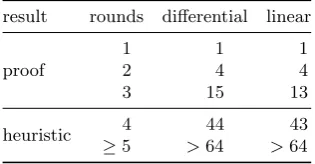
With this model, we can easily prove that the 3-roundAsconpermutation has at
least 15 differentially active S-boxes (probability≤2−30), and at least 13 linearly active S-boxes (bias ≤2−14, complexity
≥228). The bounds on the number of active S-boxes are tight, but not necessarily those on the probability. Using these results, we can prove that the full 12-round initialization or finalization has at least 60 differentially active S-boxes (probability ≤2−120) and at least 52 linearly active S-boxes (bias ≤2−53, complexity
≥2106). These bounds are almost certainly not tight, but we were not able to derive bounds for more than 3 rounds using SAT solvers. This motivates the use of heuristic search tools to find explicit characteristics.
5.2 Differential and linear characteristics
In Table 4, we present an overview of our best differential and linear characteris-tics for different round numbers of theAsconpermutation. We have been able
to improve the differential characteristic for 4 rounds of theAsconpermutation
compared to the previous best results by the designers [11]. Since the design-ers included no results on linear cryptanalysis in the submission document, we provide the first linear analysis. When comparing the best differential character-istics with the best linear charactercharacter-istics, we see that for more than two rounds of theAsconpermutation, the linear characteristics have fewer active S-boxes.
This might indicate thatAsconis more vulnerable to linear cryptanalysis.
Nev-ertheless, for 5 rounds of Ascon, the best found linear characteristic has more
than 64 active S-boxes. Assuming the best possible bias for all active S-boxes, the attack complexity is already higher than 2128.
5.3 Forgery attack on round-reduced Ascon
Usually, the characteristics from Section 5.2 cannot be directly used in an attack, since there might be additional requirements that the characteristic has to fulfill. In the case of an attack on the finalization ofAscon-128, suitable characteristics
Table 4.Minimum number of active S-boxes for theAsconpermutation.
result rounds differential linear
proof
1 1 1
2 4 4
3 15 13
heuristic 4 44 43
≥5 >64 >64
The rest of the statewords have to be free of differences. For the output of the finalization, the only requirement is that there is some fixed difference pattern inx3andx4. Knowledge about the expected differences inx0,x1, andx2at the output of the permutation is not required.
For round-reduced versions ofAscon, we have found suitable characteristics
for a reduced 3-round finalization with a probability of 2−33 and for 4-round finalization with a probability of 2−101. The used characteristic for the three round attack is given in Table 6 and the differential for the four round attack is given in Table 7 in Appendix A.
5.4 Differential-linear cryptanalysis
In differential-linear cryptanalysis, differential and linear characteristics are used together in an attack. This kind of analysis was introduced by Langford and Hellman [17]. Later on, it was demonstrated that this type of analysis is also suitable for cases where the differential and the linear part have a probability different from 1 [4, 16]. Differential-linear cryptanalysis is especially useful if the combined success probability of one short differential characteristic and one short linear characteristic is better than the probability of a longer linear or differential characteristic. One reason for such a behavior might be a bad diffusion for fewer rounds. For the attack to work, the individual probabilities of the two used characteristics have to be relatively high. According to Dunkelman et al. [12], the bias at the output of such a differential-linear characteristic is about 2pq2, where q is the bias of the linear part and p the probability of the differential characteristic. This results in a data complexity ofO(p−2q−4).
Outline of the attack. ForAscon-128, we can use differential-linear
charac-teristics as key-stream distinguisher. Like for cube-tester (Section 4.3), we can target either the initialization in a nonce-respecting scenario, or the processing of the plaintext in a nonce-misuse scenario. Here, we focus on the initialization. Therefore, differences are only allowed in the nonce (x3,x4), whereas the linear active bits have to be observable and therefore must be inx0.
part, we place two differences in the same S-box of round 1. With probability 2−2, we have one active bit at the output of this S-box. The linear layer ensures that 3 S-boxes are active in the second round. Those 3 S-boxes have the dif-ference at the same bit-position of their input. All 3 active S-boxes of round 2 have the same output pattern of 2 active bits with probability 2−3. Due to the linear layer, we then have differences on 11 S-boxes of round 3. For the linear characteristic, we use a characteristic with one active S-box in round 4 and 5 active S-boxes in round 3. The bias of the linear characteristic is 2−8. In addi-tion, we place the S-boxes in a way that the linear active S-boxes in round 3 do not overlap with the 11 S-boxes that have differences at their inputs. The bias of the generated differential-linear characteristic is 2pq2= 2−20. In practice, we are only interested in the bias of the output bit for the specific differences at the input. Due to the vast amount of possible combinations of differential and linear characteristics that achieve these requirements, we expect a much better bias.
Practical evaluation of the bias. In the best case, we place differences in bit 63 of x3 and x4, and get a bias of 2−2 in bit 9 of x0 on the output of the substitution layer of round 4. This is much better than the result of 2−20that we obtained from the theoretical analysis. It is possible to combine multiple charac-teristics to also get to a bias of 2−2in theory. However, we decided to reduce our differential-linear analysis to statistical tests, where we place differences at the input and try to measure a bias at the output bits. We think that this method is sufficient for practical attacks. For a 5-round initialization, we observe a bias of 2−10 onx
0[16] (last substitution layer) for differences in x3[63], and x4[63]. This bias can be improved to 2−9 if we only use nonces with the same sign of the difference (the concrete pairs for bothx3[63] andx4[63] are either (0,1) or (1,0)). In the case of a 6-round initialization, we were not able to observe a bias by using a set of 236inputs. The biases were averaged for randomly-chosen keys.
Observing key-dependency of the bias. As shown by Huang et al. [14], the bias observed at the output depends on the concrete values of secret and con-stant bits. They used this observation to recover the secret state of ICEPOLE in a nonce-misuse scenario. So we expect that a similar attack is possible on round-reduced versions of Ascon-128. In contrast to Huang et al., we want to recover
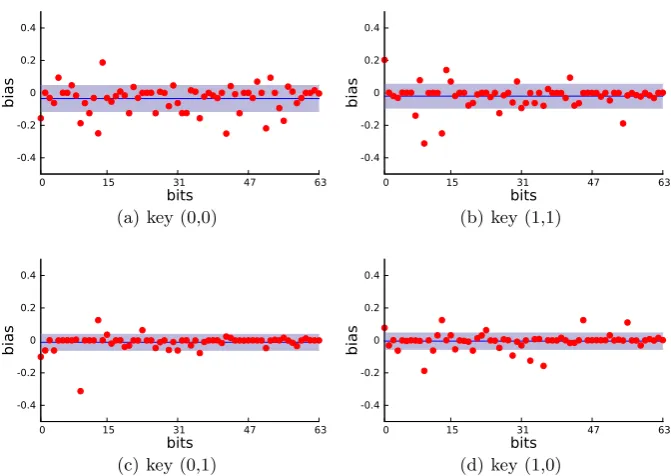
the secret key directly and attack round-reduced versions of the initialization. This also transfers the attack to a nonce-respecting scenario. For a reduced ini-talization of 4 out of 12 rounds, we observed the bias patterns shown in Table 5. This table shows that the observable bias depends on the concrete values of two key bits which contribute to the same S-box as the used difference. Moreover, the bias is completely independent of the concrete value of the constant inx0. This leads to the following straightforward attack.
Table 5.Bias of bitx0[i+ 1] in the S-box outputs of round 4 for differences in input bitsx3[i] andx4[i] (230 different inputs).
inputs (x1[i], x2[i]) key-bit pair (0,0) (0,1) (1,0) (1,1)
outputx0[i+ 1] sign +1 −1 +1 −1 bias 2−2.682−3.682−3.302−2.30
4 out of 12 rounds. In this setting, the attacker has the ability to choose the nonce and is able to observe the resulting key stream. The attacker performs a sufficient amount of queries, with pairs of nonces which have differences in x3[63] and x4[63], and calculates the bias of x0[0] of the key-stream. With the help of Table 5, the attacker is able to recover two bits of the key by matching the expected bias with his calculated bias. Since the characteristics of Ascon
are rotation-invariant within the 64-bit words, the same method can be used to recover the other key bits by placing differences in bitsiand observing the bias at position i+ 1 mod 64. Already 212 samples per bit position iare sufficient to get stable results. This results in an expected time complexity of 218 for the key-recovery attack on 4 rounds. However, in practice, we use the bias of all the bits and compute the correlation with the results of a precomputation (fingerprinting) phase to get better results. This way, we were also able to mount a key-recovery attack on the initialization of Ascon-128 reduced to 5 out of 12
rounds. In particular, we can reliably recover all key-bit pairs with values (0,0) and (1,1) with a low complexity of 236. However, we need to brute-force the other pairs, which results in an additional complexity of 232 on average and 264 in the worst case. Thus, the expected attack complexity is about 236. The complexities of both attacks on 4 and 5 rounds of the initialization have been practically verified.
Acknowledgments. The authors would like to thank the anonymous reviewers for their valuable comments and suggestions. The work has been supported in part by the Austrian Science Fund (project P26494-N15) and by the Austrian Research Promotion Agency (FFG) and the Styrian Business Promotion Agency (SFG) under grant number 836628 (SeCoS).
References
1. Aumasson, J.P., Meier, W.: Zero-sum distinguishers for reduced Keccak-f and for the core functions of Luffa and Hamsi. CHES rump session (2009)
2. Bertoni, G., Daemen, J., Peeters, M., Van Assche, G.: Keccak Specifications. Sub-mission to NIST (Round 3) (2011),http://keccak.noekeon.org
4. Biham, E., Dunkelman, O., Keller, N.: Enhancing Differential-Linear Cryptanaly-sis. In: Zheng, Y. (ed.) Advances in Cryptology – ASIACRYPT 2002. LNCS, vol. 2501, pp. 254–266. Springer (2002)
5. Biham, E., Shamir, A.: Differential Cryptanalysis of DES-like Cryptosystems. In: Menezes, A., Vanstone, S.A. (eds.) Advances in Cryptology – CRYPTO 1990. LNCS, vol. 537, pp. 2–21. Springer (1990)
6. Boura, C., Canteaut, A.: A zero-sum property for the Keccak-fpermutation with 18 rounds. In: IEEE International Symposium on Information Theory. pp. 2488– 2492. IEEE (2010)
7. Boura, C., Canteaut, A., Canni`ere, C.D.: Higher-order differential properties of keccak andLuffa. In: Joux, A. (ed.) Fast Software Encryption – FSE 2011. LNCS, vol. 6733, pp. 252–269. Springer (2011)
8. Daemen, J.: Permutation-based Encryption, Authentication and Authenticated Encryption. DIAC – Directions in Authenticated Ciphers (2012)
9. Dinur, I., Morawiecki, P., Pieprzyk, J., Srebrny, M., Straus, M.: Cube Attacks and Cube-attack-like Cryptanalysis on the Round-reduced Keccak Sponge Func-tion. IACR Cryptology ePrint Archive 2014, 736 (2014), http://eprint.iacr. org/2014/736
10. Dinur, I., Shamir, A.: Cube Attacks on Tweakable Black Box Polynomials. In: Joux, A. (ed.) Advances in Cryptology – EUROCRYPT 2009. LNCS, vol. 5479, pp. 278–299. Springer (2009)
11. Dobraunig, C., Eichlseder, M., Mendel, F., Schl¨affer, M.: Ascon. Submission to the CAESAR competition:http://ascon.iaik.tugraz.at(2014)
12. Dunkelman, O., Indesteege, S., Keller, N.: A Differential-Linear Attack on 12-Round Serpent. In: Chowdhury, D.R., Rijmen, V., Das, A. (eds.) Progress in Cryp-tology – INDOCRYPT 2008. LNCS, vol. 5365, pp. 308–321. Springer (2008) 13. Ganesh, V., Dill, D.L.: A decision procedure for bit-vectors and arrays. In:
Com-puter Aided Verification (CAV ’07). Springer (2007),https://sites.google.com/ site/stpfastprover/
14. Huang, T., Wu, H., Tjuawinata, I.: Practical State Recovery Attack on ICEPOLE, http://www3.ntu.edu.sg/home/huangtao/icepole/icepole_attack.pdf 15. Jovanovic, P., Luykx, A., Mennink, B.: Beyond 2c/2 Security in Sponge-Based
Authenticated Encryption Modes. In: Sarkar, P., Iwata, T. (eds.) Advances in Cryptology - ASIACRYPT 2014. LNCS, vol. 8873, pp. 85–104. Springer (2014), http://dx.doi.org/10.1007/978-3-662-45611-8_5
16. Langford, S.K.: Differential-linear cryptanalysis and threshold signatures. Ph.D. thesis, Stanford University (1995)
17. Langford, S.K., Hellman, M.E.: Differential-linear cryptanalysis. In: Desmedt, Y. (ed.) Advances in Cryptology – CRYPTO 1994. LNCS, vol. 839, pp. 17–25. Springer (1994)
18. Matsui, M., Yamagishi, A.: A New Method for Known Plaintext Attack of FEAL Cipher. In: Rueppel, R.A. (ed.) Advances in Cryptology – EUROCRYPT 1992. LNCS, vol. 658, pp. 81–91. Springer (1992)
19. National Institute of Standards and Technology: FIPS PUB 180-4: Secure Hash Standard. Federal Information Processing Standards Publication 180-4, U.S. De-partment of Commerce (March 2012), http://csrc.nist.gov/publications/ fips/fips180-4/fips-180-4.pdf
A
Differentials to create forgery
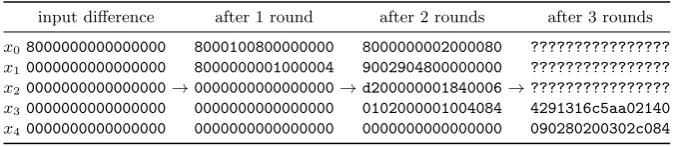
Table 6 contains the differential characteristic and Table 7 contains the differen-tial used for the forgery attacks of Section 5.3. One column corresponds to the five 64-bit words of the state, and the xor differences are given in hexadecimal notation (truncated in the last round).
Table 6. Differential characteristic to create forgery for round-reduced Ascon-128 with a 3-round finalization. The differential probability is 2−33.
input difference after 1 round after 2 rounds after 3 rounds
x08000000000000000 8000100800000000 8000000002000080 ????????????????
x10000000000000000 8000000001000004 9002904800000000 ????????????????
x20000000000000000→0000000000000000→d200000001840006→????????????????
x30000000000000000 0000000000000000 0102000001004084 4291316c5aa02140
x40000000000000000 0000000000000000 0000000000000000 090280200302c084
Table 7.Differential to create forgery for round-reducedAscon-128 with a 4-round finalization. The differential probability is 2−101.
input difference after 4 rounds
x08000000000000000 ????????????????
x10000000000000000 ????????????????
x20000000000000000→????????????????
x30000000000000000 280380ec6a0e9024
x40000000000000000 eb2541b2a0e438b0
B
Differential-linear key recovery attack on 4 rounds
-0.4 -0.2 0 0.2 0.4
0 15 31 47 63
bias
bits (a) key (0,0)
-0.4 -0.2 0 0.2 0.4
0 15 31 47 63
bias
bits (b) key (1,1)
-0.4 -0.2 0 0.2 0.4
0 15 31 47 63
bias
bits (c) key (0,1)
-0.4 -0.2 0 0.2 0.4
0 15 31 47 63
bias
bits (d) key (1,0)
![Table 3. The S-box of Ascon [11].](https://thumb-us.123doks.com/thumbv2/123dok_us/7949059.1319229/3.595.217.398.137.197/table-the-s-box-of-ascon.webp)
![Table 5. Bias of bit x0[i + 1] in the S-box outputs of round 4 for differences in inputbits x3[i] and x4[i] (230 different inputs).](https://thumb-us.123doks.com/thumbv2/123dok_us/7949059.1319229/15.595.191.423.149.191/table-bias-outputs-round-dierences-inputbits-dierent-inputs.webp)