Two round multiparty computation via
Multi-key fully homomorphic encryption
with faster homomorphic evaluations
NingBo Li1#, TanPing Zhou1#∗, XiaoYuan Yang1, YiLiang Han1, Longfei Liu1, WenChao Liu1
1 Key Laboratory of Network & Information Security under the People’s Armed Police, College of Cryptography Engineering, Engineering University of
People’s Armed Police, Xi’an, 710086, China
Abstract.Multi-key fully homomorphic encryption (MKFHE) allows com-putations on ciphertexts encrypted by different users (public keys), and the results can be jointly decrypted using the secret keys of all the users involved. The NTRU-based scheme is an important alternative to post-quantum cryp-tography, but the NTRU-based MKFHE has the following drawbacks, which cause it inefficient in scenarios such as secure multi-party computing (MPC). One is the relinearization technique used for key switching takes up most of the time of the scheme’s homomorphic evaluation, the other is that each user needs to decrypt in sequence, which makes the decryption process complicated. We propose an efficient leveled MKFHE scheme, which improves the efficiency of homomorphic evaluations, and constructs a two-round (MPC) protocol based on this. Firstly, we construct an efficient single key FHE with less relinearization operations. We greatly reduces the number of relinearization operations in ho-momorphic evaluations process by separating the hoho-momorphic multiplication and relinearization techniques. Furthermore, the batching technique and a spe-cialization of modulus can be applied to our scheme to improve the efficiency. Secondly, the efficient single-key homomorphic encryption scheme proposed in this paper is transformed into a multi-key vision according to the method in LTV12 scheme. Finally, we construct a distributed decryption process which can be implemented independently for all participating users, and reduce the number of interactions between users in the decryption process. Based on this, a two-round MPC protocol is proposed. Experimental analysis shows that the homomorphic evaluation of the single-key FHE scheme constructed in this paper is 2.4 times faster than DHS16, and the MKFHE scheme constructed in this pa-per can be used to implement a two-round MPC protocol effectively, which can be applied to secure MPC between multiple users under the cloud computing environment.
Keywords: Multi-key fully homomorphic encryption (MKFHE), NTRU,
two-round MPC, relinearization
1 Introduction
People are increasingly inclined to store large amounts of data on powerful cloud servers and outsource the cumbersome and complicated data computing process to the cloud. Although the cloud facilitates the storage and computation of big data, it is also vulnerable to be attacked by illegal organizations and users [1], thus triggering a serious issue that cannot be ignored about how to protect users’ individual privacy and data security?
Fully homomorphic encryption (FHE) [2] allows arbitrary computation on encrypted data without access to user’s secret key, it has exchangeable properties for data encryption and computation, and can be used to protect the privacy and security processing of data in cloud computing environment.
Following the breakthrough blueprint [3] of FHE designed by Gentry in 2009, FHE has come a long way [4-9]. Traditional FHE is only suitable for scenarios where the computations of ciphertext involve a single user, since it requires all the input ciphertext to be encrypted under the same key. However, in many real-world scenarios, it is often necessary to perform computations on encrypted data corresponding to different users, while ensuring that the user’s individual privacy is not exposed.
Multi-key fully homomorphic encryption (MKFHE) [10] allows computations on ciphertexts encrypted by different parties without trust, and the results can be jointly decrypted using the secret keys of all the users involved. Meanwhile, the process of computations on ciphertexts can be outsourced to the cloud offline, which avoid the interaction between the users, and can be applied to implement the secure multi-party computing (MPC) [11-14] of multi-users in the cloud computing environment.
Similar to traditional single-key FHE, the type of current MKFHE mainly include NTRU type, GSW type and BGV type.
In 2012, L ́opez-Alt et al. first proposed the concept of MKFHE, and con-struct a MKFHE scheme [LTV12] based on a variant NTRU public key cryp-tosystem [15], which is a variant of the original NTRU scheme in [16]. Its security relies on two assumptions: the ring-learning with errors (RLWE) assumption and the decisional small polynomial ratio (DSPR) assumption. [17] improved the ef-ficiency of [LTV12] by optimizing parameters, introducing a specialization of the ring structure and modulus. In PKC2017, Chongchitmate et al. proposed an NTRU-type MKFHE scheme [18], which can protect the circuit privacy. This scheme proposes a basic framework for constructing MKFHE with circuit pri-vacy characteristics, and constructs a basic framework based on this. 3 rounds of on-the-fly MPC protocol.
any new party cannot be allowed to join in during the homomorphic computa-tion. This type of MKFHE is called single-hop in [21], comparing to multi-hop MKFHE whose result ciphertext can be employed to further evaluation with new parties, i.e. any new party can dynamically join the homomorphic evaluation at any time. Another similar concept named fully dynamic MKFHE was proposed in [22], which means that the bound of number of users does not need to be input during the setup procedure.
In TCC2017, Chen et al. proposed a BGV-type multi-hop MKFHE scheme [23], which supports the Chinese Remainder Theorem (CRT)-based ciphertexts packing technique, and simplifies the ciphertext extension process in MKFHE. What’s more, [23] admits a threshold decryption protocol and two-round MPC protocol.
Comparing to BGV-type and GSW-type MKFHE, NTRU-based MKFHE scheme is simple and much faster. Furthermore, the ciphertext of NTRU-type scheme is a polynomial, thus the implementation of NTRU-type scheme is effi-cient, and the process of ciphertext extension is not required when extending a single-key NTRU-type FHE scheme to a multi-key vision.
Contributions.In this paper, we propose an efficient leveled MKFHE scheme which improves the efficiency of homomorphic evaluations, and constructs a two-round multiparty computation (MPC) protocol based on this.
• Optimized the single-key leveled FHE scheme in DHS16. We reduce the number of relinearization operations in homomorphic evaluations process by separating the homomorphic multiplication and relinearization techniques.
• Construct a multi-key leveled FHE scheme. Comparing to LTV12, the relinearization process are implemented after evaluating two levels circuit, which can reduce the computational complexity significantly. Besides that, only the evaluation keys whose corresponding users are existed in at least two ciphertexts are employed in relinearization process, which is efficient and important in real applications.
•Construct an efficient two-round MPC based on the multi-key FHE scheme in this paper. We construct a distributed decryption process which can be im-plemented independently for all participating users, thus reduce the interaction processes between users in the decryption process.
2 Background
2.1 Preliminaries
In this paper, the bold upper case letters denote matrices, and the bold lower case letters denote vectors, and all the vectors are represented as columns. For a vectorawe usea[i]to denote thei-th element ina. For a positive integern∈N, let[n] ={1, ..., n}. For a distributionA, letx←Adenotexis chosen according to a distributionA.
For security parameterλ, letd=d(λ)be a positive integer, and letφd(x) =
φ(x)=xn+ 1 be thed-th cyclotomic polynomial, and the degree n=ϕ(d) is a
The polynomial ring used in our scheme is defined asR= Z(x)/φ(x), and all operations over the ciphertext are performed inRq =R/qR where the modulus
q=q(λ)is a prime or a power of prime. Elements inRq are polynomials with
coefficients in [−q/2, q/2)(except for q = 2). We also define a B=B(λ)-bound error distributionχ over the ringR = Z(x)/φ(x), which means that the coeffi-cients of polynomial sampled fromχare at mostBin absolute value. Fora∈R, we use∥a∥∞= max0≤i≤n−1|ai|to denote the standard∥·∥∞-norm.
The security of our scheme is based on the ring learning with error (RLWE) assumption and the decisional small polynomial ratio (DSPR) assumption. Here we give a brief introduction to them.
Definition 1 (Ring Learning With Error (RLWE) Assumption). The
(decisional) RLWE assumption is a variant of learning with error (LWE) as-sumption. RLWE assumption states that it is infeasible to distinguish the follow-ing two distributions: First distribution is the uniform samples(ai, bi)∈Rnq+1.
In the second distribution, sampled ai ← Rnq and s← Rnq uniformly, ei ← χ,
and the second distribution is the specialization samples (ai, bi)∈ Rnq+1 where
bi=<ai,s>+ei.
Definition 2 (Decisional Small Polynomial Ratio (DSPR) Assump-tion). Given the ring R and Rq, and a B-bound error distribution χ over R,
the (decisional) DSPR assumption states that it is infeasible to distinguish the following two distributions:
– a polynomialh=tg/f, wheref=tf′+ 1is invertible overRq, andf′, g←χ.
– a polynomialhsampled uniformly at random overRq.
Stehlé and Steinfeld states that the DSPR assumption is hard even for un-bounded adversaries when then-th cyclotomic polynomial’s degreenis a power of 2, and the error distribution χ is a discrete Gaussian distribution DZn,σ for
σ >√q·poly(n).
2.2 Two subroutines
Here introduce two subroutines BitDecomp(·) and Powersof 2(·) which are widely used in FHE schemes. Let β =⌊logq⌋+ 1, and describe these two sub-routines as follows.
BitDecomp(x∈Rn
q, q): Given a polynomial vectorx∈Rnq, write it asx=
∑β−1
j=0 2
ju
j with alluj∈Rn2, and outputU= [u0,u1, ...,uβ−1]∈ {0,1}n·β. Powersof 2(y∈Rnq, q): Let vj = 2jy∈Rnq,j ∈ {0,1, ..., β−1}, and output
V= [v0,v1, ...,vβ−1]∈Rnq·β.
It’s obviously to verify that⟨BitDecomp(x, q),Powersof 2(y, q)⟩=⟨x,y⟩mod
2.3 Basic NTRU homomorphic encryption scheme
Here we give an introduction of the basic NTRU homomorphic encryption scheme in [10], which is a variant of the original NTRU scheme in [15, 16] to support homomorphisms and improve its security.
Setup(1λ) : For security parameter, given the following parameters which
have been defined above: a integer n=n(λ), the prime modulusq=q(λ), the polynomial ringR= Z(x)/xn+ 1andR
q =R/qR, and aB=B(λ)-bound error
distributionχover the ringR.
KeyGen(1λ) :Sample polynomials f′, g←χ, and setf = 2f′+ 1∈R (Iff
is not invertible overRq, resample f′)so that f ≡1 mod 2. Set the public key
pk:=h= 2gf−1∈R
q, and the secret keysk:=f ∈R.
Enc(pk, m)Samples,e←χ
c:=hs+ 2e+m∈Rq
Enc(pk, m)Samples, e←χ, and output the ciphertext
c:=hs+ 2e+m∈Rq
Dec(sk, c)Computeµ=f c∈Rq as
µ=f c(modq)
=f(hs+ 2e+m)(modq)
= 2(gs+f e) +f m∈Rq
Sincef ≡1 mod 2and|2(gs+f e) +f m|< q/2, the message is recovered by
m′ =µmod 2.
Given two ciphertextsc1=h1s1+ 2e1+m1∈Rq andc2=h2s2+ 2e2+m2∈
Rq that encrypt messages m1 and m2 under the same secret key f, it’s not difficult to verify its homomorphism properties of addition and multiplication.
f(c1+c2) =f(h1s1+ 2e1+m1+h2s2+ 2e2+m2) = 2(g1s1+g2s2+f(e1+e2)) +f(m1+m2)
f2·c1c2=f2[(h1s1+ 2e1+m1)(h2s2+ 2e2+m2)] = 2Eerror+f2·m1m2
Here we mainly introduce the multikey homomorphic properties which the basic NTRU scheme naturally has.
Given two ciphertextsc1=h1s1+ 2e1+m1∈Rq andc2=h2s2+ 2e2+m2∈
f1f2(c1+c2) =f1f2(h1s1+ 2e1+m1+h2s2+ 2e2+m2)
= 2(f1f2(e1+e2) +f2g1s1+f1g2s2) +f1f2(m1+m2) = 2eadd+f1f2(m1+m2)
f1f2(c1c2) =f1f2(h1s1+ 2e1+m1)(h2s2+ 2e2+m2)
= 2(2g1s1g2s2+ 2f2g1s1e2+f2g1s1m2+ 2f1g2s2e1 +f1g2s2m1) +f1f2(4e1e2+ 2e1m2+ 2e2m1) +f1f2m1m2 = 2emult+f1f2(m1m2)
This shows that decryptingc1+c2 and c1c2 using the joint secret keyf1f2 results in the sum and product of the two messages, assuming that the error
eadd and emult do not grow to be too large. Furthermore, as for some
compli-cated circuit, we can observe that the ciphertext c resulting from evaluating a multivariate polynomial function on the input ciphertext ofN users can be de-crypted by the jointly secret key ∏N
i=1f
di
i , where di denotes the degree of the
i-th variable in the polynomial function. In other words, the secret key required to decrypt the result ciphertext is not only dependent on the involved users, but also the evaluating circuit. For example, the secret key to jointly decrypt the evaluated ciphertextc12+c2 isf12f2, which is related to the involved users and the evaluating functionf(x1, x2) =x12+x2.
With the assumption of DSPR, the security of the basic NTRU homomorphic encryption scheme can be proveRqd under the RLWE assumption following two
steps: 1. Based on the hardness of DSPR assumption, the public keyh= 2gf−1
can be replaced by 2h′ for a uniformly sampled h′. 2. Once the step 1 is done, we can change the ciphertext c=hs+ 2e+m to c∗=u+m with the RLWE assumption, where uis uniformly sampled fromRq. As for arbitrary adversary,
the advantage of distinguishc∗andcis both 1/2 sinceuis uniformly distributed in Rq, which is independent of the messagem.
2.4 Cryptographic Definitions of Multi-key FHE
Definition 3 (Multi-key FHE scheme). A leveled multi-key FHE scheme consists of a set of algorithms described as follows:
– Setup(1λ,1K,1L)Given the security parameterλ, a boundKon the number of keys, a boundL on the circuit depthoutput the public parameterpp . – Gen(pp)Given the public parameter ppoutput the public key and secret key
of party i(i = 1, ..., K)and output the materials which are required for the generation of evaluation keysevk.
– Enc(pp,pki,m)Given the public keypkiof partyiand a messageµoutput the
ciphertextcti which contains the index of the corresponding secret key and
the level tag.
– Eval(pp, evk, C,(ctS1, pkS1), ...,(ctSt, pkSt))Giventtuples{(ctSi, pkSi)}i=1,...,t and a boolean circuitCwhich is needed to be evaluatedeach tuple contains a ci-phertextctSi corresponding to a set of secret keys indexed bySi=i1, ..., iki⊆
[K]and a set of public keys pkSi ={pkj,∀j ∈ Si}. Output a ciphertext ct corresponding to a set of secret keys indexed byS =∪t
i=1Si⊆[K]¡
If the input ciphertext of Eval(·) can be fresh ciphertext or intermediate results after any homomorphic operation, the MKFHE scheme satisfies the multi-hop property.
Definition 4 (Correctness). A leveled multi-hop MKFHE scheme is correct if for any circuit C of depth at most L with t input wires and a set of tuples
{(ctSi, pkSi)}i∈{1,...,t}, letting µi = Dec(skSi, ctSi), where skSi = {skj,∀j ∈
Si},i= 1, ..., t, it holds that
Pr[Dec(skS, Eval(C,(ctS1, pkS1), ...,(ctSt, pkSt)))̸=C(µ1, ..., µt)] =negl(λ) WhereS =∪ti=1Si ⊆[K],pp←Setup(1λ,1K,1L)(pkj, skj)←Gen(pp)for
j∈[S].
Definition 5 (Compactness).A leveled multi-hop MKFHE scheme is compact if there exists a polynomialpoly(·,·,·)such that|ct| ≤poly(λ, K, L), which means that the length ofctis independent of the circuitC, but can depend ofλ,K and
L.
3 Efficient leveled NTRU-based FHE scheme
3.1 Motivation
Recall the basic NTRU-type homomorphic encryption scheme in section 2.3. What we already know is that the secret key required to decrypt the result NTRU ciphertext is not only dependent on the involved users, but also the evaluating circuit,
In order to eliminate the influence of the circuit evaluated on the decryption and maintain the consistency of the decrypting form, we can use the relineariza-tion technology introduced in [5] to transform the ciphertext into one that can be jointly decrypted by the unified secret key ∏Ni=1fi of all the involved users after homomorphic operation.
In RLWE-based leveled FHE scheme BV11a, the ciphertext form is a poly-nomial vector, thus the ciphertext dimension after homomorphic multiplication will expand quadratically, which may cause trouble for the storage and operation of the ciphertext. To handle it, relinearization technique was proposed in [5] to reduce the dimension of the result ciphertext to the original extent.
relinearization after every homomorphic operation. However, in order to main-tain the consistency of decryption, it is still necessary to perform relinearization operation to transform the result ciphertext to one under the secret key .
In this paper, we consider to perform relinearization operation on the cipher-text after k4 homomorphic evaluations to reduce the number of complicated relinearization operations, thus reducing the computational complexity of homo-morphic evaluations and improving the scheme’s efficiency. It should be noted that the modulus-switching operation is still necessary after each homomorphic evaluation to control the noise in the ciphertext, i.e. we separate the relineariza-tion technique from the modulus -switching technique to make them no longer bundle.
3.2 Parameters selection in DHS16
In [17], Doröz et al. optimize the parameters selection in the light of recent theoretical and experimental results in the field of lattice reduction so as to reduce the size of public key significantly. Beyond that, the secret key remain the same for all levels so that the evaluation keys can be computed by the initial evaluation keys at level 0. In this paper, we follow the method of parameters selection in DHS16 to improve scheme’s efficiency comparing to LTV12, and give a simple introduction to it in this section.
Assume that the modulus of each level of the circuit is a decreasing sequence
q0> q1>· · ·> qL, and setqi=pt−i fori= 0,· · · , t−1, wherep∈Zis a prime
integer. The secret keyf ∈Rq0 remains the same for all levels and is invertible in all ringsZqi.
Lemma 1 (Lemma 3 in [17]).Letpbe a prime, and letf be a polynomial. If f is a unit in Rp, thenf is a unit inRpk fork ⩾1. According to lemma 1,
the evaluation keys for leveli can be simply computed byζ(i)=ζ(0) modqi.
DHS16 introduces batching technology [24] to package multiple input text into the same ciphertext and realize simultaneous input of multiple plain-text, thus improving the encryption efficiency and reducing the number of ci-phertext required for homomorphic operation. Batching technology can also be applied to our scheme to improve its efficiency. The details of batching process are presented in section 4.1 in [17].
3.3 Optimized leveled single-key FHE scheme
In this paper, we construct an leveled single-key FHE scheme, which can homomorphically evaluate the circuit more efficiently than DHS16.
– Setup(1λ) :Given the security parameter λ, an integer n=n(λ), a prime
integer p=p(λ), the prime modulus q = q(λ), the polynomial ring R =
Z(x)/xn+1andR
q=R/qR, and aB=B(λ)-bound error distributionχover
the ringR. Define a series of decreasing modulusq0=pt> q
1 > ... > qt−1,
– KeyGen(1λ) :Choose polynomialsf′, g←χ, and setf = 2f′+1so thatf ≡
1 mod 2. Set h= 2g/f ∈Rq0 (Iff is not invertible overRq0, resample f′). Samples,e←χ⌈logq0⌉, letζ(0) :=hs+2e
ζ+Powersof 2((f)
3
)∈R⌈logq0⌉
q0 , and
ζ(i→i+2) ≜ζ(0)modqi+1. Let f(i)(x) =f(x)−
1
(modqi), thus f(x)f(i)(x) =
1(modqi).
Output:sk := f ∈ Rq0(the secret key f remains the same for all levels), and pk :={h, ζ(0)}, where ζ(0) denotes the evaluation key in level 0, and evaluation keys of other levels can be computed byζ(0) and the modulus. – Enc(h, m): Input the message m, sample s(0), e(0) ← χ, and output the
ciphertext
c(0):=hs(0)+ 2e(0)+m∈Rq0 – Dec(f, c(l)): Input the ciphertextc(l)∈R
ql, compute
µ:=f·c(l)∈Rql
and output the messagem′:=µmod 2.
– (1) Add(c(1i−1), c(2i−1)) :Input two ciphertextsc1(i−1)andc(2i−1)at leveli−1. (a) Addition:c˜(addi−1)=c1(i−1)+c(2i−1).
(b) Modulus switching: ˜c(addi) ⌊(qi/qi−1)·c˜
(i−1)
add ⌉2, where ⌊·⌉2 denotes ˜c (i)
add =
˜
c(addi−1)mod 2(Relinearization is not required as addition doesn’t change the secret key).
– (2) Mult(c(1i−2), c2(i−2), c(3i−2), c4(i−2)):inputi−2level ciphertextc1(i−2),c(2i−2),
c3(i−2),c4(i−2) at level(i−2).
(a) Multiplication:˜c(1i−2)=c1(i−2)×c2(i−2)( modqi−2);˜c
(i−2) 2 =c
(i−2) 3 ×c
(i−2) 4 ( mod
qi−2)
(b) Modulus switching:c˜(1i−1)=⌊(qi−1/qi−2)·˜c (i−2) 1 ⌉2, ˜
c(2i−1)=⌊(qi−1/qi−2)·c˜ (i−2)
2 ⌉2, where⌊·⌉2denotes˜c (i−1) 1 = ˜c
(i−2)
1 mod 2and ˜
c(2i−1)= ˜c(2i−2)mod 2. (c) Multiplication:˜˜c(i−1)
1 =c˜ (i−1) 1 ·˜c
(i−1)
2 (modqi−1)
(d) Relinearization:˜˜c(i)= ⟨BitDecomp(˜˜c(i−1)),ζ(i−2→i)⟩( modq
i−1)∈Rqi−1 (e) Modulus switching:˜c(i)=⌊(qi/qi−1)·˜˜c(i)⌉2
Analysis.
(1)Correctness analysis
Here we mainly analyze the correctness of ciphertext multiplication.
Lemma2:The noise growth of evaluating two levels as a block under average case is:
Bi,average≈v4n1.5B4i−2κ
3+2v2n2(2B+ 1)2B2
i−2κ
2+nlogq
i(2B2+6B3)κ+
√
n(2B+1)
where n is the degree, B is the bound of error distributionχ over the ring R,
Bi denotes the error bound of the ciphertext at leveli,κis the reduction scale
of modulus switching.
Suppose thatc(ki−2)f = 2Ek(i−2)+f mk(modqi−2)fork∈ {1,2,3,4}. As the
corresponding secret key of˜c(1i−1) andc˜(1i−2) isf2, we have ˜
c1(i−2)(x)f2 =2 ˜E1(i−2)+f2m1m2(modqi−2)
˜
c2(i−2)(x)f2 =2 ˜E2(i−2)+f2m3m4(modqi−2)
(b)Modulus switching
Lemma3:Letq andpbe two odd integer, c∈Rq, denotec′=⌊(p/q)·c⌉2,
where⌊⌉2denotesc′ =cmod 2. For arbitraryf that satisfies||[f2c]q||∞< q/2−
(q/p)·||f2||1, we have[f2c′]
p= [f2c]q mod 2and||[f2c]p||∞<(p/q)||[f2c]q||∞+
||f2||1.
According to lemma3, we have
˜
c(1i−1)(x) =⌊(qi−1/qi−2)·˜c
(i−2)
1 (x)⌉2(modqi−1)⇒
[f2˜c1(i−1)(x)]qi−1 = [f 2c˜(i−2)
1 (x)]qi−2 mod 2 =m1m2; ˜
c(2i−1)(x) =⌊(qi−1/qi−2)·˜c
(i−2)
2 (x)⌉2(modqi−1)⇒
[f2˜c2(i−1)(x)]qi−1 = [f 2c˜(i−2)
2 (x)]qi−2 mod 2 =m3m4
(c)Multiplication:˜˜c(i−1)≜˜c(i−1) 1 טc
(i−1)
2 (modqi−1)
As the secret key of˜˜c(i−1)isf4, we have
˜
˜c(i−1)f4≜(˜c1(i−1)f2)(˜c(2i−1)f2)≜2˜˜E(i−1)+f4m1m2m3m4(modqi−1)
(d)Relinearization:˜˜c(i) = ⟨BitDecomp(˜˜c(i−1)),ζ(i−2→i)⟩(modq
i−1)∈Rqi−1 As the evaluation keyζτ(i−2→i) is a ciphertext at level(i−1), i.e.
ζτ(i−2→i)f = 2Eζ(i−2→i)
τ + 2
τf4(modq
i−1)
then we can get
˜
˜c(i)(x)f =f(∑⌊logqi−1⌋
τ=0 ˜
˜c(τi−1)(x)ζτ(i−2→i))(modqi−1)
=∑⌊logqi−1⌋
τ=0 ˜
˜c(τi−1)(x)(2Eζ(i−2→i)
τ + 2
τf4)(modq
i−1)
= 2∑⌊logqi−1⌋
τ=0 ˜
˜c(τi−1)(x)Eζ(i−2→i)
τ +
∑⌊logqi−1⌋
τ=0 ˜
˜c(τi−1)(x)·2τf4(modqi−1)
= 2∑⌊logqi−1⌋
τ=0 ˜
˜c(τi−1)(x)Eζ(i−2→i)
τ +f
4·˜˜c(i−1)(x)(modq
i−1)
= 2∑⌊logqi−1⌋
τ=0 ˜
˜c(τi−1)(x)E
ζτ(i−2→i)+ 2˜˜E
(i−1)
(e)Modulus switching:c(i)(x) =⌊(q
i/qi−1)·˜˜c(i)(x)⌉2
c(i)f =˜˜c(i)(x)f(modqi−1)(mod2) = 2˜˜E′(i−1)+f4m1m2m3m4(mod2) =m1m2m3m4
(2) Noise growth
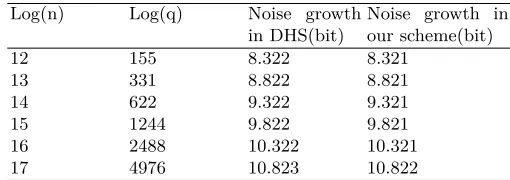
In this paper, we set Bi = 212, B = 2, δ = 1.0066, and compute the noise
growth of evaluating one block (one level per block in DHS16 ).The results are presented in table1.
Table 1.Comparsion of noise growth between DHS16 and our scheme Log(n) Log(q) Noise growth
in DHS(bit)
Noise growth in our scheme(bit)
12 155 8.322 8.321
13 331 8.822 8.821
14 622 9.322 9.321
15 1244 9.822 9.821
16 2488 10.322 10.321
17 4976 10.823 10.822
Analysis shows that in the case of two levels per block, the noise growth in our scheme is almost same as DHS16. Therefor we choose the same number of levels and modulus as in DHS16.
3.4 Leveled multi-key FHE scheme
In this section, we extend the leveled single-key FHE scheme in section 3.1 to a leveled multi-key FHE scheme based on the framework of LTV12.
– Setup(1λ): For security parameterλ, given the following parameters which
have been defined above: a integern=n(λ), the prime modulusq=q(λ), the polynomial ringR=Z(x)/xn+ 1 andR
q =R/qR, and aB =B(λ)-bound
error distributionχ over the ring R. Define a series of decreasing modulus
q0 =pt > q1 >· · · > qt−1, one modulus per circuit level, and require that
qi =pt−i fori∈ {0, ..., t−1}.
– KeyGen(1λ): Choose polynomials f′, g←χ, and setf = 2f′+ 1(Iff is not
invertible overRq, resamplef′) so thatf ≡1 mod 2.
Samplesτ, eτ ←χ, and forj∈ {1,2,3},τ∈ {0, ...,⌊logq0⌋}, compute
Outputsk:=f ∈Rq0(the secret keyf remains the same for all levels), and
pk:= {
h, ζj,τ(0)
}
j∈{1,2,3},τ∈{0,...,⌊logq0⌋} .
– Enc(pk, m)�Input the message m, sample s(0), e(0) ← χ, and output the ciphertext
c(0):=hs(0)+ 2e(0)+m∈Rq0
– Dec(f1, ..., fN, c): Input the ciphertext c ∈ Rp, suppose the corresponding
secret keys of the involved users aref1, ..., fN, compute
µ:= (f1· · ·fN)·c(modp)(mod2)
and output the messageµ.
– Eval(C×, ci1−2, c2i−2, ci3−2, ci4−2): Here we show how to homomorphically mul-tiply four ciphertexts ci1−2, ci2−2, c3i−2 and ci4−2 at level (i−2). We assume that the users associated with each ciphertext is denoted by K1, K2, K3, andK4 respectively. The public-key set of a fresh encryption is simply the set{pk}containing the public key under which it was encrypted, and we set
K1∪K2∪K3∪K4={pk1, . . . , pkr}.
(1) Multiplication:˜c(1i−2)=c1(i−2)×c2(i−2)( modqi−2);c˜
(i−2) 2 =c
(i−2) 3 ×c
(i−2) 4 ( mod
qi−2).
(2) Modulus switching:˜c(1i−1)=⌊(qi−1/qi−2)·˜c (i−2) 1 ⌉2;c˜
(i−1)
2 =⌊(qi−1/qi−2)· ˜
c(2i−2)⌉2(3) Multiplication:˜˜c(i−1)=˜c(i−1) 1 ·c˜
(i−1)
2 ( modqi−1)(4)
Relineariza-tion�Forv= 1, ..., r andτ ∈ {0, ...,⌊logqi−1⌋}, define˜˜c (i−1)
v−1,τ so that
˜ ˜c(vi−−11)=
⌊log∑qi−1⌋
τ=0 ˜ ˜c(vi−−11),τ2τ
is the binary representation of˜˜c(i−1)
v−1 , and˜˜c (i−1)
0 =˜˜c(i−1). (a) Ifpkv∈ {K1∩K2∩K3∩K4}, let
˜ ˜c(vi−1) =
⌊log∑qi−1⌋
τ=0 ˜
˜c(vi−−11),τζj(i−2→i)
v=3,τ
(b) If pkv ∈ {/ K1∩K2∩K3∩K4}, and pkv is exist in any three sets of
K1, K2, K3, K4, let
˜ ˜c(vi−1) =
⌊log∑qi−1⌋
τ=0 ˜
˜c(vi−−11),τζj(i−2→i)
v=2,τ
(c) If pkv ∈ {/ K1∩K2∩K3∩K4}, and pkv is exist in any two sets of
K1, K2, K3, K4, let
˜ ˜c(vi−1) =
⌊log∑qi−1⌋
τ=0 ˜
Finally, we can get˜˜c(i−1)
r iteratively.
(5) Modulus switching:c˜(i)=⌊(qi/qi−1)·˜˜c
(i−1)
r ⌉2, and output the result ci-phertext˜c(i), whose corresponding secret key isf1·f2· · ·fr.
To see why relinearization works, see the proof below.
P roof : Suppose that the evaluation key of v-th user is ζj(i−2→i)
v,τ =hsτ+
2eτ+ 2τ(fv)jv, thus the corresponding secret key of˜˜c
(i−1)
v−1 can be represented byf′·(fv)jv+1, wheref′generally denotes the combination of other users’ secret
keys, and we show that the new secret key after 1-round relinearization by the evaluation keyζj(i−2→i)
v,τ is changed tof
′·fv.
The new ciphertext˜˜c(i−1)
v =
⌊log∑qi−1⌋
τ=0 ˜
˜c(vi−−11),τζj(i−2→i)
v,τ , and the decrypting
pro-cess can be represented by:
(f′·fv)·˜˜c
(i−1)
v
= (f′·fv)
⌊log∑qi−1⌋
τ=0 ˜
˜c(vi−−11),τζj(i−2→i)
v,τ (modqi−1)
=f′·
⌊log∑qi−1⌋
τ=0 ˜
˜c(vi−−11),τ(2Eζ+ 2τ(fv)jv+1)
=2f′
⌊log∑qi−1⌋
τ=0 ˜
˜c(vi−−11),τEζ+f′·(fv)jv+1
⌊log∑qi−1⌋
τ=0 ˜ ˜c(vi−−11),τ2τ = 2f′
⌊log∑qi−1⌋
τ=0 ˜
˜c(vi−−11),τEζ+˜˜c
(i−1)
v−1 (
f′·(fv)jv+1
)
(modqi−1)
= 2f′
⌊log∑qi−1⌋
τ=0 ˜
˜c(vi−−11),τEζ+
(
2˜˜E(vi−−11)+f′·(fv)
jv+1·C(m
1, ..., mr)
)
(modqi−1) = 2˜˜E′v(i−−11)+f′·(fv)jv+1·C(m1, ..., mr)(modqi−1)
=C(m1, ..., mr)(mod2)
Finally we can get˜˜c(i−1)
r iteratively whose secret key is∏rv=1fv.
The optimized multi-key FHE scheme in this section has the following ad-vantages comparing to LTV12:
(1) Relinearization process are implemented after evaluating two levels cir-cuit, which can reduce the computational complexity significantly.
(2) Only the evaluation keys whose corresponding users are existed in at least two ciphertexts are employed in relinearization process, which is efficient and important in real applications.
(3) An efficient two-round MPC can be constructed based on the multi-key FHE scheme in this section.
4 Two-round multiparty computation
usually required to decrypt in sequence, which may cause complicated decryp-tion process and inevitable interacdecryp-tion between users. However, in many actual scenarios, we do not want too much interaction, and prefer the final decryption process is completed by each user independently. That is to say, distributed decryption, in most cases, is the preferred decryption method in real life.
4.1 Construction
In this paper, according to the particularity of ciphertext form in NTRU-based leveled FHE scheme, we construct a distributed decryption process which can be implemented by the involved users independently. In our construction, each user will firstly receive the result evaluated ciphertext from the cloud server, and compute the ciphertext with his (her) own secret key to obtain an “inter-mediate ciphertext”. Secondly, all the “inter“inter-mediate ciphertext” will be sent to the user or organization who requires the evaluated results for decryption.
The whole process is relatively simple and intuitive, and we give a formalized explanation below to demonstrate the feasibility of constructing the distributed decryption by the NTRU-type FHE scheme.
Suppose that the result ciphertext after homomorphically evaluating the cir-cuitC is denoted byc∈RqL, the user set involved incisS={i1, ..., iN}, their
corresponding secret keys skij = fij, and the corresponding message is mij,
j∈[N]. Then it holds that
(∏N
j=1fij)·c= 2Eerror+C(mi1, ..., miN)(modqL)
Step 1. After the cloud return the result ciphertext c ∈ Rqt−1 to involved users, each user firstly semi-decrypt the ciphertext using his own secret key and get a semi-ciphertextc′i
j=fij·c. As the corresponding secret key ofcis
∏N j=1fij,
c′ij doesn’t reveal any information of users’ messages.
Step 2. After all the users return the semi-ciphertexts c′i
j to the user or
organization who are going to decrypt, the user or organization firstly compute
c−(N−1)∈R
qt−1, and then compute
c−(N−1)·∏N
j=1c′ij =c−
(N−1)·∏N
j=1(fij ·c)
=c−(N−1)·cN−1·(∏N
j=1fij)·c
= (∏Nj=1fij)·c(modqL)(mod2)
= 2Eerror+C(mi1, ..., miN)
∏N
j=1c′ij(mod2)
=C(mi1, ..., miN)
Note that the modulus switching process is needed to reduce the noise at the final process of step 2 to ensure correct decryption.
4.2 Applications in secure genomic diagnoses
Genes are codes that direct human activity, thousands of monogenic diseases have been diagnosed to be caused by ”malignant” mutations in certain genes. In the diagnosis of such diseases, it is necessary to find the exact location where these genetic variants occur, and this often requires comparison between the genes of patients and healthy people. However, genetic data is individual’s pri-vacy, genome sharing enables discrimination [25], and even causes crime once genome information is leaked or stolen by malicious and illegal person or organi-zation. How to analyze the patient’s genetic data while protecting the privacy of genetic data is a problem worth considering in the current cloud environment.
In [25], Jagadeesh K A et al. apply a cryptographic method called Yao’s protocol to perform the desired computation without revealing any participant’s input, and introduce a “two-cloud” model to extend the protocol to N parties. However, they need to assume there are two non-colluding cloud servers that facilitate the protocol execution, which is weak in real cloud and is vulnerable to collusion attacks.
MKFHE can effectively solve the problem of colluding cloud, because the cloud can only access and compute the ciphertext of the patient’s genetic data.
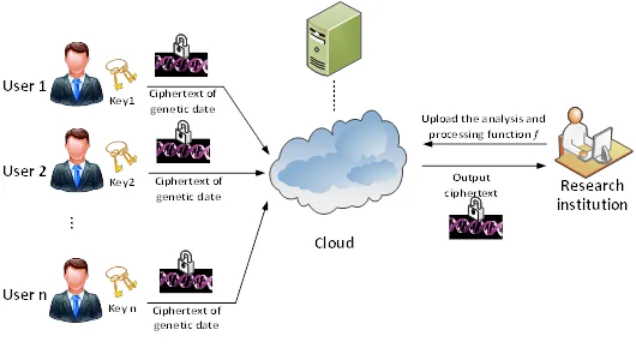
The process is as follows:
Step1. The medical institution performs gene sequencing on the patients, after that, each individual will get a variant vector of all possible rare missense and nonsense variants in the human genome, and privately denote “1” or “0” to indicate whether they have the specific mutation or not respectively, so that each individual will get a bit string.
Step2. All patients encrypt their genome bits by MKFHE scheme and upload them to the cloud.
Step3. The research institution upload the homomorphic evaluating function of genome data to the cloud.
Step4. The cloud perform the homomorphic evaluating function on the en-crypted genome data and return the result ciphertext to the patients.
Step5. The result ciphertext is jointly decrypted by all patients and return the result to the research institution.
5 Experimental results
In this section, we compare the efficiency of our single key holomorphic en-cryption scheme and DHS16. The results are presented in table 2.
Fig. 1.The flowchart of the secure genomic diagnoses
Table 2. The comparison of homomorphic multiplication between DHS16 and our scheme
Scheme
Level(s) for one relinearization
Number of levels
Total Time for evaluating multiplication gate
Average time for evaluating multiplication gate
DHS16 1 36 168084 4669
Our scheme 2 36 86832 2412
6 Conclutions
In this paper, we propose an efficient leveled MKFHE scheme, which im-proves the efficiency of homomorphic evaluations, and constructs a two-round multiparty computation (MPC) protocol based on this. We reduce the number of relinearization operations in homomorphic evaluations process by separating the homomorphic multiplication and relinearization techniques. We construct a distributed decryption process which can be implemented independently for all participating users, and avoid the interaction between users in the decryption process. Based on this, a two-round MPC protocol is proposed.
References
[1] T. Ristenpart, E. Tromer, H. Shacham, and S. Savage. Hey, you, get off of my cloud: exploring information leakage in third-party compute clouds. In ACM Conference on Computer and Communications Security, pages 199-212, 2009 [2] Rivest R., Adleman L., Dertouzos M.: On Data Banks and Privacy
Homo-morphisms, pp. 169–177. Academic Press, New York (1978)
[3] Craig Gentry. Fully homomorphic encryption using ideal lattices. In STOC, volume 9, pages 169-178, 2009.
[4] Dijk M V, Gentry C, Halevi S, et al. Fully homomorphic encryption over the integers, International Conference on Theory and Applications of Cryp-tographic Techniques. Springer-Verlag, 2010:24-43.
[5] Zvika Brakerski and Vinod Vaikuntanathan. Efficient fully homomorphic encryption from (standard) LWE. Foundations of Computer Science Annual Symposium on, 2011(2):97-106, 2011.
[6] Zvika Brakerski and Vinod Vaikuntanathan. Fully homomorphic encryp-tion from ring-lwe and security for key dependent messages. In Advances in Cryptology-CRYPTO 2011, pages 505-524. Springer, 2011.
[7] Zvika Brakerski, Craig Gentry, and Vinod Vaikuntanathan. (leveled) fully homomorphic encryption without bootstrapping. In Proceedings of the 3rd Innovations in Theoretical Computer Science Conference, pages 309-325.ACM, 2012.
[8] Craig Gentry, Amit Sahai, and Brent Waters. Homomorphic encryption from learning with errors: Conceptually-simpler, asymptotically-faster, attribute-based. In Advances in Cryptology-CRYPTO 2013, pages 75-92. Springer, 2013.
[9] Jacob Alperin-Sheriff and Chris Peikert. Faster bootstrapping with poly-nomial error. In Advances in Cryptology-CRYPTO 2014, pages 297-314. Springer, 2014.
[11] O. Goldreich, S. Micali, and A. Wigderson. How to play any mental game or a completeness theorem for protocols with honest majority. In STOC, pages 218-229, 1987.
[12] M. Ben-Or, S. Goldwasser, and A. Wigderson. Completeness theorems for non-cryptographic fault-tolerant distributed computation (extended abstract). In STOC, pages 1-10, 1988.
[13] D. Chaum, C. Cr´epeau, and I. Damg˚ard. Multiparty unconditionally se-cure protocols (extended abstract). In STOC, pages 11-19, 1988.
[14] A. C.-C. Yao. Protocols for secure computations (extended abstract). In FOCS, pages 160-164, 1982.
[15] Damien Stehlé, Steinfeld R . Making NTRU as secure as worst-case problems over ideal lattices[J]. 2011.
[16] Hoffstein J., Pipher J., Silverman J.H. (1998) NTRU: A ring-based public key cryptosystem. In: Buhler J.P. (eds) Algorithmic Number Theory. ANTS 1998. Lecture Notes in Computer Science, vol 1423. Springer, Berlin, Hei-delberg.
[17] Yarkın Doröz, Y. Hu , and B. Sunar .Homomorphic AES evaluation using the modified LTV scheme. Kluwer Academic Publishers, 2016.
[18] Chongchitmate W, Ostrovsky R. Circuit-private multi-key FHE[C]//IACR International Workshop on Public Key Cryptography. Springer, Berlin, Hei-delberg, 2017: 241-270.
[19] Michael Clear and Ciaran McGoldrick. Multi-identity and multi-key leveled FHE from learning with errors. In Advances in Cryptology - CRYPTO 2015, Proceedings, Part II, pages 630-656, 2015.
[20] Pratyay Mukherjee and Daniel Wichs. Two round multiparty computation via multi-key FHE. In Advances in Cryptology - EUROCRYPT 2016 , Pro-ceedings, Part II, pages 735-763, 2016.
[21] Chris Peikert and Sina Shiehian. Multi-key FHE from lwe, revisited. In The-ory of Cryptography - 14th International Conference, TCC 2016-B, Proceed-ings, Part II, pages 217-238, 2016.
[22] BRAKERSKI Z, PERLMAN R. Lattice-based fully dynamic multi-key FHE with short ciphertexts. In: Advances in Cryptology—CRYPTO 2016. Springer Berlin Heidelberg, 2016: 190–213.
[23] Chen L, Zhang Z, Wang X. Batched Multi-hop Multi-key FHE from Ring-LWE with Compact Ciphertext Extension, Theory of Cryptography Confer-ence. Springer, Cham, 2017:597-627.
[24] Smart N P, Vercauteren F. Fully homomorphic SIMD operations[J]. Designs, codes and cryptography, 2014, 71(1): 57-81.