and beyond
Craig Costello1 and Benjamin Smith2
1
Microsoft Research, USA [email protected]
2
Inriaand Ecole polytechnique, Institut Polytechnique de Paris, Palaiseau, France´ [email protected]
Abstract. Let A/Fp and A0/Fp be superspecial principally polarized abelian varieties of dimensiong >1. For any prime `6=p, we give an algorithm that finds a pathφ:A →A0 in the (`, . . . , `)-isogeny graph in Oe(pg−1) group operations on a classical computer, and Oe(
p
pg−1)
calls to the Grover oracle on a quantum computer. The idea is to find paths from A and A0 to nodes that correspond to products of lower dimensional abelian varieties, and to recurse down in dimension until an elliptic path-finding algorithm (such as Delfs–Galbraith) can be invoked to connect the paths in dimensiong= 1. In the general case whereAand
A0are any two nodes in the graph, this algorithm presents an asymptotic improvement over all of the algorithms in the current literature. In the special case whereAandA0 are a known and relatively small number of steps away from each other (as is the case in higher dimensional analogues of SIDH), it gives an asymptotic improvement over the quantum claw finding algorithms and an asymptotic improvement over the classical van Oorschot–Wiener algorithm.
1
Introduction
Isogenies of supersingular elliptic curves are now well-established in cryptogra-phy, from the Charles–Goren–Lauter hash function [10] to Jao and De Feo’s SIDH key exchange [27] and beyond [2,21,12,13]. While the security of isogeny-based cryptosystems depend on the difficulty of a range of computational prob-lems, the fundamental one is the isogeny problem: given supersingular elliptic curvesE1 andE2 overFp2, find a walk in the`-isogeny graph connecting them.
Forg= 2, Takashima [36] and Castryck, Decru, and Smith [7] have defined CGL-style hash functions, while Costello [11] and Flynn and Ti [19] have already proposed SIDH-like key exchanges. Generalizations to dimensions g > 2, using isogeny algorithms such as those in [4], are easy to anticipate; for example, a family of hash functions on isogeny graphs of superspecial abelian varieties with real multiplication was hinted at in [9].
So far, when estimating security levels, these generalizations assume that the higher-dimensional supersingular isogeny problem is basically as hard as the elliptic supersingular isogeny problem in graphs of the same size. In this article, we show that this assumption is false. The general supersingular isogeny problem can be partially reduced to a series of lower-dimensional isogeny problems, and thus recursively to a series of elliptic isogeny problems.
Theorem 1. There exists a classical algorithm which, given a prime `and su-perspecial abelian varieties A1 andA2 of dimension g overFp with p6=`, suc-ceeds with probability≥1/2g−1in computing a composition of(`, . . . , `)-isogenies fromA1toA2, running in expected timeOe((pg−1/P))onP processors asp→ ∞
(with `fixed).
Given that these graphs have O(pg(g+1)/2) vertices, the expected runtime for generic random-walk algorithms isOe(pg(g+1)/4/P). Our algorithm therefore
represents a substantial speedup, with nontrivial consequences for cryptographic parameter selection.3 We also see an improvement in quantum algorithms:
Theorem 2. There exists a quantum algorithm which, given a prime ` and superspecial abelian varieties A1 and A2 of dimension g over Fp with p 6= `, computes a composition of(`, . . . , `)-isogenies fromA1toA2running in expected timeOe(
p
pg−1) asp→ ∞ (with` fixed).
This reflects the general pattern seen in the passage from ECC to HECC: the dimension grows, the base field shrinks—-and the mathematical structures become more complicated, which can ultimately reduce claimed security levels. Just as index calculus attacks on discrete logarithms become more powerful in higher genus, where useful structures appear in Jacobians [15,23,22,34], so in-teresting structures in higher-dimensional isogeny graphs provide attacks that become more powerful as the dimension grows. Here, the interesting structures are (relatively large) subgraphs corresponding to increasing numbers of elliptic factors in (polarized) abelian varieties. These subgraphs are relatively large, and so random-walking into them is relatively easy. We can then glue together elliptic isogenies, found with an elliptic path-finding algorithm, to form product isoge-nies between products of elliptic curves, and thus to solve the original isogeny problem. We will see that the path-finding problem in the superspecial graph gets asymptotically easier as the dimension grows.
3 Our algorithms apply to the full superspecial graph; we do not claim any impact on
Notation and conventions. Throughout, pdenotes a prime >3, and `a prime not equal to p. Typically,pis large, and`log(p) is small enough that com-puting (`, . . . , `)-isogenies ofg-dimensional principally polarized abelian varieties (PPAVs) is polynomial in log(p). Similarly, we work with PPAVs in dimensions
g logp; in our asymptotics and complexities, g and ` are fixed. We say a functionf(X) is inOe(g(X)) iff(X) =O(h(logX)g(X)) for some polynomialh.
2
The elliptic supersingular isogeny graph
An elliptic curveE/Fpissupersingular ifE[p](Fp) = 0. We have a number of ef-ficient algorithms for testing supersingularity: see Sutherland [35] for discussion. Supersingularity is isomorphism-invariant, and any supersingular E has j -invariantj(E) inFp2; and in fact the curveE can be defined overFp2. We let
S1(p) :=
j(E) :E/Fp2 is supersingular ⊂Fp2
be the set of isomorphism classes of supersingular elliptic curves over Fp. It is well-known that
#S1(p) =j p 12
k
+p (1)
wherep= 0 ifp≡1 (mod 12), 2 ifp≡ −1 (mod 12), and 1 otherwise. Now fix a prime`6=p, and consider the directed multigraph Γ1(`;p) whose vertex set is S1(p), and whose edges correspond to `-isogenies between curves (again, up to isomorphism). The graphΓ1(`;p) is (`+ 1)-regular: there are (up to isomorphism) `+ 1 distinct `-isogenies from a supersingular elliptic curve
E/Fp2 to other elliptic curves, corresponding to the `+ 1 order-` subgroups of
E[`](Fp)∼= (Z/`Z)2that form their kernels. But since supersingularity is isogeny-invariant, the codomain of each isogeny is again supersingular; that is, the`+ 1 order-`subgroups ofE[`] are in bijection with the edges out ofj(E) inΓ1(`;p). Definition 1. A walkof length n in Γ1(`;p)is a sequence of edges j0→j1→
· · · →jn. ApathinΓ1(`;p)is an acyclic (and, in particular, non-backtracking) walk: that is, a walkj0→j1→ · · · →jn such thatji=ji0 if and only ifi=i0.
Pizer [32] proved thatΓ1(`;p) is Ramanujan: in particular,Γ1(`;p) is a con-nected expander graph, and its diameter is O(logp). We therefore expect the end-points of short random walks from any given vertex j0 to quickly yield a uniform distribution onS1(p). Indeed, ifj0is fixed andjnis the end-point of an
n-step random walk fromj0 inΓ1(`;p), then [21, Theorem 1] shows that
Pr[jn=j]− 1 #S1(p)
≤ 2 √
` `+ 1
!n
for allj ∈S1(p). (2)
The isogeny problem is supposed to be hard. Our best generic classical path-finding algorithms look for collisions in random walks, and run in expected time the square root of the graph size: in this case, Oe(
√
p). In the special case of supersingular isogeny graphs, we can make some practical improvements but the asymptotic complexity remains the same: givenj0 andj inF1(p;`), we can compute a pathj0→j in Oe(
√
p) classical operations (see [14]).
The best known quantum algorithm for path-finding [3] instead searches for paths fromj0→j00 and fromj →j0, wherej00 andj0are both inFp. Of theO(p) elements in S1(p), there are O(
√
p) elements contained in Fp; while a classical search for elements this sparse would therefore run in time O(√p), Grover’s quantum algorithm [24] completes the search in expected timeO(√4p). It remains to find a path fromj00 toj0. This could be computed classically in timeOe(4
√
p) using the Delfs–Galbraith algorithm, but Biasse, Jao and Sankar [3] show that a quantum computer can find paths between subfield curves in subexponential time, yielding an overall algorithm that runs in expected timeO(√4p).
We can also consider the problem of finding paths of a fixed (and typically short) length: for example, given e > 0 and j0 and j in S1(p) such that there exists a path φ: j0 → · · · →j of length e, find φ. This problem arises in the security analysis of SIDH, for example.
3
Cryptosystems in the elliptic supersingular graph
The Charles–Goren–Lauter hash function (CGL). Supersingular isogenies ap-peared in cryptography with the CGL hash function, which operates inΓ1(2;p). Fix a base pointj0 in S1(p), and one of the three edges inΓ1(2;p) leading into it: j−1→j0, say. To hash ann-bit message m= (m0, m1, . . . , mn−1), we let m drive a non-backtracking walkj0→ · · · →jn onΓ1(2;p): for each 0≤i < n, we compute the two rootsα0andα1ofΦ2(ji, X)/(ji−1−X) to determine the neigh-bours ofji that are notji−1, numbering the roots with respect to some ordering
ofFp2 (hereΦ2(Y, X) is the classical modular polynomial), and setji+1=αmi.
Once we have computed the entire walk j0 → · · · → jn, we can derive a log2p-bit hash valueH(m) from the end-pointjn; we call this stepfinalisation. Charles, Goren, and Lauter suggest applying a linear function f : Fp2 → Fp to map jn to H(m) = f(jn). For example, if Fp2 = Fp(ω) then we can map
jn =jn,0+jn,1ω (withjn,0 and jn,1 in Fp) to H(m) = ajn,0+bjn,1 for some fixed random choice ofaandbin Fp. Heuristically, for generalf, if we suppose
collisions and second preimages forH amounts to finding cycles inΓ1(2;p). For well-chosenpandj0, this is roughly as hard as the isogeny problem [10,§5].
SIDH. Jao and De Feo’s SIDH key exchange [27] begins with a supersingular curveE0/Fp2, wherepis in the formc·2a3b−1, with fixed torsion baseshP2, Q2i=
E0[2a] andhP
3, Q3i=E0[3b] (which are rational because of the special form of
p). Alice computes a secret walkφA : E0 → · · · → EA of length a in Γ1(2;p), publishingEA,φA(P3), andφA(Q3); similarly, Bob computes a secret walkφB :
E0→ · · · → EB of lengthbinΓ1(3;p), publishingEB,φB(P2), andφB(Q2). The basis images allow Alice to computeφB(kerφA), and BobφA(kerφB); Alice can thus “repeat” her walk starting from EB, and Bob his walk from EA, to arrive at curves representing the same point inS1(p), which is their shared secret.
Breaking Alice’s public key amounts to solving an isogeny problem inΓ1(2;p) subject to the constraint that the walk have lengtha(which is particularly short). The 3b-torsion basis may give some useful information here, though so far this is only exploited in attacks on artificial variants of SIDH [31]. Similarly, breaking Bob’s public key amounts to solving a length-b isogeny problem in Γ1(3;p). Alternatively, we can compute these short paths by computing endomorphism rings: [20, Theorem 4.1] states that ifE andE0 are inS
1(p) and we haveexplicit descriptionsof End(E) and End(E0), then we can efficiently compute theshortest
path fromE toE0 inΓ1(`;p) (see [29,20,17] for further details on this approach).
4
Abelian varieties and polarizations
An abelian variety is a smooth projective algebraic group variety. An isogeny of abelian varieties is a surjective finite morphismφ:A → A0 such thatφ(0
A) =
0A0. In dimensiong= 1, these definitions coincide with those for elliptic curves.
The proper higher-dimensional generalization of an elliptic curve is a prin-cipally polarized abelian variety (PPAV). A polarization of A is an isogeny
λ : A → Ab, where A ∼b= Pic0(A) is the dual abelian variety; λ is principal if
it is an isomorphism. IfA=Eis an elliptic curve, then there is a canonical prin-cipal polarization λ: P 7→[(P)−(∞)], and every other principal polarization is isomorphic to λ (via composition with a suitable translation and automor-phism). The JacobianJC of a curveCalso has a canonical principal polarization
defined by the theta divisor, which essentially corresponds to an embedding of
C inJC, and thus connectsJC with the divisor class group ofC.
We need a notion of compatibility between isogenies and principal polariza-tions. First, recall that every isogenyφ:A → A0 has a dual isogeny
b
φ:Ac0 →Ab.
Now, if (A, λ) and (A0, λ0) are PPAVs, thenφ:A → A0 is anisogeny of PPAVs
if φb◦λ0◦φ = [d]λ for some integer d. We then have φ† ◦φ = [d] on A (and φ◦φ† = [d] onA0), whereφ†:=λ−1◦
b
is a simple criterion on subgroupsS⊂ A[d] to determine when an isogeny with kernelS is an isogeny of PPAVs: the subgroup should be Lagrangian.4
Definition 2. Let A/Fp be a PPAV and let m be an integer prime to p. A Lagrangian subgroupof A[m]is a maximalm-Weil isotropic subgroup ofA[m].
If ` 6= p is prime, then A[`n] ∼= (
Z/`nZ)2g for all n > 0. If S ⊂ A[`] is Lagrangian, thenS ∼= (Z/`Z)g. Any Lagrangian subgroup ofA[`n] is isomorphic to (Z/`Z)n1× · · · ×(
Z/`Z)ng for somen
1≥ · · · ≥ng with Pini=gn(though not every (n1, . . . , ng) withPini=gnoccurs in this way).
We now have almost everything we need to generalize supersingular isogeny graphs from elliptic curves to higher dimension. The elliptic curves will be re-placed by PPAVs;`-isogenies will be replaced by isogenies with Lagrangian ker-nels in the `-torsion—called (`, . . . , `)-isogenies—and the elliptic dual isogeny will be replaced by the Rosati dual. It remains to define the right analogue of supersingularity in higher dimension, and study the resulting graphs.
5
The superspecial isogeny graph in dimension
g
We need an appropriate generalization of elliptic supersingularity to g >1. As explained in [7], it does not suffice to simply take the PPAVsA/FpwithA[p] = 0.
Definition 3. A PPAVAissupersingularif the Newton polygon of its Frobe-nius endomorphism has all slopes equal to 1/2, and superspecial if Frobenius acts as0onH1(A,O
A). Superspecial implies supersingular; in dimensiong= 1,
the definitions coincide.
All supersingular PPAVs are isogenous to a product of supersingular elliptic curves. Superspecial abelian varieties are isomorphic to a product of supersin-gular elliptic curves, though generally only asunpolarized abelian varieties. The special case of Jacobians is particularly relevant for us when constructing exam-ples:JC is superspecial if and only if the Hasse–Witt matrix of Cvanishes.
It is argued in [7] that the world of superspecial (and not supersingular) PPAVs is the correct setting for supersingular isogeny-based cryptography. We will not repeat this argument here; but in any case, every higher-dimensional “supersingular” cryptosystem proposed so far has in fact been superspecial.
In analogy with the elliptic supersingular graph, then, we define
Sg(p) :=
A:A/Fp2 is a superspecialg-dimensional PPAV /∼= .
Our first task is to estimate the size ofSg(p). Lemma 1. We have#Sg(p) =O(pg(g+1)/2).
4 Isogenies with strictly smaller kernels exist—isogenies with cyclic kernel are treated
Proof. See [18,§5]. This follows from the Hashimoto–Ibukiyama mass formula
X
A∈Sg(p)
1 #Aut(A)=
g
Y
i=1
B2i
4i (1 + (−p)
i),
where B2i is the 2i-th Bernoulli number. In particular, #Sg(p) is a polynomial in pof degreePg
i=1i=g(g+ 1)/2. ut Note that #Sg(p) growsquadratically ing(and exponentially in logp): we have #S1(p) =O(p), #S2(p) =O(p3), #S3(p) =O(p6), and #S4(p) =O(p10).
For each prime` 6=p, we let Γg(`;p) denote the (directed) graph on Sg(p) whose edges areFp-isomorphism classes of (`,· · ·, `)-isogenies of PPAVs: that is, isogenies whose kernels are Lagrangian subgroups of the`-torsion. Superspecial-ity is invariant under (`, . . . , `)-isogeny, so to determine the degree of the vertices ofΓg(`;p) it suffices to enumerate the Lagrangian subgroups of ag-dimensional PPAV. A simple counting argument yields Lemma 2.
Lemma 2. If A/Fp is a g-dimensional PPAV, then the number of Lagrangian subgroups ofA[`], and hence the number of edges leavingAin Γg(`;p), is
Ng(`) := g X d=0 g d `
·`(g−d2+1).
(The `-binomial coefficient n k
` :=
(n)`···(n−k+1)`
(k)`···(1)` , where (i)` :=
`i−1
`−1, counts the k-dimensional subspaces of Fn`.) In particular,Γg(`;p)isNg(`)-regular; and
Ng(`)is a polynomial in `of degree g(g+ 1)/2.
We do not yet have analogues of Pizer’s theorem to guarantee thatΓg(`;p) is Ramanujan wheng >1, though this is proven for superspecial abelian varieties with real multiplication [26]. We therefore work on the following hypothesis: Hypothesis 1. The graph Γg(`;p)is Ramanujan.
We need Hypothesis 1 in order to obtain the following analogue of Eq. 2 (a standard random walk theorem, as in [25,§3]): if we fix a vertexA0and consider
n-step random walksA0→ · · · → An, then
Pr[An ∼=A]− 1 #Sg(p)
≤ 2 p
Ng(`)−1
Ng(`)
!n
for allA ∈Sg(p). (3)
That is, random walks inΓg(`;p) converge exponentially quickly to the uniform distribution: after O(logp) steps in Γg(`;p) we are uniformly distributed over
Remark 1. Existing proposals of higher-dimensional supersingular isogeny-based cryptosystems all implicitly assume (special cases of) Hypothesis 1. For the purposes of attacking their underlying hard problems, we are comfortable making the same hypothesis. After all, if our algorithms are less effective because the expansion properties ofΓg(`;p) are less than ideal, then the cryptosystems built onΓg(`;p) will fail to be effective by the same measure.
6
Superspecial cryptosystems in dimension
g
= 2
Before attacking the isogeny problem inΓg(`;p), we consider some of the cryp-tosystems that have recently been defined in Γ2(`;p). This will also illustrate some methods for computing in these graphs, and as well as special cases of the general phenomena that can help us solve the isogeny problem more efficiently. For the rest of this section, therefore, we restrict to dimension g= 2.
Every 2-dimensional PPAV is isomorphic (as a PPAV) to either the Jacobian of a genus-2 curve, or to a product of two elliptic curves. We can therefore split
S2(p) naturally into two disjoint subsets:S2(p) =S2(p)JtS2(p)E, where
S2(p)J :={A ∈S2(p) :A ∼=JC withg(C) = 2} and S2(p)E :={A ∈S2(p) :A ∼=E1× E2 withE1,E2∈S1(p)} .
Vertices inS2(p)J are “general”, while vertices inS2(p)E are “special”. We can make the estimates implied by Lemma 1 more precise: ifp >5, then
#S2(p)J= 1 2880p
3+ 1 120p
2 and #S2(p)E = 1 288p
2+O(p)
(see e.g. [7, Proposition 2]). In particular, #S2(p)E/#S2(p) = 10/p+o(1).
Takashima’s hash function. Takashima [36] was the first to generalize CGL to
g = 2. We start with a distinguished vertex A0 in S2(p), and a distinguished incoming edge A−1 → A0 in Γ2(`;p). Each message m then drives a walk in
Γ2(`;p): at each vertex we have a choice of 14 forward isogenies (the 15th is the dual of the previous, which is a prohibited backtracking step). The messagemis therefore coded in base 14. While traversing the graph, the vertices are handled as concrete genus-2 curves representing the isomorphism classes of their Jaco-bians. Lagrangian subgroups correspond to factorizations of the hyperelliptic polynomials into a set of three quadratics, and the isogenies are computed using Richelot’s formulæ (see [6, Chapters 9-10] and [33, Chapter 8]). We derive a hash value From the final vertexAn as the Igusa–Clebsch invariants of the Jacobian, in F3p2; Takashima does not define a finalisation map (intoF3p, for example).
Example 1. Given someA0 in S2(p), choose a pointP of order 4 onA0. There exist Q and R in A0[2] such that e2([2]P, Q) = 1 and e2([2]P, R) = 1, but
e2(Q, R)6= 1. The Lagrangian subgroupsK0 :=h[2]P, Qi and K00 :=h[2]P, Ri of A0[2] are kernels of (2,2)-isogenies φ0 :A0 → A1 =∼A0/K0 andφ00 : A0 →
A0
1 ∼=A0/K00; and in general,A1 6∼=A01. NowK1:=φ0(K00) andK10 :=φ00(K0) are Lagrangian subgroups ofA1[2]. Writing I1= kerφ1† andI10 = ker (φ01)
†
, we see thatK1∩I1=hφ1(R)iandK10∩I10 =hφ1(Q)i. We thus define another pair of (2,2)-isogenies, φ1 : A1 → A2 ∼=A1/K1 and φ01 : A01 → A02 ∼=A01/K10. We have ker(φ1◦φ0) = ker(φ01◦φ00), soA2∼=A02. Now letψ:= (φ00)
†
◦(φ0
1)
†
◦φ1◦φ0. We have ψ∼= [4]A0, butψ does not factor over [2]A0 (sinceA16∼=A
0
1). Henceψ represents a nontrivial cycle of length 4 in the graph.
The ubiquity of these length-4 cycles does not mean thatΓ2(2;p) is no use for hashing: it just means that we must use a stronger rule than backtrack-avoidance when selecting steps in a walk. The following hash function does just this. The Castryck–Decru–Smith hash function (CDS). Another generalization of CGL fromΓ1(2;p) toΓ2(2;p), neatly avoiding the length-4 cycles of Example 1, is defined in [7]. Again, we fix a vertexA0and an isogenyφ−1:A−1→ A0; we let
I0⊂ A0[2] be the kernel of the Rosati dualφ†−1. Now, letm= (m0, . . . , mn−1)
be a 3n-bit message, with each 0≤mi<8. The sequence (m0, . . . , mn−1) drives a path throughΓ2(2;p) as follows: our starting point isA0, with its distinguished subgroupI0 corresponding to the edgeA−1→ A0. For each 0≤i < n, we com-pute the set of eight Lagrangian subgroups {Si,0, . . . , Si,7} of Ai[2] such that
Si,j∩Ii = 0, numbering them according to some fixed ordering on the encod-ings of Lagrangian subgroups. Then we compute φi : Ai → Ai+1 ∼=Ai/Si,mi,
and let Ii+1 := φi(Ai[2]) = kerφi†. Once we have computed the entire walk
A0→ · · · → An, we can derive a 3 log2p-bit hash valueH(m) from the isomor-phism class ofAn (though such a finalisation is unspecified in [7]). The subgroup intersection condition ensures that the composition of the isogenies in the walk is a (2n, . . . ,2n)-isogeny, thus protecting us from the small cycles of Example 1. Putting this into practice reveals an ugly technicality. As in Takashima’s hash function, we compute with vertices as genus-2 curves, encoded by their hy-perelliptic polynomials, with (2,2)-isogenies computed using Richelot’s formulæ. Walk endpoints are mapped to Igusa–Clebsch invariants inF3
p2. But these curves, formulæ, and invariants only exist for vertices inS2(p)J. We can handle vertices inS2(p)E as pairs of elliptic curves, with pairs ofj-invariants for endpoints, and there are explicit formulæ to compute isogenies in to and out of S2(p)E (see e.g. [7,§3]). Switching between representations and algorithms (to say nothing of finalisation, where S2(p)E would have a smaller, easily distinguishable, and easier-to-invert image) seems like needless fiddle when the probability of stepping onto a vertex inS2(p)E is onlyO(1/p), which is negligible for cryptographicp.
message where the hash fails than it is to find a preimage with a square-root algorithm. The former requiresO(p) work, the latterO(p3/2). In this, as we will see, the simplified CDS hash function contains the seeds of its own destruction.
Genus-2 SIDH. Flynn and Ti [19] defined an SIDH analogue in dimensiong= 2. As in the hash functions above, Richelot isogenies are used for Alice’s steps in
Γ2(2;p), while explicit formulæ for (3,3)-isogenies on Kummer surfaces are used for Bob’s steps in Γ2(3;p). Walks may (improbably) run into S2(p)E, as with the hash functions above; but the same work-arounds apply without affecting security. (Further, if we generate a public key inS2(p)E, then we can discard it and generate a new one inS2(p)J.) As with SIDH, breaking public keys amounts to computing short solutions to the isogeny problem in Γ2(2;p) or Γ2(3;p), though presumably endomorphism attacks generalizing [17] also exist.
7
Attacking the isogeny problem in superspecial graphs
We want to solve the isogeny problem inΓg(`;p). We can always do this using random walks inO(p#Sg(p)) =O(pg(g+1)/4) classical steps.
Our idea is that Sg−1(p)×S1(p) maps into Sg(p) by mapping a pair of PPAVs to their product equipped with the product polarization, and the image of Sg−1(p)×S1(p) represents a large set of easily-identifiable “distinguished vertices” inΓg(`;p). Indeed, since the mapSg−1(p)×S1(p)→Sg(p) is generically finite, of degree independent ofp, Lemma 1 implies that
#Sg(p)/#(image of Sg−1(p)×S1(p)) =O(pg−1) forg >1. (4) We can efficiently detect such a step into a product PPAV in a manner analogous to that of the failure of the CDS hash function: for example, by the breakdown of a higher-dimensional analogue of Richelot’s formulæ such as [30].
We can walk into this subset, then recursively solve the path-finding problem in the subgraphs Γg−1(`;p), . . . , Γ1(`;p) (each time walking from Γi(`;p) into
Γi−1(`;p)×Γ1(`;p)) before gluing the results together to obtain a path inΓg(`;p). Lemma 3. Let α:A→A0 andβ:B →B0 be walks in Γi(`;p)and Γj(`;p) of lengthsa andb, respectively. If a≡b (mod 2), then we can efficiently compute a path of lengthmax(a, b)fromA×B toA0×B0 in Γi+j(`;p).
Proof. Writeα=α1◦ · · · ◦αa andβ=β1◦ · · · ◦βb as compositions of (`,· · ·, ` )-isogenies. WLOG, suppose a ≥b. Setβb+1 =βb†, βb+2 = βb, ..., βa−1 =βb†,
βa=βb; thenα×β: (α1×β1)◦· · ·◦(αa×βa) is a path fromA×BtoA0×B0. ut Equations 3 and 4 show that a walk of length O(logp) lands in the image of Sg−1(p)×S1(p) with probability O(1/pg−1), and after O(pg−1) such short
walks we are inSg−1(p)×S1(p) with probability bounded away from zero. More
Algorithm 1: Computing isogeny paths inΓg(`;p)
Input:AandA0
inSg(p)
Output:A pathφ:A → A0 inΓg(`;p)
1 Find a pathψfromAto some pointB × E inSg−1(p)×S1(p)
2 Find a pathψ0fromA0
to some pointB0× E0
inSg−1(p)×S1(p)
3 Find a pathβ:B → B0
inΓg−1(`;p) using Algorithm 1 recursively if
g−1>1, or elliptic path-finding ifg−1 = 1
4 Find a pathη:E → E0inΓ1(`;p) using elliptic path-finding
5 Letb= length(β) ande= length(η). Ifb6≡e (mod 2), then fail and return⊥
(or try again with anotherψand/orψ0,β, orη) 6 Construct the product pathπ:B × E → B0× E0
defined by Lemma 3. 7 returnthe path φ:=ψ0†◦π◦ψfromAtoA0.
Proof of Theorem 1 Algorithm 1 implements the approach above, and proves Theorem 1. Step 1 computes ψ by taking O(pg−1) non-backtracking random walks of lengthO(log(p)) which can be trivially parallelized, so withP proces-sors we expect Oe(pg−1/P) steps before finding ψ. (If A is a fixed public base
point then we can assumeψis already known). Likewise, Step 2 takesOe(pg−1/P)
steps to computeψ0. Afterg−1 recursive calls, we have reduced to the problem of computing paths inΓ1(`;p) in Step 4, which can be done in timeO(
√
p/P). Step 7 applies Lemma 3 to compute the final path in polynomial time. At each level of the recursion, we have a 1/2 chance of having the same walk-length parity; hence, Algorithm 1 succeeds with probability 1/2g−1. This could be im-proved by computing more walks when the parities do not match, but 1/2g−1 suffices to prove the theorem. The total runtime isOe(pg−1/P) isogeny steps.
Proof of Theorem 2 Algorithm 1 can be run in a quantum computation model as follows. First, recall from the proof of Theorem 1 that Steps 1 and 2 find product varieties by taking O(pg−1) walks of length O(log(p)). Here we proceed following Biasse, Jao and Sankar [3,§4]. LetN be the number of walks in O(pg−1) of lengthλ(inO(log(p))). To computeψ, we define an injection
f: [1, . . . , N]−→ {nodes of distanceλstarting fromA},
and a function Cf: [1, . . . , N] → {0,1} by Cf(x) = 1 if f(x) is in Sg−1(p)× S1(p), and 0 otherwise. If there is precisely one x with Cf(x) = 1, Grover’s algorithm [24] will find it (with probability≥1/2) inO(√N) iterations. If there are an unknownt≥1 such solutions, then Boyer–Brassard–Høyer–Tapp [5] finds one inO(pN/t) iterations. Hence, if we takeλlarge enough to expect at least one solution, then we will find it in O(ppg−1) Grover iterations. We compute
ψ0 (and any recursive invocations of Steps 1 and 2) similarly.
For the elliptic path finding in Steps 3 and 4, we can apply (classical) Pollard-style pseudorandom walks which requireOe(
√
p) memory andOe(
√
Grover’s algorithm to the full graphΓ1(`;p) to find an`-isogeny path in expected timeO(√p). Finally, Step 7 applies Lemma 3 to compute the final path. Remark 2. We can use the same approach as Algorithm 1 to compute explicit en-domorphism rings of superspecial PPAVs. Suppose we want to compute End(A) for some g-dimensional AinSg(p). Following the first steps of Algorithm 1, we compute a walkφfromAintoSg−1(p)×S1(p), classically or quantumly,
recurs-ing until we end up at some E1× · · · × Eg in S1(p)g. Now we apply an elliptic endomorphism-ring-computing algorithm to each of theEi; this is equivalent to solving the isogeny problem inΓ1(`;p) (see [17,§5]), so its cost is inOe(
√
p). The products of the generators for the End(Ei) form generators for End(E1×· · ·×Eg), which we can then pull back through φ to compute a finite-index subring of End(A) that is maximal away from`. The total cost is a classical Oe(pg−1/P)
(onP processors), or a quantum Oe( p
pg−1), plus the cost of the pullback. Remark 3. Algorithm 1 computes compositions of (`, . . . , `)-isogenies. If we relax and allow arbitrary-degree isogenies, not just paths inΓg(`;p) for fixed`, then the elliptic path-finding steps can use the classical Delfs–Galbraith [14] or quantum Biasse–Jao–Sankar [3] algorithms. While this would not change the asymptotic runtime of Algorithm 1 (under the reasonable assumption that the appropriate analogue of vertices “defined over Fp” with commutative endomorphism rings form a subset of sizeO(p
#Sg(p))), both of these algorithms have low memory requirements and are arguably more implementation-friendly than Pollard-style pseudorandom walks [14,§4].
8
Cryptographic implications
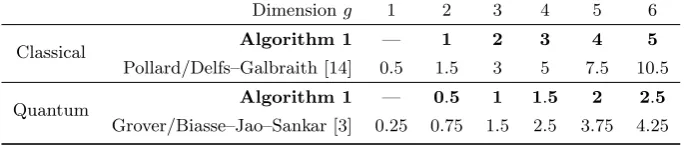
Table 1 compares Algorithm 1 with the best known attacks for dimensionsg≤6. For general path-finding, the best known algorithms are classical Pollard-style pseudorandom walks and quantum Grover search [24,5]. As noted in Remark 3, higher-dimensional analogues of Delfs–Galbraith [14] or Biasse–Jao–Sankar [3] might yield practical improvements, without changing the asymptotic runtime.
Table 1.Logarithms (basep) of asymptotic complexities of algorithms for solving the isogeny problems inΓg(`;p) for 1≤g≤6. Further explanation in text.
Dimensiong 1 2 3 4 5 6
Classical Algorithm 1 — 1 2 3 4 5
Pollard/Delfs–Galbraith [14] 0.5 1.5 3 5 7.5 10.5
Quantum Algorithm 1 — 0.5 1 1.5 2 2.5
Grover/Biasse–Jao–Sankar [3] 0.25 0.75 1.5 2.5 3.75 4.25
length. Extrapolating fromg= 1 [27] andg= 2 [19], we suppose that the secret keyspace has sizeO(p#Sg(p)) =O(pg(g+1)/4) and the target isogeny has degree in O(√p), corresponding to a path of length roughly log`(p)/2 in Γg(`;p). On the surface, therefore, Algorithm 1 does not yield a direct attack on SIDH-style protocols; or, at least, not a direct attack that succeeds with high probability. (Indeed, to resist direct attacks from Algorithm 1, it would suffice to abort any key generations passing through vertices in Sg−1(p)×S1(p).)
However, we can anticipate an attack via endomorphism rings, generalizing the attack described at the end of§3, using the algorithm outlined in Remark 2. If we assume that what is polynomial-time for elliptic endomorphisms remains so for (fixed) g >1, then we can breakg-dimensional SIDH keys by computing shortest paths in Γg(`;p) with the same complexity as Algorithm 1: that is, classical Oe(pg−1/P) and quantumOe(p(g−1)/2) forg >1.
This conjectural cost compares very favourably against the best known clas-sical and quantum attacks on g-dimensional SIDH. In the classical paradigm, a meet-in-the-middle attack would run inOe(pg(g+1)/8), with similar storage
re-quirements. In practice the best attack is the golden-collision van Oorschot– Wiener (vOW) algorithm [38] investigated in [1], which given storagewruns in expected timeOe(p3g(g+1)/16/(P
√
w)). For fixed w, the attack envisioned above gives an asymptotic improvement over vOW for all g >1. If an adversary has access to a large amount of storage, then vOW may still be the best classical algorithm forg ≤5, particularly when smaller primes are used to target lower security levels. (vOW becomes strictly worse for allg >5, even if we assume un-bounded storage.) In the quantum paradigm, Tani’s algorithm [37] would succeed in Oe(pg(g+1)/12), meaning we get the same asymptotic complexities for
dimen-sions 2 and 3, and an asymptotic improvement for all g >3. Moreover, Jaques and Schanck [28] suggest a significant gap between the asymptotic runtime of Tani’s algorithm and its actual efficacy in any meaningful model of quantum computation. On the other hand, the bottleneck of the quantum attack fore-casted above is a relatively straightforward invocation of Grover search, and the gap between its asymptotic and concrete complexities is likely to be much closer. Like the size ofSg(p), the exponents in the runtime complexities of all of the algorithms above are quadratic ing. Indeed, this was the practical motivation for instantiating isogeny-based cryptosystems in g >1. In contrast, the exponents for Algorithm 1 and our proposed SIDH attack are linear ing. This makes the potential trade-offs for cryptosystems based on higher-dimensional supersingular isogeny problems appear significantly less favourable, particularly asggrows and the gap between the previous best attacks and Algorithm 1 widens.
References
2. R. Azarderakhsh, B. Koziel, M. Campagna, B. LaMacchia, C. Costello, P. Longa, L. De Feo, M. Naehrig, B. Hess, J. Renes, A. Jalali, V. Soukharev, D. Jao, and D. Urbanik. Supersingular isogeny key encapsulation, 2017.
3. J. Biasse, D. Jao, and A. Sankar. A quantum algorithm for computing isogenies between supersingular elliptic curves. In W. Meier and D. Mukhopadhyay, editors, Progress in Cryptology - INDOCRYPT 2014 - 15th International Conference on Cryptology in India, New Delhi, India, December 14-17, 2014, Proceedings, volume 8885 ofLecture Notes in Computer Science, pages 428–442. Springer, 2014. 4. G. Bisson, R. Cosset, and D. Robert. AVIsogenies – a library for computing
isogenies between abelian varieties, November 2012. URL:http://avisogenies. gforge.inria.fr.
5. M. Boyer, G. Brassard, P. Høyer, and A. Tapp. Tight bounds on quantum search-ing. Fortschritte der Physik: Progress of Physics, 46(4-5):493–505, 1998.
6. J. W. S. Cassels and E. V. Flynn. Prolegomena to a middlebrow arithmetic of curves of genus 2, volume 230 ofLondon Mathematical Society Lecture Note Series. Cambridge University Press, 1996.
7. W. Castryck, T. Decru, and B. Smith. Hash functions from superspecial genus-2 curves using Richelot isogenies. Cryptology ePrint Archive, Report genus-2019/genus-296, 2019. To appear in the proceedings of NuTMiC 2019.
8. W. Castryck, T. Lange, C. Martindale, L. Panny, and J. Renes. CSIDH: An efficient post-quantum commutative group action. In T. Peyrin and S. Galbraith, editors, Advances in Cryptology – ASIACRYPT 2018, Part III, pages 395–427. Springer International Publishing, 2018.
9. D. X. Charles, E. Z. Goren, and K. E. Lauter. Families of Ramanujan graphs and quaternion algebras. In J. Harnad and P. Winternitz, editors, Groups and symmetries, from neolithic scots to John McKay, pages 53–80. AMS, 2009. 10. D. X. Charles, K. E. Lauter, and E. Z. Goren. Cryptographic hash functions from
expander graphs. Journal of Cryptology, 22(1):93–113, 2009.
11. C. Costello. Computing supersingular isogenies on Kummer surfaces. In Interna-tional Conference on the Theory and Application of Cryptology and Information Security, pages 428–456. Springer, 2018.
12. L. De Feo and S. Galbraith. SeaSign: Compact isogeny signatures from class group actions. InAdvances in Cryptology – EUROCRYPT 2019, 2019. To appear. 13. L. De Feo, S. Masson, C. Petit, and A. Sanso. Verifiable delay functions from
supersingular isogenies and pairings. Cryptology ePrint Archive, Report 2019/166, 2019.
14. C. Delfs and S. D. Galbraith. Computing isogenies between supersingular elliptic curves overFp. Des. Codes Cryptography, 78(2):425–440, 2016.
15. C. Diem. An index calculus algorithm for plane curves of small degree. In F. Hess, S. Pauli, and M. E. Pohst, editors,Algorithmic Number Theory, 7th International Symposium, ANTS-VII, Berlin, Germany, July 23-28, 2006, Proceedings, volume 4076 ofLecture Notes in Computer Science, pages 543–557. Springer, 2006. 16. A. Dudeanu, D. Jetchev, D. Robert, and M. Vuille. Cyclic Isogenies for Abelian
Varieties with Real Multiplication, Nov. 2017. preprint.
17. K. Eisentr¨ager, S. Hallgren, K. Lauter, T. Morrison, and C. Petit. Supersingular isogeny graphs and endomorphism rings: reductions and solutions. In J. B. Nielsen and V. Rijmen, editors, Advances in cryptology—EUROCRYPT 2018. Part III, pages 329–368. Springer International Publishing, 2018.
19. E. V. Flynn and Y. B. Ti. Genus two isogeny cryptography. In J. Ding and R. Steinwandt, editors,Post-Quantum Cryptography - 10th International Confer-ence, PQCrypto 2019, Chongqing, China, May 8-10, 2019 Revised Selected Papers, volume 11505 ofLecture Notes in Computer Science, pages 286–306. Springer, 2019. 20. S. D. Galbraith, C. Petit, B. Shani, and Y. B. Ti. On the security of supersin-gular isogeny cryptosystems. In J. H. Cheon and T. Takagi, editors,Advances in Cryptology - ASIACRYPT 2016 - 22nd International Conference on the Theory and Application of Cryptology and Information Security, Hanoi, Vietnam, Decem-ber 4-8, 2016, Proceedings, Part I, volume 10031 of Lecture Notes in Computer Science, pages 63–91, 2016.
21. S. D. Galbraith, C. Petit, and J. Silva. Identification protocols and signature schemes based on supersingular isogeny problems. In T. Takagi and T. Peyrin, editors,Advances in Cryptology - ASIACRYPT 2017 - 23rd International Confer-ence on the Theory and Applications of Cryptology and Information Security, Hong Kong, China, December 3-7, 2017, Proceedings, Part I, volume 10624 ofLecture Notes in Computer Science, pages 3–33. Springer, 2017.
22. P. Gaudry. Index calculus for abelian varieties of small dimension and the elliptic curve discrete logarithm problem. J. Symb. Comput., 44(12):1690–1702, 2009. 23. P. Gaudry, E. Thom´e, N. Th´eriault, and C. Diem. A double large prime variation
for small genus hyperelliptic index calculus.Math. Comput., 76(257):475–492, 2007. 24. L. K. Grover. A fast quantum mechanical algorithm for database search. In G. L. Miller, editor,Proceedings of the Twenty-Eighth Annual ACM Symposium on the Theory of Computing, Philadelphia, Pennsylvania, USA, May 22-24, 1996, pages 212–219. ACM, 1996.
25. S. Hoory, N. Linial, and A. Wigderson. Expander graphs and their applications. Bulletin (New Series) of the American Mathematical Society, 43(4):439–561, 2006. 26. M.-N. Hubert. Superspecial abelian varieties, theta series and the Jacquet–
Langlands correspondence. PhD thesis, McGill University, 2005.
27. D. Jao and L. De Feo. Towards quantum-resistant cryptosystems from supersin-gular elliptic curve isogenies. InInternational Workshop on Post-Quantum Cryp-tography, pages 19–34. Springer, 2011.
28. S. Jaques and J. M. Schanck. Quantum cryptanalysis in the RAM model: Claw-finding attacks on SIKE. In A. Boldyreva and D. Micciancio, editors,Advances in Cryptology - CRYPTO 2019 - 39th Annual International Cryptology Conference, Santa Barbara, CA, USA, August 18-22, 2019, Proceedings, Part I, volume 11692 ofLecture Notes in Computer Science, pages 32–61. Springer, 2019.
29. D. Kohel, K. Lauter, C. Petit, and J.-P. Tignol. On the quaternion`-isogeny path problem. LMS J. Comput. Math., 17(suppl. A):418–432, 2014.
30. D. Lubicz and D. Robert. Arithmetic on abelian and Kummer varieties. Finite Fields and Their Applications, 39:130–158, 2016.
31. C. Petit. Faster algorithms for isogeny problems using torsion point images. In T. Takagi and T. Peyrin, editors,Advances in Cryptology ASIACRYPT 2017 -23rd International Conference on the Theory and Applications of Cryptology and Information Security, Hong Kong, China, December 3-7, 2017, Proceedings, Part II, volume 10625 ofLecture Notes in Computer Science, pages 330–353. Springer, 2017.
32. A. K. Pizer. Ramanujan graphs and hecke operators.Bull. Am. Math. Soc., 23(1), 1990.
34. B. A. Smith. Isogenies and the discrete logarithm problem in jacobians of genus 3 hyperelliptic curves. J. Cryptology, 22(4):505–529, 2009.
35. A. V. Sutherland. Identifying supersingular elliptic curves. LMS Journal of Com-putation and Mathematics, 15:317–325, 2012.
36. K. Takashima. Mathematical Modelling for Next-Generation Cryptography: CREST Crypto-Math Project, chapter Efficient Algorithms for Isogeny Sequences and Their Cryptographic Applications, pages 97–114. Springer Singapore, Singa-pore, 2018.
37. S. Tani. Claw finding algorithms using quantum walk. Theor. Comput. Sci., 410(50):5285–5297, 2009.
38. P. C. van Oorschot and M. J. Wiener. Parallel collision search with cryptanalytic applications. J. Cryptology, 12(1):1–28, 1999.
A
A proof-of-concept implementation
We include a naive Magma implementation of the product finding stage (i.e. Steps 1-3) of Algorithm 1 in dimension g = 2 with ` = 2. First, it generates a challenge by walking from the known superspecial node corresponding to the curve C:y2 =x5+xover a givenFp2 to a random abelian surface in Γ2(2;p), which becomes the targetA. Then it starts computing random walks of length slightly larger than log2(p), whose steps correspond to (2,2)-isogenies. As each step is taken, it checks whether we have landed on a product of two elliptic curves (at which point it will terminate) before continuing.
Magma’s built-in functionality for (2,2)-isogenies makes this rather straight-forward. At a given node, the functionRichelotIsogenousSurfacescomputes all 15 of its neighbours, so our random walks are simply a matter of generating enough entropy to choose one of these neighbours at each of theO(log(p)) steps. For the sake of replicability, we have used Magma’s inbuilt implementation of SHA-1 to produce pseudo-random walks that are deterministically generated by an input seed. SHA-1 produces 160-bit strings, which correspond to 40 integers in [0,1, . . . ,15]; this gives a straightforward way to take 40 pseudo-random steps in Γ2(2;p), where no step is taken if the integer is 0, and otherwise the index is used to choose one of the 15 neighbours.
The seedprocessorcan be used to generate independent walks across mul-tiple processors. We always used the seed “0” to generate the target surface, and set processorto be the string “1” to kickstart a single process for very small primes. For the second and third largest primes, we used the strings “1”, “2”, . . . , “16” as seeds to 16 different deterministic processes. For the largest prime, we seeded 128 different processes.
For the primep=127= 27−1, the seed “0” walks us to the starting node corresponding toC0/Fp2:y2= (41i+ 63)x6+· · ·+ (6i+ 12)x+ 70. The single processor seeded with “1” found a product variety E1×E2 on its second walk after taking 53 stepsin total, with E1/Fp2: y2 =x3+ (93i+ 43)x2+ (23i+ 93)x+ (2i+ 31) andE2/Fp2:y2=x3+ (98i+ 73)x2+ (30i+ 61)x+ (41i+ 8).
For the prime p = 524287 = 219−1, all 16 processors were used. The processor seeded with “2” was the first to find a product variety on its 311-th walk after taking 11680 steps in total. Given that all processors walk at roughly the same pace, at this stage we would have walked close to 16·11680 =186880 steps.
For the 25-bit primep=17915903= 21337−1, the processor seeded with “13” found a product variety after taking 341 walks and a total of 12698 steps. At this stage the 16 processors would have collectively taken around 203168 steps.
The largest experiment that we have conducted to date is with the prime
p=2147483647= 231−1, where 128 processors walked in parallel. Here the processor seeded with “95” found a product variety after taking 10025 walks and a total of 375703 steps. At this stage the processors would have collectively taken around 48089984 steps.
In all of the above cases we see that product varieties are found with around
psteps. The Magma script that follows can be used to verify the experiments5, or to experiment with other primes.
5
////////////////////////////////////////////////////////// clear;
processor:="1"; p:=2^13-1; Fp:=GF(p);
Fp2<i>:=ExtensionField<Fp,x|x^2+1>; _<x>:=PolynomialRing(Fp2);
////////////////////////////////////////////////////////// Next_Walk := function(str)
H := SHA1(str);
steps := [ StringToInteger(x, 16): x in ElementToSequence(H) | x ne "0"]; return steps ,H;
end function;
////////////////////////////////////////////////////////// Walk_To_Starting_Jacobian:=function(str)
steps,H:= Next_Walk(str); C0:=HyperellipticCurve(x^5+x); J0:=Jacobian(C0);
for i:=1 to #steps do
neighbours:=RichelotIsogenousSurfaces(J0); if Type(neighbours[steps[i]]) ne SetCart then
J0:=neighbours[steps[i]]; end if;
end for; return J0; end function;
////////////////////////////////////////////////////////// Walk_Until_Found:=function(seed,J0);
found:=false; H:=seed; found:=false; walks_done:=0; steps_done:=0; while not found do
walks_done+:=1;
walks_done, "walks and",steps_done, "steps on core", processor, "for p=",p; J:=J0;
steps,H:=Next_Walk(H); for i:=1 to #steps do
steps_done+:=1;
J:=RichelotIsogenousSurfaces(J)[steps[i]]; if Type(J) eq SetCart then
found:=true; index:=i; break; end if; end for; end while;
return steps,index,walks_done,steps_done,J; end function;
//////////////////////////////////////////////////////////
file_name:="p" cat IntegerToString(p) cat "-" cat processor cat ".txt"; J0:=Walk_To_Starting_Jacobian("0");
steps,index,walks_done,steps_done,J:=Walk_Until_Found(processor,J0); Write(file_name, "walks done =");
Write(file_name, walks_done); Write(file_name, "steps_done ="); Write(file_name, steps_done); Write(file_name, "steps="); Write(file_name, steps); Write(file_name, "index="); Write(file_name, index);
Write(file_name, "Elliptic Product="); Write(file_name, J);