_____________________________________________________________________________________________________
*Corresponding author: E-mail: [email protected];
www.sciencedomain.org
The Relationship between Brain Dominance and
Academic Performance: A Cross-sectional Study
Tan Sing Keat
1*, Viknesh Kumar
1, Muhammad Shakir B. Rushdi
1,
Norhayatul Akmal Bt. Nazri
1and Lee Zi Xuan
11
Melaka Manipal Medical College, Malaysia.
Authors’ contributions
This work was carried out in collaboration between all authors. Author TSK designed the study, protocol and editing the final manuscript for research publication. Author VK designed the self-administered questionnaires, performed the statistical analysis and designed the abstract. Authors
MSBR and NABN managed the data collection, literature research and discussion of the research while author LZX managed the literature research, introduction and conclusion for the research. All authors read and approved the final manuscript.
Article Information
DOI: 10.9734/BJMMR/2016/22881 Editor(s): (1) Domenico De Berardis, Department of Mental Health, National Health Service, Psychiatric Service of Diagnosis and Treatment, “G. Mazzini” Hospital, Italy. Reviewers: (1) Juandy Jo, Nutricia Research, Singapore. (2)Anonymous, University of California, San Francisco, USA. Complete Peer review History:http://sciencedomain.org/review-history/13083
Received 3rd November 2015 Accepted 8th January 2016 Published 27th January 2016
ABSTRACT
Aims: To study the relationship between brain dominance and academic performance among
undergraduates.
Study Design: Cross-sectional study.
Place and Duration of Study: Melaka Manipal Medical College (MMMC), Melaka campus,
Malaysia, from April 2014 to June 2014.
Methodology: A cross-sectional study was conducted in a medical college and a total of 168
students participated. Data collection was done using self-administered questionnaires. It consisted of the personal profile and 3 validated questionnaires to identify the brain dominance. Academic performance of a student is obtained from the student academic office based on the roll numbers written on the questionnaire. Written informed consent was taken from the students before they participate in this research. Analysis of the data was done using EpiInfo7, with significance level set at .05 and 95% confidence level.
Results: Our study shows that there is no significant association between brain predilection and
academic performance (P>0.05). It was found that there were 58.3% of the students with left brain dominance, 25.6% right-brained students and 16.1% with whole-brained. Besides that, race of a student had significant association with academic performance (P<0.001).
Conclusion: The brain dominance of a student has no significant relationship with academic
performance. Hence, students do not have to worry which brain dominant are they and can focus on other factors affecting academic performance. Seminars and campaigns should be conducted to address students that early preparation for exam is vital to have excellent academic performance.
Keywords: Brain dominance; academic performance; undergraduates; medical student; cross-sectional study.
1. INTRODUCTION
Academic performance is assessed differently in various courses. In medical schools, assessment of clinical competence is divided into assessment of cognition and assessment of behaviour in practice as proposed by Miller’s hierarchical model in 1990 [1]. Cognition or knowledge is assessed most commonly by the written method such as Multiple Choice Questions (MCQs), Modified Extended Questions (MEQs), Short Answer Questions (SAQs) and Essay questions [2-6]. Assessment of clinical practice is done by Objective Structured Clinical Examination (OSCE), short cases, long cases and portfolios [7-10]. Many studies have been carried out to associate various factors that may influence one’s academic performance [11-13].
Different brain dominance amongst individuals is a widely known fact [14]. As each hemisphere of the brain contributes to certain different functionalities of our body, different persons tend to have their own unique ways of perceiving given information and strategize thereafter in order to respond [15-18]. Different brain dominance affects the way in which one studies the best [18-21]. There is no definite answer to which brain dominance belongs to the more successful individuals as each hemisphere of the brain is not superior to the other, instead have different specialized functions each [15,16,20]. However, few researches have proved that left brain dominant students perform better academically[22,23]. Factors affecting academic performance include student’s study habit, race, ethnicity, genetic and brain dominance [11,13,24].
Thus, this study is conducted to study the relationship between left, right and whole brain dominance and other factors with the academic performance among medical students and undergraduates in a private medical college.
2. MATERIALS AND METHODS
We have conducted a cross-sectional study from April 2014 to June 2014 in a private medical college (MMMC) in Melaka, Malaysia.
Undergraduates from MBBS program and pre-university students (FIS) from Batch 6 in the private medical college were included in the study. Year 3 students were excluded and those with no academic result to compare with. Other exclusion criteria were those who were absent on the day of study, refused to sign the written informed consent and incomplete self-administered questionnaires. Briefing was given to students before completing the questionnaires and consent was taken by signing on the questionnaires.
We collected the data for our study by using self-administered questionnaire. The first part of the questionnaire consisted of questions on personal profile which included roll number, age, gender, race, handedness and funding of course. We also included frequency of missing class, study duration per day, study method and exam preparation method. These factors were included as there are multiple factors that would affect the academic performance of a student[11-13].
The third component was to access the brain dominance based on the study habits among students [26]. There were 16 statements where students have to grade each statement 1, 3 or 6 whichever suits them best. The first 8 statements were for left brain dominance whereas the last 8 were right brain dominance statements. We calculated the total score for the two parts to find out the brain dominance of a student where the largest score represents his/her brain dominance.
The last component of the questionnaire was to access the brain dominance based on his/her perceptions and characteristics[27].There were 16 statements arranged randomly where each statement belongs to left or right brain dominance. Example of item included in this component was “I find it easier to remember names instead of faces”. Participants were required to tick only the statements which are applicable for them. We totaled up the number of statements selected each for left and right brain to know the brain dominance of a student. We came to a conclusion of brain dominance based on the three components accessed. For example, if a student has middle, left and left brain dominance for the three components, we categorized him/her as a left-brained student. Right, left and right will be categorized as right-brained. Whole/middle brain dominance category comes when there were 2 out of 3 components middle brain was chosen or when there are left, right and middle outcomes for the 3 components. Therefore, the outcome of brain dominance obtained will be more accurate and precise for each student. The outcome of academic performance was kept anonymous from the participants. We obtained the raw data of academic results from the student academic office based on the roll number provided in the questionnaires.
We organized all collected raw data using Microsoft Excel 2010. The analysis of the data was done using EpiInfo7. For descriptive statistics, we used frequency, percentage, mean ± SD and range. Unpaired t test and ANOVA were used for bivariate analysis to find the relationship between brain dominance and other variables with academic performance. The significance level was set at 0.05 for bivariate analysis. The variables which has P value <0.1 were included in multiple linear regression. Regression coefficient and 95% confidence interval were described. Bonferroni method was used to correct for multiple comparisons and
level of significance was set at 0.01 for multiple linear regression.
Participation in this survey was on voluntary basis and written informed consent was obtained from signatures of the participants which was included at the beginning of the distributed questionnaires. We had explained to the participants that all information obtained remain confidential and will be used for the purpose of data analysis in this study only. The research was approved by the Research Committee, MMMC.
3. RESULTS
281 self-administered questionnaires were distributed to whole sample of interest in lecture theatres of MMMC where we received a response of 168 completed questionnaires.
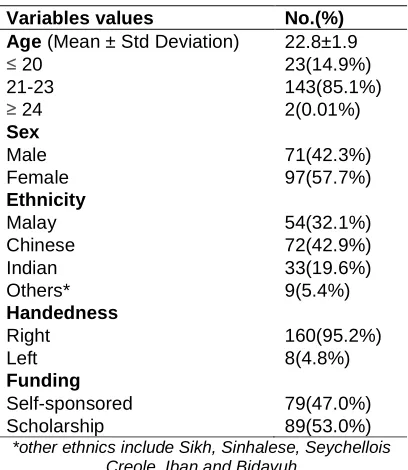
Table 1. Sociodemographic data characteristics of students (n=168)
Variables values No.(%)
Age (Mean ± Std Deviation) 22.8±1.9
≤ 20 23(14.9%)
21-23 143(85.1%)
≥24 2(0.01%)
Sex
Male 71(42.3%)
Female 97(57.7%)
Ethnicity
Malay 54(32.1%)
Chinese 72(42.9%)
Indian 33(19.6%)
Others* 9(5.4%)
Handedness
Right 160(95.2%)
Left 8(4.8%)
Funding
Self-sponsored Scholarship
79(47.0%) 89(53.0%) *other ethnics include Sikh, Sinhalese, Seychellois
Creole, Iban and Bidayuh
According to the statistical results, there was no significance in age of students, gender, handedness and funding amongst the students with their academic performance (P > 0.05, Table 3). However, the statistical
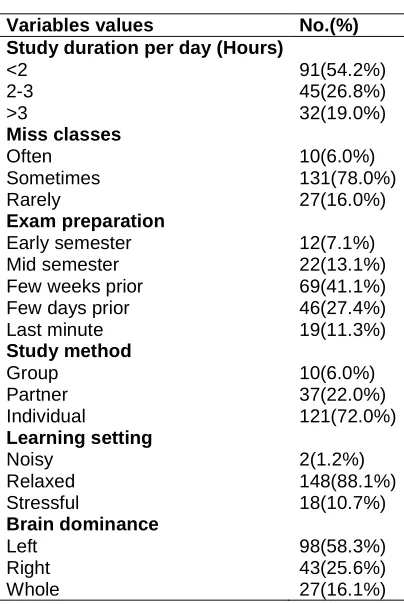
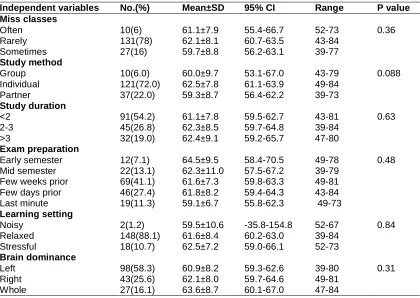
There were no significant differences in the total missed class, study duration, exam preparation, study method, learning settings and brain dominance amongst the students with their academic performances (P>0.05; Table 4).
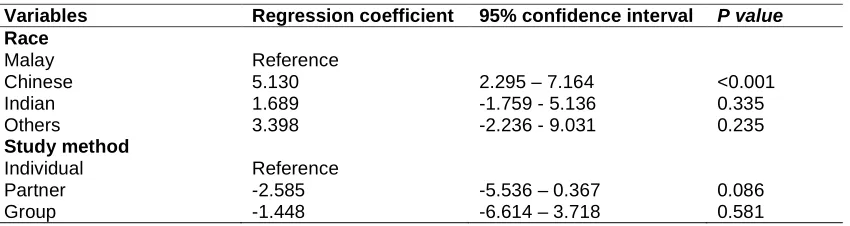
The variables which had P value <0.1 in bivariate analysis were included in multivariate analysis. In multiple linear regression analysis, Bonferroni method was used to correct for multiple comparisons and level of significance was set at 0.01. Table 5 shows that Chinese students have significantly higher academic score compared to Malay (P value <0.001) but there were no significant difference with Indian (P = 0.335) and other students (P = 0.235). There were also no significant difference of academic performance between different study methods such as studying with partner (P = 0.086) and group study (P = 0.581) compared to individual study.
4. DISCUSSION
This cross-sectional study, conducted over a 2-month period, was aimed to investigate effect of brain dominance over academic performance among undergraduate students. Data collection was done by means of self-administered questionnaires which were distributed among the participants of this study. A total of 168 voluntary respondents answered the validated questionnaires after having undergone a briefing of the study. The study also included a plethora of variables to assess their association with academic performance besides brain dominance.
In this study of academic performance, it is found that ethnicity is one of the variables that have significant association with academic performance. We had found that Chinese students perform better academically than Malay students with P< 0.001. In an effort to explain the existing differences in educational performances across ethnic groups, some studies suggest that a parent of a culture that puts more emphasis on the importance of education is directly correlated with the academic achievement of their child[28]. Chinese students perform better academically than Malay students in fields requiring good command of English such as Medicine, as they are better in English language than the Malay students [29]. Attitudes towards peer, involvement in co-curricular activities and fluency in English contribute towards Chinese students’ academic success compared to Malay students [30]. Chinese students are motivated by competition and their academic performance will
improve significantly but the same effect does not occur in Malay students [31]. Becky Francis, a visiting professor at King's College London, director of education at the Royal Society of Arts and one of the researchers from the Equality and Human Rights Commission on inequality in Britain said that families of Chinese heritage takes education seriously as a fundamental pillar of their Chinese identity, and a way of differentiating themselves not just within their own group, but from other ethnic groups as well [32].
Table 2. Learning preferences and Brain dominance among students. (n=168)
Variables values No.(%)
Study duration per day (Hours)
<2 2-3
91(54.2%) 45(26.8%)
>3 32(19.0%)
Miss classes
Often Sometimes Rarely
Exam preparation
Early semester Mid semester Few weeks prior Few days prior Last minute
Study method
Group Partner Individual
Learning setting
Noisy Relaxed Stressful
Brain dominance
Left Right Whole
10(6.0%) 131(78.0%) 27(16.0%)
12(7.1%) 22(13.1%) 69(41.1%) 46(27.4%) 19(11.3%)
10(6.0%) 37(22.0%) 121(72.0%)
2(1.2%) 148(88.1%) 18(10.7%)
98(58.3%) 43(25.6%) 27(16.1%)
there are no relationship between right brain thinkers and left brain thinkers with respect to academic agility but instead stated other
variables may dictate academic measure of students [34]. Right brain students tend to favour creative-style subjects and thus score better in
Table 3. Inferential statistics of demographic parameters and academic performance
Independent variables No.(%) Mean±SD 95% CI Range P value Age (years)
≤ 20 23(14.9) 60.8±8.6 57.1-64.5 47-81 0.59 21-23 143(85.1) 62.3±7.9 60.6-63.9 49-84
≥24 2(0.01) 61.0±8.6 58.7-63.4 39-79
Gender
Male 71 (42.3) 62.4±7.6 -3.8-1.3 0.24 Female 97 (57.7) 61.2±8.6 0.8 (0.3-1.8)
Ethnicity
Others* 9 (5.4) 62.4±9.4 55.3-69.6 49-73 0.002 Malay 54 (32.1) 58.8±7.4 56.8-60.8 39-79 Chinese 72 (42.9) 64.3±8.3 62.3-66.2 47-84 Indian 33 (19.6) 60.5±7.5 57.9-63.2 49-80
Handedness
Right 160(95.2) 61.7±8.2 2.8 (0.6-12.5) 0.92 Left 8(4.8) 61.4±8.2 0.3 (0.1-1.5)
Funding
Self-sponsored 79(47.0) 61.4±8.5 1.3(0.59-2.83) 0.49 Scholarship 89(53.0) 61.9±8.0 0.8(0.35-1.71)
*other ethnics include Sikh, Sinhalese, Seychellois Creole, Iban and Bidayuh
Table 4. Inferential statistics of learning styles and brain dominance with the students’ academic performance
Independent variables No.(%) Mean±SD 95% CI Range P value Miss classes
Often 10(6) 61.1±7.9 55.4-66.7 52-73 0.36 Rarely 131(78) 62.1±8.1 60.7-63.5 43-84
Sometimes 27(16) 59.7±8.8 56.2-63.1 39-77
Study method
Group 10(6.0) 60.0±9.7 53.1-67.0 43-79 0.088 Individual 121(72.0) 62.5±7.8 61.1-63.9 49-84
Partner 37(22.0) 59.3±8.7 56.4-62.2 39-73
Study duration
<2 91(54.2) 61.1±7.8 59.5-62.7 43-81 0.63 2-3 45(26.8) 62.3±8.5 59.7-64.8 39-84
>3 32(19.0) 62.4±9.1 59.2-65.7 47-80
Exam preparation
Early semester 12(7.1) 64.5±9.5 58.4-70.5 49-78 0.48 Mid semester 22(13.1) 62.3±11.0 57.5-67.2 39-79
Few weeks prior 69(41.1) 61.6±7.3 59.8-63.3 49-81 Few days prior 46(27.4) 61.8±8.2 59.4-64.3 43-84 Last minute 19(11.3) 59.1±6.7 55.8-62.3 49-73
Learning setting
Noisy 2(1.2) 59.5±10.6 -35.8-154.8 52-67 0.84 Relaxed 148(88.1) 61.6±8.4 60.2-63.0 39-84
Stressful 18(10.7) 62.5±7.2 59.0-66.1 52-73
Brain dominance
Left 98(58.3) 60.9±8.2 59.3-62.6 39-80 0.31 Right 43(25.6) 62.1±8.0 59.7-64.6 49-81
Table 5. Multiple linear regression analysis of race and study method with students’ academic performance
Variables Regression coefficient 95% confidence interval P value
Race
Malay Reference
Chinese 5.130 2.295 – 7.164 <0.001
Indian 1.689 -1.759 - 5.136 0.335
Others 3.398 -2.236 - 9.031 0.235
Study method
Individual Reference
Partner -2.585 -5.536 – 0.367 0.086
Group -1.448 -6.614 – 3.718 0.581
them, while left brain students tend to favour logic-based subjects and score higher in those, but brain dominance by itself cannot contribute to better grades in school [35].
In addition, the exam preparation styles have no significant association with academic performance (P = 0.48). Students who prepared few weeks and last minute prior to the examination are shown to have average academic performance. There were few other studies which found that organized and early preparation styles towards examination as well as self-handicapping are significantly associated with academic achievements [36,37]. Students who prepare early for examination will build sense of calmness and reduce anticipatory test anxiety with decrease in the desire to escape the exam [38]. On the other hand, there are also students who like to study in the last minute with less effort so that if their subsequent performance is low, it will be seen as the cause rather than lack of ability [39].
On contrary, our study had showed that study duration had no significant association with academic performance of students (P=0.63). A study had shown that certain students tend to decrease the study time to minimize forgetting and prevent interference and still achieve a good academic performance [40]. This is due to the quality of the study in each study sessions that is more important rather than the duration of study. Some students might prefer to study for a short duration during their best concentration time as quality of study matters more than the duration of study. Gender is also found to have no association with academic performance (P=0.24). A study had found that there were no significant relation between males and females regarding which aspect of intelligence is related to academic achievement [41]. Regardless of gender, each individual have their own unique way of processing given information. Hence,
there is no definite association between gender and academic performance.
Besides that, our study proved that the learning style preference is also found to have no association with academic performance. In another research, it was found that there was no significant correlation between the academic achievement and the learning style preferences of the participants in the research [42]. This is due to the fact that each individual have their own method of achieving optimum amount of knowledge due to the vast difference in the way one perceives information. On the other hand, some students might not know their best learning style preference yet as there is no guidance for them to which a learning style suits them best.
There were few studies which contradicted with our research. One of our study finding was that gender had no association with academic performance. However, a study done in a large public university in Turkey has shown that female undergraduates performed better academically and have higher grades than male undergraduates [43]. Several studies have concluded that female students quickly and easily adapt to higher education and accepted learning behaviors[44,45]. Besides that, we had found that brain dominance has no significant association with academic performance. On the other hand, a brain hemispheric study was conducted and found that whole-brained students received the greatest percentage of A's in Business Law[46]. A study which was done in Korea has showed right-brained students achieved higher creativity scores as compared to left-brained students[47].
5. LIMITATIONS
cross-sectional research, temporal relationship between brain predilection and academic performance cannot be established and as such does not reflect any causal relationship between aforementioned variables. Lastly, the results obtained from this study might not represent the entire student population in Malaysia.
6. RECOMMENDATIONS
Talks, seminars and campaigns should be conducted among students in MMMC to address late semester study habit as it was shown to produce average results. Students should be advised to do early semester preparation in order to perform better in their examinations. Lecturers should find efficient strategies to tap in the non-dominant brain of the students so they can be more whole brained and performs better academically.
7. CONCLUSION
Over the course of the study, it has become overt that brain hemispherical aptness has no association with the education success among undergraduates. To the best of our knowledge, this study is one of the scant studies on establishing brain dominance relationship with academic achievement since inadequate literature was done so far. Moreover, younger generations make up our entire sample population and as thus the need to further explore their learning aptitudes toward academic excellence.
CONSENT
All authors declared that written informed consent was obtained from the participants before they fill in the questionnaires.
ETHICAL APPROVAL
The research was approved by the Research Committee, MMMC. Written informed consent was obtained from the participants before they participate in our research and that their privacy will be maintained.
ACKNOWLEDGEMENTS
We would like to express our deepest gratitude to Dr. Htoo Htoo Kyaw Soe (Associate Professor of Department of Community Medicine, MMMC) for her patience and guidance in data analysis
and publication. We would also like to thank Professor. Dr. Adinegara bin Lutfi Abas for providing us the students’ academic results for our research outcome. Lastly, we also would like to thank the students for voluntarily participating in our research.
COMPETING INTERESTS
Authors have declared that no competing interests exist.
REFERENCES
1. Miller G. The assessment of clinical skills/competence/performance. Academy of Medicine, 1990;65:S63–67.
2. Schuwirth W, Vleuten P. Different written assessment methods: What can be said about their strengths and weaknesses? Medical Education. 2004;38:974–979. 3. Schuwirth W, Verheggen M, Vleuten P, et
al. Do short cases elicit different thinking processes than factual knowledge questions do? Medical Education. 2001;35: 348–356.
4. Case M, Swanson B. Extended-matching items: A practical alternative to free response questions. Teach Learn Medicine. 1993;5:107–115.
5. Schuwirth W, Vleuten P. In: Written assessments. Dent J, Harden R, editors. New York: Elsevier Churchill Livingstone. 2005;311–322.
6. Knox D. How to use modified essay questions. Med Teach. 1980;2:20–24. 7. Harden R, Gleeson A. ASME Medical
Education Booklet No. 8: Assessment of clinical competence using an Objective Structured Clinical Examination (OSCE). Medical Education. 1979;13:41–54. 8. Wass V, Vleuten C, Shatzer J, et al.
Assessment of clinical competence. Lancet. 2001;357:945–949.
9. Ponnamperuma G, Karunathilake M, McAleer S, Davis H. The long case and its modifications: A literature review. Medical Education. 2009;43:936–41.
10. Davis H, Ponnamperuma G. In: Portfolios, projects and dissertations. Dent J, Harden R, editors. New York: Elsevier Churchill Livingstone. 2005;346–356.
12. Richard P, Deirdre J. Student attendance and academic performance in undergraduate obstetrics/gynecology clinical rotations. The Journal of the American Medical Association. 2013; 310(21):2282-2288.
13. Beth D, Carrolyn K, LinettePostel R, et al. Performance on the National Board of Medical Examiners Part I Examination by men and women of different race and ethnicity. The Journal of the American Medical Association. 1994;272(9):674-679. 14. Caine R, Caine G. Making connections: Teaching and the human brain. New York: Addison-Wesley; 1994.
15. Dunn R. Rita Dunn answers questions on learning styles. Educational Leadership. 1990;48(2):15-19.
16. Dunn R, Dunn K. Teaching secondary students through their individual learning styles. Boston, Allyn& Bacon; 1992. 17. Kolb D. Experiential learning: Experience
as the source of learning and development. New Jersey, Prentice-Hall; 1984.
18. McCarthy B. About teaching 4mat in the classroom. Wauconda, IL; 2000.
19. Gregorc A. Style as a symptom: A phenomenological perspective. Theory into Practice. 1984;23(1):51-55.
20. Butler K. Learning and teaching styles-in theory and practice. Columbia, The Learner’s Dimension; 1987.
21. Felder R. Matters of style. ASEE Prism, 1996;6(4):18-23.
22. Bracken B, Ledford T, McCallum R. Effects of cerebral dominance on college-level achievement. Perceptual and Motor Skills. 1979;49:445-446.
23. Carthey J. Relationship between learning styles and academic achievement and brain hemispheric dominance and academic performance in business and accounting courses. The Education Resource Information Center; 1993. 24. Herrmann N. The Creative Brain. 5th Ed.
Brain Books, United States of America; 1995.
25. Human Relations Strategies for Success: Brain Dominance Questionnaire. Mac Graw Hill Company.
Available:http://www.mhhe.com/ps/hrelatio ns/general/brain.html (Accessed 15 May 2014)
26. Personality tests.
Available:www.personalityquiz.net/profiles/l eftrightbrain.html (Accessed 16 May 2014)
27. Hemispheric dominance inventory. Available:www.capone.mtsu.edu/studskl/h emispheric_dominance.html (Accessed 16 May 2014)
28. Davis-Kean P, Sexton H. Race differences in parental influences on child achievement. Merrill-Palmer Quaterly. 2009;55(3):285-318.
29. Amerrudin M, Sarimah S. Comparing form four Malay and Chinese students’ spoken english. The English Teacher. 2012;41(1): 14-26.
30. Zaizul R, Ahmad S, Norul HS, Suzana M, Fakhrul A, et al. The attributions of academic and co-curricular success of Malay and Chinese Students In Universiti Kebangsaan Malaysia. International Journal of Business and Social Science, 2012;3(2):257-267.
31. Anna A, Zulkhairi M. The role of competitiveness, gender and ethnicity in influencing academic performance. Malaysian Online Journal of Educational Management. 2014;2(1):37-47.
32. Hidden Tigers: Why do Chinese children do so well at school? The Guardian. Available:http://www.theguardian.com/edu cation/2011/feb/07/chinese-children-school-do-well.html (Accessed December 2015)
33. Parvinder Singh. Study of academic achievement in mathematics in relation to brain hemispheric dominance. International Journal of Science and Research (IJSR). 2013;4(5).
34. Lam PY. The usefulness of thinking styles in reflecting how individuals think and explaining school performance (Doctoral dissertation, The University of Hong Kong (Pokfulam, Hong Kong)); 2000.
35. Garrett SV. Putting our whole brain to use: A fresh look at the creative process. The Journal of Creative Behavior. 1976;10(4): 239-249.
36. Elliot AJ, McGregor, Holly A, et al. Achievement goals, study strategies, and exam performance: A mediational analysis. Journal of Educational Psychology. 1991; 91(3):549-563.
37. Thomas C, Gadbois S. Academic self-handicapping: The role of self-concept clarity and students' learning strategies. British Journal of Educational Psychology. 2007;77:101–119.
task engagement. Journal of Educational Psychology. 2002;94(2):381–395.
39. Tim U, Carol M. Academic self-handicapping: What we know, what more there is to learn. Educational Psychology Review. 2001;13(2):115-138.
40. Eric L, Rob T, Jessica M. College students’ study time: Course level, time of semester, and grade earned. Physiological Reports, Boise State University; 2006.
41. Habibollah, Naderi, Rohani, et al. Intelligence and academic achievement: an investigation of gender differences. Life Science Journal. 2010;7(1):85-86.
42. Lorna L. Relationships between learning style preferences and academic performance of students. International Journal of Educational Research and Technology. 2013;4(2):70-76.
43. Meltem D, Serap T. Gender differences in academic performance in a large public university in Turkey. Economic Research Centre. 2004;17(4):2-11.
44. Smith F. It’s not all about grades. Accounting for gendered degree results in geography at Brunel University. Journal of Geography in Higher Education. 2004;28: 167–178.
45. Niraj M, Preeti S. An empirical bivariate case study on associations between select factors concerning postgraduate students and their academic performance. International Journal of Research in commerce, IT and Management. 2011; 1(6):18-24.
46. Joseph HC. Relationships between learning styles and academic achievement and brain hemispheric dominance and academic performance in business and accounting courses. ERIC. 1993;1:1-75. 47. Kim J, William BM. The relationship of
creativity measures to school achievement and to preferred learning and thinking style in a sample of Korean high school students. Educational and Psychological Measurement. 1995;55(1):60-74.
_________________________________________________________________________________ © 2016 Keat et al.; This is an Open Access article distributed under the terms of the Creative Commons Attribution License (http://creativecommons.org/licenses/by/4.0), which permits unrestricted use, distribution, and reproduction in any medium, provided the original work is properly cited.
Peer-review history: