Efficient Oblivious Data Structures for Database
Services on the Cloud
∗
Thang Hoang
†Ceyhun D. Ozkaptan
‡Gabriel Hackebeil
§Attila A. Yavuz
¶Abstract
Database-as-a-service (DBaaS) allows the client to store and manage structured data on the cloud remotely. Despite its merits, DBaaS also brings significant privacy issues. Existing encryption techniques (e.g., SQL-aware encryption) can mitigate privacy concerns, but they still leak information through access patterns, which are vulnerable to statistical inference attacks. Oblivious Random Access Machine (ORAM) can seal such leakages; however, the recent studies showed significant challenges on the integration of ORAM into databases. That is, the direct usage of ORAM on databases is not only costly but also permits very limited query functionalities. In this paper, we propose new oblivious data structures calledOblivious Matrix Structure(OMAT) andOblivious Tree Structure (OTREE), which allow tree-based ORAM to be integrated into database systems in a more efficient manner with diverse query functionalities supported. OMATprovides special ORAM packaging strategies for table structures, which not only offers a significantly better performance but also enables a broad range of query types that may not be efficient in existing frameworks. On the other hand, OTREEallows oblivious conditional queries to be performed on tree-indexed databases more efficiently than existing techniques. We implemented our proposed techniques and evaluated their performance on a real cloud database with various metrics, compared with state-of-the-art counterparts.
1
Introduction
Services for outsourcing data storage and related infrastructure to the cloud have grown in the last decade due to the savings they offer to companies in terms of capital and operational costs. For instance, major cloud providers (e.g., Amazon, Microsoft) offer Database-as-a-service (DBaaS) that provides rela-tional database management systems on the cloud. This enables a client to store and manage structured data remotely. Despite its merits, DBaaS raises privacy issues. The client may encrypt the data with standard encryption; however, this also prevents searching or updating information on the cloud, thereby invalidating the effectiveness of database utilization.
Various privacy enhancing technologies have been developed toward addressing the aforementioned privacyvs. data utilization dilemma. For instance, the client can use special encryption techniques such as SQL-aware encryption (e.g., [19, 20]) or searchable encryption with various security, efficiency and query functionality trade-offs (e.g., [5, 30, 14, 3,26, 27,31, 32]) to achieve the data confidentiality and usability on the cloud. However, even such encryption techniques might not be sufficient for privacy-critical database applications (e.g., healthcare) since sensitive information may be revealed through access
∗Full version of the paper to be appeared in IEEE Transactions on Cloud Computing. Work done when the
sec-ond, the third and the fourth authors were employed at Oregon State University. E-mail: {ozkaptac, hackebeg,
attila.yavuz}@oregonstate.edu.
†School of EECS, Oregon State University, Corvallis, OR, 97331. Email:
‡Department of Electrical and Computer Engineering, The Ohio State University, Columbus, OH 43210. E-mail:
§Department of Industrial and Operations Engineering, University of Michigan, Ann Arbor, MI, 48109.
¶Department of Computer Science and Engineering, University of South Florida, Tampa, FL, 33620. E-mail:
Query q2
Query q1
Table-A (Encrypted)
Client
Database-as-a-Service (DBaaS)
RowID Col1 Col2 Col3 Col4
Row1 A B C D
Row2 E F G H
Row3 I J K L
Row4 M O P Q
Encrypted Queries to Table-A
(honest-but-curious)
Respond r1
Respond r2
Database can record and analyze query (access) patterns
(q1,r1),…,(qn,rn) Statistical Inference Attack
Sensitive information may be revealed
Query qn
Respond rn
. . .
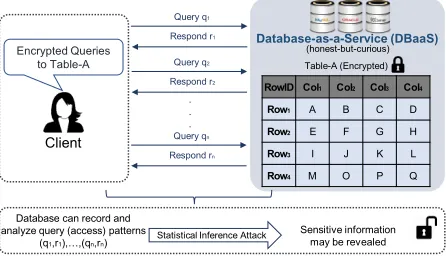
Figure 1. Information leakages through query access patterns over an encrypted database.
patterns when the client execute encrypted queries on the encrypted database. Recent work (e.g., [4,13,
16,21,33]) showed that information leakage through the access pattern can be combined with some prior contextual knowledge to launch statistical inference attacks thereby, revealing vital information about encrypted queries and database. For example, such information leaks may expose the prognosis of illness for a patient or types/timing of financial transactions over valuable assets based on encrypted queries. Therefore, hiding the access pattern an important requirement for privacy-critical database applications. Oblivious Random Access Machine (ORAM) [11] can be used to hide the client access patterns for such encrypted databases. Preliminary ORAM schemes (e.g., [11, 18]) were costly, but recent ORAM constructions (e.g., [7,23, 24,25, 28, 29]) have shown promising results. Most efficient ORAM schemes (e.g., [9, 22,25]) follow the tree paradigm [23], and achieveO(logN) communication overhead. Despite these improvements, there are several research gaps towards achieving efficient integration of ORAM into database applications. In the following, we discuss the research gaps and limitation of state-of-the-art approaches.
1.1
Limitations of Existing Approaches
The direct application of ORAM to the structured encrypted data has been shown to be costly in the context of searchable encryption [2, 12]. Meanwhile, there is a limited number of studies on the application and integration of ORAM for encrypted database systems. Chang et al. in [6] were among the first to investigate the use of ORAM in real database systems with a framework called SEAL-ORAM. In SEAL-ORAM, various ORAMs were implemented and compared on a MongoDB database platform, where ORAM blocks are constructed in a row-oriented manner. While it shows the possibility of using ORAM for encrypted databases, the functionalities and performance offered by such a direct adaptation seem to be limited. We outline the limitations of two direct ORAM applications in Figure2, and further elaborate them as below.
• Limitations of Row-Oriented Approach: In SEAL-ORAM, each row of the database table is pack-aged into an ORAM block. We refer to this approach as RowPKG. RowPKG allows efficient in-sert/delete/update queries on a row in the database table. However, to execute oblivious inin-sert/delete/update on a column, RowPKG requires to transferallblocks in ORAM, which is not only bandwidth-costly but also client-storage expensive. Similarly, the execution of any column-related queries (e.g., statistical, con-ditional queries) is also inefficient because they require transferring all the ORAM blocks, which may not be practical for large databases. RowPKG (i.e., row-oriented packaging) and its limitations are outlined in Figure2-(a).
RowID Col1 Col2 Col3 Col4
Row1 A B C D Row2 E F G H
Row3 I J K L Row4 M O P Q
Row_1 Row_2 Row_3 Row_4
Tree-based ORAM Construction of Table A
(a) Limitations of Row-Oriented Packaging in DBaaS
1. Statistical Queries: •Downloading all ORAM
blocks for statistical results
2. Conditional Queries: •Downloading all ORAM blocks to check conditions
Tree-based ORAM Construction of Table A
(b) Limitations of Cell-Oriented Packaging in DBaaS
A B C D E F G H I J K L M O P Q
1. Size of Position Map: •O(MN)
2. Row-Related Queries: •Round-trip delay to fetch all
cells in a row
3. Column-Related Queries: •Round-trip delay to fetch all
cells in a column for queries such as conditional and statistical
Table-A (MxN)
Client
Oblivious Access and Query to Table-A
STATISTICAL QUERY CONDITIONAL
QUERY
ROW QUERY ROW QUERY
(c) OMAT (Oblivious Matrix Structure):An oblivious matrix structure and new ORAM packaging strategies to permit diverse and efficient queries on table instances.
• Efficient and Oblivious Statistical Queries on Columns
• Efficient and Oblivious Conditional Queries on Columns without Indexing • Efficient and Oblivious Row Queries
(d) OTREE(Oblivious Tree Structure):An oblivious tree structure and new level-based ORAM packaging strategies with a heap unification for tree-indexed databases.
• Efficient and Oblivious Access to Tree Data Structures
• Oblivious Access to Index-Tree for Efficient Conditional and Range Queries
Imlementation and Experimental Evaluation
(i) OMATand OTREEare fully implemented with Path-ORAM. (any tree-based ORAM scheme can be used) (ii) Performance evaluations on LAN server and in-state remote (Amazon EC2) server with MongoDB instances
STATISTICAL QUERY CONDITIONAL
QUERY
Desirable Properties of Our Proposed Schemes
Research Gap: Limitations of Existing Oblivious Database Access Approaches
Figure 2. Research gap to be addressed and desirable properties of the proposed schemes.
into an ORAM block and using the pointer trick to link the blocks together. However, this approach may increase the number of requests when the query requires fetching an entire row or column. This incurs end-to-end delay due to a large number of round-trip delays, and therefore, is not suitable for large databases. Cell-oriented packaging and its limitations are summarized in Figure2-(b). The above discussion indicates that there is a significant need for an efficient oblivious data structure that permits diverse types of queries on encrypted databases. Hence, in this paper, we seek answers to the following research questions:
“Can we create an efficient oblivious data structure for encrypted databases that allows di-verse types of queries with a low overhead? Can we harness asymptotically optimal ORAMs over structured data to create an oblivious data structure?”
1.2
Our Contributions
Given the availability of asymptotically-optimal ORAM building blocks, our objective is to create new oblivious data structures by harnessing such ORAMs in efficient manners. Specifically, we propose two efficient oblivious data structures that permit various types of queries on encrypted databases:
(i)Our first scheme is referred to asOblivious Matrix Structure(OMAT) (Section3.1). The main idea behindOMAT is to create an oblivious matrix structure that permits efficient queries over table objects in the database not only for the row but also column dimension. This is achieved via various strategies that are specifically tailored for the matrix structure with a delicate balance between the query diversity and the ORAM bandwidth overhead. This allows OMAT to perform various types of oblivious queries without streaming a large number of ORAM blocks or maintaining a very large position map at the client. (ii) Our second scheme is referred to as Oblivious Tree Structure (OTREE) (Section 3.2), which is designed for oblivious accesses on tree-indexed database instances. Given a column whose values can be sorted into a tree structure (i.e., numeric values),OTREEallows efficient oblivious conditional queries (e.g., a range query).
We illustrate desirable properties of our schemes in Figure2-(c,d), and further discuss them as follows.
• Highly efficient and diverse oblivious queries: OMATsupports a diverse set of queries to be executed with ORAM. Specifically, OMATpermits oblivious statistical queries over value-based columns such as
Table 1. Transmission cost and client storage for compared schemes.
Scheme Communication Costa Efficiencyb Client Storagec
End-to-End Delayd
Moderate Network
High Network
single column-related query (e.g., statistical, conditional queries)
RowPKG [6] Z·(B1·N)·(2M−1) 1.00 O(M·N)·w(1) 6096 s 776 s
ODS-2D [29] (M/4)·[Z·(16·B1)·log2(M·N/16)] 17.04 O(M·log(M·N))·w(1) 1245 s 292 s
OMAT Z2·(B
1·M)·log2(N) 28.44 O(M·log(N))·w(1) 475 s 60 s single row-related query (e.g., insert/delete/update queries)
RowPKG [6] Z·(B2·N)·log2(M) 1.00 O(N·log(M))·w(1) 567 ms 56 ms
ODS-2D [29] (N/4)·[Z·(16·B2)·log2(M·N/16)] 0.19 O(N·log(M·N))·w(1) 2380 ms 350 ms
OMAT Z2·(B
2·N)·log2(M) 0.25 O(N·log(M))·w(1) 2032 ms 128 ms
traversal on database tree index (e.g., range queries) non-caching
ODS-Tree [29] 2·Z1·B·(H+ 1)2 1.00 O(H)·w(1) 7929 ms 1318 ms
OTREE Z2·B·(H+ 1)·(H+ 2) 1.60 O(H)·w(1) 3762 ms 592 ms
half-top caching
ODS-Tree [29] 2·Z1·B·
H+1 2
·(H+ 1) 1.00 O(
√
2H) +O(H)·w(1) 5979 ms 1008 ms
OTREE Z2·B·
H+1 2
· H+1 2
+ 1
3.20 O(√2H) +O(H)·w(1) 1676 ms 272 ms
•Table Notations:MandNdenote the total number of (real) rows and columns in the matrix data structure, respectively.His the height of the tree data
structure.ZandBdenote the bucket size and size of each block (in bytes), respectively.
•Settings: We instantiate our schemes and their counterparts with underlying Path-ORAM for a fair comparison. The bottom half of the table compares
OTREEand ODS-Tree when combined with tree-top caching technique proposed in [17], in which we assume the top half of tree-based ORAM is cached on the client during all access requests.
•Server Storage: All of the oblivious matrix structures requireO(M N) server storage, however, the storage ofOMATis a constant (e.g.,Z= 4) factor larger
than others.OTREEis twice more storage efficient than ODS.
aRepresents the total cost in terms of bytes to be processed (e.g., communication/computation depends on the underlying ORAM scheme) between the client
and the server for each request. ForOMAT, ODS-2D and RowPKG, the cost is for one access operation per query. ForOTREEand ODS, the cost is for traversing an arbitrary path in a binary tree.
bDenotes the communication cost efficiency compared to chosen baseline, whereZ= 4, B
1= 64, B2= 128, M= 215, N= 29for ODS-2D, RowPKG and OMAT, andZ1= 4, Z2= 5 (for stability),B= 4096, H= 20 for ODS-Tree andOTREE.
cClient storage consists of the worst-case stash size to keep fetched data. Additionally, the position map ofOMATand RowPKG areO((M+N) log(M+N))
andO(M·log(M)), respectively. For ODS based structures andOTREE, position map requiresO(1) storage due to pointers and half-top cached blocks are also included in client storage.
dThe delays were measured with a MongoDB instance running on Amazon EC2 connected with the client on two different network settings which are described
in Section5.1.
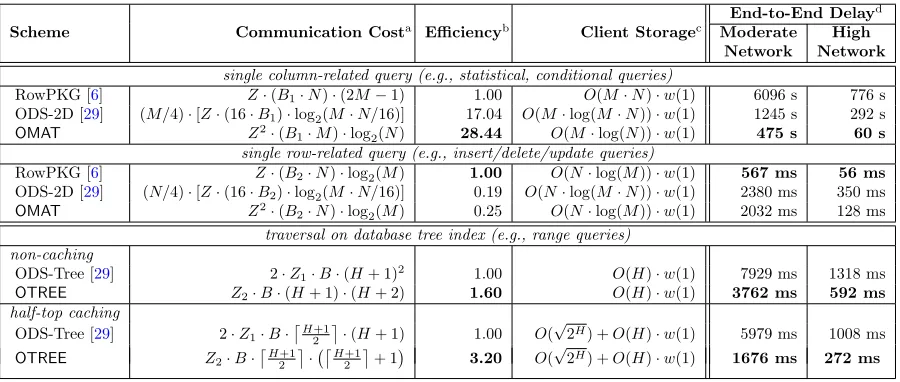
28× more communication efficient than that of RowPKG and this enables OMAT to perform queries approximately 13×faster than that of RowPKG. Compared to ODS-2D, althoughOMAT is only 1.6×
more communication-efficient, it performs approximately 5×faster in practice due to the large number of additional round-trip delays. OTREEachieves better performance than ODS for obliviously accessing the database index, which is constructed from the values of a column as a tree data structure. The communication cost ofOTREEis 1.6×less than that of ODS without caching. This gain can be increased up to 3.2×with the caching strategy.
•Generic Instantiations from Tree-based ORAM Schemes:We notice thatanytree-based ORAM scheme (e.g., [25, 28]) can be used for both OMAT and OTREE instantiations. This provides a flexibility in selecting a suitable underlying ORAM scheme, which can be adjusted according to the performance requirements of specific applications. Note that, in this paper, we instantiated our schemes with Path-ORAM [25] due to its efficiency, simplicity and not requiring any server-side computation.
•Comprehensive Experiments and Evaluations: We implementedOTREE,OMAT, and their counterparts under the same framework. We evaluated their performance with a MongoDB database instance unning on a remote AmazonEC2 server with two different network settings: (1) moderate-speed network and (2) high-speed network. This permits us to observe the impact of real network and cloud environment.
2
Preliminaries
Table 2. Summary of notations in tree-based ORAM.
Symbol Description
N Total number of nodes in the tree-based ORAM
H Height of the ORAM tree structure
b, B Block and Block size
Z Capacity (in blocks) of each node
P(i) Path from leaf nodeito root bucket in the tree
P(i, `) Bucket at level`along the pathP(i)
S Client’s local stash (optional)
pm Client’s local position map
i:=pm[id] block identified byidis currently associated with leaf nodei, i.e., it resides somewhere alongP(i) or (optional) in the stash.
2.1
Tree-based ORAM
ORAM enables a client to access encrypted data on an untrusted server without exposing the access patterns (e.g., memory blocks, their access time and order) to the server [11]. Existing ORAM schemes rely on IND-CPA encryption [15] and an oblivious shuffling to ensure that any data access patterns of the same length are computationally indistinguishable by anyone but the client.
Position map Client
Server
𝑧 ℎ = log
'𝑁 Stash
Figure 3. Tree-based ORAM structure [23].
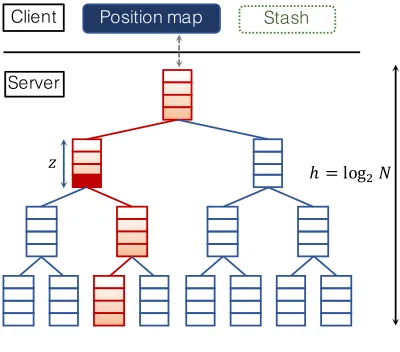
Recent ORAMs (e.g., [8, 9, 22, 25]) follow the tree paradigm [23], which consists of two main data structures: A full binary tree data structure stored at the server side and a position map (denoted aspm) stored at the client side (Figure3). Each node in the tree is called a bucket (denotedB) which can store up toZ data blocks (e.g.,Z = 4). Each blockbhas a unique identifieridand all blocks are of the same size B (4 KB). A tree-based ORAM with N leaf nodes can store up to N real blocks, and other empty slots are filled with dummy data. P(i) denotes a path from the root to leaf iof the tree. The position mappmholds the location among 2N possible pathsP(i) for every block with identifierid. The size ofpm
isO(NlogN) which can be reduced toO(1) by using recursive ORAMs to store pmon the server with theO(logN) increase of communication rounds for each access operation. Table2summarizes notations being used for tree-based ORAM scheme.
communication and computation overhead, they all rely on the aforementioned basic operations.
Path-ORAM: In Path-ORAM [25], all real blocks are downloaded and stored temporarily in a so-called
stash at the client in the retrieval phase. A new random address is then assigned to the accessed block and the local position map is updated. Next, the blocks in the stash are evicted according to the retrieval path. Path-ORAM offers asymptotically optimal communication and computation cost of O(logN) by storingO(NlogN)-sized position map. As the recursive ORAMs are known to be highly costly, we do not discuss them in this work.
2.2
Oblivious Data Structure
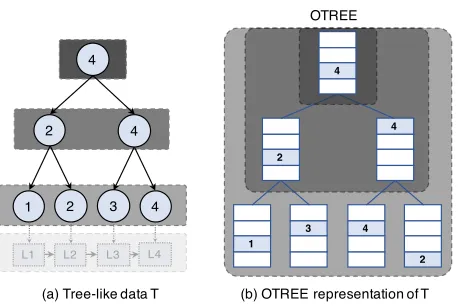
Oblivious Data Structure (ODS) proposed by Wang et al. [29] leverages “pointer techniques” to reduce the storage cost of position map components in non-recursive ORAM schemes toO(1), if the data to be accessed have some specific structures (e.g., grid, tree, etc.). For instance, given a binary search-sorted array as illustrated in Figure4, the ORAM block is augmented withk+ 1 additional slots that hold the position of the block along with the positions and identifiers of its children asb:= (id,data,pos,childmap), whereidis the block identifier,datais the block data,posis its position in ORAM structure, andchildmap
is a miniature position map with entries (idi,posi) for k children. To ensure that thechildmapis up to date, a child block must be accessed through at most one parent at any given time. If a block does not have a parent (e.g., the root of a tree), its position will be stored in the client. A parent block should never be written back to the server without updating positions of its children blocks.
4
3 1
5 2
4 1 2 3 5
Tree T Tree-based ORAM of T
Figure 4. Oblivious Data Structure for a tree structure [29].
2.3
ORAM Implementation Framework
One of the most reliable and complete ORAM frameworks is CURIOUS [2], which gives a complete implementation of the state-of-the-art ORAM schemes (e.g., Path-ORAM [25]) in Java. In this paper, we chose CURIOUS to implement our oblivious data structures as it can be adopted with database drivers such as MongoDB or MySQL.
3
Proposed Techniques
CURIOUS [2]) enables a fair experimental comparison of the proposed techniques with the state-of-the-art.
3.1
Oblivious Access on Table Structures
ID 1 2 3 4 5
1 1 2 3 4 5
2 6 7 8 9 10
3 11 12 13 14 15
4 16 17 18 19 20
…C13 C14 C15 C16 C17 C18 C19 C20 C21 C22 C23 C24 C25 C26 C27 C28
… R1
… R2
… 16 20 17 18 19 R3
… R4
… 1 5 2 3 4 R5
… R6
… 6 10 7 8 9 R7
… R8
… 11 15 12 13 14 R9
… R10
… R11
… R12
(b) OMAT representation of Table A
(a) Table A (c) Tree-ORAM based layout for oblivious row and column accesses Oblivious row access (OROW)
Oblivious column access (OCOL)
1 C13 C14 5 C15 C16 C17 2 C18 C19 C20 C21 3 C22 C23 C24 C25 C26 C27 4 C28 C5 C6 C7 C8 C9 C10 C11 C12 C1 C2 C3 C4 3 R9 R10 R11 R12 1 R5 R6 2 R7 R8 R1 R2 4 R3 R4
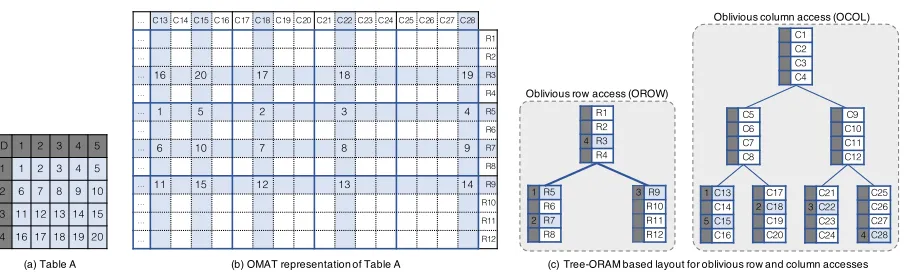
Figure 5. OMATstructure for oblivious access on table.
The direct application of tree-based ORAMs to access encrypted tables in general [2] and database systems in specific [6] have been shown to be inefficient for large datasets. Specifically, if each row in the table is packaged into an ORAM block as in [6], then performing queries to fetch a column in such a table (e.g., statistics) would require the client to stream all blocks in the ORAM structure, which might be impractical. On the other hand, packaging each cell in the table into an ORAM incurs a high network delay and client storage overhead. Thus, we investigate on how to translate the table into an oblivious data structure so that each row and column of it can be both accessed efficiently by a given ORAM scheme. Below, we first describe our oblivious data structure and then present ourOMATaccess scheme on top of it.
• Oblivious Data Structure for OMAT. The main data structure that we use for oblivious access on a table is a matrix. Given an input tableTof sizeM×N, we allocate a matrixMof sizeZ·2dlog2(M)e−1×
Z·2dlog2(N)e−1. We arrange tree-based ORAM building blocks for oblivious access as follows:
The layout of OMAT matrix M can be interpreted as two logical tree-based ORAMs defined as oblivious rows (denoted as OROW) and oblivious columns (denoted as OCOL) as illustrated in Figure
5. That is, the ORAM for row access on OROW is formed by a set of blocks bi := (idi,datai), where
idi is either a unique identifier if bi contains the content of a row of the table Tor null otherwise, and
datai ←M[i,∗]. We groupZ subsequent rows inMto form a bucket (i.e., node) in theOROWstructure. Similarly, the ORAM for column access onOCOLis formed bybj = (idj,dataj). Each (bucket) node in
OCOLis formed by groupingZ subsequent blocks.
We assign each row T[i0,∗] (i0 = 1, . . . , M) and each columnT[∗, j0] (j0 = 1, . . . , N) with a random leaf node IDs ui0 and vj0 in OROW and OCOL, respectively. That is, the data of T[i,∗] and T[∗, j]
reside in some rows and columns of M along the assigned pathsP(ui) in OROW and P(vj) in OCOL, respectively. In other words, M[i, j]←T[i0, j0], whereM[i,∗]∈ P(u
i0) in OROW andM[∗, j]∈ P(vj0)
in OCOL. Our construction requires two position maps (pmrow andpmcol) to store the assigned path for each row T[i0,∗] and each column T[∗, j0] of table T in OROW and OCOL, respectively. Our position maps store all necessary information to locate the exact position of a row/column data in the tree-based ORAM structures aspm:= (id,hpathID,level,orderi), where 0≤level≤log2(N) indicates the level of the bucket, in which the row/column withid resides, and 1≤order≤Z indicates its order in the bucket.
•The Proposed OMAT Access Scheme. We present ourOMATscheme, which is instantiated with Path-ORAM, in Algorithm 1. Specifically, given a column (resp. row) identifier (id) to be accessed1, the
Algorithm 1data←OMAT.Access(op,dim,id)
1: b←pmdim[id].pathID
2: if dim=colthen
3: pmdim[id].pathID←− {$ 1, . . . ,2dlog2(N)e−1} 4: H ← dlog2(N)e
5: else
6: pmdim[id].pathID←− {$ 1, . . . ,2dlog2(M)e−1} 7: H ← dlog2(M)e
.Read all rows/columns on the pathP(b) 8: foreach `∈ {0, . . . , H}do
9: Sdim← Sdim∪ReadBucket(dim,P(b, `))
10: data←Read row/column withidfromSdim
11: data←FilterDummy(data,S¬dim)
12: S¬dim←Update(S¬dim,pmdim)
13: if op=writethen
14: Sdim←(Sdim\ {(id,data)})∪ {(id,data∗)}
.Evict blocks from the stash 15: foreach `∈ {H, . . . ,0}do
16: S0
dim← {(id
0
,data0)∈ Sdim|P(b, `) =P(pmdim[id
0
].pathID, `)} 17: S0
dim←Select min(|S
0
dim|, Z) blocks fromS
0
dim
18: Sdim← Sdim\ Sdim0
19: o←1
20: foreach (id0,data0)∈ Sdim0 do
21: pm[id0].level←`
22: pm[id0].order←o,o←o+ 1
23: WriteBucket(dim,P(b, `),S0
dim)
24: returndata
client retrieves its location from the column (resp. row) position map (step1). The client then assigns the column (resp. row) to a new location selected uniformly at random (steps 2–7). The client reads allcolumns (resp. rows) residing on the same path according to tree-based ORAM layout (as depicted in Figure 5-(c) to the stash (steps8–9). In this case, we modify the originalReadBucket subroutine of Path-ORAM, where it now takes an extra parameter (dim) that indicates the dimension to be read, and outputs the corresponding Z columns/rows in the bucket. The client retrieves thecolumn (resp. row) with id from the stash (step 10). One might observe that according to OMAT structure, the retrieved
column (resp. row) will contain data from dummyrows (resp. columns) as depicted by empty blue cells in Figure5-(b). Therefore, to obtain only the real data of the requested column (resp. row), the client filters all data from dummyrows (resp. columns) (step11). Moreover, since the position of the retrieved column (resp. row) is moved to a new random position (steps2–7), it is required to update all rows
(resp. columns) that are currently stored in the stash at this column (resp. row) position to achieve the consistency (step 12). If the access is to update, the client then updates the column (resp. row) with new data (steps13–14) Finally, the client performs eviction as described in Path-ORAM to flushcolumns
(resp. rows) from the stash back to theOMATstructure in the server (steps15–23).
Notice that all columns/rows are IND-CPA decrypted and re-encrypted as they are read and written to/from the server, respectively. We assume that it is not required to hide the information whether a column or a row is being accessed. However, this can be achieved with the cost of performing oblivious accesses on both row and column (one of them is dummy selected randomly) for each access.
over a column in an efficient manner via OMAT. Note that OMAT can also permit conditional query on rows with WHEREstatement. Similar to statistical queries, the query can be implemented by reading the attribute column on which the WHERE clause looks up OCOLfirst to determine appropriate records that satisfy the condition, and then obliviously fetching such records onOROW structure. For example, assume that we have the following SQL-like conditional search.
SELECT * FROM A WHERE C > k
It can be implemented by:
1. Read the column C with id0 onOCOLas
C[∗,id0]←OMAT.Access(read,col,id0).
2. Get IDs of rows whose value larger thank, and such IDs are inpmrowas
I ← {id|id∈pmrow.id∧C[id,id0]> k}
3. Access onOROWto get the desired result as
R[id,∗]←OMAT.Access(read,row,id), for each id∈ I.
The aforementioned approach can work with any unindexed columns. In the next section, we propose an alternative approach that can offer a better performance if the columns can be indexed with certain restrictions.
3.2
Oblivious Access on Tree Structures
1
3 4
2 2
4 OTREE
4 4
4 3 2 1
4 2
(a) Tree-like data T (b) OTREE representation of T L1 L2 L3 L4
Figure 6. TheOTREElayout for a tree data.
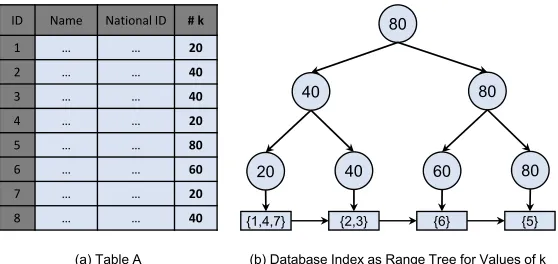
In the unencrypted database setting, conditional queries can be performed more efficiently, if column values can be indexed by a search-efficient tree data structure (e.g., Range tree, B+ tree, AVL tree). Figure9 illustrates an example of a column indexed by a range tree for (non)-equality/range queries, in which each leaf node points to a node in another linked-list structure that stores the list of matching IDs. We propose an oblivious tree structure called OTREE, in which indexed data for such queries are translated into a balanced tree structure. As inOMAT, OTREEcan be instantiated from any tree-based ORAM scheme. Notice that oblivious access on a tree was previously studied in [29]. Our method requires less amount of data to be transmitted and processed, since the structure of indexed values (i.e., the tree data structure) is not required to be hidden, and the client is merely required to traverse an arbitrary path of the tree. We present the construction ofOTREEas follows.
in a bucket at level ` or lower inOTREE. If there is no empty slot in the path, the node will be stored in the stash ifOTREEis instantiated with stash-required ORAM schemes (e.g., Path-ORAM).
We assumeTis sorted by nodes’idand the position of nodes at level`is stored in its parent node at level`−1 using the pointer technique proposed in [29]. Hence, each node ofTis considered as a separate block in OTREEstructure as: b := (id,data,childmap), where id is the node identifier sorted inT (e.g., indexed column value),dataindicates the node data, andchildmapis of structurehid,posithat stores the position information of node’s children.
•The Proposed OTREE Access Scheme: OTREEcan be instantiated with any tree-based ORAM schemes (e.g., Ring-ORAM [22], Circuit-ORAM [28]) , as similar toOMATin Section3.1, by modifying correspond-ing retrieval/eviction procedures while preservcorrespond-ing the constraints ofOTREEregarding the deepest level of nodes. OTREEalso receives a significant benefit from caching mechanisms like top-tree caching [17], which can speed up bulk access requests.
We give the proposed OTREEscheme instantiated with Path-ORAM in Algorithm 2. Specifically, given the node identifier id to be accessed in the id-sorted tree structure, the client first reads the root bucket of Path-ORAM structure to obtain the root node of the tree (steps1–3). The client then compares the requested id with the rootid to decide which child of the root node should be accessed in the next step. The client accesses this child by reading its path in the Path-ORAM structure from level 0 to level 1. We notice that for each node at levell in the tree to be accessed, the client only accesses the path in the Path-ORAM structure up to levell. The process repeats until the desired id is found (steps4–16). Finally, the client performs eviction to flush read nodes back to the Path-ORAM structure, wherein nodes at level l in the tree must reside somewhere in the Path-ORAM structure from level 0 to level l (steps
17–21).
The construction and constraints of OTREE require a stability analysis to ensure that tree-based ORAM scheme on OTREE behaves similarly to ODS in terms of the stash overflow probability. We provide an empirical stability analysis ofOTREEwith Path-ORAM as follows.
Algorithm 2(data)←OTREE.Access(op,id,data∗)
1: x0←RootPos
2: S ← S ∪ReadBucket(P(x0,0),0)
3: b0←Read block withid0= 0 fromS 4: for each`∈ {0, . . . , H−1} do
5: if compare(id,id`) =go right then
6: (id`+1, x`+1)←b`.child[1]
7: b`.child[1].pos
$
←− {0, . . . ,2`−1} 8: else
9: (id`+1, x`+1)←b`.child[0]
10: b`.child[0].pos
$
←− {0, . . . ,2`}
11: S ← S ∪ReadBucket(P`+1(x`+1, `+ 1)) 12: b`←Read blockid`fromS
13: if id=id`then
14: data←b`.data
15: if op=writethen
16: S←(S\ {b`})∪ {(id,data∗,child)}
17: foreach`0∈ {`, . . . ,0}do
18: S0← {b0∈ S:P
`(b0.pos, `0) =P`(b`.pos, `0)∧b0.level=`}
19: S0←
Select min(|S0|, z
) blocks fromS0
20: S ← S \ S0
21: WriteBucket(P`(x`, `0),S0)
•Stability Analysis of OTREE: We analyze the stability ofOTREEin terms of the average bucket load in each level of the ORAM tree. Intuitively, one would expect an increase in average bucket load near the top of the ORAM tree, and a possible increase in the average client stash size if a Path-ORAM variant (e.g., [22, 17]) is used. We show empirically by our simulations, that OTREEbehaves almost similar to ODS with a bucket size ofZ ≥4 with Path-ORAM. WithZ = 5, bucket usage withOTREEstructure approaches that of the stationary distribution when using an infinitely large bucket size.
Our empirical study considered experiments with an ORAM tree of heightH = 14 storingN = 215−1 blocks. We ran the experiments with different bucket sizes to observe its effect on the stash size and bucket usage. We treated ORAM blocks as nodes in a full binary tree ofH = 14. We inserted nodes into storage according to the breadth-first order via access functions followed by a series of (H + 1)-length access requests, each of which consists of accessing a path of nodes from the root to a random leaf node in the binary tree. A single-round experiment was the execution of 214random root-to-leaf access sequences as described.
Figures7-8show the results of these experiments for ODS andOTREEwith different bucket sizes. The results were generated by first running 1000 warm-up rounds after the initialization, and then collecting statistics over 1000 test rounds. Figure 7 depicts that with a bucket sizeZ = 5, buckets near the root of the OTREEstructure contain roughly two non-empty blocks (one more than the average number of
0 2 4 6 8 10 12 14
0 20 40 60 80 100
Level Index
Lev
el
Load
(%)
OTREE
ODS [29]
(a)Z= 4
0 2 4 6 8 10 12 14
0 20 40 60 80 100
Level Index
Lev
el
Load
(%)
OTREE
ODS [29]
(b) Z= 5
Figure 7. Average bucket load within each level of the ORAM tree for different bucket sizes, wherey-axis shows the average percentage of bucket being used andx-axis shows the bucket levels from 0 (root) to 14 (leaf).
100 101 102 103
10−9 10−8 10−7 10−6 10−5 10−5 10−4 10−3 10−2 10−1 100
m
Pr
(blo
ck
s
in
stash
≥
m
)
OTREE, Z= 4
OTREE, Z= 5
ODS [29],Z= 4 ODS [29],Z= 5
ID Name National ID # k
1 … … 20
2 … … 40
3 … … 40
4 … … 20
5 … … 80
6 … … 60
7 … … 20
8 … … 40
(a) Table A
80
40 20
40
(b) Database Index as Range Tree for Values of k 80 60
80
{1,4,7} {2,3} {6} {5}
Figure 9. Values in a column indexed as a tree, and a linked list to retrieve matching IDs for conditional queries.
blocks assigned to them). Figure8illustrates that withZ ≤4, the probability of the stash size exceeding
O(H) forOTREEdiminishes quickly. These results suggest that usingZ= 5 forOTREEin order to make underlying ORAM scheme inOTREEbehaves similarly to that withZ= 4 on ODS.
•Use Case: Conditional Query on Columns:
We exemplify an implementation of a database index structured asOTREEfor conditional queries as follows: Consider a column whose values are indexed by a sorted tree Tof heighthby putting distinct values as keys on leaf nodes as depicted in Figure9. The leaf nodes ofTpoints to a node ID in a linked-list structure that contains a linked-list of matching IDs with the key. We translateTintoOTREE, where each node at level` < Hstores the position maps of its children. We store a list of IDs in each linked-list node using an inverted index with compression. As the data structure for the linked-list, we employ ODS to store it in another ORAM structure (see [29] for details). Hence, each leaf node ofTstores the position map of a linked-list node in ODS it points to. An example of a given conditional query as follows.
SELECT ∗ FROM A WHERE C=k
where the columnCis indexed intoOTREE. It can be executed obliviously as follows.
1. Traverse a path with OTREEto get a leaf node asb←OTREE.Access(k).
2. Get ID and position map of linked-list node whichb points to as (id,pos)←b.childmap
3. Access on ODS to get the desired result as
R ←ODS.Access(id,pos,·)
The overall cost for this approach is: O(log2N+k·O(log(N)), wherekis the distance from the first element of the linked-list. The first part is the overhead ofOTREE and the second part is the overhead of ODS (without padding).
4
Security Analysis
Our security analysis, as in Path-ORAM [25], is concise as the security of our proposed schemes are evident from their base ORAM.
Definition 1(ORAM security [25]). Let~y:= ((op1,id1,data1), . . . ,(opM,idM,dataM))be a data request
sequence of lengthM, where eachopi denotes a read(idi)or awrite(idi,data)operation. LetA(~s)denote
Corollary 1. AccessingOMATleaks no information beyond(i)the size of rows and columns,(ii)whether the row or column dimension being accessed, given that the ORAM scheme being used on top is secure by Definition1.
Proof. LetMbe an OMATstructure consisting of two logical tree-based ORAM structures OROWand
OCOL as described in Section 3.1 with dimensions M and N, respectively. Let the bit B = 0 if the query is on OROW andB = 1, otherwise. A construction providing OMATleaks no information about the location of a nodeubeing accessed inM beyond the bitB and dimensions (M, N). This is due to the fact that OMATuses a secure ORAM that satisfies Definition1 to access each block of OROWand
OCOLin M. Thus, as long as the node accessed withinOROWorOCOLis not distinguishable from any other node within thatOROWandOCOLthrough the number of access requests, it is indistinguishable by Definition1.
Note that the information on whether the row or column was accessed can be hidden by performing a simultaneous row and column access on both dimensions for each query. This poses a security-performance trade-off. One can also hide the size of row and column by settingOMATmatrix with equal dimensions, but this may introduce some cost for certain applications.
Corollary 2. Accessing OTREEleaks no information about the actual path being traversed, given that
the ORAM scheme being used on top is secure by Definition1.
Proof. Let Tbe a tree data structure of height H. Let T` be the set of nodes at level 0 ≤` ≤H in the tree. A construction providing OTREEleaks no information about the location of a node u ∈ T` being accessed in the tree beyond that it is fromT`. This is due toOTREEuses a secure ORAM that satisfies Definition 1 to access each level of the tree. Thus, as long as a node accessed within level` is not distinguishable from any other node within that level through the number of access requests, it will be indistinguishable according to Definition1.
Side-channel leakages in Path-ORAM. There are several side-channel attacks on Path-ORAM (e.g.,
[1,10]) when it is executed by the secure CPU playing on behalf of the ORAM client. In this context, since the secure CPU resides in the untrusted party, the adversary has a partial view on it to exploit the timing leakage (e.g., [1]). In our model, we assume that the client is fully trusted and it is totally apart from the adversary view (i.e., untrusted database server). Therefore, we do not consider these side-channel leakages due to the difference between our model and the secure CPU context.
5
Performance Evaluation
5.1
Configurations
• Implementation: We implemented our schemes and their counterparts on CURIOUS framework [2]. We integrated additional functionalities into the framework to perform batch read/write operations to prevent unnecessary round-trip delays, and also to communicate with MongoDB instance via MongoDB Java Driver. We chose MongoDB as our database and storage engine. We preferred MongoDB since its Java Driver library is well-documented and easy to use. Moreover, it supports batch updates without restrictions, which is important for consistent performance analysis.
•Data Formatting: We created our database table with randomly generated data with a different number of rows, columns, and field sizes. We then used the table to construct tree-based ORAMs for compared schemes. For instance, in OMAT, we created OROW and OCOL structures from this table, while an oblivious tree structure is created forOTREE, as described in Section3.
102 103 0
2 4 6 8
·102
# of Columns
Resp
onse
Time
(s)
OMAT RowPKG [6] ODS-2D [29]
(a) Column-related queries with 215rows
103 104 105 106
0 2 4
·102
# of Rows
Resp
onse
Time
(ms)
OMAT
RowPKG [6] ODS-2D [29]
(b)Row-related queries with 25columns
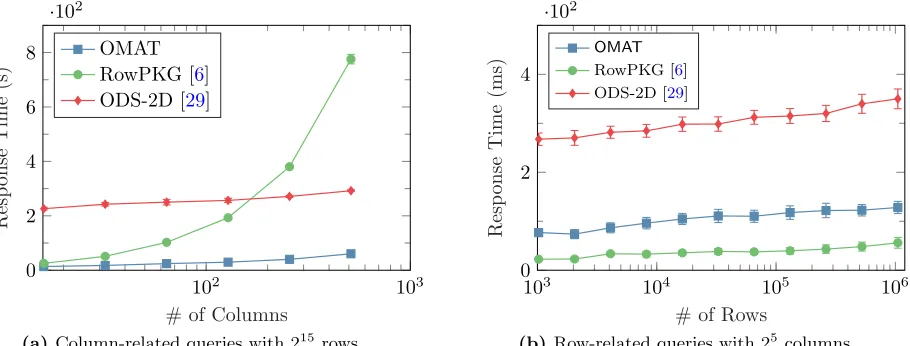
Figure 10. End-to-end delay of queries forOMATand counterparts with high-speed network setting.
type that runs Ubuntu Server 16.04. While the connection between the desktop and the server was a
high-speed network with download/upload speeds of 500/400 Mbps and an average latency of 11 ms, the connection between the laptop and the server was amoderate-speed network with download/upload speeds of 80/6 Mbps and an average latency of 30 ms.
•Evaluation Metrics: We evaluated the performance of our schemes and their counterparts based on the following metrics: (i) The Response time (i.e., end-to-end delay) including decryption, re-encryption and transmission times to perform a query; (ii) Client storage including the size of stash and position map; (iii) Server storage including the size ofOMATorOTREE. We compared the response times ofOMATand its counterparts for both row- and column-related queries (e.g., statistical, conditional). ForOTREEand ODS-Tree, we compared the response times of traversing an arbitrary path on the tree-indexed database. To measure the end-to-end delay, we used thestd::chronoC++ library to get the actual duration at the client side, from the time the client sends the first command until he receives the last response from the Amazon server. For each experiment, we ran 50 times and took the average number as the final response time reported in this section. We now describe our experimental evaluation results and compare our schemes with their counterparts.
5.2
Experimental Results
• Statistical and Conditional Queries (Column-Related): We first analyze the response time of column-related queries for OMAT, ODS-2D and RowPKG. With these queries, the client can fetch a column from the encrypted database for statistical analysis or a conditional search. Given a column-related query, the total number of bytes to be transmitted and processed by each scheme are shown in Table
1. RowPKG’s transmission cost is the size of all ORAM buckets, where Z ·(B ·N) and (2M −1) denote the bucket size and the total number of buckets, respectively. As for OMAT, its oblivious data structure OCOLallows efficient queries on column dimension withO(log(N)) communication overhead, which outperforms the linear overhead ofO(N) of RowPKG. WhileOMAT and RowPKG can fetch the whole column with one request, it requiresM/4 synchronous requests for ODS-2D where each request costsZ·(16·B1)·log2(M·N/16) bytes due to 4×4 clustering of the cells.
We measured the performance ofOMATand its counterparts with arbitrary column queries. In this experiment, we set parameters asB= 64 bytes andZ= 4. The number of columnsN varies from 24 to 29, where the number of rows isfixedto beM = 215. Figures10a and11aillustrate the performance of the schemes on two different network settings with two different client machines as described in Section
102 103 0
2 4 6
·103
# of Columns
Resp
onse
Time
(s)
OMAT RowPKG [6] ODS-2D [29]
(a) Column-related queries with 215rows
103 104 105 106
0 1 2 3 ·10
3
# of Rows
Resp
onse
Time
(ms)
OMAT
RowPKG [6] ODS-2D [29]
(b)Row-related queries with 25columns
Figure 11. End-to-end delay of queries forOMATand counterparts with moderate-speed network setting.
103 104 105 106
0 0.5 1 1.5 ·10
3
# of Leaves (Indexed Values)
Resp
onse
Time
(ms)
ODS-Tree [29]
ODS-Tree [29] with Caching
OTREE
OTREEwith Caching
(a) Moderate-Speed Network Setting
103 104 105 106
0 2 4 6 8
·103
# of Leaves (Indexed Values)
Resp
onse
Time
(ms)
ODS-Tree [29]
ODS-Tree [29] with Caching
OTREE
OTREEwith Caching
(b)High-Speed Network Setting
Figure 12. End-to-end delay of traversal on tree-indexed database forOTREEand ODS-Tree.
networks, respectively. This makesOMATabout 13×faster than RowPKG. WhileOMATperforms 2.6×
faster than ODS-2D on the moderate-speed network, it becomes 4.9×on high-speed network since the latency starts to dominate the response time of ODS-2D withM/4 requests due to its construction with pointers.
• Single Row-Related Queries: We now analyze the response time of row-related queries for OMATand its counterparts. Given a row-related query, the total number of bytes to be transmitted and processed by OMAT and its counterparts are summarized in Table 1. For OMAT and RowPKG, (B ·N) and
Z·log2(M) denote the total row size and the overhead of Path-ORAM, respectively. Due to OMAT’s
OCOLand OROW structures, OMAT is always a constant factor of Z = 4 more costly than RowPKG. Clustering strategy of ODS-2D also introduces more cost and makes ODS-2D 4.2× more costly than RowPKG whenN = 32.
We measured the performance of OMATand its counterparts with arbitrary row queries, where the number of rowsM varies from 210 to 220. The block size isB = 128 bytes and the number of columns is fixed as N = 32. By this setting, the total row/record size is B ·N = 4096 KB. Figures 10b and
11b illustrate the performance of the compared schemes for both network settings. We can see that
and moderate-speed network, respectively. As for ODS-2D, Figure10bexplicitly shows the effect of the round-trip delay introduced by network latency on ODS-2D due toN/4 synchronous requests. Although ODS-2D has similar cost withOMAT, it performs approximately 220msand 380msslower thanOMAT.
• Traversal on Tree-indexed Database: We analyze the response time of oblivious traversal on database index that is constructed as a range tree by putting distinct values of a column to the leaf of the tree. Figure 9 exemplifies the constructed range tree, and this structure is used along with its linked list to perform conditional queries (e.g., equality, range) on an indexed column, and fetch matching IDs. We compare our proposedOTREEand ODS-Tree with no caching and half-top caching strategies.
Given a database index tree constructed with values of the column, the total number of bytes to be transmitted and processed byOTREEand ODS-Tree without caching areZ2·B·(H+ 1)·(H+ 2) and 2·Z1·B·(H+ 1)2, respectively, whereH is the height of tree data structure. While ODS traverses the tree withO(H), the additional overhead of Path-ORAM makes the total overhead to beO(H2). As for
OTREE, its level restriction on ORAM storage reduces the transmission overhead by 1.6×. With half-top caching strategy, overheads of both schemes reduce as shown in Table1, however,OTREE’s construction benefits more from caching by performing traversal 3.2×less costly than ODS-Tree.
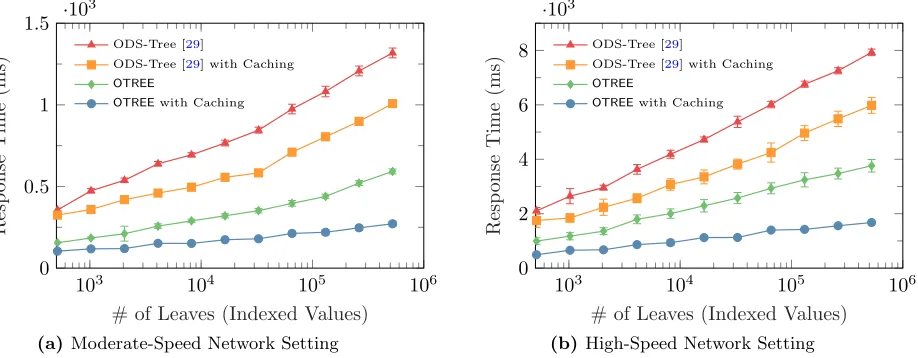
For this experiment, we set the block sizeB = 4 KB, the number of blocks inside a bucket for ODS-Tree is Z1 = 4, and the number of blocks inside a bucket for OTREE is Z2 = 5 (see Section 3.2 for the stability analysis). We benchmarked OTREE and ODS-Tree with arbitrary equality queries when the number of indexed values varies from 29 to 219. The number of indexed values is set to 219 for large database setting. For both network settings, Figure12demonstrates the effect of half-top caching strategy and how the structure of OTREEgives more leverage in response time. WhileOTREEwithout caching performs around 2×faster than its counterpart, caching allows OTREE to perform 3.6×faster than ODS-Tree with caching for both network settings.
5.3
Client and Server Storage
We now analyze the client storage overhead of our schemes and their counterparts. The position map of
OMAT requiresO((M +N)·log(M +N)) storage, while RowPKG requires O(M ·log(M)), since only the position map of rows are stored. However, the dominating factor is M, since large databases have more rows than columns. ODS’s pointer technique allows it to operate with O(1) storage for position map. Moreover, the worst-case stash size changes with the query type, because stash is also used to store currently fetched data and the worst-case storage costs are summarized in Table1. For row-related queries, the worst-case stash storage is the same for both OMAT and RowPKG but ODS-2D requires more storage due to clustering. For column-related queries, RowPKG requires storing O(M ·N) that corresponds to all ORAM buckets. Besides the query performance issues, this also makes RowPKG infeasible for very large databases to perform column-related queries. In addition, ODS-2D also requires
O(log(M)) times more client storage compared toOMAT. While RowPKG and ODS-2D have the same server storage size,OMATrequires constantZ×more storage due to additional dummy blocks.
SinceOTREEand ODS do not require the position map to operate, the client storage consists of the stash and additionally cached block according to the caching strategy used. For the worst-case, both schemes have the same client storage with the same caching strategy; however, the stash ofOTREEmay be more loaded than ODS as shown in Figure8 due to its level restriction. Moreover, server storage of
OTREEis 2×less than ODS, since Path-ORAM of ODS requires one more level thanOTREE.
6
Conclusions
techniques, and also receives more benefit from caching optimizations. These properties allowOMATand
OTREE to be ideal data structures to construct oblivious database services on the cloud, which offers high security and privacy guarantee for the users.
Acknowledgment
This work is supported by NSF CAREER Award CNS-1652389.
References
[1] C. Bao and A. Srivastava. Exploring timing side-channel attacks on path-orams. In2017 IEEE International Symposium on Hardware-Oriented Security and Trust (HOST), pages 68–73. IEEE, 2017.
[2] V. Bindschaedler, M. Naveed, X. Pan, X. Wang, and Y. Huang. Practicing oblivious access on cloud storage: the gap, the fallacy, and the new way forward. In Proceedings of the 22nd ACM SIGSAC Conference on Computer and Communications Security, pages 837–849. ACM, 2015.
[3] N. Cao, C. Wang, M. Li, K. Ren, and W. Lou. Privacy-preserving multi-keyword ranked search over encrypted cloud data. IEEE Transactions on parallel and distributed systems, 25(1):222–233, 2014.
[4] D. Cash, P. Grubbs, J. Perry, and T. Ristenpart. Leakage-abuse attacks against searchable encryption. In Proceedings of the 22nd ACM SIGSAC Conference on Computer and Communications Security, pages 668–679. ACM, 2015.
[5] D. Cash, J. Jaeger, S. Jarecki, C. S. Jutla, H. Krawczyk, M.-C. Rosu, and M. Steiner. Dynamic searchable encryption in very-large databases: Data structures and implementation. IACR Cryptology ePrint Archive, 2014:853, 2014.
[6] Z. Chang, D. Xie, and F. Li. Oblivious ram: a dissection and experimental evaluation. Proceedings of the VLDB Endowment, 9(12):1113–1124, 2016.
[7] B. Chen, H. Lin, and S. Tessaro. Oblivious parallel ram: Improved efficiency and generic constructions. In
Theory of Cryptography Conference, pages 205–234. Springer, 2016.
[8] J. Dautrich and C. Ravishankar. Combining oram with pir to minimize bandwidth costs. InProceedings of the 5th ACM Conference on Data and Application Security and Privacy, pages 289–296. ACM, 2015.
[9] S. Devadas, M. van Dijk, C. W. Fletcher, L. Ren, E. Shi, and D. Wichs. Onion oram: A constant bandwidth blowup oblivious ram. InTheory of Cryptography Conference, pages 145–174. Springer, 2016.
[10] C. W. Fletcher, L. Ren, X. Yu, M. Van Dijk, O. Khan, and S. Devadas. Suppressing the oblivious ram timing channel while making information leakage and program efficiency trade-offs. InHigh Performance Computer Architecture (HPCA), 2014 IEEE 20th International Symposium on, pages 213–224. IEEE, 2014.
[11] O. Goldreich and R. Ostrovsky. Software protection and simulation on oblivious rams. Journal of the ACM (JACM), 43(3):431–473, 1996.
[12] T. Hoang, A. Yavuz, and J. Guajardo. Practical and secure dynamic searchable encryption via oblivious access on distributed data structure. In Proceedings of the 32nd Annual Computer Security Applications Conference (ACSAC). ACM, 2016.
[13] M. S. Islam, M. Kuzu, and M. Kantarcioglu. Access pattern disclosure on searchable encryption: Rami-fication, attack and mitigation. InAnnual Network and Distributed System Security Symposium – NDSS, volume 20, page 12, 2012.
[14] S. Kamara, C. Papamanthou, and T. Roeder. Dynamic searchable symmetric encryption. InProceedings of the 2012 ACM Conference on Computer and Communications Security, pages 965–976. ACM, 2012.
[15] J. Katz and Y. Lindell. Introduction to Modern Cryptography. Chapman & Hall/CRC, 2007.
[16] C. Liu, L. Zhu, M. Wang, and Y.-a. Tan. Search pattern leakage in searchable encryption: Attacks and new construction. Information Sciences, 265:176–188, 2014.
[18] B. Pinkas and T. Reinman. Oblivious ram revisited. In Advances in Cryptology–CRYPTO 2010, pages 502–519. Springer, 2010.
[19] R. A. Popa, C. Redfield, N. Zeldovich, and H. Balakrishnan. Cryptdb: protecting confidentiality with encrypted query processing. In Proceedings of the Twenty-Third ACM Symposium on Operating Systems Principles, pages 85–100. ACM, 2011.
[20] R. A. Popa, C. Redfield, N. Zeldovich, and H. Balakrishnan. Cryptdb: processing queries on an encrypted database. Communications of the ACM, 55(9):103–111, 2012.
[21] D. Pouliot and C. V. Wright. The shadow nemesis: Inference attacks on efficiently deployable, efficiently searchable encryption. In Proceedings of the 2016 ACM Conference on Computer and Communications Security. ACM, 2016.
[22] L. Ren, C. W. Fletcher, A. Kwon, E. Stefanov, E. Shi, M. van Dijk, and S. Devadas. Ring oram: Closing the gap between small and large client storage oblivious ram. IACR Cryptology ePrint Archive, 2014:997, 2014.
[23] E. Shi, T.-H. H. Chan, E. Stefanov, and M. Li. Oblivious ram with o ((logn) 3) worst-case cost. InAdvances in Cryptology–ASIACRYPT 2011, pages 197–214. Springer, 2011.
[24] E. Stefanov, E. Shi, and D. Song. Towards practical oblivious ram. arXiv preprint arXiv:1106.3652, 2011.
[25] E. Stefanov, M. Van Dijk, E. Shi, C. Fletcher, L. Ren, X. Yu, and S. Devadas. Path oram: an extremely simple oblivious ram protocol. In Proceedings of the 2013 ACM SIGSAC conference on Computer and Communications security, pages 299–310. ACM, 2013.
[26] B. Wang, Y. Hou, M. Li, H. Wang, and H. Li. Maple: scalable multi-dimensional range search over encrypted cloud data with tree-based index. InProceedings of the 9th ACM symposium on Information, computer and communications security, pages 111–122. ACM, 2014.
[27] B. Wang, M. Li, and H. Wang. Geometric range search on encrypted spatial data. IEEE Transactions on Information Forensics and Security, 11(4):704–719, 2016.
[28] X. Wang, H. Chan, and E. Shi. Circuit oram: On tightness of the goldreich-ostrovsky lower bound. In
Proceedings of the 22nd ACM SIGSAC Conference on Computer and Communications Security, pages 850– 861. ACM, 2015.
[29] X. S. Wang, K. Nayak, C. Liu, T. Chan, E. Shi, E. Stefanov, and Y. Huang. Oblivious data structures. In Proceedings of the 2014 ACM SIGSAC Conference on Computer and Communications Security, pages 215–226. ACM, 2014.
[30] A. A. Yavuz and J. Guajardo. Dynamic searchable symmetric encryption with minimal leakage and efficient updates on commodity hardware. InSelected Areas in Cryptography – SAC 2015, Lecture Notes in Computer Science. Springer International Publishing, August 2015.
[31] H. Yin, Z. Qin, J. Zhang, L. Ou, and K. Li. Achieving secure, universal, and fine-grained query results verification for secure search scheme over encrypted cloud data. IEEE Transactions on Cloud Computing, 2017.
[32] R. Zhang, R. Xue, L. Liu, and L. Zheng. Oblivious multi-keyword search for secure cloud storage service. In
Web Services (ICWS), 2017 IEEE International Conference on, pages 269–276. IEEE, 2017.
![Figure 4. Oblivious Data Structure for a tree structure [29].](https://thumb-us.123doks.com/thumbv2/123dok_us/7954130.1319885/6.612.198.402.346.451/figure-oblivious-data-structure-a-tree-structure.webp)