Copyright 0 1995 by the Genetics Society of America
Multiple
Trait
Analysis
of
Genetic Mapping
for
Quantitative
Trait
Loci
Changjian
Jiang* and
Zhao-Bang Zengt
*Department of Agronomy, Jiangsu Agricultural College, Yangzhou, Jiangsu 225001, People's Republic of China and Program in Statistical Genetics, Department of Statistics, North Carolina State University, Raleigh, North Carolina 27695-8203
Manuscript received September 22, 1994
Accepted for publication March 30, 1995
ABSTRACT
We present in this paper models and statistical methods for performing multiple trait analysis on
mapping quantitative trait loci (QTL) based on the composite interval mapping method. By taking into
account the correlated structure of multiple traits, this joint analysis has several advantages, compared
with separate analyses, for mapping QTL, including the expected improvement on the statistical power
of the test for QTL and on the precision of parameter estimation. Also this joint analysis provides formal
procedures to test a number of biologically interesting hypotheses concerning the nature of genetic
correlations between different traits. Among the testing procedures considered are those for joint
mapping, pleiotropy, QTL by environment interaction, and pleiotropy vs. close linkage. The test of
pleiotropy (one pleiotropic QTL at a genome position) vs. close linkage (multiple nearby nonpleiotropic
QTL) can have important implications for our understanding of the nature of genetic correlations
between different traits in certain regions of a genome and also for practical applications in animal and
plant breeding because one of the major goals in breeding is to break unfavorable linkage. Results of
extensive simulation studies are presented to illustrate various properties of the analyses.
M
ANY
data for mapping quantitative trait loci(QTL) contain observations on multiple traits
or on one or several traits in multiple environments.
With such data, we can ask questions like the following:
Does a QTL have pleiotropic effects on multiple traits? Does a QTL show genotypeenvironment interaction?
What is the nature of genetic correlation between differ-
ent traits? Is the correlation due to pleiotropy or linkage
in certain regions of a genome? Statistically this involves
multiple trait analysis, because the expression of a trait in different environments can be regarded as different
traits or different trait states (FALCONER 1952).
Currently, the many statistical methods developed for
mapping QTL ( e.g., LANDER and BOTSTEIN 1989; HALEY
and KNOTT 1992; JANSEN and STAM 1994; ZENG 1994) are for analysis on one trait only and have not been
extended specifically for multiple trait analysis yet. With
that omission, a number of studies on mapping QTL (e.g., PATERSON et al. 1988, 1991; STUBER et al. 1992) analyzed different traits separately. This approach does not take advantage of the correlated structure of data and has a number of disadvantages for mapping QTL
and also for understanding the nature of genetic corre-
lations. The statistical powers of hypothesis tests tend to be lower and the sampling variances of parameter
estimation tend to be higher for separate analyses. Also,
it would be difficult to test a number of biologically interesting questions involving multiple traits by analyz- ing different traits separately.
North Carolina State University, Raleigh, NC 276958203. E-mail: [email protected]
Corresponding authur: Zhao-Bang Zeng, Department of Statistics,
Different traits are correlated genetically due to plei- otropy and linkage. With observations on a number of polymorphic genetic markers and on a number of quantitative traits, it is possible to dissect a portion of genetic variation and covariation among traits by lo- calizing and estimating responsible QTL. It is also possi-
ble to test whether the genetic correlation is due to
pleiotropy or linkage for certain regions of a genome. In this paper, we extend the composite interval map-
ping method ( ZENG 1993, 1994) to multiple trait analy-
sis. We demonstrate how the joint analysis on multiple traits can improve the power and precision of mapping QTL; we show how to test some biologically interesting hypotheses involving multiple traits, such as pleiotropy
and QTL X environment interaction, and how to test
whether significant associations for different traits in
certain regions of a genome are due to pleiotropy or
close linkage. Properties and behavior of the test statis- tics are examined by analyses and also by simulation studies.
STATISTICAL MODELS AND LIKELIHOOD ANALYSES
Composite interval mapping model for multiple traits:
In this section, we formulate statistical models and
likelihood analyses for mapping QTL that affect mul-
tiple traits, using the composite interval mapping
method.
Suppose that we have a sample of n individuals
from an F2 population crossed from two inbred lines,
with observations on m quantitative traits and on a
number of codominant genetic markers. Let the
1112 C. Jiang and Z.-B. Zeng
TABLE 1 b, and d , are partial regression coefficients of Y ] k on
Probability of QTL genotype given xjl and zjl; and ejk is the residual effect on trait k for
It is assumed that the residual effects e,bs (the error
flanking marker genotype individual j .
QTL genotype
Marker
genotype (2)
44
( 1 ) 44 ( 0 )p
= ~ M , Q / ~ M ~ M ~ , 6 = r & ~ ~ / [ ( l - rMlM2)’+
r&M2], whererhflQ is the recombination frequency between marker MI and
QTL and rMIM2 is the recombination frequency between
markers MI and M2. Double recombination is ignored.
value of each marker be recorded as
2,
1 and 0 forthe homozygote in one parental line, heterozygote
and homozygote in the other parental line, respec-
tively. These markers can be mapped in linkage
groups or mapped on chromosomes if the locations
of some of them are known.
Further, let y j k denote the value of the kth trait in the
j t h individual. To test for a QTL on a marker interval ( i,
i
+
1 ) , the statistical model for mapping QTL for onetrait ( ZENC 1994) can be readily extended for mapping
QTL for multiple traits as follows:
y j l = bo,
+
bT.7+
drzT+
( & I xjl+
dllzjl)+
ql
,1
1 1
, I ] Z = bo2
+
b,*x7
+
d : ~ ?+
C
(biz xjl+
dl29l)+
ejn,1
I
y ] m = born
+
bEx7+
dEz7+
( b l m x j l+
&rnzil)+ q m ,
1j = 1,
. . . ,
n, ( 1 )where ylk is the phenotypic value for trait k in individ-
ual j ; bok is the mean effect of the model for trait k ;
b f is the additive effect of the putative QTL on trait
k ;
XT
counts the number of the allele at the putative QTL from one of the two parental lines, say parentPl [taking values of 2, 1 and 0 with probabilities de-
pending on genotypes of the markers i and i
+
lflanking the putative QTL and the recombination fre- quencies between the QTL and the markers (Table
1 ) ] ; d f is the dominance effect of the putative QTL
on trait k ; z? is an indicator variable of the heterozy-
gosity at the QTL taking values 1 and 0 for heterozy-
gote and homozygotes (Table 1 ) ; xjl and zll are corre-
sponding variables for marker
I,
assuming t markersare selected for controlling residual genetic variation;
terms) are correlated among traits within individuals
with covariance Cov(
q k ,
e i l ) = = pklakgl but areindependent among individuals. For likelihood analy-
sis, it will be further assumed that
qg
are multivariatenormally distributed among individuals with means
zero and covariance matrix
J. .
In matrix notation, model ( 1 ) can be expressed as
Y = x* b*
+
z * d*+
X B+
E ,
( 3 ) n X m nX1 I X r n n x l I X m n x ( 2 1 + 1 ) ( 2 t + l ) x m n x mwhere Y is a ( n X m ) matrix of y j k ; x * is a ( n X 1 )
column vector of x;” ; z
*
is a ( n x 1 ) column vectorof z;”; b* is a ( 1 X m ) row vector of b f ; d* is a ( 1 X m ) rowvectorof d f ; X i s a
[ n x
( 2 t +l ) ]
matrixofdata on t markers, xjls and zjls, fitted in the model as
background control, including also the mean effect; B
is a [ ( 2 t
+
1 ) X m ] matrix of b,, d,, and4 k ;
and E is a ( n X m ) matrix of elk.The reasons to include multiple markers in the re- gression model for testing and estimating the putative
QTL effects are mainly twofold. First, these markers can
control and eliminate much of the background genetic variation from the residual variances and covariances of the model and thus can increase the statistical power for mapping QTL. Second, if some linked markers are also fitted in the model as background control, these markers can block the effects of other possibly linked
QTL in the test and thus can reduce the chance of
interference of possibly multiple linked QTL on hy- pothesis testing and parameter estimation. These prop-
erties of multiple regression analysis have been dis-
cussed in detail by ZENG (1993, 1994) in reference to
QTL mapping for one trait and can be directly applied to QTL mapping on multiple traits.
In model ( 1 )
,
for simplicity it is assumed that tmarkers are each fitted with additive and dominance
effects for genetic background control. Since many
different markers can be fitted in the model, the ques-
tion of selecting how many and what markers to be fitted in the model becomes a major issue for map-
ping QTL. A number of considerations have to be
taken into account for such a selection process, and many relevant issues involved have been discussed in
ZENC (1994). Here, we concentrate our discussion on the extension of the method to multiple trait anal- ysis and avoid lengthy discussion on this issue.
Mapping QTL on Multiple Traits 1113
variate normal distribution of error terms, the likeli-
hood function of the data is defined as
n
~1
n
[bjft(yj)
+
hjJ
( y j )+
pOjfO(yj)I
> ( 4 )j = l
where
p j ,
plj
andpoj
denote the prior probability ofx? taking values 2, 1 and 0 , respectively, for the three
genotypes of the putative QTL (Table 1 ) , and
f2
(y j )
,
fi
(yj)
andfo
(yj)
represent the multivariate normaldensity functions of the vector variable
y j
(the jth rowof Y ) with means uj2 = x,B
+
2b*, ujl = xjB+
b*+
d*, and ujo = x,B, respectively, and the covariance matrix (
2 )
.
Then, by applying standard maximum likelihood pro-
cedures, the maximum likelihood estimates of parameters
can be found as in the following. As in ZENG (1994),
these maximum likelihood estimates can be computed by
iteration through an ECM algorithm (MENG and RUBIN
1993) that is a special version of general EM algorithms.
In the ( v
+
1 ) th iteration, the &step ( k . , expectationstep) calculates the posterior probabilities of individual j
being a particular genotype at the putative QTL as
q $ J + l ) =
bjf6")
( y j )
/
[&jf6") ( y j )qi;+l) = P1jf
1")
(yj)
/
[hjfi")
(yj)
& + I ) =
Ajf6")
( y j )
/
[ b j f 6 " '(yj)
+
p1jfI"'
(yj)
+
Ajf6"'
(yj)
I ,
+
pljff")
(yj) +hjf6")
(yj)
I9+
hjf
1") (yj)
+
p o ~ f 6 " '
(yj)
I
> ( 5 )where f
6")
(y j )
,
f
1'
") (y j )
andf
6")
( yj) are the corre-sponding normal density functions with parameters re-
placed by estimates in the
vth
iteration. In the CM-step(i.e., conditional maximization step), parameters in
f2
(yj),
fi
(E)
andfo
(yj)
are divided into three groups,(b*, d * )
,
B ,V,
and estimated consecutively betweengroups but simultaneously within each group. These estimators can be shown to be as follows:
b*("+l) = q p l ) ' ( Y - X B ( u ' ) / ( 2 q ~ " + 1 " 1 ) , ( 6 )
d*("+1) = ( u + l ) f / ( q $ U + l ) f l ) [ S I
- q$"+l)'/ (2q$"+"'l) ] (Y
-
XB'")),
( 7 )
B ( " + ' ) = (X'X)"X'[y - (2q4"'1)
+ q(lu+l))b*(v+l) - (V+l)d*(U+')
91
I ,
( 8 )v ( u + l ) = [ ( y - = ( " + I ) ) ' ( y - = ( " + I )
)
- 4(qhU+1)rl)b*(u+l)'b*(U+1)
- ( q $ u + l ) f l ) (b*(U+l) + d*(U+l)
x
( b * ( u + l ) + d*(V+1)) '
) I / %
( 9 )where q p ' ) and q$"+l) are ( n
x
1) vectors of q$'+')and qiy"), and 1 is a column vector of ones. A prime represents the transpose of a matrix or a vector.
The calculation begins with q$') =
&,,
q$:) =plj,
& ) =
hj,
and some starting values for b* ( O ) and d* ( O )(one possible choice is to set them to zero)
.
Iterationsare then made between ( 5 ) , ( 6 ) , ( 7 ) , ( 8 ) , and ( 9 ) and terminated when a predetermined criterion is satis- fied. The criterion for termination is set to be that the changes of the parameter estimates, or the increment of the log-likelihood value, at each iteration become
less than E ( a small positive number, say,
lo-').
Thefinal estimates are denoted as b*, d*, B and
e,
whichwill then be used for the calculation of the maximum likelihood value for hypothesis testing.
The log-likelihood of ( 4 ) is calculated, with the pa-
rameters replaced by the estimates, as
ln(L1) = K - ( n / 2 ) ln(1VI)
n
+
C.
M & , e x p [ - ( 1 / 2 )x
(yj -21;"
- X j B ) V "x
(y3
-b *
-d *
- XjB)V"x
(yj
-b *
-d *
- XjB)'1
X ( y j - x$)'II
3=1
X
(yj-
21;* -xjB)'I
+ p l j e x p [ - ( 1 / 2 )+ p o , e x p [ - ( 1 / 2 ) ( y , - ~ ~ B ) V - ~
= K - ( n / 2 ) ln(lV1) - ( 1 / 2 )
n
x
(yj - xjB)V-l (yj - XjB)'j = l
n
+
ln{p2,exp[21;*V"(y.- Ib*
- xjB)']+
plj
exp[(b*
+
d*)V"
(yj - b*/2j = l
- d * / 2 - XjB)'1
+
P o , ) ,(10)
where
191
is the determinant of the covariance matrix,and K = -nm ln(27r)/2.
Numerical procedures of the ECM algorithm. Here
we explain how the ECM algorithm involving ( 5 )
-
( 9 )can be implemented efficiently. Computationally, the
major element of the analysis involves least squares anal-
ysis or, more specifically, the calculation ofY - XI$("+')
in each step. Numerically, least squares analysis is usu-
ally performed through a QR factorization of matrix X.
Namely, for an ( n X m ) X matrix (assuming n
>
m ),
we can decompose X as
X = (QI Q P )
(t)
= QIR, (11)where Q = (Q1, Q2) is an ( n X n) orthogonal matrix
(i.e., Q'Q = I ) and is partitioned into two parts, Q1
1114 C. Jiang and Z.-B. Zeng
usual least squares estimates B and Y - XB (residuals)
can be calculated as
B = (X'X)"X'Y = (R'QiQ,R)"R'Q;Y
= R - ~ Q I Y , ( 1 2 )
Y - XB = Y - Q,RR-'Q;Y = ( I - Q I Q ; ) Y . (13)
In our numerical implementation, before entering
the ECM loop, X is first factorized into Q and R by
Householder transformations using the LINPACK rou-
tines ( DONGARRA et al. 1979). In each loop, Y - XB is
obtained by first calculating
W = [Y - (2qz
+
q l ) b * - q1d*] - XB = Y - XB= ( I
-
Q ~ Q ; ) ~ ?
(14)from (13) and then recovering from W
Y -XB = W
+
(2q2+
q l ) b *+
qld*. (15)This is used for calculation in ( 5 ) , ( 6 ) , ( 7 ) , and ( 9 ) .
Equation 8 becomes redundant and is omitted in calcu-
lation. These numerical procedures are the same proce-
dures used by ZENG ( 1994).
Since X is unchanged in each loop,
Q
is unchanged.The above calculations become very simple updates in each loop. This illustrates the numerical advantage of the ECM algorithm, compared with the full EM algo-
rithm ( e.g.,JANSEN 1992) that groups x* and z * (repre-
sented by qs) into X and factorizes or updates factoriza-
tion of X in each loop to obtain B (which includes b
*
and d* ) and V. The convergence of the ECM algorithm
to maximum likelihood estimates has been proven by MENC and RUBIN ( 1993).
HYPOTHESIS TESTS OF QTL EFFECTS
In hypothesis testing, model ( 1 ) is usually called the
full model. With some parameter values constrained to some specific values, a number of null hypotheses can be constructed and tested. For mapping QTL, we are mostly concerned with testing hypotheses about the ad- ditive and dominance effects of QTL. However, before we test other hypotheses, we need first to test for the presence of QTL. Without losing generality, we restrict
our discussion to two traits.
Joint mapping €or QTL on two traits: With pheno-
typic observations on two traits, mapping for QTL can
be performed for each trait individually or jointly on both traits. Under the joint mapping, the hypotheses to be tested are
*
*
H,: bl = 0, dl = 0, b,* = 0, d,* = 0,
HI : At least one of them is not zero. (16)
The log-likelihood under Ho is then
l n ( b ) = ln n J ( y j ) [ j : l
1
= K - ( n / 2 ) In(
I V , / )
- nm/2, (17)where V o = ( Y - X&,)'(Y - X & , ) / n and
8,
=( X ' X ) "X'Y. The test is performed with a likelihood ratio statistic
LRl = -2 l n ( & / L l ) . (18)
Under H,, the likelihood ratio LRl will be approxi-
mately chi-square distributed. The determination of the critical value for the test is, however, very complicated. The complication is largely due to the fact that the test is usually performed for the whole genome, a situation of multiple tests. With multiple tests, the critical level for each test has to be adjusted. It has been shown
( ZENG 1994) that, for the composite interval mapping, tests in different intervals are close to being indepen- dent except for those in adjacent intervals that are
slightly correlated. Thus, if we choose a' as the genome-
wise error rate, the error rate of the test per interval,
a ,
can be approximated by using the Bonferroni correc-tion as a = 1 - ( 1 - a ' ) I", or to a good approxima-
tion as
a
= a ' / M , where M is the number of intervalsinvolved in the test. The maximum of the test statistic within an interval can be roughly approximated by a
chi-square distribution with a degree of freedom 2m
+
1 (the number of parameters under the test including
one for the position of the putative QTL) [see the
simulation study of ZENC ( 1994) for m = 1 and a back-
cross design]. Thus, in practice, we may use
x
~
/
to approximate the critical value of the test~
~
~
~
+
~
in this situation (for two traits m = 2 )
.
However, weemphasize that the correct determination of appro-
priate critical value for this test is a very complicated
statistical issue. The above recommendation is sug-
gested only for a very rough approximation. Recently, CHURCHILL and DOERGE ( 1994) proposed to use a per- mutation test to empirically estimate the genome-wise critical value for a given data set and a given test. Their method can be extended for multiple trait analysis.
Why do we need to perform joint mapping? First, the
joint analysis on two traits can provide formal proce-
dures for testing a number of biologically interesting hypotheses, such as pleiotropic effects of QTL, QTL by
environment interaction and pleiotropy us. close link-
age, as shown below. Second, if the putative QTL has pleiotropic effects on both traits, the joint mapping on both traits may perform better than mapping on each trait separately.
In APPENDIX A , the relative advantages of the joint analysis as compared to separate analyses are discussed. It is shown that the test statistic for the joint analysis
is always higher than that for each separate analysis.
However, this does not necessarily mean that the power
of the test will be increased by using more traits, because more parameters will be included in the model for test-
Mapping QTL on Multiple Traits 1115
ing. When the residual correlation p = 0 , the test statis-
tic under the joint test is approximately the sum of those under separate tests. Otherwise the joint test sta- tistic can be smaller or larger than the sum of separate test statistics, depending on the sign and magnitude of the residual correlation and the differences between QTL effects. The power of the joint test can increase significantly if the relevant QTL has pleiotropic effects
on two traits with the product of the effects in different
direction to the residual correlation. If the product of pleiotropic effects and the residual correlation are in the same direction, however, the test statistic under the
joint test will be smaller than the sum of the test statistics
under the separate tests. In this case, the increase of the test statistic for the joint test will be less significant and the power of the joint test may be less than the higher one of the separate tests due to the additional parameters fitted in the model. However, it is generally found thatjoint mapping is more informative than s e p arate mappings for traits moderately or highly corre-
lated (see simulation studies below)
.
Testing pleiotropic effects: Given a genome posi- tion or region where the presence of a QTL is indi- cated by joint mapping, statistical tests can proceed
to test whether the QTL has pleiotropic effects on
both traits. On the assumption that there is only one QTL in the relevant region, which has effects on ei-
ther one or both of two traits, hypotheses can be for-
mulated as follows:
Hlo: bl
*
= 0 , dl*
= 0 , b,* f 0, d,* f 0given a position for a QTL,
Hll: 6: f 0 , d? f 0 , b,* f 0 , d,* f 0
at the position given by Hlo; (19)
and
H20: b: f 0, d: f 0 , b2
*
= 0 , d,* = 0at the position given by H l o ,
HZ1: b: f 0 , d? f 0 , b,* f 0 , d,* f 0
at the position given by Hlo. (20)
A test for pleiotropic effects is then equivalent to the
test of both (19) and ( 2 0 ) . Only rejecting both the
null hypotheses ( i.e., Hlo and Hz0) will suggest the pres-
ence of pleiotropic effects.
Although each of (19) and ( 2 0 ) shows restriction
only on one trait, the tests will not be the same as for
each trait separately since two traits are correlated.
As
shown in APPENDIX A , when the two traits are correlated,
this test will have more power than separate analyses.
The estimates of model parameters under HI, and Hz0
can be obtained as in joint mapping of ( 5 ) - ( 9 ) except
that some estimates in ( 6 ) and
( 7 )
are set to zero. Thelikelihood ratio test statistics for (19) and ( 2 0 ) can
then be calculated correspondingly from ( 10) in a ratio
of the likelihoods with and without constraints. Fixing a testing position or region by the joint mapping for this test is consistent with the pleiotropic hypothesis. Since the testing position is fixed, the likelihood ratio test statistics under the null hypotheses of (19) and (20) will each be asymptotically chi-square distributed with two degrees of freedom.
Testing pleiotropic effects against close link- age: Although rejecting both HI, of ( 1 9 ) and Hz0 of
( 2 0 ) is consistent with the hypothesis of pleiotropic effects of a QTL, the test itself does not distinguish whether the significant effect is due to one QTL hav- ing pleiotropic effects on both traits, or possibly two
( or more ) closely linked QTL each having a predomi-
nant effect on one trait only. Two closely linked QTL each with an effect on only one trait may behave like
one pleiotropic QTL in joint mapping. Also one pleio-
tropic QTL may be estimated as two QTL at two nearby but different positions if each trait is analyzed sepa-
rately. Thus in mapping for QTL, for some regions
there may exist sufficient interests to distinguish these two possibilities. Undoubtedly, distinguishing these two cases has important implications in genetics and breeding.
Clearly, this test of pleiotropy us. close linkage is for
some specific genome regions only. The regions to be tested are first determined byjoint mapping. Only those genome regions that are significant under joint m a p ping may be suitable for this test. Relatively loosely
linked pleiotropic or nonpleiotropic QTL ( i e . , sepa-
rated by several relatively large, say 10 cM, marker inter-
vals) may be detected by joint mapping and may not be necessary to this test to distinguish them, although this test can be applied to those situations.
To test the hypotheses of pleiotropy us. close linkage
at some significant regions, the likelihood analysis has to be reformulated. Let two QTL, each with an effect on one trait only, have positions symbolically specified
by
p
( 1 ) for the QTL having an effect on trait 1 andp (
2 ) for the QTL having an effect on trait2
(if thetwo positions are in the same marker interval,
p
( 1 ) andp (
2)
are then defined as the ratios of the recombina-tion frequencies between a marker and the two posi-
tions, respectively, and between the two flanking mark- ers). The hypotheses can then be formulated as
Ho: P ( 1 ) =
P ( 2 ) ,
H I : P(1) f
P ( 2 ) .
( 2 1 )The HI here is a special case of many possible alterna-
tives. A more general alternative may be that both QTL
have pleiotropic effects. This alternative is, however, the
hypothesis for mapping two closely linked pleiotropic QTL. Although this hypothesis can be tested, we con-
fine our attention here to the alternative of two non-
1116 C. Jiang and Z.B. Zeng
Model ( 2 2 ) should be the same as model ( 1 ) for m =
2, except that ( x l j , zlj) and ( x2], z2]) are now defined
for two QTL at two different positions in one or some
nearby marker intervals. Note that when the test and search cover several marker intervals, the markers in-
side the search region should not be used for back-
ground control, otherwise the models under the null and alternative hypotheses can be inconsistent on the markers used for background control.
Model ( 22) is actually a mixture model with nine
components since recombination can result in nine
possible QTL genotypes in an
4
population for twoQTL. Let
pilad
( i l , i2 = 0 , 1 and 2 ) be the probabilityof individual j having genotype il for a putative QTL
affecting trait 1 and i2 for another QTL affecting trait
2 for given two testing positions for two QTL. The likeli-
hood function is given by
* *
* *
n 2 2
G
=n
C
X
pqdJlG(yj) 7 ( 2 3 )j = 1 i1=0 G = O
where JIG ( yj) is a bivariate normal density function for
yj with a mean vector
and covariance matrix ( 2 ) , where the indicator func-
tion
S
( 2 1 ) = 1 if il = 1 and 0 otherwise.The probability
plliV
can be inferred from the ob-served genotypes of the flanking markers. If the two putative QTL are tested in different marker intervals,
the probability of QTL genotype can be calculated inde-
pendently for each QTL from Table 1, i.e.,
pilU
=pi&,,
assuming that there is no crossing-over interfer- ence. If the two putative QTL are tested in the samemarker interval,
pi,,
can be calculated from Table 2.The &step in this case is to calculate the posterior
probabilities of individual j having genotype il for QTL
1 affecting trait 1 at position
p (
1 ) and i2 for QTL 2affecting trait 2 at position
p (
2 ) ,qb$l) =
p
11% ''f
"9 ") (y])/
p k l k j fi:Jd(x)
k l I O kI0
for i l , i2 = 0, 1, 2. ( 2 4 )
where
The CM-step is to calculate
After the convergence of the ECM algorithm, the log-
l n ( L ) = K - ( n / 2 ) l n ( l V 1 )
2 2
+
i
In{c c
p , , Q e x p [ - ( 1 / 2 )j = 1 ,,=a &L=o
X
(yj-
fizld)V-'(yj- fitlw)'lI
.
(31)In theory, the search can be made in the twodimen- sional space of possible locations of the two putative nonpleiotropic QTL in the testing region. The test sta- tistic is then gven by the likelihood ratio
L& =
-2
l n ( L o / L ) , ( 3 2 )where
&
is the maximum of the likelihoods in the two-dimensional space, and
Lo
is the maximum of the likeli-hoods on the diagonal of the two-dimensional space
that corresponds to the null hypothesis of
p
( 1 ) =p
(2
).
In practice, however, the search in the two-dimensional space is unnecessary. It is expected that the likelihood under the alternative hypothesis is maximized in the region near the peak indicated by the separate map- pings, whereas the maximum likelihood under the null
hypothesis corresponds to the joint mapping under the
same model. So instead of searching in the two-dimen-
sional space, the search can be safely concentrated in
the areas suggested by the joint and separate mappings.
As the hypotheses in
( 2 1
) are nested hypotheses, thetest statistic under Ho will be asymptotically chi-square
distributed with 1 degree of freedom. The performance
of this test will be investigated by simulations below.
QTL
by environment interaction: Genes expressed in different environments can show different effects. This differential expression is usually called genotypeby environment interaction. There are generally two
types of experimental designs used in practice to study
QTL X environment interaction ( PATERSON et al. 1991;
STUBER et al. 1992). In one design, the same set of
genotypes recorded on markers is evaluated phenotypi- cally in different environments, which may be called paired comparison or design I. In the other design,
different random sets of genotypes (or individuals)
from a common population are evaluated phenotypi-
cally in different environments, which may be called
group comparison or design 11.
In design I, since the same set of genotypes recorded
on markers are evaluated phenotypically on multiple
environments, the same X (marker data) matrix is
paired to multiple phenotypic vectors in Y , and the
statistical model for analysis is just the same as model
( 1 )
.
Essentially, we regard different expressions of thesame trait in different environments as different traits
or different trait states, a concept originally introduced
by FALCONER (1952). However, by testing the QTL X
environment interaction, we test the hypotheses
Ha: bl
*
= b2*
= b*, dl*
= d2*
= d*,H,: b; f b:, d: # d:. (33)
This test, of course, is performed only at the chromo- some regions where QTL have been suggested by the
joint mapping [ i e . , the null hypothesis Ha of (16) has
been rejected]. Under Hl of ( 3 3 ) , the model is the
full model of ( 1 )
.
Under Ha, the Estep will be similar to the full model
except that b* is substituted for b? and b: and d* for
dT and d:. In the CM-step,
b * ( V + 1 ) = q p + l ) r ( y -
XB'"')
X
(v(u))
-111 [2c(u)qiu+1)r11, (34)
d*(U+1) = [qIU+l)r/(c(U)qjU+l)' 1 ) - q p + l )
/
(2c(74q4u+1)r l ) ]
(Y
-XB'"')
( v U ) ) - l l , (35)1118 C. Jiang and Z.-B. Zeng
a ; ' u ' )
/
[ a ; ( " ) a ; ( u ) (1 - p 2 ( " ) ) ] . Here, b*("+') andd* ( u c l ) are just the weighted averages of ( 6 ) and ( 7 ) ,
respectively, weighted by the residual variance-covari-
ance matrix V"). B("+') and V("+') are given by ( 8 )
and ( 9 ) with again b* substituted for b: and b: and d*
for dT and d:. The log-likelihood is calculated from
l n ( 4 ) = K - ( n / 2 ) ln(lV1)
n
- ( 1 / 2 ) (yi - XjB)V1(Yj - x,B)'
j = 1
n
+
exp[26*1'V"
(y, - 1'6*- xjB)']
+
pljexp[(6*+
( z * ) l r V - Ij = 1
x
(yj - 1'6*/2 - l'(z*/2- x ~ B )
'1
+
hj}. ( 3 6 )The test is performed by a likelihood ratio
L& = -2 1n(&/L1) ( 3 7 )
that is asymptotically chi-square distributed with 2 de-
grees of freedom under the null hypothesis.
In design 11, the statistical model for analysis can be
specified as
ylj
= xljbl* *
+
zljdl* *
+
xljbl+
elj j = 1,2,.. .
,
nl,* *
* *
~ j ~ 2 j b 2 =
+
Zqdq+
~2jb2+
+,
j = 1 , 2 , .. .
,
%. ( 3 8 )This can be expressed in matrix notation as
yl = x: b:
+
z:dT+
Xlbl+
e l ,y2 = x2 b2
+
z 2 d2+
X2b2+
e 2 . ( 3 9 )We will assume that elj and +j are independently nor-
mally distributed with means zero and variances
a:
andai, respectively. Under HI of ( 3 3 ) , since elj and +j are
independent, parameters in each environment can be estimated separately, and in each environment the anal- ysis is on one trait. The log-likelihood is then just the sum of the log-likelihoods in each environment and can be expressed as
* *
* *
= ln(L1)1
+
ln(L1)2, ( 4 0 )where In ( Ll ) and In ( Ll ) 2 are the log-likelihoods of
(10) (with m = 1 ) in the first and second environ- ments, respectively.
Under Ho of ( 3 3 ) , the parameters have to be esti-
mated jointly. In each ECM iteration, the &step consti-
tutes
2
& + I ) = p k i j f t ! " ' ( y k j ) / C ( p k i j f I " ' ( y k j ) ) ( 4 1 )
i=O
for the kth environment, the ith genotype and the j t h individual. The CMstep constitutes
b*('J+1) = [ q $ g + l ) ' ( y l - Xlb$"))/a:(")
+ q12U+1)r (y2 - Xzb6"')
/~22(")1/
[ 2 ( q i g + l ) ' l / a : ( . )
+
q i 2 V + 1 ) r l / a i ( " ) ) ] , ( 4 2 ) d*("+1) = [q$y+"'(yl - X1bi"')/a:'"'+ q6:+')' (yz - X ~ b 6 ~ ) ) / a i ' " ) l /
[ q j y + l ) ' l / a : ( " ) + q 6 y + 1 ) ' l / a ; ( u ) ]
- b* ( 7 J + 1 )
9 ( 4 3 )
b$"+I) = ( x ; x l ) - l x ; [ y l - (2q$$"
+ q$y+l))b*(V+l) - (U+I)d*("+l) q l l
I ,
( 4 4 ) b6"+') = (X;lX,) -lx; [y2 - (2qb;+"+ q 6 y + l ) ) b * ( " + 1 ) - (U+')d*(U+') 9 21
I ,
( 4 5 )a ; ( u + l ) = [ (yl - Xlb$"+l)) (yl - Xlb(lvtl))
- 4q(t~+1)'lb*2("+1) 12
- q $ y f l ) ' l ( b * ( ' J + l ) + d * ( V + 1 ) 2
)
I / % ,
( 4 6 ) = [ (y2 - X2b6"+")'
(y2 - X2bi"+")- 4q6;+l)r1b*2(7J+l)
- q 2 1 ( " + l ) ' l ( b * ( " + ' ) + d*("+1))2]]%n2. (47)
The log-likelihood, In( L5)
,
under Ho will be similar to( 4 0 ) in form with the constraint that
6:
=b:
=6"
and (z =d
,*
=d * .
The likelihood ratio test statistic is given byL& = -2 In( &,/L4), ( 4 8 )
which is asymptotically chi-square distributed with two
degrees of freedom under the null hypothesis. It is interesting to compare the relative efficiency of the two experimental designs on mapping QTL and
testing QTL X environment interaction. When nl =
= n and n is large, the test statistic under design
I1
canbe treated approximately as a special case of design I
with p = 0. With this assumption, it is shown in APPENDIX
B that, with the same sample size for phenotyping in
the two designs (the sample size of marker genotyping
is doubled in design 11)
,
design I1 is likely to have morestatistical power for mapping QTL, whereas design I is
likely to have more statistical power for testing QTL X
environment interaction.
In this analysis, we treat the QTL X environment
effects as fixed effects. This may be appropriate for
those environments that are distinctively different, and
the inference is applied to those environments. For
Mapping QTL on Multiple Traits 1119
TABLE 3
Parameters and estimates of QTL positions and effects in the simulations
Additive effect Dominance effect
Position
QTL ( C M ) Trait 1 Trait 2 Trait 3 Trait 1 Trait 2 Trait 3
1 2 ? I 2 3 1 2 3 1 2 3 1 2 3 I 2 3 21.0 84.0 142.0
21.0 ? 4.3 84.9 ? 4.7 142.4 ? 3.9
20.9 ? 5.2 83.7 ? 9.6 141.3 ? 6.8
22.4 ? 7.8 85.6 ? 6.0 143.1 2 2.8
21.8 ? 6.5 84.9 2 4.4 142.4 ? 4.5
21.9, 21.6, 25.8 (7.7, 5.7, 13.6) 84.9, 84.3, 86.0 (17.1, 8.7, 6.7) 141, 136, 143
(6.2, 11.7, 4.1)
1
.oo
-0.30- 1
.oo
1.00 ? 0.44 -0.24 ? 0.51 -1.03 ? 0.38
1.03 f 0.43 -0.25 ? 0.56 -1.08 ? 0.36
1.05 ? 0.48 -0.26 5 0.52 -1.00 ? 0.38
1.08 f 0.42
-0.29 5 0.69
-1.13 ? 0.31
Parameters
1
.oo
0.30- 1
.oo
- 1.oo
0.30 1 .OO
Estimates by 5-123
1.00 ? 0.42 0.35 f 0.36
0.27 ? 0.27 1.02 ? 0.31 -1.00 ? 0.38 -1.01 ? 0.40
Estimates by 5-12
1.02 5 0.41
0.26 ? 0.34 -0.97 ? 0.43
Estimates of 5-13
0.30 ? 0.39
1.03 ? 0.30 -1.03 ? 0.40
Estimates by 5-23
1.05 ? 0.41 0.34 ? 0.40 -1.01 ? 0.38 -1.04 ? 0.37 0.28 ? 0.30 1.04 ? 0.35
0.43 0.43
-0.09 -0.30
0.19 0.06
0.43 ? 0.44 0.42 ? 0.28
0.17 2 0.38 0.05 t 0.29 -0.01 f 0.51 -0.27 ? 0.25
0.44 ? 0.32 0.42 ? 0.29
0.17 t 0.03 0.02 ? 0.30 0.03 ? 0.36 -0.24 2 0.30
0.47 ? 0.32
0.18 ? 0.29 -0.01 ? 0.33
0.41 ? 0.30
0.03 ? 0.29 -0.27 ? 0.25
Estimates by S 1 , S 2 and S3"
1.12 ? 0.34 0.38 ? 0.49 0.48 ? 0.33 0.41 ? 0.30
-1.03 ? 0.38 -1.06 2 0.37 0.06 ? 0.42 -0.26 ? 0.29
0.33 ? 0.45 1.06 ? 0.30 0.17 ? 0.30 -0.01 ? 0.37
0.13 -0.30
0.19
0.13 t 0.25
0.07 ? 0.22
-0.25 ? 0.23
0.14 ? 0.25
0.08 ? 0.23 -0.25 ? 0.24
0.12 ? 0.26
0.07 ? 0.23 -0.25 ? 0.23
0.11 5 0.33
-0.24 ? 0.26
0.08 f 0.24
Estimates are means 5 SD over 100 replicates, by the joint mapping on three traits (5-123) and on two traits at a time (5-12, 5-13 and 5-23) and by the separate mapping on each trait (Sl, $2 and $3).
Values in parentheses are respective SD values.
fects may be modeled as random effects and the on three traits are determined by the sum of effects of
method of variance components may have to be used. QTL sampled, plus a random vector of environmental
effects that are sampled from a trivariate normal distri-
SIMULATION STUDIES
Joint mapping us. separate mapping: To further ex- plore some properties ofjoint mapping, simulation ex-
periments were performed. For simplicity, one chrome
some with 16 uniformly distributed markers was
simulated for an F2 population. Each marker interval is
10 cM in length with a total length of 150 cM. Three QTL were simulated to affect three traits with effects
and positions listed in Table 3 (with no epistasis)
.
Heri-tabilities of the three traits are all assumed to be 0.3.
The sample size is 150. The trait values of an individual
bution with means zero, and variances and covariances
given in Table 4. Simulation and analyses were per-
formed on 100 replicates.
Given the positions and effects of QTL, the genetic
correlations between traits are expected to be 0.54,
-0.22, 0.68 between traits 1 and 2, 1 and 3,
2
and 3,respectively. [See, for example, Appendix C of ZENG
( 1992) for the calculation of the expected genetic vari-
ance in an F2 population. The genetic covariance can be
1120 C. Jiang and Z.-B. Zeng
TABLE 4
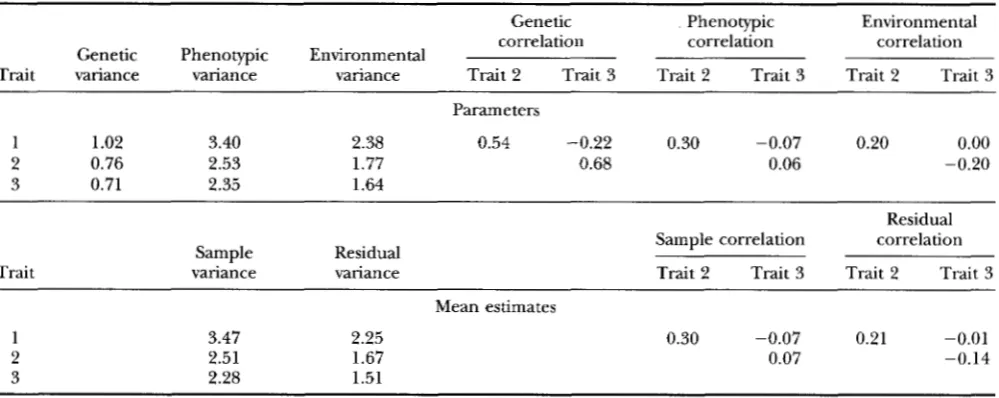
S u m m a r y parameters and mean statistics of traits for the simulation example in Table 3
Genetic Phenotypic Environmental
Genetic Phenotypic Environmental correlation correlation correlation
Trait variance variance variance Trait 2 Trait 3 Trait 2 Trait 3 Trait 2 Trait 3
Parameters
1 1.02 3.40 2.38 0.54 -0.22 0.30 -0.07 0.20 0.00
2 0.76 2.53 1.77 0.68 0.06 -0.20
3 0.71 2.35 1.64
Residual Sample correlation correlation
Sample Residual
Trait variance variance Trait 2 Trait 3 Trait 2 Trait 3
Mean estimates
1 3.47 2.25 0.30 -0.07 0.21 -0.01
2 2.51 1.67 0.07 -0.14
3 2.28 1.51
4).
Sample means, variances and correlation coeffi-cients averaged over 100 replicates are also listed in
Table 4. It is interesting to observe that the observed
(averaged) residual variances and correlations are very close to the expected environmental variances and cor- relations, as in the analysis most of the genetic variation is absorbed by markers fitted in the model.
Seven methods of QTL mapping were performed on
each simulated data set at every 1 cM on the chromo-
some. These include the following: joint mapping for
three traits (5-123 ) ,joint mapping for each pair of traits
(5-12,J-13 and 5-23) , and separate mapping for each
trait ( S1, $2 and $ 3 ) . Simply for the convenience of
discussion, in mapping except for the flanking markers,
all other markers are fitted in the model to control the genetic background because markers are evenly distrib-
uted and widely separated. We used x:.05/15,7 = 21.4,
x0,05/15,5
=17.7,
andxi.os/15,3
= 13.6 as the critical values of the test for the three levels of mapping.Summary estimates of QTL positions and effects by
the seven mapping methods are given in Table 3, and
the observed power of detection of QTL are given in
Table 5. The statistics given in Tables 3 and 5 are sum-
marized from 100 replicates for three QTL regions sep-
arately. Although three QTL are assumed to be located
on the same chromosome, they are widely separated.
TABLE 5
Observed statistical power (proportion of significant replicates over all replicates) of seven methods of QTL
mapping from 100 replicates of simulations
2
QTL 5-123 5-12 5-13 5-23 $1 $2 S 3 S-123
1 0.80 0.78 0.51 0.64 0.46 0.64 0.04 0.78 2 0.79 0.37 0.36 0.84 0.00 0.39 0.41 0.64 3 0.89 0.51 0.84 0.64 0.42 0.00 0.64 0.79
Also because of the composite interval mapping used
in analysis, tests in different regions are statistically inde-
pendent ( ZENG 1993), so that the statistical power and
sampling variance of estimates can be calculated sepa- rately for three QTL at and around the intervals sur-
rounding the QTL. In Table 5 , $123 denotes the overall
performance of the three separate mappings, and its power was calculated as the frequency of the detection of the QTL by at least one of the three separate m a p
pings. It is seen that the power of 5-123 in this case is
higher than that of S-123 for all three QTL. This shows
that some QTL with relatively small effects may be
missed by separate mappings on different traits but de-
tected by joint mapping that combined information
from different traits. The power of 5-12 is very close to
that of 5-123 on QTL 1. This is because QTL 1 has
effects mainly on traits 1 and 2, and just a small effect
on trait 3. The exclusion of trait 3 in 5-12 only slightly
affects the power of detection of the QTL. This also shows that small pleiotropic effects on additional traits included in the joint mapping may be large enough to compensate the lose of power due to the increase of
the critical value. The powers of QTL detection by J -
12,J-13 and 5-23 are generally comparable to the sizes
of pleiotropic QTL effects involved. 5-23, however, tends
to have relatively higher power. This is because the
pleiotropic effects of three QTL on traits 2 and 3 are
all in the same direction and the environment correla-
tion is negative (see APPENDIX A )
.
Means and SDs of estimates (over all replicates) of
QTL positions and effects by different methods are also
given in Table 3. All estimates seem to be relatively
unbiased. In general, the precision of estimation of
QTL positions and effects by 5-123, as indicated by SDs,
is better than other methods. Particularly, the joint anal-
Mapping QTL on Multiple Traits
TABLE 6
Parameters of QTL positions and effects and their estimates in a single replicate of simulation by the joint mapping on two traits (J-12) and the separate mapping on each trait ($1 and S2)
Additive effect Dominance effect
Position Likelihood
QTL ( C M ) Trait 1 Trait 2 Trait 1 Trait 2 ratio
Parameters
1 54 - 1.36 - 1.44 1.28 1.35
2 114 -1.16 0.75
3 128 1.30 0.49
Estimates by 5-12
1 57 - 1.03 - 1.34 1.36 1.42 66.73
2/ 3 125 -0.82 1.31 -0.35 0.52 37.49
Estimates by S1
1 55 -1.05 1.42 28.07
2 110 -0.75 1.16 15.01
Estimates by $2
1 61 -1.22 1.24 51.95
3 127 1.34 0.45 24.24
variance of estimates of QTL positions. Sampling vari-
ances of estimates of QTL positions by 5-123 are consis-
tently smaller than those by other analyses, except of
that for QTL 3 by 5-13 and for QTL 2 by 5-23 in which
cases two trait analyses have some particular advantages as noticed above.
Pleiotropy us. close linkage with one replicate: We also performed a simulation to test close linkage of two nonpleiotropic QTL against pleiotropy of a common
QTL. In this example, one chromosome with 11 mark-
ers in 10 marker intervals, each with 15 cM, was simu-
lated. Three QTL, one pleiotropic and two nonpleiotro- pic, were assumed to affect two traits with parameters
given in Table 6. The heritability for each trait is 0.4.
(The effects of QTL are undoubtedly very large.) The sample genetic, environmental and phenotypic correla-
tions are 0.42, 0.2 and 0.29, respectively. The sample
size is 300.
The results of joint mapping (5-12) and separate
mappings ( S-1 and $2) in one replicate are presented
in Table 6 and Figure 1 . At least two major QTL are
indicated by the analyses. There is some evidence from
separate mappings that there might be two nonpleiotro-
pic QTL in the region between 105 and 135 cM with
each showing a significant effect on one trait only. To
test this hypothesis, the test of pleiotropy 11s. close link-
age was performed in the two major regions that show significant effects on the traits for comparison: one be-
tween 45 and 75 cM and one between 105 and 135 cM.
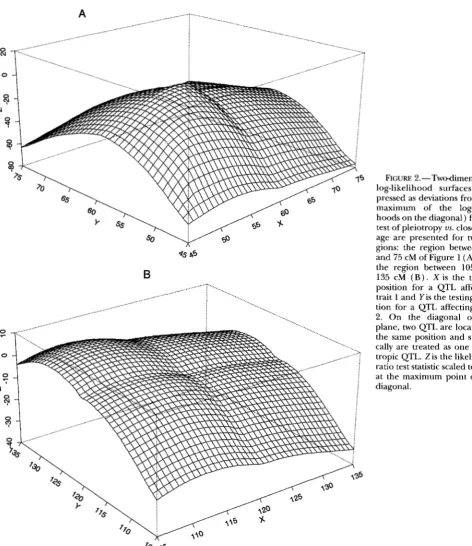
The results are plotted in Figure 2.
In Figure 2, the two-dimensional log-likelihood sur-
face (as deviations from the maximum of the log-likeli-
7 0
8 0
0 50
.rl
c,
m
3
40 Ld c,30
c,
rn
4 Q) 20
E
crl
10
0
1121
A
AA
I I I 1 I I I I I
-1
0 15 30 45 80 75 90 105 120 135 150
Testing
position
(cM)
FIGURE 1. -A simulation example of QTL mapping on two traits from an F2 population. Likelihood ratio test statistics are calculated and plotted at every 1 cM position of a chromosome for three mapping methods. 5-12 is the joint mapping on two
1122 C. Jiang and Z . 3 . Zeng
8
__.. ___..__...-y$@$
..."hoods on the diagonal) is presented. In this analysis, unlike joint mapping and the separate mappings that used all but flanking markers for background control,
only markers 1-3 and
7-11
are used in the model forbackground control in Figure 2A, and only markers 1
-
7
and 11 are used for background control in Figure2B.
On this two-dimensional surface, the diagonal elements represents null hypotheses of one pleiotropic QTL, and the offdiagonal elements represent alternative hypoth-
eses of two nonpleiotropic QTL. The likelihood ratio
FIGURE 2.-Two-dimensional log-likelihood surfaces (ex- pressed as deviations from the maximum of the log-likeli- hoods on the diagonal) for the test of pleiotropy us. close link- age are presented for two re- gions: the region between 45 and 75 cM of Figure 1 ( A ) and the region between 105 and 135 cM ( B ) . X is the testing position for a QTL affecting trait 1 and Yis the testing posi- tion for a QTL affecting trait 2. On the diagonal of X-Y plane, two QTL are located in the same position and statisti- cally are treated as one pleio- tropic QTL. Z is the likelihood ratio test statistic scaled to zero at the maximum point of the diagonal.
test is performed at the maximum of the surface against
the maximum of the diagonals. This likelihood ratio is
0.53 for Figure 2A at the position 56 cM for trait 1 and
57 cM for trait 2 (the maximum diagonal is at 57 cM) ,
which is clearly not significant, and 7.26 for Figure 2B
at the position 111 cM for trait 1 and 126 cM for trait
2 (the maximum diagonal is at 125 cM)
,
which is sig-nificant at 0.01 level (for chi-square distribution with
one degree of freedom). There is clear evidence to
Mapping QTL on Multiple Traits
TABLE 7
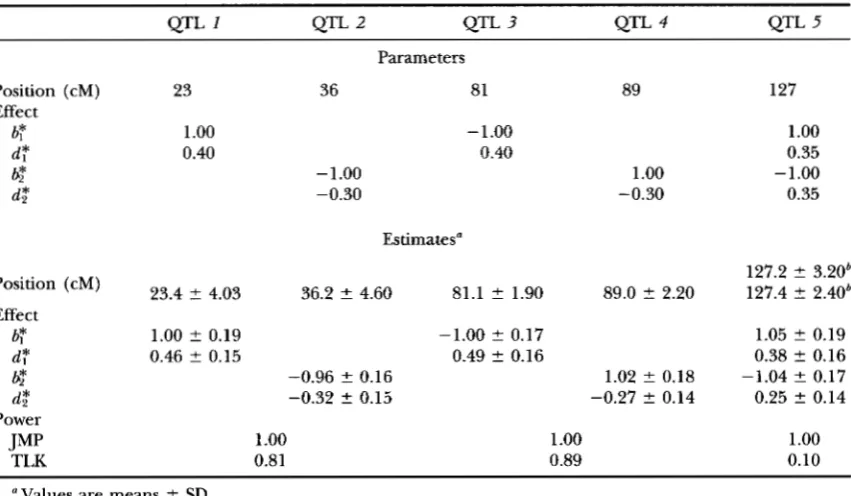
Parameters of Q l T positions and effects and their estimates over 100 replicates of simulation under the close linkage model
1123
QTL 1 QTL 2 QTL 3 QTL 4 QTL 5
Position (cM)
Effect
b$
d:
@
d,*
Position (cM)
Effect
b?
dT
@
&
JMP Power
TLK
Parameters
23 36 81 89
1
.oo
-1.000.40 0.40
-1.00 1
.oo
-0.30 -0.30
Estimates"
23.4 2 4.03 36.2 2 4.60 81.1 ? 1.90 89.0 t 2.20
1.00 ? 0.19 -1.00 ? 0.17
0.46 2 0.15 0.49 2 0.16
-0.96 2 0.16 1.02 % 0.18
-0.32 2 0.15 -0.27 2 0.14
1
.oo
1.oo
0.81 0.89 127
1
.oo
0.35 -1.000.35
127.2 2 3.20b 127.4 t 2.40b
1.05 2 0.19 0.38 t 0.16
0.25 2 0.14
1
.oo
0.10 -1.04 % 0.17"Values are means 2 SD.
Here the estimates of position of QTL 5 are ~ v e n for each trait separately (under the nonpleiotropic
model) to indicate the closeness of the kstimates.
around 111 cM showing a significant effect on trait 1
and one located around 126 cM showing a significant
effect on trait
2.
The maximum positions of diagonals in Figure 2 are the same maximum positions under the joint mapping
in Figure 1 and Table 6. The maximum positions of
offdiagonals in Figure 2 are also very close to the maxi- mum positions indicated by the separate mappings (Ta-
ble 6 ) . As discussed above, in practice this twodimen-
sional search for the best fit of two nonpleiotropic QTL is unnecessary, although the two-dimensional surface is more illuminating. The test can be constructed at the
peak suggested by joint mapping for the null hypothesis
and at or around the peak suggested by separate map- pings for the alternative hypothesis. This is clearly sup- ported by the results of Figure 2. These are, however, the results of simulation in one replicate.
Pleiotropy us. close linkage with multiple repli- cates: To show the behavior of the test statistic, we also performed simulations and tests with multiple repli- cates. The parameters of this simulation are, however,
different from the above example and are shown in
Table 7. In this simulation, one chromosome with 16 uniformly distributed markers in 15 10-cM marker in- tervals was simulated. Five QTL, one pleiotropic and
four nonpleiotropic, are assumed to affect two traits
with effects and positions listed in the table. The mag- nitudes of QTL effects are assumed to be the same for additive effects and slightly different for dominant
effects. In this way, the statistical power of the test is
comparable for different QTL. Heritabilities of the two
traits are all assumed to be 0.6 and the environmental
correlation coefficient between the traits is 0.2. Sample size is 150 and the number of replicates of simulation is 100.
For each replicate, the joint mapping is first per- formed using the procedure stated above. In the joint
mapping, QTL 1 and
2
can be detected only as oneQTL and so are QTL 3 and
4.
Therefore, only threeQTL are indicated by the joint analysis, and they are significant in all the replicates (with the estimated
power of 1 in Table
7 ) .
Again, by using the result ofZENG ( 1994), the critical value of the joint mapping is
set to be
17.7,
which corresponds to the chi-square valuewith 5 degrees of freedom at the significance level of
(0.05
/
15= ) 0.0033. The separate mappings, however,failed to detect some QTL in a few replicates (results
not shown)
.
The corresponding critical value used inthe separate mappings is 13.6.
Statistical tests for the hypotheses of pleiotropy us.
close linkage are then performed in the three regions indicated by the joint mapping. The observed powers
of the test are given in Table
7.
The power of the testfor QTL 1 and 2 is 0.81, which is slightly lower than
that for QTL 3 and 4. This may be because QTL 1 and
2
are relatively more distant from nearby markers thanQTL 3 and 4 that are only 1 cM away from the respective