ISSN: 2319-8753
International Journal of Innovative Research in Science,
Engineering and Technology
(An ISO 3297: 2007 Certified Organization)
Vol. 3, Issue 11, November 2014
Design Analysis and Optimization of Piston for
4-Stroke Petrol Engine
V.Jose ananth vino, Dr. J. Hameed Hussain
Department of Mechanical Engineering, Bharath University, Selaiyur, Chennai,India
ABSTRACT: Piston is the part of engine which convert heat and pressure energy liberated by fuel combustion into mechanical works. Engine piston is the most complex component among the automotive. This project illustrate design procedure for a piston for 4 stroke petrol engine. Design, Analysis and optimization of piston which is stronger, lighter with minimum cost and with less time. Since the design and weight of the piston influence the engine performance. Analysis of the stress distribution in the various parts of the piston to know the stresses due to the gas pressure and thermal variations using with Ansys workbench r14.5. The solid model Piston of an engine was designed by using the SOLIDWORKS software. CAD software for performing the design phase and ANSYS WORKBENCH R14.5 for analysis and optimization phases are used. The volume of the piston is reduced by 24%, the thickness of barrel is reduced by 30%, width of other ring lands of the piston is reduced by 20%, Vonmisses stress is increased by 10% and Deflection is increased after optimization. But all the parameters are well with in design consideration.
I.INTRODUCTION
1.1 ENGINE
An engine is something that produces an effect from a given input. The origin of engineering was the working of engines. There is an overlap in English between two meanings of the word "Engineer": 'those who operate engines' and 'those who design and Internal combustion engine.
ISSN: 2319-8753
International Journal of Innovative Research in Science,
Engineering and Technology
(An ISO 3297: 2007 Certified Organization)
Vol. 3, Issue 11, November 2014
Although the terms sometimes cause confusion, there is no real difference between an "engine" and a "motor." At one time, the word "engine" (from Latin, via old French, ingenious, "ability") meant any piece of machinery. A "motor" (from Latin motor, "mover") is any machine that produces mechanical power.
Traditionally, electric motors are not referred to as "engines," but combustion engines are often referred to as "motors." (An electric engine refers to locomotive operated by electricity).With that said, one must understand that common usage does often dictate definitions.
II.DESIGN AND ANALYSIS PROCESS CHART
III.TYPES OF PISTONS
TRUNK PISTONS:
Trunk pistons are long, relative to their diameter. They act both as piston and as a cylindrical crosshead. As the connecting rod is angled for part of its rotation, there is also a side force that reacts along the side of the piston against the cylinder wall. A longer piston helps to support this.
Trunk pistons have been a common design of piston since the early days of the reciprocating internal combustion engine. They were used for both petrol and diesel engines, although high speed engines have now adopted the lighter weight slipper piston.
A characteristic of most trunk pistons, particularly for diesel engines, is that they have a groove for an oil ring below the gudgeon pin, not just the rings between the gudgeon pin and crown.
ISSN: 2319-8753
International Journal of Innovative Research in Science,
Engineering and Technology
(An ISO 3297: 2007 Certified Organization)
Vol. 3, Issue 11, November 2014
CROSSHEAD PISTON:
Large slow-speed Diesel engines may require additional support for the side forces on the piston. These engines typically use crosshead pistons. The main piston has a large piston rod extending downwards from the piston to what is effectively a second smaller-diameter piston. The main piston is responsible for gas sealing and carries the piston rings. The smaller piston is purely a mechanical guide. It runs within a small cylinder as a trunk guide and also carries the gudgeon pin.Because of the additional weight of these pistons, they are not used for high-speed engines.
SLIPPER PISTON:
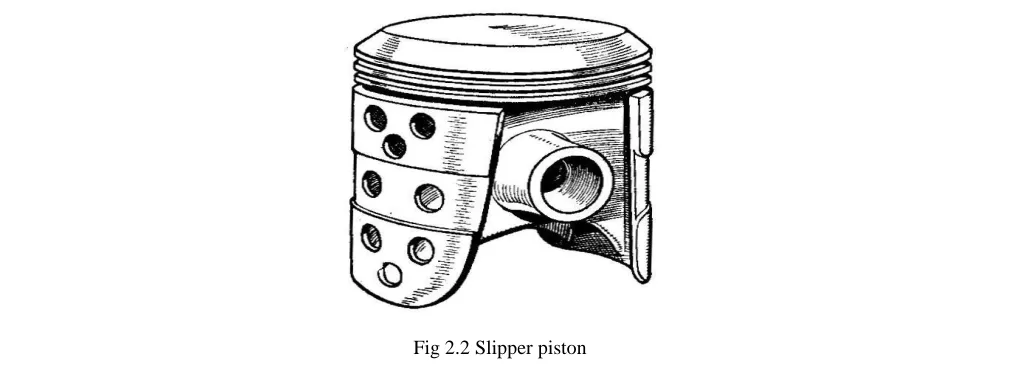
A slipper piston is a piston for a petrol engine that has been reduced in size and weight as much as possible. In the extreme case, they are reduced to the piston crown, support for the piston rings, and just enough of the piston skirt remaining to leave two lands so as to stop the piston rocking in the bore. The sides of the piston skirt around the gudgeon pin are reduced away from the cylinder wall. The purpose is mostly to reduce the reciprocating mass, thus making it easier to balance the engine and so permit high speeds. A secondary benefit may be some reduction in friction with the cylinder wall, however as most of this is due to the parts of the piston that are left behind, the benefit is minor.
Fig 2.2 Slipper piston
DEFLECTOR PISTON:
ISSN: 2319-8753
International Journal of Innovative Research in Science,
Engineering and Technology
(An ISO 3297: 2007 Certified Organization)
Vol. 3, Issue 11, November 2014
Fig 2.3 Deflector Piston
The crowns developed from a simple rib to a large asymmetric bulge, usually with a steep face on the inlet side and a gentle curve on the exhaust. Despite this, cross scavenging was never as effective as hoped. Most engines today useSchnuerle porting instead. This places a pair of transfer ports in the sides of the cylinder and encourages gas flow to rotate around a vertical axis, rather than a horizontal axis.
ISSN: 2319-8753
International Journal of Innovative Research in Science,
Engineering and Technology
(An ISO 3297: 2007 Certified Organization)
Vol. 3, Issue 11, November 2014
V. DESIGN OF PISTON (OPTIMIZED DESIGN)
Fig 5.5 Create a curved in bottom of piston and cut extrude
ANSYS 14.5:
ANSYS is an engineering simulation software (computer-aided engineering, or CAE) developer that is headquartered south of Pittsburgh in the South pointe business park in Cecil Township, Pennsylvania, and United States.
ANSYS was listed on the NASDAQ stock exchange in 1996. In late 2011, ANSYS received the highest possible score on its Smart Select Composite Ratings according to Investor's Business Daily.
The organization reinvests 15 percent of its revenues each year into research to continually refine the software. ANSYS offers engineering simulation solution sets in engineering simulation that a design process requires. Companies in a wide variety of industries use ANSYS software.
The tools put a virtual product through a rigorous testing procedure (such as crashing a car into a brick wall, or running for several years on a tarmac road) before it becomes a physical object.
ANSYS 14.5 provides a great number of new and advanced features that bolster product performance and integrity through deeper design insight.
Ansys 14.5 provides a great no of new and advance features that product performance and integrity through deeper design insight.
The many new feature in ANSYS 14.5, combined with Ansys workbench, deliver additional physics depth and breadth that can be scaled to meet the changing needs of customers.
6.2 ANSYS Workbench Platform:
The ANSYS Workbench platform is the framework upon which the industry’s broadest and deepest suite of advanced engineering simulation technology is built. An innovative project schematic view ties together the entire simulation process, guiding the user through even complex multiphysics analyses with drag-and-drop simplicity.
ISSN: 2319-8753
International Journal of Innovative Research in Science,
Engineering and Technology
(An ISO 3297: 2007 Certified Organization)
Vol. 3, Issue 11, November 2014
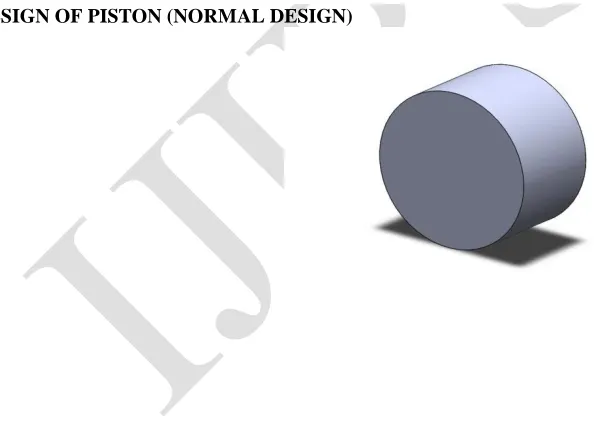
ANALYSIS OF PISTON (NORMAL DESIGN)
ANALYSIS OF PISTON (OPTIMIZED DESIGN)
VI.CONCLUSION
The deflection due to pressure applied after optimization is more than before optimization and this value is taken into consideration for design purpose. The stress distribution on the piston mainly depends on the deformation of piston. Therefore, in order to reduce the stress concentration, the piston crown should have enough stiffness to reduce the deformation. All the phases in this project given can be extended to the piston design with reduction of material at bottom. The material is removed to reduce the weight of the piston so as to improve the efficiency. It is essential to obtain the optimized results for new piston with reduced material.
In brief:
1 The optimal mathematical model which includes formation of piston crown and quality of piston at piston skirt, and the pressure applied on the piston is 10e6 pal, for the both conditions.
2. The FEA is carried out for standard piston modelused in Petrol engine ceramic coating on crown and the result of analysis indicate that the maximum stress has changed from 4.0552e8 to 4.8406e8Mpa.
REFERENCES
ISSN: 2319-8753
International Journal of Innovative Research in Science,
Engineering and Technology
(An ISO 3297: 2007 Certified Organization)
Vol. 3, Issue 11, November 2014
[2] Kanniga E., Selvaramarathnam K., Sundararajan M., "Embedded control using mems sensor with voice command and CCTV camera", Indian Journal of Science and Technology, ISSN : 0974-6846, 6(S6) (2013) pp.4794-4796.
[3] A. R. Bhagat, Y. M. Jibhakate, Thermal Analysis and Optimization of I.C. Engine Piston Using Finite Element Method, International Journal of Modern Engineering Research (IJMER), Vol.2, Issue.4, pp.2919-2921, 2012.
[4] Das M.P., Jeyanthi Rebecca L., Sharmila S., "Evaluation of antibacterial and antifungal efficacy of Wedelia chinensis leaf extracts", Journal of Chemical and Pharmaceutical Research, ISSN : 0975 – 7384, 5(2) (2013) pp.265-269.
[5] R.S.Khurmi,J.K.Gupta, A Text Book of Machine Design, S.Chand& Co., pp. 1132-1144, 2004.
[6]Subhashini V., Ponnusamy S., Muthamizhchelvan C., "Growth and characterization of novel organic optical crystal: Anilinium d-tartrate (ADT)", Spectrochimica Acta - Part A: Molecular and Biomolecular Spectroscopy, ISSN : 1386-1425, 87() (2012) pp.265-272.
[7] P. Carvalheira1, and P. Gonçalves, FEA of Two Engine Pistons Made of Aluminium Cast Alloy A390 and Ductile Iron 65-45-12 Under Service
Conditions, 5thInternational Conference on Mechanics and Materials in Design Porto-Portugal, 24-26, pp .1-21, 2006.
[8]Thomas J., Ragavi B.S., Raneesha P.K., Ahmed N.A., Cynthia S., Manoharan D., Manoharan R., "Hallermann-Streiff syndrome", Indian Journal of
Dermatology, ISSN : 0019-5154, 58(5) (2013) pp.383-384. [9] ANSYS’S Element Reference
http://www1.ansys.com/customer/content/documentation/121/ans_elem.pdf pp 1-1688.
[10]Subha Palaneeswari M., Ganesh M., Karthikeyan T., Manjula Devi A.J., Mythili S.V., "Hepcidin-minireview", Journal of Clinical and Diagnostic Research, ISSN : 0973 - 709X, 7(8) (2013) pp.1767-1771.
[11] Chiang Y. M. and Chen F. L., 1999. Sculptured surface reconstruction from CMM measurement data by a software iterative approach, Int. J. of Production Research, 37(8).
[12]Chang-Xue Feng and Shang Xiao., 2000. Computer-Aided Reverse Engineering with CMM for digitization and LOM for duplication, in Proceedings of the 4th Int’l Conference on Frontiers of Design and Manufacturing, Int’l
Academic Press, Beijing, China, 256-262.
[13] Mirosáaw Wendeker, Paweá Magryta Adam Majczak, Michaá Biaáy, “Modeling The Thermal Loads in the Subaru EJ25 Engine” Journal of KONES Powertrain and Transport, Vol. 18, No. 1, pp. 683-688, 2011.
[14] P Thamarai, B Karthik, Automatic Braking and Evasive Steering for Active Pedestrian Safety, Middle-East Journal of Scientific Research 20
(10), PP 1271-1276, 2014.
[15] M.Bharathi, Golden Kumar,Design Approach For Pitch Axis Stabilization of 3-Dof Helicopter System an LQR Controller,International Journal
of Advanced Research in Electrical, Electronics and Instrumentation Engineering,ISSN 2278 - 8875 , pp 351-365 ,Vol. 1, Issue 5, November 2012.
[16] SRIDHAR RAJA. D ,Foliated UC-EBG UWB Bandpass filter ,International Journal of Advanced Research in Electrical, Electronics and
Instrumentation Engineering ,ISSN (Print) : 2320 – 3765,pp 3701-3708,Vol. 2, Issue 8, August 2013.
[17] V.M. Ramaa Priyaa,Predictive Control in Power Converters,International Journal of Advanced Research in Electrical, Electronics and
Instrumentation Engineering, ISSN (Print) : 2320 – 3765 , pp 10475-10478 ,Vol. 3, Issue 7, July 2014.
[18] Vijayan T ,Performance of Microstrip Directional Coupler Using Synthesis Technique,International Journal of Advanced Research in
Electrical, Electronics and Instrumentation Engineering, ISSN: 2278 – 8875, pp 761-767,Vol. 2, Issue 3, March 2013.
[19] Vijayan T ,Performance Image Compression using Lifting based EEWITA,International Journal of Advanced Research in Electrical,