ABSTRACT
GALLIHER, WILLIAM PATRICK. Squashed Branch Reuse. (Under the direction of Dr. Eric Rotenberg, committee chair).
In an out-of-order superscalar processor, when a mispredicted branch initiates
recovery, all younger instructions are squashed. This includes squashing younger branches,
some of which may have executed and been discovered as mispredicted branches themselves.
In this case, the recovery initiated by the older branch can be turned into an opportunity for
higher performance, by reusing the results of squashed branches as accurate predictions when
they are refetched. Squashed Branch Reuse (SBR) exploits this opportunity by saving the
results of younger branches at the time of a squash, and selectively reusing these results for
more accurate branch prediction. Furthermore, SBR is implemented entirely within the fetch
unit, allowing it to be used easily alongside any branch predictor. SBR then turns the cost of
a squash into an opportunity for more accurate branch predictions. Looked at another way,
with SBR and under the right circumstances of concurrent branches, the processor may pay
© Copyright 2015 William Patrick Galliher
Squashed Branch Reuse
by
William P. Galliher
A thesis submitted to the Graduate Faculty of North Carolina State University
in partial fulfillment of the requirements for the degree of
Master of Science
Computer Engineering
Raleigh, North Carolina
2015
APPROVED BY:
_______________________________ _______________________________
Dr. Eric Rotenberg Dr. Huiyang Zhou
Committee Chair
DEDICATION
This thesis is dedicated to my parents, who faithfully encouraged me and supported me all
throughout my educational career. Without their guidance, love, and support, I certainly
BIOGRAPHY
William Patrick Galliher is an Accelerated Master’s Program student in the Electrical and
Computer Engineering Department at North Carolina State University. Prior to pursuing a
Master’s degree, William earned a B.S. in Computer Engineering and a B.S. in Electrical
Engineering from North Carolina State University. During that time, he had an internship
with Intel, and pursued research following up branch prediction methods with Dr. Eric
Rotenberg. His research focuses on processor architecture, namely branch predictors. Upon
completion of his Master’s degree, William plans to continue his education through pursuing
ACKNOWLEDGMENTS
I would like to thank my family, my two parents and three brothers. Their support,
encouragement, and guidance has been immeasurable, but most of all, their continued love
has kept me going through the hardest parts of my life.
I would like to thank my adviser, Dr. Eric Rotenberg, for his guidance, teaching, and
continual encouragement. He has taught me the methods of research, and shaped my
development in academia through the opportunities he has given me.
I would like to thank my advisory committee members, Dr. Huiyang Zhou and Dr.
Gregory Byrd, for their time, effort, and service. Their willingness to volunteer those aspects
leaves me immensely grateful.
I would also like to give my utmost gratitude to Elliott Forbes. His advice, from my
first year in pursuing my B.S., has cleared the way for many of the opportunities in my
academic career. From the first programming project during freshman summer, to the urging
to take Dr. Rotenberg’s architecture class, and even to this day with small meetings to
discuss research, defense, and each other’s lives, I do not think I could have asked for a better
friend through these five years.
This research was supported by NSF grant CCF-0916481 and an ECE fellowship.
Any opinions, findings, and conclusions or recommendations expressed herein are those of
TABLE OF CONTENTS
LIST OF TABLES ... vi
LIST OF FIGURES ... vii
Chapter 1 Introduction ... 1
Chapter 2 Methodology and Target Branches... 7
2.1 Methodology ... 7
2.2 Target Branches ... 8
2.2.1 soplex ... 9
2.2.2 gzip ... 10
2.2.3 astar ... 12
Chapter 3 Squashed Branch Reuse ... 14
3.1 Filling the Reuse Queue ... 14
3.2 Replaying from the Reuse Queue ... 19
3.2.1 Dynamic Iteration Analysis ... 20
3.2.2 Returning Results and Determining Confidence ... 24
Chapter 4 Evaluation Environment ... 27
Chapter 5 Results and Analysis... 29
5.1 Targeted Benchmark Performance ... 30
5.2 Misprediction Analysis ... 33
5.3 Overall Performance ... 36
Chapter 6 Related Work ... 40
6.1 Control Flow Decoupling ... 40
6.2 Speculative Branch Update ... 41
6.3 Squash Reuse ... 42
Chapter 7 Conclusion and Future Work ... 43
LIST OF TABLES
LIST OF FIGURES
Figure 1.1 Branch Queue example... 2
Figure 1.2 Misprediction scenarios without and with SBR. ... 4
Figure 1.4 gzip target branch source sample ... Error! Bookmark not defined. Figure 2.1 Base benchmark misprediction rates ... 8
Figure 2.2 soplex target branches ... 10
Figure 2.3 gzip target branches ... 11
Figure 2.4 astar target branches ... 12
Figure 3.1 Squash overview ... 16
Figure 3.2 Setting iteration counters ... 18
Figure 3.3 Removal for match before Reuse Head ... 23
Figure 3.4 Removal for match after Reuse Head ... 24
Figure 3.5 Reuse hit case ... 25
Figure 5.1 Target misprediction reduction from SBR ... 31
Figure 5.2 Misprediction reuse that came from branches other than targeted ... 32
Figure 5.3 Misprediction rates with and without SBR ... 33
Figure 5.4 Percent of Base Mispredictions Eliminated ... 34
Figure 5.5 Total Prediction Breakdown ... 36
Figure 5.6 IPC with and without SBR ... 38
Chapter 1
Introduction
Despite impressive improvements in branch predictors over several decades, certain
classes of data dependent branches have relatively high misprediction rates [1]. In an
out-of-order superscalar processor, when a mispredicted branch initiates recovery, all younger
instructions are squashed. This includes squashing younger branches, some of which may
have executed and been discovered as mispredicted branches themselves. In this case, the
recovery initiated by the older branch can be turned into an opportunity for higher
performance, by reusing the results of squashed branches as accurate predictions when they
are refetched. Squashed Branch Reuse (SBR) exploits this opportunity by saving the results
of younger branches at the time of a squash, and selectively reusing these results for more
accurate branch prediction. Furthermore, SBR is implemented entirely within the fetch unit,
allowing it to be used easily alongside any branch predictor. SBR then turns the cost of a
squash into an opportunity for more accurate branch predictions. Looked at another way,
with SBR and under the right circumstances of concurrent branches, the processor may pay
only one misprediction penalty for multiple mispredictions by the branch predictor.
SBR exploits an existing structure in the fetch unit that we will refer to as the Branch
Queue. The Branch Queue can be thought of as a reorder buffer for branches. Its purpose is
checkpoint/restore the global branch history (and possibly other information) for each
in-flight branch.
The Branch Queue keeps track of all in-flight branches in program order. Branches
are inserted into the Branch Queue in program order at fetch and removed from the Branch
Queue in program order at retirement. Each in-flight branch keeps its Branch Queue index
with it as it flows down the pipeline, so that when it executes in the backend, it can update its
Branch Queue entry with results from execution: its computed direction and whether or not it
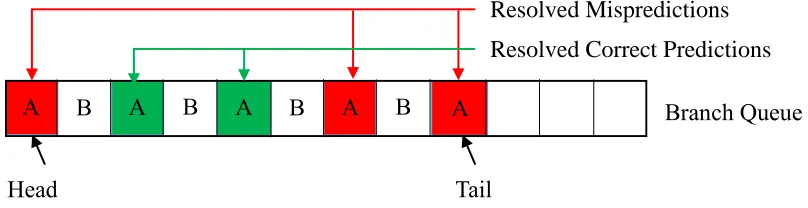
was mispredicted. Figure 1.1 shows an example snapshot of the Branch Queue during
execution. The colored (red or green) branches have executed and the non-colored branches
have not executed yet. Among the executed branches, the red ones are mispredicted and the
green ones are correctly-predicted. The mispredicted branch at the head of the Branch Queue
will initiate a pipeline squash, including rolling back the Branch Queue tail to the head and
thereby discarding all branches after the head branch.
Figure 1.1 Branch Queue example
A B A
B
A
B A
B
A
Tail
Branch Queue
Head
Resolved Mispredictions
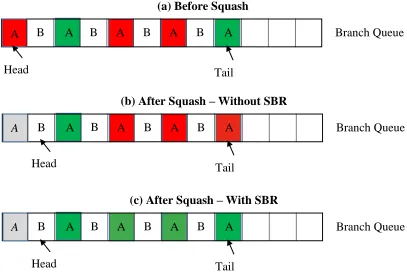
Figure 1.2 illustrates how SBR can reduce mispredictions. In Figure 1.2(a), which shows
the Branch Queue before the squash, all dynamic iterations of A have executed. The green
ones were correctly predicted and the red ones were mispredicted. The dynamic iteration of A
at the head of the Branch Queue is triggering a squash. Without SBR (Figure 1.2(b)), two
different misprediction scenarios are left after the squash. First, the two younger mispredicted
branches are mispredicted again. Second, the youngest dynamic iteration of A that was
correctly predicted before is now mispredicted, because of the change in global and/or local
branch history (assuming a two-level branch predictor) caused by the head branch. SBR
solves both of these cases by reusing all dynamic iterations of A (Figure 1.2(c)). Reuse is
Figure 1.2 Misprediction scenarios without and with SBR.
SBR is most profitable for branches that have the following three qualities:
1. Control independent of prior branches. A branch is control independent when it is
present in every iteration of the loop containing it. This allows SBR to easily line-up
refetched branches with their previously squashed results. The branch is not considered
control independent if its execution is dependent on another branch inside the loop, such as a
nested branch.
2. Data independent of prior branches. In this case, the control-independent branch’s
outcome is unaffected by prior branches’ directions. This means its squashed result is correct
– in spite of prior mispredicted branches – and reuse of this result is clearly profitable.
A B A B A B A B A
Head Tail
(a) Before Squash
Branch Queue
B A B A B A B A
Head Tail
(b) After Squash – Without SBR
Branch Queue
B A B A B A B A
Head Tail
(c) After Squash – With SBR
Branch Queue A
3. Many dynamic iterations of the branch fit within the processor window. The branch
exists in a tight loop. This increases the likelihood of many dynamic iterations being
available for reuse inside the Branch Queue at the time of a squash.
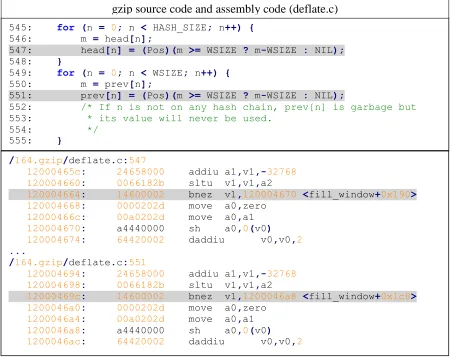
The branch “m >= WSIZE” shown in Figure 1.3, line 547, from the benchmark gzip,
is a prime example of a control and data independent branch within a tight loop. First, the
branch is executed in every iteration of the loop (control independent). Second, the branch’s
direction depends on head[n] and influences the value subsequently stored to head[n], where
n is for the current loop iteration. Thus, future dynamic iterations of the branch are
unaffected by its previous dynamic iterations (data independent). Third, the loop body is
small, allowing for many dynamic iterations of the branch to reside in the Branch Queue.
Figure 1.3 gzip target branch source sample
Rather than implement complex hardware to explicitly detect control and data
independent branches, SBR uses a confidence mechanism to learn which branches are
reusable for nearly all of its dynamic iterations. The confidence mechanism implicitly selects
branches that conform to the control independence and data independence characteristics
without explicitly checking for these characteristics. In addition, SBR automatically and
accurately aligns refetched branches with their previously squashed results using a technique
called “dynamic iteration analysis”. Finally, SBR interacts only with the existing Branch
545: for (n = 0; n < HASH_SIZE; n++) { 546: m = head[n];
Queue. Thus, integration of SBR into a superscalar processor is simple, in that it is localized
within the fetch unit and can be included alongside any branch predictor.
In this thesis, we will discuss the methodology and targeted branches that SBR is
designed for (Chapter 2). After this, we will outline the SBR implementation (Chapter 3),
and the results from running SBR and our baseline on multiple benchmarks (Chapter 5).
Finally, we will conclude with comparisons to related work (Chapter 6) and discuss possible
Chapter 2
Methodology and Target Branches
We aim to reduce mispredictions of known hard-to-predict reusable branches, through
automatic detection and reuse of these branches. To test this, we analyze benchmarks that
have branches which show the characteristics for good reuse, and determine if SBR
automatically detects and improves prediction accuracy of these branches. In addition, we
run other benchmarks to assure that SBR does not harm the performance of benchmarks
where this particular class of hard-to-predict branches is not the focus. Our goal is to discover
if SBR can improve known hard-to-predict reusable branches while, at a minimum, not
harming other benchmarks, and finding other branches valid for reuse automatically. These
other benchmarks come from the SPEC2000 and SPEC 2006 benchmark suites [2] [3]. The
known hard-to-predict branches showing good characteristics for reuse come from astar,
gzip, and soplex. The details of these branches are outlined here, and how they will assist in
analyzing SBR’s performance.
2.1 Methodology
Two benchmark suites are used, CPU2000 and CPU2006. For all benchmarks, the same
configuration was used. The simulator modeled an Intel Sandy Bridge architecture with a
gshare branch predictor using a 16KB entry table. The details of the configuration can be
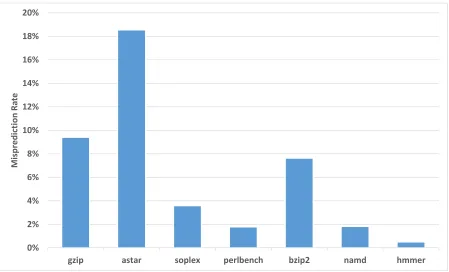
The benchmarks were run without SBR enabled, to find the baseline misprediction
rates. These rates can be seen in Figure 2.1.
Figure 2.1 Base benchmark misprediction rates
2.2 Target Branches
Three benchmarks contain target, representative hard-to-predict branches. These three
benchmarks are soplex, gzip, and astar. Each contain different situations that test different
parts of SBR, from amount of entries, ideal case that should be captured, and abnormal exit
cases for the loop. 0%
2% 4% 6% 8% 10% 12% 14% 16% 18% 20%
gzip astar soplex perlbench bzip2 namd hmmer
M
isp
re
d
ict
ion
R
at
2.2.1 soplex
The first one we will examine is soplex. Soplex contains one known hard-to-predict branch
that resides inside an outer for loop. This branch is an ideal case for SBR, as it is independent
and data dependent, while having no abnormal exit cases. Abnormal exit cases would be a
situation that causes the thread to leave the loop early, such as break statements. In this
regard, soplex creates the situation where SBR should work well, with considerable
improvement. However, because of the amount of instructions inside the loop, we would
expect to see fewer mispredictions removed by SBR from this as opposed to the gzip case,
which focuses on a tight, small loop with many iterations.
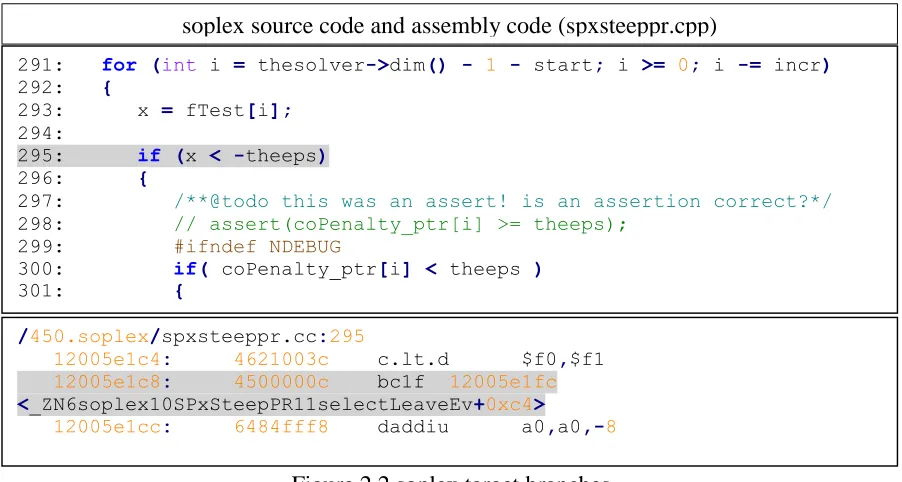
As shown in Figure 2.2, the target branch relies on theeps and x. Theeps is set before
the loop, and not modified inside the loop. The other variable x is loaded from fTest[i],
similar to gzip, so each dynamic iteration of the branch is not affected by other dynamic
iterations. These branch, located at program counter 12005e1c8, is a prime candidate for
2.2.2 gzip
Gzip contains target branches nested within a tight loop. This stresses the size of the structs
that SBR relies on, as many dynamic results will need to be reused from the Branch Queue.
This also stresses the ability of SBR to correctly retrieve the result that corresponds to a
specific dynamic iteration of the branch. If the SBR does not retrieve the branch that
corresponds to the current dynamic iteration in the fetch unit, then the prediction is not
guaranteed to be correct.
291: for (int i = thesolver->dim() - 1 - start; i >= 0; i -= incr) 292: {
293: x = fTest[i]; 294:
295: if (x < -theeps) 296: {
297: /**@todo this was an assert! is an assertion correct?*/
298: // assert(coPenalty_ptr[i] >= theeps); 299: #ifndef NDEBUG
300: if( coPenalty_ptr[i] < theeps ) 301: {
soplex source code and assembly code (spxsteeppr.cpp)
/450.soplex/spxsteeppr.cc:295
12005e1c4: 4621003c c.lt.d $f0,$f1 12005e1c8: 4500000c bc1f 12005e1fc
<_ZN6soplex10SPxSteepPR11selectLeaveEv+0xc4>
12005e1cc: 6484fff8 daddiu a0,a0,-8
The target branches for gzip, both with source and the corresponding assembly, can
be seen in Figure 2.3. The branches are the tests within the conditional statements on lines
547 and 551. They exhibit similar qualities to soplex, that m relies on an array load, and that
the work inside the conditional statement does not modify data that is used in another
dynamic iteration of the branch. However, the raw amount of work that is done in the loop is
considerably less than in soplex, stressing SBR to correctly match the dynamic iterations
during replay, and store all of the results.
545: for (n = 0; n < HASH_SIZE; n++) { 546: m = head[n];
547: head[n] = (Pos)(m >= WSIZE ? m-WSIZE : NIL); 548: }
549: for (n = 0; n < WSIZE; n++) { 550: m = prev[n];
551: prev[n] = (Pos)(m >= WSIZE ? m-WSIZE : NIL);
552: /* If n is not on any hash chain, prev[n] is garbage but
553: * its value will never be used.
554: */
555: }
gzip source code and assembly code (deflate.c)
/164.gzip/deflate.c:547
12000465c: 24658000 addiu a1,v1,-32768
120004660: 0066182b sltu v1,v1,a2
120004664: 14600002 bnez v1,120004670 <fill_window+0x190> 120004668: 0000202d move a0,zero
12000466c: 00a0202d move a0,a1 120004670: a4440000 sh a0,0(v0) 120004674: 64420002 daddiu v0,v0,2
...
/164.gzip/deflate.c:551
120004694: 24658000 addiu a1,v1,-32768
120004698: 0066182b sltu v1,v1,a2
12000469c: 14600002 bnez v1,1200046a8 <fill_window+0x1c8> 1200046a0: 0000202d move a0,zero
1200046a4: 00a0202d move a0,a1 1200046a8: a4440000 sh a0,0(v0) 1200046ac: 64420002 daddiu v0,v0,2
2.2.3 astar
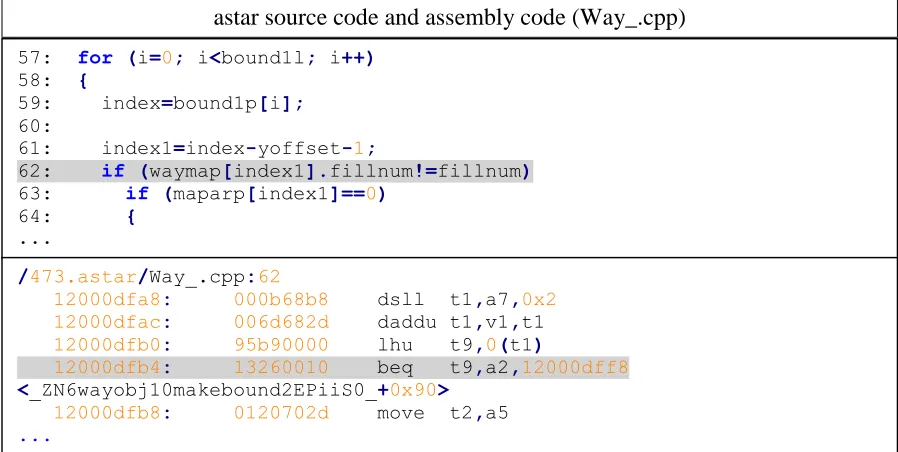
Astar exhibits hard-to-predict branches with good reuse characteristics, but it presents
another corner case that stresses SBR’s ability to match branch results that are stored with the
dynamic iteration of the branch currently being predicted in the fetch unit. Each of the
targeted, hard-to-predict branches have dependent slices that contain return statements. These
return statements create a chance that the branches being retrieved in the fetch unit do not
rely on the same data that the branches stored in the SBR relied on. Because of this, the
dynamic iterations of the branches can become out of sync. However, since SBR seeks to be
completely automated in hardware, requiring no assistance from software, while remaining
simple, it will need to be able to capture improvements from these branches as well. One
57: for (i=0; i<bound1l; i++) 58: {
59: index=bound1p[i]; 60:
61: index1=index-yoffset-1;
62: if (waymap[index1].fillnum!=fillnum) 63: if (maparp[index1]==0)
64: { ...
astar source code and assembly code (Way_.cpp)
/473.astar/Way_.cpp:62
12000dfa8: 000b68b8 dsll t1,a7,0x2
12000dfac: 006d682d daddu t1,v1,t1 12000dfb0: 95b90000 lhu t9,0(t1)
12000dfb4: 13260010 beq t9,a2,12000dff8
<_ZN6wayobj10makebound2EPiiS0_+0x90>
12000dfb8: 0120702d move t2,a5
...
sample of the eight branches in astar is shown in Figure 2.4. All of the eight branches share
similar structure.
The general benchmarks and the targeted branches will serve as a baseline to test the
overall performance of SBR. The known targeted branches will allow close examination of
how well SBR is able to capture branches that show good reuse characteristics, while the
general benchmarks will measure SBR’s impact when the presence of targeted benchmarks is
Chapter 3
Squashed Branch Reuse
Squashed Branch Reuse (SBR) is a novel technique that attempts to target hard-to-predict
branches by reusing results that would be squashed in the shadow of a previous
misprediction. To do this, SBR uses a Reuse Queue to store the results saved from a squash
of the Branch Queue, using an algorithm to set iteration counters to be used during replay.
This is one part of SBR. The second part of SBR is replaying the results from the Reuse
Queue, which involves staying in sync with the predictions currently taking place in the fetch
unit, and deciding if the result from the Reuse Queue should be used or not.
3.1 Filling the Reuse Queue
When the branch at the head of the Branch Queue is a misprediction, a squash is normally
initiated which will destroy all of the contents of the Branch Queue. In SBR, however, a
Reuse Queue is used to store the contents of the Branch Queue from being squashed. All
branches are saved in this manner, whether or not they have been executed. This is to
simplify staying in sync with the fetch unit during replay. The full iteration makes
determining the iteration simpler. If only the executed results are saved, it results in gaps
within the iteration of a loop. This is covered more extensively in section 3.2, where replay is
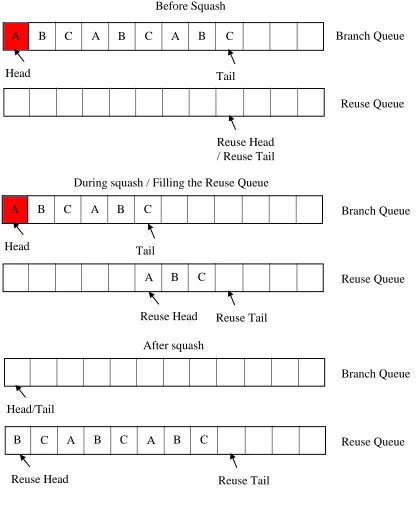
At the moment of a squash, the Branch Queue’s head points to a mispredicted branch
that is being resolved. This is shown as the box in red in Figure 3.1. In between the head and
the tail of the Branch Queue are branches that are in different states. Some might be executed
and await retirement, computed either as taken or not taken, while others might not yet be
executed. As the squash process begins, three actions occur in sequential order.
1. The Reuse Head is decremented by one to prepare for the copy of the branch.
2. The branch is copied from the Branch Queue tail to the Reuse Head of the Reuse
Queue.
Figure 3.1 Squash overview
A B C A B C A B C
Head Tail
Before Squash
Reuse Head / Reuse Tail
A B C A B C
Head Tail
During squash / Filling the Reuse Queue
A B
C
Reuse Head Reuse Tail
Branch Queue Reuse Queue Branch Queue Reuse Queue Head/Tail After squash B
C A B
C
A B
C
Reuse Head Reuse Tail
Branch Queue
First, to prepare for the copy, the Reuse Head is decremented by one. The Reuse
Queue acts as a circular buffer, and the entry at the tail is the oldest entry. If the head wraps
around to the point that it becomes equal with the tail, then the tail is decremented with the
head, essentially destroying the oldest value in the queue to make room for the new value
being copied from the Branch Queue. In this way, the Reuse Queue avoids deadlock due to it
being full, and it will always maintain that the value at the head is the newest value from the
Branch Queue.
The branch at the tail of the Branch Queue is then copied to the Reuse Head in the
Reuse Queue. This method of backfilling is to preserve any current contents that already
exist in the Reuse Queue, as older results from a squash with more entries might still be
present between the Reuse Head and the Reuse Tail.
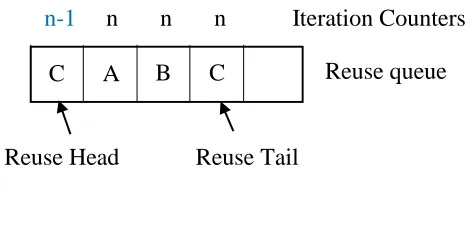
Lastly, the iteration counter of the branch at the Reuse Head is set. The iteration
counter will later be used during replay to determine the dynamic iteration of the branch in
the fetch unit. This process is shown visually in Figure 3.2. To decide the iteration counter
for the branch, first, the previous iteration counter is selected, that is, the iteration counter at
the entry right after the Reuse Head. Then, all entries in the Reuse Queue that have that same
iteration counter are searched for the branch that was copied to the Reuse Head. If there is
not a match, the branch that was copied is unique to this iteration, so its iteration counter is
set to the same as the previous iteration counter. If there is a match, then this branch already
exists in the current iteration. The branch at the Reuse Head then has its iteration counter set
Figure 3.2 Setting iteration counters
A B
C
Reuse Head Reuse Tail
n n Iteration Counters
Reuse queue Reuse queue after copying branch A
A B
C
Reuse Head Reuse Tail
n n n Iteration Counters
Reuse queue No match in iteration, copy previous counter
C A B
C
Reuse Head Reuse Tail
n n n Iteration Counters
Reuse queue Reuse queue after copying branch C
C A B
C
Reuse Head Reuse Tail
n-1 n n n Iteration Counters
This three step process is continued until the branch at the head of the Branch Queue
is reached. Since that branch is the misprediction being resolved, it will not be copied over to
the Reuse Queue, as another prediction will not be made on it. At this point, filling the Reuse
Queue stops, and the rest of the squash for the processor continues as normal. The Reuse
Queue will now hold the contents of the Branch Queue that would have been squashed,
supplemented with iteration counters.
3.2 Replaying from the Reuse Queue
When the fetch unit fetches a branch, the PC of the branch is sent to the branch predictor for
a prediction. At that time, the PC is also sent to the SBR unit, which uses the Reuse Queue to
determine if a result from the Reuse Queue exists, and if it does, if the result should be used
instead of a prediction from the branch predictor. If the SBR unit decides to use the result
from the Reuse Queue, the result is returned to the fetch unit instead of a prediction from the
branch predictor. However, the result from the SBR unit is treated just like a prediction. It
has an entry in the Branch Queue, and goes through the same steps throughout the pipeline
that a prediction does, including being verified for a misprediction and being squashed. All
interactions with the SBR unit happen parallel to interactions with the branch predictor. A
result from the SBR unit is checked at the same time a prediction from the branch predictor is
checked, and fixes for mispredictions, including updating any confidence mechanisms,
way, the SBR unit stays integrated alongside the branch predictor and Branch Queue, living
in the fetch unit. It requires no other changes to the rest of the pipeline.
Replaying a result from the Reuse Queue is then equivalent to making a prediction in
the branch predictor. It follows certain steps to maintain the Reuse Head and return a result.
These steps are as follows:
1. Upon receiving a PC from the fetch unit, perform dynamic iteration analysis
2. Check the Reuse Head for a match to the PC.
3. Determine if the result should be used or not.
First, we will define dynamic iteration analysis, as it contains the majority of the
complexity in the SBR algorithms. After that, we will detail the implementation of returning
the value, as well as determining whether to actually use the value or not.
3.2.1 Dynamic Iteration Analysis
Dynamic iteration analysis serves as the first step for accessing the Reuse Queue. The
purpose of dynamic iteration analysis is to keep the Reuse Queue in sync with the dynamic
iteration of the branches being predicted in the fetch unit. To do this, dynamic iteration
analysis chooses to move the Reuse Head based on a number of different situations that can
occur during reuse from the Reuse Queue. In general, there are two possible situations upon
querying for a match at the Reuse Head.
1. A hit of the requested reuse PC at the Reuse Head. Reuse Head is in sync with the
2. A miss of the requested reuse PC at the Reuse Head. Reuse Head is possibly out of
sync, and further analysis is required to determine if the case is insertion or removal.
On a hit, dynamic iteration analysis is complete, and SBR continues on to returning the
value and determining how to use it. However, a miss can mean that the Reuse Head is
possibly out of sync.
The first step upon a miss at the Reuse Head is to scan all entries that match the
iteration counter at the Reuse Head for a match on the requested PC. This is to try and
implicitly determine if the branch being requested is an independent branch, one of the
primary attributes of the hard-to-predict branches SBR targets. If there is no match for the
requested PC in the current iteration, then SBR determines that the requested branch is most
likely not control independent. This situation is called an insertion, where the branch being
requested by the fetch unit is a dependent branch inserted in to the current dynamic iteration.
It will leave the Reuse Head where it is, and let SBR continue on to return a miss.
If there is a hit in the current iteration, however, we are in a situation called the
removal case. SBR assumes that the PC being requested is a control independent branch.
Because of this, the branch currently at the Reuse Head is considered a control dependent
branch, as it was not requested by the fetch unit before a different, matching PC was
requested. Therefore, the branch at the Reuse Head has been removed from the dynamic
iteration. The next step is to determine if the currently requested PC is part of the current
dynamic iteration or the next dynamic iteration. Where to set the Reuse Head then relies on
which of these two we are in. The two situations can be determined based on if the hit in the
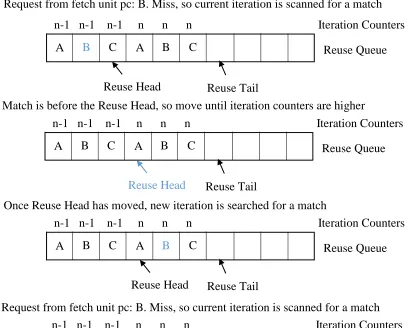
If the hit is before the Reuse Head, the currently requested PC is a PC that has already
happened earlier in the current dynamic iteration, as shown in Figure 3.3. The Reuse Head
then needs to be moved forward until it encounters an iteration counter higher than the
counter at the Reuse Head, signifying the next dynamic iteration. Once the Reuse Head has
been moved forward to the next dynamic iteration, the new iteration is scanned for the
requested PC again. If there is a match, the Reuse Head is set to that entry, and SBR
continues on towards returning the value and determining whether to use it or not.
If the match in the current iteration is after the Reuse Head, then the fetch unit is still
within the current dynamic iteration, as shown in Figure 3.4. All the branches between the
Reuse Head and the match are considered dependent branches that were removed, and the
SBR needs to leap forward to the requested PC to be able to stay in sync. The Reuse Head is
then moved forward within the current iteration to the match, and SBR continues on to
Figure 3.3 Removal for match before Reuse Head
A B
C
A B
C
Reuse Head Reuse Tail
Reuse Queue Request from fetch unit pc: B. Miss, so current iteration is scanned for a match
n-1 n-1 n-1 n n n Iteration Counters
A B
C
A B
C
Reuse Head Reuse Tail
Reuse Queue Match is before the Reuse Head, so move until iteration counters are higher
n-1 n-1 n-1 n n n Iteration Counters
A B
C
A B
C
Reuse Head Reuse Tail
Reuse Queue Once Reuse Head has moved, new iteration is searched for a match
n-1 n-1 n-1 n n n Iteration Counters
A B
C
A B
C
Reuse Head Reuse Tail
Reuse Queue Request from fetch unit pc: B. Miss, so current iteration is scanned for a match
Figure 3.4 Removal for match after Reuse Head
3.2.2 Returning Results and Determining Confidence
After dynamic iteration analysis has assured that the Reuse Head is where the most likely
possible match is, then SBR checks for a hit or miss of the requested PC from the fetch unit
at the Reuse Head. If there is a miss after dynamic iteration analysis, then it is assumed all
the work has been done to set the Reuse Head where it should be. The Reuse Head is not
moved, and a miss is returned, instead of any information. The branch predictor’s prediction
is then used instead of any result from SBR.
In the case of a hit, the information at the Reuse Head is retrieved, and the Reuse Head is
incremented by one, as shown in Figure 3.5.
A B
C
A C
Reuse Head Reuse Tail
Reuse Queue Request from fetch unit pc: C. Miss, so current iteration is scanned for a match
n-1 n-1 n-1 n n n Iteration Counters
A B
C
A C
Reuse Head Reuse Tail
Reuse Queue Match is inside iteration after the Reuse Head, so move Reuse Head to match
Figure 3.5 Reuse hit case
At this point, while SBR has a hit, and the actions from dynamic iteration analysis could
imply that the branch is most likely control independent, SBR still is not sure whether or not
the branch is data independent. To determine whether or not the branch is of this type, SBR
tests for the result changing between predictions. To assure this behavior, SBR uses a simple
confidence mechanism with a resetting counter to determine if a branch should be used or
not, as examined by Dr. Jacobsen in Assigning Confidence to Conditional Branch
Predictions [4].
The confidence mechanism has two main parts. B
C A B
C
A B
C
Reuse Head Reuse Tail
Reuse Queue Request from fetch unit pc: B, after dynamic iteration analysis.
n-2 n-2 n-1 n-1 n-1 n n n Iteration Counters
B
C A B
C
A B
C
Reuse Head Reuse Tail
Reuse Queue Hit. Return results at Reuse Head.
n-2 n-2 n-1 n-1 n-1 n n n Iteration Counters
C A B
C
A B
C
Reuse Head Reuse Tail
Reuse Queue Increment Reuse Head, then proceed to determining if results should be used.
1. Training the confidence mechanism
2. Querying the confidence mechanism to see if a particular counter is saturated
If the result returned from the Reuse Queue was executed, then it is used to train the
confidence mechanism. The entry in the Branch Queue is marked with the result from the
Reuse Queue. The entry in the Branch Queue is marked only if the branch from the Reuse
Queue was previously executed, that is, it has a result for potential reuse. Whether or not the
confidence mechanism says that that the result from the Reuse Queue is confident does not
affect marking the Branch Queue with the result. When the branch is resolved, then the result
in the Branch Queue is checked. If the result from the Reuse Queue matched the executed
result, then the confidence counter for that branch is incremented. If the result from the
Reuse Queue was not correct, then the confidence counter for that branch is reset down to
zero. This assures that only branches that are highly accurate from the SBR are used.
If the result from the Reuse Queue is executed and SBR has marked the Branch Queue to
train the confidence mechanism, then SBR queries the confidence mechanism to see if the
counter for that branch is saturated. If the confidence mechanism returns a saturated counter
for that branch, then the result from the Reuse Queue overrides the branch predictor, writing
the result in Branch Queue. Finally, the reused result is returned to the fetch unit instead of
Chapter 4
Evaluation Environment
To simulate the architecture for SBR, a cycle level MIPS-64 based simulator is used to model
the processor behavior and execute the benchmarks chosen in chapter 2 [5].
The correctness of the architecture is confirmed by matching the results of every
retired instruction back to a functional simulator that runs alongside the cycle level simulator.
Therefore, if the cycle level simulator retires the same results as the functional simulator, the
results from the cycle level simulator are taken as correct.
The sizing of the relevant structures for the architecture is chosen to be similar to an
Intel Sandy Bridge processor [6]. For the relevant SBR structures, the two variables for
sizing come in the size of the Reuse Queue and the amount of bits used in the confidence
mechanism. No bits results in a result from SBR being used with no filtering, while more
reset bits trims out less consistent branches at the cost of training time. For our testing
purposes, we chose five bits. The sizing of the Reuse Queue should normally be at least the
size of the Branch Queue, as a misprediction where the Branch Queue is full could fill the
Reuse Queue completely.
This particular configuration serves to test SBR under a smaller window processor
setting, instead of pursuing larger windows beyond what processors similar to Sandy Bridge
would implement. An increase in window size would cause more opportunities for results on
All of the settings for the sizing of the different architecture structures are contained
in Table 4.1.
Table 4.1 Simulator core configuration
Branch Prediction Branch Predictor: gshare predictor
-Number of entries in gshare table: 64k (16KB) BTB
- Sets: 1024 - Ways: 4 RAS entries: 16 Memory Hierarchy Block size: 64B
Victim Cache: 1 set 16 ways
L1: 128KB, 4 way set associative, 1 cycle access latency L2: 512KB, 8 ways, 20 cycle access latency
L3: 4096KB, 16 ways, 40 cycle access latency Memory: 200 cycle access latency
Fetch/Issue/Retire Width 4 Instructions/Cycle, interleaved ROB/IQ/LDQ/STQ Entries: 168/48/64/36, respectively Fetch to Dispatch Latency 6 cycles
Physical RF 192
Checkpoints 64
SBR Reuse Queue entries: 168
Chapter 5
Results and Analysis
Six benchmarks from SPEC2006 [3] and one benchmark from SPEC2000 [2] were run using
the simulator configuration in Table 4.1. Three of these benchmarks, gzip, astar, and soplex,
contain targeted branches that SBR should perform well in, while the other five benchmarks
from SPEC2006 were chosen to assure that SBR would have minimal impact on benchmarks
that are not known to have branches that would result in a high benefit from SBR.
For the three targeted benchmarks, the first region where the targeted branches were
identified. From that point, the simulator was run for one billion retired instructions. To
measure against the baseline, the simulator was run with the same configuration with SBR
disabled and SBR enabled.
For the five benchmarks outside of the targeted benchmarks, one billion retired
instructions were executed, however, the first billion instructions were skipped to avoid data
warmup and other preparatory work. These benchmarks were also run first with SBR
disabled, then with SBR enabled.
Statistics for all runs were collected using the simulator itself, verifying all
instructions retired and results against a functional simulator running the same benchmark.
For measuring the effectiveness of SBR, three statistics were measured. First, the
misprediction rate for ever test was measured, using mispredictions / total predictions.
to calculate speedup, using IPC with SBR / IPC without SBR. Lastly, we give the prediction
breakdown, measuring the predictions and mispredictions of both the branch predictor and
the SBR when SBR is active. For targeted benchmarks, we include two other statistics. First,
we measure the mispredictions of targeted branches with and without SBR. Second, the
amount of mispredictions eliminated by SBR apart from the targeted branches is measured,
to determine how well SBR is able to automatically reuse branches that are known to show
good reuse characteristics.
5.1 Targeted Benchmark Performance
The targeted benchmarks, astar, gzip, and soplex all performed well overall. Each of these
benchmarks had branches that had good reuse characteristics. These targeted branches
present where the majority of the performance increase should come from in SBR. Because
of this, we measured the mispredictions of the targeted branches with and without SBR. Not
only will this tell us how SBR is performing in respect to these branches, but also how well
SBR is finding improvements automatically in the rest of the benchmark. Because SBR is
meant to be automatic without any programmer or compiler input, this metric is very
important to test if SBR is performing well as a fully automatic, hardware solution.
Figure 5.1 Target misprediction reduction from SBR
More gzip and astar perform well, as expected from the results shown in section 5.1.
However, soplex shows a distinct lack of eliminated target mispredictions. The result,
however, has to do with what it shares with astar and gzip. First, as shown in Chapters 1 and
2, gzip has a very tight loop. This results in a large amount of results being reused even in
smaller window systems. Astar, however, does not have a tight loop. Its memory pattern is
more erratic, causing longer loads, which can create large amounts of resolved branches
before a load finishes. Soplex shares a larger loop body similar to astar, but the simpler
memory pattern of gzip. This means that far fewer branches will be executed before a
misprediction is resolved, resulting in a squash, the other instructions providing a buffer in
between the mispredicted branch and other potential branches executing for reuse. In
addition, the simpler memory pattern means that there will be fewer load misses, resulting in
smaller amounts of branches executed before a squash recovery. Both of these together are
0% 10% 20% 30% 40% 50% 60% 70% 80% 90% 100%
gzip astar soplex
possible scenarios in soplex that would affect SBR performance, and could account for the
lack of reuse on the soplex targeted branches.
The second aspect of the targeted benchmark performance is how much of the
mispredictions SBR eliminated came from branches other than the target branches
themselves. This statistic will show how well SBR is able to find and capitalize on other
branches that might not have been immediately noticeable if this process was done manually.
These results can be found in Figure 5.2.
Figure 5.2 Misprediction reuse that came from branches other than targeted
0% 10% 20% 30% 40% 50% 60% 70% 80% 90% 100%
The high percentage from soplex is from the behavior of soplex’s target branch.
Because most of the eliminated mispredictions did not come from that branch, improvements
that SBR was able to create came completely from other branches in the benchmark. While
the improvements in astar and gzip are much larger, the fact that soplex was still able to
achieve an improvement despite the poor performance of its targeted branches shows the
ability of SBR to automatically find other branches for reuse.
5.2 Misprediction Analysis
In the misprediction analysis, we compare the misprediction rates of the benchmarks with
SBR and without SBR, shown in Figure 5.3.
Figure 5.3 Misprediction rates with and without SBR 0% 2% 4% 6% 8% 10% 12% 14% 16% 18% 20%
gzip astar soplex perlbench bzip2 namd hmmer
As the graph shows, SBR improves accuracy on every benchmark tested. On targeted
benchmarks, such as gzip and astar, the improvement is quite large, near 17% for gzip and
over 15% for astar, as shown in Figure 5.4.
Figure 5.4 Percent of Base Mispredictions Eliminated
The benefits of SBR are shown clearly, with the targeted benchmarks gzip and astar
achieving a larger percent of mispredictions eliminated than most other benchmarks.
Hmmer achieved good improvement from SBR, exhibiting the ability for SBR to add
improvement for systems in an automated fashion. Branches that can be used are found and
exploited without programmer input, as all of the binaries were run without any
modifications specific to SBR. The other non-targeted benchmarks, perlbench, bzip2, and
0% 5% 10% 15% 20% 25%
gzip astar soplex perlbench bzip2 namd hmmer
M
isp
re
d
ict
ion
s
El
im
in
at
namd, all achieved small improvements, but not a large amount. SBR always improved the
accuracy, even if the improvement was small.
The final statistic comes in analyzing the performance of the SBR versus the branch
predictor. For the accuracy of the system to go up, the SBR is assumed to be more accurate
than the branch predictor, by almost always choosing branches that are good for reuse.
Figure 5.5 pulls together all of the predictions for the benchmarks being run with
SBR enabled. The entire bar represents the predictions made in the system, with each part of
the bar broken down to show the branch predictor mispredictions and predictions, and the
SBR mispredictions and predictions. In all situations, the yellow bar representing the
mispredictions from the SBR is a very small percentage of the overall system, which
supports that the confidence mechanism in the SBR is performing well at making sure results
Figure 5.5 Total Prediction Breakdown
5.3 Overall Performance
In addition to measuring the accuracy of the branch predictor, we also measured the
instructions per cycle (IPC) of each benchmark with and without SBR, and overall speedup.
This serves to measure the quality of our accuracy gains. The results from these tests are
shown in Figure 5.6 and Figure 5.7.
The targeted benchmarks performed similarly to how they did relative to their
misprediction rate. Astar and gzip both perform very well, with soplex still improving, just
by a smaller amount. The other benchmarks vary more. Perlbench and bzip2 both see very 0 50 100 150 200 250 300 350
gzip astar soplex perlbench bzip2 namd hmmer
Tot al p re d ict ion s (m ill ion ) SBR: Incorrect SBR: Correct
Branch Predictor: Incorrect
slight dips in performance, with perlbench being the worse of the two at a speedup of 0.998.
This loss of performance most likely comes from the mispredictions that are happening with
the SBR. What mispredictions that do happen from the SBR would come from branches that
exhibit common enough behavior to get through the confidence predictor. Such branches are
similar to loop branches, ones that could result in a large amount of squashed work if the
previous executed value changes because of a prior misprediction. This is most likely from
loop branches that are dependent on data in the loop. A previously executed value stored in
the SBR could be reliant on data that was changed based on the squash. This could result in a
costly misprediction from the SBR. However, even in this case, the loss in performance is
incredibly minor compared to the improvements in the other benchmarks, particularly gzip
and astar. Bzip2 and hmmer, both being benchmarks that were not targeted, also perform
Figure 5.6 IPC with and without SBR
0 0.25 0.5 0.75 1 1.25 1.5 1.75 2 2.25
IPC
Figure 5.7 Speedup with SBR
0.96 0.97 0.98 0.99 1 1.01 1.02 1.03 1.04 1.05 1.06 1.07
gzip astar soplex perlbench bzip2 namd hmmer
Spe
ed
u
Chapter 6
Related Work
In this chapter, two primary related mechanisms to SBR are discussed, as well as SBR in
light of these mechanisms. The two mechanisms examined are control flow decoupling
(CFD), and speculative update of the branch predictor.
6.1 Control Flow Decoupling
CFD is a novel technique that seeks to separate predictions from their dependent slices,
instead choosing to do the work of the control slice separately and push those results on to a
queue that is used later on to determine whether a dependent slice should be executed or not
[1]. In this way, CFD seeks to remove predictions from these branches altogether.
CFD worked through three parts.
1. In software, the branch can be separated in to the control slice and the dependent
slice. The control slice is brought up above the dependent slice and computed in a
separate loop.
2. The ISA is modified to support a new set of registers that communicate branch
results, called the architectural branch queue.
3. The architectural branch queue resides in the fetch unit for timely, non-speculative
SBR distinguishes itself from CFD primarily in its simplicity and automated nature.
Where CFD had to make changes to the pipeline and ISA to be able to support the
architectural branch queue, SBR lives alongside the existing branch predictor, and only
interacting with the same messages that come to the branch predictor normally. Because of
this, the ISA does not need to be changed, extra access in the pipeline does not need to be
added, and SBR becomes ambiguous to whatever ISA, programming language, or compiler
is used, at the cost of having to rely on recovering squashed values.
6.2 Speculative Branch Update
Speculatively updating the branch predictor comes closer to the original idea of SBR,
in an even simpler technique. Instead of updating the branch predictor upon retirement,
instead, the branch predictor is updated after execute. The goal is to allow the branches that
would be squashed to train the branch predictor prior to the squash, therefore improving the
branch predictor’s performance for that branch. This technique is very simple, as it does what
is normally done later in the pipeline earlier, but doesn’t add any new hardware queues or
other algorithmic changes.
At first glance, speculative branch update seems to accomplish what SBR attempted
to do. Provide better prediction for hard-to-predict branches, while keeping the solution
simple and fully automated. However, this strategy proves ineffective for the hard-to-predict
branches targeted by SBR. SBR seeks to capture these branches to be reused during the
update in the branch predictor could lead to an update of an entry that would not be used
when the branch is predicted again. In this way, speculatively updating the predictor can lead
to poisoning of other entries as well. SBR is novel in that it targets these hard-to-predict
branches without blindly poisoning other entries.
6.3 Squash Reuse
Squash Reuse and its implementation in Register Integration is a technique
introduced by Dr. Amir Roth and Dry. Gurindar S. Sohi [7]. In their technique, they attempt
to save instructions that have been squashed, then integrate those results back in to the
instruction stream. Similar to SBR, they analyze instructions to see if they are control and
data independent before deciding to reuse those results. The structures to do this are
integrated in rename, in a stage called Rename Integrate that follows fetch.
SBR differentiates itself from Squash Reuse through Register Integration by focusing
not on all instructions, but only branch prediction. SBR does not require any of the other
pipeline modifications that Squash Reuse requires, meaning that SBR can be integrated in
more superscalar microarchitectures. Furthermore, SBR simplifies control and data
independence by only analyzing branches, resulting in simpler mechanisms overall, while
Chapter 7
Conclusion and Future Work
In this study, we have examined the benefits of intelligent reuse, focusing on characteristics
that qualify branches to benefit from reuse, namely control independence, data independence,
and a large amount of these branches being able to fit inside the processor window. We
detailed the benefits of SBR, and then examined SBR’s behavior on a set of benchmarks
containing known branches of interest. Furthermore, we tested SBR’s impact on benchmarks
where the characteristics of the branches were not known. SBR lead to improvements in the
branch predictor accuracy in all cases. Furthermore, SBR was able to achieve a speedup in
the benchmarks of interest, while keeping detrimental impact small on benchmarks where
SBR did not perform as well, showing the value of intelligent branch reuse.
SBR has other avenues that need to be studied and could lead to further improvement.
First, the confidence mechanism serves as the primary way of filtering out which branches to
reuse, and which branches should not. The reset counter works well, but leads to a delay
before results are used from branches of interest, and can still lead to some branches getting
through that could harm the overall performance of the benchmark. Different confidence
mechanisms could lead to branches of interest being identified earlier, and other branches
that are not desired to be filtered out more effectively. While varying the reset bits is one
small change, this only exacerbates the problem that another confidence mechanism could
SBR is also heavily reliant on the amount of predictions that actually get executed
before the squash occurs. Because of this, it naturally lends itself to larger window structures
and longer queues, as these could result in more branches being executed before they are
squashed. Studying SBR under different processor architectures that could lead to larger
amounts of branches being stored could lead to higher improvements.
Lastly, the different possible branch predictors and misprediction recovery
mechanisms both can affect the amount of mispredictions that are available for reuse. Both of
these can be varied, to see how well SBR performs in these different scenarios. A different
misprediction recovery method could lead to fewer mispredictions overall in the Branch
Queue at the time of a squash recovery. A different branch predictor may be more accurate
overall, leading to fewer mispredictions available for reuse, or actually be worse, leading to
REFERENCES
[1] R. Sheikh, J. Tuck and E. Rotenberg, "Control-Flow Decoupling," IEEE/ACM
International Symposium on Microarchitecture, vol. 45, pp. 329-340, 2012.
[2] "SPEC CPU200 V1.3," Standard Performance Evaluation Corporation, 07 June 2007. [Online]. Available: www.spec.org/cpu2000/. [Accessed 24 March 2015].
[3] "SPEC CPU 2006," Standard Performance Evaluation Corporation, 10 June 2014. [Online]. Available: http://www.spec.org/cpu2006/. [Accessed 24 March 2015].
[4] E. Jacobson, E. Rotenberg and J. E. Smith, "Assigning Confidence to Conditional
Branch Predictions," Annual International Symposium on Microarchitecture., vol. 29,
1996.
[5] "MIPS64 Architecture," Imagination, [Online]. Available:
http://www.imgtec.com/mips/architectures/mips64.asp. [Accessed 25 March 2015].
[6] B. Valentine, Introducing Sandy Bridge, San Francisco: Intel Developer Forum, 2010.
[7] A. Roth and S. G. Sohi, "Register Integration: A Simple and Efficient Implementation of
Squash Reuse," Annual IEEE/ACM International Symposium on Microarchitecture, vol.
33, 2000.
[8] A. Seznec, "A 64 KBytes ISL-TAGE branch predictor," 3rd Championship Branch
Prediction, 2011.