O R I G I N A L R E S E A R C H
Identi
fi
cation of relevant variables and
construction of a multidimensional index for
predicting mortality in COPD patients
This article was published in the following Dove Press journal:
International Journal of Chronic Obstructive Pulmonary Disease
Limei Xu1,*
Tiaofei Ye1,*
Jiahui Li1,*
Yuhe Hu1
Wenhui Xu1
Kai Wang1
Chunquan Ou2
Xin Chen 1
1Department of Pulmonary and Critical Care Medicine, Zhujiang Hospital, Southern Medical University, Guangzhou, People’s Republic of China;2State Key Laboratory of Organ Failure Research, Department of Biostatistics, Guangdong Provincial Key Laboratory of Tropical Disease Research, School of Public Health, Southern Medical University, Guangzhou, People’s Republic of China
*These authors contributed equally to this work
Background and objective: The Body mass index, airflow Obstruction, Dyspnea, and Exercise (BODE) index is a well-known metric for chronic obstructive pulmonary disease (COPD), but it is inadequate for predicting mortality. This study proposed a new index that combines inspiratory muscle training with the BODE index and verified its ability to predict mortality in patients with COPD.
Methods:Cox regression identified predictors of mortality, which were then included in the new index. The receiver operating characteristic (ROC) curve verified the ability of the new index to predict mortality. The Kaplan-Meier curves compared the survival rates of patients with different scores on the new index.
Results:Among the 326 patients, 48 died during follow-up (1–59 months). Cox regression showed that the fat-free mass index (FFMI), forced expiratory volume in one second/the predicted value (FEV1%), modified Medical Research Council (mMRC) score, six-minute–
walk test (6MWT) distance, and maximal inspiratory pressure were predictors of mortality (P<0.05); these variables were included in the FODEP index. The AUC of the FODEP index (0.860, 95% CI: 95% CI: 0.817–0.896) was greater than that of the BODE index (0.778, 95% CI: 0.729–0.822). The Kaplan-Meier curves suggested that as the FODEP score increased, so did the risk of morality in patients with COPD. The cumulative survival in the group with the highest FODEP-value was significantly lower than that in the other groups (P<0.01).
Conclusion:The FODEP index was more effective than the BODE index at predicting the risk of mortality in patients with COPD.
Keywords:inspiratory muscle training, FODEP, BODE
Introduction
Chronic obstructive pulmonary disease (COPD), with its high prevalence, mortality, and disability rates and poor treatment response, not only seriously affects patient quality of life but also imposes large societal burdens.1COPD is heterogeneous and is mainly characterized by respiratory symptoms, although there are also extrapul-monary effects, such as malnutrition2,3and muscle dysfunction.4The prognosis of patients with COPD is affected by multiple factors, such as the patients’symptoms, nutritional status,5 exercise tolerance6 and muscle function.4 A multidimensional evaluation is therefore needed.
The Body mass index, airflow Obstruction, Dyspnea, and Exercise (BODE) index, proposed by Celli et al7as a multidimensional assessment, is widely used to evaluate COPD.8 It consists of the body mass index (BMI), airflow obstruction Correspondence: Chunquan Ou
State Key Laboratory of Organ Failure Research, Department of Biostatistics, Guangdong Provincial Key Laboratory of Tropical Disease Research, School of Public Health, Southern Medical University, 1023 Shatai Road, Guangzhou 510515, Guangdong, People’s Republic of China Tel +86 20 6136 0456
Fax +86 20 6164 8319 Email [email protected]
Xin Chen
Department of Pulmonary and Critical Care Medicine, Zhujiang Hospital, Southern Medical University, 253 Gongye Road, Guangzhou 510282, Guangdong, People’s Republic of China
Tel +86 20 6278 2296 Fax +86 20 6164 3010 Email [email protected]
International Journal of Chronic Obstructive Pulmonary Disease
Dove
press
open access to scientific and medical research
Open Access Full Text Article
International Journal of Chronic Obstructive Pulmonary Disease downloaded from https://www.dovepress.com/ by 118.70.13.36 on 22-Aug-2020
(forced expiratory volume in one second/the predicted value (FEV1%)), dyspnea (measured by the modified
Medical Research Council (mMRC) scale), and exercise capacity (measured by the six-minute–walk test (6MWT)).7 Compared with spirometry or the ABCD assessment tool from the Global Initiative for Chronic Obstructive Lung Disease (GOLD),9 the BODE index more comprehensively reflects the characteristics of COPD by evaluating the patient’s disease manifestations, nutrition, exercise, and pulmonary function and better predicts mortality10and hospitalization.1It is a pioneering tool for the multidimensional comprehensive assessment of COPD.
However, limitations still exist in the BODE index. First, in the BODE, FEV1% is classified according to the
three stages identified by the American Thoracic Society (ATS), which is based on a spirometry test and can not directly reflect the severity of the disease.11However, the GOLD classification system is associated with the severity of COPD12 and its cut-off values tend to be simpler. Furthermore, nutrition is an important factor that affects the prognosis of patients with COPD,13and the mortality rate is lower in overweight patients than in normal-weight or low-weight patients.14 Among patients with COPD, weight loss mainly results from the loss of skeletal muscle.13Muscle atrophy in COPD is caused by dyspnea, inadequate nutritional intake, insufficient exercise, and inflammation.15 The fat-free mass index (FFMI)16 has been shown to be better than BMI for assessing the nutri-tional status of patients with COPD.5Finally, in addition to limb muscle weakness, respiratory muscle dysfunction is also frequently observed. Inspiratory muscle weakness is not only an important cause of acute exacerbation17 but also a significant predictor of death in patients with COPD.18 However, the BODE index does not include any indicator of respiratory muscle function.
In summary, this study aimed to develop a new index by modifying the BODE index and verifying the ability of the modified index to predict the mortality of patients with COPD to provide a new tool for clinicians when evaluat-ing patients with COPD.
Materials and methods
Patients
From January 1, 2013 to January 1, 2014, 326 outpatients (63 females) with COPD were recruited from Zhujiang Hospital for this prospective cohort study. The inclusion
criteria were as follows: age ≥40 years and diagnosis of COPD according to spirometry (FEV1/FVC<0.70 after
inhaling 400 µg of salbutamol aerosol). All patients were clinically stable and received appropriate therapy. Patients with bronchial asthma, advanced tuberculosis, bronchiec-tasis, severe cardiovascular disease, malignant tumors and those who had suffered a respiratory infection in the pre-vious 4 weeks or participated in a rehabilitation program in the previous 3 months were excluded.
Data collection
The data collected at the baseline from all patients include age; sex; pack-years of smoking; pulmonary function, BMI, FFMI, mMRC, 6MWT, maximal inspiratory pres-sure (MIP), maximal expiratory prespres-sure (MEP), exacer-bations in the previous year and COPD assessment test (CAT) score.
Spirometry was performed with a spirometer (Pony FX229; Cosmed, Rome, Italy) at intervals of 20 mins before and after inhalation of 400 μg of salbutamol aerosol.19The collected parameters of pulmonary function included forced vital capacity (FVC), forced expiratory volume in 1 s (FEV1), FEV1/FVC and FEV1%. The
pre-dicted values of FEV1and FVC are calculated by using
ECSC regression equations with appropriate conversion factors.20
FFMI was measured with multifrequency electrodes (Inbody720; Biospace, Seoul, Korea). Each patient was measured twice and the average was calculated and used in subsequent analyses. BMI was calculated using the following formula: body mass/(height)2 (kg/m2). FFMI was calculated using the following formula: fat-free body mass/(height)2(kg/m2).
The 6MWT was conducted under the supervision of an experienced clinician. During the test, the oxygen satura-tion level was maintained at above 90%. The tests were performed twice with an interval of at least 1 hr between the two tests. The maximum test result was used in the subsequent analyses.
MIP and MEP were assessed with a digital manometer (AZ-8205; AZ Instruics, Taiwan). Quality control was conducted according to the ATS and the European Respiratory Society (ERS) protocols, and the maximum value out of three measurements was selected.21
Follow-up
Subjects were followed every 3 months for at least 2 years or until death. Acute exacerbations requiring hospital
International Journal of Chronic Obstructive Pulmonary Disease downloaded from https://www.dovepress.com/ by 118.70.13.36 on 22-Aug-2020
management (emergency visits or admissions), if any, were recorded during the follow-up. The follow-up meth-ods included telephone calls, clinic appointments and home visits. Subjects who were lost to follow-up were excluded from the analysis. One researcher identified and recorded the cause of death listed on the hospital record.
Written informed consent was obtained from all sub-jects. The protocol, which was in accordance with the Declaration of Helsinki, was approved by the ethics com-mittee of Zhujiang Hospital, Southern Medical University, Guangzhou.
Identi
fi
cation of factors predicting
mortality
Univariate Cox regression was used to identify the factors that significantly predicted mortality. The variables included were age, sex, pack-years of smoking, FVC, FEV1, FEV1/FVC, FEV1%, BMI, FFMI, 6MWT, mMRC
score, MIP, MEP and number of exacerbations in the previous year. Those factors that were statistically signifi -cant were included in multivariate Cox regression.
Construction of FODEP, the new index
The following modifications were made to the BODE index: (1) the reclassification of lung function according to the GOLD guidelines; (2) the substitution of the FFMI for BMI; and (3) the addition of MIP. The newly con-structed index was named the FODEP index.
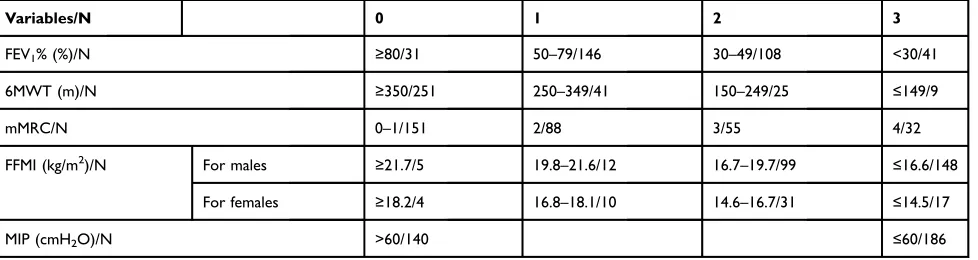
The FODEP index scores range from 0 to 15, as shown in Table 1. According to the classification of airflow limitation based on the GOLD guidelines,12the threshold for FEV1%
ranged from 0 to 3. The value of FFMI ranged from 0 (FFMI ≥21.7 kg/m2for males or FFMI≥18.2 kg/m2for females) to 3
(FFMI ≤16.6 kg/m2 for males or FFMI ≤14.5 kg/m2 for females), based on the ATS statement.22As recommended,23 a MIP>60 cmH2O is considered normal. The value of MIP
was 0 when MIP was >60 cmH2O; otherwise, it was 3. The
ranges of mMRC and 6MWT were the same as in the BODE index.
Veri
fi
cation of the FODEP index
A receiver operating characteristic (ROC) curve analysis was performed to compare the abilities of the BODE index and the FODEP index to predict mortality in patients with COPD. Patients were categorized into quartiles according to their FODEP scores. Then, Kaplan–Meier curves were plotted for all four groups to compare the differences in survival among the groups.
Statistical analysis
Continuous variables are presented as the mean ± SD, unless otherwise stated. Associations between factors and mortality were evaluated using Cox regression. ROC curve analysis was performed to compare the overall perfor-mances of the FODEP index and the BODE index with regard to the prognostic prediction and to determine the optimal threshold. Kaplan–Meier curves were constructed to determine the differences in survival among patients grouped according to their FODEP score quartile. Pearson correlation analysis was used to evaluate the rela-tionship between FODEP and hospitalization.P<0.05 was considered statistically significant. Except for the ROC curve analyses, which were performed with MedCalc Statistical Software version 15.2.2 (MedCalc Software, Ostend, Belgium), all other analyses were conducted with SPSS v. 20 (IBM Corporation, Armonk, NY, USA).
Table 1Construction of the fat-free mass index, degree of airflow obstruction, Dyspnea, exercise capacity, and maximal inspiratory pressure (FODEP) index and the number of subjects in each of the 4 stages for each component of the FODEP index
Variables/N 0 1 2 3
FEV1% (%)/N ≥80/31 50–79/146 30–49/108 <30/41
6MWT (m)/N ≥350/251 250–349/41 150–249/25 ≤149/9
mMRC/N 0–1/151 2/88 3/55 4/32
FFMI (kg/m2)/N For males ≥21.7/5 19.8–21.6/12 16.7–19.7/99 ≤16.6/148
For females ≥18.2/4 16.8–18.1/10 14.6–16.7/31 ≤14.5/17
MIP (cmH2O)/N >60/140 ≤60/186
Abbreviations:FEV1%, forced expiratory volume in one second/the predicted value; 6MWT, the six-minute-walk test; mMRC, the modified Medical Research Council;
FFMI, fat-free mass index; MIP, maximal inspiratory pressure; N, number.
International Journal of Chronic Obstructive Pulmonary Disease downloaded from https://www.dovepress.com/ by 118.70.13.36 on 22-Aug-2020
Results
Patient characteristics
In total, 502 patients were initially enrolled, of whom 121 patients were excluded. Then, the remaining 381 patients were
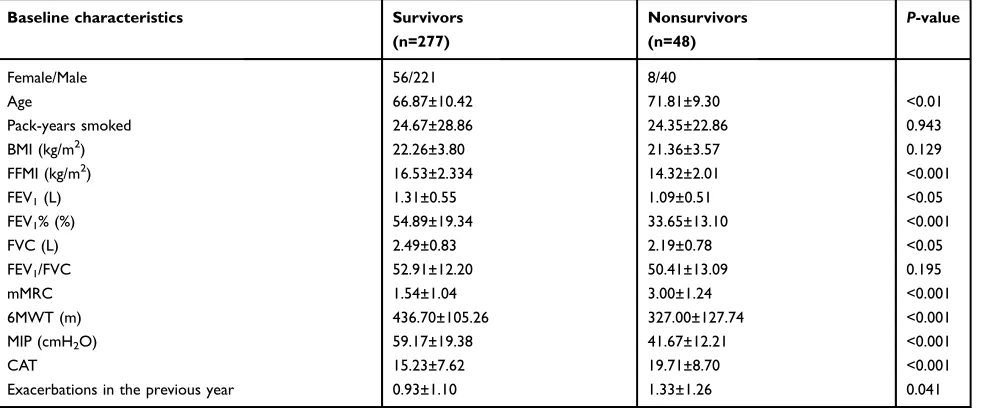
followed until the end of the study or death, while 55 patients were lost to follow-up. Thus, 326 patients (63 females; median age: 67.6 years [range: 41–92 years]) were included in the analysis (Figure 1). In this study, patients were followed for a median of 34 months (range: 1–59 months). The baseline characteristics of the survivors and nonsurvivors are shown inTable 2. During follow-up, 19 subjects (5.8%) died in the first 24 months, and 48 (14.7%) died in thefirst 59 months. Figure 2shows the change in mortality of the subjects in two different periods. The majority of patients (56 percent) died of respiratory failure, 15 percent died of cardiogenic shock, 10 percent of cerebrovascular accident, and the rest of miscella-neous causes.
Identi
fi
cation of factors predicting
mortality
Univariate Cox analysis suggested that the following fac-tors were significantly associated with mortality (Table 3): age, FFMI, FEV1%, mMRC score, 6MWT distance, MIP,
FEV1, FVC, MEP, and the number of exacerbations in the
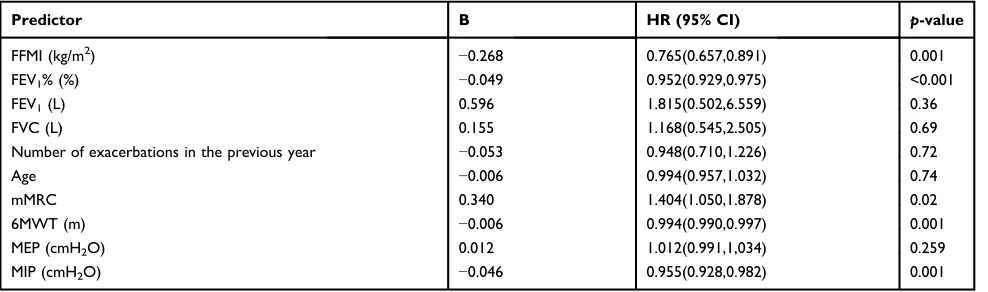
previous year. Interestingly, the association between BMI and mortality was not significant (P=0.069). Incorporating the above factors into multivariate Cox analysis revealed that the following factors were still significantly associated with mortality (Table 4): FFMI (P=0.001), FEV1% (P<0.001), mMRC score (P=0.025), 6MWT distance (P=0.001), and MIP (P=0.001).
Table 2Baseline characteristics of 277 survivors and 48 nonsurvivors
Baseline characteristics Survivors
(n=277)
Nonsurvivors (n=48)
P-value
Female/Male 56/221 8/40
Age 66.87±10.42 71.81±9.30 <0.01
Pack-years smoked 24.67±28.86 24.35±22.86 0.943
BMI (kg/m2) 22.26±3.80 21.36±3.57 0.129
FFMI (kg/m2) 16.53±2.334 14.32±2.01 <0.001
FEV1(L) 1.31±0.55 1.09±0.51 <0.05
FEV1% (%) 54.89±19.34 33.65±13.10 <0.001
FVC (L) 2.49±0.83 2.19±0.78 <0.05
FEV1/FVC 52.91±12.20 50.41±13.09 0.195
mMRC 1.54±1.04 3.00±1.24 <0.001
6MWT (m) 436.70±105.26 327.00±127.74 <0.001
MIP (cmH2O) 59.17±19.38 41.67±12.21 <0.001
CAT 15.23±7.62 19.71±8.70 <0.001
Exacerbations in the previous year 0.93±1.10 1.33±1.26 0.041
Notes:Data are presented as the mean ± SD unless otherwise indicated.
Abbreviations:BMI, body mass index; FFMI, fat-free mass index; FEV1, forced expiratory volume in one second; FEV1%, forced expiratory volume in one second/the
predicted value; FVC, forced vital capacity; mMRC, the modified Medical Research Council; 6MWT, the six-minute-walk test; MIP, maximal inspiratory pressure; CAT, COPD Assessment Test.
502 patients 121 excluded
Comorbid asthma: n=11
Other serious systemic disorders: n=9 Recent participation in pulmonary rehabilitation: n=13
Comorbid cancer or cardiovascular disease: n=58
At acute episode: n=30
381 patients
Baseline interview
Follow-up
Lost to follow-up n=55
Analysis n=326
Figure 1Flow chart of the study.
Note:We excluded such patients who were at acute episode at the time of enrollment, accompanied by more severe dyspnea and other symptoms, for they were unable to take the lung function test and six-minute-walk test in this study.
International Journal of Chronic Obstructive Pulmonary Disease downloaded from https://www.dovepress.com/ by 118.70.13.36 on 22-Aug-2020
Evaluation of the ability of the FODEP
index to predict mortality
The ROC curves for the BODE index and the FODEP index are shown inFigure 3. The AUCs for the BODE index and the FODEP index were 0.778 (95% CI: 0.729–0.822) and 0.860 (95% CI: 0.817–0.896), respectively. The AUC of the FODEP index was significantly different from that of the BODE index (P<0.001 by Delong’s method).24The Youden index of the FODEP index was 0.577, with a sensitivity and specificity of 81.25% and 76.45%, respectively. The Youden index for the BODE index was 0.427, with a sensi-tivity and specificity of 72.92% and 69.78%, respectively.
Patients were categorized into quartiles according to their FODEP scores as follows: 0–4, 5–8, 9–12, and 13–15. The Kaplan-Meier curves are presented inFigure 4. The survival
rate decreased as the FODEP index increased; the association was more significant with a higher FODEP index (P<0.001 by the log-rank test).
Correlation between the FODEP index
and the number of hospitalizations
The FODEP index has a moderate correlation with the number of hospitalizations (r=0.384, P<0.001). However, as shown inFigure 5, the ROC curves showed there was no significant difference in predicting the risk of rehospi-talization between the BODE index and the FODEP index (P=0.7046). The AUC of the FODEP index was 0.632 (95% CI: 0.577–0.684), and the AUC of the BODE index was 0.624 (95% CI: 0.569 −0.677). The Youden index of the FODEP index was 0.238, with a sensitivity 100%
Mortality at 24 months
80%
60%
40%
20%
0%
1 2 3 4 5 6
Alive Dead
7 8 9 10 11 12 13 14 15
100%
Mortality at 59 months
80%
60%
40%
20%
0%
1 2 3 4 5 6
Alive Dead
7 8 9 10 11 12 13 14 15
Figure 2FODEP scores and mortality rates over time. For each unit of the FODEP score, the bars show the proportion of subjects alive and dead at the end of 24 months and 59 months.
International Journal of Chronic Obstructive Pulmonary Disease downloaded from https://www.dovepress.com/ by 118.70.13.36 on 22-Aug-2020
and specificity of 72.12% and 51.69%, respectively. The Youden index of the BODE index was 0.186, with a sensitivity and specificity of 63.46% and 55.08%, respectively.
Discussion
This study has shown that the FODEP index, consisting of FFMI, FEV1%, the mMRC score, the 6MWT distance and
MIP, is a significant and independent predictor of mortal-ity, with every one point increase in the FODEP index score associated with a 1.55-fold increased risk of death.
Univariate Cox regression showed that age, FFMI, FEV1%, mMRC score, 6MWT distance, MIP, FEV1,
FVC, MEP, and the number of exacerbations in the previous
year were independent predictors of the risk of mortality in COPD patients; thesefindings were in line with the results of other studies such as DOSE,25 which indicated that smoking status and exacerbation frequency (as well as dyspnea and airflow obstruction) were important predictive factors, or ADO,26 which included age (plus dyspnea and airflow obstruction). However, we found that only five factors (FFMI, FEV1%, mMRC score, 6MWT distance
and MIP) were still significantly correlated with mortality in the multivariate Cox regression, which is the reason those variable were chosen for inclusion in the FODEP index.
BMI was used to assess nutritional status in the BODE index; however, it does not reflect the status of skeletal muscle in patients with COPD.27 Compared with BMI,
Table 3Univariate Cox regression analysis of independent predictors of death in COPD patients
Predictor B HR (95% CI) p-value
Sex 0.231 1.259 (0.589, 1.693) 0.552
Age 0.052 1.054 (1.021, 1.088) 0.001
Pack-years smoked 0.003 1.003 (0.993, 1.013) 0.595
FFMI (kg/m2) −0.383 0.681 (0.605, 0.767) <0.001
BMI (kg/m2) −0.74 0.929 (0.857, 1.006) 0.069
FEV1% (%) −0.083 0.920 (0.898, 0.943) <0.001
mMRC 0.945 2.574 (1.925, 3.441) <0.001
6MWT (m) −0.007 0.993 (0.991, 0.995) <0.001
FEV1(L) −0.784 0.457 (0.254, 0.822) 0.009
FVC (L) −0.416 0.659 (0.458, 0.950) 0.025
FEV1/FVC −0.018 0.982 (0.960, 1.004) 0.110
Number of exacerbations in the previous year 0.249 1.283 (1.019, 1.615) 0.034
MIP (cmH2O) −0.054 0.948 (0.930, 0.966) <0.001
MEP (cmH2O) −0.22 0.978 (0.964, 0.992) 0.002
Abbreviations:B, beta; HR, hazard ratio; FFMI, fat-free mass index; BMI, body mass index; FEV1%, forced expiratory volume in one second/the predicted value; mMRC, the
modified Medical Research Council; FEV1, forced expiratory volume in one second; FVC, forced vital capacity; 6MWT, the six-minute-walk test; MIP, maximal inspiratory
pressure; MEP, maximal expiratory pressure.
Table 4Multivariate Cox regression analysis of independent predictors of mortality in COPD patients
Predictor B HR (95% CI) p-value
FFMI (kg/m2) −0.268 0.765(0.657,0.891) 0.001
FEV1% (%) −0.049 0.952(0.929,0.975) <0.001
FEV1(L) 0.596 1.815(0.502,6.559) 0.36
FVC (L) 0.155 1.168(0.545,2.505) 0.69
Number of exacerbations in the previous year −0.053 0.948(0.710,1.226) 0.72
Age −0.006 0.994(0.957,1.032) 0.74
mMRC 0.340 1.404(1.050,1.878) 0.02
6MWT (m) −0.006 0.994(0.990,0.997) 0.001
MEP (cmH2O) 0.012 1.012(0.991,1,034) 0.259
MIP (cmH2O) −0.046 0.955(0.928,0.982) 0.001
Abbreviations:B, beta; HR, hazard ratio; FFMI, fat-free mass index; FEV1%, forced expiratory volume in one second/the predicted value; FEV1,forced expiratory volume in
one second; FVC, forced vital capacity; mMRC, the modified Medical Research Council; 6MWT, the six-minute- walk test; MIP, maximal inspiratory pressure; MEP, maximal expiratory pressure.
International Journal of Chronic Obstructive Pulmonary Disease downloaded from https://www.dovepress.com/ by 118.70.13.36 on 22-Aug-2020
FFMI seems to be more related to muscle atrophy, exercise capacity, and quality of life. FFMI was also found to be a predictor of overall mortality in subjects with normal BMI.28Thus, replacing BMI with FFMI could more accu-rately reflect the nutritional status of COPD patients.
Inspiratory muscle strength is commonly reduced in COPD patients, and the degree of reduction is related to the severity of disease.15 Previous studies reported that respiratory muscle weakness is observed in 20–50% of patients, with the reduction ranging from 15% to 30%.29 In 2010, Hill et al23 proposed that respiratory muscle strength is closely linked to dyspnea and exercise capa-city. Inspiratory muscle strength, as assessed by MIP, has been shown to be an independent predictor of survival in COPD patients,18 which was consistent with thefindings of this study. In addition, as it is less affected by external factors, MIP provides a convenient metric for inspiratory strength. Therefore, MIP was included in the FODEP index.
The ROC curve suggests that the FODEP index may be a better predictor of mortality than the BODE index, although it remains to be confirmed by further study. Kaplan-Meier survival analysis revealed that the FODEP score was closely related to the risk of mortality in patients with COPD, and the cumulative survival rate of patients with the highest FODEP score was significantly lower than that of patients with lower scores.
Exacerbations of COPD are key events in COPD management,30 making exacerbation frequency a marker of disease severity.31 Preventing exacerbations of COPD,
Figure 3ROC curves of the BODE and FODEP index for the prediction of mortality in COPD patients.
Note:The AUC of FODEP: 0.860 (95% CI: 0.817–0.896), BODE: 0.778 (95% CI: 0.729–0.822). Difference of ROC curves was significant between FODEP and BODE (P<0.001 by Delong et al (1988)).24
1.0
0.8
Survival functions
FODEP score by quartiles
Quartile 1 Quartile 2 Quartile 3 Quartile 4
0.6
0.4
Cum survival
0.2
0.0
0 10 20 30
Months
40 50 P<0.01
60
Figure 4Kaplan-Meier survival curves for patients stratified by quartiles of FODEP scores.
Note:Quartile 1: scores of 0 to 4; Quartile 2: scores of 5 to 8; Quartile 3: scores of 9 to 12; Quartile 4: scores of 13 to 15. Survival differed significantly among the 4 groups:P<0.01 by the log rank test.
Figure 5ROC curves of the BODE and FODEP indexes for the prediction of the risk of COPD-related hospitalization.
Note:The AUC of FODEP: 0.632(95% CI: 0.577–0.684), BODE: 0.624 (95% CI: 0.569−0.677). Difference of ROC curves was not significant between FODEP and BODE (P=0.7046 by Delong et al (1988)).24
International Journal of Chronic Obstructive Pulmonary Disease downloaded from https://www.dovepress.com/ by 118.70.13.36 on 22-Aug-2020
especially hospitalizations, is a major goal in the manage-ment of patients with COPD. Previous studies have sug-gested that the BODE index is a better predictor of hospitalization for COPD than is GOLD staging based on FEV1,1 while our study suggested that the FODEP
index has a similar ability to predict COPD-related hospi-talization as that of the BODE index. Thus, the FODEP index may be helpful in predicting hospitalizations in COPD patients.
This study has certain limitations. The cohort was relatively small, and the observation duration was not long enough. Second, previous studies have shown that image-based COPD classifications can indicate degrees of dyspnea and acute exacerbations.32 Van Tho et al sug-gested that COPD patients with different phenotypes on imaging examinations may present with different clinical manifestations.32 However, imaging-based phenotypes of COPD were not included in the multidimensional indica-tors in this study.
Conclusion
Compared with the BODE index, the FODEP index is better able to predict the prognosis of COPD patients. Moreover, the FODEP index provides further insights into the comprehensive assessment and management of COPD patients.
Acknowledgments
This work was supported by the Guangdong Provincial Department of Education High-level University Construction Funding Southern Medical University Clinical Research Startup Program (LC2016PY032), the Guangzhou Innovation and Entrepreneurship Education Project of Universities (201709T26), and the scientific research startup program of Southern Medical University (PY2018N046), and the Medical Scientific Research Foundation of Guangdong Province (A2019425).
Author contributions
Xin Chen is the guarantor of this research. Chunquan Ou and Xin Chen were responsible for the study concept and design. Limei Xu, Tiaofei Ye and Jiahui Li contributed to patient recruitment and patient follow-up. Yuhe Hu and Wenhui Xu acquired the data. Kai Wang analyzed the data. All authors contributed to the data analysis and manuscript drafting and revision, gave final approval of the version to be pub-lished and agree to be accountable for all aspects of the work.
Disclosure
The authors report that there are no conflicts of interest related to this work.
References
1. Ong KC, Earnest A, Lu SJ. A multidimensional grading system (BODE index) as predictor of hospitalization for COPD. Chest.
2005;128(6):3810–3816. doi:10.1378/chest.128.6.3810
2. Wouters EF, Schols AM. Prevalence and pathophysiology of nutri-tional depletion in chronic obstructive pulmonary disease. Respir Med.1993;87 Suppl B:45–47.
3. Luo Y, Zhou L, Li Y, et al. Fat-free mass index for evaluating the nutritional status and disease severity in COPD.Respir Care.2016;61 (5):680–688. doi:10.4187/respcare.04358
4. Maltais F, Decramer M, Casaburi R, et al. An Official American Thoracic Society/European Respiratory Society statement: update on limb muscle dysfunction in chronic obstructive pulmonary dis-ease. Am J Respir Crit Care Med. 2014;189(9). doi:10.1164/ rccm.201306-1150OC
5. Sabino PG, Silva BM, Brunetto AF. Nutritional status is related to fat-free mass, exercise capacity and inspiratory strength in severe chronic obstructive pulmonary disease patients.Clinics (Sao Paulo).
2010;65(6):599–605. doi:10.1590/S1807-59322010000600007 6. Gerardi DA, Lovett L, Benoit-Connors ML, Reardon JZ, ZuWallack
RL. Variables related to increased mortality following out-patient pulmonary rehabilitation.Eur Respir J.1996;9(3):431–435. 7. Celli BR, Cote CG, Marin JM, et al. The body-mass index, airflow
obstruction, dyspnea, and exercise capacity index in chronic obstruc-tive pulmonary disease. N Engl J Med. 2004;350(10):1005–1012. doi:10.1056/NEJMoa021322
8. de Torres JP, Casanova C, Marín JM, et al. Prognostic evaluation of COPD patients: GOLD 2011 versus BODE and the COPD comor-bidity index COTE.Thorax.2014;69(9):799–804. doi:10.1136/thor-axjnl-2014-205770
9. Camiciottoli G, Bigazzi F, Bartolucci M, et al. BODE-index, modified BODE-index and ADO-score in chronic obstructive pulmonary disease: relationship with COPD phenotypes and CT lung density changes. Copd.2012;9(3):297–304. doi:10.3109/15412555.2012.661000 10. Cote CG, Celli BR. BODE index: a new tool to stage and monitor
progression of chronic obstructive pulmonary disease. Pneumonol Alergol Pol.2009;77(3):305–313.
11. American Thoracic Society Statement.Lung function testing: selec-tion of reference values and interpretative strategies.Am Rev Respir Dis.1991;144(5):1202–1218. doi:10.1164/ajrccm/144.5.1202 12. Global Initiative for Chronic Obstructive Lung Disease. Global
strat-egy for the diagnosis, management and prevention of COPD.2017. Avail-able from: http://goldcopd.org. Accessed November 10, 2016. 13. Gologanu D, Ionita D, Gartonea T, Stanescu C, Bogdan MA. Body
composition in patients with chronic obstructive pulmonary disease. Maedica (Buchar).2014;9(1):25–32.
14. Cao C, Wang R, Wang J, Bunjhoo H, Xu Y, Xiong W. Body mass index and mortality in chronic obstructive pulmonary disease: a meta-analysis. PLoS One. 2012;7(8):e43892. doi:10.1371/journal. pone.0043892
15. Pothirat C, Chaiwong W, Phetsuk N, et al. The relationship between body composition and clinical parameters in chronic obstructive pulmonary disease.J Med Assoc Thai.2016;99(4):386–393. 16. VanItallie TB, Yang MU, Heymsfield SB, Funk RC, Boileau RA.
Height-normalized indices of the body’s fat-free mass and fat mass: potentially useful indicators of nutritional status. Am J Clin Nutr.
1990;52(6):953–959. doi:10.1093/ajcn/52.6.953
17. Larson JL, Covey MK, Corbridge S. Inspiratory muscle strength in chronic obstructive pulmonary disease. AACN Clin Issues.2002;13 (2):320–332.
International Journal of Chronic Obstructive Pulmonary Disease downloaded from https://www.dovepress.com/ by 118.70.13.36 on 22-Aug-2020
18. Kabitz HJ, Walterspacher S, Walker D, Windisch W. Inspiratory muscle strength in chronic obstructive pulmonary disease depending on disease severity. Clin Sci (Lond). 2007;113(5):243–249. doi:10.1042/CS20060362
19. American Thoracic Society Statement.Standardization of Spirometry. 1994 Update.Am J Respir Crit Care Med.1995;153(3):1107–1136. 20. Quanjer PHTGCJ. Lung volumes and forced ventilatoryflows. Report
Working Party‘Standardization of lung function tests’of ECSC.Eur Respir J.1993;29(Suppl 6):5–40. doi:10.1183/09041950.005s1693 21. American Thoracic Society/European Respiratory Society. ATS/ERS
statement on respiratory muscle testing.Am J Respir Crit Care Med.
2002;166(4):518–624. doi:10.1164/rccm.166.4.518
22. Nici L, Donner C, Wouters E, et al. American Thoracic Society/ European Respiratory Society statement on pulmonary rehabilitation. Am J Respir Crit Care Med.2006;173(12):1390–1413. doi:10.1164/ rccm.200508-1211ST
23. Hill K, Cecins NM, Eastwood PR, Jenkins SC. Inspiratory muscle training for patients with chronic obstructive pulmonary disease: a practical guide for clinicians. Arch Phys Med Rehabil. 2010;91 (9):1466–1470. doi:10.1016/j.apmr.2010.06.010
24. DeLong ER, DeLong DM, Clarke-Pearson DL. Comparing the areas under two or more correlated receiver operating characteristic curves: a nonparametric approach.Biometrics.1988;44(3):837–845. 25. Jones RC, Donaldson GC, Chavannes NH, et al. Derivation and
validation of a composite index of severity in chronic obstructive pulmonary disease.Am J Respir Crit Care Med.2009;180(12):1189– 1195. doi:10.1164/rccm.200902-0271OC
26. Puhan MA, Garcia-Aymerich J, Frey M, et al. Expansion of the prognostic assessment of patients with chronic obstructive pulmonary disease: the updated BODE index and the ADO index. Lancet.
2009;374(9691):704–711. doi:10.1016/S0140-6736(09)61301-5 27. Kim SB, Kang YA, Jung JY, et al. Body mass index and fat free mass
index in obstructive lung disease in Korea.Int J Tuberc Lung Dis.
2014;18(1):102–108. doi:10.5588/ijtld.13.0212
28. Ischaki E, Papatheodorou G, Gaki E, Papa I, Koulouris N, Loukides S. Body mass and fat-free mass indices in COPD: relation with variables expressing disease severity.Chest. 2007;132(1):164–169. doi:10.1378/chest.06-2789
29. Gologanu D. [Dynamic hyperinflation – the main mechanism of decreased exercise tolerance in patients with COPD].Pneumologia.
2013;62(2):102–105.
30. Seemungal TA, Donaldson GC, Paul EA, Bestall JC, Jeffries DJ, Wedzicha JA. Effect of exacerbation on quality of life in patients with chronic obstructive pulmonary disease.Am J Respir Crit Care Med.
1998;157(5 Pt 1):1418–1422. doi:10.1164/ajrccm.157.5.9709032 31. UK NCGC.Chronic Obstructive Pulmonary Disease: Management
of Chronic Obstructive Pulmonary Disease in Adults in Primary and Secondary Care. London: Royal College of Physicians (UK);2010. 32. Van Tho N, Ogawa E, Trang LT, et al. A mixed phenotype of airway
wall thickening and emphysema is associated with dyspnea and hospitalization for chronic obstructive pulmonary disease.Ann Am Thorac Soc. 2015;12(7):988–996. doi:10.1513/AnnalsATS.201411-501OC
International Journal of Chronic Obstructive Pulmonary Disease
Dove
press
Publish your work in this journal
The International Journal of COPD is an international, peer-reviewed journal of therapeutics and pharmacology focusing on concise rapid reporting of clinical studies and reviews in COPD. Special focus is given to the pathophysiological processes underlying the disease, inter-vention programs, patient focused education, and self management
protocols. This journal is indexed on PubMed Central, MedLine and CAS. The manuscript management system is completely online and includes a very quick and fair peer-review system, which is all easy to use. Visit http://www.dovepress.com/testimonials.php to read real quotes from published authors.
Submit your manuscript here:https://www.dovepress.com/international-journal-of-chronic-obstructive-pulmonary-disease-journal
International Journal of Chronic Obstructive Pulmonary Disease downloaded from https://www.dovepress.com/ by 118.70.13.36 on 22-Aug-2020