Available online:
https://edupediapublications.org/journals/index.php/IJR/
P a g e | 75A Review Paper on Wireless Sensor Networks
Priti Devi
,
Kapil Saini
Department of Computer Science Geeta Engineering college,Naultha Panipat(GEC)
KURUKSHETRA, NH 71-A, Naultha, Gohana Road, Panipat, Haryana 132107
Email Id:[email protected]
Department of Computer Science Geeta Engineering college,Naultha Panipat(GEC)
KURUKSHETRA, NH 71-A, Naultha, Gohana Road, Panipat, Haryana 132107
Email Id:[email protected]
Abstract— Wireless sensor networks are in use from the past few years and they involve deploying a large number of small nodes. A wireless sensor network consists of hundreds or thousands of low cost nodes which could either have a fixed location or randomly deployed to monitor the environment. Basically wireless sensor networking is used for monitoring the physical conditions such as weather conditions, regularity of temperature, different kinds of vibrations and also deals in the field of technology related to sound. The key evaluation metrics for wireless sensor networks are lifetime, coverage, cost and ease of deployment, response time, temporal accuracy, security, and effective sample rate. This paper provides review of various researches performed in the field of wireless sensor networks.
Keywords— Sensor Networks,
I. INTRODUCTION
In the field of wireless networking there is another form of networking which is known as wireless sensor network. Wireless networking which is comprised of a number of numerous sensors and they are interlinked or connected with each other for performing the same function collectively or cooperatively for the sake of checking and balancing the environmental factors. This type of networking is called Wireless sensor networking [1].
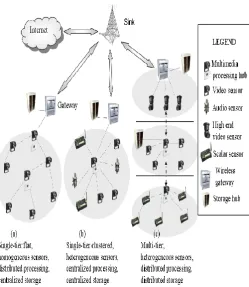
Wireless sensor networks are in use from the past few years and they involve deploying a large number of small nodes. A wireless sensor network consists of hundreds or thousands of low cost nodes as shown in Figure 1 which could either have a fixed location or randomly deployed to monitor the environment. Basically wireless sensor networking is used for monitoring the physical conditions such as weather conditions, regularity of temperature, different kinds of vibrations and also deals in the field of technology related to sound.
Figure 1: Sensor Networks
A sensor network [2] consists of multiple detection stations called sensor nodes, each of which is small, lightweight and portable. Every sensor node is equipped with a transducer, microcomputer,
transceiver and power source. The transducer
Available online:
https://edupediapublications.org/journals/index.php/IJR/
P a g e | 76computer. The power for each sensor node is derived
from the electric utility or from a battery.
A sensor network [3] is a group of specialized transducers with a communicational infrastructure intended to monitor and record conditions at diverse locations. Commonly monitored parameters are temperature, humidity, pressure, wind direction and speed, illumination intensity, vibration intensity, sound intensity, power-line voltage, chemical concentrations, pollutant levels and vital body functions.
Due to their small size, they have a number of limitations. Sensors usually communicate with each other using a multi hop approach. The flow of data ends at special nodes called base stations (sometimes they are also referred to as sinks). A base station links the sensor network to another network (like a gateway) to disseminate the data sensed for further processing. Base stations have enhanced capabilities over simple sensor nodes since they must do complex data processing; this justifies the fact that bases stations have workstation/laptop class processors, and of course enough memory, energy, storage and computational power to perform their tasks well. Usually, the communication between base stations is initiated over high bandwidth links. The nodes then sense environmental changes and report them to other nodes over flexible network architecture. Sensor nodes are great for deployment in hostile environments or over large geographical areas.
The key evaluation metrics for wireless sensor networks are lifetime, coverage, cost and ease of deployment, response time, temporal accuracy, security, and effective sample rate. This paper provides review of various researches performed in the field of wireless sensor networks.
II. LITERATURE REVIEW
In the past several other works are performed for the wireless sensor networks. The literature reviews of some of these works are explained below:
Xiang-zhong Meng, Bing Wu [94 explain the problem of determining the node locations in wireless sensor special locating algorithm. Only knowing the right location network and brings forward a new locating algorithm of nodes, information, we can find out what and how WSN nodes are which requires some false or can say duplicate nodes that know themselves position operating. In WSN, right locating of WSN node is the basic to information in advance, then realizes positioning node by clock-locating algorithms.
Hang Qin and Zhongbo Wu [5]. This paper inquire the load balancing in sensor nodes and wireless link depends on the functioning of wireless sensor networks. With an optimize(use best) model, the dynamic method of data collaborating and forwarding scheduling between grid-quorum.
Yao H. Ho , Kien A. Hua, Ning Jiang [6] presents in a Mobile Ad Hoc Network (MANET), communication connections requires to accommodate to frequent irregular topology changes due to the energy constraints, mobility, and restricted computing and executing power of the mobile hosts. We come up to this weakness by using a cross-layer design, where the physical and MAC layer cognition of the wireless medium is contribute with higher layer, in order to give significant methods of develop and manages routes. We projected two connectionless-oriented dynamic(active) route diversion technologies; and provide simulation results, depends on GloMoSim, to present their performance advantage.
Akramul Azim and Mohammad Mahfuzul [7] A new robust and rich relay node based hybrid Low Energy Adaptive Clustering Hierarchy (LEACH) which unified the currently developed energy comparison LEACH within the relay nodes depend technology so that the network still works, in absence of relay nodes, as long as even a isolated node have energy to communicate. The projected scheme also manages the efficiency of energy utilization or usage through controlling the size of cluster in a scattered manner for the very first time.
Arabinda Nanda, Amiya Kumar Rath and Saroj Kumar [8] Rout This paper proposed a dynamic discover routing technique for communication between sensor nodes and a base station in wireless sensor network. This method suffers failures of arbitrary isolated nodes in the network (node failure) or a small area of the network (area failure). Every node in the network perform only local routing preservation, requires to record only its neighbor nodes info, and obtain no additional routing overhead during failure vacant periods. It dynamically finds new routes when an mediate node or a small part of the network in the path from a sensor node to a base station fails.
Available online:
https://edupediapublications.org/journals/index.php/IJR/
P a g e | 77the state-of-the-art research efforts and industrial
solutions are provided corresponding to each factor. Further research issues for the realization and improvement of wireless sensor network technology on process industry are also mentioned”.
Pooja Singhal, Pankaj Gupta [10] described that “Wireless sensor networks are a new type of networked systems, characterized by severely constrained computational and energy resources, and an ad hoc operational environment. When we work with a large sensor area network with dense sensors , there are some nodes that has to bear the heavy traffic load then over the time such sensor goes weak and they start losing the packet. This packet loss is bearable up to some threshold value, but as the packet loss exceed this level it disturb the whole network and now any kind of data transfer over this node is not reliable. In this paper author will proposed a algorithm that will solve the problem of packets lost and improve the reliability of network. The author will implement this algorithm by help of NS-2 simulator”.
Sangeetha M, C Karthikeyan [11] provided “a detailed introduction to wireless sensor networks and its current state of the art in applications. The application of WSN in the areas of biomedical, intelligent parking, healthcare, environmental, industrial, and military have been briefed with their research issues. Research on these issues will lead to promising results, making WSN based applications very popular”.
Hosam Soleman and Ali Payandeh [12] specified that “Because of the widespread use of wireless sensor networks in many applications, and due to the nature of the specifications of these networks (WSN) in terms of wireless communication, the network contract specifications, and published it in difficult environments. All this leads to the network exposure to many types of external attacks. Therefore, the protection of these networks from external attacks is considered the one of the most important researches at this time. In this paper we investigated the security in wireless sensor networks, Limitations of WSN, Characteristic Values for some types of attacks, and have been providing protection mechanism capable of detecting and protecting wireless sensor networks from a wide range of attacks”.
Imran Khan, Fatna Belqasmi, Roch Glitho [13] described that “Wireless sensor networks (WSNs) have become pervasive and are used in many applications and services. Usually the deployments of WSNs are task oriented and domain specific; thereby precluding re-use when other applications and services are contemplated. This inevitably leads to the proliferation of redundant WSN deployments.
Virtualization is a technology that can aid in tackling this issue, as it enables the sharing of resources/infrastructure by multiple independent entities. In this paper we critically review the state of the art and propose a novel architecture for WSN virtualization. The proposed architecture has four layers (physical layer, virtual sensor layer, virtual sensor access layer and overlay layer) and relies on the constrained application protocol (CoAP). We illustrate its potential by using it in a scenario where a single WSN is shared by multiple applications; one of which is a fire monitoring application. We present the proof-of-concept prototype we have built along with the performance measurements, and discuss future research directions”.
Amit Rathee, Randeep Singh [14] described that “Wireless Sensor Network (WSN) is the current research field in computer science & has growing use in day to day life. As a new technology, it has several research challenges and vast opportunities for the researchers. This paper highlights WSN, its architecture, challenges, applications and classification of various protocols concerning it. It also classifies various security protocols to make WSN a secure network”.
III. APPLICATIONS OF WSNS
In the present area there are lot of technologies which are used for monitoring are completely based on the wireless sensor networking. Some of important applications are environmental monitoring, traffic control application, weather checking, regularity checking of temperature etc. Wireless sensor networks can also be used for detecting the presence of vehicles such as motor cycles up to trains.
These are some important wireless sensor networking based technologies which help us in our daily life. Some of there daily life applications are: used in agriculture, water level monitoring, green house monitoring. Sensor networks have been useful in a variety of domains. The primary domains at which sensor are deployed follow:
Available online:
https://edupediapublications.org/journals/index.php/IJR/
P a g e | 78Other examples include forest fire detection,
air pollution and rainfall observation in agriculture.
Military monitoring: Military uses sensor networks for battlefield surveillance; sensors could monitor vehicular traffic, track the position of the enemy or even safeguard the equipment of the side deploying sensors. Building monitoring: Sensors can also be
used in large buildings or factories monitoring climate changes. Thermostats and temperature sensor nodes are deployed all over the building’s area. In addition, sensors could be used to monitor vibration that could damage the structure of a building.
Healthcare: Sensors can be used in biomedical applications to improve the quality of the provided care. Sensors are implanted in the human body to monitor medical problems like cancer and help patients maintain their health.
IV. DESIGN CHALLENGES OF WSN
The design of WSN is influenced by many challenging factors. They are following:
Node deployment: Node deployment in WSN is application dependent and affects the performance of the routing protocol. The deployment can be either deterministic or randomized. In deterministic deployment, the sensors are manually placed and data is routed through pre-determined paths. However, in random node deployment, the sensor nodes are scattered randomly creating an infrastructure in an ad hoc manner. Energy consumption without losing
accuracy: In a multi-hop WSN each node plays a dual role as data sender and data router. The malfunctioning of some sensor nodes due to power failure can cause significant topological changes and may need rerouting of packets and reorganization of network.
Data Reporting Model: Data sensing and reporting in WSN is dependent on the application and the time criticality of the data reporting. Data reporting can be categorized as either time-driven (continuous), event-driven, query-event-driven, The routing protocol is highly influenced by the data reporting model with regard to energy consumption and route stability.
Node/Link Heterogeneity: In many studies, all sensor nodes were assumed to be homogeneous, i.e., having equal capacity in
terms of computation, communication, and power. However, depending on the application a sensor node can have different role or capability. The existence of heterogeneous set of sensors raises many technical issues related to data routing. Fault Tolerance: Nodes may fail due to
power failure, physical damage etc. This may require actively adjusting transmit powers and rerouting packets through regions of the network where more energy is available. Network Dynamics: Routing messages from
or to moving nodes is more challenging since route stability becomes an important issue, in addition to energy, bandwidth etc.
Transmission Media: In a multi-hop sensor network, communicating nodes are linked by a wireless medium. The traditional problems associated with a wireless channel (e.g., fading, high error rate) may also affect the operation of the sensor network.
Coverage: In WSN, each sensor node obtains a certain view of the environment. Hence area coverage is also an important design parameter in WSN.
Data aggregation: Since sensor nodes may generate significant redundant data, similar packets from multiple nodes can be aggregated so that the number of transmissions is reduced. Data aggregation is the combination of data from different sources according to a certain aggregation function.
Quality of Service: In some applications, data should be delivered within a certain period of time from the moment it is sensed; otherwise the data will be useless. Therefore bounded latency for data delivery is another condition for time-constrained applications.
V. CONCLUSION
Available online:
https://edupediapublications.org/journals/index.php/IJR/
P a g e | 79REFERENCES
[1] V. Rajaravivarma, Yi Yang, and Tang Yang, “An Overview of Wireless Sensor Network and Applications”, Computer Electronics, School of Technology 0-7803-7697-8/03/$17.000 2008 IEEE
[2] K Whitehouse, D Culler. “Calibration as Parameter Estimation in Sensor Networks”, In: First ACM International Workshop on Wireless Sensor Networks and Application, Atlanta GA, 2009.
[3] Ian F. Akyildiz, Weilian Su, Yogesh Sankara Subramaniam, and Erdal Cayirci, “A Survey on Sensor Networks”, Georgia Institute of Technology 0163-6804/02/$17.00 © 2002 IEEE.
[4] Xiang-zhong Meng, Bing Wu, Hui Zhu and Yao-bin Yue Xiang-zhong Meng, “Low Power Locating Algorithms For Wireless Sensors Network”, Proceedings of the 2006 IEEE.
[5] Hang Qin, Zhongbo Wu, “Analysis and Improvement of the Dynamic Load Balancing of Overlay-based WSN”, 978-1-4244-2358-3/08/$20.00 © 2008 IEEE.
[6] Yao H. Ho, Kien A. Hua, Ning Jiang, and Fei Xie , “Dynamic Route Diversion in Connectionless Mobile Ad Hoc Networks”, 1978-0-7695-3187-8/08 $25.00 © 2008 IEEE.
[7] Akramul Azim and Mohammad Mahfuzul Islam, “Hybrid LEACH: A Relay Node Based Low Energy Adaptive Clustering Hierarchy for Wireless Sensor Networks”, Proceedings of the 2009 IEEE 9th Malaysia International Conference.
[8] Arabinda Nanda, Amiya Kumar Rath and Saroj Kumar ,“Node Sensing & Dynamic Discovering Routes for Wireless Networks”, (IJCSIS) International Journal of Computer Science and Information Security, Vol. 7, No. 3, March 2010.
[9] Gang Zhao, “Wireless Sensor Networks for Industrial Process Monitoring and Control: A Survey”, Network Protocols and Algorithms ISSN 1943-3581 2011, Vol. 3, No. 1.
[10] Pooja Singhal, Pankaj Gupta, “PROPOSED SCHEME FOR RELIABLE DATA TRANSFER IN WIRELESS SENSOR NETWORKS”, IRACST – Engineering Science and Technology: An International Journal (ESTIJ), ISSN: 2250-3498, Vol.2, No. 4, August 2012.
[11] Sangeetha M, C Karthikeyan, “Introduction to Wireless Sensor Network and Research Issues: An Overview”, National Conference on Architecture, Software systems and Green computing-2013(NCASG2013).
[12] Hosam Soleman, Ali Payandeh, “SELF-PROTECTION MECHANISM FOR WIRELESS SENSOR NETWORKS”, International Journal of Network Security & Its Applications (IJNSA), Vol.6, No.3, May 2014.
[13] Imran Khan, Fatna Belqasmi, Roch Glitho, “Wireless Sensor Network Virtualization: Early Architecture and Research Perspectives”, accepted in IEEE NETWORK Magazine and will appear in May/June 2015.