Available online:
https://edupediapublications.org/journals/index.php/IJR/
P a g e | 206A study of effects of machining parameters on tool life
T.Tejaswini
Assistant Professor, Department Of Mechanical Engineering, Visvesvaraya College Of Engineering And
Technology
[email protected]
Abstract:
This work involves the investigation carried out to study the effects of machining parameters on tool life under dry machining environment. Three cutting tool materials (HSS blank tool - M2 C66, tungsten carbide insert tool grade P-10, DMNG carbide insert tool 150412-SA) and work materials (medium carbon steel 0.4 wt% C, mild steel 0.29 wt% C, brass C330) were examined. The experiments were conducted under three different spindle speeds (900, 1120, 1400rev/min); feed rates (0.1, 0.2, 0.3mm/rev) and depths of cut (0.5, 1.0, 1.5mm). The settings of machining parameters were determined by using the Taguchi experimental design method. The level of importance of the machining parameters on tool life was determined by using analysis of variance (ANOVA). The optimum machining parameters combination was obtained by using the analysis of signal-to-noise (S/N) ratio. The relationship between cutting parameters and tool life was obtained. From the results, the spindle speed had the most significant effects on tool life followed by feed rate and the depth of cut. The life of the HSS when cutting the three work pieces (medium carbon steel, mild steel and brass) was 161s, 321s and 386s respectively. The life of tungsten carbide when cutting the three work materials was 480s, 726s and 1028s respectively. The life of DMNG carbide were 782s using medium carbon steel, 864s using mild steel, and 1183s using brass. The shortest life of the three cutting tool materials (HSS, tungsten carbide and DMNG carbide) on the three work material (medium carbon steel, mild steel and brass) occurred at cutting speed (1400 rev/min), feed rate (0.3 mm/rev) and depth of cut (1.5 mm), where the life of the HSS were (15s using medium carbon steel, 58s using mild steel, 94s using brass). The life of tungsten carbide were (135s using medium carbon steel, 180s using mild steel, 274s using brass) and the life of DMNG carbide were (219s using medium carbon steel, 215s using mild steel, 311s using brass). The increment of spindle speed, feed rate and depth of cut value mostly will affect the tool life.Keywords:
Machining Operation, Cutting Tools, Cutting Conditions, Taguchi Method, ANOVA1. Introduction
An orthogonal metal cutting process for a controlled contact tool is depicted in Figure 1 with labels illustrating the nomenclature used in this paper. An Eulerian reference co-ordinate is used to describe the steady state motion of the workpiece relative to a stationary cutting tool. This cutting method is a common and time favoured metal removal process which produces finished surfaces with high quality. Its general use in all industries may give an impression that it is a perfected art. Yet, tool failure and product quality deterioration account for frequent and costly downtime for all cutting machines. Optimization of the process and accurate estimate of tool life become indispensable in this age of automation.
The goal is to find combinations of these parameters that achieve saving in power consumption, increase in tool life, correct lubrication method (determine tolerable friction condition) and improved surface quality (operate the process away from boundary of stability). The results presented in this work should create the window of optimization for this complicated metal cutting process.
Figure 1. Schematic view of the cutting zone and chip formation [1]
It has been established experimentally that there is a definite relationship between the cutting speed and tool life; increased cutting speed decreased tool life [2]. Tugrul and Karpat [3] showed that better tool life is obtained in lowest feed rate and lowest cutting speed combination. Most published works on metal cutting regard the cutting speed as having the greatest influence on tool wear and tool life [4].
Astakhov [5] conducted a research using the notion of the optimal cutting temperature and clarify for practical use the influence of the cutting feed, depth of cut, and work-piece (bore) diameter on the tool wear rate. He found out that whenever a cutting operation is done with optimal cutting temperature, increase in the cutting feed leads to an increase in the tool life. He also concluded that an increase in the depth of cut should not change the tool wear rate if the machining is carried out at the optimal cutting regime.
Mohammed et al [6] threw more light into the interactive effect of the process parameters. The result they obtained showed that the most important interactions, that effected surface roughness of machined surfaces, were between the cutting feed and depth of cut, and between cutting feed and spindle speed. They also concluded that cutting feed is by far the most dominant factor on surface roughness.
Available online:
https://edupediapublications.org/journals/index.php/IJR/
P a g e | 207the seven factors describing tool geometry, the three having the most pronounced effect on tool life are the side rake angle, the side cutting edge angle, and the nose radius [7].
Ojolo et al [8] investigated the possibility of using biological oil (palm kernel, groundnut oil, shea butter and coconut oil) with respect to cutting force, during cylindrical turning of mild steel, aluminum and copper rods. The result of the experiment clearly indicated that bio oils are suitable for metal cutting fluids during machining operation. They also concluded that groundnut and palm kernel oils are effective in reducing cutting force and increasing tool life during cylindrical turning.
Kadirgama et al [9] conducted a research on the effect of dry cutting on cutting force and tool life and made a general comparison between the experiments carried out with cutting fluid and without using any coolant and lubricant. The result showed that dry cutting produce high cutting force and low tool life compared with using coolant. They also discovered that most of the cutting tool from the dry cutting suffered high crack and some insert damage.
Work-piece microstructure has a correlation with the life of a cutting tool. In general, any constituents in the work-piece microstructure which are harder than the tool material tend to decrease tool life. For example, hard insoluble particles of aluminum oxide in the work-piece structure decrease tool life because of their abrasive action on the tool face. Conversely, some types of softer particles such as manganese sulfide in steel and lead in steel and brass have a very beneficial effect on tool life. It is believed these particles decrease the tendency for localized pressure welding to take place at the tool-chip or tool-workpiece interface, thereby creating better machined surfaces and longer tool life [7].
Taguchi method is used for the turning process by optimizing the process parameters. Optimization of process parameters is the key step in the Taguchi method to achieving high quality without increasing cost. This is because optimization of process parameters can improve quality and the optimal process parameters obtained from the Taguchi method are insensitive to the variation of environmental conditions and other noise factors. Basically, classical process parameter design is complex and not easy to use [10]. An advantage of the Taguchi method is that it emphasizes a mean performance characteristic value close
to the target value rather than a value within certain specification limits, thus improving the product quality. Additionally, Taguchi's method for experimental design is straightforward and easy to apply to many engineering situations, making it a powerful yet simple tool. It can be used to quickly narrow the scope of a research project or to identify problems in a manufacturing process from data already in existence [11, 12].
In general, the parameter optimization process of the Taguchi method is based on 8-steps of planning, conducting and evaluating results of matrix experiments to determine the best levels of control parameters [13]. The experimental confirmation test is the final step in verifying the results drawn based on Taguchi’s design approach. The optimal conditions are set for the significant factors (the insignificant factors are set at economic levels) and a selected number of experiments are run under specified cutting conditions. The average of the results from the confirmation experiment is compared with the predicted average based on the parameters and levels tested. The confirmation experiment is a crucial step and is highly recommended by Taguchi to verify the experimental results [14].
Many studies have been made using Taguchi Method to optimize the turning parameter. Nalbant et al [15] use L9(3)4 orthogonal array, signal-to-noise ratio and analysis of variance to study the performance characteristics in turning operations of AISI 1030 steel bars using P20 grade tin coated cutting inserts types with TNMG160404-MA, TNMG160408-MA and TNMG160412-MA. Three cutting parameters namely, insert radius, feed rate, and depth of cut, are optimized with considerations of surface roughness. The experimental results demonstrated that the insert radius and feed rate are the main parameters among the three controllable factors (insert radius, feed rate and depth of cut) that influence the surface roughness in turning AISI 1030 carbon steel.
Yang and Tarng [16] carried out an experiment consist of eighteen combinations on an engine lathe using tungsten carbide grade P10 for the machining of S45C steel bars. The cutting parameters that were been selected are cutting speed, feed rate and depth of cut with the response variable, tool life and surface roughness. Result showed that cutting speed and
feed rate are the significant cutting parameters that affect tool life, while the change of the depth of cut in the range has an insignificant effect on tool life. For surface roughness, all the cutting parameters have the significant effect. The confirmation experiments were conducted to verify the optimal cutting parameters. The improvement of tool life and surface roughness from the initial cutting parameters to the optimal cutting parameters was about 250%.
Mahapatra et al [17] applied Taguchi design concept to determine the influence of the cutting velocity, feed rate and depth of cut on surface roughness and tool life. Their experiments confirmed that cutting velocity and feed rate have greater influence on the surface roughness and tool life. This result also confirmed that the interaction between cutting velocity and feed rate has a significant effect on surface roughness while the interaction between cutting
velocity and feed rate, and cutting velocity and depth of cut has greater significant on tool life.
Mathematical modeling in terms of process parameters for tool life has been carried out by many researchers. Kaye et al
[18] developed a mathematical model based on response surface methodology to predict tool flank wear using spindle speed change. The grey–Taguchi method was adopted to optimize the milling parameters of aluminum alloy with multiple performance characteristics and they found that flank wear decreased from 0.177 mm to 0.067
Available online:
https://edupediapublications.org/journals/index.php/IJR/
P a g e | 208mathematical model using central composite rotatable second order response methodology to predict the adequacy of the tool wear using ANOVA in terms of machining parameters such as helix angle of cutting tool, spindle speed, feed rate, axial and radial depth of cut. Their result showed that the helix angle is the most significant parameter which reduces tool wear. They also found out that increase in spindle speed and axial depth of cut reduces tool wear. They further analyzed the interactions between process parameters and strong interactions were observed between helix angle and axial depth of cut, spindle speed and feed rate, helix angle and feed rate, and spindle speed and radial depth of cut.
Kartal [21] has employed an orthogonal array of L9 (3), 9 the signal-to-noise ratio (S/N) and the analysis of variance (ANOVA) to investigate the cutting characteristics of St 33 and St 52 steel bars using hard mine tipped pen cutting tool in CNC turning operation. Controlled factors were cutting speed (120 m/min, 150 m/min, 180 m/min), feed-rate (0.1 mm/rev, 0.2 mm/rev, 0.3 mm/rev) and depth of cut (0.5 mm, 1.0 mm, 1.5 mm). Performance characteristics were amount of tool wear and surface roughness. After analyzing the collected data, it was found out that cutting speed is most effective parameter for tool life and feed-rate has a smaller
effect compared with cutting speed. The most effective parameter is feed-rate for surface roughness; cutting speed and depth of cut have smaller effects when compared with feed-rate.
2. Materials and Methods
2.1. Materials
The materials used for this research work are Lathe machine Heidenreich & Harbeck- Hamburg 250, HSS cutting tool (14×14×200 HSS-M2 C66), tungsten carbide grade P-10, DMNG carbide tool, Vernier caliper, tape rule, medium carbon steel diameter 50mm × 1200mm long, mild steel and brass, diameter 50mm × 1400mm long respectively. The HSS and Tungsten carbide were purchased from Agarawu Market, Lagos Island while the DNMG carbide tool was obtained from the company where the experiments were carried out.
The following process parameters were used:
(1) Lathe spindle feed, IPR (inch/1000 × 1/rev) of 5, 8 and 12 inch/rev
(2) Spindle speed of 900rev/min, 1120rev/min and 1400rev/min
(3) Feed rate of 0.1mm/rev, 0.2mm/rev and 0.3 mm/rev
(4) Depth of cut of 0.5mm, 1.0mm and 1.5mm (5) Clearance angle of 110 and rake angle of 00 (6) The turning operation was carried out without
lubricant.
(7) The spindle speed and feed rate were varied according to the value selected above while the depth of cut remained constant at 0.5mm, 1.0mm and 1.5mm.
2.2. Experimental Procedure
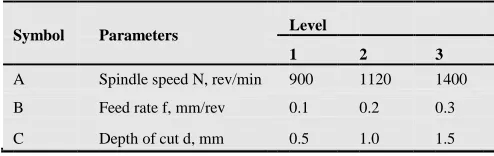
A Lathe machine Heidenreich & Harbeck- Hamburg 250 with a spindle speed range from 900 to 1400rpm was used for the machining trial. The machining center was driven by 5.5kW electric motor. The experiment was done under dry machining environment. A tape rule model Fat Max Blade Armor 35` was used to measure the total cutting length a tool will cut effectively. Tool life was determined by dividing the total length of effective cut by the product of feed rate and spindle speed of machining. The same machine was used for all experimental work. The tool life data were collected for each of the cutting conditions. Table 1 presents the cutting parameters.
Table 1. The cutting parameters and their levels
Symbol Parameters
Level
1 2 3
A Spindle speed N, rev/min 900 1120 1400
B Feed rate f, mm/rev 0.1 0.2 0.3
C Depth of cut d, mm
0.5 1.0 1.5
Available online:
https://edupediapublications.org/journals/index.php/IJR/
P a g e | 2092.2.1. Calculation of Feed Rate
The feed rate f, was calculated from
. ×
=
Where,
IPR = Feed rate in inch per revolution
mmPR = Feed rate in mmillimeter per revolution
2.2.2. Calculation of Tool Life
The tool life is estimated from
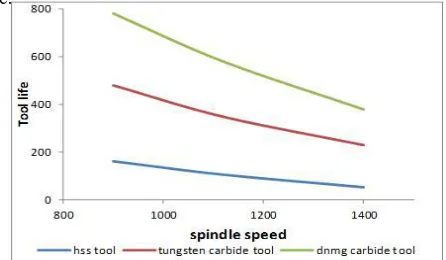
spindle speed of 900rev/min, the tool life of tungsten carbide was 480s which indicate longer tool life. When the spindle speed was increased to 1400rev/min under the same conditions, the tool life decreased to 229s i.e. 53% reduction. As the spindle speed increased at constant feed of 0.2mm/rev the tool life of tungsten carbide decreased from 400s to 167s, approximately 59% reduction in tool life. This is because cutting force on the tool edge increased as the spindle speed increased. Though carbide tools have high hot hardness and wear resistance, they have low fracture toughness. As a result, tool wear intensifies at a high cutting speed. The same trend
was observed when feed rate is constant at 0.3mm/rev; tool life of tungsten carbide decreased from 357s to 135s as the spindle speed increased. The useful life of cutting tool is drastically reduced when it is applied to machining of hardened steel, especially, in the high-speed range [22]. When using DMNG tool at varying high-speeds; the percentage reduction of the tool life was lower compare to other tool materials. As the spindle speed increased from 900rev/min to 1400 rev/min at constant feed of 0.1mm/rev, the tool life decreased from 782s to 373s given a 52% reduction. The same trend occurred when feed was constant at 0.2mm/rev; tool life of DMNG decreased from 650s to 284s given a 56% reduction as the spindle speed increased from 900rev/min to 1400rev/min. Also at constant feed rate of 0.3mm/rev the tool life decreased from 567s to 219s as the spindle speed increased from 900rev/min to 1400 rev/min. This can be explained that varying the spindle speed at high level aggravates tool wear which will excessively lead to shorter tool life.
Figure 2a. Effect of spindle speed on life of tools at constant feed rate of
0.1mm/rev
Figure 2b. Effect of spindle speed on life of tools at constant feed rate of 0.2
mm/rev Figure 2 show the effect of spindle speeds of 900, 1120, 1400
rev/min on life of tools for all values of the feed rate of 0.1, 0.2, 0.3 mm/rev. As the spindle speed increased from 900rev/min up to 1400rev/min, the tool life of HSS tool reduced from 161s to 52 s, approximately 68% reduction in tool life at constant feed of 0.1 mm/rev. It can be seen that better tool life is obtained with a combination of spindle speed 900rev/min and feed 0.1mm/rev. This agrees with Tugrul and Karpat [3], which had earlier discovered that better tool life is obtained in lowest feed rate and lowest cutting speed combination. The same trend was observed at feed rate of 0.2 mm/rev. As the spindle speed increased from 900rev/min to 1400mm/rev, the tool life of HSS drastically reduced from 128s to 27s i.e. 79% reduction. This showed that as the spindle speed increases, the cutting temperature increases. As a result of this, the tool experienced larger chip loads that caused more intensive wear. At 0.3 mm/rev feed rate, the tool life of HSS tool decreased dramatically from 107s to 15s, approximately 86% reduction as the spindle speed increased. This is traced to a high amount of carbon in medium carbon steel; at elevated temperature a brittle fracture occurs at the cutting edge and the depth of the cracks on the cutting edge increases rapidly resulting in a catastrophic fracture of the tool. This is similar to what was obtained by [2]. The same trends that occur in the tool life of HSS were observed in tungsten carbide tool but with higher tool life. When spindle speed was increased from 900rev/min to 1400 rev/min for all values of the feed rate of 0.1, 0.2, 0.3 mm/rev (Table 2), the tool life of tungsten carbide decreased from 400s to 167s. This is due to its high wear resistance. At constant feed of 0.1mm/rev and
3.1. Medium Carbon Steel
The results of the experiments are presented in Figures 2-10 and Table 2
RPM × mmPR = mmPM T = L× 60/mmPM
Where,
RPM = Revolution per minute mmPR = Millimeter per revolution L = Length of effective cut
Available online:
https://edupediapublications.org/journals/index.php/IJR/
P a g e | 210Figure 2c. Effect of spindle speed on life of tools at constant feed rate of
0.3mm/rev
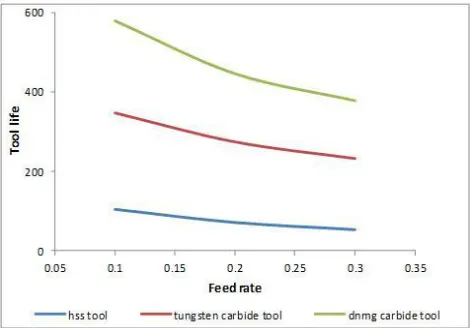
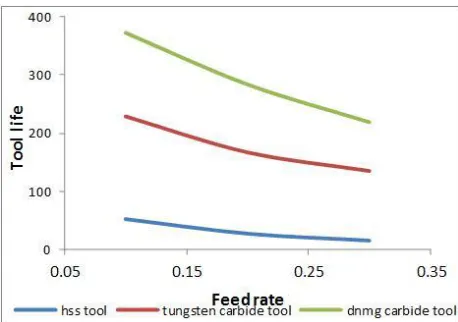
Figure 3 show the effect of feed rate (0.1, 0.2, 0.3 mm/rev) on life of tools for all values of the spindle speeds (900, 1120, 1400 rev/min). As the feed rate increased from 0.1mm/rev up to 0.3mm/rev, the tool life of HSS reduced from 161s to 107s, approximately 34% reduction in tool life at constant spindle speed 900rev/min. The same trend was observed at spindle speed 1120rev/min, as the feed rate increased from 0.1mm/rev to 0.3mm/rev (Table 2). The tool life of HSS reduced from 105s to 54s i.e. 49% reduction. It can be seen that percentage reduction in the HSS tool increased from 34% to 49% which attributed to the fact that increased feed rate led to a corresponding change in temperature, leading to shorter tool life. But if low speed is used the cutting temperature will be lower than the optimal cutting temperature, leading to longer tool life i.e. an increase in the cutting feed lead to a decrease in tool life, this agrees with Astakhov [5]. The decreasing trend occurs due to more wear occurring on the cutting edge at the higher spindle speed of 1400rev/min. As the feed rate increased up to 0.3mm/rev, the tool life of HSS decreased from 52s to 15s by 72%. The reason might be due to increase in feed rate that causes the bigger interface between cutting tool and work-piece. Larger contact area, resulted in more friction that caused more heat generated, consequently shorten the tool life. When using tungsten carbide tool it was observed that at constant spindle speed of 900rev/min the tool life of tungsten carbide decreased from 480s to 357s as the feed vary from 0.1mm /rev to 0.3 mm/rev showing 26% reduction in tool life. At a spindle speed of 1120rev/min, there was a decrease in the tool life of tungsten carbide from 384s to 233s i.e. 39% reduction as the feed rate vary from 0.1mm/rev to 0.3mm/rev, this agrees with [23] that, if the cutting speed and depth of cut are both constant, then the tool life decreased when the cutting feed is increased. The same trend was observed at constant spindle speed of 1400rev/min, as the feed rate increased from 0.1mm/rev to 0.3mm/rev. The tool life of tungsten carbide reduced from 229s to 135s with 41% reduction. At these conditions, the effect of feeding at 0.3 mm/rev is clear on tool life giving shorter tool life in all cases. However, this phenomenon can be attributed to the fact that increased feed rate, reduced tool life but actually
increased the amount of material that could be removed by the tool. When using DMNG tool at varying feed the percentage reduction of the tool was lower compare to other tool materials. The tool life of DMNG at constant spindle speed of 900rev/min decreased from 782s to 567s as the feed rate increased from 0.1mm/rev to 0.3mm/rev given a 27% reduction. As the spindle speed increased to 1120rev/min under the same conditions; lower values of tool life 580s to 379s were obtained given a percentage reduction of 35%. This is similar to 307min to 76min obtained by Zhou et al
[24] at cutting speed of 66.88m/min and 94.2m/min for cemented low carbon alloy steel using high hardness cutting tool of tungsten carbide. The same trend was observed at constant spindle speed of 1400rev/min; the tool life of DMNG decreased from 373s to 219s as the feed rate varying from 0.1mm/rev to 0.3mm/rev. This happened because varying the feed rate at high level aggravates tool wear which will excessively lead to shorter tool life. Hence it can be deduced that the useful life of cutting tool is drastically reduced when it is applied to machining of hardened steel which had earlier reported that the higher the hardness of the workpiece material, the lower is the life of the cutter [25].
Figure 3a. Effect of feed rate on life of tools at constant spindle speed of
900 rev/min
Figure 3b. Effect of feed rate on life of tools at constant spindle speed of
Available online:
https://edupediapublications.org/journals/index.php/IJR/
P a g e | 211
values of tool life (580s to 379s) were obtained. The same trend was observed at constant spindle speed of 1400rev/min the tool life of DMNG decreased from 373s to 219s as the depth of cut vary from 0.5mm to 1.5mm. This occurred because varying the depth of cut at high level aggravates tool wear which will excessively lead to shorter tool life.
Figure 3c. Effect of feed rate on life of tools at constant speed of 1400
rev/min
Figure 4 show the effect of depth of cut (0.5, 1.0, 1.5 mm) on life of tools for all values of the spindle speeds (900, 1120, 1400 mm/rev). As the depth of cut increased from 0.5 to 1.5mm, the tool life of HSS reduced from 161s to 107s at constant spindle speed 900rev/min. This is as a result of lower spindle speed that cannot enhance increase in cutting force at the cutting zone as the depth of cut increases. More materials will have to be cut which means more energy will be required and this will cause an increase in the cutting force and hence, decrease tool life. The same trend was observed at spindle speed 1120rev/min, as the depth of cut increased from 0.5mm to 1.5mm the contact length of the cutting edge with the work-piece increases and wear occurs deeper along the cutting edge as the tool life of HSS reduced from 105s to 54s i.e. 49% reduction. At spindle speed of 1400rev/min, increased depth of cut up to 1.5mm led to a corresponding increase in chip width. The center of pressure of the chip on the tool face moves away from the tool nose, causing a decreased in the tool life from 52s to15s i.e. 72%. When using tungsten carbide tool it was observed that at constant spindle speed of 900rev/min the tool life of tungsten carbide decreased from 480s to 357s as the depth of cut varied from 0.5mm to 1.5 mm showing 26% reduction in tool life. At a spindle speed of 1120rev/min, there is a decrease in the tool life of tungsten carbide from 384s to 233s i.e. 39% reduction. The same trend was observed at constant spindle speed of 1400rev/min, increased depth of cut up to 1.5mm caused more compressive stress on the cutting edge resulting in rapid fracture of the tool thereby resulting in decreased life from 229s to 135s. At these conditions, the effect of depth of cut at 1.5mm was evident on tool life giving shorter tool life in all cases. However, this phenomenon can be attributed to the fact that increased depth of cut reduced tool life but actually increased the amount of material that could be removed by the tool. When using DMNG tool at a varying depth of cut the percentage reduction in the tool was lower compared to other tool materials. The tool life of DMNG at constant spindle speed of 900rev/min decreased from 782s to 567s as the depth of cut increased from 0.5mm to 1.5mm. As
the spindle speed increased to 1120rev/min under the same conditions, lower
Figure 4a. Effect of depth of cut on life of tools at constant spindle speed
of900 rev/min
Figure 4b. Effect of depth of cut on life of tools at constant spindle speed
of1120 rev/min
Figure 4c. Effect of depth of cut on life of tools at constant spindle speed
Available online:
https://edupediapublications.org/journals/index.php/IJR/
P a g e | 2123.2. Mild Steel
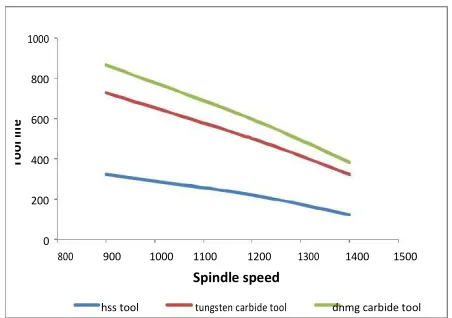
Figure 5 show the effect of spindle speed (900, 1120, 1400 rev/min) on life of tools for all values of the feed rate (0.1, 0.2, 0.3 mm/rev). As the spindle speed increased from 900rev/min up to 1400rev/min, the life of HSS tool reduced from 321s to 124s i.e 61% reduction at constant feed 0.1 mm/rev. It can be seen that better tool life was obtained with a combination of spindle speed 900rev/min and feed 0.1mm/rev. This agrees with Khan et al [26] that the life of cutting tools is very long while machining with low cutting parameters. At low cutting parameters a gradual flank wear was observed. The same decreasing trend was observed, as the spindle speed increased from 900rev/min to 1400rev/min at constant feed of 0.2mm/rev. A brittle fracture occurs at the cutting edge rather than a gradual flank wear and the depth of the cracks on the cutting edge increased rapidly resulting in a catastrophic failure of the tool. At 0.3 mm/rev feed rate, the life of HSS tool decreased dramatically from 224s to 58s as the spindle speed increased. This is similar to the results obtained by Alauddin et al [27]. The same trends that occured in the tool life of HSS were observed in tungsten carbide tool but with higher tool life. When spindle speed was increased from 900rev/min to1400 rev/min for all values of the feed rate (0.1, 0.2, 0.3 mm/rev), the tool life of tungsten carbide decreased. At constant feed of 0.1mm/rev, the tool life of tungsten carbide decreased from 726s to 320s i.e. 56% reduction. When spindle speed was increased at constant feed of 0.2mm/rev, the tool life of tungsten carbide decreased from 589s to 242s. This is because cutting force on the tool edge increased as the spindle speed increased. Though carbide tools have high hot hardness and wear resistance, they have low fracture toughness. As a result tool wear intensifies at a high cutting speed. The same trend occurred when feed rate was constant at 0.3mm/rev, tool life of tungsten carbide decreased from 541s to 180s as the spindle speed increased i.e. 67% reduction. This occurred because at high feed rate, increase in the spindle speed may cause vibration in the system which resulted in shorter tool life. When using DMNG tool at a varying speed the percentage reduction of the tool was lower compare to other tool materials. As the spindle speed increases from 900rev/min to 1400 rev/min at constant feed of 0.1mm/rev, the tool life decreased from 864s to 381s. The same trend was observed when feed was constant at 0.2mm/rev, tool life of DMNG decreased from 702s to 283s as the spindle speed increased from 900rev/min to 1400rev/min. Also at constant feed rate of 0.3mm/rev the tool life decreased from 644s to 215s as the spindle speed vary from 900rev/min to 1400 rev/min. This occurred because varying the spindle speed at high level aggravates tool wear which will excessively lead to shorter tool life.
1000
800
Too
l l
if
e 600
400
200
0
800 900 1000 1100 1200 1300 1400 1500 Spindle speed
hss tool tungsten carbide tool dnmg carbide tool
Figure 5a. Effect of spindle speed on life of tools at constant feed rate of
0.1mm/rev
800
600
life
Too
l400
200
0
800 900 1000 1100 1200 1300 1400 1500
Spindle speed
hss tool tungsten carbide tool dnmg carbide tool
Figure 5b. Effect of spindle speed on life of tools at constant feed rate of
0.2mm/rev
Figure 5c. Effect of spindle speed on life of tools at constant feed rate of
0.3mm/rev
Available online:
https://edupediapublications.org/journals/index.php/IJR/
P a g e | 213to shorter tool life. The same trend was observed at constant spindle speed of 1120rev/min as the feed rate increased from 0.1mm/rev to 0.3mm/rev. At constant spindle speed of 1400rev/min, more wear occurs on the cutting edges as the feed rate increased from 0.1mm/rev to 0.3mm/rev. The tool life of HSS, tungsten carbide and DMNG carbide decreased from 124s to 58s, 320s to 180s and 381s to 215s respectively. This happened because increased feed rate with high value of spindle speed reduced tool life but actually increased the amount of material that could be removed by the tool.
Figure 6a. Effect of feed rate on life of tools at constant spindle speed of
900 rev/min
Figure 6b. Effect of feed rate on life of tool at constant spindle speed of
1400 rev/min
Available online:
https://edupediapublications.org/journals/index.php/IJR/
P a g e | 214Figure 7b. Effect of depth of cut on life of tool at constant spindle speed of
1120 rev/min
constant feed of 0.2mm/rev the tool life of tungsten carbide decreased from 760s to 289s i.e. 61% reduction. This is because cutting force on the tool edge increases as the spindle speed increased. Though carbide tools have high hot hardness and wear resistance, they have low fracture toughness. As a result tool wear intensifies at a high cutting speed. The same trend was observed when feed rate is constant at 0.3mm/rev, tool life of tungsten carbide decreased from 746s to 274s as the spindle speed increased. This is as a result of increase in the spindle speed which caused vibration in the system leading to shorter tool life. When using DMNG tool at varying speeds, the percentage reduction of the tool was lower compare to other tool materials. As the spindle speed increased from 900rev/min to 1400 rev/min at constant feed of 0.1mm/rev, the tool life decreased from 1183s to 440s i.e. 62% reduction. The same trend occurred when feed was constant at 0.2mm/rev, tool life of DMNG decreased from 867s to 329s as the spindle speed increased from 900rev/min to 1400rev/min. Also at constant feed rate of 0.3mm/rev the tool life decreased from 848s to 311s as the spindle speeds varied from 900rev/min to 1400 rev/min. Varying the spindle speed at high level aggravates tool wear which will excessively lead to shorter tool life.
Figure 7c. Effect of depth of cut on life of tools at constant spindle speed
of1400 rev/min.
3.3. Brass
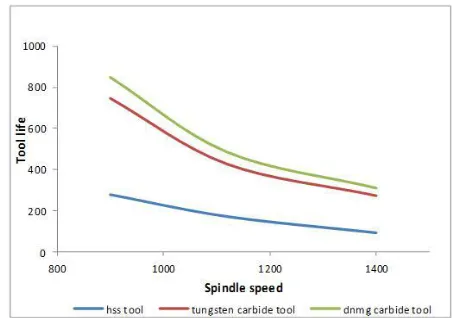
Figure 8 show the effect of spindle speed (900, 1120, 1400 rev/min) on life of tools for all values of the feed rate (0.1, 0.2, 0.3 mm/rev). At spindle speed of 900rev/min and feed rate of 0.1mm/rev, the tool life of HSS obtained was 386s (Table 2) which indicate longer tool life, this agrees with [26] that the life of tools is very long while machining with low cutting parameters. As the spindle speed increased to 1400rev/min under the same conditions, the tool life of HSS reduced by 56%. The same decreasing trend was observed, as the spindle speed increased from 900rev/min to 1400rev/min at constant feed of 0.2mm/rev, a brittle fracture occurs at the cutting edge rather than a gradual flank wear and the depth of the cracks on the cutting edge increased rapidly resulting in a catastrophic failure of the tool. At 0.3 mm/rev feed rate, the tool life of HSS tool decreased dramatically from 279s to 94s with approximating 66% reduction as the spindle speed increased, this agrees with the results of Alauddin et al [27]. The same trends occur when using tungsten carbide tool. When the spindle speed was increased from 900rev/min to 1400 rev/min for all values of the feed rate (0.1, 0.2, 0.3 mm/rev), the tool life of tungsten carbide decreased. At constant feed of 0.1mm/rev the tool life of tungsten carbide decreased from 1028s to 387s i.e. 62% reduction. When spindle speed was increased at
Figure 8a. Effect of spindle speed on life of tools at constant feed rate of
0.1mm/rev
Figure 8b. Effect of spindle speed on life of tools at constant feed rate of
Available online:
https://edupediapublications.org/journals/index.php/IJR/
P a g e | 215decreased from 1183s to 848s as the feed rate increased from 0.1mm/rev to 0.3mm/rev i.e. 28% reduction. As the spindle speed increased to 1120rev/min under the same conditions, lower values of tool life (712s to 485s) were obtained. This is similar to 307min to 76min obtained by Lin [28] at cutting speed of 66.88m/min and 94.2m/min for cemented low alloy steel using tungsten carbide high hardness cutting tool. The same trend was observed at constant spindle speed of 1400rev/min the tool life of DMNG decreased from 440s to 311s as the feed rate vary from 0.1mm/rev to 0.3mm/rev.
Figure 8c. Effect of spindle speed on life of tools at constant feed rate of
0.3mm/rev
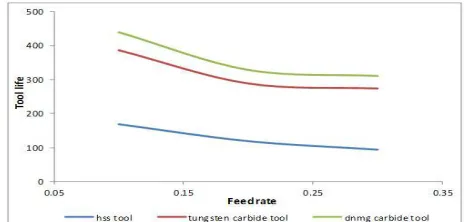
Figure 9 show the effect of feed rate (0.1, 0.2, 0.3 mm/rev) on life of tools for all values of the spindle speed (900, 1120, 1400 rev/min). At 0.1mm/rev feed rate and 900rev/min spindle speed, tool life of HSS tool was 386s. When the feed was increased to 0.3mm/rev at the same spindle speed, the tool life of HSS reduced to 279s (Table 2). The same trend was observed at spindle speed of 1120rev/min, as the feed rate increased from 0.1mm/rev to 0.3mm/rev. The tool life of HSS reduced from 274s to 173s i.e. 36%. It can be seen that percentage reduction in the HSS tool life increased from 28% to 36% which can be traced to the fact that increased feed rate led to a corresponding change in temperature, leading to shorter tool life. Tool wear was affected by temperature; the higher temperature the greater the tool wears. This agrees with Lin [28] that the wear is related to cutting temperature. The decreasing in tool life trend occurs due to more wear on the cutting edge at higher spindle speed of 1400rev/min. As the feed rate increased to 0.3mm/rev, the tool life of HSS decreased from 169s to 94s i.e. by 44%. When using tungsten carbide tool it was observed that at constant spindle speed of 900rev/min, the tool life of tungsten carbide decreased from 1028s to 746s as the feed varied from 0.1mm/rev to 0.3 mm/rev. At a spindle speed of 1120rev/min, the tool life of tungsten carbide decreased from 623s to 427s i.e. 31% reduction. This is similar to the result of Gorczyca [23] that, if the cutting speed and depth of cut are both constant, then the tool life decreased as the feed is increased. The same trend was observed at constant spindle speed of 1400rev/min, as the feed rate increased from 0.1mm/rev to 0.3mm/rev. The tool life of tungsten carbide reduced from 387s to 274s. At these conditions, the effect of feeding at 0.3 mm/rev was evident on tool life resulting in shorter tool life in all cases. However, this phenomenon can be attributed to the fact that increased feed rate, reduced tool life but actually increased the amount of material that could be removed by the tool. The same trend was observed at constant spindle speed of 1400rev/min; the tool life of DMNG decreased from 440s to 311s as the feed rate varied from 0.1mm/rev to 0.3mm/rev. When using DMNG tool at a varying feed, the percentage reduction in the
tool tool was lower compare to other tool materials. The tool life of DMNG at constant spindle speed of 900rev/min
Figure 9a. Effect of feed rate on life of tools at constant spindle speed of
900 rev/min
Figure 9b. Effect of feed rate on tool life at constant spindle speed of 1120
rev/min
Figure 9c. Effect of feed rate on life of tools at constant spindle speed of
Available online:
https://edupediapublications.org/journals/index.php/IJR/
P a g e | 216Figure 10 show the effect of depth of cut (0.5, 1.0, 1.5 mm) on life of tools for all values of the spindle speed (900, 1120, 1400 mm/rev). As the depth of cut increased from 0.5 to 1.5mm, the tool life of HSS is reduced from 386s to 279s at constant spindle speed of 900rev/min. The same trend was observed at 1120rev/min spindle speed, as the depth of cut increased from 0.5mm to 1.5mm the contact length of the cutting edge with the workpiece increased and wear occurs deeper along the cutting edge as the tool life of HSS reduced from 274s to 173s. At spindle speed of 1400rev/min, increased depth of cut up to 1.5mm led to a corresponding increase in chip width and the center of pressure of the chip on the tool face moves away from the tool nose, causing a decreased in the tool life of HSS from 169s to 94s i.e. 44% reduction. When using tungsten carbide tool it was observed that at constant spindle speed of 900rev/min the tool life decreased from 1028s to 746s as the depth of cut varied from 0.5mm to 1.5 mm showing 27% reduction in tool life. At a spindle speed of 1120rev/min, there was a decrease in the tool life of tungsten carbide from 623s to 427s as the depth of cut vary from 0.5mm to 1.5mm. The same trend was observed at constant spindle speed of 1400rev/min, increased depth of cut up to 1.5mm caused more compressive stress on the cutting edge resulting in rapid fracture of the tool leading to decreased tool life from 387s to 274s i.e. 29% reduction. At these conditions, the effect of depth of cut at 1.5mm was evident on tool life giving shorter tool life in all cases. This can be attributed to the fact that increased depth of cut reduced tool life. When using DMNG tool at a varying depth of cut the percentage reduction of the tool is lower compare to other tool materials. The tool life of DMNG at constant spindle speed of 900rev/min decreased from 1183s to 848s as the depth of cut increased from 0.5mm to 1.5mm i.e. 28% reduction. As the spindle speed increased to 1120rev/min under the same conditions, lower values of tool life (712s to 848s) were obtained. The same trend was observed at constant spindle speed of 1400rev/min; the tool life of DMNG decreased from 440s to 311s as the depth of cut varied from 0.5mm to 1.5mm.
Figure 10a. Effect of depth of cut on life of tools at constant spindle speed
of900 rev/min
Figure 10b. Effect of depth of cut on life of tools at constant spindle speed
of1120 rev/min
Figure 10c. Effect of depth of cut on life of tools at constant spindle speed
of1400 rev/min
3.4. Multiple Regression Modeling
A mathematical model was developed to predict the tool life by relating it with process parameters. The spindle speed, feed rate and interaction between spindle speed and feed rate were considered in the development of the model. The significance level for the models was set at 0.05. The correlation between factors (spindle speed, feed rate and interaction between spindle speed and feed rate) and tool life on the different tools and work materials were obtained by multiple linear regressions. MATLAB software package was used to obtain the generalised model of the form:
TL = C + β1*N + β2*f + β3*N*f (3)
Where, TL is tool life response; f is feed rate in mm/rev; and N is spindle speed in rev/min.
In multiple linear regression analysis, R2 is the regression coefficient for the models, the magnitude of R indicates whether the regression provide accurate prediction of the criterion variables.
Available online:
https://edupediapublications.org/journals/index.php/IJR/
P a g e | 217TL(HSS) = 394.5941 – 0.23434*N – 434.533*f + 0.173567N*f (4) of cut. This result is in agreement with those presented by
TL(TC) = 1001.509- 0.52569*N- 888.254*f+ 0.29379*N*f (5)
Coldwell et al [31]. From this, it was evident that the spindle speed is the most influential cutting parameter on tool life.
TL(DNMG)= 1654.574- 0.86746*N – 1657.05*f + 0.620223*N*f (6) Higher values of this parameter, as well as of feed rates and
depths of cut have proved to be detrimental to tool life [9]. The multiple linear regression models of the three tool In the analysis of S/N ratio factor level was selected to materials, using mild steel were: give maximum S/N ratio as the most suitable factor level.
TL(HSS) = 742.9268 - 0.42362*N – 786.242*f + 0.316879*N*f (7)
The selection of the most suitable factor level from the graphs showed that, level of factor that causes tool life to be TL(TC) = 1522.443- 0.8232*N – 1270.28*f + 0.431529*N*f (8) great occurred at spindle speed of 900rev/min, 0.1mm/rev
TL(DNMG) = 1817.271 – 0.98442*N- 1518.45*f +0.706712*N*f (9)
feed rate and 0.5 mm depth of cut.
The multiple linear regression models of the three tool material, using brass were:
TL(HSS) = 847.9646 – 0.46391*N 843.8f + 0.326433*N*f (10)
TL(TC) = 2326.698–1.37712*N – 2901.04f + 1.680732*N*f (11)
TL(DNMG)= 2697.187 – 1.60377*N – 3484.31f + 2.046178*N*f (12)
3.5. Determination of Cutting Parameters
3.5.1. Analysis of the Signal-to-Noise (S/N) Ratio
In Taguchi method, the term signal represents the desirable value, and noise represents the undesirable value. Process parameters with the highest S/N ratio always give the best quality with minimum variance [10]. The S/N ratio for each parameter level was calculated by finding the average of S/N ratios at the corresponding level. Tables 2 shows the response table for S/N ratio of tool life for larger is better obtained for different parameter levels. The S/N ratio used for this type of response is as reported by Taguchi and Konishi [30]. The S/N ratio for the larger-the-better is:
S/N = -10*log (mean square deviation)
S/N = -10log10(1/n Σ y-2) (13)
Where, n is the number of measurements in a trial/row, in this case, n = 1; and y is the measured value in a run/row. The S/N ratio values are calculated by taking into consideration Eqn. 13. The Tool life values measured from the experiments and their corresponding S/N ratio values are listed in Tables 2.
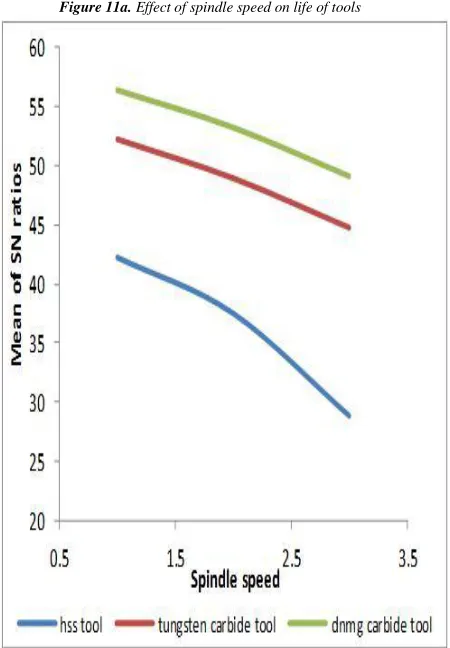
The analysis of S/N ratio of tool life showed that the first factor that caused tool life to be great was cutting speed; having feed rate and depth of cut as secondary factors. After that, the analysis was made to determine suitable factor of each main factor from S/N ratio as shown in Figures 11-13
3.6. Main Effects Plot for S/N Ratios
3.6.1. Medium Carbon Steel
The effect of process parameters (spindle speed, feed rate and depth of cut) on the life of tools (HSS, tungsten carbide and DMNG carbide), using medium carbon steel as the work material is shown in Figure 11. The life of the tools decreased with increasing spindle speed, feed rate and depth
Available online:
https://edupediapublications.org/journals/index.php/IJR/
P a g e | 218Figure 11b. Effect of feed rate on life of tools
Available online:
https://edupediapublications.org/journals/index.php/IJR/
P a g e | 219
Table 2a. Orthogonal array L9(33) design with measured Tool life for medium carbon steel
Factors
Parameters
HSS
S/N Tungsten
S/N
DNMG
S/N
No
A B D
Tool Life Ratio Carbide Tool Ratio Carbide Tool Ratio
N f D N rev/min f, mm/rev d, mm (s) (db) Life (s) (db) Life (s) (db)
1 1 1 1 900 0.1 0.5 161 44.137 480 53.625 782 57.864
2
2 2
2
1120 0.2 1.0
72
37.147 275
48.787
447
53.006
3
3 3
3
1400 0.3 1.5
15
23.522 135
42.607
219
46.809
4
3 1
1
1400 0.1 0.5
52
34.320 229
47.197
373
51.434
5
1 2
2
900 0.2 1.0
128
42.144 400
52.041
650
56.258
6
2 3
3
1120 0.3 1.5
54
34.648 233
47.347
379
51.573
7
2 1
1
1120 0.1 0.5
105
40.424 348
50.832
580
55.269
8
3 2
2
1400 0.2 1.0
27
28.627 167
44.454
284
49.066
9
1 3
3
900 0.3 1.5
107
40.588 357
51.053
567
55.072
Table 2b. Orthogonal array L9(33) design with measured Tool life for mild steel
Factors
Parameters
HSS
S/N Tungsten
S/N
DNMG
S/N
No
A B D
Tool Ratio Carbide Tool Ratio Carbide Tool Ratio
N f d
N rev/min f, mm/rev d mm
Life (s) (db) Life (s) (db) Life (s) (db)
1 1 1 1 900 0.1 0.5 321 50.130 726 57.219 864 58.730
2
2 2
2
1120 0.2 1.0
160
44.082 403
52.106
480
53.625
3
3 3
3
1400 0.3 1.5
58
35.269 180
45.105
215
46.649
4
3 1
1
1400 0.1 0.5
124
41.868 320
50.103
381
51.618
5
1 2
2
900 0.2 1.0
261
48.332 589
55.402
702
56.927
6
2 3
3
1120 0.3 1.5
128
42.144 356
51.029
424
52.547
7
2 1
1
1120 0.1 0.5
220
46.848 498
53.945
594
55.476
8
3 2
2
1400 0.2 1.0
79
37.953 242
47.676
283
49.036
9
1 3
3
900 0.3 1.5
224
47.001 541
54.664
644
56.178
Table 2c. Orthogonal array L9(33) design with measured Tool life for brass
Factors
Parameters
HSS
S/N Tungsten
S/N DNMG
S/N
A B D
No Tool Life Ratio Carbide Tool Ratio Carbide Tool Ratio
N f d N f d (s) (db) Life (sec) (db) Life (s) (db)
rev/min mm/rev mm
1 1 1 1 900 0.1 0.5 386 51.732 1028 60.240 1183 61.460
2
2 2 2
1120
0.2 1.0
209
46.403 504
54.049
572
55.148
3
3 3 3
1400
0.3 1.5
94
39.463 274
48.755
311
49.855
4
3 1 1
1400
0.1 0.5
169
44.558 387
51.754
440
52.870
5
1 2 2
900
0.2 1.0
320
50.103 760
57.616
867
58.760
6
2 3 3
1120
0.3 1.5
173
44.761 427
52.609
485
53.715
7
2 1 1
1120
0.1 0.5
274
48.755 623
55.890
712
57.050
8
3 2 2
1400
0.2 1.0
119
41.511 289
49.218
329
50.344
9
1 3 3
900
0.3 1.5
279
48.912 746
57.455
848
58.568
3.6.2. Mild Steel
Figure 12 show the effect of process parameters on tool life using mild steel as the workpiece material. From the result it was observed that the higher the process parameters the lower
Available online:
https://edupediapublications.org/journals/index.php/IJR/
P a g e | 220
Available online:
https://edupediapublications.org/journals/index.php/IJR/
P a g e | 221Figure 12a. Effect of spindle speed on life of tools
Figure 12b. Effect of feed rate on life of tools
Figure 12c. Effect of depth of cut on life of tools
3.6.3. Brass
Figure 13 show the effect of process parameters on life of tools, using brass as the work material. The results revealed that the spindle speed, feed rate and depth of cut increased with decreasing tool life. This is in agreement with the results of Axinte and Dewes [34]. From the analysis of the S/N ratio, the optimum conditions for tool life occurred when the level of spindle speed was 900rev/min, level of feed rate was 0.1mm/rev and the level of depth of cut was 0.5mm.
Figure 13a. Effect of spindle speed on life of tools
Figure 13b. Effect of feed rate on life of tools
Figure 13c. Effect of depth of cut on life of tools
3.7. Analysis of Variance
The ANOVA was performed to investigate the statistical significance of the process parameters affecting the tool life. Analysis of Variance of the tool life (T) with the objective of the analyzing the influence of spindle speed (N), feed rate (f) and depth of cut (d) on the total variance of the results was performed. The experiments were conducted for each combination of factors as per selected orthogonal array. Table 3 shows the results of the ANOVA with the tool life
Available online:
https://edupediapublications.org/journals/index.php/IJR/
P a g e | 222column of the tables indicates that the main effects are highly significant (all have very small p-values).
From Table 3a, using medium carbon steel; it can be observed that the p-values of the spindle speed for HSS, tungten carbide and DMNG carbide are 0.0011, 0.0011 and 0.0006 respectively. The p-values of the feed rate for HSS, tungsten carbide and DMNG carbide are 0.0669, 0.0873 and 0.0407 respectively. While the feed rate (p = 0.0407) for DMNG carbide showed mild significant contribution on the tool life. But the interactions of spindle speed/feed rate (p = 0.3295) for HSS, (p = 0.4533) for tungsten carbide and (p = 0.2878) for DMNG have no significant influence on tool life.
Table 3a. ANOVA results for tool life for the medium carbon steel
HSS
Coeff Standard t Stat P-value Significance
Error
Intercept 394.594 40.216 9.812 0.0002 Significant
N -0.234 0.035 -6.749 0.0011 Significant
f -434.533 186.166 -2.334 0.0669 Not Significant
N*f 0.174 0.161 1.080 0.3295 Not Significant
TUNGSTEN CARBIDE
Coeff Standard t Stat P-value Significance
Error
Intercept 1001.509 90.431 11.075 0.0001 Significant
N -0.526 0.078 -6.733 0.0011 Significant
f -888.254 418.612 -2.122 0.0873 Not Significant
N*f 0.294 0.361 0.813 0.4533 Not Significant
DNMG CARBIDE TOOL
Coeff Standard t Stat P-value Significance
Error
Intercept 1654.574 130.510 12.67774 0.0001 Significant
N -0.868 0.113 -7.69833 0.0006 Significant
f -1657.05 604.145 -2.74281 0.0407 Significant
N*f 0.620 0.522 1.18904 0.2878 Not Significant
From Table 3b, using mild steel as the work material, the spindle speed (p = 0.0012) for HSS, (p = 0.0015) for tungsten carbide and (p = 0.0013) for DMNG carbide have great influence on tool life. But the feed rate (p = 0.0693) for HSS, (p = 0.1279) for tungsten carbide and (p = 0.1227) for DMNG carbide have no significance influence on tool life. While the interaction of spindle speed/feed rate (p = 0.3310) for HSS, (p = 0.5053) for tungsten carbide and (p=0.4956) for DMNG carbide have no effect on tool life.
Table 3b. ANOVA results for tool life for the mild steel
HSS
Coeff Standard t Stat P-value Significance
Error
Intercept 742.927 73.664 10.085 0.0002 Significant
N -0.424 0.064 -6.661 0.0012 Significant
f -786.242 340.999 -2.306 0.0693 Not Significant
N*f 0.317 0.294 1.076 0.3310 Not Significant
TUNGSTEN CARBIDE
Coeff Standard t Stat P-value
Significance Error
Intercept 1522.443 150.515 10.115 0.0002 Significant
N -0.823 0.130 -6.335 0.0015 Significant
f -1270.28 696.748 -1.823 0.1279 Not significant
N*f 0.432 0.602 0.717 0.5053 Not Significant
DNMG CARBIDE
Coeff Standard t Stat P-value Significance
Error
Intercept 1817.271 176.822 10.277 0.0002 Significant
N -0.98445 0.153 -6.448 0.0013 Significant
f -1518.45 818.526 -1.855 0.1227 Not Significant
N*f 0.519108 0.707 0.735 0.4956 Not Significant
From the Table 3c, using brass as the workpiece material, it can be observed that the spindle speed (p = 0.0011) for HSS, (p = 0.0091) for tungsten carbide and (p = 0.0091) for DMNG carbide have great influence on tool life. The feed rate (p = 0.0703) for HSS and (p= 0.1658) for tungsten carbide and (p = 0.1554) for DMNG carbide shows no significance contribution on the tool life. But the interactions of spindle speed/feed rate (p = 0.3512) for HSS, (p = 0.3261) for tungsten carbide and (p = 0.3070) have no influence on tool life
Table 3c. ANOVA results for tool life for the brass
HSS
Coeff Standard t Stat P-value Significance
Error
Intercept 847.9646 79.467 10.671 0.0001 Significant
N -0.46391 0.069 -6.761 0.0011 Significant
f -843.8 367.860 -2.294 0.0703 Not Significant
N*f 0.326433 0.318 1.0278 0.3512 Not Significant
TUNGSTEN CARBIDE
Coeff Standard t Stat P-value Significance
Errors
Intercept 2326.698 386.412 6.021 0.0018 Significant
N -1.37712 0.334 -4.128 0.0091 Significant
f -2901.04 1788.738 -1.622 0.1658 Not Significant
N*f 1.680732 1.544 1.088 0.3261 Not significant
DNMG CARBIDE
Coeff Standard t Stat P-value Significance
Error
Intercept 2697.185 450.184 5.991 0.0019 Significant
N -1.604 0.3887 -4.126 0.0091 Significant
f -3484.31 2083.946 -1.672 0.1554 Not Significant
N*f 2.046 1.799 1.137 0.3070 Not Significant
4. Conclusions
The following conclusions can be drawn from this study: Among the parameters which affect the process quality, spindle
speed has an inverse influence on tool life and it was more dominant than the effect of feed rate
Available online:
https://edupediapublications.org/journals/index.php/IJR/
P a g e | 223Using experimental data, a multiple linear regression model was developed and proves to be effective in optimizing the cutting condition in turning operations
In this study, the Taguchi method gives effective methodology in order to find out the effective performance output and machining conditions
DNMG carbide tool has the longest tool life among the three types of cutting tools followed by Tungsten carbide and HSS tool which leads to the conclusion that for improved tool life, lower cutting speeds should generally be selected in combination with suitable feed rates.
References
[1] N.A. Abukhshim, P.T. Mativenga and M.A. Sheikh, “Heat generation and temperature prediction in metal cutting,” International Journal of Machine Tool and Manufacture, vol. 46, nos. 7-8, pp. 782-800, 2006.
[2] K. Musialek, “Role and importance of cutting fluids in high
efficiency machining,” The 2nd Seminar Workshop: Network Proceeding, Espoo- Otaniemi, Finland, March 1999.
[3] O. Tugrul and Y. Karpat, “Multi-objective optimization for turning processes using neural network modeling and dynamic neighborhood particle swarm optimization,” International Journal Advance Manufacturing Technology, DOI 10.1007/s00170-006-0719-8, pp. 234-247, 2007.
[4] M. Kayhan and E. Budak, “An experimental investigation of
chatter effects on tool life,” Journal of Engineering Manufacture, vol. 223, no 11, pp. 1455-1463, 2009.
[5] V. Astakhov, “Effects of the cutting feed, depth of cut, and workpiece (bore) diameter on the tool wear rate,”
International Journal of Advanced Manufacturing
Technology, DOI 10.1007/s00170-006-0635-y, 2006
[6] T.H. Mohammed, S.T. Montasser and B. Joachim, “ A study
of the effects of machining parameters on the surface roughness in the end-milling process,” Jordan Journal of Mechanical and Industrial Engineering, vol. 1, no 1, pp 1-5, 2007.
[7] T. Nadu, Tool life prediction based on cutting force and surface temperature in edge trimming of multidirectional CERP composites, Master of Science Thesis, Wichita State University, 2003.
[8] S.J. Ojolo, M.O.H. Amuda, O.Y. Ogunmola and C.U.
Ononiwu, “Experimental determination of the effect of some straight biological oils on cutting force during cylindrical turning,” Revista Materia, vol.13, pp. 650-663, 2008.
[9] K. Kadirgama, K.A. Abou-El-Hossein, B. Mohammad,
M.M. Noor and S.M. Sapuan, Prediction of tool life by statistic method in end-milling operation, Scientific Research and Essay, vol. 3, no 5, pp. 180, 2008.
[10] D.C. Montgomery, Design and analysis of experiments,Singapore: Wiley, 1991.
[11] S.R. Das, R.P. Nayak and D. Dhupal, “Optimization of cutting parameter on tool wear and workpiece surface temperature in turning of AISI D2 steel,” International Journal of Lean Thinking, vol. 3, no 2, pp. 140-156, 2012.
[12] U. Miyachi, “Welding material control,” Technical Ap plication Brief, pp. 1-5, 1999.
[13] T.R. Lin, “Experimental design and performance analysis of TiN-coated carbide tool in face milling stainless steel,” Journal of Materials Processing Technology, vol. 127, pp. 1-7, 2002.
[14] P.J. Ross, Taguchi techniques for quality engineering.
Singapore: Mc Graw-Hill International, 1996.
[15] M. Nalbant, H. Gokkaya and G. Sur, “Application of Taguchi method in the optimization of cutting parameters for surface roughness in turning,” Journal of Materials Processing Technology, vol. 28, pp. 1379-1385, 2007.
[16] W.H. Yang and Y.S. Tarng, “Design optimization of cutting parameters for turning operations based on the Taguchi method,” Journal of Materials Processing Technology, vol. 34, pp. 122-129, 1998.
[17] S.S. Mahapatra, P. Patnaik and P.K. Patnaik, “ Parametric analysis and optimization of cutting parameters for turning operations based on Taguchi Method,” Proceedings of the International Conference on Global Manufacturing and Innovation, pp. 2-8, 2006.
[18] J.E. Kaye, D.H. Yan, N. Popplewell and S. Balakrishnan, “Predicting tool flank wear using spindle speed change,” International Journal of Machine Tools and Manufacture, vol. 35, no. 9, pp. 1309-1320, 1995.
[19] A. Manna and S. Salodkar, “Optimization of machining
conditions for effective turning of E0300 alloy steel,” Journal of Materials Processing Technology, vol. 203, pp 147-153, 2008.
[20] P.S. Sivasakthivel, V.V. Murugan and R. Sudhakaran, “Prediction of tool wear from machining parameters by response surface methodology in end milling,” International Journal of Engineering Science and Technology, vol. 2, no 6, pp. 1780-1789, 2010.
[21] M.S. Kartal, Investigation based on the Taguchi method for the surface roughness and tool life with CNC turning machine. M.Sc. Thesis, Marmara University, 2006.
[22] T. Tyan, Simulation and optimization for metal forming processes, cutting, rolling and extrusion. Ph.D. Thesis,
University of Michigan, 1990.
[23] F.E. Gorczyca, Application of metal cutting theory, New York: Industrial Press, 1987.
[24] Z.M. Zhou, Y.L. Zhang, J. Dong and X.Y. Li, “Effect of cutting parameters on diamond tool life during cutting stainless steel,” Materials Science Forum, vol. 626-627, pp. 99-104, 2009.
Available online:
https://edupediapublications.org/journals/index.php/IJR/
P a g e | 224[26] A.A. Khan, A.N.R. Zuraida and Y. Izayusmati, “High speed
milling of cast iron and medium carbon steel using cemented and carbide tools,” Proceeding of the BSME-ASME International Conference on Thermal Engineering,
pp. 711-717, 2002.
[27] M. Alauddin, M.A. El Baradie and M.S.J. Hashmi,
“Prediction of tool life in end milling by response surface methodology,” Journal of Materials Processing Technology, vol. 71, pp. 456-465, 1997.
[28] H.M. Lin, “Wear behavior in turning hardness alloy steel by CBN tool,” Wear, vol. 264, pp. 679-684, 2008.
[29] O. Tugrul, K.H. Tsu and Z. Erol, “Effects of cutting edge geometry, work piece hardness, feed rate and cutting speed on surface roughness and forces in finish turning of hardened AISI H13 steel,” International Journal Advanced Manufacturing Technology, vol. 25, pp. 262–269, 2005.
[30] G.H. Taguchi and S. Konishi, Taguchi methods orthogonal arrays and linear graphs, tools for quality engineering.
Paperback, Students’ Edition, 1987.
[31] H. Coldwell, R. Woods, M. Paul, P. Koshy, R.C. Dewes and D.K. Aspinwall. “Rapid machining of hardened AISI H13 and D2 moulds, dies and press tools,” Journal of Material Processing Technology, vol. 135, pp. 301-311, 2003.
[32] K. Kadirgama, M.M. Noor, K.A. Abou-El-Hossein, H.H. Habeeb, M.M. Rahman, B. Mohamad R.A. and Bakar, “Effect of dry cutting on force and tool life when machining aerospace material,” World academy of Science Engineering and Technology, vol.71, pp. 454-456, 2010
[33] Y. Yamada, T. Aoki, S. Kitaura, Y. Tanaka, Y. Okazaki and H. Hayasaki, “High speed cutting performance of (Al, Ti)N coated carbide end mills for hardened steels,” Proc. first Int. French German Conf. High-Speed Machining, Metz, France, pp. 486-489, 1997.
![Figure 1. Schematic view of the cutting zone and chip formation [1]](https://thumb-us.123doks.com/thumbv2/123dok_us/1976302.1260971/1.595.66.285.696.789/figure-schematic-view-cutting-zone-chip-formation.webp)