Parameterized Facial Expression Synthesis
Based on MPEG-4
Amaryllis Raouzaiou
Department of Electrical and Computer Engineering, National Technical University of Athens, Heroon Polytechniou 9, 15773 Zographou, Greece
Email: [email protected]
Nicolas Tsapatsoulis
Department of Electrical and Computer Engineering, National Technical University of Athens, Heroon Polytechniou 9, 15773 Zographou, Greece
Email: [email protected]
Kostas Karpouzis
Department of Electrical and Computer Engineering, National Technical University of Athens, Heroon Polytechniou 9, 15773 Zographou, Greece
Email: [email protected]
Stefanos Kollias
Department of Electrical and Computer Engineering, National Technical University of Athens, Heroon Polytechniou 9, 15773 Zographou, Greece
Email: [email protected]
Received 25 October 2001 and in revised form 14 May 2002
In the framework of MPEG-4, one can include applications where virtual agents, utilizing both textual and multisensory data, including facial expressions and nonverbal speech, help systems become accustomed to the actual feelings of the user. Applica-tions of this technology are expected in educational environments, virtual collaborative workplaces, communities, and interactive entertainment. Facial animation has gained much interest within the MPEG-4 framework; with implementation details being an open research area (Tekalp, 1999). In this paper, we describe a method for enriching human computer interaction, focusing on analysis and synthesis of primary and intermediate facial expressions (Ekman and Friesen (1978)). To achieve this goal, we utilize facial animation parameters (FAPs) to model primary expressions and describe a rule-based technique for handling intermediate ones. A relation between FAPs and theactivationparameter proposed in classical psychological studies is established, leading to parameterized facial expression analysis and synthesis notions, compatible with the MPEG-4 standard.
Keywords and phrases:facial expression, MPEG-4 facial definition parameters, activation, parameterized expression synthesis.
1. INTRODUCTION
Research in facial expression analysis and synthesis has mainly concentrated on primary or archetypal emotions. In particular, sadness, anger, joy, fear, disgust, and surprise are categories of emotions that attracted most of the interest in human computer interaction environments. Very few studies [1] have appeared in the computer science literature, which explore nonarchetypal emotions. This trend may be due to the great influence of the works of Ekman and Friesen [2, 3] and Izard et al. [4] who proposed that the archetypal emo-tions correspond to distinct facial expressions which are sup-posed to be universally recognizable across cultures. On the
contrary, psychological researchers have extensively investi-gated [5, 6] a broader variety of emotions. An extensive sur-vey on emotion analysis can be found in [7].
MPEG-4 indicates an alternative way of modeling facial expressions and the underlying emotions, which is strongly influenced by neurophysiological and psychological studies. The facial animation parameters (FAPs) that are utilized in the framework of MPEG-4 for facial animation purposes, are strongly related to the action units (AUs) which consist the core of the facial action coding system (FACS) [8].
that emotions are points in a space with a relatively small number of dimensions, which with a first approximation are only two:activationandevaluation. From the practical point of view, evaluationseems to express internal feelings of the subject and its estimation through face formations is intractable. On the other hand, activationis related to the facial muscles movement and can be more easily estimated based on facial characteristics.
In this work, we present a methodology for analyzing and synthesizing both primary and intermediate expressions, taking into account the results of Whissel’s study and in par-ticular theactivationparameter. The proposed methodology consists of three steps.
Description of the archetypal expressions through particular FAPs
In order to do this, we translate facial muscle movements— describing expressions through muscle actions—into FAPs and create a vocabulary of FAPs for each archetypal expres-sion. FAPs required for the description of the archetypal ex-pressions are also experimentally verified through analysis of prototype datasets. In order to make comparisons with real expression sequences, we model FAPs employed in the facial expression formation through the movement of particular feature points (FPs)—the selected FPs can be automatically detected from real images or video sequences. The derived models can also serve as a bridge between expression analysis and expression synthesis disciplines [9].
Estimation of the range of variation of FAPs that are involved in each of the archetypal expressions
This is achieved by analyzing real images and video sequences as well as by animating synthesized examples.
Modelling of intermediate expressions
This is achieved through combination, in the framework of a rule-based system, of theactivationparameter—known from Whissel’s—with the description of the archetypal expressions by FAPs.
Figure 1 illustrates the way the proposed scheme func-tions. The facial expression synthesis system operates either by utilizing FAP values estimated by an image analysis sub-system, or by rendering actual expressions recognized by a fuzzy rules system. In the former case, protuberant facial points motion is analyzed and translated to FAP value vari-ation, which in turn is rendered using the synthetic face model, so as to reproduce the expression in question. Should the results of the analysis coincide with the systems knowl-edge of the definition facial expression, then the expres-sion can be rendered using predefined FAP alteration tables. These tables are computed using the known definition of archetypal emotions, fortified by video data of actual human expressions. In this case, any intermediate expressions can be rendered using interpolation rules derived by the emotion wheel.
The paper is organized as follows. In Sections 2, 3, and 4 the three legs of the proposed methodology are presented.
Requests for
Figure1: Block diagram of the proposed scheme.
In Section 5, a way of utilizing the proposed emotions syn-thesis scheme for emotion analysis purposes is described. In Section 6, experimental results, which illustrate the perfor-mance of the presented approach, are given. Finally, conclu-sions are given in Section 7.
2. DESCRIPTION OF THE ARCHETYPAL EXPRESSIONS
USING FAPS
In general, facial expressions and emotions are described by a set of measurements and transformations that can be con-sidered atomic with respect to the MPEG-4 standard. In this way, we can describe both the anatomy of a human face— basically through FDPs, as well as animation parameters, with groups of distinct tokens, eliminating the need for spec-ifying the topology of the underlying geometry. These tokens can then be mapped to automatically detected measurements and indications of motion on a video sequence and, thus, help to approximate a real expression conveyed by the sub-ject by means of a synthetic one.
Modelling facial expressions and underlying emotions through FAPs serves several purposes:
(i) provides the compatibility of synthetic sequences, created using the proposed methodology, with the MPEG-4 standard;
related with particular FAPs. Moreover, distinct FAPs can be utilized for communication between humans and computers in a paralinguistic form—expressed by facial signs;
(iii) FAPs do not correspond to specific models or topolo-gies; synthetic expressions can be animated by diff er-ent (than the one that corresponds to the real subject) models or characters.
Two basic issues should be addressed when modelling archetypal expression: (i) estimation of FAPs that are in-volved in their formation, (ii) definition of the FAP inten-sities. The former is examined in the current section, while the latter is explained in Section 5.
It is a general truth that the facial action coding system (FACS) has influenced the research on expression analysis in a high degree. FACS is a system which tries to distinguish the visually distinguishable facial movements using the knowl-edge of facial anatomy. FACS uses Action Units (AU) as mea-surement units. An AU could combine the movement of two muscles or work in the reverse way, that is, split into several muscle movement.
MPEG-4 FAPs are also strongly related to the AU; this is shown in Table 1. Description of archetypal expressions by means of muscle movements and AUs has been the start-ing point for settstart-ing the archetypal expression description through FAPs.
Hints for this mapping were obtained from psycholog-ical studies [2, 10, 11] which refer to face formation during expression generation, as well as from experimental data pro-vided by classic databases as Ekman’s (static) and MediaLab’s (dynamic)—see also Section 3. Table 2 illustrates the de-scription of archetypal expressions and some variations of them, using the MPEG-4 FAP’s terminology. It should be noted that the sets shown in Table 2 consist of the vocabulary of FAPs to be used for each archetypal expression, and not a particular profile for synthesizing expressions; this means that if animated, they would not necessarily produce the cor-responding expression. In the following, we define an ex-pression profileto be a subset of the FAPs vocabulary, corre-sponding to a particular expression, accompanied with FAP intensities, that is the actual ranges of variation, which if an-imated creates the requested expression. Several expression profiles based on the FAPs vocabulary proposed in Table 2 are shown in the experimental results section.
3. THE RANGE OF VARIATION OF FAPS IN REAL VIDEO
SEQUENCES
An important issue, useful to both emotion analysis and syn-thesis systems, is the range of variation of the FAPs that are involved in facial expression formation. From the synthesis point of view, a study has been carried out [5] which refers to FAP’s range definition. However, the suggested ranges of variation are rather loose and cannot be used for analy-sis purposes. In order to have clear cues about FAP’s range of variation in real video sequences, we analyzed two well-known datasets, showing archetypal expressions, Ekman’s
Table1: FAP to AU mapping.
Action units FAPs
AU1 raise l i eyebrow + raise r i eyebrow AU2 raise l o eyebrow + raise r o eyebrow AU3
AU4 raise l o eyebrow + raise r o eyebrow + raise l m eyebrow + raise r m eyebrow + raise l i eyebrow + raise r i eyebrow + squeeze l eyebrow + squeeze r eyebrow AU5 close t l eyelid + close t r eyelid AU6 lift l cheek + lift r cheek AU7 close b l eyelid + close b r eyelid AU8
AU9 lower t midlip + raise nose + stretch l nose + stretch r nose
AU10 raise nose (+ stretch l nose + stetch r nose) + lower t midlip
AU11
AU12 push t lip + Push b lip (+ lower lowerlip + lower t midlip + raise b midlip) AU13
AU14
AU15 lower l cornerlip + lower r cornerlip AU16
AU17 depress chin
AU18 AU19
AU20 raise b midlip + lower l cornerlip + lower r cornerlip + stretch l cornerlip + stretch r cornerlip + lower t lip lm + raise b lip lm + lower t lip lm o + raise b lip lm o + raise l cornerlip o + lower t lip rm + raise b lip rm +lower t lip rm o + raise b lip rm o +raise r cornerlip o
(static) [2] and MediaLab’s (dynamic) [12], and computed statistics about the involved FAPs. Both sets show extreme cases of expressions, rather than every day ones. However, they can be used for setting limits to the variance of the re-spective FAPs [13]. To achieve this, however, a way of model-ing FAPs through the movement of facial points is required. Analysis of FAP’s range of variation in real images and video sequences is used next for two purposes:
(i) to verify and complete the proposed vocabulary for each archetypal expression,
(ii) to define profiles of archetypal expressions.
3.1. Modeling FAPs through FP’s movement
Table2: FAPs vocabulary for archetypal expression description.
Joy
open jaw (F3), lower t midlip (F4), raise b midlip (F5), stretch l cornerlip (F6),
stretch r cornerlip (F7), raise l cornerlip (F12), raise r cornerlip (F13), close t l eyelid (F19), close t r eyelid (F20), close b l eyelid (F21), close b r eyelid (F22), raise l m eyebrow (F33), raise r m eyebrow (F34), lift l cheek (F41), lift r cheek (F42), stretch l cornerlip o (F53), stretch r cornerlip o (F54)
Sadness
close t l eyelid (F19), close t r eyelid (F20), close b l eyelid (F21), close b r eyelid (F22),
raise l i eyebrow (F31), raise r i eyebrow (F32), raise l m eyebrow (F33), raise r m eyebrow (F34), raise l o eyebrow (F35), raise r o eyebrow (F36)
Anger
lower t midlip (F4), raise b midlip (F5), push b lip (F16), depress chin (F18), close t l eyelid (F19), close t r eyelid (F20), close b l eyelid (F21), close b r eyelid (F22), raise l i eyebrow (F31), raise r i eyebrow (F32), raise l m eyebrow (F33), raise r m eyebrow (F34), raise l o eyebrow (F35), raise r o eyebrow (F36), squeeze l eyebrow (F37), squeeze r eyebrow (F38)
Fear
open jaw (F3), lower t midlip (F4), raise b midlip (F5), lower t lip lm (F8), lower t lip rm (F9), raise b lip lm (F10), raise b lip rm (F11), close t l eyelid (F19), close t r eyelid (F20),
close b l eyelid (F21), close b r eyelid (F22), raise l i eyebrow (F31), raise r i eyebrow (F32), raise l m eyebrow (F33), raise r m eyebrow (F34), raise l o eyebrow (F35), raise r o eyebrow (F36), squeeze l eyebrow (F37), squeeze r eyebrow (F38)
Disgust
open jaw (F3), lower t midlip (F4), raise b midlip (F5), lower t lip lm (F8), lower t lip rm (F9), raise b lip lm (F10), raise b lip rm (F11), close t l eyelid (F19), close t r eyelid (F20),
close b l eyelid (F21), close b r eyelid (F22), raise l m eyebrow (F33), raise r m eyebrow (F34), lower t lip lm o (F55), lower t lip rm o (F56), raise b lip lm o (F57), raise b lip rm o (F58), raise l cornerlip o (F59), raise r cornerlip o (F60)
Surprise
open jaw (F3), raise b midlip (F5), stretch l cornerlip (F6), stretch r cornerlip (F7), raise b lip lm (F10), raise b lip rm (F11), close t l eyelid (F19), close t r eyelid (F20), close b l eyelid (F21), close b r eyelid (F22), raise l i eyebrow (F31), raise r i eyebrow (F32), raise l m eyebrow (F33), raise r m eyebrow (F34), raise l o eyebrow (F35), raise r o eyebrow (F36), squeeze l eyebrow (F37), squeeze r eyebrow (F38), stretch l cornerlip o (F53),
stretch r cornerlip o (F54)
from video scenes or still images. The main reason for that is the absence of a clear quantitative definition of FAPs (at least of most of them) as well as their nonadditive nature. Note here that the same problem holds for the FACS action units. This is quite normal, due to the strong relationship between particular AUs and FAPs (see Table 1). In order to be able to measure FAPs in real images and video sequences, we should define a way of describing them through the movement of some points that lie in the facial area and are able to be au-tomatically detected. Such a description could get advantage of the extended research made on automatic facial points de-tection [14, 15]. Quantitative description of FAPs based on particular FPs, that correspond to protuberant facial points’ movement, provides the means of bridging the gap between expression analysis and animation/synthesis. In the expres-sion analysis case the nonadditive property of the FAPs can be addressed by a fuzzy rule system, similar to the one described later for creating profiles for intermediate expressions.
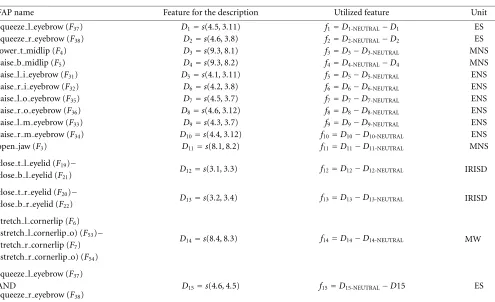
Quantitative modeling of FAPs is implemented using the features labeled as fi(i=1, . . . ,15) in Table 3 [16]. The fea-ture set employs FPs that lie in the facial area and, under some constraints, can be automatically detected and tracked.
It consists of distances, noted ass(x, y) wherexandy cor-respond to feature points shown in Figure 2b, between these protuberant points, some of which are constant during ex-pressions and are used as reference points. Distances between reference points are used for normalization (see Figure 2a). The units for fiare identical to those corresponding to FAPs,
even in cases where no one to one relation exists.
It should be noted that not all FAPs included in the vo-cabularies shown in Table 2 can be modeled by distances between facial protuberant points (e.g., raise b lip lm o,
lower t lip lm o). In such cases the corresponding FAPs are retained in the vocabulary and their ranges of variation are experimentally defined based on facial animations. More-over, some features serve for the estimation of range of vari-ation of more than one FAP (e.g., features f12, f13, f14, and
f15).
3.2. Vocabulary verification
ES0 IRISD0 Feature points affected by FAPs
Other feature points
(b)
Figure2: (a) A face model in its neutral state and the feature points used to define FAP units (FAPU). (b) Feature points (FPs).
Ekman’s (static) [2] and MediaLab’s (dynamic) [12]. The analysis was based on the FAPs’ qualitative modelling de-scribed in the previous section. Computed statistics are sum-marized in Table 4. Mean values provide typical values that can be used for particular expression profiles, while the stan-dard deviation can define the range of variation (see also Section 3.3). The units of shown values are those of the cor-responding FAPs [17]. The symbol (∗) expresses the absence of the corresponding FAP in the vocabulary of the particular
expression while the symbol (—) shows that, although the corresponding FAP is included in the vocabulary, it has not been verified by the statistical analysis. The latter case shows that not all FAPs included in the vocabulary are experimen-tally verified.
Table3: Quantitative FAPs modeling: (1)s(x,y) is the Euclidean distance between the FPsxandyshown in Figure 2b, (2)Di-NEUTRALrefers to the distanceDiwhen the face is in its neutral position.
FAP name Feature for the description Utilized feature Unit
squeeze l eyebrow (F37) D1=s(4.5,3.11) f1=D1-NEUTRAL−D1 ES
squeeze r eyebrow (F38) D2=s(4.6,3.8) f2=D2-NEUTRAL−D2 ES
lower t midlip (F4) D3=s(9.3,8.1) f3=D3−D3-NEUTRAL MNS
raise b midlip (F5) D4=s(9.3,8.2) f4=D4-NEUTRAL−D4 MNS
raise l i eyebrow (F31) D5=s(4.1,3.11) f5=D5−D5-NEUTRAL ENS
raise r i eyebrow (F32) D6=s(4.2,3.8) f6=D6−D6-NEUTRAL ENS
raise l o eyebrow (F35) D7=s(4.5,3.7) f7=D7−D7-NEUTRAL ENS
raise r o eyebrow (F36) D8=s(4.6,3.12) f8=D8−D8-NEUTRAL ENS
raise l m eyebrow (F33) D9=s(4.3,3.7) f9=D9−D9-NEUTRAL ENS
raise r m eyebrow (F34) D10=s(4.4,3.12) f10=D10−D10-NEUTRAL ENS
open jaw (F3) D11=s(8.1,8.2) f11=D11−D11-NEUTRAL MNS
close t l eyelid (F19)− D
12=s(3.1,3.3) f12=D12−D12-NEUTRAL IRISD close b l eyelid (F21)
close t r eyelid (F20)− D13=s(3.2,3.4) f13=D13−D13-NEUTRAL
IRISD close b r eyelid (F22)
stretch l cornerlip (F6)
D14=s(8.4,8.3) f14=D14−D14-NEUTRAL MW
(stretch l cornerlip o) (F53)− stretch r cornerlip (F7) (stretch r cornerlip o) (F54) squeeze l eyebrow (F37)
AND D15=s(4.6,4.5) f15=D15-NEUTRAL−D15 ES
squeeze r eyebrow (F38)
working towards a fully automatic implementation of the FP detection procedure.
Figure 3 illustrates particular statistics, computed over the previously described datasets, for the expressionjoy. In all diagrams, horizontal axis shows the indices of the features of Table 3, while vertical axis shows the value of the corre-sponding feature: Figure 3a shows the minimum values of the features, Figure 3b the maximum values, and Figure 3c the mean values. From this figure, it is confirmed, for ex-ample, that lower t midlip (feature with index 3), which refers to lowering the middle of the upper lip, is employed, since even the maximum value for this FAP is below zero. In the same way, the FAPs raise l m eyebrow, raise r m eyebrow, close t l eyelid, close t r eyelid, close b l eyelid, close b r eyelid, stretch l cornerlip, stretch r cornerlip (in-dices 9, 10, 12, 13, 14) are verified. Some of the above FAPs are described using a single variable. For example the
stretch l cornerlip andstretch r cornerlipare both modelled via f14. The values, shown in Table 4, result by dividing the
values of feature f14. Similarly to Figure 3, Figure 4 illustrates
particular statistics for the expressionsurprise.
3.3. Creating archetypal expression profiles
An archetypalexpression profileis a set of FAPs accompanied by the corresponding range of variation, which, if animated, produces a visual representation of the corresponding emo-tion. Typically, a profile of an archetypal expression consists
of a subset of the corresponding FAPs’ vocabulary coupled with the appropriate ranges of variation. The statistical ex-pression analysis performed on the above mentioned datasets is useful for FAPs’ vocabulary completion and verification, as well as for a rough estimation of the range of variation of FAPs, but not for profile creation. In order to define exact profiles for the archetypal expressions, we combined the fol-lowing three steps:
(a) we defined subsets of FAPs that are candidates to form an archetypal expression, by translating the proposed by psychological studies [2, 10, 11] face formations to FAPs,
(b) we used the corresponding ranges of variations ob-tained from Table 4,
(c) we animated the corresponding profiles to verify ap-propriateness of derived representations.
The initial range of variation for the FAPs has been com-puted as follows: let mi,j and σi,j be the mean value and
standard deviation of FAP Fj for the archetypal expression
i (wherei = {1 ⇒ Anger, 2 ⇒ Sadness, 3 ⇒ Joy, 4 ⇒ Disgust,5 ⇒Fear, 6⇒Surprise}), as estimated in Table 4. The initial range of variationXi,jof FAPFjfor the archetypal
expressioniis defined as
Table4: Statistics for the vocabulary of FAPs for the archetypal expression: the symbol (∗) expresses the absence of the corresponding FAP in the vocabulary of the particular expression while the symbol (—) shows that although the corresponding FAP is included in the vocabulary has not been verified by the statistical analysis.
FAP name (symbol) Stats Anger Sadness Joy Disgust Fear Surprise
open jaw (F3) Mean ∗ ∗ — — 291 885
StD ∗ ∗ — — 189 316
lower t midlip (F4) Mean 73 ∗ −271 −234 — ∗
StD 51 ∗ 110 109 — ∗
raise b midlip (F5) Mean ∗ ∗ — −177 218 543
StD ∗ ∗ — 108 135 203
stretch l cornerlip (F6),
Mean ∗ ∗ 234 ∗ ∗ −82
stretch l cornerlip o (F53), stretch r cornerlip (F7), stretch r cornerlip o (F54)
StD ∗ ∗ 98 ∗ ∗ 39
lower t lip lm (F8) Mean ∗ ∗ ∗ — ∗ ∗
StD ∗ ∗ ∗ — ∗ ∗
lower t lip rm (F9) Mean ∗ ∗ ∗ — ∗ ∗
StD ∗ ∗ ∗ — ∗ ∗
raise b lip lm (F10) Mean ∗ ∗ ∗ — ∗ ∗
StD ∗ ∗ ∗ — ∗ ∗
raise b lip rm (F11) Mean ∗ ∗ ∗ — ∗ ∗
StD ∗ ∗ ∗ — ∗ ∗
close t l eyelid (F19),
Mean — −153 −254 −203 244 254
close b l eyelid (F21)
StD — 112 133 148 126 83
close t r eyelid (F20),
Mean — −161 −242 −211 249 252
close b r eyelid (F22)
StD 109 122 145 128 81
raise l i eyebrow (F31) Mean −83 85 ∗ ∗ 104 224
StD 48 55 ∗ ∗ 69 103
raise r i eyebrow (F32) Mean −85 80 ∗ ∗ 111 211
StD 51 54 ∗ ∗ 72 97
raise l m eyebrow (F33) Mean −149 — 24 −80 72 144
StD 40 — 22 53 58 64
raise r m eyebrow (F34) Mean −144 — 25 −82 75 142
StD 39 — 22 54 60 62
raise l o eyebrow (F35) Mean −66 — ∗ ∗ — 54
StD 35 — ∗ ∗ — 31
raise r o eyebrow (F36) Mean −70 — ∗ ∗ — 55
StD 38 ∗ ∗ — 31
squeeze l eyebrow (F37) Mean 57 ∗ ∗ ∗ — —
StD 28 ∗ ∗ ∗ — —
squeeze r eyebrow (F38) Mean 58 ∗ ∗ ∗ — —
StD 31 ∗ ∗ ∗ — —
lift l cheek (F41) Mean ∗ ∗ — ∗ ∗ ∗
StD ∗ ∗ — ∗ ∗ ∗
lift r cheek (F42) Mean ∗ ∗ — ∗ ∗ ∗
StD ∗ ∗ — ∗ ∗ ∗
stretch l cornerlip o (F53) Mean ∗ ∗ — ∗ ∗ —
StD ∗ ∗ — ∗ ∗ —
stretch r cornerlip o (F54) Mean ∗ ∗ ∗ ∗ ∗ —
StD ∗ ∗ ∗ ∗ ∗
lower t lip lm o (F55) Mean ∗ ∗ ∗ — ∗ ∗
StD ∗ ∗ ∗ — ∗ ∗
lower t lip rm o (F56) Mean ∗ ∗ ∗ — ∗ ∗
StD ∗ ∗ ∗ — ∗ ∗
raise b lip lm o (F57) Mean ∗ ∗ ∗ — ∗ ∗
StD ∗ ∗ ∗ — ∗ ∗
raise b lip rm o (F58) Mean ∗ ∗ ∗ — ∗ ∗
StD ∗ ∗ ∗ — ∗ ∗
raise l cornerlip o (F59) Mean ∗ ∗ ∗ — ∗ ∗
StD ∗ ∗ ∗ — ∗ ∗
raise r cornerlip o (F60) Mean ∗ ∗ ∗ — ∗ ∗
100 0
−100
−200
−300
−400
−500
−600
−700
−800
1 2 3 4 5 6 7 8 9 10 11 12 13 14 15
(a) 600
500 400 300 200 100 0
−100
1 2 3 4 5 6 7 8 9 10 11 12 13 14 15 (b)
300 200 100 0
−100
−200
−300
−400
1 2 3 4 5 6 7 8 9 10 11 12 13 14 15
(c)
Figure3: Computed statistics for the expression “joy.” In all cases horizontal axis shows the indices of the features of Table 3 while vertical axis shows the value of the corresponding feature: (a) min-imum values, (b) maxmin-imum values, (c) mean values.
for bi-directional, and
Xi,j=max0, mi,j−σi,j, mi,j+σi,j (2)
or
Xi,j =mi,j−σi,j,min0, mi,j+σi,j (3) for unidirectional FAPs [17].
Generally speaking, for animation purposes, every MPEG-4 decoder has to provide and use an MPEG-4
compli-200 150 100 50 0
−50
−100
−150
−200
1 2 3 4 5 6 7 8 9 10 11 12 13 14 15
(a) 2000
1800 1600 1400 1200 1000 800 600 400 200 0
1 2 3 4 5 6 7 8 9 10 11 12 13 14 15 (b)
800 700 600 500 400 300 200 100 0
−100
−200
1 2 3 4 5 6 7 8 9 10 11 12 13 14 15 (c)
Figure4: Computed statistics for the expression “surprise.” In all cases horizontal axis shows the indices of the features of Table 3 while vertical axis shows the value of the corresponding feature: (a) minimum values, (b) maximum values, (c) mean values.
our experiments on setting the archetypal expression pro-files, we used the face model developed in the context of the European project ACTS MoMuSys [21], being freely avail-able at http://www.iso.ch/ittf. Tavail-able 5 shows some examples of archetypal expression profiles, which were created based on our method.
Figure 5 shows some examples of animated profiles. Figure 5a shows a particular profile for the archetypal expres-sionanger, while Figures 5b and 5c show alternative profiles of the same expression. The difference between them is due to FAP intensities. Difference in FAP intensities is also shown in Figures 5d and 5e, both illustrating the same profile of expressionsurprise. Finally Figure 5f shows an example of a profile of the expressionjoy.
4. CREATING PROFILES FOR INTERMEDIATE
EXPRESSIONS
In this section we propose a way for creating profiles for in-termediate expressions, used to describe the visual portion of corresponding emotions. The limited number of studies, carried out by computer scientists and engineers [7], deal-ing with emotions other than the archetypal ones, lead us to search in other subject/discipline bibliographies. Psycholo-gists examined a broader set of emotions [13], but very few of the corresponding studies provide exploitable results to computer graphics and machine vision fields. One of these studies has been carried out by Whissel [5] and suggests that emotions are points in a space spanning a relatively small number of dimensions, which with a first approximation, seem to occupy two axes: activation and evaluation. Acti-vationis the degree of arousal associated with the term, as shown in the “activation” column of Table 6, terms like pa-tient(at 3.3 in Table 6) represent a midpoint,surprised(over 6) represent high activation, andbashful(around 2) repre-sent lowactivation.Evaluationis the degree of pleasantness associated with the term, withguilty, as shown in the “eval-uation” column of Table 6 at 1.1, representing the negative extreme and delighted(at 6.4) representing the positive ex-treme [5]. From the practical point of view,evaluationseems to express internal feelings of the subject and its estimation through face formations is intractable. On the other hand,
activationis related to facial muscles’ movement and can be easily estimated based on facial characteristics.
The third column in Table 6 represents Plutchik’s [6] observation that emotion terms are unevenly distributed through the space defined by dimensions like Whissel’s. In-stead, they tend to form an approximately circular pattern calledemotion wheel. Shown values refer to an angular mea-sure, which runs fromAcceptance(0) toDisgust(180).
For the creation of profiles for intermediate emotions we consider two cases:
(a) emotions that are similar, in nature, to an archetypal one; for example they may differ only in the intensity of muscle actions;
(b) emotions that cannot be considered as related to any of the archetypal ones.
In both cases we proceed by following the following steps: (i) utilize either theactivationparameter or Plutchik’s an-gular measure as a priori knowledge about the intensity of facial actions for several emotions. This knowledge is com-bined with the profiles of archetypal expressions, through a rule based system, to create profiles for intermediate emo-tions;
(ii) animate the produced profiles for testing/correcting their appropriateness in terms of the visual similarity with the requested emotion.
4.1. Same universal emotion category
As a general rule, we can define six general categories, each one characterized by an archetypal emotion; within each of these categories, intermediate expressions are described by different emotional and optical intensities, as well as minor variation in expression details. From the synthetic point of view, emotions that belong to the same category can be ren-dered by animating the same FAPs using different intensi-ties. For example, the emotion groupfearalso containsworry
andterror[11]; these two emotions can be synthesized by re-ducing or increasing the intensities of the employed FAPs, respectively. In the case of expression profiles, this affect the range of variation of the corresponding FAPs which is appropriately translated; the fuzziness, that is introduced by the varying scale of the change of FAP intensity, also provides assistance in differentiating mildly the output in similar situ-ations. This ensures that the synthesis will not render “robot-like” animation, but drastically more realistic results.
LetP(ik) be thekth profile of emotioniandXi,j(k)be the range of variation of FAPFjinvolved inPi(k). IfA,Iare
emo-tions belonging to the same universal emotion category, A being the archetypal, and I the intermediate one, then the following rules are applied.
Rule1. P(Ak)andP(Ik)employ the same FAPs.
Rule2. The range of variationXI,j(k)is computed byXI,j(k) =
(aI/aA)XA,j(k).
Rule3. aAandaIare the values of theactivationparameter
for emotion words AandI obtained from Whissel’s study [5].
4.2. Emotions lying between archetypal ones
Creating profiles for emotions that do not clearly belong to a universal category is not straightforward. Apart from es-timating the range of variations for FAPs, we should first define the vocabulary of FAPs for the particular emotion. In order to proceed, we utilize both the emotion wheel of Plutchik [6] and especially theangularmeasure (shown also in Table 6), and theactivationparameter. LetIbe an inter-mediate emotion lying between archetypal emotionsA1and
A2(which are supposed to be the nearest, with respect to the
Table5: Profiles for the archetypal emotions.
Profiles FAPs and range of variation
Anger (P(0) A )
F4∈[22,124],F31∈[−131,−25],F32∈[−136,−34],F33∈[−189,−109],F34∈[−183,−105], F35∈[−101,−31],F36∈[−108,−32],F37∈[29,85],F38∈[27,89]
P(1) A
F19∈[−330,−200],F20∈[−335,−205],F21∈[200,330],F22∈[205,335],F31∈[−200,−80], F32∈[−194,−74],F33∈[−190,−70],F34∈[−190,−70]
P(2) A
F19∈[−330,−200],F20∈[−335,−205],F21∈[200,330],F22∈[205,335],F31∈[−200,−80], F32∈[−194,−74],F33∈[70,190],F34∈[70,190]
P(3) A
F16∈[45,155],F18∈[45,155],F19∈[−330,−200],F20∈[−330,−200],F31∈[−200,−80], F32∈[−194,−74],F33∈[−190,−70],F34∈[−190,−70],F37∈[65,135],F38∈[65,135]
P(4) A
F16∈[−355,−245],F18∈[145,255],F19∈[−330,−200],F20∈[−330,−200],F31∈[−200,−80], F32∈[−194,−74],F33∈[−190,−70],F34∈[−190,−70],F37∈[65,135],F38∈[65,135]
Sadness (P(0)
S ) F19∈[−265,−41],F20∈[−270,−52],F21∈[−265,−41],F22∈[−270,−52],F31∈[30,140], F32∈[26,134]
Joy (P(0) J )
F4∈[−381,−161],F6∈[136,332],F7∈[136,332],F19∈[−387,−121],F20∈[−364,−120], F21∈[−387,−121],F22∈[−364,−120],F33∈[2,46],F34∈[3,47],F53∈[136,332], F54∈[136,332]
P(1) J
F6∈[160,240],F7∈[160,240],F12∈[260,340],F13∈[260,340],F19∈[−449,−325],F20∈[−426,−302], F21∈[325,449],F22∈[302,426],F33∈[70,130],F34∈[70,130],F41∈[130,170],
F42∈[130,170],F53∈[160,240],F54∈[160,240]
P(2) J
F6∈[160,240],F7∈[160,240],F12∈[260,340],F13∈[260,340],F19∈[−449,−325],F20∈[−426,−302], F21∈[−312,−188],F22∈[−289,−165],F33∈[70,130],F34∈[70,130],
F41∈[130,170],F42∈[130,170],F53∈[160,240],F54∈[160,240]
P(3) J
F6∈[160,240],F7∈[160,240],F12∈[260,340],F13∈[260,340],F19∈[−449,−325],F20∈[−426,−302], F21∈[61,185],F22∈[38,162],F33∈[70,130],F34∈[70,130],F41∈[130,170],
F42∈[130,170],F53∈[160,240],F54∈[160,240]
Disgust (P(0)
D ) F4∈[−343,−125],F5∈[−285,−69],F19∈[−351,−55],F20∈[−356,−66],F21∈[−351,−55], F22∈[−356,−66],F33∈[−123,−27],F34∈[−126,−28]
Fear (P(0) F )
F3∈[102,480],F5∈[83,353],F19∈[118,370],F20∈[121,377],F21∈[118,370], F22∈[121,377],F31∈[35,173],F32∈[39,183],F33∈[14,130],F34∈[15,135]
P(1) F
F3∈[400,560],F5∈[333,373],F19∈[−400,−340],F20∈[−407,−347],F21∈[−400,−340], F22∈[−407,−347]
P(2) F
F3∈[400,560],F5∈[307,399],F19∈[−530,−470],F20∈[−523,−463],F21∈[−530,−470], F22∈[−523,−463],F31∈[460,540],F32∈[460,540],F33∈[460,540],F34∈[460,540], F35∈[460,540],F36∈[460,540]
P(3) F
F3∈[400,560],F5∈[−240,−160],F19∈[−630,−570],F20∈[−630,−570],F21∈[−630,−570], F22∈[−630,−570],F31∈[460,540],F32∈[460,540],F37∈[60,140],F38∈[60,140]
P(4) F
F3∈[400,560],F5∈[−240,−160],F19∈[−630,−570],F20∈[−630,−570],F21∈[−630,−570], F22∈[−630,−570],F31∈[460,540],F32∈[460,540],F33∈[360,440],F34∈[360,440], F35∈[260,340],F36∈[260,340],F37∈[60,140],F38∈[60,140]
P(5) F
Table5: continued.
P(6) F
F3∈[400,560],F5∈[−240,−160],F8∈[−120,−80], F9∈[−120,−80],F10∈[−120,−80], F11∈[−120,−80],F19∈[−630,−570],F20∈[−630,−570],F21∈[−630,−570],F22∈[−630,−570], F31∈[460,540],F32∈[460,540],F33∈[360,440],F34∈[360,440],F35∈[260,340],
F36∈[260,340],F37∈0,F38∈0
P(7) F
F3∈[400,560],F5∈[−240,−160],F19∈[−630,−570],F20∈[−630,−570],F21∈[−630,−570], F22∈[−630,−570],F31∈[360,440],F32∈[360,440],F33∈[260,340],F34∈[260,340], F35∈[160,240],F36∈[160,240]
P(8) F
F3∈[400,560],F5∈[−240,−160],F19∈[−630,−570],F20∈[−630,−570],F21∈[−630,−570], F22∈[−630,−570],F31∈[260,340],F32∈[260,340],F33∈[160,240],F34∈[160,240], F35∈[60,140],F36∈[60,140]
P(9) F
F3∈[400,560],F5∈[307,399],F19∈[−630,−570],F20∈[−623,−563],F21∈[−630,−570], F22∈[−623,−563],F31∈[460,540],F32∈[460,540],F33∈[460,540],F34∈[460,540], F35∈[460,540],F36∈[460,540]
Surprise (P(0) Su)
F3∈[569,1201],F5∈[340,746],F6∈[−121,−43],F7∈[−121,−43],F19∈[170,337],F20∈[171,333], F21∈[170,337],F22∈[171,333],F31∈[121,327],F32∈[114,308],F33∈[80,208],
F34∈[80,204],F35∈[23,85],F36∈[23,85],F53∈[−121,−43],F54∈[−121,−43]
P(1) Su
F3∈[1150,1252],F5∈[−792,−700],F6∈[−141,−101],F7∈[−141,−101],F10∈[−530,−470], F11∈[−530,−470],F19∈[−350,−324],F20∈[−346,−320],F21∈[−350,−324],F22∈[−346,−320], F31∈[314,340],F32∈[295,321],F33∈[195,221],F34∈[191,217],F35∈[72,98],
F36∈[73,99],F53∈[−141,−101],F54∈[−141,−101]
P(2) Su
F3∈[834,936],F5∈[−589,−497],F6∈[−102,−62],F7∈[−102,−62],F10∈[−380,−320], F11∈[−380,−320],F19∈[−267,−241],F20∈[−265,−239],F21∈[−267,−241],F22∈[−265,−239], F31∈[211,237],F32∈[198,224],F33∈[131,157],F34∈[129,155],
F35∈[41,67],F36∈[42,68]
P(3) Su
F3∈[523,615],F5∈[−386,−294],F6∈[−63,−23],F7∈[−63,−23],F10∈[−230,−170],
F11∈[−230,−170],F19∈[−158,−184],F20∈[−158,−184],F21∈[−158,−184],F22∈[−158,−184], F31∈[108,134],F32∈[101,127],F33∈[67,93],F34∈[67,93],
F35∈[10,36],F36∈[11,37]
Table6: Selected words from Whissel’s study [5].
Activation Evaluation Angle Activation Evaluation Angle
Accepting 0 Disgusted 5 3.2 181.3
Terrified 6.3 3.4 75.7 Joyful 5.4 6.1 323.4
Afraid 4.9 3.4 70.3 Delighted 4.2 6.4 318.6
Worried 3.9 2.9 126 Guilty 4 1.1 102.3
Angry 4.2 2.7 212 Bashful 2 2.7 74.7
Patient 3.3 3.8 39.7 Surprised 6.5 5.2 146.7
Sad 3.8 2.4 108.5 Eager 5 5.1 311
emotionIemerges as the union of vocabulariesVA1andVA2, that is,VI=VA1∪VA2.
As already stated in Section 2, defining a vocabulary is not enough for modeling expressions; profiles should be cre-ated for this purpose. This poses a number of interesting is-sues in the case of different FAPs employed in the animation
(a) (b) (c)
(d) (e) (f)
Figure5: Examples of animated profiles (a), (b), and (c) Anger, (d), (e) Surprise, (f) Joy.
0 1
µ(k) i,j
s(k)
i,j c(i,jk)
s(k) i,j
s(k) i,j
Figure6: The form of membership functions.
combined, whereas FAPs with contradicting intensities are cancelled out. In practice, this approach works successfully, as shown in the actual results that follow. The combination of different, perhaps contradictory or exclusive, FAPs can be used to establish a distinct emotion categorization, similar to the semantic one, with respect to the common or neighbor-ing FAPs that are used to synthesize and animate emotions.
Below, we describe the way to merge profiles of archety-pal emotions and create profiles of intermediate ones.
LetP(Ak1)be thekth profile of emotionA1andPA(l)2thelth profile of emotionA2, then the following rules are applied so
as to create a profileP(Im)for the intermediate emotionI.
Rule1. P(Im)includes FAPs that are involved either inPA(k1)or P(l)
A2.
Rule2. If theFjis a FAP involved in bothPA(k1)andP(Al)2with the same sign (direction of movement), then the range of variationXI,j(k)is computed as a weighted translation ofXA(k1),j andXA(l2),j(whereXA(k1),jandXA(l2),jare the ranges of variation of FAPFjinvolved inPA(k1)andPA(l2), resp.) in the following way:
(i) we compute the translated range of variations
tX(k) A1,j
=aaI
A1 X(k)
A1,j, t
X(k) A2,j
=aaI
A2 X(k)
A2,j (4)
ofXA(k1),j andXA(l2),j,
(ii) we compute the center and lengthcA(k1),j,sA(k1),j oft(XA(k1),j) andc(Ak2),j,sA(k2),joft(XA(k2),j),
(iii) the length ofXI,j(k)is
s(m)
I,j =ωωI−ωA1 A2−ωA1
s(k) A1,j+
ωA2−ωI ωA2−ωA1
s(l)
A2,j (5)
and its midpoint is
c(m)
I,j =ωωI−ωA1 A2−ωA1
c(k) A1,j+
ωA2−ωI ωA2−ωA1
c(l)
A2,j. (6)
the range of variationXI,j(k)is computed by
In case whereXI,j(k)is eliminated (which is the most possible situation),Fjis excluded from the profile.
Rule 4. If theFj is involved only in one of PA(k1) and PA(l)2, then the range of variation XI,j(k) will be averaged with the corresponding of the neutral face position, that is, XI,j(m) =
(aI/(2∗aA1))X parameters for emotion wordsA1,A2, andI, obtained from
Plutchik’s study [6].
It should be noted that the profiles, created using the above rules, have to be animated for testing and correction purposes; the final profiles are those that present an accept-able visual similarity with the requested real emotion.
5. THE EMOTION ANALYSIS SUBSYSTEM
In this section, we present a way of utilizing emotion mod-eling through profiles, for emotion understanding purposes. By doing this, we show that modeling emotions serves both synthesis as well as analysis purposes.
Consider as input to the emotion analysis sub-system a 15-element length feature vector ¯f that corresponds to the 15 featuresfishown in Table 3. The particular values of ¯f can be
rendered to FAP values as shown in the same table (see also Section 3.1) resulting in an input vector ¯G. The elements of
¯
Gexpress the observed values of the corresponding involved FAPs; for exampleG1refers to the value ofF37.
LetXi,j(k)be the range of variation of FAPFj involved in thekth profileP(ik)of emotioni. Ifc(i,jk)ands(i,jk)are the middle point and length of interval Xi,j(k), respectively, then we de-scribe a fuzzy classA(i,jk)forFj, using the membership
func-tionµ(i,jk)shown in Figure 6. Also let∆(i,jk)be the set of classes
A(k)
i,j that correspond to profileP(ik); the beliefs p(ik) andbi
that an observed, through the vector ¯G, facial state corre-sponds to profilePi(k)and emotioni, respectively, are com-puted through the following equations:
p(k)
expresses the relevance ri,j(k) of the ith element of the input
feature vector with respect to classA(i,jk). Actually ¯g=A( ¯G)=
{g1, g2, . . .}is the fuzzified input vector resulting from a sin-gletonfuzzification procedure [22].
If a final decision about what is the observed emotion has to be made, then the following equation is used:
q=arg max
i bi. (11)
It is observed through (8) that the various emotion pro-files correspond to the fuzzy intersection of several sets and are implemented through at-normof the formt(a, b)=a·b. Similarly, the belief that an observed feature vector corre-sponds to a particular emotion results from a fuzzy union of several sets (see (9)) through ans-normwhich is imple-mented asu(a, b)=max(a, b).
It should be noted that in the previously described emo-tion analysis system, no hypothesis has been made about the number of recognizable emotions; this number is lim-ited only from the available modeled profiles. Thus, the sys-tem can be used for analyzing either as few as the archetypal emotions or much more, using the methodology described in Section 4 to create profiles for intermediate emotions.
6. EXPERIMENTAL RESULTS
In this section, we show the efficiency of the proposed scheme on synthesizing archetypal and intermediate emo-tions according to the methodology described in the previous sections. Animated profiles were created using the face model developed in the context of the European project ACTS Mo-MuSys [21], as well as the 3D model of the software package
Poser, edition 4 of Curious Labs Company. This model has separate parts for each moving face part. The Poser model interacts with the controls in Poser and has joints that move realistically, as in real person. Poser mirrors real face move-ments by adding joint parameters to each face part. This al-lows us to manipulate the figure based on those parameters. We can control the eyes, the eyebrows, and the mouth of the model by filling the appropriate parameters; to do this a mapping from FAPs to Poser parameters is necessary. We did this mapping mainly experimentally; the relationship be-tween FAPs and Poser parameters is more or less straightfor-ward.
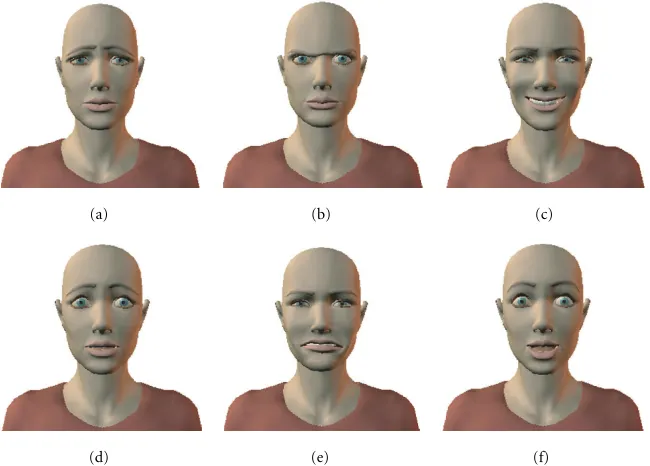
The first set of experiments shows synthesized archety-pal expressions (see Figure 7) created by using the Poser soft-ware package. The 3D nature of the face model renders the underlying emotions in a more natural way than the MPEG-4 compatible face model (compare Figures 5e and 5f for the emotions surprise and joy with Figures 7f and 7c, respec-tively). However in both cases the synthesized examples are rather convincing.
(a) (b) (c)
(d) (e) (f)
Figure7: Synthesized archetypal expressions created using the 3D model of the POSER software package: (a)sadness, (b)anger, (c)joy, (d) fear, (e)disgust, and (f)surprise.
expressions more effectively, since the FAT mechanism can approximate the effect of muscle deformation, which ac-counts for the shape of the face during expressions. In the case of Figures 9 and 11 the decoder only utilises the FAPs supplied and thus, the final result depends on the prede-fined mapping between the animation parameters and the low polygon model.
6.1. Creating profiles for emotions belonging to the same universal category
In this section, we illustrate the proposed methodology for creating profiles for emotions that belong to the same uni-versal category as an archetypal one. Emotion termsafraid,
terrified, andworriedare considered to belong to the emotion categoryfear[11] whose modeling base is the termafraid. In Table 7 are shown the produced profiles for the terms terri-fiedandworriedemerged by the one of the profiles ofafraid
(in particularP(8)F ). The range of variationXT,j(8)of FAPFj be-longing to the eighth profile of emotion termterrifiedis com-puted by the equationXT,j(8)=(6.3/4.9)XF,j(8), whereXF,j(8)is the range of variation of FAPFj belonging to the eighth profile
of emotion termafraid. Similarly,XW,j(8) =(3.9/4.9)XF,j(8)is the range of variation of FAPFj belonging to the eighth profile
of emotion termworried. Figures 8 and 9 show the animated profiles for emotion termsafraid,terrified, andworried, re-spectively. The FAP values that we used are the median ones of the corresponding ranges of variation.
6.2. Creating profiles for emotions lying between the archetypal ones
In this section, we describe the method of creating a pro-file for the emotionguilt. According to the Plutchik’sangular
measure (see Table 6), emotion termguilty(angular measure 102.3 degrees) lies between the archetypal emotion terms
afraid(angular measure 70.3 degrees) andsad(angular mea-sure 108.5 degrees), being closer to the latter. According to Section 4.2 the vocabularyVG of emotion guilt emerges as the union of vocabulariesVFandVS, that is,VG=VF∪VS, whereVFandVSare the vocabularies corresponding to
emo-tions fear andsad, respectively. In Table 8 it is shown the produced profile for the termguiltyemerged by the one of the profiles ofafraid(in particularPF(8)) andsad(PS(0)). FAPs F3,F5,F33,F34,F35, andF36 are included only in theP(8)F
and therefore the corresponding ranges of variation in the emerging guilty profile PG(m) (mth guilty profile) are com-puted by averaging the ranges of variation ofP(8)F with the neutral face, according to Rule 4 in Section 4.2; for example X(m)
G,3 = (4/2∗4.9)X (8)
F,4. FAPsF19,F20,F21,F22,F31,F32 are
included in both PF(8) andPS(0), with the same direction of movement, thus Rule 2 in Section 4.2 is followed. For exam-ple the range of variationXG,(m19) for FAPF29term is computed
as follows:
tX(8) F,19
= 4
4.9X
(8)
F,19=⇒[−510,−460],
c(8)
F,19= −485, s
(8) F,19=50,
tX(0) S,19
= 4
3.9X
(0)
S,19=⇒[−270,−42],
c(0)
S,19= −156, s(9)S,19=228,
(a) (b) (c)
Figure8: Poser face model: animated profiles for emotion terms (a)afraid, (b)terrified, and (c)worried.
(a) (b) (c)
Figure9: MPEG-4 face model: animated profiles for emotion terms (a)afraid, (b)terrified, and (c)worried.
(a) (b) (c)
Figure10: Poser face model: animated profiles for emotion terms (a)afraid, (b)guilty, and (c)sad.
(a) (b) (c)
Table7: Created profiles for the emotionsterrorandworry.
Emotion term Activation Profile
F3∈[400,560],F5∈[−240,−160],F19∈[−630,−570],F20∈[−630,−570], Afraid 4.9 F21∈[−630,−570],F22∈[−630,−570],F31∈[260,340],F32∈[260,340],
F33∈[160,240],F34∈[160,240],F35∈[60,140],F36∈[60,140]
F3∈[520,730],F5∈[−310,−210],F19∈[−820,−740],F20∈[−820,−740], Terrified 6.3 F21∈[−820,−740],F22∈[−820,−740],F31∈[340,440],F32∈[340,440],
F33∈[210,310],F34∈[210,310],F35∈[80,180],F36∈[80,180]
F3∈[320,450],F5∈[−190,−130],F19∈[−500,−450],F20∈[−500,−450], Worried 3.9 F21∈[−500,−450],F22∈[−500,−450],F31∈[210,270],F32∈[210,270],
F33∈[130,190],F34∈[130,190],F35∈[50,110],F36∈[50,110]
Table8: Created profile for the emotionguilt.
Emotion term Activation Angular measure Profile
F3∈[400,560],F5∈[−240,−160],F19∈[−630,−570],F20∈[−630,−570], Afraid 4.9 70.3 F21[−630,−570],F22∈[−630,−570],F31∈[260,340],F32∈[260,340],
F33∈[160,240],F34∈[160,240],F35∈[60,140],F36∈[60,140]
F3∈[160,230],F5∈[−100,−65],F19∈[−110,−310],F20∈[−120,−315], Guilty 4 102.3 F21∈[−110,−310],F22∈[−120,−315],F31∈[61,167],F32∈[57,160],
F33∈[65,100],F34∈[65,100],F35∈[25,60],F36∈[25,60]
Sad 3.9 108.5 F19∈[−265,−41],F20∈[−270,−52],F21∈[−265,−41],F22∈[−270,−52], F31∈[30,140],F32∈[26,134]
since
ωF=70.3◦, ωS=108.5◦, ωG=102.3◦, c(m)
G,19=
102.3−70.3
108.5−70.3∗(−156) +108.5−102.3
108.5−70.3 ∗(−485)= −209, s(m)
G,19=
102.3−70.3 108.5−70.3∗228 +108.5−102.3
108.5−70.3 ∗50=199,
(13)
andXG,(m19) corresponds to the range [−110,−310].
7. CONCLUSION, DISCUSSION, AND FURTHER
WORK
In this work, we have proposed a complete framework for creating visual profiles, based on FAPs, for intermediate (not primary) emotions. Emotion profiles can serve either the vi-sion part of an emotion recognition system, or a client side application that creates synthetic expressions. The main ad-vantage of the proposed system is its flexibility.
(i) No hypothesis about what the expression analysis sys-tem is (see Figure 1), should be made; it is enough to provide either the name of the conveyed emotion, or just the move-ment of a predefined set of FPs. In the former case, the pro-posed fuzzy system serves as an agent for synthesizing expres-sions, while in the latter case it functions as an autonomous emotion analysis system.
(ii) It is extensible with respect to completing (or mod-ifying) the proposed vocabulary of FAPs for the archetypal expressions
(iii) The range of variation of FAPs that involved in the archetypal expression profiles can be modified. Note how-ever that this modification affects the profiles that created for intermediate expressions.
(iv) It is extensible with respect to the number of inter-mediate expressions that can be modeled.
Exploitation of the results obtained by psychological studies related with emotion recognition from computer sci-entists is possible although not straightforward. We have shown that terms like theemotion wheelandactivationare suitable for extending the emotions that can be visually mod-eled.
another interesting issue which would indeed require specific FATs. This constitutes a topic for further developments.
The results presented indicate that the use of FATs, while not essential, enhances the obtained results. However, in cases of low bitrate applications where speed and responsive-ness are more important than visual fidelity, the FAT func-tionality may be omitted, since it imposes considerable over-head on the data stream. Samples of the emotional anima-tion, including values and models, used in this paper can be found at http://www.image.ntua.gr/mpeg4.
REFERENCES
[1] EC TMR Project PHYSTA Report,Development of feature rep-resentation from facial signals and speech, January 1999. [2] P. Ekman, “Facial expression and emotion,” American
Psy-chologist, vol. 48, no. 4, pp. 384–392, 1993.
[3] P. Ekman and W. V. Friesen,Pictures of Facial Affect, Consult-ing Psychologists Press, Palo Alto, Calif, USA, 1978.
[4] C. Izard, L. Dougherty, and E. A. Hembree, “A system for identifying affect expressions by holistic judgements,” Tech. Rep., University of Delaware, Newark, Del, USA, 1983. [5] C. M. Whissel, “The dictionary of affect in language,” in
Emotion: Theory, Research and Experience, R. Plutchnik and H. Kellerman, Eds., vol. 4 ofThe Measurement of Emotions, pp. 113–131, Academic Press, New York, USA, 1989. [6] R. Plutchik, Emotion: A Psychoevolutionary Synthesis, Harper
and Row, New York, USA, 1980.
[7] R. Cowie, E. Douglas-Cowie, N. Tsapatsoulis, et al., “Emo-tion recogni“Emo-tion in human-computer interac“Emo-tion,” IEEE Sig-nal Processing Magazine, vol. 18, no. 1, pp. 32–80, 2001. [8] P. Ekman and W. Friesen, The Facial Action Coding System,
Consulting Psychologists Press, San Francisco, Calif, USA, 1978.
[9] N. Tsapatsoulis, K. Karpouzis, G. Stamou, F. Piat, and S. Kol-lias, “A fuzzy system for emotion classification based on the MPEG-4 facial definition parameter set,” inProc. Euro-pean Signal Processing Conference, Tampere, Finland, Septem-ber 2000.
[10] F. Parke and K. Waters,Computer Facial Animation, A K Pe-ters, Wellesley, Mass, USA, 1996.
[11] G. Faigin, The Artist’s Complete Guide to Facial Expressions, Watson-Guptill, New York, USA, 1990.
[12] I. Essa and A. Pentland, “Coding, analysis, interpretation, and recognition of facial expressions,”IEEE Trans. on Pattern Analysis and Machine Intelligence, vol. 19, no. 7, pp. 757–763, 1997.
[13] EC TMR Project PHYSTA Report, Review of existing tech-niques for human emotion understanding and applications in human-computer interaction, October 1998.
[14] P. Chellapa, C. Wilson, and S. Sirohey, “Human and machine recognition of faces: A survey,” Proceedings of the IEEE, vol. 83, no. 5, pp. 705–740, 1995.
[15] H. A. Rowley, S. Baluja, and T. Kanade, “Neural network-based face detection,” IEEE Trans. on Pattern Analysis and Machine Intelligence, vol. 20, no. 1, pp. 23–28, 1998.
[16] K. Karpouzis, N. Tsapatsoulis, and S. Kollias, “Moving to con-tinuous facial expression space using the MPEG-4 facial defi-nition parameter (FDP) set,” inHuman Vision and Electronic
Imaging V, vol. 3959 ofProceedings of SPIE, San Jose, Calif, USA, January 2000.
[17] M. Tekalp and J. Ostermann, “Face and 2-D mesh animation in MPEG-4,”Image Communication Journal, vol. 15, no. 4-5, pp. 387–421, 2000, Tutorial Issue On The MPEG-4 Standard. [18] K.-M. Lam and H. Yan, “An analytic-to-holistic approach for face recognition based on a single frontal view,”IEEE Trans. on Pattern Analysis and Machine Intelligence, vol. 20, no. 7, pp. 673–686, 1998.
[19] J. Ostermann and E. Haratsch, “An animation definition in-terface: Rapid design of MPEG-4 compliant animated faces and bodies,” inInternational Workshop on Synthetic-Natural Hybrid Coding and Three Dimensional Imaging, pp. 216–219, Greece, September 1997.
[20] F. Lavagetto and R. Pockaj, “The facial animation engine: To-ward a high-level interface for the design of MPEG-4 compli-ant animated faces,”IEEE Trans. Circuits and Systems for Video Technology, vol. 9, no. 2, pp. 277–289, 1999.
[21] G. Abrantes and F. Pereira, “MPEG-4 facial animation tech-nology: survey, implementation and results,”IEEE Trans. Cir-cuits and Systems for Video Technology, vol. 9, no. 2, pp. 290– 305, 1999.
[22] G. J. Klir and B. Yuan, Fuzzy Sets and Fuzzy Logic, Theory and Applications, Prentice-Hall, Upper Saddle River, NJ, USA, 1995.
Amaryllis Raouzaiouwas born in Athens, Greece in 1977. She graduated from the De-partment of Electrical and Computer Engi-neering, the National Technical University of Athens in 2000 and she is currently pur-suing the Ph.D. degree at the same univer-sity. Her current research interests lie in the areas of synthetic-natural hybrid video cod-ing, human-computer interaction, machine vision, and neural networks. She is a
mem-ber of the Technical Chammem-ber of Greece. She is with the team of IST project ERMIS (Emotionally Rich Man-Machine Interaction Systems, IST-2000-29319).
Nicolas Tsapatsouliswas born in Limassol, Cyprus in 1969. He graduated from the De-partment of Electrical and Computer Engi-neering, the National Technical University of Athens in 1994 and received his Ph.D. de-gree in 2000 from the same university. His current research interests lie in the areas of human-computer interaction, machine vi-sion, image and video processing, neural networks, and biomedical engineering. He
Kostas Karpouziswas born in Athens, Greece in 1972. He gradu-ated from the Department of Electrical and Computer Engineer-ing, the National Technical University of Athens (NTUA) in 1998 and received his Ph.D. degree in 2001 from the same university. His current research interests lie in the areas of human-computer inter-action, image and video processing, 3D computer animation, and virtual reality. He is a member of the Technical Chamber of Greece and a member of ACM SIGGRAPH and SIGCHI societies. Dr. Kar-pouzis has published five papers in international journals and more than 15 in proceedings of international conferences. He is a mem-ber of the technical committee of the International Conference on Image Processing (ICIP). Since 1995 he has participated in seven research projects at Greek and European level.
Stefanos Kolliaswas born in Athens, Greece in 1956. He obtained his Diploma from National Technical University of Athens in 1979, his M.Sc. in Communication Engi-neering in 1980 from UMIST (University of Manchester, Institute of Science and Tech-nology) in England and his Ph.D. in Sig-nal Processing from the Computer Science Division of NTUA. He is with the Electri-cal Engineering Department of NTUA since