Semi-supervised dependency parsing using generalized tri-training
Anders Søgaard and Christian Rishøj Center for Language Technology
University of Copenhagen
{soegaard|crjensen}@hum.ku.dk
Abstract
Martins et al. (2008) presented what to the best of our knowledge still ranks as the best overall result on the CONLL-X Shared Task datasets. The paper shows how triads of stacked dependency parsers described in Martins et al. (2008) can label unlabeled data for each other in a way similar to co-training and produce end parsers that are significantly better than any of the stacked input parsers. We evaluate our system on five datasets from the CONLL-X Shared Task and ob-tain 10–20% error reductions, incl. the best reported results on four of them. We compare our approach to other semi-supervised learning algorithms.
1 Introduction
Semi-supervised learning of structured variables is a difficult problem that has received consid-erable attention recently, but most results have been negative (Abney, 2008). This paper uses stacked learning (Wolpert, 1992) to reduce struc-tured variables, i.e. dependency graphs, to multi-nomial variables, i.e. attachment and labeling decisions, which are easier to manage in semi-supervised learning scenarios, and which can later be combined into dependency trees using parsing algorithms for arc-factored dependency parsing. Our approach thus combines ensemble-based methods and semi-supervised learning.
Ensemble-based methods such as stacked learning are used to reduce the instability of clas-sifiers, to average out their errors and to com-bine the strengths of diverse learning algorithms.
Ensemble-based methods have attracted a lot of attention in dependency parsing recently (Sagae and Lavie, 2006; Hall et al., 2007; Nivre and McDonald, 2008; Martins et al., 2008; Fishel and Nivre, 2009; Surdeanu and Manning, 2010). Nivre and McDonald (2008) were first to intro-duce stacking in the context of dependency pars-ing.
Semi-supervised learning is typically moti-vated by data sparseness. For many classifi-cation tasks in natural language processing, la-beled data can be in short supply but unla-beled data is more readily available. Semi-supervised methods exploit unlabeled data in ad-dition to labeled data to improve performance on classification tasks. If the predictions of a learner lon unlabeled data are used to improve a learner l′ in semi-supervised learning, the ro-bustness of learning will depend on the stabil-ity ofl. Combining ensemble-based and semi-supervised methods may thus lead to more ro-bust semi-supervised learning.
selecting unlabeled data points with predictions is a difficult task. There is an imminent danger that the learner amplifies its previous mistakes, and while several techniques such as balancing and throttling have been developed to avoid such caveats, using single-view and single-learner al-gorithms often requires both caution and experi-ence with the modeling task at hand.
Algorithms with multiple views on data are known to be more robust. This insight led to the development of co-training (Blum and Mitchell, 1998), a two-view method where views inform each other, but it also paved the way for the inte-gration of ensemble-based and semi-supervised methods, i.e. for methods with multiple learners. It was mentioned that relatively little work has been devoted to this topic, but there are notable exceptions:
Bennett et al. (2003) generalized boosting to semi-supervised learning in a seminal paper, where the idea of iterative or recursive ensembles was also introduced. Li and Zhou (2005) intro-duce tri-training, a form of co-training that trains an ensemble of three learners on labeled data and runs them on unlabeled data. If two learners agree on their labeling of a data point, the data point is added to the labeled data of the third learner with the prediction of the first two. Di-daci and Roli (2006) extend self-training and co-training to multiple learners. Li and Zhou (2007) generalize tri-training to larger ensembles of ran-dom trees. The technique is also known as co-forests. Hady and Schwenker (2008) general-ize existing ensemble-based methods for semi-supervised learning scenarios; in particular they embed ensembles in a form of co-training that is shown to maintain the diversity of the ensemble over time. Milidiu and Duarte (2009) generalize boosting at start to semi-supervised learning.
This paper applies a generalization of tri-training to two classification problems, attach-ment and labeling. The attachattach-ment classifier’s weights are used for arc-factored dependency parsing, and the labeling classifier’s weights are then used to label the dependency tree delivered by the parser.
Semi-supervised dependency parsing has
at-tracted a lot of attention recently (Koo et al., 2008; Wang et al., 2008; Suzuki et al., 2009), but there has, to the best of our knowledge, been no previous attempts to apply tri-training or re-lated combinations of ensemble-based and semi-supervised methods to any of these tasks, ex-cept for the work of Sagae and Tsujii (2007) discussed in Sect. 2.6. However, tri-training has been applied to Chinese chunking (Chen et al., 2006), question classification (Nguyen et al., 2008) and POS tagging (Søgaard, 2010).
We compare generalized tri-training to other semi-supervised learning algorithms, incl. self-training, the original tri-training algorithm based on bootstrap samples (Li and Zhou, 2005), co-forests (Li and Zhou, 2007) and semi-supervised support vector machines (Sindhwani and Keerthi, 2006).
Sect. 2 introduces dependency parsing and stacked learning. Stacked learning is general-ized to dependency parsing, and previous work is briefly surveyed. We then describe how stacked dependency parsers can be further stacked as in-put for two end classifiers that can be combined to produce dependency structures. These two classifiers will learn multinomial variables (at-tachment and labeling) from a combination of labeled data and unlabeled data using a gener-alization of tri-training. Sect. 3 describes our ex-periments. We describe the data sets, and how the unlabeled data was prepared. Sect. 4 presents our results. Sect. 5 presents an error analysis and discusses the results in light of other results in the literature, and Sect. 6 concludes the paper.
2 Background and related work
2.1 Dependency parsing
each sentence is to find the dependency tree that maximizes an objective function which in our case is learned from a combination of labeled and unlabeled data.
More formally, a dependency tree for a sentence x = w1, . . . , wn is a tree T =
h{0,1, . . . , n}, Ai withA ⊆ V ×V the set of dependency arcs. Each vertex corresponds to a word in the sentence, except 0 which is the root vertex, i.e. for any i ≤ n hi,0i 6∈ A. Since a dependency tree is a tree it is acyclic. A tree is projective if every vertex has a continu-ous projection, i.e. if and only if for every arc
hi, ji ∈ A and node k ∈ V, if i < k < j
or j < k < i then there is a subset of arcs
{hi, i1i,hi1, i2i, . . . ,hik−1, iki} ∈ A such that
ik=k.
In this paper we use a maximum spanning tree algorithm, the so-called Chu-Liu-Edmonds algo-rithm (CLE) (Edmonds, 1967) to turn the pre-dictions of our semi-supervised classifiers into a dependency tree.
2.2 Stacked learning
Stacked generalization, or simply stacking, was first proposed by Wolpert (1992). Stacking is an ensemble-based learning method where multiple weak classifiers are combined in a strong end classifier. The idea is to train the end classifier directly on the predictions of the input classifiers. Say each input classifier ci with 1 ≤ i ≤
n receives an input x and outputs a prediction
ci(x). The end classifier then takes as input
hx, c1(x), . . . , cn(x)iand outputs a final predic-tionc0(hx, c1(x), . . . , cn(x)i). Training is done by cross-validation. In sum, stacking is training a classifier on the output of classifiers.
2.3 Stacked dependency parsing
Stacked learning can be generalized to structured prediction tasks such as dependency parsing. Ar-chitectures for stacking dependency parsers typi-cally only use one input parser, but otherwise the intuition is the same: the input parser is used to augment the dependency structures that the end parser is trained and evaluated on.
Nivre and McDonald (2008) first showed how the MSTParser (McDonald et al., 2005) and the
MaltParser (Nivre et al., 2007) could be im-proved by stacking each parser on the predic-tions of the other. Martins et al. (2008) general-ized their work, considering more combinations of parsers, and stacking the end parsers on non-local features from the predictions of the input parser, e.g. siblings and grand-parents. In this work we use three stacked dependency parsers for each language: mst2 (p1), malt/mst2 (p2) and malt/mst1 (p3).
The notation ”malt/mst2” means that the second-order MSTParser has been stacked on the MaltParser. The capital letters refer to feature configurations. Configuration D stacks a level 1 parser on several (non-local) features of the pre-dictions of the level 0 parser (along with the in-put features): the predicted edge, siblings, grand parents and predicted head of candidate modifier if predicted edge is 0. Configuration E stacks a level 1 parser on the features in configuration D and all the predicted children of the candi-date head. The chosen parser configurations are those that performed best in Martins et al. (2008) across the different datasets.
2.4 Stacking stacked dependency parsing
The input features of the input classifiers in stacked learning x can of course be removed from the input of the end classifier. It is also possible to stack stacked classifiers. This leaves us with four strategies for recursive stacking; namely to constantly augment the feature set, with levelnclassifiers trained on the predictions of the classifiers at alln−1lower levels with or without the input featuresx, or simply to train a level nclassifier on the predictions of the level
n−1classifiers with or withoutx.
In this work we stack stacked dependency parsers by training classifiers on the output of three stacked dependency parsers and POS tags. Consequently, we use one of the features fromx. Note that we train classifiers and not parsers on this new level 2.
label p1 p2 p3 POS
1 1 -1 1 NNP
0 0 0 0 VBD
In the second row all input parsers, p1−3 in columnsaa 2–4, agree that the verb is the root of the sentence. Column 1 tells us that this is cor-rect. In the first row, two out of three parsers agree on attaching the noun to the verb, which again is correct. We train level 2 classifiers on feature vectors produced this way. Note that or-acle performance of the ensemble is no upper bound on the accuracy of a classifier trained on level 1 predictions this way, since a classifier may learn the right decision from three wrong predictions and a POS tag.
Second we train a classifier to predict depen-dency relations. Our feature vectors are similar to the ones just described, but now contain de-pendency label predictions, e.g.:
label p1 p2 p3 POS
SBJ SBJ SBJ SBJ NN
ROOT ROOT ROOT COORD VBN
2.5 Generalized tri-training
Tri-training was originally introduced in Li and Zhou (2005). The method involves three learners that inform each other.
Let L denote the labeled data and U the unlabeled data. Assume that three classifiers
c1, c2, c3 have been trained on L. In the origi-nal algorithm, the three classifiers are obtained by applying the same learning algorithm to three bootstrap samples of the labeled data; but in gen-eralized algorithms, three different learning al-gorithms are used. An unlabeled datapoint in
U is labeled for a classifier, sayc1, if the other two classifiers agree on its label, i.e.c2 and c3. Two classifiers inform the third. If the two clas-sifiers agree on a labeling, we assume there is a good chance that they are right. In the original algorithm, learning stops when the classifiers no longer change; in generalized tri-training, a fixed stopping criterion is used. The three classifiers are combined by voting. Li and Zhou (2005) show that under certain conditions the increase in classification noise rate is compensated by the amount of newly labeled data points.
The most important condition is that the three classifiers are diverse. If the three
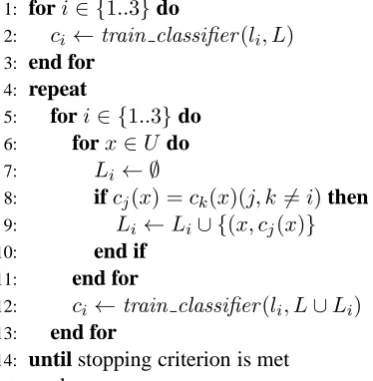
clas-1: fori∈ {1..3}do
2: ci ←train classifier(li, L)
3: end for
4: repeat
5: fori∈ {1..3}do
6: forx∈U do
7: Li ← ∅
8: ifcj(x) =ck(x)(j, k6=i)then
9: Li←Li∪ {(x, cj(x)}
10: end if
11: end for
12: ci←train classifier(li, L∪Li)
13: end for
14: until stopping criterion is met
15: applyc1
Figure 1: Generalized tri-training.
sifiers are identical, tri-training degenerates to self-training. As already mentioned, Li and Zhou (2005) obtain this diversity by training classifiers on bootstrap samples. In their exper-iments, they consider classifiers based on deci-sion trees, BP neural networks and na¨ıve Bayes inference.
In this paper we generalize the tri-training al-gorithm and use three different learning algo-rithms rather than bootstrap samples to create diversity: a na¨ıve Bayes algorithm (no smooth-ing), random forests (Breiman, 2001) (with 100 unpruned decision trees) and an algorithm that induces unpruned decision trees. The overall al-gorithm is sketched in Figure 1 withlia learning algorithm.
Our weights are those of the random forest classifier after a fixed number of rounds. The attachment classifier iterates once over the unla-beled data, while the dependency relations clas-sifier uses three iterations. The optimal number of iterations could of course be estimated on de-velopment data instead. Given the weights for an input sentence we use CLE to find its most likely dependency tree.
2.6 Related work
widely used in dependency parsing than stack-ing. Voting was first introduced in dependency parsing in Zeman and Zabokrtsky (2005). Sagae and Lavie (2006) later used weighted voting and reparsing, i.e. using CLE to find the dependency tree that reflects the maximum number of votes. They also showed that binning the vote over part-of-speech tags led to further improvements. This set-up was adopted by Hall et al. (2007) in the best performing system in the CONLL 2007 Shared Task. Fishel and Nivre (2009) later ex-perimented with binning the vote on other fea-tures with modest improvements.
Semi-supervised dependency parsing has only recently been explored, and failures have been more frequent than successes. There are, however, noteable exceptions such as Koo et al. (2008), Wang et al. (2008), Suzuki et al. (2009) and Sagae and Gordon (2009).
The semi-supervised methods employed in these experiments are very different from more traditional scenarios such as self-training and co-training. Two approaches (Koo et al., 2008; Sagae and Gordon, 2009) use clusters obtained from large amounts of unlabeled data to augment their labeled data by introducing new features, and two approaches (Wang et al., 2008; Suzuki et al., 2009) combine probability distributions ob-tained from labeled data with probability distri-butions obtained from unlabeled data.
Successes with self-training and co-training are rare, and several authors report negative re-sults, e.g. Spreyer and Kuhn (2009). A note-able exception in constituent-based parsing is the work of McClosky et al. (2006) who show that self-training is possible if a reranker is used to inform the underlying parser.
Sagae and Tsujii (2007) participated in (and won) the CONLL 2007 Shared Task on do-main adaptation. They first trained a max-imum entropy-based transition-based depen-dency parser on the out-of-domain labeled data and an SVM-based transition-based dependency parser on the reversed out-of-domain labeled data. The two parsers parse the in-domain la-beled data (reversed, in the case of the SVM-based parser). Identical analyses are added to the
original training set. The first parser is retrained and used to parse the test data. In sum, the au-thors do one round of co-training with the fol-lowing selection criterion: If the two parsers pro-duce the same dependency structures for a sen-tence, the dependency structure is added to the labeled data. This criterion is also the selection criterion in tri-training.
3 Experiments
3.1 Data
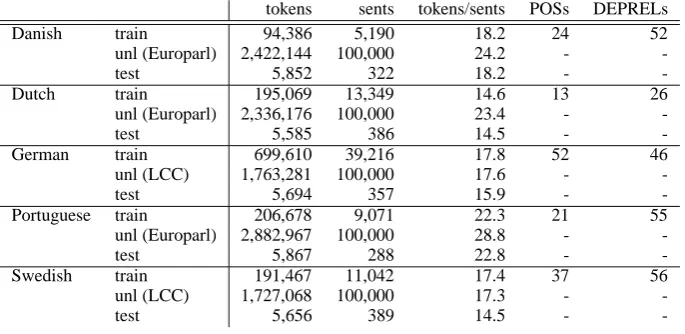
We use five datasets from the CONLL-X Shared Task (Buchholz and Marsi, 2006).1 Lemmas and morphological features (FEATS) are ignored, since we only add POS and CPOS tags to un-labeled data. For German and Swedish, we use 100,000 sentences from the Leipzig Corpora Collection (Biemann et al., 2007) as unlabeled data. For Danish, Dutch, and Portuguese we use 100,000 sentences from the Europarl cor-pus (Koehn, 2005). The data characteristics are provided in Figure 2. The unlabeled data were POS tagged using the freely available SVMTool (Gimenez and Marquez, 2004) (model 4, left-right-left).
3.2 Algorithm
Once our data has been prepared, we train the stacked dependency parsers and use them to la-bel training data for our classifiers (∼4,000 to-kens), our test data and our unlabeled data. This gives us three sets of predictions for each of the three data sets. Using the features described in Sect. 2.4 we then construct data for training our two triads of classifiers (for attachment and de-pendency relations). The entire architecture can be depicted as in Figure 3.
We first stack three dependency parsers as described in Martins et al. (2008). We then stack three classifiers on top of these dependency parsers (and POS tags): a na¨ıve Bayes classifier, a random forest, and a decision tree. Finally,
1The CONLL-X Shared Task consists of 12 datasets,
tokens sents tokens/sents POSs DEPRELs
Danish train 94,386 5,190 18.2 24 52
unl (Europarl) 2,422,144 100,000 24.2 -
-test 5,852 322 18.2 -
-Dutch train 195,069 13,349 14.6 13 26
unl (Europarl) 2,336,176 100,000 23.4 -
-test 5,585 386 14.5 -
-German train 699,610 39,216 17.8 52 46
unl (LCC) 1,763,281 100,000 17.6 -
-test 5,694 357 15.9 -
-Portuguese train 206,678 9,071 22.3 21 55
unl (Europarl) 2,882,967 100,000 28.8 -
-test 5,867 288 22.8 -
-Swedish train 191,467 11,042 17.4 37 56
unl (LCC) 1,727,068 100,000 17.3 -
-test 5,656 389 14.5 -
-Figure 2: Characteristics of the data sets.
tri-training ...
nb forests tree
stacking
mst2/mst2 malt/mst2 malt/mst1
stacking
mst2 malt mst1
Figure 3: Tri-training stacked classifiers.
we tri-train these three stacked classifiers and for each test sentence output the weights provided by the random forest classifier. These weights are used to find the best possible dependency tree using CLE.
3.3 Baselines
The best of the stacked input parsers is of course our natural baseline.
Since we have generalized tri-training, we also compare generalized tri-training to the orig-inal tri-training algorithm based on bootstrap samples. The original tri-training algorithm is run with the same decomposition and the same features as our generalized tri-training al-gorithm. We use the learning algorithm orig-inally used in Li and Zhou (2005), namely C4.5. We also compare our results to self-training (no pool, no growth rate) and co-forests (Li and Zhou, 2007). Finally, we compare our
results to semi-supervised support vector ma-chines (S3VMs) (Sindhwani and Keerthi, 2006). Since S3VMs produce binary classifiers, and one-vs.-many combination would be very time-consuming, we train a binary classifier that pro-duces a probability that any candidate arc is cor-rect and do greedy head selection. We optimized the feature set and included a total of seven fea-tures (head POS, dependent POS, dependent left neighbor POS, distance+direction, predictions of the three classifiers).
4 Results
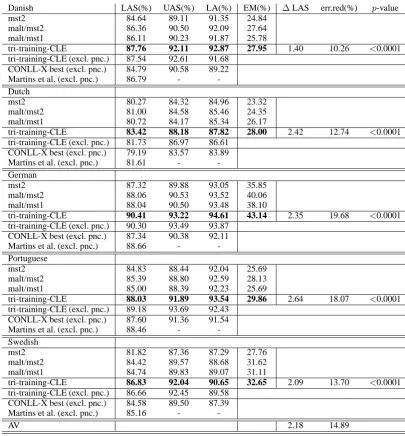
gen-Danish LAS(%) UAS(%) LA(%) EM(%) ∆LAS err.red(%) p-value
mst2 84.64 89.11 91.35 24.84
malt/mst2 86.36 90.50 92.09 27.64
malt/mst1 86.11 90.23 91.87 25.78
tri-training-CLE 87.76 92.11 92.87 27.95 1.40 10.26 <0.0001
tri-training-CLE (excl. pnc.) 87.54 92.61 91.68 CONLL-X best (excl. pnc.) 84.79 90.58 89.22 Martins et al. (excl. pnc.) 86.79 - -Dutch
mst2 80.27 84.32 84.96 23.32
malt/mst2 81.00 84.58 85.46 24.35
malt/mst1 80.72 84.17 85.34 26.17
tri-training-CLE 83.42 88.18 87.82 28.00 2.42 12.74 <0.0001
tri-training-CLE (excl. pnc.) 81.73 86.97 86.61 CONLL-X best (excl. pnc.) 79.19 83.57 83.89 Martins et al. (excl. pnc.) 81.61 - -German
mst2 87.32 89.88 93.05 35.85
malt/mst2 88.06 90.53 93.52 40.06
malt/mst1 88.04 90.50 93.48 38.10
tri-training-CLE 90.41 93.22 94.61 43.14 2.35 19.68 <0.0001
tri-training-CLE (excl. pnc.) 90.30 93.49 93.87 CONLL-X best (excl. pnc.) 87.34 90.38 92.11 Martins et al. (excl. pnc.) 88.66 - -Portuguese
mst2 84.83 88.44 92.04 25.69
malt/mst2 85.39 88.80 92.59 28.13
malt/mst1 85.00 88.39 92.23 25.69
tri-training-CLE 88.03 91.89 93.54 29.86 2.64 18.07 <0.0001
tri-training-CLE (excl. pnc.) 89.18 93.69 92.43 CONLL-X best (excl. pnc.) 87.60 91.36 91.54 Martins et al. (excl. pnc.) 88.46 - -Swedish
mst2 81.82 87.36 87.29 27.76
malt/mst2 84.42 89.57 88.68 31.62
malt/mst1 84.74 89.83 89.07 31.11
tri-training-CLE 86.83 92.04 90.65 32.65 2.09 13.70 <0.0001
tri-training-CLE (excl. pnc.) 86.66 92.45 89.58 CONLL-X best (excl. pnc.) 84.58 89.50 87.39 Martins et al. (excl. pnc.) 85.16 -
-AV 2.18 14.89
Figure 4: Results on CONLL-X datasets. Scores are including punctuation unless otherwise noted.
∆andp-value is difference with respect to best input parser.
UAS malt-mst2 S3VMs self-training orig-tri-training co-forests tri-training tri-training[full]
Danish 90.50 90.47 89.68 89.66 88.79 90.60 92.21
Dutch 84.58 85.34 84.06 83.83 83.97 86.07 88.06
German 90.53 90.15 89.83 89.92 88.47 90.81 93.20
Portuguese 88.80 65.64 87.60 87.62 87.06 89.16 91.87
Swedish 89.83 81.46 89.09 89.20 88.65 90.22 92.24
AV 88.80 82.61 88.05 88.05 87.44 89.37 91.52
eralized tri-training.
5 Error analysis and discussion
Error reductions are higher with dependencies to the root node and long distance dependencies than with local dependencies. The table below lists the labeled attachment F1-scores for the five datasets binned on dependency length. The av-erage error reduction is the same for root depen-dencies and long distance dependepen-dencies (length
>7), but significantly lower for local dependen-cies. This seems to indicate that large amounts of data are necessary for the parser to recover long distance dependencies.
root 1 2 4–7 >7
Da(F1) 98.45 96.21 92.09 88.17 90.93
– err.red 41.34 10.69 13.92 15.75 21.92 Du(F1) 83.65 94.47 88.60 82.40 81.54
– err.red 28.39 16.74 20.72 17.00 31.88 Ge(F1) 97.33 96.47 94.28 92.42 93.94
– err.red 26.65 19.77 17.46 25.25 38.97 Po(F1) 96.23 97.05 95.17 84.80 87.11
– err.red 22.47 19.56 24.86 22.56 26.97 Sw(F1) 96.37 95.67 93.46 88.42 89.57
– err.red 32.85 14.10 15.04 25.97 31.50 AV err.red 30.34 16.17 18.40 21.31 30.25
Our results for Danish, Dutch, German and Portuguese are to the best of our knowledge the best reported results in the literature. Zhang and Chan (2009) obtain a LAS of 87.20 for Swedish with transition-based parsing based on reinforce-ment learning. They evaluate their system on a subset of the CONLL-X datasets and obtain their (by far) best improvement on the Swedish dataset. They speculate that ”the reason might be that [long distance dependencies] are not pop-ular in Swedish”. Since our parser is particu-larly good at long distance dependencies, this may also explain why a supervised parser outper-forms our system on this dataset. Interestingly, our unlabeled attachment score is a lot better than the one reported by Zhang and Chan (2009), namely 92.45 compared to 91.84.
Generally, our UASs are better than our LASs. Since we separate attachment and labeling out in two independent steps, improvements in UAS and improvements in LA do not necessarily lead to improvements in LAS. While our average er-ror reduction in LAS is 14.9%, our average erer-ror reductions in UAS is 23.6%. The average error
reduction in LA is 14.0%. In two-stage depen-dency parsers or dependepen-dency parsers with joint models, improvements in UAS are typically fol-lowed by comparable improvements in LAS.
6 Conclusion
This paper showed how the stacked depen-dency parsers introduced in Martins et al. (2008) can be improved by inference from unlabeled data. Briefly put, we stack three diverse clas-sifiers on triads of stacked dependency parsers and let them label unlabeled data for each other in a co-training-like architecture. Our average error reductions in LAS over the best of our stacked input parsers is 14.9%; in UAS, it is 23.6%. The code is available at http://cst.dk/anders/tridep.html.
References
Abney, Steven. 2008. Semi-supervised learning for
computational linguistics. Chapman & Hall.
Bennett, Kristin, Ayhan Demiriz, and Richard Maclin. 2003. Exploiting unlabeled data in en-semble methods. In KDD.
Biemann, Chris, G. Heyer, U. Quasthoff, and M. Richter. 2007. The Leipzig corpora collection. In Corpus Linguistics.
Blum, Avrim and Tom Mitchell. 1998. Combining labeled and unlabeled with-co-training. In COLT.
Breiman, Leo. 2001. Random forests. Machine
Learning, 45:5–32.
Buchholz, Sabine and Erwin Marsi. 2006. CONLL-X shared task on multilingual dependency parsing. In CONLL.
Chen, Wenliang, Yujie Zhang, and Hitoshi Isahara. 2006. Chinese chunking with tri-training learning. In Computer processing of oriental languages, pages 466–473. Springer, Berlin, Germany.
Didaci, Luca and Fabio Roli. 2006. Using
co-training and self-co-training in semi-supervised mul-tiple classifier systems. In SSPR& SPR, pages 522–530. Springer, Berlin, Germany.
Edmonds, J. 1967. Optimum branchings. Journal
of Research of the National Bureau of Standards,
Fishel, Mark and Joakim Nivre. 2009. Voting and
stacking in data-driven dependency parsing. In
NODALIDA.
Gimenez, Jesus and Lluis Marquez. 2004. SVM-Tool: a general POS tagger generator based on support vector machines. In LREC.
Hady, Mohamed and Friedhelm Schwenker. 2008. Co-training by committee. International Journal
of Software and Informatics, 2:95–124.
Hall, Johan, Jens Nilsson, Joakim Nivre, Gulsen Eryigit, Beata Megyesi, Mattias Nilsson, and Markus Saers. 2007. Single malt or blended? In
CONLL.
Koehn, Philipp. 2005. Europarl: a parallel corpus for statistical machine translation. In MT-Summit.
Koo, Terry, Xavier Carreras, and Michael Collins. 2008. Simple semi-supervised dependency pars-ing. In ACL.
Li, Ming and Zhi-Hua Zhou. 2005. Tri-training: exploiting unlabeled data using three classifiers.
IEEE Transactions on Knowledge and Data En-gineering, 17(11):1529–1541.
Li, Ming and Zhi-Hua Zhou. 2007. Improve
computer-aided diagnosis with machine learning
techniques using undiagnosed samples. IEEE
Transactions on Systems, Man and Cybernetics,
37(6):1088–1098.
Martins, Andr´e, Dipanjan Das, Noah Smith, and Eric Xing. 2008. Stacking dependency parsers. In
EMNLP.
McClosky, David, Eugene Charniak, and Mark John-son. 2006. Effective self-training for parsing. In
HLT-NAACL.
McDonald, Ryan, Fernando Pereira, Kiril Ribarov, and Jan Hajiˇc. 2005. Non-projective dependency parsing using spanning tree algorithms. In
HLT-EMNLP.
Milidiu, Ruy and Julio Duarte. 2009.
Improv-ing BAS committee performance with a semi-supervised approach. In European Symposium on
Artificial Neural Networks.
Nguyen, Tri, Le Nguyen, and Akira Shimazu. 2008. Using semi-supervised learning for question clas-sification. Journal of Natural Language
Process-ing, 15:3–21.
Nivre, Joakim and Ryan McDonald. 2008. Integrat-ing graph-based and transition-based dependency parsers. In ACL-HLT.
Nivre, Joakim, Johan Hall, Jens Nilsson, Atanas Chanev, G¨ulsen Eryigit, Sandra K¨ubler, Svetoslav
Marinov, and Erwin Marsi. 2007. MaltParser.
Natural Language Engineering, 13(2):95–135.
Sagae, Kenji and Andrew Gordon. 2009. Cluster-ing words by syntactic similarity improves depen-dency parsing of predicate-argument structures. In
IWPT.
Sagae, Kenji and Alon Lavie. 2006. Parser combina-tion by reparsing. In HLT-NAACL.
Sagae, Kenji and Jun’ichi Tsujii. 2007. Dependency parsing and domain adaptation with lr models and parser ensembles. In EMNLP-CONLL.
Sindhwani, Vikas and Sathiya Keerthi. 2006. Large scale semi-supervised linear SVMs. In ACM
SI-GIR.
Søgaard, Anders. 2010. Simple semi-supervised
training of part-of-speech taggers. In ACL.
Spreyer, Kathrin and Jonas Kuhn. 2009. Data-driven dependency parsing of new languages using in-complete and noisy training data. In CONLL.
Surdeanu, Mihai and Christopher Manning. 2010. Ensemble models for dependency parsing: cheap and good? In NAACL.
Suzuki, Jun, Hideki Isozaki, Xavier Carreras, and Michael Collins. 2009. Semi-supervised convex training for dependency parsing. In EMNLP.
Wang, Qin, Dekang Lin, and Dale Schuurmans. 2008. Semi-supervised convex training for depen-dency parsing. In ACL.
Wolpert, David. 1992. Stacked generalization.
Neu-ral Networks, 5:241–259.
Zeman, Daniel and Zdenˇek ˇZabokrtsk ´y. 2005.
Im-proving parsing accuracy by combining diverse dependency parsers. In IWPT.
Zhang, Lidan and Kwok Chan. 2009. Dependency parsing with energy-based reinforcement learning. In IWPT.