A Review on E-Nose and its application in
Medical Field
Shirish Pandey
Associate Professor, Dept. of EC, BBDEC, Lucknow UP India
ABSTRACT: Electronic nose is a sensing system which sensor the concentration of volatile organic compound in exhaled human breath and by the amount of a particular voc present in exhaled human breath it will able to detect a particular dieses. Human breath contains alkanes,benzene,ketones,aldehydes and many more types of voc present in exhaled breath. this paper covers the scope and limit to identify the voc for a particular dieses by using electronic nose system
KEYWORDS: voc, enose, sensor
I.INTRODUCTION
The electronic nose system basically consists of an array of sensors, a processing unit which process the data of sensor o/p and a pattern recognition system. The voc present in human breath are get interacted with the method the critical dieses such as lung cancer, urinary tract information (UTI) and asthma sensors and the required data thus generated is compared with the previously stored data.
II.DESCRIPTION
The electronic nose system can be categorized into three main components
I. Delivery of Sample II.System of Detection
III.Data Computation
I. Delivery of Sample-. By this system data quality isimproved significantly. Following are the some of the main technique under Delivery of Sample
I A.STATIC HEADSPACE
EXTRACTION(SHS)-In this technique Sample delivery system senses the raw data and thereafter data is modified, cleaned and enhanced before going into detection system sample is kept in a sealed vial and after that voc is extracted from same after the equilibrium is established between the matrix and the gaseous phase. The form of the matrix of the sample ,temp and vial volume are the main factors of extraction efficiency
I.B.DYNAMIC HEADSPACE EXTRACTION(DHS)-this particular technique depends upon the volatile
components are get mixed with inert gas and trapped into the adsorbent . This will further heated to desorbs voc molecules.
II A.METALl OXIDE SENSOR-Metal oxide sensor ismost commonly used sensor in present time. It has trapped oxygen molecules within the oxide layer. On interaction of voc with this oxide layer the conductivity will change resulting change in resistance. Mos sensors require high operating temp around 300 0C -500 0C as to avoid any reversible reaction. By this reason the power consumption in this sensor is comparatively more
IIB METAL OXIDE–this is also a widely used sensor
.on interaction of VOC with gate material the voc is get diffused within SEMICONDUCTOR FIELD EFFECT TRANSISTOR the gate material and thus therebyaltering the threshold voltage level of gate .Drift in the threshold of mosfet is directly proportional to the concentration of the voc diffused within the gate material
IIC CONDUCTING POLYMER (CP) SENSOR- inthis type of sensor element the conducting and thus therefore
resistance of the sensor is changed due to the interaction between voc and the polymer surface. In comparison to mos sensor cp sensor responds to normal ambient temp . They are easily affected by humidity, change in temp., oxidation process
IID. OPTICAL AND PIEZOELECTRIC SENSOR- theresponse of an optical sensor depends upon different optical properties like absorbance, fluorescence ,polarization index, interference etc. an optical sensor in detection system consists of four basic components (1) a light source (2) suitable optics for directing light to and from the sensor (3) an optical sensor (4) a photo detector. Leds and photodiodes are good optical sensor. piezoelectric crystal are based on piezoelectric properties according to that when a crystal is subjected to mechanical stress it generates a potential difference. The piezoelectric crystal has a definite operating frequency which can be altered by mass change due to absorbance of gaseous molecules on the surface. These includes bulk acoustic wave(baw) surface acoustic wave, quartz crystal microbalance (qcm)
Table A.Summersied Details of Gas Sensing
Sensor Type Principle Sensitivity Advantages Disadvantages
Metal Oxide
Conductivity 5 -500 ppm Low cost; Relatively low sensitivity; Semiconductors Short response time; long-lasting High energy consumption
Short response time
Long-time instability; Conducting Low cost of fabrication;
Conductivity 0.1 - 100 ppm Irreversibility; Polymers portable structure;
Poor selectivity Low energy consumption
Fluorescence; Low parts per High sensitivity; Difficulty in miniaturization Optical billion Long lifetime;
Chemoluminescence High cost (ppb) Insensitive to environment change
Quarz Crystal High sensitivity; Complex fab. Process; 1.0-ng mass Fast response times Interference from humidity Mrobalance Piezoelectricity
change Good CMOS compatibility & & temp; (QCM)
scalability; Low signal to noise ratio;
Surface Acoustic 1.0-pg mass High sensitivity Unstable at higher temp; Piezoelectricity Good CMOS compatibility &
Wave(SAW) chnge scalability Complex readout circuitry
Carbon Low parts per Ultra-sensitive; Difficulties is fabrication and Conductivity Great adsorptive capacity; repeatability; nanotubes million Large surface-area-to-volume ratio High cost
Calorimetric Stability; Risk of catalyst poisoning Calorimetry 10 - 100 ppm Low cost; and explosion; Methods
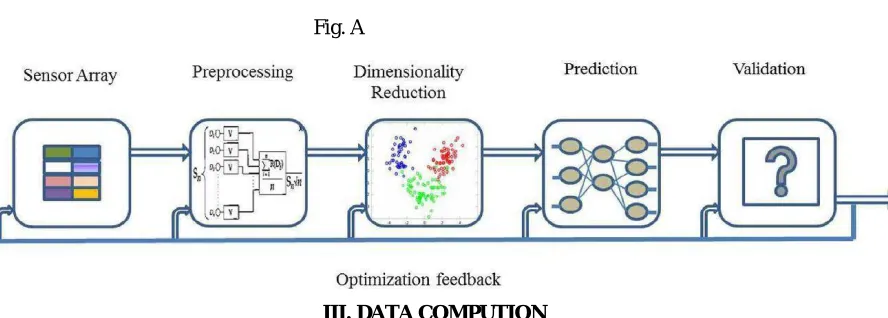
Fig. A
III. DATA COMPUTION
in data computation the primary task is to store the data in computer memory obtained from sensor output. before the processing of analysis and computing data may get process to extract an average information this may result in classification and clustering. The final step is data validation and pattern recognition. pattern recognition technique can be categorized into two groups unsupervised in which data classification is done and thereby discriminating between unknown odour vectors
IV. LITERATURE REVIEW
The exhaled human breath contains the specific voc that are sensed to make an idea about a particular diesesIma O.
Essiet (2013) have presented an experimentalmethod to sense the concentration of ammonia in exhaled human breath
to diagnose the possibility of kidney failure. The ammonia odour in the breath of patients suffering from kidney failure consists of bulk amount of blood urea nitrogen(BUN). THE concentration of blood urea nitrogen will be increased to a high level when the kidney is not functioning well . The excess urea comes out in form of ammonia in exhaled human breath .The metal oxide semiconductor sensor TGS 2602 was selected. An experimental set up was established to detect the ammonia concentration. The ammonia concentration in healthy breath was found to be less than 50 ppm. While in case of kidney failure the concentration was more than 100 ppm[1].
Lokender Yadav and Jayanand(2014) developed an experimental method for early detection of diabetes by
examining the exhaled human breath. Diabetes is metabolic dieses in which a patient hasFor supervised pattern
recognition the unknown odour is tested and classified according to a knowledge based i.e. prior knowledge about the class contained within the sample is necessary Principal component analysis is a commonly used unsupervised pattern recognition method. it mainly focused on most relevant data among the majority of data cloud. Linear discriminant analysis is a supervised method . this algorithm carefully establish a maximum separation between different group or cluster of data.high blood sugar.this blood sugar is due to less production of insulin by the body or due to the cells which do not respond to the insulin that is produced by the body. The exhaled breath of human contains a verity of voc. The person having diabetes also contains acetone in exhaled human breath which is mainly generated from decarboxylation of acetone. Metal oxide sensors are used in experimental setup for examining the concentration of acetone in human breath Mos sensor TGS 825,TGS 816 and TGS 822 are used[2].
In the year 2014 Qiang Li et.al. has proposed a method for detection of diabetes based on traditional Chinese medicine e nose signals. The traditional Chinese medicine consists of a sensing system, signal processing and suitable pattern recognition system with higher sensitivity. The TCN e nose system is made up for detection and analysis of human orders by different individual sensors. A logistic model has been proposed in this research paper[3].
relatively insensible to water vapours. the sensor so developed based on composites of homogenous or blended organic non volatile molecules with conductors such as carbon black. The sensor developed so far shows fast response, good reversibility and high stability. In the experimental set up four samples of lung air received. the first two minutes of breath samples are discarded. the later deep air of lung will be retained for experiment purpose. The sample analysis is done based on GC-MS study . By this approach the detection of lung cancer at early stage is possible[4].
In 2008 Rosella Blott et. al. proposed a patternclassification . Technique for early lung cancer detection. The device so developed can react to a gas substance by providing signals that can be analyzed to classify the inputs. The breath of 101 individuals of which 58 was not suffering from lung and 43 suffer from different type of lung cancer. the technique is based on supervised pattern classification algorithms based on different k-nearest neighbours(K-NN)approach developed on neural network(ANN)[5].
In the year 2013 N.Yusuf et. al. has developed anexperimental method to identify to identify the suspected diabetic patients by diagnose of bacteria by e nose technology .It is known that a person suffering from diabetes suffered a very slow recovery process in any type of infection. In this study 32 matrices of polymer carbon black composite sensor are used known as cyranose 320.the infected bacteria are collected by swabbing technique and kept in isolation in a blood agar medium. The initial result from this study is found to be 90% accurate. All the instrumental setting and raw data are stored in PC using PC nose software. In this study u matrix self organizing techniques is also applied in order to investigate data cluster in the multi sensor space. From the study it was found that e nose system is able to classify different type of bacteria associated with different volatile organic compound[6]
In the year 2012 Satetha Siyang et. al. has proposed an alternative method by direct measurement of urine odour using electronic nose technology to identify diabetic patients.In this method artificial urine was simulated by adding glucose in normal urine .eight commercial gas sensor were used. The collected urine samples was analyzed using principal component analysis (PCA) and cluster analysis method . As we know that the amount of glucose present in the urine sample is not more than 0.02% .Therefore the concentration of glucose is the key factor to identify the diabetic patients [7]
In sep 2012 A Voss et. al. has proposed a method todiagnose the heart failure by smelling the voc present in human
sweat using nose system. For this purpose a special appliance carrying e nose was developed which can be directly applied to the human skin surface. The sensor used basically metal oxide gas sensor with three sensitive layers.. The sno2 layer present have different sensitivity and selectivity for different gas moleculesThe principle of measurement is based on change in electrical conductivity caused by interaction between molecules and the sensor arrays. The study is based on the data analysis using principle component analysis algorithm[8]
In 2012 Saumya et. al. has proposed an experimental setup for detection of asthma patients by analyzing the human
breath. It was seen that concentration of acetone is found to be higher in the patients suffering from diabetes while concentration of ammonia is found higher is found higher in the patients suffering from renal dieses the concentration of nitric oxide is found to be higher in asthma patients . the proposed electronic nose system is composed of electro chemical sensor to identify different voc present in human breath . The proposed electronic nose system worksIn three phases gas collection, sampling and data analysis . The present study shows that nitric oxide present in exhaled human breath at a concentration 7.4 ppb or more shows that the human body is suffering from asthma[9].
In the year 2010 Hamdi Melih et. al. has suggestedan experimental method to find out glycema i.e. blood sugar level of diabetes by examining the acetone level in exhaled human breath. The average concentration of acetone in exhaled human breath is as low as 0.1ppm to 10 ppm.The sensor used in the process is quartz crystal membrane(qcm) .For data validation artificial neural network is used .The result is found to be 76.24% accurate[11]
2008 In November Vassilis et. al. has proposed a method to identify urinary tract information by electronic nose system .It has been observed that concentration of a particular voc can also be identified using gas chromatographic(GC) techniques and mass spectrometry(ms) techniques but these method require increased cost and time Enose used in this study employed a conducting polymer sensor. The 45 specimen of the human urine is taken and data validation is done using fuzzy logic and artificial neural network. It has been found that out of 45 species 30 were correctly observed by UTI infection[12]
In the year 2012 Thara seesaard et. al. presented an experimental approach for health status monitoring using electronic nose .Patients with cirrhosis have aliphatic acid in their breath while patients with kidney failure have dim ethylamine in their breath. Similarly patients with lung cancer have alkenes and benzene derivatives in exhaled human breath . The proposed system consists of an electronic nose system that has been developed to have the ability to detect the odour from human breath. And to indicate the health status of human being Metal-porphyrins(mps)/swnt-cooh and polymer /swnt-cooh nanocomposite sensors were used as the array of chemical gas sensor inside the electronic nose system . the sensors are quick responsive for exhaled human breath odour. The electronic nose thus developed is a low power device operated at room temperature. It was successfully demonstrated that the enose system can identify exhaled human breath odour and differentiate them[13]
V. CONCLUSION
In the present time a large number of documents are available on e nose covering different types of theoretical and practical aspect of electronic nose system. From this point onwards the focus should be to streamline the development of e nose system. This will require a large amount of information exchange between researchers and the people involved in practical development of enose.
REFERENCES
[1] Ima O. Essiet “Diagnosis of kidney failure by analysis of the concentration of ammonia in exhaled human breath” Journal of emerging
trends in engineering and applied sciences (JETEAS),ISSN:2141-7016,2013
[2]Lokender yadav and jayanand“Non–Invasive biosensor for Diabetes monitoring “World journal of medical sciences11(1):82-89,ISSN
1817-3055@IDSOI publications,2014
[3] Qiang Li, Li-Sang Liu,Fan Yang,Zhe-Zhou,Xue-Juan Lin,Qing-Hai Wu”Classification of diabetes disease using TCM electronic nose signals and Ensemble Learning”:ICCSE 2014
[4] Anna Folinsky”Lung cancer detection using an electronic nose” California institute of technology 2005
[5]Rossella blatt,Andrea Bonarini,Elisa Calabro,Matteo Matteucci,Matteo Torre,Ugo Pastorino”Pattern classification techniques for early lung cancer diagnosis using an electronic nose”IOS Press 2008
[6]Nyusuf,M.I.Omar,A.Zakaria,A.A.Abdullah, L.M.Kamarudin,E.J.Yeap,A.Othman and M.S.Yassin”Diagnosis of bacteria for diabetic foot
infection using electronic nose technology” IEEE conferences on wireless Sensors :2013
[7]Sathetha Siyang,Teerakiat Kerdcharoen,Chatchawal Wongchoosuk”Diabetes diagnosis by directmeasurement from urine odourusing electronic nose”BMEICON 2012
[8]A.Voss,k.witt,c.fischer,s eulecke,w.poitz,v.kechagias,r.surber,hr figulla”smelling heart failure from human skin odour with an electronic
nose”IEEE international conference EMBS 2012
[9] Saumya J.shelat.,Prof H.K. Patel DR M.D.Ddeasi”Breath Analysis Electronic nose for asthma detection”Nirma
university international conference 2012
[10] Hao Yu,Liang Xu,Mingfu cao,Xing Chen,Ping Wang,jiwei jiao,yuelin wang”Detection volatile organic compounds in breath as markers of lung cancer using a novel electronic nose”IEEE Conference 2003
[11] Hamdi Melih, Mehmet kocan”Determination of diabetic blood glucose value from breath odour using qcm sensor based electronic
nose”ieee conference 2010
[12]Vassilis s kodogiannis,John n lygouras,Hardialschowdrey”Artificial odour discrimination system using electronic nose and neural networks for the identification of urinary tract infection”IEEE transactions on information technology in biomedicine vol no 12 2008