Indistinguishable Proofs of Work or Knowledge
Foteini Baldimtsi*2, Aggelos Kiayias∗1, Thomas Zacharias∗1, and Bingsheng Zhang∗3 1University of Edinburgh, UK
2George Mason University, USA
3Security Lancaster Research Centre, Lancaster University, UK ,
{[email protected], [email protected], [email protected], [email protected]}
Abstract
We introduce a new class of protocols calledProofs of Work or Knowledge(PoWorKs). In a PoWorK, a prover can convince a verifier that she has either performed work or that she possesses knowledge of a witness to a public statementwithoutthe verifier being able to distinguish which of the two has taken place. We formalize PoWorK in terms of three properties, completeness, f-soundness and indistinguishability (wheref is a function that determines the tightness of the proof of work aspect) and present a construction that transforms 3-move HVZK protocols into 3-move public-coin PoWorKs. To formalize the work aspect in a PoWorK protocol we define cryptographic puzzles that adhere to certain uniformity conditions, which may also be of inde-pendent interest. We instantiate our puzzles in the random oracle (RO) model as well as via constructing “dense” versions of suitably hard one-way functions.
We then showcase PoWorK protocols by presenting a number of applications. We first show how non-interactive PoWorKs can be used toreduce spam emailby forcing users sending an e-mail to either prove to the mail server they are approved contacts of the recipient or to per-form computational work. As opposed to previous approaches that applied proofs of work to this problem, our proposal of using PoWorKs is privacy-preserving as it hides the list of the re-ceiver’s approved contacts from the mail server. Our second application, shows how PoWorK can be used tocomposecryptocurrencies that are based on proofs of work (“Bitcoin-like”) with cryptocurrencies that are based on knowledge relations (these include cryptocurrencies that are based on “proof of stake”, and others). The resulting PoWorK-based cryptocurrency inherits the robustness properties of the underlying two systems while PoWorK-indistinguishability ensures a uniform population of miners. Finally, we show that PoWorK protocols imply straight-line quasi-polynomial simulatable arguments of knowledge and based on our construction we obtain an efficient straight-line concurrent 3-move statistically quasi-polynomial simulatable argument of knowledge.
Keywords: proof of work, cryptographic puzzle, concurrent zero-knowledge, dense one-way functions, cryptocurrencies.
*Part of the work performed while at the National and Kapodistrian University of Athens. Research supported by ERC
1
Introduction
We introduce a new class of prover verifier protocols where the prover wishes to convince the verifier that it is either in possession of a witness to a publicly known statement or that it has invested a certain amount of computational effort. AProof of Work or Knowledge(PoWorK) enables the prover to achieve this objective while at the same time ensuring that the verifier is incapable of distinguishing which way the prover has followed : performing the work or exploiting her knowledge of the witness. At an intuitive level a PoWorK protocol is a disjunction of aproof of workand aproof of knowl-edge. Proofs of knowledge are a fundamental notion in cryptography [GMR85] with a very wide array of applications in the design of cryptographic protocols. They have been studied extensively, both in terms of efficient constructions, e.g., [Sch89], as well as in terms of their composability with them-selves or within larger protocols, see e.g., [CDS94,DNS98,CGGM00,Can01,CF01,Pas03,Pas04]. Proofs of work on the other hand, were first introduced in [DN92], further studied in [RSW96,Bac97, JB99,DGN03,CMSW09], and were primarily applied as a denial of service network or spam pro-tection mechanism; recently they have also found important applications in building decentralized cryptocurrencies (notably Bitcoin [Nak08] but also many others).
In an interactive proof protocol, we are interested primarily in two basic properties, soundness and zero-knowledge, that represent the adversarial objectives of the prover and the verifier respectively: the prover must not be able to convince the verifier of false statements while the verifier should not extract any knowledge from interacting with the prover beyond what can be inferred by the public statement. An important class of prover verifier protocols is the 3-move honest-verifier zero knowl-edge (HVZK) protocols. They are three-move protocols that are “public-coin”, i.e., the verifier in the second move merely selects a random value (that is drawn independently to the statement of the prover’s first move) and submits it to the prover. 3-move HVZK protocols capture a very wide class of practical proofs of knowledge (including Schnorr’s identification scheme [Sch89]) but also all languages inN P can be shown with a (computational) HVZK protocol via reduction to e.g., the Hamilton cycle protocol [Blu87]. The class ofΣ-protocols possesses very useful properties including being closed under conjunction and disjunction operations [CDS94].
Given the above, one may construct a PoWorK protocol for a languageLas follows: the verifier samples a cryptographic puzzle,puz, and submits it to the prover. The prover provides a commitment
ψand shows that she either possesses a witnesswshowing that the statementxbelongs toLor that the commitmentψcontains a solution topuz. It is easy to prove that this is a general four-move protocol that implements a PoWorK for any languageLand any cryptographic puzzle. On the other hand, it is known that for zero-knowledge proofs, two-round protocols do not exist for non-trivial languages [GO94] and this result remains true even if the zero-knowledge property is relaxed to O(λlogc(λ)) -simulatability [Pas03], in the sense that only languages decidable in quasi-polynomial time may have two-round quasi-polynomial-time simulatable protocols.
1.1 Our results.
1.1.1 Definition of PoWorKs.
Our formalization entails two definitions, f-soundness and (statistical) indistinguishability. In f -soundness we require that any prover that has running time (in number of steps) less than a specified parameter calibrated according to the functionfof the running time of the puzzle solver, it is guaran-teed to lead to a knowledge extractor. The importance of the functionf is to provide a safe running time upper bound under which the complete protocol execution is successful only via an (a-priori) knowledge of the witness. Indistinguishability on the other hand, ensures that a malicious verifier is incapable of discerning whether the prover performs the proof of work or possesses the knowledge of the witness. We note that timing issues are not taken into account in our model (i.e., we assume that the prover always takes the same amount of time to finish no matter which one of the two strate-gies it follows). What we do care about though, is that the prover who performs a proof of work spends at least a certain amount of computational resources. Note that indistinguishability easily im-plies witness indistinguishability [FS90], and thus any PoWorK is also a witness indistinguishable protocol.
1.1.2 PoWorK Constructions.
We present a three-move public-coin protocol instantiating a PoWorK given any 3-move HVZK pro-tocol with special soundness. Our propro-tocol transformation preserves the structure and round com-plexity of the given 3-move HVZK protocol. Observe that the verifier cannot simply provide a puz-zle challenge since this would violate the public-coin characteristic of the protocol. To achieve our construction we require puzzle generation algorithms that have a suitable uniformity characteristics, specifically, we require that the domain of puzzles (the “puzzle space”) and the challenge space of the 3-move HVZK protocol are statistically very close (in terms of the distributions induced by the puzzle sample algorithm and the verifier in the protocol). Given such suitable puzzle distribution we present a protocol where the prover is capable of generating a puzzle solution on the fly (utilizing the verifier’s public coins) and solve it, if she wishes. To establish the practicality of our approach we also construct puzzles that are “dense” within{0,1}l and hence consistent with the challenge
space of many natural 3-move HVZK protocols. Our dense puzzle based PoWorK construction has the characteristic that isblack-boxwith respect to the underlying puzzle system (which is suitable for puzzles whose security is argued, say, in the RO model).
1.1.3 Definition and instantiations of puzzles.
We give formal definitions of cryptographic puzzle systemsPuzSysthat are easy to generate, hard to solve, and easy to verify. We define additional properties like density and amortization resistance and we give two instantiations. Our first instantiation utilizes the random oracle model [BR93] while the second relies on complexity assumptions. More specifically, we useUniversal One Way Hash Functionfamilies (UOWHF) [NY89] to build extractors with special properties, invoking a variant of leftover hash lemma [Dod05]. We then combine this special extractor with suitably hard one-way functions to obtain our second puzzle instantiation; we present an instantiation of this methodology for the discrete-logarithm problem. As an intermediate result, which may be of independent interest, we show how to convert any arbitrary oneway function to a “dense” oneway function over{0,1}`(λ)
for some`(·)and security parameterλ∈Z+(cf. Theorem4).
as a monotonically increasing function that maps the running time of an adversary to the success rate of solving the puzzle. Contrary to this, our definition, motivated by our proof of knowledge application, imposes a sharp time threshold, below which the success rate of solving a puzzle becomes negligible. Also, contrary to time-lock puzzles [RSW96,WJHF04, MMV11,BGJ+16], we do not restrict the parallelizability of our puzzles as such feature does not hurt (and may even be desirable) in the PoWorK context. Parallelizable puzzles, like the ones we are focusing on here, have become very popular by their applications on cryptocurrencies. The requirement there is that the puzzle solver should spend a minimum of computational resources to find a solution to the puzzle (and may or may not choose to parallelize).
1.1.4 Applications.
Generally speaking, PoWorKs can be used in applications where we would like to allow access to either “registered” or “approved” users (who know a witness) or to every user who is willing to invest computational effort. The key property of PoWorKs is that they enhance privacy since they do not leak the type of user (i.e. approved or not) to the entity that verifies access. A nice illustration of this type of application of PoWorKs is in regard toreducing spam email. Dwork and Naor proposed using proofs of work to control spam e-mails [DN92]. The gist of the idea is that every non-approved contact of a receiver would have to perform some work (i.e. invest computational effort) in order to send her an email. A downside of the method is that the mail server has to maintain an updated list of “approved-contacts” for every user; this can be a privacy concern for the users (not to mention the cost of updating the approved contacts database). We show how by using PoWorK’s, one can still enforce the non-approved senders to perform work while preserving user privacy, since the mail server (who acts as a PoWorK verifier) will not be able to distinguish between approved and non-approved contacts because of PoWorK indistinguishability property.
Our second application is related to cryptocurrencies based on blockchains to maintain the ledger of transactions. These systems can be naturally divided by the mechanism they use to produce the next block in the blockchain as follows: first there are “puzzle-based” ones, (e.g., Bitcoin [Nak08] and many others that followed1it), and then there are “knowledge-based” ones, that include those2 that use “proof-of-stake”, “proof-of-activity” or other type of consensus mechanism that relies e.g., on a public-key infrastructure, e.g., [BLMR14, DM16, Maz15]). We demonstrate how given two cryptocurrenciesC1,C2of each type, one can use PoWorK to fuse them into a single cryptocurrencyC with the following properties: (i) inC, the miners that performC1-type of mining are indistinguishable from those that performC2-type of mining, (ii)Cwould reach consensus in the sense of persistence of transactions in the ledger under the conjunction of the conditions that systemsC1,C2 would do, (iii)Cwould satisfy liveness under the disjunction of the conditions that systemsC1,C2 would do.3 PoWorK-based cryptocurrencies that fuse the knowledge-based and the puzzle-based approach have novel features in the context of cryptocurrencies: for instance, by composing a regular Bitcoin-like cryptocurrency C1 with a centralized cryptocurrency C2 supported by a single authority, we get a cryptocurrencyCthat resembles Bitcoin but has a trusted authority with a trapdoor that enables it to regulate and normalize the block production rate. Such systems may offer a more attractive solution for nation-states or central banks that wish to issue centralized cryptocurrencies, however they do not want to be constantly involved with block production and they prefer to leave ledger maintenance to
1
E.g., Litecoin, Dogecoin, Ethereum, Dashcoin, etc.
2
E.g., Peercoin, NXT, Nushares, Faircoin etc.
3
the public, while retaining the ability to issue blocks in case of an emergency situation (e.g., many miners go offline due to a software problem). The PoWorK indistinguishability property is critically useful in this setting, since it enables the regulation of the block production rate made by the trusted party to be indistinguishable to everyone, thus ensuring that the trusted party’s involvement will be unnoticed and hence will have no impact to the economy that the cryptocurrency supports.
Our third application relates to zero-knowledge protocols and concerns quasi-polynomial time straight-line simulatable arguments of knowledge. This class of protocols was introduced by [Pas03] and was motivated by the construction of concurrent zero-knowledge proofs in the plain model (as op-posed to using a “setup” assumption). In [Pas03] a four-move argument of knowledge was presented that is quasi-polynomial time simulatable. We show that any suitable PoWorK protocol (cf. Theo-rem1for the precise formulation) implies quasi-polynomial time straight-line simulatable arguments of knowledge. Given our 3-move PoWorK construction, this immediately yields a 3-round protocol in this setting which is optimal in terms of efficiency (round complexity is optimal and computational overhead is just two exponentiations for prover and verifier in total when using the elliptic curves from [BHKL13]); we note that a similar result in terms of rounds can be obtained via a different route, specifically, via the efficient OR composition with an input-delayedΣ-protocol as recently ob-served in [CPS+16], however the resulting complexity overhead would be at least5exponentiations for prover and verifier in total when instantiated using discrete logarithms.
Roadmap. The rest of this paper is organized as follows. In Section 2, we provide basic nota-tion, and formalize cryptographic puzzles, the additional properties of dense samplable puzzles and the property of amortization resistance, as well as the notion of PoWorKs by defining completeness,
f-soundness and indistinguishability. In Section 3, we present our efficient dense puzzle based con-struction built upon an arbitrary 3-move special sound HVZK protocol for a languageL and some puzzle system, and prove that our construction achievesf-soundness and indistinguishability. In the same section, we present two dense puzzle instantiations. Finally, in Section4, we describe the appli-cations of PoWorKs. Namely, (i) a method to reduce the amount of spam email while preserving the privacy of the receiver, (ii) the composition of knowledge-based and puzzle-based cryptocurrencies that gives rise to PoWorK-based cryptocurrencies, (iii) an efficient 3-move straight-line concurrent statisticallyλpoly(logλ)-simulatable argument of knowledge as defined in [Pas03,Pas04].
2
Definitions
We start by setting the notation to be used in the rest of the paper. Byλ we denote the security
parameter and bynegl(·) the property that a function is negligible in some parameter. Letz ← Z$
denote the uniformly at random selection ofzfrom spaceZand∆[X,Y]the statistical distance of random variables (or distributions)X,Y. Composition of functions is defined by◦.
LethP(y) ↔ Vi(x, z) denote the interaction between a proverP and a verifier V on common inputx, auxiliary inputz, andP’s private inputy. For an algorithm Bthat is part of an interactive protocol letviewB andoutputB denote the views and the output ofB respectively. LetStepsB(x) be the number of steps (i.e. machine/operation cycles) executed by algorithm B on input x, and StepsP(hP(y) ↔ Vi(x, z))be the number of steps ofP, when interacting on inputsx, y, z4. IfRL is a witness relation for the languageL ∈ N P (i.e. RLpolynomial-time-decidable and(x, w)∈RL
implies that|w| ≤poly(|x|)), we define the set of witnesses for the membershipx∈LasRL(x) =
{w: (x, w)∈RL}.
2.1 Cryptographic Puzzles
Roughly speaking, a cryptographic puzzle should be easy to generate, hard to solve, and easy to verify. Given a specific security parameterλ, we denote the puzzle space asPSλ, the solution space
asSSλ, and the hardness space asHSλ. We first define puzzles with a minimum set of properties, and then add extra properties that are useful in our constructions.
Definition 1 A puzzle systemPuzSys = (Sample,Solve,Verify)consists of the following four algo-rithms:
• Sample(1λ, h) is a probabilistic puzzle instance sampling algorithm. On input the security parameter1λand a hardness factorh∈ HS
λ, it outputs a puzzle instancepuz∈ PSλ. • Solve(1λ, h,puz)is a probabilistic puzzle solving algorithm. On input the security parameter
1λ, a hardness factor h ∈ HSλ and a puzzle instance puz ∈ PSλ, it outputs a potential solutionsoln∈ SSλ.
• Verify(1λ, h,puz,soln) is a deterministic puzzle verification algorithm. On input the security parameter1λ, a hardness factor h ∈ HSλ, a puzzle instance puz ∈ PSλ and a potential solutionsoln∈ SSλ it outputstrueorfalse.
Subsequently, we define the following properties for a puzzle system.
Completeness: We say that a puzzle systemPuzSysiscomplete, if for everyh∈ HSλ:
Pr
puz←Sample(1λ, h);soln←Solve(1λ, h,puz) :
Verify(1λ, h,puz,soln) =false
=negl(λ).
Note that the number of steps thatSolve takes to run is monotonically decreasing in the hardness factorhand may exponentially depend onλ, whileVerifyshould run in polynomial time inλ.
4
g-Hardness: We say that a puzzle systemPuzSysisg-hardfor some functiong, if for every adver-saryA, for every auxiliary tapez∈ {0,1}∗and for everyh∈ HSλ:
Pr
puz←Sample(1λ, h);soln← A(z,1λ, h,puz) :
Verify(1λ, h,puz,soln) =true∧
∧StepsA(z,1λ, h,puz)≤g(StepsSolve(1λ, h,puz))
=negl(λ).
Dense Samplable Puzzles.In addition to the standard puzzle definition, for our PoWorK construction in Section3we need puzzles that can be sampled by just generating random strings (i.e. the puzzle instances should be “dense” over{0,1}`(λ,h)for some function`andλ, h∈Z+). Formally it holds
that for some function`inλandh,
∆[Sample(1λ, h),U`(λ,h)] =negl(λ),
where U`(λ,h) stands for the uniform distribution over {0,1}`(λ,h). For such puzzles we will re-quire some additional properties. First there should be a puzzle sampler that outputs a valid solution together withpuz:
• SampleSol(1λ, h)is a probabilistic solved puzzle instance sampling algorithm. On input the security parameter1λand a hardness factorh∈ HS
λ, it outputs a puzzle instance and solution
pair(puz,soln)∈ PSλ× SSλ.
Correctness of Sampling: We say that a puzzle systemPuzSysiscorrectwith respect to sampling, if for everyh∈ HSλ, we have that:
Pr
(puz,soln)←SampleSol(1λ, h) :Verify(1λ, h,puz,soln) =false
=negl(λ).
Efficiency of Sampling: We saySampleSolisefficientwith respect to the puzzleg-hardness, if for everyλ∈Z+,h∈ HS
λandpuz∈ PSλ, we have that:
StepsSampleSol(1λ, h))< g(StepsSolve(1λ, h,puz)).
Statistical Indistinguishability: We define the following two probability distributions
Ds,λ,h def
= n(puz,soln)←SampleSol(1λ, h)o and
Dp,λ,h def
=
n
puz←Sample(1λ, h),soln←Solve(1λ, h,puz) : (puz,soln)
o .
We say aPuzSysisstatistically indistinguishable, if for everyλ∈Z+andh∈ HS
λ:
∆[Ds,λ,h,Dp,λ,h] =negl(λ).
(τ, k)-Amortization Resistance.For certain applications it is important that the puzzle is not amenable to amortization. We say that ag-hard puzzle system,PuzSys, is(τ, k)-amortization resistantif for every adversaryA, for every auxiliary tapez∈ {0,1}∗and for everyh∈ HSλ:
Pr
∀1≤i≤k:puzi←Sample(1λ, h);
{soln1, . . . ,solnk} ← A(z,1λ, h,{puz1, . . . ,puzk}) :
∀1≤i≤k: Verify(1λ, h,puzi,solni) =true
∧
∧StepsA(z,1λ, h,{puz1}ki=1)≤τ
Pk
i=1g(StepsSolve(1λ, h,puzi))
Informally,(τ, k)-amortization resistance implies a lower bound on the hardness preservation against adversaries that attempt to benefit from solving vectors of puzzles of lengthk.
2.2 Definition of PoWorK
In a PoWorK, the proverP may interact with the verifierV by running in either of the two following modes: (a) theProof of Knowledge (PoK)mode, whereP convincesV that she knows a witness for some statementx, or (b) theProof of WorK (PoW)mode, whereP makes calls to the puzzle solving algorithm to solve a certain puzzle. For some language inN P and a fixed puzzle systemPuzSys, we define PoWorK to satisfy: (i) completeness, (ii) f-soundness (for some “computation-scaling” functionf) and (iii) indistinguishability, as follows:
Definition 2 (PoWorK) Let L be a language in N P and RL be a witness relation for L. Let PuzSys = (Sample,Solve,Verify) be a puzzle system and f be a function. We say that (P,V) is anf-sound Proof of Work or Knowledge (PoWorK)forLandPuzSys, if the following properties are satisfied:
(i). Completeness: for everyx ∈ L ∩ {0,1}poly(λ), w ∈ RL(x), z ∈ {0,1}∗ and every hardness factorh∈ HSλ, it holds that
(i.a) Pr[outV ← hP(w)↔ Vi(x, z, h) :outV = accept]>1−1/poly(λ) and
(i.b) Pr[outV ← hPSolve(1
λ,h,·)
↔ Vi(x, z, h) :outV = accept]>1−1/poly(λ).
(ii). f-Soundness:For everyx∈ {0,1}poly(λ), y, z∈ {0,1}∗, every hardness factorh∈ HS
λand proverP∗define byπx,y,z,h,λthe probability
Pr
puz←Sample(1λ, h);outV ← hP∗(y)↔ Vi(x, z, h) : (outV = accept
∧StepsP∗(hP∗(y)↔ Vi(x, z, h))≤f(StepsSolve(1λ, h,puz))
.
f-Soundness holds if there are non-negligible functionss, qsuch that for any P∗, there exists a PPT witness-extraction algorithm K such that for any λ ∈ N, x ∈ {0,1}poly(λ), y, z ∈
{0,1}∗, h∈ HS
λ, ifπx,y,z,h,λ≥s(λ)(representing the knowledge error), then
Pr[KP∗(x, y, z, h)∈RL(x)]≥q(λ).
(iii). Statistical (resp. Computational) Indistinguishability: for everyx ∈ L ∩ {0,1}poly(λ),w ∈
RL(x), z ∈ {0,1}∗, for every hardness factorh ∈ HSλ and for every verifier (resp. PPT verifier)V∗ , the following two random variables are statistically (resp. computationally) in-distinguishable:
DVPoK∗ def= {viewV∗ ← hP(w)↔ V∗i(x, z, h)}
DVPoW∗ def=
n
viewV∗← hPSolve(1
λ,h,·)
↔ V∗i(x, z, h)
Intuitively, soundness is related to the hardness of solving a presumably hard cryptographic puzzle. The hardness thresholdT is set to be the (probabilistic) computational complexity (in number of steps) of the puzzle solver, when the latter is provided some output of the puzzle sampling algorithm, scaled to some functionf. According to Definition2, any prover who does not know a witness, cannot convince the verifier in less thanf(T)steps with some good probability. Observe that in the definition off-soundness, the convincing capability of the prover is limited by the hardness of solving puzzle challenges. This implies that in anf-sound protocol, provers who do not know (per the knowledge extractor) are forced to “work” in order to convince the verifier. The indistinguishability property of PoWorKs implies that a (potentially malicious) verifier cannot distinguish the running mode (PoK or PoW) thatPfollows.
3
The Dense Puzzle Based PoWorK Construction
In this section, we show how to transform an arbitrary 3-move, public coin, special sound, honest ver-ifier zero-knowledge (SS-HVZK) into a 3-move public-coin PoWorK. Our construction is lightweight and requires dense samplable puzzle systems that we formalized in Section1. Additionally, we pro-vide a second construction (cf. App.A) which is less efficient, non-black-box on the puzzle, but it works for all puzzle systems and may not be public-coin (depending on the puzzle). For both con-structions, we consider a puzzle systemPuzSysthat achieves completeness andg-hardness for some functiong : N −→ R+. In addition, for dense samplable puzzle systems, we require correctness,
efficient samplability, and statistical indistinguishability.
3.1 Preliminaries
The puzzle, solution and hardness spaces are denoted by PSλ,SSλ,HSλ, as in Section2.1. Our PoWorK protocols are interactive proofs between a proverP and a verifierV, denoted by(P,V).
The challenge space of our dense puzzle based construction(P,V), denoted byCSλ, is
deter-mined by the security parameterλ. From an algebraic point of view, CSλ is set to be a group with operation⊕, where performing⊕and inverting an element should be efficient. For the first construc-tion, we require thatPSλ ⊆ CSλ. For instance, we may setCSλ as the group GF(2`(λ),⊕, where
`(λ)is the length of the challenges and⊕is the bitwise XOR operation. Of course, one may select a different setting which could be tailor made to the algebraic properties of the underlying primitives.
LetChSamplerbe the algorithm that samples a challenge fromCSλ. For a fixed security
param-eter, we define the following random variables (r.v.):
• The challenge sampling r.v.Cλ,h def
= ChSampler(1λ, h).
• The puzzle sampling r.v.Pλ,h def
= {puz←Sample(1λ, h) :puz}.
Finally, we denote byx⊕D(resp. DInv)the r.v. of performing⊕on some fixedx ∈ CSλ and an elementy sampled from r.v. D (resp. inverting an element sampled from D). The r.v. D⊕xis defined similarly. Formally,
3-move Special-sound HVZK (SS-HVZK) protocols. SS-HVZK protocols are a class of interac-tive proofs between a prover and a verifier, who have a common inputxwhere the prover generates a zero-knowledge proof that he knows a witnesswsuch that(x, w)∈RL, whereRLis a witness rela-tion for languageL ∈ N P. In a 3-move public coin SS-HVZK protocolΠ = (P1Π,P2Π,VerΠ), (i) the prover first runs(a, φ)← P1Π(w, x)and sends the first messageato the verifier; (ii) the verifier picks a challengecuniformly at random from some challenge spaceCSΠand sends the challengec to the prover; (iii) the prover then runsr←P2Π(φ, c)and sends the second messagerto the verifier. The verifier accepts the proof iffVerΠ(x, a, c, r) = 1.
We say that the protocol satisfies the computational (resp. statistical) honest-verifier zero knowl-edge (HVZK)property, if there exists a polynomial-time simulator SimΠ, which on input x ∈ L outputs an accepting transcript of the form(a, c, r)which distribution is computationally (resp. sta-tistically) indistinguishable from an actual transcript generated by the interaction of the prover and the honest verifier. A stronger property namedspecial HVZK (sHVZK) requires that there exists a simulator that produces indistinguishable transcripts on inputx∈ Land a (possibly maliciously sam-pled) challengec. When we allow the simulator to obtain an auxiliary input, we say that the protocol satisfies theauxiliary input(s)HVZK property. It is straightforward that statistical (s)HVZK is also statistical auxiliary input (s)HVZK.
Finally, we say that a 3-move public coin HVZK protocol is special-sound if there exists a polynomial-time knowledge extractorKΠthat on inputxand any pair of accepting transcripts,(a, c, r),
(a, c0, r0)forxwherec6=c0, can output a witnesswsuch that(x, w)∈RL.
3.2 The Dense Puzzle Based Compiler
We now provide a detailed description of our protocol(P,V), which can be viewed as a compiler that can transform a SS-HVZK protocolΠ = (P1Π,P2Π,VerΠ) forL ∈ N P and ag-hard puzzle systemPuzSysinto a 3-move PoWorK. The resulting PoWorK protocol achievesΘ(g)-hardness and statistical indistiguishability. From a syntax point of view, our compiler will set the challenge space of the PoWorKCSλto be equal toCSΠ. We denote bySimΠthe HVZK simulator ofΠ.
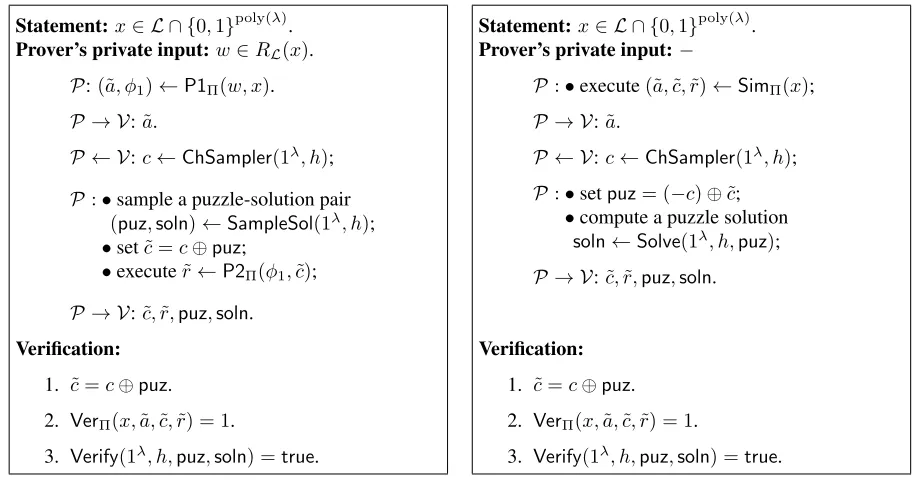
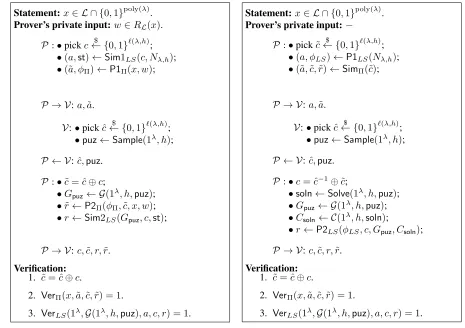
The protocol(P,V)can be executed in either of the two following modes:
1. Proof of Knowledge (PoK) mode: P has a witnessw ∈ RL(x) as private input. In order to prove knowledge ofwtoV, P runsP1ΠandP2Π as described by the original SS-HVZK protocol, with the difference that instead of providingP2Πwith the challengecfromVdirectly,
P runs the puzzle sampler algorithm to receive a pair of a puzzle and its solution,(puz,soln), computes the value˜c=c⊕puzand runsP2Πwith challenge˜c.
2. Proof of Work (PoW) mode: P has no private input and tries to convince V that it has per-formed a minimum amount of computational “work” (i.e. at least some expected number of steps). To achieve this,P runsSimΠto simulate a transcript of the original SS-HVZK protocol. Then, it receives the challengecfromV and computes the valuepuz = (−c)⊕˜c. It runs the Solvealgorithm on inputpuz, and ifpuz is a puzzle inPSλ (which, as we argue later, must occur with high probability), then it obtains a solutionsolnofpuz, except for some negligible error.
Statement:x∈ L ∩ {0,1}poly(λ).
Prover’s private input:w∈RL(x). P:(˜a, φ1)←P1Π(w, x). P → V:˜a.
P ← V:c←ChSampler(1λ, h);
P:•sample a puzzle-solution pair
(puz,soln)←SampleSol(1λ, h);
•set˜c=c⊕puz;
•executer˜←P2Π(φ1,c˜); P → V:˜c,˜r,puz,soln.
Verification:
1. ˜c=c⊕puz. 2. VerΠ(x,˜a,˜c,r˜) = 1.
3. Verify(1λ, h,puz,soln) =true.
(a) Knowing the witness (PoK)
Statement:x∈ L ∩ {0,1}poly(λ).
Prover’s private input:−
P :•execute(˜a,˜c,r˜)←SimΠ(x); P → V:˜a.
P ← V:c←ChSampler(1λ, h);
P :•setpuz= (−c)⊕˜c;
•compute a puzzle solution soln←Solve(1λ, h,puz);
P → V:˜c,r,˜ puz,soln.
Verification:
1. ˜c=c⊕puz. 2. VerΠ(x,˜a,c,˜ ˜r) = 1.
3. Verify(1λ, h,puz,soln) =true.
(b) Doing work (PoW)
Figure 1: The Dense Puzzle Based PoWorK Construction for fixed security parameterλ and pre-determined hardness factor h ∈ HSλ, given a 3-move-SS-HVZK protocol Π for language L and
a dense samplable puzzle system PuzSyssatisfying that PSλ ⊆ CSλ = CSΠ; ChSampler is the challenge sampling algorithm overCSλ.
the SS-HVZK protocol is accepting and (iii) the prover has output a correct pair of a puzzlepuzand some solutionsolnofpuz. The protocol(P,V)is presented in detail in Figure1.
3.3 Security of the Dense Puzzle Based Construction.
In order to prove that our protocol satisfies soundness and indistinguishability, we need to assume that the challenge and puzzle distributions satisfy some plausible properties and that the presumed
g-hardness of the puzzle system dominates the step complexity of the group operation and challenge sampling algorithms. In detail, we require that:
(A). The challenge and puzzle sampling distributions are statistically close.
(B). The challenge sampling distribution is (statistically)invariantto any group operation, i.e. (a) inverting a challenge sampled fromCSλ and (b) performing⊕operations on some elementx
inCSλ = CSΠand a sampled challenge. Observe that these two assumptions imply that the puzzle sampling distribution is also (statistically)⊕-invariant.
(C). With high probability, the number of steps needed forStepsSolve(1λ, h,puz)to solve ag-hard puzzlepuzaccording toPλ,h, scaled to the puzzle hardness functiong, is more than the number
(A). For every hardness factorh∈ HSλ, the r.v.Cλ,handPλ,hare1-statistically close, where1(·)is a
negligible function.
(B). For everyx ∈ CSλ and hardness factorh ∈ HSλ, the r.v. Cλ,h is2-statistically close to the r.v.
x⊕Cλ,h,Cλ,h⊕xandCInvλ,h, where2(·)is a negligible function.
(C). There exists a constantκ <1and a negligible function3(·)s.t. for every hardness factorh∈ HSλ
and everyr, r0 ∈ CSλ
Pr[puz←Sample(1λ, h) :κ·g(Steps
Solve(1λ, h,puz))> >StepsChSampler(1λ, h) +Steps
Inv(r) +Steps⊕(r, r0)]≥1−3(λ),
whereStepsInv,Steps⊕denote the number of steps needed for inversion and group operation inCSλ.
Figure 2: Assumptions for our Dense Puzzle Based PoWorK Construction, whereCλ,handPλ,hare
the challenge sampling and the puzzle sampling distributions respectively.
The assumptions described are stated formally in Figure 2. Assumptions (A) and (B) can be met for meaningful distributions, widely used in cryptographic protocols. For example, whenCλ,h
andPλ,h are close to uniform, it is straightforward that assumption (A) holds. Moreover, since the
uniform distribution is invariant under group operations, we have that assumption (B) also holds. The assumption (C) is expected to hold for any meaningful cryptographic puzzle construction. Indeed, if solving a puzzle is believed to be hard (on average) within a bounded amount of stepsT, then performing efficient tasks, such as group operations or sampling a challenge in the space where this puzzle belongs must be feasible in a number of steps much less thanT.
We prove that our dense puzzle based construction is a PoWorK, assuming (A),(B) and (C), the
g-hardness ofPuzSysand the soundness and ZK properties of the original SS-HVZK protocol. The soundness of our protocol is in constant relation with the hardness ofPuzSys.
Theorem 1 LetLbe a language inN P and letΠ = (P1Π,P2Π,VerΠ)be a special-sound 3-move statistical HVZK protocol forL, where the challenge sampling distribution is uniform. LetPuzSys= (Sample,SampleSol,Solve,Verify)be a dense samplable puzzle system that satisfiesg-hardness for some functiong. Define(P,V)as the protocol described in Figure1when built uponΠ,PuzSysand assume that (A),(B),(C) in Figure2hold. Then,(P,V)is a (1−κ)/2·g-soundPoWorK forLand PuzSyswith statistical indistiguishability, whereκis the constant defined in assumption (C).
Proof:
Completeness. By the completeness ofΠ and the correctness of PuzSys, the dense puzzle based PoWorK construction is complete in the case thatP executes the PoK mode of the protocol. Regard-ing the PoW mode, an honest execution ofPuzSysis incorrect, only if either of the two following cases is true:
(i). puz= (−c)⊕˜c∈ CSλ\ PSλ, i.e. puzis not a puzzle. By assumptions (A), (B) in Figure2, this happens with negligible probability, since
∆[ Pλ,h,Cλ,h]≤1(λ)∧∆[Cλ,h,CInvλ,h⊕˜c]≤2·2(λ)⇒
⇒∆[Pλ,h,CInvλ,h⊕˜c]≤1(λ) + 2·2(λ),
(ii). puz is a puzzle, but the puzzle solver algorithm Solve does not output a solution for puz. Namely, we have thatVerify(1λ, h,puz,soln) =false. By the completeness property ofPuzSys, this also happens with negligible probability.
Therefore,(P,V)achieves completeness with high probability, as required in Definition2.
(1−κ)/2·g-Soundness. First, we make use of the special soundness PPT extractorKΠofΠto construct a knowledge extractorKthat on input(x, y, z, h)and given the code of an arbitrary prover
ˆ
P, executes the following steps:
1. By applying standard rewinding, K interacts with Pˆ(y) for statement x and auxiliary in-putz, using two challenges c1, c2 sampled from Cλ,h and receives two protocol transcripts
h˜a1, c1,(˜c1,r˜1,puz1,soln1)iandh˜a1, c2,(˜c2,r˜2,puz2,soln2)i.
2. KrunsKΠon input(x,h˜a1,˜c1,r˜1i,h˜a1,˜c2,r˜2i).
3. Kreturns the output ofKΠ.
SinceKΠis a PPT algorithm,Kalso runs in polynomial time.
Assume that for somex∈ {0,1}poly(λ),y∈ {0,1}∗, z ∈ {0,1}∗
,h∈ HSλ, there exists a prover
P∗ and a non-negligible functions(·)s.t
Pr[puz←Sample(1λ, h);outV ← hP∗(y)↔ Vi(x, z, h) : (outV = accept)∧
∧StepsP∗(hP∗(y)↔ Vi(x, z, h))≤ (1−κ)/2
·g(StepsSolve(1λ, h,puz))]≥s(λ).
We construct an algorithmW that makes use ofP∗to break theg-hardness ofPuzSys. The input thatW receives ish(x, y, z),1λ, h,puzi, where(x, y, z)is the auxiliary input andpuzsampled from Sample(1λ, h). Then,W executes the following steps:
1. It samplesc1 by runningChSampler(1λ, h).
2. It interacts withP∗(y)for statementx, auxiliary inputz, hardness factorhand challengec1. It receives the transcripth˜a1, c1,(˜c1,r˜1,puz1,soln1)i.
3. It computes the inverse ofpuz, denoted by(−puz).
4. It computesc2 = ˜c1⊕(−puz).
5. It rewindsP∗ at the challenge phase and providesP∗ with challengec2. It receives a second transcripth˜a1, c2,(˜c2,r˜2,puz2,soln2)i.
6. It returns the valuesoln2.
By the assumption forP∗and the splitting Lemma, we have that whenP∗is challenged with two honestly selectedc1, c2, it outputs two accepting transcripts by running in no more than (1−κ)/2
Assume that Equal happens with at least s(λ)2/8 probability. We will show that this case leads to a contradiction; namely, W will output a solution of puz while running in no more than
g(StepsSolve(1λ, h,puz))steps, hence breaking theg-hardness ofPuzSys.
We observe that for anypuz, if both transcripts generated by the interaction withP∗are accepting and the values˜c1,c˜2 are equal, then we have that
c2 = ˜c1⊕(−puz)
∧(˜c2=c2⊕puz2)∧(˜c1 = ˜c2)⇒puz2= −(−puz)
=puz,
where the second equality holds due to verification step 1. Therefore, it holds that
Verify(1λ, h,puz2,soln2) =true⇔Verify(1λ, h,puz,soln2) =true. (1)
By the assumptions (A),(B) in Figure2, we have that there are negligible functions1(λ), 2(λ) s.t. for anyc˜1 thatP∗returns,
∆[˜c1⊕CInvλ,h,˜c1⊕PInvλ,h]<21(λ) and ∆[Cλ,h,˜c1⊕CInvλ,h]<22(λ),
where in the first and second inequality, we applied assumptions (A) and (B) respectively two times (one for inversion and one for⊕operation). Therefore, by the triangular inequality we have that
∆[Cλ,h,c˜1⊕PInvλ,h]<21(λ) + 22(λ). (2)
Eq. (2) implies that the probability distribution of c2 = ˜c1⊕(−puz)thatW computes is[21(·) +
22(·)]-statistically close to the challenge sampling distribution ofV. By construction, the running time ofW (in number of steps) is at most
2·StepsP∗(hP∗(y)↔ Vi(x, z, h))+Steps ((−puz)))+Steps(˜c1⊕(−puz))+StepsChSampler(1λ, h).
By assumption (C) in Figure2, there is a negligible function3(·)and a constantκ <1s.t.
Pr[puz←Sample(1λ, h) :κ·g(StepsSolve(1λ, h,puz))<StepsChSampler(1λ, h)+
+Steps((−puz)) +Steps(˜c1⊕(−puz))]≤3(λ). (3) WhenEqualoccurs, then it holds that
StepsP∗(hP∗(y)↔ Vi(x, z, h))≤ (1−κ)/2
·g(StepsSolve(1λ, h,puz)),
hence by the assumption forP∗and Eq. (2), (3), the probability that the running time ofWis bounded by
StepsW(1λ,(x, y, z), h,puz)≤
≤2·StepsP∗(hP∗(y)↔ Vi(x, z, h)) +κ·g(StepsSolve(1λ, h,puz))≤
≤(2· (1−κ)/2
)·g(StepsSolve(1λ, h,puz)) +κ·g(StepsSolve(1λ, h,puz)) = =g(StepsSolve(1λ, h,puz)),
is at leastPr[Equal]− 21(λ)+22(λ)+3(λ)
. By Eq. (1) ,(2), (3), and the assumptionPr[Equal]≥ s(λ)2/8, we have that for auxiliary tape(x, y, z)and hardness factorh:
Pr
puz←Sample(1λ, h);
soln∗ ← W(1λ,(x, y, z), h,puz) :
Verify(1λ, h,puz,soln∗) =true ∧
∧StepsW(1λ,(x, y, z), h,puz)
≤g(StepsSolve(1λ, h,puz))
≥s(λ)2/8− 21(λ) + 22(λ) +3(λ)
which contradicts to theg-hardness ofPuzSys, ass(λ)2/8− 21(λ) + 22(λ) +3(λ)
is a non-negligible function. Therefore, it holds thatPr[Equal]≤s(λ)2/8which implies
Pr[¬Equal]≥s(λ)2/8. (4)
By the construction ofKand the special soundness property of Π, we have thatK will return a witness forx wheneverKΠis provided with different˜c1,c˜2. Defineq(λ) = s(λ)2/8. By Eq. (4), whenKis given oracle access toP∗it holds that
Pr[KP∗(x, y, z, h)∈RL(x)] = Pr[¬Equal]≥q(λ). Thus, we conclude that our protocol is (1−κ)/2·g-sound.
Statistical Indistinguishability.Assume that the protocol described in Figure1does not satisfy the PoWorK indistinguishability property in Definition2. Then, for some(x, z, h)there exists a verifier
V∗that w.l.o.g. outputs a single bit and can distinguish between:
DVPoK∗ = {viewV∗← hP(w)↔ V∗i(x, z, h)} and
DVPoW∗ = nviewV∗ ← hPSolve(1
λ,h,·)
↔ V∗i(x, z, h)o.
with non-negligible advantageη(λ).
In the following, we will show that if such aV∗ exists, then we can construct an adversary B
who breaks the statistical (auxiliary input) HVZK property of the underlying 3-move protocolΠ = (P1Π,P2Π,VerΠ). This means thatBcan distinguish between:
DΠ=
n
(˜a, φ1)←P1Π(w, x); ˜c $
← CSΠ; ˜r ←P2Π(φ1,˜c) : (˜a,c,˜ ˜r)
o
and
DSim={(˜a,˜c,r˜)←SimΠ(x,(z, h)) : (˜a,˜c,r˜)}
with some non-negligible advantageη0(λ), where(z, h)is the auxiliary input. Namely, Btakes as input(x,(z, h),(˜a,˜c,r˜)), and works as follows:
1. InvokesV∗with inputx, z, hand first move message˜a. 2. V∗responds back with his challengec.
3. Bcomputespuz= (−c)⊕˜cand runsSolveon input(1λ, h,puz)to receive backsoln.
4. Bsends(˜c,r,˜ puz,soln)toV∗. 5. BreturnsV∗’s outputb∗.
By construction ofB, what is left to argue is thatpuz= (−c)⊕c˜andsoln←Solve(1λ, h,puz)
are indistinguishable from a pair(puz0,soln0)that was picked by SampleSol(1λ, h). We study the following two cases:
1. B’s input is sampled according toDΠ: By the assumption (B) in Figure2and for anycreturned byV∗, we have that:
where we applied (B) two times (one for inversion and one for⊕operation). By assumption (A), we have that
∆[Cλ,h,Pλ,h]< 1(λ).
By the triangular inequality, we have that for the distribution ofpuz= (−c)⊕˜c, it holds that
∆[Pλ,h,CInvλ,h⊕c˜]< 1(λ) + 22(λ).
By the statistical indistinguishability property ofPuzSys(Definition1), we have that the dis-tribution {soln ← Solve(1λ, h,puz) : soln} is 4(λ)-statistically close to the distribution
{(soln0,puz0) ← SampleSol(1λ, h) : soln0}, for some negligible function4. Consequently, the probability distribution of puz thatB computes is [1(λ) + 22(λ) +4(λ)]-statistically close to the puzzle sampling distribution.
2. B’s input is sampled according toDSim: in this case, it is straightforward thatBsimulates
per-fectly thePoW mode of the PoWorK protocol.
By the above and given that the probability of success ofV∗is at leastη(λ), we have that
Pr[(˜a,c,˜ ˜r)←DΠ:B(x,(z, h),˜a,˜c,r˜) = 1]−
−Pr[(˜a,˜c,r˜)←DSim:B(x,(z, h),a,˜ c,˜ ˜r) = 1] ≥
≥
Pr[viewV∗ ←D
V∗
PoK :V ∗
(viewV∗) = 1]−(1(λ) + 22(λ) +4(λ))−
− Pr[viewV∗ ←DV ∗
PoW :V∗(viewV∗) = 1]
≥
≥
Pr[viewV∗←D
V∗
PoK :V ∗
(viewV∗) = 1]−
− Pr[viewV∗ ←DV ∗
PoW :V∗(viewV∗) = 1]
−(1(λ) + 22(λ) +4(λ))
≥
≥η(λ)− 1(λ) + 22(λ) +4(λ)
.
Therefore,Bis successful in breaking the statistical HVZK property of the underlying 3-move SS-HVZK protocol with non-negligible advantageη0(λ) =η(λ)− 1(λ) + 22(λ) +4(λ)
. This leads us to the conclusion that the protocol in Figure1is a PoWorK with statistical indistinguishability.
2 Remark.Theorem1can be extended to encompass the case where the protocolΠto be compiled in the construction described in Figure1achievesT(λ)-computational HVZK, i.e. it is HVZK for every verifierBwhich runs inT(λ)steps. Specifically, in the indistinguishability proof the running time of the HVZK adversaryBis (in number of steps) bounded by:
StepsV∗(h(P1Π,P2Π)(w), VerΠ(˜c)i(x, z, h))+
+StepsInv(c) +Steps⊕((−c),˜c) +StepsSolve(1λ, h,puz).
3.4 Dense Puzzle Instantiation in the Random Oracle Model
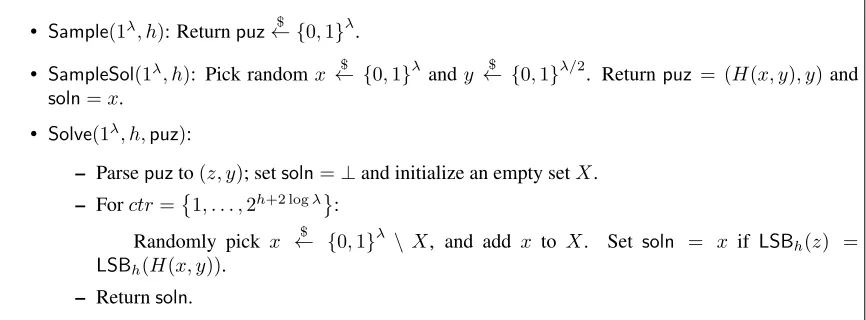
We now instantiate a dense puzzle system in the random oracle model. For a given security parameter
λ, let O : {0,1}∗ 7→ {0,1}m be a random oracle, where m ≥ λ/2. Our dense puzzle system is described in Figure3.
DefinePSλ={0,1} λ
,SSλ={0,1} λ
, andHSλ= [log2λ, λ/4]. LetH(·) :=LSBλ/2(O(·)), whereLSBk
stands forkleast significant bits.
• Sample(1λ, h): Returnpuz← {0$ ,1}λ.
• SampleSol(1λ, h): Pick randomx ← {0$ ,1}λ
andy ← {0$ ,1}λ/2. Returnpuz = (H(x, y), y)and soln=x.
• Solve(1λ, h,puz):
– Parsepuzto(z, y); setsoln=⊥and initialize an empty setX.
– Forctr=1, . . . ,2h+2 logλ :
Randomly pick x ← {0$ ,1}λ \ X, and add x to X. Set soln = x if LSBh(z) =
LSBh(H(x, y)).
– Returnsoln.
• Verify(1λ, h,puz,soln): Parsepuzto(z, y). Returntrueif and only ifLSB
h(z) =LSBh(H(soln, y)).
Figure 3: The Dense Puzzle System from the Random OracleO.
Theorem 2 Let λ ∈ Z+ be the security parameter. Define PS
λ = {0,1}λ, SSλ = {0,1}λ, and HSλ = [log2λ, λ/4]. Let O be a random oracle mapping from {0,1}∗ to {0,1}m, where
m ≥ λ/2. For anyh ∈ HSλ, the puzzle system PuzSysdescribed in Figure 3is correct, complete withSolve’s running time2h+2 logλ, efficiently samplable, statistically indistinguishable, andg-hard, where g(T) = T1/c, for any constant c > 2. In addition, for any k that is O(2λ/8), PuzSysis
(id(·), k)-amortization resistant, whereid(·)is the identity function.
Proof:
Correctness and efficient samplability. The correctness and efficient samplability is straightfor-ward.
Completeness.We now show the completeness, namely the probability thatPr[puz← {0$ ,1}λ;⊥ ←
Solve(1λ, h,puz)]is negligible inλ. We can view eachH(·, y)oracle query as an independent random
variable Aj ∈ {0,1}, with E[Aj] = p = 2−h, where Aj = 1 if and only ifLSBh(H(x∗j, y)) =
LSBh(z). Letµdenote the expected value ofA=P2
h+2 logλ
j=1 Aj, so we haveµ=E[P2
h+2 logλ
j=1 Aj] =
P2h+2 logλ
j=1 E[Aj] =p·2h+2 logλ = 22 logλ =λ2. Hence, letδ= 1− 1
λ2, by the generalized Chernoff
bound, the probabilitySolveoutputs⊥for a givenpuzis
Pr[A <1] = Pr[A <(1−δ)µ]≤e−δ 2µ 2 =e−
(1−1/λ2)2 2 ·λ
2
Statistically indistinguishability. To show∆[Ds,λ,h, Dp,λ,h] =negl(λ), we first need to show that
for allλandh ∈ HSλ, the distributionP(λ, h) = puz|(puz,soln)←SampleSol(1λ, h) of sam-pled puzzle is statistically close to a uniform distribution over thePSλ = {0,1}λ. Recall thatpuz consists of H(x, y) and y, where x,y are chosen independently and uniformly at random. Analo-gous to the leftover hash lemma (LHL) [HILL93], we can show that∆[P(λ, h),Uλ] ≤2−λ/4+1as
follows. We define the collision probability asCP(H(x, y), y) = Pr[(H(x, y), y),(H(x0, y0), y0)], where(x0, y0) is independent of and identically distributed to(x, y), i.e. Uλ ×Uλ/2. SinceOis a random oracle, we have
CP(H(x, y), y) = CP(y)·(CP(x) + Pr[H(x, y) =H(x0, y)|x=x0]) ≤ 2−λ/2·(2−λ+ 2−λ/2) = (1 + 2−λ/2)·2−λ .
Meanwhile, we have
(k(H(x, y), y)−Uλ/2×Uλ/2k2)2 = CP(H(x, y), y)−CP(Uλ/2×Uλ/2)
≤ (1 + 2−λ/2)·2−λ−2−λ = 2−3λ/2 .
Therefore,
∆[P(λ, h),Uλ] =
1
2k(H(x, y), y)−Uλ/2×Uλ/2k1 ≤ 2λ/2−1· k(H(x, y), y)−Uλ/2×Uλ/2k2
≤ 2λ/2−1·p2−3λ/2= 2−λ/4+1 .
Secondly, due to that fact thatOis a random oracle, the distribution ofpuzandsolnare independent. Moreover, theSolveis probabilistic algorithm that tests the uniform randomly selected solution can-didates, and thus it is obvious thatSolve(1λ, h,puz))outputs a randomsolnfrom the solution set of puz, which is identically distributed to the solutionsolnin(puz,soln)← SampleSol(1λ, h). There-fore, we have the distance∆[Ds,λ,h, Dp,λ,h] =negl(λ)as claimed.
g-hardness. First of all, although the adversary’s auxiliary input isz ∈ {0,1}∗ can be arbitrarily long, the adversary is only able to readO(g(2h+2 logλ)) ≤ O(2λ/4) content ofzunder its running
time limitation. Sincey ← {0$ ,1}λ/2, the probability that the read content ofz contains aH(∗, y)
oracle query is at mostpw = 2
λ/4
2λ/2 = negl(λ). In the rest case, we assume that each random oracle
query takes1 unit steps. Due to the property of random oracle, we expect 2λ−h solutions in the solution space{0,1}λfor any given puzzle instancepuz. The probability the adversary cannot find a solution within2(h+2 logλ)/ctrials is
pl=
2λ−2λ−h
2(h+2 logλ)/c
2λ
2(h+2 logλ)/c
>(1−
1
2h−(h+2 logλ)/c)
2(h+2 logλ)/c
≥1−2−(1−2c)h+ 4 clogλ .
Sincec >2andh≥log2λ, we have the probability the adversaryAcan find a solution is
(id(·), k)-amortization resistance. LetAbe an adversary that runs inO(k2(h+2 logλ)/c)steps and is given a set ofksampled puzzlespuz1, . . . ,puzk = (z1, y1), . . . ,(zk, yk). By the construction of the
algorithmSampleSol, we have that the probability that allkvaluesy1, . . . , ykare distinct is
pd= 1·(1−2−λ/2)· · ·(1−(k−1)2−λ/2)>(1−k2−λ/2)k≥1−k22−λ/2≥
≥1−(2λ/8)2·2−λ/2 = 1−2−λ/4 = 1−negl(λ).
Assume that k values y1, . . . , yk are distinct. As in the proof of g-hardness, since A runs in
O(k2(h+2 logλ)/c) =O(2(λ/8+h+2 logλ)/c) =O(2λ/4), for everyi∈[k], the probability thatAreads an oracle queryH(·, yi)from the auxiliary tape ispi ≤2−λ/4. By the union bound, the probability
thatA reads any oracle query H(·, y1). . . , H(·, yk) from the auxiliary tape is pw ≤ Qki=1pi ≤
k2−λ/4 ≤2−λ/8·2−λ/4 ≤2−λ/8=negl(λ).
Let q1, . . . , qk be the number of oracle queries H(·, y1), . . . , H(·, yk) that A makes. By the
restriction on the running time ofA, we have thatPk
i=1qi ≤k2(h+2 logλ)/c. By an averaging argu-ment, there is ani∗ ∈ [k]such thatAmakes at most2(h+2 logλ)/coracle queriesH(·, yi∗). Due to
the property of random oracle, we expect2λ−hsolutions in the solution space{0,1}λ forpuzi∗. As
previously, the probability thatAcannot find a solution of puzi∗ within2(h+2 logλ)/c trials is more
than1−2−(1−2c)h+ 4
clogλ. Sincec >2andh≥log2λ, the probability thatAcan find a solution for
allpuz1, . . . ,puzkisnegl(λ).
2
Remark. We emphasize that the dense puzzle systemPuzSysdescribed in Figure3isτ-amortization resistant with the identity functionτ for simultaneously solving k puzzles {puzi}ki=1, where k =
poly(λ). This is due to the fact that each of thekpuzzles have distinct noncey∈ {0,1}λ/2with high probability, and thus the random oracle query made forpuzi gives no information about the puzzle puzj, for j 6= i. We omit a detailed discussion here and refer to [GJKY13] (Proposition A.2) for similar analysis.
3.5 Dense Puzzle Instantiation From Complexity Assumptions
In this section, we show how to construct a puzzle system whose puzzle instance distribution is statistically close to the uniform distribution (over{0,1}m(λ)) without random oracles. The main challenge is, given an arbitrary oneway functionψ : X 7→ Y, to build another oneway function with uniform output distribution (on random inputs) while still maintaining its onewayness. As an intuition, we would like to first map the output of the given oneway function fromYto{0,1}`using an efficient injective map (which is usually the bit representation ofy ∈ Y), and then apply a strong extractor on it. LetExt:{0,1}`× {0,1}d7→ {0,1}mbe a strong extractor as defined at Definition3.
Definition 3 FunctionExt:{0,1}`× {0,1}d7→ {0,1}mis(t, )-strong extractor if for anyt-source
X(over{0,1}`), we have∆[(S,Ext(X, S)),(S,Um)]≤, whereS
$
← {0,1}dandUm
$
← {0,1}m
are drawn uniformly and independently ofX.
xands, it is computationally infeasible to findx0 such thatx 6= x0 andExt(x, s) = Ext(x0, s). We construct TCR strong extractors fromregular universal oneway hash functions(UOWHFs), initially proposed by Naor and Yung [NY89]. We first formally define the TCR property for a strong extractor in Definition4.
Definition 4 Let Ext : {0,1}`(λ)× {0,1}d(λ) 7→ {0,1}m(λ) be a strong extractor. We say Extis target collision resistant if for all PPT adversaryA, the following probability:
Pr
"
x← A(1λ);s← {0$ ,1}d(λ)
:x0 ← A(s) :
x, x0 ∈ {0,1}`(λ)∧x6=x0∧Ext(x, s) =Ext(x0, s)
#
=negl(λ).
A stronger notion,collision resistant extractors, was introduced by Dodis [Dod05]. Collision resistant extractors were applied to constructperfectly oneway probabilistic hash functionsproposed [CMR98] in 2005. The construction of such collision resistant extractors relies on a variant of leftover hash lemma proved by Dodis and Smith [DS05] that we recap, for completeness, in Lemma1.
Lemma 1 ([DS05]) Letf :{0,1}N 7→ {0,1}mbe an arbitrary function. LetH={Hi|i∈ I}be a pairwise independent hash function family with key spaceI, domain{0,1}nand range{0,1}N. If
Xis at-source over{0,1}nwitht≥m+ 2 log(1/) + 1, then we have
∆[ I, f(HI(X))
, I, f(UN)
]≤
whereI ← I$ andUN
$
← {0,1}N are drawn uniformly and independently ofX.
Our observation is that in the same way that [Dod05] employ regular collision resistant hash func-tions (CRHF) to derive collision resistant strong extractors, we can use regular universal oneway hash function (UOWHF), to obtain TCR strong extractor. The notion of UOWHF was initially proposed by Naor and Yung [NY89] where they showed that UOWHFs can be constructed by composing oneway permutations with (weakly) pairwise independent hash functions. Since then, many constructions of UOWHFs have been proposed, assuming the existence of regular oneway functions [SY90] or any oneway functions [Rom90,HHR+10].5 We recall the definition of UOWHF as Definition5.
Definition 5 A family of functionsFλ =
n
Fi :{0,1}`1(λ)7→ {0,1}`2(λ)|∀i∈ {0,1}λ
o
is a family
of universal oneway hash functions if it satisfies:
• Efficiency: Giveni∈ {0,1}λandx∈ {0,1}`1(λ),F
i(x)can be evaluated in timepoly(`1(λ), λ).
• Compressing:`2(λ)< `1(λ).
• Target Collision Resistance: For all PPTA, the following is negligible inλ:
Pr[x← A(1λ);i← {0$ ,1}λ;x0 ← A(i) : x, x0 ∈ {0,1}`1(λ)
∧(x6=x0)∧ Fi(x) =Fi(x0)
].
(5)
5We note that, on the contrary, CR strong extractors cannot be built from arbitrary oneway functions, since Simon
We would like to useH2n=
H(a,b)(x) =ax+b|∀a6= 0, a, b∈GF(2n) as the family of pair-wise independent permutations and a regular UOWHF familyFλ to construct our TCR strong ex-tractors. DefineFˆi(·) := (Fi(·), i), where Fi ∈ Fλ. Our TCR strong extractor is constructed as
Ext(x,(i, s)) = ˆFi◦Hs(x). Note that regularity of the UOWHFs is important to ensure that the
out-put distribution of such strong extractors is close to the uniform distribution, asFi(U`1(λ))≡U`2(λ).
On the other hand, some UOWHF constructions give regular UOWHFs by default (i.e., the UOWHFs constructed by the oneway permutation based approach [NY89]).
Theorem 3 Let`(λ), m(λ)be polynomials. Let
H2·`(λ)=
n
Hs:{0,1}`(λ) 7→ {0,1}`(λ)|∀s∈ {0,1}2·`(λ)
o
be a pairwise independent permutation family. Assume that
Fλ =
n
Fi:{0,1}`(λ)7→ {0,1}m(λ)|∀i∈ {0,1}λ
o
is a regular UOWHF family. Then,Extλ(x,(i, s)) = (Fi(Hs(x)), i)is a(t, )-TCR strong extractor from{0,1}`(λ)× {0,1}λ+2·`(λ)to{0,1}λ+m(λ), for any constantt≥m(λ) +λ+ 2 log(1/) + 1.
Proof:
LetFˆi(·) := (Fi(·), i). If H∞(x) = t ≥ m(λ) +λ+ 2 log(1/) + 1, by Lemma 1, we have
∆[(s,Fˆi◦Hs(x)),(s,Fˆi(U`(λ)))] ≤ . In addition,iis drawn uniformly from{0,1}λ, andFi is a
regular function; henceFi(U`(λ)) ≡ Um(λ), and thus Fˆi◦Hs(x) is statistically indistinguishable
fromUm(λ)×Uλ. Therefore, weconclude thatExtλ(x,(i, s)) = (Fi◦Hs(x), i) is a(t, )-strong
extractor. In terms of the TCR property, we show that if there exists an adversaryAwho can break the TCR of Extλ, then we can build an adversaryB who can break the TCR of Fλ as follows. B
is playing the UOWHF TCR game, meanwhile B interacts with Aas the challenger in the strong extractor TCR game. Up onAoutputsx ∈ {0,1}`(λ), thenB randomly pickss ∈ {0,1}2·`(λ) and outputsxˆ:=Hs(x)∈ {0,1}`(λ)to its challenger. Up on receivingi∈ {0,1}λfrom its challenger,B
sends(i, s)toA. Up onAoutputsx0 ∈ {0,1}`(λ),Boutputsxˆ0 :=Hs(x0)∈ {0,1}`(λ). SinceHs(·)
is a permutation, x 6= x0 impliesHs(x) 6= Hs(x0). Clearly, B’s probability of breaking UOWHF
TCR property is exactly equal toA’s probability of breaking strong extractor TCR property.
2
3.5.1 Dense Oneway Functions and Dense Puzzles from Complexity Assumptions.
We apply a TCR strong extractor for our construction. The key to the construction will be a “dense” oneway function: a oneway function is-denseoneway if its output distribution is at most-far from Umfor somem∈ Z+. We now present a transformation of a one-way function to a dense one-way
Theorem 4 Let λ1, λ2 ∈ Z+ be the security parameters. Let ψλ1 : Xλ1 7→ Yλ1 be an arbitrary
oneway function, and defineHλ1 = H∞(ψλ1(X)) for random variable X drawn uniformly from Xλ1. Assume there exists an efficient injective mapζλ1 :Yλ1 7→ {0,1}
`(λ2). If
Extλ2(x,(s1, s2)) :{0,1}
`(λ2)× {0,1}λ2+2·`(λ2)7→ {0,1}Hλ1−2 log(1/)−1
is a(Hλ1, )-TCR strong extractor, then
ψUλ1,λ2(x, s1, s2) = (Extλ2(ζλ1(ψλ1(x)),(s1, s2)), s2)
is an-dense oneway function with range{0,1}2·`(λ2)+Hλ1−2 log(1/)−1and domainX
λ1×{0,1}
λ2+2·`(λ2).
Proof: The -density of ψλU
1,λ2 follows directly from the underlying(Hλ1, )-strong extractors, and
by Theorem3,
∆[(Extλ2(ζλ1(ψλ1(x)),(s1, s2)), s2),(UHλ1−2 log(1/)−1, s2)]≤ .
We now show ψλU
1,λ2 is oneway by reduction. Namely, if there exists an adversary A who can
break the onewayness of ψUλ
1,λ2 then we can construct an adversary B who can either break the
onewayness of ψλ1 or break the TCR of Extλ2. During the reduction, B plays the ψλ1
oneway-ness game with the environmentC1 and the Extλ2 TCR game with the environment C2
simulta-neously. B receives y = ψλ1(x) for some x ∈ Xλ1 from C1, and then B outputs ζλ1(y) to C2.
Upon receiving (s1, s2) ∈ {0,1}λ2 × {0,1}2·`(λ2) from the environment C2, B sends A the im-ageψUλ1,λ2(x,(s1, s2)) = (Extλ2(ζλ1(y),(s1, s2)), s2). A will then output(x
0,(s0
1, s02)) ∈ Xλ1 × {0,1}2·`(λ2), and Bhalts if (s
1, s2) 6= (s01, s20), asA fails. Otherwise, ifψλ1(x
0) = y, Bsends x0 to the environmentC1; else B sends ζλ1(ψλ1(x
0))to the environment C2. Since ζ
λ1 is injective, ψλ1(x
0) =yimpliesζ
λ1(ψλ1(x
0)) =ζ
λ1(y); hence, ifAwins,Bcan win either one of her games.
2 The above result paves the way for constructing dense puzzles from complexity assumptions. Essentially, given a function with moderately hard characteristics making it suitable for a puzzle, it is possible to transform it to a dense puzzle by applying a suitably hard TCR extractor (“suitable” here means that breaking the TCR property should be harder than solving the puzzle). We now illustrate this methodology by applying it to the discrete logarithm problem. More generally this methodology transforms any puzzle in the sense of Definition1to a dense puzzle (assuming again a suitably hard TCR extractor).
3.5.2 The DLP Based Puzzle and Calibrating Its Hardness.
Consider the discrete logarithm problem (DLP) as the candidate oneway function for our puzzle. Let
G = hGi be some (multiplicative) cyclic group where the DLP is hard, andGis a generator with
orderp, which is aλ1-bit prime. The oneway function ψG : Zp 7→ Gis defined asψG(x) = Gx.
It is shown by Shoup [Sho97] that any probabilistic algorithm takesΩ(√p) steps to solve the DLP over generic groups. Analogously, [GJKY13] shows any probabilistic algorithm must take at least
√
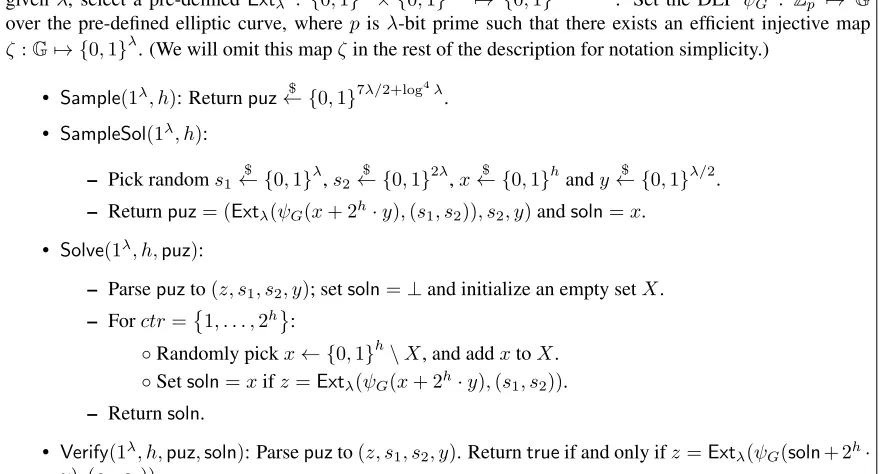
DefinePSλ = {0,1}
7λ/2+log4λ
,SSλ = {0,1}
log4λ
, andHSλ = [log4λ+ log2λ+ 1,log5λ]. For the
givenλ, select a pre-defined Extλ : {0,1} λ
× {0,1}3λ 7→ {0,1}λ+log4λ. Set the DLPψG : Zp 7→ G
over the pre-defined elliptic curve, wherepisλ-bit prime such that there exists an efficient injective map ζ:G7→ {0,1}λ. (We will omit this mapζin the rest of the description for notation simplicity.)
• Sample(1λ, h): Returnpuz← {0$ ,1}7λ/2+log4λ
.
• SampleSol(1λ, h):
– Pick randoms1 $
← {0,1}λ,s2 $
← {0,1}2λ,x← {0$ ,1}handy← {0$ ,1}λ/2.
– Returnpuz= (Extλ(ψG(x+ 2h·y),(s1, s2)), s2, y)andsoln=x.
• Solve(1λ, h,puz):
– Parsepuzto(z, s1, s2, y); setsoln=⊥and initialize an empty setX. – Forctr=
1, . . . ,2h :
◦Randomly pickx← {0,1}h\X, and addxtoX.
◦Setsoln=xifz=Extλ(ψG(x+ 2h·y),(s1, s2)). – Returnsoln.
• Verify(1λ, h,puz,soln): Parsepuzto(z, s
1, s2, y). Returntrueif and only ifz=Extλ(ψG(soln+ 2h·
y),(s1, s2)).
Figure 4: The Dense Puzzle System From DLP.
example, for a puzzle with hardness factorh≤ bλ1−1
2 c, we pickx∈ {0,1}
h
andy∈ {0,1}b(λ1−1)/2c
uniformly at random, and set the puzzle as(Extλ2(ψG(x+ 2
h ·y),(s
1, s2)), s2, y). We assume the calibrated DLP is still moderately hard with respect to the min-entropy ofx. Note that a similar assumption was used by Gennaro to construct a more efficient pseudo-random generator [Gen00]. It is easy to see that this assumption holds for DLP in generic groups, i.e. givenψG(x+ 2h·y)andy,
the best generic algorithm must take at least
√
2h+1steps to solve DLP with probability. We note that this problem is closely related to leakage-resilient cryptography [AM11,ADVW13].
On the other hand, due to the out-layer extractor, we cannot directly adopt any known (generic) DLP algorithms, such as [GTY07,GPR13]. Instead, our puzzle solver just exhaustively searches for a valid solution. There is a subtle caveat, namely the expected running time of solving a puzzle with
hardness factorh, i.e. x ← {0$ ,1}h is designed to be2h, whereas the TCR property of UOWHF is
only guaranteed against PPT adversaries with respect toλ2 (the security parameter of the UOWHF). To address this issue, we introduce an additional assumption, that is the expected running time of any adversaryA(in number of steps) can break the TCR property of the underlying UOWHF with
non-negligible probability on x ← {0$ ,1}h is ω(2h/2), (i.e. breaking TCR is expected to happen after the birthday paradox bound). The dense puzzle system from DLP (combining with TCR strong extractors) is depicted in Figure4.
Theorem 5 Let λ ∈ Z+ be the security parameter and h ∈ [log4λ+ log2λ+ 1,log5λ]be the hardness factor. LetExtλ : {0,1}λ × {0,1}3λ 7→ {0,1}λ+log
4λ
that the expected running time of any adversaryAthat breaks its TCR property with non-negligible probability onx ← {0,1}h isω(2h/2). AssumeψG : Zp 7→ Gis a hard DLP in generic groups
such that the best generic algorithm must take at least
√
2h+1εsteps to solve it with probability ε. The puzzle systemPuzSys = (Sample,SampleSol,Solve,Verify) described in Figure 4 is correct, complete withSolve’s running time2h, efficiently samplable, statistically indistinguishable, andg -hard, whereg(T) =T1/cfor any constantc >2. In addition, for anykthat isO(2log3λ),PuzSysis
(id(·), k)-amortization resistant, whereid(·)is the identity function.
Proof:Correctness and efficient samplability.Correctness and efficient samplability is straightfor-ward.
Statistically indistinguishability.We now show that the puzzle system is statistically indistinguish-able. Recall thatpuzconsists ofExtλ(ψG(x+ 2h·y),(s1, s2)), s2, y, wheres1, s2, yare chosen inde-pendently and uniformly at random. Hence(s1, s2, y)is identically distributed toUλ×U2λ×Uλ/2. Since H∞(x) = h ≥ log4λ+ log2λ+ 1 and ψG is a bijective function, by Theorem 4, the
puz = (Extλ(ψG(x + 2h ·y),(s1, s2)), s2, y) is at most = 2−(log
2λ−1)/2
= negl(λ) far from Uλ+log4λ ×U2λ ×Uλ/2, where (s1, s2) ← {0$ ,1}3λ and y ← {0$ ,1}λ/2 are drawn uniformly
random and independent tox. On the other hand, as shown in the paragraph below, the puzzle sys-tem is complete. Notice that the solver is probabilistic, soSolve(1λ, h,puz))outputs a randomsoln from the solution set ofpuz, which is identically distributed to the solution solnin (puz,soln) ←
SampleSol(1λ, h). Therefore,∆[Ds,λ,h, Dp,λ,h] =negl(λ)as claimed.
Completeness.Since the puzzle instance is statistically indistinguishable from uniform random, with
probability at most= 2−(log2λ−1)/2 = negl(λ)a puzzlepuz ← {0$ ,1}h is unsolvable; otherwise, theSolvecan be used to distinguish the puzzle instance from uniform random. It is easy to see that the solver’s running time is2h.
g-hardness. In terms of g-hardness, the adversary is able to read at mostO(2log5λ)content of its
auxiliary tapezwithin its running time, whereas(s1, s2) $
← {0,1}3λ andy ← {0$ ,1}λ/2; therefore, the probability thatzcontains aExtλ(ψG(x∗+ 2h·y),(s1, s2))query for somex∗is negligible inλ. In the rest case, recall that we assume breaking the TCR property of strong extractor is always harder than solving the generic DLP. The best generic algorithm must take at least
√
2h+1εsteps to solve a hard generic DLP with probabilityε. Therefore, given2h/c, c > 2, the adversary can successfully solve the generic DLP with probability at mostε= 2−(1−2c)h−1 =negl(λ).
(τ, k)-amortization resistance. Define the set ofksampled puzzles as puz1, . . . ,puzk = (z1, y1),
. . . ,(zk, yk). By the construction of the algorithmSampleSol, we have that the probability that all
y1, . . . , ykare distinct is
pd= 1·(1−2−λ/2)· · ·(1−(k−1)2−λ/2)>(1−k2−λ/2)k ≥1−k2·2−λ/2 = 1−negl(λ).
Assume thatkvaluesy1, . . . , ykare distinct. As shown in [Yun15], the probability that an
adver-saryAcan solve thekpuzzles with less thanΘ(√k·2h)group operations is negligible. Hence, there
exists a constantα >0such that, with1−negl(λ)probability, we haveStepsA(z,1λ, h,{puz1}ki=1)≥