ISSN 2348 – 7968
Effect of different irrigation methods using treated wastewaters on the
distribution of traces elements on two different soil textures
Khaskhoussy Khawla1,2, Kahlaoui Besma1, Jozdan Omar3, Abdullah Dakheel4, Hachicha Mohamed1 1
National Institue of Rural Engineering, Waters and Forest, 17 rue Hédi Karray, BP n°10 Ariana 2080, Tunisia.
2
National Institute of Agronomic of Tunis.
3
Arab Center of Studying Arid Lands and Dry Areas, Damascus, Syria
4
International Center for Biosaline Agriculture (ICBA)
Corresponding author: [email protected]
Abstract
Treated wastewaters (TWW) reuse for irrigation contributes to reduce water scarcity in semi arid and arid regions. However, this reuse needs adapted management in order to avoid environmental and health risks. A greenhouse pot experiment was carried out to evaluate the effect of irrigation methods using TWW on distribution of trace elements (TE) in sandy and clay soil textures. Two water qualities were used: TWW and fresh water and four irrigation methods are used: surface irrigation (SI), sprinkler irrigation (SPI), drip irrigation (DI) and subsurface drip irrigation (SDI). A maize crop was cultivated. This paper is limited to the trace elements content on soils. Chemical analyses were done on soils and water (pH, EC, Fe, Mn, Ni, Cu, Co and Pb). The results indicated a significant increase on EC, Mn, Cu, Fe and Pb with TWW for the four irrigation methods in comparison to the fresh water. The pH value, Ni and Co concentrations did not statistically differ among the different treatments. Accumulation of TE in clay soil was higher than in sandy soil. The results indicated that drip and subsurface drip irrigation could reduce soil contamination in comparison with surface and sprinkler irrigation
Keywords: methods, TWW, sandy soil, clay loam soil,
Traces elements, Tunisia..
1. Introduction
In arid and semi arid regions, fresh water is becoming scarcer and is being allocated with priority for urban water supply. Therefore, the reuse of unconventional water resources as the wastewater for agricultural irrigation can reduce the amount of water that needs to be extracted from environmental water sources [1].
Wastewater irrigation not only provides substantial amounts of beneficial nutrients as N, P and organic matter (OM) to the soil but also toxic TE, which are creating both opportunities (oligo-elements) and risk for agricultural production (Toxic elements) [2-5]. One of the issues that
attracted the attention of many researchers is the fate of chemical and TE found on wastewater especially those which can penetrate into soil, plant and finally food chain [6]. Trace elements represent a portion of important environmental pollutants which can slowly accumulate up to critical levels [7].
Since wastewater is considered as a non-ordinary source of water, its application require an appropriate management which has to have no threat to the environment, plants, soils and surface or subsurface water resources. In addition, many studies indicate that the wastewater resources traditionally classified as unsuitable for irrigation can be used successfully to grow crops without long-term hazardous consequences to crops and soils if proper management strategies are established [8]. These strategies, include adopting advanced irrigation technology, selecting appropriately tolerant crops, choice of soil texture [9-12] and appropriately irrigation methods that may influence the response of the soil to irrigation with TWW [13].
Several studies have documented the impacts of wastewater use on soil chemical properties; some involve flood irrigation [14, 15], furrow irrigation [16, 17] sprinkler application [18, 19] and surface (DI) or subsurface drip irrigation (SDI) [20, 21].
ISSN 2348 – 7968
way, other researchers investigated the effect of municipal effluent using two irrigation methods reported that the most important concern was the increase of EC in top soil layer and a decrease of Pb with SDI [1, 23].
The four basic methods of irrigation are surface or gravity irrigation, sprinkler irrigation, drip and subsurface drip irrigation. Sprinkler irrigation throws water through the air to simulate rainfall whereas the three other methods apply the water directly to the soil, other on or below the surface [24]. Most of the previous papers evaluated the effects of wastewater and on chemical properties of the soil when using one, two or three irrigation methods. But a little information is available on the impact of wastewater on TE accumulation using four different methods of irrigation. In this study, we propose to evaluate the effects of irrigation methods using TWW on accumulation of TE in soil. This study involved the application of TWW and fresh water (FW) on two different soil textures and compared the TE status under the four irrigation methods.
2. Material and Methods
2.1 Experimental design
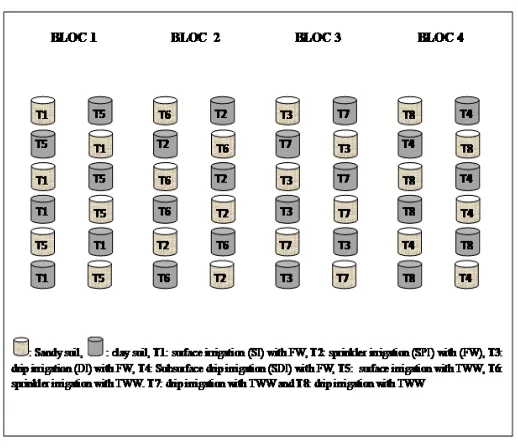
The study was carried out in greenhouse during summer from June to August 2011. The experiment was a factorial completely randomized design arranged on four blocks and consisted of eight treatments including two soil textures: sandy soil (SS) and clay soil (CS), two water qualities: treated wastewater (TWW) and fresh water (FW), and four irrigation methods: surface irrigation (SI), sprinkler irrigation (SPI), drip irrigation (DI) and subsurface drip irrigation (SDI). Thus, eight treatments were applied: T1: SI with FW, T2: SPI with FW, T3: DI with FW, T4: SDI with FW, T5: SI with TWW, T6: SPI with TWW, T7: DI with TWW and T8: SDI with TWW. For each treatment, there were 3 replicate pots leading to a total of 48 pots (Figure 1).
The TWW used in this experiment was from the wastewater treatment plant of Choutrana in North of Tunis city.
Fig. 1: Experimental design
The same amount of water was applied to all treatments 40 times and water samples were collected periodically during the experimental period (3 months) and the chemical characteristics are described below (Table 1).
Table 1: Chemical properties of fresh water (FW) and treated wastewater (TWW).
water pH EC1 Co2 Cu2 Pb2 Ni2 Fe2 Mn2
FW 8.06 1.36 0.02 0.017 0.08 0.03 0.08 0.02
TWW 7.73 3.78 0.04 0.190 0.10 0.05 0.13 0.04
1: dS/m, 2: mg/l
2.2.
Soil sampling and chemical analysis
The characteristics of two soil types were determined at the beginning of the study (Table 2).
Table 2: Initial characteristics of the two soil textures (trace elements were in mg kg-1)
soil pH EC1 Co2 Cu2 Pb2 Ni2 Fe2 Mn2
sandy 8.56 30.1 15.5 41.1 90.2 22.6 57.6 24.9
clay 8.78 5.50 30.9 19.2 430 56.9 93.8 52.4
ISSN 2348 – 7968
At the end of the study, soil samples were taken from three random points on each pot. Thirty six soil samples were taken in each treatment and 144 soil samples were taken in total. The samples were prepared by being air dried and sieved for chemical measure.
Soil EC was measured by a conductivity meter on soil saturated paste extract and pH was measured by a pH meter on mixture soil and water (1/2.5). The total traces elements concentration of soil samples were determined by digesting of dried soil samples with HF-HClO4 mixture.
The procedure based on acid digestion induced by microwave energy was optimized in order to measure the total TE contents in soils. Each soil sample (1 g) was placed in a Teflon vessel (100 mL) with HF (10 mL) and HClO4 (5 mL) and then digested in a microwave. After
that, 70 ml of perchloric acid was added to the mixture. After digestion, the samples were filtered and transferred into 100 ml volumetric flasks and brought to volume of 100 ml by added of distilled water. The filtrate was analyzed by atomic absorption for the determination of the following: Mn, Cu, Fe, Pb, Co and Ni (ISO 14869-1 (2001)).
2.3.
Statistical analyses
Data were statistically analyzed by using the Duncan test at the 5% significance level. Data analysis was done using SPSS software.
3.
Results
3.2.
Soil pH and EC
The soil EC and pH in the eight treatments were presented and compared in Table 3. Minimum EC for both soils equal to 1.44 dS m-1 for sandy soil and 1.94 dS m-1 for clay soil were recorded in T4 (SDI with FW), and maximum EC equal to 4.13 dS m-1 and 5.80 dS m-1, respectively, were related to T5 (SI with TWW).
Result for pH in both soils, showed no significant (p < 0.05) effect on pH status due to TWW use under different irrigation methods (T1, T2, T3, T4) as compared to fresh water (T5, T6, T7, T8).
Table 3: TWW effects on pH and EC of two soil texture under different irrigation methods
Treatment
parameters
pH EC
Soil texture Soil texture
Sandy clay Sandy clay
T1 8.60 a 8.75 b 2.39 d 3.30 d
T2 8.61 a 8.77 b 1.85 bc 3.28 d
T3 8.58 a 8.75 b 1.66 ab 2.15 b
T4 8.56 a 8.77 b 1.44 a 1.94 a
T5 8.40 a 8.71 b 4.13 f 5.80 g
T6 8.41 a 8.72 b 3.09 e 5.13 f
T7 8.48 a 8.70 b 2.58 d 3.45 d
T8 8.47 a 8.71 b 2.08 c 2.84 c
All values are the mean of nine repetitions (n=9) and bars with different letters are significantly different at P ≤ 0.05 according to Duncan test..
3.3.
Copper (Cu)
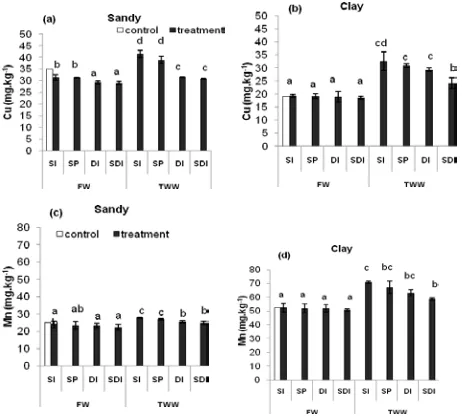
The results for Cu, in both soils showed a significant increase under different irrigation methods with TWW (T5, T6, T7 and T8) as compared to those with FW (T1, T2, T3 and T4). Among the TWW treatment, the highest Cu levels equal to 41.49 and 32.60 mg kg-1 for respectively sandy (SS) (Fig. 2a) and clay soil (CS) (Fig. 2b) were recorded in T5 and the lowest equal to 29.80 and 24.12 mg kg-1 were observed with T8 (Fig. 2).
Figure 2: Accumulation of Cu and Mn in two soil textures under different treatments (all values are the mean of nine repetitions (n=9) and bars with different letters are significantly different at P ≤ 0.05 according
ISSN 2348 – 7968
3.3.
Manganese (Mn)
As seen in the Figure 2, the irrigation methods with TWW (T5, T6, T7 and T8) had a significant (p < 0.05) effect on Mn accumulation in both soil textures as compared to those with FW (T1, T2, T3 and T4). The highest Mn levels were obtained with T5 and T6 treatments. It was, also shown the accumulation of this element in clay texture (Fig. 2d) was more important than in sandy texture (Fig. 2c).
3.4.
Iron (Fe)
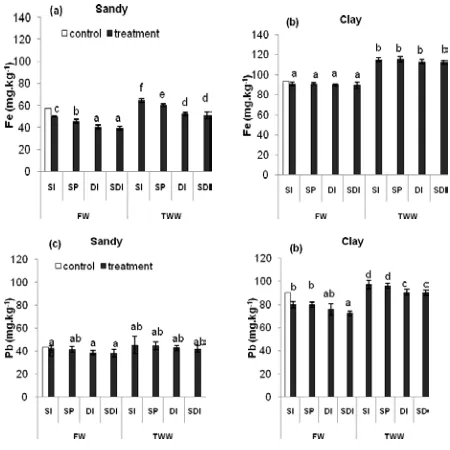
As shown in Figure 3 (Fig. 3a and 3b), Fe content in both textures was significantly (p<0.05) affected by TWW irrigation under different irrigation methods (T5, T6, T7 and T8). Furthermore, Fe accumulation under T5, T6, T7 and T8 in comparison with T1, T2, T3 and T4 treatments are much higher in clay than in sandy texture and the highest increase in Fe level by 21% was obtained with T5.
3.5.
Lead (Pb)
According to the Figure 3, in the case of sandy soil (Fig. 3c), there were no significant differences (p<0.05) in Pb (Fig. 3d) soil accumulation due to TWW use or irrigation methods. While, in the case of clay soil, the results showed that Pb amount in TWW irrigated soil exhibited 19% higher than those in FW irrigated soil. In this way, Pb soil accumulation was unaffected by irrigation methods.
Figure 3: Accumulation of Fe and Pb in two different soil textures among different treatments (all values are the mean of nine repetitions (n=9) and bars with different letters are significantly different at P ≤ 0.05 according to Duncan test).
3.6.
Nickel (Ni)
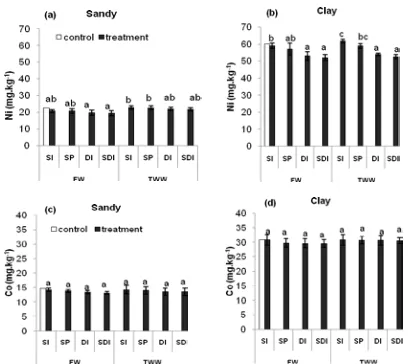
The results from different treatments for Ni level showed a significant increase under different irrigated method (p<0.05) in TWW irrigated soil in comparison with FW irrigated soil (Fig. 4). This statement was shown only for clay soil (Fig. 4b). Indeed, the highest Ni concentration of 61.00 mg kg-1 was obtained with T5 and the lowest Ni concentration of 57.47 mg kg-1 was obtained with T8. For sandy soil (Fig. 4a), except the slight increase shown with T5 treatment, there were no significant difference in Ni concentrations under different irrigation methods with TWW as compared to those with FW.
Figure 3: Accumulation of Fe and Pb in two different soil textures among different treatments (all values are the mean of nine repetitions (n=9) and bars with different letters are significantly different at P ≤ 0.05 according to Duncan test).
3.7.
Cobalt (Co)
Based on analysis of variance, result for Co content in two different soil textures (Fig. 4c and 4d) showed that there were no significant differences (p<0.05) between Co concentrations among different treatments (T1, T2, T3, T4, T5, T6, T7 and T8) (Fig. 4).
4.
Discussion
ISSN 2348 – 7968
Figure 4: Accumulation of Ni and Co among different treatments (all values are the mean of nine repetitions (n=9) and bars with different letters are significantly different at P ≤ 0.05 according to Duncan test).
agricultural soils through wastewater irrigation may not only result in soil contamination, but also affect food quality and safety [26-28]. Therefore alternative irrigation management as choice of soil texture and/or irrigation methods should be developed to overcome the problems associated with TWW irrigation. This further experiment was designed to study the effects of the four irrigation methods (S, SP, DI and SDI) using TWW on accumulation of six selective trace elements as Cu, Fe, Mn, Pb, Co and Ni in two different soil textures. The evidences provided by this study indicated that TWW caused increase of EC and this is in line with findings of Rusan et al. [29], Jahantigh [30], Khai et al. [31] and Mojiri and Hamidi [28]. The increase of EC in soil under SI and SPI methods was higher than under DI and SDI methods and the same result were observed by Tabatabaei and Najafi [32] when testing effects of irrigation with two water qualities (TWW and fresh water) under furrow, drip irrigation and subsurface drip irrigation on soil properties. They concluded that soil EC was reduced relative to the initial conditions by using the fresh water and the SDI treatment. As for pH, no significant effects of TWW was shown for this element in soil and this statement was shown for different irrigation methods, which is similar to results reported by Alhands et al. [33]. Some investigations showed that irrigation with wastewater decreased soil pH. The reason is likely due to the decomposition of organic matter and production of organic acids in soils irrigated with wastewater [24, 28, 31]. Other studies showed that the soil irrigation with wastewater increased soil pH [29, 35]. Most of these investigations described the long term impact of irrigation with wastewater effluents on soil properties.
Results for Cu, Mn and Fe showed a significant increase of these elements in both soil textures with TWW. Our results were corroborated with these obtained by other researchers [29, 30, 43, 36]. In this way, Rusan et al. [29] reported that accumulation of micronutrients and TE as a result of wastewater could be caused directly by the wastewater composition or indirectly through the increasing solubility of the indigenous insoluble soil TE as a result of the chelation or acidification action of the applied wastewater. As for Pb and Ni, the significant effect of TWW had only shown in clay soil. However, no significant effect of TWW on the amount of Co compared to FW was shown in both soil textures.
Based on our result, the irrigation methods with TWW treatments were significantly affected the Cu, Mn and Fe levels. However, no significant effect was observed for Pb, Ni and Co. The higher TE levels were obtained with surface and sprinkler irrigation as compared to DI and SDI irrigation. In addition, the highest TE level was obtained under surface irrigation with TWW and the lowest one was obtained under SDI. Similarly, Oron et al. [20] and Najafi [37] when testing the impact of municipal wastewater on chemical soil properties showed that soil contamination is reduced when using SDI.
The combination of irrigation methods, water quality and soil texture affected significantly the soil trace metal status. Indeed, the trace metal accumulation in soil decreased in order SI<SPI<DI<SDI. In general terms, irrigation methods with TWW lead, to build up of significant amount of toxic trace elements on heavier textured soil. While, this significant amount can be reduced under the different irrigation methods with TWW in the case of sandy textured soil.
5.
Conclusion
ISSN 2348 – 7968
Acknowledgements
This study was carried out under the INRGREF/ACSAD-ICBA regional project for TWW use in Arab agriculture and the national PISEAU II project for TWW and Sludge use in agriculture.
References
1. Heidarpour M, Mostafazadeh-Fard B,
AbediKoupai J ,Malekian R (2007) The effects of treated wastewater on soil chemical properties using subsurface and surface irrigation methods. AgricWater Manag 90: 87-94.
2. Chen Y, Wang C, Wang Z, (2005) Residues and source identification of persistent organic pollutants in farmland soils irrigated by effluents from biological treatment plants. Environ. Int 31: 778-783.
3. Singh KP, Mohan D, Sinha S, Dalwani R, (2004) Impact assessment of treated/untreated wastewater toxicants discharged by sewage treatment plants on health agricultural and environmental quality in the wastewater disposal area. Chemosphere 55: 227-255.
4. Kiziloglu FM, Turan M, Sahin U, Kuslu Y,
Dursun A (2008) Effects of untreated and treated wastewater irrigation on some chemical properties of cauliflower (Brassica olerecea) L. var. botrytis) and red cabbage (Brassica olerecea L. var. rubra) grown on calcareous soil in Turkey. Agric Water Manag 95: 716-24.
5. Xu, J., Wu, L.; Chang, A. C.; Zhang, Y, 2010. Impact of long-term reclaimed wastewater irrigation on agricultural soils: A preliminary assessment. J. Hazard. Mater 183: 780-786. 6. Ashworth DJ, Alloway BJ (2003) Soil mobility of
sewage sludge–derived dissolved organic matter, copper, nickel and zinc. Environ Poll, 127, 137-144.
7. Yadav RK, Goyal B, Shamara RK, Dubey SK,
Minhas PS (2002) Post-irrigation impact of domestic sewage effluent on composition of soils, crops and ground water – a case study. Environ. Int. 28: 481-486.
8. Asgari K, Najafi P, Soleymani A, Larabi R (2007) Effects of Treated Municipal Wastewater
onGrowth Parameters of Corn in
DifferentIrrigation Conditions. J Biol Sci 7: 1430-1435.
9. Phene CJ, Davis KR, Hutmacher RB, McCormick R.L (1987) Advantages of subsurface drip
irrigation for processing tomatoes. Acta Hortic 200: 101-113
10. Ayars JE, Phene CJ, Hutmacher RB, Davis KR, Schoneman RA, Vail SS, Mead RM (1999) Subsurface drip irrigation of row crops: a review of 15 years of research at the Water Management Research Laboratory. Agric Water Manage 4: 21-27.
11. Pereira L, Oweis ST, Zairi A, (2002) Irrigation management under water scarcity. Agric. Water Manage 57: 175-206.
12. Assadian NW, Di Giovanni GD, Enciso J, Iglesias J, Lindemann W (2005) The transport of waterborne solutes and bacteriophage in soil subirrigated with a wastewater blend. Agric Ecosyst Environ 111: 279-291.
13. Bhardwaj AK, Goldstein D, Azenkot A, Levy GJ (2007) Irrigation with treated wastewater under two different irrigation methods: Effects on hydraulic conductivity of a clay soil. Geoderma 140: 199-206.
14. Waly TM, Abd Elnaim EM Omran MS, El
Nashar BM (1987) Effect of sewage water on chemical properties andheavy metals content of El Gabal El Asfar sandy soil.Biol. Wastes 22 (4):264-275.
15. Liu F, Mitchel CC, Odom JW, Hill DT, Rochester EW (1998) Effects of swine lagoon effluent application on chemical properties of a loamy sand. Bioresour Technol. 63: (1) 54–73.
16. Hinrichs DG, Mazurak AP, Swanson NP (1974) Effect of effluent from beef feedlots on physical and chemical properties of soil. Soil Sci Am Proc 38 (4): 661-663.
17. Ramirez-Fuentes E, Lucho-Constantino C,
Escamilla-Silva E, Dendooven L (2002) Characteristics and carbon andnitrogen dynamics in soil irrigated with wastewater for different lengths of time. Bioresour Technol 85: 179–187.
18. Meli S, Porto M, Belligno A, Bufo SA,
Mazzatura A, Scopa A (2002) Influence of irrigation with lagooned urban wastewater on chemical and microbiological soil parameters in a citrus orchard under Mediterranean condition. Sci Total Environ 285: 69–77.
19. Amin M, Zahra A, (2011) Effects of Urban
Wastewater on Accumulation of Heavy Metals in Soil and Corn (Zea mays L.) with Sprinkler Irrigation Method. Asian J Pl 10: 233-237.
20. Oron G, Demalach Y, Gillerman L, David I, Rao VP (1999) Agric Water Manage 39: 19-33.
21. Hassanli AM, Mahmood J, Yusof S, (2008)
ISSN 2348 – 7968
and evaluation the effect on soil properties in a semi-arid area. Environ Monit Assessment 144: 151-158.
22. Pescod MB (1992) Waste water treatment and use in agriculture. FAO, irrigation and drainage Paper No 47: 118p.
23. Najafi P, Nasr S, (2009) Comparison effects of wastewater on soil chemical properties in three irrigation method. Res Crops 10: 277-280.
24. Scherer T (2010) Selecting a sprinkler irrigation system. NSDU Extension service North Dakota State University Farg : 4.
25. Harunur RMD, Nazmul H, Mohosena BT,
Rawshan P, Zahid PS, Shahidur RMD, Yahia M, (2012) Heavy Metal Pollution and Chemical Profile of Khiru River, Bangladesh. Int. J. Environ 2 (1): 57-63.
26. Muchuweti M, Birkett JW, Chinyanga E, Zvauya R, Scrimshaw MD, Lester JN (2006) Heavy metal content of vegetables irrigated with mixture of wastewater and sewage sludge in Zimbabwe: implications for human health. Agric Ecosyst Environ 112: 41-48.
27. Khan S, Cao Q, Zheng YM, Huang YZ, Zhu YG (2008) Health risks of heavy metals in contaminated soils and food crops irrigated with wastewater in Beijing, China. Environ Poll 152: 686-692.
28. Mojiri A, Hamidi AA (2011) Effects of municipal wastewater on accumulation of heavy metals in soil and wheat (TrticumAestivum L.) with two irrigation methods Romanian Agric Ressour 28: 2067-5720.
29. Rusan MJ, Hinnawi S, Rousan L (2007) Long
term effect of wastewater irrigation of forage crops on soil and plant quality parameters. Desalination 215: 143-152.
30. Jahantigh M (2008) Impact of Recycled
Wastewater Irrigation on Soil Chemical Properties in an Arid Region.Pakistanian J Biol Sci 11: 2264-2268.
31. Khai NM, Tuan PT, Vinh CN, Oborn T (2008) Effects of using wastewater as nutrient sources on soil chemical properties in peri-urban agricultural systems. VNU J Sci Earth Sci 24: 87-95.
32. Tabatabaei SH, Najafi P (2009) Effects of
irrigation with treated municipal wastewater on soil properties in arid and semi-arid regions. Irrig. Drain. J. 58 (5): 551-560
33. Alhands MN, Allick SA, Overman AR, Leseman WG, Vidak W (1995) Municipal water reuse at Tallahassee.Florida Trans. ASAE 38 (2): 411-418.
34. Vaseghi S, Afyuni M, Shariatmadari H, Mobli M (2005) Effect of sewage sludge on some nutrients concentration and soil chemical properties. J. Isfahan Water Wastewater 53: 15-19.
35. Rattan RK, Datta SP, Chhonkar PK, Suribabu K Singh AK (2005) Long-term impact of irrigation with sewage effluents on heavy metal content in soils, crops and groundwater-a case study. Agric Ecosys Environ 109 (3-4): 310-322.
36. Abedi-Koupai J, Mostafazadeh-Fard B, Afyuni M, Bagheri M.R (2006) Effect of treated wastewater on soil chemical and physical properties in an arid region. Soil Environ 52: 335-344.