Review of VANET Mobility Models with New
Cluster Based Routing Protocol
Nisha V. Jadhav
ME Student, Department of Computer Science,
SKNSIT's Sinhgad collage Of Engineering, University of Pune, Pune-511052, India.
Abstract-As we know that MANET and vehicle technology is growing and hence becoming the emerging field for most of researchers. Recently, new routing protocol proposed by some authors in order to overcome the problem of discovering and maintaining the efficient and effective route for the data transmission over the wireless network. At first stage of this research we are presenting investigation of that new approach of routing called cluster based routing for VANET and compare their performances with existing routing protocols. This new routing approach having aim of increasing the overall network throughput, minimize end to end delay. In this review paper we are aiming to take survey of cluster based new routing protocol for VANET, survey of mobility models used, and finally the comparative analysis of different existing VANET routing protocols.
Keywords: VANET, Road based routing, reactive routing protocols, proactive routing protocols, broadcasting based protocols, cluster based routing protocols
I. INTRODUCTION
Vehicular networks (VANET) attract a lot of attention in the research world. IPv6 support is needed in vehicular ad hoc network (VANET) with geographical routing. Geographic routing in vehicular ad hoc network (VANET) is becoming an interesting topic to deliver safety messages between cars but also between a car and a roadside infrastructure within a designated destination area. Static and dynamic cluster heads are dependable for synchronization between the nodes inside their clusters, and between the clusters [1]. Periodic re-clustering can choose nodes with longer journey occasion and extra number of stops similar to buses act as cluster heads. Network lifetime is extended through (i) choosing the best pathway with smallest intrusion of nodes, (ii) periodic updating in cluster head about the routing and cluster information’s, and (iii) routing from side to side the nodes with normal velocity of nodes. In this job, we present a separate cluster based approach that considers a hybrid and dynamic mobility model. Based on this approach, we present a Location based Multipath Flooding algorithm, which have three prime goals: (i) reducing delay, (ii) prolonging network lifetime by 2-hop cache, and (iii) maximal data delivery ratio at high mobility [2] [3].
Clustering was planned as a helpful device for locating the destinations. The difficulty that we address has sole necessities that differentiate it from the energy based load-balancing difficulty in distributed systems. Real-time communication protocols are inappropriate in an urban
mobility model, since we will not develop any normal and monotonous scenarios. In a total scattered system like VANET, each node can do something as a resource or a spread node, which motivates they require for resourceful algorithms to choose servers according to the outlined system goals. Every vehicle must stores the information interrelated to the cluster inside the broadcast variety of source node. In our model, a fixed number of dynamic and static sources are recognized to each vehicle of the organization, and a static source is eternally accessible for processing huge quantity of data [4]. Receiver-oriented approach has been planned where numerous nodes can decide to retransmit the message, leading to collisions and/or bandwidth wastage. Every node waits for a random delay before sending the message, except if a neighbor already present. At elevated mobility situation every nodes shift fast and it’s extremely hard to calculate the positions through the source. Because of extremely dynamic neighbors this process is not appropriate for transmitting emergency/alert messages. In our integrated approach the information pertaining to travel is maintained in both sources, smaller time in dynamic source and longer period in static sources for upcoming purpose. If the space between two cluster head nodes is found to be a smaller amount than the threshold, the cluster with fewer members is dismissed to decrease communication overheads and its members join other clusters. During high mobility situation the procedure of reclustering increases the communication rate. Locating the place of nodes, relative rate predictions and effective communication distance among nodes according to mobility are dealt in our approach [5].
ripple free clusters are used for maintaining steady vehicular infrastructure and inter cluster routing. Therefore network can adaptively regulate its dominant routing method based on its mobility features [6]. Our clustering scheme works well in a dynamic atmosphere because it does not need frozen period of motion for initial cluster configuration. Therefore it is more suitable for urban environments where vehicles change their speed and direction normally. Vehicular networks are frequently deployed by the constraint of roadways where trees and buildings control the practical transmissions as compared to open fields [7]. Vehicle nodes with low relative rate are assigned to the same cluster to tighten the association in such a cluster [8].
As in this research work we are about to present the investigation work over clustering approach for routing of VANET networks for more efficient performance. Hence it is more suitable for urban environments where vehicles change their speed and direction frequently. Vehicular networks are often deployed by the constraint of roadways where trees and buildings influence the practical transmissions as compared to open fields. Vehicle nodes with low relative speed are assigned to the same cluster to tighten the connection in such a cluster. In below section II we are first presenting the investigation study of cluster based routing protocol, after that in section III review of new cluster based routing algorithms discussed, in section IV review of mobility models presented, finally in section V we are presenting the comparative study of VANET routing protocols in brief.
II. INVESTIGATION OF CLUSTER BASED ROUTING
The features of static and dynamic clustering are combines mutually to build Cluster based Routing. Static sources situated at the street signals are used to outline static clusters. Static Cluster head is too recognized as Street corners and congested places [3] [4].
In this cluster based approach buses are selected as dynamic sources. These buses are having the predefined path and time graph. The predefined path and time graph to grip the elevated mobility situations known as dynamic cluster head. Hierarchical clustering creates layering surroundings. That layering surroundings contains some of the major challenges in such ad hoc networks. Top layer completed up of static cluster head, middle layer completed up of dynamic cluster head and lower layer consists of ordinary vehicles. Network topology also changes since of highly dynamic vehicles. This in turn affects the presentation of the network. Then it may also appeal to protocol mechanisms to act in response to such dynamics. Malfunctions in routing are responded by using Mobility alertness in topology. For cluster structure there are some mobility metrics in categorize to form a constant cluster structure thereby decreasing its influence on cluster topology. Structural design of the cluster is determined by using the Vehicles Mobility performance. Vehicles are differentiated in two dissimilar ways whichever by those vehicles which are in the communication ranges of dynamic sources or else by those vehicles which are in the ranges of static sources mounted at traffic signals and road
junctions. By differentiating vehicles into group so, the re-affiliation and re-clustering rate can be logically decreased. Based on the following parameters (VID, LID, s, VLT) we defined in Algorithm 1 dynamic clustering attempts to partition a number of nodes into multi-hop clusters. The each vehicle node in a cluster has its individual distinctive VID and Location ID representing the road in an exacting area of the city it belongs. The symbol ‘s’ indicates the rate of the vehicle and VLT indicates the vehicles life time in a exacting cluster over some time with the probability of p, D despite of the hop distance between them. The main purpose is to support robust and well-organized routing, and adaptively regulate and execute its dominant routing scheme depending on the network mobility manner.
In dynamic clustering scheme, clustering scheme requires no periodic re-clustering. When a vehicle enters into the clustering zone its sole VID is registered into the cluster head and becomes a part of that cluster. By sending out CJReq message any unclustered vehicle joins a cluster. The dimension of the cluster may be affected by Mobility, low mobility increases the size of the cluster compared to high mobility, leading to increase in the number of clusters. A Vehicle having a convincing VID can link the cluster and its speed is also an significant characteristics, if any further new vehicle other than ambulance or rescue vehicle enters into the cluster with more than an average rate then it is not necessary to renew it all over the place. Behind a convinced period of time if a vehicle does not take delivery of a response message, it will creates a fresh cluster for that vehicle and it will become the start for itself, even behind that it will send and receive message to turn out to be a cluster member or it will carry on as a cluster head [6] [7].
In the current case, every vehicle separately runs clustering and routing scheme with no any backing of other neighboring members. Therefore, accuracy is maintained still during high mobility. Each vehicle broadcasts organize messages once entering into the cluster region.
The algorithm CJM (Cluster Join Messages) is appropriate for a network with high mobility for cluster construction, where mobility of vehicles affects the cluster topology. Cluster configuration is only depends on CJM and not by any other messages so expenses are avoided; similar to the thought proposed in [10]. Before passing the data the vehicle enters into a cluster region it periodically broadcasts CCM (Cluster Connect Messages), As soon as it receives the response it will start data transmission.
reply information(r), including the VID, CID, distance, speed and Direction. Hence, for cluster formation each vehicle needs to send out (n+r) messages.
Throughout cluster building phase, should think how to reduce the amount of clustering-related communication exchanged for the cluster formation. From time to time every unclustered vehicle seeks a cluster to connection behind transfer CJM messages infrequently, and creates a single node cluster to cover itself when there is no right cluster to join. A too-small cluster, while, may create vast number of clusters and thus increase the distance end to end of hierarchical routes, substantial in longer end-to-end stoppage. To maintain away from this, two clusters are integrated based on cluster head speed and by choosing slow rate cluster head as new head [9]. In our no overlapping multihop structure, data communication is stretchier and do not have a skip limit between two neighboring cluster heads.
III. REVIEW OF NEW VANET ALGORITHMS
Here the first algorithm which is related to the multipath flooding case for VANET is presented below:
Algorithm 1: Location based Multipath Flooding Parameters
CJReq –Cluster Join Request
CJRep –Cluster Join Reply CJReq (SVID, IMVID, DVID, VC)
CJRep (DVID, IMIID, SVID, VC) CVID-Current Vehicle ID DV-Destination Vehicle DVID-Destination Vehicle ID IMVID-Intermediate Vehicle ID NV-Number of Vehicles NVID-Neighbor Vehicle ID SP-Shortest Path
SVID-Source Vehicle ID VC- Vehicle counter VID-Vehicle ID VD-Vehicle Distance At Source
a) flood (CJReq) all Immediate Neighbors (NVID) b)VC = # (NV)
for each relay node {
for each CJReq received {
if new NVID =old NVID drop (RREQ) to avoid repition if (current node(CVID = DVID) then DVID is set to nodes id else
{
i)CJReq to IMVID add(CVID) ii)Find VC1 = # (NV) }
At Destination
For each CJReq received, send (CJRep) to source If (speed>thresholdspeed)
update only VID in Cluster head else
sort(CJRep IMVID)
update details of vehile to all nodes At source {
till(timestamp< threshold time) {
link = SORT(CJRep IMVID) for each link
{
find SP= MIN(CJRep VC) send (data) to DV through SP }
SORT(CJRep IMVID) for each IMVID in CJRRep {
calculate VD
SORT( IMVID) in ascending order of VD calculate SP # elements whose VD store all VID in an array in each cluster }
The VANET research is deception on the progress of vehicular to vehicular announcement system that enables suitable, stable and the inexpensive allotment of data for the safety and for the console on the Road. The Dynamic topologies containing highly dynamic nodes will be the reason the collision on wireless medium. Therefore packet delays and losses occur frequently. Each node of VANET acts as a router to transmit the message during the network. Consequently, VANET must be a scattered multi-hop network with a time varying
Algorithm 2: Cluster Based Routing (CBR) Parameters
CID- Cluster ID CH - Cluster Head ns - Source Node nd - Destination Node
©2010 International Journal of Computer Applications (0975 - 8887)
Volume 1 – No. 15 35
ni - Intermediate Node tpath - Temporary Path DU-Data Update For a new vehicle if valid CID
receive past information and
make entry into the list register its CID in existing CH choose the CH
new vehicle is either source or relay node if source calculate speed
if CID speed< old CH speed assign(new vechile=CH) start flood(ns,nd,tpath)
Upon receiving flood(ns,nd,tpath) from source Check if (ni==nd) and
if ( tpath length > best path ) { set newpath =tpath
send newroute(nd,ns,newpath) } end if
if no RouteReq then wait until threshold time endif
if any RouteRep received find # of (interference nodes) choose minpath(interference nodes) endif
else
flood (RouteReq) until new route {
hold existing route information upto threshold time t
receiving flood(ns,nd,tpath) from neighbor node if (ni= source)
{
store the path information forward(data)
} else
{ forward newroute(nd,ns,path) }
end if end if
IV. REVIEW OF MOBILITY MODEL
With the new approach of clustering, one new thing which we want to add in this research is Hybrid mobility model
combines which more than a few existing mobility models together. We observed that this model is very much helpful for VANET networks. Mobility creates very dynamic surroundings that pose some of the main challenges in such ad hoc networks. The relative movement among nodes creates or breaks relations and changing the network topology. This in turn affects the presentation of the network and also invokes protocol mechanisms to act in response to such dynamics. Hence, mobility modeling becomes essential to the evaluation and learns of ad hoc networking protocols. Traditional mobility models, random walk, random waypoint, Manhattan model, gauss markov and reference point group mobility model attempt to mimic the movements of vehicle nodes.
V. VANETROUTING PROTOCOLS SUMMARY
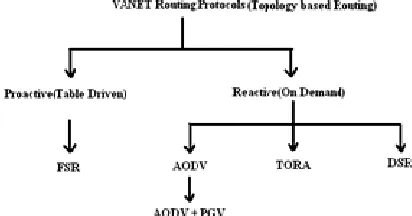
There are two main categories into which VANET routing protocols divided such as position based and topology based routing protocols [11] [12] [13]. Each routing protocol has its own advantages as well as disadvantages. Following figure 1 is showing this categorization.
Figure 1: VANET routing protocols categorization
Apart from these basic two categories, the two other categories also presented such as cluster based and broadcast based routing protocols. Below figure 2 is showing comparative analysis of these four categories of routing protocol.
VI. CONCLUSION AND FUTURE WORK
In this paper we have presented the review of VANET new cluster based routing protocol with new mobility models those are recently presented for improvement in routing performance for VANET networks. We discussed the two algorithms which are used for the performance improvement of routing protocol in VANET. In addition to this we also summarized the comparative study of different existing VANET routing protocols with their characteristics. Basically VANET protocols are divided into four common categories such as proactive, reactive, cluster based and broadcast routing protocols. For the future work, we suggest to work on geographical location based routing protocol with aim of improving the throughput as well as energy consumption.
REFERENCE
[1] James Bernsen, D. Mnivannan, Department of Computer Science, University of Kentucky, Lexington, USA “Unicast routing protocols for vechicular ad hoc networks: A critical comparison and classification”, in journal homepage: www.elsevier.com/locate/pmc Pervasive and Mobile Computing 5 (2009) 1-18
[2] Sascha Schnaufer, Holger Fuisler, Matthias Transier, Wolfgang Effelsberg, “Unicast Ad-hoc Routing in Vehicular City Scnarios“ in “Network on wheels“ project under contract no. 01AK064F and Matthias Transier.
[3] D. Estrin, R. Govindan, J. Heidemann, and S. Kumar, “Next Century Challenges: Scalable Coordination in Sensor Networks,” in Proceedings of the ACM/IEEE International Conference on Mobile Computing and Networking (MOBICOM), August 1999.
[4] Bertrand Ducourthial, Yacine Khaled, and Mohamed Shawky, ”Conditional Transmissions: Performance Study of a New Communication Strategy in VANET”, IEEE Transactions on Vehicular Technology, Vol. 56, No. 6, pp. 3348-3357,Nov 2007. [5] Zhigang Wang, Lichuan Liu, MengChu Zhou, and Nirwan Ansari,” A
Position-Based Clustering Technique for Ad Hoc Intervehicle Communication”, IEEE Transactions on Systems, Man and Cybernetics-Part C: Applications and Reviews, Vol. 38, No. 2, pp. 201-208, March 2008.
[6] Kejun Liu,Jing Deng, Pramod K. Varshney and Kashyap Balakrishnan,” An Acknowledgement-Based Approach for the Detection of Routing Misbehavior in MANETs”, IEEE Transactions on Mobile Computing, Vol. 6, No.5,pp.488-501, May 2007. [7] Jane Y.Yu and Peter H.J. Chong, ”A Survey of Clustering Schemes
For Mobile Ad Hoc Networks”, IEEE Communications & Surveys ,Vol. 7, No.1,pp.32-48,2005.
[8] T.D.C Little and A.Agarwal “An InformationPropagation Scheme for VANETs” Proc of Intelligent Transportation Systems, September 2005 page 155-56
[9] Koabazian,M.Ali Concordia Univ, Montreal “ A Performance Modeling of Connectivity in Vehicular Ad Hoc networks” Vehicular Technology,IEEE Transactions july 2008, Volume 57 Issue 4 Pages:2440-2450.
[10] Nzouonta J., Rajgure N., Wang G., and Borcea C.,” VANET Routing on City Roads using Real-Time Vehicular Traffic Information”, IEEE Transactions on Vehicular Technology, Vol. 58, No. 7., 2009. [11] Shah S., Khandre A., Shirole M. and Bhole G.. “Performance
Evaluation of Ad Hoc Routing Protocols Using NS2 Simulation”, Mobile and Pervasive Computing, CoMPC–2008.