Mediating EU Liberalisation and Negotiating Flexibility:
A Coalitional Approach to Wage Bargaining Change
Andreas Kornelakis
A thesis submitted to the European Institute of the London
School of Economics for the degree of Doctor of Philosophy.
Declaration
I certify that the thesis I have presented for examination for the PhD degree of the London School of Economics and Political Science is solely my own work other than where I have clearly indicated that it is the work of others (in which case the extent of any work carried out jointly by me and any other person is clearly identified in it).
The copyright of this thesis rests with the author. Quotation from it is permitted, provided that full acknowledgement is made. This thesis may not be reproduced without the prior written consent of the author.
Abstract
How do we explain divergent trajectories of change in wage bargaining institutions? The advancement of European economic integration, leading to markets liberalisation and increased competition, was expected to bring the breakdown of centralised bargaining arrangements. This expectation was even stronger given the internationalisation of new management practices, pushing European firms to enhance their competitiveness via increasing flexibility. Despite strong theoretical expectations towards a generalised breakdown of wage bargaining, one finds divergent trajectories of change across European countries and sectors. The task of this thesis is to explain the puzzle of varied responses in otherwise similar sectors. Banking and telecommunications sectors in Italy and Greece display a diversity of paths of institutional change: breakdown of bargaining, reform of bargaining, successful centralisation, and failed centralisation.
Acknowledgments
This thesis is the final destination of a four year journey at the London School of Economics. Luckily, I was not alone in this journey. It is with great pleasure that I write these pages, thanking all those people, who –as fellow travellers– helped me to find my way or made the journey more pleasant and interesting. First and foremost, I would like to express my gratitude to my two supervisors, Kevin Featherstone and Christa van Wijnbergen.
Kevin encouraged me to pursue a PhD from the very first moment I considered applying to the European Institute. During our discussions (either at his LSE office or even in Syntagma square) he shared with me his long experience and broad knowledge, accompanied with pinches of his excellent sense of humour. In every single meeting we had, there was something new for me to learn, constantly maturing as an academic. I always admired how he managed –among his numerous other commitments– to keep track of the ‘big picture’ of the thesis, offering steady guidance and ultimately fulfilling his mentoring role. Some of his comments were surprisingly tough, but they helped me to broaden my horizons and get the best out of me.
Whilst studying at the London School of Economics, I had also the privilege to get advice from brilliant academics. Vassilis Monastiriotis left a permanent mark on my thesis, when he acted as a co-supervisor during the first year. His positivist leaning and insistence on rigour in research shaped my way of thinking in the years that followed. Waltraud Schelkle has been an invaluable teacher in the political economy and research design seminars at the European Institute. Our discussions helped me to understand the nuts and bolts of a PhD that ‘makes a contribution to theory’. Finally, Richard Hyman introduced me to the political economy of industrial relations during my Masters, but kept up offering his time and deep knowledge of the field generously, while commenting on draft chapters.
Needless to say, the thesis has also been shaped by comments from –and discussions with– several academics either at the LSE or elsewhere. Hopping that I will not forget someone, I wish to thank Pepper Culpepper (Harvard/EUI), Ginny Doellgast (LSE), Thomas Fetzer (CEU), Simon Glendinning (LSE), Damian Grimshaw (Manchester), Bob Hancké (LSE), Anke Hassel (Hertie School), Maria Karamessini (Panteion), Maria Koumenta (Cardiff), Guglielmo Meardi (Warwick), Jim Mosher (Ohio State), Jackie O’Reilly (Brighton), Sevket Pamuk (LSE), Marco Simoni (LSE), Paola Villa (Trento), Helen Wallace (LSE) and Chris Warhurst (Sydney).
Andreas, Rebekka, Niclas, Daphne, Stan, Stefania, Panos, Achilleas, Mark, Chiara, Tim, Lior, Katjana, Tine, Margarita, Thanassis, Valentina, Marianna, Max, Ioanna and Ismini.
The European University Institute in Florence and the Athens University of Economics and Business were generous hosts during my fieldwork. Two individuals have been extremely helpful in sharing contacts at a critical stage of the fieldwork: Christos Ioannou and Luigi Lama. Apart from them I would like to thank all the interviewees for offering me their time and their insights. Certainly, the PhD journey would not have been possible without financial support: the Bodossaki Foundation provided me with a three-year scholarship covering maintenance costs, and the LSE offered me four annual studentships to cover tuition fees.
Table of Contents
Abstract...3
Acknowledgments ...4
Table of Contents ...7
List of Tables ...11
List of Abbreviations ...13
Chapter 1 EU Liberalisation, Work Flexibility, and Wage Bargaining Institutions: Explaining Divergent Trajectories of Change...19
1.1. Introduction...19
1.2. The Puzzle: Divergent Trajectories of Change in Wage Bargaining Institutions across Europe ...23
1.3. The Conceptual Frame: Pressures to Wage Bargaining Institutions from Liberalisation and Flexibility ...27
1.4. Preview of the Argument: A Coalitional Perspective on Change of Wage Bargaining Institutions...29
1.4.1. Employer Associability: A Coalition of Small and Large Firms...30
1.4.2. Labour-State Coalition: Labour Unity and Government Agenda ...31
1.5. Research Design...34
1.5.1. Case Selection Criteria...34
1.5.2. Data Collection Method ...36
1.6. Outline of the Thesis ...38
Chapter 2 Institutional Change in Wage Bargaining: Theoretical Framework and Empirical Puzzle...44
2.1. Introduction...44
2.2. Institutional Change Between and Within Advanced Capitalist Countries ...47
2.2.1. Convergence and Divergence across Capitalisms ...47
2.2.2. Varieties of Capitalism: From Comparative Statics to the Dynamics of Change ...50
2.3. The Dynamics of Change in Wage Bargaining Institutions ...54
2.3.1. Wage Bargaining: an Institution that Rests on a ‘Cross-Class Coalition’ ...54
2.3.1.1. Firms’ Benefits from Sectoral Wage Bargaining. ...54
2.3.1.2. Trade Unions’ Benefits from Sectoral Wage Bargaining...55
2.3.1.3. Governments’ Benefits from Sectoral Wage Bargaining ...56
2.3.2. Pressures for Change in Wage Bargaining Institutions ...57
2.3.2.1. External Pressures: Markets Liberalisation and Intensification of Competition ...58
2.3.2.2. Internal Pressures: Introduction of Flexible Working Practices...59
2.4. The Empirical Puzzle ...63
2.4.1. Systemic Pressures to Wage Bargaining Institutions across Europe ...65
2.4.1.1. Single Market and the Liberalisation of European Product Markets ...65
2.4.1.2. The Internationalisation of Flexible Working Practices and their Diffusion in Europe ...67
2.4.2. Divergent Trajectories of Change in Wage Bargaining Centralisation ....69
2.5. Conclusion ...73
Chapter 3 A Coalitional Approach to Wage Bargaining Change ...75
3.1. Introduction...75
3.2. An Alternative Perspective: Collective Actors and Coalitions...76
3.2.1. Employer Associability: A Coalition of Large and Small Firms...77
3.2.2. Labour-State Coalitions: Labour Unity and Government Agenda ...81
3.3. Sector-specific Pressures across European Banking and Telecommunications Industries ...84
3.3.1. The Liberalisation of European Banking ...84
3.3.2. The Internationalisation of Flexible Working in Banking ...86
3.3.3. The Liberalisation of European Telecommunications ...88
3.3.4. The Internationalisation of Flexible Working in Telecommunications ....91
3.4. Conclusion ...93
Chapter 4 The Breakdown of Centralised Wage Bargaining in the Greek Banking Sector...95
4.1. Introduction...95
4.2. The Greek Wage Bargaining System: Continuity and Change...98
4.3. Greek Banking until the 1980s: Oligopoly and State ownership...101
4.4. Greek Banking in the 1990s: State Withdrawal and the Market Unbound...104
4.4.1. EU Liberalisation, Privatisation and Intensification of Competition...104
4.4.2. Restructuring the Banks: Working Time Flexibility, Pay Flexibility and Downsizing...108
4.5. The Representation of Labour and Business...111
4.5.1. Labour: Single Voice despite Internal Divisions ...111
4.5.2. Business: The Lack of Employer Associability...115
4.6. Greek Banking in the 2000s: Tensions and the Breakdown of Centralised Wage Bargaining ...117
4.6.1. A Near Breakdown of Wage Bargaining in the mid 2000s ...117
4.6.2. The Complete Breakdown of Wage Bargaining in the late 2000s...127
4.7. Conclusion ...130
Chapter 5 The Reform of Centralised Wage Bargaining in the Italian Banking Sector ...134
5.1. Introduction...134
5.2. The Italian Wage Bargaining System: Continuity and Change ...137
5.3. Italian Banking until the 1980s: Oligopoly and State ownership ...141
5.4. Italian Banking in the 1990s: State Withdrawal and the Market Unbound...143
5.4.2. Restructuring the Banks: Working Time Flexibility, Pay flexibility and
Downsizing ...147
5.5. The Representation of Labour and Business...151
5.5.1. Labour: Unity despite Fragmentation ...151
5.5.2. Business: From Organisational Fragmentation to Unitary Employer Associability...153
5.6. Italian Banking since the mid 1990s: Tensions and the Reform of Centralised Wage Bargaining ...157
5.6.1. The Path towards the Reform of Centralised Wage Bargaining ...157
5.6.2. Italian Banking in the 2000s: At the Forefront of the ‘New Model’ in the Italian Wage Bargaining System...165
5.7. Conclusion ...168
Chapter 6 The Successful Centralisation of Wage Bargaining in the Italian Telecommunications Sector ...171
6.1. Introduction...171
6.2. Italian Telecoms until the 1980s: Monopoly and State Ownership ...173
6.3. Italian Telecoms in the 1990s: State Withdrawal and the Market Unbound...177
6.3.1. EU Liberalisation, Privatisation and Intensification of Competition...177
6.3.2. Restructuring the Telecoms: Technological Change, Downsizing, and ‘Negotiated’ Flexibility...181
6.4. The Representation of Labour and Business...188
6.4.1. Labour: ‘Single Voice’ despite Organisational Fragmentation ...188
6.4.2. Business: The ‘Privatisation’ of the Employer Associability ...192
6.5. Italian Telecoms in the early 2000s: The Centralisation of Wage Bargaining...195
6.5.1. The Path Towards the Successful Centralisation of Wage Bargaining ..195
6.5.2. Protecting the Outsiders: Outsourcing and the Almaviva Call Centre Group ...203
6.5.3. Negotiating the Restructuring of the Sector: Vodafone and Telecom Italia ...209
6.6. Conclusion ...214
Chapter 7 The Failure to Centralise Wage Bargaining in the Greek Telecommunications Sector ...216
7.1. Introduction...216
7.2. Greek Telecoms until the 1980s: Monopoly and State Ownership ...219
7.3. Greek Telecoms in the 1990s: State Withdrawal and the Market Unbound...223
7.3.1. EU Liberalisation, Privatisation, and Intensification of Competition...223
7.3.2. Restructuring the Telecoms: Technological Change, Employment Flexibility and Downsizing...232
7.4. The Representation of Labour and Business...235
7.4.1. Labour: Divided Unions and Organisational Fragmentation...235
7.4.2. Business: ‘Narrow interests’ Trade Associations and the Lack of Employer Associability...240
7.5.1. The Path Towards the Failure to Centralise Wage Bargaining...243
7.5.2. Protecting Insiders and Excluding Outsiders: OME-OTE vs. the Independent Regulator and Call-centre Employees...248
7.5.3. Negotiating the Internal Restructuring: The State Pays for OTE Downsizing ...253
7.6. Conclusion ...258
Chapter 8 Employer Associability and Labour-State Coalitions: Mediating EU Liberalisation and Negotiating Flexibility...261
8.1. Introduction...261
8.2. Review of the Argument ...263
8.3. Central Empirical Findings ...268
8.4. Testing the Argument in Other Cases ...277
8.5. Implications for Broader Academic Debates ...282
8.5.1. Comparative Political Economy: Liberalisation and the Dynamics of Change in the Mediterranean Model of Capitalism ...282
8.5.2. Comparative Employment Systems: Flexibility, Convergence and Divergence ...286
8.6. Institutional Change in the Mediterranean Capitalism and Wage Bargaining in the Context of the Eurozone Crisis ...288
Annex: List of Author’s Interviews...293
List of Tables
Table 2.1. Product Market Regulation across EU15, 1998 - 2008. ...66
Table 2.2. Percentage of Companies (%) with Flexi-time across EU15, 2009...68
Table 2.3. Percentage of Companies (%) with Employees Receiving Performance related Pay across EU15, 2009...69
Table 2.4. Union Density Rates across EU15, 1990 - 2006...70
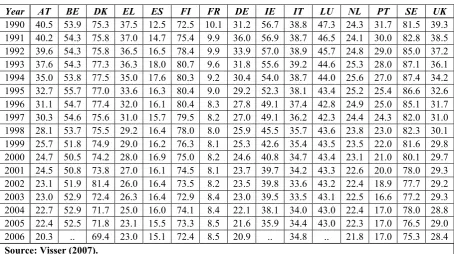
Table 2.5. Wage Bargaining Centralisation across EU15, 1992 - 2006. ...72
Table 3.1. The European Regulatory Impact on Banking in the 1980s & 1990s. 85 Table 3.2. Number of ATMs per 1 mil. Inhabitants across EU15, 1993 - 2009...87
Table 3.3. The European Regulatory Impact on Telecommunications in the 1980s and 1990s...89
Table 3.4. Product Market Regulation on Non-manufacturing Sectors (telecoms, electricity, etc) across EU15, 1990 - 2007. ...90
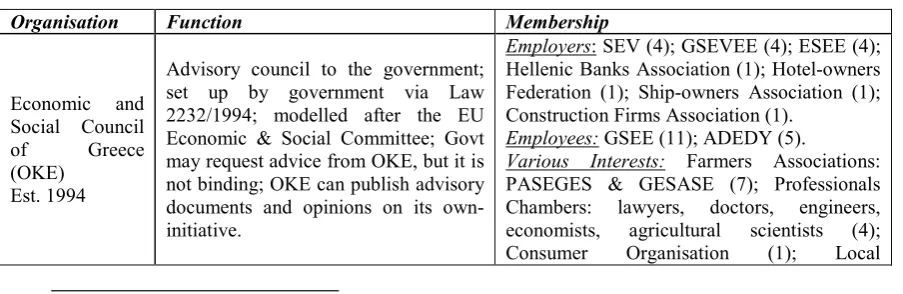
Table 4.1. Main Organisations in the Greek Interest Representation System. ...100
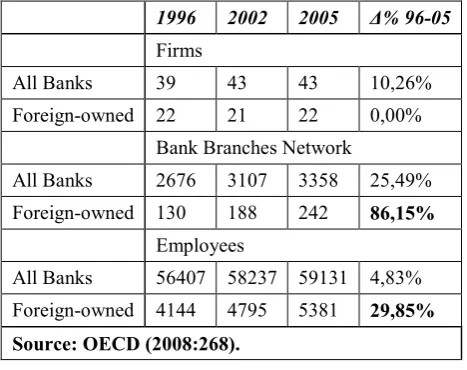
Table 4.2. Penetration of Foreign-owned Banks in Greece, 1996 - 2005...105
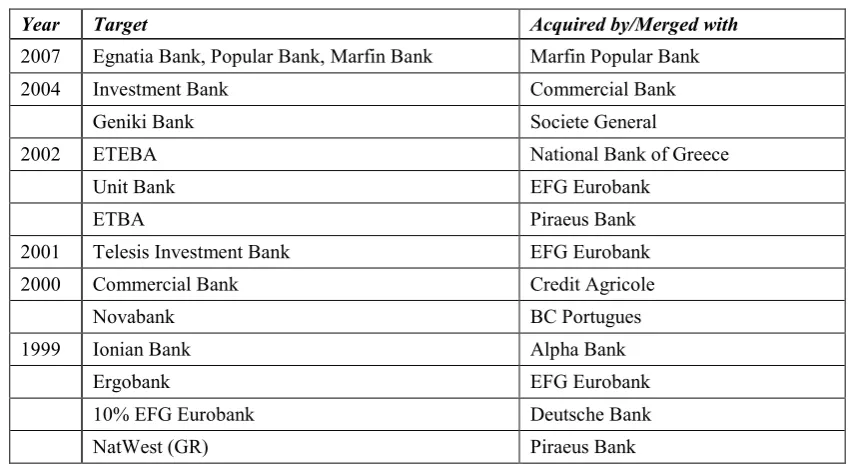
Table 4.3. Merger & Acquisition Activity in Greek Banking, 1996 - 2007. ...106
Table 4.4. Market Shares (%) of Larger Banks in Greece, 1991 - 2005...107
Table 4.5. Main Trade Union Organisations in the Greek Banking Sector. ...114
Table 4.6. Main Business Associations in the Greek Banking Sector. ...117
Table 5.1. Main Organisations in the Italian Interest Representation System....140
Table 5.2. Merger & Acquisition Activity in Italian Banking, 1996 - 2007...143
Table 5.3. Trends in the Number of Italian Banks, 1990 - 2003. ...144
Table 5.4. Penetration of Foreign-owned Banks in Italy, 1996 - 2005...145
Table 5.5. Government Ownership of Banks in Italy, 1992 - 2003...146
Table 5.6. Main Trade Union Organisations in the Italian Banking Sector...153
Table 5.7. Main Business Associations in the Italian Banking Sector. ...156
Table 6.1. Market Shares (based on subscribers) in Mobile Telephony across Italy and the UK, 2000 – 2009. ...178
Table 6.2. Incumbent Telecom Operator's Market Share (based on retail revenue) in Fixed Telephony across Italy and UK, 1997 - 2008. ...178
Table 6.4. Main Business Associations in the Italian Telecoms Sector. ...195
Table 7.1. Government Ownership (%) of OTE, 1993 - 2009...225
Table 7.2. Market Shares (based on subscribers) in Mobile Telephony across Greece and the UK, 2000 – 2009. ...227
Table 7.3. Incumbent Telecom Operator’s Market Share (by retail revenue) in Fixed Telephony across Greece and the UK, 1997 - 2008...229
Table 7.4. Main Trade Union Organisations in the Greek Telecoms Sector. ...239
Table 7.5. Main Business Associations in the Greek Telecoms Sector. ...242
List of Abbreviations
ABI: Italian Banking Association [Associazione Bancaria Italiana]
ACRI: Association of Italian Foundations and Savings Banks [Associazione Fra Le Casse Di Risparmio Italiane]
ADEDY: Confederation of Greek Civil Servants’ Trade Unions [Ανώτατη ∆ιοίκηση Ενώσεων ∆ηµοσίων Υπαλλήλων]
AETE: Greek Telephone Company [Ανώνυµος Ελληνική Τηλεφωνική Εταιρεία]
AGCOM: Authority for Communications Guarantees [Autorità per le Garanzie nelle Comunicazioni]
ASKE: Independent Trade Union of Employees [Aνεξάρτητη Συνδικαλιστική Kίνηση Eργαζοµένων]
ASSBANK: National Association of Private Banks [Associazione Nazionale Aziende Ordinarie di Credito]
ASSICREDITO: Association of Credit Institutions [Associazione Sindacale fra le Aziende di Credito]
ASSTEL: Association of Telecommunications Services Companies
[Associazione delle Imprese Esercenti Servizi di Telecomunicazioni]
CEO: Chief Executive Officer
CGIL: Italian General Labour Confederation [Confederazione Generale Italiana del Lavoro]
CISL: Italian Workers' Trade Unions Confederation [Confederazione Italiana Sindacati Lavoratori]
CME: Coordinated Market Economy
CNA: National Confederation of Arisanal, Small and Medium-sized Enterprises
[Confederazione Nazionale dell’ Artigianato e della Piccola e Media Impresa]
CNEL: National Council of Economy and Labour [Consiglio Nazionale dell'Economia e del Lavoro]
CONFAPI: Italian Confederation of Small and Medium Private Industry
[Confederazione Italiana della Piccola e Media Industria Privata]
DAKE: Democratic Independent Faction of Workers [∆ηµοκρατική Ανεξάρτητη Κίνηση Εργαζοµένων]
DC: Christian Democratic Party [Democrazia Cristiana]
DCS: Digital Cellular Service
DEH: Greek Public Electricity Company [∆ηµόσια Επιχείρηση Ηλεκτρισµού]
DHSYE: Democratic Trade Union Unity [∆ηµοκρατική Συνδικαλιστική Ενότητα]
DIRCREDITO: National Association of Directors and other Professionals in Banking [Associazione Sindacale Nazionale dell’Area Direttiva e delle Alte professionalità del Credito]
DSL: Digital Subscriber Line DT: Deutsche Telekom
EEKT: Association of Companies in Mobile Telephony [Ένωση Εταιρειών Κινητής Τηλεφωνίας]
EET: Hellenic Banks Association [Ελληνική Ένωση Τραπεζών]
EETT: National Committee of Telecommunications and Post [Εθνική Επιτροπή Τηλεπικοινωνιών και Ταχυδροµείων]
EKA: Athens Labour Centre [Εργατοϋπαλληλικό Κέντρο Αθηνών]
ENEL: Italian Public Electricity Company [Ente Nazionale per l'Energia eLettrica]
ESEE: National Confederation of Greek Commerce [Εθνική Συνοµοσπονδία Ελληνικού Εµπορίου]
EU15: the group of ‘old member-states’ before the 2004 enlargement (Austria, Belgium, Denmark, Finland, France, Germany, Greece, Ireland, Italy, Luxembourg, the Netherlands, Portugal, Spain, Sweden and the United Kingdom).
EURO-FIET: European Regional Organisation of the International Federation of Commercial, Clerical, Professional and Technical Employees
FALCRI: Autonomous Federation of Workers in Italian Banks [Federazione Autonoma Lavoratori del Credito e del Risparmio Italiani]
FDI: Foreign Direct Investment
FIBA-CISL: Italian Federation of Banking Insurance Employees [Federazione Italiana Bancari Assicurativi]
FILPT-CGIL: Federation of Italian Workers in Post and Telecommunications
[Federazione Italiana Lavoratori Poste e Telecomunicazioni]
FIM-CISL: Federation of Italian Metalworkers [Federazione Italiana Metalmeccanici]
FIOM-CGIL: Trade Union of Metallurgical Workers [Federazione Impiegati Operai Metallurgici]
FISAC-CGIL: Italian Union Federation of Employees in Insurance and Banks [Federazione Italiana Sindacale dei lavoratori delle Assicurazioni e del Credito]
FISTEL-CISL: Trade Union Federation of Information, Broadcasting and Telecommunications [Federazione Sindacale della Informazione dello Spettacolo e delle Telecomunicazioni]
FITA: Italian Federation of Tertiary Sector, Services and Innovation
[Federazione Italiana del Terziario Avanzato per I Servizi Innovativi e Professionalli]
GESASE: General Confederation of Agricultural Associations of Greece [Γενική Συνοµοσπονδία Αγροτικών Συλλόγων Ελλάδας]
GSEE: Greek General Confederation of Labour [Γενική Συνοµοσπονδία Εργατών Ελλάδας]
GSEVEE: Hellenic Confederation of Artisans [Γενική Συνοµοσπονδία Επαγγελµατιών, Βιοτεχνών, Εµπόρων Ελλάδας]
GSM: Global System for Mobile Communications, originally Groupe Spécial Mobile
IKA-ETAM: Foundation of Social Insurance [Ίδρυµα Κοινωνικών Ασφαλίσεων – Ενιαίο Ταµείο Ασφάλισης Μισθωτών]
IMI: Italian Industrial Finance Institute [Istituto Mobiliare Italiano]
ISDN: Integrated Services Digital Network
ISTAT: National Statistics Institute of Italy [Istituto Nazionale di Statistica]
KEDKE: Central Association of Municipalities and Communities of Greece [Κεντρική Ένωση ∆ήµων και Κοινοτήτων Ελλάδας]
KKE: Communist Party of Greece [Κοµµουνιστικό Κόµµα Ελλάδας]
LME: Liberal Market Economy
M&A: Mergers and Acquisitions MIG: Marfin Investment Group
ND: New Democracy [Νέα ∆ηµοκρατία]
OIYE: Federation of Private Sector Employees of Greece [Οµοσπονδία Ιδιωτικών Υπαλλήλων Ελλάδος]
OKE: Economic and Social Committee [Οικονοµική και Κοινωνική Επιτροπή]
OMED: Organisation for Mediation and Arbitration [Οργανισµός Μεσολάβησης και ∆ιαιτησίας]
OME-OTE: Federation of OTE Employees [Οµοσπονδία Εργαζοµένων ΟΤΕ]
OTE: Hellenic Telecoms Organisation [Οργανισµός Τηλεπικοινωνιών Ελλάδος]
OTOE: Federation of Banking Employees in Greece [Οµοσπονδία Τραπεζοϋπαλληλικών Οργανώσεων Ελλάδος]
PAME: All Workers Militant Front [Πανεργατικό Αγωνιστικό Μέτωπο]
PASE Vodafone: Pan-Hellenic Trade Union of Employees in Vodafone
[Πανελλήνιο Σωµατείο Εργαζοµένων Vodafone]
PASEGES: Pan-Hellenic Confederation of Agricultural Cooperatives
[Πανελλήνια Συνοµοσπονδία Ενώσεων Γεωργικών Συνεταιρισµών]
PASE-TIM/WIND: Pan-Hellenic Trade Union of Employees in TIM/WIND [Πανελλήνιο Σωµατείο Εργαζοµένων TIM/WIND]
PASKE: Pan-Hellenic Militant Trade Union Movement of Employees
[Πανελλήνια Αγωνιστική Συνδικαλιστική ΚίνησηΕργαζοµένων]
PCI: Italian Communist Party [Partito Comunista Italiano]
PRP: Performance Related Pay Systems
PSI: Italian Socialist Party [Partito Socialista Italiano]
PSTN: Public Switched Telephone Network
RSU: Unitary Workplace Representation [Rappresentanza Sindacale Unitaria]
SATPE: Greek Licensed Telecommunication Providers Association [Σύνδεσµος Αδειοδοτηµένων Τηλεπικοινωνιακών Παρόχων Ελλάδος]
SEPE: Federation of Hellenic Information and Communication Technology Enterprises [Σύνδεσµος Επιχειρήσεων Πληροφορικής & Επικοινωνιών Ελλάδας]
SEV: Hellenic Federation of Enterprises [Σύνδεσµος Επιχειρήσεων και Βιοµηχανιών]
SILCEA: Italian Trade Union of Workers in Credit [Sindacato Italiano Lavoratori Credito Enti Assimilati]
SILT-CISL: Italian Trade Union of Workers in State Telephony [Sindacato Italiano Lavoratori Telefonici Stato]
SINFUB: National Federation of Autonomous Trade Unions in Banks, Finance and Insurance [Federazione Nazionale Sindacati Autonomi – Personale di Credito, Finanza e Assicurazioni]
SIP: Italian Telephone Company [Società Italiana per l'Esercizio Telefonico,
originally Società Idroelettrica Piemontese]
SLC-CGIL: Trade Union of Workers in Communications [Sindacato Lavoratori Comunicazione]
SME: Small Medium-sized Enterprise
SMT: Trade Union of Waged Engineers [Σύνδεσµος Μισθωτών Τεχνικών]
SYN: Coalition of the Left of Movements and Ecology [Συνασπισµός της Αριστεράς των Κινηµάτων και της Οικολογίας]
TQM: Total Quality Management
UGL: General Union of Workers [Unione Generale del Lavoro]
UILCA-UIL: Italian Union of Workers in Banks and Insurance [Credito Esattorie e Assicurazioni]
UILCOM-UIL: Italian Union of Workers in Communications [Unione Italiana Lavoratori Comunicazione]
UILM-UIL: Italian Union of Workers in Manufacturing [Unione Italiana Lavoratori Metalmeccanici]
UILTE-UIL: Italian Union of Workers in Telephony [Unione Italiana Lavoratori Telefonici]
Chapter 1
EU Liberalisation, Work Flexibility, and Wage
Bargaining Institutions: Explaining Divergent Trajectories
of Change
1.1. Introduction
The progress of European economic integration and the internationalisation of
employee management practices were expected to have far-reaching
consequences on national wage bargaining institutions across advanced capitalist
countries. Responding to what is commonly perceived as the move from Fordism
to the post-Fordist era, European firms sought to enhance their competitiveness
by pushing for more labour flexibility. This ‘search for flexibility’ (Atkinson,
1984; Boyer, 1988; Deakin and Reed, 2000; Freeman, 2005; Marsden, 1995;
Streeck, 1987) would involve –among other things– the breakdown of
long-standing wage bargaining institutions along Anglo-Saxon lines. However, the
direction of change proved to be more nuanced and differentiated than initially
anticipated. In this thesis I examine the divergent trajectories of change in wage
bargaining institutions.
The early 1990s marked a crucial turning point for the progress of European
integration. On the road from the Single European Act of 1986 until the
the European Union shifted from traditional industries towards utilities and
services. The European Commission held that distortions in competition could
come from sectors providing a backbone to economic activity. Therefore
‘network sectors’ such as telecommunications, financial services, transportation
(railways, shipping, airlines), and energy (electricity, gas) became part of the
agenda of EU liberalisation (Begg and El-Agraa, 2004; Mercado et al., 2000:101; Young, 2005:109). Notably, legislation over the single market required the
liberalisation of state monopolies, but it did not require a change in the ownership
of state firms (Featherstone, 2005:232). Nevertheless, national governments
across Europe launched a series of privatisation programmes reducing the extent
of public ownership in these sectors.
The twin processes of liberalisation and privatisation marked the withdrawal of
the state from direct regulation and ownership of those sectors. Regulation was
delegated to independent regulatory authorities, and ownership transferred to
private actors. These processes were expected to have a ‘domino effect’ on
national wage bargaining institutions leading to a generalised decentralisation of
bargaining (Crouch, 2000a; Dolvik, 2004; Wallerstein, 1998). Although the
‘convergence’ of wage bargaining arrangements was not a preoccupation of the
EU-level negotiations for the Economic and Monetary Union (Dyson and
Featherstone, 1999:785), the expectation was based on several grounds. The
opening up of these markets to competition was thought that it weakened the
incentive for cost-standardisation from the part of the firms. The process of
privatisation was expected to modernise the internal work organisation of the
transforming bureaucratic organisations into competitive firms. Overall, the
pressures from EU liberalisation and international diffusion of work flexibility
were the implicit forces putting pressure for institutional convergence to the
Liberal market model of decentralised industrial relations.
Despite the above strong pressures, a uniform trend towards decentralised pay
setting is not observed in Europe (Wallerstein et al., 1997). Indeed, there is a drive towards breakdown of wage bargaining in some sectors, but this is mostly
observed within Anglo-Saxon countries (Brown and Walsh, 1991; Wallerstein,
1998). This contrasts sharply with sectors in Continental Europe, which opted for
a reform of wage bargaining institutions.
How do we explain the different trajectories of change in wage bargaining
institutions, despite the common pressures from liberalisation and flexibility?
More specifically, why do we see a breakdown of bargaining arrangements in
some sectors, whereas in other similar sectors there is a reformation of wage
bargaining institutions? Even more, how do we explain the successful efforts to
centralise bargaining in some sectors, while other similar sectors centralisation
fails and they remain decentralised? The aim of this thesis is to refine earlier
theoretical conjectures, by explaining the puzzle of divergent trajectories of
institutional change in wage bargaining. The thesis develops a novel conceptual
framework based on actors’ coalitions to explain the dynamics of change in wage
bargaining institutions. More specifically, I focus on the interactions between
employers associations, trade unions organisations, and governments, and their
studies from liberalised and privatised sectors within the Mediterranean model of
capitalism (on case selection criteria see Section 1.5).
The focus on Southern Europe is justified on the basis of received wisdom from
the scholarship on different varieties of capitalism (Albert, 1993; Amable, 2003;
Berger and Dore, 1996; Crouch, 2005a; Crouch and Streeck, 1997; Dore, 2000;
Hall and Soskice, 2001; Hancké et al., 2007; Hollingsworth and Boyer, 1997; Kitschelt et al., 1999; Schmidt, 2002; Streeck and Thelen, 2005). This burgeoning literature suggested that the institutional configuration of European countries
differs markedly. Each county approximates a different model of capitalism,
having distinct modes of coordination and different ‘interlock’ of institutions.
Most notably the Anglo-Saxon Liberal Market Economies and the Coordinated
Market Economies in Continental Europe are considered as the more ‘coherent’
models of capitalism with institutional complementarities that keep the
institutional pieces tightly together. In contrast, the Mediterranean model of
capitalism (also termed as Mixed Market Economies) (Amable, 2003; Hancké et al., 2007; Molina and Rhodes, 2007; Schmidt, 2008) is characterised by ‘incoherence’ and weak or inexistent institutional complementarities. Thus, the
pressures from liberalisation, intensification of competition, and increased
flexibility are expected to alter the institutional arrangements within the
Mediterranean model countries. They are generally considered as more
susceptible to institutional change (Hall and Thelen, 2009:26) and more
The rest of this introductory chapter is structured as follows. The next section
discusses the puzzle of divergent paths in wage bargaining change placing it in
the wider debate of institutional change across advanced capitalist countries. The
third section briefly reviews the sources of the pressures for convergence in wage
bargaining institutions and criticises the blind spots of earlier theoretical
conjectures. The fourth section previews the conceptual contribution of the thesis,
outlining a coalitional approach to wage bargaining change. The fifth section
considers the research design of the thesis and related methodological issues. The
final section concludes with an overview of thesis’ chapters.
1.2. The Puzzle: Divergent Trajectories of Change in Wage Bargaining Institutions across Europe
One of the central research questions in the debate around varieties of capitalism
has been whether countries are becoming institutionally more similar over time.
This process of greater institutional similarity has been typically understood as
convergence to the Liberal Market model of capitalism. Indeed, several scholars
from different disciplinary fields predicted that convergence to a single model of
capitalism was inevitable (Albert, 1993; Strange, 1997) and the prime driver of
change was the ‘stateless enterprise’ which adopts whatever best practice confers
comparative advantage in a ‘borderless world’ (Ohmae, 1989; Womack and
Jones, 1994). These convergence theorists were challenged by scholars in the
‘varieties of capitalism’ strand, who argued that diversity persisted among
advanced capitalist countries and comparative advantage was embedded on
Indeed, according to Crouch (Crouch, 2005b:439) one of the main
accomplishments of the varieties of capitalism literature is that it provided an
‘intellectual counterweight to easy arguments about globalisation’.
In any model of capitalism, the industrial relations sphere occupies a central place
in the overall institutional configuration. In this sphere, the market pressures push
for convergence towards the Anglo-Saxon model of decentralised bargaining. The
experience of collapse of centralised wage bargaining institutions in various
sectors of Liberal Market Economies (LME) during the 1980s was interpreted as
a glimpse of the future for the rest of the advanced industrialised world (Katz,
1993). Product market liberalisation was unambiguously followed by wage
bargaining decentralisation. Even the countries with strong corporatist
institutions, such as Sweden, did not seem to be able to evade this trend of
convergence to the Anglo-Saxon model (Pontusson and Swenson, 1996). As a
result a large body of research in US and UK (Kapstein, 1996; Katz, 1993;
Mueller and Purcell, 1992; Reder and Ulman, 1993) suggested that a generalised
pull for convergence towards the Liberal market model would occur in wage
bargaining institutions of advanced capitalist countries.
Yet, empirical reality defied strong theoretical expectations and centralised wage
bargaining arrangements proved to be much more resilient than a large body of
literature assumed. Wallerstein et al. (1997) showed that wage bargaining institutions in Northern and Central Europe proved to be resilient at least until the
late 1990s. Even more, the second chapter of this thesis uses novel empirical data
across EU151 up until the late 2000s. Instead, the trajectories of change across EU
countries are divergent, which presents us with an intriguing empirical puzzle
with a wider relevance.
The growing body of work around varieties of capitalism offers a few insights to
partly explain those divergent trajectories of change. Continental European
countries were considered as part of Coordinated Market Economies; in which
certain institutions ‘clustered together’ and produced increasing returns derived
from ‘institutional complementarities’ (Hall and Soskice, 2001:17). As a result
complete breakdown of wage bargaining was avoided, because decentralisation
would likely jeopardise the provision of collective goods (such as skill-formation)
or because new production strategies have increased employers’ dependence on
social peace (Thelen, 2000; Thelen and Van Wijnbergen, 2003).
Instead of an outright decentralisation of the Anglo-Saxon type, liberalisation of
industrial relations was resisted and in the greater part of Continental Europe the
response of unions and employers was an ‘organised’ reform of wage bargaining
institutions (Crouch, 2000a). In this case the sectoral-level bargaining was
retained, but firm level bargaining increased in relative importance. The sectoral
level was kept to set minima in wages and working conditions across a sector,
while more (and more substantial) issues (e.g. working time) were deferred to the
firm level, so as to promote flexibility and better suit the needs of individual
enterprises. This type of change was dubbed as ‘organised decentralisation’
1
(Crouch, 2000a; Traxler, 1995:7). However, this term was little more than an
observation and certainly fell short of explaining this counter-trend. As Thelen
(2010:189-192) notes, these developments still pose a challenge for conventional
wisdom in the literature.
While the VoC insights on institutional complementarities offer a start for an
explanation for the resilience of wage bargaining institutions in Continental
Europe, they leave wanting an explanation for the survival of wage bargaining
arrangements in Mediterranean capitalism. In the latter ‘complementarities’ of the
CME type are weak or absent, organised interests are not ‘encompassing’ enough
to ensure provision of collective goods (Molina and Rhodes, 2007), and industrial
conflict is endemic (Visser, 2002).
Thus, one would expect that when Mediterranean model countries experience the
process of liberalisation in a given product market, wage bargaining will face
severe destabilising pressures, following a path of institutional convergence
towards the Liberal Market model. The lack of complementarities will not hold
the institutional arrangements intact. Nevertheless, this development is not
uniformly observed, and this still poses a challenge for earlier conjectures. Before
advancing a novel conceptual framework to explain the dynamics of change in
wage bargaining, I will first turn to the received wisdom in the literature outlining
1.3. The Conceptual Frame: Pressures to Wage Bargaining Institutions from Liberalisation and Flexibility
The received wisdom on wage bargaining change can perhaps be grouped in two
hypotheses, which highlight the changed business preferences vis-à-vis wage bargaining institutions. The first hypothesis could be termed ‘the liberalisation hypothesis’. The emphasis here is on the external and increasingly competitive business environment that firms face, and how this alters their preferences. In
relatively closed and protected product markets, oligopolistic firms preferred to
‘take the wages out of competition’ (Marginson et al., 2003; Swenson, 1989) through sectoral wage bargaining. But the increased integration of product
markets ‘weakens this logic’ (Marginson et al., 2003:165) and firms’ incentives
to bargain with trade unions are reduced, thus favouring abandonment of sectoral
bargaining (Reder and Ulman, 1993; Streeck and Schmitter, 1991).
The second hypothesis entails a more diverse list of factors, which could be
dubbed ‘the flexibility hypothesis’. This includes the adoption of new flexible work organisation inside firms in response to technological changes (Katz,
1993:14-15; Pontusson and Swenson, 1996:235; Wallerstein and Golden,
1997:700-701) as well as the need to link closely pay with individual
performance (Brown and Walsh, 1991:51-53; Iversen, 1996:406-407; Pontusson
and Swenson, 1996:236-237). The more general point is that the model of a firm
based on Fordist mass production with ‘internal labour markets’ is gradually
diminishing. Internal labour markets entailed permanent employees with fixed
of labour, and their management was based on strict hierarchies (Grimshaw et al., 2001). Instead, the post-Fordist era includes a move to ‘lean and mean’
organisation of production, with increased pay flexibility, need for employees
with polyvalent skills, and a flatter job classification system. The common
implication from all these changes is that the detailed specification of wage levels
and working conditions in sectoral wage agreements inhibits ‘flexibility’.
Therefore, business preferences change towards favouring decentralisation of
bargaining.
There are good reasons to doubt a priori the plausibility of the above hypotheses, not least because they are focused solely on business needs. While they describe
well the triggers that may change individual firms’ preferences, they do suffer
from the weaknesses of functionalism. They assume a simplistic causal chain
between changing needs and changing institutions, and are likely to miss crucial
mediating factors that may moderate pressures or may transform the nature and direction of institutional change. Firms are portrayed as automatically pursuing a
single-best strategy that serves their interests irrespective of place and context.
This conception misses the point that firms are creative and adaptive rational
actors (Streeck, 1997) and their responses are far from mechanical.
Furthermore, the empirical developments proved to be inconsistent with the
expectations of the above hypotheses. As mentioned above, there is no trend
towards generalised breakdown of centralised bargaining across EU15, despite
the apparent pressures from liberalisation and flexibility. Instead the trend across
there is indeed decentralisation, in others stability of wage bargaining level, and
in some others a trend towards centralisation. To put it in other words, while the
scope conditions of liberalisation and flexibility are present in a wide range
European capitalist countries, the outcome of breakdown of wage bargaining
appears only in a handfulof Anglo-Saxon cases (cf. Wallerstein, 1998:201). As a
corollary, there is a lack of a conceptual framework to understand these divergent
trajectories of change. Therefore, the task of this thesis is to develop an
alternative approach, which could account for the divergent trajectories of
institutional change in wage bargaining. The next section previews the argument
of the thesis.
1.4. Preview of the Argument: A Coalitional Perspective on Change of Wage Bargaining Institutions
I argue that the factors pinpointed by earlier hypotheses may constitute triggers of
preference change for individual firms; however, they alone are not sufficient to
bring institutional breakdown (i.e. decentralisation of bargaining). In other words,
these pressures provide necessary but not sufficient conditions for the breakup of
wage bargaining institutions. Instead, the way that these pressures will play out
depends on the coalitions that the relevant actors will be able to form. A
coalitional approach to wage bargaining change suggests that there are two crucial mediating conditions –ignored by earlier literature- that may moderate or
block the pressures towards abandonment of wage bargaining institutions:
1.4.1. Employer Associability: A Coalition of Small and Large Firms
The first factor that was neglected by the earlier literature was the role that
employers associations may play vis-à-vis wage bargaining change. Drawing on the literature on business associations (Doner and Schneider, 2000; Schmitter and
Streeck, 1999; Traxler, 2001) I argue that employers associability is likely to be a
mediating factor between individual firms preferences and institutional outcomes. Employer associability is a wider concept than just an employer association. It
not only means that an association possess the legal competence to represent the
members’ interests in labour relations (as an employer association), but also the
internal representation process is balanced so that decision making does not result
in a skewed representation towards one or another group of members. Therefore,
employer associability is missing in two occasions: (i) when an association does
not have the legal competence to represent firms on labour relations (i.e. is just a
trade association representing narrow interests) and (ii) when representation is
skewed towards one category of firms in the sector (e.g. large firms vs. small
firms).
Following from the above, the first hypothesis is that if employer associability
exists, then destabilising pressures in wage bargaining are likely to be moderated.
Drawing on insights offered by Schmitter and Streeck (1999:13) ‘collective
interest associations’ are in a better position than individual firms to appreciate
and protect the long-run interests of their membership, even if this requires to
enforce their decisions upon reluctant or resisting members. But given the new
members’ needs for greater flexibility. Therefore, it is likely to strike a
compromise getting ‘the best of both worlds’ for its members by reforming the
wage bargaining institution. The sectoral wage agreement would set a
level-playing field with minimum standards across the sector, lowering drastically
transaction costs and ripping off the benefits from social peace. At the same time,
issues regarding more pay and work organisation flexibility can be deferred to the
firm level. The first research hypothesis follows from the above analysis:
Hypothesis I: Whilst pressures from liberalisation and flexibility may act as triggers changing individual firms’ preferences towards abandoning centralised bargaining, the presence of ‘employer associability’ will likely moderate destabilising pressures and lead to a reform of the institution.
1.4.2. Labour-State Coalition: Labour Unity and Government Agenda
In addition to employer associability, there is another mediating factor that has
been neglected by earlier literature and may temper the pressures towards the
abandonment of wage bargaining institutions: labour-state coalitions. Admittedly,
there is a long literature documenting and explaining the decline in trade unions’
membership across advanced industrialised countries (Ebbinghaus and Visser,
1999; Freeman, 1995; Western, 1995). This picture of union power decline
enhanced the expectation for a generalised breakdown of wage bargaining
arrangements. However, trade union power should not only be conceptualised in
terms of membership, but also in unions’ ability to invite the government to
trade unions have developed clientelistic and particularistic relationships with
political parties, investing in ‘political power’ (Featherstone and Papadimitriou,
2008; Molina and Rhodes, 2007). But more generally, the importance of the role
of the state in steering social bargaining across Europe was highlighted by a large
literature on social pacts (Crouch, 2000a; Rhodes, 2001; Schmitter and Grote,
1997). I borrow from this literature the insight that bargaining is likely to take
place in the ‘shadow of hierarchy’ namely the shadow of the state. Subsequent
accounts of social pacts and welfare reform fleshed out the causal mechanism that
links the motivation of state steering social partners’ bargaining, pinpointing the
role of party politics and electoral pressures (Green-Pedersen, 2003; Hamann and
Kelly, 2007). The above insights support a priori the plausibility of the hypothesis that the institution of wage bargaining may not only rest on a
‘cross-class’ coalition as Swenson (1989:34) suggested, but also on a ‘labour-state’
coalition.
Indeed, in the context of steep union membership decline, I argue that organised
labour is unlikely to be able to stem alone the employers’ challenge to centralised
bargaining. Still, if labour steers the interest of the government, it may hinge on
its coercive (and persuasive) power and forge a labour-state coalition. Thus, an
institutional arrangement may be enforced to resisting individual firms. There are,
however, two important conditions. First, labour should be able to speak with a
‘single voice’ irrespective of the decline in membership or the organisational
structure of trade unionism. This denotes the interest representation on the side of
labour. Second, union members’ vote should be significant for the party in
tactical policy trade-offs in the rest of the government’s agenda. Therefore, a
labour-state coalition cannot be forged in two occasions: (i) if labour is divided
and cannot unite to pursue or defend centralised bargaining or (ii) if electoral
pressures are weak and priorities in government agenda clash with the support of
wage bargaining institution. The above analysis results in the following
hypothesis:
Hypothesis II: Whilst pressures from liberalisation and flexibility may act as triggers changing individual firms’ preferences towards abandoning centralised bargaining, the presence of a ‘labour-state’ coalition will likely moderate destabilising pressures and lead to a survival of the institution.
In a nutshell, the above hypotheses refine the earlier conjectures by introducing
two factors (employer associability and labour-state coalitions). Both factors
allude to the coalitions of domestic actors that may transform the direction of
institutional change. To use quantitative terminology the hypotheses suggest two
‘intervening variables’ which mediate the relationship between the ‘dependent
variable’ (wage bargaining agreements) and the ‘independent’ variables’
(liberalisation and flexibility). The next section considers the overall research
1.5. Research Design
1.5.1. Case Selection Criteria
The thesis suggests the plausibility of the hypotheses applying them to explain
four ‘most likely’ (Eckstein, 1975; George and Bennett, 2005) sectoral case
studies: Greek banking, Italian banking, Italian telecommunications, and Greek
telecommunications, which are arranged in matched pairs.
There are several reasons that justify lowering the unit of analysis from national
level to sub-national level. First, the composite indicators of national wage
bargaining centralization (used in the second chapter) are not suitable for the
research question and can only document trends over time. National level
institutions change very slowly over time, and thus the analysis is better off
locating those ‘rare events’ of significant and abrupt institutional change.
Thereby, one can inquire the motives and interactions between actors via in depth sectoral case studies. By contrast, the composite indicators would tend to identify
stability even in cases where the change is subtle, as in the case of reform of wage bargaining towards ‘organised decentralisation’. Despite the actual change
in the relative importance between levels of bargaining, the composite indicators
would still count the same level of centralisation.
In addition, all four cases exhibit the scope conditions of earlier theories, namely
they are liberalised sectors in which competition intensified, and the privatisation
accelerated the diffusion of flexibility in work organisation. Thus, the pressures
bargaining was ‘most likely’. Although their starting points differ (in banking
sectors the starting point is sectoral bargaining, whereas in telecoms the starting
point is firm level bargaining); still, the expectation was that all of them will
converge to the LME decentralised bargaining structure.
Simultaneously, the wider institutional context of the countries strengthens this
research expectation. Italy and Greece belong to the Mediterranean model of
capitalism, which is also ‘most-likely’ for institutional convergence to the Liberal
Market model. On the one hand, these cases are institutionally incoherent; unlike
CMEs, wage bargaining is not part of strong institutional complementarities that
keep the system together. On the other hand, both cases share similar traditions of
extensive state ownership in the economy and state involvement in the industrial
relations realm (Baccaro and Pulignano, 2011; Ioannou, 2010). This ‘controls’ for
substantial differences in national-level institutions. Indeed, as Culpepper (2005a)
argues, this research strategy may help holding constant a number of pertinent
explanatory variables, such as differences in national-level institutions and state
traditions.
In spite of the strong expectation for a common trajectory of change, we observe
that the paths of institutional change diverge. On the one hand, there is survival
and reform of sectoral wage bargaining in Italian banking, whereas there is a
breakdown of sectoral wage bargaining in Greek banking. On the other hand,
there is a successful centralisation of bargaining in Italian telecoms and there is a
Hence, the cases are also matched on pairs following the most similar systems/different outcomes comparative design (Collier, 1993; Mahoney, 2004; Przeworski and Teune, 1970). The dependent variable is binary, i.e. the presence
(or absence) of a sectoral wage agreement. Extreme selection bias is avoided
because case selection allows ‘for at least some variation on the dependent
variable’ (King et al., 1994:129). The different timing of the case studies is determined by the difference in the timing of the processes of liberalisation and
privatisation, and accordingly, the different times that the destabilising pressures
appeared. In Italian banking and telecoms the pressures appeared around the late
1990s, whereas in Greek banking and telecoms around the mid 2000s.
More generally, the ‘universe of cases’ (Ragin, 2004) comprises of liberalised
and privatised sectors in Southern Europe. There is a clear EU regulatory impact
on these sectors, since they have been liberalised in the 1990s and the state
withdrew from their regulation. Second, these sectors shared a tradition of state
ownership, while privatisation signified the withdrawal of the state during the
1990s. Following from their privatisation, these sectors underwent intensive
restructuring and work organisation flexibility was introduced. The second half of
the third chapter examines these systemic pressures in more detail.
1.5.2. Data Collection Method
The data for the case studies were collected via interviews with key informants.
Elite interviewing was chosen as the most appropriate data collection method to
actors’ motivation (George and Bennett, 2005; Hall, 2006). The key informants
included representatives from sectoral and national trade union organisations,
representatives from sectoral business associations, representatives of
governmental political parties, as well as experts who had deep and intimate
knowledge of the developments in those sectors. The typical length of interviews
was about one hour, ranging from a minimum of thirty minutes to a maximum of
two and a half hours. Most of the interviews were tape-recorded (unless the
informants preferred not to) with a commitment not to attribute quotes and to
respect confidentiality. The discussion was based on a semi-structured interview
protocol with open questions.
Interviewing is a research technique that has clear strengths with respect to
unearthing original empirical detail, which is usually possessed by few
informants in key positions. It is especially well suited to garner evidence
pertaining to actors’ strategies and motivations. Still, interviewing is also a
technique with weaknesses, which were also considered in the research design
stage and there was an effort to minimise those weaknesses. Notably, the validity
and credibility of informants’ insights was cross-checked via triangulation
(Denscombe, 2007:201) of the information either with other informants and/or
with other primary and secondary sources. Hence, the case studies also rely on
several sources including inter alia: press releases and official announcements, wage bargaining agreements, newspaper articles, and expert reports on sectoral
developments. If the informants’ insights were judged to be debatable and were
the total number of interviews was 28. The final section outlines the structure of
the thesis’ chapters.
1.6. Outline of the Thesis
The next chapter starts by reviewing the scholarly works dealing with
institutional change across and within varieties of capitalism, and then examines
the more specific works on wage bargaining institutions. Those works lie at the
intersection of comparative political economy and comparative employment
systems literatures.2 The works on wage bargaining institutions are reviewed with
two questions in mind: (i) what are the benefits that actors perceived to get from
sectoral wage bargaining institutions in the Fordist era?; and (ii) how do the
post-industrial pressures towards destabilisation of those institutions manifest
themselves? Thus, the chapter elaborates on the causal mechanisms behind the
liberalisation and the flexibility hypotheses. The hypotheses are then criticised on
theoretical grounds and this outlines the conceptual lacuna that this thesis seeks to
fill. The rest of the chapter examines empirical data on national level wage
bargaining trends across Europe since the 1990s. The central finding is that
despite the liberalisation of markets and introduction of flexibility across EU15,
wage bargaining centralisation followed divergent trajectories of change. This
2
strengthens the empirical puzzle of the thesis and suggests the broader relevance
of the research question.
The third chapter presents a novel coalitional approach to wage bargaining
change. Coalitional approaches have already been used in comparative political
economy to examine institutional change. Notwithstanding, a coalitional
perspective has not been applied (to the best of my knowledge) to explain the
dynamics of change in wage bargaining institutions up until now. The core
insight of the thesis suggests that although structural factors of liberalisation and
flexibility pull towards a generalised breakdown of centralised bargaining, the
particular trajectory of change will be determined by the coalitions of collective
actors. Thereby, employer associability and a ‘labour-state coalition’ are
presented as crucial mediating factors explaining divergent trajectories of change.
The logic of the hypotheses is set out via synthesising and cross-borrowing insights from related literatures on business associations and state’s role in social
pacts. This strengthens their ex ante plausibility, before getting to the empirical evidence. The second part of the chapter examines the systemic pressures across
European banking and telecommunications sectors. Both sectors have felt the
European regulatory impact with an opening up of those markets and
intensification of competition. At the same time, the international diffusion of
flexible working practices had an impact on the internal work organisation of
firms in those sectors.
The fourth chapter starts with an in-depth examination of labour politics in the
system since the 1980s, introducing the main actors and setting the institutional
context at the national level. Then it briefly examines the banking sector under
state ownership until the late 1980s, before turning to the processes of
liberalisation and privatisation that mainly took place during the 1990s. It is
shown that the two processes facilitated the increase in competition within the
market. The opening up allowed the entrance of foreign banks, accelerated
mergers and acquisitions, and intensified competitive pressures. In addition, the
privatisation process accelerated the modernisation of banks with introduction of
new technologies and new management practices towards working time and pay
flexibility. The purpose of those sections is to pin down the presence of strong
destabilising pressures towards abandonment of wage bargaining institutions.
Then the chapter turns to the wage bargaining rounds in the 2000s paying close
attention to the interactions between the three major actors and their underlying
motives. The wage bargaining institution survives until the mid 2000s, but broke
down in the late 2000s. This ‘within-case variation’ is explained by the the
presence or absence of a labour-state coalition.
The fifth chapter turns to the Italian banking sector, which provides a sharp
contrast to the Greek case. In Italian banking sectoral wage bargaining did not
break down, but was reformed to meet new needs. The chapter begins with an
overview of the Italian industrial relations system since the 1980s and introduces
the main actors at the national level. Then it examines the banking sector under
state ownership, before turning to the processes of liberalisation and privatisation
of the system during the 1990s. Afterwards, the chapter sketches the pervasisve
is to show that the destabilising pressures towards wage bargaining institutions
were strong. However, this outcome did materialise. The account of wage
bargaining rounds in the late 1990s shows that the trajectory of reform of the
wage bargaining system towards ‘organised decentralisation’ was facilitated by
employer associability and a labour-state coalition.
The sixth chapter shifts the focus to the Italian telecommunications sector, where
wage bargaining is centralised from firm level to sectoral level. It briefly reviews
the sector under state ownership until the late 1980s and then turns to the
liberalisation and privatisation of the system during the 1990s. Afterwards, it
presents the penetration of flexible working practices during the 1990s in both the
privatised Telecom Italia and new telecom operators. The purpose of those
sections is again to pin down the strong expectation towards a decentralised wage
bargaining structure. The account of wage bargaining rounds in the early 2000s
pays close attention to the interactions between the three major actors: employers,
labour and the state. The role of the state in supporting the institution of wage
bargaining appears more vividly in the mid 2000s when call-centre firms resist
their inclusion under the remit of the sectoral agreement. Overall, the case study
shows that the centralisation of wage bargaining solidified due to employer
associability and a labour-state coalition.
The seventh chapter examines the Greek telecommunications sector, where wage
bargaining remains decentralised at firm level (inertia) despite the effort to centralise it as in the Italian case. It briefly reviews the sector under state
of the system during the 1990s. Afterwards, it presents the penetration of flexible
working practices during the 1990s and early 2000s. Those sections pin down the
strong pressures that militated against a centralised wage bargaining arrangement.
However, the chapter refines earlier theories showing that the decentralised
bargaining structure is explained, because the stronger union in the sector was
simply not interested in such a strategy and was focused on pursuing narrow
interests. Additionally, firms’ associations were narrow representing only product
market interests, while labour was organisationally and ideologically divided and
the conditions to forge a coalition with the state for centralisation of bargaining
were missing.
The final chapter brings everything together by reviewing the main argument and
summarising the central empirical findings. Thus, the conceptual and empirical
contributions of the thesis are clearly set out. The chapter also gauges the wider
applicability of the argument and outlines how it can be tested to further cases.
Moreover, the implications of the argument and empirical findings for broader
academic debates in comparative political economy and comparative employment
systems is discussed. In comparative political economy, the thesis contributes to
fleshing out empirically the role of the state in shaping institutional change within
the Mediterranean model of capitalism. More generally, the cases suggest that
divergent trajectories of institutional change are possible even within cases
belonging to the same model of Mediterranean capitalism. Finally, the
implications for comparative employment systems literature are discussed. The
findings of the thesis corroborate other works’ findings that despite