Volume 2010, Article ID 595431,17pages doi:10.1155/2010/595431
Research Article
Opportunistic Multicasting Scheduling Using Erasure-Correction
Coding over Wireless Channels
Quang Le-Dang and Tho Le-Ngoc
Department of Electrical and Computer Engineering, McGill University, 3480 University Street, Montreal, Quebec, Canada H3A 2A7
Correspondence should be addressed to Tho Le-Ngoc,[email protected]
Received 9 August 2010; Accepted 3 November 2010
Academic Editor: Zhiqiang Liu
Copyright © 2010 Q. Le-Dang and T. Le-Ngoc. This is an open access article distributed under the Creative Commons Attribution License, which permits unrestricted use, distribution, and reproduction in any medium, provided the original work is properly cited.
This paper proposes an opportunistic multicast scheduling scheme using erasure-correction coding to jointly explore the multicast gain and multiuser diversity. For each transmission, the proposed scheme sends only one copy to all users in the multicast group at a transmission rate determined by a SNR threshold. Analytical framework is developed to establish the optimum selection of the SNR threshold and coding rate for given channel conditions to achieve the best throughput in both cases of full channel knowledge and only partial channel knowledge of the average SNR and fading type. Numerical results show that the proposed scheme outperforms both the worst-user and best-user schemes for a wide range of average SNR and multicast group size. Our study indicates that full channel knowledge is only significantly beneficial at small multicast group size. For a large multicast group, partial channel knowledge is sufficient to closely approach the achievable throughput in the case of full channel knowledge while it can significantly reduce the overhead required for channel information feedback. Further extension of the proposed scheme applied to OFDM system to exploit frequency diversity in a frequency-selective fading environment illustrates that a considerable delay reduction can be achieved with negligible degradation in multicast throughput.
1. Introduction
Multicast services over wireless communications have recently become more and more popular. Multicast gain has been explored in a worst-user (WU) approach by transmitting only one copy to all users in the multicast group, for example, [1]. In wireline networks, since user channels are fixed, the multicast throughput increases linearly with the multicast group size, N. However, due to a possible large difference in the instantaneous channel gains of the various links from the base-station (BS) to users in a wireless fading environment, the BS may have to apply the lowest supportable rate (corresponding to the worst BS-user link), which results in very low bandwidth efficiency. Based on this fact, opportunistic scheduling forunicast transmission to explore the multiuser diversity by sending one copy to the user with the highest instantaneous channel gain has been extensively researched. Unfortunately, such a best-user (BU) approach does not make use of the multicast gain, which can yield low utility of resources, especially for a large
multicast group size. While opportunistic scheduling for unicast transmission has been extensively researched, the idea of exploiting multiuser diversity into multicast has not been studied in an equivalent extent yet. In [2], a
These studies assume perfect knowledge of the channel responses of all users in the multicast group at the BS.
In this paper, we propose an opportunistic multicast scheduling scheme that can jointly explore multicast gain, multiuser diversity, and time/frequency diversity in a wireless fading environment. In the proposed scheme, each packet is sent only once to all users in the multicast group at a transmission rate determined by a selected channel gain threshold and an erasure-correction coding is used to deal with possible erasures when the instantaneous signal-to-noise ratio (SNR) of a BS-user link happens to be inadequate. Reed-Solomon (n,k) erasure-correction code is applied to a block of transmitted packets such that erased packets can be recovered as long as the number of erased packets in a block does not exceed the erasure correction capability, that is, (n−k). As each packet can be transmitted in a time or a frequency slot, erasure-correction coding to a block of transmitted packets effectively explores the time/frequency diversity in a wireless fading environment. The selection of channel gain threshold and erasure correction code param-eters are jointly optimized for best multicast throughput. Furthermore, to study the role of channel knowledge, the proposed scheme is considered in two cases: (i) with full channel gain knowledge and (ii) with only partial knowledge of fading type and average SNR. An analytical framework has been developed to evaluate the multicast throughput of the proposed erasure-correction coding opportunistic multicast scheduling (ECOM) scheme as well as the BU and WU approaches. We prove that the effective multicast throughput (i.e., the multicast rate that each user can receive) of WU and BU asymptotically converges to zero as the group size increases while that of our proposed scheme is bounded from zero depending on the SNR. Numerical results illustrate that for small multicast group size, full channel gain knowledge can offer better multicast throughput than partial channel knowledge; however, for large group size, the difference in multicast rates of these two cases is just negligible. Besides, performance evaluation shows that with the ability of combining both gains, the proposed scheme outperforms both BU and WU for a wide range of SNRs.
Furthermore we consider extending ECOM for appli-cations to Orthogonal Frequency Division Multiplexing (OFDM) systems. In particular, we explore frequency diversity in a frequency-selective fading environment by sending coded packets over subcarriers. However, since there is a correlation in channel gains among the subcarriers, deep fade on one subcarrier may result in insufficient instantaneous SNR on neighbouring subcarriers. Hence, we have investigated the effects of correlation in subcarrier channel gains on the achievable multicast throughput of the proposed scheme. Numerical results indicate that by exploring frequency diversity, we can significantly reduce the delay with negligible degradation in multicast throughput.
The rest of this paper is organized as follows. In
Section 2 the proposed ECOM schemes are described and the analytical framework on multicast throughput of the proposed schemes and BU and WU is provided. Then performance evaluation and comparisons are discussed to illustrate the trade-offbetween multicast gain and multiuser
diversity and the significance of full and partial channel knowledge. In Section 3, ECOM scheme is extended for applications to OFDM systems. The effects of correlation in subcarrier channel responses in a frequency-selective fading environment on the multicast throughput and the trade-off between throughput and delay are discussed. Finally,Section 4provides concluding remarks.
2. ECOM Scheme over Block Flat
Fading Channels
2.1. System Model. Consider a wireless point-to-multipoint downlink system supporting multicast service for a group of
Nusers. For simplicity, without loss of generality, downlink transmission from the BS to users is assumed to consist of nonoverlapping time-slots; each slot can accommodate one equal-length packet. Letx(t) be the transmitted signal in the time-slott; letni(t)∼CN(0,N0) be additive white Gaussian thermal noise withN0noise power. The average SNR, which is denoted byγ, represents the average link quality of the channel assumed to be the same for all BS-user links, (As our main focus in this paper is to study opportunistic multicast schemes for wireless communications in presence of small-scale fading, we consider the homogenous case in which users in a multicasting group have similar average SNR and independent and identically distributed (i.i.d.) small-scale fading. The analytical framework can be extended for the nonhomogeneous case.) The received signalyi(t) at useriis
then given by
yi(t)=hi(t)∗x(t) +ni(t), (1)
wherehi(t) is the instantaneous channel gain in the
time-slotton the link from the BS to useri.hi(t) represents the
instantaneous channel gain on wireless link from the BS to useri with normalized power ofE{|hi(t)|2} = 1. Further,
fades over BS-user links in each time-slot are assumed to be block frequency-flat fading channels; that is, the channel impulse response can be expressed ash(t)=htδ(t−τ), where
htis assumed to be independent and identically distributed
(i.i.d.) and quasistatic; that is, any BS-user link fade remain unchanged during a given time-slot and varies independently from one time-slot to another.
In the case of perfect channel knowledge at the transmit-ter, that is, the BS knows exactly the instantaneous channel gains,hi(t)’s, of all BS-user links, adaptive modulation and
coding (AMC) can be applied to achieve the maximum transmission rate, in terms of bandwidth efficiency, b/s/Hz for useriat time-slottas
ri(t)=log2
1 +γρi(t)
, ρi(t)|hi(t)|2. (2)
Since wireless environment is broadcast in its nature, the BS can transmit each multicast packet to the whole multicast group using only one transmission by sending at the supportable rate of the user with lowest channel response, that is,
rWU(t)=log2
1 +γ min
i=1,2,...,N
ρi(t)
RS codeword
Figure1: Packet-level coding structure using an RS(n,k) code.
This is known as the worst-user (WU) approach. In a line-of-sight (LOS) environment, the wireless links only suffered from path loss and shadowing, which result in small difference among the channel gains, that is,ρi(t)≈1. In this
scenario, it can be seen that by using WU approach, thefull multicast gain can be achieved. However, when taking into account small-scale multipath fading, instantaneous channel gains of various user links at a given time can be largely different. Hence, mini=1,2,...,N{ρi(t)}and accordingly,rWU(t)
is likely to be very low whenN is large, which may lead to inefficient use of available resource (bandwidth) although multicast gain is exploited (As to be shown inSection 2.3.1,
rWU(t) asymptotically converges to zero asNincreases). In fact, this difference in instantaneous channel responses among the users promotes multiuser diversity that has been explored in unicast services by sending information to the best-user (BU), that is, the user with the best instantaneous channel gain. This opportunistic approach can be also used to support multicast services with the transmission rate of
rBU(t)=log2
In this way, the resource utilization can be maximized in each time slot at the cost of sending each packet N times. Since each packet requires at leastNtransmissions to cover the whole multicast group, the effective multicast rate that each user receives can be expressed as
rBUeff(t)= tunistic approach is likely to be reduced whenNincreases. (As to be shown in Section 2.3.2, rBUeff(t) asymptotically
converges to zero asNincreases.)
From the previous discussion, it can be seen that if we try to take advantage of multicast gain by using WU approach, the BS needs to send multicast packets only once but the
consequence is that the transmission rate must be chosen as the lowest rate of all the users. On the other hand, if we try to make use of multiuser diversity by using BU approach, the BS can maximize its transmission rate at each time slot; however, each packet needs to be sent many times.
2.2. Proposed ECOM Schemes. Taking into account both multiuser diversity and multicast gain, the proposed ECOM schemes try to maximize the achievable multicast through-put. ECOM schemes make use of an erasure-correcting code, for example, Reed-Solomon (RS) code, to encode the transmitted packets as shown inFigure 1. (A similar packet-level coding structure used for a different purpose has been proposed for DVB-S2, e.g., see [10].)
Each informationpacket is partitioned into E symbols; each symbol hasqbits. Organizing thek information equal-length packets (to be sent) in a rowwise manner, they are encoded in a columnwise manner by using a Reed-Solomon code RS(n,k) defined over the Galois field GF(2q), as follows.
Each RS codeword containskinformationq-bit symbols and (n−k)parity q-bit symbols. The k information symbols of the RS codeworde,e = 1, 2,. . .,E, are theeth symbols of the kinformation packets and are used to generate the (n−k)paritysymbols of the RS codeworde. Each of these (n−k) parity symbols forms theeth symbol of one of (n−k) parity packets. In other words, forkinformationpackets, the proposed ECOM scheme sendsnpackets, in which (n−k) additional packets contain parity symbols as overhead.
The transmission rate (in b/s/Hz) to send n packets is selected as
rECOM=log2
1 +γρ∗ , (6)
where ρ∗ is the predetermined channel gain threshold.
Taking into account the overhead of theparitypackets, the effective transmission rate in the proposed ECOM scheme is (k/n)rECOM. The choice ofρ∗ for certain criterion will be
discussed later.
It can be seen that, in the time-slot t, users with
ρi(t) ≥ ρ∗ can correctly receive the packet. For other users
withρi(t)< ρ∗, the packet is likely in error due to insufficient
instantaneous SNR. In this case, the erroneous packets can be assumed to be erased and this event can be denoted at the receiver. It is well known that an RS(n,k) code can correct up to (n−k) erased symbols, for example, [11]. Therefore, in the proposed ECOM scheme, userican correctly decode allk packets when the number of events thatρi(t) < ρ∗ is
not exceeding (n−k)-within thentime-slots. It can be seen that the proposed ECOM schemes explore multicasting gain by sending only one copy to allNusers while making use of both multiuser diversity (by selectingρ∗) and time diversity
(with erasure-correcting codes). Although RS code is used as an illustrative example in this paper, other erasure-correcting codes can be applied in the proposed ECOM schemes.
information is negligible. Motivated by these questions, the selection ofρ∗is considered for two following scenarios.
2.2.1. ECOM with Full Channel Knowledge (ECOMF). Inspired by WU and BU as extreme cases of multicast gain and multiuser diversity and threshold-Tscheme, if the base-station transmitter has full knowledge of the instantaneous channel gains,ρi(t)’s, of all users in every timeslot, the BS
can sort users in the descending order of their instantaneous channel gains, that is,ρ1> ρ2>· · ·> ρN >· · ·> ρN, and
selects a subgroup ofNusers (N≤N) that have the highest channel gains andρ∗asρ∗=ρN.
Interestingly, WU and BU can be considered as two specific cases of ECOMF; that is, WU is ECOMF withN =
N(all users),k =n(no coding), while BU is ECOMF with
N=1 (best user),k=1 (repetition code).
The choice of the subgroup sizeNand code ratek/nis crucial in optimizing the required transmission rate and will be discussed inSection 2.3.3(1).
2.2.2. ECOM with Partial Channel Knowledge (ECOMP). As the full knowledge of the instantaneous channel gains,
ρi(t), of all users at any time-slot t comes at the costs
of required fast and accurate channel measurements and signalling between the BS and users, it is interesting to consider the case without perfect channel information at transmitter. In particular, we investigate an approach called ECOMP to select ρ∗ = ρth that maximizes the average multicast rate based on the partial knowledge of the channel stochastic properties of the BS-user links, for example, the fadingtypeand average SNRγ. The throughput analysis of ECOMP is to be discussed inSection 2.3.3(2).
2.3. Throughput Analysis. For the considered quasistatic i.i.d. fading environment, the channel gain ρi(t) can be
represented by a random variable ρ with the probability density function (pdf) fρ(ρ) and the instantaneous SNR is
denoted by the random variableγγρ.
2.3.1. Throughput of Worst-User (WU) Scheme. In the WU scheme, only one copy is sent to all N users using the transmission rate corresponding to the channel gain of the worst user. The cumulative distribution (cdf) of the channel gain of the worst user is given by
FρWU
ρ =1−1−Fρ
ρ N, (7)
whereFρ(ρ) is the cdf ofρ.
As only one copy is sent to allN users, effectively, the average achievable multicast rate of the WU scheme is N
times the average transmission rate, that is,
rWU=N
∞
0 log2
1 +γρ fρWU
ρ dρ, (8)
where the pdf fρWU(ρ)=N(1−Fρ(ρ))
N−1
fρ(ρ).
According to (8), the effective average throughput of WU for each user is given by
rWUeff =
rWU
N =
∞
0 log2
1 +γρ fρWU
ρ dρ. (9)
For Rayleigh fading channel, fρWU(ρ) = Ne−Nρ and, therefore, according to Jensen’s inequality
rWUeff =EρWU
log21 +γρ
≤log21 +γEρWU
ρ=log2
1 + γ
N
≤ γ
N.
(10)
Since γ/N −→
N→ ∞ 0, the effective throughput of WU
approaches zero as the multicast group sizeN grows large; therefore, for large multicast group, exploiting only multicast gain is not an efficient way to do multicast.
2.3.2. Throughput of Best-User (BU) Scheme. In the BU scheme, each packet is sent N times at the rate of the user with best channel condition. Under the assumption of a quasistatic i.i.d. fading environment, the cdf of the instantaneous SNR of the best user is given by
FρBU
ρ =
N
i=1
Fρi
ρ =Fρ
ρ N. (11)
The expected transmission rate for the best user in any given time-slot is given by
EρBU[rBU]=
∞
0 log2
1 +γρ fρBU
ρ dρ, (12)
where the pdf fρBU(ρ)=N(Fρ(ρ))
N−1f
ρ(ρ).
As one copy is sent to each user, effectively, the average achievablemulticastrate of BU scheme overntime-slots can be expressed as
rBU=N
n
n
x=1
⎛ ⎝n
x
⎞
⎠EρBU[rBU]x px
1−p n−x
=N
nEρBU[rBU]np.
(13)
Withp=1/Nbeing the probability that a given user can receive the packet, (23) becomes
rBU=NEρBU[rBU] 1
N =EρBU[rBU]. (14) According to (24), the effective average throughput of BU for each user is given by
rBUeff=
1
NEρBU[rBU]. (15) It is noted that sincep=1/N, the probability that a given user can receive the packet afterNconsecutive transmissions is not 1. Hence, further implementation is needed for BU to achieve (15). One of such implementations is illustrated in [6] with a separated queue for each user.
For Rayleigh fading channel,
fρBU
and therefore, according to Jensen’s inequality,
Equations (17)-(18) prove that the effective throughput of BU approaches zero as the multicast group size N
grows large; therefore, for large multicast group, exploiting only multiuser diversity is also not an efficient way for multicasting.
2.3.3. Throughput of Proposed ECOM Schemes. In the ECOM schemes, a user can correctly decode its information if it can receivek or more nonerased packets within n transmitted packets. Under the assumption of a quasistatic i.i.d. fading environment, the probabilitypthat channel gain of a certain user is greater than channel gain thresholdρ∗is the same for
all usersiin all time-slots, and the probability that each user can receive at leastknonerased packets can be expressed as
Pr{x≥k} =
(1) Throughput of ECOMF. As previously discussed, the ECOMF selects a subgroup ofNusers (N ≤N) that have the highest channel gains andρ∗ asρNthe lowest
instanta-neous channel gain of theNth user. Under the assumption of a quasistatic i.i.d. fading environment, according to order statistics, the cdf of is given by
FρN
and the corresponding pdf is
fρN
It is obvious that, in a given time-slot, the channel gain of a certain user is greater than channel gain thresholdρNif this
user belongs to the selected subgroup ofNusers. Since the user channel gains distributions are i.i.d., the probability that a user is in this selected subgroup isN/N. In other words, the probabilitypECOMFthat the channel gain of a certain user exceeds the thresholdρNis
pECOMF=N
N. (22)
As a result, the average achievable multicast rate of the ECOMF scheme with RS(n,k) is given by and ECOMF becomes WU.
WhenN=1 andk=1, (23) becomes
For a given channel fading fρ(ρ), the average achievable
multicast rate of ECOMF, rECOMF, can be optimized by selectingNandk/n.
(2) Throughput of ECOMP. In ECOMP, for a selected channel gain thresholdρth, the probability pECOMPthat the channel gain of a certain user exceeds the threshold ρthis
For example, pECOMP = e−ρth for a Rayleigh fading channel. In average, there are onlyNPr{x ≥ k}users that can successfully receive the multicast packets at an effective transmission rate of (k/n)rECOM. Therefore, effectively, the average achievablemulticast rate of the ECOM scheme with RS(n,k) code is given by
selected to maximize the above average achievablemulticast rate of the ECOMP scheme.
From (27), it is straightforward to see that rECOMP/N does not depend on the multicast group sizeN; that is, at a given SNR,γ, there always existkandρthso thatrECOMPis bounded from zero regardless ofN, andrECOMPis reduced as
γreduces.
(3) Comparison between ECOMF and ECOMP. In this part, an analytical derivation is given to compare the average achievable multicast rates of ECOMF and ECOMP.
Using the Jensen inequality,EρN[log2(1 + γρ)] in (23) can be approximated as
EρN
log21 +γρ ≈log21 +γEρN
ρ. (28)
For a Rayleigh fading channel, we have
EρN multicast rate can be expressed as
It is interesting to see that the right-hand side of inequality (35) is equivalent to the multicast rate of ECOMP as in (27) with ρ ≡ ρth. In other words, the multicast rate of ECOMF is lower-bounded by that of ECOMP and therefore is also bounded away from zero. The relationship
e−ρ = N/N further shows that when the multicast group sizeN is sufficient large, ECOMP can converge to ECOMF by settingρth=ln(N/N).
2.4. Illustrative Results. As a figure of merit to evaluate and compare the performance of different schemes, we define the effective multicast throughputin units of b/s/Hz/user as the ratio of the average achievablemulticastrate (as shown in (8), (14), (23) and (27)) to the multicast group population,N. Our numerical results are based on (8), (14), (23), and (27) and are confirmed by simulation at a very good agreement with difference of less than 1%.
2.4.1. Effect ofρ∗ on Throughput. We first analyze the effect
of the selected ρ∗ on the effective throughput of ECOM
schemes over different Rayleigh fading conditions. As an illustrative example, a multicast group size ofN =100 and RS(255, k) is considered.
Consider a Rayleigh fading environment with average SNR of 20 dB; the effect of subgroup size and cut-off threshold selection is depicted in Figure 2. It is shown that for a given value ofk, there is an optimum value of
ρ∗ that maximizes the effective multicast rate. From the
derived relationship ρ∗ = ρth = ln(N/N), increasing the subgroup size N in ECOMF is equivalent to decreasing the cut-offthresholdρthin ECOMP. It is observed that the optimum value ofρ∗decreases askincreases. This indicates that multicast gain is preferred over multiuser diversity as more users can receive the packet. It is noted that the normalized throughput of both ECOMF and ECOMP drops sharply after this optimal point whenρthorρ∗increases (or,
equivalently,N decreases). In this case, a lowerk with its correspondingρ∗ is a better choice since it provides better
erasure correction capability at the expense of more coding overhead. The optimal bound (dashed line) presents the maximum achievable multicast throughput over all possible values ofkfor ECOMF and ECOMP. The results inFigure 2
show that the optimum throughput increases withρ∗ until
reaching its peak and decreases afterwards, which implies that if we try to increase a short-term rate in each timeslot, the payoffwill be the long-term average throughput as the erasure correction capability has to be high to compensate for packet loss, which makes multicast transmission inefficient after its optimal point. It is shown in Figure 2 that over Rayleigh fading channel at an average SNR of 20 dB, the optimalk for best multicast throughput is 190 for ECOMF and 184 for ECOMP with an appropriate optimum threshold value atN ≈ 80 for ECOMF andρth = 0.25 for ECOMP. The optimal values ofρthandkfor ECOMP for each channel condition can be found through optimization method as illustrated in the appendix.
We are now extending our observation of theoptimal throughput versus ρ∗ for different SNRs as shown in Figure 3. It is observed that the peak throughput decreases
with SNR as expected. As the average SNR decreases, the optimum channel gain threshold ρ∗ increases which
illustrates that erasures occur more often at lower average SNR and k has to be reduced to increase the erasure-correction capability of RS(255,k) at the expense of lower coding rate (and hence lower achievable throughput). The results also show that as the average SNR increases, the proposed ECOM schemes select a lower transmission rate, as shown in (6), implying that the multicast gain becomes more dominant at higher SNR as more users can receive multicast packet in each timeslot.
The above results and discussions confirm that the proposed ECOM schemes can flexibly combine the multicast gain with the multiuser diversity and time diversity via the use of erasure correction coding to achieve optimum achievable throughput in various fading conditions.
2.4.2. Effect of Group Size on Multicast Throughput. The effect of multicast group size on multicast throughput on Rayleigh fading channel at 20 dB is shown in Figure 4(a) for WU, BU, and ECOM schemes. As defined at the beginning of
Section 2.4, the effective multicast throughput in terms of b/s/Hz/user represents the effective rate each user of the multicast group can expect. When the number of users increases, the achievable multicast rate of the WU and BU schemes is quickly reduced to zero, as indicated by (10) and (18), while the proposed ECOM schemes achieve a high multicast rate with the effective multicast throughput of ECOMP unchanged with the multicast group size, shown by (27). This can be explained by the fact that, in the proposed ECOMP scheme, the probability of successful decoding/reception of the multicast copy does not depend on the multicast group size and is the same for every user in the group in an i.i.d. fading environment while the decision for transmission in WU, BU, and ECOMF cases requires the consideration of the whole multicast group for determining transmission rate at each timeslot. Further performance comparisons of the four schemes at low SNR of 0 dB are shown in Figure 4(b). The results confirm the previous observations that WU and accordingly, multicast gain are more favorable at high SNR (Figure 4(a)) while BU or multiuser diversity is superior at low SNR (Figure 4(b)). Furthermore, at any SNR, the performance of both BU and WU quickly decreases as the multicast group size increases, which indicates that for a large group size, neither multicast gain nor multiuser diversity alone can fully exploit multicast capacity and a hybrid treatment is more suitable. Figures4(a)
and4(b)also indicate that, for a very small multicast group size, ECOMF has the same performance as WU, as shown in (24), which yields the best throughput at high SNR. At very low SNR of 0 dB and for a very small multicast group size (Figure 4(b)), ECOMF has slightly lower performance than BU due to erasure code overhead (i.e., coding rate is less than 1). However, for the case of BU, a complicated queuing system (e.g., in [6]) is needed to guarantee loss-free transmission to achieve (15). The results in Figures4(a)and
100 80
60 40
20 0
Subgroupsize Optimal
bound
k=100 k=150
k=200
k=250 0
0.5 1 1.5 2 2.5 3 3.5
E
ff
ecti
ve
multicast
thr
oug
h
put
(b/s/Hz/user)
(a) ECOMF
4 3.5 3 2.5 2 1.5 1 0.5 0
ρth
Optimal bound
k=50
k=100
k=150
k=200
0 0.5 1 1.5 2 2.5 3 3.5
E
ff
ecti
ve
multicast
thr
oug
h
put
(b/s/Hz/user)
(b) ECOMP
Figure2: Effective multicast throughput versusρ∗for ECOM schemes using RS(256, k) in a Rayleigh fading channel with an average SNR
of 20 dB.
100 80
60 40
20 0
Subgroupsize 20 dB
15 dB
10 dB
0 0.5 1 1.5 2 2.5 3 3.5
E
ff
ecti
ve
multicast
thr
oug
h
put
(b/s/Hz/user)
(a) ECOMF
2 1.5
1 0.5
0
ρth 20 dB
15 dB
10 dB
0 0.5 1 1.5 2 2.5 3 3.5
E
ff
ecti
ve
multicast
thr
oug
h
put
(b/s/Hz/user)
(b) ECOMP
Figure3: Optimal effective multicast throughputs of ECOMF and ECOMP in a Rayleigh fading channel for different average SNRs.
difference between ECOMF and ECOMP is greatly reduced. In other words, the full channel knowledge is beneficial to enhance the throughput of ECOMF, but for a large multicast group size, such performance advantage of ECOMF over ECOMP diminishes, and ECOMP with only requiredpartial channel knowledge can be a better choice for simplicity.
The relationshipe−ρth = N/N derived in the previous Section is confirmed in Figure 5. As shown in Figure 5
at an average SNR of 0 dB, the ratio N/N converges to
e−ρth from above as N increases or, correspondingly, the ECOMF thresholdρ∗approaches the ECOMF thresholdρth withρ∗< ρth. This implies that, in average, ECOMF always
obtains higher transmission rate than ECOMP (as the benefit offullchannel knowledge).
50 40
30 20
10 0
Multicast groupsize ECOMF
ECOMP
BU WU
0 1 2 3 4 5 6
E
ff
ecti
ve
multicast
thr
oug
h
put
(b/s/Hz/user)
(a) with average SNR of 20 dB
50 40
30 20
10 0
Multicast groupsize ECOMF
ECOMP
BU WU 0
0.1 0.2 0.3 0.4 0.5 0.6 0.7 0.8 0.9
E
ff
ecti
ve
multicast
thr
oug
h
put
(b/s/Hz/user)
(b) with average SNR of 0 dB
Figure4: Effective multicast throughputs of different schemes versus number of users (over Rayleigh fading channels).
50 40
30 20
10 0
Multicast groupsizeN N
N
e−ρth
0.4 0.5 0.6 0.7 0.8 0.9 1
Figure5: Convergence ofN/N toe−ρth (Rayleigh fading channel
with average SNR of 0 dB).
saturating throughput. The results indicate that when the average SNR is sufficiently high, the various BS-user links are sufficiently good, and, as a consequence, it is more likely that allNusers in the multicast group are able to successfully receive the transmitted packets. Hence, it is better to explore multicast gain (i.e., transmission only one copy for all
Nusers) to achieve higher normalized throughput in the case of high SNR. However, at a lowaverageSNR (e.g., below 5 dB inFigure 6), theinstantaneousSNRs in various BS-user links are likely more different; that is, some users may be in deep fades while the others have adequate SNRs. This suggests a more pronounced role of multiuser diversity, and hence the BU scheme outperforms the WU scheme as confirmed
40 30 20
10 0
−10 −20
Average SNR ECOMF
ECOMP
BU WU
10−4 10−3 10−2 10−1 100 101
E
ff
ecti
ve
multicast
thr
oug
h
put
(b/s/Hz/user)
Figure6: Throughputs given by different schemes versus average
SNRs (Rayleigh fading channel, 100 users).
4 3.5 3 2.5 2 1.5 1 0.5 0
ρth
m=1.8
m=1
m=0.5
0 0.5 1 1.5 2 2.5 3 3.5 4 4.5 5
E
ff
ecti
ve
multicast
thr
oug
h
put
(b/s/Hz/user)
Figure7: Optimal normalized throughput versusρthfor ECOMP
scheme in different Nakagami-mchannels with average SNR of 20 dB.
coding) and essentially explore only the multicast gain.
Figure 6also confirms that for large multicast group size the gain provided by ECOMF is just marginally larger than that provided by ECOMP, and hence, it is sufficiently efficient to have only thepartialknowledge of the channel distribution which varies much more slowly than the channel itself and is much easier to estimate than the instantaneous channel. Without the required knowledge of the instantaneous user channel responseshi(t)’s, the proposed ECOMP scheme can
significantly reduce the system complexity and resources for channel estimation and feedback signaling. Furthermore, it can cope with fast time-varying fading channels, especially in mobile wireless communications systems.
2.4.4. Effect of Different Nakagami-m Fading Environments on ECOM. Consider a quasistatic i.i.d. Nakagami-mfading environment with pdf
fρ
ρ =(m)mρ
m−1 Γ(m)exp
−mρ withEρ=1, (36)
and cdf
Fρ
ρ =ν
m,mρ
Γ(m) , (37)
whereΓ(m) is the Gamma function,Γ(m)= 0∞tm−1e−tdt, and ν(m,mρ) is the lower incomplete Gamma function,
υ(m,x)=0xtm−1e−tdt.
In this part, the effect of different Nakagami-m fading environments on ECOM is investigated. Since both ECOMP and ECOMF have the same characteristics as shown in the last parts, for simplicity, only the results of ECOMP are illustrated.
In Figure 7, performance comparison of ECOMP on different fading type conditions is investigated. Consider
Nakagami-m channels at the same average SNR of 20 dB for different values of m: m = 1 for a Rayleigh channel,
m = 1.8 for a milder situation, equivalent to a Ricean channel, and m = 0.5 for a considerably severe fading channel. The results inFigure 7illustrate that as the fading becomes less severe (i.e., with larger value of m), the optimum achievable throughput is increased as we can expect. Correspondingly, the optimum value of threshold
ρth is increased in a milder fading environment. This can be explained as follows. Whenmincreases, the peak of the Nakagami-mprobability density function occurs at a higher value and its variance decreases; in other words, more users have good channels and therefore are less likely to receive erased packets. Hence the proposed ECOMP scheme can select a higher transmission rate,rECOMP, and a higher code ratek/nas shown in (27) for multicast transmission.
3. ECOM Scheme over Frequency-Selective
Multipath Fading Wireless Channels
In this section, we consider to extend the application of the proposed ECOM scheme to broadband OFDM systems in a frequency-selective fading environment by exploiting frequency diversity. OFDM divides the entire transmission bandwidth into many subchannels, each with sufficiently narrow bandwidth such that the corresponding subchannel response can be regarded as being frequency-flat. To apply ECOM scheme to OFDM systems, one approach could be transmitting coded packets on one selected subcarrier in many independent time-slots as inSection 2. Since packets are coded in blocks and sent in time, each user needs to receive the entire block before decoding, and hence, this introduces a delay. One modification to reduce this delay is to send many coded packets simultaneously on many subcarriers, that is, exploring frequency diversity.
IFFT .. . .
. .
YM Y2
Y1
XM X2
X1
Parallel serial to converter
xn yn
wn
· · · + Multipath fading channel
Serial to parallel converter
FFT
Figure8: OFDM system model.
100 50
0 −50
−100
m1-m2
L=2
L=4
L=8
L=256
0.1 0.2 0.3 0.4 0.5 0.6 0.7 0.8 0.9 1
E
[
Hm
1
H
∗ m2
]
Figure9: Correlation between OFDM subcarriers.
3.1. OFDM System Model and Correlation Factor among the OFDM Subcarriers. Consider a wireless downlink OFDM
system with M subcarriers over a bandwidth B =
MΔf,where Δf is the subcarrier bandwidth, as shown in
Figure 8. Cyclic prefix is not shown in the diagram for simplicity, as it does not affect the following study. In a given time slot t, {Xm}m=1,...,M is a block of complex signals in
frequency domain where Xm is the transmitted signal on
frequencym.Xm is assumed to have zero mean and power
E[X2]= P. These transmitted signals are transformed into samples xn(t) in time domain through the discrete inverse
Fourier transform with sampling timeΔt=1/(MΔf). These time samples are serially transmitted through a multipath fading channel and are contaminated by additive white Gaussian noisewm(t) ∼ CN(0, N0) withN0 noise power. The received signalyncan be expressed as
yn(t)=h(t)∗xn(t) +wn(t). (38)
LetLbe the number of resolvable paths in the multipath fading channel, withhlbeing the tap gain of thelth resolvable
path. Similar to Section 2, hl’s are assumed to remain
unchanged in a given time-slot and vary independently
from one time-slot to another. The impulse response of the multipath channel in time domain can be written as
h(t)=
L−1
l=0
hlδ(t−lΔt). (39)
In our study, hl’s are assumed to follow power delay
profile in COST 259 [12], that is,hl∼CN(0,σl2) withσl2 =
e−l/4/L−1
l=0e−l/4.
From (38), the received signalYm in frequency domain
(after FFT block inFigure 8) can be given by
Ym=HmXm+Wm, (40)
whereWmis the fast Fourier transform (FFT) ofwmandHm
denotes the channel response in frequency domain, which is the FFT of (39), that is,
Hm= L−1
l=0
hle−j2π(lt)(mf)= L−1
l=0
hle−j2πlm/M. (41)
Hm indicates the fade level of the signal on subcarrier
m and hence determines the channel quality at that fre-quency. Sincehl ∼ CN(0,σl2) withσl2 = e−l/4/
L−1
l=0 e−l/4,
Hm∼CN(0, 1). Sincehl’s remain unchanged in a given
time-slot and vary independently from one time-time-slot to another,
Hm’s also remain unchanged in a given time-slot and vary
independently from one time-slot to another.
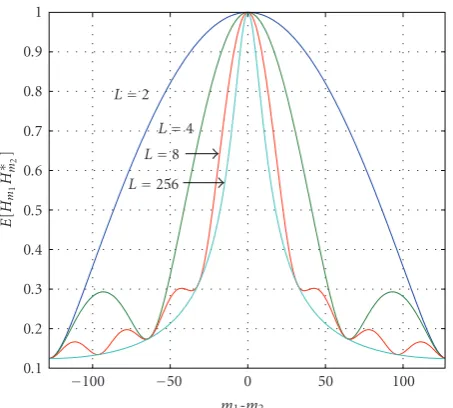
From (41), the correlation in channel responses of subcarriersm1andm2can be calculated as follows:
EHm1Hm∗2
=E
⎡ ⎣L−1
l=0
L−1
l=0
hle−j2πlm1/Mh∗lej2πl m2/M
⎤ ⎦, (42)
and sinceE[hlh∗l]=0,
EHm1Hm∗2
=E
⎡ ⎣L−1
l=0
|h1|2e−j2πl(m1−m2)/M
⎤ ⎦
=E
⎡ ⎣L−1
l=0
α2
le−j2πl(m1−m2)/M ⎤ ⎦.
(43)
tap gains. It can be seen inFigure 9that this correlation is large when the frequency separation betweenm1 andm2is small; hence if one subcarrier is in deep fade, the other is also likely to be in deep fade which may result in packet loss on both subcarriers if we use these two for transmission. On the other hand, when this correlation factor is small, deep fade on one subcarrier is less likely to affect the other subcarrier. Moreover, it is observed from Figure 9that, for a given level of correlation, when the number of resolvable paths increases, the frequency separation decreases. For example, when the number of resolvable paths increases from 2 to 4, the minimum frequency separation to achieve a correlation of 0.3 decreases from 105 to 52 subcarriers, which is approximately two times. The same observation applies whenLincreases from 4 to 8. However, when Lis larger than 8, this observation is no longer valid as shown in Figure 9. Hence, multipath fading channel introduces frequency diversity that can be used, especially forL from 2 to 8.
3.2. ECOMP for OFDM. Using the system model as
described inSection 2.1to support multicast scenario forN
users, we first derive the relationship between average SNR and the instantaneous SNR on each subcarrier and then describe the operation of ECOMP in the case of OFDM.
Applying (41), the instantaneous channel gain for user
ion subcarriermis given by
Hi,m= L−1
l=0
hi,le−2πml/M. (44)
LetXm(t) be the transmitted signal on subcarriermat
timeslottwith normalized power of 1, the average SNR on subcarriermof useriat time-slottcan be expressed as
γi,m(t)=E
Xm(t)Hi,m(t)2
N0
=E
|Xm(t)|2
EHi,m(t)2
N0 =
P N0 =γ
, (45)
and the instantaneous SNR on subcarrier m of user i at timeslottis given by
γi,m(t)=Hi,m(t)2
E|Xm(t)|2
N0 =ρi,m
(t)γ, (46)
whereρi,m(t)|Hi,k(t)|2.
Following the discussions in the previous section, similar to (4) and (5), the effective multicast rates for WU and BU in OFDM system can be given by
rWUm(t)=log2
1 +γ min
i=1,2,...,N
ρi,m(t)
,
rBUm(t)= 1
Nlog2
1 +γ max
i=1,2,...,N
ρi,m(t)
.
(47)
3.2.1. ECOMP for OFDM Using Only Frequency Diversity. Expanding ECOMP to OFDM system, the transmission rate to send multicast packet on each subcarrier can be selected based on the channel gain thresholdρthas follows:
rECOMm=log2
1 +γρth . (48)
To recover the erased packets for users with inadequate instantaneous SNR, ECOMP makes use of RS-code with the same encoding scheme as described in Section 2. For simplicity, without loss of generality, we assume that the number of RS coded packets is equal to the number of subcarriers, that is,n=M, and hence, the whole RS-coded packet block is sent in one time-slot with each coded packet transmitted on one subcarrier as illustrated inFigure 10for time-slott.
The optimization problem for multicast rate when applying ECOMP to OFDM then becomes
arg max
ρth,k
k nlog2
1 +γρth Pr{x≥k}, (49)
where Pr{x ≥ k} is the probability that a given user can receive at least k nonerased packets on all the subcarriers. At the first look, this probability is similar to that in the previous section; however, it is noted that, in the scenario of OFDM, channel gains in subcarriers are correlated and a simple expression using binomial distribution as in the previous section is not applicable. For this, we use simulation to study the throughput performance of ECOMP for OFDM. In particular, we investigate the effects of the number of resolvable paths on the effective multicast throughput and compare the performance of the proposed scheme with that of BU and WU. In our simulations, multicasting is done on a multicast group ofN = 100 users. For simplicity, an OFDM system withM =256 subcarriers and RS(256,k) is considered.
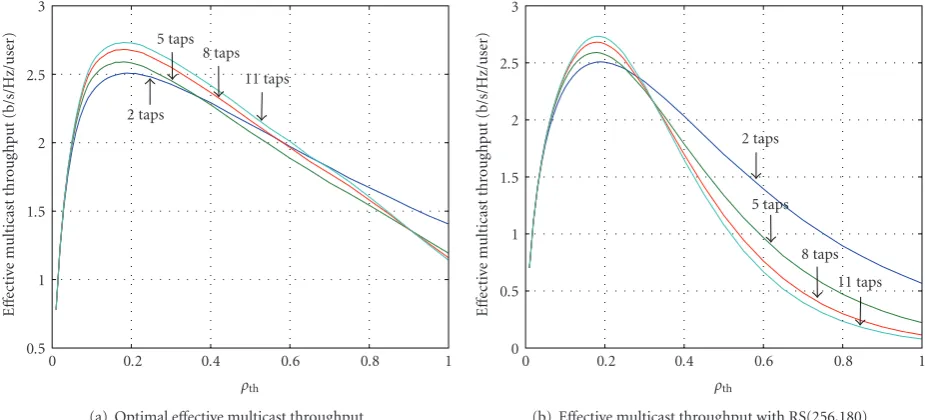
(1) Effects of the Number of Resolvable Paths on Multicast Throughput. In Figure 11, the effect of different fading conditions on the achievable normalized throughput over multipath fading channels is examined at the same average SNR of 20 dB with the number of resolvable paths L =
2, 5, 8, and 11. The results in Figure 11(a) show that the effective multicast throughput depends on the number of resolvable paths. When Lincreases, the correlation among the subcarriers reduces, that is, less chance that packets are erased at the same time, and hence the achievable multicast rate increases asLincreases. This is not the case for unicast where the ergodic capacity is independent of the number of resolvable paths as shown in [13–15]. However, as shown in Figure 11(b), this gain comes with a cost: at the same code rate, as the number of resolvable paths increases, the throughput curve becomes more sensitive to the channel gain thresholdρth.
RS codeword
Time-slott−1 Time-slott Time-slott+ 1
Time
Packet 1
Packet 2
Packetk
Packetk+ 1
PacketM
Symbol 1 Symbol
1
Symbol 1 Symbol
1
Symbol 1
Symbol 2 Symbol
2
Symbol 2 Symbol
2
Symbol 2
Symbol
E
Symbol
E
Symbol
E
Symbol
E
Symbol
E
Subcarrier 1
Subcarrier 2
Subcarrierk
Subcarrierk+ 1
SubcarrierM
· · ·
· · ·
· · ·
· · ·
· · · . . .
. . .
Fre
q
u
en
cy
k
data
pac
kets
M
−
k
par
it
y
pac
kets
Figure10: Transmission of RS-coded packets of ECOMP over OFDM subcarriers.
1 0.8
0.6 0.4
0.2 0
ρth 2 taps
5 taps 8 taps
11 taps
0.5 1 1.5 2 2.5 3
E
ff
ecti
ve
multicast
thr
oug
h
put
(b/s/Hz/user)
(a) Optimal effective multicast throughput
1 0.8
0.6 0.4
0.2 0
ρth 2 taps
5 taps 8 taps
11 taps
0 0.5 1 1.5 2 2.5 3
E
ff
ecti
ve
multicast
thr
oug
h
put
(b/s/Hz/user)
(b) Effective multicast throughput with RS(256,180)
Figure11: Effective multicast throughput versusρthfor ECOMP scheme in different numbers of resolvable paths with average SNR of 20 dB.
Similar to the performance comparison inSection 2, BU is better than WU in the low SNR region while WU outper-forms BU after the crossover point of around 5 dB. Combin-ing both multicast gain and multiuser diversity, the through-put performance of ECOMP is superior to both BU and WU in the considered SNR range and asymptotically converges to WU at high SNR. However, it is noted that the improvement in throughput of ECOMP on OFDM system is smaller than that in the case of single carrier. For instance, at 5 dB, as compared to BU and WU, ECOMP offers an improvement in
3.2.2. ECOMP for OFDM Using Both Time and Frequency Diversity. When applying ECOMP to OFDM by sending all coded packets on all subcarriers, it can be seen that we gainn
times reduction in the delay as each RS block can be sent in only one time-slot. However, as the channel gains of OFDM subcarriers are correlated, if one subcarrier of a given user is in deep fade (i.e.,ρi,m(t) is very low), it is likely that the
subcarriers close to it are also in deep fade and the packets that are sent on these subcarriers will likely be erased. To compensate for the erased packets ECOMP has to select a lower transmission rate and lower RS code rate k to gain more erasure correction capability and hence this reduces the multicast rate. To enhance this throughput performance, it is necessary to keep the correlation among the subcarriers in use as low as possible by increasing their frequency separation. As shown in Figure 9, this required frequency separation depends on the number of resolvable paths. In other words, by transmitting coded packets on subcarriers far from each other we can achieve lower correlation for higher multicast throughput. However, fewer packets can be transmitted on one time-slot and as a consequence more time-slots are needed for transmitting each RS block, introducing more delay.
Based on the above discussions, we consider the extended erasure-correction coding-based opportunistic multicast (EECOM) scheme, in which the BS encodeskdata packets using RS erasure code to form a block of n-coded packets in the same way as inSection 2, but, instead of sending all
n-coded packets on allMsubcarriers in one timeslot (as in
Figure 11), thesen-coded packets are sent overStimeslots on only a subset of C OFDM subcarriers equally spaced with a frequency separation ofS. For the same assumption ofn = M,CS = M.Figure 13illustrates the transmission mechanism of EECOMP forS=2.
The optimization problem for EECOM can be modified from (49) as in the following:
arg max
ρth,k
k nlog2
1 +γρth Pr{x≥k}S, (50)
where Pr{x≥k}S is the probability that a given user can
receive at leastknonerased packets overStime-slots. For the same reason as in the last part, the probability Pr{x≥k}S
does not have a closed-form mathematical expression and the throughput of EECOM is investigated by simulations. Similar toSection 3.2, our simulation results are based on a group of 100 users in an OFDM system withM = 256 subcarriers.
Figure 14 depicts the performance of EECOMP for different numbers of timeslots. In this graph, the horizontal axis represents the number of time-slot S in log2 scale. It is observed that as the number of time-slot S increases, the multicast throughput monotonically increases, which illustrates the trade-offbetween throughput and delay. When
S=1, EECOMP exploits only frequency diversity by sending all coded packets of one RS block in one time-slot on all subcarriers. The effective multicast throughput for EECOMP is the same as in Figure 11(a). When S = 256, EECOMP exploits only time diversity by sending only one coded packet
40 30 20
10 0
−10 −20
SNR ECOMP
BU WU
10−4 10−3 10−2 10−1 100 101
E
ff
ecti
ve
multicast
thr
oug
h
put
(b/s/Hz/user)
Figure12: Throughputs of different schemes versus average SNRs
(5 taps, 100 users).
in each time-slot on one subcarrier and the multicast rate in this case is the same as in Figure 2(b), that is, around 3.34 b/s/Hz which is about 25% higher than that in the case of S = 1. Moreover, when S is large enough, the effective throughput for EECOMP is approximately equal to that of
S = 256. For example, when S is larger than 32 for 8-tap channels, 64 for 4-tap channels, or 128 for 2-tap channels, the achievable multicast rates for EECOMP are roughly the same as the case of S = 256, which correspond to a correlation factor of 0.3 or less (by calculating the frequency separations in these cases and referring to Figure 9for the correlation values). This indicates that there is a significant delay reduction with virtually no penalty in multicast rate at these points andSis reduced when the number of resolvable paths increases; for example,S is reduced by 2, 4, 8 times when L = 2, 4, 8, respectively. However, whenL is very large, as shown in Figure 9, the correlation between two subcarriers of a given frequency separation is not much changed with L. Hence, for largerL, the delay cannot be reduced further.
In addition, it is observed that for points in Figure 14
with the same multicast rate, they yield the same correlation level shown inFigure 9. For instance, atS=32 forL=4 and
S=64 forL=2, the multicast rate is about 3.3 b/s/Hz/user (Figure 14). At these points, the subcarrier separations are 32 and 64 subcarriers whenL =4 andL=2, respectively, for the same correlation factor of about 0.7 (Figure 9). The same observation applies for other points with approximately the same effective multicast throughput inFigure 14.
4. Conclusion
RS
Time-slott Time-slott+ 1 Time
Packet
Figure13: Transmission of RS-coded packets for EECOMP.
256
Number of time-slots (S) 8 taps
Figure 14: Performance of EECOMP for different numbers of
timeslots in multipath fading channel with average SNR of 20 dB.
scheme, the BS sends each packet only once at a transmission rate determined by a channel gain threshold and using erasure correction capability of RS(n,k) to recover erased packets due to insufficient instantaneous SNR on BS-user links. RS coding scheme is applied to a block of packets and coded packets are sent in time or frequency slots to effectively explore time/frequency diversity. The channel gain threshold
and erasure code rate are jointly optimized for best multicast throughput.
On frequency-flat fading channels, the selection of channel gain threshold is considered in two cases of full channel knowledge and partial knowledge of average SNR and fading type of wireless channel. An analytical frame-work has been developed to analyze the effective multicast throughput of BU, WU, and of the proposed scheme. In this framework, we prove that while the effective multicast rates of both BU and WU asymptotically converge to zero as the multicast group size increases, this effective multicast rate of the proposed scheme is bounded from zero and depends on the average SNR. We further prove that, for the proposed ECOM scheme, the benefit of full channel knowledge is only pronounced at small multicast group sizes. As the group size increases, partial knowledge of channel response is sufficient in providing approximately the same throughput performance but significantly reducing resources (bandwidth, power) for feedback signalling.
Furthermore, in this paper, we have extended ECOM for applications to OFDM system aiming at exploiting both time and frequency diversity in a frequency-selective fading environment. The effects of frequency correlation on multicast rate are investigated and our study shows that by exploiting both time and frequency diversity, we can significantly reduce transmission delay with negligible degradation in multicast throughput.
Appendix
Rate Optimization for ECOMP
Using Normal approximation to nj=knk pj(1−p)n−j in
(27), the effective multicast rate of ECOMP can be rewritten as
The optimization problem for ECOMP can be expressed as follows:
The Larangian function can be defined as
Lρ,k = −rECOMP−λ1ρ−λ2k−λ3(n−k+ 1). (A.4)
Since all the constrains (51–53) are inactive constrains, according to the Karush-Kuhn-Tucker conditions [16],λ1=
λ2 = λ3 = 0; therefore, the derivative of the Larangian is
Considering Rayleigh fading channel, p=e−ρth, we then solve∇L(ρth,k)=0 for the peak rate
The above equation gives the relationship betweenkand
References
[1] C. Eklund, R. B. Marks, S. Ponnuswamy, K. L. Stanwood, and N. J. van Waes,WirelessMAN: Inside the IEEE802.16 Standard for Wireless Metropolitan Networks, IEEE Press, 2006. [2] P. Chaporkar and S. Sarkar, “Wireless multicast: theory and
approaches,”IEEE Transactions on Information Theory, vol. 51, no. 6, pp. 1954–1972, 2005.
[3] U. C. Kozat, “On the throughput capacity of opportunistic multicasting with erasure codes,” in Proceedings of the 27th IEEE Communications Society Conference on Computer Com-munications (INFOCOM ’08), pp. 520–528, April 2008. [4] T. P. Low, M. O. Pun, and C. C. J. Kuo, “Optimized
opportunistic multicast scheduling over cellular networks,” in Proceedings of the IEEE Global Telecommunications Conference (GLOBECOM ’08), pp. 4144–4148, New Orleans, La, USA, November-December 2008.
[5] P. K. Gopala and H. El Gamal, “Opportunistic multicasting,” in Proceedings of the 38th Asilomar Conference on Signals, Systems and Computers, pp. 845–849, November 2004. [6] P. K. Gopala and H. El Gamal, “On the throughput-delay
tradeoffin cellular multicast,” inProceedings of the Interna-tional Conference on Wireless Networks, Communications and Mobile Computing, pp. 1401–1406, June 2005.
[7] C. H. Koh and Y. Y. Kim, “A proportional fair scheduling for multicast services in wireless cellular networks,” inProceedings of the 64th IEEE Vehicular Technology Conference (VTC ’06), pp. 1063–1067, September 2006.
[8] H. Won, H. Cai, DO. Y. Eun et al., “Multicast scheduling in cellular data networks,” inProceedings of the 26th IEEE Com-munications Society Conference on Computer ComCom-munications (INFOCOM ’07), pp. 1172–1180, May 2007.
[9] M. O. Sunay and A. Eks¸im, “Wireless multicast with multi-user diversity,” in Proceedings of the IEEE 59th Vehicular Technology Conference (VTC ’04), pp. 1584–1588, May 2004. [10] S. Cioni, C. P. Niebla, G. S. Granados, S. Scalise, A.
Vanelli-Coralli, and M. A. V. Castro, “Advanced fade countermeasures for DVB-S2 systems in railway scenarios,”EURASIP Journal on Wireless Communications and Networking, vol. 2007, Article ID 49718, 2007.
[11] B. Sklar,Digital Communications: Fundamentals and Applica-tions, Prentice-Hall, New York, NY, USA, 2nd edition, 2001. [12] L. M. Correia,Wireless Flexible Personalised Communications,
Wiley, New York, NY, USA, 2001.
[13] H. B¨olcskei, D. Gesbert, and A. J. Paulraj, “On the capacity of OFDM-based spatial multiplexing systems,”IEEE Transactions on Communications, vol. 50, no. 2, pp. 225–234, 2002. [14] L. H. Ozarow, S. Shamai, and A. D. Wyner, “Information
theoretic considerations for cellular mobile radio,” IEEE Transactions on Vehicular Technology, vol. 43, no. 2, pp. 359– 378, 1994.
[15] E. Biglieri, J. Proakis, and S. Shamai, “Fading channels: information-theoretic and communications aspects,” IEEE Transactions on Information Theory, vol. 44, no. 6, pp. 2619– 2692, 1998.