A Quantum MIMO Architecture for Antenna Wireless Digital
Communications
Said Mikki*
Abstract—A general theoretical framework for MIMO digital wireless communications is proposed for sending classical M-ary information over quantum states instead of classical electromagnetic waves. The basic theory of quantum MIMO architecture suitable for spatial diversity application is proposed and analyzed. The fundamental design equations are derived and shown to be equivalent to a special constrained nonlinear optimization problem. The main advantage of the MIMO architecture is that it provides new resources for the system designer since using multiple Tx quantum antennas coupled with judicious choice of optimum positions for the multiple Rx quantum measurement operators can enhance the ability to realize quantum communication systems. Therefore, additional degrees of freedom are expected to become available in the proposed quantum MIMO systems. The proposed system is expected to be best physically realized using electromagnetic process in second-quantized (photon) states, ideally coherent or squeezed radiation states.
1. INTRODUCTION
Multiple-Input-Multiple-Output (MIMO) systems refer to a class of wireless communication systems designed to address the mounting difficulties arising from the negative impact of increasing complexity, coupling, and interferences in modern-day propagation environments [1–4]. Since more devices and systems are being used in the same unit area, and urban settings themselves are becoming denser and more crowded, the impact of undesired objects like scatterers has made it extremely hard to monotonically increase data rates using the traditional Single-Input-Single-Output (SISO) scheme of wireless communications. Instead, there is a need to devise new architectures and topologies capable of exploiting the rich spatial diversity and inherent complexity of typical propagation environments. MIMO system is such technology, and together with its immediate predecessor, diversity system, has proved to be one of the most promising candidates for bringing out significantly higher data rates for 5G and autonomous systems applications.
The main goal of the present paper is to build a basic general fundamental theory for MIMO communications over quantum channels where classical information is transmitted through quantum states instead of classical electromagnetic fields. In quantum optical wireless communication systems, one requires the use of a suitable light source at the transmitter in order to generate carefully prepared quantum states of light that encode classical information where an isomorphism exists between classical bits or symbols and a quantum alphabet composed of a set of coherent quantum states. The special radiating structure capable of preparing a specific coherent state based on a classical input source is termed quantum antenna, which we refer to for brevity as ‘q-antenna,’ while classical antennas are simply duped ‘c-antennas.’ Quantum MIMO differs from the previously proposed quantum single-input-single-output (SISO) [5–10, 13–19, 26–29] in utilizing multiple quantum antennas at the Tx and multiple receivers at the Rx terminal. Therefore, quantum MIMO (q-MIMO) is essentially motivated
Received 24 March 2019, Accepted 1 June 2019, Scheduled 14 June 2019 * Corresponding author: Said Mikki ([email protected]).
by applications in wireless communications, rather than the “wired” optical-fiber links that appear to have dominated research in optical quantum communications so far. As such, this makes the study and development of quantum MIMO systems considerably more difficult than fiber-optics quantum communications since not much is known experimentally and theoretically about optical wireless networks. Indeed, since scattering effects are very severe in the optical regime, while building quantum wireless links at lower frequencies like RF, microwave, or mmWave is not feasible due to weakness of quantum effects at such low frequency, much of the research on quantum telecommunications have focused on using guided waves to encode classical information using quantum states, mostly coherent laser modes. In our opinion, such overall situation in the nascent field of quantum communications makes it even more urgent to consider alternative system design for wireless quantum communications capable of addressing the multiplying difficulties arising from both using optical quantum wireless and the presence of dense-and-complex propagation environments in present-day urban settings. Moreover, it is expected that similar to classical MIMO, the use of multiple antennas and receivers can enhance the spectral efficiency of quantum MIMO links over quantum SISO.
In what follows, we first review the classical SISO detection theory, which is based on the classical work of Helstrom and Helovo [5–9]. Next, the essential ideas of a MIMO system are proposed and evolved in terms of a set of commuting operators. The common projector systems of such operators are then used to extend the classical theory to the multiple antenna case. New design equations are derived and compared with the SISO Rx structure. The main objective of this paper is to introduce a very general theoretical framework for quantum wireless MIMO suitable for future, more concrete and application-oriented implementations. The presentation is kept intentionally broad and very minimal physical assumptions are made in order to allow different physical realization to emerge in the future. However, analysis, discussion, and proposals regarding the practical implications and future prospects of our system are provided in Sec. 3.3.
2. THE BASIC SETTING OF QUANTUM COMMUNICATIONS
2.1. Introduction
The quantum SISO system possesses an overall similarity to its classical counterpart in still having the same essential building blocks, namely information source, transmitter, channel, and receiver [9, 10]. However, certain fundamental differences also exist, and these pertain to the use of quantum physics to transmit information rather than electromagnetic fields in classical states. The information source remains the same, but in q-SISO systems, the transmitter will be composed of a quantum encoder (q-encoder) and a quantum antenna (q-antenna), together producing radiation in a quantum state |s. As the quantum state (q-state) travels through the quantum channel (q-channel), it will be either transformed to another pure state |s, or become a mixed state, in which it is best to represent the latter by the density operator, say ρs. The received (pure or mixed) states will then be processed by a receiver consisting of two fundamentally distinct systems. The first is the measurement device M, which will project the received state onto one of finite number of possible outcomes, the spectrum of the measurement operator associated with the device M. The next system is the quantum decision (q-decision) circuit, which is essentially classical in the sense that it will take the actually produced measured outcome fromM (now a classical number measurement) and makes a decision about which of the finite classical information symbols at the transmitter was actually sent.
2.2. The Quantum SISO Transmitter
We work with an M-ary digital communication system in which the information source will generate information sequenceani, wherenandiare the symbol’s time and index, respectively. That is, at every time stepnthe source will choose one and only one symbol out ofM alphabets in the setA. Since in the present paper we deal with the fundamental theory of quantum MIMO, we will not include inter-symbol interference and related digital transmission analysis and hence for simplicity we drop explicit mention of the time indexn. Consequently, we write
Next, the classical encoder (c-encoder) will transform these symbols into suitable pulses
si(t), i= 1,2, ..., M,
that can be fed directly to the q-antennas for transmission through the channel. Finally, the classical pulsesi(t) will be radiated as a pure state |si through the q-antenna. The entire q-SISO transmitter can then be summarized by
ai −−−−−−→c-encoding si(t)−−−−−−→ |q-encoding si orρi=|si si|, (1) where we also added the density operator representation
ρi =|si si|
as an equivalent form of the radiated state when the latter is pure state like |si as is the case here. Note that when thermal noise is added to the system, the coherent state produced by the q-antenna will be transformed into a mixed state. In the latter case, the use of the density operator formalism becomes essential since the density operator with thermal noise cannot be factorized into a diagonal form like |ss|. In other words, we have
|si orρi =|si si|−−−−−−−−−−−−−→Thermal Noise Added ρthi , (2)
whereρthi is a mixed state density operator containing all information about the original radiated pure state |si plus off-diagonal state-environment interactions caused by thermal noise. The q-transmitter will also assign a set of probabilities
pi, i= 1,2, ..., M, for each radiated quantum state, which we define by
Pr{|s=|si}:=pi.
The proper choice of these probabilities amounts to what is usually termedpre-codingin classical MIMO and is projected to be fundamental also in quantum MIMO system design. Overall, the q-transmitter can be summarized as transforming the original classical alphabet set A to the quantum alphabet Aq, i.e.,
|si ∈Aq ={|s1,|s2, ...,|sM},
where the entire process is encapsulated by the q-coding map
Cq: A→Aq.
The minimum requirement that Cq must satisfy is being bijective (one-to-one) to ensure that each original classical information symbol is uniquely mapped to one and only one quantum state for transmission through the quantum channel. Note that an equivalent coding map can also be written using the density operator. The receiver structure will be discussed directly in the next section when we analyze the proposed q-MIMO system.
2.3. The Digital Quantum SISO Channel
eigenvalue. Let the projector operator system associated with the receiver measurement operator O given by the projector system
{Pk, k= 1,2, ..., K},
where K is the number of possible measurement outcomes, which we assume to be finite. Here, every
Pk is a projector operator projecting the measured state |si onto one of the observable O potential
outcomes |mk, i.e., we have [12]
|si −−−−−−−−−−−−−−−→ |Measurement throughO mk= Pk|si
si|Pk|si, k = 1, ..., K. (3)
Using the spectral decomposition theorem, the receiver observable O itself can be expanded as [12]
O =
mk∈M
mkPk, (4)
where
M:=σ(O) ={m1, m2, ..., mK}
is the spectrum of O consisting of the set of all possible measurement valuations.
Based on this notation, we can now compute the transition probabilities of the SISO quantum channel as follows. Assume that symbol si was transmitted. Let the quantum receiver’s front-end measurement operator beO. According to the quantum rules, the probability of detecting outcomemk given si can be given by [11]
p(k|i) := Pr{|m=|mk ||si}=si|Pk|si, (5) wherei= 1, .., M,k= 1, .., K. It is also possible to express the same result more conveniently using the density operator formalism. In that case, Equation (5) can be written as
p(k|i) = Pr{m=mk|ρi}= Tr{ρiPk}, (6) for i = 1, ..., M, k = 1, ..., K. In this paper, Equation (6) will be used instead of Equation (5). The quantum SISO channel matrix has the form
HSISO= [p(k|i)]K×M, (7)
an K×M matrix with elements given by Equation (6).
2.4. The Quantum SISO Digital Receiver
The final stage in the quantum SISO is the digital receiver, which is here mainly treated within the existing framework of quantum decision theory [9]. That is, the last step needed in order to complete the link is to transform the measured outcomemkinto a decision about which one of theM transmitted digital symbols si, i = 1, ..., M was transmitted. Post-measurement decision can be implemented by decomposing the receiver measurement apparatus’ spectrumMinto M disjoint setsMj [9]
M=M
j=1Mj. (8)
The decision circuit then consists of a map
D: M → Aq
from the receiver set of outcomesMto the set of originally transmitted quantum states Aq defined by
D(m) =|si ⇐⇒ mk ∈Mi. (9) Therefore, the decision map D will construct an estimation of which state was originally transmitted based on the measurements that the receiver apparatus O has produced. The design of the decision circuit can then be fully reduced to the choice of the partition setMj,j = 1,2, ..., M, in (8).
To complete the analysis of the quantum SISO system, we need to compute the probability of correct detection. The probability of correct detection of theith symbolsi is readily found to be
However, since according to fundamental quantum theory various individual measurements are mutual exclusive, i.e., the various events
m=m1, m=m2, ..., m=mK,
cannot occur simultaneously, the probability of the universal statement above can be expanded as sum of the probabilities of the individual propositional instantiations. In other words, we can write
pc(si) =
mk∈Mi
Pr{mk|si} (10)
or using Equation (6)
pc(si) =
mk∈Mi
Tr{ρiPk} (11)
Finally, the total probability of correct detection is
Pc= M
i=1 pi
mk∈Mi
Tr{ρiPk}, (12)
which is the average over all other symbols’ probabilities of correct detection weighed by their a priori probabilities set by the q-encoder.
3. QUANTUM MIMO SYSTEM
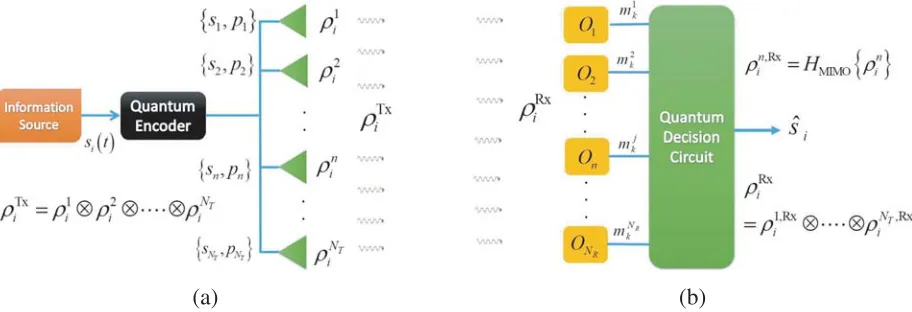
Figure 1(a) shows the proposed basic (bare minimum) Tx quantum MIMO system. The information stream consists of a succession of symbols si each chosen from the universal alphabetA as in q-SISO systems discussed above. The q-MIMO encoder will distribute each symbolsi intoNT q-antennas that in turn radiate NT pure coherent states
|sni orρni =|sni sni|, n= 1,2, ..., NT, i= 1,2, ..., M,
where again we use either the vector or density operator formalism. These individual pure states can also be associated with different coding schemes, here translated into a set of q-state a prior probabilities which we denote by
pn
i, n= 1,2, ..., NT, i= 1,2, ..., M.
On the receiver side (see Fig. 1(b)), we place a set ofNR measurement apparatus corresponding to the operators
Oj, j= 1,2, ..., NR.
The result of every operator measurement is a set of outcomesMj with cardinalityKj. That is, in order to profit from the additional richness of multipath environments, we allow the measurement operators to be different at the Rx side in order to exploit this added complexity in the process of designing an optimal receiver. Each Rx measurement operator Oj will produce an outcome
mjk∈ Mj,
here labeled by the discrete index ktaking values 1,2, ..., Kj. Thus, in contrast to q-SISO systems, the quantum MIMO decision must now deal with a considerably larger set of measured outcomes, namely the
NR NR
j=1 Kj
total possible measurement valuations that mjk may assume. However, in order to simultaneously measure the outcomes at all receivers, we assume that all measurement operators are commutative, i.e., mutually compatible. Mathematically, this translates into [11]
Oj, Oj= 0, for all j=j. (13)
(a) (b)
Figure 1. (a) Quantum MIMO system transmitting architecture. (b) Quantum MIMO system receiver architecture. Here,HMIMO is the propagator operator of the wireless environment.
3.1. Quantum MIMO Channel Analysis
Every pure state emanating from an antenna in the Tx side will travel down through all possible paths toward the receiver, generally reaching all nR measurement receivers. The transmitted state when all q-antennas radiate together is the product state
ρtx
i =ρ1i ⊗ρ2i ⊗ · · · ⊗ρNi T. (14)
However, each pure state ρni will travel through a different path (and hence environment) compared to other fellow states with different n, leading to the need for explicitly taking into account the transformation that each state will undergo while passing through the quantum channel as follows
ρn
i −−−−−−−−−−−−−−−−→Quantum MIMO Channel ρrxin, (15)
where ρrxin is the contribution to the total quantum state at the receiver made by the nth transmitted state ρni. Note that this is anew state (possiblymixed) described by the density operatorρrxin. The Rx measurement operator, however, does not know in advance the exact decomposition of Equation (15), and hence it is not possible to search for a composite measurement operator at each Rx site that can measure every factor state ρrxin in Equation (15). For that reason and in order to produce a realistic description of the q-MIMO system, it is necessary to write the total Rx state in full at the Rx terminal. Consequently, the received state at all measurement sites is given by the tensor product of individual states coming from allNT Tx antennas. We have
ρrx
i =ρrxi1 ⊗ρrxi2 ⊗ · · · ⊗ρrxin⊗ · · · ⊗ρrxiNT, (16)
regard since it treats each transmitted q-state produced by one q-antenna as essentially independent from others. While the q-MIMO Rx will not be able to always distinguish each of the factor states in Equation (16) via direct quantum measurement, it is hoped nevertheless that the use of multiple measurement processes and then combining them together (post-measurement processing) can improve the overall performance of q-MIMO links in comparison to traditional q-SISO systems.
Note the fundamental difference between classical and quantum MIMO systems: In contrast to the classical case, the Rx radiation state ρrxi does not depend on position. Indeed, working with the Heisenberg picture, the state is time independent while measurement operators (observables), for instance, field strength, energy, momentum, spin, etc, are spacetime functions. The operators Oj are then functions of r, although for simplicity we drop out this dependence. All q-MIMO receivers will interact with essentially the same global state of Equation (16). However, it is very difficult to directly calculate with Equation (16). In fact, in what follows we will not develop the digital receiver theory based on such factorization according to paths because the latter is unknown to the receiver. Instead, we rely on q-antenna theory to provide natural universal basis for the Hilbert space of the entire MIMO system, say a set|l indexed byl, and expand all (e.g., pure) states as
ρn i =
l
ainl|l l|, ρjni =
l
aijnl|l l|, ρrxi =
l
ail|l l|,etc. (17)
Indeed, when q-antennas are used for wireless quantum MIMO system realization, such a universal computational basis exists, namely the Fock photon states, which can also be applied with some modification to deal with mixed states.
3.2. Quantum MIMO Receiver Design
From the assumption in Equation (13), we know that there exist a common set of eigenspaces shared by all measurement operators Oj,j = 1, ..., NR. Let the projector system associated with this MIMO receivers eigenvalue decomposition be given by
Pk, k= 1,2, ..., K. (18)
We will next construe all (generally not identical) spectral decompositions associated with the NR operators Oj using the universal Rx projector system in Equation (18). However, even though the Rx global q-state in Equation (16) possesses its own universal computational basis, namely the Fock state representation of multi-mode coherent radiation modes, every measurement operatorOj at the q-MIMO receiver will must be expressed in terms of its own Hilbert spaceHj. Afterwards, the Rx MIMO state
ρrx
i may be expanded in every such Hilbert space into the corresponding complete set of eigen-basis,
i.e., the eigenvectors of the corresponding measurement operator. In other words, at the jth receiver, a random variablemj, the result found by measuring the incident stateρrxi by the Hermitian operator
Oj, will be assigned, with measured outcomes mjk taking values in the set
Mj :=σ(O j), i.e., the spectrum of the operatorOj itself. We further write
Kj :=|Mj|,
so the cardinalities of the measurement sets at the receiver are not necessarily identical in order to allow for more flexibility in designing the q-MIMO system in spatially diverse environments.
Based on this overall analysis, we are now in position to compute the MIMO channel matrix connecting the emitting antennas and the receiver’s measurement devices. Let the spectrum of thejth antenna operatorOj be
Mj :=σ(Oj) =
mj1, mj2, ..., mjKj
.
Therefore, from the spectral decomposition theorem,Oj can be expanded as [12]
Oj =
mjk∈Mj
where
Pkj, j = 1,2, ..., NR, k= 1,2, ..., Kj, (20) is the projector system of thejth Rx measurement site.
It is interesting to see how from Equation (13) one may explicitly write
Pkj =
k∈Dj
k
Pk, (21)
where the setsDkj are defined by
k ∈Dj
k ⇐⇒ mj =mjk.
In other words, Dkj is the index subset
Djk⊂ {1,2, ..., K}
containing the indices of all projectors Pk projecting the Rx state onto the eigenspace of Oj with eigenvalue mjk, where the operator Pkj now serves as a single projector for this eigenspace itself.
It now readily follows from the spectral decomposition theorem of Equation (19) and the quantum rules that the probability of measuring thekth outcomemjk∈ Mj when sending theith symbol via the
nth q-antenna is given by
p(k|inj) = Pr
mj =mj k|ρrxin
= Tr
ρrx
inPkj
. (22)
This is a tensor of rank 4 expressed as
HMIMO= [p(k|inj)]K×M×NT×NR (23)
capturing the full stochastic content of q-MIMO systems. Note that for a fixedkand i, expression (22) corresponds to theNT ×NR MIMO channel matrix in classical wireless communications.
If we now try to compute the probability of measuringmjkgiven that the symbolsi (i.e., the q-state
ρrx
i ) was transmittedbefore going through the NT q-antennas, then this can be put in the form
p(k|ij) = Pr
mj =mjk|ρrxi
= Pr
mj =mjk|ρrxi
, (24)
where use was made of Equations (14), (15), and (16). Consequently, basic quantum theory predicts that [12]
p(k|ij) = Tr
ρrx
i Pkj
, (25)
which can be effectively calculated by means of a suitable universal computational Hilbert space basis such as Fock states.
Next, our goal is to compute the transition probabilities of the MIMO system in order to prepare for the design of an optimum receiver capable of maximizing the probability of correct detection. To do this, a proper decision strategy at q-MIMO receiver circuit must be determined. Following a method similar to the one ascribed to q-SISO systems [9, 10], we partition each receiver’s measurement spectrum Mj intoM disjoint subset as follows
Mj =M
l=1M
j
l, j= 1,2, ..., NR, (26)
where
MjlMjl =∅ ⇐⇒ l=l.
The decision map DMIMO of the MIMO system will be constructed from the set of all measurements
mj at all receivers, i.e., we have
DMIMO : NR
j=1M
j → A
q, (27)
with explicit definition specified by
Here,mis the NR×1 vector of all measurements
m:= [m1 m2 ... mNR]T.
The probability of deciding that the lth symbol was sent given that the ith symbol was actually transmitted, here denoted by p(l|i), is
p(l|i) = Pr
m1
k∈ M1l, · · · , mkNR ∈ MNl R|ρrxi
(29)
The individual probabilities are now computed by
Pr
mjk∈ Mjl |ρrx
i
=
mjk∈Mjl Tr
ρrx
i Pkj
, (30)
which may be re-expressed as
Pr
mjk∈ Mjl |ρrx
i
= Tr
ρrx
i Qjl
. (31)
Here, the operatorQjl is defined by
Qjl :=
mjk∈Mjl
Pkj. (32)
It can be easily shown from Equation (32) that all of theMNR operatorsQjl are Hermitian. Moreover, one may directly prove from the standard properties of the projector systemPkj that
Qjl ≥0, (33)
that is the positive semi-definiteness of each receiver measurement operator. Moreover, we also have
l
Qjl =IHj, (34)
which is the statement of completeness in Hj, the Hilbert space of thejth Rx measurement device. Therefore, each of thej= 1,2, ..., NR classes
Qjl, l= 1,2, ..., M
constitutes a set of POVM operators (Positive Operator Valued Measures) [10] on the corresponding receiver’s measurement Hilbert space Hj, and hence can serve as generalized receiver operators to be determined by the final design process (see below).
Before moving to the evaluation of the probability of correct detection, we note that the construction of the receiver POVM through Equation (32) in terms of the common projector systemPkj directly leads to the conclusion that all of the operators Qjl are idompotent, i.e., we have
QjlQjl =Qjl. This can be proved by using Equation (32) to write
QjlQjl =
mjk∈Mjl
mjk∈Mjl
PkjPkj =
mjk∈Mjl
Pkj =Qjl, (35)
where the projector property
PkjPkj =Pkjδkk (36) was utilized.
Since all operators Oj are commutative, the joint (29) probability is now readily found as [12]
p(l|i) = Tr ⎧ ⎨ ⎩ρrxi
NR
j=1 Qjl
⎫ ⎬
Now, the probability of correct detection of the ith symbol is
pc(i) := Pr{DMIMO(m) =|si|si}=p(i|i). (38)
Therefore, from Equation (37) we find
p(i|i) = Tr ⎧ ⎨ ⎩ρrxi
NR
j=1 Qji
⎫ ⎬
⎭. (39)
Finally, the probability of correct of the q-MIMO is obtained by averaging over all symbols as follows
Pc =
M
i=1 piTr
⎧ ⎨ ⎩ρrxi
NR
j=1 Qji
⎫ ⎬
⎭. (40)
In order to design the q-MIMO receiver, we need to solve an optimization problem where we search forNR×M POVM operatorsQ∗lj,j= 1,2, ..., NR,l= 1,2, ..., M, such that
Q∗ij = arg max
Qji
⎧ ⎨ ⎩ M i=1 piTr
⎧ ⎨ ⎩ρrxi
NR
j=1 Qji
⎫ ⎬ ⎭ ⎫ ⎬ ⎭ (41)
under the constrains
Qji ≥0,
M
l=1
Qij =IHj, [Qji, Qij] =δiiδjj. (42)
This is the fundamental Rx design problem of MIMO digital communication systems, a nonlinear constrained optimization problem that can be solved using numerical search algorithms.
We note that in contrast to Helstrom’s SISO theory, the quantum detection problem of MIMO receivers is considerably more complicated since the cost function in Equation (41) is nonlinear. Moreover, the actual radiation state ρrx impinging on the Rx must be estimated before embarking on the process of solving the receiver design problem. This can be done using the quantum antenna theory currently under development by the author, which attempts to describe the overall physical structure of the radiation state in terms of coherent states. Details of the solution using this theory and some numerical optimization results will be reported in future work. However, the basic q-MIMO theory reported here is very general and is valid regardless of the physical realization method.
3.3. Channel Capacity in q-MIMO Systems
Effectively, we have managed to derive the stochastic channel matrix of a basic q-MIMO system through expression (37), which gives the probability p(l|i) that the lth symbol sl is constructed at the digital receiver given that theith symbol si was transmitted. Note that this is valid even when noise is totally ignored in the q-MIMO system. Indeed, assuming that thermal noise is not present, the incident density operator ρrxi becomes diagonal, i.e., corresponds to pure state [10]. In this case, only pure quantum noise (shot noise) is present and the channel matrix is still probabilistic. This is in direct contrast with classic communications where the system becomes deterministic when noise is ignored. The advantage of our formulation so far is that by using the density operator formalism, there is no need to change the derived expression when moving from zero thermal noise to thermal noise; indeed, the only difference is that in the latter case, the density operator becomes mixed [12].
According to information theory, the mutual information between the the reconstructed symbol ˆs and the transmitted symbolsis given by [1]
I(ˆs;s) =
M i=1 M l=1
pip(l|i) logMp(l|i)
i=1
pip(l|i)
Consequently, using Equation (37), expression (43) becomes
I(ˆs;s) =
M i=1 M l=1 Tr ⎧ ⎨ ⎩piρrxi
NR
j=1 Qjl
⎫ ⎬ ⎭log Tr ⎧ ⎨ ⎩ρrxi
NR
j=1 Qjl
⎫ ⎬ ⎭ M i=1 Tr ⎧ ⎨ ⎩piρrxi
NR
j=1 Qjl
⎫ ⎬ ⎭
, (44)
Assuming that the receiver operatorsQllare already available, e.g., by solving the optimization problem in Equation (41), then the q-MIMO channel capacity can be found by solving the following maximization problem
Cq-MIMO= max
pi ⎡ ⎢ ⎢ ⎢ ⎢ ⎢ ⎢ ⎣ M i=1 M l=1 Tr ⎧ ⎨ ⎩piρrxi
NR
j=1 Qjl
⎫ ⎬ ⎭log Tr ⎧ ⎨ ⎩ρrxi
NR
j=1 Qjl
⎫ ⎬ ⎭ M i=1 Tr ⎧ ⎨ ⎩piρrxi
NR
j=1 Qjl
⎫ ⎬ ⎭ ⎤ ⎥ ⎥ ⎥ ⎥ ⎥ ⎥ ⎦ . (45)
In other words, capacity is the maximum possible mutual information over all allowable source information distributions [1].
Note that in all such expressions above, the architecture of the transmitter is encoded in the inner structure of the received quantum state ρrxi , so knowledge of the q-antenna array and the propagation environment is required in order to compute the channel capacity through Equation (45).
3.4. Discussion and Practical Issues
The general theory developed above does not exhaust what can be possibly done with quantum MIMO system design, providing one possible system architecture among others. This particular design was developed intentional in abstract setting in order to make it available to the largest number of possible physical realizations. In this section, we briefly comment on the nature of the results attained and their potential applications in existing and future nonclassical communication systems.
We begin by emphasizing that the electromagnetic background of the ultimate physical process underlying our communication system dominates the proposed design. The reason is that we intentionally build the transmitter in terms of quantum antennas, which are defined as classical radiators producing nonclassical propagating states.† More specifically, the radiated q-states that can be best utilized in our proposed architecture are either coherent states or squeezed states [22– 24], which are special pure quantum states of the radiation field derived using the standard second quantization procedure [11]. Coherent states, for example, describe very well laser modes operating above threshold [21], while squeezed states (inherently nonclassical states of light) are now available in quantum optics experiments [25]. Therefore, the generation of specialized modulated and coded quantum states is not currently a major issue and has already been done by several researchers, e.g., see reviews in [20, 28]. On the other hand, from the perspective of the practical implications of the present paper, it is essentially the ability to spatially orientate quantum transmitters what makes the system interesting from the viewpoint of applications since spatial re-positioning of independent transmitting modules can lead to spatial multiplexing on one hand, and to potential enhancement of interference-and-noise immunity (increasing probability of correct detection) if additional signal processing or measurement operators design where introduced in the backend as is usually the case in classical MIMO systems (the new signal processing in q-communications need not be identical though.) Indeed, the quantum Rx system itself must utilize the ability to spatially reposition every measurement device in order to “sample” the quantum state at different structural “viewpoints.” For example, the combined Rx quantum stateρrxmay contain distinct salient structural features that cannot be efficiently
probed by a single measurement device. The use of multiple devices in the Rx then can allow us to
exploit the ability to use spatial position as a “measurement design parameter” because from quantum electrodynamics we know that different measurement operators can be produced by merely changing the location of the measurement.‡
The last observation brings us to the second major practical application of our proposed MIMO system architecture. Since spatial position at the Rx side can be utilized to “engineer” desired measurement operators, the decomposition of the effective diversity-type q-MIMO Rx shown in Fig. 1(b) intojQjl, such as those appearing in equations like (37) and (41), can be considered apractical method to realize an optimum measurement operator in the lab. Indeed, since we start with a set of known or realizable projector measurement operators, namely the universal set given in Equation (18), it follows that the product formjQjl(r), where here we reinstate the dependence of the POVMQjl operator on position (already implicit in the use of the indexj to label different Rx measurement operators), allows the designer greater freedom in synthesizing desired system equipment in the Rx terminal than what would be the case with SISO or even MISO architectures. Examples of position-dependent operators are extremely obvious in the case of electromagnetic (QED) measurements, which include electric and magnetic fields strengths, photon numbers, spin, angular momentum, see [24] for extensive theoretical discussion and [25] for experimental realization of these electromagnetic-type quantum measurements.
The new form of the optimum quantum detection scheme in Equation (41) with the constraints of Equation (42) can be considered an expansion of the available number of degrees of freedom that the engineer can draw on in his quest to develop and build more reliable wireless quantum communication systems. It is indeed the underlying motivating philosophy behind MIMO research to exploit the increased spatial complexity of the problem in order to design more complex but higher performance generation of wireless communication systems. The architecture proposed in this paper can be realized with electromagnetic infrastructure, but the full details of the implementation are quite extensive and will be addressed elsewhere. First, we note that proper models of quantum antennas must be derived and tested. Quantum channel modeling is already in general more well developed and several excellent Gaussian channel models suitable for electromagnetic-type quantum communications are currently available, see for instance [10, 20]. On the other hand, the receiver design process will require solving the constrained general optimization problem in Equation (41), most probably numerically for the general case. In outline, one must build the entire Hilbert space (theoretically infinite dimensional but should be truncated for practical computations) then perform all calculations of the quantum antennas, channel propagation, and receiver design offline in the simulator. It is hoped that the resulting system will exhibit greater design options since it is already more complex, being richer in new spatial degrees of freedom that can be tuned or optimized in order to best attain target link performance metrics.
4. CONCLUSION
We proposed a basic quantum MIMO architecture suitable for applications involving spatial diversity and optimum quantum digital receiver design, with the main goal being increasing the reliability of wireless quantum communication systems transmitting classical information over quantum channels. It was found that a class of commuting measurement operators at the receiver can be used to design optimum Rx structures by solving a nonlinear constrained optimization problem to find the best POVM operators realizing combined measurement and decision processes. The use of multiple measurement devices at the Rx terminal is expected to have several applications. One of them is the ability to relax the conditions of implementing the optimum SISO POVM operators by allowing several different but readily realizable operators to collectively interact with each other in order to synthesize a total MIMO optimum Rx POVM. Also, the use of spatial processing via enacting multiple measurements at various positions can be profitably exploited to increase the designers resources since it allows additional degrees of freedom to become available. It is expected that an electromagnetic physical realization of the proposed system architecture has a very promising practical prospect since it would allow using positions of quantum antennas at the transmitter, and quantum measurement operators at the receiver, to allow for joined optimum fine tuning of the overall system performance.
‡ Technically, we work here in the Heisenberg picture where the fields are assumed as time-dependent measurement operators evolving
REFERENCES
1. Lathi, B. P. and Z. Ding, Modern Digital and Analog Communication Systems, Oxford University Press, New York, 2009.
2. Hampton, J. R., Introduction to MIMO Communications, Cambridge University Press, 2014. 3. Marzetta, T. L., E. G. Larsson, H. Yang, and H. Q. Ngo, Fundamentals of Massive MIMO,
Cambridge University Press, 2016.
4. Mikki, S. M. and Y. M. M. Antar, New Foundations for Applied Electromagnetics, Artech House, 2016.
5. Helstrom, C. W., J. W. S. Liu, and J. P. Gordon, “Quantum-mechanical communication theory,” Proc. IEEE, Vol. 58, No. 10, 1578–1598, 1970.
6. Kennedy, R. S., “A near-optimum receiver for the binary coherent state quantum channel,” Massachusetts Institute of Technology (MIT Research Laboratory of Electronics Quarterly Progress Report 108), Technical Report, Cambridge (MA), January 1973.
7. Holevo, A. S., “Statistical decision theory for quantum systems,”J. Multivar. Anal., Vol. 3, No. 4, 337–394, 1973.
8. Yuen, H. P., R. Kennedy, and M. Lax, “Optimum testing of multiple hypotheses in quantum detection theory,” IEEE Transactions on Information Theory, Vol. 21, No. 2, 125–134, 1975. 9. Helstrom, C. W., Quantum Detection and Estimation Theory, Academic Press, 1976.
10. Cariolaro, G., Quantum Communications, Springer International Publishing, Switzerland, 2015. 11. Dirac, P. A. M.,The Principles of Quantum Mechanics, 3rd edition, Oxford UP, 1947.
12. Von Neumann, J.,The Mathematical Foundations of Quantum Mechanics, New Edition, Princeton University Press, 2018.
13. Kato, K., M. Osaki, M. Sasaki, and O. Hirota, “Quantum detection and mutual information for QAM and PSK signals,”IEEE Trans. Commun., Vol. 47, No. 2, 248–254, 1999.
14. Vilnrotter, V. and C. W. Lau, “Quantum detection and channel capacity using state-space optimization,” NASA, Technical Report, Interplanetary Network Progress (IPN) Progress Report, 42148, February 2002.
15. Vilnrotter, V. and C. W. Lau, “Quantum detection theory for the free-space channel,” NASA, Technical Report, Interplanetary Network Progress (IPN) Progress Report, 42146, August 2001. 16. Eldar, Y. C., A. Megretski, and G. C. Verghese, “Optimal detection of symmetric mixed quantum
states,”IEEE Transactions on Information Theory, Vol. 50, No. 6, 1198–1207, 2004.
17. Vilnrotter, V. and C. W. Lau, “Binary quantum receiver concept demonstration,” NASA, Technical Report, Interplanetary Network Progress (IPN) Progress Report, 42165, May 2006.
18. Assalini, A., G. Cariolaro, and G. Pierobon, “Efficient optimal minimum error discrimination of symmetric quantum states,” Phys. Rev. A, Vol. 81, 012315, 2010.
19. Cariolaro, G., R. Corvaja, and G. Pierobon, “Compression of pure and mixed states in quantum detection,”Global Telecommunications Conference, GLOBECOM, IEEE, 2011, Vol. 2011, 15, 2011. 20. Holevo, A. S. and V. Giovannetti, “Quantum channels and their entropic characteristics,” Rep.
Prog. Phys., Vol. 75, No. 4, 046001, 2012.
21. Glauber, R. J., Quantum Theory of Optical Coherence, Wiley, 2007.
22. Klauder, J. R. and E. C. G. Sudarshan,Fundamentals of Quantum Optics, W. A. Benjamin, Inc., New York and Amsterdam, 1968.
23. Merzbacher, E.,Quantum Mechanics, 3rd edition, Wiley, 1997.
24. Garrison, J. C. and R. Y. Chiao Quantum Optics, Oxford University Press, 2008.
25. Ou, Z. J., Quantum Optics for Experimentalists, 432, World Scientific, New Jersey, 2017.
26. Imre, S. and F. Bal´azs, Quantum Computing and Communications: An Engineering Approach, John Wiley & Sons Ltd, 2005.
28. Bulletin of the Chinese Academy of Science, “Quantum communications,” BCAS, Vol. 30, No. 2, 2016.