Semi-Homomorphic Encryption and
Multiparty Computation
Rikke Bendlin, Ivan Damg˚ard, Claudio Orlandi and Sarah Zakarias Department of Computer Science, Aarhus University and CFEM?
Abstract. An additively-homomorphic encryption scheme enables us to compute linear functions of an encrypted input by manipulating only the ciphertexts. We define the relaxed notion of a semi-homomorphicencryption scheme, where the plaintext can be recovered as long as the computed function does not increase the size of the input “too much”. We show that a number of existing cryptosystems are captured by our relaxed notion. In particular, we give examples of semi-homomorphic encryption schemes based on lattices, subset sum and factoring. We then demonstrate how semi-homomorphic encryption schemes allow us to construct anefficient multiparty computation protocol for arithmetic circuits, UC-secure against a dishonest majority. The protocol consists of a preprocessing phase and an online phase. Neither the inputs nor the function to be computed have to be known during preprocessing. Moreover, the online phase is extremely efficient as it requiresno cryptographic operations: the parties only need to exchange additive shares and verify information theoretic MACs. Our contribution is therefore twofold: from a theoretical point of view, we can base multiparty computation on a variety of different assumptions, while on the practical side we offer a protocol with better efficiency than any previous solution.
1
Introduction
The fascinating idea of computing on encrypted data can be traced back at least to a seminal paper by Rivest, Adleman and Dertouzos [RAD78] under the name ofprivacy homomorphism. A privacy homomorphism, or homomorphic encryption scheme in more modern terminology, is a public-key encryption scheme (G,E,D) for which it holds that D(E(a)⊗E(b)) = a⊕b, where (⊗,⊕) are some group operation in the ciphertext and plaintext space respectively. For instance, if⊕represents modular addition in some ring, we call such a schemeadditively-homomorphic. Intuitively a homomorphic encryption scheme enables two parties, say Alice and Bob, to performsecure computation: as an example, Alice could encrypt her input aunder her public key, send the ciphertext E(a) to Bob; now by the homomorphic property, Bob can compute a ciphertext containing, e.g., E(a·b+c) and send it back to Alice, who can decrypt and learn the result. Thus, Bob has computed a non trivial function of the input a. However, Bob only sees an encryption of a which leaks no information onaitself, assuming that the encryption scheme is secure. Informally we will say that a set of parties P1, . . . , Pn holding private inputs x1, . . . , xn securely compute a function of their inputs
y =f(x1, . . . , xn) if, by running some cryptographic protocol, the honest parties learn the correct output
of the functiony. In addition, even if (up to)n−1 parties are corrupt and cooperate, they are not able to learn any information about the honest parties’ inputs, no matter how they deviate from the specifications of the protocol.
Building secure multiparty computation (MPC) protocols for this case of dishonest majority is essential for several reasons: First, it is notoriously hard to handle dishonest majority efficiently and it is well known that unconditionally secure solutions do not exist. Therefore, we cannot avoid using some form of public-key technology which is typically much more expensive than the standard primitives used for honest majority (such as secret sharing). Secondly, security against dishonest majority is often the most natural to shoot for in applications, and is of course the only meaningful goal in the significant 2-party case. Thus, finding practical solutions for dishonest majority under reasonable assumptions is arguably the most important research goal with respect to applications of multiparty computation.
?
Whilefully-homomorphicencryption [Gen09] allows for significant improvement in communication com-plexity, it would incur a huge computational overhead with current state of the art. In this paper we take a different road: in a nutshell, we relax the requirements of homomorphic encryption so that we can implement it under a variety of assumptions, and we show how this weaker primitive is sufficient for efficient MPC. Our main contributions are:
A framework for semi-homomorphic encryption: we define the notion of a semi-homomorphic encryption modulo p, for a moduluspthat is input to the key generation. Abstracting from the details, the encryption function is additively homomorphic and will accept any integerxas input plaintext. However, in contrast to what we usually require from a homomorphic cryptosystem, decryption returns the correct result modulo ponly ifxis numerically small enough. We demonstrate the generality of the framework by giving several examples of known cryptosystems that are semi-homomorphic or can be modified to be so by trivial ad-justments. These include: the Okamoto-Uchiyama cryptosystem [OU98]; Paillier cryptosystem [Pai99] and its generalization by Damg˚ard and Jurik [DJ01]; Regev’s LWE based cryptosystem [Reg05]; the scheme of Damg˚ard, Geisler and Krøigaard [DGK09] based on a subgroup-decision problem; the subset-sum based scheme by Lyubashevsky, Palacio and Segev [LPS10]; Gentry, Halevi and Vaikuntanathan’s scheme [GHV10] based on LWE, and van Dijk, Gentry, Halevi and Vaikuntanathan’s scheme [DGHV10] based on the approx-imate gcd problem. We also show a zero-knowledge protocol for any semi-homomorphic cryptosystem, where a prover, given ciphertext C and public keypk, demonstrates that he knows plaintextxand randomnessr such thatC=Epk(x, r), and thatxfurthermore is numerically less than a given bound. We show that using
a twist of the amortization technique of Cramer and Damg˚ard [CD09], one can giveusuch proofs in parallel where the soundness error is 2−u and the cost per instance proved is essentially 2 encryption operations for
both parties. The application of the technique from [CD09] to prove that a plaintext is bounded in size is new and of independent interest.
Information-theoretic “online” MPC: we propose a UC secure [Can01] protocol for arithmetic multiparty computation that, in the presence of a trusted dealer who does not know the inputs, offers information-theoretic security against an adaptive, malicious adversary that corrupts any dishonest majority of the parties. Using information-theoretic authentication for MPC has already been proposed by [RBO89], where they apply so-called IC Signatures for the case of honest majority. The main idea of our protocol is that the parties will be given additive sharing of multiplicative triples [Bea91], together with information theoretic MACs of their shares – forcing the parties to use the correct shares during the protocol. This online phase is essentially optimal, as no symmetric or public-key cryptography is used, matching the efficiency of passive protocols for honest majority like [BOGW88,CCD88]. Concretely, each party performsO(n2) multiplications
modulo p to evaluate a secure multiplication. This improves on the previous protocol of Damg˚ard and Orlandi (DO) [DO10] where a Pedersen commitment was published for every shared value. Getting rid of the commitments we improve on efficiency (a factor ofΩ(κ), whereκis the security parameter) and security (information theoretic against computational). Implementation results for the two-party case indicate about 6 msec per multiplication (see Appendix B), at least an order of magnitude faster than that of DO on the same platform. Moreover, in DO the modulus pof the computation had to match the prime order of the group where the commitments live. Here, we can, however, choose pfreely to match the application which typically allows much smaller values ofp.
An efficient implementation of the offline phase: we show how to replace the share dealer for the online phase by a protocol based solely on semi-homomorphic encryption1. Our offline phase is UC-secure against any
dishonest majority, and it matches the lower bound for secure computation with dishonest majority ofO(n2)
public-key operations per multiplication gate [HIK07]. In the most efficient instantiation, the offline phase of DO requires security of Paillier encryption and hardness of discrete logarithms. Our offline phase only has to assume security of Paillier cryptosystem and achieves similar efficiency: A count of operations suggests that 1 The trusted dealer could be implemented using any existing MPC protocol for dishonest majority, but we want to
our offline phase is as efficient as DO up to a small constant factor (about 2-3). Preliminary implementation results indicate about 2-3 sec to prepare a multiplication. Since we generalize to any semi-homomorphic scheme including Regev’s scheme, we get the first potentially practical solution for dishonest majority that is believed to withstand a quantum attack. It is not possible to achieve UC security for dishonest majority without set-up assumptions, and our protocol works in the registered public-key model of [BCNP04] where we assume that public keys for all parties are known, and corrupted parties know their own secret keys.
Related Work: It was shown by Canetti, Lindell, Ostrovsky and Sahai [CLOS02] that secure computation is possible under general assumptions even when considering any corrupted number of parties in a concurrent setting (the UC framework). Their solution is, however, very far from being practical. For computation over Boolean circuits efficient solutions can be constructed from Yao’s garbled circuit technique, see e.g. Pinkas, Schneider, Smart and Williams [PSSW09]. However, our main interest here is arithmetic computation over larger fields or rings, which is a much more efficient approach for applications such as benchmarking or some auction variants. A more efficient solution for the arithmetic case was shown by Cramer, Damg˚ard and Nielsen [CDN01], based on threshold homomorphic encryption. However, it requires distributed key generation and uses heavy public-key machinery throughout the protocol. More recently, Ishai, Prabhakaran and Sahai [IPS09] and the aforementioned DO protocol show more efficient solutions. Although the techniques used are completely different, the asymptotic complexities are similar, but the constants are significantly smaller in the DO solution, which was the most practical protocol proposed so far.
Notation: We letUS denote the uniform distribution over the setS. We usex←X to denote the process
of samplingxfrom the distributionX or, ifX is a set, a uniform choice from it.
We say that a function f :N→Ris negligible if∀c,∃nc s.t. ifn > nc thenf(n)< n−c. We will useε(·)
to denote an unspecified negligible function.
For p∈ N, we represent Zp by the numbers{−b(p−1)/2c, . . . ,d(p−1)/2e}. If x is an m-dimensional
vector,||x||∞:= max(|x1|, . . . ,|xm|). Unless differently specified, all the logarithms are in base 2.
As a general convention: lowercase letters a, b, c, . . . represent integers and capital letters A, B, C, . . . ciphertexts. Bold lowercase letters r,s, . . . are vectors and bold capitalsM,A, . . . are matrices. We call κ the computational security parameter and uthe statistical security parameter. In practice ucan be set to be much smaller thanκ, as it does not depend on the computing power of the adversary.
2
The Framework for Semi-Homomorphic Encryption
In this section we introduce a framework for public-key cryptosystems, that satisfy a relaxed version of the additive homomorphic property. LetPKE= (G,E,D) be a tuple of algorithms where:
G(1κ, p) is a randomized algorithm that takes as input a security parameterκand a modulusp;2It outputs
a public/secret key pair (pk, sk) and a set of parametersP= (p, M, R,Dd
σ,G). Here,M, Rare integers,Ddσ
is the description of a randomized algorithm producing as outputd-vectors with integer entries (to be used as randomness for encryption). We require that except with negligible probability, Dd
σ will always output r
with||r||∞≤σ, for someσ < Rthat may depend onκ. Finally,Gis the abelian group where the ciphertexts
belong (written in additive notation). For practical purposes one can think ofM andR to be of size super-polynomial inκ, andpandσas being much smaller thanM andRrespectively. We will assume that every other algorithm takes as input the parametersP, without specifying this explicitly.
Epk(x,r) is a deterministic algorithm that takes as input an integerx∈Zand a vectorr∈Zd and outputs a
ciphertextC∈G. We sometimes writeEpk(x) when it is not important to specify the randomness explicitly.
Given C1 =Epk(x1,r1), C2 = Epk(x2,r2) in G, we have C1+C2 =Epk(x1+x2,r1+r2). In other words,
Epk(·,·) is a homomorphism from (Zd+1,+) to (G,+)). Given someτ andρwe callC a (τ, ρ)-ciphertext if
there existsx,r with|x| ≤τ and||r||∞≤ρsuch that C =Epk(x,r). Note that given a ciphertextτ andρ
2 In the framework there are no restrictions for the choice ofp; however in the next sectionspwill always be chosen
are not unique. When we refer to a (τ, ρ)-ciphertext,τ andρshould be interpreted as an upper limit to the size of the message and randomness contained in the ciphertext.
Dsk(C) is a deterministic algorithm that takes as input a ciphertextC∈Gand outputsx0∈Zp∪ {⊥}.
We say that a semi-homomorphic encryption schemePKEiscorrect if,∀p: Pr[ (pk, sk,P)←G(1κ, p), x∈Z,|x| ≤M;r∈Zd,||r||∞≤R:
Dsk(Epk(x,r))6=xmodp] < ε(κ)
where the probabilities are taken over the random coins of GandE.
We now define the IND-CPA security game for a semi-homomorphic cryptosystem. Let A= (A1,A2) be
a PPT TM, then we run the following experiment: (pk, sk,P)←G(1κ, p)
(m0, m1,state)← A1(1κ, pk) withm0, m1∈Zp
b← {0,1}, C←Epk(mb), b0← A2(1κ,state, C)
We define the advantage of A as AdvCPA(A, κ) =|Pr[b =b0]−1/2|, where the probabilities are taken over
the random choices ofG,E,A in the above experiment. We say thatPKE is IND-CPAsecure if∀ PPT A, AdvCPA(A, κ)< ε(κ).
Next, we discuss the motivation for the way this framework is put together: when in the following, honest players encrypt data, plaintext xwill be chosen in Zp and the randomness raccording to Dσd. This
ensures IND-CPA security and also that such data can be decrypted correctly, since by assumption onDd σ,
||r||∞≤σ≤R. However, we also want that a (possibly dishonest) playerPi is committed toxby publishing
C =Epk(x,r). We are not able to force a player to choose xin Zp, nor thatr is sampled with the correct
distribution. But our zero-knowledge protocolscan ensure that C is a (τ, ρ)-ciphertext, for concrete values of τ, ρ. Ifτ < M, ρ < R, then correctness implies that C commits Pi to xmodp, even if x,r may not be
uniquely determined fromC.
2.1 Examples of Semi-Homomorphic Encryption
Regev’s cryptosystem[Reg05] is parametrized by p, q, mand α, and is given by (G,E,D). A variant of the system was also given in [BD10], where parameters are chosen slightly differently than in the original. In both [Reg05] and [BD10] only a single bit was encrypted, it is quite easy, though, to extend it to elements of a bigger ring. It is this generalized version of the variant in [BD10] that we describe here. All calculations are done in Zq. Key generation G(1κ) is done by samplings∈Znq andA∈Zmq×n uniformly at random andx∈Zmq
from a discrete Gaussian distribution with mean 0 and standard deviation √qα
2π. We then have the key pair
(pk, sk) = ((A,As+x),s). Encryption of a messageγ∈Zpis done by sampling a uniformly random vector
r ∈ {−1,0,1}m. A ciphertext C is then given by C = E
pk(γ,r) = (a, b) = (ATr,(As+x)Tr+γbq/pe).
Decryption is given by Dsk(C) =
(b−sTa)·p/q
. Regev’s cryptosystem works with a decryption error, which can, however, be made negligibly small when choosing the parameters.
Fitting the cryptosystem to the framework is quite straight forward. The group G=Zn
q ×Zq and pis
just the same. The distribution Dd
σ from which the randomness ris taken is the uniform distribution over
{−1,0,1}m, that is d = m and σ = 1. Given two ciphertexts (a, b) and (a0, b0) we define addition to be
InPaillier’s cryptosystem[Pai99] the secret key is two large primesp1, p2, the public key isN =p1p2, and
the encryption function is Epk(x, r) = (N + 1)xrN modN2 where x∈ ZN and r is random in Z∗N2. The
decryption functionD0sk reconstructs correctly any plaintext inZN, and to get a semi-homomorphic scheme
modulo p, we simply redefine the decryption as D(c) = D0(c) modp. It is not hard to see that we get a semi-homomorphic scheme with M = (N −1)/2, R = ∞, d = 1,Dd
σ = UZ∗N2, σ = ∞ and G = Z ∗ N2. In
particular, note that we do not need to bound the size of the randomness, hence we setσ=R=∞. The cryptosystem looks syntactically a bit different from our definition which writesGadditively, while
ZN∗2 is usually written with multiplicative notation; also for Paillier we haveEpk(x, r) +Epk(x0, r) =Epk(x+
x0, r·r0) and notEpk(x+x0, r+r0). However, this makes no difference in the following, except that it actually
makes some of the zero-knowledge protocols simpler (more details in Section 2.2). It is easy to see that the generalization of Paillier in [DJ01] can be modified in a similar way to be semi-homomorphic.
Subset Sum Cryptosystem Another example is (a slightly generalized version of) the cryptosystem from [LPS10] based on the subset sum problem.
In the subset sum problem with parameters n, qm (denoted SS(n,qm)), we are givena1, . . . , an, T ∈Z
and want to findS ⊆ {1, . . . , n}such thatP
i∈Sai=T modqm. In the following we will use vector notation,
that is for example we write a number inZqm as anm-dimensional vector with entries inZq. We usefor the subset sum operation, so a subset sum with the elements in the columns ofA∈Zmq×nisAs=As+c,
wheres ∈ {0,1}n is the chosen subset of elements andc∈
Zmq denotes the vector of carries in the sum. In
our generalized version of the scheme, we will, however, also generalize theoperator, such that the vector sis allowed to have non-binary entries.
Thek-bit-cryptosystem based on SS(n,qn+k) is given by (G0,E0,D0). Key generationG0randomly samples
A’ ∈ Zn×n
q and s1, . . . ,sk ∈ {0,1}n. Then, it calculates the subset sums: ti = A’si, i = 1, . . . , k and
outputs pk = A = [A’||t1|| · · · ||tk] and sk = (s1, . . . ,sk). Encryption C = E0pk(m;r) for a message m ∈
{0,1}k and randomness r ∈ {0,1}n outputs rT A+bq/2e[0n||m
1|| · · · ||mk]. Decryption D0sk(C) writes
C = [vT||w1|| · · · ||wk], where v∈Znq and w1, . . . , wk ∈Zq and calculatesyi =vTs−wimodq. Finally, it
outputs as thei-th bit 0 if |yi|< q4 and 1 otherwise. This will be correct with probability 1−n−ω(1).
To make it fit into the framework we redefine the cryptosystem, allowing, first of all, multiples of elements in the subset sum and secondly we do encryptions of a single value inZp instead of a vector of bits.
More precisely, we have a semi-homomorphic scheme modulopwhereG=Zn+1q , d=n,Ddσ=U{−1,0,1}n, so σ = 1. The cryptosystem based on subset sum with parameters n and qn+1 is given by (G,E,D). Key
generation G is done as in G’, except that now s ∈ {−1,0,1}n. Encryption E
pk(m,r) outputs rT A+
bq/pe[0n||m] with m ∈ Zp and r ∈ {−1,0,1}n. For the purpose of decryption we partition the interval
[−2q,q2] more fine-grained, enabling us to decrypt to more than just to 0 and 1. Concretely, for values inZp,
we partition the interval into sub-intervals of size pq. When we decrypt we do the same calculation as before, but instead decryption determines and outputs the closest multiple j of qp. In other words, Dsk(C) writes
C= [vT||w] and outputsy=b(p/q)(vTs−w) modqe.
Adding two ciphertexts,C, C0we get (r+r’)TA+bq/pe[0n||m+m0], which is the same kind of expression as with normal encryption. The only difference is that the size of the entries in the random vector and the size of the message might exceed the “standard” values,σandpfor randomness and message respectively.
As for correctness the bounds M, Rwill need to be chosen such that they satisfy
2Rn+ 2Rnlog2(n) +1
2(M+p)< q
2p, (1)
due to tedious calculations omitted here. This also means that we will have to increase the size of q (and thereby the size of the ciphertext). Correctness is obtained as before with a decryption error ofn−ω(1).
Semantic security follows in the same way as for the original scheme, assuming that the subset sum instance is hard. The problem SS(n, qm) is known to be harder as the so called density n/log(qm) gets
closer to 1 [IN96]. When the density is less than 1/n or larger thann/log2(n) we have algorithms that use polynomial time, [LO85,Fri86,FP05,Lyu05,Sha08]. A concrete choice of q = Θ nlog(n)
Other examples. The Okamoto-Uchiyama scheme is closely related to Paillier’s cryptosystem, except that the modulus used is of the formp21p2. Just like the scheme of Damg˚ard, Geisler and Krøigaard [DGK09] it is
based on a subgroup-decision problem. Both schemes can be made semi-homomorphic modulopin the same way as Paillier’s scheme, by reducing modulopafter the normal decryption process is done.
The scheme by van Dijk, Gentry, Halevi and Vaikuntanathan [DGHV10] based on the approximate gcd problem is fully homomorphic, but if we only require the additive homomorphic property, much more practical instances of the cryptosystem can be built, and it is essentially by construction already semi-homomorphic.
2.2 Zero-Knowledge Proofs
We present two zero-knowledge protocols, ΠPoPK, ΠPoCMwhere a proverP proves to a verifierV that some ciphertexts are correctly computed and that some ciphertexts satisfy a multiplicative relation respectively. ΠPoPK has (amortized) complexity O(κ+u) bits per instance proved, where the soundness error is 2−u.
ΠPoCM has complexity O(κu). We also show a more efficient version of ΠPoCM that works only for Paillier encryption, with complexityO(κ+u). Finally, in Appendix A, we define themultiplication securityproperty that we conjecture is satisfied for all our example cryptosystems after applying a simple modification. We show that assuming this property, ΠPoCMcan be replaced by a different check that has complexityO(κ+u). ΠPoPK and ΠPoCM will both be of the standard 3-move form with a random u-bit challenge, and so they are honest verifier zero-knowledge. To achieve zero-knowledge against an arbitrary verifier standard techniques can be used. In particular, in our MPC protocol we will assume – only for the sake of simplicity – a functionalityFRand that generates random challenges on demand. TheFRand functionality is specified in detail in Figure 10 and can be implemented in our key registration model using only semi-homomorphic encryption. In the protocols both prover and verifier will have public keys pkP and pkV. By EP(a,r) we
denote an encryption underpkP, similarly forEV(a,r).
We emphasize that the zero-knowledge property of our protocols does not depend on IND-CPA security of the cryptosystem, instead it follows from the homomorphic property and the fact that the honest prover creates, for the purpose of the protocol, some auxiliary ciphertexts containing enough randomness to hide the prover’s secrets.
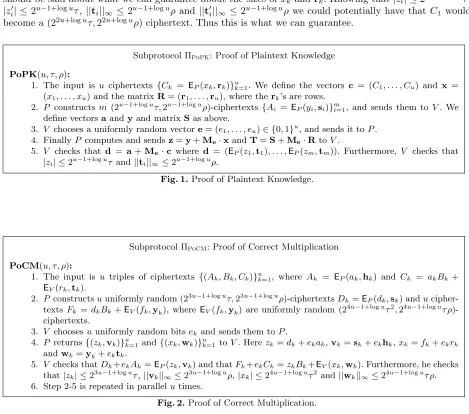
Proof of Plaintext Knowledge. ΠPoPK takes as common inputuciphertexts Ck, k= 1, . . . , u. If these
are (τ, ρ)-ciphertexts, the protocol is complete and statistical zero-knowledge. The protocol is sound in the following sense: assuming thatpkP is well-formed, ifP is corrupt and can make V accept with probability
larger than 2−u, then all the Ck are (22u+loguτ,22u+loguρ)-ciphertexts. The protocol is also a proof of
knowledge with knowledge error 2−u that P knows correctly formed plaintexts and randomness for all the
Ck’s.
In other words, ΠPoPKis a ZKPoK for the following relation,exceptthat zero-knowledge and completeness only hold if theCk’s satisfy the stronger condition of being (τ, ρ)-ciphertexts. However, this is no problem in
the following: the prover will always create theCk’s himself and can therefore ensure that they are correctly
formed if he is honest.
R(u,τ,ρ)PoPK ={(x, w)| x= (pkP, C1, . . . , Cu);
w= ((x1,r1), . . . ,(xu,ru)) :Ck =EP(xk,rk),
|xk| ≤22u+loguτ,||rk||∞≤22u+loguρ}
We use the approach of [CD09] to get small amortized complexity of the zero-knowledge proofs, and thereby gaining efficiency by performing the proofs on u simultaneous instances. In the following we de-fine m = 2u−1, furthermore Me is an m×umatrix constructed given a uniformly random vector e =
(e1, . . . , eu)∈ {0,1}u. Specifically the (i, k)-th entryMe,i,kis given byMe,i,k=ei−k+1for 1≤i−k+ 1≤u
and 0 otherwise. ByMe,iwe denote thei-th row ofMe. The protocol can be seen in Figure 1. Completeness
Completeness This follows directly by construction. Assume that P is honest and look at the checks V makes. First
ai+Me,i·c=EP(yi,si) +Me,i·c=EP(yi,si) + u
X
k=1
Me,i,k·ck
=EP(yi,si) + u
X
k=1
Me,i,k·EP(xk,rk) =EP(yi+ u
X
k=1
Me,i,k·xk,si+ u
X
k=1
Me,i,k·rk)
=EP(yi+Me,i·x,si+Me,i·R) =EP(zi,ti)
so this will obviously be correct if P is honest. Furthermore zi =yi+Me,i·x, and since the entries in c
are (τ, ρ)-ciphertexts, we have thatMe,i·x≤uτ. This means that Me,i·xis taken from an exponentially
smaller interval thanyi, and therefore the check of|zi| ≤2u−1+loguτwill only fail with negligible probability.
A similar argument can be made for the check of||ti||∞≤2u−1+loguρ.
Zero-Knowledge We give an honest-verifier simulator for the protocol that simulates accepting con-versations. First note that a conversation has the form (a,e,(z,T)). Now, to simulate an accepting con-versation first choose e ∈ {0,1}u uniformly random, and z,T uniformly random such that d contains
(2u−1+loguτ,2u−1+loguρ)-ciphertexts. Finally, construct a such that d = a+M
e ·c, where as always
d= (EP(z1,t1), . . . ,EP(zm,tm)). A simulated accepting conversation is now given by (a,e,(z,T)).
We should now argue that a real accepting conversation and a simulated accepting conversation are statistically indistinguishable. By construction it will clearly still be the case that d = a+Me·c. Now
we look at the distributions of the conversations. First the distribution of e in both real and simulated conversations is exactly the same. Looking at a in a real conversation the entries Ak will be uniformly
random (2u−1+loguτ,2u−1+loguρ)-ciphertexts. In the simulated conversation we havea=d−M
e·c, where
dcontains uniformly random (2u−1+loguτ,2u−1+loguρ)-ciphertexts. Looking atM
e·cand remembering that
Meonly contains entries in{0,1}, we see thatMe·cwill be a vector containing at most (uτ, uρ)-ciphertexts.
What we conclude is that the contribution fromMe·cis exponentially smaller than the contribution from
d, soa=d−Me·cwill be statistically indistinguishable from uniformly random (2u−1+loguτ,2u−1+logu
ρ)-ciphertexts. A similar argument can be made for the statistical indistinguishability of (z,T) in the two cases.
Here we argue soundness which is the more interesting case:
Soundness Assume we are given any prover P∗, and consider the case where P∗ can make V accept for botheande0,e6=e0, by sendingz,z0,TandT0 respectively. We now have the following equation:
(Me−Me0)c= (d−d0) (2)
What we would like is to findx= (x1, . . . , xu) andR= (r1, . . . ,ru) such that Ck =EP(xk,rk). We can do
this by viewing (2) as a system of linear equations. First letj be the biggest index such thatej6=e0j. Now
look at theu×usubmatrix ofMe−Me’given by the rowsj throughj+uboth included. This is an upper
triangular matrix with entries in{−1,0,1} andej−e0j 6= 0 on a diagonal. Now remember the form of the
entries in the vectorsc,dandd0, we haveCk=EP(xk,rk),Dk =EP(zk,tk),Dk0 =EP(zk0,t 0
k). We can now
directly solve the equations for thexk’s and the rk’s by starting with Cu and going up. We give examples
of the first few equations (remember we are going bottom up). For simplicity we will assume that all entries inMe−Me0 will be 1.
EP(xu,ru) =EP(zu+j−zu+j0 ,tu+j−t0u+j)
EP(xu−1,ru−1) +EP(xu,ru) =EP(zu+j−1−zu+j0 −1,tu+j−1−t0u+j−1)
Since we know all values used on the right hand sides and since the cryptosystem used is additively ho-momorphic, it should now be clear that we can find xk and rk such that Ck = EP(xk,rk). A final note
should be said about what we can guarantee about the sizes ofxk andrk. Knowing that|zi| ≤2u−1+loguτ,
|zi0| ≤2u−1+loguτ, ||t
i||∞ ≤2u−1+loguρand ||ti0||∞ ≤2u−1+loguρwe could potentially have that C1 would
become a (22u+loguτ,22u+loguρ) ciphertext. Thus this is what we can guarantee.
Subprotocol ΠPoPK: Proof of Plaintext Knowledge
PoPK(u, τ, ρ):
1. The input is u ciphertexts {Ck = EP(xk,rk)}uk=1. We define the vectors c = (C1, . . . , Cu) and x = (x1, . . . , xu) and the matrixR= (r1, . . . ,ru), where therk’s are rows.
2. P constructsm (2u−1+loguτ,2u−1+loguρ)-ciphertexts{Ai =EP(yi,si)}mi=1, and sends them to V. We define vectorsaandyand matrixSas above.
3. V chooses a uniformly random vectore= (e1, . . . , eu)∈ {0,1}u, and sends it toP. 4. FinallyP computes and sendsz=y+Me·xandT=S+Me·RtoV.
5. V checks thatd = a+Me·c where d = (EP(z1,t1), . . . ,EP(zm,tm)). Furthermore, V checks that |zi| ≤2u−1+loguτ and||ti||∞≤2u−1+loguρ.
Fig. 1.Proof of Plaintext Knowledge.
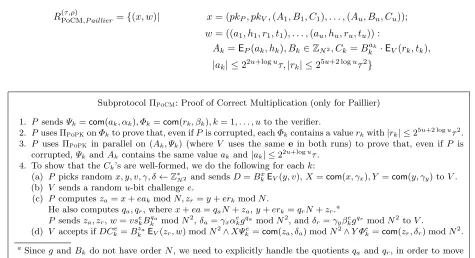
Subprotocol ΠPoCM: Proof of Correct Multiplication
PoCM(u, τ, ρ):
1. The input is u triples of ciphertexts {(Ak, Bk, Ck)}uk=1, where Ak = EP(ak,hk) and Ck = akBk+
EV(rk,tk).
2. P constructsuuniformly random (23u−1+loguτ,23u−1+loguρ)-ciphertextsDk=EP(dk,sk) andu cipher-textsFk =dkBk+EV(fk,yk), whereEV(fk,yk) are uniformly random (2
4u−1+loguτ2,24u−1+loguτ ρ
)-ciphertexts.
3. V choosesuuniformly random bitsek and sends them toP.
4. P returns{(zk,vk)}uk=1and{(xk,wk)}uk=1toV. Herezk=dk+ekak,vk=sk+ekhk,xk=fk+ekrk andwk=yk+ektk.
5. V checks thatDk+ekAk=EP(zk,vk) and thatFk+ekCk=zkBk+EV(xk,wk). Furthermore, he checks that|zk| ≤23u−1+loguτ,||vk||∞≤23u−1+loguρ,|xk| ≤24u−1+loguτ2and||wk||∞≤24u−1+loguτ ρ.
6. Step 2-5 is repeated in parallelutimes.
Fig. 2.Proof of Correct Multiplication.
Proof of Correct Multiplication. ΠPoCM(u, τ, ρ) takes as common inpututriples of ciphertexts (Ak, Bk, Ck)
for k = 1, . . . , u, where Ak is under pkP and Bk and Ck are under pkV (and so are in the group GV). If
P is honest, he will know ak and ak ≤ τ. Furthermore P has created Ck as Ck = akBk +EV(rk,tk),
where EV(rk,tk) is a random (23u+loguτ2,23u+loguτ ρ)-ciphertext. Under these assumptions the protocol is
zero-knowledge.
Jumping ahead, we note that in the context where the protocol will be used, it will always be known that Bk in every triple is a (22u+loguτ,22u+loguρ)-ciphertext, as a result of executing ΠPoPK. The choice of sizes
for EV(rk,tk) then ensures that Ck is statistically close to a random (23u+loguτ2,23u+loguτ ρ)-ciphertext,
Summarizing, ΠPoCMis a ZKPoK for the relation (under the assumption thatpkP, pkV are well-formed):
R(u,τ,ρ)PoCM ={(x, w)| x= (pkP, pkV,(A1, B1, C1), . . . ,(Au, Bu, Cu));
w= ((a1,h1, r1,t1), . . . ,(au,hu, ru,tu)) :
Ak =EP(ak,hk), Bk∈GV, Ck=akBk+EV(rk,tk),
|ak| ≤23u+loguτ,||hk||∞≤23u+loguρ,
|rk| ≤24u+loguτ2,||tk||∞≤24u+loguτ ρ)}
The protocol can be seen in Figure 2. Note that Step 6 could also be interpreted as choosingek as au-bit
vector instead, thereby only callingFRand once.
Completeness In the following we leave out the subscriptk; for instanceameansak. Completeness follows
directly by construction. Consider the first two checks thatV makes in step 5 of the protocol. First we have: D+eA=EP(d,s) +eEp(a,h) =EP(d+ea,s+eh) =EP(z,v)
Secondly we have:
F+eC=dB+EV(f,y) +e(aB+EV(r,t))
= (d+ea)B+EV(f+er,y+et)
=zB+EV(x,w)
ForV’s checks on sizes these will succeed except with negligible probability since the intervals from which d,s,f andyare taken are exponentially larger than those from whicha,h,randtare taken.
Soundness Again we leave out the subscript k. Assume we are given any prover P∗, and consider the case where P∗ can make V accept for both e= 0 and e= 1 by sending (z0,v0, x0,w0) and (z1,v1, x1,w1)
respectively. This gives us the following equations:
D=EP(z0,v0) , D+A=EP(z1,v1)
F =z0B+EV(x0,w0) , F+C=z1B+EV(x1,w1)
which gives us that,
A=EP(z1−z0,v1−v0) , C= (z1−z0)B+EV(x1−x0,w1−w0)
This shows that a cheating proverP∗ has success probability at most 1/2 in one iteration. Since we repeat utimes, this gives a soundness error of 2−u. A final note should be said about what we can guarantee about
the sizes ofak,hk, rk andtk. Knowing that|z0| ≤23u−1+loguτ,|z1| ≤23u−1+loguτ, ||v0||∞≤23u−1+loguτ
and ||v1||∞ ≤ 23u−1+loguρ, we can only guarantee that EP(a,h) is a (23u+loguτ,23u+loguρ)-ciphertext.
Similarly, knowing that|x0| ≤ 24u−1+loguτ2, |x1| ≤ 24u−1+loguτ2, ||w0||∞ ≤24u−1+loguτ ρ and||w1||∞ ≤
24u−1+loguτ ρ, we can only guarantee thatEV(r,t) is a (24u+loguτ2,24u+loguτ ρ)-ciphertext.
Zero-Knowledge Again we leave out the subscriptk. We give an honest-verifier simulator for the protocol that simulates accepting conversations. First note that a conversation has the form ((D, F), e,(z,v, x,w)). Now to simulate an accepting conversation we first choose e as a uniformly random bit, and (z,v, x,w) uniformly random such that |z| ≤ 23u−1+loguτ, ||v||
∞ ≤ 23u−1+loguρ, |x| ≤ 24u−1+loguτ2 and ||w||∞ ≤
24u−1+loguτ ρ. Finally construct D and F such that D+eA =E
P(z,v) and F+eC =zB+EV(x,w). A
We now argue that a real accepting conversation is statistically indistinguishable from a simulated ac-cepting conversation. By construction it will clearly be the case that D +eA = EP(z,v) and F+eC =
zB+EV(x,w), which is whatV checks. Next we look at the distributions of the conversations. First the
dis-tribution ofeis clearly the same in both cases. Looking atDin a real conversation, this is uniformly random (23u−1+loguτ,23u−1+loguρ)-ciphertext, in the simulated case it is given byD=E
P(z,v)−eA. NowEP(z,v)
is a uniformly random (23u−1+loguτ,23u−1+loguρ)-ciphertext, and eAis exponentially smaller. ThereforeD
will be statistically indistinguishable from a random (23u−1+loguτ,23u−1+loguρ)-ciphertext. The same line of
argument can be used to show that the distributions ofF and (z,v, x,w) are statistically indistinguishable in the two cases.
Zero-Knowledge Protocols for Paillier. For the particular case of Paillier encryption, ΠPoPK can be used as it is, except that there is no bound required on the randomness, instead all random values used in encryptions are expected to be inZ∗
N2. Thus, the relations to prove will only require that the random values
are inZ∗N2 and this is also what the verifier should check in the protocol.
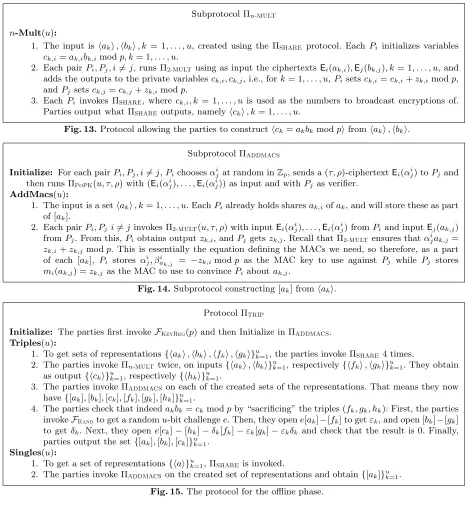
For ΠPoCM we sketch a version that is more efficient than the above, using special properties of Paillier encryption. In order to improve readability, we depart here from the additive notation for operations on ciphertexts, since multiplicative notation is usually used for Paillier. In the following, letpkV =N. Note first
that based on such a public key, one can define an unconditionally hiding commitment scheme with public key g=EV(0). To commit toa∈ ZN, one sendscom(a, r) =garN modN, for random r∈ Z∗N2. One can
show that the scheme is binding assuming it is hard to extractN-th roots modulo N2 (which must be the
case if Paillier encryption is secure).
We restate the relationR(u,τ,ρ)PoCM from above as it will look for the Paillier case, in multiplicative notation and without bounds on the randomness:
R(τ,ρ)PoCM,Paillier ={(x, w)| x= (pkP, pkV,(A1, B1, C1), . . . ,(Au, Bu, Cu));
w= ((a1, h1, r1, t1), . . . ,(au, hu, ru, tu)) :
Ak=EP(ak, hk), Bk ∈ZN2, Ck=Bkak·EV(rk, tk),
|ak| ≤22u+loguτ,|rk| ≤25u+2 loguτ2}
Subprotocol ΠPoCM: Proof of Correct Multiplication (only for Paillier)
1. P sendsΨk=com(ak, αk), Φk=com(rk, βk), k= 1, . . . , uto the verifier.
2. Puses ΠPoPKonΦkto prove that, even ifPis corrupted, eachΦkcontains a valuerkwith|rk| ≤25u+2 loguτ2. 3. P uses ΠPoPK in parallel on (Ak, Ψk) (whereV uses the samee in both runs) to prove that, even if P is
corrupted,Ψk andAkcontains the same valueak and|ak| ≤22u+loguτ. 4. To show that theCk’s are well-formed, we do the following for eachk:
(a) P picks randomx, y, v, γ, δ←Z∗N2 and sendsD=BkxEV(y, v),X=com(x, γx), Y =com(y, γy) toV. (b) V sends a randomu-bit challengee.
(c) P computesza=x+eakmodN, zr=y+erkmodN.
He also computesqa, qr, wherex+ea=qaN+za,y+erk=qrN+zr.a
P sendsza, zr,w=vsekB qa k modN
2,δ
a=γxαekgqamodN2, andδr=γyβekgqrmodN2 toV. (d) V accepts ifDCke=B
za
k EV(zr, w) modN2∧XΨke=com(za, δa) modN2∧Y Φek=com(zr, δr) modN2.
a
Since gandBk do not have orderN, we need to explicitly handle the quotientsqa andqr, in order to move the “excess multiples” ofN into the randomness parts of the commitments and ciphertext.
Fig. 3.Proof of Correct Multiplication for Paillier encryption.
proof of knowledge that for eachk: 1) the same bounded size value is contained in bothAk andΨk, and that
2) a bounded size value is contained inΦk. The proof for{Φk}is simply ΠPoPKsince a commitment has the
same form as an encryption (with (N+ 1) replaced byg). The proof for{Ψk, Ak} is made of two instances
of ΠPoPK run in parallel, using the same challengeeand responseszi in both instances. Finally, the prover
must show thatCk can be written asCk =Bakk·EV(rk, tk), whereak is the value contained in Ψk andrk is
the value inΦk. Since all commitments and ciphertexts live in the same groupZ∗N2, wherepkV =N, we can
do this efficiently using a variant of a protocol from [CDN01]. The resulting protocol is shown in Figure 3. Completeness of the protocol in steps 1-4 of Figure 3 is straightforward by inspection. Honest verifier zero-knowledge follows by the standard argument: choose e and the prover’s responses uniformly in their respective domains and use the equations checked by the verifier to compute a matching first messageD, X, Y. This implies completeness and honest verifier zero-knowledge for the overall protocol, since the subprotocols in steps 2 and 3 have these properties as well.
Finally, soundness follows by assuming we are given correct responses in step 7 to two different challenges. From the equations checked by the verifier, we can then easily compute ak, αk, rk, βk, sk such thatΨk =
com(ak, αk), Φk(rk, βk), Ck=BkakEV(rk, sk). Now, by soundness of the protocols in steps 2 and 3, we can also
compute bounded size valuesa0k, r0kthat are contained inΨk, Φk. By the binding property of the commitment
scheme, we haver0
k =rk, a0k =ak except with negligible probability, so we have a witness as required in the
specification of the relation.
3
The Online Phase
Our goal is to implement reactive arithmetic multiparty computation over Zp for a prime p of size
super-polynomial in the statistical security parameteru. The (standard) ideal functionalityFAMPCthat we imple-ment can be seen in Figure 6. We assume here that the parties already have a functionality for synchronous3, secure communication and broadcast.
We first present a protocol for an online phase that assumes access to a functionality FTRIP which we later show how to implement using an offline protocol. The online phase is based on a representation of values inZp that are shared additively where shares are authenticated using information theoretic message
authentication codes (MACs). Before presenting the protocol we introduce how the MACs work and how they are included in the representation of a value inZp. Furthermore, we argue how one can compute with
these representations as we do with simple values, and in particular how the relation to the MACs are maintained.
In the rest of this section, all additions and multiplications are to be read modulop, even if not specified. The number of parties is denoted byn, and we call the parties P1, . . . , Pn.
3.1 The MACs
A keyKin this system is a random pairK= (α, β)∈Z2p, and the authentication code for a valuea∈Zp is
MACK(a) =αa+βmodp.
We will apply the MACs by having one partyPiholda,MACK(a) and another partyPj holdingK. The
idea is to use the MAC to preventPi from lying aboutawhen he is supposed to reveal it toPj. It will be
very important in the following that if we keep αconstant over several different MAC keys, then one can add two MACs and get a valid authentication code for the sum of the two corresponding messages. More concretely, two keys K = (α, β), K0 = (α0, β0) are said to beconsistent if α=α0. For consistent keys, we defineK+K0= (α, β+β0) so that it holds that MAC
K(a) + MACK0(a0) = MACK+K0(a+a0).
3
The MACs will be used as follows: we give to Pi several different valuesm1, m2, . . . with corresponding
MACs γ1, γ2, . . . computed using keys Ki = (α, βi) that are random but consistent. It is then easy to see
that ifPiclaims a false value for any of themi’s (or a linear combination of them) he can guess an acceptable
MAC for such a value with probability at most 1/p.
Opening: We can reliably open a consistent representation toPj: eachPisendsai, mj(ai) toPj.Pjchecks that
mj(ai) = MACKj
ai(ai) and broadcastsOK orfail accordingly. If all is OK,Pjcomputesa=
P
iai, else we abort. We can modify this to opening a value [a] to all parties, by opening as above to everyPj.
Addition: Given two key-consistent representations as above we get that [a+a0] = [{ai+a
0
i,{Kaij +K i a0
j, mj(ai) +mj(a
0
i)}nj=1}ni=1]
is a consistent representation ofa+a0. This new representation can be computed only by local operations. Multiplication by constants: In a similar way, we can multiply a public constantδ“into” a representation. This is writtenδ[a] and is taken to mean that all parties multiply their shares, keys and MACs byδ. This gives a consistent representation [δa].
Addition of constants: We can add a public constantδ into a representation. This is writtenδ+ [a] and is taken to mean that P1 will addδ to his share a1. Also, each Pj will replace his key Kaj1 = (α
j 1, β
j a1) by
Kaj1+δ = (αj1, β j a1−δα
j
1). This will ensure that the MACs held byP1 will now be valid for the new share
a1+δ, so we now have a consistent representation [a+δ].
Fig. 4.Operations on [·]-representations.
FunctionalityFTRIP
Initialize: On input (init, p) from all parties the functionality stores the modulusp. For each corrupted party
Pithe environment specifies valuesαij, j= 1, . . . , n, except thoseαijwhere bothPiandPjare corrupt. For each honestPi, it choosesαij, j= 1, . . . , nat random.
Singles: On input (singles, u) from all partiesPi, the functionality does the following, forv= 1, . . . , u: 1. It waits to get from the environment either “stop”, or some data as specified below. In the first case
it sends “fail” to all honest parties and stops. In the second case, the environment specifies for each corrupt partyPi, a shareaiandnpairs of values (mj(ai), βaij), j= 1, . . . , n, except those (mj(ai), β
i aj) where bothPiandPjare corrupt.
2. The functionality choosesa∈Zpat random and creates the representation [a] as follows:
(a) First it chooses random shares for the honest parties such that the sum of these and those specified by the environment is correct: LetCbe the set of corrupt parties, thenai is chosen at random for
Pi6∈C, subject toa=Piai.
(b) For each honestPi, andj= 1, . . . , n,βaij is chosen as follows: ifPjis honest,β i
aj is chosen at random, otherwise it setsβi
aj =mi(aj)−α i
jaj. Note that the environment already specified mi(aj), aj, so what is done here is to construct the key to be held byPito be consistent with the share and MAC chosen by the environment.
(c) For alli= 1, . . . , n, j= 1, . . . , nit setsKaij = (α i
j, βaij), and computesmj(ai) = MACKjai(ai). (d) Now all data for [a] is created. The functionality sends {ai,{Kaij, mj(ai)}j=1,...,n} to each honest
Pi(no need to send anything to corrupt parties, the environment already has the data). Triples: On input (triples, u) from all partiesPi, the functionality does the following, forv= 1, . . . , u:
1. Step 1 is done as in “Singles”.
2. For each triple to create it chooses a, b at random and sets c = ab. Now it creates representations [a],[b],[c], each as in Step 2 in “Singles”.
3.2 The Representation and Linear Computation
To represent a value a∈Zp, we will give a share ai to each party Pi. In addition, Pi will hold MAC keys
Ki
a1, . . . , K
i
an. He will use keyK
i
aj to check the share ofPj, if we decide to makea public. Finally,Pi also holds a set of authentication codes MACKj
ai(ai). We will denote MACKjai(ai) bymj(ai) from now on. Party Piwill usemj(ai) to convincePj thatai is correct, if we decide to makeapublic. Summing up, we have the
following way of representinga:
[a] = [{ai,{Kaij, mj(ai)}
n j=1}
n i=1]
where{ai,{Kaij, mj(ai)}
n
j=1}is the information held privately byPi, and where we use [a] as shorthand when
it is not needed to explicitly talk about the shares and MACs. We say that [a] = [{ai,{Kaij, mj(ai)}
n j=1}ni=1]
isconsistent, witha=P
iai, ifmj(ai) = MACKaij (ai) for alli, j. Two representations
[a] = [{ai,{Kaij, mj(ai)}
n
j=1}ni=1], [a0] = [{a0i,{Kai0
j, mj(a
0
i)}nj=1}ni=1]
are said to be key-consistentif they are both consistent, and if for all i, j the keysKi aj, K
i a0
j
are consistent. We will want allrepresentations in the following to be key-consistent: this is ensured by letting Pi use the
same αj-value in keys towardsPj throughout. Therefore the notation Kaij = (α
i j, β
i
aj) makes sense and we can compute with the representations, as detailed in Figure 4.
FunctionalityFAMPC
Initialize: On input (init, p) from all parties, the functionality activates and stores the modulusp.
Rand: On input (rand, Pi,varid) from all partiesPi, withvarida fresh identifier, the functionality picksr←Zp and stores (varid, r).
Input: On input (input, Pi,varid, x) fromPiand (input, Pi,varid,?) from all other parties, withvarid a fresh identifier, the functionality stores (varid, x).
Add: On command (add,varid1,varid2,varid3) from all parties (ifvarid1,varid2 are present in memory and
varid3 is not), the functionality retrieves (varid1, x), (varid2, y) and stores (varid3, x+ymodp).
Multiply: On input (multiply,varid1,varid2,varid3) from all parties (ifvarid1,varid2 are present in memory andvarid3 is not), the functionality retrieves (varid1, x), (varid2, y) and stores (varid3, x·ymodp). Output: On input (output, Pi,varid) from all parties (ifvaridis present in memory), the functionality retrieves
(varid, x) and outputs it toPi.
Fig. 6.The ideal functionality for arithmetic MPC.
3.3 Triples and Multiplication
For multiplication and input sharing we will need both random single values [a] and triples [a],[b],[c] where a, b are random and c = abmodp. Also, we assume that all singles and triples we ever produce are key consistent, so that we can freely add them together. More precisely, we assume we have access to an ideal functionalityFTRIP providing us with the above. This is presented in Figure 5.
The principle in the specification of the functionality is that the environment is allowed to specify all the data that the corrupted parties should hold, including all shares of secrets, keys and MACs. Then, the functionality chooses the secrets to be shared and constructs the data for honest parties so it is consistent with the secrets and the data specified by the environment.
Protocol ΠAMPC
Initialize: The parties first invoke FTRIP(init, p). Then, they invokeFTRIP(triples, u) and FTRIP(singles,u) a sufficient number of times to create enough singles and triples.
Input: To sharePi’s input [xi] with identifiervarid,Pi takes a single [a] from the set of available ones. Then, the following is performed:
1. [a] is opened toPi. 2. Pibroadcastsδ=xi−a.
3. The parties compute [xi] = [a] +δ.
Rand: The parties take an available single [a] and store with identifiervarid.
Add: To add [x],[y] with identifiersvarid1,varid2the parties compute [z] = [x] + [y] and assign [z] the identifier
varid3.
Multiply: To multiply [x],[y] with identifiersvarid1,varid2 the parties do the following: 1. They take a triple ([a],[b],[c]) from the set of the available ones.
2. [x]−[a] =εand [y]−[b] =δare opened. 3. They compute [z] = [c] +ε[b] +δ[a] +εδ
4. They assign [z] the identifiervarid3 and remove ([a],[b],[c]) from the set of the available triples. Output: To output [x] with identifiervaridtoPithe parties do an opening of [x] toPi.
Fig. 7.The protocol for arithmetic MPC.
To do so we first open [x]−[a] to get a valueε, and [y]−[b] to getδ. Then, we havexy= (a+ε)(b+δ) = c+εb+δa+εδ. Therefore, we get a new representation ofxyas follows:
[xy] = [c] +ε[b] +δ[a] +εδ.
Using the tools from the previous sections we can now construct a protocol ΠAMPC that securely imple-ments the MPC functionality FAMPC in the UC security framework. FAMPC and ΠAMPC are presented in Figure 6 and Figure 7 respectively.
Theorem 1. In the FTRIP-hybrid model, the protocol ΠAMPC implements FAMPC with statistical security against any static4, active adversary corrupting up ton−1 parties.
Proof. We construct a simulator SAMPC such that a poly-time environmentZ cannot distinguish between the real protocol systemFTRIPcomposed with ΠAMPCandFAMPCcomposed with SAMPC. We assume here static, active corruption. The simulator will internally run a copy of FTRIP composed with ΠAMPC where it corrupts the parties specified by Z. The simulator relays messages between parties/FTRIP and Z, such that Z will see the same interface as when interacting with a real protocol. During the run of the internal protocol the simulator will keep copies of the shares, MACs and keys of both honest and corrupted parties and update them according to the execution.
The idea is now, that the simulator runs the protocol with the environment, where it plays the role of the honest parties. Since the inputs of the honest parties are not known to the simulator these will be random values (or zero). However, if the protocol is secure, the environment will not be able to tell the difference. The specification of the simulatorSAMPCis presented in Figure 8.
In general, the openings in the protocol do not reveal any information about the values that the parties have. Whenever we open a value during Input or Multiply we mask it by subtracting with a new random value. Therefore, the distribution of the view of the corrupted parties is exactly the same in the simulation as in the real case. Then, the only method there is left for the environment to distinguish between the two cases, is to compare the protocol execution with the inputs and outputs of the honest parties and check for inconsistency.
If the simulated protocol fails at some point because of a wrong MAC, the simulator aborts which is consistent with the internal state of the ideal functionality since, in this case, the simulator also makes the ideal functionality fail.
4
SimulatorSAMPC
In the following,HandCrepresent the set of corrupted and and honest parties, respectively.
Initialize: The simulator initializes the copy withpand creates the desired number of triples. Here the simulator will read all data of the corrupted parties specified to the copy ofFTRIP.
Rand: The simulator runs the copy protocol honestly and callsrand on the ideal functionalityFAMPC. Input: IfPi∈Hthe copy is run honestly with dummy input, for example 0. If in Step 1 during input, the MACs
are not correct, the protocol is aborted.
IfPi∈Cthe input step is done honestly and then the simulator waits forPito broadcastδ. Given this, the simulator can computex0i=a+δmodpsince it knows (all the shares of)a. This is the supposed input of
Pi, which the simulator now gives to the ideal functionalityFAMPC.
Add: The simulator runs the protocol honestly and callsadd on the ideal functionalityFAMPC.
Multiply: The simulator runs the protocol honestly and, as before, aborts if some share from a corrupted party is not correct. Otherwise it callsmultiply on the ideal functionalityFAMPC.
Output: If Pi ∈Hthe output step is run and the protocol is aborted if some share from a corrupted party is not correct. Otherwise the simulator callsoutput onFAMPC.
IfPi∈Cthe simulator callsoutput onFAMPC. SincePi is corrupted the ideal functionality will provide the simulator withy, which is the output to Pi. Now it has to simulate shares yj of honest parties such that they are consistent withy. This is done by changing one of the internal shares of an honest party. LetPkbe that party. The new share is now computed asyk0 =y−
P
i6=kyi. Next, a valid MAC fory0kis needed. This, the simulator can compute from scratch as MACKi
yk(y
0
k) since it knows from the beginning the keys ofPi. This enables it to computeKyik by the computations on representations done during the protocol. Now the simulator sends the internal shares and corresponding MACs toPi.
Fig. 8.The simulator forFAMPC.
If the simulated protocol succeeds, the ideal functionality is always told to output the result of the function evaluation. This result is of course the correct evaluation of the input matching the shares that were read from the corrupted parties in the beginning. Therefore, if the corrupted parties during the protocol successfully cheat with their shares, this would not be consistent. However, as argued in Section 3.1, the probability of a party being able to claim a wrong value for a given MAC is 1/p. In conclusion, if the protocol succeeds, the computation is correct except with probability a polynomial multiple (the number of MACs ever checked) of 1/p.
4
The Offline Phase
In this section we describe the protocol ΠTRIPwhich securely implements the functionalityFTRIPdescribed in Section 3 in the presence of two standard functionalities: a key registration functionalityFKeyReg(Figure 9) and a functionality that generates random challengesFRand(Figure 10)5.
FunctionalityFKeyReg
FKeyReg proceeds as follows, givenGand security parameter 1 κ
:
Registration (honest): On inputpfrom an honest partyPi, the functionality runs (ski, pki)←G(1κ, p), and then sends (registered, Pi, pki,⊥) to all partiesPj6=Piand (registered, Pi, pki, ski) toPi;
Registration (corrupted): On input (p, r∗) from a corrupted partyPi, the functionality does as before using
r∗(instead of a uniform string) as the random tape for theGalgorithm.
Fig. 9.The ideal functionality for the key registration model.
5 F
FunctionalityFRand
Rand. sample: The functionality has only one command: When receiving (rand, u) from all parties, it samples a uniformr← {0,1}u
and outputs (rand, r) to all parties.
Fig. 10.The ideal functionality for coin-flipping.
4.1 h·i-representation
Throughout the description of the offline phase,Ei will denoteEpki wherepki is the public key of partyPi, as established by FKeyReg. We assume the cryptosystem used is semi-homomorphic modulo p, as defined in Section 2. In the following, we will always set τ = p/2 and ρ = σ. Thus, if Pi generates a ciphertext
C = Ei(x,r) where x∈ Zp and r is generated byDdσ, C will be a (τ, ρ)-ciphertext. We will use the
zero-knowledge protocols from Section 2.2. They depend on an “information theoretic” security parameter u controlling, e.g., the soundness error. We will say that a semi-homomorphic cryptosystem is admissible if it allows correct decryption of ciphertext produced in those protocols, that is, if M ≥ 25u+2 loguτ2 and
R≥24u+loguτ ρ.
In the followinghxkiwill stand for the following representation ofxk∈Zp: eachPihas publishedEi(xk,i)
and holds xk,i privately, such thatxk =Pixk,i modp. For the protocol to be secure, it will be necessary
to ensure that the parties encrypt small enough plaintexts. For this purpose we use the ΠPoPK described in Section 2.2, and we get the protocol in Figure 11 to establish a set hxki, k = 1, . . . , u of such random
representations.
Subprotocol ΠSHARE
Share(u):
1. EachPichoosesxk,i∈Zpat random fork= 1, . . . , uand broadcasts (τ, ρ)-ciphertexts{Ei(xk,i)}uk=1. 2. Each pairPi, Pj, i6=j, runs ΠPoPK(u, τ, ρ) with theEi(xk,i)’s as input. This proves that the ciphertexts
are (22u+loguτ,22u+loguρ)-ciphertexts.
3. All parties output hxki = (E1(xk,1), . . . ,En(xk,n)), for k = 1, . . . , u, where xk is defined by xk =
P
ixk,imodp.Pi keeps thexk,iand the randomness for his encryptions as private output.
Fig. 11.Subprotocol allowing parties to create random additively shared values.
Subprotocol Π2-MULT
2-Mult(u, τ, ρ):
1. HonestPiandPjinput (τ, ρ)-ciphertexts{Ei(xk)}uk=1,{Ej(yk)}uk=1. (At this point of the protocol it has already been verified that the ciphertexts are (22u+loguτ,22u+loguρ)-ciphertexts.)
2. For eachk,Pi sendsCk=xkEj(yk) +Ej(rk) toPj. HereEj(rk) is a random (23u+loguτ2,23u+loguτ ρ )-encryption underPj’s public key.Pifurthermore invokes ΠPoCM(u, τ, ρ) with inputCk,Ei(xk),Ej(yk), to prove that theCk’s are constructed correctly.
3. For eachk,Pj decryptsCk to obtainvk, and outputszk,j=vkmodp.Pi outputszk,i=−rkmodp.
Subprotocol Πn-MULT
n-Mult(u):
1. The input is haki,hbki, k = 1, . . . , u, created using the ΠSHARE protocol. EachPi initializes variables
ck,i=ak,ibk,imodp, k= 1, . . . , u.
2. Each pairPi, Pj, i6=j, runs Π2-MULT using as input the ciphertextsEi(ak,i),Ej(bk,j), k= 1, . . . , u, and adds the outputs to the private variablesck,i, ck,j, i.e., fork= 1, . . . , u,Pi setsck,i=ck,i+zk,imodp, andPjsets ck,j=ck,j+zk,imodp.
3. Each Pi invokes ΠSHARE, whereck,i, k = 1, . . . , uis used as the numbers to broadcast encryptions of. Parties output what ΠSHARE outputs, namelyhcki, k= 1, . . . , u.
Fig. 13.Protocol allowing the parties to constructhck=akbkmodpifromhaki,hbki.
Subprotocol ΠADDMACS
Initialize: For each pairPi, Pj, i6=j,Pichoosesαijat random inZp, sends a (τ, ρ)-ciphertextEi(αij) toPjand then runs ΠPoPK(u, τ, ρ) with (Ei(αij), . . . ,Ei(αij)) as input and withPj as verifier.
AddMacs(u):
1. The input is a sethaki, k= 1, . . . , u. EachPialready holds sharesak,iofak, and will store these as part of [ak].
2. Each pairPi, Pj i6=jinvokes Π2-MULT(u, τ, ρ) with inputEi(αji), . . . ,Ei(αij) fromPiand inputEj(ak,j) fromPj. From this,Piobtains outputzk,i, andPjgetszk,j. Recall that Π2-MULTensures thatαijak,j =
zk,i+zk,jmodp. This is essentially the equation defining the MACs we need, so therefore, as a part of each [ak], Pi stores αij, β
i
ak,j = −zk,imodp as the MAC key to use against Pj while Pj stores
mi(ak,j) =zk,j as the MAC to use to convincePiaboutak,j.
Fig. 14.Subprotocol constructing [ak] fromhaki.
Protocol ΠTRIP
Initialize: The parties first invokeFKeyReg(p) and then Initialize in ΠADDMACS. Triples(u):
1. To get sets of representations{haki,hbki,hfki,hgki}uk=1, the parties invoke ΠSHARE4 times.
2. The parties invoke Πn-MULTtwice, on inputs{haki,hbki}k=1u , respectively{hfki,hgki}uk=1. They obtain as output{hcki}uk=1, respectively{hhki}uk=1.
3. The parties invoke ΠADDMACSon each of the created sets of the representations. That means they now have{[ak],[bk],[ck],[fk],[gk],[hk]}uk=1.
4. The parties check that indeedakbk=ckmodpby “sacrificing” the triples (fk, gk, hk): First, the parties invokeFRandto get a randomu-bit challengee. Then, they opene[ak]−[fk] to getεk, and open [bk]−[gk] to get δk. Next, they opene[ck]−[hk]−δk[fk]−εk[gk]−εkδk and check that the result is 0. Finally, parties output the set{[ak],[bk],[ck]}uk=1.
Singles(u):
1. To get a set of representations{hai}u
k=1, ΠSHAREis invoked.
2. The parties invoke ΠADDMACSon the created set of representations and obtain{[ak]}uk=1.
Fig. 15.The protocol for the offline phase.
4.2 h·i-multiplication
The final goal of the ΠTRIP protocol is to produce triples [ak],[bk],[ck] with akbk = ckmodp in the [·
]-representation, but for now we will disregard the MACs and construct a protocol Πn-MULT which produces
tripleshaki,hbki,hckiin theh·i-representation.6
We will start by describing a two-party protocol. AssumePiis holding a set ofu(τ, ρ)-encryptionsEi(xk)
under his public key and likewise Pj is holding u (τ, ρ)-encryptions Ej(yk) under his public key. For each
6 In fact, due to the nature of the MACs, the same protocol that is used to compute two-party multiplications will
k, we want the protocol to output zk,i, zk,j to Pi, Pj, respectively, such thatxkyk =zk,i+zk,jmodp. Such
a protocol can be seen in Figure 12. This protocol does not commit parties to their output, so there is no guarantee that corrupt parties will later use their output correctly – however, the protocol ensures that malicious parties know which shares they ought to continue with. To build the protocol Πn-MULT, the first
thing to notice is that givenhakiandhbkiwe have thatck=akbk=Pi
P
jak,ibk,j. Constructing each of the
terms in this sum in shared form is exactly what Π2-MULT allows us to do. The Πn-MULT protocol can now
be seen in Figure 13. Note that it does not guarantee that the multiplicative relation in the triples holds, we will check for this later.
4.3 From h·i-triples to [·]-triples
We first describe a protocol that allows us to add MACs to the h·i-representation. This consists essentially of invoking the Π2-MULT a number of times. The protocol is shown in Figure 14. The full protocol ΠTRIP, which also includes the possibility of creating a set of single values, is now a straightforward application of the subprotocols we have defined now. This is shown in Figure 15.
Theorem 2. If the underlying cryptosystem is semi-homomorphic modulop, admissible and IND-CPA se-cure, then ΠTRIP implements FTRIP with computational security against any static, active adversary cor-rupting up ton−1 parties, in the (FKeyReg,FRand)-hybrid model.
Proof. We first observe that any semi-homomorphic encryption scheme has, in addition to the regular key generation algorithmG, the following alternate key generation algorithmG∗:
– G∗(1κ, p) is a randomized algorithm that outputs ameaningless public key fpkwith the property that an encryption of any messageE
f
pk(x) is statistically indistinguishable from an encryption of 0. Let (pk, sk)←
G(1κ, p) and
f
pk←G∗(1κ, p). Then we have thatpk and
f
pk are computationally indistinguishable. Most of our example schemes already have this property, where in fact indistinguishability of the two types of keys is equivalent to semantic security. However, the property can be assumed without loss of generality, by including a ciphertextCe=Epk(b) in the public key redefining the encryption algorithm to be
E∗pk(x) =x·Ce+Epk(0). Then, bothGandG∗would run the same algorithm, with the only difference being
thatGusesb= 1 whileG∗usesb= 0. Also in this case, semantic security is equivalent to indistinguishability of the types of keys. Additionally, the presence of meaningless public keys allows us to use semi-homomorphic encryption to construct UC-commitments, using techniques similar to [DN02].
The Simulator STRIP We now construct a simulator STRIP where the idea is that it simulates the calls to FKeyReg andFRandand runs a copy of the protocol internally. The simulator plays the honest players’ role and does all the steps in ΠTRIP. During these, it obtains the shares and values of the corrupted parties, since it knows all the secret keys. These values are then input toFTRIP. A precise description is provided in Figure 16.
Security is argued by doing the following reduction: Assume there exists a distinguisher D that can distinguish with significant probability between a real and a simulated view. Then, we can use this to distinguish between a normally generated public key and the so-called meaningless public key described above. That is, we can construct a distinguisherD0 that given a public keypk∗ can tell whether pk∗ =pk or pk∗ =fpk. This is a contradiction since a key generated by the normal key generator is computationally indistinguishable from a meaningless key.
SimulatorSTRIP
Initialize: The simulator first uses G(1κ) to generate the key pairs (sk
i, pki) for every Pi and sends the keys to the corrupt parties. Then, it does the initialization step of ΠTRIPwhere it aborts if ΠPoPKfails for some
Pi, Pj, where eitherPi orPjis honest. Otherwise, for each pairPi, PjwherePiis corrupt andPj is honest, the simulator will receiveEi(αij), which it decrypts and inputs to FTRIPwhen calling Initialize.
Triples: The simulator performs ΠTRIP. During this, ΠPoPKand ΠPoCM are performed a number of times. The simulator will abort the protocol if they fail for somePi, Pj, where either Pi or Pj is honest. Otherwise it proceeds with the steps:
1. In the first step ΠSHAREis invoked 4 times, in which the simulator receives for each corruptPiciphertexts
Ei(ak,i),Ei(bk,i),Ei(fk,i),Ei(gk,i), k= 1, . . . , u. The simulator decrypts and stores these.
2. Next, in step 2, during the sharing, the simulator receives from each corrupt Pi ciphertexts
Ei(ck,i),Ei(hk,i) of the shares ck, hk, where ck =akbkmodp, hk = fkgkmodp. Again, the simulator decrypts and stores.
3. Then, in step 3, the protocol Π2-MULTis done between two partiesPi, Pjto obtain keys and MACs for all the shares. In the case wherePiis corrupt andPjis honest the simulator obtains the MAC, for sayak,j by decrypting thedksent byPi. When, on the other hand,Piis honest andPjis corrupt, the simulator decryptsdk, gettingsk, about which ΠPoCMguaranteessk=ykxk+rkmodp. Therefore, the simulator obtainsβi
ak,j by calculating−(sk−xkyk) modp. This can be done sinceykis chosen byPi, that is here the simulator, andxkis acquired earlier during input sharing.
4. Finally, in step 4,FRandis simulated by choosing a randomu-bit value. Then, the check is done honestly. If the check fails, the simulator aborts. Otherwise, the simulator calls Triples onFTRIP and inputs all the shares and values of the corrupted parties.
Singles: The simulator does step 1 and 3 from above, but only with one set of representations. Then it calls
SinglesonFTRIPwhere it inputs the shares and values of corrupted parties.
Fig. 16.The simulator forFTRIP.
For simplicity we describe in the following, the algorithm B for the two-party setting, where we have a corrupt party P1 and an honest party P2: We start by letting the input pk∗ be the public key of P2 and
then we generate a normal key pair (pk1, sk1) and send it toP1. After this, we begin executing the protocol.
However, during multiplications when P1 sends ciphertexts to P2, we cannot decrypt. Instead, we exploit
thatP1andP2have run ΠPoCM withP1 as prover. That isP1has proved that he knowsa, r of appropriate
size such that the ciphertext was constructed asaEpk2(x) +Epk2(r). This means, we can use the knowledge
extractor of ΠPoCM and rewinding to extract the values a, r from P1. With this we calculate the resulting
plaintexty=ax+rmodp, and continue the protocol as if we had decrypted. In the end we choose randomly between the real or the simulated view. In the first case, we let the output be exactly those values, that were used in our execution of the protocol. That is, all shared values are determined from the values that were used, so for examplea=aRealP1 +aRealP2 . In the second case, we choose the output forP2as FTRIP would do.
That means, the shares of a given triple aP1, bP1, cP1 will now be determined by choosing a, b at random,
settingc=abmodpand then letting aP2 =a−a
Real
P1 , bP2 =b−b
Real
P1 , cP2 =c−c
Real P1 .
It can now be seen, that if pk∗ was a normal key, then the view corresponds statistically to either a real or a simulated execution. The execution matches exactly either a real or a simulated one except from the small probability that an extractor fails in getting the value inside an encryption, in which case we give up. Ifpk∗ is a meaningless key, we know first of all that the encryptions underP2’s key contain statistically
no information about the values. Then, because of ΠPoPK, it is guaranteed that the parties make well-formed ciphertexts, encrypting values that are not too big. This and the fact that the cryptosystem is admissible ensures, that decryption gives the correct value when B or the simulator decrypts. Moreover, bounding the size is very important in Π2-MULT, when P2 sends akE1(bk) +E1(rk), such that we are certain that the
random value rk is big enough to maskP2’s choice ak. In addition, we need that all messages sent in the
zero-knowledge protocols where P2 acts as prover, do not depend on the specific values that P2 has. This