A non-interactive deniable authentication scheme in
the standard model
Bin Wang ,Qing Zhao and Ke Dai
Information Engineering College of Yangzhou University
No.196 West HuaYang Road, Yangzhou City, Jiangsu Province, P.R.China
E-mail: [email protected]
Abstract: Deniable authentication protocols enable a sender to authenticate a message to a
receiver such that the receiver is unable to prove the identity of the sender to a third party. In
contrast to interactive schemes, non-interactive deniable authentication schemes improve
communication efficiency. Currently, several non-interactive deniable authentication schemes
have been proposed with provable security in the random oracle model. In this paper, we
study the problem of constructing non-interactive deniable authentication scheme secure in
the standard model without bilinear groups. An efficient non-interactive deniable
authentication scheme is presented by combining the Diffie-Hellman key exchange protocol
with authenticated encryption schemes. We prove the security of our scheme by sequences of
games and show that the computational cost of our construction can be dramatically reduced
by applying pre-computation technique.
Keywords: Deniable authentication; Authenticated encryption; Diffie-Hellman key exchange;
The standard model; Sequences of games
1. Introduction
One of the main fields of interest in cryptography is the design and analysis of
authentication schemes. Deniable authentication schemes enable a sender to authenticate a
message to a receiver such that the specified receiver is unable to prove to a third party that
the message is authenticated by the sender. Deniable authentication schemes are useful in
electronic voting systems and secure negotiation over the Internet where the sender’s identity
should only be revealed to the specified receiver.
The concept of deniable authentication was initially developed by Dwork et al. [10]
the network and the proof of knowledge was rather time-consuming. Another deniable
authentication protocol was developed independently by Aumann and Rabin [1] under the
factoring assumption. Later, Deng [9] proposed two deniable authentication schemes based on
the factoring problem and the discrete logarithm problem respectively. Fan [11] proposed a
simple deniable authentication protocol based on the Diffie-Hellman key exchange protocol.
But the schemes [9,11] did not provide formal analysis and were broken or improved in
[23,25]. Raimondo et al. [19] considered new approaches for deniable authentication while
providing guaranteed provable-security. They [19] extended the ideas from authenticated key
exchange protocols [3] to the setting of deniable authentication protocols.
However, all of the above-mentioned deniable authentication protocols are interactive
protocols. To reduce the communication cost, several non-interactive deniable authentication
schemes have been proposed [14-16, 20]. Nevertheless, these non-interactive schemes did not
present a rigorous security model to specify adversary’s capabilities and goal. So they can
only provide a weak security guarantee. For example, an improved scheme was proposed in
[17] to correct a security flaw in [16]. Consequently, to analyze the security of non-interactive
deniable authentication schemes, it is important to base the security proof on a formalized
security model.
Later, Wang et al. [22] presented a formal model for deniable authentication based on the
security model for traditional authentication schemes [5]. They also designed a
non-interactive deniable authentication scheme based on designated verifier proofs [13] and
proved their scheme to be secure under the DDH assumption. Recently, Youn et al. [24]
presented a more efficient non-interactive deniable authentication scheme based on trapdoor
commitment, which is proved to be secure under the security model in [22].
However, [22,24] proved security in the random oracle model. In cryptography, the
random oracle model is a useful tool to prove the security of cryptographic schemes. However,
such kind of security proof relies on the existence of random functions (that is, cryptographic
hash functions replaced by elaborately designed random oracles). There are examples of
schemes [2,7], which are secure in the random oracle model but are vulnerable to attacks
when the random oracle is replaced by cryptographic hash functions. So it is desirable to
by the amount of time and computational power available.
Susilo et al. [21] provided generic constructions for non-interactive deniable ring
authentication via ring signature and chameleon hash function. Strictly speaking, a 2-user ring
signature schemes is sufficient for their construction to yield a deniable authentication scheme.
However, the existing 2-user ring signature schemes in the standard model are built upon
bilinear groups such that they are rather costly to be implemented. For instance, the 2-user
ring signature schemes mentioned in [6] and the scheme in [8] require at least 3 pairing
operations for verification. As pairing operations require more computational cost than
exponentiation operations, it is natural to ask whether we can obtain a more efficient deniable
authentication scheme such that the underlying primitives can be instantiated without relying
on random oracle as well as bilinear groups. In addition, the use of chameleon hash function
in their construction may induce additional computational (e.g., exponentiation operations and
an implicit mapping from the output of chameleon hash function to the message domain of
ring signature scheme) and communication cost(e.g., the randomness used by chameleon hash
function should be included).
Hence the goal of this paper is to design efficient non-interactive deniable authentication
schemes secure in the standard model that can be instantiated without bilinear groups. At first,
we provide a generic construction for deniable authentication such that the deniability is
based on the Diffie-Hellman key exchange protocol. Subsequently, we prove that our
construction is secure against impersonation attack under the security model in [22] in the
standard model by sequences of games. To prove the unforgeability of our construction, we
make use of the notion of integrity of plaintexts from authenticated symmetric encryption.
Finally we compare the efficiency with other non-interactive deniable authentication schemes
with provable-security in the random oracle model. The result shows that the performance of
our construction is comparable to those non-interactive schemes in terms of the computational
cost.
2. Preliminaries
1 2
( ,
,
; )
y
←
A x x
r
means thatA
has inputx x
1,
2,
and random coinsr
, and theoutput of
A
is assigned toy
. We use the notationx
←
RS
to mean “the element x ischosen with uniform probability from the set S”.
2.1 DDH assumption
Let
G
={
G
k}
k be a family of groups whereG
k has prime order2
k−1<
q
k<
2
k.Given random generators
g g
1,
2 ofG
k, consider the following distributions:k
DH
={( 1, 2, 1, 2) | }k r r
R q g g g g r← Z
k
Rand
= 1 21 2 1 2 1 2
{( , , , ) | , }
k r r
R q g g g g r r ← Z
For an adversary
A
, his distinguishing advantage is defined as follows:, k ( ) DDH A G
Adv k =
| Pr
[ ( )
1]
Pr
[ ( )
1] |
RDHk
A
RRandkA
τ←
τ
= −
τ←τ
=
, whereτ
is of the form1 2 1 2
( ,
g g u u
, ,
)
.We say that DDH assumption hold over the group family
G
={
G
k}
k if for all PPT(probabilistic polynomial-time) adversary
A
, , ( )k DDH A G
Adv k is negligible.
2.2 Key Derivation Function
A key derivation function
KDF
is defined as follows::
{0,1}
kKDF Dom
→
.For an adversary
A
, his distinguishing advantage is defined as follows:( )
KDF A
Adv
k
=1
1 {0,1}
|
Pr [ (
( ))]
Pr
[ ( )] |
k
R R
x Dom k
A KDF x
A k
←
−
← .We say that
KDF
is a secure key derivation function if for all PPT adversaryA
,( )
KDF A
Adv
k
is negligible.2.3 INT-PTXT secure symmetric encryption
Let
SKE
=
( ,
E D
)
be a symmetric encryption scheme. A gameExp
SEPTXT( )
k
[4]between an adversary
A
and a game challenger S is defined as follows:(1) The challenger S picks an encryption key
ek
←
R{0,1}
k and a setEQ
which is(2) An encryption query
M
i issued by the adversaryA
is handled as follows:S computes
C
i←
E
ek(
M
i)
and setsEQ
←
EQ
∪
{
M
i}
. ThenC
i is returned toA
.(3) Finally
A
outputs a ciphertextC
*.Let
M
*=
D
ek(
C
*)
. IfM
*≠⊥
andM
*∉
EQ
, thenA
wins the game.The advantage
Adv
APTXT( )
k
of the adversaryA
in this game is defined to be theprobability that
A
wins the game. A symmetric encryption scheme provides integrity ofplaintexts (INT-PTXT secure) if for all PPT adversary
A
, the advantageAdv
PTXTA( )
k
isnegligible. Bellare [4] demonstrated that the property of integrity of plaintexts can be
achieved by applying the Encrypt-and-MAC composition method to a symmetric encryption
scheme and a message authentication scheme.
2.4 One-time secure signature
A signature scheme consists of the following algorithms:
(1) Key generation Gen: takes as input the security parameter k and outputs a public
key
pk
and a matching secret key sk.(2) Signing
Sign
: takes the secret key sk and a messageM
as input and outputs asignature by computing
σ
←
Sign sk M
(
,
)
.(3) Verification
Vrfy
: takes as input a public keypk
, a messageM
and a signatureσ
.(
,
, )
Vrfy pk M
σ
outputs 1 ifσ
is valid and 0 otherwise.Then we consider the following game Exp1sigCMA( )k between an adversary
A
and achallenger S:
(1) S runs
Gen
(1 )
k to obtain the key pairpk
,sk.(2)
A
is givenpk
and is allowed to issue a signature queryM
only once. Then S(3)
A
outputs(
M
*,
σ
*)
.A
wins the game ifVrfy pk M
(
,
*,
σ
*)
= ∧
1 (
M
*≠
M
)
.A signature scheme is existentially unforgeable under a one-time chosen message attack if for
all PPT adversary
A
, the success probabilityAdv
1ACMA( )
k
ofA
in the above game is negligible.2.5 Groth’s one-time secure signature
Given a group G of order
q
with generatorg
and a hash function*
:{0,1} q
H →Z , we now describe a one-time signature scheme from Groth [10] whose security
is proved in the standard model based on the discrete logarithm problem and
collision-resistance of
H
.(1) Key generation : Picks x y, ∈Zq* and sets
f
=
g
x andh
=
g
y . Then picks,
qr s
∈
Z
and setsc
=
f h
r s. The public key ispk
=
( , , )
f h c
and the secret key is(
, ( , , , ))
sk
=
pk x y r s
.(2) Signing: To sign a message
m
∈
{0,1}
* , pickst
←
RZ
q . The signature is( , ( (
t x r t
)
y s
H m
( )) / )
y
σ
=
− + ⋅ −
.(3) Verification: To verify the signature
σ
=
( , )
t w
, checks thatc
=
g
H m( )f h
t w. 3. Deniable authentication schemes3.1 Syntax of deniable authentication schemes
A non-interactive deniable authentication scheme consists of the following algorithms
[22]:
(1) Setup: Given a security parameter k, generates common system parameters cps.
(2) KeyGen: Given cps, generates a public key
pk
and a matching secret key sk.(3) P: Given a message
M
, the prover runsP(
pk sk M
V,
P,
; )
ρ
to generate anauthenticator Authen, where
pk
V is the public key of the verifier,sk
P is the secret keyThe conversation transcript C is defined to be
M
||
Authen
.(4) V: Given the transcript C, the verifier runs
V M Authen sk
(
,
,
V,
pk
P)
to output adecision bit
d
∈
{0,1}
. d =1 means that the verifier accepts.Correctness: For all
cps
←
Setup(1 )
k ,(
pk sk
,
)
←KeyGen(cps)
, we require perfectconsistency, meaning that
Pr
1:
(
,
,
; )
1
(
,
,
,
)
V P
V P
Authen
P pk sk M
d
d
V M Authen sk
pk
ρ
⎡
⎡
←
⎤
⎤
=
=
⎢
⎢
←
⎥
⎥
⎣
⎦
⎣
⎦
.(5) Sim: Given the prover’s public key
pk
P and the verifier’s secret keysk
V, thesimulation algorithm Sim generates a simulated authenticator
( P, V, ; )
Authen←Sim pk sk M
ρ
.3.2 Security model for deniable authentication schemes 3.2.1 Unforgeability
Let NDI=
(Setup, KeyGen,P,V,Sim)
be a non-interactive deniable authenticationscheme. Consider the following game ExpimpNDI,A( )k between an adversary
A
and a gamechallenger S[22]:
Stage 1: The challenger S runs
cps
←
Setup(1 )
k, and
KeyGen(cps)
to obtain the prover and verifier key pairs(
pk sk
P,
P)
,(
pk sk
V,
V)
respectively. An empty set Res is also created, which is used to store Conv queries issued by the adversary. ThenA
isprovided with the public keys
pk
P,
pk
V.Stage 2: The challenger S answers each Conv query issued by
A
as follows: (1) Given a messageM
chosen byA
, S sets the state of the prover algorithm toP
St
=(
pk sk
V,
P; )
ρ
, whereρ
denotes fresh random coins chosen by S. Then S providesA
withAuthen
←
P M St
(
,
P)
and setsRes
←
Res {
∪
M
}
.Output: Eventually,
A
outputsSt
A, which represents knowledge gained byA
during stage 2. If the following conditions hold, the output of the game is set to 1 to indicate
(1)
* *
* * *
(
,
)
(
)
(
,
,
,
)
A
V P
M
Authen
A St
d
V M
Authen sk
pk
⎡
←
⎤
⎢
⎥
←
⎢
⎥
⎣
⎦
, and(2)
d
*=
1
,M
*∉
Res
., where
(
M
*,
Authen
*)
denotes the final output of the adversaryA
.The advantage of
A
in this game is defined as AdvimpNDI,A( )k =Pr[ExpimpNDI,A( )k =1].NDI is secure against impersonation attack if AdvimpNDI,A( )k is negligible for every PPT
adversary
A
.3.2.2 Deniability
Consider the following game ExpDenNDI,D( )k between a distinguisher
D
and a gamechallenger S [22].
Stage 1: The challenger S runs
cps
←
Setup(1 )
k , andKeyGen(cps)
to obtain the key pairs(
pk sk
P,
P)
,(
pk sk
V,
V)
. Two empty sets Resand Res are created. Then the distinguisherD
is provided with the public keyspk
P,
pk
V.Stage 2: The distinguisher
D
makes the following queries:(1) Conv queries: Given a message
M
chosen byD
, S sets the state of theprover algorithm to
St
P=(
pk sk
V,
P; )
ρ
, whereρ
denotes fresh random coins chosen byS. Then S provides
D
withAuthen
←
P M St
(
,
P)
and setsRes
←
Res {
∪
M
}
.(2) Conv queries: Given a message
M
chosen byD
, S sets the input of thesimulation algorithm Sim to St=
(
pk sk
P,
V; )
ρ
, whereρ
denotes fresh random coinschosen by S . Then S provides
D
withAuthen
←
Sim M St
(
,
)
and setsRes
←
Res {
∪
M
}
.Challenge: Once
D
decides that Stage 2 is over,D
picks a messageM
* such that*
challenger S picks a random bit b
∈
{0,1}
. If b=0, S generates a real transcript Cand returns C to
D
. Otherwise, S generates a simulated transcript C and returns Cto
D
.Guess: Finally,
D
outputs a bitb
/. Ifb
/=
b
, the output of the game is set to 1 toindicate that
D
wins the game and 0 otherwise.The advantage of
D
in this game is defined as AdvDenNDI,D( )k =Pr[ExpDenNDI,D( )k =1].NDI is deniable if AdvDenNDI,D( )k is negligible for every PPT distinguisher
D
.4 Our scheme
Our scheme consists of the following algorithms:
(1) Setup: Let G be a multiplicative cyclic group generated by
g
with prime orderq
,log
2q
=
k
, where k is a security parameter. Then chooses a key derivation function:
{0,1}
kKDF G
→
, a symmetric encryption schemeSKE
=
( ,
E D
)
and a one-time securesignature scheme
(
Gen Sign Vrfy
,
,
)
.(2) KeyGen: Picks
x
U←
RZ
q. The public keypk
U of a user U isg
xU and the secretkey is
x
U.(3) P: Given a message
M
and the public keyg
xV of the verifier VU, the prover PUproceeds as follows:
(
xV)
xPvk
=
g
,dk
=
KDF vk
(
)
,(
pk sk
/,
/)
←
Gen
(1 )
k , /(
)
dk
e
=
E
pk
,t
=
Sign
sk/(
M
)
, wherex x
P,
V denotes the secret keys of the prover PU and the verifier VU respectively.Finally, the prover PU sends the authenticator
Authen
=
( , )
e t
and the messageM
to the verifier VU.(
xP)
xVvk
=
g
,dk
=
KDF vk
(
)
,pk
=
D
dk( )
e
If
pk
=⊥
orVrfy
pk(
M t
, )
≠
1
, then outputs 0. Otherwise outputs1
to accept the signature. The correctness of our scheme is obvious.(5) Sim: Given the public key
g
xP of the prover, it is obvious that the verifier is able tosimulate the identically distributed authenticators by computing the trapdoor
(
g
xP)
xV .5 Security Analysis
Theorem 1: Assume that (1) DDH assumption hold over G with prime order
q
; (2)KDF
is a secure key derivation function; (3)SKE
=
( , )
E D
is a INT-PTXT securesymmetric encryption scheme; (4)
(
Gen Sign Vrfy
,
,
)
is a signature scheme secure under one-time chosen message attack. Then our non-interactive deniable authentication scheme isunforgeable.
Proof: We define a game called Game 0 between an adversary
A
and a simulator S. Atfirst, the instructions in
Init(1 )
k is executed by S.Game 0
Init(1 )
kBegin
I0: The simulator S generates the public parameter
<
G g q
, ,
>
and picks a keyderivation function
KDF
, a one-time secure signature scheme(
Gen Sign Vrfy
,
,
)
and a symmetric encryption schemeSKE
=
( , )
E D
.I1: S picks
x x
P,
V←
RZ
q and computes xP Ppk
=
g
, xV Vpk
=
g
;I2: S computes
vk
=
(
g
xV)
xP,dk
=
KDF vk
(
)
,i←0;I3: S provides
A
with<
G g q
, ,
>
, the description ofKDF
,(
Gen Sign Vrfy
,
,
)
,( , )
SKE
=
E D
and the public keyspk
P,pk
V.Assume without loss of generality that
A
makes exactlyQ
Conv queries. For i-thConv query, we denote the intermediate values produced by the simulator by
(
pk sk
i/,
i/)
,e
i,t
i. When processing each Conv queryM
issued byA
, S invokes the procedureConv M
(
)
and returns the output to
A
.(
)
Conv M
Begin
C1: i← +i 1,
M
i←
M
, generates(
pk sk
i/,
i/)
←
Gen
( )
⋅
; C2: computese
i=
E
dk(
pk
i/)
, /(
)
i i sk i
t
=
Sign
M
and returnsAuthen
i=
( , )
e t
i i ; EndFinally, the adversary
A
outputsM
*, ( , )
e t
* * . Then the simulator S computes* *
( )
dk
pk
=
D
e
. Ifpk
*≠⊥
and * * *(
, )
1
pk
Vrfy
M t
=
,A
wins Game 0.Game 0 is exactly the ExpimpNDI,A( )k game used to define unforgeability of
non-interactive deniable authentication schemes. Then we prove theorem 1 by using a
sequence of games. We define
X
i to be the event thatA
wins in Gamei
.Game 1
Game 1 is the same as Game 0 except that line I2 in the procedure Init is modified as follows:
Init(1 )
kBegin
I0: Unchanged; I1: Unchanged;
I2:
vk
←
RG
;dk
=
KDF vk
(
)
;i←0I3: Unchanged. End
Lemma 1: There exists an efficient adversary
A
1 such that1
0 1 ,
| Pr[X ]−Pr[X ] |≤AdvA GDDH( )k .
runs a hybrid game with the adversary
A
according to the instructions of the simulator inGame 0 except that the procedure Init is modified as follows:
Init(1 )
kBegin
I0:
A
1 setsg
←
g
1 and picksKDF
,(
Gen Sign Vrfy
,
,
)
andSKE
=
( , )
E D
.I1:
A
1 setspk
P=
g
2,pk
V=
u
1;I2:
vk
←
u
2;dk
=
KDF vk
(
)
,i←0;I3:
A
1 providesA
with<
G g q
, ,
>
, the description ofKDF
,(
Gen Sign Vrfy
,
,
)
,( , )
SKE
=
E D
and the public keyspk
P,pk
V.End
1
A
outputs 1 ifA
wins and outputs 0 otherwise. Ifτ
is a DH tuple, the hybrid gameacts like Game 0, and if
τ
is a random tuple, the hybrid game acts like Game 1. Letε
=| Pr[
X
0]
−
Pr[
X
1] |
. The distinguishing advantage ofA
1 is at leastε
.Game 2
Game 2 is the same as Game 1 except that line I2 in the procedure Init is modified as follows:
Init(1 )
kBegin
I0: Unchanged; I1: Unchanged;
I2:
vk
←
RG
;{0,1}
kdk
←
,i←0;I3: Unchanged. End
Lemma 2: There exists an efficient adversary
A
2 such that2
1 2
| Pr[X ]−Pr[X ] |≤AdvAKDF( )k .
Proof: Observe that vk in Game 1 is chosen at random and used only once as input to
Assume that the adversary
A
outputsM
*, ( , )
e t
* * in Game 2. At this point, letReuse be the event that
D
dk( )
e
*=
pk
i/ for some1
≤ ≤
i
Q
. Obviously we have2
Pr[
X
]
=Pr[X2∧Reuse]+Pr[X2∧Reuse]Lemma 3: There exists an efficient adversary
A
3 such that2
1
Pr[
X
| Reuse]
Q
⋅
≤3 1
( )
CMA A
Adv k .
Proof: At first, the challenger in the experiment Exp1sigCMA( )k generates
(
pk sk
,
)
←
Gen
( )
⋅
.Then the adversary
A
3 takes the description of one-time secure signature scheme(
Gen Sign Vrfy
,
,
)
and the public keypk
as input and simulates the environment of Game 2 as follows:Init(1 )
kBegin
I0:
A
3 generates the public parameter<
G g q
, ,
>
and picksKDF
and( , )
SKE
=
E D
.I1:
A
3 picksx x
P,
V←
RZ
q and computes xP Ppk
=
g
, xV Vpk
=
g
;I2:
dk
←
{0,1}
k;j
←
R{1,
, }
Q
,i←0;I3:
A
3 providesA
with<
G g q
, ,
>
, the description ofKDF
,(
Gen Sign Vrfy
,
,
)
,( , )
SKE
=
E D
and the public keyspk
P,pk
V .End
When processing each Conv query
M
issued byA
,A
3 invokesConv M
(
)
and returns the output toA
.(
)
Conv M
Begin
1
If
i
≠
j
then/ /
(
pk sk
i,
i)
←
Gen
( )
⋅
; /(
)
i dk i
e
=
E
pk
, /(
)
i i sk i
t
=
Sign
M
and returnAuthen
i=
( , )
e t
i i ; Else(
)
i dk
e
=
E
pk
,t
i=
O M
(
i)
and returnAuthen
i=
( , )
e t
i i , where O denotes thesigning oracle which can be accessed by
A
3 only once in the experiment1
( )
CMA sig Exp k .
End
After the adversary
A
outputsM
*, ( , )
e t
* * ,A
3 decryptse
* to obtain* *
( )
dk
pk
=
D
e
. Ifpk
*≠
pk
, thenA
3 aborts. Otherwise,A
3 outputs(
M t
*, )
* ifA
wins.If
A
3 correctly guess the indexj
when the event Reuse happens, we have2
1
Pr[
X
| Reuse]
Q
⋅
≤ 3 1 ( ) CMA AAdv k .
Lemma 4: There exists an efficient adversary
A
4 such that2
Pr[X | Reuse]≤
4 ( ) PTXT A
Adv k .
Proof: At first, the challenger in the experiment
Exp
SEPTXT( )
k
generatesdk
←
{0,1}
k. Thenthe adversary
A
4 takes the description ofSKE
=
( , )
E D
as input and simulates the environment of Game 2 as follows:Init(1 )
kBegin
I0:
A
4 generates the public parameter<
G g q
, ,
>
and picksKDF
,(
Gen Sign Vrfy
,
,
)
.I1:
A
4 picksx x
P,
V←
RZ
q and computes xP Ppk
=
g
, xV Vpk
=
g
;I3:
A
4 providesA
with<
G g q
, ,
>
, the description ofKDF
,(
Gen Sign Vrfy
,
,
)
,( , )
SKE
=
E D
and the public keyspk
P,pk
V.End
When processing each Conv query
M
issued byA
,A
4 invokesConv M
(
)
and returns the output toA
.(
)
Conv M
Begin
C1: i← +i 1,
M
i←
M
;(
pk sk
i/,
i/)
←
Gen
( )
⋅
; C2:e
i=
O pk
(
i/)
, /(
)
i i sk i
t
=
Sign
M
and returnAuthen
i=
( , )
e t
i i , where O denotesthe encryption oracle accessed by
A
4 in the experimentExp
SEPTXT( )
k
. EndAfter the adversary
A
outputsM
*, ( , )
e t
* * ,A
4 outputse
*. The challenger in theexperiment
Exp
SEPTXT( )
k
decrypts*
e
to obtainpk
*=
D
dk( )
e
* . Obviously, when theevent Reuse happens,
A
4 wins ifA
wins in Game 2.As
A
4 perfectly simulates the environment of Game 2 for the adversaryA
, so wehave Pr[X2| Reuse]≤
4 ( ) PTXT A
Adv k . By combining the above results, we have:
imp NDI,A
Adv ( )k ≤
1 2 3 4
1
, ( ) ( ) max( ( ), ( )) DDH KDF CMA PTXT
A G A A A
Adv k +Adv k + Q Adv⋅ k Adv k
By assumption, the right-hand side of the above equation is negligible, which finishes the
proof.
6. Performance Analysis
In this section, we evaluate the performance of our construction and other related
non-interactive deniable authentication schemes with provable security [22,24] in terms of the
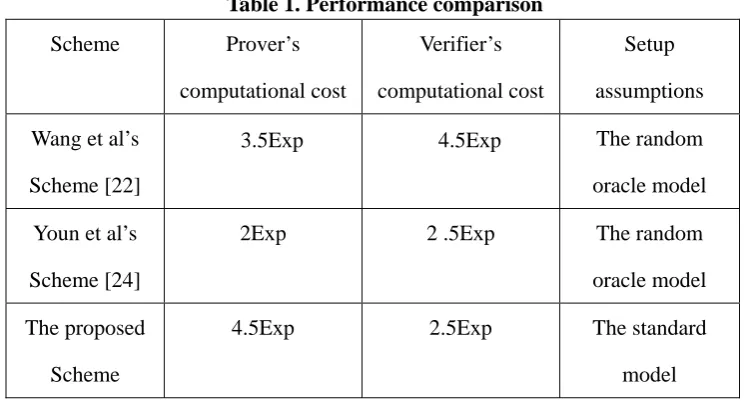
computational cost. The result is stated in Table 1. Exp denotes an exponentiation operation,
we use the signature scheme in [12] which is one-time secure in the standard model to
instantiate our construction. Note that the computational cost of a prover in our scheme
should take the key generation of one-time signature scheme into consideration.
In the table, the computational cost of a multi-exponentiation (that is, computing 1 2 a b
g g
or
g g g
1a 2b 3c) is assumed to be at most 1.5 exponentiations[18]. Although the scheme [24] ismore efficient than others, the efficiency of our construction can be further reduced when the
key pair of one-time signature scheme can be pre-computed and stored such that only one
exponentiation is needed to compute the shared secret
vk
=
(
g
xV)
xP. Such pre-computation technique does not apply to the schemes in [22,24]. Moreover, our scheme is proven to besecure in the standard model which provides stronger security guarantee than the random
oracle model.
Table 1. Performance comparison Scheme Prover’s
computational cost
Verifier’s
computational cost
Setup
assumptions
Wang et al’s
Scheme [22]
3.5Exp 4.5Exp The random
oracle model
Youn et al’s
Scheme [24]
2Exp 2 .5Exp The random
oracle model
The proposed
Scheme
4.5Exp 2.5Exp The standard
model
6. Conclusion
In this paper, we provide a generic construction for deniable authentication schemes that
can be instantiated without bilinear groups. Deniability of our scheme is achieved by the
property of the Diffie-Hellman key exchange protocol. In the following, we prove our scheme
to be unforgeable in the standard model by sequences of games. In the process of proof, we
make use of the notion of integrity of plaintexts with regard to symmetric encryption. Finally
we show that the computational cost of our construction can be dramatically reduced by
comparable to the most efficient non-interactive deniable authentication scheme [24] whose
security is based on the random oracle model.
Acknowledgement
This work is supported by Natural Science Foundation of Higher Education Institutions,
in Jiangsu Province office of education, P.R. China (Grant No. 10KJD520005), National
Natural Science Foundation of China(Grant No. 60803122),
Innovative Foundation of
Yangzhou University (Grant No. 2011CXJ022, 2011CXJ023).
References
[1] Y. Aumann, M.O. Rabin, “Authentication, enhanced security and error correcting codes”,
in Proceedings of CRYPTO 1998. Springer, LNCS 1462, 1998, pp.299–303
[2] M. Bellare, M. Boldyreva, and A. Palacio, “An uninstantiable random oracle model
scheme for a hybrid-encryption problem” EuroCrypt 2004, Springer, LNCS 3027, 2004,
pp.171-188
[3] M. Bellare, R. Canetti and H. Krawczyk, “A Modular Approach to the Design and
Analysis of Authentication and Key Exchange Protocols”, proc. of 30th Symposium on
Theory of Computing (STOC), ACM, 1998, pp. 419–428
[4] M. Bellare , C. Namprempre, “Authenticated Encryption: Relations among Notions and
Analysis of the Generic Composition paradigm”, Journal of Cryptology, 21(4)(2008),
469–491
[5] M. Bellare, C. Namprempre , G. Neven, “Security Proofs for Identity-Based Identification
and Signature Schemes”, Journal of Cryptology, 22(1)(2009), pp.1–61
[6] A. Bender, J. Katz, R. Morselli, “Ring Signatures: Stronger Definitions, and Constructions
without Random oracles”, Journal of Cryptology, 22(1)(2009), pp.114–138
[7] R. Canetti, O. Goldreich and S. Halevi, “The random oracle methodology, revisited”. In
STOC, 1998, pp. 209–218
[8] S.S.M. Chow, V.K.-W.Wei, J.K. Liu, T.H. Yuen, “Ring signatures without random
oracles”, in Proc. ACM Symposium on Information, Computer and Communications Security
[9] X. Deng, C. Lee, H. Lee, H. Zhu, “Deniable Authentication Protocols”, IEE Proc.Comput.
Digit. Tech., 148(2)(2001), pp.101–104
[10] C. Dwork, M. Naor, A. Sahai, “Concurrent zero-knowledge”, in: Proceedings of 30th
ACM STOC’98, 1998, pp.409–418
[11] L. Fan, C.X. Xu, J.H. Li, “Deniable authentication protocol based on Diffie–Hellman
algorithm”, Electronics Letters, 38 (4)(2002), pp.705–706
[12] J. Groth, "Simulation-sound NIZK proofs for a practical language and constant size
group signatures", in ASIACRYPT’2006, 2006, pp.339-358
[13] M. Jacobsson, K. Sako, R, Impagliazzo, "Designated verifier proofs and their
applications", in EUROCRYPT’1996, LNCS 1070, 1996, pp.143-154
[14] W.B. Lee, C.C. Wu, W.J. Tsaur, “A novel deniable authentication protocol using
generalized ElGamal signature scheme”, Information Sciences, 177(2007), pp.1376–1381
[15] R. Lu, Z.F. Cao, “A new deniable authentication protocol from bilinear pairings”,
Applied Mathematics and Computation, 168(2005), pp.954–961.
[16] R. Lu, Z.F. Cao, “Non-interactive deniable authentication protocol based on factoring”,
Computer Standards & Interfaces, 27 (2005), pp.401–405.
[17] R. Lu, Z.F. Cao, “Erratum to “Non-interactive deniable authentication protocol based
on factoring””, Computer Standards & Interfaces, 29 (2007), pp.275.
[18] A.J. Menezes, P.C.van Oorschot and S.A. Vanstone, “Handbook of Applied Cryptography”,
CRC Press, 1997
[19] M.D. Raimondo and R. Gennaro, “New Approaches for Deniable Authentication”,Journal
of Cryptology, 22(2009), pp.572–615
[20] Z. Shao, “Efficient deniable authentication protocol based on generalized ElGamal
signature scheme”, Computer Standards & Interfaces, 26 (2004), pp.449–454.
[21] W. Susilo and Y. Mu, “Non-interactive Deniable Ring Authentication”, in ICISC’2003,
LNCS 2971,2003, pp. 386-401
[22]Bin Wang,ZhaoXia Song,“A non-interactive deniable authentication scheme based on
designated verifier proofs”. Information Science, 179(6)(2009), pp.858-865
[23] E.J. Yoon, E. K. Ryu, K.Y. Yoo, “Improvement of Fan et al.’s deniable authentication
(2005), pp.274–280
[24]T.Y Youn, C.Lee,Y.H., Park, “An efficient non-interactive deniable authentication scheme
based on trapdoor commitment schemes”, Computer Communications, 34(2011), pp.353-357
[25] R.W. Zhu, D.S. Wong, and C.H. Lee, “Cryptanalysis of a suite of deniable authentication