A non-interactive deniable authentication scheme
based on designated verifier proofs
Bin Wang
Information Engineering College of Yangzhou University
No.36 Middle JiangYang Road, Yangzhou City, Jiangsu Province, P.R.China
Tel: 086-0514-82220820
E-mail:[email protected]
Abstract: A deniable authentication protocol enables a receiver to identify the source of the
given messages but unable to prove to a third party the identity of the sender. In recent years,
several non-interactive deniable authentication schemes have been proposed in order to
enhance efficiency. In this paper, we propose a security model for non-interactive deniable
authentication schemes. Then a non-interactive deniable authentication scheme is presented
based on designated verifier proofs. Furthermore, we prove the security of our scheme under
the DDH assumption.
Keywords: Deniable authentication, Authentication, Designated verifier proofs, DDH assumption, Provable security;
1. Introduction
In an open network environment, authentication protocols enable a receiver to make sure
that a particular sender wants to authenticate a message to him. A deniable authentication
protocol is an authentication protocol which enables the receiver to identify the source of the
given messages but unable to prove to a third party the identity of the sender.
The notion of deniable authentication was developed by Aumann and Rabin [1]. Later,
Deng et al.[4] proposed two improved schemes based on Aumann and Rabin’s work. In 2002,
Fan et al. [6] proposed a simple deniable authentication protocol based on the Diffie-Hellman
key distribution protocol. Since then deniable authentication schemes have enjoyed a
considerable amount of interest from the cryptographic research community. However,
security of these schemes is argued by presenting attacks that fail, which provides very weak
On the other hand, the notion of deniable authentication was formalized by Dwork et al.
[5] using simulation paradigm. In other words, an authentication protocol is deniable if the
view of any verifier can be simulated without knowing the secret key of the prover.
Nevertheless, Dwork et al. introduced timing constraints on the network in order to prove
security in the concurrent setting and the proof of knowledge is rather time-consuming.
Raimondo et al. [13,14] combined simulation paradigm with the security model for authenticated key exchange protocols [2] to present a formal definition of deniability.
However, as their model aims at deniable key exchange protocols (requiring to use special
protocol compilers), it is not appropriate to directly adopt their method for designing deniable
authentication protocols; otherwise the resulting security reduction would not be tight.
Furthermore, all the above-mentioned interactive schemes require several communication
rounds between the prover and the verifier. Consequently, several non-interactive deniable
authentication schemes have been proposed in order to reduce the communication cost
[10,11,15].
To the author’s knowledge, only Susilo et al. [16] provided a formal definition of a
non-interactive deniable ring authentication scheme. A generic method was proposed in [16]
for converting a ring signature scheme to a deniable ring authentication scheme by means of
the concept of chameleon hash function. Hence the security of their scheme relies on the
underlying ring signature scheme and chameleon hash function, which are rather costly
primitives to be used for achieving deniability (requiring a lot of pairing operations as well as
exponentiation operations).
Our goal in this paper is to define the notion of non-interactive deniable authentication
by combining simulation paradigm with the model for authentication schemes defined in [3,
7]. In 1996, Jacobsson et al. introduced the concept of designated-verifier proofs [9]. Such
proofs enable a prover Alice to convince a designated verifier Bob that a statement is true.
However, Bob cannot transfer the proofs to a third party. The reason is that Bob himself can
simulate such proofs. Then we propose a non-interactive deniable authentication scheme on
the basis of designated-verifier proofs. Subsequently, we prove that our scheme is secure
under the DDH assumption and deniable in the concurrent setting. Finally we compare the
computational cost and underlying security assumptions.
2. Preliminaries
2.1 DDH Problem
DDH problem: Let G be a multiplicative cyclic group of prime order q generated by g.
Given x, y, z
g g g
, x y z, , Zq, decide whether z(xy) modq.
A distinguishing algorithm D is said to ( , )t
-solve the DDH problem in group G ifD runs in time at most t and
| Pr[ , ,x y z Zq:D g( x,gy,gz) 1] Pr[ ,x yZq:D g( x,gy,gxy)1] |
.We say that G is a ( , )t
-DDH group if there is no polynomial time algorithm D( , )t
-solves the DDH problem in group G.2.2 Notation
If A is a randomized algorithm, then yA x x( ,1 2,) means that A has input
1, 2,
x x , and the output of A is assigned to y.
3. Deniable authentication schemes
3.1 Syntax of deniable authentication schemes
A non-interactive deniable authentication scheme is a tuple (Kg,P,V,Sim). On input a security parameter k , the randomized polynomial time algorithm Kg generates a public
key pk and a matching secret key sk. The public/secret key pairs for the prover and the
verifier are represented by (pk skP, P) , (pk skV, V) respectively. P (resp. V) is a polynomial time algorithm called the prover (resp. verifier) algorithm.
In an initialization step, the prover picks a message M . Then the interaction between
( , ) ( , , , ) ( , , , )
P V
P V
M Authen P M sk pk
d V pk sk M Authen
, where
denotes random coins chosen by theprover algorithm. Authen is the authenticator for the given message M produced by the
prover algorithm. The decision bit d{0,1} is output by the verifier. d 1 means that the verifier accepts. A conversation transcript is defined to be C=M ||Authen.
Correctness: For all k , (pk sk, ) Kg(1 )k
, we require perfect consistency,
meaning that Pr 1: ( , ) ( , , , ) 1 ( , , , )
P V
P V
M Authen P M sk pk
d
d V pk sk M Authen
.
On input the prover’s public key pkP, the receiver’s secret key skV, and a message
M , the simulation algorithm Sim should generate a simulated transcript C which is computationally indistinguishable from a real transcript C for the given message M .
3.2 Security model for deniable authentication schemes
3.2.1 Unforgeability of deniable authentication schemes
Let NDI = (Kg,P,V,Sim) be a non-interactive deniable authentication scheme. Consider the following game ExpimpNDI,A( )k between an adversary A and a game challenger
S:
Stage1: The challenger S runs the algorithm Kg(1 )k
to obtain key pairs (pk skP, P),
(pk skV, V). An empty set Res is also created, which is used to store the conversation
transcripts. Then the adversary A is provided with the public keys pkP,pkV . Stage2: The adversary A makes the following queries:
(1) Conv queries: A adaptively picks a message M . On input the message M , the challenger S sets the input of the prover algorithm to StP=(M sk, P,pkV, )
, where
denotes fresh random coins chosen by S . Then the challenger S executes( , ) ( )
( , , , )
P
P V
M Authen P St
d V pk sk M Authen
(pk skP, V,M Authen, ) by S. In the end, S provides A with C=M ||Authen (the
conversation transcript) and sets ResRes {C} .
Output: Eventually, A outputs StA, which represents knowledge gained by A
during stage 2. Then A picks a message M*. The adversary A wins if :
(1)
* * *
* * *
( , ) ( , )
( , , , )
A
P V
M Authen A M St
d V pk sk M Authen
,
* * *
||
C M Authen ; and
(2) d* 1, C*Res.
The advantage of A in this game is AdvimpNDI,A( )k =Pr[ExpimpNDI,A( )k 1]. We say that
NDI is secure against impersonation attack if AdvimpNDI,A( )k is negligible for every polynomial time adversary A.
3.2.2 Deniability
Consider the following game ExpDenNDI,D( )k between a distinguisher D and a game challenger S:
Stage1: The challenger S runs the algorithm Kg to obtain key pairs (pk skP, P),
(pk skV, V). Two empty sets Resand Res are created. Then the distinguisher D is provided with the public keys pkP,pkV.
Stage2: The distinguisher D makes the following queries:
(1) Conv queries: On input a message M chosen by D, the challenger S sets the input of the prover algorithm to StP=(M sk, P, pkV, )
, where
denotes fresh random coins chosen by the challenger S . Then the challenger S executes( , ) ( )
( , , , )
P
P V
M Authen P St
d V pk sk M Authen
. Note that input of the verifier algorithm is set to
(pk skP, V,M Authen, ) by S . In the end, S provides the distinguisher D with
(2) Conv queries: On input a message M chosen by D, the challenger S sets the input of the simulation algorithm Sim to St=(M sk, V,pkP, )
, where
denotes fresh random coins chosen by S. Then the challenger S runs the simulation algorithm by executing M|| AuthenSim St( ). In the end, S provides D with CM ||Authen, and sets ResRes{ }C .Challenge: Once D decides that Stage2 is over, D picks a message M* such that
*
M has not been submitted as one of the Conv queries, Conv queries. Then the challenger picks a random bit b{0,1}. If b=0, S performs in the same way as it
answers Conv queries. If b=1, S performs in the same way as it answers Conv
queries.
Guess: Finally, D outputs a bit b/. D wins the game if b/ b.
The advantage of D in this game is AdvDenNDI,D( )k =|Pr[ / ] 1| 2
b b . We say that
NDI is deniable if AdvDenNDI,D( )k is negligible for every polynomial time D.
4. Our scheme
Our scheme is based on the techniques used in [8,9]. Let G be a multiplicative cyclic
group of prime order q generated by g, log q2 k, where k is a security parameter. Then we choose a secure collision-resistant hash function H , H:{0,1}*Zq. The system parameters are params=G q g H, , , .
Kg(Key Generation): Chooses a random h G and a random x Zq .
Computesy1 gx and y2 hx. The public key is pk( ,h y y1, 2) and the secret key is
x. The public/secret key pairs for the prover and the verifier are represented by (pkP,xP),
(1) Picks random wZ rq, Zq and computes
/
1
( )
w r
V
c g y .
(2) Picks a random kZq* and computes ,
k k
Ag Bh .
(3) Computes cH M c A B( , , , )/ . If (c w) 0 modq, then goto step (2); otherwise computes sx cP( w) kmodq.
(4) Sends M and Authen( ,w g c sr, , ) to the verifier.
V(Verifier): Given a tuple Authen( ,w g c s Mr, , , ), the verifier performs as follows: (1) Computes c/ gw(gr)xV .
(2) Computes A (gs(y1P) (c w)),B (h ys( 2P) (c w))
. Returns 1 if and only if
/
( , , , )
cH M c A B .
Sim(Simulation algorithm): On input a message M , the prover’s public key pkP
and the verifier’s secret key xV, the algorithm performs as follows:
(1) Picks random
Zq,
Zq*, sZq and computes c/ g. (2) Computes ( s( 1 ) ), ( s( 2 ) )P P
A g y B h y .
(3) Computes cH M c A B( , , , )/ .
(4) Computes w
cmodq and r (
w x) V .(5) Produces M and Authen( ,w g c sr, , ).
Lemma 1: Given the public/secret key pairs (pkP,xP), (pkV,xV), the statistical distance of the following distributions is negligible.
*
,
( , , , ) , , 0 mod ( ) mod
R q R q
r
R q R q
P
w Z r Z
w g c s k Z c Z c w q
s x c w k q
* / , , ( , , , ) mod ( ) mod
R q R q
r R q
V
Z Z
s c Z
w g c s
w c q
r w x q
Proof: We use the notation xR S to mean “the element x is chosen with uniform
probability from the set S ”. At first, we choose a valid tuple ( , , , )w R c s ,
, , q,
w c sZ RG, such that for some message M
(1) c/ gw( )R xV , ( ) ( )
1 2
( s( ) c w ), ( s( ) c w )
P P
A g y B h y .
(2) cH M c A B( , /, , ).
We then compute the probability of appearance of this tuple following each distribution
of probabilities.
Pr[( , r, , ) ( , , , )]
w g c s w R c s
=
,
, , 0 mod
Pr[ ] , , r R q R q R q
g R r Z
w w c c c w q
w c Z
s s s Z
=1 (q q3( 1))
/
Pr[( ,w g c sr, , ) ( , , , )]w R c s
= / , , Pr[ ] , , R q R q r R q
s s s Z
c c w w
w c Z
g R r Z
=1 q4
The statistical distance of the distribution
/ (simulated transcripts) from the correctdistribution
(real transcripts) is at most 1 q. Hence, the statistical distance is negligible by the choice of security parameter k.5. Security Analysis
Theorem 1: Let G be a multiplicative cyclic group of prime order q generated by g
authentication scheme with success probability
in time at most t. Suppose A makes atmost qh random oracle queries and qc Conv queries. Then there is an algorithm B that
solves the DDH problem in G1 with
/
( (qc qh 2) q)
/
1
( c )
t t O q t
Proof: Algorithm B is given as input a tuple ( ,g gx,gy,gz). The system parameters are params=G q g H, , , , where H is a random oracle controlled by B.
B sets the public key of the prover to pkP ( ,h y1P,y2P) , where hgy ,
1 , 2
x z
P P
y g y g . Next, B picks a random x/ Zq and sets the public key of the
verifier to pkV ( ,h y1V gx/,y2V hx/) . Then B works by interacting with the adversary A.
Stage1: An empty set Res is created by B. Then the adversary A is provided with
,
P V
pk pk .
Stage2: B should answer A’s queries as follows:
H queries: A picks kZq*,
/
c G, and computes / k, / k
A g B h . In response
to a H-query (M c A B, ,/ /, /) issued by A, B first checks if the output of H on this input has been previously defined. If so, B returns the previously assigned value. Otherwise,
B responds with a value chosen uniformly at random from Zq and stores
/ / / / / /
((M c A B, , , ),H M c A B( , , , )).
Conv queries: A picks a message M and issues a Conv query. In response to a
Conv query,B performs as follows:
(1) Picks random
Zq,
Zq*, sZq and computes/ c g.
(2) Computes A/ (gs(y1P)),B/ (h ys( 2P)).
(4) Computes w
cmodq and r (
w x) /.(5) Sets Authen( ,w g c sr, , ). Then B provides A with C M ||Authen and sets ResRes { } C .
Eventually, A picks a message M* and outputs C*M*||Authen*. If the verifier
algorithm returns 1 on input C* and C*Res, then B outputs 1; otherwise B outputs 0.
Lemma 2: Assume g h y, , 1P,y2PG, but there is no xZq with gx y1P, hx y2P. Given wZ rq, Zq and a message M , a cheating prover with the public key
1 2
( , , )
P P P
pk h y y can pick at most one value of c over Zq for which the honest verifier
will accept M ||( ,w g c sr, , ).
Proof: Given w r, , assume that the cheating prover can pick two c c1, 2,c1c2modq, such
that the honest verifier will accept ( ,w g c s Mr, , ,i i ), i{1, 2}. Then we have
/
( )xV w r
c g g , ( si( 1 ) (ci w)), ( si( 2 ) (ci w))
i P i P
A g y B h y ,
/
( , , , )
i i i
c H M c A B ,i{1, 2}
The probability that at least one of (M c A B, /, i, i), i{1, 2} not having been queried by A is at most 2 q( i.e., A can guess B’s uniform random answer). As 2 q is negligible, we always assume that (M c A B, /, i, i), i{1, 2} have been queried by A. Hence we know that ki, ki
i i
A g B h , i{1, 2}, where k1 and k2 are chosen by A. Since c1c2modq, we have
1
1 2 1 2 1 2
(( ) ( ))( ) mod 1
s s k k c c q P
g y , ((1 2) (1 2))(1 2)1mod
2
s s k k c c q P
h y , which is contrary to the
assumption of the lemma.
We first analyze the probability that B outputs 1 when ( , x, y, z)
Diffie-Hellman tuple. According to Lemma 1, the statistical distance of the distribution
/(simulated transcripts) from the correct distribution is at most 1 q. Taking as a whole, qc
simulated transcripts are jointly distributed with statistical distance at most q qc from the
correct distribution. Then B outputs 1 with probability at least
(q qc ) in this case.Secondly, if ( ,g gx,gy,gz) is a random tuple, then it is not a Diffie-Hellman tuple with probability 1 1 q . In this case, for any w r, , it follows from Lemma 2 that there is at most one possible value of c for which there exists some s satisfying
/
( )xV w r
c g g , A(gs(y1P) (c w)),B(h ys( 2P) (c w))
/
( , , , )
cH M c A B
Thus A outputs a forgery (and hence B outputs 1 ) with probability
(( h 1) )(1 1 ) 1 (( h 1) )
q q q q q q q
in this case (the additive factor of 1 occursin case A did not make the relevant H-query for its forgery). Putting everything together, we have
| Pr[ ,x yZq:D g( x,gy,gxy) 1] Pr[ , ,x y zZq:D g( x,gy,gz)1] |
(
(qc qh 2) q)Theorem 2: Let G be a multiplicative cyclic group of prime order q generated by g.
Suppose a polynomial-time adversary A makes at most qh random oracle queries, qc
Conv queries and qc Conv queries. Our non-interactive deniable authentication scheme is deniable against A.
Proof: The system parameters are params=G q g H, , , , where H is a random oracle controlled by B.
B first picks a random hG and random xP,xV Zq. The public key of the prover
is pkV =( ,h y1V,y2V), where 1 xV, 2 xV
V V
y g y h . Obviously, B generates key pairs
with the same distribution as in the real interaction. Then B works by interacting with the
adversary A.
Stage1: Two empty sets Resand Res are created. Then the adversary A is provided with pkP,pkV.
Stage2: Since B knows the secret keys of the prover and the verifier, Conv queries and Conv queries issued by A can be answered correctly.
Challenge: At the end of Stage2, A picks a message M* such that M* has not
been submitted as one of the Conv queries, Conv queries. Then B picks a random bit
b{0,1}. If b=0, S performs in the same way as it answers Conv queries. If b=1,
S performs in the same way as it answers Conv queries.
It follows from Lemma 1 that the advantage of A is negligible since the statistical
distance of the above-mentioned distributions is negligible.
Theorem 3: Concurrent composition of our scheme preserves deniability.
Proof: Assume there is a verifier interacting with t independent copies of the prover
algorithm simultaneously, where t is polynomial in the security parameter k defined in
section 4. Let T be the concurrent composition of t individual transcripts. Then we have
T =((M1||Authen1),, (Mi||Autheni),, (Mt ||Authent))
We can construct a simulator to produce a simulated concurrent transcript T as follows
by means of the simulation algorithm defined in section 4:
T=(M1|| Authen1,,Mi ||Autheni,,Mt||Authent)
According to Lemma 1, it is easy to see that the statistical distance of the distribution
with respect to simulated concurrent transcripts from the correct distribution
( ) 2k
t q poly k
. For any negligible function
( )n and any polynomial p n( ),( ) ( )n p n
6. Performance Analysis
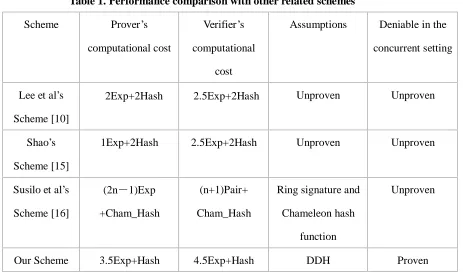
In this section, we evaluate the performance of the proposed scheme and other related
non-interactive deniable authentication schemes proposed in [10,15,16] in terms of the
computational cost and underlying security assumptions. The result is stated in Table 1. Hash
denotes a hash operation. Exp, Pair and Cham_Hash denote an exponentiation operation, a
pairing operation and a Chameleon hash operation respectively, which are the most
time-consuming operation. Note that Susilo et al’s scheme [16] used the chameleon hash
function Cham_Hash ( , )V m r g ym rmodp.
In the table, the computational cost of a multi-exponentiation(that is, computing g ha b)
is assumed to be equivalent to 1.5 exponentiations[12]. Although the schemes proposed in
[10,15] are more efficient, no formal security analysis is presented for their schemes. In
addition, the security of Susilo et al’s scheme relies on the underlying ring signature scheme
and chameleon hash function, which are rather costly primitives (requiring a lot of pairing
operations as well as exponentiation operations). In addition, our scheme is proven to be
deniable in the concurrent setting.
Table 1. Performance comparison with other related schemes
Scheme Prover’s
computational cost
Verifier’s
computational
cost
Assumptions Deniable in the
concurrent setting
Lee et al’s
Scheme [10]
2Exp+2Hash 2.5Exp+2Hash Unproven Unproven
Shao’s
Scheme [15]
1Exp+2Hash 2.5Exp+2Hash Unproven Unproven
Susilo et al’s
Scheme [16]
(2n-1)Exp
+Cham_Hash
(n+1)Pair+
Cham_Hash
Ring signature and
Chameleon hash
function
Unproven
7.Conclusion
In this paper, we present a security model for non-interactive deniable authentication
schemes. Then we construct a non-interactive deniable authentication scheme based on the
concept of designated-verifier proofs. Finally, we show that our scheme satisfies the deniable
property and is unforgeable against a polynomial time adversary. The security of our scheme
is proved under the DDH assumption. Moreover, we show that our scheme is deniable in the
concurrent setting.
References
[1] Y. Aumann, M.O. Rabin, “Authentication enhanced security and error correcting codes”,
in Proceedings of CRYPTO 1998. Springer, 1998, LNCS 1462, 299–303.
[2] M. Bellare, R. Canetti and H. Krawczyk, “A Modular Approach to the Design and Analysis of Authentication and Key Exchange Protocols”, proc. of 30th Symposium on
Theory of Computing (STOC), ACM, pp. 419–428, 1998.
[3] M. Bellare , C. Namprempre , G. Neven, “Security Proofs for Identity-Based
Identification and Signature Schemes”, in EUROCRYPT 2004, LNCS 3027,2004, 268-286.
[4] X. Deng, C. Lee, H. Lee, H. Zhu, “Deniable Authentication Protocols”, IEE Proc.Comput.
Digit. Tech., 148(2)(2001), 101–104.
[5] C. Dwork, M. Naor, A. Sahai, “Concurrent zero-knowledge”,in: Proceedings of 30th
ACM STOC’98, 1998, 409–418.
[6] L. Fan, C.X. Xu, J.H. Li, “Deniable authentication protocol based on Diffie–Hellman
algorithm”, Electronics Letters, 38 (4) (2002), 705–706.
[7] U. Feige, A. Fiat, and A. Shamir, “Zero knowledge proofs of identity”, Journal of
Cryptology, 1(2)(1988), 77–94.
[8] E. J. Goh, S. Jarecki, J. Katz, N. Wan, "Efficient Signature Schemes with Tight Reductions
to the Diffie-Hellman Problems", Journal of Cryptology, 20(4)(2007), 493–514.
[9] M. Jacobsson, K. Sako, R, Impagliazzo, "Designated verifier proofs and their
applications", in EUROCRYPT 1996, LNCS 1070, 1996, 143-154.
[10] W.B. Lee, C.C. Wu, W.J. Tsaur, “A novel deniable authentication protocol using
[11] R. Lu, Z.F. Cao, “A new deniable authentication protocol from bilinear pairings”,
Applied Mathematics and Computation, 168 (2005), 954–961.
[12] A.J.Menezes, P.C.van Oorschot and S.A. Vanstone, “Handbook of Applied Cryptography”, CRC Press, 1997
[13] M.D. Raimondo and R. Gennaro, “New Approaches for Deniable Authentication”,
http://eprint.iacr.org/2005/046.pdf.
[14] M.D. Raimondo, R. Gennaro and H. Krawczyk, “Deniable Authentication and Key
Exchange”, proc. of the 13th ACM conference on Computer and communications security,
ACM, 2006, pp. 400–409.
[15] Z.Shao, “Efficient deniable authentication protocol based on generalized ElGamal
signature scheme”, Computer Standards & Interfaces, 26 (2004), 449–454.
[16] W. Susilo and Y. Mu, “Non-interactive Deniable Ring Authentication”, in ICISC 2003,
LNCS 2971, pp. 386-401.
[17] E.J. Yoon, E. K. Ryu, K.Y. Yoo, “Improvement of Fan et al.’s deniable authentication
protocol based on Diffie–Hellman algorithm”, Applied Mathematics and Computation, 167
(2005), 274–280.
[18] R.W. Zhu, D.S. Wong, and C.H. Lee, “Cryptanalysis of a suite of deniable authentication
protocols”, IEEE Communications Letters, 10(6) (2006), 504-506.
Corresponding author: Bin Wang
Address: P.O.Box 153#
Information Engineering College No.36 Middle JiangYang Road
Yangzhou University, Yangzhou City, Jiangsu Province, Peoples Republic of China
Postal code: 225009