© 2015, IJCSMC All Rights Reserved 487 Available Online atwww.ijcsmc.com
International Journal of Computer Science and Mobile Computing
A Monthly Journal of Computer Science and Information Technology
ISSN 2320–088X
IJCSMC, Vol. 4, Issue. 4, April 2015, pg.487 – 492
RESEARCH ARTICLE
AUTO GENERATION OF CODE AND TABLE TOOL
Mr. Sandeep Agarwalla
#1, Ms. Priyanka Roy
#2#1
Faculty [Dept. of Computer Science], Indian Institute of Management & Commerce, Khairatabad, Hyderabad, India [email protected]
#2
Lecturer at Computer Science Dept. Aurora PG College, Ramanthapur, Hyderabad, India [email protected]
__________________________________________________________________________________________________
Abstract-- The paper is about a windows application of which will generate initial code files, tables schema and stored procedures to deal with the tables generated. The generated codes will be used by the software developers of a company which can be integrated with any web/window application(s). This tool can connect with any database server on network and execute the script generated. In the proposed system, there must exist a database where the user can create table with the required number of fields. Every table created is be placed under the same database. The code can be generated by any top level manager/ project head (with basic knowledge of computers). The tool will even guarantee the level of abstraction to be maintained between the developers hierarchy.
Keywords: Code Generation, Table, Stored procedures, Database, Abstraction
_____________________________________________________________________________________
I INTRODUCTION
In recent years technology has surpassed general human thoughts and task are needed to be completed in moments with minimal error; that too in a secured and controlled manner. In today’s software development companies; they follow a new way to develop their software in faster and optimized way. For most of the web development, they create templates prior by which it gives the client a better understanding of the website outlook. The developer even have to work less to generate the code and most of task is already being done while creating the template.
Similarly for developing a software which may have too many tables in the database and it needs C# or java code to create the business logic to access it from front end and place to in the back end. More over triggers, stored procedures are also required for other support of the software. To avoid the hustle to repeating the above tasks again and again develops create auto generation code. So in development Industries the new era has began for auto generation of code, tables, scripts and documentation that can be helpful in creating products in moments and maintain the standard as well.
© 2015, IJCSMC All Rights Reserved 488
IIMETHODOLOGY &OBJECTIVES
1. Basic Front end code (C#/Java/Android) Generated Automatically.
2. Basic Back end code (Tables, SQL triggers and stored procedure) Generated Automatically.
3.
Level of Abstraction to done automaticallyMethodology
The present study focuses on the secondary sources of data from Books, Journals, Articles, and interviews with eminent personalities from various departments of the University.
IIIEXISTING SYSTEMS
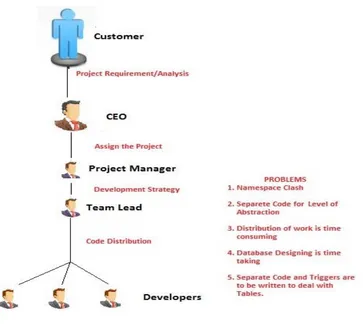
The existing system is to generate the code after making a lot of team effort. Continues interaction between team mates are mate as clash between the namespace are there. Sometimes some inexperienced developers does not create the hierarchy of management. Distribution of functional part in coding takes a lot of time. Even naming conventions creates problem. The Manager or Architect need to continuously monitor the code. Finally Project completion time becomes huge.
© 2015, IJCSMC All Rights Reserved 489
IVPROPOSED SYSTEM
Utility tools are commonly used now a days by developers to get optimized software in a faster way. Customization must be in
high rather than coding. As most of the code are auto generated or created previously in the form of templates.
The proposed system solves the problems discussed above. The tool is very user friendly and with basic knowledge of
computers the tool can be operated. The tool is developed for a project manager/ team lead to generate the required basic coding
structure for the project development.
AUTO GENERATION OF CODE AND TABLE TOOL is built on dot net windows platform and executable with single mouse
click. This tool creates web forms for ASP.Net web applications on Dotnet 4.0 and sql scripts for the respective table at the
desired directory. Once the files are created script can be executed on the SQL server which is either on same server or on
network when provided the credentials.
Solution Summary
The solution is a windows executable application.
The tool can be executed on any windows server without any dependencies.
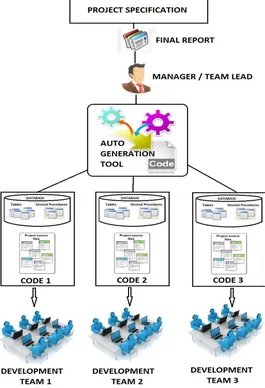
The structure is as follows
© 2015, IJCSMC All Rights Reserved 490 It solves the problem which was discussed in the existing system
1. Namespace problems raised for developers will be resolved.
2. The separate code generated for the developers will maintain the abstraction level. No need to write separate code or plan for maintaining the abstraction level.
3. Distribution of work to developers will be easier.
4. The database design and the structure will be created immediately.
5. Triggers/ Stored Procedures will be automatically created to handle the various requirement of the database.
Simple Application to show how to use the tool
A sample application is developed using Microsoft C# and SQL Server. The following window will be seen when the application is opened
Figure 3: Sample Application Window
Provide name for the webpage in the text box provided for which code file and script file required.
Default SQL table with 7 fields will be automatically created and modifications for them is not allowed but additional columns can be provided to the table by be inserted as new rows into the grid with the respective data type.
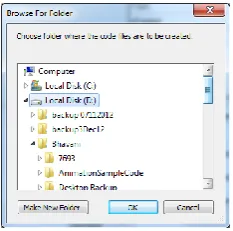
Click on the “Browse” button which opens directory browsing dialog from which the destination directory is to be selected. A child directory with name CodeGenDirectory will be created inside it and files will be created inside it.
© 2015, IJCSMC All Rights Reserved 491
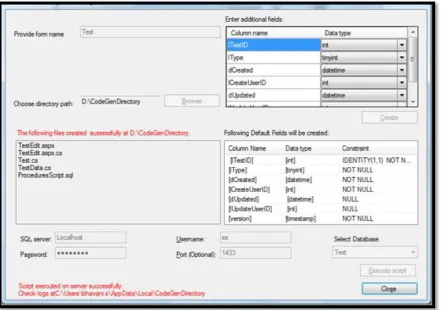
SQL server credential region will be enabled which is again optional and provided for executing the script on SQL server, the credentials are to be provided and then select the database from the dropdown on which the script to be executed and finally click on “Execute Script” button to complete the step. All the respective codes will be generated.
Figure 5 : Sample Application Window after all information added
Sample generated Codes in C# and SQL Server
© 2015, IJCSMC All Rights Reserved 492
V CONCLUSION
This project reduces the burden for managers to create namespaces for developers of same project; even the burden for levels of authorization is also reduced. Accessibility to the required is given to the developers. Table schema and insertion, deletion stored procedure is also created. The sample test shows how C# code is also generated for the tables and the stored procedures. So a lot of time is saved for the developers. Certain future enhancement is always necessary. But code generation is based on specific requirement only.
REFERENCES
[1] Martin Fowler, "Crossing Refactoring's Rubicon" ( http://martinfowler.com/articles/refactoringRubicon.html )
[2] Generative Programming: Methods, Tools, and Applications by Krzysztof Czarnecki and Ulrich W. Eisenecker, Addison
Wesley, 2000.
[3] Code Generation for Dummies (http://www.methodsandtools.com/archive/archive.php?id=86)
[4] Code Generation with Macrofort (http://claudegomez.fr/macrofort/macrofort.html)
[5] Ricardo Aler Mur, "Automatic Inductive Programming (http://www.evannai.inf.uc3m.es/et/icml06/aiptutorial.htm)", ICML
2006 Tutorial. June 2006.
[6] Fraser, C. W., and Hanson, D. R. Engineering a simple, efficient code generator generator. ACM Letters on Programming
Languages and Systems 1, 3 (1992), 213–226.
[7] Ganapathi, M. Code Generation and Optimization using Attribute Grammars. PhD thesis, University of Wisconsin,
Madison, 1980.
[8] E. Hill, L. Pollock, and K. Vijay-Shanker. Automatically capturing source code context of nl-queries for software
maintenance and reuse. In Proceedings of the 31st International Conference on Software Engineering, ICSE '09, pages
232{242, Washington, DC, USA, 2009. IEEE Computer Society.
[9] R. Holmes and G. C. Murphy. Using structural context to recommend source code examples. In Proceedings of the 27th
international conference on Software engineering, ICSE '05, pages 117{125, New York, NY, USA, 2005. ACM.
[10] E. Reiter and R. Dale. Building natural language generation systems. Cambridge University Press, New York, NY, USA,