Efficient Simulation of
Cell Loss Probability Using
Standardized ATM Connection
Traffic Descriptors
J.
A.
Freebersyser
J.
K. Townsend
~nter
for Communications and Signal Processing
Department of Electrical and Computer Engineering
.North Carolina State University
rv6-
94 / 22
EFFICIENT SIMULATION OF CELL LOSS
PROBABILITY USING STANDARDIZED ATM
CONNECTION TRAFFIC DESCRIPTORS
JAMES A. FREEBERSYSER1 J. !{EITH TOWNSEND
Center for Communications and Signal Processing Department of Electrical and Computer Engineering
North Carolina State University Raleigh, North Carolina 27695-7914
ABSTRACT
In ATM networks, the purpose of connection admission control is to decide if allowing a new connection into the network violates a quality of service measure, such as the cell loss probability. Testing the algorithms that perform connection admission control is difficult because of the complexity of the ATM switch architectures, the low cell loss probabilities required by ATM networks, and the unwieldiness of matching statistical models of the traffic entering the network to the traffic descriptors used by the call admission control algorithm. In this paper, instead of using statistical traffic models, we describe the traffic entering the network by the standardized ATM connection traffic descriptors used by the connection admission control algorithms. We develop a simulation framework for estimating the cell loss probability due to buffer overflow, use importance sampling to increase the efficiency of the simulation, and find an analytical solution for the improvement.
For the experimental examples considered here, we obtained 3 to 9 orders of magnitude improvement in efficiency compared to conventional Monte Carlo simulation. We also derive upper and lower bounds on the cell loss probability that can be used to determine if this method can be applied effectively to a given system before simulation. The efficient Sil11l11a-tion method developed here is suitable for the design and testing of the switch architectures and connection admission control algorithms planned for use in ATM networks.f
Ijames A. Freebersyser is supported by the U.S. Air Force Palace Knight Program.
Efficient Simulation of Cell Loss Probability.... , Freebersyser and Townsend
1
Introduction
1
The purpose of Connection Admission Control (CA(~) algorithms in Asynchronous Transfer
Mode (ATM) networks is to decide in real time whether a new connection can be admitted
into the network without violating Quality of Service (QoS) measures, such as the cell loss
probability, for the new connection or the existing connections, The decisions made by the
CAC algorithm in implementing a given CAC policy are specific to each ATM switch design,
and are also used ill the negotiation of the traffic descriptors and QoS measures that result in
the traffic contract between the user and the network
[1].
TIle complexity of the ATNIswitcharchitectures, the low cell loss probabilities required by ATM networks (10-6 to 10-1 2 ) , and
the unwieldiness of matching statistical traffic models to the traffic descriptors used by the
CAC algorithm combine to make testing of CAC algorithms difficult.
In many cases, the complex ATM switch architectures are simplified so that analysis can
be used to develop real time algorithms that approximate performance measures, These
approximations are then used to make CAC decisions. However, some method of testing
CAC algorithms developed in this manner is necessary to verify that the resulting CAC
decisions are correct.
Monte Carlo (MC) simulation can be used to obtain accurate estimates of performance
measures of complex ATM switch architectures but is too slow to be used for CAC in real
time. Even in non-real time environments, such as using
MC
simulation to test a C~ACalgorithm, MC simulation can be too slow for very low cell loss probabilities because of
the long run times required to obtain accurate estimates. Importance Sampling (IS) is a
technique that, under the proper conditions, can speed IIp simulations involving rare events of
network (queueing) systems (see for example, [2]-[6]). By carefully choosing the modification
or bias of the underlying probability measures, large speed-up factors ill simulation run time
can be obtained.
Most commonly, statistical traffic models have been used in the ana.lysis and
Me
sirnu-lation of ATM switches and networks. Several generations of statistical models have been
Efficient Simulation of Cell Loss Proba.bility.... , Freebersyser a.nd Townsend 2
These statistical traffic models have become increasingly accurate, but they have also
be-come more complicated and therefore less tractable to analysis. In addition, it is difficult to
establish a relationship between the parameters of the statistical models of the ATM traffic
and the traffic descriptors used by the CAC algorithm. [7]
To overcome this problem, we characterize the traffic entering the ATlVI network by the
ATM connection traffic descriptors standardized by the ATM Forum
[1].
This approach,where the traffic descriptors used by the CAC algorithm are also used in the analysis of a
performance measure, is called the operational approach (versus the statistical approach) in
[8]. The operational approach has been previously considered in [8]-[12L where all of the
methods cited used analysis to determine approximations or upper bounds of the cell loss
probability. However, the low cell loss probabilities which are of interest were not determined
for any of the methods cited, and the traffic descriptors standardized by the ATM Forum
were not used.
In this paper, we first describe a MC simulation framework using the standardized ATM
connection traffic descriptors to characterize the traffic entering the network. We then show
how IS is applied to this MC simulation framework. For the experimental systems we
consider, our method results in 3 to 9 orders of magnitude increase in efficiency compared
to the conventional MC simulation used to estimate the cell loss probability due to buffer
overflow. We also derive upper and lower bounds on the cell loss probability that can be
used to determine whether applying this method to a particular system will be successful.
Our method of efficient simulation is applicable to the design and testing of ATlVI switches,
as well as the CAe algorithms planned for use with these ATM switches.
2
System Description
In this section, we first consider the ATM connection traffic descriptors standardized by the
ATM Forum that will be used to characterize the traffic entering the network. We then
Efficient Simulation of Cell Loss Probability.... , FreebersLyser and Townsend
2---. 2
•
Input Ports•
•
•
•
•
Output Ports
Np- - - ' Shared
Bus Cell Buffer Server
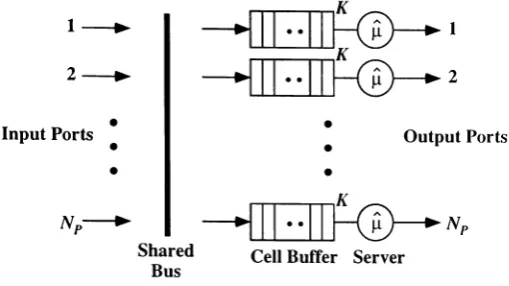
Figure 1: ATM switch architecture.
2.1
ATM Connection Traffic Descriptors
We characterize a connection requesting admission into the ATM network by the following
ATM connection traffic descriptors standardized by the ATM FOrUlTI User-Network Interface
Specification [1]:
~, peak cell rate (peR) in bps
"X,
sustained (average) cell rate (SCR) in bpsB,
maximum burst length in cells at the peak cell rate(1)
(2)
(:3)
The (~,
X,
B)-triplet contains optional traffic connection descriptors which can be used toderive the remaining required traffic connection descriptors that define the traffic contract,
specifically the cell delay variation and burst tolerance [1]. Each connection, which may be all
individual source or multiplexed sources, negotiates with the CAC~ algorithm for admission
into the network using these descriptors to describe the traffic.
2.2
ATM Sw-itch Architecture
The model for the ATM switch architecture considered here is shown ill Figure 1. TIle ATM
switch has Np input ports, and each connection in the network routed by the shared bus to
the output cell buffer of one of the
Np
output ports is described by the same(~,
X,
B)-triplet.Efficient Simulation of Cell Loss Probability.... , Freebersyser and Townsend
(~,K)
4
Connection Admission Control
YeslNo
Fig1lre 2: Connection admission control block diagram.
the shared bus during an arrival slot. The output cell buffers use a first-in, first-out
(FIFO)
queueing discipline. Each output cell buffer has a finite size of K cells, and cells exit the
output cell buffer at a service rate of
it
bps.2.3
System Model
Our goal is to determine the cell loss probability due to buffer overflow resulting from the
worst-case conforming traffic conditions for a given set of ATM connection traffic descriptors
as a function of the number of connections in the network. We consider OI11y homogeneous
connection traffic in the network, that is, all No connections in the network which are being
routed through one of the Np output cell buffers of size K and service rate
p,
have identicalU,
X,
B)-triplets. The block diagram of the CAC algorithm for these conditions is shown inFigure 2. We assume ergodicity in the traffic flow routed through each of the Np output cell
buffers, so that by examining one output cell buffer we obtain the performance characteristic
of all the Np output cell buffers, and that the output cell buffer is initially empty, since the
steady-state behavior of the system is equivalent whether it is reached by starting N
+
1connections with an empty output cell buffer, or by adding an additional connection to the
existing N connections and a non-empty output cell buffer.
The worst-case arrival condition which is still compliant according to the Usage Parameter
Control (UPC) is when the traffic enters the network at the peak rate, A, such that the
worst-Efficient Simulation of Cell Loss Probability.... , Fvcebereyser and Townsend
A
B=4 cells
n-rT'l
T=16slots~IIIIIIIIIIII
o
1 2 3 4 5 6 7 8 9 10 11 12 13 14 15Figure 3: Busy /idle cycle example.
5
case arrival condition in determining whether or not a QoS measure for cell loss probability
is violated by admitting a new connection to the network.
We operate with a slotted-time system where an arrival slot is the amount of time that
one cell takes to arrive. The period of the busy/idle cycle of the arriving traffic,
T,
is thetime in slots that the
iJ
length cell burst at the peak rate must be averaged over so that thesustained rate,
1,
is not exceeded, thusT
==
iJ~/1,
slots (4)An example of a burst of length B
==
4 cells is shown in Figure 3. TIle randomness ill thesystem model described here is found in the connection starting-slot position. A connection
can start in any slot within the T length period, so we describe the connection starting-slot
position by a uniform probability density.
We let the number of ports on the ATM switch be equal to the number of connections
routed through the output cell buffer, Np
==
No, since this condition results in an upperbound of the cell loss probability for any size switch, in terms of the number of input and
output ports. The data rate of the shared bus is then No cells per arrival slot, as shown
in Figure 4, so that all N
c·
input ports have access to the shared bus in each arrival slot,which results in N
c·
service slots per arrival slot. When N<
No input ports are active, wemake the worst-case assumption that the cells of the active ports occupy the first JV of No
service slots, rather than operating with some type of round-robin bus access mechanism.
We assume that each connection occupies every service slot position with equal probability
for each output cell buffer, so that the the cell loss probability for any one connection is
Efficient Simulation of Cell Loss Probability.... , Freebersyser and Townsend
Cell Arrivals
1
D
I Arrival/ S l o t Service
D
Slot2 I
/
1 2 Nc
•
•
•
•
•
•
Arrival Arrival
D
Slot SlotNc I Boundary Boundary
Figure 4: Relationship between arrival slots and service slots.
Check for
Arrival Blocks Departure
Service Slot Fill Service Service Slot
Boundary Buffer Boundary
Figure 5: Order of events within a service slot.
The effective service rate, u, of the server is
It
=
it
I
~,
cells per arri val slot6
In each service slot, one cell can be loaded into the output cell buffer if there are arriving
cells and
/-lINe'
cells can be removed from the output cell buffer if the output cell buffercontains greater than
/-lINe
cells. If the output cell buffer contains less than ItlNe
cells,the available cells in the output cell buffer are serviced. If there are no cell arrivals, cells in
the output cell buffer are still removed according to this policy. Figure 5 shows the order of
events within a service slot.
While the ATM switch architecture considered here may seem simplistic more
corn-plicated ATM switch architectures can be considered using this methodology, TIle main
feature of this system model is that the traffic entering the network is defined in terms of
Efficient Simulation of Cell Loss Probability.... , Freebersyser and Townsend
3
Closed-Form Analysis of Cell Loss Probability
7
Consider the set V of all unique connection starting-slot vectors 'Q.I for j
=
1 .../VI.
Aconnection starting-slot vector Qj is composed of N
c
elements, where the l-th element ill thevector represents the slot position, from slot 1 to slot
T,
where the l-th connection startsits
13
length cell burst. Each connection starting-slot vector 'Qj corresponds to the loss of icells anel the arrival of l: cells in a steady-state period T
ss .
Let n'C L l be the total numberof connection starting-slot vectors 'Q.j that map to i cell losses in a steady-state period T
ss ,
where
11/1
=
'Lf':oax
nCL , and Lm a x is the maximum number of cell losses in a steady-stateperiod
Tss.
The probability of i cell losses in a steady-state periodTss
is described by amultinomial probability distribution with individual probabilities
(6)
h "\""Lmax 1
were LJi=O PCLl
== .
In a similar fashion, nC A k is the total number of connection starting-slot vectors Qj that
map to k cells arriving in a steady-state period T
ss .
Thus,11/1
==
'Lt~ox nC A k where Amax isthe maximum number of cells that can arrive in a steady-state period Tss . The proba.bility
of k cells arriving in a steady-state period T
ss
is described by a multinomial probabilitydistribution with indivi~ualprobabilities
h "\""Amax - 1
were LJi=O PCAk - •
Define the cell loss ratio (CLR) or cell loss probability, PCL' as
Total Number of Cell Losses 'L~oax in'C L l
PCL
==
T I N
ota urn erb
0f ArrirrivmgC 11
e S == "\""ALJk=Omax
k~n'CAk(7)
(8)
We can also define PCL in terms of the average number of cell losses and the average number
of cells arrived, nCL and riCA' respectively.
1 ",L m a x .
iVT
LJi=O znC LiPCL
==
~l----.;....",-A-m-ax-k-iVT
LJk=O nC A kEfficient Simulation of Cell Loss Probability.... , Freebersyser and Townsend 8
For the systems we consider here, we know that
n
C A is constant for a givenU,"X,
B)-triplet,so we rewrite PCL as
- ~Lma.x •
f) _ n'C L _ L....,.i=O 'lPCLt
.LCL -
-nCA
n.,
(10)Thus, PCL is a weighted sum of probabilities from the multinomial distribution of cell loss.
The variance of PCL is then
(11)
which will be used later in calculating the improvement in simulationefficiency,
The brute force method of determiningPCL is to sum the cell losses and cell arrivals over
the entire set
11
of connection starting-slot vectors 1?.j' A minor simplification is to fix 011e ofthe connections at slot zero because the connection starting-slot vectors1?.jare translationly
invariant from this reference point, resulting in
where ICL is the binary indicator function of a cell loss in a service slot,
I.
== {
1, if a cell loss occursCL 0, if a cell loss does not occur
ICA is the binary indicator function of an arriving cell in a service slot,
{
I ,if a cell arrival occurs
lCA
=
0, if a cell arrival does not occur(13)
(14)
T
ss
is the steady-state period and has the same length as a period T, -il indexes thestarting-slot of the
i3
length cell burst of the l-th connection, and Ni- is the number of connectionsrouted through the output cell buffer. However, for even small values ofT and Ncr, the
Efficient Simulation of Cell Loss Probability.... ,Fteeoexeyscr eiu! Townsend
9
4
Estimation Using Simulation
We first consider conventional MC estimation in a network framework. We then discuss how
the simulation itself is greatly simplified by the use of ATM connection traffic descriptors,
and show how IS is applied within this framework. We also derive upper and lower bounds
of the cell loss probability which can be used to determine if simulation of a particular set
of ATM connection traffic descriptors and switch parameters using this method is feasible.
Lastly, we consider some examples to demonstrate our methodology,
4.1
Monte Carlo
Sirnulation
The brute force method of determining PCL is intractable ifV is large, which is the case for
many realistic systems of interest, so we use MC simulation to estimate PCL by randomly
selecting
N
D of the starting-slot vectors 12.jout ofV
and form the estimatePCL
" 1 x-No ~Tss~Nc I (' , )
p. _
nC L _ N;;L..."i=l L..."j=l L..."n=l CL Z,J,nCL - " - } ~Nn ~Tss ~Nc I (' , )
nCA Nn wi=1 wj=1 wn=1 CA 'l,J,n
(15)
We can rewrite (15) using the multivalued indicator function ofa cell loss for all No
connec-tions in a steady-state period
Tss
M _ { L, if L cell losses occur for 1
<
L<
Lm a x CL - 0, if a cell loss does not occur(16)
and the multivalued indicator function of a cell arrival for all No connectionsin a steady-state
period
Tss
MC A
= {
A, if A cell arrivals occur for 1
<
A<
Am a x0, if a cell arrival does not occur
(17)
(18)
as
" } ~Nn M (')
" nCL N;;wi=} CL 'l
PCL == -"- == 1 No 7\{/ (')
n C A Nn Ei=l.1Vj CA i
where MC L and MC A map each starting-slot vector 12.j drawn independently from
11
to Lcell losses and A cell arrivals, respectively, in a steady-state period T
ss .
The multivaluedindicators functions are used instead of the binary indicator functions ill order to obtain
Efficient Simulation of Cell Loss Probability.... , Freebersyser and Townsend 10
(20)
a cell loss results ill a correlated binomial distribution because the cell losses are the result
of bursty events [13].
Since all No connections generate a burst of length
iJ
cells, the number of arrivals persteady-state period
Tss
is1 (
A)
A
nCA
=
N
D
NDNc B
=
NcB
(19)
As mentioned previously.,
n
C A is constant so we are actually concerned with estimating nCL,the numerator in (15), the average number of cell losses per steady-state periocl T
ss .
Byestimating nCL we are implicitly estimating the PCLi of the multinomial distribution of cell
loss.
In order to determine the confidence interval of PCL' the
Me
simulation V\Te consideractually estimates nCL and therefore PCL by independently drawing Ns of NR connection
starting-slot vectors 12jout of the set V.
1 " Ns " NR M (' ')
n _
~ ~i=l ~j=l cL'l,]TCL - _
nCA
We determine the confidence interval of PCL by letting the estimate of PCL corresponding to
the i-th of N
s
sets ofNR
independent draws be PCLt' where i == 1., ... ,Ns .,
so that overallestimate of PCL is the sample mean
A 1 Ns A
PCL
=
N2:
PCL,S i=l
(21)
(22)
We estimate the variance of PCL by the sample variance
I N s
&2
(P
C L )=
N (N _1)
2:(P
C L ; -p
C L)2 S S t=lWe do not assume a normal distribution for the confidence interval, but use the method
found in
[14],
which determined that the confidence interval of a weighted sum of individualmultinomial probabilities follows a X2 distribution. We state the theorem from
[14]
with theoriginal notation slightly altered for our application:
Theorem: As
NsN
R --+ 00, the lower limit of the probability that PCL satisfiesEfficient Simulation of Cell Loss Probability.... ,Fteebersyser and Townsend 11
is at least 1-a where A is tile positive square root of the upper (1 - a)-th percentage point
of the \,2 distribution with Lm a x degrees of freedom.
The multinomial framework used here reduces to the more familiar binomial case with
normally distributed confidence intervals when Lm ax
==
1. lJsing the \2 distribution resultsin wider confidence intervals than using the normal distribution, but because we have used
the multivalued indicator functions in
(18)
rather than the binary inclicator function in (1,5),we have independence between cell loss events. This is critical since cell loss events occur
in a bursty fashion, which makes tile binomial random variable represented by the binary
indicator function correlated [13]. Measuring this correlation is difficult when rare events
are involved, which in turn makes deriving accurate confidence intervals of our estimates
difficult. This problem is solved by the multinomial framework because the selection of each
connection starting-slot vector 12-j from
V
is done independently.4.2
Monte Carlo Simulation Framework
As stated previously, the randomness in the system model is found in the position of the
connection starting-slots. Once the connection starting-slot vector 'Qj has been drawn, the
system model behaves deterministically in that the number of cell arrivals a.s well as the
number of cells serviced is known for each slot.
By observing the performance of this system, several characteristics were determined that
assist us in speeding up the simulation without applying IS. First, we are working with a
stable system since the size of the output cell buffer is finite. Second, we are able to detect
the onset of tile steady-state. Last and most important, the system exhibits predictable
behavior in the mechanism that causes cell losses, so we can anticipate if a cell loss is going
to occur for a given connection starting-slot vector 12-j. We need only observe the queue
length for three periods to determine whether or not a cell loss OCellI'S. We use the following
rules to take advantage of these three characteristics:
Define X
[n]
as the queue length in cells and A[n]
as the number of arrivals in cells at theEfficient Siinuleiion ofCell Loss Probability.... , Freebetsyset and Townsend
Nc
=
3 connections12
A.
B=4 cells t---+--+---I--I
T=16slots
o
1 2 3 4 5 6 7 8 9 10 11 12 13 14 15Figure 6: Aligned at zero example.
1. The cell arrivals that occur during the 2nd period constitute the steady-state cell
arrivals, i.e. A [T
+
n,]
=
A[h~T+
T+
n]
where k is a non-negative integer.2. If the output cell buffer size remains unchanged from the end of the second period to the
end of the third period,
4X"
[2T]=
4X"
[3T],and a cell loss does not occur, l\,tC L (2T~ 3T)==
0, the steady-state has been reached and a cell loss will never occur for this particular
connection starting-slot vector 12j.
3. If the output cell buffer size increases from the end of the second period to the end of
the third period, 4\"[2T]
<
X [3T], the output cell buffer size keeps increasing until acell loss occurs.
4. When a cell loss occurs in a period,
M
C L(kT, (k
+
1)T)
>
0 fork
~ 2,k
an integer,and the output cell buffer size at the end of consecutive periods is the same, ~\ [h~T]
==
..X"
[(k+
I)T], the steady-state has been reached.The connection starting-slot vector12j that results in the maximum number of cell losses
in a period corresponds to the situation where all the connections start at slot zero, which
we define as the aligned at zero (AAZ) case as shown in Figure 6. The maximum number of
cell losses that can occur in a steady-state period T
ss ,
Lm a x , is thenL
m a x =l
i3
(N
c - It) -I{
J+
1 (24)We will consider two types of cell losses: Type A and Type B. Type A cell losses occur
Efficient Simulation of Cell Loss Probabili(y.... , Freebersvse: and Townsend
arriving cells over a timet
<
T
and an output cell buffer overflow results in a cell loss. TypeB cell losses occur when the total number of arriving cells in a period T is greater than the
service available. We will be mostly interested in Type Acell losses since such cell losses are
rare events.
Type A cell losses can not occur until there is a sufficient number of arriving cells over a
given time window. Since all arrival must occur for a cell loss to occur, we assume the AAZ
case to get the worst-case conditions for cell loss, that is the least number of connections
that result in a cell loss requires that
A A
EN
c
>
1< +Bf.1Thus the minimum number of connections, Nc m in , required to cause a cell loss is
(2,5)
(26)
where
r
x1
is the ceiling operation that rounds x up to the next highest integer if x is not all integer. For a number of connections Nc<
Nc m in , cell losses at the output cell buffer cannever occur.
Type B cell losses, where a cell loss is guaranteed a priori, occur when the SUIll of the
average rates of all the connections is greater than the available service, or
f.1
<
ANc
(27)Therefore, the number of connections, Ncg, required to guarantee a. cell loss at the output
cell buffer is
(28)
The performance region we are interested in is over the range of connections lVc m i n :::;
NCf ::; NCfg• However, when cell losses are rare events, which is oftell the case in realistic
systems of interest,
Me
simulation is slow, therefore we use IS to make the simulation moreEfficient Simulation of Cfell Loss Probability.... , Freebersyser and Townsencl
4.3
Efficient Simulation Using Importance Sampling
14
.
The basic notion behind IS is to modify or bias the original proba.bility density function for
the connection st.art.ing-slot vector,
i-
(v),
to a new proba.bility density function, j'~(v), thatreduces the variance of the estimate of PCL' while weighting ea.ch cell loss event so that P~L
remains an unbiased estimate of PCL. The only required condition on the pdf ~f~(v) is that
f;(v)
>
0 when the multi valued indicator function .MC L(Qj
EVCL)
>
0, whereVCL
C V isthe subset of connections starting-slot vectors which cause a cell loss. The pdf .fv(v) we
consider here is the product of i.i.d. uniform probability density functions.
The key to using IS is knowing how to bias the pdf fv(v). Intuitively. we want to use
IS to increase the number of cell losses that occur. Type B cell losses result ill high va.lues
for PCL' so vee are most interested in Type A cell losses. We have previously determined
that the connection starting-slot has a uniform probability distribution over a period
T.
Unfortunately, there is no general bias scheme for the uniform probability distribution known
to the authors that is effective.
4.3.1 Theory
For this problem, we use a priori information about the system 1110del to determine an
effective bias scheme. The approach we take is based on the idea that one connection is fixed
to start at slot zero and an examination of the restrictions involved with using IS. Assume
we know the set VCL of connection starting-slot vectors'Qj that cause cell losses. Then PCL is
(.1)
Nc-1 '\'I,vC LI1\,{ (i )T L...,,1.=1 CL
PCL
==
"-NcB
(29)
IS is applied by reducing the set of connection starting-slot vectors
u,
fromI\/ I
to1'-''"* I
<
Il/I
such that all of the non-zero cell loss events are included in V", i.e. \/~L C ll* C l/. This
results in n~LJ
=
nCLl for i=
1 ... Lm a x , which implies that n'~LO<
n'CLo· By maintainingall the connection starting-slot vectors that cause cell losses in ll*, we do not violate the
Efficient Simulation of Cell Loss Probability.... , Freebersyser a,nd Townsend
like VCL = V*, but as long as IV*I
<<
IVI and VCL C V*, the efficiency of the simulation can be increased.This reduction in connection starting-slot vectors results in the biased individual
proba-bilities from the multinomial distribution for cell loss
(:30 )
The relationship between the unbiased PCL, and the biased P~L, is based on the the weight
function or likelihood ratio, ltV
==
IV* I/IVI,
so that(:31 )
Therefore, IS implicitly biases the PCLi to P~Li'
The cell loss probability found using IS, P;L' is the same as that found without using IS.
The variance of P;L is
Lm a x
(iW)
2 * _ t.;ax(il/I!)
')*L -
PCLiL -
1ci.,i=O nCA i=O n'CA
L
m a x
( i ) 2 L
m a x ( i )
W
L
=--
PCLl -L
=--
]JC L li=O n C A i=O n C A
(33)
which will be used later in calculating the improvement in simulation efficiency.
4.3.2
Application
We mentioned previously that Type A cell losses occur when individual connections start so
close together that the server can not keep up with the arriving cells over a time t
<
T
andan output cell buffer overflow results in a cell loss. Assume that one connection is fixed to
start at slot zero. Then for a given number of connections, we can determine the distance
in slots c from the connection fixed to start at slot zero, so that a cell loss does 110t occur
Efficient Simulation of Cell Loss Probability....~ Fteebersvser a.nd Townsend 16
multi-valued indicator function l\le L is always zero outside this region and the support of the
uniform pdf that originally covered the entire interval T can be reduced around both sides
of slot zero.
Define Cmin as the distance in slots from the start of the 13 length ('('ll burst of the
connection furthest from slot zero for a connection sl.arting-slot vector 12.1 that still causes
a cell loss for NC'min connections, and define C m in+l similarly for NC:rllin+l connections.
TIle
equations used to determine Cmin and C m in+l are a function of theATIVI
connection trafficdescriptors and the switch parameters.
For J.l
2:
1.0 andNc.: -
1<
J.l~ K
emin
=
LB - 1'1 J+
1Cmin - It
A ! { _
unless
B -
N _==
0 then Cmin - 0, andGmin J..L
C min+l ==
B
+
CminFor J.l
2:
1.0 andNCf
m in - 1~J-l
unless
B
( NC m in -J-l) - ]{
== 0 then Cmin == 0, andC min+l ==
B
+
CminFor J.l
<
1.0Cmin ==
l
B/
It -B
J+
1and
C min+l ==
l2B/J-l- B
J+
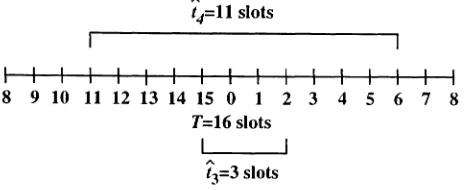
1The number of slots covered by the biased uniform pdf is
i
==
2c+
1(34)
(:35 )
(37)
(:38 )
(39)
Efficient Simulation of Cell Loss Probabili(y.... ,Fteebersyee: and Townsend
I I I I I I I I I I I I I I I
8 9 10 11 12 13 14 15 0 1 2 3 4 5 6 7 8
T=16slots I
~=3slots
Figure 7: Example of
i
distances.17
compared to the unbiased uniform pdf that covers the full T slot period. An example of
i
slot distances is shown in Figure 7.
This quasi-analytic form of IS fixes the weight within the simulation according to how
much the support of the original uniform pdf is reduced around the connection fixed to start
at slot zero. Each connection starting-slot 1!..j is drawn independently from the identical
biased uniform distribution, which results in the weight function
Nc
II
("
)NC-I
vV
=
I
v (v)/
I~(
v)
=
I
j (v)/
I](
v)
=
t /T
j=2
(41)
The expression of the weight function in
(41)
is the same as that in (31) where11/
1= TNc-Iand IV*
I
=
iNc-I.4.3.3 Simulation Using IS
The
Me
simulation using IS estimates P;L by independently drawing N s sets of NRconnec-tion starting-slot vectors 1!..j out of the set V*
1 \:"'Ns \:"'NR M* (. ,.)
" N sNR L--i=I L--j=I CL 1" J
P~L = - - - - = : : - - - - = - : : . . - - - (42)
where M~L(i,j)takes on the values 1 to Lm a x and indicates the number of cell losses for the
(i,j)-th connection starting-slot vector Qj drawn from the biased distribution, .f;(v).
Now for
NCmin'
we observe that PCL(NCmiJ
=
PCL(imin) ,
but for PCL(NCmill+l)
this is notthe case. Rather we have
Efficient Simulation of Cell Loss Probability.... , Freebersyser tuu! Townsend 18
We first find the cell losses involving the connection fixed at zero, or NC L
(imin+1),
and then add in the cell losses not involving the connection fixed at zero, NC L(i~in+1)'
We account for the cell losses outside thet
m in+1 range by sliding thef
m in range over the T -t..lIn+1
slots outsidet
m in+1 and subtracting the AAZ case at the boundary so thatNC L
(imin+1)
+
C~~:ii:+l
(T -
L.in+1)
NC L (NCmiJ+
N
C L(N
C m in ) -N
C L(N
C m in AAZ) (44)N c .
where
eN
Cmin'mm+l ==N
C'min+l is the combination operator and this factor accounts for thedifferent combinations of
NCf
m in connections that can occur outside thei
m i n+1 range. Wedivide by a factor of
l/T
Ncm in + l-1 and use
(44)
to find(45)
or in terms of PCL we have
(46)
(47)
which is a very tight bound since the AAZ case constitutes such asmall portion of the total
number of cell losses. In finding PCL
(N
Gmin+l)'
we actually violate the IS rule that.f~
(
v)>
0when
M
C L(Qj
EV
C L )>
0 in a known way, and correct for this by replacing the correctnumber of cell losses using PCL
(N
GmiJ·
The simulation uses the estimates of PeL(L.IO+l)
and PeL(N
Gmin)
to estimate PCL (NGmin+l)
in(4
7).The variance of P~L
(N
C m in ) is the sample varianceEfficient Simulation of Cell Loss Probability.... , FreebersJ!ser and Townsend 19
The variance of
P~L
(N
G'min+l)
is the weighted sum of the variances;;-2
(P~L
(fmin))
and;;-2
(P~L
(imin+l))
;;-2
(P~L
(NGmin+l))
+
The quantities in (48) and (49) are used in the calculation of the confidence intervals of the
estimates for
P~L
(N
GmiJ
andP~L
(N
Gmin+! )
4.3.4 Calculation of the Improvement Factor
The improvement,
Rnet,
that results from using IS describes the factor by which an ISestimator that uses the given method is more accurate than a conventional IVI C estimator
based on the same sample size, or, equivalently, how many fewer steady-state periods must
be simulated to obtain a given accuracy. The improvement,
Rnet,
is found analytically bytaking the ratio of the variances, (J2 (PCL) and (J2 (P;L) from (11) and (3:3), respectively.
L
(
. )2
. max _~_ _
p2
L~=o riCA PCLI CL
L
(
. )2
W .max ~ _
p2
Lz=o
nCA PCLt CL1
--+ - as PCL --+ 0
l¥
(50)As PeL ~ 0, the improvement obtained by using IS approaches the inverse of the weight
from above, so a lower bound on the improvement,
l
RnetJ,
is(
,,)NC-l
l
RnetJ
== l/vV == T[t
(51)From (51), we see that improvement always results if
i
<
T
for any value of PeL if Nc>
2.4.4
Upper and Lower Bounds of the Cell Loss Probability
The distance Cmin can be used to derive an upper bound for PCL for NC m in connections by
assuming that Lm a x cell losses from (24) occur whenever one or more cell losses occur. For at
least one cell loss to occur, all NC m i n connections must start within Cmin slots of each other.
Efficient Simula.tion of Cel! Loss Proba.bility.... ,Fteeberevser and Townsend
20
Figure 7).
If
we assume that one connection is fixed at slot zero, the probability of the remaining NC min - 1 connections starting within Cmin slots of each other is (Cmin/T)NCmin-1.Therefore an upper bound for PCL is
n'C A
P
(a11Y cell loss) Lm a xn'C A
NcminE
For the experimental systems considered later, the upper bound in (52) is one or two orders
of magnitude high.
An upper bound for PCL for NCmin+l connections can be derived using the same method
used to find the PCL
(NCmin+l)
in (47), except that we substitute the bounds for PCL(LlIl+1)
and PCL
(i~In+I)
into (47) rather than the estimates. We upper bound PCL(imin+1)
using(52)
asnCA
p (any cell loss)Lm a x
n
C A(~
)NCmin+l -1
(C
min+1
+
1)(l
iJ
(NCmin+l -
It) -
I\J
+
1)We use
r
PCL(NCmin)l
in the expression for PCL(i~in+1)
so thatPCL
(NCmin+l)
<
r
PCL (NCmin+l )l
r
PCL(imin+1)
1
+
r
PCL(i~m+1)
1
r
PCL(t
min
+
1 )1
N
C min(Ncmin+l
(T -
t
min
+
1)
+
1)
flJ
(N-,)1 (54)+
N T CL Cm lOCm in + l
A lower bound for PCL for a number of connections less than that guaranteed to cause an
error,
Nc
<
Nc
Efficient Simulation of Cell Loss Probability.... , Freebersyser eiu! Townsend 21
(S,5 )
case shown in Figure 6, where Lm a x cell losses occur. If we aSSUTIle that one connection is
fixed at slot zero, the probability of the remaining
No -
1connections starting at slot zero,is (l/T)NC-l. Therefore, a lower bound for PeL is
(
)NC-1( "
)
lPeL(No<Ncg)J=l~ed= ~
lB(Nc,-p)-AoJ+l
n'C A Nc.,B
For combinations of
(~,
X,
B)-triplets and(fl,
K)-pairs that result in Cmin
=
0, the lowerbound is exactly PCL for N
Cmin
connections.A lower bound for PCL for a number of connections greater than or equal to that
guaran-teed to cause an error, lVe
2:
Ncg,is found by assuming that for every connection starting-slotvector 12.j, the Lg cell losses associated with the overflow ill a period T occur so that
(56)
where
L'g
==
n
C A -ItT.
This is a lower bound because it is possible to lose more thanLg
cells, such as in the AAZ case where Lg ::; Lm a x • In (56), we also see that as N
c
increases,PCL ~ 1as expected.
4.5
Feasibility of System Simulation
We can determine whether or not a given system can be simulated effectively before
SilTIU-lation by using the upper bound of PCL and the lower bound of
R
n e t • We definePCL
as theequivalent cell loss probability that must be simulated using conventional
Me
simulationafter the improvement has been taken into account. We will see later that the upper bound
of PCL(N
c m in) is roughly two orders of magnitude high for the experimental examples vve
consider here, so to find
PCL
we divider
PCL(Ncmin)l
by a factor of 100as in (S7)(
T ) Nc . -1
PedNomiJ
=
(fPedNomiJl
/100)i
min
rrn nWe define the simulation effort, E, as
E ==
TNc/P
c L(,57)
(,58)
noting that the effort required by any simulation is inversely proportional to PCL and
1)ro-portional to
T
andNc.
Based on the results of the experimental examples vee consider later,Efficient Simulation of Cell Loss Probability.... , Freebersyser and Townsend 22
System j, Mbps
X,
Mbps B, cells u. Mbps 1\, cells01 500 50 2 200 4
02 8 2 4 1:3 !)
Table 1: ATM connection traffic descriptors and switch parameters for the simple examples.
System T, slots p.,cells/slot NC m in ,corms. Cmin' slots Lm a x (Nc . ),rru n cells
D1 20 0.8 3 1 1
02 16 1.625 3 1 2
Table 2: Derived simulation parameters for the simple exa.mples.
4.6
Sjrnulat.ion
Methodology
In order to demonstrate and verify our methodology, we considered the two simple examples
with the ATM connection traffic descriptors and switch parameters given in Table 1. The
parameters for the simple examples were selected so that the PCL a.nd PeLt could be
deter-mined by brute force as in (12). The service rates were selected so that the different formulas
for determining Cmin and Cmin+l could be tested depending on whether fJ
2:
1or 1.£<
1.The ATM connection traffic descriptors and switch parameters in Table 1 are substituted
into the appropriate equations in Section 4.3.2 to find the derived simulation parameters for
the simple examples shown in Table 2. The derived simulation parameters are used as inputs
to the simulation.
The exact results for NC'min and NC'm in + l connections for the simple examples are shown
in Table 3. We performed conventional
Me
simulation and simulation using IS for N Cminand N
e .
connections using Ns
=
20 of NR steady-state periods shown in Table :3 illm in-l-l
order to compare MC and IS simulation results. The estimates of PeL from the MC and
01 3 10,000 2.917 X 10⁻³
D1 4 10,000 9.975 X 10⁻³ 02 3 40,000 2.604x 10-':3 D2 4 40,000 1.811X 10-£J
System ~ Nc, conns. I NR PCL
Efficient Sunuleiiou of Cell Loss Probability.... , Freebersyseteru! Townsend 23
95~ CI
95%CI CL 0
Dl 3 2.956X10 '0 (2.850X 10 '0,3.062X10 '0) 2.915X10-'- (2.B08x10-:\ 2.922X10"":3) Dl 4 9.975X10 -0 (9.773X10 '0 11.022X10 .:L) 9.981X10 -3 (9.941X10-'J,1.004X10-2)
D2 3 2.621X10 ~ (2.578X 10 '3,2.666X 10 .3) 2.604X10-,-0 (2.GOUx 10-:\ 2.f)USx 10-3 )
D2 4 1.827X10 .'2 (1.795X10 .J,1.859X10 .3) 1.814X10 ·2 (1.7~J;-': X 10-3, 1 .8 :12x 10--:3)
System INc,conns.
II
Table 4: lVIC and IS estimates and confidence intervals for the simple e-xamples.
Exact Observed l/W Exact Observed l/Hl
I
I
System Rn e t NCm 1ll ti.; NCrnin for NCmin
«:
NC mi n 4- 1 Rn e t NCmin+l for N('TfIIf1+1Dl 196.5 226.0 44.4 26.0 23.7 11.0
D2 96.0 123.7 28.4 4.3 4.0 3.1
Table ,5: Improvements for the simple examples.
IS simulations and the resulting confidence intervals of the simple examples are S110\Vn in
Table 4. Confidence intervals for the estimates of PCL for NC m i n and NC rn m+1 connections
are determined using the method from
[14]
given in (23). As expected, the estimates of PCLfound using IS are closer to the exact value for PCL than the
Me
estimates, and also havetighter confidence intervals.
Shown in Table ,5 are the improvement factors obtained for the simple examples using
several different methods. The exact improvement is found by substituting the PCL, found
by brute force into
(.50).
The observed improvement is found by taking the ratio of 0-2(P
C L ) and &2 (P~L) since the Me and IS simulations were performed for an identical number of NRsteady-state periods. Finally, the value of l/W is given, and this quantity is indeed a lower
bound for Rn e t• Clearly, the computational effort expended in estimating PCL by simulation
for the simple examples is greater than that required by brute force, but the purpose of this
exercise was to verify the methodology itself rather than estimate PCL'
5
Experimental Examples
We considered the following experimental examples, where PCL and ]JCL, are unknown, with
the ATM connection traffic descriptors and switch parameters shown in Table 6. The derived
simulation parameters for the experimental examples are shown in Table 7. The cell loss
Efficient Simulation of Cell Loss Probability.... , Freebersyser a.nd Townsend
System ,,\, Mbps X, Mbps
iJ,
cells I'·, Mbps tc,cells1 15 1 10 120 100
2 15 1 200 120 100
3 50 1 10 120 100
4 50 1 200 120 100
5 75 1 200 120 100
6 15 5 25 120 100
7 50 5 25 120 100
8 500 2 10 120 200
9 500 10 25 120 200
10 500 1 100 120 200
11 500 2 50 120 200
12 500 2 100 120 200
13 2.1 0.031 148 120 100
14 32 1 200 120 100
24
Table 6: ATNI connection traffic descriptors and switch parameters for the experimental
examples.
System T, slots u, cells/slot NCmin' conns. Cmin,slots Lm a x(Nc'm"n)' cells
1 150 8.0 18 0 1
2 3000 8.0 9 101 101
3 500 2.4 13 7 7
4 10000 2.4 3 34 21
.5 1.5000 1.6 3 129 181
6 75 8.0 12 0 1
7 250 2.4 7 15 16
8 2500 0.24 21 32 8
9 1250 0.24 9 80 20
10 .50000 0.24 3 317 77
11 12500 0.24 5 159 ;3~)
12 25000 0.24 3 317 77
13 10025 57 1/7 58 32 '27
14 6400 3.75 5 121 I 151
Efficiellt Simulation of C~ellLoss Probability.... , Fteebcrsvse; tuu! Townsend
Nc ,conus. PCL Comment
120 1.38x 10-~ e
=
0.02 110 1.96 x 10⁻³( =
0.04100 2.49x 10⁻⁴
f
=
0.190 2.08x 10⁻⁵
f
=
0.2~)80 2.03x 10⁻⁶
( =
0.219 3.92 x 10-~" Upper Bound
18 5.64x 10⁻⁴u Exact
17 0 Exact
Table S: Cell loss probability as a function of the number of connections for system 1.
Nc, conns.
PCL
COn1111ent120 2.10x 10⁻² e
=
0.02110 3.68 x 10⁻³ ( = 0.07
100 5.50 x 10⁻⁴ e= 0.10
90 6.78 x10⁻⁵
f
=
0.1280 7.36 x10⁻⁶
f
=
0.1014 7.17x10⁻² 0 Upper Bound
13 2.88x10⁻²⁴ Upper Bound
11 0 Exact
Table 9: Cell loss probability as a function of the number of connections for system :3.
8-16. The estimates of PCL for systems 1, 3, 8, and 13are shown i11 tables because vve were
unable to generate complete performance curves for reasons whichvee discuss later. However,
PCL for these systems is extremely low and in such systems we give the upper bound. For
systems 1 and 6~ we are able to determine the exact PCL using the lower bound in (5.5) since
Cmin
==
0, which results in Lm a x==
1cell losses for the AAZ case for NC m in connections. Notethat a PCL ~ 10-14 corresponds to 1 cell loss per year for a service rate on the order of 1
Gbps.
Nc, conns. PCL C~0111ment
61 1.64x 10-~ Exact
60 1.96X 10⁻³ c= 0.01
22 4.84 x10⁻³ 2 Upper Bound
21 1.75x 10⁻³ 8 Upper Bound
20 0 Exact
Efficient Simulation of Cel! Loss Proba.bility.... , Freebersyser and Towuncni! By.tem 2 26 1xlO-1. lxlO-:l lx10 -3 lxlO -4 1x10 -5
..:I 1x10 -6
(£10u
-7 lx10 1x10 -8 1x10 -9 lx10-1 O lx10-1 1 lx10 -12 lx10 -13
---)..---~
~..---. /V
VV
/
0 20 30 40 50 60 70 80 90 100 110 12 Number of connect ions
Figure 8: Cell loss probability as a function of the number of connections for system 2 (TIle dashed portion of the curve is a straight line interpolation).
lxlO -1 -2 lx10 1x10 -3 ..:I (£10U -6 lxlO lx10 -5 1x10-b -7 1x10
----
--- I.---~ ~---V VV
/ ')
/
JI
f
I10 20 30 40 50 60 70 80 90 100 110 120 Numberotconnections
Efficient Simulation of Cell Loss Probability.... , Freebersyser a.nd Townsend
27
lx10 -1 -2 1x10 -4 lxlO ~ ---,..---
---~ /",,-...-' /
~/
vv
/
,
I10 20 30 40 50 60 70 80 90 100 110 120 Number of connections
Figure 10: Cell loss probability as a function of the number of connections for system ,5.
System 6 -~ lx10 -2 lxl0 1xl0-3 -4 lxlO -5 lxl0 1xl0 -6 -7 lxl0 -8 lxlO 1x10 -9 -10 lxl0 -11 lxl0 -12 lxl0 -13 lx10 -14 lx10 lxl0 -15 -16 lxlO -17 lxl0 -18 lxl0 -19 lxl0 -20 lxl0 -21 lxl0 -22 lxl0 -23 lxl0 -24 lxl0 ~
---~ »> / V10 14 16 18 20 22 24 26
Number of connections
Efficient Simulation of Cell Loss Probability.... , Freebers,yser and Townsend System 7 28 1x10 -1 1x10 -2 lx10 -3 1x10 -4 1x10 -5 ..:I u (QI 1x10 -6 -7 lx10 lx10 -8 lx10-9 1xlO-1 O
v
V
/
~/
V
/ /
/
/
/
/
f
t10 12 14 16 18 20 22 24 26 28 Number of connections
Figure 12: Cell loss probability as a function of the number of connections for system 7.
System 9 lx10 -1 1xlO-2 -3 1xlO -4 lx10 ..:I lx10-5 (QIu lx10-6 lx10-7 lx10 -8 lx10 -9 1.x10-1 O -11 1.x10 ~~ ,...
/
,
J/
/ '
/
I
/
/8 10 11 12 13 14 15 1
Number of connect 10n8
Efficient Simulatiol1
of
Cel! Loss Probability.... , Freebersyser and TOlvnsendSystem 10
29
lx10-2
lx10 -3
~I.--""" ~
~
,....---:
~~V
V
V
I
If
J
I
0 10 20 30 40 50 60 70 80 90 100 110 12
~
Number of connections
Figure 14: Cell loss probability as a function of the number of connections for system 10.
System 11 -1
lx10 lx10-~
lx10 -3 -4 lxl0
..:I
<AeU 1x10 -5 1xl0-6 -7 1x10 lxl0-1t 1x10⁻⁹
~
.----~~
V
~. /
/
V/
V
/
(
10 15 20 25 30 35 40 45 50 55 60 Number of connections
Efficient Simulation of Cell Loss Probability.... , Freebersyser and Townsend
System 12
lx10-J
~
---'
/ ~
/
~V
/
V
9 I
~
~
10 15 20 25 30 35 40 45 50 55 60 Number of connections
Figure 16: Cell loss probability as a function of the number of connections for system 12 (The dashed portion of the curve is a cubic spline interpolation).
Nc, conns.
PeL
Comment3870 4.91 x 10-~ f
=
0.013500 1.57x 10⁻² e
=
0.043200 4.47 x 10⁻³
f
=
0.052900 7.11 x 10⁻⁴
e
=
0.14 2600 6.96 x 10⁻⁵f
=
0.:372400 6.56 x 10⁻⁶
c
=
0.:30 2200 4.22 x 10-' c=
1.0059 2.01 x 10⁻¹⁰ 1 Upper Bound
58 5.60 x 10⁻¹⁴ 4 Upper Bound
57 0 Exact
Efficiellt Simulation of Cell Loss Probability.... , Fteebcvevsev «ud Townsend
System 14
:31
1x10⁻¹
1x10-~ 1x10 -3
..:I
(~u 1x10 -6
1x10 -5 lx10 -6 -7 1x10 lx10 -8
-
~....--
,;-.-~~
. /
V
V
/
)
/1
9
10 20 30 40 50 60 70 80 90 100 110 120 Number of connections
Figure 17: Cell loss probability as a function of the number of connections for system 14 (The dashed portion of the curve is a cubic spline interpolation).
For each performance curve, the bottom two points were obtained by simulation using
IS, and the remaining points were obtained by conventional lVrC simulation. The accuracy
of the Me; estimates is measured using the precision, E, which we define as
0-
(PeL)
E=
-"';""",,--PCL
(59)
and is typically E
S
0.1 for the systems where performance curves could be obtained.Two types of discontinuities occur in the performance curves. In (26), we determined
the minimum number of connections, NCmin' needed for at least one cell loss at the output
cell buffer due to overflow. Thus, for N
c'
<
NCfm in , PCL==
O. TIle downward pointing arrowat the bottom of each performance curve is meant to signify that PCL is zero below NC m in
connections, thus there is a point on the performance curve where cell losses begin to occur
and below this point cell losses do not occur. This is an important result because the C~AC
algorithm can quickly determine that a new connection can be admitted to the network since
Efficient Suiniuuion
of
elfell Loss Proba.bili(y.... , Fteebereyeer eiu! Towiiseiid :32System PCL (Nc . )rm n 95%CI NR PCL (Ncmin+l) 95%) CI NR
2 1.00X10 13
(7.55X 10 14
I1.25X10 1~\) 4000 2.09X10 1:2 (0.0,{),41 X 10-1 2 ) 20000
3 NS NS
4 4.75X10 7 {3.G8
X10 (
,5.83X 10 I) 20 3.25X10 .(j (1.G4 Xnr",4.87Xur") 40 5 4.36X10 ·5 (:).2:) ~ lOb15 .3 9X10 '5) 50 1.31X10 4 (8.88X10-'.1,1.7:3X10⁻⁴
) .sO
6 7.89X10 ·:24 CFS NS
7 4.61 X10 10 (:L~.C)X 10
"'. 5.36X10 lU) 10000 1.85X10 8 (8.:~~)X10-::1,2.:-)(; / 10-8) 10000
8 NS NS
9 2.96X 10 ·11 (2.09X10 '11,3.84 X 10 11) 1000 6.09X10 ·9 (1.~J5X10-9,1.02 / 10-~) 1000
10 1.01 X10 ·5 (5.3,5X10 '6,1.49X10 .5) 20 3.01 X 10-;.) (LOSX 10-.1,4.9R X 10-'s ) SO
11 4.23X10 ~ (3.83X 10 .~,4.63X10 .~) 1000 2.70X 10 ·4 (2.39X 10-8,3.UOX 10-~) 1000
12 4.06X 10 ·5 (3.30X 10 J,4.82X 10 5) 200 1.27X10 ·4 (9.36>~ 10-'.1, 1.(iUX 10-1) 200
13 NS NS
14 3.18X 10 ·8 (1.07X 10 '8,5.29X 10 .8) 50 1.68X10 ·8 (2.59X lU-~,3.10X 10-8 ) 100
Table 12: IS estimates and confidence intervals for the experimental examples(C~FS
==
ClosedForm Solution, NS
==
Not Simulated).The guaranteed cell loss condition in (28) also creates a discontinuity in that there is a
point on the curve where a 'jump' in the cell loss probability is possible. TIle discontinuity
related to the load being greater than the available service is only noticeable for system 9
in Figure 13, where we see a 'jump' of 5 orders of magnitude in
PCL
betweenNc:
=
12 andNe.
==
13 connections which is associated with the guaranteed cell loss floor that begins atNo
==
1:3 connections.Confidence intervals for the estimates of PeL for N Cmin and NCmin+l connections for the
experimental examples using the method from [14] given in (2:3) are shown in Table 12.
Because the experimental examples we considered are capable of large values for the degrees
of freedom,
L
m m the \'2 distribution can give negative values for the lower confidence interval,such as in system 2. In such cases, we use zero as the lower confidence interval.
For systems2,6, 12, and 14 in Figures 8,11, 16, and 17, the use of this method resulted in
a 'gap' between the points found by simulation using IS and the points found by conventional
Me
simulation. The existence of this 'gap' is a present limitation of this method which isstill under study. In systems where this 'gap' is small, such as systems 12 and 14 in Figures
16 and 17, it can be bridged using cubic spline interpolation, since we expect a. smooth curve
in the 'gap' region. Nevertheless, the method still provides a means of estimating PCL in the
Efficient Simulation of Cell Loss Probability.... ,Freebersveei a.nd Townsend
System lRned1Nc .min lRncd1 NCmin+l
1 CFS NS
2 2.3 X 10⁹ 1.9X 10⁶
3 NS NS
4 2.1 X 10⁴ 9.7 X 10:1
5 3.4 X 10J 1.LX 104
6 (~FS NS
7 2.8 X 10⁵ 2.7X 10J
8 NS NS
9 1.3 X 10' 5.9 X 10⁴
10 6.2 X 10³ 3.9 X 10⁴
11 2.4 X 10° 1.4X 10⁶
12 1.5X 10³ 4.9 X 10J
13 NS NS
14 4.8 X 10⁵ 9.8 X 10⁴
;33
Table 1:3: Lower bound of the improvement obtained from 1/1;11 for the experimental
exam-ples (CFS
==
Closed Form Solution, NS==
Not Simulated).The lower bound on the improvement,
lRnetJ,
obtained by using IS for Hc
'mm! • and Nr. .'mm+lconnections for the experimental examples is shown in Table 13. TIle improvement obtained
for the experimental systems that could be simulated ranges from ;3 to 9 orders of magnitude.
From the first column of Table 14 we see that
r
PCL1is typically two orders of magnitudeabove
PCL,
as previously mentioned. ThePCL
values for the experimental systems are shownin Table 14. along with the simulation effort,
E
(NC m in ) , ordered from smallest to largest~and the simulation time required for NR
=
100 steady-state periods for NC min connectionson a DECStation ,5000/2,5. Unlike other applications of IS ill a network framework
[6],
the application of IS here does not increase the period length or the number of arrivals
in a period, therefore the length of the simulation time of a single steady-state period for
conventional
Me
simulation is the same as it is for simulation using IS.By examining the value ofE, we can see that ifNC m in andT are large and the improvement
does not significantly increase PCL to
PCL'
then this method is unable tu estimatePeL. Thereis a gap of two orders of magnitude between the system with the highest
E
that we were ableto simulate, system 2, and the system with the lowest
E
that we were unable to simulate,system 3, where systems 1 and 6 were not considered because closed form solutions existed
Efficient Simulation of C,fell Loss Probability.... ,Freebeteyeet and Townsenct 34
min WID 'win n ( , 0 I I
~.rr IIII
12 1.29 X 10 ~ 2.0 X 10 1 3.8 X 10⁵ 200.:3()
5 2.88 X 10 3 9.7 X 10 2 4.7 X 10;) 124.~L
10 3.24 X 10 3- 2.0 X 10 1 7.5 X 10⁵ :360.5K
14 2.34 X 10 ~ 1.1 X 10 ... 2.8 X lab 7X.:):)
11 6.37 X 10 I
1.5 X 10 2 4.2 X lab 149.15
7 6.3~)X 10 8 I.8x10 4 9.9X IOI) 4.79
4 I.35x10~ 2.8 X 10 3 1.1 X 101 80.G2
~) 1.92 x 10 tr 2.5 x 10 4 4.4 X 10⁷ L8.41
L 9.35 X 10 1... 2.1 x 10 4 1.3 X 10⁸ 58.25
6 7.8~) X 10 •.:4 CFS C~FS L.58
1 5.64 X 10 40 CFS CFS 5.71
3 2.09 X 10 IT 4.0 x 10 7 1.7 X 101U 1:3.58
8 1.75 x 10 38 8.8 x 10 9 6.0 X 10T 2 110.0:3
13 5.60 x 10 144 3.0 x 10 zi 2.0 X 10-b
1093.69
System ~
r
PCL(Nc' 0)1
I
PCL
(Nc . )I
E (Nc )I
tN 100(N, ) secondsI
Table 14: Upper bound of cell loss probability, equivalent M(~ simulation of cell loss proba-bility, simulation effort, and time in seconds for NR
=
100 steady-state periods Tss for theexperimental examples (CFS = Closed Form Solution).
to simulation, once a baseline has been determined for a particular ATM switch architecture
and the computer on which the simulation is being performed.
6
Conclusion
We have developed a simulation framework that describes the traffic entering the network
by the standardized ATM connection traffic descriptors used to make connection admission
control decisions. We have also described how IS can be applied within this framework to the
problem of estimating the cell loss probability due to buffer overflow, including an analytical
solution for the improvement. For the experimental systems considered, this method resulted
in 3 to 9 orders of magnitude improvement in efficiency compared to conventional Monte
Carlo simulation. In addition, we have derived upper and lower bounds on the cell loss
probability that can be used to determine in advance of simulation whether this method can
be applied effectively to a given system. This method of efficient simulation is suitable to the
design and testing of even the most complicated ATM switches and connection admission