Integration of Wireless Sensor Networks and
Mobile Cloud- a Survey
Sukanya C.M#1
Master of Technology, Computer Science And Engineering Sahrdaya college of Engineering And Technology
Calicut University, Kerala
Priya K.V#2
Assistant Professor, Computer Science And Engineering Sahrdaya college of Engineering And Technology
Calicut University, Kerala
Vince Paul#3
Head Of the Department, Computer Science And Engineering Sahrdaya college of Engineering And Technology
Calicut University, Kerala
Mr.Sankaranarayanan P.N #4
Assistant Professor, Computer Science And Engineering Sahrdaya college of Engineering And Technology
Calicut University, Kerala
Abstract— This paper presents a comprehensive survey on the sensory data processing framework to integrate wireless sensor networks with mobile cloud. It also describes about the communication and data management issues in mobile sensor networks. This paper describes the concept of wireless sensor networks and mobile cloud computing. Recently, much research has proposed to integrate wireless sensor networks (WSNs) with mobile cloud computing, so that powerful cloud computing can be exploited to process the sensory data accumulated by WSNs and provide these date to the mobile users on demand. The current WSN-MCC integration schemes have several drawbacks. This paper is proposing a data processing framework, which aims at transmitting desired data to the mobile users in a rapid, reliable and even more secure manner. The proposed framework decreases the storage requirements for sensor nodes and networks gateway. And also it minimizes the traffic overhead and bandwidth requirement for the sensor networks. In addition the framework can able to predict the future trend of the sensory data. Also it can provide security for this sensory data. This framework makes sure that the mobile users obtain their desired data faster.
Keywords— data processing, framework, integration, mobile
cloud computing (MCC), wireless sensor networks (WSNs)
I. INTRODUCTION
Data gathering capability of wireless sensor networks (WSNs) as well as the data storage and processing ability of mobile cloud computing (MCC), WSN-MCC integration is attracting significant attention from both academia and industry. Focusing on processing of the sensory data in WSN-MCC integration, by identifying the critical issues concerning WSN-MCC integration and proposing a sensory data processing framework, which aims at transmitting desirable sensory data to the mobile users in a fast, reliable, and secure manner.
A. Mobile cloud computing
Over the last few years, the number of applications migrated to cloud is increased substantially. Moreover the cloud computing (CC) has emerged as a new computing model. In CC resources which can be processors, storage, networks, applications or services that are provided to the user on- demand manner through the internet. This provides a number of advantages to the user of the computing device. Some of the advantages include 1) no up-front investment; 2) lower operating cost; 3) high scalability; 4) easy accessibility; 5) reduced business risks; 6) reduced maintenance cost.
Mobile devices such as smart phones, tablet pcs etc are become a crucial part of human life. The mobile users are experiencing different services from mobile applications for example Google apps, iphone apps etc are storing datas on remote servers through wireless networks. The most important feature of communication provided by these mobile devices are, it is not bounded by time and place. The quick progress of mobile computing (MC) has a strong role in the development of information technology (IT).
The term “mobile cloud computing” was introduced in mid-2007. The entrepreneurs have attracted this, because it is a profitable business option that decreases the development and running cost of mobile applications. The mobile cloud computing is defined as follows [5]:
“Mobile Cloud Computing at its simplest refers to an infrastructure where both the data storage and the data processing happen outside of the mobile device. Mobile cloud applications move the computing power and storage away from mobile phones and into the cloud, bringing applications and mobile computing to not just Smartphone users but a much broader range of mobile subscribers.”
mobile devices by offloading much of the data processing and storage from the mobile device to the more reliable and strong platforms that are located in the clouds. In addition MCC also provides a lot of new mobile services such as mobile commerce, mobile cloud learning, mobile clod healthcare and mobile cloud gaming. In traditional mobile devices there may be issues such as increased storage cost, decreased processing speed and limited resources on the device. But, with the cloud storing data and processing data requests from smart phones or other mobile devices through the wireless networks, faster processing speed and less cost can be provided through MCC. Consider an example in case of mobile gaming. In mobile gaming MCC could store the huge resources required for the mobile game in the servers on the mobile cloud. Then the game player needs only to interact with the screen interface on their mobile devices. This can help to reduce the energy consumption for the device and it can also increases the performance such as refresh rate, picture clarity, sound effects of the gaming. Architecture of mobile cloud computing: The general architecture of the MCC is shown in the Fig 1. In this mobile devices are connected to the mobile networks via base stations that build and control the connections or links and functional interfaces between the networks and mobile devices. Mobile users’ requests and datas such as their ID and location are sending to the central processors. These central processors are connected to the server which provides the mobile network services. Here mobile network operators provide services to the mobile users by using a series of operations such as authentication, authorization and accounting based on the home agent and subscribers’ data stored in the database. This series of process can be called AAA. After that these requests from the subscribers are delivered to a cloud through internet. The cloud controllers in the cloud process the requests in order to provide the corresponding services to the mobile users.
Fig.1 Architecture of MCC
Advantages of MCC are 1) Extending battery lifetime, 2) Improving data storage capacity, 3) Increasing processing power, 4) Improving reliability.
Applications of MCC are 1) Mobile commerce, 2) Mobile learning, 3) Mobile healthcare, 4) Mobile gaming.
B. Wireless sensor networks
Wireless sensor networks (WSNs) are networks consisting of spatially distributed autonomous sensors to cooperatively monitor some physical or environmental conditions (e.g., temperature, sound, vibration, pressure, motion etc.) [1]-[3]. WSNs consist of low-cost, low-power, multifunctional sensor nodes that are small in size and can be used to communicate within short distances.
These tiny sensing nodes consist of sensing, data processing and communicating components. Sensor networks represent a significant improvement over traditional sensors which are deployed in following two ways [1]:
Sensors can be positioned far from the actual phenomenon, i.e., something known by sense perception. In this approach, large sensors that use some complex techniques to distinguish the targets from environmental noise are required.
Several sensors that perform only sensing can be deployed. The positions of the sensors and communications topology are carefully engineered. They transmit time series of the sensed phenomenon to the central nodes where computations are performed and data are fused.
A sensor network is composed of numerous sensor nodes which are largely deployed either inside the phenomenon or near to it. There is no need to determine the positions of the sensor nodes. So it can be randomly place in the networks. Another unique feature is the cooperative effort of the sensor nodes. The sensor nodes are placed on the on-board processor. The sensing nodes do some computations and send only the required partially processed data, instead of sending the raw data.
Sensor networks have a wide range of applications. Some of the application areas include health, military and security. For example a doctor can remotely monitor a patient’s condition. Sensor networks can be used to detect the foreign chemical agents in air and water. And it can be used to identify the type, location and concentration of pollutants. That is in general the sensor networks provide a better understanding of the environment.
Ad hoc networking techniques are used for the realization of sensor networks. The difference between sensor networks and ad hoc network are listed below [1]:
The number of sensor nodes in a sensor network can be several orders of magnitude higher than the nodes in an ad hoc network.
Sensor nodes are densely deployed. Sensor nodes are prone to failures.
The topology of a sensor network changes very frequently.
Sensor nodes mainly use broadcast communication paradigm whereas most ad hoc networks are based on point-to-point communications.
Sensor nodes are limited in power, computational capacities, and memory.
Sensor networks may consists of many different types of sensors such as seismic, thermal, infrared visual, low sampling rate magnetic, acoustic and radar. These sensors are able to monitor a wide variety of atmospheric conditions such as:
Temperature, Humidity,
Vehicular movement, Pressure,
Vibration, Noise levels,
Lightening conditions,
The presence or absence of certain kinds of objects, Speed, direction, size, mechanical stress of an object.
The applications of sensor networks include battlefield surveillance, battle damage assessment, industrial process monitoring and control, health monitoring, home automation, traffic monitoring etc.
C. Integration of WSN and MCC
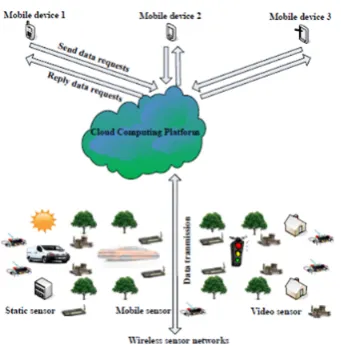
The data gathering ability of WSN and the powerful data storage and processing capacities of MCC, the integration of WSN and MCC grabbed more attention from both academia and industry. The main idea of the WSN-MCC integration is that to use the powerful sensors in the sensor networks to collect the data from the environment and these datas can be stored on the powerful servers in the CC platforms. These sensory datas are processed and then transmit those processed sensory data to the mobile users, when they are requesting. The following figure shows the WSN-MCC integration framework. In this figure WSNs gathers the weather, humidity, traffic, temperature, pressure, and house information within a certain area. The collected sensory datas are first send to the cloud for processing and storage. Then the cloud sends this data to the mobile users when they are requested i.e., in an on demand manner.
II. PROPOSED FRAMEWORK FOR WSN-MCC
INTEGRATION
The Fig.2 shows the proposed WSN-MCC integration, and fig. shows the flowchart of how the sensory data are processed over the framework.
Fig 2. WSN-MCC Integration framework
The steps that are taking place in the WSN-MCC integration are given below:
First, there is a sensor gateway for each cluster of WSN collecting sensory data. The sensors in the sensor network gather the sensory data and send this sensory data to the sensor gateway. The further processing of the collected sensory data are taking place at the sensor gateway.
Second, when the sensor gateway receives the sensory data, the sensor gateway processes this data. The sensory data is processed through the following five components: data traffic monitoring unit, data filtering unit, data prediction unit, data compression unit, and data encryption unit
.
The unit in the sensor gateway filters the sensory data traffic according to a set of predefined rules, monitors the data traffic, and predicts the future sensory data. Then the sensory data are compressed and encrypted. Detailed descriptions of these five processing units will be given later. After the sensor gateway has processed the data, the faulty datas are discarded and the remaining normal datas are further transmitted to the cloud gateway.Third, then the cloud gateway receives the sensory data from the sensor gateway, the cloud gateway processes the received data by decrypting the data with the data decryption unit and then decompressing the data with the data decompression unit.
Fourth, the decrypted and decompressed sensory data from the cloud gateway are stored and processed by the powerful servers in the cloud, so that they are suitable for presentation to requesting mobile users. Also, the cloud uses the data recommendation unit to analyse the data feature information required by mobile users.
Fifth, the cloud encrypts the required sensory data with the encryption unit at the cloud gateway whenever the mobile user requesting the data. The mobile users decrypt the received data with the data decryption unit in the respective mobile device. When the mobile users issue data requests, they also encrypt the data requests, and the data requests are further decrypted by the decryption unit of the cloud gateway.
Finally, the cloud gives feedback to the WSN manager whenever the cloud obtains the data feature information required by mobile users. This feedback contains feature information; this feature information is encrypted with the encryption unit at the cloud gateway. The corresponding sensor gateway decrypts the information with the data decryption unit, and then, the WSN manager can take corresponding countermeasures (e.g., deploying more sensors to the area that mobile users are interested in).
A. Descriptions of Data Processing Tasks
The data processing tasks described above are explained in the following section.
compromised, and the network manager check whether the situation is true to avoid further harm from the compromised sensors to the network.
2) Data Filtering: The values of data collected by the sensors should fall within an acceptable range, according to the design of the sensors. However there is chances to occur sensory data values that are out of range due to various reasons. The data filtering unit checks whether the collected sensory data values are in a particular range. The data values that are out of range are the faulty data and they are discarded.
3) Data Prediction: Here, we consider that time-series sensory data are collected by the WSN, and apply the secondary exponential smoothing model (SESM) for data prediction. The SESM is a widely used technique that can be applied to time-series data, either to produce smoothed data for presentation or to make forecasts.
4) Data Compression and Decompression: Compression and decompression are performed at the respective gateways to reduce packet losses due to network congestion. However, important sensory data could still be lost if the decompressed data do not perfectly match the data that are compressed, i.e., the compression/decompression process is lossy. To avoid this problem, we utilize lossless compression/ decompression techniques. A deflate algorithm that combines Huffman coding and LZ77 is used here for lossless data compression.
5) Data Encryption and Decryption: Here Rivest– Shamir–Adleman (RSA) algorithm is used for security. RSA algorithm has the following characteristics: 1) RSA is based on the factorization of large numbers, which is rather difficult to break. 2) RSA is a public-keybased cryptographic algorithm, and thus, the security of keys is high 3) RSA is widely used in real-life applications due to its simplicity and ease of implementation.
B. Framework Characteristics
Based on the descriptions of the data processing tasks included in the proposed framework, we can see that the proposed framework has the following desirable characteristics.
1) Extend the Sensor Network Lifetime: By offloading data processing from the sensors to the cloud, energy consumption due to extensive data processing at the sensors will be significantly reduced, and the lifetime of the sensor network will be extended.
2) Reduce the Storage Requirement of the Sensor and the Sensor Gateway: In the proposed framework, complex
signal processing functions are included to the cloud. There is no need for the sensor, the sensor gateway, or the cloud gateway to store a large amount of data for processing. Thus, the storage requirements of the sensor and the sensor gateway are minimized.
3) Decrease the Sensory Data Transmission Bandwidth Requirement and Traffic: Because the sensory data are filtered and compressed before transmitting to the
cloud, the traffic load and transmission bandwidth requirements for sensory data arereduced.
4) Predict the Future Trend of the Sensory Data: We can predict the future trend of the sensory data by using the SESM method. Since peoples are aware about the future conditions, peoples can take measures in advance to prevent the occurrence of dangerous events. 5) Monitor the Sensory Data Traffic: Based on the data traffic monitoring unit in the sensor gateway, the sensory data traffic is monitored. If the sensory data traffic is too high or too low, then there is some error occurred with some sensors. Only the true data values are accepted. Faulty data values are discarded.
6) Improve the Security of Transmitted Data: Since the compressed data are encrypted with RSA before transmission to the cloud, there will not be any hacking.
III.CONCLUSION
The integration of WSN with MCC is a very important research topic. Focusing on the sensory data processing aspect in integrated WSN–MCC, in this paper, we have proposed a framework to process the sensory data collected by the sensors, before transmitting the sensory data to mobile users in a fast, reliable, and secure manner. This framework includes data traffic monitoring, filtering, prediction, compression, and decompression capabilities are incorporated in the sensor gateway and the cloud gateway. Data encryption and decryption techniques are applied in the cloud, mobile devices, and sensor and cloud gateways to increase capacity. Due to the advanced capabilities and high performance of the proposed framework the mobile users can securely obtain their desired sensory data faster.
IV.ACKNOWLEDGMENT
First and foremost I thank Almighty God for all the blessings endowed on me. I would also like to express my immense pleasure and gratitude towards our Executive Director Rev.Fr.Dr.Antu Alappadan our Director Prof.K T Joseph and our principal Dr.Sudha George valavi of Sahrdaya College of Engineering And Technology for inspiring me to undertake this seminar. I deeply express my sincere thanks to Mr.Vince Paul, HOD of Computer Science And Engineering department of Sahrdaya College Of Engineering And Technology for his whole hearted support. I also would like to express my sincere gratitude to my seminar guide Mrs. Priya K.V and to my seminar coordinator Mr.Sankaranarayanan P.N who supported me throughout the seminar .I would like to extend my gratitude to all other faculty members for their help advice.
REFERENCES
[1] I. F. Akyildiz, W. Su, Y. Sankarasubramaniam, and E. Cayirci, “Wireless sensor networks: A survey,” Comput. Netw., vol. 38, pp. 393–422, 2002.
[2] C. Zhu, L. Shu, T. Hara, L. Wang, S. Nishio, and L. T. Yang, “A survey on communication and data management issues in mobile sensor networks,” Wireless Commun. And Mob. Comput., vol. 14, no. 1, pp. 19– 36, Jan. 2014.
[4] Q. Zhang, L. Cheng, and R. Boutaba, “Cloud computing: State-of-the-art and research challenges,” J. Ineternet Serv. Appl., vol. 1, no. 1, pp. 7–18, May 2010.
[5] H. T. Dinh, C. Lee, D. Niyato, and P. Wang, “A survey of mobile cloud computing: Architecture, applications, and approaches,” Wireless Commun. Mobile Comput., vol. 13, no. 18, pp. 1587–1611, Dec. 2013.
[6] C. Zhu, V. C. M. Leung, X. Hu, L. Shu, and L. T. Yang, “A review of key issues that concern the feasibility of mobile cloud computing,” in Proc.IEEE Int. Conf. Cyber, Phys. Soc. Comput., 2013, pp. 769– 776.
[7] S. Wang and S. Dey, “Adaptive mobile cloud computing to enable rich mobile multimedia applications,” IEEE Trans. Multimedia, vol. 15, no. 4, pp. 870–883, Jun. 2013.
[8] M. Yuriyama and T. Kushida, “Sensor-cloud infrastructure—Physical sensor management with virtualized sensors on cloud computing,” in Proc.13th Int. Conf. Netw. Based Inf. Syst., 2010, pp. 1–8.
[9] G. Fortino, M. Pathan, and G. D. Fatta, “Bodycloud: Integration of cloud computing and body sensor networks,” in Proc. IEEE 4th Int. Conf. CloudComput. Technol. Sci., 2012, pp. 851–856.