Weak Keys of the Full MISTY1 Block Cipher for
Related-Key Cryptanalysis
⋆Jiqiang Lu1, Wun-She Yap1,2, and Yongzhuang Wei3,4
1
Institute for Infocomm Research, Agency for Science, Technology and Research 1 Fusionopolis Way, #19-01 Connexis, Singapore 138632
[email protected], [email protected] 2
Faculty of Information Science and Technology, Multimedia University, Melaka 75450, Malaysia
3
Guilin University of Electronic Technology, Guilin City, Guangxi Province 541004, P.R. China
4 State Key Laboratory of Information Security, Institute of Software, Chinese Academy of Sciences, Beijing 100190, P.R. China
walker−[email protected]
Abstract. The MISTY1 block cipher has a 64-bit block length, a 128-bit user key and a
recommended number of 8 rounds. It is a Japanese CRYPTREC-recommended e-government cipher, an European NESSIE selected cipher, and an ISO international standard. Despite of considerable cryptanalytic efforts during the past fifteen years, there has been no pub-lished cryptanalytic attack on the full MISTY1 cipher algorithm. In this paper, we present related-key differential and related-key amplified boomerang attacks on the full MISTY1 under certain weak key assumptions: We describe 2103.57 weak keys and a related-key dif-ferential attack on the full MISTY1 with a data complexity of 261chosen ciphertexts and a time complexity of 287.94 encryptions; and we also describe 292 weak keys and a related-key amplified boomerang attack on the full MISTY1 with a data complexity of 260.5chosen plain-texts and a time complexity of 280.18encryptions. For the very first time, our results exhibit a cryptographic weakness in the full MISTY1 cipher (when used with the recommended 8 rounds), and show that the MISTY1 cipher is distinguishable from a random function and thus cannot be regarded to be an ideal cipher.
Key words: Block cipher, MISTY1, Differential cryptanalysis, Amplified boomerang attack, Related-key cryptanalysis, Weak key.
1 Introduction
The block cipher MISTY1 [33] was designed by Matsui and published in 1997. It has a 64-bit block length, a 128-bit user key, and a variable number of rounds; the officially recommended number of rounds is 8. We consider the version of MISTY1 that uses the recommended 8 rounds in this paper, which is also the most widely discussed version so far. MISTY1 has a Feistel structure with a total of ten key-dependent logical functionsFL
— twoFLfunctions at the beginning plus two inserted after every two rounds. It became a CRYPTREC [10] e-government recommended cipher in 2002, and a NESSIE [35] selected block cipher in 2003, and was adopted as an ISO [15] international standard in 2005 and 2010.
MISTY1 has attracted extensive attention since its publication, and its security has been analysed against a wide range of cryptanalytic techniques [1,12,25,26,29,32,38–42]. In summary, the main previously published cryptanalytic results on MISTY1 are as follows. In 2008, Dunkelman and Keller [12] described impossible differential attacks [3, 23] on 6-round MISTY1 with FL functions and 7-round MISTY1 without FL functions. In the
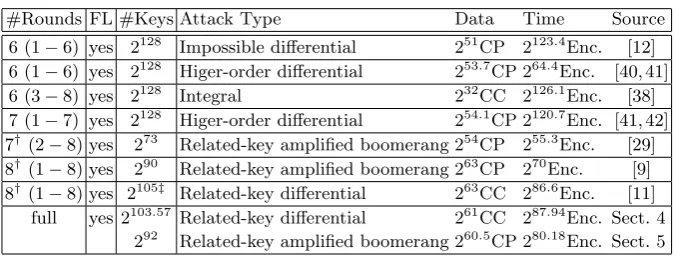
Table 1.Main cryptanalytic results on MISTY1
#Rounds FL #Keys Attack Type Data Time Source
6 (1−6) yes 2128 Impossible differential 251CP 2123.4Enc. [12] 6 (1−6) yes 2128 Higer-order differential 253.7CP 264.4Enc. [40, 41] 6 (3−8) yes 2128 Integral 232CC 2126.1Enc. [38] 7 (1−7) yes 2128 Higer-order differential 254.1CP 2120.7Enc. [41, 42] 7†(2−8) yes 273 Related-key amplified boomerang 254CP 255.3Enc. [29] 8†(1−8) yes 290 Related-key amplified boomerang 263CP 270Enc. [9] 8†(1−8) yes 2105‡ Related-key differential 263CC 286.6Enc. [11]
full yes 2103.57 Related-key differential 261CC 287.94Enc. Sect. 4 292 Related-key amplified boomerang 260.5CP 280.18Enc. Sect. 5
†: Exclude the first/last two FL functions,‡: There is a flaw, see Section 5 for detail.
same year, Lee et al. [29] gave a related-key amplified boomerang attack [4, 14, 20] on 7-round MISTY1 with FL functions under a class of 273weak key1, and Tsunoo et al. [41] presented a higher-order differential attack [22, 27] on 6 and 7-round MISTY1 with FL functions (without making a weak key assumption). In 2009, Sun and Lai [38] presented an integral attack on 6-round MISTY1 with FL functions, following Knudsen and Wagner’s attack [24] on 5-round MISTY1. Most recently, following Lee et al.’s work, Chen and Dai [9] presented a 7-round related-key amplified boomerang distinguisher with probability 2−118 under a class of 290weak keys and gave a related-key amplified boomerang attack on the 8-round MISTY1 with only the first 8 FL functions; and in [11] they described a 7-round related-key differential characteristic with probability 2−60under a class of 2105 weak keys and finally presented a related-key differential attack on the 8-round MISTY1 with only the last 8 FL functions. So far, there has been no published (non-generic) cryptanalytic attack on the full 8 rounds of MISTY1 yet.
Related-key cryptanalysis [2, 21] assumes that the attacker knows the relationship be-tween one or more pairs of unknown keys; certain current real-world applications may allow for practical related-key attacks, for example, key-exchange protocols and hash functions [17]. Related-key differential cryptanalysis [17] takes advantage of how a spe-cific difference in a pair of inputs of a cipher or function can affect a difference in the pair of outputs of the cipher or function, where the pair of outputs are obtained by encrypt-ing the pair of inputs usencrypt-ing two different keys with a specific difference. The related-key amplified boomerang attack [4, 14, 20] is a combination of related-key cryptanalysis and the amplified boomerang attack [18]; the amplified boomerang attack is a variant of the boomerang attack [43]. Remarkably, under certain weak key assumptions the related-key differential cryptanalysis technique was used in 2009 by Biryukov et al. [8] to obtain the the first cryptanalytic attack on the full version of the AES [36] block cipher with 256 key bits; and the related-key amplified boomerang attack technique was used to yield the first cryptanalytic attacks on the full versions of both AES with 192/256 key bits and KASUMI [16] — a variant of MISTY1, without using a weak key assumption, by Biham et al. [5, 13] and Biryukov et al. [7], respectively.
In this paper, for the very first time we show that the full MISTY1 cipher can be distinguished from a random function (in the related-key model): Building on Chen and Dai’s work described in [9,11], we present related-key differential and amplified boomerang attacks on the full MISTY1 cipher under certain weak key assumptions. First, we spot some flaws in Dai and Chen’s differential cryptanalytic results presented in [11], and find that there are only about 2102.57 weak keys in their weak key class such that their 7-round
related-key differential holds, but with probability 2−58; and we observe that there are
also a different class of 2102.57 weak keys under which there exists a 7-round related-key differential with probability 2−58. We use the 7-round related-key differentials to break the full MISTY1. Finally, we find that under the class of 290 weak keys described in [9], Chen and Dai’s 7-round related-key amplified boomerang distinguisher actually has a probability of 2−116, instead of 2−118, which can be used to attack the full MISTY1; and similar results hold for three other classes of weak keys of the same size. Table 1 summarises our and previously published main cryptanalytic results on MISTY1, where CP and CC refer respectively to the numbers of chosen plaintexts and chosen ciphertexts, Enc. refers to the required number of encryption operations of the relevant version of MISTY1, and “yes” means “with FL functions”.
The remainder of the paper is organised as follows. In the next section, we describe the notation, the MISTY1 cipher and the related-key amplified boomerang attack. In Sections 3 and 4 we review Chen and Dai’s cryptanalytic results and give our differential and amplified boomerang cryptanalytic results on MISTY1, respectively. Section 5 concludes this paper.
2 Preliminaries
In this section we give the notation, and briefly describe the MISTY1 cipher and the related-key amplified boomerang attack.
2.1 Notation
The bits of a value are numbered from left to right, starting with 1. We use the following notation throughout this paper.
⊕ bitwise logical exclusive OR (XOR)
∩ bitwise logical AND
∪ bitwise logical OR
|| bit string concatenation
◦ functional composition. When composing functions X and Y, Y◦X denotes the function obtained by first applying X and then Y
2.2 The MISTY1 Block Cipher
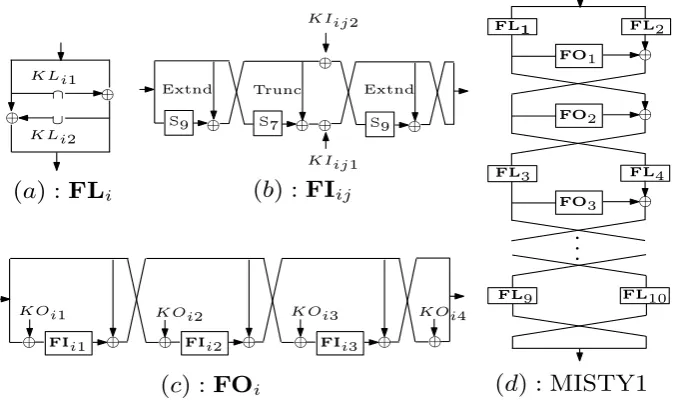
MISTY1 [33] employs a complex Feistel structure with a 64-bit block length and a 128-bit user key. It uses the following three functionsFL,FI,FO, which are respectively depicted in Fig. 1-(a), Fig. 1-(b) and Fig. 1-(c) with their respective subkeys to be described below.
– FL:{0,1}32×{0,1}32→ {0,1}32is a key-dependent linear function. IfX= (XL||XR)
is a 32-bit block andY = (Y1||Y2) is a 32-bit block of two 16-bit wordsY1, Y2, then
FL(X, Y) = (XL⊕((XR⊕(XL∩Y1))∪Y2), XR⊕(XL∩Y1)).
– FI:{0,1}16×{0,1}16→ {0,1}16is a non-linear function. IfX= (XL(9 bits)||XR(7 bits))
and Y = (Y1(7 bits)||Y2(9 bits)) are 16-bit blocks, then FI(X, Y) is computed as
fol-lows, whereXL0, XR0,· · ·, XL3, XR3are 9 or 7-bit variables, S9is a 9×9-bit bijective
S-box, S7 is a 7×7-bit bijective S-box, the function Extnd extends from 7 bits to 9
S9 ⊕ S7 ⊕ ⊕
⊕ S9 ⊕
KIij2
KIij1
⊕ ⊕
∩ ∪
KLi1
KLi2
⊕ ⊕
KOi1
FIi1 ⊕ ⊕
KOi2
FIi2 ⊕ ⊕
KOi3
FIi3 ⊕
KOi4
(a) : FLi (b) : FIij
(c) :FOi
Extnd Trunc Extnd
FL1 FL2
⊕
FO1
⊕
FO2
FL3 FL4
⊕
FO3
FL9 FL10
.. .
(d) : MISTY1
Fig. 1.MISTY1 and its components
1. XL0 =XL, XR0=XR;
2. XL1 =XR0,XR1 = S9(XL0)⊕Extnd(XR0);
3. XL2 =XR1⊕Y2,XR2 = S7(XL1)⊕Trunc(XR1)⊕Y1;
4. XL3 =XR2,XR3 = S9(XL2)⊕Extnd(XR2);
5. FI(X, Y) = (XL3||XR3).
– FO:{0,1}32× {0,1}64× {0,1}48→ {0,1}32is a non-linear function. IfX= (XL||XR)
is a 32-bit block,Y = (Y1||Y2||Y3||Y4) is a 64-bit block of four 16-bit wordsY1, Y2, Y3, Y4,
andZ = (Z1||Z2||Z3) is a 48-bit block of three 16-bit wordsZ1, Z2, Z3, thenFO(X, Y, Z)
is defined as follows, whereXL0, XR0,· · ·, XL3, XR3 are 16-bit variables.
1. XL0 =XL, XR0=XR;
2. For j= 1,2,3:
XLj =XRj−1,XRj =FI(XLj−1⊕Yj, Zj)⊕XRj−1;
3. FO(X, Y, Z) = (XL3⊕Y4)||XR3.
MISTY1 uses a total of ten 32-bit subkeysKL1, KL2,· · ·, KL10 for theFL functions,
twenty-four 16-bit subkeysKIij for theFI functions, and thirty-two 16-bit subkeysKOil
for theFO functions, (16i68,16j63,16l64), all derived from a 128-bit user key
K. The key schedule is as follows.
1. RepresentK as eight 16-bit words K= (K1, K2,· · ·, K8).
2. Generate a different set of eight 16-bit wordsK1′, K2′,· · ·, K8′ by
Ki′ =FI(Ki, Ki+1), fori= 1,2,· · ·,8,
where the subscript i+ 1 is reduced by 8 when it is larger than 8, (similar for some subkeys in the following step).
3. The subkeys are as follows.
KOi1=Ki, KOi2=Ki+2, KOi3 =Ki+7, KOi4 =Ki+4; KIi1 =Ki′+5, KIi2 =Ki′+1, KIi3 =Ki′+3;
KLi =Ki+1 2 ||K
′
i+1 2 +6
, fori= 1,3,5,7; otherwise, KLi =K′i
2+2||
Ki
P
C E1
KA
P∗
C∗
E0
KB
E1
KB
P′
C′
E0
KC
E1
KC
P′∗
C′∗
E0
KD
E1
KD
α α
β β
γ γ
δ δ E0
KA
Fig. 2.A related-key amplified boomerang distinguisher
MISTY1 takes a 64-bit plaintext P as input, and has a variable number of rounds; the recommended number of rounds is 8. Its encryption procedure is as follows, where
L0, R0,· · ·, Li, Ri are 32-bit variables, KOj = (KOj1||KOj2||KOj3||KOj4), and KIj =
(KIj1||KIj2||KIj3), (j = 1,2,· · ·,8); see Fig. 1-(d).
1. (L0||R0) = (PL||PR).
2. For i= 1,3,5,7:
Ri =FL(Li−1, KLi), Li=FL(Ri−1, KLi+1)⊕FO(Ri, KOi, KIi);
Ri+1 =Li,Li+1=Ri⊕FO(Li, KOi+1, KIi+1).
3. CiphertextC =FL(R8, KL10)||FL(L8, KL9).
We refer to the 8 rounds in the above description as Rounds 1,2,· · ·,8, respectively.
2.3 The Related-Key Amplified Boomerang Attack
A related-key amplified boomerang attack is based on a related-key amplified boomerang distinguisher, which treats a block cipherE:{0,1}n×{0,1}k → {0,1}nas a cascade of two sub-ciphersE=E1◦E0 and requires that there exists a related-key differential∆α→∆β
with probabilitypforE0: PrX∈{0,1}n[E0K
A(X)⊕E 0
KB(X⊕α) =β] = PrX∈{0,1}n[E 0
KC(X)⊕
E0K
D(X⊕α) =β] =p, and a related-key differential∆γ→∆δ with probability q forE 1:
PrX∈{0,1}n[E1K
A(X)⊕E 1
KC(X⊕γ) =δ] = PrX∈{0,1}n[E 1
KB (X)⊕E
1
KD(X⊕γ) =δ] = q,
where the four unknown user keys KA, KB, KC, KD satisfy KB = KA⊕∆K0, KC =
KA⊕∆K1 and KD =KC ⊕∆K0, with∆K0 and ∆K1 being two known differences. See
Fig. 2.
A quartet consisting of two randomly chosen pairs of plaintexts (P, P∗ = P ⊕α) and (P′, P′∗ = P′ ⊕α) satisfies E0K
A(P)⊕E 0
KB(P
∗) = E0
KC(P
′)⊕E0
KD(P
′∗) = β with
probabilityp2. Assuming that the intermediate values afterE0distribute uniformly over all possible values, we getE0K
A(P)⊕E 0
KC(P
′) =γwith probability 2−n. Once this occurs, then
E0K
B(P
∗)⊕E0
KD(P
′∗) =γ holds with probability 1, forE0
KB(P
∗)⊕E0
KD(P
′∗) = (E0
KA(P)⊕
E0K
B(P
∗))⊕(E0
KC(P
′)⊕E0
KD(P
′∗))⊕(E0
KA(P)⊕E 0
KC(P
′)) =β⊕β⊕γ =γ. As a result,
the probability that the quartet satisfiesEKA(P)⊕EKC(P′) =EKB(P∗)⊕EKD(P′∗) =δ
is expected to be about (Pr(∆α→∆β))2·2−n·(Pr(∆γ→∆δ))2 = 2−n·p2·q2; while for a random cipher, the probability is about 2−n×2= 2−2n.
Note that in addition to those assumptions [28] used in differential cryptanalysis [6], the related-key amplified boomerang attack requires another assumption about independence, and we refer the reader to [19, 34] for a more formal discussion of the assumptions as well as the attack technique. These assumptions mean that, in some cases, the probability of a related-key amplified boomerang distinguisher may be overestimated or underestimated, and so is the success probability of the attack. Anyway, it seems reasonable to take the worst case assumption from the point of the user of a cipher. An application of such an attack was given by Dunkelman et al. [13] to break the full KASUMI cipher with a practical complexity, and its validity was experimentally verified.
3 2103.57 Weak Keys of the Full MISTY1 for a Related-Key Differential
Attack
In this section, we first review Dai and Chen’s class of 2105 weak keys and their 7-round related-key differential characteristic with probability 2−60 under the class of weak keys. Then, we show that there are actually only 2102.57weak keys such that the 7-round related-key differential characteristic holds, and it has a probability of 2−58. Next we devise a related-key differential attack on the full MISTY1 when the user key used is a weak key from the class of 2102.57 weak keys. At last we describe another class of 2102.57 weak keys under which similar results hold.
3.1 A Class of 2105 Weak Keys due to Dai and Chen
First define three constants which will be used subsequently: A 7-bit constanta= 0010000, a 16-bit constantb= 0010000000010000, and another 16-bit constantc= 00100000000000 00, all in binary notation. Observe thatb= (a||02||a) and c= (a||09).
LetKA, KB be two 128-bit user keys defined as follows:
KA= (K1, K2, K3, K4, K5, K6, K7, K8), KB = (K1, K2, K3, K4, K5, K6∗, K7, K8).
By the key schedule of MISTY1 we can get the corresponding eight 16-bit words for
KA, KB, which are denoted as follows.
KA′ = (K1′, K2′, K3′, K4′, K5′, K6′, K7′, K8′), KB′ = (K1′, K2′, K3′, K4′, K5′∗, K6′∗, K7′, K8′).
Then, the class of weak keys is defined to be the set of all possible values for (KA, KB)
that satisfy the following 10 conditions, where K6,12 denotes the 12-th bit of K6, and
similar forK7,3, K7,12, K8,3, K4′,3, K4′,12, K7′,3.
K6⊕K6∗=c; (1)
K5′ ⊕K5′∗=b; (2)
K6′ ⊕K6′∗=c; (3)
K6,12= 0; (4)
K7,3 = 1; (5)
K7,12= 0; (6)
K8,3 = 1; (7)
K4′,3 = 1; (8)
K4′,12= 1; (9)
Now let us analyse the number of the weak keys. First observe that when Condition (1) holds, then Condition (2) holds with certainty.
Note that K4′ =FI(K4, K5), K6′ =FI(K6, K7), K6′∗ =FI(K6∗, K7), K7′ =FI(K7, K8).
By performing a computer search, we get
|{(K4, K5)|Conditions (8) and (9)}|= 230;
|{(K6, K7, K8)|Conditions (1),(3),(4),(5),(6),(7) and (10)}|= 227.
Therefore, Dai and Chen [11] concluded that there are a total of 2105 possible values forKAsatisfying the above 10 conditions, and thus there are 2105 weak keys.
3.2 Dai and Chen’s 7-Round Related-Key Differential Characteristic
Under the class of 2105 weak keys (KA, KB) described in Section 3.1, Dai and Chen
de-scribed the following 7-round related-key differential characteristic∆α→∆β: (b||032||c)→ (032||c||016) with probability 2−60 for Rounds 2–8, where 032 represents a binary string of 32 zeros, and so on. In Fig. 5 in Appendix A we illustrate the related-key differential characteristic in detail, whereR4,3 denotes the 3-rd bit ofR4 (the right half of the output
of Round 4), and R4,12 denotes the 12-th bit ofR4.
As a result, Dai and Chen presented a related-key differential attack on 8-round MISTY1 without the first two FL functions, by conducting a key recovery on FO1 in
a way similar to the early abort technique for impossible differential cryptanalysis intro-duced in [32]
3.3 A Corrected Class of Weak Keys and Improved 7-Round Related-Key
Differential
We first focus on the FI73 function in Dai and Chen’s 7-round related-key differential
characteristic, where the probability is 2−16. Observe that KI73 = K2′. Dai and Chen
assumed a random distribution when calculating the probability of the differential ∆c→ ∆cforFI73, and thus obtained a probability value of 2−16, (An alternative explanation is
to consider the two S9S-boxes, each having a probability value of 2−8). However, intuitively
we should make sure that a weak key (KA, KB) should also satisfy the condition that the
differential∆c→∆cis a possible differential forFI73; otherwise, the differential∆c→∆c
would have a zero probability, and the 7-round differential characteristic would be flawed. Thus, we should put the following additional condition when defining a set of weak keys:
PrFI(·,K′
2)(∆c→∆c)>0. (11) Motivated by this, we perform a computer programming to test the number of K2′
satisfying Condition (11), and we find that the number ofK2′ satisfying Condition (11) is equal to 215. As a consequence, we know that the number of (K2, K3) satisfying Condition
(11) is 231, thus not all 232 possible values for (K
2, K3) meet Condition (11), so this is
really a flaw in Dai and Chen’s results. Furthermore, we find that for each satisfyingK2′, there are exactly two pairs of inputs to FI73 which follow the differential ∆c→∆c, that
is to say, the probability PrFI(·,K′
2)(∆c → ∆c) = 2
−15, twice as large as the probability
value 2−16 used by Dai and Chen.
Next we focus on the FI21function in Dai and Chen’s 7-round related-key differential
characteristic, where the probability is 2−16, and KI21 = K7′. Likewise, we should make
sure that a weak key (KA, KB) should also satisfy the condition that the differential
a zero probability, and the 7-round differential characteristic would be flawed. Similarly, we should put another condition when defining a set of weak keys:
PrFI(·,K7′)(∆b→∆c)>0. (12)
By performing a computer programming we find that the number of K7′ satisfying Condition (12) is 24320 ≈ 214.57; on the other hand, the number of K7′ satisfying Con-ditions (1), (3), (4), (5), (6), (7) and (10) is 215 (and for each satisfying K7′ there are 212 possible values for (K6′, K8)), so not all the possible values of K7′ satisfying
Condi-tions (1), (3), (4), (5), (6), (7) and (10) satisfy Condition (12). After a further test, we get that the number ofK7′ satisfying Conditions (1), (3), (4), (5), (6), (7), (10) and (12) is 12160≈ 213.57. As a result, we know that the number of (K6, K7, K8) satisfying
Con-ditions (1), (3), (4), (5), (6), (7), (10) and (12) is 213.57×212 = 225.57, so this is another flaw in Dai and Chen’s results. Furthermore, we have that PrFI(·,K7′)(∆b→∆c) is 2−15for
each of 9600 satisfying values forK7′, 2−14 for each of 2432 satisfying values for K7′, and
6
216 ≈2−13.42 for each of 128 satisfying values forK7′.
In summary, there are approximately 2102.57 weak keys satisfying Conditions (1)–(12), and the 7-round related-key differential ∆α → ∆β has a minimum probability of 2−58 under a weak key (KA, KB). In particular, we have the following result.
Proposition 1. In the class of 2102.57 weak keys satisfying Conditions (1)–(12),
1. there are 216 possible values forK
1, 216 possible values forK3, and 216 possible values for K5;
2. there are225.57 possible values for(K6, K7, K8); in particular there are a total of213.57 possible values for K7′, and for every possible value ofK7′ there are 212 possible values for (K6′, K8);
3. there are a total of 28 possible values for K2′,8−16, 216 possible values for K3′, and 28
possible values for K4′,8−16, where K2′,8−16 denotes bits (8,· · ·,16) of K2′ and K4′,8−16 denotes bits(8,· · ·,16) of K4′;
4. PrFI(·,∀K7′)(∆b→∆c)≥2−15,PrFI(·,∀K2′)(∆c→∆c) = 2−15.
3.4 Attacking the Full MISTY1 under the Class of 2102.57 Weak Keys
The 7-round related-key differential with probability 2−58can be used to conduct a
related-key differential attack on the full MISTY1 when the user related-key used is a weak related-key from the class of 2102.57 weak keys.
Preliminary Results. We first concentrate on the propagation of the input difference
α(= b||032||c) of the 7-round differential through the preceding Round 1, including the
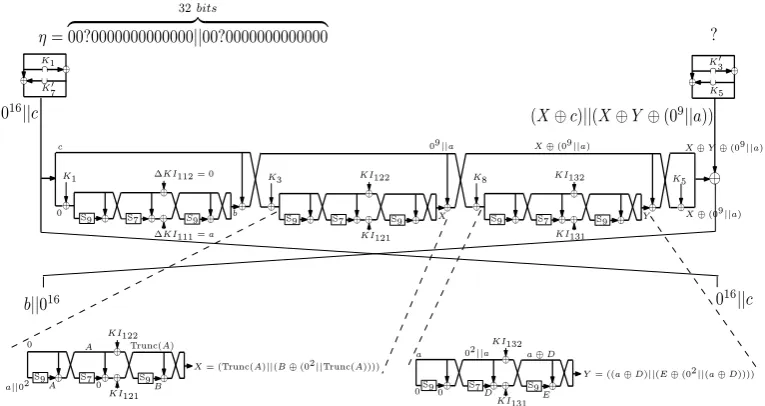
FL1 and FL2 functions, under (KA, KB); see Fig. 3.
Under (KA, KB), by the key schedule of MISTY1 we have
∆KO11=∆K1= 0, ∆KO12=∆K3 = 0, ∆KO13=∆K8= 0, ∆KO14=∆K5 = 0,
∆KI11=∆K6′ =c, ∆KI12=∆K2′ = 0, ∆KI13=∆K4′ = 0, ∆KL1 =∆(K1||K7′) = 0, ∆KL2 =∆(K3′||K5) = 0.
As depicted in Fig. 3, the right half ofαis (016||c), so theFI11function has a zero input
difference; however since ∆KO11 = 0 and ∆KI11 = c, the output difference of FI11 is b
inFI12 has an input difference a||02, and we assume its output difference isA ∈ {0,1}9;
the S7 function inFI12has a zero input and output difference. The second S9 function in
FI12 has an input differenceA, and we assume its output difference isB ∈ {0,1}9. As a
result, theFI12function has an output differenceX = (Trunc(A)||(B⊕(02||Trunc(A)))).
A simple computer programming reveals that Trunc(A) can take all 27 possible values, and thus we assume thatX can take all values in{0,1}16.
Since the input difference of theFI13function is 09||a, the first S9 function inFI13 has
a zero input difference. The S7 function inFI13 has an input differencea, and we assume
its output difference is D ∈ {0,1}7, which can take only 26 possible values. The second S9 function in FI13 has an input difference 02||a, and we assume its output difference is E∈ {0,1}9. Consequently, theFI13function has an output difference Y = ((a⊕D)||(E⊕
(02||(a⊕D)))), and it can take about 215values in{0,1}16; we denote the set of 215values bySd.
TheFL1 function has an output difference (016||c), so its input difference can only be
of the form
32bits
z }| {
00?0000000000000||00?0000000000000, which will be denoted byη = (ηL, ηR)
in the following descriptions, where the question marker “?” represents an indeterminate bit; and when the first question marker takes a zero value, the second question marker can take only 1, that is η has only three possible values, (The specific form depends on the values of the two subkey bitsK1,3 and K7′,3). TheFL2 function has an output difference
(X⊕c)||(X⊕Y⊕(09||a)), so its input difference is indeterminate, denoted by “?” in Fig. 3. From the above analysis we can see that the subkeys KI121 and KI131 do not affect
the values ofXandY, and thus they are not required when checking whether a candidate plaintext pair generates the input difference α = (b||032||c) of the 7-round related-key differential. Further, as K3′ =FI(K3, K4), K4′ =FI(K4, K5), K6′ =FI(K6, K7) and K7′ =
FI(K7, K8), we have the following result.
Proposition 2. Only the subkeys(K1, K2′,8−16, K3, K4, K5, K6, K7, K8)are required when checking whether a candidate plaintext pair produces the input differenceα = (b||032||c) of the 7-round related-key differential.
Attack Procedure. We first precompute two hash tables T1 and T2. Observe that from the left halves of a pair of plaintexts we only need (K1, K3, K2′,8−16) when computing the
output difference X of the FI12 function and only need (K1, K6′, K7′, K8, K4′,8−16) when
computing the output differenceY of theFI13 function. To generateT1 andT2, we do the
following procedure under every 32-bit valuex= (xL||xR).
1. For every possibleK1:
(a) Compute Z = (xL∩K1)⊕((xL⊕ηL)∩K1)⊕ηR, and proceed to the following
steps only when Z =c.
(b) For every possible (K3, K2′,8−16), compute the output difference ofFI12 asX.
2. Store all satisfying (K1, K3, K2′,8−16) into TableT1 indexed by (x, η, X).
3. For every possibleK7′:
(a) Compute W =ηL⊕(((xL∩K1)⊕xR)∪K7′)⊕(((xL∩K1)⊕xR⊕c)∪K7′), and
proceed to the following steps only when W = 0.
(b) For every possible (K6′, K8, K4′,8−16), compute the output difference ofFI13 asY.
4. Store the values of (K6, K7, K8) corresponding to all satisfying (K6′, K7′, K8) into Table T2 indexed by (x, η, Y, K1, K4′,8−16).
⊕ ⊕
∩ ∪
K1
K′ 7
⊕ ⊕
S9 ⊕ S7 ⊕ ⊕
⊕ S9 ⊕
∆KI112 = 0
∆KI111 =a K1
⊕ ⊕
S9 ⊕ S7 ⊕ ⊕
⊕ S9 ⊕
KI122
KI121 K3
⊕ ⊕
S9 ⊕ S7 ⊕ ⊕
⊕ S9 ⊕
KI132
KI131 K8
⊕
K5 ⊕
⊕ ⊕
∩ ∪
K′ 3
K5
η=
32bits
z }| {
00?0000000000000||00?0000000000000 ?
b X
c
0
b||016 016||c
09||a X⊕(09||a)
Y X⊕(09||a) X⊕Y⊕(09||a)
016
||c (X⊕c)||(X⊕Y⊕(09
||a))
S9 ⊕ S7 ⊕ ⊕
⊕ S9 ⊕
KI122
KI121
X= (Trunc(A)||(B⊕(02||Trunc(A)))) 0
a||02 A A
0
Trunc(A)
B S9 ⊕ S7 ⊕
⊕
⊕ S9 ⊕
KI132
KI131
Y= ((a⊕D)||(E⊕(02||(a⊕D)))) 0
a
D 02||a
E a⊕D
0
Fig. 3.Propagation ofαthrough the inverse of Round 1 withFL1 andFL2
216×28×2−16= 223satisfying values for (K1, K3, K2′,8−16) inT1. The precomputation for T1 takes about 232×3×216×216×28 ≈273.59FIcomputations, andT1requires a memory of about 224×232×3×216×16+16+88 ≈275.91 bytes. There are 213.57 possible values for
K7′, 212possible values for (K6′, K8), 28 possible values forK4′,8−16, and 215possible values
forY. For a fixed (x, η, Y, K1, K4′,8−16), on average there are 213.57×2−1×212×2−15 =
29.57 satisfying values for (K6′, K7′, K8) in T2. The precomputation for T2 takes about
232×3×216×213.57×212×28×2≈284.16 FIcomputations, and T2 requires a memory of about 29.57×232×3×215×216×28×6≈284.74 bytes. Note that we can use several tricks to optimise the procedure to reduce the computational complexity for generating the two tables, but anyway it is negligible compared with the computational complexity of the following online attack procedure.
We devise the following attack procedure to break the full MISTY1 when a weak key is used.
1. Initialize zero to an array of 295.57 counters corresponding to all the 295.57 possible values for (K1, K2′,8−16, K3, K4, K5, K6, K7, K8).
2. Choose 260 ciphertext pairs (C, C∗ =C⊕(032||c||016)). In a chosen-ciphertext attack scenario, obtain the plaintexts for the ciphertexts C, C∗ under KA, KB, respectively,
and we denote by P = (P LL||P LR, P RL||P RR) the plaintext for ciphertext C
en-crypted under KA, by P∗ = (P L∗L||P L∗R, P R∗L||P R∗R) the plaintext for ciphertextC∗
encrypted underKB.
3. Check whether a plaintext pair (P, P∗) meets the condition (P LL||P LR)⊕(P L∗L||P L∗R)
=η by first checking the 30 bit positions with a zero difference and then checking the remaining two bit positions. Keep only the satisfying plaintext pairs.
4. For every remaining plaintext pair (P, P∗), do the following sub-steps. (a) Guess a possible value for (K3′, K5), and compute (X, Y) such that
(X⊕c)||(X⊕Y ⊕(09||a)) =FL(P RL||P RR, K3||′ K5)⊕FL(P R∗L||P R∗R, K3||′ K5).
Execute the next steps only if Y ∈ Sd; otherwise, repeat this step with another
(b) Access TableT1 at entry (P LL||P LR, η, X) to get the satisfying values for (K1, K3, K2′,8−16).
(c) For each satisfying value for (K1, K3, K2′,8−16), retrieve K4 from the equation K3′ = FI(K3, K4), compute K4′ = FI(K4, K5), and access Table T2 at entry
(P LL||P LR, η, Y, K1, K4′,8−16) to get the satisfying values for (K6, K7, K8).
(d) Increase 1 to each of the counters corresponding to the obtained values for (K1, K2′,8−16, K3, K4, K5, K6, K7, K8).
5. For a value of (K1, K2′,8−16, K3, K4, K5, K6, K7, K8) whose counter number is equal
to or larger than 3, exhaustively search the remaining 7 key bits with two known plaintext-ciphertext pairs. If a value of (K1, K2,· · ·, K8) is suggested, output it as the
user key of the full MISTY1.
Attack Complexity. The attack requires 260×2 = 261 chosen ciphertexts. In Step 3, only 260×2−30× 34 ≈ 229.58 palintext pairs are expected to satisfy the condition, and it takes about 260 memory accesses to obtain the satisfying palintext pairs. Step 4(a) has a time complexity of about 229.58×216×216×2 = 262.58FLcomputations. In Step 4(b), for a plaintext pair and a possible value for (K3′, K5), on average we obtain 223possible values for
(K1, K3, K2′,8−16), as discussed in the procomputation phase; due to the filtering condition
in Step 4(a), Step 4(b) has a time complexity of about 229.58× 221516 ×232×223 = 283.58 memory accesses (if conducted on a 64-bit computer). In Step 4(c), for a plaintext pair and a possible value for (K1, K3, K5, K2′,8−16, K3′), on average we obtain 29.57 possible values
for (K6, K7, K8), (as discussed in the procomputation phase), thus Step 4(c) has a time
complexity of about 228.58×232 ×223×29.57 = 293.15 memory accesses. Step 4(d) has a time complexity of about 293.15 ×2 = 294.15 memory accesses, where the factor “2”
represents that a single operation requires two memory accesses when conducted on a 64-bit computer.
The probability that the counter for a wrong (K1, K2′,8−16, K3, K4, K5, K6, K7, K8) has
a number equal to or larger than 3 is approximately∑2i=360[(260i )·(2−64)i·(1−2−64)260−i]≈ 2−14.67. Thus, it is expected that there are a total of 295.57×2−14.67= 280.9 wrong values of (K1, K2′,8−16, K3, K4, K5, K6, K7, K8) whose counters have a number equal to or larger
than 3. Thus it requires 280.9 ×27+ 280.9×27×2−64 ≈ 287.9 trial encryptions to check them in Step 5. In Step 5, a wrong value of (K1, K2,· · ·, K8) is suggested with probability
2−64×2 = 2−128, so the number of suggested values for (K1, K2,· · ·, K8) is expected to
be 287.9×2−128 = 2−40.1, which is rather low. Thus, the time complexity of the attack is dominated by Steps 4(c), 4(d) and 5. On a general 64-bit personal computer (with Intel Xeon Processor E5630 running on Ubuntu 10.04), we check that a full encryption using an optimised MISTY1 implementation twice as fast as the one given in [37] by the cipher designer equals about 212 memory accesses in terms of time. Therefore, the attack has
a total time complexity of about 293.15×2−12+ 294.15×2−12+ 287.9 ≈ 287.94 MISTY1 encryptions.
The counter for the correct key has an expected number of 260×2−58 = 4, and the probability that the counter for the correct key has a number equal to or larger than 3 is approximately ∑2i=360[(260i )·(2−58)i·(1−2−58)260−i]≈ 0.76. Therefore, the related-key
differential attack has a success probability of 76%.
3.5 Another Class of 2102.57 Weak Keys
In the above sub-sections we have described a class of 2102.57weak keys and a related-key
differential attack on the full MISTY1 under a weak key. However, we observe that there exists another class of 2102.57 weak keys under which similar results hold. The new weak key class is obtained by settingK7′,3= 1, which is further classified into two sub-classes by the possible values of the subkey bit K1,3. This will affect only the FL10 function in the
7-round related-key differential, but the output difference ofFL10 will be fixed onceK1,3
is given, that is, the right half of the output difference of the resulting 7-round related-key differential will be c||c when K1,3 = 1, and 016||c when K1,3 = 0. Thus, by choosing
a number of ciphertext pairs with a corresponding difference we can conduct a similar attack on the full MISTY1 under every sub-class of weak keys. In total, we have 2103.57 weak keys under which a related-key differential attack can break the full MISTY1.
4 292 Weak Keys of the Full MISTY1 for a Related-Key Amplified
Boomerang Attack
In this section, we first review Chen and Dai’s class of 290 weak keys and their 7-round related-key amplified boomerang distinguisher with probability 2−118. Next, we describe
a slight improvement to Chen and Dai’s 7-round related-key amplified boomerang dis-tinguisher, which has a probability of 2−116, and then present a related-key amplified boomerang attack on the full MISTY1 under the class of 290 weak keys. Finally, we
de-scribe three other classes of 290 weak keys under which there exist similar results.
4.1 A Class of 290 Weak Keys due to Chen and Dai
First define the same three constantsa, b, c as used in Section 3.1, that is a 7-bit constant
a= 0010000, a 16-bit constant b = 0010000000010000, and another 16-bit constant c = 0010000000000000, all in binary notation.
LetKA, KB, KC, KD be four 128-bit user keys defined as follows:
KA= (K1, K2, K3, K4, K5, K6, K7, K8), KB = (K1, K2∗, K3, K4, K5, K6, K7, K8), KC = (K1, K2, K3, K4, K5, K6∗, K7, K8), KD = (K1, K2∗, K3, K4, K5, K6∗, K7, K8).
By the key schedule of MISTY1 we can get the corresponding eight 16-bit words for
KA, KB, KC, KD, which are denoted as follows.
KA′ = (K1′, K2′, K3′, K4′, K5′, K6′, K7′, K8′), KB′ = (K1′∗, K2′∗, K3′, K4′, K5′, K6′, K7′, K8′), KC′ = (K1′, K2′, K3′, K4′, K5′∗, K6′∗, K7′, K8′), KD′ = (K1′∗, K2′∗, K3′, K4′, K5′∗, K6′∗, K7′, K8′).
Then, the class of weak keys is defined to be the set of all possible values for (KA, KB,
KC, KD) that satisfy the following 12 conditions, whereK5,3 denotes the 3-rd bit of K5,
and similar forK5,12, K4′,3, K7,3, K7,12, K8,3.
K2⊕K2∗=c; (13)
K1′ ⊕K1′∗=b; (15)
K5′ ⊕K5′∗=b; (16)
K2′ ⊕K2′∗=c; (17)
K6′ ⊕K6′∗=c; (18)
K5,3 = 1; (19)
K5,12= 0; (20)
K4′,3 = 0; (21)
K7,3 = 1; (22)
K7,12= 0; (23)
K8,3 = 0. (24)
Now let us analyse the number of the weak keys. First observe that when Condition (13) holds, then Condition (15) holds with certainty; when Condition (14) holds, Condition (16) holds with certainty.
Note that K2′ =FI(K2, K3), K2′∗ =FI(K2∗, K3), K4′ = FI(K4, K5), K6′ = FI(K6, K7), K6′∗=FI(K6∗, K7). By performing a computer search, we get
|{(K2, K3)|Conditions (13) and (17)}|= 216; |{(K4, K5)|Conditions (19),(20) and (21)}|= 229; |{(K6, K7)|Conditions (14),(18),(22) and (23)}|= 214.
Therefore, Chen and Dai [9] got that there are a total of 290 possible values for KA
satisfying the above 12 conditions, and thus there are 290 weak keys.
4.2 Chen and Dai’s 7-Round Related-Key Amplified Boomerang
Distinguisher
We now describe Chen and Dai’s related-key amplified boomerang distinguisher for Rounds 1–7 under the class of 290 weak keys (KA, KB, KC, KD) described in Section 4.1.
The first related-key differential∆α→∆βfor this distinguisher is the 2-round related-key differential (048||b)→(032||c||016) with probability 1 for Rounds 1–2 under (K
A, KB)
or under (KC, KD), where 048 represents a binary string of 48 zeros and so on. The
second related-key differential ∆γ → ∆δ for this distinguisher is the 5-round related-key differential (048||b) → 0 with probability 2−27 for Rounds 3–7 under (K
A, KC) or under
(KB, KD). In Fig. 6 in Appendix A we illustrate the two related-key differentials in detail,
whereR4,3 denotes the 3-rd bit ofR4 (the right half of the output of Round 4), and R4,12
denotes the 12-th bit ofR4.
Consequently, Chen and Dai obtained a 7-round related-key amplified boomerang dis-tinguisher with probability 12×(2−27)2×2−64= 2−118under a weak key (KA, KB, KC, KD).
As a result, they presented an attack on 8-round MISTY1 without the last two FL func-tions, by conducting a key recovery onFO8 (in a way similar to the early abort technique
used in [32]).
4.3 An Improved 7-Round Related-Key Amplified Boomerang Distinguisher
First focus on the FI73 function in the second related-key differential ∆γ → ∆δ used
in Chen and Dai’s 7-round distinguisher, where the probability is 2−16. Observe that
KI73=K2′ orK2′∗, depending on which pair from a quartet is considered. Chen and Dai
what we mention in Section 3.3, we should make sure that a weak key (KA, KB, KC, KD)
should also satisfy the condition that the differential∆c→∆cis a possible differential for
FI73; otherwise, the differential∆c→∆c would have a zero probability, and the 7-round
distinguisher would be flawed. Thus, we should put the following two additional conditions when defining a set of weak keys:
PrFI(·,K2′)(∆c→∆c)>0; (25)
PrFI(·,K′∗
2 )(∆c→∆c)>0. (26) After performing a computer programming, we surprisingly find that the number of (K2, K3) satisfying Conditions (13),(17),(25) and (26) is equal to the number of (K2, K3)
satisfying Conditions (13) and (17), that is|{(K2, K3)|Conditions (13),(17),(25) and (26)}|
= 216. This means that the class of weak keys satisfying Conditions (13)–(26) is the same as the class of weak keys satisfying Conditions (13)–(24) due to Chen and Dai. But nev-ertheless we find something valuable: For each possibleK2′ or K2′∗, there are exactly two pairs of inputs toFI73which follow the differential∆c→∆c, that is to say, the differential ∆c→ ∆c forFI73 has a probability of 2−15, twice as large as the probability value used
by Chen and Dai.
Therefore, the second related-key differential∆γ →∆δused in Chen and Dai’s 7-round distinguisher actually has a probability of 2−26, and the resulting 7-round distinguisher
has probability 12×(2−26)2×2−64= 2−116 under a weak key (KA, KB, KC, KD).
Particularly we have the following result.
Proposition 3. In the class of 290 weak keys satisfying Conditions (13)–(26),
1. there are 216 possible values forK1, 214 possible values forK5, and 215 possible values for K8;
2. there are 214 possible values for(K6, K7); in particular there are a total of213 possible values for K7, and for every possible value of K7 there are 2 possible values for K6; 3. there are a total of 216 possible values for K3′;
4. PrFI(·,∀K2′)(∆c→∆c) = PrFI(·,∀K2′∗)(∆c→∆c) = 2−15.
4.4 Attacking the Full MISTY1 under the Class of 290 Weak Keys
We devise a related-key amplified boomerang attack on the full MISTY1 under a weak key from the weak key class, basing it on the 7-round related-key amplified boomerang distinguisher with probability 2−116.
Preliminary Results. First concentrate on the propagation of the output difference
δ(= 0) of the 7-round distinguisher through the following Round 8, including theFL9 and
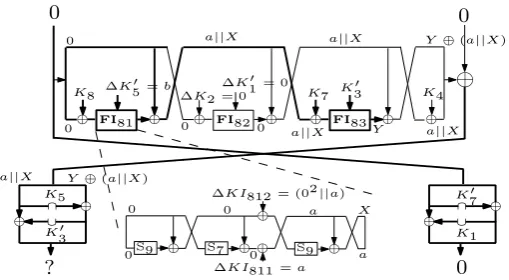
FL10 functions, under (KA, KC) or under (KB, KD); see Fig. 4.
Under (KA, KC), by the key schedule of MISTY1 we have
∆KO81=∆K8= 0, ∆KO82=∆K2 = 0, ∆KO83=∆K7= 0, ∆KO84=∆K4 = 0,
∆KI81=∆K5′ =b, ∆KI82=∆K1′ = 0, ∆KI83=∆K3′ = 0, ∆KL9 =∆(K5||K3′) = 0, ∆KL10=∆(K7||′ K1) = 0.
Since δ = 0, the FI81 and FI82 functions both have a zero input difference. The first
S9 and S7 in FI81 both have a zero input difference, however, as ∆KI81 = b we know
⊕ ⊕
K8
FI81 ⊕ ⊕ ∆K2 = 0
FI82 ⊕ ⊕ K
7
FI83
⊕
⊕ ⊕
∩ ∪
K5
K′ 3
⊕ ⊕
∩ ∪
K′ 7
K1
0 0
∆K′
5=b ∆ K′
1= 0 K′ 3 0
0 0 0 Y
0
⊕
K4
S9 ⊕ S7 ⊕ ⊕
⊕ S9 ⊕
∆K I812 = (02||a)
∆K I811 =a 0
0 a
X
a||X Y ⊕(a||X)
Y ⊕(a||X)
a||X
a||X
a||X a||X
0
0 a
?
Fig. 4.Propagation ofδthrough Round 8 withFL9 andFL10
function has a form ofa||X, where X ∈ {0,1}9 can take only 28 possible values, and we denote by Sa the set of the 28 possible values forX. Since ∆KO82 = 0 and ∆KI82 = 0,
theFI82 function has a zero output difference. Since∆KO83= 0, the FI83 function has
an input differencea||X. We assume the output difference for FI83 is Y. Then, the FO8
function has an output difference (a||X)||(Y ⊕(a||X)), so theFL9 function has an input
difference (a||X)||(Y⊕(a||X)), but its output difference is indeterminate (Denoted by the question marker in Fig. 4). TheFL10 function has a zero input and output difference.
The same results hold for the propagation of δ under (KB, KD); note that X and Y
under this case may take a different value from that case under (KA, KC).
Finally, since theFI82function has a zero input and output difference, by the structure
of the FO function we observe that only the subkeys (K1, K3′, K5, K5′, K5′∗, K7, K7′, K8)
are required when checking whether a candidate quartet consisting of two ciphertext pairs produces the output difference δ = 0 of the 7-round distinguisher. Since K5′ =
FI(K5, K6), K5′∗=K5′ ⊕b and K7′ =FI(K7, K8), we have the following result.
Proposition 4. Only the subkeys (K1, K3′, K5, K6, K7, K8) are required when checking whether a candidate quartet consisting of two ciphertext pairs satisfies the output difference δ= 0 of the 7-round distinguisher.
Attack Procedure. First we precompute two hash tables T1 and T2, as follows.
TableT1. Note that KI81 =K5′ orK5′∗(= K5′ ⊕b), KO83 =K7, andKI83=K3′. Under
every possible (K3′, K5′, K7), we compute (∆µ, ∆ν) for every x= (xL||xR) ∈ {0,1}32,
as follows.
µ= FI81(xL, K5′)⊕FI81(xL, K5′ ⊕b), ν = FI83(FI81(xL, K5′)⊕XR⊕K7, K3′)⊕
FI83(FI81(xL, K5′ ⊕b)⊕XR⊕K7, K3′).
By the structure of FI, we know the left 7 bits of µ must be a, and µ has the form
a||X, that is µ = (a||X), where X ∈ Sa, where Sa is defined above. For a fixed
(K3′, K5′, K7, µ, ν), on average there are 232×2−8×2−16= 28 satisfying values for x.
We store the satisfying values ofxinto tableT1indexed by the value (K3′, K5′, K7, X, ν).
There are 216 possible values for K3′, at most 216 possible values for K5′, 213 possible values forK7, 28 possible values forµ, and 216possible values forν, thus this
TableT2. Under every possible (K1, K7′, K8), we computeλ= (K8||016)⊕FL−101(x, K7′||K1)
for eachx∈ {0,1}32. There are 216possible values forK1, 213possible values forK7, 215
possible values forK8, and 216 possible values for K7′. Note thatK7 =FI−1(K7′, K8).
For a fixed (x, λ, K7), on average there are 216×215×2−32= 0.5 satisfying values for
(K1, K7′, K8); for a fixed (K1, K7, K8), there are 232 satisfying (x, λ). We make table T2 in the following manner:
For every possibleK7:
For every possible (K1, K8):
– Compute K7′ =FI(K7, K8).
– Find all the 232 possible (x, λ) such thatλ= (K8||016)⊕FL−101(x, K7′||K1).
– Store (K1, K8) into TableT2 indexed first byK7 and then by (x, λ).
– Set a binary marker with two possible statuses, “up” and “down”, to the set of 232tuples (K7, K1, K8, x, λ). The marker’s initial status is down.
That is, for a K7, there are 231 markers corresponding to the 231 possible values of
(K1, K8); and 232 different (x, λ) that work under the same (K7, K1, K8) share the
same marker. T2 requires a memory of about 213×216×215×232×4 = 278 bytes. This precomputation has a time complexity of about 213×216×215×232= 276FL−1
computations.
Now we can give the following attack procedure to break the full MISTY1.
1. Initialize zero to an array of 275 counters corresponding to all the 275 possible values for (K1, K3′, K5, K6, K7, K8).
2. Choose a set of 258.5 plaintext pairs (P, P∗ = P ⊕(048||b)), and another set of 258.5 plaintext pairs (P′, P′∗=P′⊕(048||b)). In a chosen-plaintext attack scenario, obtain the ciphertexts for the plaintexts P, P∗, P′, P′∗ under KA, KB, KC, KD, respectively, and
we denote by C = (CLL||CLR, CRL||CRR) the ciphertext for plaintext P encrypted
underKA, byC∗= (CL∗L||CL∗R, CRL∗||CR∗R) the ciphertext for plaintextP∗ encrypted
underKB, byC′ = (CL′L||CL′R, CR′L||CR′R) the ciphertext for plaintextP′ encrypted
under KC, and by C′∗ = (CL′∗L||CL′∗R, CR′∗L||CR′∗R) the ciphertext for plaintext P′∗
encrypted underKD.
3. Check whether a candidate quartet (C, C∗, C′, C′∗) meets both the following conditions by storing the ciphertext pairs (C, C∗) and (C′, C′∗) into a hash table indexed by the values CRL||CRR||CR∗L||CR∗R and CR′L||CR′R||CR′∗L||CR′∗R.
(CRL||CRR)⊕(CR′L||CR′R) = 0,(CR∗L||CR∗R)⊕(CR′∗L||CR′∗R) = 0.
Keep only the satisfying quartets.
4. For every remaining quartet (C, C∗, C′, C′∗), do the following sub-steps. (a) Choose all the possible K3′ satisfying the following conditions:
(CLR∪K3′)⊕CLL⊕(CLR′ ∪K3′)⊕CL′L=a||X′,
(CL∗R∪K3′)⊕CL∗L⊕(CL′∗R∪K3′)⊕CL′∗L =a||X∗,
where X′, X∗ represents two indeterminate 9-bit values, (X′, X∗ can be different for different quartets, but obviously their values are fixed for a given quartet and
K3′).
(b) For every satisfying K3′, do as follows.
C′∗. Let
FL−91(CLL||CLR, K5||K3′)⊕FL−91(CL′L||CL′R, K5||K3′)
= a||X′||(Y′⊕(a||X′)),
FL−91(CL∗L||CL∗R, K5||K3′)⊕FL−91(CL′∗L||CL′∗R, K5||K3′) = a||X∗||(Y∗⊕(a||X∗)),
whereY′, Y∗ represent specific 16-bit values.
ii. GuessK7; by Proposition 3-(2) we know there are two corresponding values for K6 (for each guessed K7), and we denote them by Ke6 and K6. Then, do the
following four sub-steps. A. Compute
e
K5′ =FI(K5,Ke6);K′5=FI(K5, K6).
B. For (C, C′), access TableT1 at entry (K3′,Ke5′, K7, X′, Y′) to get the possible
32-bit inputs to theFO8 function excluding the XOR operation withKO81.
As discussed earlier, whenX′ ∈ Sa, on average there are 28 possible inputs,
and we denote them byxe1,xe2,· · ·,xe256; when X′ does not belong to Sa we
get no input and go to execute Step 4(b)(ii)(D). Similarly, for (C∗, C′∗), access Table T1 at entry (K3′,Ke5′, K7, X∗, Y∗) to get the possible 32-bit
inputs to the FO8 function excluding the XOR operation with KO81, and
we denote them byxe∗1,xe∗2,· · ·,xe∗256 whenX∗∈ Sa; whenX′ does not belong
toSa there is no input and we execute Step 4(b)(ii)(D).
C. For i = 1,2,· · ·,256, access Table T2 at entry (K7, CLL|| CLR,xei) and
flip the corresponding marker up. For i = 1,2,· · ·,256, access Table T2 at entry (K7, CL∗L||CL∗R,ex∗i) and check whether the corresponding marker is
up or down; if it is up, get the corresponding (K1, K8) and increase 1 to the
counter corresponding to the guessed (K1, K3′, K5,Ke6, K7, K8), otherwise
execute the next iteration (Initialize the markers in T2 to be down after finishing all the 256 iterations).
D. Repeat the above two sub-steps (B) and (C) similarly for the case K′5. When X′ or X∗ does not belong to Sa, there is no input, and we execute
Step 4(b)(ii) with another guess forK7. (If this sub-step is done, go to Step
4(b)(ii), etc.)
5. For a value of (K1, K3′, K5, K6, K7, K8) whose counter has a non-zero number,
exhaus-tively search the remaining key bits with two known plaintext-ciphertext pairs. If a value of (K1, K2,· · ·, K8) is suggested, output it as the user key of the full MISTY1.
Note that in Step 4(b)(ii) we check the two pairs from a candidate quartet one after the other, instead of checking them simultaneously. This is the early abort technique for the (related-key) rectangle attack, described in [31] as well as in Chapter 4.4 of [30].