Unsteady MHD Flow Through Porous Medium In A
Rotating Parallel Plate Channel Under The Influence Of
Variable Pressure Gradient
Shaik Sharmila
1, Prof. R. Siva Prasad
11Department of Mathematics, Sri Krishnadevaraya University, Ananthapuramu-515003,
Andhra Pradesh, India Email : [email protected]
Abstract:In this paper, an unsteady magneto hydro dynamic (MHD) two-layered fluids flow in a horizontal channel
between two parallel plates in the presence of an applied magnetic and electric field is investigated, when the whole system is rotated about an axis perpendicular to the flow. The flow is driven by a constant uniform pressure gradient in the channel bounded by two parallel insulating plates, when both fluids are considered as electrically conducting. The two fluids are assumed to be incompressible with variable properties, namely, different viscosities, thermal and electrical conductivities. Also, the transport properties of the two fluids are taken to be constant and the bounding plates are maintained at constant and equal temperatures. The governing partial differential equations are then reduced to the ordinary linear differential equations by using two-term series. Exact solutions for primary and secondary velocity distributions, also the temperatures are obtained in both fluid regions of the channel. Profiles of these solutions are plotted to discuss the effect on the flow and heat transfer characteristics, and their dependence on the governing parameters involved, such as the Hartmann number, Taylor number (rotation parameter), and ratios of the viscosities, heights, electrical and thermal conductivities. Moreover, an observation is made how the velocity and temperature distributions vary with hydro magnetic interaction in the case of steady and unsteady motions in the presence of rigid rotation.
Keywords: Porous Medium, Parallel Plate, Pressure Gradient, MHD
1. INTRODUCTION:
The flow of an electrically conducting fluid in the presence of a magnetic field is encountered in cosmical and geophysical fluid dynamics. The problems of fluid motion in parallel plate channels and rectangular channels have been studied by several authors due to their importance in engineering and
technological fields. Subsequently, considerable
attention has been also given to the study of magneto hydro dynamic flow of viscous fluids in a rotating system. New and emerging ideas have been added to the literature to possible applications in geophysics, astrophysics, engineering problems, geothermal energy, stem stimulation of oil field, food drying and heat pipes etc. The viscous fluid flow in a rotating frame of reference is of considerable importance due to the occurrence of various natural phenomena and for its application in various technological situations, which are governed by the actions of Coriolis forces.
The broad subjects of oceanography,
meteorology, atmospheric science and astronomy involve some important and essential features of rotating fluids. The rotating flow of an electrically conducting fluid in the presence of a magnetic field is encountered in cosmological and geophysical fluid dynamics. Many important observations on the viscous fluid flow problems in a rotating system under different conditions and configurations have come out from the analytical studies of many investigators, namely, Greenspan and Howard [13], Holton [20], Vidyanidhi [44], Walin [45], Siegman [40], Jana and Datta [22],
Seth et al. [38], Mazumder [29], Ganapathy [9], Hayat
et al.[18], Hayat and Hutter [16] and Das et al. [6]. The investigation on an oscillatory flow in a rotating channel is important from a practical point of view, because fluid oscillations may be expected in many MHD devices and natural phenomena where the fluid flow is generated due to the oscillating pressure gradient or due to vibrating plates/walls. In view of these facts, Mukherjee and Debnath [31], Seth and Jana [37], Singh [41], Ghosh [11], Ghosh and Pop [12] and Guria and Jana [14] investigated an oscillatory flow of a viscous incompressible electrically conducting fluid in a rotating channel under different conditions to analyze various aspects of the problem. Rahman and Sattar [33] studied an MHD free convection and mass transfer flow with an oscillating plate velocity and constant heat source in a rotating frame of reference.
Moreover, the temperature distribution plays an important role in MHD generators, plasma physics, turbines, etc. Also, it is a known fact that, to generate electricity, the temperature is used to run the turbine across a magnetic field. Transportation and extraction of the products of oil are other obvious applications using a two-phase system to obtain the increased flow rates in an electromagnetic pump from the possibility of reducing the power required to pump oil in a pipe line by a suitable addition of water (Shail, [39]).
There are several investigations with regards to both experimental and theoretical aspects of Magneto hydro dynamic flow problems, which are available in the literature [viz., Packham and Shail [32], Lielausis [23], Michiyoshi et al. [30], Chan [4], Chao et al. [5], Dunn [8], Gherson [10], Lohrasbi and Sahai [26],
Alireza and Sahai [1], Serizawa et al. [35], Malashetty
and Leela [27], Malashetty and Umavathi [28], Ramadan and Chamkha [3], Chamkha [2], Tsuyoshi Inoue and Shu-Ichiro Inutsuka [42] etc.]. Also, recent studies show that magneto hydro dynamic (MHD) flows can also be a viable option for transporting conducting fluids in micro scale systems, such as a flow inside the micro-channel networks of a lab-on-a-chip
device (Haim et al., [15]; Hussameddine et al., [21]. In
micro-fluidic devices, multiple fluids can be transported through a channel for different reasons. For example, an increase in mobility of a fluid may be achieved by stratification of a highly mobile fluid or mixing of two or more fluids in transit may be designed for emulsification or heat and mass transfer applications. In this regard, magnetic field-driven micro-pumps are an increasing demand due to their long-term reliability in generating flow, low power requirement and mixing
efficiency (Yi et al., [47] and Weston et al., [46]).
Most of the above investigations correspond to the steady flow situations. However, a significant number of practical problems dealing with immiscible fluids are unsteady in nature. In many practical problems, it is also advantageous to consider both immiscible fluids as electrically conducting, one of which is highly electrically conducting compared to the other. The fluid of low electrical conductivity compared to the other is helpful to reduce the power required to pump the fluid in MHD pumps and flow meters. In view of these facts, Heavy and Young [19] studied oscillating two-phase channel flows. Debnath and Basu [7] discussed the unsteady slip flow in an electrically conducting two-phase fluid under transverse magnetic fields. Chamkha [3] studied the unsteady MHD convective heat and mass transfer past a semi-infinite vertical permeable moving plate with heat absorption.
Umavathi et al. [43] investigated an oscillatory
Hartmann two-fluid flow and heat transfer in a horizontal channel. Linga Raju and Sreedhar [25] discussed an unsteady two-fluid flow and heat transfer of conducting fluids in channels under transverse magnetic field. On the other hand, the simultaneous influence of rotation and an external magnetic field on electrically conducting two-layered/two-phase fluid
systems seem to be dynamically important and physically useful etc.
2. FORMULATION AND SOLUTION:
Consider the unsteady MHD flow of a viscous incompressible electrically conducting fluid between two infinitely long horizontal parallel walls separated
by a distance h. Choose a Cartesian co-ordinates system
with the x-axis along the channel wall at y = 0, the y-
axis perpendicular to the channel walls and z-axis is
normal to the xy-plane as shown in the figure. 1. A
uniform transverse magnetic field H0 is applied
perpendicular to the channel walls. Since the channel walls are infinite in extent and the flow is unsteady, the
physical variables are the function of y and t only.
The unsteady governing equations of motion of the flow
through porous medium along x and z-directions in a
rotating frame of reference are
u
k
u
H
σμ
y
u
x
p
ρ
1
w
y
u
v
t
u
e2
2
20 2
0
2
(2.1)
w
k
w
H
σμ
y
w
u
y
w
v
t
w
e2
2
20 2
0
2
(2.2)
where, (u, w) is the velocity components along
O(x, z) directions respectively.
is the density of thefluid,
μ
e is the magnetic permeability,
is thecoefficient of kinematic viscosity, k is the permeability
of the medium,
H
0 is the applied magnetic field and pthe fluid pressure. The initial and boundary conditions are
h
y
t
w
u
0
,
0
,
0
,
0
h
y
y
t
v
v
w
u
0
,
0
,
0,
0
,
0
and
We introduce the non-dimensional variables2 2 * 2 * 2 * * * * *
* , , , , , , ,
ph p h h
t t qh q wh w uh u h y y h x
x
Making use of non-dimensional variables, the equations (2.1) and (2.2) becomes to (dropping asterisks)
Du
u
M
y
u
t
f
w
K
y
u
t
u
22 2 2
)
(
2
Re
(2.4) Figure1: Physical Geometry of the problem
Dw
(Hartmann number squared)
2
(Rotation parameter),
(Non-dimensional pressure gradient)Corresponding non-dimensional initial and boundary conditions are
1
Combining equations (2.4) and (2.5), Let
1
The initial and boundary conditions are1
Taking the Laplace transform of the equation (2.7), we have
The transformed boundary conditions are
0
The solution of the equation (2.9) subjected to the boundary conditions (2.10) are
given by
P
are real constants.Taking the inverse Laplace transforms to the equation (2.11), and we obtain the solution for the complex velocity q as,
2
K
. The equation (2.13) represents the velocityof the fluid in the general case.
Now we shall consider the following special cases.
Case. 1. Velocity distribution for impulsive pressure gradient:
In this case
P
1
P
2
0
, then the equation (2.10)reduces to
1
Case. 2. Velocity distribution for cosine oscillations of pressure gradient:
In this case
P
0
0
andCase. 3. Velocity distribution for sine oscillations of pressure gradient:
In this case
P
0
0
andShear Stress:
For the impulsive change of pressure gradient, the
non-dimensional shear stresses at the wall
y
0
are givenby
For the cosine oscillations of pressure gradient, the
non-dimensional shear stresses at the wall
y
0
are given
For the sine oscillations of pressure gradient, the non-dimensional shear stresses at the
wall
y
0
are given by3. RESULTS AND DISCUSSION
The unsteady MHD flow of a viscous incompressible electrically conducting fluid through porous medium in a rotating parallel plate channel with
variable pressure gradient has been studied. The governing equations are solved analytically using the Laplace transform technique. For computationally we have considered three different cases 1. Impulsive change of pressure gradient, 2. Cosine oscillations of pressure gradient and 3. Sine oscillations of pressure gradient. The flow governed by the non-dimensional
parameters for the velocity components u and w with
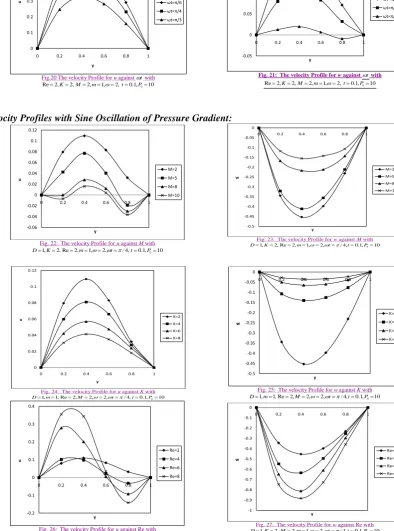
impulsive pressure gradient Fig.10-Fig.21 represent the velocity profiles for cosine oscillations of pressure gradient, where as the Fig.22-Fig.33 represent the velocity profiles for sine oscillations of pressure gradient.
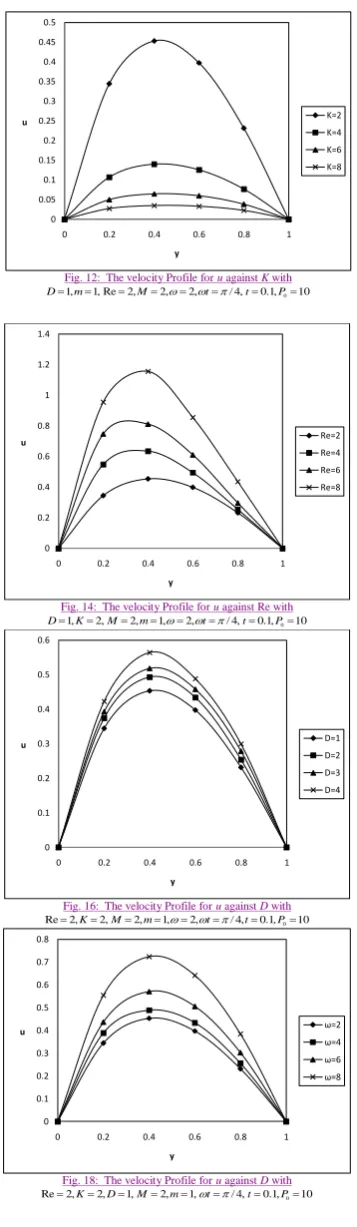
We have seen from Fig.2, Fig.10 and Fig.22
that the velocity component u increases with an increase
in magnetic parameter M for the impulsive change, and
decreases for cosine and sine oscillations of the pressure gradient. Fig.3, Fig.11 and Fig.23 shows that the
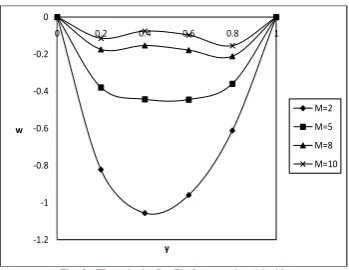
velocity component w decreases for the cosine
oscillations of the pressure gradient while it increases for impulsive change and sine oscillations of the
secondary velocity w decreases for cosine oscillations
of the pressure gradient, while primary velocity u
increases and w reduces throughout the fluid region
with an increase in rotation parameter K for impulse
change, the reversal behaviour is observed for sine oscillations of the pressure gradient. The rotation parameter defines the relative magnitude of the Coriolis force and the viscous force in the regime; therefore it is clear that high magnitude Coriolis forces are counter-productive for the primary flow. Fig.6, Fig.14 and
Fig.26, we noticed that the primary velocity u decreases
with an increase in Reynolds number Re for the impulsive change, while it increases with an increase in Reynolds number Re for cosine oscillations of the pressure gradient, the magnitude of the velocity
component w enhances initially for
y
0
.
2
and thengradually reduces for
0
.
4
y
1
with an increase inReynolds number Re for sine oscillations of the pressure gradient.
It is seen from Fig.7, Fig.15 and Fig.27 that the
secondary velocity w increases for the impulsive change
while it decreases for sine oscillations of the pressure gradient with an increase in Reynolds number Re.
Similarly, the magnitude of the velocity component w
enhances initially for
y
0
.
2
and then graduallynumber Re for cosine oscillations of the pressure gradient. It is seen from Fig.8, Fig.16, and Fig.28 that
the primary velocity u increases with an increase in
permeability parameter D for the impulsive change,
cosine and sine oscillations of the pressure gradient throughout the fluid region. Likewise from Fig.9,
Fig.17 and Fig.29 that the secondary velocity w reduces
with an increase in permeability parameter D for sine
oscillations of the pressure gradient while it enhances for the impulsive change and cosine oscillations of the pressure gradient. Fig.18 and Fig.30 shown that the
primary velocity u increases with an increase in
frequency parameter
for cosine oscillations of thepressure gradient while the velocity u enhances for
6
&
4
,
2
and then experiences retardation for8
for sine oscillations of the pressure gradient. Ithas been seen from Fig.15 and Fig.31 that the
secondary velocity w decreases for the sine oscillations
of the pressure gradient while the velocity u enhances
for
2
,
4
&
6
and then experiences retardation for8
for cosine oscillations of the pressure gradientwith an increase in frequency parameter
. Finally wehave noticed from Fig.20 and Fig.32 that, the
magnitude of the primary velocity u decreases with an
increase in phase angle
t
for both cosine and sineoscillations of the pressure gradient. It is also seen from
Fig.21 and Fig.33 that the secondary velocity w reduces
for cosine oscillations of the pressure gradient while it increases for sine oscillations of the pressure gradient
with an increase in phase angle
t
. It is noted that, themagnitude of the velocities for cosine oscillations of the pressure gradient are always greater than magnitude of sine oscillations of the pressure gradient.
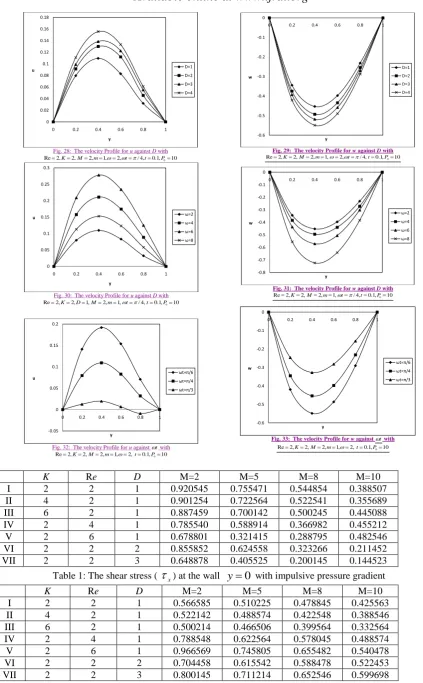
The non-dimensional shear stresses
x and
zhave been calculated at the wall (
y
0
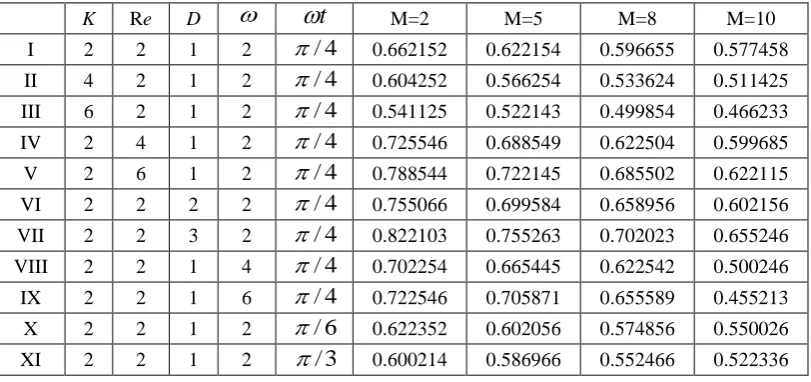
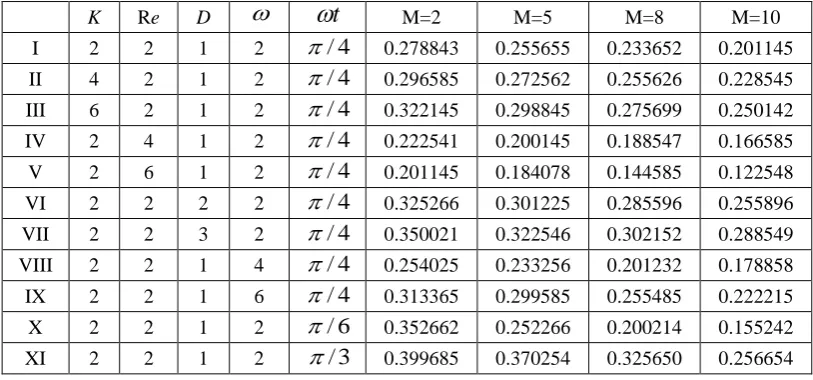
) due to theprimary and the secondary flows are presented in Table1-Table6 and computationally discussed with reference to governing parameters like, magnetic
parameter M, rotation parameter K, Reynolds number
Re, Permeability parameter D, frequency parameter
and phase angle
t
. We notice that the shear stressesx
and
z due to the primary and secondary flow at thewall
y
0
reduce for the impulsive change, cosine andsine oscillations of the pressure gradient with an
increase in Hartmann number M. The magnitude of
the shear stress
x due to the primary flow decreasesfor the impulsive change and cosine oscillations, while it increases for sine oscillations of the pressure gradient
with an increase in rotation parameter K or Permeability
parameter D. It is found that the shear stress
zdecreases for both impulsive change and cosine oscillations of the pressure gradient while it increases for sine oscillations of the pressure gradient with an
increase in rotation parameter K and Permeability
parameter D. The shear stress
x decreases for smallvalues of magnetic parameter M (
8) and then itincreases for the impulsive change, cosine and sine oscillations of the pressure gradient with an increase in
Reynolds number Re. Also the shear stress
z increasesfor both impulsive change and cosine oscillations of the pressure gradient while it decreases for sine oscillations of the pressure gradient with an increase in Reynolds
number Re. The shear stress
x increases for smallvalues of magnetic parameter M (
8) and then itdecreases for cosine and sine oscillations of the pressure
gradient with an increase in frequency parameter
. Itis found that the shear stress
z increases for smallvalues of magnetic parameter M (
8) and then itdecreases for cosine oscillations while it first decreases and then increases for sine oscillations of the pressure
gradient with an increase in frequency parameter
.The shear stress
x decreases for both cosine and sineoscillations of the pressure gradient with an increase in
phage angle
t
. Also the shear stress
z decreases forcosine oscillations of the pressure gradient while it increases for sine oscillations of the pressure gradient
with an increase in phage angle
t
.4. GRAPHS & TABLES
I. Velocity Profiles with Impulsive Pressure Gradient:
Fig. 2: The velocity Profile for u against M with
10 , 1 . 0 , 1 , 2 Re , 2 ,
1 0
K m t P
D 0 1 2 3 4 5 6
0 0.2 0.4 0.6 0.8 1
u
y
M=2
M=5
M=8
M=10
Fig. 3: The velocity Profile for w against M with
10 , 1 . 0 , 1 , 2 Re , 2 ,
1 0
K m t P
D -1.2
-1 -0.8 -0.6 -0.4 -0.2 0
0 0.2 0.4 0.6 0.8 1
w
y
M=2
M=5
M=8
Fig. 4: The velocity Profile for u against K with
10 , 1 . 0 , 2 , 2 Re , 1 ,
1 0
m M t P
D 0 0.5 1 1.5 2 2.5 3 3.5 4
0 0.2 0.4 0.6 0.8 1
u
y
K=2
K=4
K=6
K=8
Fig. 5: The velocity Profile for w against K with 10 , 1 . 0 , 2 , 2 Re , 1 ,
1 0
m M t P D
-2.5 -2 -1.5 -1 -0.5 0
0 0.2 0.4 0.6 0.8 1
w
y
K=2 K=4 K=6 K=8
Fig. 6: The velocity Profile for u against Re with
10 , 1 . 0 , 1 , 2 , 2 ,
1 0
K M m t P
D 0 0.2 0.4 0.6 0.8 1 1.2 1.4 1.6 1.8
0 0.2 0.4 0.6 0.8 1
u
y
Re=2
Re=4
Re=6
Re=8
Fig. 7: The velocity Profile for w against Re with
10 , 1 . 0 , 1 , 2 , 2 ,
1 0
K M m t P
D -1.2
-1 -0.8 -0.6 -0.4 -0.2 0
0 0.2 0.4 0.6 0.8 1
w
y
Re=2
Re=4
Re=6
Re=8
Fig. 8: The velocity Profile for u against D with 10 , 1 . 0 , 1 , 2 , 2 , 2
Re K M m t P0
0 0.5 1 1.5 2 2.5 3
0 0.2 0.4 0.6 0.8 1
u
y
D=1 D=2 D=3 D=4
Fig. 9: The velocity Profile for w against D with
10 , 1 . 0 , 1 , 2 , 2 , 2
Re K M m t P0
-1.2 -1 -0.8 -0.6 -0.4 -0.2 0
0 0.2 0.4 0.6 0.8 1
w
y
D=1
D=2
D=3
D=4
II. Velocity Profiles with Cosine Oscillation of Pressure Gradient:
Fig. 10: The velocity Profile for u against M with
10 , 1 . 0 , 4 / , 2 , 1 , 2 Re , 2 ,
1 0
K m t t P
D
0 0.05 0.1 0.15 0.2 0.25 0.3 0.35 0.4 0.45 0.5
0 0.2 0.4 0.6 0.8 1
u
y
M=2
M=5
M=8
M=10
Fig. 11: The velocity Profile for w against M with
10 , 1 . 0 , 4 / , 2 , 1 , 2 Re , 2 ,
1 0
K m t t P
D
-0.06 -0.04 -0.02 0 0.02 0.04 0.06 0.08 0.1 0.12
0 0.2 0.4 0.6 0.8 1
w
y
Fig. 12: The velocity Profile for u against K with
10 , 1 . 0 , 4 / , 2 , 2 , 2 Re , 1 ,
1 0
m M t t P
D
0 0.05 0.1 0.15 0.2 0.25 0.3 0.35 0.4 0.45 0.5
0 0.2 0.4 0.6 0.8 1
u
y
K=2
K=4
K=6
K=8
Fig. 13: The velocity Profile for w against K with
10 , 1 . 0 , 4 / , 2 , 2 , 2 Re , 1 ,
1 0
m M t t P
D
0 0.02 0.04 0.06 0.08 0.1 0.12
0 0.2 0.4 0.6 0.8 1
w
y
K=2
K=4
K=6
K=8
Fig. 14: The velocity Profile for u against Re with
10 , 1 . 0 , 4 / , 2 , 1 , 2 , 2 ,
1 0
K M m t t P
D
0 0.2 0.4 0.6 0.8 1 1.2 1.4
0 0.2 0.4 0.6 0.8 1
u
y
Re=2
Re=4
Re=6
Re=8
Fig. 15: The velocity Profile for w against Re with
10 , 1 . 0 , 4 / , 2 , 1 , 2 , 2 ,
1 0
K M m t t P
D
-0.2 -0.1 0 0.1 0.2 0.3 0.4
0 0.2 0.4 0.6 0.8 1
w
y
Re=2
Re=4
Re=6
Re=8
Fig. 16: The velocity Profile for u against D with
10 , 1 . 0 , 4 / , 2 , 1 , 2 , 2 , 2
Re K M m t t P0
0 0.1 0.2 0.3 0.4 0.5 0.6
0 0.2 0.4 0.6 0.8 1
u
y
D=1
D=2
D=3
D=4
Fig. 17: The velocity Profile for w against D with
10 , 1 . 0 , 4 / , 2 , 1 , 2 , 2 , 2
Re K M m t t P0
0 0.02 0.04 0.06 0.08 0.1 0.12 0.14 0.16 0.18
0 0.2 0.4 0.6 0.8 1
w
y
D=1 D=2 D=3 D=4
Fig. 18: The velocity Profile for u against D with
10 , 1 . 0 , 4 / , 1 , 2 , 1 , 2 , 2
Re K D M m t t P0
0 0.1 0.2 0.3 0.4 0.5 0.6 0.7 0.8
0 0.2 0.4 0.6 0.8 1
u
y
ω=2
ω=4
ω=6
ω=8
Fig. 19: The velocity Profile for w against D with 10 , 1 . 0 , 4 / , 1 , 2 , 2 , 2
Re K M m t t P0
0 0.05 0.1 0.15 0.2 0.25 0.3
0 0.2 0.4 0.6 0.8 1
w
y
Fig.20 The velocity Profile for u against t with
10 , 1 . 0 , 2 , 1 , 2 , 2 , 2
Re K M m t P0
0 0.1 0.2 0.3 0.4 0.5 0.6
0 0.2 0.4 0.6 0.8 1
u
y
ωt=π/6
ωt=π/4
ωt=π/3
Fig. 21: The velocity Profile for w against t with 10 , 1 . 0 , 2 , 1 , 2 , 2 , 2
Re K M m t P0
-0.05 0 0.05 0.1 0.15 0.2
0 0.2 0.4 0.6 0.8 1
w
y
ωt=π/6
ωt=π/4
ωt=π/3
III. Velocity Profiles with Sine Oscillation of Pressure Gradient:
Fig. 22: The velocity Profile for u against M with
10 , 1 . 0 , 4 / , 2 , 1 , 2 Re , 2 ,
1 0
K m t t P
D
-0.06 -0.04 -0.02 0 0.02 0.04 0.06 0.08 0.1 0.12
0 0.2 0.4 0.6 0.8 1
u
y
M=2
M=5
M=8
M=10
Fig. 23: The velocity Profile for w against M with
10 , 1 . 0 , 4 / , 2 , 1 , 2 Re , 2 ,
1 0
K m t t P
D
-0.5 -0.45 -0.4 -0.35 -0.3 -0.25 -0.2 -0.15 -0.1 -0.05 0
0 0.2 0.4 0.6 0.8 1
w
y
M=2 M=5 M=8 M=10
Fig. 24: The velocity Profile for u against K with 10 , 1 . 0 , 4 / , 2 , 2 , 2 Re , 1 ,
1 0
m M t t P
D
0 0.02 0.04 0.06 0.08 0.1 0.12
0 0.2 0.4 0.6 0.8 1
u
y
K=2 K=4 K=6 K=8
Fig. 25: The velocity Profile for w against K with
10 , 1 . 0 , 4 / , 2 , 2 , 2 Re , 1 ,
1 0
m M t t P
D
-0.5 -0.45 -0.4 -0.35 -0.3 -0.25 -0.2 -0.15 -0.1 -0.05 0
0 0.2 0.4 0.6 0.8 1
w
y
K=2
K=4
K=6
K=8
Fig. 26: The velocity Profile for u against Re with
10 , 1 . 0 , 4 / , 2 , 1 , 2 , 2 ,
1 0
K M m t t P
D
-0.2 -0.1 0 0.1 0.2 0.3 0.4
0 0.2 0.4 0.6 0.8 1
u
y
Re=2
Re=4
Re=6
Re=8
Fig. 27: The velocity Profile for w against Re with
10 , 1 . 0 , 4 / , 2 , 1 , 2 , 2 ,
1 0
K M m t t P
D
-1 -0.9 -0.8 -0.7 -0.6 -0.5 -0.4 -0.3 -0.2 -0.1 0
0 0.2 0.4 0.6 0.8 1
w
y
Fig. 28: The velocity Profile for u against D with
10 , 1 . 0 , 4 / , 2 , 1 , 2 , 2 , 2
Re K M m t t P0
0 0.02 0.04 0.06 0.08 0.1 0.12 0.14 0.16 0.18
0 0.2 0.4 0.6 0.8 1
u
y
D=1
D=2
D=3
D=4
Fig. 29: The velocity Profile for w against D with
10 , 1 . 0 , 4 / , 2 , 1 , 2 , 2 , 2
Re K M m t t P0
-0.6 -0.5 -0.4 -0.3 -0.2 -0.1 0
0 0.2 0.4 0.6 0.8 1
w
y
D=1 D=2 D=3 D=4
Fig. 30: The velocity Profile for u against D with
10 , 1 . 0 , 4 / , 1 , 2 , 1 , 2 , 2
Re K D M m t t P0
0 0.05 0.1 0.15 0.2 0.25 0.3
0 0.2 0.4 0.6 0.8 1
u
y
ω=2
ω=4
ω=6
ω=8
Fig. 31: The velocity Profile for w against D with 10 , 1 . 0 , 4 / , 1 , 2 , 2 , 2
Re K M m t t P0
-0.8 -0.7 -0.6 -0.5 -0.4 -0.3 -0.2 -0.1 0
0 0.2 0.4 0.6 0.8 1
w
y
ω=2
ω=4
ω=6
ω=8
Fig. 32: The velocity Profile for u against t with
10 , 1 . 0 , 2 , 1 , 2 , 2 , 2
Re K M m t P0
-0.05 0 0.05 0.1 0.15 0.2
0 0.2 0.4 0.6 0.8 1
u
y
ωt=π/6
ωt=π/4
ωt=π/3
Fig. 33: The velocity Profile for w against t with 10 , 1 . 0 , 2 , 1 , 2 , 2 , 2
Re K M m t P0
-0.6 -0.5 -0.4 -0.3 -0.2 -0.1 0
0 0.2 0.4 0.6 0.8 1
w
y
ωt=π/6
ωt=π/4
ωt=π/3
K Re D M=2 M=5 M=8 M=10
I 2 2 1 0.920545 0.755471 0.544854 0.388507
II 4 2 1 0.901254 0.722564 0.522541 0.355689
III 6 2 1 0.887459 0.700142 0.500245 0.445088
IV 2 4 1 0.785540 0.588914 0.366982 0.455212
V 2 6 1 0.678801 0.321415 0.288795 0.482546
VI 2 2 2 0.855852 0.624558 0.323266 0.211452
VII 2 2 3 0.648878 0.405525 0.200145 0.144523
Table 1: The shear stress (
x) at the wally
0
with impulsive pressure gradientK Re D M=2 M=5 M=8 M=10
I 2 2 1 0.566585 0.510225 0.478845 0.425563
II 4 2 1 0.522142 0.488574 0.422548 0.388546
III 6 2 1 0.500214 0.466506 0.399564 0.332564
IV 2 4 1 0.788548 0.622564 0.578045 0.488574
V 2 6 1 0.966569 0.745805 0.655482 0.540478
VI 2 2 2 0.704458 0.615542 0.588478 0.522453
VII 2 2 3 0.800145 0.711214 0.652546 0.599698
K Re D
t
M=2 M=5 M=8 M=10I 2 2 1 2
/
4
0.814025 0.755845 0.681452 0.622142II 4 2 1 2
/
4
0.722459 0.699857 0.640563 0.574486III 6 2 1 2
/
4
0.622546 0.584740 0.589902 0.510252IV 2 4 1 2
/
4
0.788458 0.685548 0.622548 0.684476V 2 6 1 2
/
4
0.688982 0.566809 0.566527 0.722105VI 2 2 2 2
/
4
0.699885 0.685041 0.661245 0.600732VII 2 2 3 2
/
4
0.588987 0.562215 0.541046 0.522146VIII 2 2 1 4
/
4
0.998702 0.855406 0.746025 0.520214IX 2 2 1 6
/
4
1.225473 0.958456 0.866502 0.445106X 2 2 1 2
/
6
0.885442 0.822546 0.755480 0.688549XI 2 2 1 2
/
3
0.745582 0.722152 0.622548 0.588479Table 3: The shear stress (
x) at the wally
0
with cosine oscillations ofpressure gradient
Table 4: The shear stress (
z) at the wally
0
with cosine oscillations ofpressure gradient
K Re D
t
M=2 M=5 M=8 M=10I 2 2 1 2
/
4
0.356636 0.322546 0.299555 0.277485II 4 2 1 2
/
4
0.388546 0.352262 0.314452 0.299873III 6 2 1 2
/
4
0.399658 0.366585 0.322506 0.302145IV 2 4 1 2
/
4
0.321021 0.302589 0.288695 0.266899V 2 6 1 2
/
4
0.301332 0.284585 0.266554 0.244855VI 2 2 2 2
/
4
0.366525 0.336502 0.300045 0.299845VII 2 2 3 2
/
4
0.377785 0.344215 0.321787 0.332566VIII 2 2 1 4
/
4
0.255466 0.210023 0.199665 0.156656IX 2 2 1 6
/
4
0.221455 0.188545 0.144526 0.122546X 2 2 1 2
/
6
0.422515 0.400526 0.355626 0.322145XI 2 2 1 2
/
3
0.333256 0.302214 0.255664 0.221552Table 5: The shear stress (
x) at the wally
0
with sine oscillations ofpressure gradient
K Re D
t
M=2 M=5 M=8 M=10I 2 2 1 2
/
4
0.662152 0.622154 0.596655 0.577458II 4 2 1 2
/
4
0.604252 0.566254 0.533624 0.511425III 6 2 1 2
/
4
0.541125 0.522143 0.499854 0.466233IV 2 4 1 2
/
4
0.725546 0.688549 0.622504 0.599685V 2 6 1 2
/
4
0.788544 0.722145 0.685502 0.622115VI 2 2 2 2
/
4
0.755066 0.699584 0.658956 0.602156VII 2 2 3 2
/
4
0.822103 0.755263 0.702023 0.655246VIII 2 2 1 4
/
4
0.702254 0.665445 0.622542 0.500246IX 2 2 1 6
/
4
0.722546 0.705871 0.655589 0.455213X 2 2 1 2
/
6
0.622352 0.602056 0.574856 0.550026K Re D
t
M=2 M=5 M=8 M=10I 2 2 1 2
/
4
0.278843 0.255655 0.233652 0.201145II 4 2 1 2
/
4
0.296585 0.272562 0.255626 0.228545III 6 2 1 2
/
4
0.322145 0.298845 0.275699 0.250142IV 2 4 1 2
/
4
0.222541 0.200145 0.188547 0.166585V 2 6 1 2
/
4
0.201145 0.184078 0.144585 0.122548VI 2 2 2 2
/
4
0.325266 0.301225 0.285596 0.255896VII 2 2 3 2
/
4
0.350021 0.322546 0.302152 0.288549VIII 2 2 1 4
/
4
0.254025 0.233256 0.201232 0.178858IX 2 2 1 6
/
4
0.313365 0.299585 0.255485 0.222215X 2 2 1 2
/
6
0.352662 0.252266 0.200214 0.155242XI 2 2 1 2
/
3
0.399685 0.370254 0.325650 0.256654Table 6: The shear stress (
z) at the wally
0
with sine oscillations of pressure gradient5. CONCLUSIONS:
The velocity component for primary flow
enhances with increasing M, K and D, and
reduces with Re for the impulsive change of pressure gradient.
The velocity component for secondary flow
enhances with increasing M, Re and D, and
reduces with K for the impulsive change of
pressure gradient.
The velocity component for primary flow
increases with increasing Re, D and
, andreduces with M, K and phase angle
t
for thecosine oscillations of pressure gradient.
The velocity component for primary flow
increases with increasing D, and reduces with
M, K and phase angle
t
for the sineoscillations of pressure gradient.
The magnitude of the velocity components for
primary flow and for secondary flow enhances
initially for
y
0
.
2
and then graduallyreduces for
0
.
2
y
1
with an increase inReynolds number Re for sine and cosine
oscillations of the pressure gradient
respectively.
The velocity for primary flow and for
secondary flow enhances for
2
,
4
&
6
and then experiences retardation for
8
forsine and cosine oscillations of the pressure gradient respectively.
The velocity component for secondary flow
enhances with increasing M, K and phase angle
t
, and reduces with increase in Re, D andfrequency of oscillation
for the impulsivechange of pressure gradient.
The magnitude of the shear stress
x due tothe primary flow decreases for the impulsive change and cosine of the pressure gradient
with an increase in M, Re, K or Permeability
parameter D.
The magnitude of the shear stress
z due tothe secondary flow reduces for the impulsive change and cosine of the pressure gradient
with an increase in rotation parameter M or K
and enhances with increasing in Re or D.
Both the stresses enhance with increase in K
and D; and reduce with increase in M or Re for
sine of the pressure gradient.
The shear stress
x increases for small valuesof magnetic parameter M (
8) and then itdecreases for cosine and sine oscillations of the pressure gradient with an increase in
frequency parameter
. The shear stress
z increases for small valuesof magnetic parameter M (
8) and then itdecreases for cosine oscillations while it first decreases and then increases for sine oscillations of the pressure gradient with an
increase in frequency parameter
. The shear stress
x decreases for both cosineand sine oscillations of the pressure gradient
with an increase in phage angle
t
. Also theshear stress
z decreases for cosineoscillations of the pressure gradient while it increases for sine oscillations of the pressure
gradient with an increase in phage angle
t
.REFERENCES:
[1]. Alireza S. and Sahai V. Heat transfer in
developing magnetohydrodynamic
poiseuille flow and variable Transport properties, International Journal of Heat Mass Transfer, vol.33 (8), pp.1711-1720(1990).
[2]. Chamkha A.J. Flow of two-immiscible fluids in
of Fluids Engineering, vol.122, pp.117-124(2000).
[3]. Chamkha A.J. Unsteady MHD convective heat
and mass transfer past a semi-infinite vertical permeable moving plate with heat absorption,
International Journal of
Engineering Science, vol.42, pp.217-230(2004).
[4]. Chan C.K. Finite element formulation and
solution of nonlinear heat transfer, Journal of Nuclear Engineering and Design, vol.51, p.253 (1979).
[5]. Chao J., Mikic B.B. and Todreas N.E. Radiation
streaming in power reactors: proceedings of the special session, American Nuclear Society (ANS) Winter Meeting, Washington, D.C. Nuclear Technology, 42, 22(1979).
[6]. Das B.K., Guria M. and Jana R.N. Unsteady
Couette flow in a rotating system, Meccanica, vol.43, p.517|(2008).
[7]. Debnath L. and Basu U. Unsteady slip flow in an
electrically conducting two-phase fluid under transverse magnetic fields, Nuovo Cimento, vol.28B,pp.349-362(1975).
[8]. Dunn P.F. Single-phase and two-phase magneto
hydro dynamic pipe flow, International Journal of Heat Mass Transfer, vol.23, p.373 (1980).
[9]. Ganapathy R. A note on oscillatory Couette flow
in a rotating system. ASME, Journal of Applied Mechanics, vol.61, p.208 (1994).
[10].Gherson P. and Lykoudis P.S. Local
measurements in two-phase liquid-metal
magneto-fluid mechanic flow, Journal of Fluid Mechanics, vol.147, pp.81-104(1984).
[11].Ghosh S.K. Unsteady hydromagnetic flow in a
rotating channel with oscillating pressure gradient, Journal of the Physical Society of Japan, vol.62, p.3893 (1993).
[12].Ghosh S.K. and Pop I. Hall effects on unsteady
hydro magnetic flow in a rotating system with
oscillatory pressure gradient, International
Journal of Applied Mechanics and Engineering, vol.8, p.43 (2003).
[13].Greenspan H.P. and Howard L.N. On a time
dependent motion of a rotating fluid, Journal of Fluid Mechanics, vol.17, p.385 (1963).
[14].Guria M. and Jana R.N. Hydro magnetic flow in
the Ekman layer on an oscillating porous plate. Magneto hydro dynamics , vol.43, pp.3-11(2007).
[15].Haim H.B., Jianzhong Z., Shizhi Q. and Yu X. A
magneto-hydrodynamically controlled fluidic network, Sensors and Actuators B, vol.88 (2), pp.205–216(2003).
[16].Hayat T. and Hutter K. Rotating flow of a
second-order fluid on a porous plate,
International Journal of Non-Linear Mechanics, vol.39, p.767 (2004).
[17].Hayat T., Nadeem S. and Asghar S.
Hydromagnetic Couette flow of an Oldroyd-B
fluid in a rotating system , International Journal of Engineering Science, vol.42, p.65 (2004).
[18].Hayat T., Nadeem S., Asghar S. and Siddiqui
A.M. Fluctuating flow of a third-grade fluid on a porous plate in a rotating medium, International Journal of Non-Linear Mechanics, vol.36, p.901 (2001).
[19].Heavy J.V. and Young H.T. Oscillating two-
phase channel flows, Z. Angew. Math. Phys.,vol.21, p.454 (1970).
[20].Holton J. R. The influence of viscous boundary
layers on transient motions in a stratified rotating fluid, International Journal of Atmospheric Science, vol.22, p.402 (1965).
[21].Hussameddine S.K.,Martin J.M. and Sang W.J.
Analytical prediction of flow field in magneto hydro dynamic based micro fluidic devices, Journal of Fluids Engineering, vol.130(9), p.6(2008).
[22].Jana R.N. and Datta N. Couette flow and heat
transfer in a rotating system Acta
Mechanica,vol.26, p.301 (1977).
[23].Lielausis O. Liquid metal magneto
hydrodynamics, Atomic Energy Review, vol.13, p.527 (1975).
[24].Linga Raju T. and Murty P.S.R. Hydro magnetic
two-phase flow and heat transfer through two parallel plates in a rotating system Journal of Indian Academy of Mathematics, Indore, India, vol.28 (2), pp.343-360(2006).
[25].Linga Raju T. and Sreedhar S. Unsteady
two-fluid flow and heat transfer of conducting two-fluids in channels under transverse magnetic field International Journal of Applied Mechanics and Engineering, vol.14(4), pp.1093-1114(2009).
[26].Lohrasbi J. and Sahai V. Magnetohydrodynamic
heat transfer in two-phase flow between parallel plates Applied Scientific Research, vol.45, pp.53-66(1989).
[27].Malashetty M.S. and Leela V.
Magnetohydrodynamic heat transfer in two phase flow International Journal of Engineering Science, vol.30, pp.371-377(1992).
[28].Malashetty M.S. and Umavathi J.C. Two phase
magneto hydrodynamic flow and heat
transfer in an inclined channel International Journal of Multiphase Flow, vol.23 (3), pp.545-560(1997).
[29].Mazumder B.S. An exact solution of oscillatory
Couette flow in a rotating system ASME Journal of Applied Mechanics, vol.58, p.1104 (1991).
[30].Michiyoshi Funakawa Kuramoto C., Akita Y.
and Takahashi O. Instead of the helium-lithium annular mist flow at high temperature, an
air-mercury stratified flow in a horizontal
[31].Mukherjee S. and Debnath L. On unsteady rotating boundary layer flows between two porous plates ZAMM, vol.57, p.188 (1977).
[32].Packham B.A. and Shail R. Stratified laminar
flow of two immiscible fluids. Proceedings of
Cambridge Philosophical Society, vol.69,
pp.443-448(1971).
[33].Rahman M.M. and Sattar M.A. MHD free
convection and mass transfer flow with oscillating plate velocity and constant heat source in a rotating frame of reference, The Dhaka University Journal of Science, vol.47, p.63(1999).
[34].Ramadan H.M. and Chamkha A.J. Two-phase
free convection flow over an infinite permeable inclined plate with non-uniform particle-phase density, International Journal of Engineering Science, vol.37, p.1351 (1999).
[35].Serizawa A., Ida T., Takahashi O. and
Michiyoshi I.MHD effect on Nak-nitrogen two-phase flow and heat transfer in a vertical round
tube International Journal Multi-Phase
Flow,vol.16 (5), p.761 (1990).
[36].Seth G.S. and Ansari M.S. Magneto hydro
dynamic convective flow in a rotating channel with Hall effects International Journal of Theoretical and Applied Mechanics, vol.4, p.205 (2009).
[37].Seth G.S. and Jana R.N.Unsteady hydro
magnetic flow in a rotating channel with oscillating pressure gradient Acta Mechanica, vol.37, p.29 (1980).
[38].Seth G.S., Jana R.N. and Maiti M.K. Unsteady
hydro magnetic Couette flow in a rotating system International Journal of Engineering Science, vol.20, p.989 (1982).
[39].Shail R. On laminar tow-phase flow in magneto
hydro dynamics International Journal of
Engineering Science, vol.11, p.1103 (1973).
[40].Siegmann W.L. The spin-down of rotating
stratified fluids Journal of Fluid
Mechanics,vol.47, p.689 (1971).
[41].Singh K.D. An oscillatory ydromagnetic Couette
flow in a rotating system ZAMM,
vol.80, p.429 (2000).
[42].Tsuyoshi I. and Shu-Ichiro I. Two-fluid magneto
hydrodynamic simulation of converging Hi flows in the Interstellar medium The Astrophysical Journal, vol.687(1), pp.303-310(2008).
[43].Umavathi J.C., Abdul Mateen, Chamkha A.J.
and Al- Mudhaf A. Oscillatory Hartmann two-fluid flow and heat transfer in a horizontal
channel International Journal of Applied
Mechanics and Engineering, vol.11 (1), pp.155-178(2006).
[44].Vidyanidhi V. Secondary flow of a conducting
liquid in a rotating channel Journal of Mathematical and Physical Sciences, vol.3, p.193 (1969).
[45].Walin G. Some aspects of time dependent
motion of a stratified rotating fluid Journal of Fluid Mechanics, vol.36, p.289 (969).
[46].Weston M.C., Gerner M.D. and Fritsch I.
Magnetic fields for fluid motion Analytical Chemistry, vol.82 (9), pp.3411–3418(2010).
[47].Yi M., Qian S. and Bau H. A magneto hydro