Inter-sentential Relations in Information Extraction Corpora
Kumutha Swampillai, Mark Stevenson
Department of Computer Science, University of Sheffield, Regent Court, 211 Portobello,
Sehffield, S1 4DP United Kingdom
{k.swampillai, m.stevenson}@dcs.shef.ac.uk
Abstract
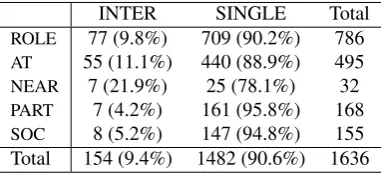
In natural language relationships between entities can asserted within a single sentence or over many sentences in a document. Many information extraction systems are constrained to extracting binary relations that are asserted within a single sentence (single-sentence relations) and this limits the proportion of relations they can extract since those expressed across multiple sentences (inter-sentential relations) are not considered. The analysis in this paper focuses on finding the distribution of inter-sentential and single-sentence relations in two corpora used for the evaluation of information extraction systems: the MUC6 corpus and the ACE corpus from 2003. In order to carry out this analysis we had to manually mark up all the management succession relations described in the MUC6 corpus. It was found that inter-sentential relations constitute 28.5% and 9.4% of the total number of relations in MUC6 and ACE03 respectively. This places upper bounds on the recall of information extraction systems that do not consider relations that are asserted across multiple sentences (71.5% and 90.6% respectively).
1.
Introduction
Relation extraction is a subtask of Information Extraction (IE) that aims to identify instances of pre-defined relation within text. For example, the sentence“John Scheurer was appointed as the new CEO of Allied Capital last week.” as-serts a relation between“John Scheurer”and“Allied Cap-ital”.
Many relation extraction systems constrain the search for relations to ones that are asserted within a single sentence, for example (Zelenko et al., 2003; Culotta and Sorensen, 2004; Zhao and Grishman, 2005; Zhou et al., 2007). We refer to these as single-sentence relations. The practical ad-vantage of this approach is that it limits both the computa-tional complexity of the task and data sparsity issues that arise with machine learning approaches to relation extrac-tion. However, relationships between two entities in a doc-ument can be expressed over more than one sentence. For example,“Allied Capital announced interim results and a new CEO last week. John Scheurer has been appointed to the post with immediate effect.” also asserts a relation between“John Scheurer”and“Allied Capital”. We call these relations inter-sentential.
Previous work investigating the proportion of inter-sentential relations in information extraction corpora is lim-ited. An examination of relations in single and multiple sentences within the MUC4, MUC6 and MUC7 corpora (Stevenson, 2007) estimated that at most 40% of events containing 2 or more entities were inter-sentential. An anal-ysis carried out on a manually annotated corpus of clinical records of cancer patients (Roberts et al., 2008) reported that 22.7% of relations were inter-sentential.
It is important to know the proportion and distribution of inter-sentential relations in IE corpora both to understand the coverage of existing relation extraction systems and to inform new developments in relation extraction. This paper reports an investigation into the inter-sentential
re-lations found in two widely used Information Extraction corpora: the Message Understanding Conference (MUC6) corpus from 1995 and the Automatic Content Extraction (ACE03) corpus from 2003. The analysis in this paper focuses on finding the distribution of inter-sentential and single-sentential relations in the MUC6 corpus and the ACE corpus from 2003.
In Section 2. we introduce the corpora used in this work. In Section 3. we describe the supplementary annotation car-ried out on the MUC6 corpus to locate entities participating in events within the documents. Section 4. and 5. detail the results of our analysis of the inter-sentential relations in the MUC6 and ACE03 corpora respectively.
2.
Information Extraction Corpora
2.1. MUC6
SUCCESSION EVENT ID 9404150071-1
ORGANIZATION
NAME “Paul Allen Group”
TYPE COMPANY
LOCALE Bellevue CITY
PER NAME “Vern Raburn”
NEW STATUS IN
ON THE JOB NO
POST “president”
VACANCY REASON NEW POST CREATED
Figure 1: Summarized event template for succession event 9404150071-1 in MUC6 corpus.
RELATION ID PRI20001 108.2000.1506-R3
TYPE AT
SUBTYPE LOCATED
CLASS EXPLICIT
ARGNUM1
STRING “Moscow”
START 69
END 74
TYPE GPE
ARGNUM2
STRING “A lawyer for US spy suspect, Edwin Prope”
START 148
END 187
TYPE PER
Figure 2: Summarized event template for binary relation PRI20001 108.2000.1506-R3 in the ACE corpus (2003).
<PER ev=1(IN)>Richard C. Bartlett</PER>
was named to the newly created position of
<POST ev=1(IN)>vice chairman</POST> of <ORG
ev=1(IN)>Mary Kay Corp.</ORG>, a privately
held cosmetics company.
Figure 3: MUC6 annotation
sample of 5 documents were annotated twice and the inter-annotator agreement between these found to be 84%. All of the disagreements between the two annotators related to the markup of organsation names. This often occurred because one annotator chose to mark up the organisation mention most closely preceding the mentions of the other participating entities, deciding that the mention of the en-tity at that point in the discourse meant that it was implicitly participating in the succession event. Whereas the other an-notator marked up the organisation mention that made some reference to the management succession event and only if this was not available reverted to marking up the closest preceding mention. For example, the following following sentences describe the replacement of Rosso by Wareham as president of Beckman Instruments Inc.
“Beckman Instruments Inc.said it will cut 11% of its work force, consolidate its life sciences laboratory and diagnostic laboratory businesses, and take other steps to reorganize and cut costs.
Beckman’sstock dropped 50 cents to $26.25 a share in composite New York Stock Exchange trading.
Louis Rosso, chairman and chief executive officer, said
John P. Wareham, 52 years old, will succeed him as
president.”
One annotator marked-up the company name in the first sentence as it is mentioned in the context of reorganisation and cost cutting. While the other chose the company name in the second sentence which is the mention of the organi-sation name which most closely precedes person name and post participating in the event. The main purpose of our analysis is to determine whether events are inter-sentential and the disagreements between annotators did not alter the classification of any event (all related to inter-sentential events). We chose the first approach for the final annotation of the 200 documents.
4.
MUC6 Analysis
MUC6 relations and 9.4% of ACE03 relations are inter-sentential. This quantification of inter-sentential relations in the MUC6 corpus (28.5%) improves on previous investi-gation (Stevenson, 2007) that calculated an upper bound of 40%.
The difference between the proportion of inter-sentential relations in the two corpora is due to the nature of the ex-traction task used by each. The MUC6 exex-traction task re-quires the filling of complex templates that are specific to the types of information contained in the documents that form the MUC6 corpus. Information from a variety of sen-tences in a document is often required to complete these templates. The MUC6 templates were simplified to a set of three binary relations for the study presented here but of-ten still include information from multiple senof-tences. On the other hand the ACE03 task involves the extraction of simpler generic relations that may be found in a range of documents. These relations can be identified without con-sidering the wider context of the document in a larger pro-portion of cases. It is therefore important to consider the nature of the extraction task when deciding whether to use a relation extraction system that is limited to identifying single-sentence relations.
This study has also shown that some relation types are more commonly asserted using cross-sentence linguistic con-structs and that in the MUC6 corpus likelihood of two enti-ties being related is inversely proportional to the number of sentence boundaries between the two entities. This infor-mation may be useful for the development of approaches to the detection of inter-sentential relations.
7.
References
Aron Culotta and Jeffrey Sorensen. 2004. Dependency tree kernels for relation extraction. InACL ’04: Proceedings of the 42nd Annual Meeting on Association for Computa-tional Linguistics, page 423, Morristown, NJ, USA. As-sociation for Computational Linguistics.
Hamish Cunningham, Diana Maynard, Kalina Bontcheva, and Valentin Tablan. 2002. GATE: A framework and graphical development environment for robust NLP tools and applications. InProceedings of the 40th Anniversary Meeting of the Association for Computational Linguis-tics.
Ralph Grishman and Beth Sundheim. 1996a. Design of the MUC-6 evaluation. In Proceedings of a workshop on held at Vienna, Virginia, pages 413–422, Morristown, NJ, USA. Association for Computational Linguistics. Ralph Grishman and Beth Sundheim. 1996b. Message
Un-derstanding Conference-6: a brief history. In Proceed-ings of the 16th conference on Computational linguis-tics, pages 466–471, Morristown, NJ, USA. Association for Computational Linguistics.
Angus Roberts, Robert Gaizauskas, and Mark Hepple. 2008. Extracting clinical relationships from patient nar-ratives. In Proceedings of the Workshop on Current Trends in Biomedical Natural Language Processing, pages 10–18, Columbus, Ohio, June. Association for Computational Linguistics.
Mark Stevenson. 2007. Fact distribution in
informa-tion extracinforma-tion. Language Resources and Evaluation, 40(2):183–201, May.
Dmitry Zelenko, Chinatsu Aone, and Anthony Richardella. 2003. Kernel methods for relation extraction. J. Mach. Learn. Res., 3:1083–1106.
Shubin Zhao and Ralph Grishman. 2005. Extracting rela-tions with integrated information using kernel methods. InACL ’05: Proceedings of the 43rd Annual Meeting on Association for Computational Linguistics, pages 419– 426, Morristown, NJ, USA. Association for Computa-tional Linguistics.