Cross-Document Named Entity
Co-reference Resolution for Dutch
As a pre-process for named entity based text mining
J.P. Balkenende
Balkenende
premier Balkenende
Jan Smit
Smit
C.A. Versloot
Versloot
de Vries
Vries
Amsterdam Nederland
Oranje
?
?
?
Corné Versloot
Cross-Document Named Entity
Co-reference Resolution for Dutch
As a pre-process for named entity based text mining
Master Thesis of Corné Versloot
March 2007 - October 2007
University of Twente Faculty of Electrical Engineering, Mathematics and Computer Science.
Department of Human Media Interaction
P.O. Box 217 7500 AE Enschede
Supervisors: ir. R.B. Trieschnigg prof. dr. F.M.G. de Jong
TNO Information and Communication Technology.
Department of Broadband and Voice Solutions
Brassersplein 2 P.O. Box 5050 2600 GB Delft
Preface
This thesis is the result of my graduation project performed at TNO-ICT in the department of Broadband and Voice Solutions. In this graduation project I performed research into named entity co-reference resolution for Dutch and the influence of this process on name based text mining. With this thesis I conclude the computer science master ‘Human Media Interaction’ which I followed at the University of Twente.
Abstract
People create massive amounts of texts, finding information within these texts usually involves reading. It is possible to extract information from texts automatically but most techniques are farm from perfect. One example is text mining based on names: extraction of names from texts and discovery of information using these names. However, names often have a lot of variances, the same name can refer to different things and different names can refer to the same thing. Finding out which names in a large set of documents refer to which ‘entities’ in the world is the focus of this graduation project.
This research studied methods to perform cross-document named entity co-reference resolution for Dutch and the impact of this resolution on name based text mining. In order to do this the named entity co-reference resolution was split into two separate (sequential parts) parts: co-reference resolution in single documents and co-reference resolution in multiple documents.
The single document study was heavily based on surface form similarity of names following the hypothesis that similar names within one document are co-referential. Two methods were created and evaluated with respect to a baseline method.
The co-reference ‘clusters’ created by the best of these two methods served as a starting point for cross-document named entity co-reference resolution. In this part of the research machine learning techniques were used to train a model capable of distinguishing co-referential names from non-co-referential names.
The best method from this study was used to pre-process news articles for Novalink, a text mining tool developed by TNO based on named entity co-occurrence. Two versions of Novalink, one with and one without named entity co-reference resolution were compared in an evaluation to study the impact of named entity co-reference resolution.
A few important conclusions can be derived from the evaluation:
• Single document NE co-reference resolution can be done using only
name similarity.
• Similarity of names is very important to solve NE co-reference
resolution, but more information is needed to solve ‘hard’ cases (especially in cross-document NE co-reference resolution).
• High recall scores of the groups of co-referential names does not
directly lead to ‘better’ text mining results (In case of the Novalink tool). Good results can be obtained using less than the optimum number of names.
• It is important that groups of co-referential names have a high
Contents
CONTENTS ...7
1 INTRODUCTION ...11
1.1 RESEARCH QUESTIONS... 11
1.1.1 Problem description ... 11
1.1.2 Main research question... 13
1.1.3 Sub questions ... 13
1.1.4 Restrictions... 14
1.2 METHODOLOGY... 14
1.3 THESIS OVERVIEW... 14
2 RELATED WORK AND STATE OF THE ART ...17
2.1 INTRODUCTION... 17
2.2 WHAT IS TEXT MINING? ... 17
2.3 MESSAGE UNDERSTANDING CONFERENCE... 18
2.4 NAMED ENTITY ANALYSIS... 18
2.4.1 Rigid- and non-rigid designators ... 19
2.4.2 Name recognition ... 19
2.4.3 Classification of names ... 20
2.4.4 Evolution of names in news articles ... 21
2.5 NAMED ENTITY CO-REFERENCE RESOLUTION... 21
2.5.1 Lexical knowledge... 21
2.5.2 Using meta-data... 21
2.5.3 Using context ... 22
2.5.4 Using world knowledge ... 23
2.6 ANAPHORA RESOLUTION... 23
3 NOVALINK ...25
3.1 INTRODUCTION... 25
3.2 PRE-PROCESS... 25
3.3 RUNTIME-PROCESS... 26
3.4 NNER EVALUATION... 26
3.4.1 Evaluation methodology... 26
3.4.2 Results... 27
3.4.3 Discussion of the results ... 27
3.4.4 Conclusion ... 28
4 EVALUATION METHODOLOGY ...31
4.1 INTRODUCTION... 31
4.2 COMMONLY USED EVALUATION METRICS... 31
4.3 ADAPTATION OF A METRIC FOR NAMED ENTITY CO-REFERENCE RESOLUTION... 32
4.3.1 MUC co-reference resolution evaluation scheme ... 33
4.3.2 Name matching approach ... 34
4.3.3 Clustering matching approach... 35
4.4 SUMMARY... 37
5 CORPUS CREATION ...39
5.1 INTRODUCTION... 39
5.2 DOCUMENT SELECTION... 39
5.3 ANNOTATION AND ATTRIBUTES SELECTION... 40
5.4 ANNOTATION AIDING... 41
5.5 OBSERVED PROBLEMS... 41
5.6 INTER ANNOTATOR AGREEMENT... 42
5.7 POST-PROCESSING OF THE CORPUS... 43
6 SINGLE-DOCUMENT NAMED ENTITY CO-REFERENCE RESOLUTION ...45
6.1 INTRODUCTION... 45
6.2 BASELINE STRING-COMPARISON METHOD... 46
6.2.2 Evaluation of the baseline method... 46
6.2.3 Discussion of the results ... 47
6.3 ADVANCED METHOD... 48
6.3.1 Selection and implementation of advanced method... 48
6.3.2 Evaluation of the advanced method ... 50
6.3.3 Discussion of the results ... 50
6.4 JW-METHOD... 51
6.4.1 Selection and implementation of JW-method... 51
6.4.2 Evaluation JW method ... 52
6.4.3 Discussion of the results ... 52
6.5 USING NAME TYPE INFORMATION... 53
6.5.1 Evaluation of this type-enriched-method ... 53
6.5.2 Discussion of the results ... 54
6.6 COMPLEXITY OF THE SOLUTIONS... 54
6.7 CONCLUSION... 55
7 CROSS DOCUMENT NAMED ENTITY CO-REFERENCE RESOLUTION...57
7.1 INTRODUCTION... 57
7.2 BASELINE METHOD... 57
7.2.1 Results... 58
7.2.2 Discussion of the baseline results ... 58
7.3 USING ADDITIONAL INFORMATION... 58
7.3.1 Introduction... 58
7.3.2 Selection and similarity measurement of features ... 59
7.3.3 Statistics on the features ... 60
7.4 USING MACHINE LEARNING TO TRAIN MODELS... 62
7.4.1 Introduction... 62
7.4.2 Similarity estimation ... 62
7.4.3 SVM classification ... 63
7.4.4 K-nearest neighbour classification ... 65
7.4.5 Discussion of the machine learning results... 67
7.5 IMPROVING THE BASELINE METHOD... 68
7.5.1 Results... 68
7.5.2 Discussion of the results ... 69
7.6 CONCLUSION... 69
8 IMPACT OF NAMED ENTITY RESOLUTION ON TEXT-MINING ...71
8.1 INTRODUCTION... 71
8.2 EVALUATION METHODOLOGY... 71
8.2.1 Selection of evaluation cases ... 73
8.3 RESULTS... 73
8.4 INTERPRETATION AND EXPLANATION OF THE RESULTS... 74
8.5 CONCLUSION... 77
9 DISCUSSION...79
9.1 GROUND TRUTH DATA... 79
9.2 SOLUTION STRATEGY... 79
9.3 NE CO-REFERENCE RESOLUTION EVALUATION METHODOLOGY... 79
9.4 SINGLE DOCUMENT NE CO-REFERENCE RESOLUTION... 80
9.5 CROSS DOCUMENT NE CO-REFERENCE RESOLUTION... 80
9.6 COMPLEXITY OF NE CO-REFERENCE RESOLUTION METHODS... 80
9.7 EVALUATION OF TEXT MINING... 80
10 CONCLUSION...83
10.1 MAIN RESEARCH QUESTION... 83
10.2 SUB QUESTIONS... 84
11 FUTURE WORK...85
11.1 EXPLORE THE POSSIBILITIES OF SYNTACTIC AND SEMANTIC KNOWLEDGE... 85
11.2 CROSS-DOCUMENT NE CO-REFERENCE RESOLUTION STRATEGY... 85
11.3 IMPROVING THE NAMED ENTITY RECOGNIZER... 85
APPENDIX A ...91
APPENDIX B ...99
APPENDIX C ...100
1
Introduction
People generate lots of information every day. Information can have various forms like news broadcasts, news articles, web sites, radio, web logs etc. A lot of this information is freely available on internet or is contained in large databases or storage facilities (news paper archives, TV archives etc.). Access tools for these archives allow people to search for sources using key words. Finding the specific answers or the information you are looking for typically involves reading (or watching/listening).
An alternative is to extract and summarize information from texts automatically to provide the user with a global overview and starting point for further search. This functionality is studied in the field of text mining, a research field that develops and evaluates methods to automatically find information in written documents (a more formal definition is given in chapter 2). Useful information can be found in patterns in texts, or extracted from multiple documents. For example names that frequently co-occur in texts is a pattern. In the case of names it can be said that the entities the names refer to have some kind of relation.
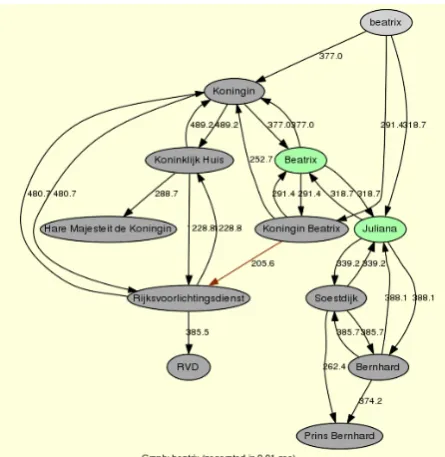
This is basically what Novalink does. The purpose of the tool is to give an overview of named entities (NE) that are related to another NE. Named entities are things (objects, persons, organizations etc) in the real word which are referred to by names or noun phrases in texts. Novalink tries to find relations between named entities in news articles based on their co-occurrence. More precisely; NE’s that frequently occur in the same document, more than can be expected by chance, are assumed to have ‘something to do with each other’. An example of a Novalink result is shown in figure 1.1. A more thorough description of this system can be found in chapter 3.
Novalink is just one example of a text mining tool. The field of text mining is relatively young and a lot of work is needed in order to reach the fields ‘full’ potential. My graduation project described in this thesis is just one small step in this direction.
1.1
Research questions
1.1.1 Problem description
From a computational point of view texts are just simply sequences of characters that do not have any meaning. These sequences can be broken down into pieces such as words, sentences and paragraphs. Humans have a lot of knowledge concerning the meaning of these pieces and that enables them to understand the meaning of texts. Computers lack this knowledge making it very hard to understand even the simplest sentences, not to mention entire texts.
One important piece of information for name based text mining systems is which names refer to the same entity. Names that refer to the same entity are referential. For example ‘George Bush’ and ‘G.W. Bush’ are co-referential because they both refer to the American president (in certain temporal context). Unfortunately systems often lack this kind of information. Novalink uses a very simple rule to determine if names are co-referential:
names that are exactly the same co-refer to the same entity.
found by simple reasoning. The different types of mistakes are described in the following list:
• Synonymic names (different names for the same entity) are treated as separate entities which can cause the system to miss relations. An example can be the entity ‘Henk Kamp’ with two name variations ‘Kamp’ and ‘Henk Kamp’. When searching for ‘Henk Kamp’ the possible entities that often co-occur with ‘H. Kamp’ can be missed. • Homonymic names (that are exactly the same) that refer to different
NE’s are treated as one entity. The result is that relations found for this entity can in reality belong to different entities and thus give an erroneous result. An example that really occurs within Novalink has to do with the name ‘Marco’, the first name of a soccer coach (van Basten) and the first name of a singer (Borsato). When searching for Marco the relations that are found are from both people giving a very strange result with relations from both the music and from the soccer domain.
Users generally can not detect these mistakes because they do not know anything about the NE of interest and hence can not evaluate the correctness of the result. The only effect of the problem thing that does show up in the results is ‘double entities’. These are entities that are co-referential in reality but are separate entities within the result. Novalink often thinks that these entities have a relation because they frequently co-occur in documents. An example of this can be seen in figure 1.1 where there are a total of 5 nodes that refer to Beatrix. This graph also shows that not only names refer to NE’s but also noun phrases like ‘Hare Majesteit de Koningin’.
The problems described above would not occur if the system knows exactly is needed to solve the problem for names from multiple texts because Novalink works on a large set of documents. Simply said the task is to find out for all the names in a set of documents what entity they refer to; if multiple names refer to the same entity they are co-referential.
Finding all the co-referential names can be a
very time consuming process and the document collection for which this technique can have added value may be huge. Because of this the method(s) used to solve the problem must be fast and scalable to process all the documents in an acceptable amount of time. Scalable means that when the number of documents doubles the processing time should not grow unacceptably i.e. ‘explode’.
1.1.2 Main research question
First the main research question and hypothesis for this research are formulated. Then this question is broken down into a number of sub-questions used to focus on different aspects of this research.
The main research question is:
Can Dutch text mining be improved using named entity co-reference resolution?
The hypothesis concerning this question is:
A text mining system that has information about NE co-references will give better results than a system without this knowledge.
I expect a system that uses NE co-reference resolution to perform better than a text mining system without this knowledge. The reason is very simple: understanding which names refer to which NE’s enables to system to find better results (relations in case of Novalink). With ‘better’ is meant less double entities and more correct relations (see also the requirements for the Novalink evaluation in chapter 8.1).
1.1.3 Sub questions
To answer this research question a set of sub questions needs to be solved or answered. An important part of the research is to develop an adequate NE co-reference resolution method.
What information (features) can be used to solve cross-document NE co-references.
The most basic solution to the problem is to use string matching techniques to asses whether two names are co-referential or not. However, string matching techniques are not enough to solve all NE co-references, especially when names are homonymic/ambiguous or synonymic more information is needed. Features could be extracted from texts (important nouns, important names etc) themselves and from metadata about the texts (author, publish date etc). The question is what information could be used and how informative (with respect to the problem) they are. A lot of information on this matter can be found in literature.
What sub-set of these features gives the best co-reference resolution result with a minimum of computation complexity?
As described above, there could be a lot of different features that can be used to solve NE co-references. However, it is likely that some features are more important than others. Secondly, the extraction of some features might be more expensive than the extraction of others. Since the final solution needs to be scalable there is a trade-off between the features to use (and the quality that can be accomplished using these features) and the total computational complexity.
How exactly does the NE co-reference resolution effect the text mining task?
1.1.4 Restrictions
This paragraph describes pragmatic restrictions used to limit the scope of the research, explains where the restrictions come from and how they influence this work.
Restriction 1: The Novalink Named Entity Recognizer (NNER)
Novalink uses a name recognizer to recognize the names in the articles. It is not part of this research to alter or improve this recognizer. As a result this study is based on the names recognized by the. What names the NNER recognizes is described in chapter 3.2.
Since methods created in this study are tuned to the NNER output it is possible that they show different performance when working with names recognized by other programs.
Restriction 2: No usage of syntactic and semantic knowledge
Syntactic, semantic and world knowledge can be very useful in this research and are frequently used in for example ‘anaphora resolution’ (see chapter 2). Unfortunately these techniques are often computational expensive and correct usage of them for Dutch is a study on its own. As a result these techniques are not used in this research. The restriction to use a ‘knowledge poor’ approach is possibly a lower performance on the created methods (in comparison with knowledge rich methods). More information regarding syntactic, semantic and world knowledge can be found in chapter 2.6.
1.2
Methodology
First a literature study was done to find general information regarding the research questions and relevant research fields (NLP and text mining). The findings of this study formed the basis and general guideline for this graduation project. A corpus containing cross-document NE co-reference annotations was created for Dutch and was used as ground truth data for evaluations.
The NE co-reference resolution problem was split into two parts: single document and cross document NE co-reference resolution (inspired by David Yarowsky (Yarowsky; 1995)). A baseline method was created for single document NE co-reference resolution. More advanced methods were build in an iterative way and evaluated with respect to the baseline.
The NE co-references found within single documents served as the basis for the development of cross-document named entity co-reference resolution methods. The methodology for the cross document co-reference resolution was largely the same as for the single document resolution. A baseline method was developed and more advanced methods were built and evaluated. The best method was implemented into Novalink and the results were compared with results from the ‘unaltered’ Novalink. This evaluation indicates the usefulness of the NE co-reference resolution done for text-mining and thus answers the main research question.
1.3
Thesis overview
The table of contents and the methodology section already gave an indication of the steps used to answer the research questions. This section will describe the different chapters in this document in more detail.
The purpose and internal mechanics of Novalink are described in chapter 3. This chapter also contains the methodology used to evaluate the NNER and an assessment how the NNER influences this research.
A good evaluation method was needed to assess the quality of the developed methods. It turned out that there was no such method available, at least none that fulfilled the requirements for this research. Chapter 4 describes different evaluation methods with their strong and weak points and describes the final choice used in this research.
The evaluation method needed ground truth data, in this case a corpus with cross-document named entity annotations. Chapter 5 describes the work done to create this corpus. This chapter also contains examples of hard NE co-reference cases to give an indication of the difficulty of the problem. As described in the methodology section it is common to start with single document named entity co-reference resolution. The definition of a baseline method and the iterative process to create and evaluate new methods is described in chapter 6. The results from the single document method serve as a baseline for the cross-document named entity co-reference resolution methods described in chapter 7. This chapter describes the different features that are extracted and the machine learning process used to build a good model. Most answers to the sub research questions will be given in this chapter.
The last step of the research is the evaluation of the effect of NE co-reference resolution on name based text mining. This evaluation is done using the ‘old’ and ‘new’ Novalink systems. The exact evaluation methodology and the results are described in chapter 8.
2
Related Work and State of the Art
2.1
Introduction
This chapter provides the setting of this research; what work has already been done and what are useful methods that can be used in this research. The chapter is divided into five sections:
• What is text mining? This section describes the differences between data mining, text mining and information retrieval.
• Message Understanding conference: the most influential conference in the field of Information Extraction (IE) the field containing data- and text-mining.
• Named entities: definitions and techniques that are useful for this research.
• NE co-reference resolution: a section explaining common methods to solve NE co-references.
• Anaphora resolution: part of Natural Language Processing that
studies co-references in broader form.
2.2
What is text mining?
Data mining and text mining (related to information retrieval) are mentioned in the introduction and here I clarify what they exactly mean and how they relate to this research. This section will explain the terminology and will use some examples for clarification. The ideas and definitions described in this section are mainly derived from work done by Hearst (Hearst; 1999).
Hearst et al. introduce a number of parameters used to distinguish between the different types of ‘mining’:
• Novelty of information:
- finding patterns
- finding novel information
- finding non-novel information
• Type of data:
- Structured data or strictly formatted text (data in databases). - Textual data: normal (unstructured) text.
An important parameter is the novelty of information; did a system really find ‘new’ information or did it not (for example finding information sources). With new information Hearst means latent information; knowledge that is present in some way but is not used explicitly. Using these parameters Hearst proposes the categorization as described in table 2.1.
Finding
linguistics Text mining Information retrieval
This table shows that data mining is ‘defined’ as the search for patterns in structured data. Hearst gives the example of mining a supermarket database for products that are often sold together (so they can be put together in the same alley). Word co-occurrence is used as an example of the discovery of patterns in textual data as covered by the field of computational linguistics. Text mining is defined as finding novel information in textual data.
Following these criteria Novalink would not be a text mining tool but would do ‘computational linguistics’ because it finds a pattern (frequently co-occurring names). In my opinion this has to do with the definition of patterns; what are patterns exactly? Hearst only mentions patterns in words and claims that “computational linguistics applications tell us about how to improve language analysis, but they do not discover more widely usable information”. In my opinion this depends on the patterns that are discovered and on possible interpretation of patterns. The patterns found by Novalink do not improve language analysis but provide the user with new knowledge that was not written down intentionally by the author(s). From that perspective Novalink is a text mining tool.
2.3
Message Understanding Conference
The Message Understanding Conference, more commonly referred to as MUC, is the most important Information Extraction. MUC is mostly an evaluation framework to compare and benchmark different methods built for different tasks. The conferences are numbered, starting with MUC-1 in 1987. The first two conferences were initiated by Beth Sundheim and focused on knowledge extraction from military messages. Throughout the years MUC supported a growing number of tasks such as: named entity recognition, attribute extraction, relation extraction and a few more. A cross document named entity co-reference resolution task was proposed for MUC-6 and an evaluation method was defined (see section 4.3.1). However it was not included as a formal task because it was considered to be too ambitious at the time (Grishman; 1994).
MUC provides datasets for the tasks which are evaluated at the conference. A lot of the IE extraction methods known today were firstly created to solve MUC tasks. The last few years also work on other languages or combination of languages has been added to MUC under the name of Multilingual Entity Task (MET).
Data sets for MUC-6 and MUC-7 were created by the Linguistic Data Consortium (LDC). The LDC named entity annotation guide served as a bases for the creation of the corpus in this research (section 5.3). Some of the methods and evaluation metrics made for MUC tasks were used in this graduation project.
Closely related to MUC is the ‘Conference on Natural Language Learning’ (CoNNL) an annual event first organized in 1997. The CoNLL conference has one shared task every year, the participating systems for this task are evaluated and compared in a systematic way (like in MUC). On of the tasks was multi language named entity recognition. The dataset for this task was used as training set for the NNER.
2.4
Named Entity Analysis
The terms named entity, name and other associated terms are used a lot in this report and hence it is important to have a clear understanding these terms:
• Named Entity: an entity in the real world that can be referred to by using proper names or definite descriptions. Named entities are mostly physical objects but they can also be more abstract concepts (like theories).
• Proper noun/name: a noun that denotes a particular NE; usually
capitalized in European languages. Simply ‘name’ will be used throughout this report to denote these proper nouns/names.
• Definite description: a noun-phrase that refers to a specific NE (like mayor of Amsterdam).
2.4.1 Rigid- and non-rigid designators
Two classes of names and noun phrases were first defined by the philosopher Saul Kripke in ‘Naming and necessity’, three lectures on reference of proper names. These classes are rigid- and non-rigid designators and are important for this research. A rigid designator is a proper name that depending on the context refers to the same entity. A non-rigid designator is usually a definite description that does not refer to the same entity even if the context is the same. For example ‘the mayor of Amsterdam’ is non-rigid because it does not refer to one unique person (the mayor in 1980 was someone else as the mayor in 2000).
Rigid and non rigid designators can be found throughout the news articles. The mayor example above surely refers to a real person and using extra information like the publication date the referent can be identified. Without usage of semantic information (restriction number 2) non-rigid designators are very hard to solve. Some people are often referred to by non-rigid designators, often using their job titles (Dutch soccer coach, prime minister). These NE’s often contain useful information from text mining point of view and hence are important to process.
2.4.2 Name recognition
One of the first MUC tasks was the recognition of names, a challenging task with a lot of exceptions. For English and Dutch names are capitalized which is a useful feature for name recognition. However, not all capitalized words not at the beginning of a sentence are names, and words at the beginning of a sentence can be names. Also, names can contain words that are not capitalized, can be concatenated together or can contain abbreviations. It is hard to recognize or exclude all the different exceptions.
In general there are two ways to do name recognition: rule based (using various kinds of information) and machine learning. Rule based recognizers use hand crafted rules which are often typical for the language. Rules give an indication if a word (group) is likely to be a name. Commonly used rules for English and Dutch are:
• Word must be capitalized
• Capitalized word followed by another capitalized word is often one name
• Capitalized words in subject role are often names
Examples from (Louis A., de Waal A, C. Venter; 2006) are: • Word capitalization and word length
• PoS tags
• Possessive ending (Jane‘s)
• Company information (Ltd, TM etc) • Titles (Mr, lord, professor etc)
Sometimes rules are used in a post process to correct some of the (mostly simple) mistakes made by a learned model. Both types of name recognition methods often use pre compiled lists of names called gazetteers. It is also possible to use multiple different methods in a sequence to ‘minimize’ the effect of weak points of individual recognizers. Radu Florian explored this approach for the Conference on Natural Language Learning (CoNLL) NE recognition task and reports an accuracy around 98% (Florian R.; 2002). CoNLL also has a language independent NE recognition task which is changing since language specific information can not be used. Sang et al. describe the sixteen systems and their performance of this task (for English and German). The best performing method by Florian et al. (Florian, Ittycheriah, Jing, and Zhang; 2003) achieved an F-measure of 88.8% for English and 72.4% for German.
The CoNLL data sets are pre-processed with an IOB tagger. This tagger tags words with either an I (inside), O (outside) or B (begin). Names can be extracted using sequences of these tags: a B followed by multiple I’s. In some variations of the IOB tag set the B is omitted, the first occurrence of an I after an O can then be seen as the old ‘B’ tag. The IOB tag set was first defined by Ramshaw et al. (Ramshaw and Marcus; 1995).
2.4.3 Classification of names
Another thoroughly investigated aspect of names is their types. The type of a name is what the entity is that is referred to by the name. Most common types used within research are person, organization and location. However this is not a complete set. The types as used for MUC, described by the Linguistic Data consortium are: person, organization, facility, location, Geo-political entity, vehicle and weapon (Linguistic Data Consortium; 2005). One example of work done in this direction is the identification of types in Korean news articles by Kim et al. (Kim, Kang and Choi; 2002). They report 73.16% precision and 72.98% recall for 2580 types. Type information is very useful for information extraction since it adds semantic knowledge to names. The types normally used are not always sufficient and more types or hierarchical classification gives a lot more useful information. One example is work done by (Fleischman and Hovy; 2002) who develop a method to distinguishing three person types (politician, entertainer, businessmen) using the local context of the names.
2.4.4 Evolution of names in news articles
A very interesting study was done by Nenkova and McKeown (Nenkova and McKeown; 2003). They studied occurrences and modifications of names throughout English news articles. Their main focus was on the introduction of names in a text and if these names are changed in subsequent occurrences (and if so, in what way). They found that:
• names are initially used fully (with or without pre-modifiers like tiles) • this initially used name is very likely to be changed since the formal
name initially introduced is not suited for continuous usage (happens 76% of the cases)
• if a modified form is chosen it is not likely the name will change more • Usage of first names and nick names is very unlikely, but if they are
used they will probably be continuously used throughout the remainder of the text.
• Normally subsequent mentions of names have less or equal modifiers (such as Mr. and Mrs.). In case of one modifier the chance is 50% it will be used again.
This information is interesting because it describes how names can evolve in texts and the chance that certain changes occur.
2.5
Named entity co-reference resolution
Named entity co-reference resolution is the process of finding co-referential names in groups of texts. The techniques used to do this largely depend on the domain of the texts and availability of certain knowledge (like syntax and world knowledge). Information that is frequently used is: lexical knowledge, domain knowledge, context and world knowledge. The following sections explain these concepts in more detail. However, some techniques are quite complex and the reader is advised to read the referred work to get a better understanding of the different techniques.
2.5.1 Lexical knowledge
Lexical knowledge is always needed when performing NE co-reference resolution. Different names need to be compared in a meaningful way to give an indication if two names are co-referential. There are a lot of different string matching (similarity assessment) techniques that can be used. Cohen (William) did a lot of research in this direction. The research done by Cohen et al. (Cohen, Ravikumar and Fiendberg; 2003) compares string matching techniques for name matching purposes. Edit-distance, token based distance and hybrid distance functions were compared. Their conclusion is that a combination of JaroWinkler token matching with TFIDF ranking scheme performs best (slightly better than these methods used independently).
2.5.2 Using meta-data
Meta data is specific knowledge about the texts that can be used for the NE co-reference resolution process. Meta-data is often supplied along with texts or can be extracted relatively simply (recognition of titles, authors etc.). The data available might differ depending on the type of text. Examples are:
• Author(s)
• Title
• Publish date
• Category of text (sports article, political article, action, humour etc) • Publisher
• Keywords (for example in scientific articles)
An example of work that heavily depends on this type of knowledge is research done by Lee et al. (Lee, On, Kang and Park; 2005). This research tries to fix citation problem in digital libraries. These libraries have a large number of citation records with a lot of names which can contain spelling errors or are similar to other names. Lee et al. describe two different problems: split citation (one author with different name spelling variants) and mixed citation (multiple authors that have the same name). This is the same problem as described in this research (although in a different domain). To compare two citations ‘article meta-data’ like co-authors, titles and venues are extracted from the database and represented as vectors. The similarity between these vectors is calculated to find out if the two citations belong to the same author or not. They report an overall accuracy of 90%-93% (precision and recall results are not presented).
It should be noted that this system is not a text mining system since it does not extract the information from raw texts but from a database. Because of this the information the system can work with is very accurate.
2.5.3 Using context
Lexical information from names is always needed but does not always solve NE co-references correctly, very common names are often hard to solve correctly. The context of the names can be used to help solve these hard cases (and solve ‘easy’ cases with higher certainty). Context features are always words that occur in either the immediate surrounding of a name (local context) or in the document (global context). These words are mostly nouns since they are most informative. The similarity between the contexts of two names is then used to assess whether two names are co-referential or not. The following examples describe NE co-reference resolution methods that use various forms of context.
Examples are work from Bagga et al. (Bagga and Baldwin; 1998a) and work from Niu et al. (Niu, Li and Srihari; 2004) that builds on the work from Bagga. Both articles are about cross-document named entity co-reference resolution. The work from Bagga et al. describes a system which takes single co-referenced processed documents and tries to match names with all already seen names. This matching is not done using the names themselves but using the context of the names. In this case the context contains all the sentences that contain the name. These sentences are then represented as vectors and can be compared on common terms. If the similarity of two vectors is higher than a predefined threshold the names are concluded to co-refer. Bagga reports F-measures around 81%.
Peng et al. (Peng, He and Mao; 2006) use local and global context for the disambiguation of American location names. The local context consists of words directly before and after the name, global context consists of representative words for the text the name occurs in. The system extracts names from text and stores them together with their contexts in a profile. These profiles can be compared using the context words and popularity of a location (based on the population of the location). Peng et al. trained the weights for the three different scores on 17.755 newspaper articles. This training showed a large influence of local context and a smaller influence on the result by the global context. Final results of an evaluation on 300 documents show an accuracy of 78.8% (with a local window size of four words).
2.5.4 Using world knowledge
It is also possible to use external knowledge like dictionaries and encyclopaedia to solve co-referring names. Information extracted from these knowledge sources is used in addition to methods described above. World knowledge is often hard to use; extracting the right information is often difficult and can take a lot of computing time (parsing, scanning etc).
One example is research done by Bunescu et al. (Bunescu and Pasca; 2002). Their aim is to disambiguate names in a query using the other search terms in the query. Information extracted from Wikipedia is used to achieve this. They basically try to link the context words from the query to context words from articles about a person with the query name. They use the disambiguation page from Wikipedia to find all these different persons (and their articles). The system is trained and evaluated using examples extracted from Wikipedia. Results show an average increase of 10% on the accuracy of returned results.
2.6
Anaphora resolution
Since NE co-reference resolution is related to anaphora resolution it is an obvious step to do a study of anaphora resolution research and common techniques. Most of the information and examples treated in this chapter were derived from Mitkov’s ‘Anaphora Resolution’ (Mitkov; 2002) and from Jurafsky and Martin’s ‘Speech and Language Processing’ (Jurafsky and Martin; 2000). This section will describe and assess the usefulness of some of the techniques used for anaphora resolution.
Anaphora are used to maintain cohesion in texts. When a part of a text refers (back) to some word(s) this part is called anaphor and the word group it refers to is called the antecedent. When both words have the same referent in the real world they are co-referential. If the antecedent is mentioned subsequently in the text the ‘anaphor’ is called a cataphor. Research by (Hobbs; 1978) found that 98% of pronoun antecedents were in the same sentence as the pronoun or in the previous one. Interesting for my research is the finding that it is not uncommon for proper names to refer to antecedents that are more than 30 sentences away!
Typically anaphora resolution consists of three steps: identification of anaphors, identification of possible antecedents and selection of an antecedent for an anaphor. The first two steps are usually not hard and can be done using lexical and syntactical methods. To minimize the search space the identification of possible antecedents for an anaphor is done within a certain scope (number of words or sentences) of the anaphor. The third step is harder and is more interesting with regard to this research.
There are a lot of different methods to select the right (best) antecedent depending on the amount of knowledge that can be used (semantic knowledge, world knowledge etc). Typically methods use constraints and preferences. Constraints are rules that must apply to the antecedent. Usually these are number and gender agreement with the anaphor. If there are more antecedents that fit the constraints preferences can be used to give an indication if an antecedent is ‘good’ or ‘not good’ for the given anaphor.
Different types of knowledge can be used to solve anaphora:
• Morphological or lexical knowledge: This knowledge concerns
characteristics of words like gender and number.
• Syntactic knowledge: This is knowledge about the location and role of words and word groups in a sentence. Examples are Part-of-Speech tagging and grammars.
• Semantic knowledge: the knowledge about the meaning of word
(groups) and if words can co-occur meaningfully.
• Discourse knowledge: knowledge about what a text or part of a text is about (the subject).
• Real world knowledge: this is knowledge about the world, usually
extracted from specific knowledge sources.
Often a combination of these techniques is used to find the best antecedent. Different weights can be used to stress the importance of one technique over the other. Gender and number information are almost always used as constraints, the anaphor and the antecedent must have the same gender and number. A lot of times this is enough, only one antecedent is left within the search scope en thus this must be the right one. However this is not always the case and other knowledge must be used to select the best one from the remaining set of antecedents. Usually preferences are used to score the remaining antecedents. Throughout the years a great number of methods were used. Most of them are based on syntactic or discourse knowledge. Examples are the preference of certain syntactic roles (subject over object) and current ‘focus’ of the discourse over newly introduced possibilities. Pattern recognition in combination with a corpus and machine learning techniques can also be used to score antecedents.
Another important aspect of anaphora resolution is the way methods are evaluated. First of all there is a difference of evaluating a method on hand annotated data or on automatically processed data. Mitkov argues they should be done both in order to know how good the method strictly is and how good the method is in a system.
3
Novalink
3.1
Introduction
The introduction already gave a short introduction into Novalink; a tool developed at TNO-ICT used to provide an overview of named entities that are related to the name the user is interested in. In order to do this Novalink has to find relations between NE’s.
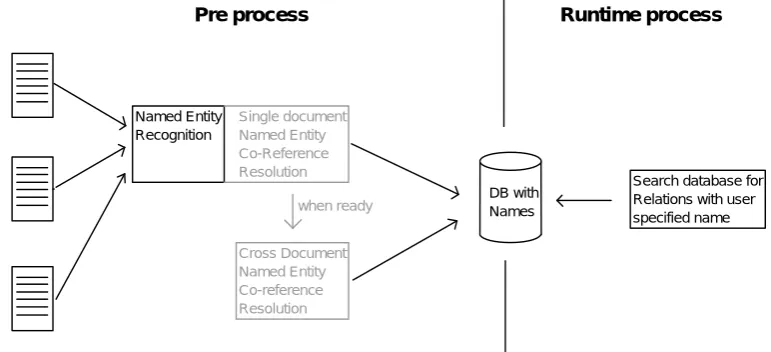
Novalink can be divided into two separate processes: a pre-process and a runtime process. Both processes are run independently and are described in the sections below. This research focus is to add named entity co-reference resolution to the pre-process in order to enhance the quality of the text mining done in the runtime-process (figure 2.1). The assumption is that information about co-referring names helps the runtime process finding more/better relations.
An important part of the Novalink system is the NNER which does the name recognition. These names form the basis for the NE co-reference resolution done in this research and hence it is important to know the mistakes the NNER makes. Section 3.4 describes the NNER evaluation done to assess the influence of the NNER on the NE co-reference resolution task. This section also describes the evaluation methodology, results and a conclusion.
3.2
Pre-process
Novalink’s pre-process is responsible for filling a database with all the information needed for text mining. In short Novalink processes a set of news articles (in text form) to extract the names. These names and some meta-data extracted from the documents are put into a database. The named entity recognizer used to recognize the names is a machine learned recognizer. The NNER was trained on annotated text from the Belgian newspaper ‘De Morgen’ which was used for the CoNLL-03 language independent NE recognition task. Besides the annotation of names the texts were annotated with IOB and PoS tags (nouns, verbs, adjectives etc).
The NNER recognizes proper names. In some cases NNER also recognizes definite descriptions, mostly when a location name is used as an adjective (Dutch premier, Amsterdam’s mayor etc).
Cross Document
Novalink uses a very simple rule to do NE co-reference resolution: names that are exactly the same are co-referential. This naïve rule causes several text mining problems; these are described in section 1.1.1.
3.3
Runtime-process
The actual text mining takes place in the runtime process and is initiated by a user by specifying a name. All the names in the database that match this term exactly are used to find relations. This is done in a statistical manner; co-occurrence of names is based on the number of documents both names occur in and the number of documents only one occurs in. The intuition behind this approach is that names that have a relation occur more frequently together than names that do not have a relation. The actual similarity is calculated using Dunning’s Log-Likelihood (Dunning T.; 1993). The top X strongest relations are displayed in a tree-like-graph as shown figure 1.1 in the introduction. Knowing exactly what names belong to what entity enables this text mining process to find relations with higher certainty and more results.
3.4
NNER Evaluation
3.4.1 Evaluation methodology
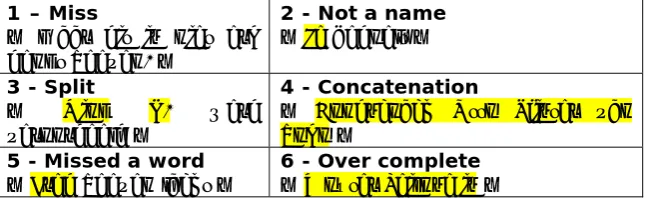
Since the goal is to evaluate the influence of the NNER on the co-reference task it was not enough to just count errors and calculate statistics. It must be clear what types of mistakes the NNER makes so the influence of these mistakes could be evaluated properly. There are a total of six different types of mistakes the NNER can make from which some can occur simultaneously in one annotation. The NNER:
1. missed a name
2. annotated a word that is not a name 3. split one name in multiple ‘names’
4. concatenated multiple names into a single name
5. missed characters or word(s) that belonged to a name (incomplete) 6. annotated a few characters or words as belonging to a name while
they do not (over complete)
The following table 3.1 shows examples of these mistakes as they were encountered during annotation of the corpus (annotations by are coloured yellow).
The Ground Truth data created for the evaluation of methods made in this research (described in chapter 5) was also used for the evaluation of the NNER. The data contains 271 annotated documents which were compared with documents annotated by the NNER. This comparison was done automatically using a very simple tool that recognizes and counts the different mistakes.
Most mistakes can be recognized very easily but some depend on pre-defined parameters. Classification of splits depends on the length of the gap
1 – Miss
… Bondscoach Otto Pfister van Togo …
5 - Missed a word
mistake as 1 or 2. For this evaluation the gap size was set to 3 characters (two annotations closer to each other than the gap size are classified as a split). If the gap parameter was set larger mistakes 3 and 4 occurred more while mistakes 1 and 2 occurred less, the total number of mistakes stayed the same (within 0.5%).
3.4.2 Results
The following table shows the number of the separate mistakes.
As can be seen the 271 files contained a total of 9363 names from which 1841 were contain some kind of mistake. This means that the NNER has an accuracy of 80.34%. Note that this is not the amount of names the NNER recognizes; it is the percentage of names the NNER recognizes 100% correctly.
Recall and precision were calculated using the percentage of missing and incorrect recognitions so the NNER has a precision of 0.94 and a recall of 0.98. This shows that the NNER only misses very few names but has the tendency to annotate words that are no names.
Most of the mistakes made by the NNER are either the annotation of a normal word or incomplete annotation of a name (together 58% of all mistakes). Most of the words that were wrongly identified as a name are the first words in a sentence.
The NNER sometimes misses part of a name like the first- or last name. Mostly this is a random mistake but in some cases the NNER makes this mistake very consistent within a certain name in a text. It is unclear what part of the NNER causes this mistake.
As can be read in the table it is relatively rare that the NNER splits a single name up or concatenates multiple names.
3.4.3 Discussion of the results
Some of the mistakes made by the NNER can be explained by character-set conversion errors in the database of Novalink. Some of these errors resulted in the deletion of spaces and changes of punctuation marks. Errors like these can be the reason for some of the mistakes made by the NNER. For example the incorrect annotation of a normal word is sometimes the effect of the omission of a space character after a sentence ending. Usage of corrected documents will probably give slightly better results.
The tool used to count the mistakes is based on start- and end indices of words and not on the word strings them selves (to minimize implementation work). These indices are often shifted, meaning that the indices in the ground truth data vary slightly from the indices in the NNER-annotated data (the cause is unknown).
Mistake Number %
mistakes % of total
Missed a name 217 11.8 % 2.32 %
Annotated a name incorrectly 566 30.7 % 6.05 %
Split one name up in multiple
names 137 7.4 % 1.46 %
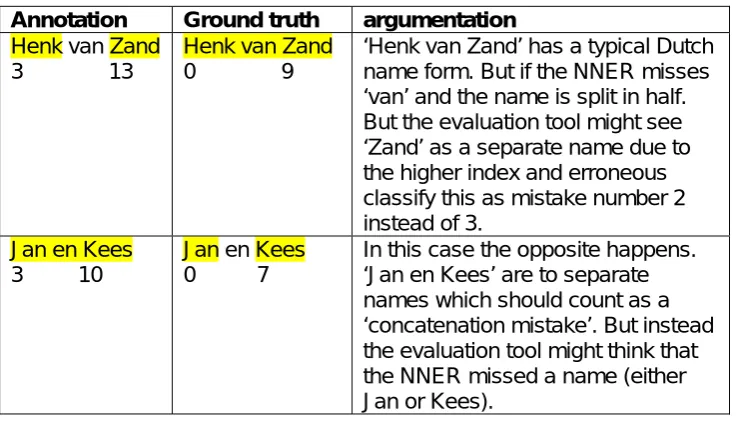
This makes it sometimes hard to distinguish between mistakes numbers 2 and 3 and between mistakes 1 and 4 (see the examples in table 3.3). So it is possible that the numbers of these mistakes are not totally correct. These situations do not occur that often so the evaluation accurately represents the quality of the NNER and the distribution of its mistakes.
3.4.4 Conclusion
Even though the NNER makes a mistake once every five names the majority of these mistakes do not or very minimal change the surface form of a name. It is this surface form that is very informative and gives a first indication if two names are likely to co-refer or not. From this point of view the concatenation or splitting of name(s) has the biggest impact since they tend to change the surface form radically. Fortunately these types of mistakes are relatively rare (2.22% of all names).
The impact of incomplete or ‘over-complete’ names (mistakes 5 and 6) is hard to predict and largely depends on what has been annotated too much or too little. In general over-complete names will not be a big problem since the correct name is still contained in the annotation. Incomplete annotations on the other hand have lost a bit of information. This lack of information could make the comparison of names less accurate.
The third and last group of mistakes concern words that are either wrongly identified as a name or names that were completely missed by the NNER. Names that were missed simply do not exist for the system and hence they are not a problem for the co-reference task. Names that were erroneously identified will be compared with other names and can in that way introduce faulty data in the system. This is not so much a problem for name co-reference resolution but it is for the text mining task. However, this is no different from the current system.
Even though this evaluation was not meant to improve the quality of the NNER the results (and observations) indicate an area of improvement. It would help the NNER a lot if it would keep track of the recognized names and uses this information in a post process evaluating its own annotations.
Annotation Ground truth argumentation Henk van Zand
3 13
Henk van Zand 0 9
‘Henk van Zand’ has a typical Dutch name form. But if the NNER misses ‘van’ and the name is split in half. But the evaluation tool might see ‘Zand’ as a separate name due to the higher index and erroneous classify this as mistake number 2 instead of 3.
Jan en Kees 3 10
Jan en Kees 0 7
In this case the opposite happens. ‘Jan en Kees’ are to separate names which should count as a ‘concatenation mistake’. But instead the evaluation tool might think that the NNER missed a name (either Jan or Kees).
4
Evaluation methodology
4.1
Introduction
Proper evaluation of the NE co-reference resolution methods is very important. Most important is of course the fact that the evaluation should give a good and clear indication of the performance and should point out the strong and weak points of the evaluated algorithm. This is not as trivial as it might seem, for different systems different aspects of the evaluation are important. For this research it is most important that the evaluation metric gives a good indication how good a methodology works and how much better (or worse) it works with respect to other methods. A set of requirements was used to select and refine a good evaluation methodology.
The evaluation metric should:
1. Give a good indication of the performance of the evaluated method.
This means:
- Mistakes made must be counted the same (regardless
of the group of names the mistake was made in)
2. Give a good indication of the strong and weak points of the evaluated method:
- indicate if names are erroneously grouped together vs. names that are erroneously left out of a group
3. Give a clear indication how much better or worse one method is
compared to another
4. Be understandable for other computer scientists active in related research-fields
First a number of evaluation methods proposed by literature are ‘evaluated’ with respect to the requirements. Secondly it is described how one of these methods is adopted to suit the requirements. The method selected is used for both single- and cross document named entity co-reference resolution evaluation.
4.2
Commonly used evaluation metrics
There are a lot of research fields that that have high similarity to this research and hence evaluation metrics from these fields might be very usable. Fields closely related are Information Retrieval, Anaphora Resolution and Clustering. Evaluation metrics commonly used within all three fields are precision and recall (combined within an F-measure) which originate from the field of Information Retrieval.
Precision and recall can be combined in a single score called the F-measure (weighted average of precision and recall). Within F-score it is possible to give preference to precision over recall (or the other way around). Precision and recall are also used for the evaluation of most MUC tasks. In general these are good performance measures and also give insight in the strong and weak points of the evaluated method.
Because of possible inconsistent usage of recall and precision measurements for anaphora resolution, Mitkov (Mitkov; 2002) proposes ‘success rate’. The success rate simply is the number of correct answers divided by the total number of answers. Even though it is a relatively good performance indicator it does not give a lot of insight into the evaluated method. This metric only indicates how many of the names are correctly ‘paired up’, but it does not really give information what causes a specific success rate (are names erroneously clustered or not). Because of this it does not satisfy requirements one and two.
Another evaluation metric used within the field of clustering is Ctrk (Yang, Yoo, Zhang and Kisiel; 2005). For every cluster a Ctrk score is calculated and these scores are averaged for a single score. Ctrk is a cost function that lets the user set the costs for misses (documents that should have been in a cluster) and false alarms (documents that should not be in a cluster). These costs are normalized using the observed chance on a mistake and the chance that a mistake occurs at random within the data set. In the end the lower the cost the better the evaluated method performs. This evaluation metric gives a good view on the overall performance. Even though the final score is not very informative with respect to the strong and weak points of the evaluated method the score is made up from other scores that do give an insight. Each individual score tells something about the ‘hardness’ of a certain cluster, in this case a certain name. Clusters and scores can easily be evaluated by a human to see what names turn out to be hard and why (depending on cluster size).
Two of the above described evaluation metrics (Ctrk and precision/recall) are largely the same with respect to the given requirements. The Ctrk does not give a lot of insight on its own but need to be evaluated to be useful. Precision and recall do not have this drawback and are frequently used. Hence precision and recall are used for the evaluations in this research.
4.3
Adaptation of a Metric for Named Entity Co-reference
Resolution
With the selection of precision, recall and F-measure as evaluation measures it is yet unclear what these terms exactly mean with respect to NE co-reference resolution or how to calculate them properly. To answer these questions the terms that make up precision and recall should be defined properly.
The common functions used to calculate precision and recall are:
• True positive: the number of names in a co-reference group that really co-refer.
• False positive: the number of names in a co-reference group that do not co-refer with the other names in that group
• False negative: the number of names that co-refer with other names in a co-reference group but are not a member of this group.
• True negative: number of names that are not co-referential and are not members of the same group (not used for precision and recall calculations, but added to give a complete list).
The data that needs to be evaluated has groups (clusters) of names that are determined to co-refer to the same entity. So names that were clustered together by the algorithm that were also clustered by human annotators were solved correctly and hence are true-positive. If a cluster defined by the algorithm misses names then these names were wrongly classified as not belonging to that cluster and hence are false-negative. It is also possible for an algorithm to cluster together to many names and thus the names that should not be in the cluster are false-positive.
Even with these definitions it is not a clear cut how to calculate precision and recall per cluster, nor how to determine the overall precision and recall (per document or per document set). The following sections describe methods created (based on evaluation methods in other research fields) and methods found in literature to do this.
4.3.1 MUC co-reference resolution evaluation scheme
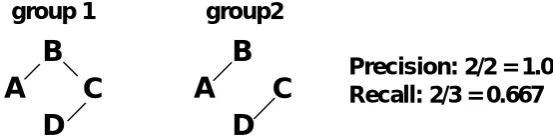
The evaluation method proposed for the MUC cross-document NE co-reference resolution task was proposed by Vilain et al. (Vilain, Burger, Aberdeen, Connolly and Hirschman; 1995). This evaluation method is based on the links needed to make a minimum-spanning tree connecting the names that are co-referential. The links in the tree are used to calculate recall and precision scores. The example given by Vilain et al. has ground truth data consisting of {A-B, B-C, D} which is compared with {A-B, C-D}. The recall score is 2/3 because 2 of the 3 links are found, the precision is 2/2 because both links are correct (see figure 4.1).
In my opinion this method has two drawbacks:
• Precision and recall are calculated using the links between names instead of the names themselves. In order to give accurate results it should be about the names grouped together. In my opinion a recall score of 2/4 gives a more accurate indication of the situation than 2/3 since both {A-B} and {C-D} have 2 from the 4 co-referential names and not 2/3 because of the links.
• The method does not distinguish between mistakes made in large
groups and small groups. In the end it is about the ‘missing links’ and this is independent of the size of the sets where these links are missing. Arguably this is undesirable because mistakes can have more or less impact on the total co-reference task depending where the mistake took place. So this method fails requirement 1.
4.3.2 Name matching approach
The next is based on name pairs in the same way anaphora resolution evaluates anaphor – antecedent pairs. Every possible name pair in the system is evaluated. For each pair of names (pair1) in the automatically annotated data the corresponding names (pair2) in the ground truth data are identified. From pair 2 it is checked if they are co-referential or not and then pair 1 is evaluated using this knowledge:
• If both pair 1 and pair 2 are co-referential pair 1 is counted as true-positive.
• If pair 1 is found to be co-referential but pair 2 is not, pair 1 is counted as a false-positive
• If pair 2 is co-referential but pair 1 is not, pair 1 is counted as false-negative
• If both pairs are not co-referential count pair 1 as true-negative
In this way a confusion matrix can be created and precision and recall can be calculated using this matrix. For the evaluation of multiple documents the average of the different scores for each document can be used.
A drawback of this method is the large number of comparisons (n*(n-1)/2). For a document with only 10 names 45 name pairs are evaluated, resulting in a confusion matrix with a total sum of 45. The vast majority of comparisons will be true-negative since most word pairs do not co-refer. Because of this, accuracy and success rate measures will not be representative. However recall and precision will be representative since the number of true-negatives is not used in calculation of either of them.
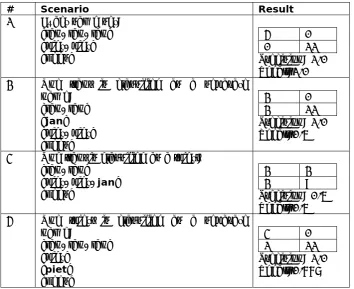
The example above shows the impact of one error in different situations. Firstly it is shown that a simple mistake can result in precision (and recall) of 0.5! Secondly, the exact same mistake occurring in different clusters results in different scores (example 2 and 4).
This inconsistent rating of errors makes this method unsuitable for calculation of precision and recall (it fails requirement 1).
4.3.3 Clustering matching approach
The second approach compares groups (clusters) of names (not pairs of names) analogue to clustering evaluation methods. Each cluster in the ground truth data is matched with a cluster in the automatically generated data. These clusters are compared and for each cluster precision and recall scores are be calculated.
The first step is to match a cluster from the ground truth set with a cluster from the evaluation set. Clusters are not always easy to match since clusters in the evaluation set can differ (a lot) from clusters in the ground truth data. Clusters can contain a different number of names, can be split or concatenated together. Some clusters in the ground truth set might not exist in the evaluation set (or the other way around). There are multiple criteria to compare clusters:
• total number of names two clusters have in common • recall between two clusters
• precision between to clusters • F-measure of two clusters
# Scenario Result
2 One ‘jan’ is classified as a separate
name:
4 One ‘piet’ is classified as a separate
name:
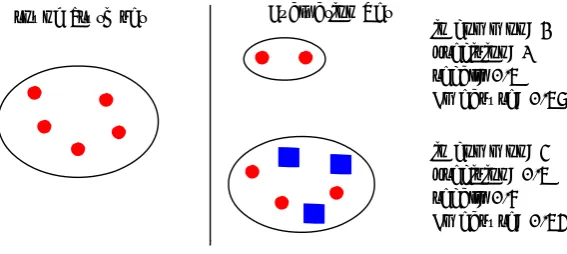
The most intuitive method is to simply match clusters on the number of names they have in common. Unfortunately this matching criterion favours recall over precision and it is arguable that it does not always select the best matching cluster (see figure 4.3).
An alternative proposed by Agarwal (Agarwal; 1995) uses F-measure to match clusters. This method selects clusters based on both precision and recall and does not favour one of them over the other (unless weighted F-measure is used). An example (figure 4.3) using the above described method is described below. Looking at this example it is evident that matching based on F-measure is more ‘honest’ than matching based on common names.
Using a method to match clusters and calculate precision and recall for each pair of clusters does not give a performance score for a single document. The most natural way is to average the scores for the individual clusters into single precision and recall scores. However, simply dividing the sum of the individual scores by the total number of clusters does not give a representative score. The reason is that small clusters contribute the same to the final score as large clusters while these have a higher probability of having lower scores (fails requirement 1). In this way document scores are higher than they should be. A solution is to multiply each cluster-score by the number of names in the cluster and in the end divide the sum of these scores by the total number of names data. In this way larger clusters contribute more to the final precision and recall scores.
A short preliminary study of the ground truth data showed that 2/3 of the clusters only has one name. Even though the final scores are normalized using the number of names within clusters the great number of one-name-clusters still has a big impact. Especially since the chance on mistakes in these small clusters is relatively low they are likely to raise the precision and recall scores. Hence not evaluating clusters with only one name will give more accurate scores. Mistakes made with these one-name-clusters will still be incorporated in the result since they have impact on longer clusters that are evaluated. In this way the disproportional influence of small clusters on the final scores is reduced while mistakes made within these clusters are still evaluated. This is the same as the notion of ‘critical’ anaphora proposed by Mitkov. Anaphora that are simple to solve can be left out of the evaluations leaving only the hard (critical) cases.
Ground Truth set Evaluation Set
Independent of the matching method used, there is always the possibility that clusters in either the ground truth data or evaluation set are not matched due to erroneously recognized names. Same as with the ‘name matching approach’ it is hard to predict how these clusters influence precision and recall. As proposed before, these mistakes should be measured separately.
The way to calculate precision and recall based on clusters is basically the same as the B-CUBED method proposed by Bagga et al. (Bagga and Baldwin; 1998a) and (Bagga and Baldwin; 1998b). The main commonality (and difference with the MUC method) is that the scores are weighted using the cluster size. In this way the drawbacks of the MUC method as described at the end of section 4.3.1 is omitted. Still the method described by Bagga et al. differs a bit from the proposed method. Firstly it does not describe the matching method(s) used to select clusters used to calculate precision and recall with. Secondly they do not describe special treatment of one-name-clusters.
4.4
Summary
A number of different evaluation metrics were described and evaluated using the requirements stated in section 4.1. The method that fulfilled all the requirements compares clusters of names in the ground truth data with clusters of names created by a co-reference resolution method. For each cluster of co-referential names in the ground truth data (called GT) the following is done:
1. Find the best matching cluster of names created by the co-reference method using the F-measure as criterion (this group is called CM). 2. Calculate the precision and recall scores of CM with respect to GT
(using the members of the two clusters).
- Precision: number of correct names in CM / total number of names in CM
- Recall: number of correct names in CM / total number of names in GT
3. These scores are weighted using the number of names in GT, groups with only 1 name are not used in the evaluation.
4. The final score is the sum of all the weighted scores divided by the total number of names in the ground truth data
There is a large probability that not all of the clusters found by co-reference resolution methods will be evaluated simply because they do not match a clusters in the ground truth data. These clusters will simply be counted separately and will be called ‘over complete clusters’.
5
Corpus creation
5.1
Introduction
The selected evaluation method described in chapter 4 compares co-referential names found by a method with co-co-referential names in the ground truth data. Unfortunately the correct data needed was not available (texts with annotated Dutch named entity co-references) and hence needed to be created.
This chapter describes the creation of a corpus that was used to evaluate both single- and cross-document co-reference resolution methods (described in chapters 7 and 8). This means that the ground truth data (in form of an annotated corpus) should contain cross-document named entity co-reference annotations. This makes the creation of such a corpus very hard; somehow it should be clear what names in the entire corpus are co-referential. Such a corpus did not yet exist for Dutch and hence it was needed to be built from scratch.
For evaluation purposes it was decided that the corpus should resemble the entire data set as closely as possible. The reason behind this decision was that the creation of a more general ‘named entity cross-document co-reference’ corpus would differ too much from annotations created by the NNER. That would make the corpus unsuitable for evaluation in this research.
To be able to train/tune and evaluate different methods on all the possible problems the corpus has to contain these problems:
• Similar names that refer to different NE’s • Different names that refer to the same NE
• Definite descriptions (which are often non-rigid designators)
The following set of requirements was used for the creation of this corpus: 1.