INTEGRATION OF UNCERTAIN REAL-TIME LOGISTICS DATA FOR REACTIVE SCHEDULING USING FUZZY SET THEORY
*K. Szczesny, and M. König Ruhr-Universität Bochum
Universitätsstraße 150 D-44780 Bochum, Germany
(*Corresponding author: [email protected]) L. Laußat,and M. Helmus
Bergische Universität Wuppertal Pauluskirchstr. 7 D-42285 Wuppertal, Germany
INTEGRATION OF UNCERTAIN REAL-TIME LOGISTICS DATA FOR REACTIVE SCHEDULING USING FUZZY SET THEORY
ABSTRACT
This paper considers the integration of uncertain real-time logistics data for reactive construction scheduling. In order to manage a construction project efficiently, an accurate schedule representing the current project progress is inevitable. The quality and up-to-dateness of such a schedule depends on the availability of real-time data. Typically, real-time logistics data contain information about the availability of material, equipment and personnel as well as delivery dates and site conditions. The accuracy and inherent uncertainty depends on the location where the real-time data was acquired. Currently, the integration of such data into a construction schedule is a very time-consuming, manual and, thus, error-prone process. Therefore, this paper proposes a methodology that enables an automatic integration of such uncertain data into construction schedules. By integrating uncertainties into the existing schedule their impacts on the construction work can be evaluated. For this, discrete event simulation is applied. In order to model uncertain input parameters for simulation models this methodology applies the fuzzy sets theory. In combination with alpha-cut sampling technique, discrete model input parameters are obtained. By applying reactive scheduling with several discrete event simulation experiments, the results can be used to modify construction schedules according to agreed timeframes and costs. In order to demonstrate and validate the presented approach an example is conducted.
KEYWORDS
Real-time logistics data, reactive construction scheduling, uncertainty modeling, fuzzy set theory, discrete event simulation
INTRODUCTION
The efficient execution and control of construction projects depends highly on the accuracy of the underlying construction schedules. In turn, the quality of construction schedules and their being up-to-date depends on the availability of real-time data. In general, up-to-date schedules must include current information about the overall construction progress, modified planning documents or available equipment. One crucial point is the gathering and evaluation of real-time data regarding their impact on the overall project progress. In practice, a lot of significant real-time data are increasingly logistics-related. Real-time logistics data contain information about available material, equipment and personnel as well as updated delivery dates and site conditions. In this context, Auto-ID techniques are appropriate methods to collect logistics data automatically. Biometrics and RFID are typical Auto-ID techniques that can be readily applied on construction sites and along the way towards the construction site. These data implicitly imply different types of uncertainties due to infrequent collections, varying transport times, or manual assumptions. By integrating uncertainties into the existing schedule their consequences on construction works can be evaluated. In this context, discrete event simulation is well suited. Generally, uncertain data can be expressed by probabilistic functions or fuzzy sets (Zadeh, 1965). The Fuzzy Theory is often applied if manual assumptions should be considered. The impact of disturbances or changed conditions can be analyzed by adding additional fuzzy constraints and performing several simulation experiments. Based on the simulation results the planned schedule can be modified to keep to the agreed timeframe and costs. The procedure is called reactive scheduling. Normally, the main goal is to repair the schedule in such a way that the original structure of the schedule is only changed as minimally as possible (van de Vonder et al., 2007). In this paper a concept is presented to integrate uncertain real-time logistics data into discrete event construction simulation model by using fuzzy sets. In this context the so-called alpha-cut sampling technique is used to investigate the impact of uncertainties on the simulation results.
RELATED WORK
In the manufacturing industry the acquisition of real-time data is often performed by Auto-ID techniques. Due to fixed production lines, identifiable resources, and detailed schedules the recorded real-time data can be clearly associated to activities of the planned scheduling. Furthermore, the measured data contains marginal uncertainties. Consequently, real-time data can be directly used to update the planned schedule (Hotz et al., 2006). In contrast, in civil engineering several concepts regarding the acquisition of real-time data by Auto-ID techniques were proposed just recently. Only a few early applications were implemented in practise. For example, in Cho et al. (2011) the authors investigated vertical resource transports on construction sites. Selected resources were labelled with RFID tags and the corresponding elevators were equipped with stationary reading devices. In Yin et al. (2009) the authors proposes another RFID-based production management system for a construction yard. Kim et al. (2009) developed a goods inward inspection on construction sites for prefabricated components and steelwork for bridge construction. In Ren et al. (2011) the authors propose an RFID-based controlling management for goods inward inspection and installation of tubes. In Ergen et al. (2007) the authors proposes a concept regarding intelligent building components. These components are capable of holding information about their status, assembly guide and maintenance information. However, uncertainties and the impacts on the schedule are not considered.
Regarding scheduling problems the general research literature is broader. Scheduling in presence of real-time data is referred to as dynamic scheduling (Ouelhadj & Petrovic, 2009). Generally, in the predictive-reactive scheduling approach the existing schedule is revisited in response to real-time data occurrence. The approach in the paper at hand is similar to the predictive-reactive approach. In Yu and Qi (2004) the authors propose an analytical concept to automatically adjust schedules. Their approach is based on linear programming and tries to minimize the deviation. This approach only takes single activities and the project duration into account. Van de Vonder et al. (2006) proposes plain heuristic procedures that may be used to repair the deviation between target-schedules and the actual-state schedules. The additional consideration of priorities or further time windows is possible. With the help of simple sampling methods different schedule alternatives may be generated. Quite straightforward construction processes and only a few resources were considered.
However, the application of discrete event simulation models is an established methodology for analysis and planning of processes. In Halpin (1977) and Tommelein et al. (1994) the first approaches regarding civil engineering are described. Domain specific construction processes, technological dependencies and resource requirements can be described by applying different modelling concepts. For example, Martinez (1998) developed a special-purpose simulation modeling tool for planning and estimating earth-moving operations. In Ruwanpura & AbouRizk (2001) the authors propose a special purpose tunnelling simulation tool. For the domain of tunneling, a demonstration of a methodology of how discrete event simulations and fuzzy expert systems can be integrated is given in Shaheen et al. (2009). Further, Kulejewski (2011) investigates how fuzzy numbers and alpha-cuts of a fuzzy number can be used to model imprecision of constraints. In this case alpha-cuts are used to assess a certain probability about the uncertainty regarding constraints. However, no consideration of real-time data is investigated. Nevertheless, the effort to model realistic and simulation models is very high. Because of this, in practise the application of simulation is not very common. Therefore recent research is investigating model driven simulation modeling. With the help of building information models (BIM) and knowledge-based methods semi-automatic model generation and adaption can be utilized (Wu et al., 2010; Xu et al., 2003).
REACTIVE SCHEDULING CONCEPT
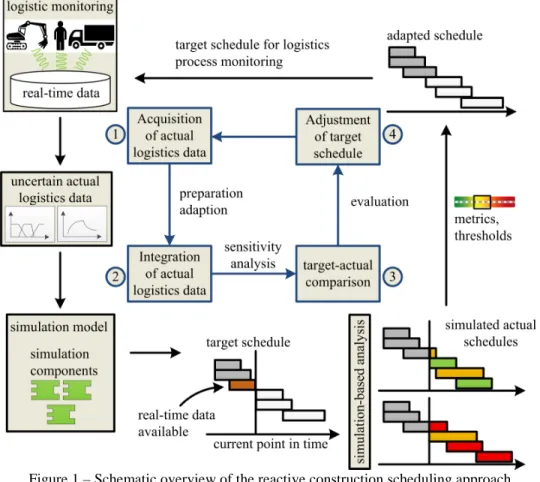
In this section a proposed reactive construction scheduling approach is presented in which real-time logistics data are considered for controlling and updating construction schedules. A schematic overview of this approach is illustrated in Figure 1. The concept consists of four steps according to the reactive scheduling concept. Firstly, the acquisition, preparation and adaption of real-time logistics data are performed. Typically, real-time logistics data contain information about the availability of material,
equipment and personnel as well as delivery dates and site conditions. The accuracy and inherent uncertainty depends on the location where the real-time data was collected. A typical data measurement point is a factory shipping area to get some information regarding predicted material delivery dates. Another measurement point is the personnel access on the construction site. The recorded data contain information about the personnel and their specific qualification. Subsequently, it is possible to calculate whether the required personnel for a certain activity are available. However, sometimes the collected data cannot be directly assigned to activities of the schedule because the date of measurement is way ahead of the planned execution date. In addition, manual assumptions or related uncertainties have to be taking into account. For example, the delivery date of material was specified to within the next five to ten days. Another example is that a diseased worker will appear in the next two days with a certain probability. As a result, there is a need to prepare the collected logistics data in a way that they can be used to predict possible delays. In this context fuzzy set theory is used model the uncertain logistics data for the reactive scheduling approach.
Figure 1 – Schematic overview of the reactive construction scheduling approach
In the next step, the prepared data is integrated into a construction simulation model by defining additional constraints for the involved activities. Therefore, a constraint-based simulation approach is used (König et al., 2007). This enables an automatic updating of the simulation model by adding real-time logistics constraints. The real-time logistics constraints are so-called early starting time constraints. That means that an associated activity cannot be executed earlier than the defined date. Due to the inherent uncertainty several earliest starting times have to be investigated. Consequently, a sensitivity analysis has to be performed. In this context, a sensitivity analysis is the study of how the uncertainty in the real-time logistics data affects the schedule and the project duration. The effects can be highlighted by target-actual-comparison. The concept how to compute input values representing real-time data by using fuzzy sets is highlighted in this paper. In the last step, the planned schedule should be updated, if crucial delays or other significant deviations were detected. For this, simulation-based optimization can be applied (Nguyen et al.,
2012). In this context, an important objective is to keep the modification as low as possible to avoid redisposing of personnel or equipment.
MODELING UNCERTAIN REAL-TIME LOGISTICS DATA
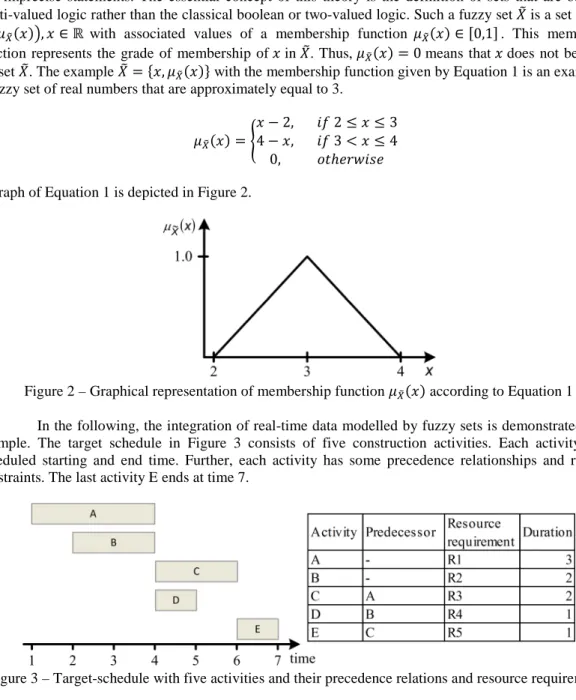
Several techniques exist to model and analyze uncertainties in model parameters, such as real-time data. One method is Monte-Carlo simulation that handles uncertain input parameters as random variables based on given probabilistic distributions. In this paper the fuzzy alpha-cut analysis based on fuzzy set theory is applied (Zadeh, 1965). The fuzzy set theory enables a formal description of uncertainty and imprecise statements. The essential concept of this theory is the definition of sets that are based on multi-valued logic rather than the classical boolean or two-valued logic. Such a fuzzy set is a set of pairs ,෨,∈ ℝ with associated values of a membership function ෨∈ 0,1. This membership
function represents the grade of membership of in . Thus, ෨= 0 means that does not belong to
the set . The example =,෨ with the membership function given by Equation 1 is an example of
a fuzzy set of real numbers that are approximately equal to 3.
෨=
− 2, 2 ≤≤ 3 4 −, 3 <≤ 4
0, ℎ
(1)
A graph of Equation 1 is depicted in Figure 2.
Figure 2 – Graphical representation of membership function ෨ according to Equation 1
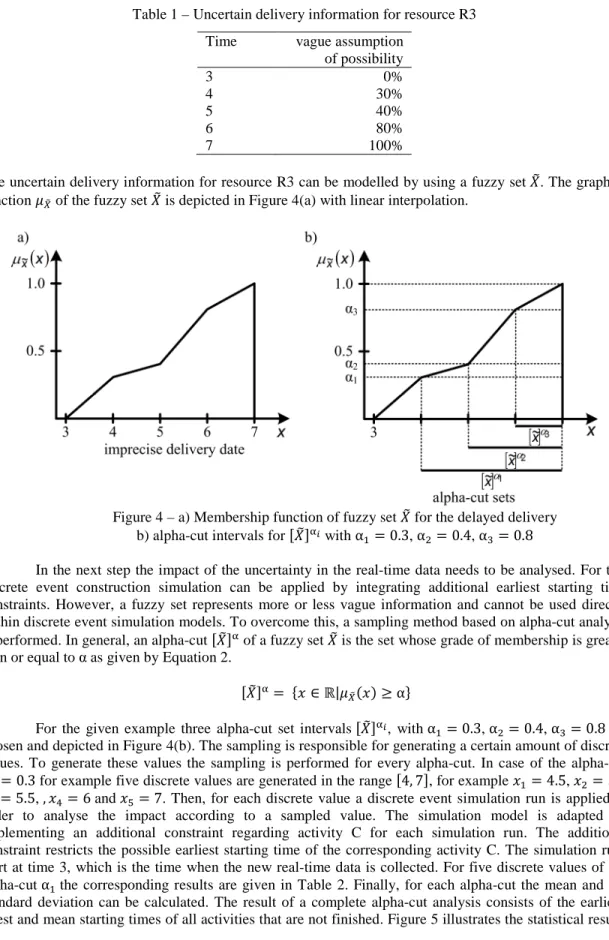
In the following, the integration of real-time data modelled by fuzzy sets is demonstrated by an example. The target schedule in Figure 3 consists of five construction activities. Each activity has a scheduled starting and end time. Further, each activity has some precedence relationships and resource constraints. The last activity E ends at time 7.
Figure 3 – Target-schedule with five activities and their precedence relations and resource requirements At time 3 new real-time logistic data is available. This data contains information about the delivery date of resource R3 that is required by activity C. The collected and manually prepared data is associated with certain uncertainties. In this example information about four possible delivery times and their probabilities are available. The delivery information is as stated in Table 1.
Table 1 – Uncertain delivery information for resource R3 Time vague assumption
of possibility 3 0% 4 30% 5 40% 6 80% 7 100%
The uncertain delivery information for resource R3 can be modelled by using a fuzzy set . The graph of function ෨ of the fuzzy set is depicted in Figure 4(a) with linear interpolation.
Figure 4 – a) Membership function of fuzzy set for the delayed delivery b) alpha-cut intervals for with α
ଵ= 0.3, αଶ= 0.4, αଷ= 0.8
In the next step the impact of the uncertainty in the real-time data needs to be analysed. For this discrete event construction simulation can be applied by integrating additional earliest starting time constraints. However, a fuzzy set represents more or less vague information and cannot be used directly within discrete event simulation models. To overcome this, a sampling method based on alpha-cut analysis is performed. In general, an alpha-cut
of a fuzzy set is the set whose grade of membership is greater than or equal to α as given by Equation 2.
= ∈ ℝ|෨≥ α (2)
For the given example three alpha-cut set intervals , with α
ଵ= 0.3, αଶ= 0.4, αଷ= 0.8 are
chosen and depicted in Figure 4(b). The sampling is responsible for generating a certain amount of discrete values. To generate these values the sampling is performed for every alpha-cut. In case of the alpha-cut
αଵ= 0.3 for example five discrete values are generated in the range 4, 7, for example ଵ= 4.5, ଶ= 5.0,
ଷ= 5.5, ,ସ= 6 and ହ= 7. Then, for each discrete value a discrete event simulation run is applied in
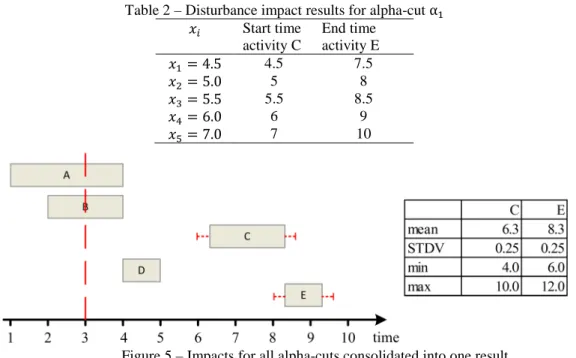
order to analyse the impact according to a sampled value. The simulation model is adapted by implementing an additional constraint regarding activity C for each simulation run. The additional constraint restricts the possible earliest starting time of the corresponding activity C. The simulation runs start at time 3, which is the time when the new real-time data is collected. For five discrete values of the alpha-cut αଵ the corresponding results are given in Table 2. Finally, for each alpha-cut the mean and the
standard deviation can be calculated. The result of a complete alpha-cut analysis consists of the earliest, latest and mean starting times of all activities that are not finished. Figure 5 illustrates the statistical results
for 1.000 simulation experiments. The mean starting and thus the ending time of activity C are delayed in such a way that the succeeding activities, such as activity E, are delayed with high probability.
Table 2 – Disturbance impact results for alpha-cut αଵ
Start time activity C End time activity E ଵ= 4.5 4.5 7.5 ଶ= 5.0 5 8 ଷ= 5.5 5.5 8.5 ସ= 6.0 6 9 ହ= 7.0 7 10
Figure 5 – Impacts for all alpha-cuts consolidated into one result CONCLUSIONS AND OUTLOOK
In this research a concept for real-time logistics data integration into simulation models regarding construction scheduling was presented. The aim of this concept is to close the gap between already existing simulation models, which do not consider information about time data, and recorded but unused real-time data. To achieve this purpose the existing simulation model was adapted. In this adapted model, the information about real-time data regarding construction processes were modeled as additional constraints. Then, these constraints were attached to the associated construction processes. A hypothetical target-schedule was used to demonstrate the application of this approach. The results clearly show that the integration and consideration of recorded uncertain real-time data performs well. However, further research and development of the later stages of the proposed approach is required. For this, the results generated with the assistance of the stage presented in this work will be used as input to be processed by succeeding stages, like simulation-based comparison or schedule adjustment.
ACKNOWLEDGEMENTS
The authors gratefully acknowledge funding from the German Research Foundation DFG under grant number KO-3473/4-1 and HE-2697/10-1.
REFERENCES
Cho, C-Y., Kwon, S., Shin, T-H., Chin, S., & Kim Y-S. (2011). A development of next generation intelligent construction liftcar toolkit for vertical material movement management. Automation in Construction, 20(1), 14-27. doi: 10.1016/j.autcon.2010.07.008
Ergen, E., Akinci, B., & Sacks, R. (2007). Tracking and locating components in a precast storage yard utilizing radio frequency identification technology and GPS. Automation in Construction, 16(3), 354-367. doi: 10.1016/j.autcon.2006.07.004
Halpin, D. W. (1977). CYCLONE – Method for Modeling Job Site Processes. Journal of the Construction Division, 103(3), 489-499.
Hotz, I., Hanisch, A., & Schulze, T. (2006). Simulations-based early warning systems as a practical approach for the automotive industry. In Perrone, L. L., Wieland, F. P., Liu, J., Nicol, D. M., &Fujimoto R. M. (Eds.), Proceedings of the 2006 Winter Simulation Conference (pp. 1962-1970). Monterey, CA, USA
Kim, C., Ju, Y., Kim, H., & Kim J-H. (2009). Resource Management in Civil Construction Using RFID Technologies. 26th International Symposium on Automation and Robotics in Construction (pp. 105-108). Austin, TX
König, M., Beißert, U., Steinhauer, D., & Bargstädt, H.-J. (2007). Constraint-Based Simulation of Outfitting Processes in Shipbuilding and Civil Engineering. Proceedings of the 6th EUROSIM Congress on Modeling and Simulation. Ljubljana, Slovenia
Kulejewski, J. (2011). Construction project scheduling with imprecisely defined constraints. In Wamelink, J.W.F., Geraedts, R. P., Volker L. (Eds.), Proceedings of the CIB International Conference Management and Innovation for a Sustainable Built Environment. Delft, The Netherlands Nguyen, V. V., Hartmann, D., & König, M. (2012). A distributed agent-based approach for
simulation-based optimization. Advanced Engineering Informatics 26(4), 814-832. doi: 10.1016/j.aei.2012.06.001
Martinez, J. C. (1998). EarthMover-simulation tool for earthwork planning. In Medeiros, D. J., Watson, E. F., Carson, J.S., & Manivannan, M. S. (Eds.), Proceedings of the 1998 Winter Simulation Conference (pp. 1263-1271). Washington, DC, USA
Ouelhadj, D., Petrovic, S. (2009). Survey of Dynamic Scheduling in Manufacturing Systems. Journal of Scheduling, 12(4), 417-431. doi: 10.1007/s10951-008-0090-8
Ren, Z., Anumba, C. J., & Tah, J. (2011). RFID-facilitated construction materials management (RFID-CMM) – A case study of water-supply project. Advanced Engineering Informatics, 25(2), 198-207. doi: 10.1016/j.aei.2010.02.002
Ruwanpura, J. Y. & AbouRizk, S. M. (2001). Design, development and application of soil transition algorithms for tunneling using special purpose simulation. In Peters, B. A., Smith, J. S., Medeiros, D. J., & Rohrer, M. W. (Eds.). Proceedings of the 2001 Winter Simulation Conference (1512-1520). Washington, DC, USA
Shaheen, A. A., Fayek, A. R., AbouRizk, S. M. (2009). Methodology for integrating fuzzy expert systems and discrete event simulation in construction engineering. Canadian Journal of Civil Engineering, 36(9), 1478-1490. doi: 10.1139/L09-091
Tommelein, I. D., Carr, R. I., & Odeh, A. M. (1994). Assembly of Simulation Networks Using Designs, Plans, and Methods. Journal of Construction Engineering and Management, 120(4), 796-815. doi: 10.1061/(ASCE)0733-9364(1994)120:4(796)
van de Vonder, S., Demeulemeester, E., Leus, R., & Herroelen, W. (2006). Proactive-Reactive Project Scheduling Trade-Offs and Procedures. In Perspectives in Modern Project Scheduling,
Józefowska, J. & Weglarz, J. (Eds.), International Series in Operations Research & Management Science (pp. 25-51). Springer US
van de Vonder, S., Ballestín, F., Demeulemeester, E., & Herroelen, W. (2007). Heuristic procedures for reactive project scheduling. Computers and Industrial Engineering, 52(1), 11-28. doi:
10.1016/j.cie.2006.10.002
Wu, I., Borrmann, A., Beißert, U., König, M., & Rank, E. (2010). Bridge construction schedule generation with pattern-based construction methods and constraint-based simulation. Advanced Engineering Informatics, 24(4), 379–388. doi: 10.1016/j.aei.2010.07.002
Xu, J., AbouRizk, S., & Frazer, C. (2003). Integrated three-dimensional computeraided design and discrete-event simulation models. Canadian Journal of Civil Engineering 30(2), 449–459. doi: 10.1139/l02-110
Yin, S., Tserng, H., Wang, J. C., & Tsai, S. C. (2009). Developing a precast production management system using RFID technology. Automation in Construction, 18(5), 677-691. doi:
10.1016/j.autcon.2009.02.004
Yu, G., & Qi, X. (2004). Disruption management: Framework, models and applications. Singapore, River Edge, NJ: World Scientific
Zadeh, L. A. (1965). Fuzzy sets. Information and Control, 8(3), 338-353. doi: 10.1016/S0019-9958(65)90241-X