Consumer Behavior Analysis
Consumption is the primary economic a We are consumers, not producers. Con heterodox marketing scholarship and i with much to offer both constituencies. behavior analysis fi ts within a larger-scal psychology, behavior analysis and org Describing both theoretical analyses and
ctivity in our post-industrial society. sumer behavior analysis is leading nnovative applied behavioral work, This volume shows how consumer e approach to marketing, consumer anizational behavior management. empirical studies including labora-tory experiments in e-commerce, in-store experiments in grocery shopping, and an analysis of the counterfeit goods market, this book is a working example of translational research. It contains tools and studies to help under-stand contemporary consumer behavior, particularly for those in marketing. Scholars will appreciate the theory and real-world applications evident in each chapter when considering their own research direction. All students of marketing theory, behavior analysis and consumer choice will fi nd this col-lection a thought-provoking tool for further understanding of a new behav-ioral approach to marketing strategy, consumer decisions and marketing fi rms.
This book comprises articles originally published in the Journal of Organizational Behavior Management
and others written for this volume.
Donald A. Hantula is an organizational psychologist, Associate Professor of Psychology, member of the Interdisciplinary Masters Program in Applied Behavior Analysis and Director of the Decision Laboratory at Temple University, USA.Victoria K. Wells is Senior Lecturer in Marketing at Durham Business School at the University of Durham, UK. Previously she was a Research Associate and Lecturer in Marketing and strategy at Cardiff Business School, UK. She has also worked in industry as an Account Executive in marketing communications.
Consumer Behavior Analysis
(A) Rational Approach to Consumer Choice
Edited by
Donald A. Hantula and Victoria K. Wells
Routledge
Taylor & Francis C roup L O N D O N A N D NEW YORK
First published 2013 by Routledge
2 Park Square, Milton Park, Abingdon, Oxon, OX14 4RN Simultaneously published in the USA and Canada by Routledge
711 Third Avenue, New York, NY 10017
Routledge is an imprint of the Taylor & Francis Group, an informa business
© 2013 Taylor & Francis
This book is a reproduction of articles fi rst published in the Journal of Organizational Behavior Management. The Publisher requests to those authors who may be citing this book to state, also, the bibliographical details of the special issue on which the book was based, as per the Citation Information page.
All rights reserved. No part of this book may be reprinted or reproduced or utilised in any form or by any electronic, mechanical, or other means, now known or hereafter invented, including photocopying and recording, or in any information storage or retrieval system, without permission in writing from the publishers.
Trademark notice: Product or corporate names may be trademarks or registered trademarks, and are used only for identifi cation and explanation without intent to infringe.
British Library Cataloguing in Publication Data
A catalogue record for this book is available from the British Library ISBN13: 978-0-415-51920-5
Typeset in Garamond
Publisher’s Note
The publisher would like to make readers aware that the chapters in this book may be referred to as articles as they are identical to the articles published in the special issue. The publisher accepts responsibility for any inconsistencies that may have arisen in the course of preparing this volume for print.
v
Contents
Citation Information vii
1. Introduction: The Analysis of Consumer Behavior 1 Victoria K. Wells and Donald A. Hantula
Part I: Theoretical and Conceptual Issues in Consumer
Behavior Analysis 11
2. Invitation to Consumer Behavior Analysis 13
Gordon R. Foxall
3. Implications of Motivating Operations for the Functional
Analysis of Consumer Choice 31
Asle Fagerstrøm, Gordon R. Foxall and Erik Arntzen
4. On the Evolutionary Bases of Consumer Reinforcement 48 Michael Nicholson and Sarah Hong Xiao
5. Organizational Performance and Customer Value 66 Donald Tosti and Scott A. Herbst
Part II: Empirical Research in Consumer Behavior Analysis 87 6. A Prompting Procedure for Increasing Sales in a
Small Pet Store 89
Jacqueline Milligan and Donald A. Hantula
7. Substitutability and Independence: Matching Analyses of
Brands and Products 97
Gordon R. Foxall, Victoria K. Wells, Shing Wan Chang and Jorge M. Oliveira-Castro
vi
8. Consumer Brand Choice: Money Allocation as a Function
of Brand Reinforcing Attributes 113
Jorge M. Oliveira-Castro, Gordon R. Foxall and Victoria K. Wells
9. Market Segmentation From a Behavioral Perspective 128 Victoria K. Wells, Shing Wan Chang,
Jorge M. Oliveira-Castro and John Pallister
10. The Motivating Effect of Antecedent Stimuli on the Web Shop: A Conjoint Analysis of the Impact of
Antecedent Stimuli at the Point of Online Purchase 151 Asle Fagerstrøm
11. The Effects of a Point-of-Purchase Display on
Relative Sales: An In-Store Experimental Evaluation 173 Valdimar Sigurdsson, Halldor Engilbertsson and Gordon R. Foxall 12. In-Store Experimental Approach to Pricing and
Consumer Behavior 185
Valdimar Sigurdsson, Gordon R. Foxall and Hugi Saevarsson 13. Trick or Treat? An Examination of Marketing Relationships
in a Nondeceptive Counterfeit Market 198
Sarah Hong Xiao and Michael Nicholson
14. From Job Analysis to Performance Management: A Synergistic
Rapprochement to Organizational Effectiveness 222 Charles R. Crowell, Donald A. Hantula and Kari L. McArthur
15. From Producers to Consumers: A Research Agenda for
Consumer Behavior Analysis 239
Donald A. Hantula
Index 253
vii
Citation Information
The following chapters were originally published in the Journal of Organizational Behavior Management. When citing this material, please use the original issue information and page numbering for each article, as follows:
Chapter 2
Invitation to Consumer Behavior Analysis Gordon R. Foxall
Journal of Organizational Behavior Management, volume 30, issue 2 (2010) pp. 92-109
Chapter 3
Implications of Motivating Operations for the Functional Analysis of Consumer Choice
Asle Fagerstrøm, Gordon R. Foxall and Erik Arntzen
Journal of Organizational Behavior Management, volume 30, issue 2 (2010) pp. 110-126
Chapter 4
On the Evolutionary Bases of Consumer Reinforcement Michael Nicholson and Sarah Hong Xiao
Journal of Organizational Behavior Management, volume 30, issue 2 (2010) pp. 127-144
Chapter 5
Organizational Performance and Customer Value Donald Tosti and Scott A. Herbst
Journal of Organizational Behavior Management, volume 29, issues 3-4 (2009) pp. 294-314
viii Chapter 6
A Prompting Procedure for Increasing Sales in a Small Pet Store Jacqueline Milligan and Donald A. Hantula
Journal of Organizational Behavior Management, volume 25, issue 3 (2005) pp. 37-44
Chapter 7
Substitutability and Independence: Matching Analyses of Brands and Products
Gordon R. Foxall, Victoria K. Wells, Shing Wan Chang and Jorge M. Oliveira-Castro
Journal of Organizational Behavior Management, volume 30, issue 2 (2010) pp. 145-160
Chapter 8
Consumer Brand Choice: Money Allocation as a Function of Brand Reinforcing Attributes
Jorge M. Oliveira-Castro, Gordon R. Foxall and Victoria K. Wells Journal of Organizational Behavior Management, volume 30, issue 2 (2010) pp. 161-175
Chapter 9
Market Segmentation From a Behavioral Perspective
Victoria K. Wells, Shing Wan Chang, Jorge M. Oliveira-Castro and John Pallister
Journal of Organizational Behavior Management, volume 30, issue 2 (2010) pp. 176-198
Chapter 10
The Motivating Effect of Antecedent Stimuli on the Web Shop: A Conjoint Analysis of the Impact of Antecedent Stimuli at the Point of Online Purchase
Asle Fagerstrøm
Journal of Organizational Behavior Management, volume 30, issue 2 (2010) pp. 199-220
Chapter 11
The Effects of a Point-of-Purchase Display on Relative Sales: An In-Store Experimental Evaluation
Valdimar Sigurdsson, Halldor Engilbertsson and Gordon R. Foxall Journal of Organizational Behavior Management, volume 30, issue 3 (2010) pp. 222-233
ix Chapter 12
In-Store Experimental Approach to Pricing and Consumer Behavior Valdimar Sigurdsson, Gordon R. Foxall and Hugi Saevarsson
Journal of Organizational Behavior Management, volume 30, issue 3 (2010) pp. 234-246
Chapter 13
Trick or Treat? An Examination of Marketing Relationships in a Nondeceptive Counterfeit Market
Sarah Hong Xiao and Michael Nicholson
Journal of Organizational Behavior Management, volume 30, issue 3 (2010) pp. 247-270
Chapter 14
From Job Analysis to Performance Management: A Synergistic Rapprochement to Organizational Effectiveness
Charles R. Crowell, Donald A. Hantula and Kari L. McArthur
Journal of Organizational Behavior Management,
volume 31, issue 4
(2011
) pp. 316-332Introduction: The Analysis of
Consumer Behavior
VICTORIA K. WELLS
Durham University Business School, Durham University
DONALD A. HANTULA
Temple University, USA
The chapters in this book refl ect the development of, and current thinking in Consumer Behavior Analysis (CBA) which stands at the intersection between behaviour analysis, consumers and organizations. First presented in a special issue and in a later special section of the Journal of Organisational Behavior Management in 2010, the papers reproduced as chapters in this volume along-side three other relevant recent papers also published in the Journal of Organisational Behavior Management (JOBM) are a collection of contempo-rary research and theory in CBA. This volume represents an expansion of the Organizational Behavior Management (OBM) model from its largely manage-ment-centered employee behavior focus to include explicitly the behavior of consumers of the goods and services that these employees make and provide.
Behavior analysis and consumer behavior share a long history since the fi rst applications of behavioral psychology in industry, as exemplifi ed by Watson’s work in the early 20th century (DiClemente & Hantula, 2000) and more contemporaneously the application of behavior analytic principles to marketing, consumer choices. Changing individual consumer behavior has long been part of applied behaviour analysis (DiClemente & Hantula, 2003). Indeed, some of this behavior analytic work has appeared in the pages of a number of marketing journalsover the years such as the Journal of Advertising Research (Lindsley, 1962), Journal of Marketing (Nord & Peter, 1980; Peter & Nord, 1982), Journal of Consumer Research (Janizewski & Warlop, 1993) and Psychology & Marketing (Till, Stanley, & Priluck, 2008).
Organizational Behavior Management emerged in parallel, with initial studies in the 1960s and 1970s establishing it as a discipline in its own right by the 1980s and developing further in the ensuing years (Dickinson, 2000). OBM is an applied science that recognizes that “behaviour is an import ele-ment of what ultimately counts as performance in organizations” (Mawhinney, 2000, p. 7). OBM applies psychological principles of organizational behavior and the experimental analysis of behavior to organizations to improve indi-vidual and group performance and worker safety. A review of JOBM articles published from 1987–1997 point noted that the top three problems addressed were productivity and quality, customer satisfaction, and training and devel-opment (Nolan, Jarema, & Austin, 1999), with customer satisfaction being of most interest to the present edited collection.
Consumers are an important part of the organization, and hence fall under the realm of OBM. While customer satisfaction has been of interest to those in OBM, a more comprehensive approach, taking into account a wider appreciation of this has not been championed. A range of journal articles have been published bringing together OBM and consumer behavior analy-sis and include work on brand preference (Martinko, 1987), the use of prompts and suggestive selling (Ralis & O’Brien, 1986; Martinko, White, & Hassell, 1989; Johnson & Masotti, 1990; Ebster, Wagner, & Valis, 2006; Milligan & Hantula, 2005 (the latter is reproduced in this volume)), performance feed-back and social reinforcement (Weisman, 2006), theft reduction (Carter & Holmberg, 1992) and sales management (Martinko, Caset, & Fadil, 2001).
However, a thoroughgoing behavioral analysis of consumer choice, behavior, and marketing was lacking until a number of researchers turned their attention to developing Consumer Behavior Analysis (CBA) from the late 1990s. Those new to the area may fi nd a defi nition of CBA useful. Consumer Behavior Analysis is a synthesis of behavioral economics and psy-chology with the real world complexities of consumer choice in a marketing-oriented economy (Foxall, 2001). CBA adds to work in behavioral economics by combining it with marketing science, the empirical study of patterns of consumer choice in affl uent, marketing oriented economies. Studies of choice inspired by Herrnstein’s (1961) matching law and Hursh’s (1980) extension to analyses of substitutability and complementarity within behav-ioral economics provided fi rm grounding for a theoretically rich behavbehav-ioral analysis of consumer behavior. An article by Foxall (1998b) offered a radical behaviorist interpretation of consumer behavior called the Behavioral Perspective Model (BPM). A chapter by Hantula, DiClemente, and Rajala (2001) introduced the Behavioral Ecology of Consumption and brought con-cepts and methods from work in Foraging Theory (Stephens & Krebs, 1986) and matching theory into the analysis of consumer behavior. Further theo-retical grounding was also provided in an inaugural essay at the beginning of the Millennium (Foxall, 2001), and research to that point was extensively reviewed in the three volumes of Consumer Behaviour Analysis: Critical
CONSUMER BEHAVIOR ANALYSIS
Perspectives in Business and Management (Foxall, 2002). These initial forays into CBA were then followed by a number of articles expanding the scope of the area (for example see Foxall & James, 2001, 2003; DiClemente and Hantula, 2003; Romero, Foxall, James, & Schrezenmaier, 2006; Foxall, Oliveira-Castro, James, & Schrezenmaier, 2006, 2007). These supplied a solid conceptual foundation for the more complex empirical and theoretical anal-yses presented in these pages.
While the synthesis of OBM and consumer behavior noted above has touched upon some aspects of marketing science it covers only a small range of its applications theories and approaches. Consumer Behavior Analysis has sought to explore and explain a much wider range of marketing theory and strategy. Marketing uses the analogy of the 4Ps or the marketing mix (fi rst developed by McCarthy, 1960): Product, Price, Place and Promotion to highlight the four key controllable factors that marketers have at their disposal and which must be determined taking into account the uncontrol-lable factors such as the existing business situation and external infl uences (for example: government policy and social and cultural elements). Consumer Behavior Analysis has explored all 4Ps, to differing extents. The majority of its work has concentrated on the P of product, the central focus of market-ing, as without the product there is no need for any of the other elements. Aspects of product that have been studied from a product perspective include brand and product choice, multibrand purchasing, substitutes and comple-ments, product formulation, repeat purchasing, product differentiation (Foxall & James, 2003; Foxall, Oliveira-Castro, James, & Schrezenmaier, 2006; Oliveira-Castro, Foxall, & Schrezenmaier, 2006; Oliveira-Castro, Foxall, James, Roberta, Pohl, Dias, & Chang, 2008) and brands and branding (Oliveira-Castro, Foxall, Yan & Wells, in press). The effects of price have been studied by the exploration of retail prices (Oliveira-Castro, Foxall, & Schrezenmaier, 2007; Oliveira-Castro, Foxall, & James, 2008; Sigurdsson, Foxall, & Saevarsson, this book; Smith & Hantula, 2008). Place and Promotion have been explored more recently including work exploring retail choice (James, 2009; James & Foxall, 2010), situational infl uences (Foxall, Yan, Wells, & Oliveira-Castro, 2012), online environments (Fagerstrøm, this book; Hantula, Brockman, & Smith, 2008) and point of purchase display (Sigurdsson, Engilbertsson, & Foxall, this book).
CBA also seeks to go beyond the 4Ps conceptual framework and has explored different types of marketing including social marketing (Foxall, Oliveira-Castro, James, Yani-de-Soriano, & Sigurdsson, 2006), services mar-keting (Wells & Foxall, 2011), marmar-keting strategy (segmentation in particular, see Wells, Chang, Oliveira-Castro, & Pallister, this book) and consumer mis-behavior (the purchase of counterfeit products in particular, see Xiao & Nicholson, this book).
Consumer behavior analysis represents a truly interdisciplinary approach to consumer choice and marketing science, as can be seen by the author
CONSUMER BEHAVIOR ANALYSIS
affi liations contained in this book which include business schools, psychol-ogy departments and technolpsychol-ogy schools. CBA also celebrates a diversity of viewpoints. It is not, and has not been developed to be, an attempt to assert the importance of behavioral psychology to the exclusion of cognitive or other perspectives on consumer choice which are considerably more common in the marketing science literature. In fact, Foxall (2001) states that a central component of CBA and in particular the BPM, is to use competing concurrent theories of behavior as standpoints from which to critique one another. Recent theoretical work has emphasized this broader theoretical perspective (Foxall et al., 2007; Hantula, 2012). Indeed a number of the chapters within the volume also actively and directly compare, contrast and in some cases integrate with existing conventional wisdom in their respective areas.
The majority of the chapters within this book come directly from, or were inspired by, the 1st International Symposium on Consumer Behavior Analysis which was held in Cardiff, UK in September 2007 and organized by the Cardiff Business School Consumer Behavior Analysis Research Group (CBARG). Behavior analysts and marketing scientists came together to share perspectives, methodologies and data. What emerged from this meeting was a clear consensus that Consumer Behavior Analysis is at the leading edge of innovative behavioral work and heterodox marketing scholarship, with much to offer both constituencies. As noted, the papers were then published as a special issue and a special section of JOBM in 2010 (Volume 30, 2/3). These papers are reproduced as chapters in this volume. Three other papers, all also published in JOBM, are also included within the volume to widen the scope of the book and to highlight other research currently taking place within the OBM and CBA intersection. These papers are interspersed in the relevant sections below.
THEORETICAL AND CONCEPTUAL ADVANCES IN
CONSUMER BEHAVIOR ANALYSIS
The fi rst four chapters of the book explore current theoretical and conceptual approaches to the area of consumer behavior analysis. The fi rst full chapter in this volume provides a background and introduction to the underpinning, evo-lution and extension of the BPM, a model of consumer behavior based initially on radical behaviorism and asks whether this approach is a feasible and accept-able alternative to the cognitive stance taken by the majority of consumer psy-chologists and researchers. It explores facets of the research programs, many of which are taken further and studied conceptually and empirically in chapters within the book and have been discussed briefl y already.
The second chapter by Fagerstrøm, Foxall and Arntzen, extends Agnew’s (1998) analysis of the establishing operation in OBM by integrating Motivating
CONSUMER BEHAVIOR ANALYSIS
Operations (MO) with the consumer behavior setting aspect of the BPM. The chapter continues in the Watsonian tradition and provides a behavioral approach to the understanding of motivation of consumers and distinguishes between many different types of MOs, and aligned areas (for example dis-criminative stimuli, value and behavior altering effects, conditioned MOs and rule governed behavior), many of which have not been explored fully in relation to consumer research.
The third conceptual chapter by Nicholson and Xiao draws on evolu-tionary psychology and behavioral-ecological frameworks in order to inter-pret both general reinforcement and the bifurifi cation of reinforcement suggested by the BPM. In keeping with the grounding in evolution advanced by the Behavioral Ecology of Consumption (Hantula, et al., 2001), they advo-cate a consumer behavior analysis informed by evolutionary theory, expanding inquiry beyond proximal causes to more distal causes of behavior.
The fourth conceptual chapter by Tosti and Herbert was published in JOBM in 2009, as the special issue on which this book is based, was being created. This chapter highlights an assessment of the relationship between consumer and organizational practices. It applies a behavioral systems approach building on the work of Krapf and Gasparotto (1982) and Brethower (2000) to discuss the behavioral characteristics of a customer centered organ-ization with the consumer as an important stakeholder.
EMPIRICAL RESEARCH IN CONSUMER BEHAVIOR ANALYSIS
Field research has been a hallmark of both organizational behavior manage-ment and consumer analysis from their inceptions and is also a vital part of the consumer behavior analysis stream of research. Empirical research in general can utilize many different methodologies. This is no difference in the study of consumer behavior analysis where a number of approaches have been used and are refl ected in the chapters of this section.
The fi rst chapter within this section includes a paper from JOBM pub-lished in 2005. This paper (Milligan & Hantula, 2005) experiments with sug-gestive selling through a simple prompting procedure in a small business. By modifying a key employee behavior the study had a signifi cant effect on customer behavior within the store resulting in a fourfold increase in sales by the end of the year and became one of the earliest papers to test the realm of OBM research and application within a consumer environment. This paper represents an early ‘full circle’ approach of managing and meas-uring both employee and consumer behavior within the OBM paradigm, and using consumer behavior as the dependent variable to index the effects of changes in employee behavior in a live store environment.
The next three chapters in this section utilize secondary consumer panel data building on a range of earlier studies (e.g. Foxall & James, 2003; Romero,
CONSUMER BEHAVIOR ANALYSIS
Foxall, Schrezenmaier, Oliveira-Castro, & James, 2006; Oliveira-Castro, Foxall, James, Roberta, Pohl, Dias, & Chang, 2008). The fi rst of these uses matching theory which represents perhaps the most well-developed and quantitatively sophisticated research stream in behavior analysis. Foxall, Wells, Chang and Oliveira-Castro in their chapter on substitutability and independence use a matching analyses approach to explore the behavior of consumers with regards choices at product and brand level and their reac-tions to price, extending earlier work in the area. In the second chapter based on secondary data Oliveira-Castro, Foxall and Wells also utilize the matching law but adapt its parameters including the three types of conse-quences (utilitarian, informational and aversive) proposed by the BPM. The third chapter based on secondary data extends into marketing strategy and one of its central concepts of segmentation. Wells, Chang, Oliveira-Castro and Pallister present a consumer behavior analytic approach to segmentation incorporating aspects of the BPM. The chapter segments consumers via their choices of products that demonstrate differing levels and combinations of utilitarian and informational reinforcement. The proposed segmentation base of the BPM is also contrasted with and explored alongside more traditional demographic variables. All three chapters use a very large sample of con-sumers buying fast moving consumer goods, those products purchased often and generally in a supermarket environment, for example with as many as 75,847 single purchases for cookies within the dataset. The fi rst and last chapters in this section use the purchase of cookies as their focus while the second paper (Oliveira-Castro et al.) uses four product categories (cookies, yellow fats (butter, margarine etc), fruit juice and baked beans).
The next chapter, by Fagerstrøm, uses an experimental methodology to explore online shopping, part of the place aspect of marketing. Online shop-ping was among the fi rst consumer setting used for theoretically-driven work in consumer behavior analysis (e.g., Rajala & Hantula, 2000), and remains a well-used test bed for empirical investigations. Fagerstrøm’s chapter contin-ues in this line of research by exploring the applicability of the MO concept (Agnew, 1998) to online shopping through an empirical study using conjoint analysis, building on the earlier chapter by Fagerstrøm, Foxall and Arntzen. A range of antecedent stimuli are used (for example stock level, price, reviews, order confi rmation procedures and donations to charity) and are manipulated to explore what motivates consumers during online purchase, especially in terms of the completion of their purchases.
The next two chapters also use experimental approaches but extend this work into the live store environments studying real consumers and their purchases. The fi rst chapter, by Sigurdsson, Engilbertsson and Foxall, explores the effects of point of purchase displays on unit sales while the second chapter, by Sigurdsson, Foxall and Saevarsson, explores the effects of price changes. In some cases prices were altered by as much as 25%.
CONSUMER BEHAVIOR ANALYSIS
Both studies showed unanticipated results and effects on unit sales and the chapters include detailed discussion of the usefulness and role of behavioral experimentation techniques within the research wider program.
The penultimate empirical chapter highlights how methodological pluralism has been an important feature that distinguishes CBA research from “applied behavior analysis” in general. The chapter, by Xiao and Nicholson, takes a more practical approach presenting a behavioral analysis of counterfeit good marketing fi rms in China. Using multiple data sources, and methodologies, this chapter draws on Foxall’s (1998a) idea of the mar-keting fi rm, another extension of the BPM research program, and discusses the various reinforcement types in action in relationships between buyers and sellers.
The fi nal empirical chapter was published in JOBM in 2011, a year after the special issue on which this book is based. This chapter (Crowell, Hantula, & McArthur, 2011) highlights how OBM research and procedures can incorporate tools from Industrial and Organizational Psychology (IOP) to achieve an effective and valid organizational improvement strategy aimed at increasing customer satisfaction through task clarifi cation, feedback, praise, selection, job performance criteria and interventions to improve employee behaviors. Once again, consumer behavior was employed as the dependent variable to measure the impact of interventions designed to change critical employee behaviors. The chapter reports on a case study of this approach for a service technician post resulting in signifi cant improvements in cus-tomer satisfaction.
THE FUTURE
The concluding chapter in the volume brings together and summarizes the state of consumer behavior analysis, showcasing past publications in JOBM and highlighting the key features and developments in the area, including noting a recent special issue of the Service Industries Journal (Wells & Foxall, 2011) as well as proposing a future research agenda. It is clear that the chap-ters in this book provide empirical, methodological and theoretical bases for a more explicit inclusion of behavior analysis principles in consumer behav-ior and marketing work and the fi nal chapter provides an agenda to do this further. This work has reached an exciting time and is at a signifi cant devel-opment point. Building on initial investigations and offerings, in 2001, Foxall described CBA as enjoying its inaugural phase. A decade later CBA has grown in its scope and popularity attracting researchers from mainstream marketing and behavior analysis allowing depth and breadth in its range of applications and areas of inquiry. This book highlights many of these devel-opments and positions them for future expansion.
CONSUMER BEHAVIOR ANALYSIS
REFERENCES
Agnew, J. L. (1998). The establishing operation in organizational behavior manage-ment. Journal of Organizational Behavior Management, 18, 7–19.
Brethower, D. (2000). Integrating theory, research and practice in human perfor-mance technology. Performance Improvement, 39(4), 33–43.
Carter, N., & Holmberg, B. (1992). Theft reduction in a grocery store through product identifi cation. Journal of Organizational Behavior Management, 13, 129–135.
Crowell, C. R., Hantula, D. A., & McArthur, K.L. (2011). From job analysis to perfor-mance management: A synergistic rapprochement to organizational effective-ness. Journal of Organizational Behavior Management, 31, 316–332.
DiClemente, D. F., & Hantula, D. A. (2000). John Broadus Watson: I/O psychologist. The Industrial Psychologist, 37, 47–55.
DiClemente, D. F., & Hantula, D. A. (2003). Applied behavioral economics and consumer choice. Journal of Economic Psychology, 24, 589–602.
Dickinson, A. C. (2000). The historical roots of organizational Behavior Management in the Private Sector: the 1950s–1980s. Journal of Organizational Behavior Management, 20(3/4), 9–58.
Ebster, C., Wager, U., & Valis, S. (2006). The effectiveness of verbal prompts on sales. Journal of Retailing and Consumer Services, 13(3), 169–176.
Foxall, G. R. (1998a). The marketing fi rm. Journal of Economic Psychology, 20, 207–234.
Foxall, G. R. (1998b). Radical behaviorist interpretation: generating and evaluating an account of consumer behavior. The Behavior Analyst, 21, 321–354.
Foxall, G. R. (2001). Foundations of consumer behaviour analysis. Marketing Theory, 1(2), 165–199.
Foxall, G. R. (2002). Consumer Behaviour Analysis: Critical Perspectives on Business and Management. Routledge.
Foxall, G. R., & James, V. K. (2001). The behavioral basis of consumer choice: a preliminary analysis. European Journal of Behavior Analysis, 2, 209–220. Foxall, G. R., & James, V. K. (2003). The behavioral ecology of brand choice: how
and what do consumers maximize? Psychology & Marketing, 20(9), 811–836. Foxall, G. R., Oliveira-Castro, J. M., James, V. K., Yani-de Soriano, M., & Sigurdsson,
V. (2006). Consumer behavior analysis and social marketing: the case of envi-ronmental conservation. Behavior and Social Issues, 15, 101–124.
Foxall, G. R., Oliveira-Castro, J. M., James, V. K., & Schrezenmaier, T. C. (2006). Consumer behavior analysis: the case of brand choice. Revista Psicologica: Organizeções e Trabalho, 6(1), 50–78.
Foxall, G. R., Oliveira-Castro, J. M., James, V. K., & Schrezenmaier, T. C. (2007). The behavioral economics of brand choice, Basingstoke, UK: Palgrave Macmillan. Foxall, G., Yan, J., Wells, V. K., & Oliveira-Castro, J. (in press). Brand related and
situational infl uences on demand elasticity. Journal of Business Research. Hantula, D. A. (2012). Consumers are foragers not rational actors: A behavioral
ecology of consumer choice. In G. Foxall & V. James (Eds.), Handbook of New Developments in Consumer Behaviour (pp. 549–577). London, UK: Edward Elgar.
CONSUMER BEHAVIOR ANALYSIS
Hantula, D. A., DiClemente, D. F., & Rajala, A. K. (2001). Outside the box: The analysis of consumer behavior. In L. Hayes, J. Austin, & R. Fleming (Eds.), Organizational change (pp. 203–233). Reno, NV: Context Press.
Hantula, D. A., Brockman, D. D., & Smith, C. L. (2008). Online shopping as foraging: The effects of increasing delays on purchasing and patch residence. IEEE Transactions on Professional Communication, 51(2), 147–154.
Herrnstein, R. J. (1961). Relative and absolute strength of response as a function of frequency of reinforcement. Journal of the Experimental Analysis of Behavior, 4, 267–272.
Hursh, S. R. (1980). Economic concepts for the analysis of behavior. Journal of the Experimental Analysis of Behavior, 34, 219–238.
James, V. K. (2009, August). Retail Choice and Consumer Behaviour Analysis: An exploratory study. Presented at the Association for Behavior Analysis International Conference, Oslo, Norway.
James, V. K., & Foxall, G. R. (2010, May). Retail Choice and Consumer Behavior Analysis: Further Analyses. Presented at the Association for Behavior Analysis International Conference, San Antonio, TX.
Janizewski, C., & Warlop, L. (1993). The infl uence of classical conditioning proce-dure of subsequent attention to the conditioned brand. Journal of Consumer Research, 20, 171-8.
Johnson, C. M., & Masotti, R. M. (1990). Suggestive selling by waitstaff in family-style restaurants: An experimental and multisetting observations. Journal Of Organizational Behavior Management, 11(1), 35–54.
Krapfl , J. E., & Gasparotto, G. (1982). Behavioral systems analysis. In L. W. Frederiksen (Ed.), Handbook of Organizational Behavior Management (pp. 21–38). New York: Wiley.
Lindsley, O. R. (1962). A behavioral measure of television viewing. Journal of Advertising Research, 2,2–12.
Martinko, M. J. (1987). An O.B. Mod. Analysis of consumer behavior. Journal of Organizational Behavior Management, 8, 19–43.
Martinko, M. J., Casey, W. W., & Fadil, P. (2001). A behavioral approach to sales management. In C. M. Johnson, W. K. Redman, & T. C. Mawhinney. (Eds.). Handbook of Organizational Performance: Behavior Analysis and Management (pp. 327–344). Haworth Press.
Martinko, M. J., White, D., & Hassell, B. (1989). An operant analysis of prompting in a sales environment. Journal of Organizational Behavior Management, 10(1), 93–107. Mawhinney, T. C. (2000). Editorial: The organizational behaviour management
culture: Its origins and future directions. Journal of Organizational Behavior Management, 20(3/4), 1–8.
McCarthy, E. J. (1960). Basic Marketing. Homewood, IL: Irwin.
Milligan, J., & Hantula, D. (2005). A prompting procedure for increasing sales in a small pet store. Journal of Organizational Behavior Management, 25, 37–44. Nolan, T. V., Jarema, K. A., & Austin, J. (1999). An objective review of the Journal of
Organizational Behavioral Management: 1987–1997. Journal of Organizational Behavior Management, 19(3),83–114.
Nord, W. R., & Peter, J. P. (1980). A behavior modifi cation perspective on marketing, Journal of Marketing, 44, 36–47.
CONSUMER BEHAVIOR ANALYSIS
Oliveira-Castro, J. M., Foxall, G. R., & Schrezenmaier, T. C. (2006). Consumer brand choice: individual and group analyses of demand elasticity. Journal of the Experimental Analysis of Behavior, 85, 147–166.
Oliveira-Castro, J. M., Foxall, G. R., & Schrezenmaier, T. C. (2007). Patterns of con-sumer response to retail price differentials. In G. R. Foxall, J. M. Oliveira-Castro, V. K. James, & T. C. Schrezenmaier. (Eds.). The Behavioral Economics of Brand Choice, Palgrave Macmillan.
Oliveira-Castro, J. M., Foxall, G. R., & James, V. K. (2008). Individual differences in price responsiveness within and across brands. Service Industries Journal, 28(6), 733–753.
Oliveira-Castro, J. M., Foxall, G. R., James, V. K., Roberta, H. B. F., Pohl, M. B., Dias, B., & Chang, S. W. (2008). Consumer-based brand equity and brand performance. Service Industries Journal, 28(4), 445–461.
Oliveira-Castro, J. M., Foxall, G. R., Yan, J., & Wells, V. K. (2011). A behavioral-economic analysis of the essential value of brands. Behavioral Processes, 87, 106–114.
Peter, J. P., & Nord, W. R. (1982). A clarifi cation and extension of operant principles in marketing. Journal of Marketing, 46, 102–107.
Rajala, A. K., & Hantula, D. A. (2000). Towards a behavioral ecology of consump-tion: Delay-reduction effects on foraging in a simulated internet mall. Managerial and Decision Economics, 21, 145–158.
Ralis, R., & O’Brien, R. (1986). Prompts, goal setting and feedback to increase sug-gestive selling. Journal of Organizational Behavior Management, 8, 5–18. Romero, S., Foxall, G. R., Schrezenmaier, T., Oliveira-Castro, J., & James, V. K.
(2006). Deviations from matching in consumer choice. European Journal of Behavior Analysis, 7(1), 15–40.
Smith, C. L., & Hantula, D. A. (2003). Pricing effects on foraging in a simulated Internet shopping mall. Journal of Economic Psychology, 24(5), 653–674. Stephens, D. W., & Krebs, J. R. (1986). Foraging theory. Princeton, NJ: Princeton
University Press.
Till, B. D., Stanley, S. M., & Priluck, R. (2008). Classical conditioning and celebrity endorsers: An examination of belongingness and resistance to extinction. Psychology & Marketing, 25, 179–196.
Weisman, D. W. (2006). The effects of performance feedback and social reinforce-ment on up-selling at fast-food restaurants. Journal of Organizational Behavior Management, 26(4), 1–18.
Wells, V. K., & Foxall, G. R. (2011). Editorial: consumer behaviour analysis and services. Service Industries Journal, 31(15), 2507–2513.
CONSUMER BEHAVIOR ANALYSIS
Part I: Theoretical and Conceptual Issue in
Consumer Behavior Analysis
Invitation to Consumer Behavior Analysis
GORDON R. FOXALL
Cardiff University, Cardiff, Wales, United Kingdom
This article presents an introduction to consumer behavior analysis by describing the Behavioral Perspective Model of consumer choice and showing how research has, first, confirmed this framework and, second, opened up behavior analysis and behavioral economics to the study of consumer behavior in natural settings. It concludes with a discussion of current investigations in consumer research and theory. Hopefully, it will serve as an invitation to other researchers to work within this exciting and relevant context.
Although the main theoretical perspective of consumer research has been cognitive, behaviorism receives intermittent mention as a possible contributor, though its potential for understanding consumer choice remains underde-veloped. Some consumer theories incorporate it to deal with routine aspects of consumer behavior, while other treatments approach it as a source of marketer, especially retailer, tactics. The possibility that behaviorism pro-vides insights into the explanation of consumer choice has been neglected. Consumer behavior analysis (CBA), the application of behavioral economics to the sphere of human consumer choice, particularly in the context of advanced marketing-oriented economies, attempts to redress the balance by exploring the nature of behaviorist explanation and its capacity to enlighten consumer research (Foxall, 1998, 2001, 2002, 2003).
In light of the theoretical and empirical advances made by behavior ana-lysts in verbal behavior and behavioral economics during the last two decades, behaviorism promises to extend the investigation and explanation of consumer behavior beyond the limits of a purely cognitive approach. Behav-ioral economics, in particular, combines the rigor of operant theory with the methods of experimental economics, with the aim of understanding aspects of consumer choice that cognitive consumer psychology has often neglected, such as gambling, addiction, and health-related behaviors, as well as more routine features of consumer behavior, such as product and brand choice. Consumer behavior analysis adds to this the contextual framework of con-sumer decision-making in marketing-oriented economies, adding further to the interdisciplinary base of the psychological investigation of economic behavior (DiClemente & Hantula, 2003b; Foxall, 2009, 2010a, 2010b).
THE BEHAVIORAL PERSPECTIVE MODEL
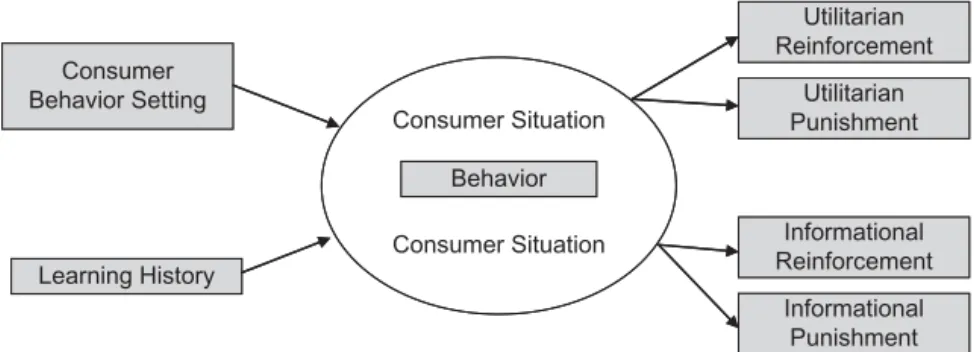
The original aim of the CBA research program was to ascertain whether a model of consumer choice based on a radical behaviorist framework was feasible, and if so, what the epistemological nature of such a route to expla-nation would be (Foxall, 1994, 2004a). So the aim has never been to change the paradigm in consumer research in favor of behaviorism, but to test a radical behaviorist depiction of consumer choice to its limit, adding in other approaches to explanation only as and when they became essential. The earliest stages involved critiques of the central explanatory devices assumed in consumer research at the time, notably the ideas that attitudes and inten-tions inevitably precede, prefigure, and determine consumer behavior, or that novel behavior on the part of consumers was explicable in terms of underlying traits of “innovativeness.” The development of a model of con-sumer behavior based on radical behaviorism resulted in the Behavioral Perspective Model (BPM), which is an elaboration of the “three-term contin-gency,” the basic explanatory device of operant psychology in which a dis-criminative stimulus (SD) marks the occasion on which a particular response (R) is likely to be rewarded or reinforced (SR), i.e., to increase in frequency, or punished (SP), i.e., to decrease. The three-term contingency is usually depicted as SD : R → SR/P where : indicates that the probability of an operant response is increased in the presence of the SD, while by definition that response leads to consequences that are reinforcing and/or punishing. The model shown in Figure 1 adapts these key elements to suit the interpreta-tion and predicinterpreta-tion of human economic behavior in affluent societies.
Consumer choice is the outcome of the consumer’s learning history meet-ing the current consumer behavior settmeet-ing, the point at which the experience of consumption meets a new opportunity to consume. This intersection is the consumer situation, the immediate determinant of approach-avoidance
CONSUMER BEHAVIOR ANALYSIS
responses involved in purchase and consumption. The consumer behavior setting comprises the stimulus antecedents of that behavior, some of which will have been present on earlier consumption occasions. Given the individual’s learning history, i.e., past choices and the reinforcing/punishing consequences they have had, these initially neutral stimuli are transformed into the dis-criminative stimuli that set the occasion for current choice; in particular, the individual’s consumption history invests them with meaning, in the sense of a capacity to generate specific kinds of approach and or avoidance behaviors, which produce consequences that regulate the rate of recurrence of the behaviors that produced them. The consumer situation also consists of moti-vating operations (MOs), such as rules that invest the consequences inherent in the discriminative stimuli with additional motivating or inhibitory power by making the consequences of radical behaviorism appear more or less reinforcing, more or less punishing.
The Consumer Behavior Setting
Like the three-term contingency, the BPM specifies antecedent stimulus con-ditions (the behavior setting) but combines the concepts of discriminative stimuli and motivating operations by means of the construct of behavior setting scope, the extent to which these setting elements encourage or inhibit the behavior predicted to occur in such settings. Settings of purchase and consumption are all relatively open, but differ from one another along a restricted continuum of closed-open consumer behavior settings. Waiting in line at the bank to pay in a check occurs in a relatively closed consumer behavior setting: there is probably no alternative to being there and waiting until a teller becomes available, standing in an orderly fashion is encour-aged both by the physical style of the building and by the social arrange-ments, and deviation from the established behavior program of the setting is likely to be punished by stares or glares. An open consumer behavior setting encourages a wider range of alternative behaviors. In a bar, for
FIGURE 1 Summative Behavioral Perspective Model.
Utilitarian Punishment Utilitarian Reinforcement Informational Reinforcement Informational Punishment Behavior Consumer Situation Consumer Situation Learning History Consumer BehaviorSetting Utilitarian Punishment Utilitarian Reinforcement Informational Reinforcement Informational Punishment Behavior Learning History Consumer Behavior Setting
CONSUMER BEHAVIOR ANALYSIS
instance, all manner of beverages and snacks may be available, there may be TV to watch, talking loudly may not be discouraged, and even singing and dancing may be possible. The customer is free to leave at any time, even if only to go to another bar in the vicinity—at least far freer than he or she would be to leave the bank and find another at which to present the check.
Patterns of Reinforcement
The consequences of economic behavior fall into three types: (a) utilitarian reinforcement, which consists in the functional outcomes of behavior; (b) informational reinforcement, which stems from the symbolic outcomes, prin-cipally performance feedback; and (c) aversive/punishing consequences, the costs of purchase and consumption. Such aversive outcomes can themselves be subdivided into those that are utilitarian in nature and those that are sym-bolic. Utilitarian reinforcement consists in the direct usable, economic, and technical benefits of owning and consuming a product or service, while infor-mational reinforcement inheres in benefits of ownership and consumption, which are usually social in nature and consist in the prestige or status as well as the self-esteem generated by ownership and consumption. The driver of the cheapest car available is principally concerned with the utilitarian benefits that all cars provide: most obviously, door-to-door transportation. Informa-tional reinforcement, on the other hand, is more likely to involve a lifestyle statement by which the consumer seeks to convey his or her social status or to bolster esteem and/or reported feelings of self-esteem. The driver of a Porsche clearly gets from A to B in it but also receives social esteem and sta-tus from others as well as personally conferred self-esteem. These constitute symbolic rewards of consumption. Most products have an element of both the instrumental and the symbolic. A mobile phone not only provides com-munications services when and where the consumer wants them; because it has interchangeable colored cases, it may also signal to that consumer’s social group that he or she is “cool” (or, a year later, “not so cool”).
Patterns of reinforcement, based on combining high and low levels of utilitarian reinforcement and high and low levels of informational reinforce-ment, suggest four operant classes of consumer behavior as illustrated in Figure 2. The four broad classes of consumer behavior that can be inferred
FIGURE 2 Operant classes of consumer behavior defined by pattern of reinforcement.
MAINTENANCE HEDONISM Low informational reinforcement ACCUMULATION ACCOMPLISHMENT Low utilitarian reinforcement High utilitarian reinforcement High informational reinforcement
CONSUMER BEHAVIOR ANALYSIS