121 A MIXED-RESPONSE INTELLIGENT TUTORING SYSTEM
BASED ON LEARNING FROM DEMONSTRATION
A Dissertation by
OMAR ÁLVAREZ XOCHIHUA
Submitted to the Office of Graduate Studies of Texas A&M University
in partial fulfillment of the requirements for the degree of DOCTOR OF PHILOSOPHY
May 2012
121 A Mixed-response Intelligent Tutoring System Based on Learning from Demonstration
121 A MIXED-RESPONSE INTELLIGENT TUTORING SYSTEM
BASED ON LEARNING FROM DEMONSTRATION
A Dissertation by
OMAR ÁLVAREZ XOCHIHUA
Submitted to the Office of Graduate Studies of Texas A&M University
in partial fulfillment of the requirements for the degree of DOCTOR OF PHILOSOPHY
Approved by:
Co-Chairs of Committee, Riccardo Bettati Lauren Cifuentes Committee Members, Richard Furuta
Frank Shipman Head of Department, Duncan M. Walker
May 2012
121 ABSTRACT
A Mixed-response Intelligent Tutoring System Based on Learning from Demonstration. (May 2012)
Omar Álvarez Xochihua, B.S., Universidad Autónoma de Baja California; M.A.I., Instituto Tecnológico y de Estudios Superiores de Monterrey
Co-Chairs of Advisory Committee: Dr. Riccardo Bettati Dr. Lauren Cifuentes
Intelligent Tutoring Systems (ITS) have a significant educational impact on student’s learning. However, researchers report time intensive interaction is needed between ITS developers and domain-experts to gather and represent domain knowledge. The challenge is augmented when the target domain is ill-defined. The primary problem resides in often using traditional approaches for gathering domain and tutoring experts’ knowledge at design time and conventional methods for knowledge representation built for well-defined domains. Similar to evolving knowledge acquisition approaches used in other fields, we replace this restricted view of ITS knowledge learning merely at design time with an incremental approach that continues training the ITS during run time. We investigate a gradual knowledge learning approach through continuous instructor-student demonstrations. We present a Mixed-response Intelligent Tutoring System based on Learning from Demonstration that gathers and represents knowledge at run time. Furthermore, we implement two knowledge representation methods (Weighted Markov
121 Models and Weighted Context Free Grammars) and corresponding algorithms for
building domain and tutoring knowledge-bases at run time.
We use students’ solutions to cybersecurity exercises as the primary data source for our initial framework testing. Five experiments were conducted using various granularity levels for data representation, multiple datasets differing in content and size, and multiple experts to evaluate framework performance. Using our WCFG-based knowledge representation method in conjunction with a finer data representation granularity level, the implemented framework reached 97% effectiveness in providing correct feedback. The ITS demonstrated consistency when applied to multiple datasets and experts. Furthermore, on average, only 1.4 hours were needed by instructors to build the knowledge-base and required tutorial actions per exercise. Finally, the ITS framework showed suitable and consistent performance when applied to a second domain.
These results imply that ITS domain models for ill-defined domains can be gradually constructed, yet generate successful results with minimal effort from instructors and framework developers. We demonstrate that, in addition to providing an
effective tutoring performance, an ITS framework can offer: scalability in data magnitude, efficiency in reducing human effort required for building a confident knowledge-base, metacognition in inferring its current knowledge, robustness in handling different pedagogical and tutoring criteria, and portability for multiple domain use.
121 DEDICATION
To my dear wife Olimpia, my fantastic sons Jared & Eber, and especially to my unforgettable mother Silvia† and brother Saul†.
121 ACKNOWLEDGEMENTS
I would like to thank my research advisors, Dr. Riccardo Bettati and Dr. Lauren Cifuentes, for their guidance and support during my doctoral studies. I also thank the rest of my committee members, Dr. Richard Furuta and Dr. Frank Shipman, for their valuable and fruitful comments and feedback that helped me to improve my dissertation work.
I would like to thank my friends at Texas A&M University who helped me to conduct my research studies. Specially, I would like to express my appreciation to Rene Mercer for her always helpful advice, friendship, and constructive criticism in her multiple reviews of my dissertation. I also thank the participants involved in evaluating the functionality and performance of the implemented Intelligent Tutoring System framework.
Finally, I thank my wife, Olimpia, for her love and continuous support and encouragement during all these years. I also thank my sons, Jared and Eber, for living with us through this great experience and making this period of time more enjoyable. I also thank all my family members for their continuous support in my successfully accomplishing my doctoral studies.
121 TABLE OF CONTENTS Page ABSTRACT ... iii DEDICATION ... v ACKNOWLEDGEMENTS ... vi
TABLE OF CONTENTS ... vii
LIST OF FIGURES ... x
LIST OF TABLES ... xii
CHAPTER I INTRODUCTION ... 1
A. Motivation ... 1
B. The Problem: ITS Knowledge Acquisition at Design Time ... 5
C. A Modern View of an Intelligent Tutoring System ... 8
1. Effectiveness ... 9 2. Scalability ... 9 3. Efficiency ... 10 4. Portability... 11 5. Metacognition ... 11 6. Robustness ... 12
D. Hypotheses of the Study ... 12
1. Hypothesis 1 (effectiveness) ... 13
2. Hypothesis 2 (metacognition) ... 13
3. Hypothesis 3 (efficiency, scalability, and robustness) ... 14
4. Hypothesis 4 (portability) ... 15
E. Relevant Contributions ... 15
F. Dissertation Structure ... 17
II RELATED WORK ... 18
A. Intelligent Tutoring Systems ... 18
B. The Architecture Supporting an ITS ... 21
121
CHAPTER Page
1. The Model-tracing Approach... 24
2. The Constraint-based Modeling Approach ... 26
D. Successful ITSs Supporting Learning in Ill-defined Domains .. 29
E. Building Domain Knowledge from User Data ... 36
1. Students Data-based Knowledge Learning ... 37
2. Student-instructor Interaction Data-based Knowledge Learning ... 38
F. Machine Learning in Support of Knowledge Acquisition ... 41
1. Learning from Demonstration ... 42
III MIXED-RESPONSE INTELLIGENT TUTORING SYSTEM ... 45
A. Mixed-response Framework ... 45
B. Learning from Demonstration ... 47
1. The Demonstration Process ... 48
2. Policy Derivation ... 49
3. Intelligent Tutor Metacognitive Skill ... 52
4. Data Representation Methods ... 54
C. Weighted Markov Models ... 55
1. Weighted Markov Models Generation ... 56
2. Classification Policy Inference ... 59
3. Use of the Classification Policy ... 60
D. Weighted Context Free Grammars ... 62
1. Weighted Context Free Grammars Generation ... 64
2. Classification Policy Inference ... 71
3. Use of the Classification Policy ... 79
E. Summary ... 81
IV ITS FRAMEWORK EVALUATION ... 82
A. The Cybersecurity Domain ... 83
B. The WAES Learning Environment... 84
C. Participants... 87
D. Evaluation Studies ... 88
E. Data Preprocessing ... 89
1. Data Preparation ... 90
2. Data Transformation ... 92
F. Effect of Symbol Granularity Level ... 93
G. Batch Learning Experiments ... 97
1. Effectiveness and Metacognitive Skill Evaluation Results . 98 2. Robustness Evaluation Results ... 104
121
CHAPTER Page
H. Interactive Learning Experiments ... 109
1. ITS Interactive Learning Environment ... 111
2. Efficiency and Robustness Evaluation Results ... 116
3. Portability Evaluation Results ... 128
I. ITS Framework Implementation ... 134
J. ITS Framework Evaluation Summary ... 136
V CONCLUSIONS AND FUTURE WORK ... 140
A. Conclusions ... 140
B. Future Work ... 144
C. Final Remarks ... 146
REFERENCES ... 148
APPENDIX A: WEB ACCESS EXERCISE SYSTEM ... 160
APPENDIX B: OPERATIONAL EXAMPLES OF THE MIXED-RESPONSE ITS FRAMEWORK ... 163
121 LIST OF FIGURES
FIGURE Page
1 Intelligent tutoring loop ... 23
2 Examples of production rules for a packet filtering requirement ... 25
3 Example of a constraint representing a correct solution ... 27
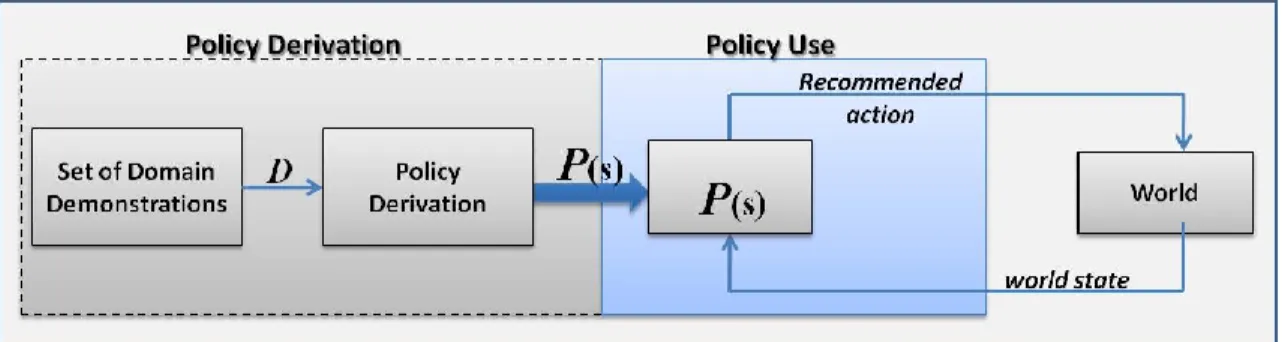
4 Policy derivation and use cycle ... 47
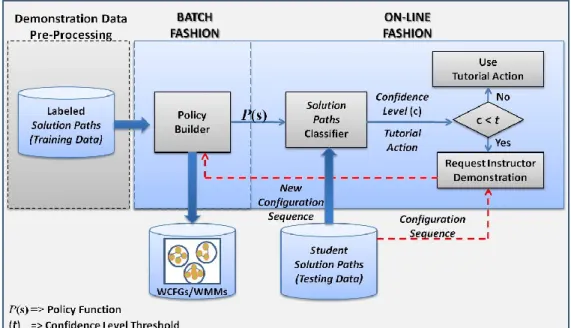
5 Implemented Learning from Demonstration process ... 49
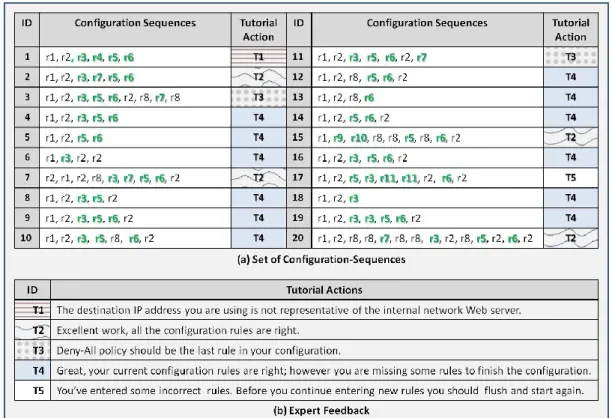
6 Configuration sequences and their tutorial actions ... 57
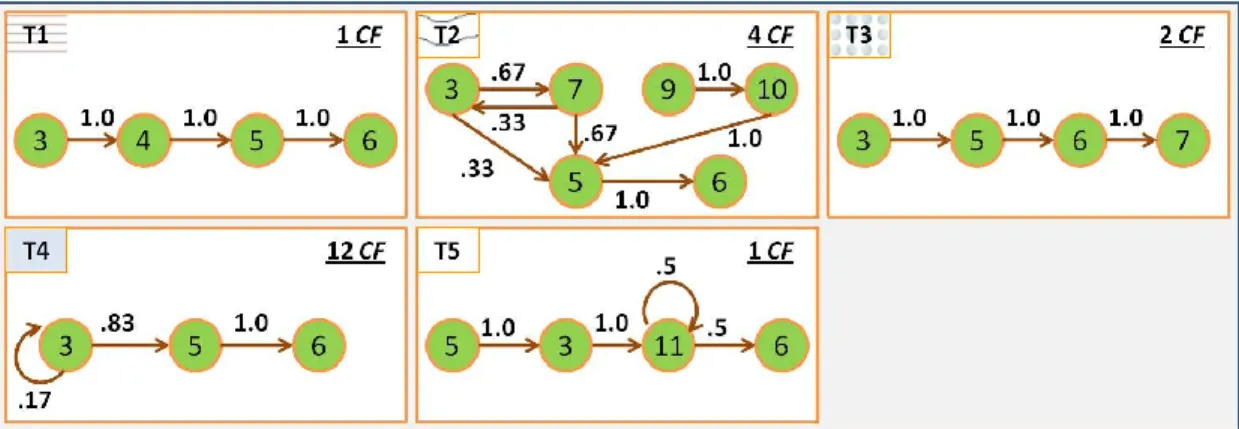
7 Set of Markov Models with transition probability distributions ... 58
8 Set of Markov Models with transition weights based on state-transition frequency ... 59
9 Context free grammar and parsing trees... 63
10 Grammars generated by the SEQUITUR algorithm ... 68
11 Weighted context free grammars ... 71
12 Parsing algorithms ... 73
13 Enhanced-CYK algorithm ... 76
14 Enhanced*-CYK algorithm using WCFG ... 78
15 Enhanced-CYK algorithm using WCFG and a partially represented input sequence ... 80
16 Set of tutorial actions predefined by an expert ... 91
17 Dataset transformation based on token granularity level ... 95
18 Dataset transformation based on paired-symbols and CRs granularity levels ... 96
121
19 Workspace for training and evaluating the ITS tutoring performance ... 111
20 Low confidence level classification ... 113
21 Description of the exercise’s requirements and example of correct solution ... 114
22 Set of student’s solutions assigned to a tutorial action’s cluster ... 115
23 Statistical report on the ITS performance ... 116
24 ITS’s Learning and tutoring performance from four experts ... 118
25 ITS’s learning and tutoring detailed performance from four experts ... 121
26 ITS’s learning and tutoring performance from three datasets ... 124
27 ITS’s learning and tutoring detailed performance from three datasets ... 127
28 Solution examples from cybersecurity and database domains ... 130
29 ITS’s learning and tutoring performance from three SQL-query exercises ... 133
A.1 Web Access Exercise System ... 160
A.2 Student’s configuration log-file ... 161
B.1 Architecture of the mixed-response ITS framework ... 163
B.2 Intelligent tutor-student scenario ... 165
B.3 Configuration sequence retrieved from a student’s log-file ... 166
B.4 Example of two clusters including configuration sequences and tutorial actions learned by the intelligent tutor ... 167
B.5 Configuration sequence classification ... 168
B.6 Intelligent tutor-instructor scenario ... 170
121 LIST OF TABLES
TABLE Page
1 Artificial intelligence features of intelligent tutors ... 19
2 Pseudo-code for the SEQUITUR algorithm ... 66
3 Frequent behaviors and misconceptions in configuration rules ... 92
4 Representation percentages according to granularity level and approach . 100 5 Effectiveness results ... 101
6 Effectiveness and metacognition results ... 104
7 Robustness results ... 106
8 Distribution of collected data forscalability testing ... 107
9 Scalability results ... 108
10 ITS’s learning and tutoring performance from four experts ... 119
11 Percentage of feedback provided by the ITS from four experts... 119
12 ITS’s learning and tutoring detailed performance from four experts ... 122
13 ITS’s learning and tutoring performance from three datasets ... 125
14 Percentage of feedback provided by the ITS from three datasets ... 125
15 ITS’s learning and tutoring detailed performance from three datasets ... 126
16 Comparison of characteristics between solutions from SQL-query and CRs ... 131
17 ITS’s learning and tutoring performance from three SQL-query exercises ... 134
18 Percentage of feedback provided by the ITS from three SQL-query exercises ... 134
121 CHAPTER I
INTRODUCTION
A. Motivation
Using computers in education has become a ubiquitous phenomenon in contemporary culture. New learning environments have been developed using various types of digital media (e.g., audio, video, and images) and computer network technology, thereby allowing delivery of more interactive and effective instruction to large numbers of students in an affordable and timely way. By using these technology affordances, students from different domains can learn basic concepts, apply those concepts through solving a diversity of problems, and even gain hands-on experience in their fields by interacting with virtual instruments at a distance. However, researchers agreed that it was not sufficient to make this instructional material merely accessible. Educational and Artificial Intelligence researchers saw the importance and feasibility of complementing this type of instruction with customized tutoring for every student (Nkambou, Bourdeau, & Mizoguchi, 2010). Empirical research has demonstrated that students perform twice as well when individual tutoring is used instead of a conventional group teaching approach (Bloom, 1984). Therefore, providing personalized guidance to students who learn through these new instructional environments, places Intelligent Tutoring Systems (ITSs) in a unique position to offer a comprehensive and meaningful educational service. ____________
This dissertation follows the style of International Journal of Artificial Intelligence in Education (IJAIED).
121 In order to customize the pedagogical process, ITSs have been complementing
computerized learning environments. ITSs are computer-based experts that (1) provide personalized instruction, (2) monitor and assess student learning performance, and (3) provide feedback to students during the learning process (Psotka, Massey, & Mutter, 1998). ITS researchers use Artificial Intelligence (AI) techniques to gather and represent experts’ domain knowledge and build effective and customized tutoring support for students during the problem solving process (Nkambou et al., 2010). The problem solving process can be summarized by the following set of activities: contextualize and understand the problem, identify possible problem solutions, select the best solution, implement the selected solution’s steps, and evaluate solution outcomes and adapt the solution if needed (Jonassen, 1997).
Intelligent Tutoring Systems have been helping students learn how to solve problems in a variety of domains (e.g., geography, medical diagnosis, computer programming, mathematics, physics, genetics, law, and chemistry) since the early 1980’s (Urban-Lurain, 1996). The types of problems found within these domains can be classified using a continuum based on the degree of structure inherent within the problem; this problem-structure continuum ranges from well-structured to ill-structured (Simon, Egidi, Viale, & Marris, 1992). The continuum identifies problems with single known solutions and clear solution paths (very well-structured) at one end, and those with several potentially acceptable solutions and lack of a defining solution path (ill-structured) at the other end (Jonassen, 1997). Within the ITS field, these two categories are usually referred to as well- and ill-defined.
121 The types of problems students encounter within some domains may be very
structured, well-defined problems. These types of problems are mainly characterized by having only one or a small number of correct answers. Well-defined problems also have a systematic solution path, as opposed to problems where solution paths vary widely and lead to various correct answers. For well-defined problems, which are commonly found in domains such as mathematics (Arroyo, Murray, Woolf, & Beal, 2003) and chemistry (Stevens & Soller, 2005), the domain knowledge can be often reduced to a small number of rules. Therefore, feedback use for well-defined domains should be constructed in order to help students memorize concepts, facts, or problem solution steps (Woolf, 2009). Hence, gathering instructors’ knowledge and appropriate tutorial actions at ITS design time is a suitable and economical approach.
However, this approach is not sufficient for ill-defined problems because novel problem solutions may constantly arise based on contextual situations. Ill-defined problems are mainly characterized by their lack of systematic solution methods (Lynch, Ashley, Aleven, & Pinkwart, 2006). Two fields that exemplify ill-defined problems are law and architecture. These fields are referred to as ill-defined domains. Jonassen (1997) and Lynch et al. (2006) summarized a comprehensive list of characteristics attributed to problems within ill-defined domains. A compilation of these characteristics follows:
initial steps to solve a problem can vary, multiple solutions and solution paths exist, right answers are context and time dependent, systematic solution methods do not exist, and
121 new right answers will inevitably emerge.
Therefore, within ill-defined domains, the feedback provided by an ITS should be constructed in order to help students reason and make inferences based on the specific circumstances (Woolf, 2009).
Furthermore, within ill-defined domains, acquiring relevant and sufficient expert knowledge to design ITSs is extremely costly. Fournier-Viger, Nkambou, and Mephu-Nguifo (2008b) state that “for many ill-defined domains, the domain knowledge is hard to define explicitly” when developing an ITS. Thus, even when an expert, or set of experts, can provide a considerable amount of domain knowledge at design time, there is always the possibility of new points of view or evidence that may challenge previous conclusions.
Past ITS research, primarily within well-defined domains, has provided strong empirical evidence indicating improved learning outcomes by up to one or even two standard deviations when students are paired with an ITS (Lynch et al., 2006; Jonassen, 1997). However, the construction of these educationally powerful systems is still extremely costly and time consuming, principally in domains characterized by having ill-defined problems (Fournier-Viger, Nkambou, & Mephu-Nguifo, 2010).
Traditionally, ITS developers build the domain expertise of the ITS based on human expert knowledge. This domain expertise usually consists of a predefined set of solutions, solution paths, expected student misconceptions, and the required feedback, which are often predetermined by experts at ITS design time. Because of the significant time and cost currently necessary to build these tutoring environments, methods for
121 efficiently gathering and representing human expert knowledge within the ITS field
remain highly researched topics.
This is of particular relevance within domains where students are expected to solve ill-defined problems that lack a clear structure and which are highly time and context dependent. Within these types of domains, because of the unpredictability of the entire set of problem solving steps, the ITS domain expertise cannot be based on a set of predefined solution paths, potential correct solutions, and a set of standard feedback responses. Hence, the framework of ITSs designed to assist students in addressing ill-defined problems must comprise a set of functional characteristics that allows an ITS to evolve and adapt to changing learning environments. Using these characteristics an ITS framework should progressively learn or infer novel solution paths, viable answers, and methods for advising students at run time. In addition, what may truly define the intelligence of an intelligent tutor is its metacognitive ability to autonomously determine its current knowledge and when that knowledge should be improved by external sources such as a human expert. Based on our review of the literature, ITS frameworks addressing the functionalities mentioned above do not exist, which begs the following question: What is the best way to construct such an ITS framework, and can that framework generate adequate feedback at a high level of effectiveness?
B. The Problem: ITS Knowledge Acquisition at Design Time
A challenging goal, for any ITS, is to learn enough adequate domain-specific knowledge and relevant feedback from human instructors or experts to effectively support students
121 in their learning. Within this document we will often refer to feedback provided by the
ITS or human expert as a tutorial action. The acquisition of domain knowledge and development of tutorial actions has been a task primarily implemented at design time. ITS developers build this knowledge by interviewing experts regarding (a) meaningful, domain-specific problems, (b) the problem solving process, (c) possible problem solutions, (d) potential student misconceptions, and (e) the type of help instructors provide to support students in overcoming misconceptions. In addition, ITS developers observe and track experts as they move through the entire problem solving process. While this approach has proven effective for well-defined domains, it is for ill-defined domains for which these methods are not economically sound for gathering all of the domain knowledge and corresponding dynamic set of tutorial actions.
Customized feedback is the primary contribution the ITS makes to the learning process. However, for the ITS to effectively help students, ITS developers must consider where on the problem-structure continuum the domain falls for which the ITS is going to be utilized. The domain categorization on the continuum will determine the type of feedback students will need. This in turn will identify the best framework to use for constructing the ITS.
For an ITS to aid students in ill-defined problem solving, it is evident that gathering comprehensive domain knowledge during design time or inferring new knowledge and the adequate feedback at run time for unexpected situations is a difficult task (Amershi & Conati, 2009). Therefore, for ITSs intended for ill-defined domains, continuous instructor interaction, when requested by the intelligent tutor beyond design
121 time, should be considered. In this way, instructors will be able to monitor, evaluate, and
contribute to the ITS-student tutoring process. However, this implies that the ITS should learn to identify novel students’ solutions and autonomously determine whether its domain knowledge is sufficient. When unfamiliar situations are encountered by the ITS, the intervention by a human instructor with domain expertise would be required. This reduces the risk, which is common in systems with tutorial actions that are formulated at design time, of not being sufficiently student-centered.
Student-centered learning considers the needs of students as individuals and encourages them to have an active participation within the learning process (Jones, 2007). For instance, presenting the same material to every student without considering his or her specific learning needs (the one size fits all approach) is not student-centered (Woolf, 2009). By modeling student and domain knowledge, intelligent tutors have the capability to provide student-centered learning environments (Woolf, 2009). Within well-defined domains, ITSs use the predefined domain model to evaluate student performance in order to provide customized instruction and feedback. However, within ill-defined domains, ITSs should learn to identify unfamiliar situations and request the instructor’s help when necessary in order to provide personalized feedback according to the characteristics of the solution provided by the student.
In this study, we present a mixed-response Intelligent Tutoring System framework based on Learning from Demonstration (LfD) techniques for which we will show to be applicable for well- and ill-defined problems. By having the capability of determining its current domain knowledge level, the intelligent tutor will be able to infer
121 its level of confidence before triggering a tutorial response for a student’s feedback
request. The ITS will either provide feedback to students when the knowledge confidence level is high, or ask the human instructor to direct the tutorial task; thereby training the ITS to handle similar situations in the future. The presented mixed-response ITS framework exemplifies an extended view of an intelligent tutor intended to sufficiently support student-centered learning within ill-defined domains by highlighting the importance of maintaining expert participation during run time and adding a much needed metacognitive feature. The success of this framework will illustrate that a metacognitive functionality can be implemented that will teach the ITS how to recognize and better apply its current knowledge as well as defer to the human expert when necessary.
C. A Modern View of an Intelligent Tutoring System
We envision that modern ITS frameworks, primarily those addressing ill-defined domains, should be based on a set of functional characteristics that allow them to dynamically teach and learn while in use. An intelligent tutoring environment should have the capability to identify knowledge gaps within its knowledge-base and request human help to lead the tutoring process when necessary and learn from it. We propose a tutoring environment in which instructors have a more active role; allowing them to continuously train the intelligent tutor and customize the tutoring knowledge-base based on individual instructional perspectives. Next, we describe how we define the envisioned
121 ITS framework by the following functional characteristics: effectiveness, scalability,
efficiency, portability, metacognition and robustness.
1. Effectiveness
We define ITS effectiveness as the system’s capability to properly learn and use the set of demonstrations obtained from student-instructor interactions. The intelligent tutor should be able to construct or reconstruct its knowledge-base based on these demonstrations. The knowledge-base generated from demonstrations should be represented in such a way that identical or highly similar student problem solving situations are classified correctly and appropriate tutorial actions are generated. In other words, an ITS should have the ability to successfully provide adequate tutorial actions according to the learned knowledge (Woolf, 2009).
2. Scalability
One of the primary objectives of the use of ITSs (and many other educational technologies) is to scale up the ability of a single instructor (or a small number thereof) to effectively reach out to and teach large numbers of students. Therefore, any technology supporting scalability should do so along the following lines: (1) scalability in terms of numbers of students; (2) scalability in terms of student diversity; and (3) scalability in terms of adaptability to instructors’ pedagogical perspectives. In particular, for an ITS, this means having the ability to build and continuously refine its knowledge-base in order to provide adequate help to a large number of students despite their diverse
121 backgrounds. Furthermore, ITSs should maintain or increase its performance
proportionally as it is applied to larger situations. Hence, the ITS knowledge representation structures should be capable of accommodating that growth and maintaining an effective system functionality to meet tutorial needs regardless of the size or diversity of the knowledge obtained (Viccari, Jaques, & Verdin, 2008).
3. Efficiency
We define ITS efficiency as the system’s capability to quickly and easily learn from demonstrations obtained from student-instructor interactions. As stated previously, a primary challenge in building ITSs is the time required to gather the domain knowledge and corresponding tutorial actions. This is because of the large amount of time required by ITS designers to gather and represent knowledge from domain experts. ITS authoring systems are intended to reduce or eliminate the need for designer and domain expert interaction by allowing instructors to build the ITS knowledge individually. The efficiency of ITS authoring systems is often measured by this amount of time and effort required by instructors to build an ITS; principally at design time (Lynch et al., 2006). However, we are measuring the efficiency of the proposed ITS framework by considering the amount of time required to build the ITS domain knowledge and tutorial actionsat run time as opposed to merely at design time.
121 4. Portability
We consider portability (domain agnosticism) to be a core characteristic of a modern ITS framework. That is, it should be able to be used across learning domains with minimal implementation effort. The use of flexible knowledge representation structures is a key element for ITS frameworks to be domain independent. In fact, one of the primary tenets of this work is that ITSs can be designed in an a priori domain agnostic fashion with domain knowledge added at run time. Portability is considered within the ITS field but not often addressed (Nkambou, et al., 2010). Most of the current ITS frameworks for ill-defined problems have been implemented and tested with only a target domain in mind.
5. Metacognition
In order to continuously improve its own knowledge-base, a modern ITS should have the capability to know what it does and does not know, and to thereby determine its competency to address previously unknown student problem solving situations. In our research, this is referred to as metacognition. Furthermore, having metacognitive skills implies that the ITS will know when to best use its current knowledge and –most importantly– when to best invoke strategies for learning and extending its knowledge-base (Fournier-Viger et al., 2008b). Adding metacognitive capabilities to an ITS enables it to assess its current domain knowledge level, to grow and adapt, and to remain active and useful over time (Chernova & Veloso, 2009).
121 6. Robustness
Finally, when training an ITS at design time, experts communicate the set of correct and incorrect solutions and solution paths in a systematic way. In addition, ITS developers often obtain the domain knowledge from only one or a few experts with equal or similar instructional perspectives (Woolf, 2009). This ITS implementation environment results in building and testing the ITS knowledge-base in a controlled fashion. For an ITS framework in which knowledge is built at run time, however, the system grows its domain expertise on-line from student and instructor input. Particular attention must be paid such that the learning process leads to an effective set of rules despite different student backgrounds, sequences of training examples, and differences in instructors’ pedagogical perspectives. In addition, the ITS should be able to handle errors or instructor differences while it is being trained and maintain acceptable system performance despite anomalous or inconsistent inputs. We call this characteristic the
robustness of the ITS.
D. Hypotheses of the Study
The purpose of this study is to determine if an ITS using a mixed-response framework addressing the aforementioned functional characteristics (e.g., effectiveness, scalability,
efficiency, portability, metacognition and robustness) can build comprehensive domain knowledge and appropriate tutorial actions based on demonstrations of human instructor-student interactions. This study also seeks to determine whether the ITS can effectively estimate its knowledge confidence level in order to initiate interaction with
121 students and provide adequate feedback based on its learned knowledge, or trigger a help
request asking human tutors to lead the tutoring process. Our study is focused on the development of a mixed-response ITS framework using exercises developed from the Network Security (cybersecurity) domain. Problems addressed within this domain include well- and ill-defined characteristics. Based on the previous discussion, our study evaluates the following hypotheses:
1. Hypothesis 1 (effectiveness)
The ITS’s domain knowledge and tutorial actions can gradually be built at run time from
logs of instructor-student interactions by using Learning from Demonstration
techniques.
We present how the proposed mixed-response ITS framework can "learn" solution patterns produced by students and ask the human instructor to provide feedback when solution paths unknown to the ITS arise, thus progressively improving its ability to apply tutorial actions and ultimately automating instruction. We demonstrate how LfD can be used to derive a policy to autonomously classify student activities and respond with tutorial actions in an effective way.
2. Hypothesis 2 (metacognition)
The proposed mixed-response ITS framework can automatically determine its knowledge
121
in order to autonomously decide whether to interact with the student or make a request
for an instructor response.
We demonstrate that by associating the ITS’s previously learned solutions with new student activities, we can compute the confidence level that the ITS has in the policy. By using these confidence levels, our ITS framework can autonomously decide whether to interact with the students as long as the confidence level is high, or make a request for and learn from the instructor’s response whenever the confidence level is not sufficiently high, thereby implementing the aforementioned metacognitive functional characteristic.
3. Hypothesis 3 (efficiency, scalability, and robustness)
The proposed mixed-response ITS framework based on Learning from Demonstration
can be implemented by using data representation methods that support three functional
characteristics envisioned for modern ITS: efficiency, scalability, and robustness.
We describe the methods used for representing the ITS knowledge-base and how these methods support the implementation of the functional characteristics envisioned for a modern ITS framework. These methods were implemented in a batch and online ITS learning fashion and their performances were compared. Specifically, we show how efficiency, scalability, and robustness are highly influenced by the selected data representation method.
121 4. Hypothesis 4 (portability)
The proposed mixed-response ITS framework based on Learning from Demonstration
can be implemented by using data representation methods that can provide a
transferable framework to different content domains.
We describe how the methods used for representing the ITS knowledge-base and tutorial actions support the implementation of the proposed ITS framework in two different domains. Cybersecurity (configuration of network security devices), a domain considered as ill-defined, and databases (specification of SQL-queries), a domain considered more structured along the problem-structure continuum. Also, we illustrate several common characteristics found in logged data obtained from students solving problems within both well- and ill-defined domains.
E. Relevant Contributions
Recent studies regarding ITSs supporting ill-defined problem solving have typically focused on the ITS knowledge acquisition from experts at design time. Our research expands this method by integrating the instructor into the tutoring process (mixed-response approach) of problem solving, allowing an ITS to learn from this integration at run time.
This research is of significance to the domains of ITSs and educational technology. Our mixed-response approach extends the work of the ITS field by introducing a twofold approach to designing ITS frameworks by: (1) presenting a method for naturally integrating instructors into the tutoring process; and (2),
121 continuously improving an ITS’s domain knowledge by learning from students’ and
instructors’ interactions with the ITS. By allowing instructors to monitor, evaluate, and contribute to the ITS-student tutoring process, we support intelligent tutor developers in addressing ill-defined domains where knowledge is constantly changing.
The use of students’ data to generate the ITS’s knowledge-base allows for the identification of unexpected situations, as well as contextualization of the domain knowledge to specific audiences. By using this framework, well-defined problems can also be considered in order to filter noisy or inaccurate demonstrations. Educators who explore the advantages of such an approach will be able to analyze past learning experiences and identify unsuitable demonstrations. By adding two interactive modes to support cognitive processes: instructor-student, and intelligent tutor-student, we leave outliers and pedagogically interesting situations to the human instructor to handle and routine situations to the ITS.
We also introduce a novel view of an ITS framework addressing ill-defined domains. The proposed framework consists of six functional characteristics. We envision these future tutoring systems to be equipped with: effectiveness and efficiency
in learning and using the instructor-students demonstrations; scalability supporting the expansion of their knowledge-base; portability based on a framework capable to be used in different domains; metacognitive skills to understand their existing knowledge level; and, robustness that allows them to handle different student backgrounds and instructors’ pedagogical perspectives. Our final contribution, is a new and effective method to represent an ITS’s knowledge-base consisting of sequential data. The
121 proposed knowledge representation method is primarily designed for ill-defined
domains.
F. Dissertation Structure
The remainder of the dissertation is organized as follows. In Chapter II we give an overview of ITS knowledge learning methods, LfD, and approaches similar to the mixed-response approach. Then, in Chapter III we outline the implementation methods used for the proposed framework and the ill-defined domain (cybersecurity) used to test the ITS framework. Also, we describe the approaches (Weighted Markov Model and Weighted Context Free Grammar) used for knowledge representation. In Chapter IV we present the procedures and methods used to evaluate the mixed-response ITS framework. We also describe the evaluation results. Finally, we present conclusions regarding the framework’s functionality and future work in Chapter V.
121 CHAPTER II
RELATED WORK
A. Intelligent Tutoring Systems
Intelligent Tutoring Systems are computer-based tutors that, after learning domain and tutoring knowledge from experts, can provide customized instruction to students. Once ITSs are developed, they can provide one-on-one instruction similar to human instructors with relatively lower cost and total flexibility in time and location (Lu, 2006). The term Intelligent Tutoring Systems was first coined by Sleeman and Brown (1982) as an evolving term of Intelligent Computer-Aided Instruction (ICAI). The term ITS was quickly adopted by the ITS research community to clearly differentiate ITSs from Computer-Aided Instruction (CAI). The latter often referred to the general use of computers in education (Nwana, 1990), whereas, an ITS makes use of artificial intelligence to provide customized instruction. A set of distinct features that distinguish ITSs from CAI systems have been identified as illustrated in Table 1 (Woolf, 2009): generativity, student modeling, expert modeling, mixed-initiative, interactive learning, instructional modeling, and self-improving. Woolf (2009) presents a recompilation of these seven features and a set of ITSs for which they are exemplified. However, she concludes that few ITSs contain all of these features, and current knowledge of intelligent tutors’ abilities to address each feature ranges from simple to sophisticated, emphasizing that more research on artificial intelligence, cognitive science, and education is required to address all of them.
121 Table 1
Artificial intelligence features of intelligent tutors Features of Intelligent Tutor Description of Feature
Generativity
The ability to generate appropriate problems, hints, and help customized to student learning needs.
Student modeling
The ability to represent and reason about a student’s current knowledge and learning needs and to respond by providing instruction.
Expert modeling
A representation and way to reason about expert performance in the domain and the implied capability to respond by providing instruction.
Mixed-Initiative
The ability to initiate interactions with a student as well as to interpret and respond usefully to student-initiated interactions.
Interactive learning
Learning activities that require authentic student engagement and are appropriately contextualized and domain-relevant.
Instructional modeling The ability to change teaching mode based on inferences about a student’s learning.
Self-improving A system’s ability to monitor, evaluate, and improve its own teaching performance based on its experience with previous students.
This table was obtained from "Building Intelligent Interactive Tutors" by Beverly P. Woolf (MacMillan Publishing, 2009).
These distinguishing features mainly emphasize that an ITS should: (a) effectively and efficiently generate customized help to student learning needs based on a correct representation and reasoning of the learned students’ and instructors’ knowledge; (b) consist of domain-relevant activities and an interactive learning environment; (c) have the ability to initiate or respond to interactions with students; and (d), be able to self-improve its teaching performance based on observed students’ activities.
121 In this research we complement and enhance the currently identified ITS features
with our six proposed characteristics (i.e., effectiveness, scalability, efficiency,
portability, metacognition and robustness). For instance, we emphasize the significance of the ITS effectively and efficiently learning and using its knowledge. However, for ill-defined domains, we suggest that this characteristic can only be accomplished through continuous participation from human-instructors within the tutoring process. We visualize robust expert models adapting to varying instructor pedagogical perspectives, handling inconsistencies in input data, and equipped with a scalability feature for continuous knowledge growth accommodating new learning needs. Finally, even though an ITS can self-improve its teaching performance based on observed student experiences, the intelligent tutor should be designed with metacognitive skills to evaluate its knowledge level in order to trigger a correct tutoring response. For example, if the ITS knowledge confidence level is high based on previously learned domain knowledge and observations of previous students, then the ITS will provide feedback to the student. Otherwise, the intelligent tutor will request help from a human expert in order to answer students’ tutoring requests and learn from observed instructor-student interaction.
VanLehn (2006) introduced a new description of how tutoring systems behave. He emphasized that, even though ITSs differ widely in their task domain and the implementation of the intelligence features mentioned above, ITSs tutoring behaviors are quite similar. He describes tutoring systems as having two loops: the outer loop and the
inner loop. The outer loop decides which task the student should do next based on the student’s background or prior student performance. A task is considered an activity or
121 exercise intended to get students to learn specific domain content or skills. The inner
loop is executed within a task. This loop is executed once for each step taken by the student in the solution of a task. A step is represented by the actions the student performs while solving a problem. Within the inner loop the intelligent tutor has a closer tutoring interaction with students by analyzing students’ steps, giving different levels of feedback (i.e., minimal, detailed, or error specific feedback), hints on the next step, and assessing students’ knowledge. VanLehn (2006) emphasizes the relevance of the inner loop functionality; he classifies systems without an inner loop as CAI systems and those with one as an ITS. Hence, the focus of this research is on the enhancement of the inner-loop functionality, which we refer to as the tutoring loop.
B. The Architecture Supporting an ITS
When master instructors teach their students, they tend to use already acquired domain knowledge and teaching strategies. Based on observation of a student’s learning behavior, instructors decide what knowledge he or she is missing and the best method to convey that knowledge (e.g., through a hint, question, example, or any other teaching strategy). Simultaneously, instructors estimate and consider student differences with regards to knowledge background, abilities, and learning styles.
ITSs should represent how people teach and learn. Knowledge about the domain, students, and teaching strategies should be represented and stored in the ITS’s backend. This information should be efficiently conveyed through a user interface (frontend). This
121 knowledge is commonly organized within an ITS in four modules: domain, student,
teaching, and interface or communication.
Domain-knowledge, commonly known as domain-model, represents the knowledge acquired from observing how experts perform and solve problems in the domain.
Student-knowledge, commonly known as student-model, represents a student’s level of mastery of the domain and contextual information (e.g., possible misconceptions, time spent on problems, help requested, and correct answers). This module allows the ITS to deliver customized instruction.
Tutorial-knowledge, commonly known as teaching-model or pedagogical-model, represents teaching or tutoring strategies and includes methods for feedback reasoning (e.g., what type of feedback to give, when and how to give feedback, and appropriate amount of feedback).
Communication-module represents methods for monitoring student activity and for communication between student and the ITS (e.g., text-based dialogues, animated agents, natural language communication, interactive screens, and multiple-choice or open-ended questions).
These modules interact with each other before a tutoring response is produced (Woolf, 2009). The modules’ interactions are referred to as the tutoring loop. Figure 1 illustrates the four modules present in an ITS and their interrelationship representing the tutoring loop.
121 Figure 1. Intelligent tutoring loop. (1) The ITS monitors and logs the student problem
solving performance; (2) The intelligent tutor receives the student activity and (3) builds or updates the student model; (4) The ITS is continuously comparing the student problem solving state and the learned domain knowledge; (5) If the ITS detects a student misconception or the student asks for help, the ITS selects the tutorial action based on the current student state; and, (6,7) The ITS interacts with the student providing the selected feedback.
In this research we are principally interested in the construction of the domain-model. Specifically, we are interested in developing effective and efficient methods for gathering and representing domain knowledge for ITSs aiding students learning in ill-defined domains. These methods are based on the premise that, within domains addressing ill-defined problems, the participation of human-instructors is a vital and constant necessity.
C. Knowledge-base Modeling Approaches
Two of the most frequently used approaches for constructing the domain-model of Intelligent Tutoring Systems are Model-tracing (Anderson, 1996) and Constraint-based
121
Modeling (Ohlsson, 1994). In this section we describe the theory and rationale behind these two approaches, as well as their limitations when it comes to the implementation of ITSs within ill-defined domains.
1. The Model-tracing Approach
The Model-tracing approach is based on the ACT-R (Adaptive Character of Thought-Rational) theory (Anderson, 1996). This theory assumes that a person performs a task based on a set of discrete operations. Model-tracing Tutors implement the ACT-R approach typically by representing task models (problem solving steps) using a set of
production rules (e.g., cognitive tutors). A production rule is commonly represented by
if-then statements (e.g., IF <condition> THEN <conclusion> or IF <condition> THEN <action>). Task models are usually built from cognitive task analysis.
Production rules intend to describe, in a declarative and procedural way, the correct solution steps and frequent misconceptions of students. Production rules representing misconceptions are known as “buggy” rules and are usually associated with feedback actions. Declarative production rules represent propositional knowledge (e.g., knowing that) while procedural production rules represent skill or performance knowledge (e.g., knowing how and when) (Anderson, 1983). Typically, levels of dependency among production rules exist; hence, one production rule triggers one or more additional production rules. Normally, the complete set of production rules is provided by an expert at design time, whereas, a student’s cognitive model is created while the student interacts with the system. The Model-tracing approach consists of
121 tracking the production rules applied by the student to generate the student’s cognitive
model.
An example of a set of correct and incorrect production rules addressing a configuration task within the cybersecurity domain is shown in Figure 2. These production rules are addressing a security requirement intended to prevent an internal computer network from accepting traffic considered to be spoofed or unsafe. In order to configure security devices to filter pre-specified traffic, the iptables-configuration
command is used.
Figure 2. Examples of production rules for a packet filtering requirement. (a)
Declarative production rule exemplifying a correct statement; (b) Procedural production rule exemplifying a correct action; (c) Procedural “buggy” rule exemplifying a common incorrect use of REJECT and DROP parameters.
This approach can easily be applied to less complex domains where the set of solution paths and common misconceptions are well known. In those cases, the production rules can be straightforwardly implemented. However, there are a few
(a)
IF a security requirement is to deny spoofed packets
THEN the iptables-configuration denying spoofed packets should be first in the configuration sequence
(b)
IF the goal is to enter an iptables-configuration denying spoofed packets AND spoofed IP addresses are known
THEN the iptables-configuration should REJECT spoofed IP addresses (c)
IF the goal is to enter an iptables-configuration denying spoofed packets AND spoofed IP addresses are known
121 limitations to using this approach. The cost of implementing the set of required
production rules can be extremely high, specifically, when ITS designers try to address all potential student misconceptions. Anderson, Corbett, Koedinger, and Pelletier (1995) and Koedinger, Aleven, Heffernan, McLaren, and Hockenberry (2004) reported a significantly large amount of time required to produce a set of production rules. Anderson et al., (1995) reported a ratio of 10 hours of work to produce a single production rule. In addition, production rules tend to be tied to the design context and, within ill-defined domains, cognitive tasks (problem solving steps) are regularly hard to obtain and reduce to if-then statements (Woolf, 2009; Fournier-Viger et al., 2010). For instance, for the ill-defined cybersecurity domain addressed in this study, specifically for the security requirement addressed in Figure 2, a number of situations can cause students’ misconceptions while building the spoofed packets iptables-configuration rule. In addition, an organization’s security policy can consist of up to thousands of security requirements. This implies a multitude of possible rule constructions and rule sequences in order to implement the final configuration, which only adds to the time and cost for designing an ITS supporting this domain.
2. The Constraint-based Modeling Approach
This approach to building domain-models is founded on the rationale that effective tutoring can be achieved by examining the problem state at which a student arrived, regardless of the path taken (Ohlsson, 1994). Contrary to the Model-tracing
121 knowledge representing correct solutions. Correct solutions are specified by a set of
constraints representing domain principles. Each constraint principally consists of a
relevance condition, a satisfaction condition, and a feedback action. The relevance condition describes the action or step the student is trying to accomplish and the satisfaction condition specifies the expected answers or actions. Whenever a satisfaction condition is violated based on the relevance condition, the ITS provides the student with the feedback action assigned to the violated constraint (Fournier-Viger et al., 2010). An example of a constraint consisting of the relevance condition and satisfaction condition using the same security requirement in Figure 2 is shown in Figure 3.
Figure 3. Example of a constraint representing a correct solution.
The focus of the Constraint-based approach is on assessing the student’s current solution state instead of the entire solution path (how the student arrived there). This approach is advantageous for ill-defined domains in which there are no clear or ultimate strategies to solve a problem (Fournier-Viger et al., 2010). Therefore, the correctness of a student’s solution can be based on whether or not the solution satisfies the set of predefined constraints. Another benefit to using this approach is the reduction in time required to build the domain-model. The amount of building time is reduced because the
Relevance Condition:
The student is configuring a security requirement to deny spoofed packets and the spoofed IP addresses are known
Satisfaction Condition:
The iptables-configuration should REJECT spoofed IP addresses and be first in the configuration sequence
121 approach does not take into account the representation of potential student
misconceptions. In other words, the approach only considers the identification of constraints that should be fulfilled to accept a solution as correct. Mitrovic (1998) reported that on average, 1.1 hours were necessary for implementing and testing a constraint in the SQL-queries domain. This amount of time is significant when compared to the 10 hours reported by Anderson et al., (1995). However, the time required for the constraints generation is influenced by the intended domain. Therefore, the time reduction achieved by using this approach cannot be generalized for every domain. Hence, the cost in design time required for developing an ITS using this approach is still considered a necessary research topic.
Furthermore, this and the Model-tracing approach are in general used to build
knowledge-bases only during the design phase (Lynch et al., 2006; Koedinger et al., 2004), which limits the size of the domain-model as a result. Finally, because of the many acceptable solutions and uncertainty of constraints supporting a solution, this approach has not been widely adopted for ITSs supporting students learning within ill-defined domains. However, there does exist some evidence of successful implementations of ITSs for ill-defined domains using this approach. For instance, the KERMIT/EER tutor used to teach how to design entity-relationship diagrams, a database modeling method (Mitrovic, Martin, & Suraweera, 2007). Yet, the way in which developers of the KERMIT/EER tutor handled the inestimable amount of acceptable solutions was accomplished by designing the system interface to restrict the range of possible students’ solutions (Fournier-Viger et al., 2010), a significant limitation that
121 must be addressed. More examples of ITSs addressing ill-defined problem solving using
conventional and novel knowledge representation approaches are presented in the next section.
D. Successful ITSs Supporting Learning in Ill-defined Domains
Most of the current ITSs are effectively and efficiently supporting students learning to solve well-defined problems, consequently having a tremendous positive impact on education. Empirical research reports one or even two standard deviations of improvement in students’ learning outcomes for well-defined problem-solving as a result of using an ITS (Woolf, 2009). Given the characteristics of well-defined problems, developers of ITSs supporting learning for this type of problem solving are able to acquire and represent expert and student knowledge in a comprehensive way. Therefore, students are able to receive precise feedback for the majority of misconceptions that occur. There are also research studies describing successful implementations of ITSs designed for assisting students with addressing ill-defined problem solving as well (Fournier-Viger et al., 2010, Noronha & Fernandes 2005, Noronha, Galante, & Fernandes, 2005). However, for ill-defined problems, it is difficult to acquire and represent expert and student knowledge using conventional knowledge representation methods. During the past few years, a group of researchers have been working in this subfield of ITSs. They are researching the adaption of traditional tutoring models to ill-defined domains and developing novel methods for data modeling and feedback inference. This research is occurring in domains such as language learning, medical
121 diagnosis, legal reasoning, and database design (Aleven, Ashley, Lynch, & Pinkwart,
2008). Examples of systems using conventional and new approaches and the techniques used to generate and represent the domain knowledge are described next.
Walker, Ogan, Aleven, and Jones (2008) presented two adaptive support approaches for asynchronous online discussion in an ill-defined domain, intercultural competence: individual support and peer moderator. The ill-definedness of this domain resides in the nature of a forum where many valid arguments can be proposed, yet there is not a single right solution. Consequently, forums are open to a variety of discussion threads based on different participants’ background, viewpoints, and interpretation of facts. The researchers implemented a decision tree model used to assess a discussion post and provide feedback. The decision tree was populated with a set of elements a correct post should consider (e.g., on-topic, correct facts, and good argumentation) and a set of predefined feedback messages (considering positive and constructive criticism for unsatisfactory posts). To identify these elements the researchers performed a quantitative and a qualitative analysis. Then feedback was developed by consulting an expert.
After the knowledge-base was populated and feedback generated, the two approaches were used for ITS interaction with students while they participated in the forum. The individual support approach assessed the students’ posts by using a keyword analysis algorithm to identify which element in the tree was not satisfied. After that, the system provided feedback by randomly selecting a feedback message from the set addressing the missing element. The peer moderator approach considered students moderators from the class to assess the discussion posts and provide feedback.
121 Moderators selected a post from the board, and then were asked to assess the post by
answering yes or no questions about which elements were correctly addressed. The system provided a feedback template consisting of potential positive and constructive criticism statements according to the unsatisfied elements. The students needed to fill the template with specific details they wanted to address from the post they were reviewing. Students’ discussions and moderators’ feedback were used as new demonstrations to update the ITS knowledge-base.
The results of the study indicated that the peer moderator feedback was better than the individual support feedback and was much more inconsistent in quality. The inconsistency was perhaps because the researchers used students as moderators and feedback providers in the peer moderator approach. Given that student moderators are learning at the same time as their peers, their interpretation of satisfied or unsatisfied elements might vary as they gain experience, thus influencing the type and quality of feedback they provide over time.
We agree with two of the premises of this study: (1) providing human support to perform tasks that an automated system is unable to do could definitely augment the system’s effectiveness, and (2) the corpus of new input data from students using the system and moderators ratings and feedback might serve as new training data for implementing a comprehensive intelligent support. In this way, the ITS’s intellect will continuously grow supporting the scalability characteristic envisioned for intelligent tutors within ill-defined domains. However, contrary to Walker et al., (2008), we consider the integration of instructors, not students, as human experts providing
121 feedback for novel situations and moderating the ITS performance. Integrating the
instructor support to the tutoring loop will increase the consistency in the feedback quality.
CanadarmTutor is another example of and ITS supporting learning in an ill-defined domain (Fournier-Viger, Nkambou, & Mephu-Nguifo, 2009). This intelligent tutor helps astronauts learn how to operate a robotic arm in a 3D simulated environment in the International Space Station. The robotic arm is only visible through several cameras available within the spatial environment. Learners should determine an appropriate set of arm movements to put the arm into an intended final position and use the correct cameras to visualize their performance. Movements should avoid collisions with elements within the spatial environment as well as hazardous configurations. Even though the learning goal is to move the arm from an initial state to a final state, the learning task is considered ill-defined because there are a limitless number of solution paths (seven joints arm), there is no standard way to determine legal movements for shifting from one state to the optimal next one, and contextual characteristics of subspaces influencing the arm’s manipulation (Fournier-Viger et al., 2010). The significance of analyzing this ITS’s performance is that its knowledge representation and reasoning has been implemented and tested using several conventional and novel knowledge representation models. Therefore, empirical research regarding benefits and drawbacks of those approaches are available.
The first tested implementation was based on an expert system approach in which a path-planner was used (Kabanza, Nkambou, & Belghith, 2005). An expert system
121 approach allows the ITS to generate expert solutions. Then, the ITS compares the
generated solutions with the student’s solution; differences between the generated and student solutions are used to determine the required feedback. This approach allows the ITS to produce demonstrations of correct and incorrect motions and entire solution paths, as well as track students’ solutions. However, some demonstrations generated by the ITS cannot be realistically performed by a human, and it is impossible to estimate student’s knowledge gaps (Fournier-Viger et al., 2010).
The second knowledge representation implementation was based on a Model-tracing approach (Fournier-Viger, Nkambou, & Mayers, 2008a). A cognitive task analysis was generated from demonstrations of solution paths performed by real learners. Researchers divided the entire 3D learning space into 3D subspaces. The
declarative knowledge was represented as relationships among the 3D subspaces, spatial modules or elements within subspaces, and the cameras used to visualize elements within subspaces. The procedural knowledge was represented as a sequence of cameras used to visualize the subspaces, calibration of camera parameters, and the set of subspaces that should be visited to reach the final state. Using the Model-tracing approach, the ITS was able to afford additional tutoring services such as providing learners access to use the declarative and procedural knowledge stored by the ITS, evaluating the learners’ knowledge level, generating customized exercises based on the estimated learners knowledge level, and giving proactive feedback.