Evolution Towards Broadband Wireless Systems
Fumiyuki Adachi
Dept. of Electrical and Communications Engineering, Tohoku University. Sendai, Japan
Abstract
Convergence of wireless communications, computing and Internet is on the way. This will be the driving force to-wards a wireless multimedia society. In this paper, we will overview today’s standards of 3G cellular and wireless LAN systems. There are two trends complementing each other: enhancing the cellular technology (3G WCDMA, cdma2000, etc) and enhancing the wireless LAN technol-ogy (HiperLAN, IEEE802.11, HiSWAN, etc). More or less, these two technologies have been evolving independently, but now, coordination between these two have been con-sidered viable to realize broadband communication era. Recently, discussions on 4th generation (4G) wireless sys-tems have been intensified. We will foresee how wireless systems will evolve into global 4G wireless systems. In global 4G wireless, cellular and wireless LAN systems ar-chitectures may become closer and will work together via IP core network. Difference between them may be that the former offers seamless handoff for real-time services but the latter offers seamless roaming for nomadic services, focus-ing on very high-speed data communications close to 1Gbps.
Keywords
Broadband, wireless, cellular, wireless LAN
1. Introduction
Our ultimate goal is to communicate any type of information with anyone, at anytime, from anywhere. This is only possible with the aid of wireless technology. For the last two decades, wireless communication technologies have enhanced our communication networks by providing an important capability, i.e., mobility. There are two types of wireless communications networks; one is the cellular net-work, which has evolved from mobile telephone, and the other is wireless local area network (LAN), which has emerged from computer network.
The growth rate of cellular services accelerated over the last 10 years. In Japan, the total number of subscribers of cellular and Personal Handyphone System (PHS) services reached close to 57 million by March 2000 and exceeded the number of fixed analog telephone circuit lines. This clearly shows that people want to communicate with people, not with places. In line with the increasing popula rity of Inter-net (multimedia) communications in fixed Inter-networks, cellular systems are evolving from simply providing traditional voice and fax communications services to providing Internet services. In 2002, about 70% of cellular phones in
net services. In 2002, about 70% of cellular phones in Japan are equipped with Internet communication functions. Now, it seems that a cellular phone is not just for voice convers a-tion, but is a communication tool for private as well as busi-ness use. Local area networks (LAN) for computer commu-nications in business offices, factories, schools, etc., have evolved into wireless LAN to expand their service areas, as cordless phones have been used as wireless replacements for fixed phones. Recently, wireless LAN with much faster data transport and roaming capabilities is also gaining popularity for nomadic services. Wireless LAN covers hot spot areas, e.g., homes, shopping areas, railway stations, airports, hotels, for accessing Internet.
Convergence of wireless communications, computing and Internet is on the way. This will be the driving force towards a wireless multimedia society. Most important are the International Mobile Telecommunication (IMT)-2000 Systems [1], or the 3rd generation (3G) cellular systems, wire-less LANs, and wirewire-less IP networks. Present 3G cellular systems and wireless LANs are designed to provide data rates up to 2Mbps (currently 384kbps in service) and 54Mbps. However, their data rate capability will sooner or later become insufficient to cope with the ever-increasing demands for rich multimedia services (broadband communi-cations).
In this paper, we will overview today’s standards of 3G cellular and wireless LAN systems. Recently, discussions on 4th generation (4G) wireless systems have been intensi-fied [2]. We will foresee how wireless systems will evolve into global 4G wireless systems.
2. Evolution Into Wideband Communication
Era
There are two trends complementing each other to re-alize the wireless wideband communications era: enhancing the 3G cellular technology (WCDMA, cdma2000, etc) and enhancing the wireless LAN technology (HiperLAN, IEEE802.11, HiSWAN, etc). More or less, these two technologies have been evolving independently, but now, close coordination between these two have been considered v iable to realize broadband communications era.
2.1 Cellular standards
It was more than 20 years ago that analog cellular sys-tems (1G cellular syssys-tems) appeared, followed by digital cellular systems (2G cellular systems) that are currently used. In a cellular system, service area is covered by many
distributed base stations that are controlled by radio net-work controllers (RNCs). User locations are tracked and their information is stored in location registers.
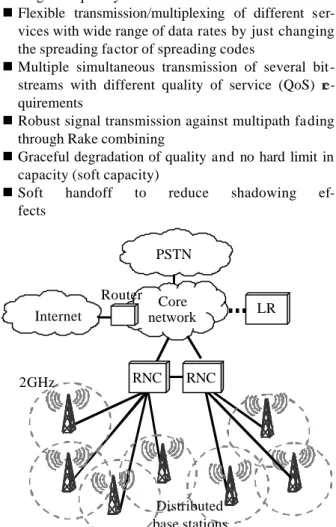
The data transfer rates in 2G cellular systems are too slow, e.g., less than 64kbps, for retrieving rich information comprising text and images. However, a significantly wide range of data-rates were in demand, e.g., from as low as 8kbps to a couple of megabits per second. This led to the 3G cellular standards. Figure 1 illustrates a simplified archi-tecture of the 3G WCDMA systems . Several base stations are controlled by RNC, which is in turn connected to the core network. Minimum requirements in terms of data trans-port rates and quality for different communication environ-ments are:
n Indoor: 2Mbps with bit error rate (BER)=10-6
n Pedestrian: 384kbps with BER=10-6
n Vehicular: 144kbps with BER=10-6
Wideband (5MHz bandwidth) direct sequence code div i-sion multiple access (DS-CDMA) technology has been adopted as one of the wireless access techniques [3] since it has many advantages over its counterpart, time division multiple access (TDMA) technology:
n Single-frequency reuse
n Flexible transmission/multiplexing of different ser-vices with wide range of data rates by just changing the spreading fa ctor of spreading codes
n Multiple simultaneous transmission of several bit-streams with different quality of service (QoS) re-quirements
n Robust signal transmission against multipath fading through Rake combining
n Graceful degradation of quality and no hard limit in capacity (soft capacity)
n Soft handoff to reduce shadowing ef-fects Internet PSTN 2GHz LR RNC Core network RNC Router Distributed base stations
Fig. 1 3G WCDMA cellular architecture.
There are two alternatives: one is WCDMA and the other cdma2000. Now, the shift to 3G systems is on going. The introduction of WCDMA services took place in Japan in 2001. This will be continued in Europe. Meanwhile, WCDMA will continue to evolve to meet the demands for packet-data services and substantially strengthen its downlink data rate capability, resulting in high-speed (8~10Mbps) downlink packet access (HSDPA) for best ef-fort packet data services. The major technical features of HSDPA include [17]:
n Adaptive modulation and coding to vary the modu-lation level and channel coding rate according to the received signal quality
n Fast hybrid ARQ to provide implicit link adaptation to instantaneous channel conditions
n Fast cell selection for a mobile to be served by the best cell rather than by multiple cells (unlike soft handoff)
The evolution of cellular systems is shown in Fig. 2. New systems have appeared every decade according to advancements in wireless technologies and changes in user demands. 1980 1990 2000 Year
2G
~64kbps1G
~2.4kbps Narrowband Era Service type Voice Multimedia Analog AMPS TACS NTT Digital IS95 IS136 GSM PDC 20103G
~2Mbps Wideband Era4G
~1Gbps IMT-2000 Broadband Era Broadband wirelessFig. 2 Evolution of cellular systems .
2.2 Wireless LAN standards
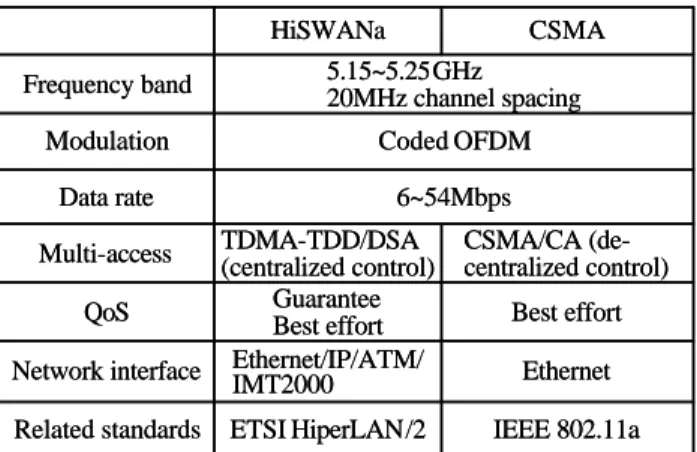
Different versions of wireless LAN standards exist in the 2.4GHz and 5GHz bands. Figure 3 illustrate a simplified structure of wireless LAN system. A wireless terminal ac-cesses servers distributed in LAN and Internet via nearby access point (AP). Today’s wireless LAN standards in-clude: ETSI-BRAN HiperLAN/2 (5GHz), IEEE802.11a (5GHz) and b (2.4GHz), and ARIB high-speed wireless access net-work (HiSWAN) and CSMA (5GHz), etc. The 5GHz wireless LAN standards are more or less identical, with OFDM modulation, 20MHz channel spacing, data rates up to 54Mbps, while IEEE802.11b uses DS-CDMA and provides ~11Mbps data rate in the 2.4GHz band. Two types of multi-ple access techniques are adopted in wireless LANs. They are CSMA/CA and TDMA-TDD/DSA; the former is the distributed control and the latter the central control. Since wireless LANs provide significantly higher data rates but have a shorter-range coverage (100~150m but 500m~1km in LOS condition) than 3G cellular systems, Wireless LANs
and 2/3G cellular systems are considered to be complement each other.
ARIB 5GHz wireless LAN standards, HiSWANa and CSMA, are compared in Table 1 [4]. The former has many commonalities with HiperLAN/2 while the latter IEEE802.11a HiSWAN can accommodate a maximum of 256 users per AP and efficiently handle asymmetric traffic between uplink and downlink due to the dynamic assignment of the TDMA/TDD slots between them. Link adaptation i s em-ployed that changes the combination of OFDM subcarrier data modulation level and coding rate according to changes in propagation environments. Since HiSWANa utilizes the central control, QoS control is possible. There are three QoS classes: best effort class using ARQ with guaranteed mini-mum bandwidth, fixed guaranteed bandwidth class using ARQ, and fixed guaranteed bandwidth class without ARQ. HiSWANa was originally designed to have an interface with ATM networks but now with 3G cellular systems by adding the convergence layer to wireless LAN protocol stacks .
AP Server Internet AP AP Terminal 2.4/5GHz Server Router
Fig. 3 Wireless LAN architecture. Table 1 ARIB 5GHz wireless LAN standards
IEEE 802.11a ETSI HiperLAN/2 Related standards Ethernet Ethernet/IP/ATM/ IMT2000 Network interface Best effort Guarantee Best effort QoS CSMA/CA (de-centralized control) TDMA-TDD/DSA (centralized control) Multi-access 6~54Mbps Data rate Coded OFDM Modulation 5.15~5.25GHz 20MHz channel spacing Frequency band CSMA HiSWANa IEEE 802.11a ETSI HiperLAN/2 Related standards Ethernet Ethernet/IP/ATM/ IMT2000 Network interface Best effort Guarantee Best effort QoS CSMA/CA (de-centralized control) TDMA-TDD/DSA (centralized control) Multi-access 6~54Mbps Data rate Coded OFDM Modulation 5.15~5.25GHz 20MHz channel spacing Frequency band CSMA HiSWANa
Recently, a move of coordination between cellular communications and wireless LANs is under way. Since most of the traffic will be data transport between the termi-nal and Internet via APs, the central access control seems to be efficient even in wireless LAN. CSMA/CA used in ARIB CSMA standard (also in IEEE802.11) is a distributed
control. In wireless environments, there may arise the well-known hidden terminal problem if the links are not in LOS environment, this may significantly reduce the wireless LAN throughput. Roaming functions are necessary in wire-less LANs to support nomadic services. Wirewire-less LANs provide much faster data rate capability but lacks nation-wide mobility support (although handoff within the own wireless LAN is possible). This may be only possible by close coordination with cellular networks that equip loca-tion registers.
3. Evolution Into Broadband Communication
Era
Broadband multimedia services will soon be in full force in fixed networks based on next generation Internet tech-nology. Information transferred over the Internet will be-come increasingly rich. It is quite difficult to predict which services will become popular in the coming 10 years. How-ever, most of the services may contain high resolution and shorter delay streaming video combined with audio. An important issue to be discussed is whether extremely high data rates are necessary everywhere. Perhaps, small hot spot areas, e.g., homes, shopping areas, railway stations, airports, hotels, etc., require such extremely high data rates. However in future, the requirement of high data rate ser-vices at all places will be a trend.
The most important objective of the global 4th genera-tion (4G) wireless systems (global 4G wireless includes cel-lular and wireless LAN) is to offer both celcel-lular and nomadic users broadband multimedia services everywhere. The so-called 4G cellular systems (expected to emerge around 2010) provide nationwide coverage but will support much in-creased data rates than 3G cellular systems (WCDMA, cdma2000). On the other hand, wireless LANs will only cover hot spot areas with extremely high data rates, but will strengthen its roaming and handoff capabilities. However, to provide a seamless nationwide broadband services, close coordination of 3/4G cellular systems and wireless LANs is necessary, as indicated in [17].
3.1 Evolution path
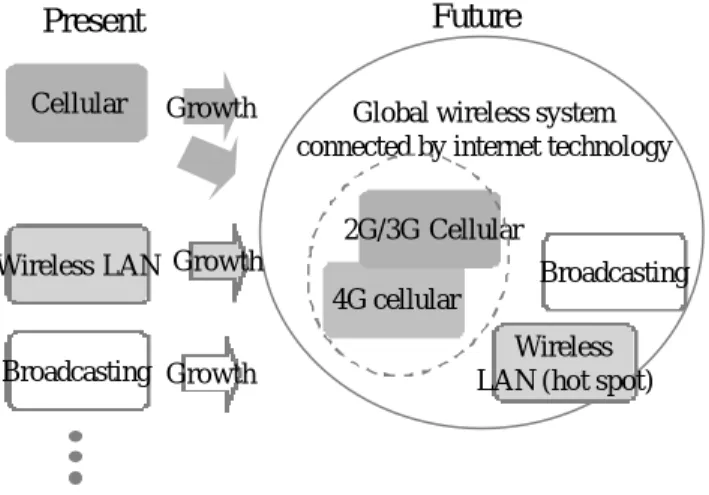
In line with an explosive expansion of Internet traffic, demands for broad ranges of services (in terms of data rate, quality, traffic type, …) are becoming stronger. It may be almost impossible to build a single super wireless system to meet all the demands. Therefore, it may be wise to construct a virtual global system that can efficiently connect many dedicated wireless systems using broadband internet tech-nology, each optimized to each communications environ-ment as indicated by Fig. 4.
The virtual global system allows each wireless system to evolve independently of each other. Seamless roaming and handoff capabilities among cellular systems, wireless LAN systems, and other wireless systems will be of paramount importance. This will be an important task of IP
mount importance. This will be an important task of IP based core network.
Global wireless system connected by internet technology
Broadcasting Wireless LAN (hot spot) Cellular Broadcasting Wireless LAN Growth Growth Growth 4G cellular 2G/3G Cellular
Present
Future
Fig.4 Global 4G wireless system.
3.2 Close to 1Gbps wireless will be required
at hot spot areas
Demands will become stronger and stronger for downloading of ever increasing volume of information. Tremendous long transport time over the air is necessary with today’s wireless technology. In case of cellular com-munications, a 1MB still image needs 14 min at 9.6kbps of 2G technologies to download. The transport time will be significantly reduced to 4s with 2Mbps of 3G cellular tech-nologies. But, sooner or later, much richer images (stream-ing video combined with audio) will appear on Web sites distributed worldwide. Furthermore, the asymmetry between forward (base-to-mobile) and reverse (mobile-to-base) wire-less link traffic is increasing. More than several dozen times higher rates will be required for forward links for download-ing of images from a Web site. On the other hand, today’s wireless LANs cannot provide nationwide roaming services for nomadic users.
Global 4G wireless systems need be fu lly packet-based. Giga-bit wireless technology (up to 1G bps) will be required that is optimized to broadband IP packet transport over the air. Flexible data multiplexing of much broader range of in-formation rates than today’s 3G and wireless LAN is re-quired. Significantly asymmetric traffic between forward and reverse links is foreseen. For wireless access, a mixture of random and reservation packet access and much flexible wireless resource assignment between forward and reverse links will be required. A 100M~1Gbps class wireless access (we call this technology Giga-bit wireless) may be neces-sary with best effort type transmission but keeping mini-mum required quality. The Global 4G wireless system re-quirements for the air interface may be:
n Global and seamless roaming between different wire-less systems
n Hot spots and pedestrian environments: 100M~1Gbps
n Vehicular environments: ~100Mbps
n Spectrum efficiency: ~10 bps/Hz
The 4th requirement is of paramount importance because of very limited available bandwidths. For achieving this, multi-ple-input multiple-output antenna systems (MIMO) will play an important role.
3.3 Cellular network structure will become
closer to wireless LAN
As one may expect, IP packet traffic will dominate over the circuit switched traffic in the near future. 3G systems have a much higher data transport capability and can han-dle IP packet traffic more efficiently than any other 2G sys-tems. However, 3G core networks seem to be only slowly evolving from 2G by taking advantage of their legacy and therefore, 3G core networks may not be fully optimized to the IP packet traffic.
It should be emphasized again here that the global wire-less system would consist of broadband 4G cellular systems, 2G/3G cellular systems, wireless LANs, and probably broadcasting systems. The 4G cellular systems will be used for nationwide and hotspot areas coverage, while evolved wireless LANs will cover only hot spot areas. Broadcasting systems may have nationwide coverage to provide cellular and n omadic users with one-way streaming video programs and high-fidelity music programs, etc. Wireless network architecture completely different from 2G/3G cellular sys-tems is thus, necessary. An advanced IP networks will con-nect wireless access network components of the aforemen-tioned systems to each other.
Base station WNC
LR
WNC: Wireless Network Control LR: Location Register
IP-based wireless access network
IP -based core network
Fig. 5 Conceptual configuration of 4G cellular systems . Table 2 Comparison of 1G ~ 4G cellular systems
OFDM, CDMA based access DS-CDMA TDMA, DS-CDMA FDMA Internet (text, images) Internet (text only) Circuit-switched Voice Analog 1G Core-network Major Services Wireless Access Broadband IP-based Circuit -and packet -switched Circuit -and packet switched Broadband rich Internet Up to 1 Giga bit/s 4G Voice Voice Digital Digital 3G 2G OFDM, CDMA based access DS-CDMA TDMA, DS-CDMA FDMA Internet (text, images) Internet (text only) Circuit-switched Voice Analog 1G Core-network Major Services Wireless Access Broadband IP-based Circuit -and packet -switched Circuit -and packet switched Broadband rich Internet Up to 1 Giga bit/s 4G Voice Voice Digital Digital 3G 2G
Figure 5 illustrates a conceptual configuration of 4G cellular systems (which is one component of the global 4G wireless system). The cellular systems will be based on all IP-based wireless access and core networks, through which different wireless systems are connected to support seam-less services. The wireseam-less part of 4G cellular systems will become closer to a wireless LAN, but with wide area mobil-ity management as in the 2G/3G cellular systems. Table 2 shows how 1G to 4G cellular systems are different. Cellular systems require many call control functions and distributed database, and quick and stable connections between these are necessary. These will be embedded in the IP-based wire-less access networks based on a virtual leased line concept. Voice traffic can be transferred as IP packets, i.e., VoIP, but how to guarantee different QoS requirements and reduce latency is a major technical issue.
4. Wireless Challenges
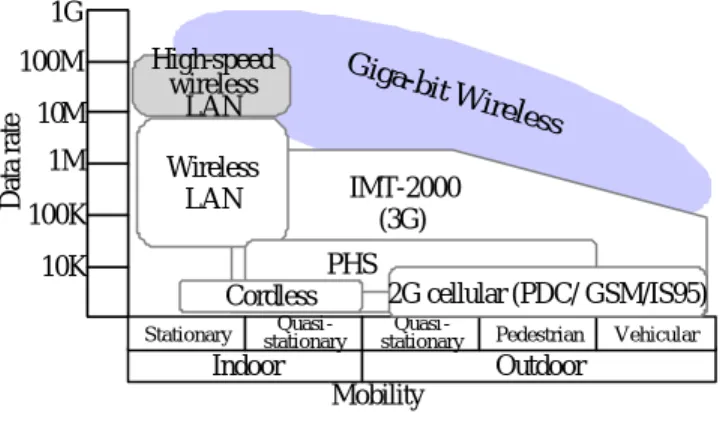
Technology target of 4G wireless is shown in the mobil-ity-data rate plain of Fig. 6. Giga-bit wireless for broadband packet access is one of the core technologies for global 4G wireless systems. It may be necessary to develop common wireless technology to be used in cellular and wireless LAN systems. Then, it is relatively easy to develop software de-fined wireless terminals that can access both cellular and wireless systems (even broadband broadcasting systems). Below we focus our discussions on broadband wireless access techniques. Giga -bit Wireless 1G 100M 10M 1M 100K 10K Data rate Indoor Outdoor Wireless LAN
Stationary stationaryQuasi - stationaryQuasi - Pedestrian Vehicular
Mobility IMT-2000 (3G) High-speed wireless LAN PHS 2G cellular (PDC/ GSM/IS95) Cordless
Fig. 6 Mobility-data rate map.
For wireless access, today’s 3G cellular standards adopt DS-CDMA while high-speed wireless LAN standards employ CSMA/CA or TDMA-TDD/DSA combined with OFDM. A simple use of 3G DS-CDMA technologies seems to experience significant degradations in a severe frequency selective fading channel. Any wireless technique has its own limitations: too long propagation delays to equalize in TDMA, too weak propagation paths to coherent Rake com-bine in DS-CDMA, and no multipath diversity and large peak-to-average power ratio when using OFDM. Proper choice of wireless access techniques is important. In OFDM, many narrowband channels are used in parallel, leading to
small performance degradations in a severe frequency sele c-tive channel. Recently, a combination of OFDM and CDMA techniques is extensively studied as 4G wireless access. The challenge is to transmit data packets of as many users as possible with high quality at hig h speed (close to 1Gbps) under severe frequency-selective fading environments.A debate similar to that concerning 3G wireless access will undoubtedly occur again. An interesting question is: whether to spread as in 3G or not to spread as in 2G? There will be two approaches to realize Giga-bit wireless: from DS-CDMA [3] and from MC-DS-CDMA [5], [6], [7]. The former uses time-domain spreading sequences , while the latter uses frequency-domain spreading sequences , as under-stood from Fig. 7.
time
freq.
user#0user#1user#2 user#3 1 chip 1 data symbol (a) DS-CDMA user#2user#3 time freq. user#0user#1 1 chip 1 data symbol (b) MC-CDMA
Fig. 7 DS-CDMA and MC-CDMA.
4.1 DS-CDMA approach
The spreading factor (SF) can control the transmission data rate and the number of simultaneously transmitting users. For packet data services, ARQ combined with DS-CDMA (spread ARQ) seems to be the most appropriate error control scheme. However, spread ARQ alone cannot perform satisfactorily in a severe frequency selective chan-nel. Spread ARQ can be combined with forward error con-trol technique to form spread hybrid ARQ, in which the in-formation data is first forward error coded and then spread to transmit.
One promising solution is to use spread type-II hybrid ARQ with rate compatible punctured turbo (RCPT) coding and coherent rake combining [8]. Spread type-II hybrid RCPT ARQ transmits only additional parity bits in response to a retransmission request. Combined use of present and previously received packets forms a lower rate code. Code combing [9] or time diversity (TD) combining [10] is also utilized. The computer simulated performance of spread type-II hybrid RCPT ARQ in a four-path (L=4) frequency selective Rayleigh channel is plotted in Fig. 8. In multi-user environment, the throughput obtained with and without
spreading is found to be almost the same when RCPT codes are used as the error correction code.
Interesting question with respect to spread type-II hy-brid RCPT ARQ is: what should be the spreading factor? We need to consider the pros and cons for a spread system and a non-spread system.
(a) When spread: Spreading allows multiple users to com-municate at the same time. Each user is provided con-tinuous transmission but the time taken for transmission is longer. Total throughput is divided among the users ; hence, each user’s throughput is lower. This may be op-timum for real time communication with a constant data rate.
(b) When not spread: High throughput is given to a single user at each moment. After completing the transmission of one user, channel is assigned to another user. Users need to wait for channel being assigned. This scheme may be optimum for non-real time data communications.
0 0 . 2 0 . 4 0 . 6 0 . 8 1 1 1 0 1 0 0 S p r e a d i n g f a c t o r Total throughput E b / N o = 0 d B E b / N o = 0 d B E b / N o = 4 d B E b / N o = 4 d B E b / N o = 8 d B E b / N o = 8 d B I d e a l W M S A
Fig. 8 Downlink total throughput of spread type-II RCPT hybrid ARQ. N=SF users and L=4-path Rayleigh channel.
Then, is it necessary to spread? Both can be used. The use of orthogonal variable spreading factor (OVSF) spread-ing code [11], [12] allows construction of spread and non-spread systems. A possible non-non-spread wireless system may be a random TDMA system with appropriate schedul-ing, while a possible spread system is just an extension of present 3G cellular system based on DS-CDMA. Real time and non-real time services with relatively low data rate per user are provided in cellular system with SF>1. On the other hand, in hot spot areas, non-real time services with very high data rates are provided with SF=1. An SF=1 system requires a fast scheduling mechanism to determine which user to transmit in the given time interval. Since higher pri-ority of services is given to users in better channel condi-tions, a certain degree of fairness among users should be kept. The SF=1 system can be extended to a cellular system
with the aid of fast selection of transmit cell and adaptive antenna array. Note that, in areas with too severe fre-quency-selective channel environments, this approach may not be optimal.
4.2 MC-CDMA approach
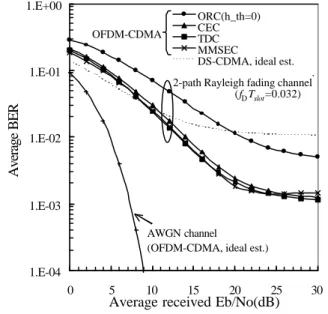
MC-CDMA wireless access can cope with severe fre-quency-selective fading and allows multi-rate transmission using OVSF spreading codes (when orthogonal sub-carriers are used, it is called OFDM-CDMA). MC-CDMA can fill the gap between OFDM and DS-CDMA [13]. The former can overcome frequency-selective fading by adopting a rela-tively low-complexity receiver (a simple one-tap equalizer per sub-carrier), while the latter gives multi-access capabil-ity, multi-rate transmission, single-frequency reuse, etc. The received signal suffers from severe frequency distortion and thus, partial orthogonality destruction is produced, thereby producing large multi-user interference (MUI). A number of multi-user interference suppression techniques have been proposed: orthogonal restoration combining (ORC), con-trolled equalization combining (CEC), minimum mean square error combining (MMSEC) and threshold detection combin-ing (TDC) [5], [6], [7], [14]. The computer simulated BER performances of MC-CDMA achievable with ORC, CEC, TDC, and MMSEC are compared with that of DS-CDMA in Fig. 9. MC-CDMA achieves better BER performance than DS-CDMA. 1.E-04 1.E-03 1.E-02 1.E-01 1.E+00 0 5 10 15 20 25 30
Average received Eb/No(dB)
Average BER
ORC(h_th=0) CEC TDC MMSEC
DS-CDMA, ideal est. AWGN channel, ideal est. 2-path Rayleigh fading channel OFDM-CDMA
AWGN channel
(OFDM-CDMA, ideal est.) (fDTslot=0.032) 1.E-04 1.E-03 1.E-02 1.E-01 1.E+00 0 5 10 15 20 25 30
Average received Eb/No(dB)
Average BER
ORC(h_th=0) CEC TDC MMSEC
DS-CDMA, ideal est. AWGN channel, ideal est. 2-path Rayleigh fading channel OFDM-CDMA
AWGN channel
(OFDM-CDMA, ideal est.) (fDTslot=0.032)
Fig. 9 Downlink BER performance of MC-CDMA. N=128 users and L=2-path Rayleigh channel.
It allows flexible system design between cellular system and single cell system. The use of SF>1 allows single-frequency reuse similarly to 3G, while SF=1 can be used to cover hotspot areas, resulting in a single -cell system using OFDM [13], as illustrated in Fig. 10 (similar design can be applied to DS-CDMA). To significantly increase the data
rate within limited bandwidth under severe frequency-selective environments, the combination of MC-CDMA approach with MIMO plays an important role.
PN#2 Pure OFDM+rand om TDMA PN#6 PN#3 PN#5 PN#4 PN#1 OFDM-CDMA PN#0
Fig. 10 OVSF DS-CDMA and MC-CDMA systems.
4.3 Virtual cell
The frequency bands for the global 4G wireless sys-tems will most likely lie above 5 GHz. One important ques-tion is whether extremely high data rate can be designed on the basis of today’s 3G cellular and wireless LAN system architectures. Since the propagation loss is in proportion to 2.6th power to the carrier frequency [15], the links are not only interference-limited but also become severely power-limited. This suggests that a nano-cell or even a pico-cell structure must be adopted. As mentioned earlier, it is almost impossible for 4G cellular and wireless LAN systems to pro-vide nationwide coverage; only hot spot areas with high multimedia traffic can be covered. In hot spot areas, data transport needs be done almost instantly at speeds of 100M~1Gbps. In other areas, however, data transport can be done using conventional cellular systems.
Due to the nano/pico-cell structure, propagation statis-tics are strongly influenced by microscopic structure of nearby propagation environments and dynamically change from cell to cell according to the movement of a user. This makes use of adaptive antenna array quite attractive not only in the base stations but also in mobile terminals. How-ever, additional gains achievable by adaptive antenna array may be 10~20dB at most and may not be sufficient to offset the significant increase in the path loss. The introduction of adaptive (modulation level and code rate to the time-varying channel conditions) best-effort transmission is necessary but with guaranteed minimum data rate of e.g. 30Mbps; faster transmission rates if closer to base stations or better propagation conditions. The above discussions imply that 4G wireless systems may need to be designed apart from the cellular concept that relies on the statistical properties of propagation channels .
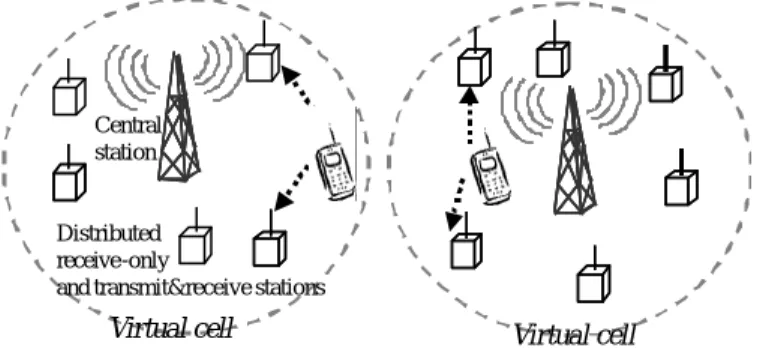
One idea to cope with increasing path loss is to adopt virtual cell concept [16]. This is illustrated in Fig. 11. Each virtual cell consists of many distributed small base stations with extremely high data rate capability. This is similar to an ad hoc network, e.g., wireless LAN, but with central
admini-stration (central station). Most of the cellular system re-search is focused on centralized systems. This virtual cell concept is particularly suitable to non-real time IP packet transport, which obviously does not require transmit and receive functions at the same base station. Hence, the re-ceive-only stations can be distributed in each virtual cell together with conventional transmit & receive stations.
The small base stations can be similar to existing wire-less LANs, e.g., HiperLAN, IEEE802.11, HiSWAN, etc, but most importantly having dynamic network topology, autonomous routing to the central station, fast handoff, fluctuating link capacity. Each small base station can be connected based on wireless multi-hopping technology. i.e., each small base stations with short communication ranges may be used and the user data can be relayed via small base stations to the central station. They can be installed where needed and removed when not needed; they are connected to each other in a self-configuring way to transport IP traffic. For the ad hoc networking, it may be difficult to guarantee the fixed QoS. QoS control, security, routing and mobility management are important research issues.
Central base s tations with large transmit powers can be co-located with the base stations of 2G/3G cellular systems . Since coverage areas of virtual cells cannot overlap each other, close cooperation with 2G/3G systems is necessary. The 3G cellular radio access network (RAN) can be overlaid with the above virtual cell networks in the hot spot areas. This requires inter-system mobility management between the 3G and virtual cell networks, a dynamic IP routing algo-rithm, and the so-called software defined radio technology. The last is to make a single mobile terminal access different radio components of global 4G wireless systems.
Central station
Distributed receive-only
and transmit&receive stations
Virtual cell Virtual cell
Fig. 11 Virtual cell using ad hoc and multi hop networks.
5. Conclusion
Wireless is becoming more and more important. Wire-less systems are now becoming an important infrastructure of our society. It may be almost impossible to build a single super wireless system to meet demands for broad ranges of Internet services (in terms of transmission rate, quality, traf-fic, …) to cellular and nomadic users. A virtual global sys-tem is a good solution that can efficiently connect many dedicated wireless systems including 2~4G cellular systems, wireless LAN, broadcasting systems, etc., each optimized to each communications environment.
In this paper, we overviewed today’s wireless stan-dards of 3G cellular systems and wireless LANs and dis-cussed technical issues for the realization of global 4G wire-less systems. The core network will be fully IP-based. Giba-bit wireless and virtual cell concept were presented. The expected frequency bands are above several GHz and data throughput over the air will be close to 1Gbps. Cellular and wireless LAN system architecture may become closer and will work together based on IP core network. Difference between them may be the former offers seamless handoff for real-time services but the latter offers seamless roaming for nomadic services, focusing on very high-speed data com-munications close to 1Gbps. In case of cellular systems, since wireless links are severely power-limited for such a Giga-bit wireless, adoption of the well-known and long-time used cellular concept may not be a good idea. Adoption of virtual cell concept that allows flexible installation of dis-tributed base stations may be a better solution. The receive functions can be separated from the base station and can be geographically distributed to make it possible to reduce the transmit power of portable phones. Virtual cell concept adopts ad hoc and multi-hop networking to provide ex-tremely high data rate services with reasonable transmit power.
Before the realization of the wireless society, very diffi-cult but interesting technical challenges are waiting for us.
REFERENCES
[1] Special issue, IMT-2000: Standards efforts of the ITU, IEEE Personal Commun., Vol. 4, Aug. 1997.
[2] “Fourth generation wireless networks and interconnecting standards,” IEEE Personal Commun., vol. 8, Oct. 2001.
[3] Special issue, Wideband CDMA, IEEE Commun. Mag., Vol. 36, Sept. 1998.
[4] T. Hattori and M. Fujioka, ed, Wireless broadband lec-ture book, (in Japanese) IDG Japan, 2002.
[5] M. Helard, R. Le Gouable, J.-F. Helard, and J.-Y. Bau-dais, “Multicarrier CDMA techniques for future wide-band wireless networks,” Annals of Telecommunica-tions, Vol. 56, pp. 260-274, May-June 2001.
[6] S. Hara and R. Prasad, “Design and performance of multicarrier CDMA system in frequency-selective Rayleigh fading channels,” IEEE Trans. Veh. Technol., Vol. 48, pp. 1584-1595, Sept. 1999.
[7] S. Hara and R. Prasad, “Overview of multicarrier CDMA”, IEEE Commun. Mag., pp.126-144, Dec. 1997. [8] D. Garg and F. Adachi, “Effect of limited number of
retransmissions of RCPT hybrid ARQ for DS-CDMA mobile radio,” Proc. 5th International Symp osium on Wireless Personal Multimedia Communications, Hawaii, Oct. 27-30, 2002.
[9] D. Chase, “Code combining- a maximum likelihood de-coding approach for combing and arbitrary number of noisy packets ”, IEEE Trans. Commun., Vol COM-33, pp. 385-393, May 1985.
[10] F. Adachi, S. Ito, and K. Ohno, “Performance analysis of a time diversity ARQ in land mobile radio”, IEEE Trans. Commun., Vol. 37, pp.177-183, Feb. 1989. [11] F. Adachi, M. Sawahashi, and K. Okawa,
“Tree-structured generation of orthogonal spreading codes with different lengths for forward link of DS-CDMA mobile radio,” IEE Electron. Lett., Vol. 33, pp. 27-28, Jan. 1997.
[12] K. Okawa and F. Adachi, “Orthogonal forward link us-ing orthogonal multi-spreadus-ing factor codes for coher-ent DS-CDMA mobile radio,” IEICE Trans. Commun., Vol.E81-B, pp. 777-784, April 1998.
[13] H. Atarashi and M. Sawahashi, “Variable spreading factor orthogonal frequency and code division multi-plexing (VSF-OFCDM),” 2001 Third International Workshop on Multi-Carrier Spread Spectrum (MC-SS 2001) & Related Topics, pp.113-122, Oberpfafenhofen, Germany, Sept. 26-28, 2001.
[14] T. Sao and F. Adachi, “Pilot-aided frequency-domain equalization with threshold detection for OFDM-CDMA downlink transmissions in a frequency selec-tive fading channel,” IEICE Trans. Commun., to appear. [15] M. Hata, “Empirical formula for propagation loss in land
mobile radio services,” IEEE Trans. Veh. Technol., Vol. VT-29, No. 3, pp.317-325, Aug. 1980.
[16] F. Adachi, “Wireless past and future - evolving mobile communications systems,” IEICE Trans. Fundamentals, Vol. E84-A, pp.55-60, Jan. 2001.
[17] H. Honkasalo, K. Pehkonen, M. T. Niemi, and A. T. Leino, “WCDMA and WLAN for 3G and beyond,” IEEE Wireless Commun., Vol. 9, pp. 14-18, April 2002.