This report is a reprint from the June 27, 2002 Patricia Seybold Group's Strategic Research Service.
It has been reproduced here as originally published.
Patricia Seybold Group
S t r a t e g i c C o n s u l t a n t s & T h o u g h t L e a d e r s
CPXe as a Web Services
Business Framework for
Printing Digital Photographs
Choreographing E-Business Environments for
Distributed Photofinishing
Customer-Centric Solutions/ Perspective
CPXe as a Web Services Business Framework
for Printing Digital Photographs
Choreographing E-Business Environments for Distributed Photofinishing
By Geoffrey E. Bock June 27, 2002
NETTING IT OUT
On June 17, 2002, the International Imaging Industry Association (I3A), an industry consor-tium that includes Kodak, HP, and Fujifilm, an-nounced the Common Picture eXchange Envi-ronment (CPXe), a Web Services business framework designed to making printing digital images as convenient as using film. Relying on SOAP, XML, and UDDI, CPXe is designed to build an end-to-end e-business environment for linking consumers who take digital photographs with photofinishers who produce high-quality prints.
CPXe is only one of a number of initiatives that Kodak is backing for creating and distributing digital assets within electronic environments. The company is intent on becoming a major technology provider in the rapidly emerging in-foimaging marketplace.
We believe that CPXe illustrates the business benefits of a Web Services business framework for managing content on the Web and for fos-tering network-enabled, distributed business processes that deliver added-value services to customers.
WHEN A PICTURE IS WORTH A THOUSAND WORDS
An Industry-Wide Initiative
On June 17, 2002, the International Imaging In-dustry Association (I3A) announced the Common
Picture eXchange Environment (CPXe), a Web Ser-vices business framework designed to make printing digital images as convenient as using film. As an industry consortium, I3A members have a signifi-cant interest in building a common (and open) ena-bling infrastructure for supporting the emerging digi-tal imaging marketplace. Eastman Kodak, HP, and Fujifilm have led the CPXe effort within the I3A.
CPXe will enable the transmission and printing of digital images among digital cameras, PCs, desk-top software, Internet services, photo kiosks, digital minilabs, and photofinishers—regardless of the types of digital cameras, desktop hardware, or oper-ating systems. CPXe will allow consumers using any digital camera or device to upload, download, and order prints of digital pictures at any retail location with any type of photofinishing equipment used by the retailer.
For instance, in the not too distant future, once we have selected our 10 favorite digital pictures from our daughter’s first birthday party, we will be able to go online and, using a Web browser, have a set printed at any one of a number of local photofinishing firms in our neighborhood. We will also be able to find a photofinisher online who will print a bound album (at an affordable cost) and ship it to the proud grandparents.
Relying on SOAP, XML, and UDDI
CPXe relies on SOAP and XML for describing the exchange of digitized image content, and regis-ters its service-access descriptions in a UDDI direc-tory. The I3A initiative is designed to make it easy for camera manufacturers to build connections to CPXe-compliant service providers and for customers to connect to photofinishers who will produce
high-2 • CPXe as a Web Services Business Framework for Printing Digital Photographs
© 2002 Patricia Seybold Group
resolution, photographic-quality prints of their digi-tal pictures. The industry consortium will support and manage the directory of service providers.
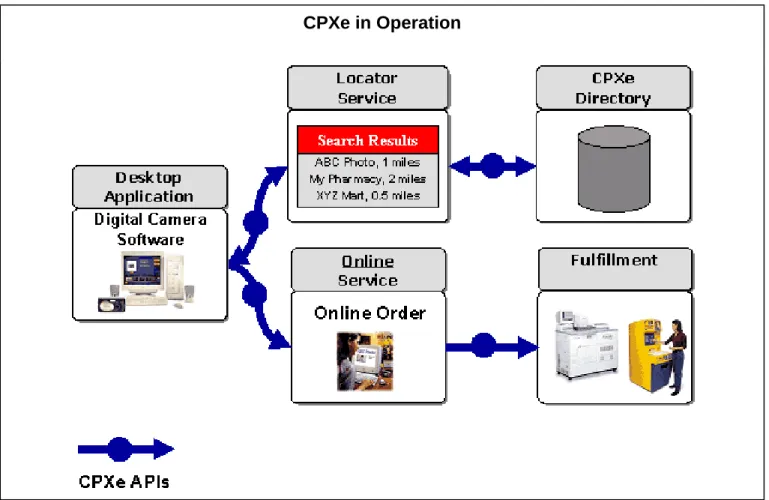
To continue our example, as the parents of a one year old, we will connect to the Internet (either di-rectly from our digital camera or through an inter-mediate Webtop), check a Web-based directory of photofinishers, find one that is offering the services we want, and then electronically send our order to its printing process (see Illustration 1). Photofinishers themselves can decide how much information about their services they disclose through the common di-rectory. For instance, CPXe allows for companies to publish pricing information, but it does not require them to do so.
As a result, CPXe standardizes the Internet-centric protocols and the underlying business proc-esses for digitized photofinishing. It includes com-ponent interfaces to access:
• Locator Services
• Fulfillment Access Services
• Storage Services
• Financial and Tracking Services
Over time, CPXe may eventually replace the vendor-specific mechanisms used by existing con-sumer-oriented e-business services such as Ofoto, Shutterfly, and NikonNet.
Moreover, as this Web Services business frame-work matures, we expect that CPXe will have an impact on the distribution of royalty-free and profes-sional stock photography, operated by such firms as Getty Images and Corbus. And CPXe may well lead to entirely new kinds of Web-based business ser-vices that most of us have not yet been able to imag-ine.
CPXe in Operation
Illustration 1. CPXe provides a Web Services business framework for linking customers to photofinishers. An end user uses a desktop application to access a provider locator service and then to upload digital images to a pro-vider for printing and fulfillment.
IMPLICATIONS FOR MANAGING CONTENT ON THE WEB
How a Web Services Business Framework Transforms Customer Experiences
CPXe, in fact, is a good example of how a Web Services business framework promises to transform customer experiences for managing content on the Web and thus create an adaptive business process environment. Following the criteria we have
de-scribed in “The Anatomy of Web Services1,” CPXe
specifies the business-related services for consumers to communicate with a range of photofinishing pro-viders across the Web for such
activities as discovery, provi-sioning, transactions, billing, and the like.
Then there is the question of how to deliver value by creating compelling customer experi-ences based on industry-standard protocols and services. As we witnessed in the run-up to the Windows XP announce-ment in 2001, an industry battle is brewing between Microsoft (which has its own ambitions for managing digital
photogra-phy experiences) and Kodak. A widely-accepted Web Services business framework which describes the core business processes for photofinishing ser-vices could provide the common ground for defusing this skirmish.
Of course, there is always a gap between an-nouncing a standard and building a profitable busi-ness. CPXe is not slated to be completed until the end of 2002, and there will invariably be some tech-nology fine-tuning in the process as developers be-gin to use it. We certainly do not want to minimize the challenges that photofinishing firms confront as they digitize their operations, nor that technology providers face as they develop the hardware and software environments that utilize CPXe. Fulfilling the promise of linking consumers who are using digital cameras and desktop software to a range of
1
Published May 16, 2002, http://www.psgroup.com/ doc/products/2002/5/TL5-16-02CC/TL5-16-02CC.asp.
high-quality photographic printing and production facilities will require ongoing investment.
But what counts in this instance is the vision of a common good. With the accelerating growth in sales of digital cameras, the photofinishing industry is facing a strategic inflection point. Connecting to the Internet and integrating photofinishing solutions into a completely digital content storage, organization, and distribution environment, is the way for these firms to capture renewed growth in the long run.
Kodak as a Technology Provider
This Web Services business framework is only the beginning of the story. From a company
perspec-tive, CPXe illustrates how Ko-dak, as a key player in the pho-tography industry, is adapting to the digital revolution. CPXe is only one of a number of in-vestments that we expect the company to make in the months and years ahead.
Through its “Infoimag-ing@Kodak” initiative, Kodak has announced its intentions to become a major technology provider in digital-imaging so-lutions for the Internet econ-omy. Kodak estimates that Info-imaging represents a $225 billion industry, created by the convergence of imaging and information technology. Kodak is fo-cusing on:
• Devices, such as printers, scanners, flat-panel
displays, digital cameras, and PDAs
• Infrastructure, such as imaging software,
broad-band services, and imaging protocols—in addi-tion to photofinishing networks
• Services and media, such as inkjet paper and
inkjet printers, document preservation, and im-age-enabled e-commerce
Using its considerable patent portfolio, Kodak is pursuing business opportunities in all three market sectors. It believes that it already has patents for sig-nificantly improving the quality and clarity of digital color images, both when displayed electronically
CPXe is a good example
of how a Web Services
business framework promises to
transform customer experiences
for managing content
on the Web and thus create
an adaptive business process
4 • CPXe as a Web Services Business Framework for Printing Digital Photographs
© 2002 Patricia Seybold Group
and when printed. Kodak is launching a series of joint ventures with other firms (such as Sanyo for next-generation flat panel displays and HP for high-resolution color printing) to productize its advanced technologies.
Kodak is also making ongoing investments in strategic software technologies for facilitating the storage and distribution of digital images within Internet-scale network environments. Kodak’s con-tribution to CPXe is just one example of a set of in-novations that we expect the company to introduce.
Consequences of Digital Convergence
Finally, as a Web Services business framework, CPXe illustrates the consequences (and business benefits) of digital convergence for managing con-tent on the Web. The images we view are first and foremost digital assets. We expect to store and dis-tribute them digitally.
A Web Services business framework defines the key components of the underlying value chain that support the digital connections. As a viable business proposition, a Web Services business framework describes what we need to do when we want to find various service providers on the Web as well as what one (or more) network-enabled businesses do when they want to offer us their services. When success-ful, these frameworks describe end-to-end business processes that satisfy our needs.
What counts are the relationships among the sev-eral parties and the methods of communicating es-sential information for doing business. A Web Ser-vices business framework such as CPXe is not sim-ply a defined set of software protocols—although the framework certainly needs to specify the syntax and semantics of any automated information inter-change. Rather, the framework also identifies and choreographs specific business processes—how in-dependent firms can structure their relationships, interactions, and information exchanges over the network and deliver value to their customers.
Contact Info:
International Imaging Industry Association 30230 Rancho Viejo Road, Suite 208 San Juan Capistrano, CA 92675 Lisa A. Walker Executive Director Phone: 914.698.7603 Fax: 949.481.7648 E-Mail: [email protected] Internet: http://www.i3a.org Eastman Kodak
Digital and Applied Imaging 21819 Atlantic Blvd. Suite 300
Dulles, VA 20166 Mark Cook
Director of Product Management Phone: 571.434.2212
E-Mail: [email protected]