How to select a
biomass
certification
scheme?
Colofon
Date
May 2011
Status
Final version, public
This study was carried out in the framework of the Netherlands Programmes
Sustainable Biomass by
Name organisation
Partners for Innovation BV
Contact person
Peter Vissers, Ander Paz, Emiel Hanekamp
Although this report has been put together with the greatest possible care, NL Agency does
not accept liability for possible errors.
Contact
Netherlands Programmes Sustainable Biomass
Ella Lammers and Maartje op de Coul
NL Agency
NL Energy and Climate Change
Croeselaan 15, 3521 BJ Utrecht
P.O. Box 8242, 3503 RE Utrecht
The Netherlands
Email: [email protected]
Phone: +31.88.6022569
www.agentschapNL.nl/biomass
Partners for Innovation BV
Peter Vissers, Ander Paz and Emiel Hanekamp
Partners for Innovation BV
Cruquiusweg 20
1019 AT Amsterdam
The Netherlands
Email: [email protected]
Phone: +31.20.6200511
www.partnersforinnovation.com
Guidance for the reader
This document aims to provide guidance to organisations and projects involved in
the production of biofuels and biomass for energy purposes to select a
sustainability certification scheme.
This study has been carried out for NL Agency in the period November 2010 to
May 2011.
In Chapter 1 ‘Introduction’, the background, objective and approach of this study
are presented. Chapter 2 ‘Biomass certification: overview and backgrounds’
describes the relevant legislative developments, a first introduction to certification
schemes in general and to the 18 certification schemes discussed in more detail in
this report. Chapter 3 ‘Biomass certification: how to select a scheme’ aims to
guide organisations in their selection process towards a sustainable biomass
certification scheme.
This report expresses the opinion of the authors, and not necessarily NL Agency's
views.
The information for this report was compiled with the utmost care. Comments or
suggestions on the information presented in this report are highly welcomed:
please contact the authors to share your views. The authors cannot be held
responsible for the consequences of any errors or mistakes in the report.
Acknowledgements
The preparation of this report would not have been possible without the support
and efforts of a number of individuals and institutions. NL Agency would like to
thank everyone involved for his or her cooperation, specifically the representatives
of the sustainability standards reviewed in this study and the input from
representatives of certification bodies: Andreas Feige (ISCC), Arjan Alkema and
John Hontelez (FSC), Eric Evers and Giovanni Wawoe (Dekra), Eric Werner-Korall
(DQS), Frederik Callens (GlobalGap), Inge Kreupeling and Martine Meerburg
(SGS), Jarno Dakhorst (NTA8080), Maryline Guiramand and Sébastien Haye
(RSB), Peter Jürgens (REDcert), Sigrid Brynestad (DNV), Tjipke Hoekstra and
Frank van der Velden (Control Union Certifications).
Definitions and abbreviations
2BSvs
To Be Sustainable voluntary scheme
AGNL
Agentschap NL (NL Agency)
Accreditation
Accreditation is the recognition, by an independent accreditation
body, of the competence of a Certification Body. An accreditation
body assesses both the management system and the technical
competency of the Certification Body. In addition the accreditation
body exercises supervision to guarantee the impartiality and
expertise of the Certification Body.
Assessment
methodology
Methodology of the criteria framework or certification scheme that
is used to assess the biomass against sustainability criteria.
Assessment
scheme
Standard or framework within which biomass is assessed against
sustainability criteria (we use it as a synonym for criteria
framework).
BLE
German Government Agency for Agriculture and Food
BSI
Bonsucro / Better Sugarcane Initiative
CB
Certification Body
CEN
European Committee of Standardization
Certification
Certification is intended to put a "seal" of credibility on a product,
process, system or service. Being certified means that a certain
standard has been satisfied. The certification procedure, usually
done by a third party is the procedure which ensures that a
product, process, system or service conforms to the standards.
The organization performing the certification is called
a certification body or certifier. The certification body might do the
actual inspection, or contract the inspection out to an inspector or
inspection body. The certification decision, i.e. the granting of the
"certificate", is based on the inspection or verification report,
possibly complemented by other information sources. Certification
of a code encompasses verification and validation, but also can
include such things as documentation, quality assurance, and
version control.
Certification
scheme
Standard or established framework within which biomass is
assessed against sustainability criteria, and in which an accredited
certification body certifies that a particular operation is in
compliance with the standard or framework.
CoC
Chain of custody. This is an audit process that reviews the path
taken by raw materials, beginning with a certified source and
continuing through processing, manufacturing, distribution and
print, until the material becomes a final product ready for sale to
the end-use consumer. The chronological documentation or paper
trail, showing the seizure, custody, control, transfer, analysis, and
disposition of evidence, physical or electronic.
Criteria
framework
Standard or framework within which biomass is assessed against
sustainability criteria (we use it as a synonym for assessment
scheme).
Criterion
Normative requirement that forms the second highest level of
criteria frameworks and certification schemes.
CSR
Corporate Social Responsibility
EC
European Commission
EEG
German Renewable Energy Sources Act
EISA
US Energy Independence and Security Act of 2007
EPA
US Environmental Protection Agency
EPFL
École Polytechnique Fédérale de Lausanne
EU
European Union
EU-27
European Union having 27 Member States
FLEGT
EU Action Plan for Forest Law Enforcement, Governance and Trade
FQD
Fuel Quality Directive (EU Directive)
FSC
Forest Stewardship Council
GGL
Green Gold Label ( Essent/RWE label)
GHG
Greenhouse gas
GAP
Good Agricultural Practices
GSBF
Global Sustainable Biomass Fund
IAF
International Accreditation Forum
Illegal logging The harvesting of timber in contravention of the laws and
regulations of the country of harvest
iLUC
indirect Land Use Change
Indicator
Compliance indicator used by the auditors to check whether a
requirement of a standard is fulfilled.
ISEAL
ISEAL Alliance is the global association for social and
environmental standards
ISCC
International Sustainability Carbon Certification system
ISO
International Organization for Standardization
ISO 17011
Requirements for accreditation bodies assessing and accrediting
conformity assessment bodies
ISO 17021
Requirements for bodies providing audit and certification of
management systems
ISO 19011
Guidelines for quality and/or environmental management systems
auditing
ISO/guide 65
Requirements for third-party operating a product certification
system
Lacey Act
The 2008 Farm Bill (the Food, Conservation, and Energy Act of
2008), effective May 22, 2008, amended the Lacey Act combats
trafficking in “illegal” wildlife, fish, and plants.
LEAF
Linking Environment And Farming
NTA
Nederlandse Technische Afspraak (Netherlands Technical
Agreement)
PEFC
Programme for the Endorsement of Forest Certification
Principle
Normative requirement that forms the highest level of criteria
frameworks and certification schemes.
P&C
Principles & Criteria
RA
Rainforest Alliance
RBSA
Abengoa RED Bioenergy Sustainability Assurance standard
RED
Renewable Energy Directive: Directive 2009/28/EC on the
promotion of the use of energy from renewable sources
RESA
Rapid Environmental and Social Assessment
RFA
Renewable Fuels Agency (UK)
RFS
Renewable Fuel Standard
RSB
Roundtable on Sustainable Bio-fuels
RSPO
Roundtable on Sustainable Palm Oil
RTRS
Round Table on Responsible Soy
SAN
Sustainable Agriculture Network
SBI
Sustainable Biomass Import programme
SIA
Social Impact Assessment
Standard
According to the British Standards Institution (BSI), the oldest
standards body in the world, a standard is: ‘a published
specification that establishes a common language, and contains a
technical specification or other precise criteria and is designed to
be used consistently, as a rule, a guideline, or a definition’.
ToR
Terms of reference
Validation
The process of determining the degree to which a product,
process, system or service is an accurate representation of the
intended result.
Verification
The process of determining (visual checking, measurement,
laboratory tests, or examination of documents) that a product,
process, system or service complies with the criteria as defined by
a standard. This process can be conducted within the certification
pathway as part of the auditing process or prior to the certification.
In the latter case, verification services, usually offered by third
parties (inspectors or verifiers) do not imply certification, and it
does not allow the use of certification system trademarks or
claims. However, it does provide the company with a third-party
documentation which may be forwarded business-to-business or
used to facilitate communication with stakeholders.
Index
Colofon—2
Contact—3
Guidance for the reader—4
Acknowledgements—5
Definitions and abbreviations—6
Executive summary—11
1
Introduction—13
1.1
Background—13
1.2
Objective—13
1.3
Project approach—13
2
Biomass certification: overview and backgrounds—14
2.1
Regulatory requirements—14
2.1.1
European legislation for biofuels—14
2.1.2
US legislation for biofuels—14
2.1.3
Legislation for illegal logging—15
2.2
Introduction to certification schemes—16
2.3
Characterisation of most relevant biomass certification schemes—17
3
Biomass certification: how to select a scheme—21
3.1
Is biomass certification appropriate for your business?—22
3.1.1
Assess your organisation’s ambitions and situation—22
3.1.2
Talk with your customers about their needs and requirements—23
3.2
Which certification scheme(s) to select?—23
3.2.1
Fit with organisational and biomass chain characteristics—24
3.2.2
Does the scheme facilitate trade of your product?—25
3.2.3
Does the scheme meet legal requirements?—25
3.2.4
Is the scheme credible?—27
3.2.5
Easiness to comply with the standard’s requirements—29
3.2.6
Fit with your willingness to pay for the scheme benefits—30
3.2.7
Fit with customer needs and requirements—32
3.3
Make a final choice and engage—32
3.3.1
Talk with certification bodies about your plans—32
3.3.2
Talk with your customers about selecting a certification scheme—32
3.3.3
Make a final choice and engage—33
Appendix A: Self assessment form—34
Appendix B: Factsheets of 5 selected certification schemes—37
Appendix C: Information on 13 other certification schemes—78
Appendix D: Bibliographic references—83
Executive summary
Certification of biomass: a high number of possible schemes
In the last decades, certification – an independent seal showing that a product,
process, system or service satisfies a certain standard – has become an important
tool for governments and companies to show their sustainability performance.
Currently there are certification schemes available for almost every product and
service.
A variety of voluntary certification schemes has become operational for the
production, processing and trade of biomass and agricultural products since the
early 1990s. The most prominent ones are FSC in the field of forest certification,
and the Fairtrade standards, GlobalGAP and SAN in the agricultural sector.
Since approximately 2005 work on sustainability standards for biofuels and
biomass-for-energy purposes intensified. Various organizations started developing
sustainability standards, principles and criteria further to the potential of
biomass-for-energy and the concerns about its sustainability aspects. The first private
standards occurred, for example the schemes of Electrabel Belgium (Laborelec)
and Essent Netherlands (GGL). Crop-specific standards came up, developed by
multi-stakeholder initiatives, such as the RSPO standard for palm oil, the RTRS for
soy and Bonsucro/BSI for sugarcane. The development of more generic biomass
standards such as ISCC, NTA8080 and RSB started. In 2010 a number of new
schemes entered the market place with the aim to facilitate compliance with the
EU Renewable Energy Directive.
NL Agency signals difficulties to select appropriate certification schemes
NL Agency, the implementing agency of the Dutch Ministry of Economic Affairs,
Agriculture and Innovation on issues as sustainability, innovation, international
business and cooperation, implements a support programme to develop more
sustainable biomass production chains. It appeared that the biomass actors in this
programme were having difficulties to select an appropriate biomass certification
standard. NL Agency hence took the initiative to develop dedicated guidance.
This report: provide guidance on selection of certification schemes
The aim of this report is to provide biomass actors developing more sustainable
biomass production chains, with:
1.
Information about important biomass sustainability certification schemes;
2.
Guidance to make a well-substantiated decision on the choice for a specific
biomass sustainability certification scheme.
This report: tools and information that facilitate scheme selection
The present report contains a number of tools and information that facilitate the
selection of a certification scheme:
1.
A comparison table of 18 certification schemes that are considered most
relevant for biofuels and biomass for energy purposes (Figure 3 in section 2.3);
2.
A selection model for biomass certification schemes following three main
questions and a number of sub questions (see the Figure 0 below);
3.
A self assessment form that can be used for the process of selecting a
4.
Detailed factsheets on the 5 most relevant certification schemes in Appendix B
(FSC, ISCC, NTA8080, REDcert and RSB). These factsheets were validated by
the scheme owners;
5.
Brief information on 13 other relevant certification schemes in Appendix C
(2BSvs, Abengoa RBSA, BioGrace, Bonsucro BSI, Greenergy, GGL, GlobalGAP,
Laborelec, Neste Oil, Red Tractor, RSPO, RTRS and SAN).
The project information was collected by means of interviews with scheme owners
and certification bodies, interaction with a high number of biomass actors, and
analysis of literature and scheme documentation.
For more information on the selection process, we refer to the report itself. In
Chapter 1 ‘Introduction’, the background, objective and approach of this study are
presented. Chapter 2 ‘Biomass certification: overview and backgrounds’ describes
the relevant legislative developments, a first introduction to certification schemes
in general and to the 18 certification schemes discussed in more detail in this
report. Chapter 3 ‘Biomass certification: how to select a scheme’ aims to guide
organisations in their selection process towards a sustainable biomass certification
scheme.
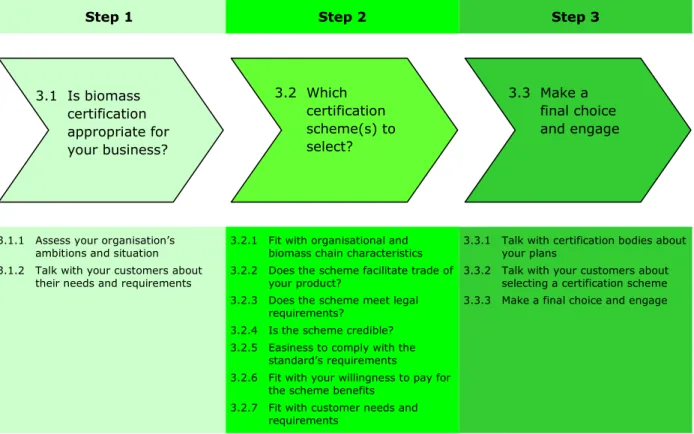
Figure 0: The process of selecting a certification scheme
Step 1
Step 2
Step 3
3.1.1 Assess your organisation’s ambitions and situation 3.1.2 Talk with your customers about
their needs and requirements
3.2.1 Fit with organisational and biomass chain characteristics 3.2.2 Does the scheme facilitate trade of
your product?
3.2.3 Does the scheme meet legal requirements?
3.2.4 Is the scheme credible? 3.2.5 Easiness to comply with the
standard’s requirements
3.2.6 Fit with your willingness to pay for the scheme benefits
3.2.7 Fit with customer needs and requirements
3.3.1 Talk with certification bodies about your plans
3.3.2 Talk with your customers about selecting a certification scheme 3.3.3 Make a final choice and engage
3.3 Make a
final choice
and engage
3.2 Which
certification
scheme(s) to
select?
3.1 Is biomass
certification
appropriate for
your business?
1
Introduction
1.1
Background
The demand for energy is increasing globally; fossil fuel stocks are diminishing.
Diversification of energy sources is necessary in order to provide for this
increasing demand.
Through various regulations and programmes NL Agency facilitates and stimulates
projects and supplementary research in order to gain experience in the production
and certification of sustainable biomass:
•
The Sustainable Biomass Import programme (by order of the Ministry of
Economic Affairs, Agriculture and Innovation).
•
The Global Sustainable Biomass programme (by order of the Ministry of
Foreign Affairs).
Biomass projects are also included in several other programmes of NL Agency,
such as the Daey Ouwens Fund for small-scale renewable energy projects in
developing countries (by order of the Ministry of Foreign Affairs).
The Netherlands Programmes for Sustainable Biomass bundles the knowledge
from the biomass project portfolio of NL Agency and fills the knowledge gaps with
supplementary research. The biomass project portfolio consists of some 41
projects
1in which market actors and knowledge institutes are developing more
sustainable biomass production chains in developing countries and more
sustainable import of biomass to the Netherlands. The focus of these projects is on
the production of biofuels and biomass for energy purposes.
This report aims to support the 41 projects but can also be used by other actors
involved in developing sustainable biomass chains. The report targets all chain
actors: biomass producers, biomass processors, biofuel blenders, fuel distributors.
1.2
Objective
The aim of this report is to provide the actors of the NL Agency biomass project
portfolio (and of other projects aimed at developing more sustainable biomass
production chains) with:
1.
Information about important biomass sustainability certification schemes;
2.
Guidance to be able to make a well-substantiated decision on the choice for a
specific biomass sustainability certification scheme.
1.3
Project approach
The project’s approach was based on the following activities:
1.
selection of 5 certifications schemes for sustainable biomass;
2.
detailed analysis of these 5 schemes and drafting of a factsheet per scheme;
3.
interviews with scheme owners and certification bodies;
4.
review of factsheets by scheme owners;
5.
selection of 13 additional biomass certification schemes and characterisation
based on existing literature.
1 An overview of all biomass projects that are funded by NL Agency in the framework of the Netherlands Programmes for Sustainable Biomass can be found at http://www.agentschapnl.nl/biomass, under ‘Projects’
2
Biomass certification: overview and backgrounds
2.1
Regulatory requirements
Recent regulatory developments, especially in the EU and US, have addressed the
sustainability of biomass. This is highlighted hereafter.
2.1.1
European legislation for biofuels
The EU introduced, in 2009, binding sustainability criteria for biofuels and
bioliquids under the Renewable Energy Directive (RED)
2and the Fuel Quality
Directive
3. These criteria apply to biofuels and bioliquids both produced in the EU
and imported to the EU. EU Member States are responsible for ensuring that the
sustainability criteria are met by economic operators. In order to reduce the
administrative burden for economic operators, they can use recognised ‘voluntary
schemes’ to show compliance with some or all of the sustainability criteria. The
European Commission (EC) has established a procedure
4to assess whether a
voluntary scheme fulfils the requirements and is currently assessing a number of
schemes.
For solid and gaseous biomass used in electricity, heating and cooling, there are
no binding criteria at EU level. Further to the concern that increasing imports from
third countries may lead to the unsustainable production of biomass, the main
importing countries of biomass started to develop national sustainability
requirements for bio-energy
5. This has led to various national and sometimes
regional certification schemes (voluntary and mandatory) in the agriculture,
forestry and energy sectors. In 2010 the EC has made recommendations to EU
Member States on the development of these sustainability schemes. The EC will
report by 31 December 2011 on whether the national schemes have sufficiently
and appropriately addressed the sustainability criteria, and whether these
schemes have led to barriers to trade and to the development of the bio-energy
sector. It will,
inter alia
, consider if additional measures such as common
sustainability criteria at EU level would be appropriate.
2.1.2
US legislation for biofuels
The US Renewable Fuel Standard (RFS)
6uses a different approach: the RFS
requires that each category of renewable fuel emits fewer greenhouse gases than
the petroleum fuel it replaces, and sets restrictions on the type of feedstock used
and the types of land that can be used to grow and harvest the feedstock. US
renewable fuel producers have reporting obligations based on default values
established per feedstock. For feedstock not produced in the US, producers need
to comply with specific recordkeeping and reporting requirements showing that the
feedstock complies with the requirements. State-level legislation in the US, such
as the California’s Low Carbon Fuel Standard, is also largely based upon reporting
requirements using default carbon intensity values established per type of biofuel.
2 Directive 2009/28/EC
3 Directive 98/70/EC as amended by Directive 2009/30/EC 4 Communication from the Commission (2010/C 160/01)
5 Source: report from the Commission on sustainability requirements for the use of solid and gaseous biomass sources in electricity, heating and cooling (COM(2010)11)
The US has hence adopted a direct legislative approach not relying on voluntary
certification schemes. At the same time, US legislation confirms the global trend of
increasing importance of sustainability in the biofuel market.
2.1.3
Legislation for illegal logging
Both in the US and in Europe new legislation for woody biomass is in force, or will
become in force, addressing illegal logging. Illegal logging is directly related with
sustainability of biomass. In economic terms, illegal logging results in lost
revenues and other foregone benefits. In environmental terms, illegal logging is
associated with deforestation, climate change and a loss of biodiversity. In social
terms, illegal logging can be linked to conflicts over land and resources, the
disempowerment of local and indigenous communities, corruption and armed
conflicts.
As of 1 October 2010, the amended US Lacey Act is in force for all plants and their
products — including timber, wood, and paper products. The purpose of the Act is:
1.
To prevent trade in illegally harvested lumber.
2.
To prevent trade in wood products made from illegally harvested lumber.
The Lacey Act bans commerce in illegally sourced plants and their products. It is
each company’s responsibility to exercise “due care” and understand the origin of
its forest products, keeping in mind that a Lacey Act violation can occur at almost
any point in a forest product supply chain.
The EU policy to fight illegal logging and associated trade was defined back in
2003 with the Forest Law Enforcement Governance and Trade (FLEGT) Action
Plan. This Action Plan has led to two key pieces of legislation:
1.
FLEGT Regulation adopted in 2005, allowing for the control of the entry of
timber to the EU from countries entering into bilateral FLEGT Voluntary
Partnership Agreements with the EU;
2.
EU Timber Regulation, adopted in October 2010, as an overarching measure
to prohibit placing of illegal timber and timber products on the EU market.
FLEGT aims to improve governance and reduce illegal logging by strengthening
sustainable and legal forest management, improving governance and promoting
trade in legally produced timber. A key element of the FLEGT Action Plan is a
voluntary scheme to ensure that only legally harvested timber is imported into the
EU from countries agreeing to take part in this scheme. Once agreed, the
voluntary scheme will include commitments and action from both parties to halt
trade in illegal timber, notably with a license scheme to verify the legality of
timber exported to the EU.
As of 3 March 2013, the EU Timber Regulation will prohibit the first placing of
illegally produced wood products on the EU market. This Regulation defines the
obligations of operators who place timber and timber products on the EU market.
The US Lacey Act, the EU FLEGT Regulation and the EU Timber Regulation do not
impose additional sustainability requirements on woody biomass but merely
additional reporting requirements. They all confirm the growing attention towards
biomass and sustainability issues. In many circumstances, companies involved in
the trade of woody biomass and their products, will use voluntary certification
schemes to proof their compliance with illegal logging legislation.
2.2
Introduction to certification schemes
In the last decades, certification – an independent seal showing that a product,
process, system or service satisfies a certain standard – has become an important
tool for governments and companies to show their sustainability performance.
Currently there are certification schemes available for almost every product and
service (e.g. forest, food, fair trade, agriculture and energy).
Certification initiatives that ensure the sustainable performance of farms and firms
are increasingly popular. For example, in the EU27 about 70 million ha of forest
area (about 45% of the total) has been certified
7. Another example: Fairtrade
certified products are sold in 70 countries around the world. In some national
markets, Fairtrade accounts for between 20 to 50% of the market share in certain
products
8.
Regarding national standard setting initiatives in the biomass sector, the UK was
the first country in the EU to implement a mandatory reporting standard (RTFO, in
2008) to ensure that biofuels targets are met in a sustainable way. Subsequently,
in 2009, the EU RED set mandatory standards for sustainability of biomass used
for liquid biofuels (at least 35% reduction of emissions of greenhouse gases
(GHG), conservation of biodiversity areas and of areas with high carbon stocks).
A variety of voluntary sustainability standards has become operational for the
production, processing and trade of biomass and agricultural products since the
early 1990s. In the field of forest certification, the most prominent standards are
FSC and PEFC. The main examples of general standards in the agricultural sector
are the Fairtrade standards, GlobalGAP and SAN. Also crop-specific standards
came up, developed by multi-stakeholder initiatives, such as the RSPO standard
for palm oil, the RTRS for soy and Bonsucro/BSI for sugarcane. Driven by
forthcoming legislation and customers demand, private firms have also developed
their own standards for green electricity. Some of them include biomass, for
example the schemes of Electrabel (Belgium - Laborelec) and Essent (Netherlands
- GGL).
Since approximately 2005 work on sustainability standards for biomass-for-energy
purposes intensified. Various organizations started developing sustainability
standards, principles and criteria. From 2008 existing schemes started adapting to
the draft EU RED, while in 2010 a series of new schemes arose with the objective
to facilitate compliance with the EU RED.
The most relevant schemes for biomass for energy are presented in section 2.3.
The majority of schemes are certification schemes (e.g. NTA8080 and REDcert);
some are verification schemes (e.g. Laborelec).
These sustainability schemes allow producers to comply with regulations and
enable the end user to differentiate among raw materials and services based on
their environmental and social attributes. This facilitates price premiums for
certified products, and these premiums, in turn, create financial incentives for
farms and firms to meet certification standards. However, differences exist in the
scopes, strictness and level of detail of these standards, due to various interests
and priorities.
7 COWI (2009)
With the increasing number and use of sustainability standards, the reputation and
credibility of a standard has become a key criterion for success. The ISEAL
Alliance, the global association for social and environmental standards, has defined
requirements for ensuring credibility
9, for example that standards are developed
through a multi-stakeholder process, that they measurably contribute to
sustainability objectives, and that they ensure that producers and supply chain of
the final product are regularly audited for compliance.
2.3
Characterisation of most relevant biomass certification schemes
We have used the following definition to select the most relevant certification
schemes for the biomass to energy sector: “
International oriented certification and
verification schemes that focus on biomass for energy purposes, or on biomass in
general but with a clear orientation towards energy purposes”.
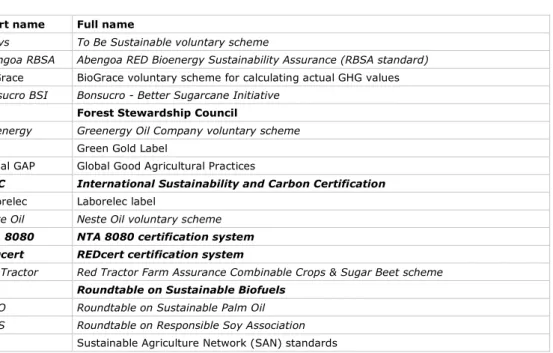
Figure 1: List of the most relevant biomass certification schemes and standards
Short name Full name
2BSvs To Be Sustainable voluntary scheme
Abengoa RBSA Abengoa RED Bioenergy Sustainability Assurance (RBSA standard)
BioGrace BioGrace voluntary scheme for calculating actual GHG values
Bonsucro BSI Bonsucro - Better Sugarcane Initiative
FSC Forest Stewardship Council
Greenergy Greenergy Oil Company voluntary scheme
GGL Green Gold Label
Global GAP Global Good Agricultural Practices
ISCC International Sustainability and Carbon Certification
Laborelec Laborelec label
Neste Oil Neste Oil voluntary scheme NTA 8080 NTA 8080 certification system REDcert REDcert certification system
Red Tractor Red Tractor Farm Assurance Combinable Crops & Sugar Beet scheme RSB Roundtable on Sustainable Biofuels
RSPO Roundtable on Sustainable Palm Oil RTRS Roundtable on Responsible Soy Association
SAN Sustainable Agriculture Network (SAN) standards
The table (Figure 1) presents the schemes that we considered most relevant. The
list is composed of the twelve voluntary schemes submitted to the EC for RED
recognition
10, presented in
italics
, and of six additional schemes that were selected
because of their potential use by biomass to energy actors. For the schemes
presented in bold, detailed factsheets are included in Appendix B while the other
schemes are presented in Appendix C. A number of additional initiatives and
schemes exist but were considered less relevant for the sector
11.
9 See ISEAL’s Codes of Good Practice on www.isealalliance.org 10 Source: Neeft (2011)
11 Several overviews of schemes exist in literature. We refer for example to BTG (2008), GBEP (2008), COWI (2009), Englund (2010), FAO (2010, Imperial College (2010), Van Dam (2010) and Partners for Innovation (2010).
Figure 2 : Overview of biomass sustainability schemes and standards
Entire
biomass chain
Production
of biomass
Specific
feedstock
All types of
feedstock
Bonsucro,
RSPO,
RTRS
GlobalGAP,
Red Tractor,
SAN
FSC,
REDcert
2BSvs, Abengoa,
Biograce, GGL,
Greenergy, ISCC,
Laborelec, Neste Oil,
NTA8080, RSB
B
io
m
a
s
s
c
h
a
in
fo
c
u
s
Applicable feedstock
Figure 2 shows two of the many differences between these sustainability schemes:
the horizontal axe indicates if a scheme is feedstock specific or not and the vertical
axe indicates to which extent they cover the entire biomass chain.
Most of the schemes cover the entire biomass chain of production, conversion,
trade and end-use, with exceptions of GlobalGAP, Red Tractor and SAN that focus
on agricultural processes and hence on the first step of the biomass value chain.
There are a number of schemes that are feedstock specific (Bonsucro sugarcane,
RSPO palm oil and RTRS soy). Another batch of schemes have a larger scope but
do not accept all types of feedstock (FSC wood and wood products, GlobalGAP,
Red Tractor and SAN agricultural products, REDcert biomass produced in EU-27).
The other schemes are open for all types of feedstock.
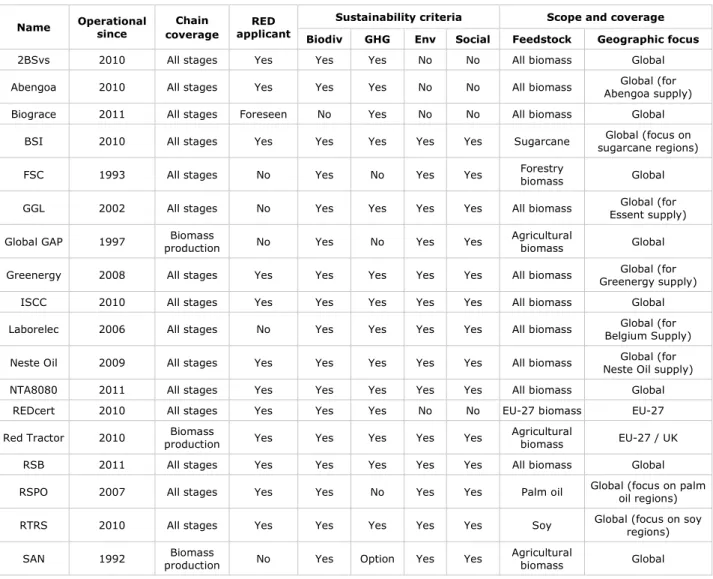
Figure 3 (page 19) presents a more detailed characterization of the schemes and
includes information on when schemes became operational, coverage of criteria to
guarantee the sustainability, and geographic scope.
Figure 3 Characteristics of 18 most relevant biomass certification schemes and standards
Biodiv: rated ‘yes’ if a standard includes biodiversity requirements. GHG: rated ‘yes’ if a standard includes GHG requirements.
Env: rated ‘yes’ if a standard includes requirements regarding air pollution, chemical use, water management or waste management.
Social: rated ‘yes’ if a standards includes requirements regarding workers rights or human rights. Sources: scheme websites, FAO (2010), Partners for Innovation (2010)
Column two of Figure 3 highlights when schemes became operational. Three
schemes, focusing on forestry and agricultural products, became operational in the
nineties and have thousands of hectares certified (FSC, GlobalGAP and SAN). The
first energy-related standard became operational in 2002 (GGL). The other
standards became operational after 2006. Ten out of 18 schemes became open for
business in 2010 or 2011. These schemes hence are in a start-up phase
characterised by growing operational experience and a relatively high number of
optimisation changes to fit the reality on the ground and to adapt to the latest
developments of the EU RED implementation.
Name Operational since Chain coverage RED applicant
Sustainability criteria Scope and coverage
Biodiv GHG Env Social Feedstock Geographic focus
2BSvs 2010 All stages Yes Yes Yes No No All biomass Global
Abengoa 2010 All stages Yes Yes Yes No No All biomass Global (for Abengoa supply)
Biograce 2011 All stages Foreseen No Yes No No All biomass Global
BSI 2010 All stages Yes Yes Yes Yes Yes Sugarcane Global (focus on sugarcane regions)
FSC 1993 All stages No Yes No Yes Yes Forestry
biomass Global
GGL 2002 All stages No Yes Yes Yes Yes All biomass Global (for Essent supply)
Global GAP 1997 Biomass
production No Yes No Yes Yes
Agricultural
biomass Global
Greenergy 2008 All stages Yes Yes Yes Yes Yes All biomass Global (for Greenergy supply)
ISCC 2010 All stages Yes Yes Yes Yes Yes All biomass Global
Laborelec 2006 All stages No Yes Yes Yes Yes All biomass Global (for Belgium Supply)
Neste Oil 2009 All stages Yes Yes Yes Yes Yes All biomass Global (for Neste Oil supply)
NTA8080 2011 All stages Yes Yes Yes Yes Yes All biomass Global REDcert 2010 All stages Yes Yes Yes No No EU-27 biomass EU-27
Red Tractor 2010 Biomass
production Yes Yes Yes Yes Yes
Agricultural
biomass EU-27 / UK
RSB 2011 All stages Yes Yes Yes Yes Yes All biomass Global
RSPO 2007 All stages Yes Yes No Yes Yes Palm oil Global (focus on palm oil regions)
RTRS 2010 All stages Yes Yes Yes Yes Yes Soy Global (focus on soy regions)
SAN 1992 Biomass
production No Yes Option Yes Yes
Agricultural
Regarding biodiversity aspects (column 5), all schemes except Biograce recognize
the importance of conserving areas of high biodiversity and have formulated
criteria to protect nature conservation areas. Some schemes align to RED and
define no-go areas; others go beyond RED and have more comprehensive
requirements.
Fourteen schemes include compulsory criteria regarding GHG emissions (column
6). Operators involved in the production and supply chain are required to provide
calculated values or to use default values, prior to or upon delivery of the biomass.
Operators estimate direct GHG impacts of the biomass production and of land use
change. Some of the schemes that have not yet incorporated GHG requirements,
have established working groups to study the introduction of criteria on GHG
emissions (FSC, RSPO) or have developed optional criteria (SAN). BioGrace only
addresses the EU RED GHG requirement.
Environmental and social criteria are well covered (columns 7 and 8). Fourteen
schemes explicitly include mandatory requirements to reduce the impacts on
natural resources (soil, water, air, use of chemicals) and to address human and
workers rights. The only exceptions are the schemes that align to RED
implementation (2BSvs, Abengoa, BioGrace and REDcert). For biomass produced
in the EU, the RED refers to existing EU rules
12for farmers establishing minimum
requirements for good agricultural and environmental condition.
Biomass supply chains are diverse and differ, depending on for example the type
and source of feedstock, the scale of production, and local geographical and
economic conditions. All schemes are able to certify biomass coming from all over
the world, except REDcert, that only involves biomass produced in the EU27. The
company schemes typically have a global focus but the biomass is meant for
supply of the company scheme owner (Abengoa, GGL/Essent Netherlands,
Greenergy, Laborelec/Electrabel Belgium, Neste Oil).
3
Biomass certification: how to select a scheme
The present chapter aims to guide organisations, involved in the production of
sustainable biofuels and biomass for energy purposes, in their selection process
towards a sustainable biomass certification scheme.
In this chapter the following topics will be addressed:
1.
Is biomass certification appropriate for your business?
paragraph 3.1;
2.
Which certification scheme(s) to select?
paragraph 3.2;
3.
Make a final choice and engage
paragraph 3.3.
Figure 4 explains the process of selecting a certification scheme in more detail
with reference to the different paragraphs and sections in this chapter.
Figure 4: The process of selecting a certification scheme
Step 1
Step 2
Step 3
3.1.1 Assess your organisation’s ambitions and situation 3.1.2 Talk with your customers about
their needs and requirements
3.2.1 Fit with organisational and biomass chain characteristics 3.2.2 Does the scheme facilitate trade of
your product?
3.2.3 Does the scheme meet legal requirements?
3.2.4 Is the scheme credible? 3.2.5 Easiness to comply with the
standard’s requirements
3.2.6 Fit with your willingness to pay for the scheme benefits
3.2.7 Fit with customer needs and requirements
3.3.1 Talk with certification bodies about your plans
3.3.2 Talk with your customers about selecting a certification scheme 3.3.3 Make a final choice and engage
The present report contains a number of tools and information that facilitate the
selection of a certification scheme. These are:
1.
A self assessment form that can be used for the process of selecting a
certification scheme (Appendix A, page 34). The self assessment form is a
practical tool that will help you ask yourself the relevant questions. It is
nothing more and nothing less than a questionnaire with all the questions and
issues raised in this report, collected in a structured form;
2.
The comparison table of the 18 most appropriate certification schemes for
biofuels and biomass for energy purposes (Figure 3, page 19);
3.3 Make a
final choice
and engage
3.2 Which
certification
scheme(s) to
select?
3.1 Is biomass
certification
appropriate for
your business?
3.
Detailed factsheets on 5 certification schemes (FSC, ISCC, NTA8080, REDcert
and RSB: Appendices B1–B5, starting at page 37). These factsheets were
validated by the scheme owners;
4.
Brief information on 13 other certification schemes (Appendix C, page 78).
3.1
Is biomass certification appropriate for your business?
Obtaining a sustainable biomass certificate is not always easy, and often increases
your operational costs, at least in the short term. At the same time, there may be
advantages such as higher revenues, reduced risks and lower costs in the long run
through improved operational efficiency, as well as other advantages as a result of
a proactive attitude towards possible future regulatory requirements.
So, before selecting a certification scheme, an organisation should evaluate
whether the advantages outweigh the costs. The following paragraphs provide the
elements to do so and are structured along the following issues:
1.
your organisation’s ambitions and situation (section 3.1.1);
2.
your customer’s needs and requirements (section 3.1.2).
3.1.1
Assess your organisation’s ambitions and situation
3.1.1.1
Revenues and market opportunities
As a result of the many policies in force to stimulate sustainable biomass,
especially in Europe and the US, there is a general consensus that the market for
sustainably produced biomass will increase. The fact that many European energy
companies are involved in bioenergy and sustainability criteria for biomass, will
also drive the market for certified sustainable biomass, and may increase
revenues for this type of biomass compared to non-sustainable biomass. For the
moment, however, it is still unclear how big the revenue and market opportunities
will be, in both the short and the long term.
3.1.1.2
Regulatory requirements
All around the world there is a vivid discussion about the sustainability of biomass.
In the EU and the US a regulatory framework has already been introduced for
biomass for energy purposes. To be able to adapt to changing or new regulatory
requirements, it is crucial to keep track of the developments of the regulatory
requirements regarding sustainable biomass, especially in the country where the
biomass is being produced and in the country where it is used.
3.1.1.3
Operational risks
Not taking sufficiently care of the environmental, social and economical aspects of
an operation, may put a company at risk, in the near or more distant future. As
said before, there is a growing attention to sustainability aspects which is partly
already translated into regulatory requirements. To be able to show that your
company fulfils the sustainability requirements, by complying with a sustainability
standard, reduces these risks and may also increase the value of your company.
3.1.1.4
Corporate social responsibility
Corporate Social Responsibility (CSR) is the term that is used when referring to
the intrinsic motivation of a company, and the people working within the company,
to do business in an ethical and responsible way and to address environmental,
social and economical issues in a balanced way. More and more businesses
recognise the added value of CSR, both business and human wise. Business wise
since it addresses the above-mentioned developments on regulatory requirements
and market changes. Human wise because it appears much more rewarding and
appealing to work for responsible businesses. Sustainability certification can
provide your company with the independent assessment of CSR.
3.1.1.5
Operational costs
When choosing for certification of your biomass, your operational costs will
increase, due to costs for auditing, for the certificates themselves and for
compliance i.e. costs for organisational and technical measures. Certainly in the
short term, but possibly also in the medium and long term. These costs depend
upon factors such as size and location of the property, but also on the
organisational and technical measures already taken by the organisation. In the
long term the operational costs might decrease due to increased efficiency of the
operation as a result of the in-depth analysis of the organisation and operational
activities, and anticipation to potential risks.
3.1.2
Talk with your customers about their needs and requirements
When talking with your customers there are typically two situations possible:
1.
Your customer requests that your product is certified. Based on the
assessment of your own organisation’s situation and ambitions (paragraph
3.1.1) you can either choose to respond to this request or look for other
customers;
2.
Your customer does not (yet) impose certification requirements on your
product. In this case you should discuss whether this is likely to be the case
in the near future.
Examples of issues to discuss with your customers are:
•
(New) regulatory and consumer requirements, and potential impacts on your
product;
•
Expectations on market and price development;
•
Willingness to engage in biomass certification.
You may wish to talk to the customer(s) behind your direct customer i.e. the next
actor(s) in the biomass chain (see Figure 5). This allows you to detect and
anticipate the forthcoming requirements in an early stage.
Figure 5: Schematic overview of the biomass chain
Feedstock
producer
Feedstock
conversion
1
Feedstock
conversion
2
Fuel
blender
Fuel
distributor
3.2
Which certification scheme(s) to select?
After having addressed whether biomass certification is appropriate for your
business or not, in paragraph 3.1, we focus in this paragraph on how to select a
certification scheme. From our discussions with biomass producers, certification
bodies and certification schemes, as well as from desk research, we consider that
the following seven questions should be answered when selecting a certification
scheme:
1.
Does the scheme fit with your organisational and biomass chain
characteristics?
2.
Does the scheme facilitate trade of your product?
3.
Does the scheme meet legal requirements?
4.
Is the scheme credible?
5.
How easy is it to comply with the scheme’s requirements?
6.
What are the scheme and compliance costs?
7.
Does the scheme fit with your customer needs and requirements?
These questions are discussed in the sections hereafter (sections 3.2.1 to 3.2.7).
To highlight how the schemes fit with each of these questions, we have included
tables referring to the 5 schemes presented in Appendix B. Where appropriate, we
also refer to the 13 schemes presented in Appendix C.
3.2.1
Fit with organisational and biomass chain characteristics
The first question is about the fit with the characteristics of your organisation and
of the biomass value chain. The scope of the scheme should match these
characteristics. The essential questions are:
•
Does a scheme support the feedstock(s) used?
•
Does a scheme cover your location(s) of operation(s)?
•
Does a scheme cover the biomass chains under consideration?
Figure 6 provides detailed answers regarding these questions for the five schemes.
For the eighteen schemes these questions are addressed in Figure 3 (section 2.3).
Figure 6: Feedstock, geographic coverage and chain coverage
FSC ISCC NTA8080 REDcert RSB
Type of biomass covered
Solid biomass All types of biomass
All types of biomass
Biofuels and
bioliquids Liquid biofuels
Feedstock Forestry, including clearance products All types of biomass All types of
biomass EU-27 biomass
All types of biomass
Geographic
coverage Global Global Global EU-27 Global
Chain coverage
All stages of the supply chain
All stages of the supply chain
All stages of the supply chain
All stages of the supply chain
All stages of the supply chain
Regarding the type of biomass and feedstock covered (rows 1 and 2 in Figure 6),
three schemes have restrictions: REDcert only applies to biofuels and bioliquids
13,
RSB only applies to liquid biofuels, and FSC only applies to wood and wood fibre
products. ISCC and NTA8080, on the contrary, address all types of biomass and
hence allow more flexibility to operators wishing to be involved in various types of
certified biomass. RSB has the objective to cover all types of biomass in the long
term.
Regarding the geographic coverage (row 3 of Figure 6), four standards have a
global coverage while REDcert is the exception: REDcert is limited to biomass
13 Following the RED definition (article 2): Biofuels: liquid or gaseous fuel for transport produced from biomass. Bioliquids: liquid fuel for energy purposes other than for transport, including electricity and heating and cooling, produced from biomass.
produced in the EU-27. REDcert is therefore not usable for biomass with an origin
outside Europe.
Regarding chain coverage (row 4 of Figure 6), all standards cover the complete
biomass value chain i.e. biomass production, processing, trading and end-use.
3.2.2
Does the scheme facilitate trade of your product?
From our discussions with biomass chain actors, we understand that certified
biomass forms, at the time of this report, a plus for some of them, and a
requirement for others, following internal policies or market requirements such as
created by the RED in the EU. They also indicate that certified biomass does not
necessarily lead to premium prices, at this moment.
At the same time, however, it is clear that the market for certified biomass is
growing and is expected to continue to do so. The number of certificates issued in
this market is hence growing quickly. This is well demonstrated by the high
numbers of certificates that were issued by ISCC and REDcert after only one year
of operation: 283 and 782 respectively. In future this may increase revenues for
this type of biomass compared to non-sustainable biomass. It is however largely
unclear how big the market and revenues will be, in both the short and the long
term. As an example, Text box 7 below highlights how the market for sustainable
palm oil increased in 2010.
Textbox 7: Sustainable palm oil market
Market uptake of sustainable palm oil will need to accelerate in 2011 in order to keep up with
rapidly growing production, claims the Roundtable on Sustainable Palm Oil (RSPO). In
November 2010 it was announced that all palm oil used in the Netherlands will be certified
by the RSPO by 2015, as all the suppliers and buyers in the Dutch market have signed a
manifesto and pledged to work towards this goal. According to the RSPO, the combined
production capacity of certified oil palm plantations and smallholders grew strongly in 2010,
from 1.4m tonnes/yr in January to 3.4m tonnes/yr in December. The volume of actual
RSPO-certified sustainable palm oil on the market jumped from 1.3m tonnes in 2009 to 2.3m
tonnes in 2010. Sales of sustainable palm oil more than tripled from 0.4m tonnes in 2009 to
about 1.3m tonnes in 2010. The past year also saw strong growth in sales of certified
sustainable palm kernel products. Palm growers sold GreenPalm certificates covering the
production of about 180,000 tonnes of palm kernel in 2010, which amounts to about 35 per
cent of RSPO-certified sustainable palm kernel supplied in the same year.The RSPO said the
number of its members grew to over 500 companies and organizations, while 81 palm oil
mills and 113 facilities in the palm product supply chain are now fully certified. Source:
www.confectionerynews.com
The certification schemes that focus on biofuels all take account of the EU RED
requirements and hence facilitate trade of your product on the EU market. At
present they do not facilitate trade on the US market. It is yet unclear if and how
they facilitate trade of your product on other markets. This will become clearer in
the years to come. The general perception is that sustainability requirements will
become more important in the near future on a global level.
3.2.3
Does the scheme meet legal requirements?
Getting assurance that legal requirements are met can be related to (i) the type of
feedstock that is used to ‘produce’ the biofuel, to (ii) the country or region in
which the end-use takes place, or to (iii) both.
In the first case, feedstock related schemes may do the job such as Bonsucro
(sugarcane), RTRS (soy), RSPO (palm oil), GlobalGAP, Red Tractor and SAN
(agricultural products) or FSC (wood). These schemes focus on ensuring that
feedstock is sustainably produced, but also undertake activities to align to legal
requirements in their end-use markets.
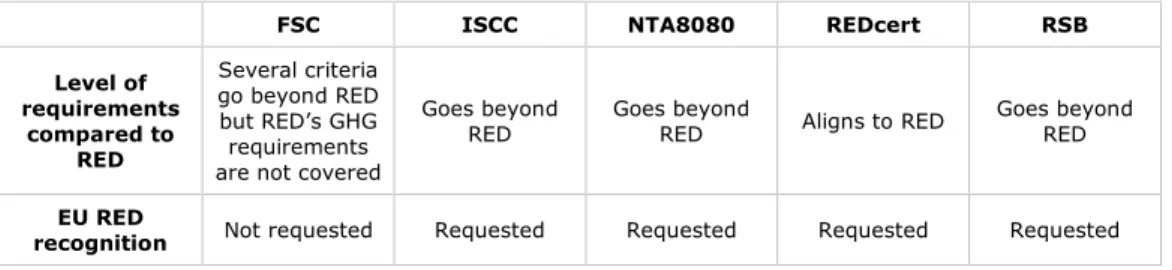
Figure 8: Compliance with the RED
FSC ISCC NTA8080 REDcert RSB
Level of requirements compared to RED Several criteria go beyond RED but RED’s GHG requirements are not covered
Goes beyond RED
Goes beyond
RED Aligns to RED
Goes beyond RED
EU RED
recognition Not requested Requested Requested Requested Requested
For EU companies, the second case is important: the RED legislation is an
important driver to seek assurance. Figure 8 highlights how the five schemes
comply with the RED. All five schemes, except FSC, aim to comply with the
binding sustainability criteria for biofuels and bioliquids of the RED. At the time of
this report, none of the schemes have obtained a formal recognition by the EC.
The EC is working on the assessments and expects to make these public in the
course of 2011.
Note however that, at present, the market in many EU countries is in transition
towards RED compliance. In Germany, for instance, companies have to provide
sustainability certificates to benefit from the national support scheme for
renewable fuels. In 2010 they had hence to address themselves to ISCC and
REDcert, as these were the only schemes that provided such certificates. This
situation has changed slightly in March 2011, when the German authorities
provisionally accepted RSB, and will further change in near future, when any
certificate of a voluntary scheme recognised by the EC can give access to these
benefits.
For FSC the situation is different since its most direct link is with the RED
requirements regarding solid biomass. The RED has no common sustainability
requirements for such biomass. Instead the EC has made recommendations to EU
Member States on the development of national sustainability schemes. The current
FSC system is being evaluated by some governments on its applicability as
biomass certification scheme. The first conclusion is that FSC certification can be
used as a proxy for the maintenance of conservation values and ecosystem
integrity, but due to the fundamentally different approach, it is not designed to
provide all answers to the emerging national EU sustainability criteria
14.
If a company produces agricultural or forestry products for two markets (e.g. for
food and energy, or for timber and energy), the certification scheme should
preferably be applicable to both markets. At present only four schemes provide
this possibility: Bonsucro (sugarcane), Red Tractor (agricultural products), RSPO
(palm oil) and RTRS (soy). They all have requested EC recognition under the RED
and hence can be used in both food and energy markets.
So far, the schemes FSC, GlobalGAP and SAN, do not target the energy market
but monitor the developments closely and/or prepare to be aligned to the
requirements in this market. In some cases their certificates already give a certain
access to energy markets: the Laborelec scheme, for instance, accepts FSC and
GlobalGAP certificates for a number of its requirements.
Some of the biomass to energy schemes are opening up to other markets. ISCC,
for example, is nowadays focusing on the biomass to energy market but has plans
to extend its scope in order to cover biomass for chemical, pharmaceutical and
technical applications.
3.2.4
Is the scheme credible?
Whether a scheme is considered credible by its stakeholders, is related to many
factors, such as the experience, independency and representativeness of the
bodies involved and the appropriateness, fairness and robustness of its procedures
and criteria. The number of years being operational and the number of certificates
issued (market uptake and applicability) may also be an indicator for the
credibility of a scheme. Credibility may also evolve over time.
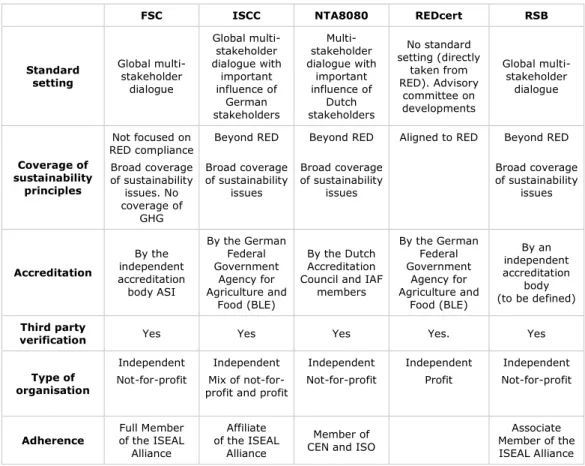
Figure 9: Information related to the credibility of the five selected schemes
FSC ISCC NTA8080 REDcert RSB
Standard setting Global multi-stakeholder dialogue Global multi-stakeholder dialogue with important influence of German stakeholders Multi-stakeholder dialogue with important influence of Dutch stakeholders No standard setting (directly taken from RED). Advisory committee on developments Global multi-stakeholder dialogue Coverage of sustainability principles Not focused on RED compliance Broad coverage of sustainability issues. No coverage of GHG Beyond RED Broad coverage of sustainability issues Beyond RED Broad coverage of sustainability issues
Aligned to RED Beyond RED
Broad coverage of sustainability issues Accreditation By the independent accreditation body ASI By the German Federal Government Agency for Agriculture and Food (BLE) By the Dutch Accreditation Council and IAF
members By the German Federal Government Agency for Agriculture and Food (BLE) By an independent accreditation body (to be defined) Third party
verification Yes Yes Yes Yes. Yes
Type of organisation Independent Not-for-profit Independent Mix of not-for-profit and not-for-profit
Independent Not-for-profit Independent Profit Independent Not-for-profit Adherence Full Member of the ISEAL Alliance Affiliate of the ISEAL Alliance Member of CEN and ISO
Associate Member of the ISEAL Alliance
Figure 9 presents information on five schemes against a number of credibility
aspects
15. An important aspect is how standard setting takes place (row 1 in
Figure 9): FSC and RSB use a truly global multi-stakeholder approach. ISCC and
NTA 8080 also use a multi-stakeholder approach but less global since stakeholders
from respectively Germany and the Netherlands have a dominant say. There is no
multi-stakeholder approach at REDcert since REDcert only implements the RED
requirements.
Credibility is also related to how sustainability issues are covered (row 2 in Figure
9). ISCC, NTA8080 and RSB cover sustainability issues in a broad way, with some
differences (see also paragraph 3.2.5). FSC also covers sustainability issues in a
broad way but does not address GHG emissions. REDcert only addresses the RED
requirements.
There are notable differences regarding accreditation (row 3 in Figure 9). FSC,
NTA8080 and RSB make use of independent accreditation bodies. Independency is
less ensured in the cases of ISCC and REDcert, where the German Government
Agency for Agriculture and Food (BLE) combines the roles of accreditation body
and policy implementation agency.
All schemes make use of third party verification (row 4 in Figure 9) although there
are important differences regarding the coverage of this third party verification.
REDcert, for instance, relies to a large part on self-declarations of biomass
producers which are subject to random verification.
All scheme owners are independent organisations (row 5 in Figure 9). FSC,
NTA8080 and RSB are managed by not-for-profit organisations, ISCC by a mix of
not-for-profit and for-profit organisations (ISCC Association and Meo Carbon
Solutions), and REDcert by a for-profit organisation.
FSC and RSB are members of the ISEAL Alliance and have committed to the ISEAL
codes (row 6 in Figure 9). FSC is a Full Member and complies with the ISEAL codes
of good practice. RSB is an Associate Member and is in the process of meeting the
ISEAL codes of good practice. NEN is the Dutch standardisation institute and as
such member of the CEN and ISO organisations. ISCC is Affiliate of the ISEAL
Alliance, which is a possibility for interested organisations and individuals to follow
the works of ISEAL closely without having to commit to its codes of conduct.
Figure 10: Information related to the market uptake and launch of the five selected schemes
FSC ISCC NTA8080 REDcert RSB
Number of certificates issued in April 2011 19,749 CoC certificates, 1,028 FM/CoC certificates 283 certificates 2 certificates 782 certificates None (went live in March 2011) Year of going live 1993 2010 2011 2010 2011
Note: for FSC the numbers of certificates date from February 2011
15 For the selection of these aspects we inspired ourselves by ISEAL research on credibility of environmental and social standards. We refer to ISEAL 2007, 2009 and 2011.
There are big differences in the number of years being operational and the number
of certificates issued (see Figure 10). This is partly related to the start date of the
schemes but also to the effort needed to comply with the scheme. FSC became
operational in 1993 and has a high number of certificates issued, more than
20,000. REDcert and ISCC went live in 2010 and have hundreds of certificates
issued. NTA8080 and RSB both opened in Q1 2011 and have a very limited
number of certificates issued at the time of this report.
3.2.5
Easiness to comply with the standard’s requirements
The easiness to comply with a certain standard depends, on the one hand, on the
stringency of the sustainability requirements of a scheme, and, on the other hand,
on the user simplicity and practicability of the scheme. These aspects are detailed
hereafter.
Figure 11: Certification schemes and stringency of sustainability criteria
REDcert
RSB
RSB
NTA 8080
ISCC
more stringent sustainability criteria
FSC
If we compare the five certification schemes (see Figure 11), REDcert clearly has
the less stringent sustainability requirements since they are limited to those of the
RED, and is hence the most easy to comply with.
FSC, NTA8080, ISCC and RSB have more stringent requirements. We consider that
they are at a similar level even if there are notable differences: FSC, for instance,
does not include carbon and GHG requirements. Another difference is that RSB
includes, on top of environmental and social requirements, an economic
requirement: bio-energy actors should demonstrate the long term economic
viability of their operation. All four have requirements regarding Environmental
and Social Impact Assessments (EIA and SIA), stakeholder consultations
according to the principles of Free Prior Informed Consent (PFIC), and legal
compliance.
The measures to be taken and the associated compliance costs depend on the
scheme’s sustainability requirements as well as on your ability to comply. In
general can be said: the more stringent the requirements, the higher the costs.
Figure 12: Possibility of less stringent requirements
FSC ISCC NTA8080 REDcert RSB
Step-in
certification Perhaps No Yes No Perhaps
Less stringent rules for biomass out of
residues
No Yes Yes Yes No
Less stringent rules for small
holders Yes Adapted indicators Streamlined auditing Group certification Yes Streamlined auditing Yes Adapted criteria Streamlined auditing Group certification Yes Streamlined auditing Yes Adapted criteria Group certification
All standards offer less stringent requirements for specific situations. NTA8080
offers a lower level of requirements at the start (row 1 of Figure 12): it has
adopted a RED growth model allowing companies to comply with the RED
requirements first and the full standard later on. A similar approach is under
discussion at the RSB. FSC has developed a 3-step modular programme for
facilitating progress of applicants towards full FSC certification; decision making on
the implementation of this programme is anticipated for 2011. ISCC and REDcert
do not offer stepwise approaches.
ISCC, NTA8080 and REDcert foresee reduced requirements for biomass produced
of residues, in line with the RED (see row 2 of Figure 12). FSC and RSB do not
have less stringent requirements for biomass produced of residues.
All standards have special auditing requirements for smallholders, i.e. streamlined
auditing and/or group certification (see row 3 of Figure 12). On top of this, FSC,
NTA8080 and RSB offer reduced sustainability requirements to smallholders.
Regarding the user friendliness of the five schemes, all have publicly available
websites with extensive information, reports and tools. As FSC is active the
longest, their website is the most extensive in number of languages as well as in
information and tools provided. None of the schemes have a personal helpdesk for
organisations aiming at comply with the schemes requirements, but all indicate to
be responsive to questions and problems.
Compliance can also be facilitated if a scheme recognises certificates of other
schemes. This differs along the schemes. REDcert indicates that it accepts all
schemes that are recognised by the EC under the RED. ISCC currently accepts
REDcert, FSC and PEFC certificates for part of the requirements. FSC accepts a
number of certificates issued under programmes of the Rainforest Alliance.
NTA8080 and RSB have not yet accepted certificates of other standards. All
schemes have procedures to recognise certificates of other schemes.
3.2.6
Fit with your willingness to pay for the scheme benefits
Costs for scheme participation and compliance are situation-specific, and vary per
organisation type, organisation size or turn-over and annual amount of biomass or
biofuel. There are three types of cost:
1.
Certificate costs
: costs to be pa