Received June 10, 2009 1554-1010 $ 03.50 Dynamic Publishers, Inc.
FlexiSec: A Configurable Link Layer Security
Architecture for Wireless Sensor Networks
Devesh Jinwala*1, Dhiren Patel2 and Kankar Dasgupta3* corresponding author
1Central Computer Centre, Sardar Vallabhbhai National Institute of Technology, Ichchhanath, Surat, India
2
Department of Computer Engineering, Sardar Vallabhbhai National Institute of Technology, Ichchhanath, Surat, India
3
Space Applications Centre, Indian Space Research Organization, Satellite Road, Ahmedabad, India
Abstract: Ensuring communications security in Wireless Sensor Networks (WSNs) indeed is critical; due to the criticality of the resources in the sensor nodes as well as due to their ubiquitous and pervasive deployment, with varying attributes and degrees of security required. The proliferation of the next generation sensor nodes, has not solved this problem, because of the greater emphasis on low-cost deployment.
In addition, the WSNs use data-centric multi-hop communication that in turn, necessitates the security support to be devised at the link layer (increasing the cost of security related operations), instead of being at the application layer, as in general networks. Therefore, an energy-efficient link layer security framework is necessitated. There do exists a number of link layer security architectures that offer some combinations of the security attributes desired by different WSN applications.
However, as we show in this paper, none of them is responsive to the actual security demands of the applications. Therefore, we believe that there is a need for investigating the feasibility of a configurable software-based link layer security architecture wherein an application can be compiled flexibly, with respect to its actual security demands.
In this paper, we analyze, propose and experiment with the basic design of such configurable link layer security architecture for WSNs. We also experimentally evaluate various aspects related to our scheme viz. configurable block ciphers, configurable block cipher modes of operations, configurable MAC sizes and configurable replay protection. The architecture proposed is aimed to offer the optimal level of security at the minimal overhead, thus saving the precious resources in the WSNs.
Keywords: Wireless Sensor Networks, Link Layer Security, Encryption, Authentication, Replay Protection.
1.
Introduction
Wireless Sensor Networks (WSNs) comprise of the networked wireless sensor nodes to realize some vital functionality. Some of the example applications of WSNs are environmental parameter monitoring (flood, water level, temperature, stress, strain, pressure etc), industrial automation in hostile environments, tracking movements of living beings in parks, sanctuaries, offices, schools, banks
etc, surveillance in war zones, enemy camps and a host of others [1][2]. Irrespective of the applications for which the WSNs are deployed, the security of the network nodes by themselves and that of the data collected and disseminated by them is of prime concern [2][3].
Wireless sensor nodes are characterized by severe constraints in power, computational resources, memory, and bandwidth and have small physical size with low power consumption [1][2]. On the other hand, using the security protocols always entails additional overhead on the computational, storage and energy resources. Therefore, ensuring security in WSNs requires adapting the conventional security protocols to the resource constrained WSN environments, with minimal overhead.
In addition, it is a fact that unconditional security is not possible in practice, even in the resource rich, conventional networks [4]. Therefore, the security protocols therein, have always been designed to offer computational security only. Computational security is based on either the intractability of solving a particular computational problem or on ensuring that the computational complexity of the security algorithm is too high to enable it to be broken, within reasonable time and within the available resources [4]. Therefore, the security protocols in conventional networks are designed to operate and be safe, within the precincts of the available resources on the target platform, only.
Now, in order to have confidence in computational security, the conventional security protocols are inherently designed with higher computational, storage and energy resource overheads [5]. Such higher overheads are tolerable by the resource-rich Personal Computers, but may not be tolerable by the resource-starved sensor nodes. Therefore, in the WSNs, due to the low resources, it is even more essential to ensure that the associated overhead due to the security protocols is at the minimum.
In addition to the above-mentioned facts, the communication paradigm followed in WSNs is data-centric multi-hop communication, instead of the route-centric
multi-hop communication used in the conventional networks. The data-centric multi-hop communication is characterized by the in-network processing. In-network processing is based on data fusion that involves on the fly aggregation, summarization, or duplicate elimination of the data collected from different sensor nodes [1][2]. Since the processing of the data is done on-the-fly, the overall communication costs are reduced [1]. However, the fall-out of this is that with multi-hop communication and the
in-network processing demanding applications, the
conventional end-to-end security mechanisms alone are not sufficient for the WSN [3]. This means that the direct applications of the protocols like IPSec [6], TLS [7] SSL [8] in WSNs is obviated.
Therefore, the security protocols in the WSNs have to be devised at the link layer to support secure data fusion [3] [9]. In the link layer security protocols, because the security related operations are carried out at every hop, the overhead due to the same further increases [3]. Hence, these protocols have to be designed carefully to reduce the overhead to the extent possible.
In order to investigate whether the overhead can somehow be optimized or not, it is necessary to identify what specific link layer security attributes are desired and whether any refinement is possible with respect to each one of them or not. We discuss in the next section, how in attempt to improve the resource overhead in relation to the security attributes desired, the notion of the configurable security attributes is useful.
1.1 Motivation
The security attributes that any link layer security protocol must offer are data confidentiality (mechanism: data encryption), data integrity and data-origin authentication (mechanism: keyed hash functions) and data
freshness with protection against replay attacks
(mechanism: an appropriate anti-replay algorithm).
However, not all the sensor network applications demand all of these attributes. Well, we observed earlier, that the WSNs are deployed for a wide and diverse spectrum of applications. Therefore, there are wide variations in the security demands of various applications, too. Hence, it is essential to identify the classes of WSN applications that demand similar security attributes.
In [10], we elaborately survey a wide cross-section of live WSN applications that have diverse demands for security, using which we propose a security attributes driven taxonomy of WSN applications. We use the proposed taxonomy as the basis, to analyze the level and the types of security attributes desired in each category of applications.
In addition, from the survey of the types of the existing WSN nodes and their configurations, we realize that the available resources in the sensor nodes also vary a lot. For example the Berkeley Mica2 [11] motes, released first in 2004, have 128 KB of program memory and 4 KB of RAM whereas the Crossbow iMote2 motes released in 2007 have 256kB SRAM, 32MB flash memory and 32MB of SDRAM [12].
Hence, we primarily conclude that the link layer security architecture in WSNs must be responsive to the application environment under consideration. This means that it should be flexible and configurable.
Unfortunately, our investigation reveals that the existing attempts at providing software-based link layer security support viz. SPINS [13], TinySec [14], SenSec [15], and MiniSec [16] assume abstract security models of the WSN deployment that are not completely sensitive to the actual security demands of the target applications. Therefore, these frameworks do not allow configurability in tuning the type and level of the security attributes for an application to help minimize the resource overhead.
Alternately, the necessary link layer security support may be provided by the underlying hardware based on IEEE 802.15.4 specification [17][18]. However, using a hardware-based solution lacks flexibility and does not provide the transparent security enablement for the existing WSN applications [19].
Therefore, we propose here, model of a flexible link layer security architecture viz. FlexiSec. We attempt to make the model configurable by providing various security attributes driven alternatives to the application designer, to enable the optimal target code for the application under consideration, to be generated.
We arrive at the configuration of each such security attributes driven alternative in the proposed model, by investigating the type and the level of security attributes, that alternative is aimed to offer. In order to support our design, we implement and analyze the alternative configurations therein and show that our design performs better than the contemporary architectures.
To be specific, our experimentations and analyses are done with respect to the overhead associated with various block ciphers, the block cipher modes of operations, the
message authentication code sizes, and the replay
protection algorithms. In the next section, we present an overview of the specific research issues that helped us in arriving at the configuration of our proposed model; with proper justification that made us focus on those issues. 1.2 Scope of Work
The link layer security architecture that we propose here viz. FlexiSec is aimed to offer configurable security with respect to the following aspects.
(a) First, our proposed framework allows application designer tune the desired security attributes necessary for an application. The proposed framework is aimed to support either message/entity authentication or a combination of confidentiality and authentication or that of confidentiality, authentication, and replay protection along with flexible selection of MAC sizes. Such flexibility is necessary with respect to the diverse security demands of the WSN applications, as illustrated in [10].
As for example, with the combined Authenticated-Encryption technique that the Output Codebook Mode (OCB) [20], the Counter with Cipher Block Chaining Message Authentication Code (CCM) Mode [21] and the
Galois Counter Mode (GCM) [22] follow, the applications demanding the message confidentiality as well as data integrity, are more efficient to implement, as compared to the same using the conventional modes. This is so, because the conventional modes like Cipher Block Chaining Mode [23] are designed to support confidentiality and not message integrity check. Hence, the message integrity check algorithm like CBC-MAC [24] is required to be employed separately, resulting into increased overall overhead.
On the other hand, if the security architecture employs only the Authenticated Encryption (AE) modes of operation, then the applications demanding only authentication may not be implemented as efficiently, as with the conventional CBC-MAC mechanism.
(b) Next, we propose that in the link layer security framework employed, the strength of the cipher used must be commensurate with the resource overhead entailed and the security level desired. We emphasize that the confidence in a security protocol is largely derived from that in the cipher. At the same time, the total overhead associated with the use of such a protocol is also largely due to the intrinsic design of the cipher and due to the cipher parameters viz. the key-size, block-size and the number of rounds.
Therefore, instead of merely using a cipher just because it is accepted as an advanced standard, it is essential to examine whether any other lightweight cipher, operating without any compromise on the necessary cipher parameters (beginning with the key-size), can be feasibly employed or not.
Based on our experiments carried out to measure the overhead associated, we prescribe two ciphers at two extremes; yet offering the security strength due to 128-bit key-size. The prescribed ciphers are the AES cipher Rijndael [25] and an optimized version of lightweight cipher Corrected Block Tiny Encryption Algorithm (XXTEA) [26]. As part of our experimentation, we propose two optimized versions of the AES viz. a speed optimized and a size optimized version, too.
We again emphasize that the availability of multiple configurable options to the application programmer, enables him/her to compile an application with the optimal alternatives depending upon the availability of the resources and the security demands of the application; thereby tuning the optimum level of security, at the minimal overhead.
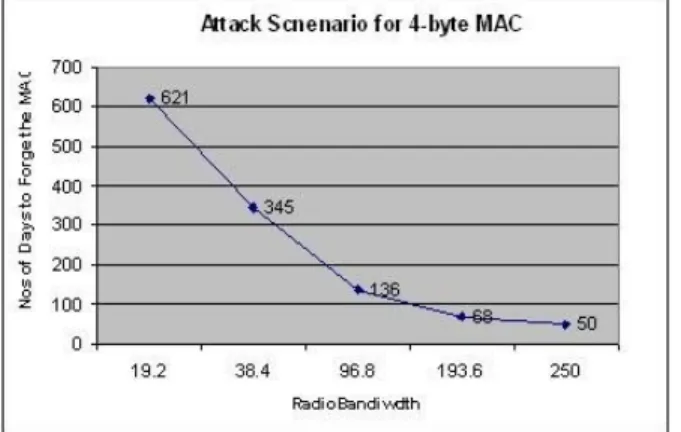
(c) Next, again with an aim to reduce the resource overhead, we propose that the size of the Message Authentication Code (MAC) employed must be commensurate with the packet transmission rate of the application under consideration. The current link layer security architectures [14][15][16] employ 4-byte MAC. We consider varying MAC sizes of 4 bytes or 8 bytes, based on the security attributes driven taxonomy of WSN applications [10] as before.
(d) Lastly, we show that a simple Bloom-filter based anti-replay technique for supporting link layer anti-replay protection as we proposed in [27] is useful for FlexiSec; as compared to the conventional methods for implementing replay protection [28].
Hence, the innovative approach in our solution will offer the following benefits as compared to the peer link layer security frameworks for WSNs:
• Our proposed framework has configurable and flexible security features that can be tailored to the needs of the application under consideration.
• It can be used as a ready-to-use experimental test-bed for security related experimentations in WSNs.
• It can offer seamless migration of legacy applications to make them security enabled such that there is no need for separate API calls to be made to use the security features.
As has been the test-bed for our experimentations, the proposed security architecture is also intended to be integrated with the TinyOS [29] environment. However, it can be extended for any other alternate platform.
To the best of our knowledge, ours is the first attempt at proposing a model of configurable link layer security architecture that employs and evaluates the XXTEA and the AES ciphers in the CBC, OCB and CCM block cipher modes as well as proposes a simple Bloom filter based replay protection algorithm for unicast communications [28][27] .
The rest of the paper is organized as follows: in section 2 we survey the existing software based link layer security architectures. In section 3, we describe the characteristics of the ciphers and the modes of operations used by us for evaluation. In section 4, we present a survey of the conventional approaches for ensuring replay protection in WSNs and the Bloom filter based approach for replay protection along with our design. In section 5, we discuss our methodology of evaluation and the experimental setup. In section 6, we present the results and analyze them whereas in section 7, we discuss the proposed model of the FlexiSec architecture. We conclude with the plan for the further work in section 8.
2.
Link Layer Security Architectures
In this section, we present a survey of the existing link layer security architectures. There indeed have been a significant number of attempts published in the literature, aimed at enriching the link layer protocols in WSNs, with the essential security mechanisms.
Karlof et al present TinySec [14] as a lightweight and efficient link-layer security protocol for WSNs. It is the first link layer security architecture implemented in software. TinySec attempts to provide at least minimal configurable link layer security, with three different modes of operations. These operation mode provide either (a) no security support or (b) support for message authentication only based on Cipher Block Chaining Message Authentication Code (CBC-MAC) [24] viz. TinySec_Auth or (c) support for (b) and message confidentiality via encryption in Cipher Block Chaining (CBC) mode [23] viz. TinySec_AE mode.
The designers of TinySec emphasize that protection against replay attacks need not be built-in at the link layer. Therefore, there is no mode of operation that offers such
selection.
Architecturally, TinySec also aims to employ a plug-and-play design to make it possible to alter the basic building blocks of the security architecture i.e. the cipher employed or the cipher mode of operation used. However, we experienced that factually, such alteration requires significant changes to the underlying TinySec code. As for example though it is easy to use a 128-bit key-sized cipher by merely changing a few lines in the TinySec configuration file viz. TinySecC.nc, employing a 128-bit block sized cipher requires a careful understanding of the TinySec architecture and substantial cryptic changes to various other implementation modules.
TinySec employs 64-bit block-sized and 80-bit key-sized Skipjack [30], as the default block cipher. The authors of TinySec also discuss the experimental evaluation of the encumbered 128-bit key-sized and 64-bit RC5 block cipher [31].
SenSec is another attempt at designing the link layer security framework for specific body monitoring application at the Institute of Infocomm Research, Singapore. Thus, it cannot be employed as a platform for further cryptographic experimentations. It also uses Skipjack as the block cipher but with modified XCBC [32] mode of operation. Being modeled highly on the design of TinySec, SenSec too does not support replay protection. TinySec and SenSec are devised for security support in only unicast communication mode.
Mark Luk et al in [16] present a recent attempt at designing the link layer security architecture that is designed for the Telos motes [33]. MiniSec uses a different approach in that it offers two operating modes, one tailored for single-source unicast communication, whereas the other, for multi-source broadcast communication. It offers all the basic desired link layer security properties viz. data encryption, message integrity and replay protection. MiniSec also uses Skipjack as the block cipher.
However, MiniSec offers no configurability with respect to the security attributes, offering only AE block cipher mode of operation. Thus, applications demanding only message or entity authentication cannot be optimally implemented in MiniSec. Neither does MiniSec offer any choice in selection of cipher as well as the selection of the MAC sizes.
Alternatively, the link layer security support may be provided using a protocol confirming to the IEEE 802.15.4 specification [17]. One of the protocols confirming to the IEEE 802.15.4 standard, is the ZigBee protocol [34]. ZigBee is a specification, targeted at RF applications that require a low data rate, long battery life, and secure networking. However, the use of ZigBee protocol involves appropriate licensing and membership of the ZigBee Consortium. In addition, ZigBee has been labeled as a protocol offering high security at high overhead in [16] and hence suitable for the higher end PAN devices and not the low end WSN nodes. This is factually reflected in its cipher specification – all of the modes in IEEE 802.15.4 specification are based on the AES Rijndael cipher that indeed - with all improved and
optimized versions – is still an expensive cipher. In addition, the IEEE 802.15.4 specification offers a mode that offers only data encryption using Counter mode [23]. With any encryption of the data without message authentication labeled as being useless, the limitations of such a mode of operation have well been discussed in [35].
As compared to these solutions, the design that we propose here is better due to the following reasons:
(a) In FlexiSec model, we make a provision for three different optimized versions of two different ciphers. The ciphers we have selected are the AES and the XXTEA cipher. Our results indeed show that the XXTEA cipher can be a better choice for those environments where the available storage is limited, whereas the optimized versions of the AES cipher are better otherwise.
(b) We also provide configurable selection of either the conventional CBC-MAC for ensuring authentication only or the efficient OCB Authenticated Encryption block cipher mode of operation for ensuring confidentiality as well as integrity in FlexiSec.
(c) FlexiSec also caters to the selection of variable MAC sizes that are responsive to the application needs and hardware used.
(d) FlexiSec also has the provision of a simple and efficient replay protection schemes.
(e) FlexiSec explicitly omits the insecure block cipher modes of operation that are specified in IEEE 802.15.4 standard viz. the Counter mode without authentication support.
(f) In FlexiSec, we also make the provision of an option for non-keyed authentication support as well as the provision of security support being derived from hardware too.
We discuss the detailed model of FlexiSec in section 7.
3.
Block Ciphers and Modes for FlexiSec
We now discuss the characteristics of the block ciphers and the cipher modes of operation that we believe can be used as potential candidates in the link layer security architecture FlexiSec. We observe that in our process of selecting and/or optimizing the selected cipher and the cipher mode of operation for the link layer security architectures, it is necessary to look for any peer attempts to do so.
This is so because instead of reinventing the wheel, we could then use the same results for our architecture. Hence, in section 3.3, we discuss the related work attempted at evaluation of the block ciphers and the modes in the WSN environment and justify how our approach here, is different from the contemporary ones.
3.1 The Block Ciphers
We attempt the evaluation of the AES cipher Rijndael, the XXTEA cipher, RC6 [36] and the Skipjack cipher. Our aim is to identify different possible candidate ciphers to comply with the nature of the application under consideration and the available resources. Hence, we compared the performance of the AES, RC6 and XXTEA
against that of Skipjack and tried to justify as to how amongst the ciphers with the key-size of 128-bits, AES and XXTEA can be used as two suitable candidates. As mentioned earlier, we also optimize the AES and the XXTEA ciphers for the link layer security architecture for the WSNs.
Our baseline cipher for evaluation is Skipjack, since it is the cipher of choice, in all the existing software based link layer security architectures. Skipjack uses 80-bit key with a 64-bit block size and 32 rounds of an unbalanced Feistel network. The cipher was declassified in 1998 with an aim to replace then standard cipher viz. the DES [37]. The best cryptanalytic attack against the cipher was carried out on its 31 of the 32 rounds, employing differential cryptanalysis [38].
However, we attempted exploring whether 80-bit key-size of Skipjack can be considered sufficient today? Although the strength of a cipher is a complex measure of the cipher function, key-size and the block-size, we believe that the size of the cipher key is primarily an indicative measure of the strength of the computational security of the cipher. The cipher key-size must be sufficient enough to prevent the brute force attack against the cipher. Hence, we attempted to analyze the justification for the 80-bit key-size, as we discuss below.
In [39], Lenstra attempts to quantify the security of a cryptosystem with respect to its key length in terms of the trust in the Data Encryption Standard [38] cipher. DES was first introduced in 1977 and then was reviewed every five years. Thus, it was trusted at least till 1982. Lenstra proposes that the security of DES in 1982 be treated as the base security to calculate the security margin y of any other cipher. Assuming k as the key-size required to carry out the best known attack against a cipher A, the number of years till the cipher A can be considered secure i.e. the security margin y of the cipher A can be defined as
23 30 ) 56 ( 1982 + − = k y (1)
IF y is known i.e. the year up to which the cipher is required to be secure, the minimum required k can be found out. If calculated in this manner, the 80-bit key-sized cipher can be considered as safe until 2013 and a 128-bit key-size cipher, until 2076.
However, this hypothesis was given by Lenstra in 2001. The recent recommendations portray a very different picture. As per the claims of RSA Security Labs, 80-bit keys would become crackable by 2010 [40]. In addition, we found a conservative prescription by ECRYPT [41] that dictates a minimal of 128-bits keys be used, for any cipher.
In the Table-I below we show the prescribed key-sizes by ECRYPT, NIST [42], NSA[43], and RFC3766 [44].
Table 1 Cipher Key-sizes
Organization /Method Desirable SKC key-size in bits Desirable PKC key-size in bits Secure till year ECRYPT 128 3248 2029 NIST 128 3072 2030 NSA 128 - - RFC 3766 128 3253 -
From this discussion, we conclude that it is necessary to look for a 128-bit key-sized cipher even for the low-resource WSN environments. We have considered three categories of candidate ciphers with 128-bit key-size.
First, we have selected AES because it is the current
cipher standard. The AES cipher follows the substitution-permutation network structure. Next, we
selected RC6 because it was one of the candidate cipher for the Advanced Encryption Standard selection and has been used as a cipher suitable for embedded systems in [45]. On the other hand, in the lookout for 128-bit key-sized lightweight ciphers, we tried selecting a cipher from the Tiny Encryption Algorithm family.
The TEA (Tiny Encryption Algorithm) [46] cipher is a 64-bit block cipher with 128-bit key-size and 64 rounds of operation. It is a short Feistel iteration cipher with no preset tables, nor any explicit key mixing routines. The 64 rounds of Feistel operations are based on the expressions viz.
]) 3 [ ) 5 (( ) ( ]) 2 [ 4 ( ]) 1 [ ) 5 (( ) ( ]) 0 [ 4 ( 2 ) 1 5 ( 31 key RH sum RH key RH LH LH key LH sum LH key LH RH RH sum sum + >> ⊕ + ⊕ + << + = + << ⊕ + ⊕ + << + = − + =The key mixing operation in TEA uses addition and a golden number delta given by
31
2 ) 1 5 ( −whereas the second and the third expressions show the Feistel functions of the cipher.
Various cryptanalytic attacks on TEA have been reported in the literature. Biryukov and Wagner exposed the slide attack on TEA in [47], whereas Kesley in [48] exposed the reduced key strength of the cipher due to the equivalent keys.
Hernandez et al. in [49] showed that, it is possible to find the distinguisher for TEA with only 2115 chosen plaintexts and five rounds, using genetic algorithms. Moon et al in [50] show that with 252.5 chosen plain texts and 284 encryptions, it is possible to attack an 11-round TEA with impossible differentials. In [51], Seokhie Hong use the truncated differentials of probability 1 to attack a 17-round TEA with 1920 chosen plain texts that improves on the previous attacks.
Needham et al. in [52] propose the XTEA cipher, to overcome the limitations of TEA, specifically the related key attack. However, XTEA is shown to be more vulnerable to differential and truncated differential attacks in [51].
Wheeler et al. then propose in [26] the Corrected Block TEA cipher (XXTEA) as an improvement over Block TEA. XXTEA also uses 128-bit key-sizes with a Feistel network design and variable 6 to 32 rounds depending on the block size.
No major published cryptanalytic weaknesses of XXTEA cipher are known. Therefore, we deduce that TEA and XTEA should not be adjudged as the lightweight cipher of choice for our framework. Hence, we selected the XXTEA cipher for our framework. We believe that because of its simplistic design, it ought to be appropriate for the resource constrained WSNs.
(2)
3.2 Block Cipher Modes of Operation
We have also attempted the optimization and evaluation of the block cipher modes of operations. Commonly the block cipher modes of operation can be categorized as either Conventional mode or the Authenticated Encryption mode. The Cipher Block Chaining mode is the commonly used conventional mode of operation. The CBC mode encryption with the ciphertext block C, the plaintext block P, the cipher key K, the encryption function E and the initialization vector IV, is defined as [23]
C
i=
E P
K(
i⊕
C
i−1),
C
0=
IV
(4)whereas, the CBC mode decryption operation is defined as
P
i=
D C
K( )
i⊕
C
i−1,
C
0=
IV
(5)The CBC mode necessitates that for every encryption round, the initialization vector must be unique in order to ensure semantic security. In CBC, for an input message of N blocks, N block cipher calls are required only for ensuring confidentiality i.e. there is no computation of the MAC during the encryption round. The MAC can be computed using any other algorithm but normally, it is computed using the CBC-MAC [24] that is defined as,
C
i=
E P
K(
i⊕
C
i−1),
C
0=
0
n (6)Thus, in computation of MAC also, another N block cipher calls are required.
In addition, since this is a separate call to the block cipher; different set of keys than the one used for computing the ciphertext (for confidentiality) are required here. Thus, the total overhead not only increases because of the multiple calls to the block cipher but also due to the additional key management, required.
As compared to the same, the Output Codebook Mode (OCB) [20], the Counter with CBC-MAC (CCM) [21] Mode and the Galois Counter Mode (GCM) [22] i.e. the Authenticated Encryption (AE) modes were proposed to lower the computational and storage costs.
Phillip Rogaway et al. proposed the OCB mode in [20]. In this mode, the plaintext is encrypted to get the ciphertext and then the MAC (computed with a MAC computation routine) is appended at the end of the encrypted message in the form of a tag. The length of the tag controls the level of authentication.
Formally, first in this mode, an offset or a random value is computed as
(0 )
b KO
=
E
(7) where O denotes the b-bit zero vector encrypted under the key K. OCB mode employs a nonce instead of an IV or a counter to randomize the encryption. If N denotes the nonce for a message1 2 3 4
....
nM
=
M M M M
M
,then the ith block Mi in OCB is encrypted as
E M
K(
i⊕
O
i⊕
N
)
⊕
O
i⊕
N
(8) whereas it computes the tag as
E M
K(
i⊕
...
⊕
M
n⊕
Y
n⊕
O
n+1⊕
N
)
(9)The OCB protocol requires two state variables. First, it employs a single cipher key K used for both encapsulation
and decapsulation. In addition, it uses a 28-bit packet sequence counter to construct the OCB mode nonce.
For a message of N blocks, OCB requires 2 + N block cipher calls to encrypt the message as well as compute the tag, in a single invocation of the cryptosystem. Thus, the principal characteristics of OCB are in achieving optimal number of block cipher calls, parallelizable routines and the use of a single-key [20].
Russ Housley, Doug Whiting and Niels Ferguson proposed the CCM mode in [21]. It is based on employing the cipher in the Counter mode of operation and then using the CBC-MAC for computing the MAC. The CCM mode is less efficient than the OCB mode as it requires twice the number of block cipher calls, as required by the OCB mode.
John Viega and David A. McGrew proposed the Galois Counter Mode as an improvement to Carter-Wegman Counter CWC mode (CWC) [53]. It is now recommended by the NIST as its latest standard [54].
The GCM mode offers the triple benefits of being parallelizable in hardware and software, being able to authenticate the data beyond those, which are not encrypted (Authenticated Encryption with Associated Data (AEAD)) as well as being patent free. It is specified to be used with 128-bit ciphers only in general and with the AES cipher in particular, although the block size of the underlying cipher should not matter. We have implemented GCM not only with the AES versions but also with the 80-bit Skipjack cipher.
The GCM mode dispels the CCM approach of combining an already existing encryption mode with an already existing message integrity check mechanism (result: two passes) albeit using a single key to offer authenticated encryption. It even does not use the inverse cipher function of the underlying cipher. GCM uses a conventional mode for encryption but uses the authentication by computing the MAC in the Galois field. It takes as input a block cipher key K, an initialization vector IV, a plaintext P, and any additional data A to be authenticated. In turn, it gives as output the ciphertext C, and an authentication tag T
Albeit for the gain in performance that one obtains using the AE modes, it is emphasized that they are useful only when an application demands confidentiality as well as message integrity both. For those applications requiring only the message authentication and integrity, the AE modes are not useful.
3.3 Related Work in Evaluation of Ciphers and Modes In general, the block ciphers used for evaluation in WSN environment are viz. RC5 [31], Skipjack [30], Rijndael [25], Twofish [55], KASUMI [56], Camellia [56], TEA [46].
There have been many benchmarks and evaluation of the block ciphers for the WSNs as surveyed and discussed here.
Law et al in [57], present a detailed evaluation of the block ciphers viz. Skipjack, RC5, RC6, MISTY1 [58], Rijndael, Twofish, KASUMI, and Camellia. The evaluation is based on security properties, storage and energy efficiency of the ciphers. The results prescribe Skipjack as a suitable cipher in low memory resources environment to offer low
security strength, MISTY1 as a suitable cipher for higher security strength and AES as a suitable cipher for the applications that necessitate highest speed of operation at higher demands for memory.
However, their evaluation of the ciphers is not done within any link layer architecture, thus not accounting for any link layer framework overhead. In addition, no attempt has been made to optimize the cipher code – instead, simply the openSSL [59] versions of the ciphers are employed. Moreover, as against the recommendation of these results, RC5 has been reported to be having higher speed than AES in [60].
In [61], Großshädl Johann et al attempt at energy evaluation of the software implementations of the block ciphers. The authors have considered the ciphers RC6 [36], Rijndael, Serpent [62], Twofish and XTEA. They have used the simulation for the StrongARM SA-1100 processor used principally in embedded systems like cell phones and PDAs. However, this evaluation is also not done within any link layer security framework; nor the actual deployment on the sensor nodes or any typical WSN platform has been done.
In [63] Guimarães Germano et al. discuss another attempt at evaluating the security mechanisms in WSNs. They evaluate the ciphers viz. TEA, Skipjack and RC5 on the TinySec platform with the Mica2 motes. However, in this evaluation, the authors do not prescribe any specific cipher as a suitable cipher; nor do they consider vital ciphers like the AES and the XXTEA.
In [64], Luo Xiaohua et al. evaluate the performance of ciphers viz. SEAL [65], RC4 [66], RC5, TEA by implementing the ciphers on the Mica2 motes. The evaluation claims that RC5 is not suited for the WSNs. However, as we do here, neither the AES optimization, nor the secure XXTEA (instead of TEA) implementation & optimization, have been attempted.
In [67], Ganesan Prasanth et al. analyze and model the encryption overhead by estimating the execution time and memory occupancy for the encryption and message digest algorithms viz. RC4, IDEA[68], RC5, MD5[69], and SHA-1[70] on various hardware platforms viz. Atmega 103, Atmega 128, Mitsubishi M16C/10, Intel StrongARM SA-110, Intel XScale PXA250 and SUN UltraSPARC II processors. Thus, the focus in this research exercise is to evaluate the performance of various embedded hardware platforms using the ciphers as the basis, rather than evaluating the ciphers by themselves. Even otherwise, the vital ciphers like the AES, XXTEA, and Skipjack are not at all considered for evaluation.
Hence, from the above we conclude that none of these research exercises focuses specifically on the block ciphers and block cipher modes in the link layer framework that we attempt here. These evaluations are not aimed at imparting flexibility to the link layer security architecture. The fallout of this fact is that none of the attempts considers the lightweight ciphers of the TEA family as well as the AES cipher for evaluations, nor is there any attempt at optimizing the implementations of these ciphers, to specifically prescribe the ciphers suitable in different
environments.
4.
Replay Attacks and Anti-Replay Schemes
As mentioned earlier, we believe that one of the vital attributes of a link layer security framework is the protection against replay attacks. Therefore, we analyzed, designed, implemented and investigated the conventional replay protection algorithms in WSN setup and came up with a simple yet efficient Bloom filter [28] based anti-replay algorithm as discussed in [27]. In this section, we analyze our replay protection algorithms, intended to be used in FlexiSec.4.1 Replay Attacks
A replay attack occurs when an adversary captures a packet in one protocol run and replays it later, in some other protocol run. Formally, let a sender A, at time instant t1 has sent k packets in the set T, bearing sequence numbers viz.
TSEQ = {SEQ1, SEQ2, SEQ3,……SEQk}
An adversary orchestrates the replay attack, by capturing any of these packets during the transmission and replaying at an instant later than A.
The protection against replay attacks can be devised by defining a temporal or causal relationship, between the properties of the message received at an instant and those of the messages received previously. Such relationship is exploited to define an anti-replay protocol to handle a replay attack.
Various approaches based on the above are analyzed in [71], [72], [73], and [74]. We survey these with a detailed analysis in [27].
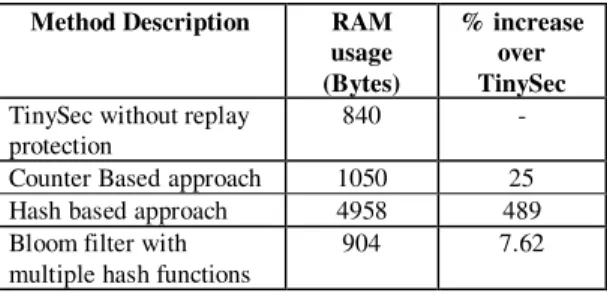
For FlexiSec, we design, implement and evaluate four different algorithms for replay protection viz. based on employing a Counter and a Hash function as state identifiers, and a third based on employing a Bloom filter for detecting replays. We discuss the design, and implementation of the same in [27]. Here, with the focus on FlexiSec design, we show the results obtained to justify the selection of Bloom filter based algorithm for FlexiSec. 4.1.2 Replay protection in WSNs
As discussed earlier, the existing attempts at devising link layer security framework in the WSNs are the SPINS [13], TinySec [14], SenSec [15], and MiniSec [16].
SNEP as part of SPINS achieves replay protection by keeping a consistent counter between the sender and receiver. However, as we show in our evaluation, a counter based approach is grossly inefficient in WSNs.
The designers of TinySec do not consider replay protection as desirable at the link layer. They affirm that the replay protection ought to be the responsibility of the application layer.
However, as we analyze in [27], with application layer replay protection, a replayed packet injected into a WSN may travel through many hops before being detected at the destination. This would waste the precious resources in sensor nodes. Hence, it is essential to provide replay protection at the link layer itself.
MiniSec is a secure link layer protocol that serves to provide, according to its designers, low energy consumption and high security. MiniSec provides two different strategies for anti-replay for its two different operating modes.
For the unicast mode, a synchronized counter based approach is proposed. However, such scheme is not scalable with the increase in the number of nodes in the network. In addition, it requires costly resynchronization routines to be executed, when the counters shared, are desynchronized due to the out-of-order delivery of the packets. As against that, our sliding window based counter approach does not require any resynchronization to be done although it is not scalable, as in MiniSec.
To handle scalability concerns, MiniSec indeed employs a Bloom Filter based approach with sliding window (in broadcast setup). However, our solution against replays is a simpler one, being applicable in a unicast setup in WSNs. 4.2 Our Design
In this section, we illustrate and analyze how our Bloom filter based algorithm is efficient and scalable as compared to the conventional approaches.
As mentioned earlier, using a counter value as the message tag is one of the most common approaches for detecting packet replays. However, when we use a counter-based algorithm, we have to devise a suitable data structure to maintain the counter value and incorporate it as one of the data packet component.
DEST (2) AM (1) LEN (1) SRC (2) CTR (2) Data (0..29) MAC (4)
Figure 1. TinySec_AE Packet Format [14] In the TinySec packet format as shown in Fig. 1, a counter (CTR) indeed is used by its designers for framing the Initialization Vector. Therefore, TinySec can easily be augmented with replay protection using the CTR for the purpose. The counter-based algorithm for replay protection is shown in Fig. 2. Algorithm CounterReplayDetect(CounterReceived, NodeID) { 1. id = o; 2. for id = 1 to lastValidId { 3. if (id==NodeID) { 4. if (CounterReceived <= LastCount[NodeID]) 5. replayed = 1; else 6. replayed = 0; 7. LastCount[NodeID]=CounterReceived; } } }
Figure 2. Antireplay algorithm using a CTR [IJCS]
However, in a typical WSN, each sensor node will have to maintain the counter value for all the other (n-1) nodes in the network. Thereby, the total storage expended turns out to be
n(n-1) * bytes_per_counter_value (10)
Therefore, this approach is not scalable and can be employed only for small size networks.
However, this approach does not require counter resynchronization as in SNEP or in MiniSec unicast approach. The counter value required for replay protection is part of IV, so there is no extra overhead in packet size involved for this method. Hence, the method incurs very less consumption in radio energy.
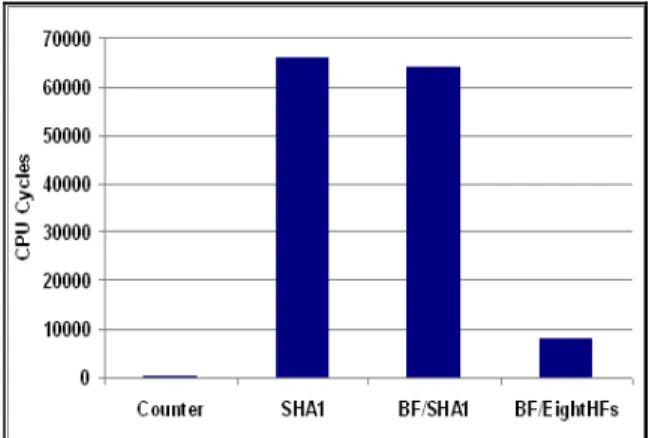
Unlike the previous approach, in the hash-function based algorithm, a hash value generated by a hash function, can be used as a type tag to maintain the state information required for detecting replays. A standard hash function like SHA-1 [70] can be used for the purpose. However, SHA-1 hash function and hence this algorithm entails lots of resource overhead, as we illustrate through our experimental results.
As compared, the Bloom filter [28] based algorithm, which uses a bloom filter with hash functions, is scalable as well as efficient.
The Bloom filter is a special compact data structure used for probabilistic representation of a set so as to probabilistically answer membership queries about the elements of the set. The Bloom filter uses a Bloom filter vector as the representative of the data set. The contents of the Bloom filter vector are determined by the application of the hash functions on the input data element. That is, the hash values generated upon the application of hash functions to a data item, are treated as different addresses in the Bloom filter vector, the contents of which are set to a 1, to designate the presence of the corresponding data item.
Formally, a Bloom filter is a vector of n bits consisting of each individually addressable cells viz. a1, a2, a3, a4…..an along with m different hash functions viz. h1, h2, h3,……….hm. Initially, the Bloom filter is empty with all its bits set to 0.
To add the information about a data element, say di, to the Bloom filter, each of the hash functions hj, 1<=j<=m is applied on di to get the corresponding hash values hvj. The vector addresses indexed by hvj in the Bloom filter vector are then set to 1.
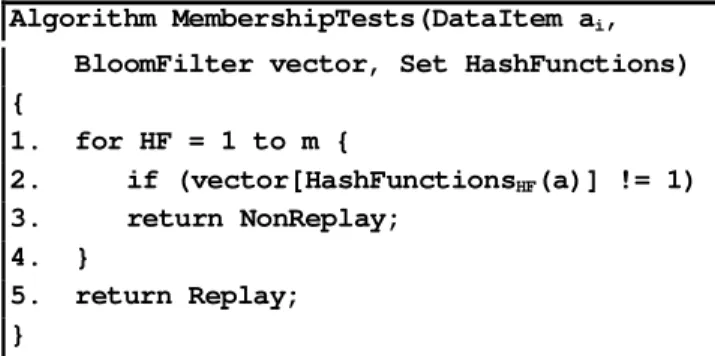
Subsequently, to query for the membership of a data element di, the data element is again hashed with m hash functions to get the m different hash values viz. hv1, hv2, hv3,……….hvm. Whether an element is a member of the set or not is determined as per the algorithm in Fig. 3.
In using the above approach for replay detection, when a packet is first received by a node, the message freshness identifier (tag) in the packet is hashed by the m hash functions as before, and the bits in the Bloom vector are set. If these bit values are 1, then the packet is a replayed packet, otherwise it is not, as illustrated in the algorithm in Fig. 3.
Algorithm MembershipTests(DataItem ai, BloomFilter vector, Set HashFunctions) { 1. for HF = 1 to m { 2. if (vector[HashFunctionsHF(a)] != 1) 3. return NonReplay; 4. } 5. return Replay; }
Figure 3. Generic Algorithm using Bloom filter 4.3 False Positives in Bloom filter
Bloom filter based replay protection algorithm may suffer from false positives. That is, even if a packet is not a replayed packet, it may be tagged as a replayed one.
Let the size of Bloom filter vector be m and there be k hash functions, in use. Then, the probability that any one of the location in the vector not being set by any one hash function is given by P’
P ' 1 1 m
= − (11) When employing k hash functions, the same will be ' 1 1 k P m = − (12) If there were in all n elements, then the probability for a certain bit to be still not set would be given by
' 1 1 k n P m = − (13) Then, the probability P that the bit is set will be given by 1 1 1 k n P m = − − (14) Thus, when carrying out the set membership tests, for the data item that is already in the set, the expression (14) above can be used. However, for a data item that is not in the set, the set membership tests must return test above as 0. If we assume that, the set membership test, erroneously returns the same element to be actually present in the set, it would be so only if each of the k hash functions, yield the same value to be 1. That is the probability for a false positive can be derived from expression (14) as
P
F a lse−P o siti ve = 1 1 1 k k n m − − (15) F a lse P ositive1
k kn mP
−e
−
=
−
(16)1
2
k≈
(17)In general, to prevent false positives, the Bloom filter design criterion specifies tuning k i.e. the number of hash functions.
Our Bloom filter based algorithm for replay protection employs eight hash functions. We show our improved version of the algorithm (as compared to the one in [27]) using eight hash functions in Fig. 4.
In this algorithm, we use bloom filter with eight 32-bit hash functions i.e. theoretically 232 different values per hash function. Thus, the false positive rate in our approach turns out to be 1/256 i.e. 0.00390. The eight hash functions that we have employed are from the family of universal hash functions, requiring lesser computational overhead than SHA-1 viz. RSHash, JSHash, PJWHash, ELPHash, BKDRHash, SDBMHash, DJBHash, DEKHash, and APHash. We carefully implement the bloom filter as two-dimensional vector in order to implement it, optimally.
5.
Experimental Setup
In this section we describe the tools and the platform used by us for the experiments conducted as well as the methodology adopted and the test application used to do so. 5.1 Platforms and Tools used
We have used the TinySec link layer security framework in the TinyOS 1.1x operating environment [29] with the nesC [75] as the language of implementation. We have also employed TOSSIM simulator [76] to first simulate our code and subsequently deploy the code on the Mica2 sensor nodes. We have exploited the TinyOS support for the deployment of the code on the Mica2 motes.
Although TOSSIM captures TinyOS behavior at very low level, it does not model the power consumption for the motes. This is because it does not model the CPU execution time, and thus, cannot provide accurate information for calculating the CPU energy consumption.
Hence, we are using AVRORA [77] to measure the CPU cycles and power consumption for a particular node. Avrora is an emulator implemented in Java that runs the actual Mica code, while emulating each WSN node as its own thread.
Having implemented the ciphers, modes and the replay protection schemes in nesC and plugged them in the TinySec framework, our evaluation in general consists of three different stages, as follows:
Algorithm ReplayBloomFilter8(Packet In,Set HashFunction,int n, Filter BloomFilter) {
1. if (!FilterCreated) {
2. Filter CreateBloomFilter (set A, Set
HashFunctions, integer n, BloomFilter BloomVector)
3. FilterCreated=1; }
4. for each received packet { 5. for i = 1 to k {
6.
HashValue=ApplyHashi(TypeTag(Packet In)) 7. if (BloomVector[HashValue] == 1) 8. replayed=1; 9. else 10. replayed=0; 11. BloomVector[HashValue] = 1; 12. exit(); } } 13. if (replayed == 1) 14. return (replayedpacket=1) 15. else { 16. return (replayedpacket=0); } }
Figure 4. Antireplay Algorithm ReplayBloomFilter8 (a) First, we evaluate the performance in TinyOS environment with TOSSIM as the WSN simulator. The nesC compiler itself gives as output the RAM and ROM requirements of the application under consideration as part of the compilation process that helps us in determining the storage requirement.
(b) Next, we use the Avrora simulator to determine the throughput in bits/sec and the energy consumed. For the purpose, we converted the executable file generated by Mica2 compilation into ELF file format and then simulated it in AVRORA by setting the appropriate flag monitors. We measured throughput according to following formulae with the clock speed of 8 MHz.
( _ * ) /
Throughput= Message size CPUC lockSpeed NoofCycles
(18) To measure the energy consumption, we follow the same method as for CPU cycle measurement again using the appropriate flags in Avrora. The total simulation time was set to 100 seconds. We obtain the CPU and radio energy consumption for each mote and normalize the same, for evaluation.
(c) Third, we deploy the application under consideration on the Mica2 motes to verify that the application indeed behaves as examined earlier.
One question which arises here is why did, we employ
Mica2 motes, when resource enriched next generation motes like Intel iMote [12], Crossbow Iris motes [78] and Moteiv’s Tmote Sky motes [79] are available, today. Well, these motes indeed have higher computational and storage power. However, we believe that our evaluation that is carried out on more stringent environment of Mica2 motes, can always be true in more resource-rich environments. 5.2 The Test Application
For all of our evaluations we employ a simple application that comes bundled with the TinyOS environment viz. TestTinySec – the pseudocode shown in Fig. 5.
Algorithm TestTinySec 1. counter = timer
2. while (counter == fired){
3. if (Send(Data Packet)) then LED=green 4. else if( Receive(Data Packet)) then
LED=red }
Figure 5. The TestTinySec Algorithm
Figure 6. TestTinySec application in TinySec The pseudocode of the application is as shown in the code snippet in Fig. 5 whereas its call-graph generated under the nesC compiler is shown in Fig. 6. TestTinySecM is the main module of the application. It uses a counter (which is part of the data packet sent/received over the radio) that is incremented on firing of a timer.
TestTinySecM module also uses the TinyOS interfaces SendMsg and ReceiveMsg those are implemented by the component SecureGenericComm. SecureGenericComm is responsible for sending and receiving the secure messages over the radio. The counter value modified by the component Counter, is further passed by TestTinySecM (the suffix M here, as per the nesC conventions signifies the main module of the application) through the SendMsg interface of TinyOS, for onward transmission over the radio, to the component SecureGenericComm of TinyOS. In addition, when the message is sent, the Leds interface is used to toggle the LED on the mote. When the message is transmitted by a mote, the LED is turned green whereas, when the message is received by a mote, the LED is turned red.
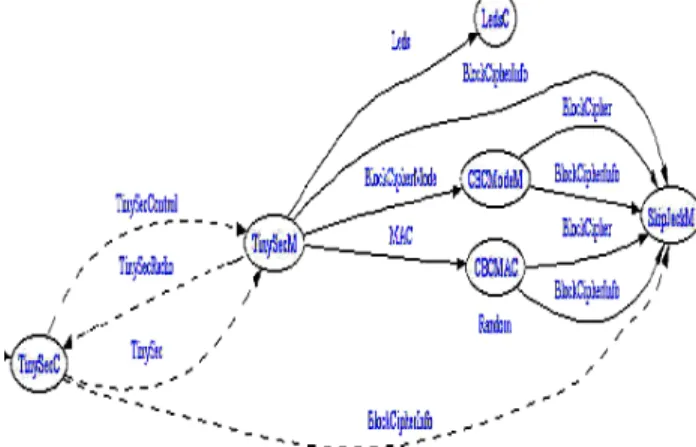
The module TinySecM.nc handles all the security related operations in TinySec. In Fig. 7, we show the partial call-graph showing the security components of the TinySec that
come into play, during the execution. The call-graph was generated for the Skipjack cipher wired in the CBC mode that is the default configuration of TinySec. As can be seen,
TinySecM.nc uses the modules CBCModeM.nc and
CBCMAC.nc with appropriate calls to the default cipher component SkipJackM.nc to encrypt and decrypt the message and to generate and verify the MAC. Thus, SkipJackM, CBCMAC and CBCModeM components are not implemented by us.
Figure 7. Partial Call-graph of the application with Skipjack in CBC Mode
5.3 The nesC Versions and Application Call-graphs As mentioned earlier, as part of its functionality,
TinySecM.nc eventually calls the default cipher
component SkipjackM.nc. In our experimentation, we replaced SkipJackM.nc with our own appropriate cipher components viz. TEAM.nc (for TEA), XTEAM.nc (for XTEA), XXTEAM.nc (for XXTEA), OXXTEAM.nc (for our own optimized XXTEA implementation), RC6M.nc
(for our RC6 implementation), AESSPO.nc (for our own
speed-optimized AES implementation) and AESSIO.nc
(for our own size-optimized AES implementation).
The 64-bit key for the Skipjack cipher in the default TinySec configuration, is stored in the
./tinyos-keyfile. On the other hand, the ciphers of the TEA
family are all 64-bit ciphers, using 128-bit key-size. Thus, we modified the ./tinyos-keyfile augmenting the keys in it. In addition, since the block cipher calls for encryption and for computation of the MAC are different calls, two sets of 128-bit keys are required to be stored in the key-file. Execution of these ciphers required modification of the key-size, cipher and mode contexts parameters in the TinySec header file, too. Apart from these files, we also modified the TinySec configuration files viz.
TinySecM.nc, CBCMAC.nc and CBCModeM.nc,to
lend the 128-bit key support.
We also implement the nesC components for block cipher modes viz. the CCM (CCMM) and the OCB mode (OCBM)
and the GCM (GCMM).
We have tried to size-optimize the AES version inspired from the C-versions of AES in [80] and have tried to speed-optimize the version of AES, inspired from the openSSL
[59] version. We subsequently converted these into nesC. For the AES size-optimized cipher implementation (AESSIO) for our work, we are expending in only two 256-byte wide entries in the F-table and S-table of AES [25]. We implement the rest of the computations required in AES, in the form of in-line functions and macros. Therefore, we expect that the throughput of this approach must be lower as compared to an approach in which the computations are reduced by expending more storage.
In our AES speed-optimized version (AESSPO); we are using the AES small tables approach. In this approach, the intermediate values stored in the table are one 32-bit 256 entry forward table and a reverse table each (1 KB + 1 KB) and a reverse S-Box (256 bytes). Thus, the total expended storage in this case is 2048 + 256 = 2304 bytes.
Alternately, when employing AES large transformation tables, four forward and reverse tables each with 32-bit, 256 entries are required (4 KB + 4 KB = 8192 B). Thus, the total increased expense in storage is 8192 – 2304 = 5888 B i.e. an increased storage overhead of 71%. For one round, this approach requires 16 table lookups and twelve 32-bit OR operations, followed by four 32-bit exclusive-OR operations in the AddRoundKey step.
Comparing our size-optimized version with the speed- optimized version, we get a saving of 2304 -512 = 1792 Bytes i.e. a percentage saving of 77.77%. Such saving is indeed significant in the resource-starved environments in the sensor nodes.
The relative comparison of our size and speed optimized versions of AES is shown in Table II. As we analyze in the next section , our theoretical evaluation as done above is actually reflected in the performance evaluation done by us.
Table II AES Optimizations Sr
No
Cipher Storage Expended in Tables Total Storage 1. AES Speed Optimized cipher
32-bit 256 entries Forward computation table 32-bit 256 entries Reverse computation table 8-bit 256 entries S-box
2304 bytes
2. AES Storage Optimized version
8-bit 256 entries Forward S-Box
8-bit 256 entries Reverse S-Box
512 bytes
For XXTEA, we used the basic C-version in [26] and converted it into the nesC version. We also attempted optimizing the basic XXTEA operation using pre-computed tables and inline assembly code. We utilized tables for storing the value of DELTA (the magic constant) and round key generation for each round. We used the inline assembly code for the conversions viz. four-byte character ↔ long data type. We evaluate both the basic XXTEA cipher (XXTEA) and our own optimized XXTEA (XXTEAO).
We subsequently modified the TinySec configuration files to execute the TestTinySec application using all the combinations of cipher and their modes of operation viz. AESSpeedOptrimized, AESSizeOptimized in the OCB, CCM and GCM modes and the Skipjack in the CBC mode.
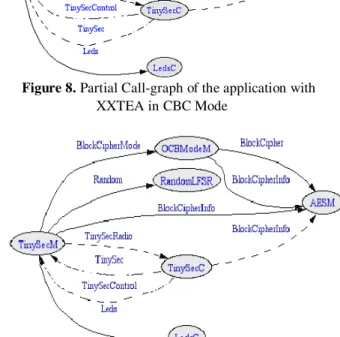
In Fig. 8, we show the sample partial snapshots of the TestTinySec call-graph with XXTEA cipher in the CBC mode, whereas we show the partial call-graph of the application with AES cipher in the OCB mode in Fig. 9.
In addition, since AES and RC6 are 128-bit ciphers as compared to the 64-bit Skipjack and XXTEA, we made appropriate logical changes in the TinySec files, for obtaining this support. For XXTEA, RC6 and AES, we also changed the default tinyos-keyfile to enable the support for 128-bit cipher keys.
For the evaluation of our replay protection algorithms also, we use the same test application.
Figure 8. Partial Call-graph of the application with XXTEA in CBC Mode
Figure 9. Partial Call-graph of the application with AES in OCB Mode
6.
Results and Analysis
In this section, we first show our experimental evaluation of the block cipher modes of operation, evaluation of ciphers and then the results for the anti-replay algorithm.
6.1 Evaluation of the Block Cipher Modes
We present the results of evaluations of the storage requirements (RAM and ROM), throughput in terms of bits/sec and the energy requirements for CBC, OCB, CCM, and GCM block cipher modes in the figures 10 to 13. We must emphasize that since we wanted to examine the advantages and suitability of the block cipher modes of operations, we used only a single cipher i.e. AES for evaluation of the cipher modes. The use of AES definitely
yields improved security strength as compared to the TinySec default Skipjack cipher. We have used the Skipjack cipher in CBC mode as the reference for our comparison. Hence, it must be emphasized that without looking into any of the metrics, the fundamental advantage that we get using the AE modes is that the latter offer two security attributes as compared to the CBC mode that only offers confidentiality.
From Fig. 10, for the MICA2 motes with only 4KB of RAM, we can see that an overhead of only 13.46% and 12.98% results when using the OCB or CCM mode with the AES speed-optimized (AESSPO) and AES size-optimized (AESSIO) cipher implementations.
Figure 10. Increase (%) in RAM/ROM over the Skipjack in the CBC mode
The same in case of GCM mode is substantially higher. This fact can be a critical factor in mode selection since RAM is scarce even in the recent next-generation motes.
However, the significant advantage here is that with under 15% additional overhead in storage, both the attributes viz. confidentiality and authentication are obtained whereas with CBC mode only confidentiality is obtained.
From Fig. 11 for the CPU cycles comparison, we can see that the CBC, OCB, CCM, GCM modes of operation require 129.08%, 48.09% and 133.31% and 54.88% more CPU cycles respectively, when employing AES speed-optimized block cipher over the same with Skipjack cipher in CBC. The corresponding figures for the AES size-optimized version are similar. Thus, when employing OCB mode, the penalty in terms of increased CPU resources is much lesser as compared to the same, when employing CBC/CCM/GCM modes.
In Fig. 12, we show the penalty in the form of lesser throughput when employing the AES cipher. Again, when employing our version of the AESSpeedOptimized in OCB, the percentage reduction in throughput is minimal, as compared to the CBC, CCM, or GCM modes.
Figure 11. Increase (%) in CPU cycles over the Skipjack in CBC mode
Figure 12. (%) Penalty in throughput with OCB/CCM (AES) over CBC (Skipjack)
Figure 13. (%) Penalty in Energy consumption with OCB/CCM (AES) over CBC (Skipjack)
This is a significant observation pointing to the fact that security due to 128-bit key strength with a stronger mode like OCB is obtained at much lesser overhead. Hence, the OCB mode should be the preferred mode of operation and not the CCM mode as in IEEE 802.15.4 standard specification – at least for the open source link layer security architecture, that we propose here.
Energy is the most critical of all the resources in the WSNs. As can be seen from Fig. 13, the penalty in energy consumption in Mica2 motes for OCB/CCM/GCM modes employed in 128-bit key-size cipher, is much less as compared to the Skipjack cipher in CBC mode.
Even with the increase in the CPU and storage resources in the next generation motes as was pointed out earlier, the energy availability for these motes has almost remained the same as the Mica2 motes. Hence, our results indicating lesser penalty in energy consumption for OCB/CCM/GCM modes are even more significant and vital.
We must again emphasize that the penalty when employing the AE modes, referred to above – whether in terms of the increased storage, or increased CPU cycles, reduced throughput, or increased energy consumption, is to be weighed in proper context. For, in return for the same, the underlying cryptosystem will offer two security attributes instead of a single one (when employing only CBC mode) and hence ultimately it results into overall reduction in overhead associated.
6.2 Evaluation of the Block Ciphers
In the figures 14-16, we show our results for the cipher evaluation. In Fig. 14, we show the storage requirements for the ciphers under consideration. We observed the RAM requirement of the cipher XXTEA and that of our own optimized XXTEA is the minimal- again which is a significant advantage because the size of RAM has not grown as significantly even in the next generation motes.
Figure 14. RAM & ROM requirements for ciphers We also show the reduction in the ROM footprint that we were able to achieve in the XXTEAO, with the inline code and the pre-computation of the tables and delta values.
In Fig. 15, we show the energy requirements of the ciphers estimated using the Avrora. From the observed energy requirements of the ciphers, the following points can be concluded:
(a) As compared to Skipjack (80-bit key-size), the energy requirement of the 128-bit key-sized lightweight cipher XXTEAO (our own optimized XXTEA version) is only slightly higher.
(b) The energy demands of AESSPO cipher is quite low, but it requires higher memory.
Since energy constraints in motes are always severer, the XXTEA cipher gives the best of both the worlds – it requires lower memory, provides the security strength due to 128-bit
Figure 15. Energy in Encryption/Decryption for ciphers
Figure 16. Throughput of Cipher Operations key-size and demands lower energy resources as compared to other 128-bit key-sized ciphers like RC6 and AES.
However, this also means that if the available resources permit, the security strength due to the AES standard can also be availed of, by using the speed optimized version of AES.
Nevertheless, as is seen from the observations in Fig. 16, the throughput of XXTEA is the least. We are able to improve this in our own optimized version. However, in general the lesser throughput is due to the large number of rounds (32) involving combinations of rotations and exclusive OR operation.
It may be noted that XXTEA is a cipher not having any substitution operation – it achieves the required non-linearity through only the combinations of additions modulo 232, rotations and ex-OR operations. While the designers of XXTEA proclaim having considered substitution also as one of the options, it is worthwhile (with increasing storage availability in motes) to investigate a combination of substitution and rotation based operations in XXTEA with lesser number of rounds, than present.
Hence, depending upon the availability of the resources either of the XXTEA or the AES versions can be employed to attain the higher security strength – thus justifying the flexibility in selection of block ciphers.
![Figure 1. TinySec_AE Packet Format [14]](https://thumb-us.123doks.com/thumbv2/123dok_us/474654.2556102/8.918.103.461.763.1074/figure-tinysec-ae-packet-format.webp)