IOP Conference Series: Materials Science and Engineering
PAPER • OPEN ACCESS
Effect of oxygenate additive on diesel engine fuel
consumption and emissions operating with
biodiesel-diesel blend at idling conditions
To cite this article: H M Mahmudul et al 2017 IOP Conf. Ser.: Mater. Sci. Eng. 257 012084
View the article online for updates and enhancements.
Related content
Diesel engine fuel consumption and emission analysis using steam generated non-surfactant water-in-diesel emulsion fuel
Dhani Avianto Sugeng, Mohamad Fathur Hafeezat Mohd Zahari, Ahmad Muhsin Ithnin et al.
-Performance and Emissions of a Small Compression Ignition Engine Run on Dual-fuel Mode (Diesel-Raw biogas)
H Ambarita, E P Sinulingga, M KM Nasution et al.
-Experimental investigation of the impact of using alcohol- biodiesel-diesel blending fuel on combustion of single cylinder CI engine
H.M. Mahmudul, Ftwi Y. Hagos, Rizalman Mamat et al.
1234567890
4th International Conference on Mechanical Engineering Research (ICMER2017) IOP Publishing IOP Conf. Series: Materials Science and Engineering 257 (2017) 012084 doi:10.1088/1757-899X/257/1/012084
Effect of oxygenate additive on diesel engine fuel consumption
and emissions operating with biodiesel-diesel blend at idling
conditions
H M Mahmudul1*, F Y Hagos1, R Mamat1, M M Noor1, I M Yusri1
1
Automotive Engineering Research Group, Faculty of Mechanical Engineering, Universiti Malaysia Pahang, 26600 Pekan, Pahang, Malaysia
*Corresponding author: [email protected]
Abstract. Biodiesel is promising alternative fuel to run the automotive engine but idling is the
main problem to run the vehicles in a big city. Vehicles running with idling condition cause higher fuel supply and higher emission level due to being having fuel residues in the exhaust. The purpose of this study is to evaluate the impact of alcohol additive on fuel consumption and emissions parameters under idling conditions when a multicylinder diesel engine operates with the diesel-biodiesel blend. The study found that using 5% butanol as an additive with B5 (5% Palm biodiesel + 95% diesel) blends fuel lowers brake specific fuel consumption and CO emissions by 38% and 20% respectively. But the addition of butanol increases NOx and CO2
emissions. Based on the result it can be said that 5% butanol can be used in a diesel engine with B5 without any engine modifications to tackle the idling problem.
1.Introduction
Transportation system has a great importance for the social and economic development of any country. The rising issue for transportation sector is the energy, which is mainly fulfilled by gasoline and diesel fuel. Globally 1.1% in average energy consumption is increased in the transportation sector every year [1]. The transportation sector accounts for the largest share (63%) of the total growth in world consumption of petroleum and other liquid fuels from 2010 to 2040 [2]. There are about 22% global GHG (greenhouse gas) emissions come from the transportation sector due to the increasing demand for vehicles. The rapid growth of the number of vehicle industry in the world has resulted in an increase of exhaust emissions to the environment. Vehicular emissions such as particulate matter (PM), hydrocarbon (HC), carbon dioxide (CO2), carbon monoxide (CO) and nitrogen oxides (NOx) are hugely responsible for the air quality deterioration [3]. The International Energy Agency (IEA) forecasts that the emissions of CO2 from transport sector will increase by 92% between 1990 and 2020 [4]. Also, it is estimated that 8.6 billion metric tons of CO2will be released to the atmosphere from 2020 to 2035. It is very urgent to find out alternative fuels for transportation sector as this sector is emitting higher GHG emission and contributing to the rapid growth of global oil demand. Recently, attention has been drawn to develop cleaner alternative fuels from renewable sources to reduce the harmful emissions to air and to reduce the dependency on the petro-diesel fuel [5]. Researchers are using biodiesel in diesel engines with or without additives to solve the energy and environment issue. The advantages of biodiesel as compared to diesel fuel are such as the negligible sulphur and aromatic content. Moreover, higher flash point and lubricity added some advantages[6]. The majority of the researchers agrees that biodiesel reduces the emissions like particulate matter (PM), unburnt total hydrocarbons (THC) and carbon monoxide (CO) emissions than diesel.[7] Kumar et al. [8] applied
2
1234567890
4th International Conference on Mechanical Engineering Research (ICMER2017) IOP Publishing IOP Conf. Series: Materials Science and Engineering 257 (2017) 012084 doi:10.1088/1757-899X/257/1/012084
methanol in Jatropha oil and ethanol in animal fat to a diesel engine. The results showed that drastic reduction in smoke, NOx, HC and CO emissions were observed with the emulsion as compared to neat fat and neat diesel at high power outputs. Guarieiro et al. [9] used various blends of diesel and ethanol with soybean oil and biodiesel, castor oil and biodiesel, where 7% to 15% by volume ethanol was added. The author reported that improvement of combustion efficiencies of diesel fuel can be achieved by the adding oxygenated fuels such as ethanol, biodiesel and vegetable oils, due to having a complete combustion. But, there was no substantial difference in case of CO emission.Alcohols such as ethanol, methanol, pentanol, and butanol are being used as an additive in a diesel engine to overcome the cold flow problems and mitigate the NOx emission. Also, alcohols are low cost oxygenate additive having high oxygen content (up to 34% by weight) which can significantly reduce further PM emission. Among the alcohols, butanol is better additive for internal combustion engine combustion compared to ethanol and methanol. Butanol offers higher cetane number, heating value, lower vaporization heat and better miscibility with biodiesel fuel than ethanol and methanol.Also, butanol is a better choice to be used as an additive with biodiesel-diesel blends as it lowers CO, HC, and soot emission than other alcohols [10].
When the engine is run with biodiesel and their blends with diesel fuel it affects the engine performance and emissions of a diesel engine.so many researchers are already done using diesel-biodiesel blends. Currently, this is the major problem truck industry is currently facing. Though biodiesel is a very effective solutions energy source for the engine, high idling is a critical problem for the transport industry. The idling operational condition is defined as a condition in which the engine runs at low load and at low-rated speed. Engine running at idling condition results in higher fuel consumption [11]. During this condition, the engine cannot work at peak operating temperature. This leads to incomplete combustion and emissions level increase due to having fuel residues in the exhaust. Many studies have been conducted to evaluate engine performance and emission using palm biodiesel blends in a diesel engine at idling condition [12, 13] but very few have been conducted using a small portion of alcohol as an additive with palm biodiesel-diesel blend at idling condition. Thus, the aim of this study is to evaluate the effect of a small proportion of butanol as a fuel additive in the B5 blend on engine fuel consumption and exhaust emissions at idling condition. In this study, 5% butanol has been chosen as an additive with 5% palm oil biodiesel and 95% diesel fuel because butanol is less corrosive and energy content of butanol is higher than ethanol and methanol.
1.1.Engine setup and specification
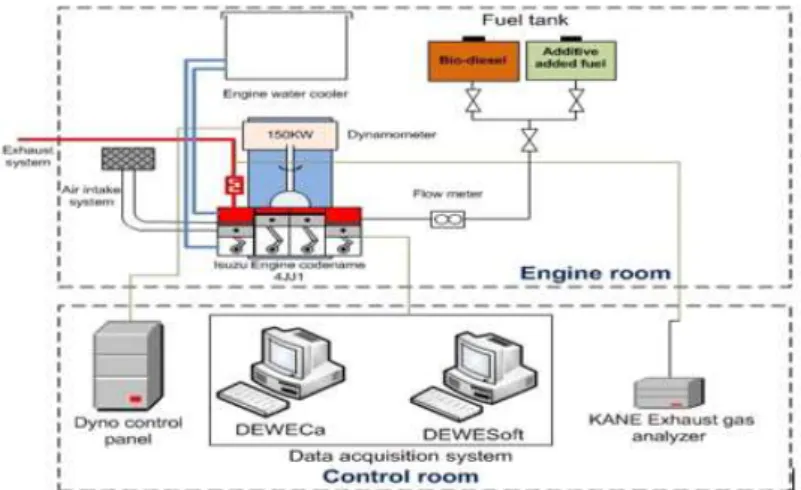
In this study B5, biodiesel has been used as a reference fuel which is suggested by Malaysian government [11]. Biodiesel-diesel blended fuels were collected from the local market in Malaysia. A small proportion butanol was added as an additive which was also acquired from local markets. Table 1 shows the properties of biodiesel, diesel and butanol. An ISUZU (4JJ1) multi-cylinder vehicular engine was used to perform the performance and emission test. The engine was run at two idling conditions at 1000 rpm and 1500 rpm. Figure 1 shows the schematic diagram of engine test bed. Table 2 shows the details specification of the engine. In order to acquire accurate and repeatable engine test data for diesel engine performance and emission characteristics, the engine test bed was instrumented with speed sensors, pressure transducers, fuel flow meters, in-line torque meter and a gas analyser. The emissions of the engine were measured by Kane gas analyser (Kane auto 4-3).
1234567890
4th International Conference on Mechanical Engineering Research (ICMER2017) IOP Publishing IOP Conf. Series: Materials Science and Engineering 257 (2017) 012084 doi:10.1088/1757-899X/257/1/012084
Figure 1. Project Test Rig Schematic
Table 1. Engine Specification
2.Result and Discussion
2.1. Analysis of Engine Performance
i. Engine Torque 0 5 10 15 20 25 30 35 40 45 B5 B5+5% Butanol En gi n e To rq u e [N -m] 1000 rpm 1500 rpm
Engine parameters Value
Model ISUZU 4JJ1 (Turbocharge)
Type 4-cylinder, water cooled, vertical in-line
Bore (mm) 95.4
Stroke (mm) 104.9
Displacement (L) 3 L
Number of cylinders 4 in-line Compression ratio 17.5 Connecting rod length (mm) 150.0 Piston pin offset (mm) 1.0
Rated output at 2500 rpm 61.0±3% kW Maximum torque at 1800 rpm 280±5% Nm
Injection system Direct injection common rail
Figure 2. Engine torque at idling condition for B5 and B5+5% butanol.
4
1234567890
4th International Conference on Mechanical Engineering Research (ICMER2017) IOP Publishing IOP Conf. Series: Materials Science and Engineering 257 (2017) 012084 doi:10.1088/1757-899X/257/1/012084
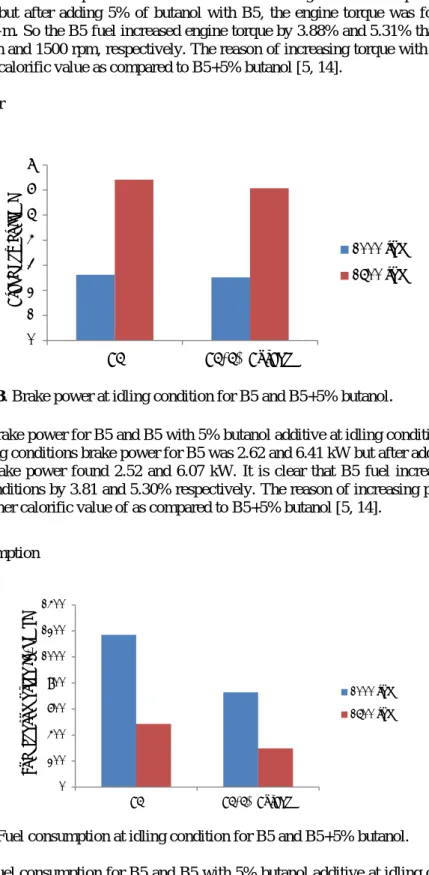
Figure 2 shows the engine torque for B5 and B5 with 5% butanol additive (B5+5% butanol) at idling conditions for 1000 and 1500 rpm. It can be seen that at both idling condition torque for B5 was 25 N-m and 40.8 N-m but after adding 5% of butanol with B5, the engine torque was found to be 24.03 N-m and 38.63 N-m. So the B5 fuel increased engine torque by 3.88% and 5.31% than B5+5% butanol fuel at 1000 rpm and 1500 rpm, respectively. The reason of increasing torque with that of B5 fuel is due to the higher calorific value as compared to B5+5% butanol [5, 14].
ii. Brake Power
Figure 3. Brake power at idling condition for B5 and B5+5% butanol
.
Figure 3 shows the brake power for B5 and B5 with 5% butanol additive at idling conditions. It can be seen that at both idling conditions brake power for B5 was 2.62 and 6.41 kW but after adding 5% of butanol with B5, the brake power found 2.52 and 6.07 kW. It is clear that B5 fuel increased brake power at both idling conditions by 3.81 and 5.30% respectively. The reason of increasing power with B5 fuel is due to the higher calorific value of as compared to B5+5% butanol [5, 14].
iii. Fuel Consumption
Figure 4. Fuel consumption at idling condition for B5 and B5+5% butanol.
Figure 4 shows the fuel consumption for B5 and B5 with 5% butanol additive at idling conditions. It is clear from the graph that at both idling conditions, fuel consumption for B5 was 1169.44 g/kWh and 485.50 g/kWh but after adding 5% of butanol with B5, the fuel consumption was found to be
0 1 2 3 4 5 6 7 B5 B5+5% Butanol B rake Pow e r [ kW] 1000 rpm 1500 rpm 0 200 400 600 800 1000 1200 1400 B5 B5+5% Butanol Fu e l c o n su m p tion [g /kWh ] 1000 rpm 1500 rpm
1234567890
4th International Conference on Mechanical Engineering Research (ICMER2017) IOP Publishing IOP Conf. Series: Materials Science and Engineering 257 (2017) 012084 doi:10.1088/1757-899X/257/1/012084
485.50 and 297.65 g/kWh. It is clear that B5+5% butanol fuel decreased fuel consumption by 38% and 39% at both 1000 and 1500 rpm, respectively. The reason of reducing fuel consumption by the additive added fuel can be attributed to the lower density and viscosity of butanol additive [10]. Fuel is delivered to the engine on a volumetric basis per stroke; thus, lower quantities of additive added fuels are fed into the engine due to the lower viscosity [15].
2.2. Analysis of Engine Gas Emission i. Carbon mono oxide (CO)
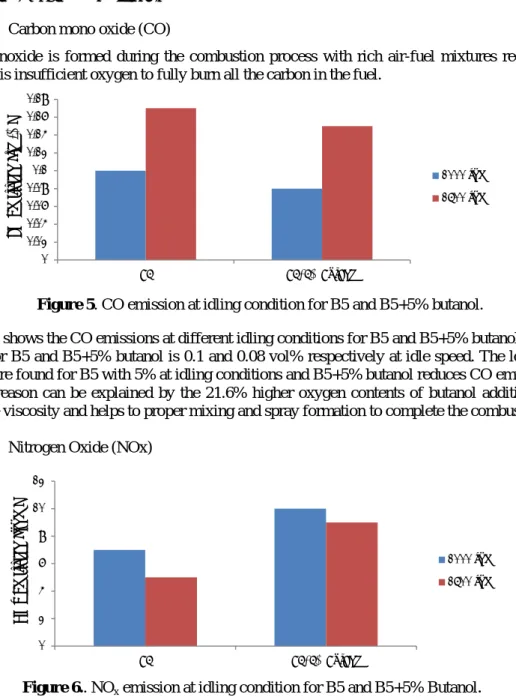
Carbon monoxide is formed during the combustion process with rich air-fuel mixtures regions and when there is insufficient oxygen to fully burn all the carbon in the fuel.
Figure 5 shows the CO emissions at different idling conditions for B5 and B5+5% butanol. The CO emission for B5 and B5+5% butanol is 0.1 and 0.08 vol% respectively at idle speed. The lowest CO emissions are found for B5 with 5% at idling conditions and B5+5% butanol reduces CO emissions by 20%. The reason can be explained by the 21.6% higher oxygen contents of butanol additive which reduced the viscosity and helps to proper mixing and spray formation to complete the combustion[13].
ii. Nitrogen Oxide (NOx)
Figure 6.. NOx emission at idling condition for B5 and B5+5% Butanol
.
NOx emission is strongly related to the higher peak combustion temperature. Figure 6 shows the NOx emissions at different idling conditions for B5 and B5+5% Butanol at idling conditions. The NOx emission for B5 and B5+5% butanol is 7 and 10 ppm respectively. Additive added fuel produces 43% NOx emission that diesel-biodiesel blend. This can be attributed to the lean air/fuel ratio, as butanol contains 21.6% more oxygen in its molecular structure. Many researchers reported that oxygenated
0 0.02 0.04 0.06 0.08 0.1 0.12 0.14 0.16 0.18 B5 B5+5% Butanol CO E m issi o n [vol .% ] 1000 rpm 1500 rpm 0 2 4 6 8 10 12 B5 B5+5% Butanol N Ox E m issi o n [p p m ] 1000 rpm 1500 rpm
6
1234567890
4th International Conference on Mechanical Engineering Research (ICMER2017) IOP Publishing IOP Conf. Series: Materials Science and Engineering 257 (2017) 012084 doi:10.1088/1757-899X/257/1/012084
fuel blends help to complete combustion which causes higher combustion temperature. Thus, NOxemission increased [13, 14].
iii. Carbon-di-oxide (CO2)
Figure 7. CO2 emission at idling condition for B5 and B5+5% Butanol
When the carbon completely burns with oxygen then CO2 is produced. The variation of CO2 emission at idling condition is shown in figure 7. The CO2 emission for B5 and B5+5% butanol is 5.3 and 6.5 vol. % respectively. Additive added fuel increased the CO2 emissions by 23% than B5 fuel. This could be attributed to the higher oxygen contents in butanol additive fuel which helps to burn the fuel completely in diesel engines. The production of carbon dioxide from biofuel can be neglected as it is absorbed by the crops, thus helps to maintain CO2 levels constant [4].
3.Conclusions
An experimental investigation has been carried out to find the fuel consumption and emissions characteristics of a diesel engine at idle conditions. Based on the findings it can be concluded that, during idling condition, the use of B5+5% butanol fuel makes a significant improvement in fuel consumption and CO emissions. Fuel consumption for B5+5% butanol is 38%lower than B5 fuel. The butanol additive added fuel reduces CO emissions by 20% but increases NOx and CO2 emissions by 43% and 23% respectively. Because butanol contains 21.6% more oxygen in its molecular structure which helps to complete combustion. Finally, it can be recommended that 5% butanol with B5 blend can slightly improve engines performance and emission during idling thus it can be used to run diesel engines.
Acknowledgement
Authors wishing to acknowledge assistance or encouragement from colleagues, special work by technical staff and the financial support (RDU 160304) from University Malaysia Pahang.
References
[1] Newell, R.G. and S. Iler, The global energy outlook. 2013, National Bureau of Economic Research.
[2] Mahmudul, H., et al., Production, characterization and performance of biodiesel as an
alternative fuel in diesel engines–A review. Renewable and Sustainable Energy Reviews,
2017. 72: p. 497-509.
[3] Liaquat, A., et al., Potential emissions reduction in road transport sector using biofuel in
developing countries. Atmospheric Environment, 2010. 44(32): p. 3869-3877.
[4] Gorham, R., Air pollution from ground transportation: an assessment of causes, strategies
and tactics, and proposed actions for the international community. 2002: Tournesol Conseils.
0 1 2 3 4 5 6 7 8 B5 B5+5% Butanol CO 2 E m issi o n [vo l.% ] 1000 rpm 1500 rpm
1234567890
4th International Conference on Mechanical Engineering Research (ICMER2017) IOP Publishing IOP Conf. Series: Materials Science and Engineering 257 (2017) 012084 doi:10.1088/1757-899X/257/1/012084
[5] Mofijur, M., et al., Comparative evaluation of performance and emission characteristics of Moringa oleifera and Palm oil based biodiesel in a diesel engine. Industrial Crops and Products, 2014. 53: p. 78-84.
[6] Mahmudul, H., et al. Impact of oxygenated additives to diesel-biodiesel blends in the context of performance and emissions characteristics of a CI engine. in IOP Conference Series:
Materials Science and Engineering. 2016. IOP Publishing.
[7] Mahmudul, H., et al. Experimental investigation of the impact of using alcohol-biodiesel-diesel blending fuel on combustion of single cylinder CI engine. in IOP Conference Series:
Materials Science and Engineering. 2016. IOP Publishing.
[8] Kumar, M.S., A. Ramesh, and B. Nagalingam, An experimental comparison of methods to use methanol and Jatropha oil in a compression ignition engine. biomass and bioenergy, 2003.
25(3): p. 309-318.
[9] Guarieiro, L.L.N., et al., Assessment of the use of oxygenated fuels on emissions and
performance of a diesel engine. Microchemical Journal, 2014. 117: p. 94-99.
[10] Mofijur, M., M. Rasul, and N. Hassan. Effect of butanol additive on the performance and emission of Australian macadamia biodiesel fuel in a diesel engine. in Sustainable and
Renewable Energy Engineering (ICSREE), 2017 2nd International Conference. 2017. IEEE.
[11] Rahman, S.A., et al., Effect of idling on fuel consumption and emissions of a diesel engine fueled by Jatropha biodiesel blends. Journal of cleaner production, 2014. 69: p. 208-215. [12] Rahman, S.A., et al., Production of palm and Calophyllum inophyllum based biodiesel and
investigation of blend performance and exhaust emission in an unmodified diesel engine at
high idling conditions. Energy Conversion and Management, 2013. 76: p. 362-367.
[13] Rahman, S.A., et al., Assessing idling effects on a compression ignition engine fueled with
Jatropha and Palm biodiesel blends. Renewable Energy, 2014. 68: p. 644-650.
[14] Xue, J., T.E. Grift, and A.C. Hansen, Effect of biodiesel on engine performances and
emissions. Renewable and sustainable energy reviews, 2011. 15(2): p. 1098-1116.
[15] Rao, P., Experimental investigations on the influence of properties of jatropha biodiesel on
performance, combustion, and emission characteristics of a DI-CI engine. World academy of