A framework for the control of integrated production
and transport systems by combining evolutionary
scheduling with fault detection methods
Bernd Scholz-Reiter University of Bremen,
Bibliothekstraße 1, 28359 Bremen, Germany Jens Hartmann ([email protected]),
BIBA - Bremer Institut für Produktion und Logistik GmbH, University of Bremen, Hochschulring 20, 28359 Bremen, Germany
Carlos Ernani Fries,
Industrial and Systems Engineering Department, Federal University of Santa Catarina, 88010-970 Florianopolis, Santa Catarina, Brasil
Abstract
The scheduling and control of production and transport processes in manufacturing supply chains is usually handled separately, i.e. interdependencies between both processes are not taken into account so that globally optimal scheduling decisions cannot be guaranteed. An integrated consideration of these processes holds the potential to improve the supply chain performance. In addition, manufacturing and transport take place in dynamic environments and are subjected to several kinds of disruptions. Critical events put the timely execution of a given schedule at risk and ask for a control strategy that assures the efficient operation of a supply chain. This paper presents a framework for the control of integrated production and transport systems by combining integrated scheduling with fault detection methods. A framework for the interplay of the scheduling method with signal based fault detection methods is given by a simulation model of the production and transport system. Thus, in case of a detected critical disturbance, a replanning is performed based on the current status of the running system.
Keywords: Integrated scheduling, Production and transport scheduling problem, Fault detection
Introduction
Manufacturing supply chains can be regarded as integrated systems of material and information flow, often on a global scale, between partners who perform value adding processes at different stages of a product. Effective interfaces between the involved partners are crucial for the competitiveness of the supply chain (Christopher 2005). The alignment and coordination of resources is supported by advanced planning systems
(APS). On the operational level, these systems perform separate planning of production and transport processes (Rohde et al. 2000). The processes are aligned by a tactical planning based on aggregated information, e.g. mean values for handling times or material flows. Since an integrated planning can be superior to the sequential approach of current APS (Chen and Vairaktarakis 2005), efficient solution methods for the integrated production and transport scheduling problem (PTSP) hold the potential to improve the competitiveness of global supply chains.
Many research approaches assume complete information about the production and transport processes at the time of scheduling and the execution of a plan in a deterministic environment. Based on this, the PTSP can be formulated as a mixed-integer program (MIP) comprising binary and continuous variables and belongs to the class of NP-hard problems. This means that the computation of exact solutions has a high complexity and is limited to small problem instances, even in the deterministic case. However, operating production and transport systems are subjected to different kinds of expected or unexpected events that might result in changes of a given schedule. Examples of such perturbations are machine failures, rush orders, traffic congestions, production delays, etc. Thus, an effective operational management of these systems requires the ability to react dynamically on critical disturbances that put the execution of a schedule at risk. As a preliminary, disturbances need to be identified and analyzed.
This paper presents a framework for the control of integrated production and transport systems that addresses requirements for a control on the operational level. The control is based on the execution of a baseline schedule that is adapted dynamically to react on critical disturbances. Section 2 presents a literature review of current scheduling methods for supply chains as well as of fault detection and analysis methods. Feasible schedules are generated by an evolutionary algorithm, presented in Section 3. Here, the PTSP in its MIP formulation is decomposed into a combinatorial and a continuous subproblem. A solution for the binary variables is computed through the evolution. The corresponding continuous variables are determined by the solution of a linear program. Section 4 describes how fault detection methods can be used to trigger a rescheduling as a reaction to critical disturbances. The scheduling and fault detection methods are combined in Section 5 in a simulation environment for the control of the production and transport system.
Literature review
Nowadays, many industries feature a high degree of flexibility in their production processes, which is also addressed in literature (Li et al. 2001, Bish et al. 2005). This flexibility raises the complexity of the coordination of processes along the supply chain. If the supply chain contains large distances between the different production facilities, potentially even on a global scale, an efficient inter-facility transport coordination is crucial for the performance of the whole chain. The material flow has to be aligned with the internal processes of each intermediate production facility in order to achieve low costs and lead times as well as a high service level (De Matta and Miller 2004). Traditionally, industry does not use integrated approaches where the planning of production processes takes into account the transport network and vice versa. Instead, the planning is done sequentially, using only little information about adjoining processes on the tactical planning level (Rohde et al. 2000). This lack of coordination can lead to a
reduced overall efficiency and to unnecessarily high overall costs (De Matta and Miller 2004). The efficient integration of processes on the operational level is still an open research topic, even though several authors address integrated production and transport problems. Common approaches are based on mathematical programming and on simulation models (De Matta and Miller 2004, Chen and Vairaktarakis 2005, Geismar et al. 2008, Scholz-Reiter et al. 2011, Yung et al. 2006). A review of mathematical programming models is given by (Mula et al. 2010). Many approaches for integrated production and transport scheduling include the vehicle routing problem (VRP), which consists of finding an optimal assignment of a number of tasks (e.g. pick-up and delivery) to a fleet of vehicles and which is a very intensively studied problem in operations research. Several variants of the VRP are also regarded, such as the VRP with time windows, multiple depots or non-homogeneous fleets of vehicles (Golden et al. 2010, Toth and Vigo 2002, Cordeau et al. 2007).
Most of the approaches presented in literature are based on deterministic process data, such as a completely known set of orders at the moment of scheduling a certain time period and deterministic production and transportation times. However, the real supply chain operates in a dynamic environment where processes are exposed to a variety of expected and unexpected events. This can be related to single resources (e.g. the break-down of a machine or a truck delay due to traffic congestion) as well as strategic concerns (e.g. shortage of materials) or changes in process data (e.g. change of job priority or job cancellations). In order to respect the dynamic influences for scheduling, a real-time control strategy is necessary that includes the analysis of disruptive events in the system and is able to generate mitigating actions (Ouelhadj and Petrovic 2009). Approaches for real-time scheduling were identified in literature as a promising stream of research (Baruah and Pruhs 2010, Herroelen and Leus 2005). Different methods for dynamic transport scheduling were also investigated, such as agent-based scheduling (Mes et al. 2007), on-line decision making (Schönberger and Kopfer 2009) and dynamic vehicle scheduling (Huisman et al. 2004). However, a comprehensive approach for the dynamic scheduling of integrated production and transport systems on the operational level is still missing.
Methods for the detection of critical disturbances, called faults, were developed and applied in different fields of research. Complex systems, such as chemical plants, aircrafts or nuclear power plants with a high need of a problem-free operation for safety reasons pushed this development (Hoskins et al. 1991). For manufacturing supply chains, the detection of faults is critical to ensure product quality and process reliability. A fault is considered as an unpermitted deviation of at least one of the system parameters or characteristic properties from an acceptable condition (Isermann and Ballé 1997). Thus, a fault holds the potential of affecting the normal operation of the production system and should be detected in order to enable a mitigating action. According to (Isermann 2005), faults can be classified as abrupt, incipient and intermittent, depending on their appearance in time. Abrupt faults are abnormal changes of parameters that occur instantaneously or at least very fast. However, the term refers only to the development of a signal over time and not to its magnitude. As a matter of fact, the bigger challenge is the detection of small deviations that accumulate over time, the so-called incipient faults. Finally, intermittent faults occur regularly or irregularly and potentially with varying magnitude and are most difficult to detect. The approaches to realize the fault detection
can be distinguished in two classes: signal based and model based. The basis of signal based fault detection is the direct analysis of monitored system data in order to recognize patterns that indicate a fault. Model based approaches include a mathematical model for the generation of expected values for the development of the system parameters. An analysis of the discrepancy between predicted and actual parameters can also indicate a fault (Ding 2008).
Evolutionary scheduling approach
The preliminary for a control of integrated production and transport systems is the ability to compute optimal integrated schedules on the operational level. The underlying problem that has to be solved is the integrated production and transport scheduling problem (PTSP). This problem can be formulated as a mixed integer program (MIP), which is a mathematical optimization problem comprising continuous and binary variables (Scholz-Reiter et al. 2010). The PTSP belongs to the class of NP-hard problems and the computation of exact solutions for the MIP formulation is limited to very small problem instances. Thus, the use of heuristic methods is necessary, that are capable of computing near-optimal solutions for larger problem instances in reasonable time. In the following, we propose an evolutionary scheduling approach that is based on the idea that the computation of the binary variables and the computation of the continuous variables for the MIP solution can be treated separately.
As in Scholz-Reiter et al. 2010, the modeled production system is a heterogeneous open flow-shop with several consecutive production levels. Each production level consists of several machines with order-type dependent processing costs and processing times, where each job has to be processed by one machine of each level. Additionally, a job can be processed externally in very short time but at high costs. Waiting times between subsequent production steps are considered as storage that produces costs. After production, the products are delivered to subsequent facilities of the supply chain or to the final customer. The facilities are located in a fully connected road network. The costs of a tour are composed of a fixed amount for operating the tour, a variable amount dependent on its length and penalty costs for an unpunctual delivery. External transport at high costs is also possible.
The binary variables represent the decisions to be taken for a problem solution, e.g. if a job is processed externally or not. Assignments are also represented as binary decisions, e.g. whether or not a job is assigned to a specific machine or tour. The same applies to the sequencing of jobs, e.g. whether or not a job i is processed before a job j on a certain machine. The remaining variables are continuous, like the starting times for the production on each machine, storage times or the duration of tours. A schematic representation of the linear objective function of the MIP is given in Equation (1).
Min. ∑
Tlatecpen+∑
Tstorcstor+∑∑∑∑
Xcprod+∑
(Ocfix+Tdurcvar)+∑
(EcexP+LcexT) (1)J J J K N M V J
The equation consists of several terms, each representing partial costs. The objective is to minimize the total costs, i.e. the sum of all terms. The set of jobs is denoted as J, the job types as K. The variables N, M and V represent the set of production levels, machines and tours, respectively. The first term minimizes the penalty costs for
unpunctual deliveries and the second term represents the total storage costs. The production costs for all jobs that are assigned to a machine by the binary variable X are given by the third term. The second last term contains the binary variable O, which permits a tour to be performed. The total sum of fixed and variable costs of the tours are minimized by this term. Finally, the costs for external production and transport are represented by the last term. It includes the binary variables E and L that define whether or not a job is produced or transported externally. A full description of the program can be found in Hartmann et al. 2012.
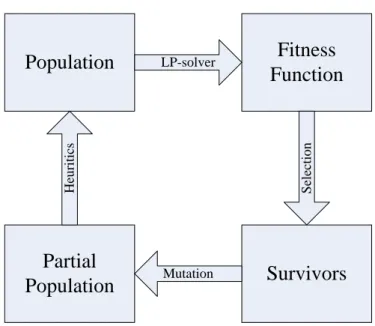
Assuming that the binary variables are already known and not part of the optimization, the multiplications containing binary variables turn into static scalar values in Equation (1). The remaining optimization problem is a linear program (LP), which can be solved efficiently. The solution of the LP determines the costs of the optimal schedule corresponding to the given set of binary variables. This leads to the idea of optimizing the binary variables through an evolutionary algorithm as shown in Figure 1.
Population
Fitness
Function
Survivors
Partial
Population
LP-solver Selection Mutation HeuriticsFigure 1 – Evolutionary approach for integrated production and transport scheduling
Evolutionary algorithms are iterative optimization methods that imitate the natural selection. The starting point is an initial population of individuals that is evaluated by a fitness function, which determines a scalar fitness value as criteria to compare different individuals. In case of the scheduling problem, an individual is a full set of binary variables and the fitness value of each individual represents the total costs of the corresponding schedule. Hence, in this case, the fitness function is the linear program. After the corresponding LP has been solved for all individuals of the population, the best individuals are selected as survivors for the next generation. In order to receive the original population size, new individuals are generated by a mutation process and the iteration can be continued. Since the number of binary variables of the MIP is very high, heuristic methods can be used to determine a part of the decisions to be taken, e.g. routing heuristics for sequencing the jobs on a tour. This way, the solution space for the evolution is reduced and the convergence towards good solutions is speeded up.
Fault detection based control strategy
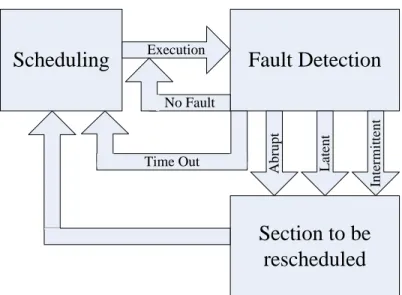
Production as well as transport systems operate in dynamic environments and are subjected to different kinds of disruptive events. These might occur expectedly or unexpectedly. Thus, in addition to efficient scheduling methods, supply chain management has to include a control strategy that can react on disruptions with a rescheduling of processes. Three different policies for triggering a rescheduling can be distinguished: rolling time horizon, event-driven and hybrid (Vieira et al. 2003). Scheduling on a rolling time horizon describes the segmentation of the processes to be scheduled into short time periods that are scheduled subsequently in a static way. An event-driven policy triggers a rescheduling based on the occurrence of a disruptive event. Hence, the renewal epochs are stochastic. The combination, a hybrid rescheduling policy, performs the rescheduling periodically and also in case of an unforeseen event. As a rescheduling policy for production and transport systems we propose a hybrid strategy as shown in Figure 2, where the periodical renewal epochs correspond to the end of a working day or week. Based on a computed initial schedule the system is executed and monitored by a fault detection method, which is the core of the control strategy. As long as no fault is detected, the system is executed according to the given schedule. Besides the periodic time out, the fault detection can trigger three different events, i.e. the occurrence of an abrupt, a latent or an intermittent fault. Depending on the kind of fault it can be decided, if a full rescheduling has to be performed or if the rescheduling of a part of the processes is sufficient.
Scheduling
Fault Detection
Section to be
rescheduled
Execution Abrupt Latent Intermittent No Fault Time OutFigure 2 – Control strategy based on fault detection
The fault detection can be based on the direct evaluation of system parameters. A classical approach is statistical hypothesis testing, which selects one of two options: not rejecting the null hypothesis H0 (i.e. the system is running normally) or rejecting it in favor of the alternative hypothesis H1 (i.e. the presence of a fault). The methods which do not require a fixed sample size are called sequential analysis. One of these methods is the sequential probability ratio test (SPRT). Here, the samples are taken into account one by one. The decision between both hypotheses is taken, once enough samples have been gathered. The decision is based on the ratio of the conditional likelihoods of the data,
given hypotheses H0 and H1, respectively. The SPRT was proven to use the smallest number of samples of all statistical tests with the same error probability.
Simulation model and test case
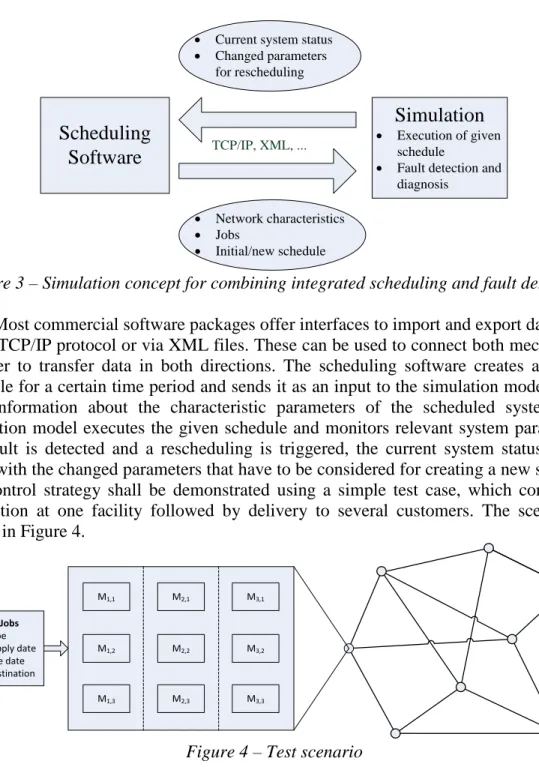
In the previous sections we described two separate mechanisms that can be combined to a control strategy for production and transport systems. The implementation of the evolutionary scheduling method requires a powerful computing language. In our case a prototypical implementation was done in Matlab. The fault detection analyses data signals during the runtime of a system, which can be simulated with software tools such as Arena. A structure for the implementation setup is shown in Figure 3.
Scheduling
Software
Simulation
• Execution of givenschedule
• Fault detection and diagnosis
• Current system status • Changed parameters for rescheduling • Network characteristics • Jobs • Initial/new schedule TCP/IP, XML, ...
Figure 3 – Simulation concept for combining integrated scheduling and fault detection
Most commercial software packages offer interfaces to import and export data, such as the TCP/IP protocol or via XML files. These can be used to connect both mechanisms in order to transfer data in both directions. The scheduling software creates an initial schedule for a certain time period and sends it as an input to the simulation model, along with information about the characteristic parameters of the scheduled system. The simulation model executes the given schedule and monitors relevant system parameters. If a fault is detected and a rescheduling is triggered, the current system status is sent along with the changed parameters that have to be considered for creating a new schedule. The control strategy shall be demonstrated using a simple test case, which consists of production at one facility followed by delivery to several customers. The scenario is shown in Figure 4. M1,1 M1,2 M1,3 M2,1 M2,2 M2,3 M3,3 M3,2 M3,1 Jobs - Type - Supply date - Due date - Destination
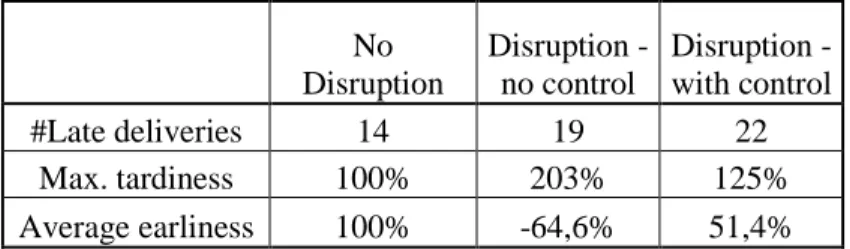
The scenario consists of a production facility with three subsequent production levels, that each contain three machines. The products are processed by one machine of each level and then delivered to a customer network with seven cities. The initial schedule is computed for a period of one working day of eight hours. The number of jobs that have to be processed during this period is 50 with an average processing time of 30 minutes on each machine. The scenario was simulated three times with the same configuration of job types, supply dates, due dates and destinations as well as with identical production and delivery times. The first simulation was run without disruptive events and serves as a benchmark. The other two simulations were disturbed by an abrupt fault, i.e. a downtime of one machine for three hours. The second simulation run did not include a control strategy which could react on the disturbance by rescheduling. This means that the initial schedule was executed on the other machines while the jobs that were supposed to be processed by the broken machine had to wait during the downtime. The third simulation run included rescheduling as a reaction on the disturbance. During the downtime of the machine, the assigned jobs were included in the schedule of the remaining machines of the same levels. The results of the simulation are summarized in Table 1.
Table 1 –Simulation results
No Disruption Disruption - no control Disruption - with control #Late deliveries 14 19 22 Max. tardiness 100% 203% 125% Average earliness 100% -64,6% 51,4%
The due dates of the jobs were set very tight, so that even in the first simulation run without disturbance 14 jobs could not be delivered in time. However, the tardiness was very small and the average delivery time for all jobs was before the respective due date. The average earliness of this simulation was set to a benchmark value of 100%. The maximum tardiness of the jobs was also set to 100%. The disturbed simulation without control strategy features an increased number of 19 late deliveries due to the waiting time at the broken machine. The tardiness of the job with the latest arrival after its due date was doubled in comparison to simulation 1. In average, the earliness of the first simulation was exhausted and turned into an average lateness. Simulation 3 showed that the control strategy has the ability to mitigate the consequences of a disturbance. Although the number of late deliveries increased more than in simulation 2, the maximum tardiness increased dramatically less. The average earliness of simulation 1 was reduced only by half, so that the average delivery is still before the due date of a job, in stark contrast to simulation 2. This means that the control strategy turned a big delay of a small number of jobs into a small delay of more jobs, which does not affect an average punctual delivery.
Conclusion
An integrated view on the scheduling of production and transport operations holds the potential to improve the efficiency of global supply chains. However, the production and transport scheduling problem belongs to the class of NP-hard optimization problems and
is thus hard to solve. In addition, production and transport operate in dynamic environments, where unexpected disruptions might impair a reliable and efficient performance.
This paper introduced a comprehensive scheduling and control strategy for integrated production and transport systems. The scheduling problem can be formulated as a mixed integer program, which can be solved by exact algorithms only for small problem instances. An evolutionary solution method was proposed that enables the computation of heuristic solutions also for large problem instances. Based on the scheduling method, a framework for a control method was proposed that enables the reaction on critical disturbances by rescheduling. A hybrid approach was used to trigger a rescheduling based on a rolling time horizon as well as on the occurrence of disruptive events, which are detected by signal based fault detection methods. A layout for the combination of the scheduling method with the fault detection based control was specified. Finally, the ability of the approach to improve the system performance by rescheduling as a reaction to a fault was demonstrated with a test scenario.
Acknowledgements
This research was supported by CAPES, CNPq, FINEP and DFG as part of the Brazilian-German Collaborative Research Initiative on Manufacturing Technology (BRAGECRIM).
References
Baruah, S., K. Pruhs. 2010. Open problems in real-time scheduling. Journal of Scheduling13(6): 577-582.
Chen, Z.-L., G. L. Vairaktarakis. 2005. Integrated Scheduling of Production and Distribution Operations.
Management Science. 51(4): 614-628.
Christopher, M. 2005. Logistics & Supply Chain Management: Creating Value-Adding Networks.3.ed.
Financial Times/Prentice Hall. New Jersey.
Cordeau, J.-F., G. Laporte, M. W. Savelsbergh, D. Vigo. 2007. Vehicle routing. Barnhart C., G. Laporte,
eds. Handbook in Operations Research and Management Science. Vol. 14. Elsevier. 367-428.
De Matta, R., T. Miller. 2004. Production and inter-facility transportation scheduling for a process industry.
European Journal of Operational Research. 158(1): 72-88.
Ding, S. X. 2008. Model-based fault diagnosis techniques: design schemes, algorithms, and tools. Springer.
Berlin.
Geismar, H. N. G. Laporte, L. Lei, C. Sriskandarajah. 2008. The integrated production and transportation
scheduling problem for a product with a short lifespan. Informs Journal on Computing. 20(1):
21-33.
Golden, B. L., S. Raghavan, E. A. Wasil. 2010. The vehicle routing problem: latest advances and new
challenges. Springer. New York.
Hartmann, J., Makuschewitz, T., Frazzon, E. M., Scholz-Reiter, B. 2012. A genetic algorithm for the
integrated scheduling of production and transport systems. Operations Research Proceedings
2012. Springer. Berlin Heidelberg. (To be buplished).
Herroelen, W., R. Leus. 2005. Project scheduling under uncertainty: Survey and research potentials.
European Journal of Operational Research. 165(2): 289-306.
Hoskins, J. C., K. M. Kaliyur, D. M. Himmelblau. 1991. Fault diagnosis in complex chemical plants using
artificial neural networks. AIChE Journal. 37(1): 137-141.
Huisman, D., R. Freling, A. P. M. Wagelmans. 2004. A Robust Solution Approach to the Dynamic Vehicle
Scheduling Problem. Transportation Science. 38(4): 447-458.
Isermann, R., P. Ballé. 1997. Trends in the application of model-based fault detection and diagnosis of
technical processes. Control Engineering Practice. 5(5): 709-719.
Isermann, R. 2005. Model-based fault-detection and diagnosis – status and applications. Annual Reviews in
Li, L., E. L. Porteus, H. Zhang. 2001. Optimal operating policies for multiplant stochastic manufacturing
systems in a changing environment. Management Science. 47(11): 1539-1551.
Mes, M., M. van der Heijden, H. van Harten. 2007. Comparison of agent-based scheduling to look-ahead
heuristics for real-time transportation problems. European Journal of Operational Research.
181(1): 59-75.
Mula, J., D. Peidro, M. Diáz-Madroñero, E. Vicens. 2010. Mathematical programming models for supply
chain production and transport planning. European Journal of Operational Research. 204(3):
377-390.
Ouelhadj, D., S. Petrovic. 2009. A survey of dynamic scheduling in manufacturing systems, Journal of
Scheduling, 12(4): 417-431.
Rohde, J., H. Meyr, M. Wagner. 2000. Die Supply Chain Planning Matrix. PPS Management. 5(1): 10-15.
Scholz-Reiter, B., E. M. Frazzon, T. Makuschewitz. 2010. Integrating manufacturing and logistic systems
along global supply chains. CIRP Journal of Manufacturing Science and Technology. 2(3):
216-223.
Scholz-Reiter, B., A. G. N. Novaes, E. M. Frazzon, T. Makuschewitz. 2011. A New Approach for Handling
Perturbations in Supply Chains. Industrie Management. 27(2): 19-22.
Schönberger, J., H. Kopfer. 2009. Online decision making and automatic decision model adaptation.
Computers & Operations Research. 36(6): 1740-1750.
Toth, P., D. Vigo. 2002 The vehicle routing problem. SIAM Monographs on Discrete Mathematics and
Applications, Society for Industrial and Applied Mathematics. Philadelphia.
Vieira, G. E., J. W. Hermann, E. Lin. 2003. Rescheduling manufacturing systems: a framework of
strategies, policies and methods, Journal of Scheduling, 6(1): 39-62.
Yung, K.-L., J. Tang, A. W. H. Ip, D. Wang. 2006. Heuristics for Joint Decisions in Production,