ERAWATCH Country Reports 2013: Spain
Ana Fernández-Zubieta2 0 1 4
European Commission
Joint Research Centre
Institute for Prospective Technological Studies
Contact information
Address: Edificio Expo. c/ Inca Garcilaso, 3. E-41092 Seville (Spain) E-mail: [email protected] Tel.: +34 954488318 Fax: +34 954488300 https://ec.europa.eu/jrc https://ec.europa.eu/jrc/en/institutes/ipts Legal Notice
This publication is a Science and Policy Report by the Joint Research Centre, the European Commission’s in-house science service. It aims to provide evidence-based scientific support to the European policy-making process. The scientific output expressed does not imply a policy position of the European Commission. Neither the European Commission nor any person acting on behalf of the Commission is responsible for the use which might be made of this publication.
All images © European Union 2014 JRC91153
EUR 26789 EN
ISBN 978-92-79-39551-2 (PDF) ISSN 1831-9424 (online) doi:10.2791/11675
Luxembourg: Publications Office of the European Union, 2014 © European Union, 2014
Reproduction is authorised provided the source is acknowledged.
Abstract
The Analytical Country Reports analyse and assess in a structured manner the evolution of the national policy research and innovation in the perspective of the wider EU strategy and goals, with a particular focus on the performance of the national research and innovation (R&I) system, their broader policy mix and governance. The 2013 edition of the Country Reports highlight national policy and system developments occurring since late 2012 and assess, through dedicated sections:
national progress in addressing Research and Innovation system challenges;
national progress in addressing the 5 ERA priorities;
the progress at Member State level towards achieving the Innovation Union;
the status and relevant features of Regional and/or National Research and Innovation Strategies on Smart Specialisation (RIS3);
as far relevant, country Specific Research and Innovation (R&I) Recommendations.
Detailed annexes in tabular form provide access to country information in a concise and synthetic manner.
The reports were originally produced in December 2013, focusing on policy developments occurring over the preceding twelve months.
1
ACKNOWLEDGEMENTS AND FURTHER
INFORMATION
This analytical country report is one of a series of annual ERAWATCH reports produced for EU Member States and Countries Associated to the Seventh Framework Programme for Research of the European Union (FP7). ERAWATCH is a joint initiative of the European Commission's Directorate General for Research and Innovation and Joint Research Centre. The Country Report 2013 builds on and updates the 2012 edition. The report identifies the structural challenges of the national research and innovation system and assesses the match between the national priorities and the structural challenges, highlighting the latest developments, their dynamics and impact in the overall national context.
The first draft of this report was produced in December 2013 and was focused on developments taking place in the previous twelve months. In particular, it has benefited from comments and suggestions of Fernando Hervás from JRC-IPTS who reviewed the draft report. The contributions and comments from DG-RTD and the ERAWATCH and JRC National Contact Point (Marta March, Cecilia Cabello Valdés) and Xavier Roland Eekhout are also gratefully acknowledged.
The report is currently only published in electronic format and is available on the ERAWATCH website. Comments on this report are welcome and should be addressed to [email protected].
Copyright of this document belongs to the European Commission. Neither the European Commission, nor any person acting on its behalf, may be held responsible for the use of the information contained in this document, or for any errors which, despite careful preparation and checking, may appear. The report does not represent the official opinion of the European Commission, nor that of the national authorities. It has been prepared by independent external experts, who provide evidence based analysis of the national Research and Innovation system and policy.
2
EXECUTIVE SUMMARY
Spain has considerably reduced its Research and Development (R&D) and innovation investments during the last years, threatening to set back the progress made before during the previous period. Spain made considerable efforts in the period 2002-2008 duplicating its Gross Expenditures on R&D (GERD) in absolute terms. However, the financial crisis cut short the positive trend. After 2008, the R&D intensity (GERD as a percentage of Gross Domestic Product -GDP) practically stagnated (around 1.4%) and decreased to 1.36% in 2011. In 2012, R&D intensity decreased to 1.3%, reaching a figure similar to the one in 2007 (1.27%). The Government Budget Appropriations or Outlays on R&D (GBAORD) has been decreasing importantly over the last three years, by -4.5% in 2010 by -12.7% in 2011 and by -13.1% in 2012, reaching a budget of €6,300m. Data on the general government budget for R&D and innovation (PGE) showed that, after decreasing in 2012 by -25.6%, public investments in R&D and innovation decreased in 2013 by -7.2% leading to a budget of €5,932m (Molero and de No, 2012b, Molero and de No, 2013a). This means that public R&D investments went back to the levels of 2005-2006. In relative terms, the total funds per R&D personnel in Full Time Equivalent (FTE) have changed from €31.9k in 2002 to €41.1k per head in 2009. For 2013, this figure will represent €22.6k per head, which is much lower than the one in 2002 (Molero and de No, 2012c; Molero and de No, 2013a). In addition, the non-execution of an important part of the budgets has worsened the situation. In the period 2009-2011, between 21% and 45% of the yearly public government budgets were not executed (FECYT, 2013). These severe cuts in R&D and innovation investments have raised important concerns among research-related organisations1 about the financial sustainability of the Spanish R&D and innovation system.
They also indicate that it will be very difficult for Spain to reach the targets of 3% GERD per GDP set by the Europe 2020 strategy. In fact, the newSpanish Strategy for Science, Technology and Innovation (EESTI) (2013-2020) has set a new lower target of 2% GERD per GDP for 2020. This new lower target, the cancellation and delays in launching important R&D calls (e.g. Promotion of R&D and innovation towards societal challenges) appear to contradict the formal policy discourse that supports R&D and innovation as a mechanism to change its economic structure and to overcome the current economic crisis
Spain has a quasi-federal decentralised R&D and innovation system. Some recent developments might improve the coordination of national and regional R&D and innovation policies. For example, the new Law of Science, Technology and Innovation (LCTI 2011) is aimed at improving national and regional coordination through the Council of Science, Technology and Innovation (CPCTI). Four regions accounted in 2012 for 69.7% of all R&D expenditures: Madrid (25.6%), Catalonia (22.3%), Andalusia (11.1%) and the Basque Country (10.7%). In relative terms, the leading regions are the Basque Country, Navarre, Madrid and Catalonia with a GERD by GDP of 2.2%; 1.9%, 1.8% and 1.5% respectively. The Basque Country is the only region that has increased its yearly R&D Intensity over the last three years (2%, 2.1% and 2.2%). All Regional authorities “Comunidades Autónomas” have registered to the Smart Specialisation Platform (S³P), which “assists Member States and regions to develop, implement and review Research and Innovation Strategies for Smart Specialisation (RIS³)” (RIS³: on-line). Currently, all
1 These organisations include: the Spanish Confederation of Scientific Societies (COSCE), the Spanish Conference
of University Rectors (CRUE), the Platform for Dignifying Research (PDI), the Spanish Federation of Young Researchers (FJI) and the National Association of Ramón y Cajal Researchers (ANIRC). These organisations have jointly signed different manifestos (see section 2.5). They are diverse and have different levels of relevance to the research system.
3
the Spanish regions are developing their RIS3 strategies, which have to be finished by the end of 2013 (NRP, 2013) The new Spanish Strategy for Science, Technology and Innovation (EESTI) (2013-2020)includes the concept of “smart specialisation” in one of its 6 priority axes (Priority 5).
Important efforts have been made in improving the R&D and innovation policy mix over the past years. Successive strategies and plans have tried to address the challenges of the Spanish R&D system and to follow the suggestions of some comprehensive evaluations on this system (e.g. OECD, 2006) in order to address the challenges of the Spanish R&D and innovation system. The Spanish R&D and innovation system have challenges related to the country's industrial structure, to its science and technology base and to its governance structures (OECD, 2006; EW, 2009 and 2011; EC, 2011a and 2011b). The industrial structure in Spain is characterised by the significant weight of low-tech Small and Medium-sized Enterprises (SMEs) that leads to low levels of R&D and innovation spending and patenting activity. Its science and technology base is a rigid and closed system with low levels of mobility between institutions, territories and sectors. Its governance structure demands higher levels of institutional coordination (regional and ministerial); complementarities between research and innovation policies; and synergies between policy design and implementation. The new Spanish R&D and innovation strategy EESTI (2013-2020) and the new Plan of Scientific and Technical Research and Innovation (PECTI) (2013-2016) also follow this trend and try to respond to the challenges of the system and the shortcomings of previous plans. The changes in the strategies and plans indicate an increasing emphasis on innovation, public-private R&D collaboration, research excellence and other emerging topics, such as the promotion of R&D and innovation on societal challenges or the role of public procurement to promote R&D and innovation. The increasing importance of competitive funding, the implementation of a more diversified set of instruments (e.g. tax incentives, venture capital), and the increasing alignment with European objectives are also important changes in the Spanish policy mix. The new law (LCTI 2011) has also tried to address these challenges. However, as these very documents recognise, the structural and governance challenges of the Spanish research system remain.
Currently the most important challenge of the Spanish R&D and innovation system is to reverse the decreasing trend of public R&D and innovation investments and to assure an effective implementation of the policy framework for R&D. The evolution of the Spanish policy mix during the last decade was quite satisfactory, including a including a diversified set of instruments that tried to tackle the identified barriers and weaknesses of the R&D system. This evolution is currently threatened by the important public budget cuts in R&D and innovation. There are also some indications that point that policy implementation could have been improved. The increasing proportion of non-executed public budget for R&D and innovation (Molero and de No, 2012a; Fecyt, 2013) indicates that there is a need for analysing what instruments and measures are not being sufficiently demanded or used. Similarly, the increasing proportion of public budgets allocated through loans (MINECO, 2013) points that budget cuts have been applied without considering one of the strengths of the R&D and innovation system, namely its basic research (which primarily needs grant financing). During the last two years, many important policy programmes have been delayed or cancelled. The delay suffered in launching the main programme for basic R&D (“Promotion of R&D and innovation towards societal challenges”) reveals that policy implementation has been unreliable. It also indicates that the strengths of the system (basic research) have not been considered when implementing the R&D plan. The budget crisis suffered by the Spanish National Research Council (CSIC) during Summer 2013 points to the need of a more stable budgetary framework for public research institutions. In addition, no specific measures appeared to be taken to address the consequences of the crisis in the R&D system. The combination of the lack of measures for addressing systematic failures of the R&D system (ERAWATCH report 2010; EW, 2011; EW, 2012) with
4
the lack of measures for addressing the negative consequences of the crisis will probably exacerbate some of the long-term challenges of the R&D system. For example, the limited character of the measures to make the public labour market for researchers more flexible combined with the lack of specific measures to support researchers under temporary contracts, have concentrated the negative effects of budget cuts on the young and mobile researchers. The precarious situation of young and mobile excellent researchers diminishes the research base of the country and does not encourage future generations to enter into a research career.
5
Table of Contents
EXECUTIVE SUMMARY ... 2
1 BASIC CHARACTERISATION OF THE RESEARCH AND INNOVATION SYSTEM ... 6
2 Recent developments of the research and innovation policy and system ... 11
2.1 National economic and political ... 11
2.2 Funding trends... 12
2.2.1 Funding flows ... 12
2.2.2 Funding mechanisms ... 14
2.2.3 Thematic versus generic funding ... 16
2.2.4 Innovation funding ... 16
2.3 Research and innovation system changes ... 17
2.4 Recent policy developments ... 19
2.5 National Reform Programme 2013 ... 21
2.6 Recent evaluations, consultations, foresight exercises ... 23
2.7 Regional and/or National Research and Innovation Strategies on Smart Specialisation (RIS3) ... 24
3 Structural challenges facing the national system ... 26
3.1 National Research and Innovation policy ... 26
3.2 Structural challenges of the national R&I system ... 27
3.3 Meeting structural challenges ... 28
4 National progress in innovation union key policy actions ... 33
4.1 Strengthening the knowledge base and reducing fragmentation ... 33
4.1.1 Promoting excellence in education and skills development ... 33
4.1.2 Research Infrastructures ... 36
4.2 Getting good ideas to market ... 37
4.2.1 Improving access to finance ... 37
4.2.2 Protect and enhance the value of intellectual property and boosting creativity ... 38
4.2.3 Public procurement ... 40
4.3 Working in partnership to address societal challenges ... 41
4.4 Maximising social and territorial cohesion ... 42
4.5 International Scientific Cooperation ... 42
5 National progress towards realisation of era ... 44
5.1 More effective national research systems ... 44
5.2 Optimal transnational co-operation and competition ... 45
5.3 An open labour market for researchers ... 46
5.4 Gender equality and gender mainstreaming in research... 47
5.5 Optimal circulation, access to and transfer of scientific knowledge including via digital ERA ... 49
Annex 1. Performance of the national and regional research and innovation system ... 50
Annex 2. National progress on Innovation Union commitments ... 57
Annex 3. NATIONAL PROGRESS TOWARDS REALISATION OF ERA ... 67
Annex 4 ... 73
References ... 79
List of Abbreviations ... 82
6
1
BASIC CHARACTERISATION OF THE
RESEARCH AND INNOVATION SYSTEM
Spain has 46.7 million inhabitants (9.2% of the whole population of Europe) and produces around 8.7% of the GDP of the European Union (EU-28). The GDP per capita in 2012 was €22,300, below the EU-28 average of €25,500. The crisis in Spain particularly affected the unemployment rate, which rose to the highest in Europe (25.0% in 2012). GDP decreased significantly (by -3.8%) in 2009 and stabilised during 2010 and 2011 in values around 0%. In 2012, GDP again decreased importantly (by 1.7%) while in the Eurozone this percentage was -0.4%. With regard to the input side of the innovation and science system, Spain made great efforts in the period 2002-2008 when its Gross Expenditure on R&D (GERD) in absolute terms doubled, while in relative terms the GERD by GDP increased from 0.99% in 2002 to 1.39% in 2009. However, the financial crisis hindered this positive trend. In 2010 the R&D intensity (GERD as a percentage of GDP) practically stagnated (1.4%) and decreased to 1.36% in 2011. In 2012, R&D intensity decreased to 1.3%, reaching a figure similar to the one in 2007 (1.27%). The Government Budget Appropriations or Outlays on R&D (GBAORD) in Spain and its regions has been decreasing importantly over the last four years, by -4.5% in 2010 and by -12.7% in 2011 and by -13.1%, reaching a budget of €6,300m. R&D funded by Business Enterprise Sector as a percentage of GDP is stagnated in 0.6%, far from the EU average of 1.12%. After 2012, only some data are available on the budget for public expenditure by the central government on R&D and innovation (PGE).2 This state level budget increased from €4,000m in
2003 to €9,673m in 2009. After 2009, the budget began decreasing, by -4.1% in 2010, -7.4% in 2011 and by -25.6 in 2012. For 2013 another -7.2% reduction was applied, leading to a budget of €5,932m. The PGE for 2013 returned the public R&D investments to the levels of 2005-06 (Molero and de No, 2013a). The foreseen budget for 2014 envisages an increase of €213,9m (3,61%), a quantity lower than the reduction applied in 2013 (€461m). It must be pointed out that the state budgets include not only direct expenditures and subsidies for R&D but also loans. In fact, in the last few years the role of loans has increased while the budget for subsidies has decreased, which implies, de facto, a greater decrease. Considering the growth of the Spanish R&D system, the total funds per R&D personnel (FTE) have changed from €31.9k in 2002 to €41.1k per head in 2009. For 2013, this figure will represent €22.6k per head (€16.2k non-financial) (Molero and de No, 2012c, Molero and de No, 2013a). In addition, the non-execution of an important part of the public budgets has worsened the situation. In the period 2009-2011, between 21% and 45% of the yearly public government budgets were not executed (FECYT, 2013). This is a clear step backwards for the Spanish R&D system which sets back the opportunities for Spain to change its economic structure and to overcome the current economic crisis. In addition, the new Spanish Strategy for Science, Technology and Innovation (EESTI) (2013-2020) has recently set a new lower target of 2% GERD per GDP for 2020.3
3 A 3% target was set by the National Reform Programme (NRP) in 2011 and ratified in the NRP of 2012,
translating the EU-level targets of the Europe 2020 strategy into national targets.
3 These organisations include: the Spanish Confederation of Scientific Societies (COSCE), the Spanish Conference
of University Rectors (CRUE), the Platform for Dignifying Research (PDI), the Spanish Federation of Young Researchers (FJI) and the National Association of Ramón y Cajal Researchers (ANIRC). These organisations have jointly signed different manifestos (see section 2.5). They are diverse and have different levels of relevance to the research system.
3 A 3% target was set by the National Reform Programme (NRP) in 2011 and ratified in the NRP of 2012,
7
Spain is a “moderate innovator”4 (EC, 2012a and EC, 2013a) and its strengths lie in tertiary
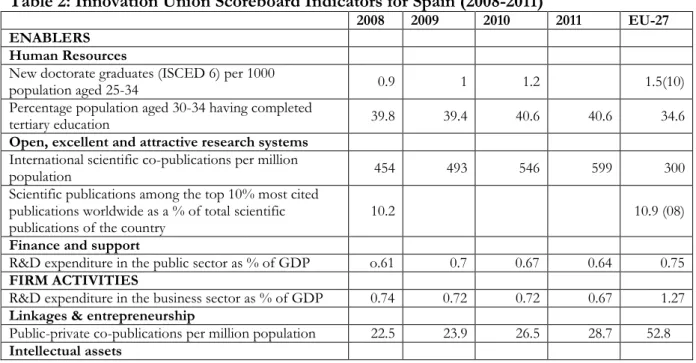
education, international scientific co-publications and medium and high tech exports, while its weaknesses are in private investments, public-private linkages, innovation outputs and knowledge-intensive activities. To illustrate its strengths: with increasing levels between 2008 and 2011 (data from the Innovation Union Scoreboard IUSB dashboard), and above the EU-27 average (shown in brackets), Spain is outstanding firstly in its percentage of population aged 30-34 who have completed tertiary education, which changed from 39.8% to 40.6% (30-34.6%); secondly, in the level of international co-publications per million, which changed from 454 to 599 (300)5; and thirdly in the contribution of medium and high-tech product exports of trade
balance total, which changed from 101.97 to 103.05 (101.28). In contrast, the weak figures show that at levels below the EU-27 average, Spain underperformed in the percentage of GDP of private R&D expenditures, by 0.67% in 2011 against the UE-27 level (1.27%); in the number of public-private co-publications per million population, 22.5 against 52.8; in patent applications per billion GDP (in PPS€), 1.43 against 3.9; in patent applications in societal challenges per billion GDP (in PPS€), 0.39 against 0.96; in the percentage of GDP coming from licence and patent revenues from abroad, 0.06% against 0.51%; and in the percentage of knowledge-intensive services exports of total service exports, 21.6% against 45.1%.
The number of people employed in R&D activities in 2012 was 208,831 (FTE). After increasing more than 65% from 2002 to 2010, this number decreased in 2011 by -3.1 and in 2012 by -2.9, coming back to total figures lower than the ones of 2008. Based on the FTE data for 2012, 42.8% are working in the private sector, 37% in Higher Education Institutions (HEIs), 20% in Public Research Organisations (PROs) and 0.2% in Private Non for Profit Sector. Taking into account the research performance, universities showed the highest research performance level in the total number of international articles published in 2003-2011 (ICONO-Scimago, 2013). In 2011, Universities published around 70.2% of total publications, followed by the health sector (26.1%), Public Research Bodies (OPIs) (22.9%), others (2.5%) and firms (1.6%). However, taking into account the quality of publications (“normalised impact”) OPIs showed the highest impact with 1.6, followed by the health sector (1.4), Universities (1.3) and firms (1.3).
The main responsibilities for research and innovation policy design and operational management are concentrated in the Ministry of Economics and Competitiveness (MINECO) – before December 2011 the Ministry of Science and Innovation (MICINN) – which distributed (in 2013) 76.7% of the Spanish State Budget6 on R&D and innovation, increasing considerable its share
(68.9% in 2012) (ICONO-Ministerio de Hacienda, 2013). The Ministry of Industry, Energy and Tourism (MINETUR) – accounted for 18.6% of the budget. Other R&D players are the Ministry of Defence (2.4%) and the Ministry of Education, Culture and Sports – with 1.6% of the total R&D-related funds of the Spanish State Budget (ICONO, 2013).
The MINECO, assisted by the State Secretary for Research, Development and Innovation (SSRDI), is responsible for drafting and managing the main R&D and innovation instruments: the multiannual “strategies” and “plans”. The Spanish Strategy for Science, Technology and Innovation (EESTI) (2013-2020) is the strategy that sets the rationale, objectives and indicators of the Spanish R&D and innovation policy. The Spanish State Plan for Scientific and Technical
4 Together with the Czech Republic, Greece, Hungary, Italy, Lithuania, Malta, Portugal and Slovakia (EC, 2013). 5 The important increase in production of publications in Spain is ratified with other sources (Scopus). For the
period of 2000-2011, Spain has increased its share of world production of publication from 2.3% to 3% and its share of the European production from 7.5% to 11.1% in the same period (COTEC, 2013: 33).
6 In contrast to the case of the GBAORD data this budget includes not only subsidies and direct or indirect R&D
8
Research and Innovation (PECTI) (2013-2016) is a multiannual plan that implements the EESTI by setting its priorities, programmes, coordination mechanisms, costs and sources of funding. The new EESTI and PECTI were approved on 1st February 2013. The proposals have merged
the two strategies and plans originally envisaged by the new Law of Science, Technology and Innovation (LCTI 2011). The PECTI replaced the National Plan for R&D and Innovation (2008-2011), extended to the end of 2012. Details on these important policy framework changes are provided in chapter 2. The MINECO is supported by the Executive Committee for Science, Technology and Innovation policy (CDCTI) and two main advisory bodies, which are the Council of Science, Technology and Innovation (CPCTI) (in charge of the coordination with regional governments and other actors of the R&D system) and the Advisory Council of Science, technology and Innovation (CACTI) (which gathers representatives of the research community, enterprises and trade-unions). The main funding bodies involved in the implementation of R&D and innovation policies are: The Spanish Research Agency (to be created), which aims to be an autonomous entity that will assign R&D funds on scientific merit grounds and the Centre for Industrial Technological Development (CDTI), which is a public corporate entity engaged mainly in the promotion of innovation and technological development for companies. Other institutions, such as the Carlos III Health Institute (ISCIII) also fund research. The Information System of Science, Technology and Innovation (SICTI) is responsible for the data collection and analysis for the monitoring of all policy programmes and instruments of the R&D and innovation policy (see Figure 1).
Spain has a quasi-federal decentralised political system with different degrees of competence devolution from the central government to the regions, depending on the policy area. As far as R&D and innovation-related policies are concerned, this allocation of competences were not clearly assigned to the different administrative levels which led most regions to develop similar R&D plans and to launch similar and often overlapping instruments, programmes and agencies at both regional and national administrative levels7 (Erawatch Country Report 2010 and 2011).
Some recent developments might improve the coordination of national and regional R&D and innovation policies. For example, the new Law of Science, Technology and Innovation (LCTI 2011) is aimed at improving national and regional coordination through the Council of Science, Technology and Innovation (CPCTI). Some specific policies are more often carried out on a regional level, such as cluster policies and SME-oriented measures. Moreover the regional governments are also in charge of the universities. Four regions accounted in 2012 for 69.7% of all R&D expenditures: Madrid (25.6%), Catalonia (22.3%), Andalusia (11.1%) and the Basque Country (10.7%). In relative terms, the leading regions are the Basque Country, Navarre, Madrid and Catalonia with a GERD by GDP of 2.2%; 1.9%, 1.8% and 1.5% respectively. The Basque Country is the only region that has increased its yearly R&D Intensity over the last three years (2%, 2.1% and 2.2%). All Regional authorities “Comunidades Autónomas” have registered to the Smart Specialisation Platform (S³P), which “assists Member States and regions to develop, implement and review Research and Innovation Strategies for Smart Specialisation (RIS³)” (RIS³: on-line). Currently, all the Spanish regions are developing their RIS3 strategies, which have to be finished by the end of 2013 (NRP, 2013) The newSpanish Strategy for Science, Technology and Innovation (EESTI) (2013-2020) includes the concept of “smart specialisation” in one of its 6 priority axe (Priority 5). This could help to overcome some fragmentation by prioritising research areas, based on the needs and resources of the regions.
7 Such as the case of scholarships for PhD students; R&D project support for firms, PRO or HEI; National and
regional “accreditation” agencies – grant researchers with a declaration that allows them to access to a certain job positions. Moreover, several regional R&D policy plans are similar to the national “plan”. See Gómez (2007) and Díez-Bueso (2013) for more details on the R&D and innovation national and regional allocation of competences.
9
The implementation of the new policy framework is suffering from delays in important policy R&D programmes (e.g. call for proposals of the R&D plan on fundamental research projects “Promotion of R&D and Innovation towards societal challenges and Research Training (FPI)), significant reductions (e.g. Research Training – FPI and University Personnel Training (FPU) – with a reduction of 200 grants) and cancellations (e.g. the Jae programme, aiming to reinforce human resources). In addition, the Spanish National Research Council (CSIC) went under one of its largest budget crisis during Summer 2013. The largest scientific organisation, with about 15,000 employees, and one of the most important research performers of the country, with about the 20 per cent of the national scientific production, has suffered large budget cuts from the government, with approximately 500 million Euros of total reduction (see section 2.3).
10 Figure 1: The structure of the Spanish research and innovation system
SOURCE: Own elaboration. Key: in orange: State oriented institutions and instruments. In blue: regional oriented institutions and mechanisms. In green: research performers
CACTI Advisory Council of Science, technology and Innovation CDTI Centre for Industrial Technological Development
CDCTI Executive Committee for Science, Technology and Innovation policy CPCTI Council of Science, Technology and Innovation
DGICT Directorate-General of Scientific and Technological Research DGIC Directorate-General of Innovation and Competitiveness EESTI Spanish Strategy for Science and Technology and Innovation. ISCIII Carlos III Health Institute
MINECO Ministry of Economy and Competitiveness ) MINETUR Ministry of Industry, Energy and Tourism MEDU Ministry of Education, Culture and Sports
MDE Ministry of Defence
SGCTI General Secretariat of Science, Technology and Innovation SICTI Information System of Science, Technology and Innovation SSRDI State Secretary of Research Development and Innovation
PECTI Spanish State Plan of Scientific and Technical Research and Innovation (2013-2016)
(*) The PECTI merges the envisaged Spanish National Plan for Scientific and Technical Research (PECT) and the Spanish National Plan for Innovation (PEI) .
The EESTI merges the planned Spanish Strategy for Science and Technology (EEST) and the Spanish Strategy for Innovation (EEI)
(**) Not yet implemented.
(***) The Spanish Foundation for Science and Technology (FECYT) facilitates the integration and following of the Spanish R&D and innovation system.
11
2
RECENT DEVELOPMENTS OF THE
RESEARCH AND INNOVATION POLICY
AND SYSTEM
2.1
National economic and political
The crisis in Spain has particularly affected the unemployment rate, which is the highest in Europe since 2010 (25.0% in 2012).8 Spanish GDP decreased by -0.3% in 2010 and increased
slightly by 0.4% in 2011 while in the Eurozone these percentages were respectively 2.1 and 1.5%. The debt crisis obliged Spain to apply severe cuts to its public budget, which have specially affected the budgets for R&D and Innovation. GBAORD decreased by -12.2% in 2011. In 2012, GDP again decreased importantly (by -1.7%) while in the Eurozone this percentage was -0.4%. The budget for public expenditures by the central government on R&D and innovation (PGE) decreased in 2012 by -25.6% and in 2013 by -7.2%. In addition, the period 2009-2012, between 21% and 45% of the yearly public government budgets were not executed (Fecyt, 2013: 31)9 (see
section 2.2). During 2012 and 2013, several national and regional calls have been delayed (e.g. Ramón y Cajal, Promotion of R&D and innovation towards societal challenges) or cancel (e.g. JAE-doc). Due to larger budget cuts from the government suffered since 2010, the Spanish National Research Council (CSIC) went under a major budget crisis during the summer of 2013. Concerns about the sustainability of the Spanish R&D system raised by research-related organisation and institutional and grassroots action in support of science in 2012 remained during 2013 (see section 2.3).
Regulatory changes to comply with public deficit targets also affected the R&D and innovation system. For example, in order to be able to create the new Spanish Research Agency envisaged by the new Law LCTI it was necessary to include an amendment to the draft of the General State Budget of 2012 as this forbade the creation of any public agency. The Agency is still to be created. In the same way, some regulatory measures to correct the public deficit (e.g. Royal Decree-Law 20/2011) have limited staff recruitment and the filling of positions left vacant by retirees.
The Spanish Strategy for Science, Technology and Innovation (EESTI) (2013-2020) and the Spanish State Plan for Scientific and Technical Research and Innovation (PECTI) (2013-2016) were approved in on 1st February 2013. These documents set and implement the rationale and
objectives of the Spanish R&D and innovation system. They have introduced important changes in the system (see section 2.4). In addition, the basic principles of the Spanish Research System and R&D policy framework have suffered also important changes in previous years due to the approval of new Law of Science, Technology and Innovation (LCTI 2011) (1st June 2011) and the arrival of a new government (21st December 2011) (see Annex and Country Report for Spain 2012 (ERAWATCH, 2013) for more details). In addition, the Entrepreneurship and Internationalisation Support Act (Law 14/2013) was published on the 27th September 2013 and
8 Data come from Eurostat. Data for 2013 (INE), confirms this increasing trend with higher levels of
unemployment (26.6%, second trimester).
9 Provisional data for 2013 (November) facilitated by the FECYT with data of IGAE shows percentages of
12
includes measures to promote entrepreneurship and facilitate finance to the creation of new business.
2.2
Funding trends
2.2.1
Funding flows
As mentioned, the national R&D investment target for 2020 has been downgraded to 2% GERD per GDP for 2020 from a 3% target. This new target has been set by the new strategy EESTI (2013-2020) and ratified by the National Reform Programme 2013 (NRP, 2013). It has to be noted that this R&D intensity target for 2020 is lower to the current European average (EU-28, 2.06) and falls short to the 3% target fixed for the EU as a whole in the Europe 2020 strategy. Spain translated this EU-level target into a 3% national target in the National Reform Programme 2011 and ratified it in the National Reform Programme 2012. The previous national strategy for innovation (Ingenio 2010) established as goals to commit with the Lisbon Strategy a 2% R&D investment by GDP for 2010 and to increase the R&D contribution of the private sector up to 55% and to reach the EU-15 average in the percentage of GDP allocated to ICT. 10
The new strategy and Plan (EESTI and PECTI) recognised the importance of increasing the role of private investments in R&D they include a target of 0.73% BERD/GDP for 2016 and the strategy a 1.2% for 2020.
Progresses towards reaching this target are negative due to the decreasing investments in R&D. After a period of increasing economic growth, which ended in 2008, Spanish GDP has been showing negative or close to cero values. GDP decreased significantly (by -3.8%) in 2009 and stabilises during 2010 and 2011with values around 0% (see Table 1). In 2012, GDP again decreased importantly (by -1.7%) while in the Eurozone this percentage was -0.4%. With regard to the input side of the innovation and science system, Spain made great efforts in the period 2002-2008 when its Gross Expenditure on R&D (GERD) in absolute terms doubled and increased well above the EU-average, while in relative terms the GERD by GDP increased from 0.99% in 2002 to 1.35% in 2008, reaching in 2009 a 1.39%. However, the financial crisis stopped this positive trend. In 2010 the R&D intensity (GERD as a percentage of GDP) practically stagnated (1.4%) and decreased to 1.36% in 2011. In 2012, R&D intensity decreased to 1.3%, reaching a figure similar to the one in 2007 (1.27%). The Government Budget Appropriations or Outlays on R&D (GBAORD) in Spain and its regions has been decreasing importantly over the last four years, by -4.5% in 2010 and by -12.7% in 2011 and by 13.1%, reaching a budget of €6,300m. R&D funded by Business Enterprise Sector as a percentage of GDP is stagnated in 0.6%, far from the EU average of 1.12%. Regarding the distribution of GERD by sectors of performance, the business enterprise sector increased its share from 51.9% in 2009 to 53.0% in 2012. This increase went mainly against the decline in shares of Government Sector. These figures on R&D expenditures indicate that it will be very difficult for Spain to reach the targets either of 3% GERD per GDP set by the Europe 2020 strategy or of 2% set by the new Spanish Strategy EESTI (2013-2020).
13 Table 1. Basic indicators for R&D investments
2009 2010 2011 2012 EU28 (2012)
GDP growth rate -3.8 -0.2 0.1 -1.6 -0.4
GERD (% of GDP) 1.39 1.4 1.36 1.3 2.06 (e)
GERD (euro per capita) 315.4 313.8 303.9 286 525.8 (e)
GBAORD - Total R&D appropriations (€ million) 8,700 8,308 7,252 6,300 86,309
R&D funded by Business Enterprise Sector (% of GDP) 0.60 0.60 0.60 : 1.12 (e)
R&D performed by HEIs (% of GERD) 27.8 28.3 28.2 27.7 24
R&D performed by Government Sector (% of GERD) 20.1 20.1 19.5 19.1 12
R&D performed by Business Enterprise Sector (% of GERD) 51.9 51.5 52.1 53.0 63
Share of competitive vs. institutional public funding for R&D : : : : :
Venture Capital as % of GDP) 0.013 0.01 0.012 0.009 :
Employment in high- and medium-high-technology
manufacturing sectors as share of total employment 3.7 3.87 3.8 : 5.6 (*) Employment in knowledge-intensive service sectors as share
of total employment) 30.3 31.4 32.1 : 38.9
Turnover from Innovation as % of total turnover 17,02 17,74 16,93 12,37 :
Data Source: EUROSTAT, December 2013. Last three indicator ICONO-Eurostat
e - EUROSTAT estimate (:) Non-available (*) EU-27
After 2012, only data on the central government’s budget for public expenditures (PGE) to R&D and innovation is available.11 This state level budget increased from €4,000m in 2003 to
€9,673m in 2009. After 2009, the budget began decreasing, by -4.1% in 2010, -7.4% in 2011 and by -25.6 in 2012. For 2013 another -7.2% reduction was applied, leading to a budget of €5,932m. The PGE for 2013 returned the public R&D investments to the levels of 2005-06 (Molero and de No, 2013a). The foreseen budget for 2014 envisages an increase of €213,9m (3,61%), a quantity that is much lower than the one reduced last year (€461m) (Molero and de No, 2013b). The state budgets include not only direct expenditures and subsidies on R&D but also loans. In fact, in the last few years the share of loans has been increasing, in contrast to that of subsidies, which implies, de facto, an even greater decrease. Considering the growth of the Spanish R&D system, the total funds per R&D personnel (FTE) have changed from €31.9k in 2002 to €41.1k per head in 2009. For 2013, this figure will represent €22.6k per head (€16.2k non-financial) (Molero and de No, 2012c, Molero and de No, 2013a). This is a clear step backwards for the Spanish R&D system. In addition, the non-execution of an important part of the budgets has worsened the situation. In the period of 2009-2012, between 21% and 45% of the yearly budgets were not executed (Fecyt, 2013). Since 2008, the total budget not executed is equivalent to €8,661m, which is higher than the total budget for 2011 (Molero and de No, 2012a). COSCE, in
14
its analysis of the PGE on R&D for 2013 (Molero and de No, 2012c and 2013a), warns that the envisaged 80% of the total reduction lies in non-financial funds, and this will have a devastating impact on public research and, especially, in basic research (see section 2.3 for the reaction of some research organisations on R&D funding cuts). Therefore, it can be considered that the impact of the crisis in R&D and innovation investment has been severe, and might have been exacerbated by government’s reductions in public investments for R&D and innovation.
2.2.2
Funding mechanisms
2.2.2.1
Competitive vs. institutional public funding
Competitive project-based funding has gained importance within the Spanish R&D and innovation system.12 On this regard the law of 2011 simplifies the allocation of competitive
funding for research and innovation by giving the responsibility for the allocation of funds to two main bodies, the new research agency (to be created) and the existing Center for Industrial Technological Development.13 The provisional budget for R&D and Innovation distributed by
the State Secretary of Research Development and Innovation for 2013 was €3,864.2m, of which 72.3% was distributed through low interest credits and 27.7% was subsidies (MINECO, 2013).14
The new plan PECTI (2013-2016) clearly states that most of the funds will be distributed through competitive funding mechanisms.
The distribution of block funding is different between PROs and universities. This funding is more important for the public research organisations than for the universities. In the case of universities, funding for teaching and operational costs is the responsibility of the regions, which offer institutional funding to universities based mainly on the number of students and teachers and other related criteria. It is supposed that university academic personnel devote 66% of their time to teaching and 33% to research activities. So two-thirds of their salaries can be considered as institutional R&D funding. In fact this part of their salaries is considered as R&D expenditure in the official statistics. The state and regions provide little or no institutional funding for research (block grants) so the rest of their research funds come mainly from regional, national and international programmes based on competitive project funding. This project funding is generally distributed through public tendering oriented to broad thematic fields. The finance of R&D activities of OPIs is mainly channelled through the state budget (PGE)) through MINECO, although other ministries also distributed R&D funds for PROs. Institutional funding in 2013 for PROs was €1,234.7m (-7.73% lower than 2012), which is 19.6% of GBAORD (Molero and de No, 2013a; Molero et al., 2011). A substantial part of their funds (based on data for 2007) goes to salaries (40%), operational costs (10%) and investments (17%) while the
12 In 1989 this form of support accounted for 30% of the R&D-related state budget, while at the beginning of this
century this percentage was around 23% of all funds (Sanz, 2005).
13 Several policy measures have tried to increase the competitiveness of the R&D system. For example, the Severo
Ochoa Centres of excellence that promote excellence in scientific research through performance-based funding for research institutions.
14 This budget is only part of the Central Government share (PGE- budget line 46) (€5,932m). This provisional
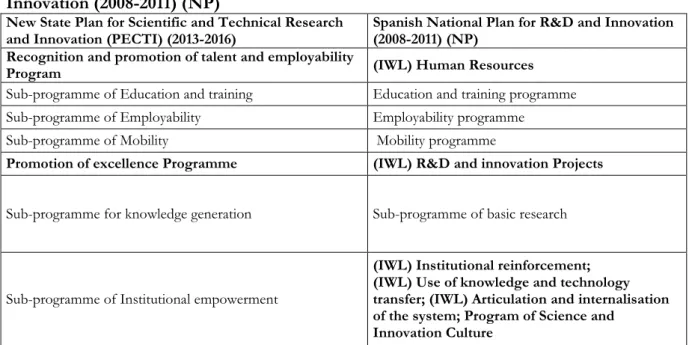
budget data has to be taken with caution as it has been taken from the working plan of the new plan PECTI (2013-2016) and percentages are own calculation. This makes these figures non-comparable with last publically available data on the national plan expenditures on R&D for 2011 (FECYT, 2012). Thus, references to figures of the previous plan will be included in footnote for illustrating purposes. The budget for R&D and innovation distributed by the National State Administration (AGE) for 2011 was €3,323.7m, of which 63.4% was distributed through low interest credits and 36.6% was subsidies (FECYT, 2012). See Table ii in the Annex for the equivalences of programmes between previous and current plan.
15
“operational transfers” - mainly used for research - counts for less than 7% of the received block funding (León et al., 2006).15
To finance their research activities the OPIs obtain funds from the regional, national and European public tenders for R&D (competitive project funding, participation in large European R&D facilities, etc.) and industrial contract research.
2.2.2.2
Government direct vs indirect R&D funding
Spain boasts a broad set of policy instruments, mostly based on low interest credits (government direct funding), to stimulate greater R&D and innovation. In addition, the Spanish system of tax incentives16 (indirect government funding) for R&D and innovation has been one of the most
generous among OECD countries for the past few years. However, despite the fact that tax incentives are very generous, the bureaucratic procedure for benefitting from these deductions was until recently complex and uncertain. This diminished the incentive effects of the support programme. The Ministry of Treasury has indicated that the average annual cost of tax income forgone by the state was €200-300m in 2002-03 and over €300-400m in 2004-08, decreasing to around €200m in the last few years (PGE, 2013). This represents around 3-5% of private R&D expenditure in this period, while support in the form of subventions since 2007 has been around 16-18 % (see country Fiche).
Public procurement (government direct funding) of innovative good and services has been increasingly encouraged in Spain (see section 4.2). The Plan PECTI (2013-2016) includes public procurement of innovative goods and services within the Strategic Action of Economy and Digital Society, Programme of business leadership (AEESD 3). In addition, The Council of Ministries (8/07/2011) agreed on setting a 3% target of new investments of the general public administration to be devoted to innovative public procurement. Five tenders are listed in the CDTI web but it is not clear if the 3% objective has been met.17
The investments in risk capital including seed capital, start-up funds and funding for other stages of the business creation was in 2012 €1,470.2m and represents 0.009% of the Spanish GDP (see Table 1). This has decrease significantly since 2010 (€2,479.7m) by -20.4% in 2011 and by -25.5 in 2012 (ICONO-Eurostat, 2013). In Spain there were about 54 networks and groups of Business Angels in 2009 (OECD, STI Scoreboard 2011, from FECYT). Although Spain has recently designed a large number of support schemes to foster public-private cooperation in R&D and innovation (see section 4.2) and funding streams can be found to cover the entire
15 Based on data for 2007.
16 The current Spanish regulation includes three types of R&D tax incentives for firms (Ministry of Science and
Innovation, 2011: 12): (1) Tax deduction for R&D and Innovation activities (ex-ante and ex-post); (2) Income reduction for transferring intangible assets (“Patent Box”) and (3) Social security benefits for full-time R&D personnel. The Spanish system of tax incentives for R&D and Innovation has been one of the most generous among OECD countries for the past few years. The deductions are based on the Royal Decree - Law 4/2004 and are further developed in Law 35/2006; Law 4/2008; the Royal Decree - Law 3/2009 and the Law 2/2011). The tax reform approved in November 2006 brought important changes. First, it enabled up to a 40% reduction in social security taxes of R&D staff working for firm. Second, following a trend of reducing corporate taxes, R&D and Innovation corporate tax credits were also reduced. In 2009, the deduction procedure was simplified; cancelling the time limit of 2 years to deduce taxes for R&D investments. Moreover in 2011 the deduction for innovation was increased from 8% to 12%, but this increase has been cancelled for 2012 and 2013.
17 No specific information on public procurement is found in the provisional Budget published of the working plan
16
value creation chain from fundamental research through market innovation, they are not included in one single programme.
2.2.3
Thematic versus generic funding
The distribution of the Spanish GBAOD by thematic social economic objectives18 shows that in
2012 over 49.6% of the funds could be considered as generic while 50.4 % could be directly assigned to specific technological or scientific areas. Generic funds increased its weight in the last few years from 34.4 in 2007 to 49.6 in 2012. Regarding thematic R&D priorities, the most important ones are health, with participation of 8.9%, and Industrial production and technology (IPT - 8.9%), followed by Agriculture (6.1%) and Exploration and exploitation of space (5.6%). Comparing the distribution of the last two years, it can be mentioned that Spain has increase its participation in Industrial production and technology, but decrease importantly its participation in Health. Compared to the EU-average, Spain has a higher participation in Agriculture, Environment, Exploration and exploitation of space and Health, while lower mainly in Political and social systems, structures and processes and energy. In addition, the percentage of the defence-related GBOARD is lower than the EU average, representing in 2012 a 1.6% of GBAORD compared to the 4.8% of the EU-28 average.
According to provisional budget for R&D and Innovation distributed by the State Secretary of Research Development and Innovation for 2013, the State programme “Promotion of R&D and innovation towards societal challenges” will distribute €2183.3m (MINECO, 2013). This programme represents approximately 56.5% of the total budget (see section 4.3).
2.2.4
Innovation funding
One of the most important trends in the Spanish policy mix in the last few years has been the clear shift towards innovation policies and knowledge transfer from the research sector to the productive one - together with the increasing importance of competitive funding; the implementation o a more diversified set of instruments; the solution of societal challenges and public procurement. This change can be seen through the changes in the objectives of the strategies and plans, new initiatives, instruments and budget allocation. Spanish national authorities implemented specific strategies to promote innovation and knowledge challenges. For example, the Spanish Strategy for Innovation (e2i) set the goals for innovation policies at national level during the period 2010-2015. In addition, a specific strategy and plan for innovation was originally envisaged by the Law of Science, Technology and Innovation (LCTI 2011), but finally merged in the current strategy EESTI (2013-2020). The CDTI is the entity that usually manages the national programmes for the promotion of innovation and technological development for companies. In addition, regional authorities implement regional strategies for innovation. As mentioned, Spain implements a large set of instruments for funding R&D and Innovation for business organisations: Low interest credits; tax incentives (including: tax deductions for R&D and Innovation activities; income reduction for transferring intangible asset – Patent Box; and social security benefits for full-time R&D personnel); public procurement and
18 GBAORD is probably the most comprehensive approach to analyse the thematic priority setting of the Spanish
policies for R&D and innovation. See EW (2011) for different alternatives to analyse the thematic focus and its advantages and disadvantages.
17
risk capital (see section 2.2.2.2). It is usually difficult to disentangle the funds that go for R&D from the ones that go to innovation. In the provisional budget for R&D and Innovation distributed by the State Secretary of Research Development and Innovation for 2013, Public funds for innovation and knowledge Transference are mainly included in the “Business leadership programme” that includes three sub-programmes: (1) private R&D and innovation; (2) Enabling technologies; and (3) Collaborative R&D and innovation. In 2013, it is estimated that this programme will distribute €831.9m (approximately 21.5% of total funds), distributing €81.4m, €10.8m and €333.5m through the sub-programmes mentioned above (MINECO, 2013).19 Main indicators for innovation come from the Community Innovation Survey. Funding
for innovation represented in 2012 €13,410m (ICONO-INE, 2013).
2.3
Research and innovation system changes
The Spanish Strategy for Science, Technology and Innovation (EESTI) (2013-2020) sets the rationale, objectives and indicators of the Spanish R&D and innovation policy. The Spanish State Plan for Scientific and Technical Research and Innovation (PECTI) (2013-2016) is a multiannual plan that implements the EESTI by setting its priorities, programmes, coordination mechanisms, costs and sources of funding. The new EESTI and PECTI were approved on 1st
February 2013. The proposals have merged the two strategies and plans originally envisaged by the new Law of Science, Technology and Innovation (LCTI 2011). The changes in the strategies and plans indicates an increasing emphasis on innovation, public-private R&D collaboration, research excellence and other emerging topics, such as the promotion of R&D and innovation on societal challenges or the role of public procurement20 to promote R&D and innovation.
They have introduced the concept of Smart Specialisation. One of the most significant changes of the EESTI (2013-2020) is that it has set a new lower target of 2% GERD per GDP for 2020, instead of the 3% target (see section 2.4 for more details).
The LCTI brought about some important changes in the Spanish research and innovation system. The emphasis in improving national and regional coordination through the Council of Science, Technology and Innovation (CPCTI) and Information System of Science, Technology and Innovation SICTI and the creation of the new Spanish Research Agency (still pending) are probably the most important changes in the governance structure introduced by this law. Some bodies were re-organised (e.g. the CPCTI) or re-named. The new government(December 2011) closed down the Ministry of Science and Innovation (MICINN) and reallocated the main R&D and innovation responsibilities to the Ministry of Economy and Competitiveness (MINECO). Other Ministries with R&D responsibilities were reorganised or renamed (See Figure I for the structure of the system and Table i in the Annex for a summary of some of the main organisational changes and equivalences between the new and previous Spanish R&D and innovation system and Country Report for Spain 2012 (ERAWATCH, 2013) for more details).
19 See footnote 14.
20 The Law on Sustainable Economy (2011) introduced public procurement of innovative goods and services as a
policy instrument, especially in some specific fields such as environmental protection and digitalisation of public services, in collaboration with regional and local authorities (For details, see the Mini Country Report of Spain 2011; COTEC, 2011b). The new Law of Science, Technology and Innovation (2011) reinforced the objectives of these policy initiatives and instruments. INNODMANDA and INNOCOMPRA are instruments designed to implement these policy goals.
18
The Spanish National Research Council (CSIC) went under one of its largest budget crisis in years during summer 2013. Since 2010, the CSIC has suffered large budget cuts from the government, with approximately 500 million Euros of total reduction. The council needed 100 million Euros to make it to the end of the year. The government injected 25 million Euros during summer and 70 millions in October 2013. During this period, the CSIC absorbed the savings of its institutes to deal with the cash shortages, which caused important concerns among the directors of its institutes about the sustainability of the centres (see below mobilisations regarding the CSIC situation). The CSIC is the Spain’s largest scientific organisation with about 15,000 employees and one of the most important research performers of the country, with about the 20 per cent of the national scientific production. It appears that the crisis is having an significant impact reducing importantly its young and temporary contracts (see section 4.1) The institutional and grassroots public demonstrations in support of science that started in 2012 continued during 2013. The campaign for “A tick box in the tax declaration” (“Casilla en apoyo de la ciencia en la declaración de la Renta”), the “Open letter for Science in Spain”, followed by the communication “No future without R&D and Innovation” and the simultaneous support actions of 19th December 2012 were probably the most significant ones (see Country Report for
Spain 2012 (EW, 2013) for more details). In 2013, public mobilisations continued due to the delay in launching important R&D calls and the budget crises suffered by the CSIC. These actions denounced the severe public budget cuts on R&D and innovation as making R&D and innovation unsustainable and reducing the opportunities to improve the Spanish economy. On the 21st May 2013 the Group Open Letter for Science (“Colectivo carta abierta por la
ciencia”) launched an open call for signatures in support for the second letter for the science “Let’s save the Spanish R&D and innovation”. The group is composed by different research-related organisations – the Spanish Confederation of Scientific Societies (COSCE), the Spanish Conference of University Rectors (CRUE), the Platform for Dignifying Research (PDI), the Spanish Federation of Young Researchers (FJI) and the National Association of Ramón y Cajal Researchers (ANIRC) – and the trade unions Confederation of Worker’s Commissions (CCOO) and General Union for Workers (UGT). The letter denounced the worsening situation of the Spanish R&D and innovation system and proposed a list of nine demands to the government. This letter gathered more than 80,000 signatures through an on-line petition.
On the 14th June 2013 there was a new call for simultaneous public demonstrations in support of
research and innovation (“Convocatoria 14J”). The call managed to gather the biggest demonstration of scientist in Spain and was followed in different cities of Spain and in foreign countries and had and important media impact.
On the 30th July 2013 there was a new call for signatures in support of increasing funding for the
CSIC that suffered a major budget crisis. The call gathered about 280,000 signatures. With the same purpose, more than 100 institute directors signed a letter addressed to the State Secretary of Research Development and Innovation.
On the 27th of September 2013 coinciding with the “Researchers’ Night” and the debate on the Spanish Congress of the PGE there was another call for public demonstration in support of science.
As a result of the meetings of the groups with different political parties, on the 19th December
2013, all political parties with representatives in the Congress, with the exception of the Popular Party, currently in the government, signed an agreement in support of the R&D and Innovation. This agreement denounces the decreasing public investments in R&D and states the following four points to guarantee an stable policy support for R&D and Innovation: (1) to ensure a sustained levels funding on R&D similar to the Eurozone average; (2) to remove the regulatory measures that limit the recruitment of researchers in the public sector (Royal Decree-Law
19
20/2011) and to increase the levels R&D personnel per inhabitant; (3) to ensure the adequate implementation of the policy objectives and measures envisaged in the PECTI, by guarantying a predictable time-line; and (4) to create the Spanish Research Agency envisaged in the LCTI (2011).
During the last two years, some programmes suffered important delays (e.g. call for proposals of the R&D plan on fundamental research projects -“Promotion of R&D and Innovation towards societal challenges”- and Research Training (FPI)) or significant reductions (e.g. Research Training – FPI and FPU – with a reduction of 200 grants), or were cancelled entirely (e.g. the Jae programme). Also, many regions reduced their budgets for R&D and innovation and cancelled research training grants (e.g. Madrid, Castile and Leon and the Canary Islands).
2.4
Recent policy developments
The new Law of Science, Technology and Innovation (LCTI) (1st June 2011) introduced important changes in the Spanish R&D and innovation system. The main new policy developments which followed in 2013 were: the approval of the new Spanish Strategy for Science and Technology and Innovation (EESTI) (2013-2020) and the Spanish State Plan of Scientific and Technical Research and Innovation (PECTI) (2013-2016); and the publication of the Entrepreneurship and Internationalisation Support Act (Law 14/2013) on the 27th September
2013.
The new Law of Science, Technology and Innovation (LCTI) (1st June 2011) replaced the so-called Law of Science of 1986. The new law aims to improve coordination with regional and European authorities, to take into account the growth of the Spanish R&D and innovation system, to improve research careers and to help the transition to an economy based on knowledge and innovation. It also mentions gender issues and ethics. The emphasis on innovation, which was missing in the Law of 1986, the design of several mechanisms aimed at improving national and regional coordination (e.g. the Council of Science, Technology and Innovation (CPCTI) and the new information system (SICTI)), and the project of the Spanish Research Agency are the main relevant aspects of the new Law. It modifies the governance and human resources for R&D (e.g. new labour contracts and unified professional career to facilitate mobility between public research centres and universities) and improves the mechanisms for the transference of knowledge (e.g. by improving granting property rights to researchers and reducing the incompatibility for researchers employed at public institutions to work in private firms) (See Annex and Country Report for Spain 2012 (EW, 2013) for more details on the changes brought by the LCTI).
THE SPANISH STRATEGY FOR SCIENCE AND TECHNOLGY AND INNOVATION (EESTI)
The Spanish Strategy for Science and Technology and Innovation (EESTI) (2013-2020)
establishes the rationale, objectives and indicators of the Spanish R&D and innovation policy. The EESTI merges the two strategies envisaged by the LCTI –the Spanish Strategy for Science and Technology (EEST) and Spanish Strategy for Innovation (EEI) – and replaces to the previous National Science and Technology Strategy (ENCYT) and Spanish Strategy for Innovation (e2i).
The new strategy, EESTI, is based on: 5 basic principles; 4 general objectives disaggregated into 18 specific objectives; 6 Priority Axes; and 6 articulation mechanisms. It also sets out indicators
20
to measure the impact of the R&D and innovation policy.
Its 5 principles are: (1) Coordination of R&D and innovation policies; (2) Stable framework; (3) Quality and social impact; (4) Efficiency and accountability; (5) Gender issues (See section 4.1 for the general and specific objectives).
The EESTI is in line with the Europe 2020 strategy. It is also based on an analysis that identifies 14 challenges21 that are quite similar to the ones identified by the OECD report (2006).
THE SPANISH STATE PLAN FOR SCIENTIFIC AND TECHNICAL RESEARCH AND INNOVATION (PECTI) (2013-2016)
The Spanish State Plan for Scientific and Technical Research and Innovation (PECTI) (2013-2016) implements the EESTI by establishing its priorities, programmes, coordination mechanisms, costs and sources of funding. The PECTI merges the two strategies envisaged by the LCTI – the Spanish National Plan for Scientific and Technical Research (PECT) and the Spanish National Plan for Innovation (PEI) – and replaces the National Plan for R&D and Innovation 2008-2011, extended to the end of 2012, as well as Ingenio 2010.
The new PECTI gives special emphasis on its integration into the European Research Area and to the promotion of: “(a) excellent basic research; (b) technological, industrial and firm leadership; and (c) scientific and technical research and innovation capabilities on grand challenges” (PECTI: 5).
Following the EESTI format, it is structured into 4 programmes and 18 sub-programmes (see Box ii in the Annex).22 In addition, it includes 2 strategic actions – first Health and secondly
Digital economy and society. It establishes 6 modes of participation23 and 4 funding instruments
– subsidies, loans, venture capital and tax incentives. As in previous plans, it is operationalised through annual programmes. It envisages indicators to evaluate the management and the result of the programmes.
The PECTI is based on an analysis of the previous plan that identified 8 main problems.24
The new strategy and plan were approved on 1st February 2013, to follow on the previous
National Plan on R&D that finished in 2011 and was extended to the end of 2012. Two public consultation processes on the strategy and plan were carried out in October 2012 and December 2012 (see section 2.6).
21 (1) Low intensity of R&D effort; (2) Low private R&D investments; (3) Lack of instruments for financing private
R&D; (4) Lack of venture capital; (5) Regional disparity in R&D; (6) Fragmentation of R&D groups; (7) Lack of public-private collaboration; (8) Inefficient mechanisms for Knowledge transfer; (9) Low R&D activity in traditional sectors and SMEs; (10) Small size and number of enterprises doing R&D activities; (11) Inter-sectorial mobility barriers for scientists; (12) Small survival business rates; (13) Low internationalisation of R&D actors (specially firms); (14) Low rate of firms in medium high sectors.
22 The programmes and sub-programmes are similar to the general and specific objectives of the EESTI.
23 (1) R&D and innovation programmes; (2) Human Resources actions; (3) Research infrastructures and equipment;
(4) complementary actions; (5) dynamic actions; and (6) collaborative actions.
24 (1) Administrative burden; (2) lack of coordination (inter-institutional; inter-departmental and inter-regional); (3)
excessive number of instrument; (4) fragmentation of funding; (5) unrealistic time framework; (6) lack of adequate indicator to follow evaluate the development and impact; (7) lack of dissemination of the results of funded projects; and (8) ministerial organisational changes that created problems in the development of programmes.
21
THE ENTREPRENEURSHIP AND INTERNATIONALISATION SUPPORT ACT - LAW 14/2013 OF THE 27TH SEPTEMBER 2013
The Entrepreneurship and Internationalisation Support Act (Law 14/2013) was published on the 27th September 2013, which includes measures:
Aimed at boosting entrepreneurship. These include: training; the implementation of a legal status of “Limited Liability Entrepreneur” (Emprendedor de Responsabilidad Limitada) and “Progressively Formed Limited Liability Company” (Sociedad Limitada de Formación Sucesiva); reducing to 24 hours the time for creating a limited liability company; the creation of Entrepreneur Service Points; and provision of a second chance for entrepreneurs through an extra-judicial payment mechanism.
Fiscal measures: changing the timing of VAT obligation to actual cash payments; introducing tax allowances for reinvestment of profits; R&D allowances; and tax incentives for investments in entrepreneurs.
To boost finance for entrepreneurs: eliminating the charges to create incentives for issuing securities on Alternative Fixed-Income Market; making more flexible the regulation for refinancing agreements; and booting new instruments for financing projects for internationalisation.
To promote business growth: extending the list of activities not subject to municipal licenses and reducing obstacles for entrepreneurs to access to public contracts.
To boost the internationalisation of the Spanish economy: planning a new system of visas and residence permits to attract talent and investment from abroad; and envisaging a Spanish strategy for internationalisation.
2.5
National Reform Programme 2013
The National Reform Programme 2013 (NRP) follows the agenda of reforms stated in the
previous NRP with a greater emphasis on the elements aimed to tackle the biggest restriction of growth. Therefore, it aims to sort out the difficulties for companies to access to finance; to create a favourable environment for entrepreneurs and to tackle the social consequences of the economic crisis. It includes eig