Conjugative Selectivity of Plasmids Is Affected by Coexisting
Recipient Candidates
Ayako Sakuda,aChiho Suzuki-Minakuchi,a,bKazunori Okada,a Hideaki Nojiria,b
aBiotechnology Research Center, The University of Tokyo, Tokyo, Japan
bCollaborative Research Institute for Innovative Microbiology, The University of Tokyo, Tokyo, Japan
ABSTRACT Understanding the mechanisms underlying plasmid behavior under conditions of various environments is important to predict the fate of plasmids in nature. Most previous studies on plasmid transfer employed two strains: one as a donor and the other as a recipient. However, in natural environments, there are usu-ally different recipient cells available to which plasmid can be transferred. In this study, to reveal the underlying mechanisms, we assessed the transferability of plas-mids from one donor strain to either of two recipient candidates as the most simpli-fied model. We used Pseudomonas putida KT2440 and Pseudomonas resinovorans
CA10dm4 as model hosts and pCAR1 (IncP-7), NAH7 (IncP-9), pB10 (IncP-1), and R388 (IncW) as model plasmids. As expected, in most cases these plasmids were generally transferred more frequently to a recipient of the same species than to a recipient of a different one under conditions of liquid and filter mating, although NAH7 was transferred from P. resinovorans more frequently to P. putida than to P. resinovorans during filter mating. With the exception of pCAR1, which was less af-fected, the coexistence of other recipients enhanced the preferences of conjugative transfer to the same species. In particular, preferences corresponding to transfer fromP. putidato a different recipient (P. resinovorans) were reduced by the presence of a coexisting same recipient (P. putida) during transfer of NAH7 in liquid and trans-fer of R388 in filter mating. We determined that large cell aggregates and sub-stances secreted into culture supernatant were not responsible for this phenome-non. Overall, the results of this study suggest the existence of unknown factors determining optimal plasmid transfer to native recipients.
IMPORTANCE Most previous studies on plasmid conjugal transfer employed experi-mental setups with two strains: one as a donor and the other as a recipient. How-ever, the results obtained sometimes failed to agree with observations obtained un-der natural environmental conditions or in a model microcosm using natural soil and water samples. Therefore, we consider that there is a “gap” in our understand-ing of plasmid behavior in the context of bacterial consortia that exist under the ac-tual environmental conditions. In this study, we clearly showed that the conjugation selectivity of a plasmid can be affected by the recipient candidates existing around the donor strain by the use of a simplified experimental setup with one strain as the donor and two strains as recipients. These phenomena could not be explained by factors known to affect plasmid transfer as suggested by previous studies. Therefore, we suggest the presence of novel elements regulating plasmid transfer within con-sortia.
KEYWORDS Gram-negative bacteria,Pseudomonas, conjugation, plasmids
P
lasmids are mobile genetic elements that facilitate rapid adaptation to environ-mental changes and subsequent evolution of bacteria by conjugal transfer in natural environments (1). Many factors affect plasmid transfer. For instance, thetran-Received5 September 2018Accepted2
December 2018 Published19 December 2018
CitationSakuda A, Suzuki-Minakuchi C, Okada
K, Nojiri H. 2018. Conjugative selectivity of plasmids is affected by coexisting recipient candidates. mSphere 3:e00490-18.https://doi .org/10.1128/mSphere.00490-18.
EditorTimothy E. Mattes, University of Iowa
Copyright© 2018 Sakuda et al. This is an
open-access article distributed under the terms of theCreative Commons Attribution 4.0 International license.
Address correspondence to Hideaki Nojiri, [email protected].
We successfully showed that the conjugation selectivity of plasmids can be affected by the recipient candidates combination existing around the donor using a simplified experimental setup with one strain as the donor and two strains as recipients.
Applied and Environmental Science
crossm
on September 8, 2020 by guest
http://msphere.asm.org/
scription of transfer genes on plasmids is regulated by a host factor(s). There is a cross talk between the plasmid and the host chromosome during transcriptional regulation of transfer genes carried on the F plasmid (2, 3). Some recipient factors, such as the clustered regularly interspaced short palindromic repeat (CRISPR)-Cas system, are known to degrade foreign DNA. Richter et al. suggested that acquisition of a new spacer by the type I-F CRISPR-Cas system resulted in curing of the plasmid and that increasing the number of spacers reduced the conjugation efficiency (4). Surface exclusion and entry exclusion also inhibit the invasion of foreign DNA into recipient cells (5). Moreover, the outer membrane protein OmpA and lipopolysaccharides (LPSs) of the recipient cell are required for efficient conjugation of the F plasmid (6, 7). It has been suggested that PilV adhesin, which is thought to be located at the tip of thin pili, determines recipient specificity during liquid mating of the antibiotic-resistant IncI1 plasmid R64 through recognition of LPSs on the surface of recipient cells (8). It is also known that the nitrogen-related phosphotransferase system (PTSNtr) inPseudomonas
putidais involved in inhibiting the conjugation efficiency of the naphthalene degra-dative IncP-9 plasmid NAH7 (9, 10) fromEscherichia coli(11). The combination of donor and recipient has been found to be responsible for the plasmid conjugation efficiency, with an enhanced tendency of more-frequent plasmid transfer to the same species (12). On the other hand, genome-wide screening in E. coli failed to identify the essential factor necessary for conjugation of the antibiotic resistance IncW plasmid R388 (13, 14) on the recipient chromosome (15). Still, the mechanism for recognition of the recipient cell and the factors that determine conjugation host range remain to be clarified.
Almost all of these factors were determined in studies performed under laboratory conditions. However, considering the differences between laboratory and natural environmental conditions, it is important to clarify the behaviors of plasmids and their hosts under natural conditions. Comparing plasmid behaviors among different hosts or under different conditions enables us to predict the fate of plasmids in natural environments. Many environmental factors such as temperature, nutrient availability, and high-salt stress can affect plasmid behavior (16, 17). It is also known that the peptide pheromone cCF10 facilitates cell aggregation and enhances the transfer fre-quency (TF) of the antibiotic resistance plasmid pCF10 inEnterococcus faecalis, which is a Gram-positive bacterium (18, 19). In the case of Gram-negative bacteria, it has been known that some compounds in the cell culture such as fatty acids can affect the transfer ability of IncF, IncW, and IncH plasmids (20). Similarly, quorum-sensing systems regulate the transfer of Ti plasmid inAgrobacterium tumefaciens(21). It has also been demonstrated that coresidential plasmids in the same host cell can affect each other’s conjugation efficiencies (22–24). Moreover, our studies using carbazole-degradative IncP-7 plasmid pCAR1 (25–27) as a model also suggested that some environmental factors can affect plasmid conjugation. We showed that the conjugation efficiency of pCAR1 is promoted by the divalent cations Ca2⫹ and Mg2⫹(28, 29). Furthermore,
differences in cell density and mating conditions (liquid mating or filter mating) affected the plasmid conjugation efficiency of pCAR1 (30). Furthermore, in an artificial microcosm study using 15 different bacterial strains, including seven Pseudomonas
strains, conjugative transfer of pCAR1 was detected only toPseudomonas resinovorans. In contrast, pCAR1 conjugation to otherPseudomonasstrains could be detected in filter mating experiments using one donor and one recipient strain (31, 32). These results indicated that the conjugation host range of the plasmid can be affected by the surrounding environment. To clarify the factor(s) responsible for these phenomena, we had to employ a simplified experimental setting.
Conjugation occurs among bacterial consortia under natural conditions. There are several types of candidate recipient cells around the donor cell when conjugation occurs. In most of the studies described above, the mating experiments were per-formed by combining one donor strain and one recipient strain (1:1 mating), which does not reflect the actual natural environmental conditions, in which there are several types of strains present around the donor strain at the same time. Therefore, in this study, we used two different species as possible candidate recipients and one donor
on September 8, 2020 by guest
http://msphere.asm.org/
strain (1:2 mating) as a most extensively simplified conjugation design under natural conditions. We employedP. putidaKT2440 (33) andP. resinovoransCA10dm4 (pCAR1-cured derivative strain of CA10) (34) as model hosts and used pCAR1, NAH7, antibiotic resistance IncP-1plasmid pB10 (35), and antibiotic resistance IncW plasmid R388 as model plasmids to perform liquid and filter mating assays. Using this 1:2 mating system, we evaluated the effect of a coexisting candidate recipient on transconjugant forma-tion by conjugaforma-tion. We evaluated the transconjugant formaforma-tion efficiency of each plasmid by TF (calculated by dividing the CFU per milliliter of transconjugant cells by the CFU per milliliter of donor cells).
RESULTS
Liquid mating experiments. In order to construct the experimental setup of mating assay, we first determined the optimal time for detection of the effect of a coexisting candidate recipient on transconjugant formation. Mating was performed for 1 h, 3 h, and 16 h. As shown in Fig. S1 in the supplemental material, the tendencies of plasmid transfer were similar after 3- and 16-h mating, although the TFs toP. resino-vorans were lower at 16 h than at 3 h. Higher growth rates of donor cells than of transconjugant cells during the mating procedure might be responsible for the ob-served lower TFs at 16 h than at 3 h. Therefore, we concluded that the longer mating time is not suitable for comparison of TFs. Since 1 h was too short a time to perform experiments in triplicate, we adopted 3 h as the optimal mating time for all mating experiments in this study. In addition, we also counted the cell number after the mating assays and confirmed that there was no effect of the viability or growth of each strain on the TF of plasmids during the 3-h mating assay procedure (see Table S1 in the supplemental material).
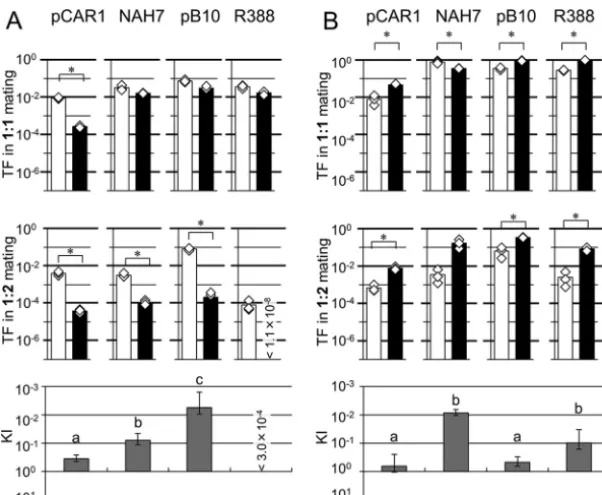
The TFs of the plasmids during liquid mating usingP. putidaas the donor are shown in Fig. 1A. The TFs of plasmids forP. putidawere higher than those forP. resinovorans
during 1:1 mating. In 1:2 mating, although the TFs detected were generally lower than those detected in 1:1 mating, higher TFs were detected inP. putidaas recipient than in
P. resinovoransas recipient. In particular, transfer of NAH7 fromP. putidatoP. resino-voranswas markedly reduced during 1:2 mating (Fig. 1A). To evaluate the recipient preference in 1:2 mating quantitatively, we defined the kin index (KI), which shows the effect of candidate recipients from the same species on TFs compared to the effect of candidate recipients from different species during 1:2 mating (Fig. 1 [see also Table S2]; for the statistical analyses, see Materials and Methods and Table S3). The KI was calculated according to the following equation, wherer1:2represents the ratios of TFs to different species/the ratios of TFs to the same species during 1:2 mating and r1:1 represents the ratios of TFs to different species/the ratios of TFs to the same species during 1:1 mating:
KI⫽r1:2⁄r1:1
As shown in Fig. 1 and Table S2, the ratios of the TFs to different recipients/the TFs to the same recipient for pCAR1 were similar during 1:1 and 1:2 liquid mating exper-iments using theP. putidastrain as the donor. On the basis of this result, it could be concluded that the coexistence ofP. putida(same species) as a candidate recipient in the same location had no or negligible effect on the TF of pCAR1 to P. resinovorans
(different species) during 1:2 mating. In contrast, there were larger differences between those ratios when the other plasmids were used, and the KIs were less than 1. The comparison of KIs among the four plasmids clearly showed that transfer of NAH7 to a different species recipient was reduced dramatically by the presence of same species recipient (KI⫽1.7E⫺03⫾2.3E⫺03) (Table S2).
Next, the TFs of the four plasmids using P. resinovoransas a donor during liquid mating were assessed (Fig. 1B). NAH7, pB10, and R388 were transferred more frequently toP. resinovoransthan toP. putidaduring 1:1 mating. Similar tendencies were observed in 1:2 mating, although there were no statistically significant differences between the TFs of pB10 and R388 toP. putidaand toP. resinovorans. The TFs of pCAR1 from donor
on September 8, 2020 by guest
http://msphere.asm.org/
P. resinovorans to each recipient were comparable during 1:1 mating, although the values were very low. In the case of 1:2 mating, the values were near the detection limit. As shown in Table S2, the KIs of pCAR1, NAH7, and pB10 were 4.0E⫺01⫾3.1E⫺01, 1.6E⫺01⫾1.0E⫺01, and 2.3E⫺01⫾1.5E⫺02, respectively, suggesting that the TFs of these three plasmids from P. resinovorans to P. putida were slightly affected by coexisting P. resinovorans during 1:2 mating, although there were no statistically significant differences between the data from the four plasmids (Fig. 1; see also Table S2 and Table S3).
Filter mating experiments.Plasmid behavior can change between liquid and filter mating (30). It is likely that cell motility on a solid surface is restricted compared with that in liquid. Therefore, we assessed the effects of a coexisting candidate recipient in the 1:2 mating assay on a solid surface using the same combinations of donor/recipient strains and plasmids. It is known that plasmids which make short rigid pili are transferred with higher frequency in filter mating than in liquid (36). Consistent with these findings, the TFs of NAH7, pB10, and R388, which make short rigid pili, on solid surfaces were higher than those seen in the liquid mating experiments (Fig. 2). The results obtained using P. putidaas a donor of the four plasmids are shown in Fig. 2A. The TFs of NAH7, pB10, and R388 toP. resinovoranswere slightly lower during 1:1 mating than the corresponding TFs toP. putida. However, the TFs of these three plasmids toP. resinovoranswere markedly lower than the TFs toP. putidaduring 1:2 mating and the KIs were⬍0.1, suggesting that transfer fromP. putidatoP. resinovorans
was highly affected by the presence of coexisting P. putida cells (Fig. 2; see also Table S2). Notably, transfer of R388 toP. resinovoranswas detected at a frequency of 1.7⫻10⫺2during 1:1 mating, but the TF of this plasmid toP. resinovoranswas reduced FIG 1 Transfer frequency (TF) of each plasmid in the 1:1 mating (upper panels) and 1:2 mating (lower panels) assays of liquid mating. Plasmid-harboring strains ofPseudomonas putida(A) orP. resinovorans (B) were used as donors. As the recipient strain(s),P. putida(orP. resinovorans) and both strains were used in 1:1 and 1:2 mating assays, respectively. Cell mixtures were incubated in microtubes containing LB for 3 h at 30°C to allow mating. Bars show the mean TFs (transconjugants/donor) calculated from triplicate assays (shown by white diamonds). White bars show TFs of plasmids toP. putida, and black bars show TFs of plasmids toP. resinovorans. All experiments were performed twice, and their reproducibility was confirmed. Asterisks indicate significant differences between two conditions as assessed by Student’st test (P⬍0.05) (n⫽3). Kin indices (KIs) were calculated according to the equation [ratio in 1:2 mating (r1:2)]/[ratio in 1:1 mating (r1:1)], wherer1:2andr1:1represent the ratios of TFs to different species/ratios
of TFs to the same species during 1:2 mating and the ratios of TFs to different species/ratios of TFs to the same species during 1:1 mating, respectively. Note that theyaxis data are inverted. Different letters above the bars indicate significant differences (P⬍0.05 [Kruskal-Wallis test],P⬍0.05 [Conover-Iman
test],n⫽3).
on September 8, 2020 by guest
http://msphere.asm.org/
to below the detection limit during 1:2 mating. On the other hand, pCAR1 was preferably transferred toP. putidain both the 1:1 and 1:2 mating experiments, and the KI was 3.5E⫺01⫾9.3E⫺02. These findings suggested that the effect of the presence of coexistingP. putidaon pCAR1 transfer was lower than that seen with the other three plasmids and that this tendency was similarly seen in the liquid mating experiments (Fig. 1A; see also Table S2).
Next,P. resinovoranswas used as the donor, and the results are shown in Fig. 2B. The TFs fromP. resinovoransseen under the filter mating conditions were generally higher than those obtained whenP. putidawas used as the donor (Fig. 2A). Although the TF of NAH7 toP. putidawas slightly higher than that toP. resinovoransduring 1:1 mating, the frequency of transfer of the plasmids toP. resinovoranswas generally higher than that toP. putidain both the 1:1 and 1:2 mating combinations. The KIs of pCAR1 and pB10 were 6.5E⫺01⫾4.0E⫺01 and 4.7E⫺01⫾1.7E⫺01, respectively, which are statis-tically significantly higher values than those seen with NAH7 and R388 (Fig. 2; see also Table S2 and Table S3). These results suggested that the effects of the presence of coexistingP. resinovoranson the conjugal transfer of pCAR1 and pB10 fromP. resino-voranstoP. putidawere lower than those seen with NAH7 and R388.
Effect of cell aggregation.Because cell aggregation may enhance plasmid transfer (37), we assessed whether aggregation of cells of the same species donor and recipient strains occurred. Cells were subjected to 1:2 liquid mating conditions and were ob-served by fluorescence microscopy. As shown in Fig. 3, whenP. putidawas used as the donor strain, the cells of two recipient candidates,P. putida(blue) andP. resinovorans
FIG 2 Transfer frequency (TF) of each plasmid in 1:1 mating (upper panels) and 1:2 mating (lower panels) assays of filter mating. Plasmid-harboring strains ofPseudomonas putida(A) orP. resinovorans(B) were used as donors. As recipient strain(s),P. putida(orP. resinovorans) and both strains were used in 1:1 and 1:2 mating assays, respectively. Cell mixtures were incubated for mating on a solid-agar LB plate surface for 3 h at 30°C. Bars show mean TFs (transconjugants/donor) calculated from triplicate assays (shown by open diamonds). White bars show the TF of the plasmid toP. putida, and black bars show the TF of the plasmid toP. resinovorans. All experiments were performed twice, and their reproducibility was con-firmed. Asterisks indicate significant differences between two conditions as assessed by Student’sttest (P⬍0.05) (n ⫽3). Kin indices (KIs) were calculated according to the equation [ratio in 1:2 mating (r1:2)]/ratio in 1:1 mating (r1:1)], wherer1:2andr1:1represent the ratios of TFs to different species/ratios of
TFs to the same species during 1:2 mating and the ratios of TFs to different species/ratios of TFs to the same species during 1:1 mating, respectively. Note that theyaxis data are inverted. Different letters above the bars indicate significant differences (P⬍0.05 [Kruskal-Wallis test],P⬍0.05 [Conover-Iman test],n⫽3).
on September 8, 2020 by guest
http://msphere.asm.org/
(green), showed a free-living state, and no large aggregation of cells was detected in the mating mixtures for each plasmid. Similar results were observed whenP. resino-voranswas used as the donor. These results were markedly different from those seen with the aggregated control sample. Although we cannot rule out the possible exis-tence of small aggregations of 2 to 3 cells in the mating mixture, these observations suggested that formation of large cell aggregates was not the cause of the effect of the presence of coexisting recipients on plasmid transfer.
Effect of culture supernatant. We evaluated whether the candidate recipient strain(s) secreted a substance(s) into the culture supernatant that affected plasmid transfer. In this study, we added the supernatant of aP. putidaculture or of the mating mixture of NAH7-harboring P. putida and P. putida to the cell mixture of NAH7-harboringP. putidaandP. resinovorans(as a 1:1 mating experiment). If the compound(s) secreted into the culture supernatant affected NAH7 conjugation toP. resinovorans, the TF of NAH7 to P. resinovorans would be decreased by adding the supernatants. However, the TF of NAH7 was not affected, as shown in Fig. 4. This result clearly showed that no compound affecting the conjugation of NAH7 toP. resinovoranswas secreted into the P. putidaculture supernatant or into that of the mating mixture of NAH7-harboringP. putidaandP. putida.
DISCUSSION
Our results suggest that plasmids were transferred generally more frequently to the same species recipient than to different species in 1:1 combinations under the liquid and filter mating conditions. The genome modification system of the host, such as methylation, a restriction enzyme system, and a CRISPR-Cas system, might affect plasmid behavior under 1:1 mating condition. The presence of the same species recipient candidate affected plasmid transfer to different species during 1:2 mating, and the ratio of TF to different species were lower in most combinations of donor/recipient strains and plasmids. This tendency was clearly shown by the fact that the KIs detected in almost all experiments were⬍1 (Fig. 1 and 2; see also Table S2 in the supplemental material), suggesting common mechanisms underlying the plasmid behavior in multi-FIG 3 Microscopy of the donor and recipient strains in 1:2 liquid mating culture. Plasmid-harboring strain P. putida SM1443 or strain P. resinovorans CA10L was used as the donor, while P. putida KT2440RGdr andP. resinovoransCA10dm4RGgfp were used as recipients.P. putidaKT2440RGdr was used as a positive control for aggregation, since that strain has been shown empirically to aggregate in medium containing succinate as the sole carbon source. Cells were stained with 50g/ml 4’,6’-diamidino-2-phenylindole (DAPI; blue), where P. resinovoransCA10dm4RGgfp cells exhibited green fluorescence. An aliquot (2l) of each mating culture was observed with fluorescence microscopy (BX53; Olympus). The resulting images were analyzed using DP2-BSW software (Olympus). Scale bar, 20m.
on September 8, 2020 by guest
http://msphere.asm.org/
ple recipients. Notably, we used only twoPseudomonasstrains as hosts in this study. Therefore, it will be necessary to confirm this phenomenon in other host strains and with other host/plasmid combinations.
It is noteworthy that the KIs of NAH7 transfer fromP. putidaduring liquid mating (Fig. 1A) and of transfer of R388 fromP. putidaduring filter mating (Fig. 2A) were much lower than were seen with the other strains, suggesting that the presence of the same species strain severely interfered with conjugation to a different species strain in these combinations. The data may also suggest that there are unknown factors that enhance the effect of the presence of the same species strain for specific plasmids under specific conditions. In contrast, the KIs of pCAR1 were higher than those of the other plasmids for most combinations of donor/recipient strains (Fig. 1 and 2; see also Table S2), although there were no statistically significant differences between KIs for each plasmid using P. resinovorans as the donor in liquid mating. In particular, the KI of pCAR1 conjugation from P. putidaunder liquid mating conditions was ⬎1 (Fig. 1; see also Table S2), suggesting that the transfer machinery encoded on pCAR1 or the stability of donor-recipient mating pair formation (MPF) can reduce the effect of the presence of other coexisting strains. Whether or not other IncP-7 plasmids would also have similar characteristics in 1:2 mating experiments should be confirmed.
We explored the relaxase encoded on the plasmids used in this study (mobility [MOB] classification [38]), where NAH7 and R388 were classified as MOBF, pB10 was classified as MOBP, and pCAR1 was classified as MOBH. Both MOBFand MOBPhave the “3H” motif, and their structures are similar, but MOBHhas the “HD hydrolase” motif (38). These differences might affect plasmid behavior, including the smaller effect of coex-isting strains on the pCAR1 transfer (Fig. 1 and 2; see also Table S2). Furthermore, the pilus types of plasmids have been classified on the basis of the proteins used to form mating pairs; NAH7, pB10, and R388 encode MPFT, which forms short rigid pili as described above, whereas pCAR1 encodes MPFF, which forms long flexible pili (39). Because pili could initiate contact with the recipient cell during plasmid transfer, these differences in pili might also be the reason for the distinct forms of plasmid behavior in multiple recipients. To study the effects of MOB/MPF-type relaxase, we plan to use other plasmids belonging to the same or other MOB/MPF types to attempt to construct chimera plasmids for further analysis.
We have succeeded in revealing that there is a novel but unknown mechanism that determines the fate of conjugation by selecting recipient cells among the bacterial consortia. The phenomena observed in this study cannot be explained by factors reported in previous studies, which were found in a mating assay performed only with one strain as a donor and another strain as a recipient. We have not succeeded in understanding the molecular mechanisms or clarified whether the factor(s) involved in FIG 4 Transfer frequency (TF) of NAH7 during liquid mating with culture supernatant.Pseudomonas putidawas used as the donor, andP. resinovoranswas used as the recipient. An aliquot (400l) of the filtered culture supernatant ofP. resinovoransor ofP. putidaor of a 3-h mating culture of NAH7-harboring P. putidaandP. putidawas added to the mixture of collected donor and recipient cells. Bars show mean TFs (transconjugants/donor) calculated from triplicate assays (shown by open diamonds). All experiments were performed twice to confirm reproducibility.
on September 8, 2020 by guest
http://msphere.asm.org/
these phenomena is encoded on the plasmid or on the host or on both. However, further forthcoming analyses might close the gap between laboratory conditions and actual environmental conditions in the study of plasmid behavior.
MATERIALS AND METHODS
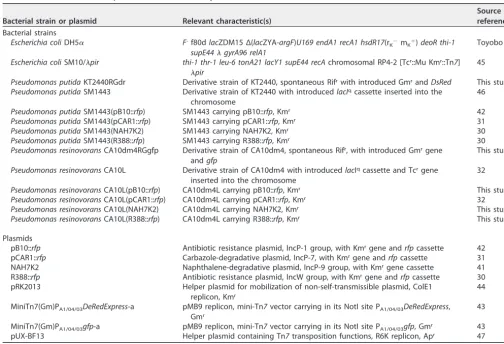
Bacterial strains, media, and culture conditions.The bacterial strains and plasmids used in this study are listed in Table 1.E. coliandPseudomonasstrains were grown overnight in lysogeny broth (LB) (40) containing the appropriate antibiotics for selection at 37°C and 30°C, respectively. Antibiotics were used at final concentrations of 50g ml⫺1for kanamycin (Km), 30g ml⫺1for gentamicin (Gm), 25g
ml⫺1for rifampin (Rif), 100g ml⫺1for ampicillin (Ap), and 12.5g ml⫺1for tetracycline (Tc). Solid media
were prepared by adding 1.6% (wt/vol) agar to liquid LB medium. Derivative plasmids of pCAR1, NAH7, pB10, and R388 (pCAR1::rfp[31], NAH7K2 [41], pB10::rfp[42], and R388::rfp[30], respectively) were used in this study to select transconjugants with respect to Km resistance.P. resinovoransstrains harboring NAH7K2, pB10::rfp, or R388::rfpwere constructed using a method similar to a previously described method (32). Each plasmid was transferred fromP. putidaSM1443 intoP. resinovoransCA10L, with Km resistance and Tc resistance as the selection markers. P. putida KT2440RGdr and P. resinovorans CA10dm4RGgfp were constructed according to the following method. The PA1/04/03-DsRedgene
cassette was inserted into the chromosome of theP. putidaKT2440 spontaneous Rifrstrain by filter
mating withE. coliK-12 [miniTn7(Gm)PA1/04/03DeRedExpress-a] (43),E. coliSM10/pir(pUX-BF13) (43),
andE. coliDH5␣(pRK2013) (44). Similarly, a PA1/04/03-gfpcassette was inserted into the chromosome
of the P. resinovorans CA10dm4 spontaneous Rifr strain by filter mating with E. coli K-12
[miniTn7(Gm)PA1/04/03gfp-a] (43),E. coliSM10/pir(pUX-BF13) (43), andE. coliDH5␣(pRK2013) (44).
Each cassette was transposed into the chromosomalattTn7site located downstream of theglmS gene.
Mating assay.For mating assays usingP. putidastrains as donors,P. putidaSM1443(pCAR1::rfp) (31), P. putidaSM1443(NAH7K2) (30),P. putidaSM1443(pB10::rfp) (38), andP. putidaSM1443(R388::rfp) (30) were used as donors of pCAR1::rfp, NAH7K2, pB10::rfp, and R388::rfp, respectively. For mating assays using P. resinovoransstrains as donors,P. resinovoransCA10L(pCAR1::rfp),P. resinovoransCA10L(NAH7K2),P. resinovoransCA10L(pB10::rfp), andP. resinovoransCA10L(R388::rfp) were used as donors of pCAR1::rfp, NAH7K2, pB10::rfp, and R388::rfp, respectively. Strains P. putida KT2440RGdr and P. resinovorans TABLE 1Bacterial strains and plasmids used in this study
Bacterial strain or plasmid Relevant characteristic(s)
Source or reference Bacterial strains
Escherichia coliDH5␣ F-f80dlacZDM15 Δ(lacZYA-argF)U169 endA1 recA1 hsdR17(r
K⫺mK⫹)deoR thi-1
supE44gyrA96 relA1
Toyobo
Escherichia coliSM10/pir thi-1 thr-1 leu-6 tonA21 lacY1 supE44 recAchromosomal RP4-2 [Tcr::Mu Kmr::Tn7] pir
45
Pseudomonas putidaKT2440RGdr Derivative strain of KT2440, spontaneous Rifrwith introduced GmrandDsRed This study
Pseudomonas putidaSM1443 Derivative strain of KT2440 with introducedlacIqcassette inserted into the chromosome
46
Pseudomonas putidaSM1443(pB10::rfp) SM1443 carrying pB10::rfp, Kmr 42
Pseudomonas putidaSM1443(pCAR1::rfp) SM1443 carrying pCAR1::rfp, Kmr 31
Pseudomonas putidaSM1443(NAH7K2) SM1443 carrying NAH7K2, Kmr 30
Pseudomonas putidaSM1443(R388::rfp) SM1443 carrying R388::rfp, Kmr 30
Pseudomonas resinovoransCA10dm4RGgfp Derivative strain of CA10dm4, spontaneous Rifr, with introduced Gmrgene andgfp
This study
Pseudomonas resinovoransCA10L Derivative strain of CA10dm4 with introducedlacIqcassette and Tcrgene inserted into the chromosome
32
Pseudomonas resinovoransCA10L(pB10::rfp) CA10dm4L carrying pB10::rfp, Kmr This study
Pseudomonas resinovoransCA10L(pCAR1::rfp) CA10dm4L carrying pCAR1::rfp, Kmr 32
Pseudomonas resinovoransCA10L(NAH7K2) CA10dm4L carrying NAH7K2, Kmr This study
Pseudomonas resinovoransCA10L(R388::rfp) CA10dm4L carrying R388::rfp, Kmr This study
Plasmids
pB10::rfp Antibiotic resistance plasmid, IncP-1 group, with Kmrgene andrfpcassette 42 pCAR1::rfp Carbazole-degradative plasmid, IncP-7, with Kmrgene andrfpcassette 31 NAH7K2 Naphthalene-degradative plasmid, IncP-9 group, with Kmrgene cassette 41 R388::rfp Antibiotic resistance plasmid, IncW group, with Kmrgene andrfpcassette 30 pRK2013 Helper plasmid for mobilization of non-self-transmissible plasmid, ColE1
replicon, Kmr
44
MiniTn7(Gm)PA1/04/03DeRedExpress-a pMB9 replicon, mini-Tn7vector carrying in its NotI site PA1/04/03DeRedExpress, Gmr
43
MiniTn7(Gm)PA1/04/03gfp-a pMB9 replicon, mini-Tn7vector carrying in its NotI site PA1/04/03gfp, Gmr 43 pUX-BF13 Helper plasmid containing Tn7transposition functions, R6K replicon, Apr 47
on September 8, 2020 by guest
http://msphere.asm.org/
CA10dm4RGgfp were used as recipients. Overnight cultures of donor and recipient cells were harvested and washed with fresh LB. The resulting cells were suspended in fresh LB to an optical density at 600 nm (OD600) of 2⫻10⫺1for the donor and 2⫻100for the recipient. Equal volumes (200l) of donor and
recipient cell suspensions were mixed for 1:1 mating. A 200-l aliquot of the donor cell suspension and 100l of each recipient cell suspension were mixed for 1:2 mating. Donor and recipient cells were mixed in 2-ml microtubes sealed with a gas-permeable adhesive seal (Thermo Fisher Scientific, Waltham, MA, USA) and incubated for 1, 3, or 16 h at 30°C for liquid mating. A mixture of donor and recipient cells was transferred onto a 0.22-m-pore-size membrane filter (Millipore, Billerica, MA, USA) using glass micro-analysis filter holders and filtering flasks (Millipore) for filter mating. Each filter was placed on an LB agar plate and incubated at 30°C for 1, 3, or 16 h. After incubation, 10 or 100l of a diluted mixture from each tube was spotted or spread on selected agar plates. The number of donor cells was calculated by determination of the number of CFUs grown on Km-added agar plates. While the transconjugants could also be grown on the Km-added agar plates, the numbers of transconjugants were completely different from the number of donors (usually more than 10 times lower than the number of donors), so we ignored them, in accordance with a previous study (30). The number of recipient cells was similarly calculated by determination of the number of CFUs grown on Rif- and Gm-added agar plates, while the transconju-gants could also be grown on this plate, and we ignored them also. The number of transconjugant cells was calculated by determination of the number of CFUs grown on Km-, Rif-, and Gm-added agar plate. The green fluorescent protein (GFP) was used in the 1:2 mating assay to distinguish the two recipient strains. The GFP fluorescence of colonies was detected by the use of a Dark Reader DR46B Transillumi-nator (Clare Chemical Research, Dolores, CO, USA). TheDsRedgene was inserted together with the Gm resistance gene, and we used Gm resistance only as a marker of recipients in this study. We did not use the DsRed florescence as a marker because of the slow expression and weak fluorescence of DsRed. We verified that the method used to distinguish the two strains using GFP was correct by colony hybrid-ization (see Text S1 and Fig. S2 in the supplemental material). The levels of donor, recipient, and transconjugant cells seen after the mating assays are shown in Table S1 in the supplemental material. TFs were calculated by dividing the CFU per milliliter of the transconjugant cells by the CFU per milliliter of the donor cells. All experiments were performed at least twice.
Statistical analyses. The data used to determine the effect of the different recipients on the conjugation frequency of the different plasmids were assessed using Student’s t tests (P⬍0.05). Differences in the KIs of each plasmid in liquid or filter mating assay were analyzed using the Kruskal-Wallis test (P⬍0.05). As a result, thePvalues corresponding to the results of comparisons of liquid mating usingP. putidaas the donor, liquid mating usingP. resinovoransas the donor, filter mating usingP. putidaas the donor, and filter mating usingP. resinovoransas the donor were calculated as 0.02451, 0.516, 0.01723, and 0.02488 from Table S2, respectively. Among these, multiple comparisons were performed for the data set withPvalues of⬍0.05 by the Conover-Iman test (i.e., liquid mating using P. putidaas the donor, filter mating usingP. putidaas the donor, and filter mating usingP. resinovorans as the donor). The results are shown in Table S3.
Cell aggregation.Plasmid-harboring strains ofP. putidaSM1443 orP. resinovoransCA10L were used as donors, while P. putida KT2440RGdr andP. resinovoransCA10dm4RGgfp were used as the two recipient strains. The 1:2 mating mixtures were prepared as described under “Mating assay” above and were incubated in 2-ml microcentrifuge tubes at 30°C for 3 h. After the incubation, each mating culture was stained with 50g ml⫺1DAPI (4’,6’-diamidino-2-phenylindole) for 15 min at 25°C and 2l of each
sample was observed with fluorescence microscopy (BX53; Olympus, Tokyo, Japan). The resulting images were analyzed using DP2-BSW software (Olympus). The recipient (P. putidaKT2440RGdr) was grown in the medium with succinate as the sole carbon source at 30°C for 4 h to act as a positive control for aggregation.
Mating assay with culture supernatant.Culture supernatants were prepared by centrifuging the cell cultures (15,000 rpm, 2 min, 25°C) and filtering the supernatants with 0.22-m-pore-size filters (Millipore). A 400-l aliquot of the filtered supernatants ofP. resinovoransCA10dm4RGgfp orP. putida KT2440RGdr or of 3-h mating cultures ofP. putidaSM1443(NAH7K2) andP. putidaKT2440RGdr was prepared. The mating mixtures ofP. putidaSM1443(NAH7K2) andP. resinovoransCA10dm4RGgfp were prepared as described under “Mating assay” above, and the cells were collected from the mating mixtures by centrifugation (15,000 rpm, 2 min, 25°C). After suspension of the cells in the culture supernatants, the mating mixtures were sealed in 2-ml microtubes with a gas-permeable adhesive seal (Thermo Fisher Scientific) and were incubated at 30°C for 3 h. TFs were calculated as described under “Mating assay” above.
SUPPLEMENTAL MATERIAL
Supplemental material for this article may be found at https://doi.org/10.1128/ mSphere.00490-18.
TEXT S1, DOCX file, 0.04 MB. FIG S1, TIF file, 0.7 MB. FIG S2, TIF file, 1.2 MB. TABLE S1, DOCX file, 0.03 MB. TABLE S2, DOCX file, 0.02 MB. TABLE S3, DOCX file, 0.02 MB.
on September 8, 2020 by guest
http://msphere.asm.org/
ACKNOWLEDGMENTS
We are grateful to Eva Top of the University of Idaho for providing pB10::rfp. We also thank Masataka Tsuda of Tohoku University for generously providing NAH7K2.
This work was financially supported by JSPS KAKENHI (grant 15K14686) (to H.N.), JST ERATO (grant JPMJER1502) (to C.S.-M.), and a Grant-in-Aid for JSPS Research Fellow (grant 18J12407) (to A.S.), Japan.
REFERENCES
1. Frost LS, Leplae R, Summers A, Toussaint A. 2005. Mobile genetic elements: the agents of open source evolution. Nat Rev Microbiol 3:722–732.https://doi.org/10.1038/nrmicro1235.
2. Frost LS, Koraimann G. 2010. Regulation of bacterial conjugation: bal-ancing opportunity with adversity. Future Microbiol 5:1057–1071.
https://doi.org/10.2217/fmb.10.70.
3. Wong JJ, Lu J, Glover JN. 2012. Relaxosome function and conjugation regulation in F-like plasmids—a structural biology perspective. Mol Micro-biol 85:602– 617.https://doi.org/10.1111/j.1365-2958.2012.08131.x. 4. Richter C, Dy RL, McKenzie RE, Watson BN, Taylor C, Chang JT, McNeil
MB, Staals RH, Fineran PC. 2014. Priming in the type I-F CRISPR-Cas system triggers strand-independent spacer acquisition, bi-directionally from the primed protospacer. Nucleic Acids Res 42:8516 – 8526.https:// doi.org/10.1093/nar/gku527.
5. Thomas CM, Nielsen KM. 2005. Mechanisms of, and barriers to, horizon-tal gene transfer between bacteria. Nat Rev Microbiol 3:711–721.https:// doi.org/10.1038/nrmicro1234.
6. Manoil C, Rosenbusch JP. 1982. Conjugation-deficient mutants of Esch-erichia coli distinguish classes of functions of the outer membrane OmpA protein. Mol Gen Genet 187:148 –156.
7. Anthony KG, Klimke WA, Manchak J, Frost LS. 1999. Comparison of proteins involved in pilus synthesis and mating pair stabilization from the related plasmids F and R100-1: insights into the mechanism of conjugation. J Bacteriol 181:5149 –5159.
8. Ishiwa A, Komano T. 2003. Thin pilus PilV adhesins of plasmid R64 recognize specific structures of the lipopolysaccharide molecules of recipient cells. J Bacteriol 185:5192–5199.https://doi.org/10.1128/JB.185 .17.5192-5199.2003.
9. Dunn NW, Gunsalus IC. 1973. Transmissible plasmid coding early en-zymes of naphthalene oxidation in Pseudomonas putida. J Bacteriol 114:974 –979.
10. Sota M, Yano H, Ono A, Miyazaki R, Ishii H, Genka H, Top EM, Tsuda M. 2006. Genomic and functional analysis of the IncP-9 naphthalene-catabolic plasmid NAH7 and its transposon Tn4655suggests catabolic gene spread by a tyrosine recombinase. J Bacteriol 188:4057– 4067.
https://doi.org/10.1128/JB.00185-06.
11. Inoue K, Miyazaki R, Ohtsubo Y, Nagata Y, Tsuda M. 2013. Inhibitory effect ofPseudomonas putidanitrogen-related phosphotransferase sys-tem on conjugative transfer of IncP-9 plasmid fromEscherichia coli. FEMS Microbiol Lett 345:102–109.https://doi.org/10.1111/1574-6968.12188. 12. Shintani M, Habe H, Tsuda M, Omori T, Yamane H, Nojiri H. 2005.
Recipient range of IncP-7 conjugative plasmid pCAR2 fromPseudomonas putidaHS01 is broader than from otherPseudomonasstrains. Biotechnol Lett 27:1847–1853.https://doi.org/10.1007/s10529-005-3892-1. 13. Datta N, Hedges RW. 1972. Trimethoprim resistance conferred by W
plasmids inEnterobacteriaceae. J Gen Microbiol 72:349 –355.https://doi .org/10.1099/00221287-72-2-349.
14. Fernández-López R, Garcillán-Barcia MP, Revilla C, Lázaro M, Vielva L, de la Cruz F. 2006. Dynamics of the IncW genetic backbone imply general trends in conjugative plasmid evolution. FEMS Microbiol Rev 30: 942–966.https://doi.org/10.1111/j.1574-6976.2006.00042.x.
15. Pérez-Mendoza D, de la Cruz F. 2009.Escherichia coligenes affecting recipient ability in plasmid conjugation: are there any? BMC Genomics 10:71.https://doi.org/10.1186/1471-2164-10-71.
16. Verma T, Ramteke PW, Garg SK. 2002. Effect of ecological factors on conjugal transfer of chromium-resistant plasmid inEscherichia coli iso-lated from tannery effluent. Appl Biochem Biotechnol 102:5–20. 17. Beuls E, Modrie P, Deserranno C, Mahillon J. 2012. High-salt stress
conditions increase the pAW63 transfer frequency inBacillus thuringien-sis. Appl Environ Microbiol 78:7128 –7131.https://doi.org/10.1128/AEM .01105-12.
18. Mori M, Sakagami Y, Ishii Y, Isogai A, Kitada C, Fujino M, Adsit JC, Dunny
GM, Suzuki A. 1988. Structure of cCF10, a peptide sex pheromone which induces conjugative transfer of theStreptococcus faecalis tetracycline resistance plasmid, pCF10. J Biol Chem 263:14574 –14578.
19. Dunny GM. 2007. The peptide pheromone-inducible conjugation system ofEnterococcus faecalisplasmid pCF10: cell-cell signalling, gene transfer, complexity and evolution. Philos Trans R Soc Lond B Biol Sci 362: 1185–1193.https://doi.org/10.1098/rstb.2007.2043.
20. Getino M, Fernández-López R, Palencia-Gándara C, Campos-Gómez J, Sánchez-López JM, Martínez M, Fernández A, de la Cruz F. 2016. Tan-zawaic acids, a chemically novel set of bacterial conjugation inhibitors. PLoS One 11:e0148098.https://doi.org/10.1371/journal.pone.0148098. 21. Zhang L, Murphy PJ, Kerr A, Tate ME. 1993.Agrobacteriumconjugation
and gene regulation by N-acyl-L-homoserine lactones. Nature 362: 446 – 448.https://doi.org/10.1038/362446a0.
22. Gama JA, Zilhão R, Dionisio F. 2017. Conjugation efficiency depends on intra and intercellular interactions between distinct plasmids: plasmids promote the immigration of other plasmids but repress co-colonizing plasmids. Plasmid 93:6 –16.https://doi.org/10.1016/j.plasmid.2017.08.003.
23. Gama JA, Zilhão R, Dionisio F. 2017. Multiple plasmid interference— pledging allegiance to my enemy’s enemy. Plasmid 93:17–23.https:// doi.org/10.1016/j.plasmid.2017.08.002.
24. Gama JA, Zilhão R, Dionisio F. 2017. Co-resident plasmids travel to-gether. Plasmid 93:24 –29.https://doi.org/10.1016/j.plasmid.2017.08.004. 25. Ouchiyama N, Zhang Y, Omori T, Kodama T. 1993. Biodegradation of carbazole by Pseudomonas spp. CA06 and CA10. Biosci Biotechnol Biochem 57:455– 460.https://doi.org/10.1271/bbb.57.455.
26. Nojiri H, Sekiguchi H, Maeda K, Urata M, Nakai S, Yoshida T, Habe H, Omori T. 2001. Genetic characterization and evolutionary implications of cargene cluster in the carbazole degraderPseudomonassp. strain CA10. J Bacteriol 183:3663–3679.https://doi.org/10.1128/JB.183.12.3663-3679 .2001.
27. Maeda K, Nojiri H, Shintani M, Yoshida T, Habe H, Omori T. 2003. Complete nucleotide sequence of carbazole/dioxin-degrading plasmid pCAR1 inPseudomonas resinovoransstrain CA10 indicates its mosaicity and the presence of large catabolic transposon Tn4676. J Mol Biol 326:21–33.
28. Shintani M, Matsui K, Takemura T, Yamane H, Nojiri H. 2008. Behavior of the IncP-7 carbazole-degradative plasmid pCAR1 in artificial environ-mental samples. Appl Microbiol Biotechnol 80:485– 497.https://doi.org/ 10.1007/s00253-008-1564-5.
29. Sakuda A, Suzuki-Minakuchi C, Matsui K, Takahashi Y, Okada K, Yamane H, Shintani M, Nojiri H. 2018. Divalent cations increase the conjugation efficiency of the incompatibility P-7 group plasmid pCAR1 among dif-ferentPseudomonashosts. Microbiology 164:20 –27.https://doi.org/10 .1099/mic.0.000583.
30. Yanagida K, Sakuda A, Suzuki-Minakuchi C, Shintani M, Matsui K, Okada K, Nojiri H. 2016. Comparisons of the transferability of plasmids pCAR1, pB10, R388, and NAH7 among Pseudomonas putida at different cell densities. Biosci Biotechnol Biochem 80:1020 –1023.https://doi.org/10 .1080/09168451.2015.1127131.
31. Shintani M, Fukushima N, Tezuka M, Yamane H, Nojiri H. 2007. Conju-gative transfer of the IncP-7 carbazole degradative plasmid, pCAR1, in river water samples. Biotechnol Lett 30:117–122. https://doi.org/10 .1007/s10529-007-9519-y.
32. Shintani M, Yamane H, Nojiri H. 2010. Behavior of various hosts of the IncP-7 carbazole-degradative plasmid pCAR1 in artificial microcosms. Biosci Biotechnol Biochem 74:343–349. https://doi.org/10.1271/bbb .90675.
33. Nelson KE, Weinel C, Paulsen IT, Dodson RJ, Hilbert H, Martins dos Santos VAP, Fouts DE, Gill SR, Pop M, Holmes M, Brinkac L, Beanan M, DeBoy RT, Daugherty S, Kolonay J, Madupu R, Nelson W, White O, Peterson J, Khouri H, Hance I, Lee PC, Holtzapple E, Scanlan D, Tran K, Moazzez A,
on September 8, 2020 by guest
http://msphere.asm.org/
Utterback T, Rizzo M, Lee K, Kosack D, Moestl D, Wedler H, Lauber J, Stjepandic D, Hoheisel J, Straetz M, Heim S, Kiewitz C, Eisen J, Timmis KN, Dusterhoft A, Tummler B, Fraser CM. 2002. Complete genome sequence and comparative analysis of the metabolically versatilePseudomonas putidaKT2440. Environ Microbiol 4:799 – 808.https://doi.org/10.1046/j .1462-2920.2002.00366.x.
34. Shintani M, Yano H, Habe H, Omori T, Yamane H, Tsuda M, Nojiri H. 2006. Characterization of the replication, maintenance, and transfer features of the IncP-7 plasmid pCAR1, which carries genes involved in carbazole and dioxin degradation. Appl Environ Microbiol 72:3206 –3216.https:// doi.org/10.1128/AEM.72.5.3206-3216.2006.
35. Schlüter A, Heuer H, Szczepanowski R, Forney LJ, Thomas CM, Pühler A, Top EM. 2003. The 64,508 bp IncP-1beta antibiotic multiresistance plas-mid pB10 isolated from a wastewater treatment plant provides evidence for recombination between members of different branches of the IncP-1beta group. Microbiology 149:3139 –3153.
36. Bradley DE, Taylor DE, Cohen DR. 1980. Specification of surface mating systems among conjugative drug resistance plasmids inEscherichia coli K-12. J Bacteriol 143:1466 –1470.
37. Reniero R, Cocconcelli P, Bottazzi V, Morelli L. 1992. High frequency of conjugation inLactobacillus mediated by an aggregation-promoting factor. J Gen Microbiol 138:763–768.https://doi.org/10.1099/00221287 -138-4-763.
38. Garcillán-Barcia MP, Francia MV, de la Cruz F. 2009. The diversity of conjugative relaxases and its application in plasmid classification. FEMS Microbiol Rev 33:657– 687.https://doi.org/10.1111/j.1574-6976 .2009.00168.x.
39. Lawley TD, Klimke WA, Gubbins MJ, Frost LS. 2003. F factor conjugation
is a true type IV secretion system. FEMS Microbiol Lett 224:1–15.https:// doi.org/10.1016/S0378-1097(03)00430-0.
40. Sambrook J, Russell DW. 2001. Molecular cloning: a laboratory manual. Cold Spring Harbor Laboratory, Cold Spring Harbor, NY.
41. Ono A, Miyazaki R, Sota M, Ohtsubo Y, Nagata Y, Tsuda M. 2007. Isolation and characterization of naphthalene catabolic genes and plasmids from oil-contaminated soil by using two cultivation-independent approaches. Appl Microbiol Biotechnol 74:501–510.https://doi.org/10.1007/s00253 -006-0671-4.
42. de Gelder L, Vandecasteele FP, Brown CJ, Forney LJ, Top EM. 2005. Plasmid donor affects host range of promiscuous IncP-1beta plasmid pB10 in an activated-sludge microbial community. Appl Environ Micro-biol 71:5309 –5317.https://doi.org/10.1128/AEM.71.9.5309-5317.2005. 43. Lambertsen L, Sternberg C, Molin S. 2004. Mini-Tn7transposons for
site-specific tagging of bacteria with fluorescent proteins. Environ Mi-crobiol 6:726 –732.https://doi.org/10.1111/j.1462-2920.2004.00605.x. 44. Figurski DH, Helinski DR. 1979. Replication of an origin-containing
de-rivative of plasmid RK2 dependent on a plasmid function provided in trans. Proc Natl Acad Sci U S A 76:1648 –1652.
45. Miller VL, Mekalanos JJ. 1988. A novel suicide vector and its use in construction of insertion mutations: osmoregulation of outer membrane proteins and virulence determinants inVibrio choleraerequirestoxR. J Bacteriol 170:2575–2583.
46. Christensen BB, Sternberg C, Andersen JB, Eberl L, Moller S, Givskov M, Molin S. 1998. Establishment of new genetic traits in a microbial biofilm community. Appl Environ Microbiol 64:2247–2255.
47. Bao Y, Lies DP, Fu H, Roberts GP. 1991. An improved Tn7-based system for the single-copy insertion of cloned genes into chromosomes of gram-negative bacteria. Gene 109:167–168.
![FIG 1 Transfer frequency (TF) of each plasmid in the 1:1 mating (upper panels) and 1:2 mating (lower(above the bars indicate significant differences (test],in 1:1 and 1:2 mating assays, respectively](https://thumb-us.123doks.com/thumbv2/123dok_us/8656897.1727526/4.594.67.345.71.291/transfer-frequency-plasmid-indicate-signicant-differences-assays-respectively.webp)