1535-9778/05/$08.00⫹0 doi:10.1128/EC.4.9.1583–1590.2005
Copyright © 2005, American Society for Microbiology. All Rights Reserved.
Functional Conservation and Specialization among Eukaryotic
Anti-Silencing Function 1 Histone Chaperones
Beth A. Tamburini, Joshua J. Carson, Melissa W. Adkins, and Jessica K. Tyler*
Department of Biochemistry and Molecular Genetics, University of Colorado Health Sciences Center, Aurora, Colorado 80010
Received 17 May 2005/Accepted 24 June 2005
Chromatin disassembly and reassembly, mediated by histone chaperones such as anti-silencing function 1 (Asf1), are likely to accompany all nuclear processes that occur on the DNA template. In order to gain insight into the functional conservation of Asf1 across eukaryotes, we have replaced the budding yeast Asf1 protein
withDrosophilaAsf1 (dAsf1) or either of the two human Asf1 (hAsf1a and hAsf1b) counterparts. We found that
hAsf1b is best able to rescue the growth defect ofSaccharomyces cerevisiaelacking Asf1. Moreover, dAsf1 and hAsf1b but not hAsf1a can replace the role of yeast Asf1 in protecting against replicational stress and activating thePHO5gene, while only hAsf1a can replace the role of Asf1 in protecting against double-stranded-DNA-damaging agents. Furthermore, it appears that the interaction between Asf1 and the DNA damage checkpoint protein Rad53 is not required for Asf1’s role in maintaining genomic integrity. In addition to indicating the functional conservation of the Asf1 proteins across species, these studies suggest distinct roles for the two human Asf1 proteins.
Chromatin is made up of a basic repeating unit called the nucleosome. The nucleosome consists of approximately 147 base pairs of DNA wrapped around a histone octamer com-prising two molecules each of histones H2A, H2B, H3, and H4 (12, 13). The deposition of histone proteins onto the DNA to form chromatin mainly occurs following DNA replication. This chromatin assembly process is mediated (at least in vitro) by histone H3-H4 chaperones, including chromatin assembly fac-tor 1 (CAF-1) and anti-silencing function 1 (Asf1) (30). The role of Asf1-mediated chromatin assembly in cellular processes is not limited to DNA replication, as budding yeast deleted for
ASF1have phenotypes that implicate Asf1 in transcriptional
silencing, transcriptional regulation, protection against DNA-damaging agents, genomic instability, normal cell cycle pro-gression, and DNA replication (1, 2, 5, 8–10, 14, 19, 20, 22–25, 28, 30). Although Asf1 is highly conserved through evolution, it is unclear whether Asf1 from higher eukaryotes also plays a role in these processes.
Asf1 functions as an H3-H4 histone chaperone to regulate
transcription. Saccharomyces cerevisiae Asf1 was originally
identified by its ability to derepress transcriptional silencing when overexpressed (10, 27). Transcriptional silencing is me-diated by a specialized repressive chromatin structure akin to
heterochromatin in higher eukaryotes. While deletion ofASF1
results in a nominal decrease in transcriptional silencing (10, 27), this defect is exacerbated by inactivation of CAF-1, sug-gesting a role for Asf1 in silencing (30). In addition to a role in transcriptional silencing, Asf1 has also been shown to have a direct role in transcriptional activation. For example, degrada-tion of Asf1 results in the immediate dereguladegrada-tion of many genes without the requirement for passage through S phase
(33). As such, the transcriptional role of Asf1 is independent of its role during DNA replication-coupled chromatin assembly. A molecular mechanism by which Asf1 may directly influence
gene expression has become evident at the yeastPHO5and
PHO8promoters, where Asf1-mediated nucleosome
disassem-bly is required for transcriptional activation of these genes (1). Asf1 also appears to play an important, although poorly understood, role in maintaining genomic stability. For exam-ple, yeast cells deleted for Asf1 grow slowly, due to activation of the DNA damage checkpoint as a result of an increased level of spontaneous DNA damage (24). Furthermore, Asf1 mutants have an increased rate of genomic instability (19, 22, 24). Spontaneous DNA damage and genomic instability are usually the result of problems during DNA replication, sug-gesting that Asf1-mediated chromatin assembly influences
DNA replication. Yeast cells deleted forASF1are also highly
sensitive to DNA-damaging agents (31) and it is possible that Asf1 assembles and/or disassembles chromatin during DNA repair.
Asf1 has also been implicated as a target of the DNA dam-age checkpoint response. Specifically, Asf1 binds to the yeast DNA damage checkpoint kinase Rad53 (5, 8). Upon activation of the DNA damage checkpoint, Rad53 is phosphorylated, causing Asf1 to be released and allowing it to bind histones (5, 8). This dynamic interaction may activate Asf1 to bring his-tones to DNA damage in order to repair the chromatin struc-ture.
While most of the cellular processes affected by Asf1 have been discovered in yeast, it is unclear what role Asf1 plays in
higher eukaryotes. Drosophila melanogaster Asf1 has been
shown to be essential and also appears to influence chromatin structure, as measured by transcriptional assays of heterochro-matin structure in flies (16). The human homologs of Asf1, hAsf1a and hAsf1b, both bind to replication-specific and tran-scription-specific histone variants, H3.1 and H3.3, respectively, suggesting that both human Asf1 proteins may also assemble/
* Corresponding author. Mailing address: Department of Biochem-istry and Molecular Genetics, UCHSC, Mail Stop 8101, P. O. Box 6511, Aurora CO 80045. Phone: 303 724 3224. Fax: 303 724 3221. E-mail: [email protected].
1583
on September 8, 2020 by guest
http://ec.asm.org/
human Asf1 proteins that provide novel insight into the func-tion of Asf1 in higher eukaryotes. Indeed, we find that the functions of the yeast Asf1 protein have been divided between the two human Asf1 proteins, with hAsf1a playing a primary role in DNA repair and hAsf1b contributing to genomic sta-bility during DNA replication, transcription, and replication.
MATERIALS AND METHODS
Yeast strains.The yeast strains used were as follows. ACN026,MAT␣ade2-1 leu2-3,112, lys5, ura3-52, ade3::Gal10::HO⌬HO::Ade1,⌬hml::ADE1⌬hmr::ade1 ASF1-13myc:KAN(this study); BAT011,MAT␣ade2-1 leu2-3,112 his3-11 trp1-1 ura3-1 cac1::LEU2 TEVIIL::URA HMRa::ADE2 asf1::hAsf1b-13myc KAN(this study); BAT013,MAT␣ ade2-1 leu2-3,112 his3-11 trp1-1 ura3-1 cac1::LEU2 TEVIIL::URA HMRa::ADE2 asf1::dAsf1-13myc KAN (this study); BAT014,
MAT␣ ade2-1 leu2-3,112 his3-11 trp1-1 ura3-1 TEVIIL::URA HMRa::ADE2 asf1::dAsf1-13myc KAN(this study); BAT015,MAT␣ade2-1 leu2-3,112 his3-11 trp1-1 ura3-1 cac1::LEU2 TEVIIL::URA HMRa::ADE2 asf1::hAsf1a-13myc KAN
(this study); BAT016, MAT␣ ade2-1 leu2-3,112 his3-11 trp1-1 ura3-1 TEVIIL::URA HMRa::ADE2 asf1::hAsf1a-13myc KAN(this study); JKT0010,
MATa his3-11 leu2-3,112 lys2 trp-1 ura3-1 bar1::LEU2(1); JKT0049,MAT␣ ade2-1 his3-11 leu2-3,112 trp1-1 ura301 cac1::LEU2 TELVIIL::URA3(this study); KDY006, MAT␣ ade2-1 leu2-3,112 his3-11 trp1-1 ura3-1 TEVIIL::URA HMRa::ADE2 asf1::hAsf1b-13myc KAN(this study); MPY0042,MATahis3-11 leu2-3,112 lys2 trp1-1 ura3-1 bar1:::LEU2 asf1::KAN(1); ROY1169,MAT␣ade2-1 LYS2 leu2-3,112 his3-11 trp1-1 ura3-1 cac1::LEU2 asf1::his5⫹TELVIIL::URA3 HMRa::ADE2 can1-100(30); ROY1170,MAT␣ade2-1 LYS2 leu2-3,112 his3-11 trp1-1 ura3-1 asf1::his5⫹ TELVIIL::URA3 HMRa::ADE2 can1-100 (30); ROY1171, MAT␣ ade2-1 LYS2 leu2-3,112 his3-11 trp1-1 ura3-1 cac1::LEU2 TELVIIL::URA3 HMRa::ADE2 can1-100(30); and ROY1172,MAT␣ade2-1 LYS2 leu2-3,112 his3-11 trp1-1 ura3-1 TELVIIL::URA3 HMRa::ADE2 can1-100
(30).
Immunoprecipitation.Immunoprecipitation of proteins was performed as de-scribed previously (11) with the following alterations. Yeast cells were grown to an optical density at 600 nm (OD600) of 1.0 to 1.5. Cells were washed twice with
phosphate-buffered saline (PBS). One half of the culture was then incubated for 30 min at room temperature with 3 mM of the thiol-cleavable homobifunctional cross-linker dithiobis(succinimidyl propionate) (DSP) in PBS made from a 0.1 M stock diluted in dimethyl sulfoxide (4). The other half of the culture was left untreated.
Cells were washed with PBS and then resuspended in lysis buffer (20 mM Tris, pH 7.5, 150 mM NaCl, 2 mM EDTA, 0.2% Triton X-100, phenylmethylsulfonyl fluoride, benzamidine, aprotinin, leupeptin) at 4°C. Total protein was measured and equivalent amounts of protein were immunoprecipitated for each sample, between 6 mg/ml and 8 mg/ml. Asf1-Myc was immunoprecipitated using a 1:50 dilution of anti-rabbit polyclonal c-Myc (A-14) (Santa Cruz Biotechnology). The anti-Myc antibody was captured on protein A-Sepharose beads, which was washed in lysis buffer and then the beads were resuspended in 20l of protein sample buffer, boiled, and 10l was resolved by sodium dodecyl sulfate (SDS)-polyacrylamide gel electrophoresis (PAGE) and detected by Western blot anal-ysis. Nitrocellulose membranes were blocked in 3% milk in Tris-buffered saline (TBS) plus 0.05% Tween 20 and primary antibodies H3AcK9/14 (1:500) (Up-state), Rad53 (1:100) (yC-19) (Santa Cruz Biotechnology), and c-Myc (1:100)
RESULTS
Human Asf1b best compensates for the growth defect of yeast deleted for ASF1. We sought to gain insight into the functional conservation of the Asf1 proteins across eukaryotes and the potential functional differences between the two hu-man Asf1 proteins. In contrast to the single Asf1 protein in
budding yeast andDrosophila, there are two forms of Asf1 in
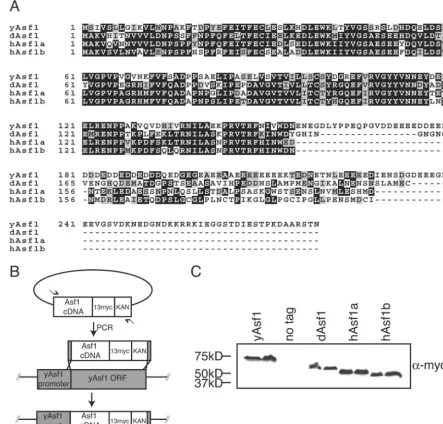
humans, hAsf1a and hAsf1b. The sequence of the C terminus of Asf1 is divergent across species (Fig. 1A). The C terminus is dispensable for the role of Asf1 in silencing, resistance to DNA-damaging agents and replicational stress, interaction with histones, Rad53 and HIRA, and Asf1’s ability to deposit histones onto DNA in vitro (3, 32). The conserved N-terminal
region ofDrosophilaAsf1 is 59% identical to the yeast protein,
while hAsf1a and hAsf1b are 57% and 59% identical to yeast Asf1, respectively, and are 84% identical to each other.
Due to the similarities between the Asf1 proteins, we asked
whether theDrosophila or human Asf1 proteins could
func-tionally compensate for the deletion of budding yeastASF1.
We integrated theDrosophilagene (dASF1) and the human
gene (hASF1aandhASF1b) open reading frames in place of
the endogenous yeastASF1open reading frame (Fig. 1B). In
this manner, theDrosophilaor either human Asf1 protein was
the sole Asf1 protein within the cell and under the
transcrip-tional control of the yeastASF1promoter. A C-terminal
13-Myc epitope was included to verify equal expression levels of
the yeast,Drosophila, and human Asf1 proteins (Fig. 1C).
In order to compare the functions of Asf1 proteins across
eukaryotes, we tested the ability of theDrosophilaand human
Asf1 homologs to replace yeast Asf1 for growth. Yeast deleted
forASF1grow slowly due to an elongated metaphase of the
cell cycle (24). This metaphase elongation is due to activation of the DNA damage checkpoint in response to an elevated level of spontaneous DNA damage during DNA replication (24). We compared the growth of wild-type yeast, yeast deleted
forASF1, and those containing only hAsf1a, hAsf1b, or dAsf1.
We found that human Asf1b best complemented the slow
growth rate of yeast deleted forASF1, while hAsf1a and dAsf1
only partially complemented the growth rate (Fig. 2A). In support of this, the colony size for yeast containing hAsf1b was closest to that of wild-type Asf1 yeast, while colonies of yeast strains containing hAsf1a and dAsf1 were only slightly bigger
than yeast deleted for ASF1 (Fig. 2B). Furthermore, yeast
containing hAsf1b accumulated in the G2/M phase of the cell
cycle to a much lesser degree than yeast deleted forASF1or
on September 8, 2020 by guest
yeast containing hAsf1a or dAsf1, as determined by flow cy-tometry analysis (data not shown). These results indicate that hAsf1b can mimic the role of yeast Asf1 in preventing slow growth, suggesting that hAsf1b is more functionally similar to yeast Asf1.
DrosophilaAsf1 and human Asf1b protect against
replica-tional stress, while human Asf1a protects against double-strand DNA-damaging agents.In order to further examine the role of the Asf1 homologs in maintaining genomic integrity, we tested their ability to provide resistance to agents that induce
DNA damage and replicational stress. Yeast lackingASF1are
highly sensitive to the radiomimetic drug bleomycin, which
induces double-strand DNA damage (5, 30). We found that
human Asf1a, but not human Asf1b orDrosophilaAsf1, is able
to restore resistance to bleomycin (Fig. 3).
Yeast lackingASF1are also highly sensitive to agents that
induce DNA damage during DNA replication, such as the DNA-alkylating agent methyl methane sulfonate, the topo-isomerase I religation inhibitor camptothecin, and hydroxy-urea, which results in replicational stalling (10, 24, 27, 30). We
found that human Asf1b andDrosophilaAsf1 are able to fully
restore resistance to hydroxyurea, camptothecin, and methyl methane sulfonate, while human Asf1a only partially restores resistance to these agents (Fig. 3). The sensitivity of strains
FIG. 1. A. Alignment of yeast,Drosophila, and human Asf1 proteins, showing conserved and nonconserved regions of the Asf1 gene, where black represents identical residues and gray represents conserved residues. B. Schematic of insertion of Asf1 homologs into yeast. PCR fragments carrying the open reading frames of human andDrosophilaAsf1 were inserted by homologous recombination downstream of the endogenous yeast
ASF1promoter. Yeast DNA is represented by gray boxes and homolog DNA is represented by white boxes. A C-terminal 13-Myc epitope tag and kanamycin resistance gene were included for detection and selection on medium, respectively. C. Equivalent expression of the yeast,Drosophila, and human Asf1 proteins in yeast; 6g of total protein extracts from strains ACN026 (yAsf1), ROY1172 (no tag), BAT014 (dAsf1), BAT016 (hAsf1a), and KDY006 (hAsf1b) were loaded on a 7.5% SDS gel and Western blotted using a Myc antibody.
on September 8, 2020 by guest
http://ec.asm.org/
carrying the homologs of Asf1 to DNA-damaging agents was not a result of changes in Asf1 transcription, because protein levels of epitope-tagged yeast Asf1 do not change upon treat-ment of DNA-damaging agents (data not shown) and all the homologs were under the control of the yeast Asf1 transcrip-tional regulatory sequences.
These results allow us to separate the functions of the hu-man Asf1 proteins, where hAsf1a functions in maintaining viability in response to double-strand DNA damage, and hAsf1b function is more important during DNA replication. We suggest that hAsf1a contributes to the repair of DNA
andHMLsilent mating type loci (30). We used aURA3marker
inserted proximal to the telomere of chromosome VII and an
ADE2marker inserted into theHMRlocus in order to measure
silencing by the different homologs of Asf1. These experiments
were performed in yeast deleted for theCAC1gene, encoding
a subunit of the chromatin assembly factor CAF-1 complex, as this deletion allows the role of Asf1 in silencing to be measured
(30). Silencing of the telomere-proximalURA3gene is
mea-sured by growth on the drug 5⬘ fluoroorotic acid (5⬘FOA),
where wild-type silencing of URA3allows growth on 5⬘FOA
and a silencing defect causes death on 5⬘FOA. We found that
hAsf1b and dAsf1 allowed more growth on 5⬘FOA than yeast
deleted for ASF1 or yeast containing hAsf1a (Fig. 4). This
result indicates that hAsf1b and dAsf1 can best mimic the role of yeast Asf1 for telomeric silencing, suggesting that hAsf1b may play a more prominent role in heterochromatin formation in human cells than hAsf1a.
Silencing of theHMR-insertedADE2gene is measured by
colony color, as silencing ofADE2 leads to the build-up of a
red pigment from the adenine biosynthesis pathway, yielding
red colonies. A silencing defect atHMR::ADE2results in white
colonies, as seen for the yeast deleted for ASF1 (Fig. 4).
hAsf1a, hAsf1b, and dAsf1 yielded colonies that were more
pink than yeast deleted forASF1but less pink than colonies
containing yeast Asf1 (Fig. 4). Slight variations in the colony color were observed in the strains containing hAsf1a, hAsf1b, and dAsf1, presumably due to the defect in maintenance of
transcriptional silencing that results from the deletion ofCAC1
in these strains (15). This result shows that hAsf1a, hAsf1b, and dAsf1 can partially mimic the role of yeast Asf1 for silenc-ing of the matsilenc-ing type locus. Taken together, these data
indi-FIG. 2. hAsf1b best complements the growth defect of yeast de-leted forASF1. A. Exponentially growing cultures of strains JKT049 (yAsf1), BAT015 (hAsf1a), BAT011 (hAsf1b), BAT013 (dAsf1), and ROY1169 (asf1⌬) were diluted to an OD of 0.1, and OD readings were taken over time and plotted. B. The same strains used in panel A were plated and grown for 3 days before images were photographed.
FIG. 3. Ability of homologs of Asf1 to provide resistance to DNA-damaging agents. Exponentially growing cultures of yeast strains ROY1172 (yAsf1), BAT016 (hAsf1a), KDY006 (hAsf1b), BAT014 (dAsf1), and ROY1170 (asf1⌬) were plated in 10-fold serial dilutions on rich medium (control), rich medium plus 1.5 mU bleomycin, 100 mM hydroxyurea, 10M camptothecin, and 0.01% methyl methane sulfonate and grown for 2 to 3 days at 30°C.
on September 8, 2020 by guest
cate that the human andDrosophilacounterparts of Asf1 can partially mimic the silencing function of yeast Asf1, although this appears to be in a locus-specific manner for hAsf1a.
Human Asf1b and dAsf1 complement the role of yeast Asf1 in activation of thePHO5gene.Next, we tested the ability of
the human and Drosophila Asf1 homologs to activate the
PHO5 gene. Asf1-mediated disassembly of the nucleosomes
over the PHO5 promoter is required for activation of the
PHO5gene (1). We assayed the ability of the Asf1 homologs to
activatePHO5by measuring the acid phosphatase activity of
the product of thePHO5gene (1). We found that while hAsf1b
and dAsf1 were able to activate thePHO5gene to the same
level as yeast Asf1, there was a slight delay inPHO5activation
(Fig. 5). By contrast, hAsf1a was unable to activate thePHO5
gene (Fig. 5). The defect inPHO5activation in strains carrying
the homologs of Asf1 was not a result of changes in Asf1 transcription, because protein levels of epitope-tagged yeast Asf1 do not change in different phosphate media (data not shown) and all the homologs were under the control of the yeast Asf1 transcriptional regulatory sequences. These data show that hAsf1b and dAsf1 but not hAsf1a are able to replace
yeast Asf1 for its role in activation of the PHO5 promoter.
Activation of thePHO5gene is due to a direct role of Asf1 in
chromatin disassembly at the promoter (1), suggesting,
be-cause hAsf1b but not hAsf1a can activatePHO5, that human
Asf1b but not hAsf1a is likely to be directly involved in tran-scriptional regulation in human cells.
Human andDrosophilacounterparts of yeast Asf1 have dif-ferent histone-binding abilities. To further increase our un-derstanding of the functional conservation of the Asf1 proteins
in yeast, humans, andDrosophila, we asked whether the
Dro-sophilaand human Asf1 proteins could interact with some of
the binding partners of yeast Asf1. Asf1 binds to histone H3 (30), and presumably this interaction is essential for its histone chaperone function during chromatin assembly and disassem-bly. We measured the ability of the Asf1 homologs to bind endogenous yeast histones by coimmunoprecipitation analysis. We were barely able to detect the interaction between the endogenous yeast Asf1 protein and endogenous histone H3 by immunoprecipitation analysis (Fig. 6). Therefore, we treated cells with the 12-angstrom cross-linker dithiobis(succinimidyl propionate) prior to immunoprecipitation to stabilize existing protein-protein interactions (4).
Addition of the cross-linker enabled detection of coprecipi-tating histone H3 with yeast Asf1 (Fig. 6). By contrast,
inter-FIG. 4. Ability of homologs of Asf1 to mediate transcriptional si-lencing. Yeast strains ROY1171 (yAsf1), BAT015 (hAsf1a), BAT011 (hAsf1b), BAT013 (dAsf1), and ROY1169 (asf1⌬) were plated in 10-fold serial dilutions onto rich medium, medium containing the indicated amounts of 5⬘FOA per 250 ml, or medium containing low adenine and grown for 2 to 3 days at 30°C.
FIG. 5. Ability of homologs of Asf1 to activatePHO5. Yeast strains JKT010 (yAsf1), BAT014 (dAsf1), BAT016 (hAsf1a), KDY006 (hAsf1b), and MPY0042 (asf1⌬) were grown overnight, diluted in phosphate-depleted medium to OD600of 0.25, and phosphatase activ-ity was measured at the time points indicated.
FIG. 6. Asf1 homologs bind differentially to yeast histone H3 and Rad53. Yeast strains ROY1172 (no tag), ACN026 (yAsf1), BAT014 (dAsf1), BAT016 (hAsf1a), and KDY006 (hAsf1b) were grown to OD600of⬃1.0, lysed, and immunoprecipitated with a Myc antibody. Equal amounts of protein were loaded onto an SDS-PAGE gel and Western blotted for either Myc, acetylated lysine 9/14 of H3 or Rad53. All soluble histones are modified on H3 lysine 9, and therefore the signal with the acetylated lysine 9/14 antibody reflects the amount of soluble histones. The presence (⫹) or absence (⫺) of treatment with the DSP cross-linker is indicated. Equal amounts of Asf1, H3K9/14, and Rad53 were detected in the input samples from all strains (data not shown).
on September 8, 2020 by guest
http://ec.asm.org/
noprecipitation.
We used anti-acetylated histone H3 antibodies for this ex-periment, as they were more sensitive than anti-H3 antibodies. The different affinities of the Asf1 homologs for histones are unlikely to reflect different affinities for acetylated histones, as Asf1 binds to the C terminus of histone H3, not the N terminus (18). These data show that the relative order of affinity of the Asf1 proteins for the yeast histones, from highest to lowest, is hAsf1a, yAsf1, hAsf1b, dAsf1.
Human and Drosophila counterparts of yeast Asf1 fail to bind Rad53. The interaction between Asf1 and the DNA checkpoint protein Rad53 may be important for the role of Asf1 in protecting against genomic instability (5, 8). Using coimmunoprecipitation analysis, we were able to detect the interaction between yeast Asf1 and Rad53 both with and with-out the DSP cross-linker (Fig. 6). By contrast, neither hAsf1a, hAsf1b, nor dAsf1 detectably bound Rad53 in this assay. Given that hAsf1a can functionally replace the role of yeast Asf1 for protection from DNA-damaging agents and that hAsf1b and dAsf1 can functionally replace the role of yeast Asf1 during replicational stress (Fig. 3), these Rad53 binding results indi-cate that the interaction between Asf1 and Rad53 is unlikely to be important for the function of Asf1 in protecting against genomic insults and replicational stress.
DISCUSSION
Mechanistic insight into the function of Asf1 has come
largely from studies in yeast. Showing thatDrosophilaAsf1 and
the two human Asf1 proteins can function in yeast demon-strates that the function of Asf1 is highly similar in higher eukaryotes and yeast. The eukaryotic Asf1 proteins have been
highly conserved through evolution, withDrosophilaand the
two human Asf1 proteins being able to perform different as-pects of the function of budding yeast Asf1. Furthermore, although the two human Asf1 proteins are highly similar in sequence, they are likely to have different functions within human cells because they complement distinct functions of yeast Asf1.
We conclude from our data that hAsf1a and hAsf1b have unique functions. Indeed, it appears that the functions of yeast Asf1 have been divided between the two human Asf1 proteins. Human Asf1b can replace yeast Asf1’s role in growth (likely a consequence of Asf1 protecting against endogenous genomic instability during DNA replication) (24), protection against
DNA replication, silencing, repair, and cell growth are also likely to reflect Asf1-mediated histone H3-H4 disassembly and/or reassembly accompanying DNA replication and DNA repair. The functional distinctions between the two human Asf1 proteins in yeast are likely to indicate that they perform distinct functions in human cells.
We propose that hAsf1a assembles and disassembles chro-matin during DNA repair, while hAsf1b assembles and disas-sembles chromatin during DNA replication in human cells. Presumably, these specialized functions of the human Asf1 proteins would be mediated through differential protein-pro-tein interactions. Yeast Asf1 has recently been shown to be recruited to DNA by replication protein C (RFC) (6), and it would be insightful to determine whether hAsf1b but not hAsf1a can bind to human RFC. Furthermore, given that we
have recently localized DrosophilaAsf1 to DNA replication
foci (Schulz and Tyler, submitted), it will be interesting to determine whether human Asf1b but not Asf1a localizes to DNA replication foci in human cells.
DrosophilaAsf1 is more functionally similar to hAsf1b (and yeast Asf1) than hAsf1a, as determined by their abilities to
complement deletion of ASF1in yeast. This would have not
been predicted from the sequence identity between the pro-teins alone, because the identity between the conserved re-gions of hAsf1b and dAsf1 is 71%, while that between the conserved regions of hAsf1a and dAsf1 is 75%. Furthermore, analysis of the protein sequences does not identify regions of Asf1 that could account for the functional similarities between hAsf1b and dAsf1, as there are only three residues (82S, 86E, and 120P) that are conserved between dAsf1 and hAsf1b but absent from hAsf1a. It is conceivable that these residues are important for mediating differential protein interactions be-tween hAsf1a and hAsf1b, but these residues do not map to any of the known interaction interfaces (3, 17). Furthermore, there is only one residue (154D) that is present in hAsf1b, dAsf1, and yeast Asf1 but absent from hAsf1a (154E). It is unlikely that this one residue is responsible for the functional similarity between dAsf1, yAsf1, and hAsf1b and the many functional differences to hAsf1a. The recent nuclear magnetic resonance structure of human Asf1a showed several loops that were shifted relative to their positions in the yeast Asf1 crystal structure (3, 17). Although the hAsf1b structure is not yet solved, it is possible that these loops dictate the functional specificity of the human Asf1 proteins by mediating differential protein-protein interactions.
on September 8, 2020 by guest
The ability of the human and DrosophilaAsf1 proteins to function in yeast indicates a striking degree of conservation of the Asf1 proteins through evolution. This functional comple-mentation demonstrates not only that the functions of the Asf1 proteins are similar across eukarotyes, but also that the human and Drosophilaproteins can interact with the yeast counter-parts of their binding partners. As such, the regions of the Asf1 proteins that mediate these protein-protein interactions must fall within the highly conserved regions of Asf1 (Fig. 1A) and the binding partners of Asf1 must also have been highly con-served through evolution.
It is noteworthy that human Asf1a and Asf1b andDrosophila
Asf1 have quite different affinities for the yeast histones, with hAsf1a very strongly binding and hAsf1b and dAsf1 weakly binding yeast histones. This does not necessarily reflect the affinities of the Asf1 proteins for the histones from their own species, but may reflect diversification of the histone binding region of the Asf1 proteins through evolution. However, the
differential affinity of the human andDrosophilaAsf1 proteins
for yeast histones allows us to draw correlations with their functional abilities in yeast. It is quite striking that a stronger affinity for histones does not correlate with greater functional competence of the human Asf1 proteins in yeast. For example, hAsf1a binds yeast histones very strongly (stronger than yAsf1), but only complements the DNA damage sensitivity phenotype, not the growth defect, the sensitivity to
replica-tional stress, or the defect in PHO5 activation or
transcrip-tional silencing in cells lacking yeast Asf1.
It is possible that a highly dynamic interaction with histones is required in order for Asf1 to function during transcription and replication. For example, if all the hAsf1a in yeast is already bound to histones due to its high affinity for yeast histones, one could imagine that there would not be any free
hAsf1a available to remove the histones from thePHO5
pro-moter to facilitatePHO5activation. Similarly, an Asf1-histone
interaction that is too strong could prevent the histones being released onto the DNA during chromatin assembly. We can conclude that a stronger interaction is not always a better interaction in the case of highly dynamic functions like those of the histone chaperone Asf1.
It is possible that the different abilities of hAsf1a and hAsf1b to bind to yeast histones determines how well they mimic the yeast Asf1 protein. In this case, it is possible that the observed different functions of hAsf1a and hAsf1b are an artifact of placing these proteins in yeast and that hAsf1a and hAsf1b may be fully redundant in human cells. However, the available evidence suggests that this is not the case, and that hAsf1a and hAsf1b are likely to have distinct functions in vivo. RNA in-terference inactivation of hAsf1a leads to a moderate delay in S phase, while RNA interference of hAsf1b leads to no delay (7). RNA interference of both hAsf1a and hAsf1b leads to a much greater delay in S phase (7). Similarly, hAsf1a but not hAsf1b is required to promote the formation of senescence-associated heterochromatin foci in primary fibroblasts (34). While studies of hAsf1a and hAsf1b in human cells are limited, the information that is available supports our data showing that hAsf1a and hAsf1b have some specific and redundant functions in vivo.
Asf1 binds to the DNA damage checkpoint kinase Rad53 in yeast (5, 8). While this interaction is intriguing and strongly
suggests that Asf1 and Rad53 function together to facilitate DNA repair and replication, we find that this is unlikely to be the case. Our data indicate that the interaction between Rad53 and Asf1 is unlikely to be important for Asf1’s function in protecting against spontaneous genomic instability, DNA rep-licational stress and double-strand DNA-damaging agents. Furthermore, we have been unable to detect an interaction
between dAsf1 and the Drosophila equivalent of Rad53,
Dmchk2, by coimmunoprecipitation and in vitro binding anal-yses (data not shown). Similarly, an interaction between hu-man Chk2 and huhu-man Asf1 has not been detected (7). Fur-thermore, we found that Dmchk2 is not able to complement the loss of Rad53 in budding yeast (data not shown). It there-fore appears that the interaction between Rad53 and Asf1 is
specific to yeast and probably explains why Drosophila and
human Asf1 failed to bind to Rad53 (Fig. 6). Nonetheless, the
fact that human andDrosophilaAsf1 can complement the role
of yeast Asf1 in protecting against DNA-damaging agents and replicational stress indicates that the interaction between Rad53 and Asf1 is not required for these functions of Asf1.
These studies also demonstrate that phosphorylation of
hu-man and Drosophila Asf1 is unlikely to be essential for its
function. Human Asf1a is phosphorylated by Tousled-like ki-nases (Tlks) during S phase, while hAsf1b is phosphorylated by Tlks in M phase (26). There are no obvious Tlk homologs in yeast, although it is impossible to rule out whether there are functionally analogous kinases in yeast. However, phosphory-lation of yeast Asf1 has not been observed, suggesting that phosphorylation similar to that mediated by Tlks does not
occur on the human andDrosophilaAsf1 proteins when they
are present in yeast. The fact that human andDrosophilaAsf1
proteins are at least partially functional in yeast indicates that Tlk-mediated phosphorylation is not essential for their func-tion in yeast.
It is possible that phosphorylation of Asf1 in human and
Drosophila cells may play a regulatory role that is not con-served in yeast. It is noteworthy that human Asf1a but not Asf1b is phosphorylated in an S-phase-specific manner by Tlks in human cells (26). Perhaps phosphorylation of hAsf1a is required for it to mediate chromatin assembly and disassembly during replication, and the absence of the S-phase-specific Tlk-mediated phosphorylation of hAsf1a in yeast may be re-sponsible for the failure of hAsf1a to protect against genomic instability and replication stress-inducing drugs in yeast. Fu-ture studies are required to determine whether Tlk-mediated phosphorylation of Asf1 activates, represses, or regulates the function of Asf1.
ACKNOWLEDGMENTS
We thank Christine English, Laura Schulz, and Jeffrey Linger for critical reading of the manuscript. We thank Kim Dao Dang and Andy Nelson for technical assistance with strain construction. We are grate-ful to Tin-Tin Su and Wei Du for reagents to examine the Dmchk2-dAsf1 interaction.
This work was supported by a grant from the NIH (CA95641) to J.K.T. J.K.T. is a Leukemia & Lymphoma Society Scholar.
REFERENCES
1.Adkins, M. W., S. R. Howar, and J. K. Tyler.2004. Chromatin disassembly mediated by the histone chaperone Asf1 is essential for transcriptional ac-tivation of the yeast PHO5 and PHO8 genes. Mol. Cell14:657–666. 2.Chimura, T., T. Kuzuhara, and M. Horikoshi.2002. Identification and
on September 8, 2020 by guest
http://ec.asm.org/
9.Krawitz, D. C., T. Kama, and P. D. Kaufman.2002. Chromatin assembly factor I mutants defective for PCNA binding require Asf1/Hir proteins for silencing. Mol. Cell. Biol.22:614–625.
10.Le, S., C. Davis, J. B. Konopka, and R. Sternglanz.1997. Two new S-phase-specific genes from Saccharomyces cerevisiae. Yeast13:1029–1042. 11.Loewith, R., J. S. Smith, M. Meijer, T. J. Williams, N. Bachman, J. D. Boeke,
and D. Young.2001. Pho23 is associated with the Rpd3 histone deacetylase and is required for its normal function in regulation of gene expression and silencing in Saccharomyces cerevisiae. J. Biol. Chem.276:24068–24074. 12.Luger, K., A. W. Mader, R. K. Richmond, D. F. Sargent, and T. J. Richmond.
1997. Crystal structure of the nucleosome core particle at 2.8 A resolution. Nature389:251–260.
13.Luger, K., T. J. Rechsteiner, and T. J. Richmond.1999. Expression and purification of recombinant histones and nucleosome reconstitution. Meth-ods Mol. Biol119:1–16.
14.Meijsing, S. H., and A. E. Ehrenhofer-Murray.2001. The silencing complex SAS-I links histone acetylation to the assembly of repressed chromatin by CAF-I and Asf1 in Saccharomyces cerevisiae. Genes Dev.15:3169–3182. 15.Monson, E. K., D. de Bruin, and V. A. Zakian.1997. The yeast Cac1 protein
is required for the stable inheritance of transcriptionally repressed chromatin at telomeres. Proc. Natl. Acad. Sci. USA94:13081–13086.
16.Moshkin, Y. M., J. A. Armstrong, R. K. Maeda, J. W. Tamkun, P. Verrijzer, J. A. Kennison, and F. Karch.2002. Histone chaperone ASF1 cooperates with the Brahma chromatin-remodelling machinery. Genes Dev.16:2621– 2626.
17.Mousson, F., A. Lautrette, J. Y. Thuret, M. Agez, R. Courbeyrette, B. Amigues, E. Becker, J. M. Neumann, R. Guerois, C. Mann, and F. Ochsen-bein.2005. Structural basis for the interaction of Asf1 with histone H3 and its functional implications. Proc. Natl. Acad. Sci. USA102:5975–5980. 18.Munakata, T., N. Adachi, N. Yokoyama, T. Kuzuhara, and M. Horikoshi.
2000. A human homologue of yeast anti-silencing factor has histone chap-erone activity. Genes Cells5:221–233.
19.Myung, K., V. Pennaneach, E. S. Kats, and R. D. Kolodner.2003. Saccha-romyces cerevisiae chromatin-assembly factors that act during DNA
repli-histone deposition protein Asf1p requires Hir proteins and PCNA for het-erochromatic silencing. Curr. Biol.11:463–473.
26.Sillje, H. H., and E. A. Nigg.2001. Identification of human Asf1 chromatin assembly factors as substrates of Tousled-like kinases. Curr. Biol.11:1068– 1073.
27.Singer, M. S., A. Kahana, A. J. Wolf, L. L. Meisinger, S. E. Peterson, C. Goggin, M. Mahowald, and D. E. Gottschling.1998. Identification of high-copy disruptors of telomeric silencing in Saccharomyces cerevisiae. Genetics
150:613–632.
28.Sutton, A., J. Bucaria, M. A. Osley, and R. Sternglanz.2001. Yeast asf1 protein is required for cell cycle regulation of histone gene transcription. Genetics158:587–596.
29.Tagami, H., D. Ray-Gallet, G. Almouzni, and Y. Nakatani.2004. Histone H3.1 and H3.3 complexes mediate nucleosome assembly pathways depen-dent or independepen-dent of DNA synthesis. Cell116:51–61.
30.Tyler, J. K., C. R. Adams, S. R. Chen, R. Kobayashi, R. T. Kamakaka, and J. T. Kadonaga.1999. The RCAF complex mediates chromatin assembly during DNA replication and repair. Nature402:555–560.
31.Tyler, J. K., K. A. Collins, J. Prasad-Sinha, E. Amiott, M. Bulger, P. J. Harte, R. Kobayashi, and J. T. Kadonaga.2001. Interaction between the Drosoph-ila CAF-1 and ASF1 chromatin assembly factors. Mol. Biol. Cell21:6574– 6584.
32.Umehara, T., T. Chimura, N. Ichikawa, and M. Horikoshi.2002. Polyanionic stretch-deleted histone chaperone cia1/Asf1p is functional both in vivo and in vitro. Genes Cells7:59–73.
33.Zabaronick, S. R., and J. K. Tyler.2005. The histone chaperone anti-silenc-ing function 1 is a global regulator of transcription independent of passage through S phase. Mol. Cell. Biol.25:652–660.
34.Zhang, R., M. V. Poustovoitov, X. Ye, H. A. Santos, W. Chen, S. M. Daganzo, J. P. Erzberger, I. G. Serebriiskii, A. A. Canutescu, R. L. Dunbrack, J. R. Pehrson, J. M. Berger, P. D. Kaufman, and P. D. Adams.2005. Formation of MacroH2A-containing senescence-associated heterochromatin foci and senescence driven by ASF1a and HIRA. Dev. Cell8:19–30.