Imitation Learning: A Survey of Learning Methods
Ahmed Hussein, School of Computing Science and Digital Media, Robert Gordon University
Mohamed Medhat Gaber, School of Computing and Digital Technology, Birmingham City University
Eyad Elyan, School of Computing Science and Digital Media, Robert Gordon University
Chrisina Jayne, School of Computing Science and Digital Media, Robert Gordon University
Imitation learning techniques aim to mimic human behavior in a given task. An agent (a learning machine) is trained to perform a task from demonstrations by learning a mapping between observations and actions. The idea of teaching by imitation has been around for many years, however, the field is gaining attention recently due to advances in computing and sensing as well as rising demand for intelligent applications. The paradigm of learning by imitation is gaining popularity because it facilitates teaching complex tasks with minimal expert knowledge of the tasks. Generic imitation learning methods could potentially reduce the problem of teaching a task to that of providing demonstrations; without the need for explicit programming or designing reward functions specific to the task. Modern sensors are able to collect and transmit high volumes of data rapidly, and processors with high computational power allow fast processing that maps the sensory data to actions in a timely manner. This opens the door for many potential AI applications that require real-time perception and reaction such as humanoid robots, self-driving vehicles, human computer interaction and computer games to name a few. However, specialized algorithms are needed to effectively and robustly learn models as learning by imitation poses its own set of challenges. In this paper, we sur-vey imitation learning methods and present design options in different steps of the learning process. We introduce a background and motivation for the field as well as highlight challenges specific to the imitation problem. Methods for designing and evaluating imitation learning tasks are categorized and reviewed. Spe-cial attention is given to learning methods in robotics and games as these domains are the most popular in the literature and provide a wide array of problems and methodologies. We extensively discuss combining imitation learning approaches using different sources and methods, as well as incorporating other motion learning methods to enhance imitation. We also discuss the potential impact on industry, present major applications and highlight current and future research directions.
CCS Concepts:rGeneral and reference
→Surveys and overviews;rComputing methodologies
→ Learning paradigms; Learning settings; Machine learning approaches;Cognitive robotics; Control methods; Distributed artificial intelligence; Computer vision;
General Terms: Design, Algorithms
Additional Key Words and Phrases: Imitation learning, learning from demonstrations, intelligent agents, learning from experience, self-improvement, feature representations, robotics, deep learning, reinforcement learning
ACM Reference Format:
Ahmed Hussein, Mohamed M. Gaber, Eyad Elyan, and Chrisina Jayne, 2016. Imitation Learning: A Survey of Learning Methods.ACM Comput. Surv.V, N, Article A (January YYYY), 35 pages.
DOI:http://dx.doi.org/10.1145/0000000.0000000
Author’s addresses: A. Hussein, E. Elyan, and Chrisina Jayne School of Computing Science and Digital Media, Robert Gordon University, Riverside East, Garthdee Road, Aberdeen AB10 7GJ, United Kingdom M. M. Gaber, School of Computing and Digital Technology, Birmingham City University, 15 Bartholomew Row, Birmingham B5 5JU, United Kingdom
Permission to make digital or hard copies of all or part of this work for personal or classroom use is granted without fee provided that copies are not made or distributed for profit or commercial advantage and that copies bear this notice and the full citation on the first page. Copyrights for components of this work owned by others than ACM must be honored. Abstracting with credit is permitted. To copy otherwise, or repub-lish, to post on servers or to redistribute to lists, requires prior specific permission and/or a fee. Request permissions from [email protected].
c
YYYY ACM. 0360-0300/YYYY/01-ARTA $15.00
1. INTRODUCTION
In recent years, the demand for intelligent agents capable of mimicking human behav-ior has grown substantially. Advancement in robotics and communication technology have given rise to many potential applications that need artificial intelligence that can not only make intelligent decisions, but is able to perform motor actions realistically in a variety of situations. Many future directions in technology rely on the ability of artificial intelligence agents to behave as a human would when presented with the same situation. Examples of such fields are self-driving vehicles, assistive robots and human computer interaction. For the latter especially, opportunities for new applica-tions are growing due to recent interest in consumer virtual reality and motion capture systems1. In these applications and many robotics tasks, we are faced with the
prob-lem of executing an action given the current state of the agent and its surroundings. The number of possible scenarios in a complex application is too large to cover by ex-plicit programming and so a successful agent must be able to handle unseen scenarios. While such a task may be formulated as an optimization problem, it has become widely accepted that having prior knowledge provided by an expert is more effective and ef-ficient than searching for a solution from scratch [Schaal 1999] [Schaal et al. 1997] [Bakker and Kuniyoshi 1996] [Billard et al. 2008]. In addition, optimization through trial and error requires reward functions that are designed specifically for each task. One can imagine that even for simple tasks, the number of possible sequences of ac-tions an agent can take grows exponentially. Defining rewards for such problems is difficult, and in many cases unknown.
One of the more natural and intuitive ways of imparting knowledge by an expert is to provide demonstrations for the desired behavior that the learner is required to emulate. It is much easier for the human teacher to transfer their knowledge through demonstration than to articulate it in a way that the learner will understand [Raza et al. 2012]. This paper reviews the methods used to teach artificial agents to perform complex sequences of actions through imitation.
Imitation learning is an interdisciplinary field of research. Existing surveys focus on different challenges and perspectives of tackling this problem. Early surveys re-view the history of imitation learning and early attempts to learn from demonstra-tion [Schaal 1999] [Schaal et al. 2003]. In [Billard et al. 2008] learning approaches are categorized as engineering oriented and biologically oriented methods, [Ijspeert et al. 2013] focus on learning methods from the viewpoint of dynamical systems, while [Argall et al. 2009] address different challenges in the process of imitation such as acquiring demonstrations, physical and sensory issues as well as learning techniques. However, due to recent advancements in the field and a surge in potential applications, it is important at this time to conduct a survey that focuses on the computational meth-ods used to learn from demonstrated behavior. More specifically, we review artificial intelligence methods which are used to learn policies that solve problems according to human demonstrations. By focusing on learning methods, this survey addresses learning for any intelligent agent, whether it manifests itself as a physical robot or a software agent (such as games, simulations, planning, etc. ). The reviewed litera-ture addresses various applications, however, many of the methods used are generic and can be applied to general motion learning tasks. The learning process is catego-rized into: creating feature representations, direct imitation and indirect learning. The methods and sources of learning for each process are reviewed as well as evaluation metrics and applications suitable for these methods.
Imitation learning refers to an agent’s acquisition of skills or behaviors by observing a teacher demonstrating a given task. With inspiration and basis stemmed in neuro-science, imitation learning is an important part of machine intelligence and human computer interaction, and has from an early point been viewed as an integral part in the future of robotics [Schaal 1999]. Another popular paradigm is learning through trial and error; however, providing good examples to learn from expedites the process of finding a suitable action model and prevents the agent from falling into local min-ima. Moreover, a learner could very well arrive on its own at a suitable solution, i.e one that achieves a certain quantifiable goal, but which differs significantly from the way a human would approach the task. It is sometimes important for the learner’s actions to be believable and appear natural. This is necessary in many robotic domains as well as human computer interaction where the performance of the learner is only as good as a human observer’s perception of it. It is therefore favorable to teach a learner the desired behavior from a set of collected instances. However, it is often the case that direct imitation of the expert’s motion doesn’t suffice due to variations in the task such as the positions of objects or inadequate demonstrations. Therefore imitation learning techniques need to be able to learn a policy from the given demonstrations that can generalize to unseen scenarios. As such the agent learns to perform the task rather than deterministically copying the teacher.
The field of imitation learning draws its importance from its relevance to a variety of applications such as human computer interaction and assistive robots. It is being used to teach robots of varying skeletons and degrees of freedom (DOF) to perform an array of different tasks. Some examples are navigational problems, which typically employ vehicle-like robots, with relatively lower degrees of freedom. These include flying vehicles [Sammut et al. 2014] [Abbeel et al. 2007] [Ng et al. 2006], or ground vehicles [Silver et al. 2008] [Ratliff et al. 2007a] [Chernova and Veloso 2007a] [Ollis et al. 2007]. Other applications focus on robots with higher degrees of freedom such as humanoid robots [Mataric 2000a] [Asfour et al. 2008][Calinon and Billard 2007a] or robotic arms [Kober and Peters 2010][Kober and Peters 2009b][M ¨ulling et al. 2013]. High DOF humanoid robots can learn discrete actions such as standing up, and cyclic tasks such as walking [Berger et al. 2008]. Although the majority of applications target robotics, imitation learning applies to simulations [Berger et al. 2008] [Argall et al. 2007] and is even used in computer games [Thurau et al. 2004a] [Gorman 2009] [Ross and Bagnell 2010].
Imitation learning works by extracting information about the behavior of the teacher and the surrounding environment including any manipulated objects, and learning a mapping between the situation and demonstrated behavior. Traditional machine learning algorithms do not scale to high dimensional agents with high degrees of free-dom [Kober and Peters 2010]. Specialized algorithms are therefore needed to create adequate representations and predictions to be able to emulate motor functions in hu-mans.
a policy. However, learning a direct mapping between state and action is often not enough to achieve the required behavior. This can happen due to a number of issues such as errors in acquiring the demonstrations, variance in the skeletons of the teacher and learner (correspondence problem) or insufficient demonstrations. Moreover, the task performed by the learner may slightly vary from the demonstrated task due to changes in the environment, obstacles or targets. Therefore, imitation learning fre-quently involves another step that requires the learner to perform the learned action and re-optimize the learned policy according to its performance of the task. This self-improvement can be achieved with respect to a quantifiable reward or learned from examples. Many of these approaches fall under the wide umbrella of reinforcement learning.
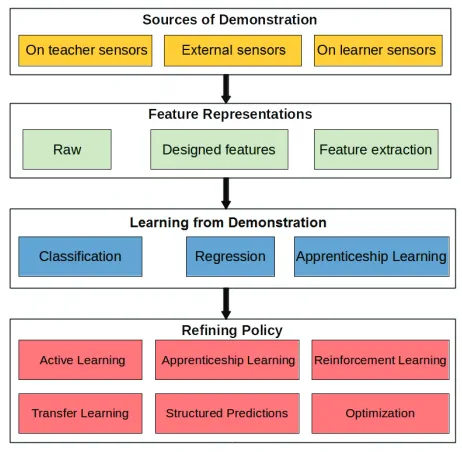
Figure 1 shows a workflow of an imitation learning process. The process starts by capturing actions to learn from, this can be achieved via different sensing methods. The data from the sensors is then processed to extract features that describe the state and surroundings of the performer. The features are used to learn a policy to mimic the demonstrated behavior. Finally the policy can be enhanced by allowing the agent to act out the policy and refine it based on its performance. This step may or may not require the input of a teacher. It might be intuitive to think of policy-refinement as a post learning step, but in many cases it occurs in conjunction with learning from demonstrations.
Fig. 1. Imitation learning flowchart
Imitation learning applications face a number of diverse challenges due to their interdisciplinary nature:
when the agent is sensing the environment. Noisy or unreliable sensing will result in erroneous behavior even if the model is adequately trained. [Argall et al. 2009] survey the different methods of gathering demonstrations and the challenges in each approach.
— Another issue concerning demonstration is the correspondence problem [Dauten-hahn and Nehaniv 2002]. Correspondence is the matching of the learner’s capabil-ities, skeleton and degrees of freedom to that of the teacher. Any discrepancies in the size or structure between the teacher and learner need to be compensated for dur-ing traindur-ing. Often in this case a learner can learn the shape of the movement from demonstrations, then refine the model through trial and error to achieve its goal. — A related challenge is the problem of observability where the kinematics of the
teacher are not known to learner [Schaal et al. 2003]. If the demonstrations are not provided by a designated teacher, the learner may not be aware of the capabilities and possible actions of the teacher; it can only observe the effects of the teacher’s actions and attempt to replicate them using its own kinematics.
— The learning process also faces practical problems as traditional machine learning techniques do not scale well to high degrees of freedom [Kober and Peters 2010]. Due to the real-time nature of many imitation learning applications, the learning algorithms are restricted by computing power and memory limitations; especially in robotic applications that require on-board computers to perform the real-time pro-cessing.
— Moreover, complex behaviors can often be viewed as a trajectory of dependent micro actions which violates the independent and identically distributed (i.i.d.) assumption adopted in most machine learning practices. The learned policy must be able to adapt its behavior based on previous actions and make corrections if necessary.
— The policy must also be able to adapt to variations in the task and the surround-ing environment. The complex nature of imitation learnsurround-ing applications dictate that agents must be able to reliably perform the task even under circumstances that vary from the training demonstration.
— Tasks that entail human-robot interaction pose a new set of challenges. Naturally safety is a chief concern in such applications [De Santis et al. 2008] [Ikemoto et al. 2012], and measures need to be taken to prevent injury of the human partners and insure their safety. Moreover, other challenges concern the mechanics of the robot, such as its ability to react to the humans’ force and adapt to their actions.
In the next section we formally present the problem of imitation learning and discuss different ways to formulate the problem. Section 3 describes the different methods for creating feature representations. Section 4 reviews direct imitation methods for learn-ing from demonstrations. Section 5 surveys indirect learnlearn-ing techniques and presents the different approaches to improve learned policies through optimizing reward func-tions and teachers’ behaviors. The paradigms for improving direct imitation through indirect learning are also discussed. Section 6 reviews the use of imitation learning in multi-agent scenarios. Section 7 describes different evaluation approaches and Section 8 shows the potential applications to utilize imitation learning. Finally, we present a conclusion and discuss future directions in Section 9.
2. PROBLEM FORMULATION
In this section we formalize the problem of imitation learning and introduce some preliminaries and definitions.
DEFINITION 2. An agent is defined as an entity that autonomously interacts within an environment towards achieving or optimizing a goal [Russell and Norvig 2003]. An agent can be thought of as a software robot; it receives information from the envi-ronment by sensing or communication and acts upon the envienvi-ronment using a set of actuators.
DEFINITION 3. A policy is a function that maps a state (a description of the agent, such as pose, positions and velocities of various parts of the skeleton, and its relevant surrounding) to an action. It is what the agent uses to decide which action to execute when presented with a situation.
Policies can be learned from demonstration or experience. The demonstrations may come from a designated teacher or another agent; the experience may be the agent’s own or another’s. The difference between the two types of training instances is that demonstrations provide the optimal action to a given state, and so the agent learns to reproduce this behavior in similar situations. This makes demonstrations suited for direct policy learning such as supervised learning methods. While experience shows the performed action, which may not be optimal, but also provides the reward (or cost) of performing that action given the current state, and so the agent learns to act in a manner that maximizes its overall reward. Therefore reinforcement learning is mainly used to learn from experience. More formally, demonstrations and experiences can be defined as follows.
DEFINITION 4. A demonstration is presented as a pair of input and output(x, y). Wherex is a vector of features describing the state at that instant andyis the action performed by the demonstrator.
DEFINITION 5. An experience is presented as a tuple(s, a, r, s′
)wheresis the state, ais the action taken at states,ris the reward received for performing actionaands′
is the new state resulting from that action.
It is clear from this formulation that learning from demonstration doesn’t require the learner to know the cost function optimized by the teacher. It can simply optimize the error of deviating from the demonstrated output such as the least square error in supervised learning. More formally, from a set of demonstrationsD= (xi, yi)an agent
learns a policyπsuch that:
u(t) =π(x(t), t, α) (1) Whereuis the predicted action,xis the feature vector,tis the time andαis the set of policy parameters that are changed through learning. While the time parametert is used to specify an instance of input and output, it is also input to the policyπ as a separate parameter.
DEFINITION 6. A policy that usestin learning the parameters of the policy is called a non-stationary policy (also known as non-autonomous [Schaal et al. 2003]) i.e the policy takes into consideration at what stage of the task the agent is currently acting.
DEFINITION 7. A stationary policy (autonomous) neglects the time parameter and learns one policy for all steps in an action sequence.
and changes in the parameters of the task [Schaal et al. 2003]. Moreover, this failure to adapt to new scenarios, at one point in the trajectory, can result in compounded errors as the agent continues to perform the remainder of action. In light of these drawbacks, methods for learning trajectories using stationary policies are motivated. An example is the use of structured predictions [Ross et al. 2010] where the training demonstra-tions are aggregated with labeled instances at different time steps in the trajectory – so time is encoded in the state. Alternatively, [Ijspeert et al. 2002a] learns attractor landscapes from the demonstrations, creating a stationary policy that is attracted to the demonstrated trajectory. This avoids compounded errors as the current state is considered by the policy before executing each state of the trajectory.
Learning from experience is commonly formulated as a Markov decision process (MDP). MDPs lend themselves naturally to motor actions, as they represent a state-action network and are therefore suitable for reinforcement learning. In addition the Markov property dictates that the next state is only dependent on the previous state and action, regardless of earlier states. This timeless property promotes stationary policies. There are different methods to learn from experience through reinforcement learning that are out of the scope of this paper. For a survey and formal definitions of reinforcement learning methods for intelligent agents, the reader is referred to [Kober et al. 2013]. Note that both learning paradigms are similarly formulated with the ex-ception of the cost function; the feature vectorx(t)corresponds tos,u(t)corresponds toaandx(t+ 1)corresponds to the resulting state s′. It is therefore not uncommon
(especially in more recent research) to combine learning from demonstrations and ex-perience to perform a task.
We now consider the predicted actionu(t)in equation 1.
DEFINITION 8. An action u(t) can often represent a vector rather than a single value. This means that the action is comprised of more than one decision executed si-multaneously; such as pressing multiple buttons on a controller or moving multiple joints in a robot.
Actions can also represent different levels of motor control: low level actions, motor primitives and high level macro actions [Argall et al. 2009].
DEFINITION 9. Low level actions are those that execute simple commands such as move forward and turn in navigation tasks, or jump and shoot in games.
These low level actions can be directly predicted using a supervised classifier. Low level actions also extend to regression when the predicted actions have continuous values rather than a discrete set of actions (see learning motion).
DEFINITION 10. Motor primitives are simple building blocks that are executed in sequence to perform complex motions. An action is broken down into basic unit actions (often concerning one degree of freedom or actuator) that can be used to make up any action that needs to be performed in the given problem.
These primitives are then learned by the policy. In addition to being useful in build-ing complex actions from a discrete set of primitives, motor primitives can represent a desired move in state space, since they can be used to reach any possible state. As in MDPs described above, the transition from one state to another state based on which action is taken is easily tracked when using motor primitives. In this case the output of the policy in equation 1 can represent the change in the current state [Schaal et al. 2003] as follows:
˙
DEFINITION 11. High level macro actions are decisions that determine the immedi-ate plan of the agent. It is then broken down to lower level action sequences. Examples of high level decisions are grasp object or perform forehand.
For a thorough formalization of learning from demonstrations, we refer the reader to [Schaal et al. 2003].
3. FEATURE REPRESENTATIONS
Before learning a policy it is important to represent the observable state in a form that is adequate and efficient for training. This representation is called a feature vector. A feature may include information about the learner, its environment, manipulable objects and other agents in the experiment. Training features need to be adequate, meaning that they convey enough information to form a solid policy to solve the task. It is also important that the features can be extracted and processed efficiently with respect to the time and computational restriction of imitation learning applications.
When capturing data, the important question is: what to imitate? In most real appli-cations, the environment is often too complicated to be represented in its totality, be-cause it usually has an abundance of irrelevant or redundant information. It is there-fore necessary to consider which aspects of the demonstrations we want to present to the learner.
3.1. Handling Demonstrations
Even before feature extraction stages, dealing with demonstrations poses a number of challenges. A major issue is the correspondence problem introduced in section 1. Creating correspondence mappings between teacher and learner can be computation-ally intensive, but some methods attempt to create such correspondence in real-time. In [Jin et al. 2016] a projection of the teacher’s behavior to the agent’s motion space is developed online by sparsely sampling corresponding features. Neural network can also be utilized to improve the response time of inverse kinematics (IK) based methods [Hwang et al. 2016] and find trajectories appropriate for the learner’s motion space based on the desired state of end-effectors. However, IK methods place no further re-strictions on the agent’s behavior as long as the end effector is in the demonstrated position [Mohammad and Nishida 2013]. This poses a problem for trajectory imita-tion applicaimita-tions such as gesture imitaimita-tion. To alleviate this limitaimita-tion [Mohammad and Nishida 2013] propose a close-form solution to the correspondence problem based on optimizing external (mapping between observed demonstrations and expected be-havior of learner) and learner mapping (mapping between state of the learner and its observed behavior). While most approaches store learned behaviors after mapping to the learner’s motion space, in [Bandera 2010] human gestures are captured, identi-fied and learned in the motion space of the teacher. While that requires learning a model for the teacher’s motion, it allows perception to be totally independent of the learner’s constraints and facilitates human motion recognition. The learned motions are finally translated to the robot’s motion space before execution. A different approach is to address correspondence in reward space where corresponding reward profiles for the demonstrators and the robot are built [Gonz ´alez-Fierro et al. 2013]. The difference between them is optimized with respect to the robots internal constraints to ensure the feasibility of the developed trajectory. This enables learning from demonstrations by multiple human teachers with different physical characteristics.
provided only with demonstrations starting from the right of the target, will start by moving to the familiar position if initialized in a different position. In [Kim et al. 2013] a method for learning from limited and inaccurate data is proposed, where the demonstrations are used to constraint a reinforcement learning algorithm that learns from trial and error. Combining learning from demonstrations and experience is ex-tensively investigated in subsection 5.1. As an alternative way to cope with the lack of good demonstrations, [Grollman and Billard 2012] learn a policy from failed demon-strations where the agent is trained to avoid repeating unsuccessful behavior.
Demonstrations need not be provided by a dedicated teacher but can instead be observed from another agent. In this case an important question is what to imitate from the continuous behavior being demonstrated. In [Mohammad and Nishida 2012] learning from unplanned demonstrations is addressed by segmenting actions from the demonstrations and estimating the significance of the behavior in these segments to the investigated task according to 3 criteria: (1) Change detection is used to discover significant regions of the demonstrations, (2) constrained motif discovery identifies re-curring behaviors and (3) change-causality explores the causality between the demon-strated behavior and changes in the environment. Similarly, in [Tan 2015] acquired recordings of a human hand are segmented into basic behaviors before extracting rel-evant features and learning behavior generation. The feature extraction and behavior generation are performed with respect to 3 attributes: (1) Preconditions, which are en-vironmental condition required for the task. (2) Internal constraints, which are char-acteristics of the agent that restrict its behavior. (3) Post results, which represent the consequences of a behavior.
Regardless of the source of the signal, captured data may be represented in different ways. We categorize representations as: raw features, designed or engineered features, and extracted features. Figure 2 Shows the relations between different feature repre-sentations.
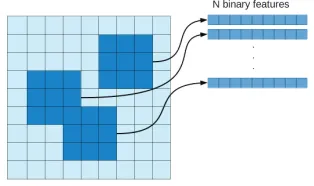
Fig. 2. Features relation diagram Fig. 3. Extracting binary features from an image
3.2. Raw Features
Raw data captured from the source can be used directly for training. If the raw features convey adequate information and are of an appropriate number of dimensions, they can be suitable for learning with no further processing. This way no computational overhead is spent in calculating features.
to the classifier without extracting any designed features. The image is down-sampled to 24×18 pixels to avoid the complications that come with high dimensional feature vectors. An image of that size with three color channels yields a 1,296 feature vector.
3.3. Manually Designed Features
These are features that are extracted using specially designed functions. These meth-ods incorporate expert knowledge about the data and application to determine what useful information can be derived by processing the raw data. [Torrey et al. 2005] ex-tract features from the absolute positions of players on a soccer field. More meaningful information such as relative distance from a player, distance and angle to the goal, and length and angles of player triangles are calculated. The continuous features are dis-cretized into overlapping tiles. This transformation of features from a numeric domain to binary tiles is reported to significantly improve learning.
Manually designed features are popular with learning from visual data. They play an important part in computer vision methods that are used to teach machines by demonstration. Computer vision approaches are popular from an early point in teach-ing robots to behave from demonstrations [Schaal 1999]. These approaches rely on detecting objects of interest and tracking their movement to capture the demonstrated actions in a form that can be used for learning. In [Demiris and Dearden 2005] a computer vision system is employed to create representations that are used to train a bayesian belief network. Training samples are generated by detecting and tracking objects in the scene; which is performed by clustering regions of the image according to their position and movement properties. [Billard and Matari´c 2001] imitate human movement by tracking relevant points on the human body. A computer vision system is used to detect human arm movement and track motion based on markers worn by the performer. The system only learns when motion is detected by observing change in the marker positions. In a recent study [Hwang et al. 2016], humanoid robots are trained to imitate human motion from visual observation. Demonstrations are cap-tured using a stereo-vision system to create a 3D image sequence. The demonstrator’s body is isolated from the sequence and a set of predetermined points on the upper and lower body are identified. Subsequently the extracted features are used to estimate the demonstrator’s posture along the trajectory. A variation of inverse-kinematics that em-ploys neural networks is used to reproduce the key posture features in the humanoid robot.
For the Mario bros game in [Ross and Bagnell 2010], the source signal is the screen-shot at the current frame. The image is divided into 22×22 equally sized cells. For each cell, 14 binary features (the value of each feature can be 0 or 1) are generated; each signifying whether or not the cell contains a certain object such as enemies, ob-stacles and/or power-ups. As such, each cell can contain between 0 and 14 of the pre-defined objects. A demonstration is made up of the last 4 frames (so as to contain information about the direction in which objects are moving) as well as the last 4 cho-sen actions. [Ortega et al. 2013] use a similar grid to reprecho-sent the environment, but add more numerical features and features describing the state of the character.
Figure 3 illustrates dividing an image to sub-patches and extracting binary features.
3.4. Extracted Features
irrelevant. This issue also applies to visual information. If the agent observes its sur-roundings using visual sensors, it is provided with high dimensional data in the form of pixels per frame. However, at any given point, most of the pixels in the captured frame would probably be irrelevant to the agent or contain redundant information.
Principal component analysis (PCA) can be used to project the captured data onto or-thogonal axes and represent the state of the agent in lower dimensions. This technique has been widely used with high DOF robots [Ikemoto et al. 2012] [Berger et al. 2008] [Vogt et al. 2014] [Calinon and Billard 2007b]. In [Curran et al. 2015], PCA is used to extract features in a Mario game. Data describing the state of the playable character, dangers, rewards and obstacles is projected onto as few as 4 dimensions. It is worth mentioning that the three types of features (raw, designed and extracted) were used in the literature to provide representations for the same Mario task.
Deep learning approaches [Bengio 2009] can also be used to extract features without expert knowledge of the data. These approaches find success in automatically learning features from high dimensional data; especially when no established sets of features are available. In a recent study [Mnih et al. 2015], Deep Q Learning (DQN) is used to learn features from high dimensional images. The aim of this technique is to enable a generic model to learn a variety of complex problems automatically. The method is tested on 49 Atari games, each with different environments, goals and actions. There-fore, it is beneficial to be able to extract features automatically from the captured signals (in this case screenshots of the Atari games at each frame) rather than man-ually design specific features for each problem. A low resolution (84× 84) version of the colored frames is used as input to a deep convolutional neural network (CNN) that is coupled with Q based reinforcement learning to automatically learn a variety of dif-ferent problems through trial and error. The results in many cases surpass other AI agents and in some cases are comparable to human performance. Similarly, [Koutn´ık et al. 2013] use deep neural networks to learn from video streams in a car racing game. Note that these examples utilize deep neural networks with reinforcement learning, without employing a teacher or optimal demonstrations. However the feature extrac-tion techniques can be used to learn from demonstraextrac-tions or experience alike. Since the success of DQN, several variations of deep reinforcement learning have emerged that utilize actor-critic methods [Mnih et al. 2016] [Lillicrap et al. 2015] which allow for po-tential combinations with learning from demonstrations. In [Guo et al. 2014] learning from demonstrations is applied on the same Atari benchmark [Bellemare et al. 2012]. A supervised network is used to train a policy using samples from a high performing but non real-time agent. This approach is reported to outperform agents that learn from scratch through reinforcement learning. In [Levine et al. 2015] deep learning is used to train a robot to perform a number of object manipulation tasks using guided policy search (see section on reinforcement learning).
the board. This state representation is input into a deep convolutional neural network that extracts higher level features and maps the learned features to actions.
4. LEARNING MOTION
We now address the different methods for learning a policy from demonstrations. After considering what to learn, this process is concerned with the question how to learn? The most straight forward way to learn a policy from demonstrations is direct imita-tion. That is to learn a supervised model from the demonstration, where the action provided by the expert acts as the label for a given instance. The model is then capa-ble of predicting the appropriate action when presented with a situation. Supervised learning methods are categorized into classification and regression.
4.1. Classification
Classification is a popular task in machine learning where observations are automati-cally categorized into a finite set of classes. A classifierh(x)is used to predict the class y to which an independent observationx belongs; wherey ∈ Y,Y = {y1, y2. . . yp} is
a finite set of classes, andx = {x1, x2. . . xm} is a vector ofmfeatures. In supervised
classification, h(x)is trained using a dataset of n labeled samples(x(i), y(i)), where x(i)∈X,y(i)∈Y andi= 1,2. . . n.
4.2. Regression
Regression methods are used to learn actions in a continuous space. Unlike classifi-cation, regression methods map the input state to a numeric output that represents an action. Thus they are suitable for low level motor actions rather than higher level decisions. Especially when actions are represented continuous values, such as input from a joystick [Ross et al. 2010]. The regressorI(x)maps an independent sample x to a continuous valueyrather than a set of classes. Wherey∈R, the set of real num-bers. Similarly the regressor is trained using a set of labeled samples(x(i), y(i)), where y(i)∈Randi= 1,2. . . n.
A commonly used technique is locally weighted regression (LWR). LWR is suitable for learning trajectories, as these motions are made up of sequences of continuous val-ues. Examples of such motions are batting tasks [Kober and Peters 2009c] [Ijspeert et al. 2002b] (where the agent is required to execute a motion trajectory in order to pass by a point and hit a target); and walking [Nakanishi et al. 2004] where the agent needs to produce a trajectory that results in smooth stable motion. A more comprehen-sive application is table tennis. [M ¨ulling et al. 2013] use Linear Bayesian Regression to teach a robot arm to play a continuous game of table tennis. The agent is required to move with precision in a continuous 3D space in different situations, such as when hitting the ball, recovering position after a hit and preparing for the opponent’s next move. Another paradigm commonly used for regression is artificial neural networks (ANN). Neural networks differ from other regression techniques in that they are de-manding in training time and training samples. Neural network approaches are often inspired by biology and neuroscience studies, and attempt to emulate the learning and imitation process in humans and animals [Billard et al. 2008]. The use of regression with a dynamic system of motor primitives has produced a number of applications for learning discrete and rhythmic motions [Ijspeert et al. 2002a] [Schaal et al. 2007] [Kober et al. 2008], though most approaches focus on direct imitation without fur-ther optimization [Kober and Peters 2009a]. In such applications, a dynamic system represents a single degree of freedom (DOF) as each DOF has a different goal and constraints [Schaal et al. 2007].
In both classification and regression methods, a design decision can be made re-garding the learning models resources. Lazy learners such askNN and LWR do not need training but need to retain all training samples when performing predictions. On the other hand, trained models such as ANN and SVM require training time, but once a model is created the training samples are no longer needed and only the model is stored, which saves memory. These models can also result in very short prediction times.
4.3. Hierarchical Models
Rather than using a single model to reproduce human behavior, a hierarchical model can be employed that breaks down the learned actions into a number of phases. A clas-sification model can be used to decide which action or sub-action, from a set of possible actions, should be performed at a given time. A different model is then used to define the details of the selected action, where each possible low-level action has a designated model. [Bentivegna et al. 2004] use a hierarchical approach for imitation learning on two different problems. The first is Air Hockey which is played against an opponent, and the objective is to shoot a puck into the opponent’s goal while protecting your own. The second game is marble maze; the maze can be tilted around different axis to move the ball towards the end of the maze. Each task has a set of low level actions called mo-tor primitives that make up the playing possibilities for the agent (e.g., Straight shot, Defend Goal, and Roll ball to corner). In the first stage, a nearest neighbor classifier is used to select the action to be performed. By observing the state of the game the clas-sifier searches for the most similar instances in the demonstrations provided by the human expert, and retrieves the primitive selected by the human at that point. The next step is to define the goal of the selected action, for example the velocity of the ball or the position of the puck when the primitive is completed. The goal is then used in a regression model to find the parameters of the action that would optimize the desired goal. The goal is derived from theknearest neighbor demonstrations found in the pre-vious step. The goals in those demonstrations are input in a local weighted regression model to perform the primitive. In a similar fashion, [Chernova and Veloso 2008] use a classifier to make decisions in a sorting task consisting of the following macro actions (wait, sort left, sort right and pass). Each macro action entails temporal motor actions such as picking up a ball, moving and placing the ball.
Fig. 4. Example of hierarchical learning of actions
huge potential in applications that can take advantage of sensing and motor control in the physical world. While video games can be attractive because they alleviate many challenges such as data capturing and sensor error; and thus allow development of new complex learning methods in a controlled and easily reproducible environment. Moreover, games have built-in scoring measures that can facilitate evaluation and even designing the learning process in reinforcement learning approaches.
5. INDIRECT LEARNING
In this section, we discuss indirect ways to learn policies that can complement or re-place direct imitation. The policy can be refined from demonstrations, experience or observation to be more accurate or to be more general and robust against unseen cir-cumstances.
It is often the case that direct imitation on its own is not adequate to reproduce robust, human-like behavior in intelligent agents. This limitation can be attributed to two main factors: (1) errors in demonstration, and (2) poor generalization. Due to limitations of data acquisition techniques, such as correspondence problem, sensor er-ror and physical influences in kinesthetic demonstrations [Argall et al. 2009], direct imitation can lead to inaccurate or unstable performance, especially in tasks that re-quire precise motion in continuous space such as reaching or batting. For example, in [Berger et al. 2008] a robot attempting to walk by directly mimicking the demonstra-tions would fall because the demonstrademonstra-tions do not accurately take into consideration the physical properties involved in the task such as the robot’s weight and center of mass. However, refinement of the policy through trial and error would take these fac-tors into account and produce a stable motion.
While generalization is an important issue in all machine learning practices, a spe-cial case of generalization is highlighted in imitation learning applications. It is com-mon that human decom-monstrations are provided as sequence of actions. The dependence of each action on the previous part of the sequence violates the ‘iid’ assumption of train-ing samples that is integral to generalization in supervised learntrain-ing [Ross and Bag-nell 2010]. Moreover, since human experts provide only correct examples, the learner is unequipped to handle errors in the trajectory. If the learner deviates from the op-timal performance at any point in the trajectory (which is expected in any machine learning task), it would be presented with an unseen situation that the model is not trained to accommodate for. A clear example is provided in [Togelius et al. 2007] where supervised learning was used to learn a policy to drive a car. Given that human demon-strations contained only ‘good driving’ with no crashes or close calls, when error occurs and the car deviates from demonstrated trajectories, the learner does not know how to recover.
5.1. Reinforcement Learning
Reinforcement learning (RL) learns a policy to solve a problem via trial and error.
DEFINITION 12. In RL, an agent is modeled as a Markov Decision Process (MDP) that learns to navigate in a state space. A finite MDP consists of a tuple (S, A, T, R), whereS is a finite set of states, A is the set of possible actions, T is the set of state transition probabilities andRis a reward function.T Psacontain a set of probabilities wherePsais the probability of arriving at statesgiven actionaand wherea∈Aand
s∈S. The reward functionR(sk, ak, sk+1)returns an immediate reward for taking an
action in a given state and ending up in a new stateak→sk+1wherekis the time step.
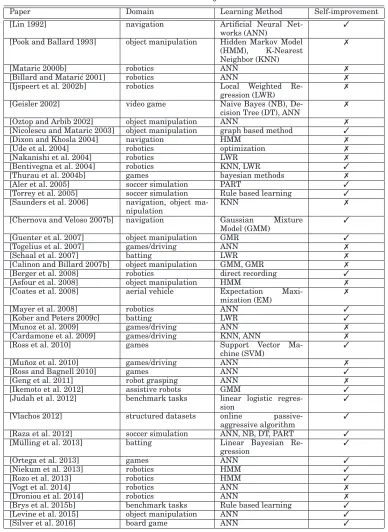
Table I. Direct Learning Methods.
Paper Domain Learning Method Self-improvement
[Lin 1992] navigation Artificial Neural Net-works (ANN)
✓
[Pook and Ballard 1993] object manipulation Hidden Markov Model (HMM), K-Nearest Neighbor (KNN)
✗
[Mataric 2000b] robotics ANN ✗
[Billard and Matari´c 2001] robotics ANN ✗
[Ijspeert et al. 2002b] robotics Local Weighted Re-gression (LWR)
✗
[Geisler 2002] video game Naive Bayes (NB), De-cision Tree (DT), ANN
✗
[Oztop and Arbib 2002] object manipulation ANN ✗
[Nicolescu and Mataric 2003] object manipulation graph based method ✓
[Dixon and Khosla 2004] navigation HMM ✗
[Ude et al. 2004] robotics optimization ✗
[Nakanishi et al. 2004] robotics LWR ✗
[Bentivegna et al. 2004] robotics KNN, LWR ✓
[Thurau et al. 2004b] games bayesian methods ✗
[Aler et al. 2005] soccer simulation PART ✓
[Torrey et al. 2005] soccer simulation Rule based learning ✓ [Saunders et al. 2006] navigation, object
ma-nipulation
KNN ✗
[Chernova and Veloso 2007b] navigation Gaussian Mixture Model (GMM)
✓
[Guenter et al. 2007] object manipulation GMR ✓
[Togelius et al. 2007] games/driving ANN ✗
[Schaal et al. 2007] batting LWR ✗
[Calinon and Billard 2007b] object manipulation GMM, GMR ✗
[Berger et al. 2008] robotics direct recording ✓
[Asfour et al. 2008] object manipulation HMM ✗
[Coates et al. 2008] aerial vehicle Expectation Maxi-mization (EM)
✗
[Mayer et al. 2008] robotics ANN ✓
[Kober and Peters 2009c] batting LWR ✓
[Munoz et al. 2009] games/driving ANN ✗
[Cardamone et al. 2009] games/driving KNN, ANN ✗
[Ross et al. 2010] games Support Vector Ma-chine (SVM)
✓
[Mu ˜noz et al. 2010] games/driving ANN ✗
[Ross and Bagnell 2010] games ANN ✓
[Geng et al. 2011] robot grasping ANN ✗
[Ikemoto et al. 2012] assistive robots GMM ✓
[Judah et al. 2012] benchmark tasks linear logistic regres-sion
✓
[Vlachos 2012] structured datasets online passive-aggressive algorithm
✓
[Raza et al. 2012] soccer simulation ANN, NB, DT, PART ✓ [M ¨ulling et al. 2013] batting Linear Bayesian
Re-gression
✓
[Ortega et al. 2013] games ANN ✓
[Niekum et al. 2013] robotics HMM ✓
[Rozo et al. 2013] robotics HMM ✓
[Vogt et al. 2014] robotics ANN ✗
[Droniou et al. 2014] robotics ANN ✗
[Brys et al. 2015b] benchmark tasks Rule based learning ✓
[Levine et al. 2015] object manipulation ANN ✓
RL starts off with a random policy and modifies its parameters based on rewards gained from executing this policy. Reinforcement learning can be used on its own to learn a policy for a variety of robotic applications. However, if a policy is learned from demonstration, reinforcement learning can be applied to fine tune the parameters. Pro-viding positive or negative examples to train a policy helps reinforcement learning by reducing the search space available [Billard et al. 2008]. Enhancing the policy using RL is sometimes necessary if there are physical discrepancies between the teacher and the learner or to alleviate errors in acquiring the demonstrations. RL can also be use-ful to train the policy for unseen situations that are not covered in the demonstrations. Applying reinforcement learning to the learned policy instead of a random one can sig-nificantly speed up the RL process and avoids the risk of the policy from converging into a local minimum. Moreover RL can find a policy to perform a task that does not look normal to the human observer. In applications where the learner interacts with a human, it is important for the user to intuitively recognize the agent’s actions. This is common in cases where robots are introduced into established environments (such as homes and offices) to interact with untrained human users [Calinon and Billard 2008]. By applying Reinforcement learning to a policy learned from human demonstrations the problem of unfamiliar behavior can be avoided. In imitation learning methods, re-inforcement learning is often combined with learning from demonstrations to improve a learned policy when the fitness of the performed task can be evaluated.
In early research, teaching using demonstrations of successful actions was used to improve and speed up reinforcement learning. In [Lin 1992], reinforcement learning is used to learn a policy to play a game in a 2D dynamic environment. Different methods for enhancing the RL policy are examined. The results demonstrate that teaching the learner with demonstrations improves its score and helps prevent the learner from falling in local minima. It is also noted that the improvement from teaching increases with the difficulty of the task. Solutions to simple problems can be easily inferred without requiring demonstrations from an expert. But as the complexity of the task increases the advantage of learning from demonstrations becomes more significant, and even necessary for successful learning in more difficult tasks [Lin 1991].
In [Guenter et al. 2007] Gaussian mixed regression (GMR) is used to train a robot on an object grasping task. Since unseen scenarios such as obstacles and the variable location of the object are expected in this application, reinforcement learning is used to explore new ways to perform the task. The trained system is a dynamic system that performs damping on the imitated trajectories. This allows the robot to smoothly achieve its target and prevents reinforcement learning from resulting in oscillations. Using damping in dynamic systems is a common approach when combining imitation learning and reinforcement learning [Kober and Peters 2010][Kober et al. 2013].
An impressive application of imitation and reinforcement learning is training an agent to play the board game ‘Go’ that rivals human experts [Silver et al. 2016]. A deep convolutional neural network is trained using past games. Then reinforcement learning is used to refine the weights of the network and improve the policy.
A different approach to combine learning from demonstrations with reinforcement learning is employed in [Brys et al. 2015a]. Rather than using the demonstrations to train an initial policy, they are used to derive prior knowledge for reward shaping [Ng et al. 1999]. A reward function is used to encourage sub-achievements in the task, such as milestones reached in the demonstrations. This reward function is combined with the primary reward function to supply the agent with the cost of its actions. This paradigm of using expert demonstrations to derive a reward function is similar to inverse reinforcement learning approaches [Abbeel and Ng 2004].
2013]. Therefore policy search methods are a good fit to integrate with imitation learn-ing methods. A policy gradient method is used in [Kohl and Stone 2004] to improve an existing policy that can be created through supervised learning or explicit program-ming. A similar approach [Peters and Schaal 2008] is used within a dynamic system that was previously used for supervised learning from demonstrations [Ijspeert et al. 2002b]. This led to a series of work that utilizes the dynamic system in [Ijspeert et al. 2002b] to learn from demonstrations and subsequently use reinforcement learning for self-improvement [Kober and Peters 2010] [Kober and Peters 2014] [Buchli et al. 2011] [Pastor et al. 2011]. This framework is used to teach robotic arms a number of appli-cations such as ball in cup, ball paddling [Kober and Peters 2010] [Kober and Peters 2009c] and playing table tennis [M ¨ulling et al. 2013]. Rather than using reinforcement learning to refine a policy trained from demonstrations, demonstrations can be used to guide the policy search. In [Levine and Koltun 2013] differential dynamic program-ming is used to generate guiding samples from human demonstrations. These guiding samples help the policy search explore high reward regions of the policy space.
Recurrent neural networks are incorporated into guided policy search in [Zhang et al. 2016] to facilitate dealing with partially observed problems. Past memories are augmented to the state space and are considered when predicting the next action. A supervised approach uses demonstrated trajectories to decide which memories to store while reinforcement learning is used to optimize the policy including the memory state values.
A different way to utilize reinforcement learning in imitation learning is to use RL to provide demonstrations for direct imitation. This approach does not need a human teacher as the policy is learned from scratch using trial and error and then used to generate demonstrations for training. One reason for generating demonstrations and training a supervised model rather than using the RL policy directly is that the RL method does not act in real-time [Guo et al. 2014]. Another situation is when the RL policy is learned in a controlled environment. In [Levine et al. 2015] reinforcement learning is used to learn a variety of robotic tasks in a controlled environment. In-formation such as the position of target objects is available during this phase. A deep convolutional neural network is then trained using demonstrations from the RL policy. The neural network learns to map visual input to actions and thus learns to perform the tasks without the information needed in the RL phase. This mimics human demon-strations as humans utilize expert knowledge – that is not incorporated in the training process – to provide demonstrations.
For a comprehensive survey of reinforcement learning in robotics, the reader is re-ferred to [Kober et al. 2013]
5.2. Optimization
Optimization approaches can also be used to find a solution to a given problem. DEFINITION 13. Given a cost functionf :A→Rthat reflects the performance of an agent, whereAis a set of input parameters andRis the set of real numbers, optimization methods aim to find the input parametersx0that minimize the cost function. Such that f(x0)≤f(x)∀x∈A
Colony Optimization (ACO) [Zhang et al. 2010] are used to generate trajectories for un-manned vehicle navigation. These techniques simulate the behavior of living creatures to find and optimal global solution in the search space. As is the case with reinforce-ment learning, evolutionary algorithms can be integrated with imitation learning to improve trajectories learned by demonstration or to speed up the optimization process. In [Berger et al. 2008] a genetic algorithm (GA) is used to optimize demonstrated motion trajectories. The trajectories are used as a starting population for the genetic algorithm. The recorded trajectories are encoded as chromosomes constituted of genes representing the motor primitives. The GA searches for the chromosome that optimizes a fitness function that evaluates the success of the task. Projecting the motor trajecto-ries to lower dimension illustrates the significant change between the optimized mo-tion and the one learned directly from kinesthetic manipulamo-tion [Berger et al. 2008].
Similarly in [Aler et al. 2005] evolutionary algorithms are used after training agents in a soccer simulation. A possible solution (chromosome) is represented as a set of
if-thenrules. The rules are finite due to the finite permutations of observations and actions. A weighted function of the number of goals and other performance measures is used to evaluate the fitness of a solution. Although the evolutionary algorithm had a small population size and did not employ crossover, it showed promising results over the rules learned from demonstrations.
[Togelius et al. 2007] also used evolutionary algorithms to optimize multiple objec-tives in a racing game. The algorithms evolve an optimized solution (controller) from an initial population of driving trajectories. Evaluation of the evolved controllers found that they stay faithful to the driving style of the players they are modeled after. This is true for quantitative measures such as speed and progress, and for subjective obser-vations such as driving in the center of the road.
[Ortega et al. 2013] treat the weights of a neural network as the genome to be opti-mized. The initial population is provided by training the network with demonstrated samples to initialize the weights. The demonstrations are also used to create a fit-ness value corresponding to the mean squared error distance from the desired outputs (human actions).
sequence-independent joint representation for the demonstrator and the learner is used to form a fitness function. PSO is used to find the joint angles to optimize this similarity mea-sure. A different method of integrating demonstrations is proposed in [El-Hussieny et al. 2015]. Inspired by Inverse Reinforcement Learning (see section on apprentice-ship learning), an Inverse Linear Quadratic Regulator(ILQR) framework is used to learn cost function optimized by the human demonstrator. PSO is then employed to find a solution for the learned function instead of gradient methods.
5.3. Transfer Learning
Transfer learning is a machine learning paradigm where knowledge of a task or a domain is used to enhance learning of another task.
DEFINITION 14. Given a source DomainDsand taskTs, transfer learning is defined as improving the learning of a target taskTtin domainDt using knowledge ofDsand
Ts; whereDs6=Dt orTs =6 Tt. A domainD={χ, P(X)}is defined as a feature spaceχ and a marginal probability distributionP(X), WhereX={x1, ...xn} ∈χ. The condition
Ds6=Dt holds ifχs6=χt orPs(X)6=Pt(X)[Pan and Yang 2010].
A learner can acquire various forms of knowledge about a task from another agent such as useful feature representations or parameters for the learning model. Transfer learning is relevant to imitation learning and robotic applications because acquiring samples is difficult and costly. Utilizing knowledge of a task that we already invested to learn can be efficient and effective.
A policy learned in one task can be used to advice (train) a learner on another task that carries some similarities. In [Torrey et al. 2005] this approach is implemented on two robocup soccer simulator tasks, the first is to keep the ball from the other team, and second to score a goal. It is obvious that skills learned to perform the first task can be of use in the later. In this case advice is formulated as a rule concerning the state and one or more action. To create advice the policy for the first task is learned using reinforcement learning. The learned policy is then mapped by a user (to avoid discrepancies in state or action spaces) into the form of advice that is used to initiate the policy for the second task. After receiving advice the learner continues to refine the policy through reinforcement learning and can modify or ignore the given advice if it proves through experience to be inaccurate or irrelevant.
Often in transfer learning, human input is needed to map the knowledge from one domain to another, however, in some cases the mapping procedure can be automated [Torrey and Shavlik 2009]. For example, in [Kuhlmann and Stone 2007] a mapping function for general game playing is presented. The function automatically maps be-tween different domains to learn from previous experience. The agent is able to identify previously played games relevant to the current task. The agent may have played the same game before or a similar one and is able to select an appropriate source task to learn from without it being explicitly designated. Experiments show that the transfer learning approach speeds up the process of learning the game via reinforcement learn-ing (compared to learnlearn-ing from scratch) and achieves a better performance after the learning iterations are complete. The results also suggest that the advantage of using transfer learning is correlated with the number of training instances transferred from the source tasks. Even if the agent encounter negative transfer [Pan and Yang 2010] for example from overfitting to the source task, it can recover by learning through ex-perience and rectifying its model in the current task to converge in appropriate time [Kuhlmann and Stone 2007].
one task and perform reward shaping for a similar task. In [Brys et al. 2015b] transfer learning is applied from a simple version of the problem to a more complex one (e.g 2D to 3D mountain car and a Mario game without enemies to a game with enemies).
5.4. Apprenticeship Learning
In many artificial intelligence applications such as games or complex robotic tasks, the success of an action is hard to quantify. In that case the demonstrated samples can be used as a template for the desired performance. In [Abbeel and Ng 2004], appren-ticeship learning (or inverse reinforcement learning) is proposed to improve a learned policy when no clear reward function is available; such as the task of driving. In such applications the aim is to mimic the behavior of the human teachers under the as-sumption that the teacher is optimizing an unknown function.
DEFINITION 15. Inverse reinforcement learning (IRL) uses the training samples to learn the reward function being optimized by the expert and use it to improve the trained model.
Thus, IRL obtains performance similar to that of the expert. With no reward func-tion the agent is modeled as an MDP/R (S,A,T). Instead the policy is modeled after feature expectations µE derived from expert’s demonstrations. Given n trajectories
{s(0i), s (i)
1 , . . .}mi=1the empirical estimate for the feature expectation of the expert’s pol-icyµE=µ(ΠE)is denoted as:
ˆ
µE=
1
m
m
X
i=1
∞
X
t=0
γtφ(s(ti)). (3)
Whereγis a discount factor andφ(s(ti))is the feature vector at timetof
demonstra-tioni. The goal of the RL algorithm is to find a policyπ¯ such that ||µ(¯π)−µE||2 ≤ ǫ whereµ(¯π)is the expectation of the policy [Abbeel and Ng 2004].
In addition, IRL can be employed rather than traditional RL even if a reward func-tion exists (given that demonstrafunc-tions are available). For example, in [Lee et al. 2014] apprenticeship learning is used to derive a reward function from expert demonstra-tions in a Mario game. While the goals in a game such as Mario can be pre-defined (such as score from killing enemies and collecting coins or the time to complete the level), it is not known how an expert user prioritizes these goals. So in an effort to mimic human behavior, a reward function extracted from demonstrations is favored to a manually designed reward function.
5.5. Active Learning
Active learning is a paradigm where the model is able to query an expert for the opti-mal response to a given state, and use these active samples to improve its policy.
DEFINITION 16. A classifierh(x)is trained on a labeled datasetDK(x(i), y(i))and used to predict the labels of an unlabelled datasetDU(x(i)). A subsetDC(x(i))⊂DU is chosen by the learner to query the expert for the correct labelsy∗(i). The active samples DC(x(i), y∗(i)) are used to train h(x) with the goal of minimizing n : the number of samples inDC.
Active learning is a useful method to adapt the model to situations that were not covered in the original training samples. Since imitation learning involves mimicking the full trajectory of a motion, an error may occur at any step of the execution. Creating passive training sets that can avoid this problem is very difficult.
One approach to decide when to query the expert is using confidence estimations to identify parts of the learned model that need improvement. When performing learned actions, the confidence in this prediction is estimated and the learner can decide to request new demonstrations to improve this area of the application or to use the cur-rent policy if the confidence is sufficient. Alternating between executing the policy and updating it with new samples, the learner gradually gains confidence and obtains a generalized policy that after some time does not need to request more updates. Con-fidence based policy improvement is used in [Chernova and Veloso 2007b] to learn navigation and in [Chernova and Veloso 2008] for a macro sorting task.
In [Judah et al. 2012] active learning is introduced to enable the agent to query expert at any step in the trajectory, given all the past steps. This problem is reduced to iid active learning and is argued to significantly decrease the number of required demonstrations.
[Ikemoto et al. 2012] propose active learning in human-robot cooperative tasks. The human and robot physically interact to achieve a common goal in an asymmetric task (i.e the human and the robot have different roles). Active learning occurs between rounds of interaction and the human provides feedback to the robot via a graphical user interface (GUI). The feedback is recorded and is added to a database of training samples that is used to train the Gaussian mixture model that controls the actions of the robot. The physical interaction between the human and robot results in mutu-ally dependent behavior. So with each iteration of interaction, the coupled actions of the two parties converge into a smoother motion trajectory. Qualitative analysis of the experiments show that if the human adapts to the robots actions, the interaction be-tween them can be improved; and that the interaction is more significantly improved if the robot in turn adapts to the human’s action with every round of interaction.
model which is learned incrementally to allow for additional demonstrations at any point.
5.6. Structured Predictions
In a similar spirit, DAGGER [Ross et al. 2010] employs sample aggregation to general-ize for unseen situations. However, the approach is fundamentally different. DAGGER formulates the imitation learning problem as a structured prediction problem inspired by [Daum´e Iii et al. 2009], an action is regarded as a sequence of dependent predic-tions. Since each action is dependent on the previous state, an error leads to unseen state from which the learner cannot recover, leading to compounded errors. DAGGER shows that it is both necessary and sufficient to aggregate samples that cover initial learning errors. Therefore, an iterative approach is proposed that uses an optimal pol-icy to correct each step of the actions predicted using the current polpol-icy, thus creating new modified samples that are used to update the policy. As the algorithm iterates, the utilization of the optimal policy diminishes until only the learned policy is used as the final model.
[Le et al. 2016] propose an algorithm called SIMILE that mitigates the limitations of [Ross et al. 2010] and [Daum´e Iii et al. 2009] by producing a stationary policy that doesn’t require data aggregation. SIMILE alleviates the need for an expert to provide the action at every stage of the trajectory by providing ”virtual expert feedback” that controls the smoothness of the corrected trajectory and converges to the expert’s ac-tions.
Considering past actions in the learning process is an important point in imitation learning as many applications rely on performing trajectories of dependent motion primitives. A generic method of incorporating memory in learning is using recurrent neural networks (RNN) [Droniou et al. 2014]. RNNs create a feedback loop among the hidden layers in order to consider the network’s previous outputs and are therefore well suited for tasks with structured trajectories [Mayer et al. 2008].
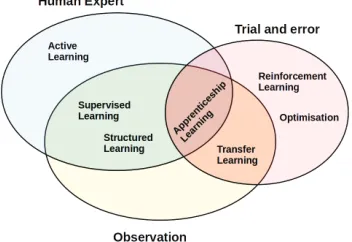
Fig. 5. learning methods from different sources
or by observing the required behavior from other agents. RL and optimization meth-ods learn through trial and error and do not make use of demonstrations. Transfer learning uses experience from old tasks, or knowledge from other agents to learn a new policy. Apprenticeship learning uses demonstrations from an expert or observa-tion to learn a reward funcobserva-tion. A policy that optimizes the reward funcobserva-tion can then be learned through experience.
6. MULTI-AGENT IMITATION
Although creating autonomous multi-agents have been thoroughly investigated through reinforcement learning [Shoham et al. 2003] [Busoniu et al. 2008], it is not as extensively explored in imitation learning. Despite the lack of research, imitation learning and multi-agent applications can be a good fit. Learning from demonstra-tions can be improved in multi-agent environments as knowledge can be transferred between agents of similar objectives. On the other hand, imitation learning can be beneficial in tasks where agents need to interact in a manner that is realistic from a human’s perspective. Following we present methods that incorporate imitation learn-ing in multiple agents.
In [Price and Boutilier 1999] implicit imitation is used to improve a learner’s RL model. A multi-agent setting enables an agent to learn by observing other agents per-forming a similar task using similar actions to those possessed by the agent. The men-tor agent provides demonstrations by performing the task to optimize its objectives, so there is no need for a designated teacher; and the actions of an agent are unknown to other agents. A learner can observe the state changes resulting from the actions of a mentor agent and accordingly refine its model. This premise is useful for real applica-tions where multiple agents act in the same environment. However, this work assumes that the agents are non-interacting, i.e., the consequences of one agent’s actions are in-dependent of other agents. Implicit imitation is closely related to transfer learning as a learner acquires the knowledge learned previously by a different learner. This ap-plication corresponds to a transductive transfer learning setting where the task is the same but the domains of the mentor and learner are different [Pan and Yang 2010]. An interesting aspect of this approach is that an agent can learn different skills from dif-ferent mentors. In one experiment two mentors are acting to achieve difdif-ferent goals; the learner uses observations from both agents to learn a more difficult task. Note however, that the tasks were designed so that a combination of the policies used by the mentors form an optimal policy for the learner’s problem. [Price and Boutilier 1999]. This can be considered as an example of hierarchical transfer learning, where learn-ing solutions to multiple problems can help achieve more complex tasks [Torrey and Shavlik 2009]. However, in this case the knowledge of the tasks is learned through observations and imitation.