http://www.sciencepublishinggroup.com/j/ajce doi: 10.11648/j.ajce.20190702.13
ISSN: 2330-8729 (Print); ISSN: 2330-8737 (Online)
A New Design Methodology for Carrying Capacity of Hot
Rolled I Section Steel of Local Buckling
:
:
:
:
The Overall
Interaction Concept
Jiajing Liu, Weining Yuan,
Hu Xiong,
Yihao Xu
School of Civil Engineering, Chang’an University, Xi’an, China
Email address:
To cite this article:
Jiajing Liu, Weining Yuan, Hu Xiong, Yihao Xu. A New Design Methodology for Carrying Capacity of Hot Rolled I Section Steel of Local Buckling: The Overall Interaction Concept. American Journal of Civil Engineering. Vol. 7, No. 2, 2019, pp. 52-58.
doi: 10.11648/j.ajce.20190702.13
Received: April 21, 2019; Accepted: June 11, 2019; Published: June 15, 2019
Abstract:
Through the finite element software ABAQUS, the finite element model considering the initial imperfection and residual stress is established, and the finite element results are compared with the collected test results to verify the reliability of the numerical model. By analyzing the ultimate carrying capacity of I section of axial compression with different aspect ratios, the design method of ultimate carrying capacity of axial compression members of hot rolled I section from thick to thin is studied. The result of Overall Interaction Concept (OIC) for hot rolled I section steel under axial compression is obtained by using the finite element calculation results, and the results are compared with the Eurocode (EN1993-1-1) and the Chinese steel structure design standard (GB50017-2017), so as to study the accuracy of the recommend design method. Results found that: i) the calculation result from EC3 of the cross section classification concept most conservative or unsafe, ii) the results from GB almost all conservative, iii) comparing with the existed design methods the OIC design method reflect the relationship between carrying capacity and the the generalized relative slenderness, that can accurately predict ultimate carrying capacity. Research shows that OIC is a more effective and accurate method.Keywords:
Hot-Rolled I Section Steel, Ultimate Bearing Capacity, Overall Interaction Concept1. Introduction
At present, most of the steel structure codes in various countries always divide sections into several categories according to the width to thickness ratio of section, and adopt different formulas for carrying capacity design according to different categories of sections, such as European code (EN1993-1-1) for steel structure design [1] and American code (ANSI/AISC 360-10) for steel structure design [2]. The calculation of carrying capacity of hot-rolled I section steel in the Chinese steel structure design standard (GB 50017-2017) is determined by the principle of equal stability that avoid local buckling, and the yield strength is used to adjust when the member with very small slenderness [3]. However, the above design standard all have the following shortcomings [4]: i) it is simply considered that the plates support each other without considering the interaction between plates [5], ii) The yield strength f y is taken as the design value,
ignoring the improvement of carrying capacity of section by strain strengthening, iii) There is no theoretical basis for the concept of section classification, iv) The calculation of effective width method (EWM) is complicated. In response to the above shortcomings, scholars have proposed direct strength method (DSM) and continuous strength method (CSM), but both of them have their own scope of application and shortcomings. DSM is mainly applicable to the problem of post-buckling strength of a thin section, while CSM is applicable to the problem of strain strengthening of a thick section. So although DSM and CSM have their own advantages, but both still can not solve the same problem as the concept of section classification, that is, the discontinuity in the calculation of bearing capacity.
Winter, CSM is based on strain expression, while the prototype of OIC formula is based on Aryton-perry formula. The main advantages of OIC are that, i) it can take into account all the factors (initial displacement, residual stress, post-buckling strength, strain strengthening) that have an impact on the carrying capacity calculation of steel members, and can be expressed in one basic theoretical formula; ii) in the design curve of carrying capacity, good continuity and consistency can be obtained during the transition from thick section to thin section, and effective and accurate calculation results of carrying capacity can be obtained; iii) it can be simply applied to a set of computer computing framework, greatly improving computing efficiency. In recent years, researchers have applied OIC to the research on the carrying capacity of square, rectangular and round tube steel members, but the open section member needs to be further studied [6]. In this paper, finite element software ABAQUS was used for modeling, and finite element analysis was conducted on the carrying capacity of 13 hot-rolled I-section steel members under axial compression, and the comparison was made with the collected test data to verify the reliability and accuracy of the finite element model. The calculation results from validated finite element model was used for parameter analysis, and its results were compared with the results from calculation methods of EC3, GB and OIC.
2. The Numerical Simulation
2.1. Test Specimen
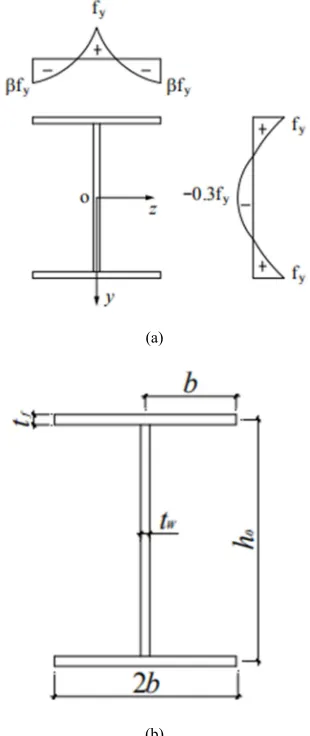
In this paper, the test results of carrying capacity of 13 hot -rolled H-section members under axial compression [7, 8] are used to verify the reliability of the established finite element model. The section form and residual stress distribution of H-shaped steel are shown in figure 1 [9]. In the figure, h0 represents the effective height of section, b represents the width of flange extension, tw and tf respectively represent the thickness of web and flange, β is -0.5. The comparison between the test results of hot - rolled short column members and the calculation results of ultimate carrying capacity of finite element under compression is listed in table 1, Nu,FE and Nu,test
respectively represent the ultimate carrying capacity calculated by finite element method and the ultimate carrying capacity obtained by test.
2.2. Finite Element Model
It has been proved in literature [4, 10] that the four-node quadrilateral finite film strain linear reduction integral shell element (S4R element) can perfectly simulate the real state of member and perform a good linear eigenvalue analysis of buckling. Therefore, for hot-rolled I section steel, S4R element is adopted in this paper to simulate its local buckling capacity under axial compression. All the constitutive models used in the member model are the measured values of the mechanical materials property.
(a)
(b)
Figure 1. Parameters of h-shaped section (a), residual stress distribution (b).
In the finite element analysis, the initial imperfection mode is approximately replaced by the low-order buckling mode obtained by the eigenvalue buckling analysis, because this mode reflects the most adverse geometric imperfection shape of the member. Figure 2 presents the first mode of axial pressure, on the basis of which we multiply a imperfection amplitude value to obtain an approximate form of the initial imperfection of the finite element model, and then impose to the nonlinear analysis in ABAQUS by the *INPERFECTION command. In this paper, the amplitude value (a/200) of the equivalent geometric initial imperfection suggested in EC3 was used as the parameter input of the geometric initial imperfection of the finite element model. A is the section of net width of the thinner member.
Table 1.Comparison of results between test to finite element of hot -rolled short column compression member.
Test number Strength of materials fy nomi, fy,actu fu,actu u,FE u,test N N (N/mm2) (N/mm2) (N/mm2)
SC_A5-1 S235 235 309.9 438.3 0.86
SC_A5-1 S235 235 309.9 438.3 0.90
SC_A5-2 S235 235 309.9 438.3 0.87
SC_A5-2 S235 235 309.9 438.3 0.85
SC_A11-1 S335 335 475.5 548.3 0.85
SC_A11-1 S335 335 475.5 548.3 0.94
SC_A11-2 S335 335 475.5 548.3 0.90
SC_A11-2 S335 335 475.5 548.3 0.90
C7HEB160 S335 335 — — 0.87
305×127×48_SC1 S335 335 391 534 0.96
305×127×48_SC2 S335 335 391 534 0.98
305×165×40_SC1 S335 335 391 534 0.991
305×165×40_SC2 S335 335 391 534 0.952
The mean 0.91
The variance 0.002233
Note: fy,nomi and fy,actu represent nominal and actual yield stress respectively, while fu,actu represents real ultimate stress.
Figure 2. Axial compression of the first mode.
2.3. Result Compared Between Finite Element and the Experimental
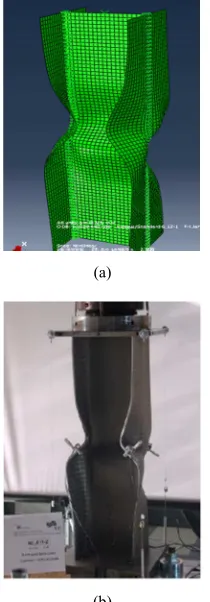
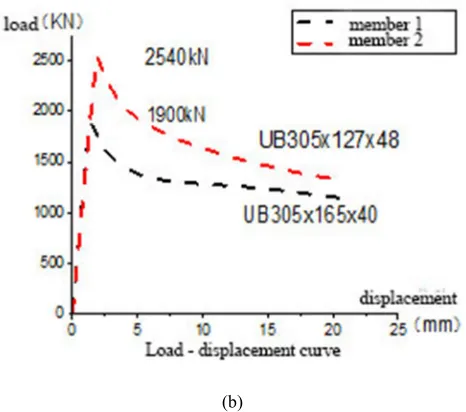
In this paper, nonlinear numerical analysis is carried out on 13 axial compression members of hot-rolled I-section steel, and local buckling failure modes and load-displacement curves of the members of test and finite element simulation are compared, which are respectively listed in figure 4 and figure 5. It can be seen from the figure that the local buckling failure form of the test and the finite element simulation is basically same. But for the load-displacement curve, whether it is the overall trend of the curve or the curvature and the peak of the curve both are basically consistent. It can be concluded from the comparison of the above two points and the comparison of the ultimate carrying capacity in table 1 that the model established in this paper can perfectly simulate the real state of member and can be used for the following parameter analysis.
Figure 3. I-section finite element model.
(a)
(b)
Figure 4. Comparison of local buckling morphology between test and finite
2.4. Finite Element Parameter Analysis
The carrying capacity of hot-rolled I section steel of local buckling is analyzed by using the verified finite element model. S4R element was used to establish the finite element model of short column of I-section steel under axial compression. The residual stress distribution, initial imperfection and amplitude, and boundary conditions of the model were same as those of the verified model. And the meshing analysis and calculation process were same as those of the verified model. The constitutive relation takes the general stress-strain curve of hot-rolled steel. The I-shaped section studied in this paper varies from thick to thin. In order to meet this condition, there are three variations. The first one is that the flange thickness remains constant while the web thickness changes. The second is that the thickness of the web is constant while flange thickness change. The third one is that the thickness of web and flange varies but the ratio remains the same. The study shows that the three changes can make the section coverage from thick to thin, but the third change belongs to the lower boundary envelope in terms of the carrying capacity, so the third change mode is adopted. For
I-beam, w w f f
h t b t
ξ= is a parameter reflecting the interaction
between flange and web. When ζ≤3.0, the section belongs to the weak flange and strong web; when ζ>3.0, the section belongs to the strong flange and weak web [11]. For the section selected in this paper, ζ is between 3.0 and 7.31 [5]. The section selected for the axial compression member belongs to the strong flange and weak web, and the type of section is determined by the web. Since the ratio of web thickness to flange thickness is constant in this paper, the main parameter is H/B. A total of 276 finite element models were established. The change range of ratio of height to thickness of web is h tw=10εk−110εk (εk= 235 fy ), on 10εk∼80εk take a point every 2εk, on 80εk∼110εk take a point every 3εk. A
total of 46 points. H/B =1.0, 1.25, 1.5, 1.75, 2.0, 2.5.
(a)
(b)
Figure 5. Comparison of load displacement curves obtained by test and finite element method (a) experimental result (b) finite element result.
3. Overall Interaction Concept
The OIC method, proposed in 2013, is based on the improved Aryton-perry formula and takes into account several factors that include strain strengthening, initial imperfection, residual stress, and post-buckling strength of the plate. Here's a quick overview of the improved Aryton-perry formula. The classical Aryton-perry formula is obtained based on the stability of the compression member that considers initial displacement imperfection. Formula (1) is obtained.
el W A υ η= 0⋅
, which is called the impact factor of the initial imperfection.
( )1-χ
(
1-χ λ⋅ 2)
=ηχ(1)
In order to more accurately describe the influence of imperfection and their influence range, Dwight proposes the following formula. α is the factor reflecting the initial imperfection, and λ0 is the initial value of entering the plasticity.
0
-η α λ λ=( ) (2)
Formula (1) is for the overall stability, and the local stability can also be described in this form, as show in formula 3.
(
1- χcs)(
1−χcs⋅λcs)
=ηχcs (3)The improved aryton-perry formula [6] can be obtained by inserting corresponding factors in the appropriate places of the above formula.
( )
(
1 δ)
cs cs cs cs
β - χ −χ ⋅λ =ηχ (4)
η=α (λ-λ0)
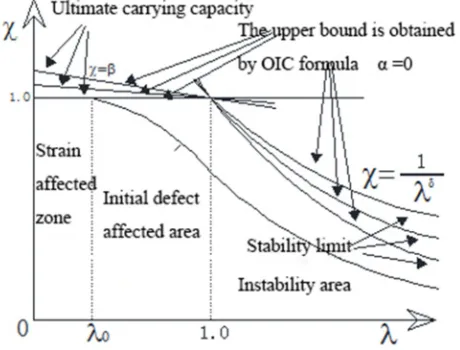
related to the post-buckling behavior of the section (mainly related to the thin section); αcs represents the impact of initial imperfection and residual stresses on the ultimate carrying capacity of the section (with the greatest impact on the intermediate type section); λ0is the initial value at which the section enters the plastic state. The meaning of each parameter can be intuitively seen in figure 6.
Figure 6. Schematic diagram of each parameter in the improved
Aryton-perry formula.
To take the further transformation of (4) can observe (5).
φ=0.5(1+αcs(λcs-λ0)+λδβ) (5)
Note that each parameter introduced in the equation is obtained by local fitting of finite element calculation results, and we finally get the χcs∼λcs relationship curve, namely the design curve based on OIC.
4. Comparison Between Eurocode,
Chinese Design Standard and OIC
Methods
4.1. Eurocode: EN 1993-1-1 Method
The section is divided into four types according to the width-thickness ratio limits. The classification criteria are as follows: λp≤0.5(Class 1), 0.5<λp≤0.6(Class 2), 0.6<λp≤0.9 (Class 3), the rest are four types of cross sections.
(
)
0 5.p y cr
λ
=
f
σ
is the limit of elastic buckling stress, whereσcr is the limit of elastic buckling stress. Class 1 section, plastic bending moment can be achieved, has adequate rotation capacity using plastic design. Class 2 section, the rotation capacity is small, can also achieve plastic bending moment using plastic design. Class 3 section, the carrying capacity cannot reach the plastic bending moment, can reach the yield moment using elastic design. Class 4 sections, local
buckling occurs before the yield of the edge fiber, which results in partial section failure. The effective width method is adopted for the calculation of carrying capacity of class 4 sections[1].
4.2. Chinese Design Standard: GB50017————2017
Unlike the European and American codes, the Chinese design standard for steel structure do not adopt the sectional classification, but adopt the principle of equal stability to determine the width-to-thickness ratio of the plate. Local instability is not allowed, and when the slenderness is very small, yield strength is used to adjust.
4.3. Application of Overall Interaction Concept
The key of OIC method lies in the buckling curve. In this paper, the buckling curve is obtained by fitting ABAQUS calculation results. The application steps of OIC are shown in figure 7. In this paper, Rb was calculated by ABAQUS and Rcr was calculated by CUFSM.
Figure 7.OIC design schematic diagram.
Step 1: calculate Rpl (ultimate carrying capacity) Step 2: calculate Rcr (ultimate stability)
Step 3: calculate Generalized relative slenderness.
rel pl cr
λ
=
R
R
Step 4: calculate reduction factor obtained by OIC.
0( )
rel
f
χ= λ
Step 5: calculate actual carrying capacity of member.
b pl
R = ⋅χ R
4.4. The Compared of Calculation Results of Each Design Method
The finite element calculation results are compared with the Chinese steel structure design standard and Eurocode and the proposed OIC calculation method, as shown in figure 8, 9 and 10. The overall comparison figure is shown in figure 11. 2
CS
CS
δ
β
χ
φ
φ
λ β
=
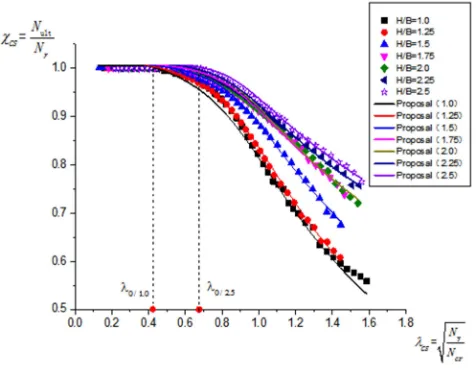
It can be seen from figure 8 that the proposed OIC method is basically consistent with the finite element calculation results. Figure 9 and figure 10 show that both calculation results of GB (Chinese steel structure design standard) and EC3 (Eurocode) are smaller than the finite element results, which is a relatively conservative method. It can be seen more clearly from figure 11 that when the cross section is a thick one, the position of the elliptic circle on the left side of the figure, the three calculation methods are all greater than value 1, and the scatter points coincide exactly. This indicates that the recommended methods of GB, EC3 and OIC are more conservative than the calculation results of finite element. The reason is that for the thick section, the three methods artificially limit the ultimate carrying capacity to the yield of the whole section without considering the strain strengthening of the thick section. For hot-rolled member, the recommended method of OIC does not consider strain hardening, β=1. For the semi-thick section, the calculation result of EC3 is below the dividing line (value 1), as shown in the middle oval circle position. The calculation result of GB is above value 1, while the suggested method is close to value 1. This shows that for the semi-thick section the European design code is not safe, Chinese steel structure design standard are conservative, the proposed method of OIC is more reasonable. In the area of 0.88, the area of thin and flexible section, as shown in figure of the oval circle on the right, the maximum calculation result of GB is close to 1.2, and the maximum calculation result of EC3 is 1.08, both of which are too conservative. The results of the proposed method of OIC float around the boundary of value 1, so the OIC is more reasonable.
Table 2 gives the ratio of Chinese steel structure design standard, European steel structure design code and OIC recommended method compare to the finite element calculation results from the mean and variance. It can be seen from the table 2 that the every code are close to the finite element calculation results, which verifies the correctness of the finite element model. The OIC method is the closest to the finite element calculation results, which indicates the rationality of the OIC method.
Figure 8.Comparison of finite element results with OIC method.
Figure 9. Comparison of finite element results with GB method.
Figure10. Comparison of finite element results with EC3 results.
Figure11.Results of GB, EC3 and OIC are compared with the finite element
results.
Table 2. Comparison between method of GB, EC3, and OIC and finite
element calculation results.
Standard statistic GB
FE
N N
EC
FE
N N
OIC
FE
N N
The mean 0.946 0.979 0.996
5. Conclusion
In this paper, the design method of local buckling carrying capacity of hot-rolled I section steel under axial compression is studied. The finite element model of hot- rolled I section steel is established,and its correctness of the finite element model was verified. The 276 models were calculated and analyzed using the verified finite element model, and the results were compared with the Eurocode and Chinese steel design standard and the proposed OIC method. The following conclusions were obtained:
1)The established finite element model has fully considered the various imperfection of hot-rolled section I steel under the axial compression: a) residual stress, b) the impact of the initial geometric imperfection. And the established finite element model can accurately calculate the local buckling bearing capacity.
2)For the thick section of the European code and Chinese steel design standard on the hot-rolled I section under the axial compression, local carrying capacity design is conservative. For the semi-thick section, European code is not safe, and Chinese steel design standard is conservative. For the thin section, the European code and Chinese steel design standard are conservative. On the contrary, the result of OIC method is more reasonable that is close to the actual carrying capacity of member. 3)The OIC method is based on the Aryton-perry formula
and takes into account the effects of strain hardening, post-buckling strength, residual stress, and initial imperfection on the section of carrying capacity. This method is closest to the finite element calculation result and is a more effective design method.
References
[1] EN 1993-1-1. Eurocode 3: Design of steel structures—Part 1– 1: Classification of cross sections [S]. Brussels: European Committee for standardization (CEN); 2005.
[2] American Institute of Steel Construction. Specification for Structural Steel Buildings: ANSI / AISC 360-10 [S]. Chicago, USA: American Institute of Steel Construction, 2010. [3] Ministry of construction of the People's Republic of China.
Standards for steel structure design: GB 50017—2017 [S]. Beijing: China planning press, 2017.
[4] Joanna Nseir. Development of a new design Method for The cross section Capacity of Steel of Hollow Section [D]. Universite de Liege, Liege, Belgique, 2015.
[5] Yongzhen Li. Extension of Direct Strenth Mothed to Hot- rolled and Welded H profile cross-section [D]. Universite de Liege, 2014.
[6] Bobo Wu. A new design method -- "overall interaction method" [J]. Construction engineering technology and design. 2017, 5 (134): 40-41.
[7] Kettler M. Elastic-plastic cross-sectional resistance of semi-compact H-and hollow sections [D]. Technical University of Graz, 2008.
[8] Andrew Foster. Stability and design of steel beams in the strain-hardening range [D]. Imperial College London, 2014. [9] Fancheng Cui, Changgen Deng, Yiyi. Chen. Elastic-plastic
local buckling analysis of h-section axial compression steel members [C]. //Proceedings of the 14th (ISSF-2014) academic exchange and teaching seminar, structural stability and fatigue branch, China steel structure association. Tongji university, 2014: 122-128.
[10] Liya Li. Study on section carrying capacity of cold-formed and hot-rolled rectangular tube steel members [D]. Xian: Master's thesis of Chang 'an university, 2017.