Newton Homotopy Solution for Nonlinear Equations
Using Maple14
Nor Hanim Abd. Rahman, Arsmah Ibrahim, Mohd Idris Jayes Faculty of Computer and Mathematical Sciences,
Universiti Teknologi MARA Malaysia (UiTM), 40450 Shah Alam, Selangor, Malaysia
*Corresponding email: [email protected]
Abstract
Many numerical approaches have been suggested to solve nonlinear problems. Some of the methods utilize successive approximation procedure to ensure every step of computing will converge to the desired root and one of the most common problems is the improper initial values for the iterative methods. This study evaluates Palancz et.al’s. (2010) paper on solving nonlinear equations using linear homotopy method in Mathematica. In this paper, the Newton-homotopy method using start-system is implemented in Maple14, to solve several nonlinear problems. Comparisons of results obtained in terms of number of iterations and convergence rates show promising application of the Newton-homotopy method for nonlinear problems.
1. INTRODUCTION
Newton-Raphson method offers fast, accurate numerical results compared to other methods and the best method proven to converge quadratically and applicable to many fields of knowledge. Many attempts have been done in finding the solution for the roots of equations of the form of
; 0 ) (x
f x; (1)
where
f
(
x
)
may be given explicitly as polynomials (Nor Hanim, Arsmah & Mohd Idris, 2010a, 2010b, 2010c; Li, Cheng & Neta, 2010; Saeed & Khthr, 2010; Kou, Wang & Li, 2010; Shenggou, Xiangke & Lizhi, 2009; Yun, 2009; Chun & Neta, 2009; Chun, Bae & Neta, 2009; Fang & He, 2007,2009) or, ordinary or partial differential equations at specific values (He, 1999). However, one of the disadvantages of the classical iterative Newton-Raphson method such as,) ( '
) ( -1
i i i
i f x
x f x
x where, f'(xi) 0 (2)
is the usage of division in the formula which is not very efficient in terms of computational time (Nor Hanim, Arsmah & Mohd Idris, 2010a,2010b,2010c) that could lead to divergent, when
0 ) ( ' xi
f and the usage of derivative is mostly difficult to solve.
Another known method in solving nonlinear problems is homotopy method, which is a global numerical method used in various science and engineering areas (Palancz et.al, 2010; Hazaveh et.al, 2003). Much attention too has been given to develop several iterative methods for solving nonlinear equations such as the Newton homotopy continuation method (Saeed & Khthr, 2010; Rafiq & Awais, 2008; Abbasbandy, 2003). Homotopy can guarantee to converge by certain path if a suitable auxiliary homotopy function is chosen (Rafiq & Awais, 2008).
In this paper, the general algorithms of homotopy equations via Newton-Raphson method are used to find roots of polynomials. The efficiency of these methods is illustrated and comparison of convergence and number of iterations are made.
2. PROJECT DESIGNS
The power form is the standard way for a polynomial in mathematical discussions and very convenient form for differentiating and integrating. However, it may lead to loss of significance. So to avoid this, the shifted power is introduced. Below is the basic theorem of a polynomial.
Definition 2.1:
A polynomial p(x) of degree n is defined as
n
ix a x
a x a x a x a x
p( ) 3 ...
3 2 2 1 1 0
0 (3)
where, ai are real constants fori0 to n.
2.1 The basic idea of linear homotopy
where,
is an embedded parameter and
0,1; p(x)is the start system;q(x) f(x)is the target system; ).H(x,0) p(x)&H(x,1)q(x) f(x
There are 3 basic ways to identify a start system of a linear homotopy (Palancz et.al, 2010) such as,
(i) The fixed-point homotopy:
p(x)x-x0 , H(x,)(1-)(x-x0)q(x)0; (5)
where x0is an initial approximation of Eq.(4).
(ii) The Newton-homotopy:
) ( -) ( )
(x q x q x0
p , H(x,)(1-)
q(x)-q(x0)
q(x)0; (6)(iii) The start-system Newton-homotopy:
p(x) xn -C, H(x,)(1-)(xnC)q(x)0; (7)
where npreferably be the highest power of xof Eq.(3),
C is any constant, and the roots ofp(x)0can be easily found.
Besides the ease of Newton-homotopy, it does not guarantee to converge (Palancz et.al, 2010; Choi & Book, 1991). Hereafter, our discussions will only proceed with the type-(iii) method for its flexibility to choose the values of n and C. Below are some of the examples of Maple14 algorithms used. The iterations will follow the following algorithms.
Algorithm 2.1: Newton-homotopy using start-system
Step1: Identifyq(x) f(x)0.
Step2: Identifyp(x), such thatp(x)xn-C.
Step3: Find the initial value, x0, by settingp(x)xn-C0such as,
Step4: SimplifyH(x,)(1-)(xn -C)q(x) such as,
Step5: IterateH(x,)(1-)(xn -C)q(x) where
0,1 e.g. 0.0, 0.2, 0.4, 0.6, 0.8, and 1.0 by using the classical Newton Raphson (See Eq. (2)),3. NUMERICAL EXAMPLES AND DISCUSSIONS
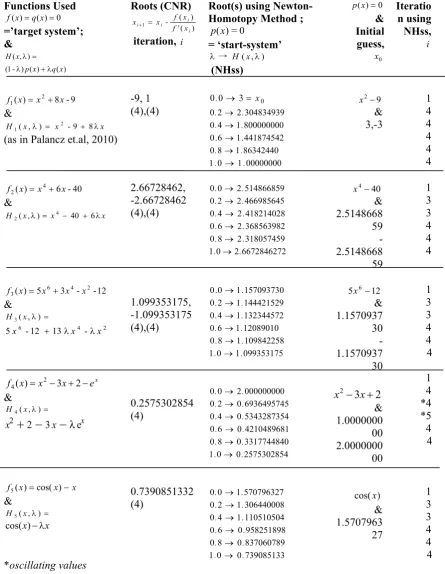
In this section, some numerical examples presented to illustrate the efficiency of the iterative methods such as the classical Newton-Raphson (CNR) and the start-system homotopy (see Eq. (7)). By using the following test functions ((a), (b), (c), (d) and (e)) and specified the outputs to 10-digit values, we obtained the results as shown in Table 1.
(a) ( ) 2 8 -9
1 x x x
f (See Palancz et.al, 2010);
(b) 0( ) 4 6 -4
2 x x x
f ;
(c) ( ) 5 6 3 4- 2-12
3 x x x x
f ;
(d) f (x)x23x2ex
4 (See Abbasbandy, 2003; Saeed & Khthr, 2010);
(e) f5(x)cos(x)x (See Abbasbandy, 2003; C.Chun et.al, 2009; C.Chun & Neta, 2009; Kou et.al, 2010; Li et.al, 2010).
Table1 shows that the efficiency of the iterative Newton-homotopy using start-system (NHss) gives equal or better results in terms of convergence rate as compared to the classical Newton-Raphson. It seems that the computations converge in less than 5 iterations.
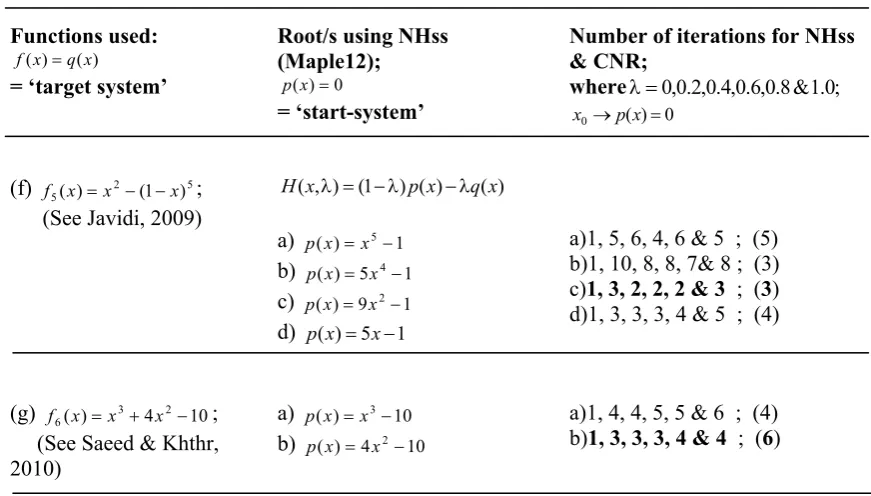
We also approximated using different powers of x on the start-systems and recorded the number of iterations. The following test functions (f) and (g) are used and the approximated zeros are displayed in Table 2:
(f) f6(x) x2(1x)5 (See Javidi, 2009);
Table 1: Numerical experiment results of the existing method, the Classical Newton-Raphson (CNR), and the proposed methods, the Newton-Homotopy using start-system (NHss) using
Maple14. Functions Used 0 ) ( ) (x qx f =’target system’; & ) , (x H ) ( ) ( ) -1
( px q x
Roots (CNR) ) ( ' ) ( -1 i i i i x f x f x x
iteration, i
Root(s) using Newton-Homotopy Method ;
0 = ) (x p = ‘start-system’ ) , (
H x
(NHss)
0 ) (x
p & Initial guess, 0 x Iteratio n using NHss, i 9 -8 ) ( 2
1 x x x
f
&
x x
x
H ( ,) 2 -9 8 1
(as in Palancz et.al, 2010) -9, 1
(4),(4) 0
3 0
0. x
304834939 2
2 0. .
800000000 1
4 0. .
441874542 . 1 6 . 0 86342440 1 8 0. .
00000000 1
0
1. .
9 2 x & 3,-3 1 4 4 4 4 4 40 -6 ) ( 4
2 x x x
f
&
x x
x
H ( ,) 4 40 6 2 2.66728462, -2.66728462 (4),(4) 514866859 2 0 0. .
466985645 2
2 0. .
418214028 2
4 0. .
368563982 2
6 0. .
318057459 2
8 0. .
6672846272 2
0 1. .
40 4 x & 2.5148668 59 -2.5148668 59 1 3 3 4 4 4 12 -3 5 )
( 6 4 2
3 x x x x
f
& ) , ( 3 x H 2 4 6 -12 13
-5x x x
x
e x x x
f ( ) 23 2 4 & ) , ( 4 x H x x x
f5( )cos( )
& ) , ( 5 x H x x) cos( *oscillating values 1.099353175, -1.099353175 (4),(4) 0.2575302854 (4) 0.7390851332 (4) 157093730 . 1 0 . 0 144421529 1 2 0. .
132344572 1
4 0. .
12089010 1
6 0. .
109842258 1
8 0. .
099353175 1
0 1. .
000000000 2
0 0. .
6936495745 0
2 0. .
5343287354 0
4 0. .
4210489681 0
6 0. .
3317744840 0
8 0. .
2575302854 0
0 1. .
570796327 1
0 0. .
306440008 1
2 0. .
110510504 1
4 0. .
958251898 0
6 0. .
837060789 0
8 0. .
739085133 0
0 1. .
12 5x6
& 1.1570937 30 -1.1570937 30 2 3
2 x
Table 2: Comparison of Classical Newton-Raphson (CNR) and Newton-homotopy using different start-systems (NHss).
Functions used:
) ( ) (x q x
f
= ‘target system’
Root/s using NHss (Maple12);
0 ) (x p
= ‘start-system’
Number of iterations for NHss & CNR;
where0,0.2,0.4,0.6,0.8&1.0; 0
) ( 0p x
x
(f) 2 5
5(x) x (1 x)
f ;
(See Javidi, 2009)
) ( ) ( ) 1 ( ) ,
(x p x q x
H
a) p(x)x51 b) p(x)5x41 c) p(x)9x21 d) p(x)5x1
a)1, 5, 6, 4, 6 & 5 ; (5) b)1, 10, 8, 8, 7& 8 ; (3) c)1, 3, 2, 2, 2 & 3 ; (3) d)1, 3, 3, 3, 4 & 5 ; (4)
(g) ( ) 3 4 2 10 6 x x x
f ;
(See Saeed & Khthr, 2010)
a) p(x)x310 b) p(x)4x210
a)1, 4, 4, 5, 5 & 6 ; (4) b)1, 3, 3, 3, 4 & 4 ; (6)
In Table 2, it can be seen that the functions that use the start-system with lower degree of n (such as degree of two) converges faster than the higher degree.
4. CONCLUSIONS
As demonstrated in the numerical results, Newton-Homotopy using start-system method converges better or equal to the classical Newton-Raphson. It is also very important to have a proper start-system to ensure convergence is fast and computing time is reduced.
REFERENCES
Abbasbandy, S. (2003). “Improving Newton-Raphson method for nonlinear equations by modified Adomian decomposition method” Applied Mathematics and Computation.145(2-3).pp.887-893.
Chun, C. & Neta, B. (2009). “A third-order modification of Newton’s method for multiple roots” Applied Mathematics
and Computation211.pp.474-479.
Chun, C., Bae, H. & Neta, B. (2009). “New families of nonlinear third-order solvers for finding multiple roots”
Computer and Mathematics with Applications58.pp.1574-1582.
Choi, S.H. & Book, N.L. (1991). “Unreachable roots for global homotopy continuation methods” AIChE J
37(7).pp.1093-1095.
Fang, L. & He, G. (2009). “Some modifications of Newton’s method with higher-order convergence for solving nonlinear equations” Journal of Computational and Applied Mathematics 228.pp.296-303.
Feng, X. & He, Y. (2007). “High order iterative methods without derivatives for solving nonlinear equations” Applied
Mathematics and Computation186(2).pp.1617-1623.
Hazaveh K., Jeffrey D.J., Reid G.J., Watt S.M., Wittkopf A.D. (2003). “An exploration of homotopy solving in Maple”
WSPC Proceeding.
He, J-H. (1999). “Homotopy perturbation technique” Computer Methods in Applied Mechanic and Engineering
178.pp.257-262.
Li, S.G., Cheng, L.Z. & Neta, B. (2010). “Some fourth-order nonlinear solvers with closed formulae for multiple roots” Computer and Mathematics with Applications59 pp.126-135.
Nor Hanim Abd. Rahman, Arsmah Ibrahim & Mohd Idris Jayes (2010a). “Non-division Iterative Newton-Raphson in Solving x= surd[(a/R)]^(1/n)” Proceeding of ICSTIE'10, pp.47
Nor Hanim Abd Rahman, Arsmah Ibrahim, & Mohd Idris Jayes (2010b) “Newton Homotopy Solution for Nonlinear Equations using Maple” Buku Prosiding Jilid 2 Matematik SKASM2010 sempena SKSM18. pp. 225-232.
Nor Hanim Abd Rahman, Arsmah Ibrahim & Mohd Idris Jayes (2010c). “Non-division Newton-Raphson Method in Solving Nonlinear Equations” Proceedings of the 2nd International Conference on Mathematical Sciences
(ICMS2).pp. 491-498.
Palancz, B., Awange, J.L., Zaletnyik, P. & Lewis, R.H. (2010). “Linear homotopy solution of nonlinear systems of equations in geodesy” Journal of Geodasy 84(1).pp.79-95. doi 10.1007/s100190-009-0346-x.
Rafiq, A & Awais, M. (2008). “Convergence on the homotopy continuation method” International Journal of
Appl. Math and Mech4(6).pp.62-70.
Saeed, R.K. & Khthr, F.W. (2010). “Three new iterative methods for solving nonlinear equations” Australian
Journal of Basic & Applied Sciences4(6).pp.1022-1030.
Shenggou, L., Xiangke, L. & Lizhi, C. (2009). "A new fourth-order iterative method for finding multiple roots of nonlinear” Applied Mathematics and Computation215.pp.1288-1292.
Yun, B.I. (2009). “A derivative free iterative method for finding multiple roots of nonlinear equations”