ITER Instrumentation and Control System towards Long
Pulse Operation
∗
)
Izuru YONEKAWA, Antonio Vergara FERNANDEZ, Jean-Marc FOURNERON,
Jean-Yves JOURNEAUX, Wolf-Dieter KLOTZ, Anders WALLANDER and CODAC Team
ITER Organization, Route de Vinon sur Verdon, 13115 St. Paul lez Durance, France
(Received 28 November 2011/Accepted 28 February 2012)
ITER is a long-pulse tokamak with elongated plasma. The nominal inductive operation produces a D-T fusion power of 500 MW for a burn length of 300-500 s, with the injection of 50 MW of auxiliary power. With non-inductive current drive from the H&CD systems, the burn duration is envisaged to be extended to 3000 s.
The term ITER Instrumentation & Control (I&C) includes everything required to operate the ITER facility. It comprises three vertical tiers; conventional control, interlock system and safety system, and two horizontal layers; central I&C systems and plant system I&C. CODAC (Control, Data Access and Communication) system forms the upper level of the hierarchy, and is the conventional central control system of ITER architecture. CODAC system is responsible for integrating all plant system I&C and enable operation of ITER as a single integrated plant. CODAC system provides overall plant systems coordination, supervision, plant status monitoring, alarm handling, data archiving, plant visualization (HMI) and remote experiment functions. CIS (Central Interlock System) and CSS (Central Safety System) also form the upper level of the hierarchy to supervising and integrating all plant system interlock and safety functions. Plant system I&C forms the lower level of the hierarchy, and provide dedicated plant data acquisition, plant status monitoring, plant control and plant protection functions to perform individual plant system operation under the supervision of central I&C systems.
c
2012 The Japan Society of Plasma Science and Nuclear Fusion Research
Keywords: ITER, I&C, CODAC, PCDH, CODAC core system, EPICS, CIS, CSS DOI: 10.1585/pfr.7.2505047
1. Introduction
The main challenge for ITER instrumentation and control system is to integrate all plant system I&C and en-able integrated and automated operation of the ITER facil-ity. Since more than 60 % of value of the ITER project is driven by in-kind procurements from seven parties, the priority of the ITER central control group has been to es-tablish the standards and technologies affecting the plant system I&C as well as reducing risks in future integration. This point is already presented in many occasions [1, 2].
Two evolving products have been developed to allow this: a set of documents, called the Plant Control Design Handbook (PCDH), defining the standards and a control system framework, called CODAC Core System, imple-menting those standards and providing a development en-vironment for plant system I&C. In parallel, the design of the central I&C system is proceeding with the preliminary design review scheduled in late 2011.
1.1
Plant control design handbook
The PCDH is a set of documents that defines manda-tory rules, recommended guidelines, methodologies and catalogues of supported products. It is a living
docu-author’s e-mail: [email protected]
∗)This article is based on the invited presentation at the 21st International
Toki Conference (ITC21).
ment with the latest release issued in February 2011. The PCDH specifies the design methodology for development of plant system I&C including deliverables according to the plant system life cycle. It includes a catalogue of sup-ported products. The catalogue includes Siemens Simatic S7 PLC, IEI PICMG 1.3 PC, National Instrument multi-purpose PXI6259 I/O board, Sarel cubicles and many more products to be defined soon as supported products.
The PCDH is contractually binding in all in-kind pro-curements. It has been subjected to thorough review by representatives of all ITER member states. The ITER cen-tral control group is actively promoting PCDH by organiz-ing presentations and trainorganiz-ing in the member states as well as developing pilot cases for proof of concept. PCDH is available at [3].
1.2
CODAC core system
CODAC Core System (CCS) is a control system soft-ware framework that implements the standards defined in the PCDH and guarantees that the plant system I&C can be integrated into the central I&C system [4]. It runs on all computers within the ITER architecture, both locally and centrally. The most important feature is the use of the EPICS middleware [4], which guarantees communication using the channel access protocol. Major releases of CCS are made on a yearly basis. ITER contributions in addition
c
2012 The Japan Society of Plasma
to EPICS are publicly available at [5].
Organizations contributing to the ITER project, in par-ticular developers of local control systems can become reg-istered users. A regreg-istered user is provided with support, such as software distribution, help desk and access to the development environment.
In this paper, we report focusing on the central Instru-mentation and control part with important technology se-lection.
2. Required Functions
Required key functions to the ITER control system are 1) control and monitor ITER to allow operation, 2) protect ITER investment from failure of plant system components or incorrect machine operation, and 3) protect environment and people from possible nuclear risk and plant operation hazards.
These key functions are segregated into three sepa-rate control tiers in ITER: conventional control system, interlock control system and safety control system. They present the fundamental system architecture.
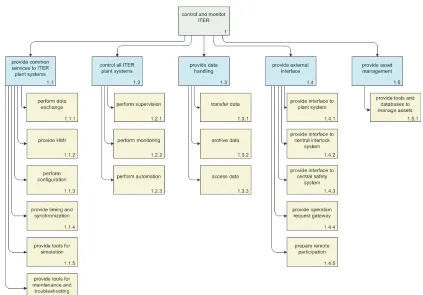
The required key functions for the CODAC are clas-sified into following five categories: 1) provide common services for ITER plant systems, 2) control ITER all plant systems, 3) provide data handling, 4) provide external in-terfaces and 5) provide asset management. These five key functions are also further broken down into detailed
func-Fig. 1 Top level functional breakdown of CODAC.
tions to design CODAC system. Figure 1 shows CODAC top level functional breakdown.
3. Architecture
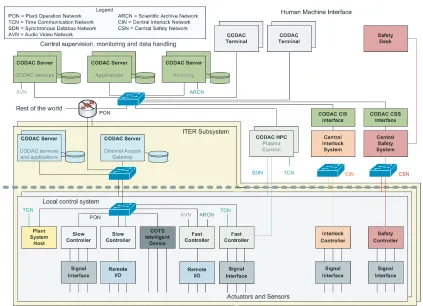
The architecture of the ITER control system is illus-trated in Fig. 2. The main principles are maintained from the conceptual design [6], segregation in three vertical tiers; conventional control: interlock control: and safety control: and two horizontal layers; central and local. The local layer is procured in-kind, while the central layer is developed by the host, ITER Organization in France.
Fig. 2 Physical architecture of ITER control system.
4. Selected Technologies
4.1
EPICS
A key technology decision was taken in 2009 with the adoption of the EPICS toolkit. This decision gave a head start to the development of CODAC Core System because all key requirements, such as robust communica-tion and “live database”, are solved by EPICS. In the pre-ceding evaluation, open source solutions took preference over commercial ones because of longevity requirements. Of the open source alternatives EPICS was preferred over other choices because of its proven track record of reliabil-ity and scalabilreliabil-ity and the fact that it has been successfully deployed in almost all ITER member states, including on tokamaks in Korea (KSTAR) and the US (NSTX). CODAC Core System v2 comes with EPICS core v 3.14.12 and a selection of additional EPICS packages.
4.2
Linux
A second important decision was to adopt Linux as the base operating system. It is an obvious choice consid-ering the selection of EPICS/LINUX for large experimen-tal facilities in the world. An evaluation was carried out of the three mainstream distributors of Linux: Ubuntu, Red Hat and SUSE. Red Hat was selected for being the market leader and providing the longest support of major releases. CODAC Core System v2 comes with Red Hat Enterprise Linux (RHEL) v5.5 x86 64. It is planned to upgrade to v6.1 in the next major release due in early 2012.
4.3
Control system studio
Control System Studio (CSS), developed by DESY, ORNL and Brookhaven, is an Eclipse-based collection of tools running on top of EPICS to monitor and operate large scale control systems. An evaluation was carried out to ad-dress both the functionality and performance of the prod-uct and match the requirements, mainly on the presenta-tion layer, of CODAC. Many of these tools rely on a rela-tional database (RDB), typically Oracle or MySQL. How-ever, due to the uncertainty of MySQL’s future as open source ITER has selected PostgreSQL as RDB. The evalu-ation therefore also included compatibility tests with Post-greSQL. The result was to add BOY (Best ever Operating interface Yet), BEAST (Best Ever Alarm System Toolkit), BEAUTY (Best Ever Archive UTility, Yet) and SNL Edi-tor (State Notation Language EdiEdi-tor) as toolbox for appli-cation development in CODAC Core System.
4.4
Configuration
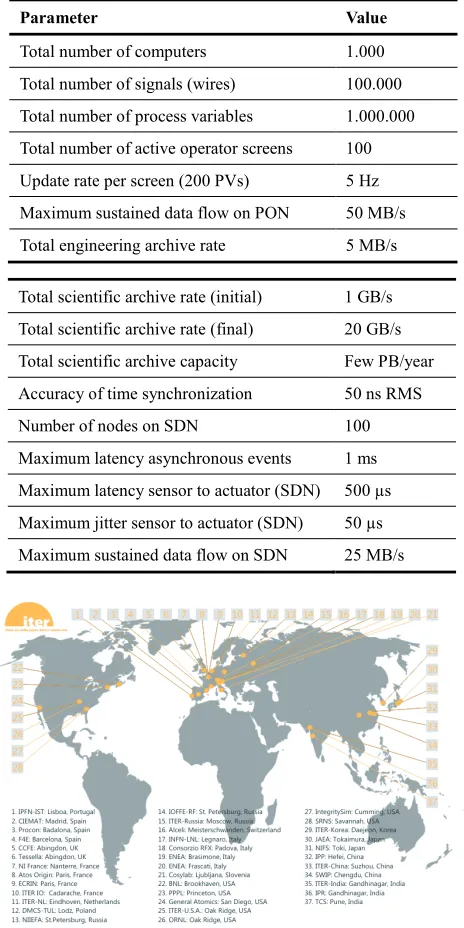
Table 1 ITER controls main parameters.
Fig. 3 Registered organizations using CCS.
called self-description data (SDD) : are given in [8]. SDD makes heavy use of data base technologies like: Hibernate, Spring, Web Services, and PostgreSQL.
4.5
Development environment and
distribu-tion
The distributed nature of the ITER control system de-velopment (Fig. 3) requires high quality, both on the prod-uct (CODAC Core System) and the software distribution. To achieve quality and be cost effective unifying processes and technologies are essential. Major investments have been made in this area. Subversion has been selected as the version control tool, Apache Maven as the build tool, RPM (Red Hat package management) for packaging and
Fig. 4 Measured latency 1 GbE, 10 GbE and RMN.
for managing dependencies, Bugzilla as the issue tracking system, Jenkins for continuous integration and automated test execution and Red Hat Network Satellite Server for software distribution [9].
4.6
PTPv2 (IEEE 1588-2008)
The driving requirement for synchronizing ITER computers is the correlation of different diagnostics data using absolute time stamps. The requirement for absolute time stamp precision has been set to 50 ns RMS. Require-ments for pre-programmed triggers are much more relaxed (1 ms RMS). These requirements are matched closely by the precision time protocol (IEEE 1588-2008) now widely supported by many vendors. We have implemented the CODAC TCN network based on a PTPv2 using Mein-berg and Symmetricom grand master clocks, IEEE 1588-2008 compatible industrial switches (Cisco IE3000 and Hirschman MAR1040) and NI PXI 6682 timing receivers as host nodes and confirmed the performance.
4.7
10 GbE multicast UDP
tech-nology evolution of Ethernet we have therefore selected 10 GbE UDP multicast as our solution for the real-time net-work. Table 1 shows required performance assumption of ITER control system.
5. Current R&D for Technology
Se-lection
The two biggest areas of technology selection not yet addressed are scientific archiving and plasma feedback control. A preliminary study of scientific data format has been carried out resulting in indications that HDF5 is the preferred candidate. This will be followed by the im-plementation of an archive prototype in 2012. Different options for high performance file systems are also being benchmarked, the main candidates being NFS4, HDFS and pNFS.
A major world-wide effort task with a consortium of experts in plasma control has been initiated. This task aims to detail the requirements and build engineering models of plasma control for ITER. In parallel an evaluation of existing real-time frameworks is underway. This frame-work, together with the real-time netframe-work, will make up the plasma control infrastructure. A primary candidate at this time is MARTe or some derivate of that [10].
A third area of active R&D concerns fast controllers, particular xTCA and FPGA technologies targeting diag-nostics. A number of prototypes are being implemented with the aim of bringing such products into the PCDH cat-alogue of standard components.
6. Scientific Data Archiving
ITER data archiving strategy is to have temporary storage inside secure operation zone within 10 days storage for operation, and permanent data storage outside secure operation zone for physics and other people usage includ-ing remote sites.
ITER produces two different types of data during its operation.
a) Engineering data: consists of data produced conven-tional plant systems such as process value, alarms, control commands. It is characterized slow data rates and low volume than scientific data.
b) Scientific data: consists principally of data produced by the diagnostic systems. It is characterized by much higher data rates and volume than the engineering data, and therefore requires special treatment. The selected data writing performance of EPICS/CSS based slow data archiver is around 8000 samples/sec), therefore, dedicated to scientific data archiving system is required.
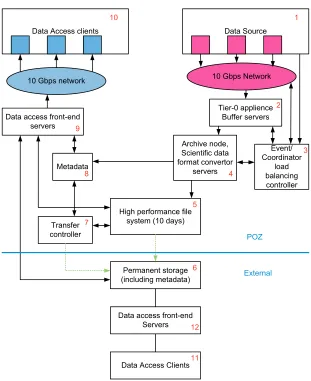
Figure 5 gives the outline architecture of the scien-tific archiving system. The most challenging requirement is managing the very high-bandwidth data stream (some-times up to 50 GB/sec for 10 seconds), while the other data
streams are continuously archived during the long pulse. To meet this requirement, a two-tier approach is suggested. Box 1 represents the different data sources which stream data to the Tier-0 appliance including nodes connected to SDN (box 2). Its main task is to buffer the raw data as fast as possible into memory. Load-balancing between the dif-ferent buffer servers is required to ensure that a server is not overwhelmed. This is done via the information con-troller (box 3), which also keeps track of the status of the incoming data and buffer servers. Then the archiving nodes (box 4) read data from the buffer servers and convert them into the appropriate format and store the data into files in the high performance file system (box 5). This file sys-tem is shared by all the archiving nodes and should have enough capacity to store 10 days of data. The metadata server stores information about the files residing in the high performance file system, such as pulse number and cor-responding time range, etc. The data files are then repli-cated (streamed) as fast as possible to the permanent stor-age system (box 6). All off-line physics treatment of data is using this storage. There is a transfer controller service (box 7) which monitors the file transfer between tempo-rary and permanent storage. Once the file is replicated, the metadata server is updated to indicate that the file has been successfully transferred to permanent storage and can be removed to make room for more data in the temporary archive system.
Data can be accessed from both inside and outside the plant operation zone (POZ). In the case of an external re-quest (box 11), the data comes from the permanent storage (never from the temporary one). In the case of an internal request (box 10), the data access front-end servers (box 9) checks with the metafile server (box 6) whether the file is still in the temporary storage. If it is not there, it gets fetched from the permanent one.
7. Plasma Control
The Plasma Control System is responsible for all as-pects of Plasma Control during an ITER discharge. Its main control functions can be grouped into 6 categories:
a) Wall conditioning and Tritium removal
b) Axisymmetric magnetic control (plasma shape, verti-cal stability, etc.)
c) Non-axisymmetric magnetic control (ELM control, NTM control, etc.)
d) Kinetic control (density, fusion burn, etc.) e) Disruption avoidance and mitigation
f) Event handling
Fig. 5 Outline of scientific data archiving system.
various systems on ITER will be installed only during the first few years of operation. Hence increasing control func-tionality will be required depending on the availability of diagnostics and actuators. The PCS must be capable of adding functionality without impacting the rest of the sys-tem. These requirements can only be fulfilled by a highly modular and flexible system.
The long pulse duration of ITER also requires an ex-ception handling system in order to mitigate effects of plant system failure or performance degradation and also to ad-dress plasma-driven effects such as edge-localized modes or neoclassical tearing modes. Furthermore, machine pro-tection will be an important factor for the plasma control system. ITER will be the first machine where the main mitigation action of the central interlock system (plasma termination by massive gas injection) will have a detrimen-tal effect on machine lifetime due to stress in components induced by the disruption following the gas injection. The PCS will be the first line of defence for machine protection and will implement a number of methods to avoid having to fire the plasma termination system. R&D activities are underway to investigate event handling strategies and de-velop simulation tools to design and test PCS algorithms
for control and protection. At the present, conceptual de-sign of the PCS is still on-going and that no implementa-tion decision has been taken yet.
8. Remote Experiment Concept
ITER is designed and being constructed by the seven member states (China, Europe, India, Japan, Korea, Russia and United States). Remote participation from ITER off -site to ITER experiment is therefore extremely important. Possible support provided by CODAC system to remote participation are monitor operational data, requesting sci-entific data near real time and remote clients of the ITER pulse scheduling. To protect unauthorized access into se-cured network zone POZ, Operation Request Gatekeeper (ORG) was introduced. This function validates the request and managing authorized access such as examine against known user list and pre-defined role. This requirement may not necessary for the first operational year and as such its implementation deferred to later time. Figure 6 shows the concept of ORG.
9. Interlock and Safety System
com-Fig. 6 Operation Request Gatekeeper concept.
Fig. 7 CIS and PIS Architecture.
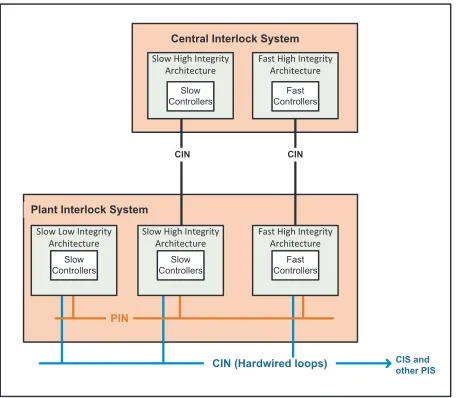
bination of the central interlock system as plant wide ITER machine protection and plant interlock system as individ-ual plant system components protection against failure of the components and off-normal operational events. Re-quired functions for the interlock system are to protect ITER machine automatically or manually, to record com-ponents failure and protection actions and display the in-terlock system status to the operator. To implement these interlock functions, local/central action, low/high integrity and slow/fast protection concepts have been adopted for the design. Figure 7 shows simplified central interlock sys-tem (CIS) and plant interlock syssys-tem (PIS) architecture. To make reliable interlock system, CIS and PIS exchange dig-ital Boolean data to create protective actions, and use CO-DAC infrastructure for data recording and display to the operator. Plant wide interlock functions are coordinated by the CIS as basic philosophy. However, some limited in-terlock action such as coil quench protection use hardwired interlocks directly between the sensors and actuators of the
Fig. 8 SCS-N overview.
related plant systems. This is one of the exceptional cases where hardwired links are needed due to the extremely high reliability and/or fast response required [11].
ITER safety system is composed of nuclear safety sys-tem and occupational safety syssys-tem for the purpose to pro-tect environment and personnel against nuclear related is-sues and risks, and control the access to the building where plant operation related hazards may exist. These two sys-tems are independent. It is the first time that a Tokamak will be considered as nuclear facility with significant nu-clear risks. The main nunu-clear safety functions are related to the tritium confinement.
To achieve functional safety, Safety Integrity Level (SIL) assessment is applied. The SIL is determined for each safety function according to the associated risk estimated frequency and the seriousness of its consequences.
A Safety Integrity Level (SIL) applies to an end-to-end safety function of the safety-related system, not just to a component or part of the system. Both systems maximise the usage of commercial off-the shelf (COTS) components to provide reliable and cost effective solutions.
10. Pilot Projects
A number of pilot projects have been initiated to con-firm the technology selections, prove the feasibility of im-plementing ITER controls using the selected approaches and identify any weak points to be addressed.
The ITER construction site and office buildings are currently powered by a 15 kV substation. Applying the methodology and standard components defined in the PCDH, this substation has been successfully interfaced to ITER CODAC using two Siemens S7 PLCs, PSH, CODAC servers and CODAC Core System to monitor, archive and handle alarms for 400 process variables. Also similar ap-plication to the building monitoring system BMS) is under development.
The neutral beam test bed facility in RFX Padova, Italy, will be used to test and commission the neutral beam injectors for ITER. The first system to be implemented will be an ion source and RFX has decided to apply CODAC Core System in this project. An initial evaluation has not shown any show-stoppers. The project is expected to be completed in 2015.
The Frascati Tokamak Upgrade (FSU) in Italy decided to upgrade the control for their flywheel generator using PCDH and CSS. This has been accomplished and an inter-face to the legacy control system has been implemented. Commissioning of the system during tokamak operation is planned in the autumn.
The control system of KSTAR (Korea Superconduct-ing Tokamak Advanced Research) is based on EPICS and
therefore a perfect candidate for testing ITER CODAC concepts. A collaboration project is underway to convert the hydrogen fuelling system to ITER standards and to im-plement closed-loop density control. The conclusion of the first phase is scheduled for late 2011 and of the second phase for late 2012.
11. Conclusions
The design and implementation of the ITER control system is progressing according to the plan. Functional roles between central I&C system and plant system I&C are well defined. Still some detailed functions inside CO-DAC are conceptual and need further development. Many technology decisions have been taken during the last year. The success or failure of the project will be determined by the acceptance of this work by the ITER member states responsible for providing in-kind local control systems.
The views and opinions expressed herein do not nec-essarily reflect those of the ITER Organization
[1] J.Y. Journeaux et al., “Instrumentation and control stan-dardization in the ITER project”, 26th Symposium on Fu-sion Technology (2010).
[2] A. Wallander et al., “News from ITER Controls-Status Re-port”, 13th International Conference on Accelerator and Large Experimental Physics Control Systems (2011). [3] http://www.iter.org/org/team/chd/cid/codac
[4] F. Di Maio et al., “The CODAC software distribution for the ITER plant systems”, 13th International Conference on Accelerator and Large Experimental Physics Control Sys-tems (2011).
[5] http://www.aps.anl.gov/epics
[6] J.B. Lister et al., Fusion Eng. Des. 83, 164 (2008). [7] A. Wallander et al., “Baseline Architecture of ITER control
system”, IEEE TNS 2011 (in press).
[8] L. Abadie et al., “The self-description data configuration model”, IAEA TM8, San Francisco, June 2011.
[9] A. Zagar et al., “ITER CODAC Core System Development Process”, IAEA TM8, San Francisco, June 2011.