THE INFLUENCE OF SCOPE AND
TIMING OF QUALITY ASSURANCE IN
THE PLANNED AND SYSTEMATIC
PATTERN OF SOFTWARE
DEVELOPMENT PROCESS: A NOVEL
STUDY
Dr.S.S.Riaz Ahamed
Principal, Sathak Institute of Technology, Ramanathapuram, Tamilnadu, India.
Email:[email protected]
ABSTRACT
Software quality is a composite work and can be enriched by high level analysis, design structure, encoding, testing to be followed with a properly structured FTR and corrective action. This has become a conventional practice. New voices are being heard that quality principles can be factored into a model and that can turn out a broad spectrum of indices and metrics. In turn these indices and metrics can measure either explicitly or implicitly the quality of the software. Variations in turning out finely designed product eat into the vitals of quality content. Control over quality is ensured by setting in motion a chain of inspections reviews and tests that verify that each section of the working module functionally meets its assigned task. Where deviations from the norms specified are observed the aberrations are to be corrected by retuning the process. Quality Assurance is possible only if quality products are turned out. In turn it is helped by auditing and reporting. Needless to say mere auditing and reporting will not produce quality products.
Keywords: Software Quality Assurance (SQA), Software Quality Assurance Plan (SQAP)
1. INRODUCTION
Figure 1: Example Building Blocks
2. MANAGEMENT INDICATORS FOR SOFTWARE DEVELOPMENT
The accurate assessment of software status during development continues to be a strong requirement during all phases of development. The general idea of management indicators is it is a set of quantitative indicators for higher management’s use in evaluating software development. It is possible to define a set of quantitative indicators to assist management assessment of current project status. Each indicator is required to drive a red, amber, or green assessment that provides status without requiring expert understanding of the indicator methodology. The use of these indicators greatly enhances the timeliness of software status, visibility into software problems, and timely initiation of corrective actions. By looking at the indicators that have been assessed as red, management can easily identify the areas that truly require management attention. The concept is best illustrated by the use of an example - requirements stability. The requirements stability measurement is an indicator of the amount of software requirements changes (new or revised requirements) that occur during development. The intent of this indicator is to measure the degree of software requirements stability and flag situations where the volume of changes begins to substantially impact the software development and testing process.
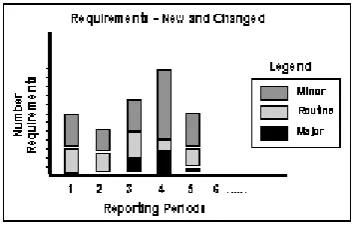
The determination of a requirement change's impact is a key aspect of assessing stability. Each change's impact can be assigned to one of three categories major, routine, or minor as shown below. The numeric values of the boundaries between the categories are for illustrative purpose only. Specific values must be determined for each program.
Category Attribute
Major Causing greater than 5% re-design (i.e., 5% change in the requirements), or 5% re-code (i.e., 5% change in the source lines of code), or 5% re-test of the Build, or 5% change in the number of test cases of a specific subsystem.
Routine Less than 5% re-design, or re-code or re-test
Minor No significant re-design, re-code or re-test
A display can then be constructed of the number of requirement changes in each category for each reporting period as shown below.
Figure 2: Requirement Stability Display
STATUS THRESHOLD
RED >= 1 Major or 4 Routine
AMBER > 2 Routine
GREEN Below AMBER threshold
Figure 3: Requirement Change Threshold
In the example shown in figure 2, the assessment for the current reporting period for this indicator would be Red since it has one major requirement change.
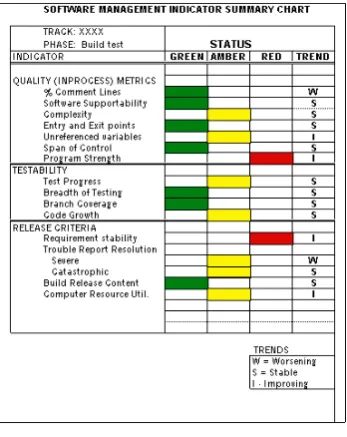
When this type of analysis is accomplished on a number of areas of interest, you can than construct a display as shown below.
Figure 4: Management Indicator Example
By looking at the indicators that have been assessed as red, management can easily identify the areas that truly require management attention and can now concentrate their attention to those areas.
A number of organizations have adopted this approach. For example, the Software Engineering Directorate (SED), Army Aviation & Missile Command defined a minimum set of indicators that addresses the progressive phases of software development. These indicators provide management with the visibility to verify that: 1. the software product has been adequately defined
2. software development has been properly planned and is progressing satisfactorily 3. the product has been properly documented
4. the product has been progressively tested to meet its requirements 5. the software is effectively supportable over the life cycle
The software management indicators selected by SED cover every phase of the software development. The indicator set covers the following measurement categories:
- Requirement Stability - Software Development Manpower - Software Development Progress - Computer Resource Utilization - Schedule Risk - Trouble Report Resolution
- Software Product Delivery - Supportability
An indicator has been designed for each of these eight categories. Each of these indicators will have a red, amber, green assessment to communicate status to management.
In general the Management indicator can be used to
Work and progress (work performed over time)
Budgeted cost and expenditures (cost incurred over time)
Change traffic and stability (change traffic over time)
Breakage and modularity (average breakage per change over time)
Rework and adaptability (average rework per change per change over time)
Meantime between failures (MTBF) and maturity (defect rate over time)
3. SOFTWARE QUALITY ASSURANCE
Software Quality Assurance (SQA) is a planned and systematic pattern of all actions necessary to provide adequate confidence that the item or product conforms to establish technical requirements. Software Quality Assurance is synonymous with Software `Product Assurance' (PA) and the terms are used interchangeably in these Standards. The quality assurance activity is the process of verifying that these standards are being applied. In small projects this could be done by the development team, but in large projects specific staff should be allocated to the role. The Software Quality Assurance Plan (SQAP) defines how adherence to these standards will be monitored. The SQAP contents list is a checklist for activities that have to be carried out to assure the quality of the product. For each activity, those with responsibility for SQA should describe the plans for monitoring it.
Activities
Objective evidence of adherence to these standards should be sought during all phases of the life cycle. Documents called for by this standard should be obtained and examined. Source code should be checked for adherence to coding standards. Where possible, aspects of quality (e.g. complexity, reliability, maintainability, safety, number of defects, number of problems, number of RIDs) should be measured quantitatively, using well-established metrics.
Management
Analysis of the managerial structure that influences and controls the quality of the software is an SQA activity. The existence of an appropriate organisational structure should be verified. It should be confirmed that the individuals defined in that structure have defined tasks and responsibilities. The organisation, tasks and responsibilities will have been defined in the SPMP.
Documentation
The documentation plan that has been defined in the SPMP should be analysed. Any departures from the documentation plan defined in these standards should be scrutinised and discussed with project management.
Standards, practices, conventions and metrics
Adherence to all standards, practices and conventions should be monitored.
Reviews and audits
These Standards call for reviews of the URD, the SRD, the ADD, the DDD, the SVVP and the SCMP. It also calls for the review and audit of the code during production. The review and audit arrangements described in the SVVP should be examined. Many kinds of reviews are possible (e.g. technical, inspection and walkthrough). It should be verified that the review mechanisms appropriate for the type of project. SQA personnel should participate in the review process.
Testing activities
Unit, integration, system and acceptance testing of executable software is essential to assure its quality. Test plans, test designs, test case, test procedures and test reports are described in the SVVP. These should be reviewed by SQA personnel.
Problem reporting and corrective action
The problem handling procedure described in these standards is designed to report and track problems from identification until solution. SQA personnel should monitor the execution of the procedures, described in the SCMP, and examine trends in problem occurrence.
Tools, techniques and methods
These Standards call for a tools, techniques and methods for software production to be defined at the project level. It is an SQA activity to check that appropriate tools, techniques and methods are selected and to monitor their correct application. SQA personnel may decide that additional tools, techniques and methods are required to support their monitoring activity. These should be described in the SQAP.
Code and media control
These Standards require that the procedures for the methods and facilities used to maintain, store, secure and document controlled versions of the identified software, be defined in the SCMP. SQA personnel should check that appropriate procedures have been defined in the SCMP and carried out.
Supplier control
Software items acquired from external suppliers must always be checked against the standards for the project.
Records collection, maintenance and retention
Training
SQA personnel should check that development staff are properly trained for their tasks and identify any training that is necessary. Training plans are documented in the SPMP.
Risk management
All projects must identify the factors that are critical to their success and control these factors. This is called `risk management'. Project management must always analyse the risks that affect the project. Their findings are documented in the SPMP. SQA personnel should monitor the risk management activity, and advise project management on the methods and procedures to identify, assess, monitor, and control areas of risk.
4. THE SOFTWARE QUALITY ASSURANCE PLAN
All software quality assurance activities shall be documented in the Software Quality Assurance Plan (SQAP).Software Quality Assurance Plan for the SR phase
1 Purpose
2 Reference Documents 3 Management
4 Documentation
5 Standards, practices, conventions and metrics 5.1 Documentation standards
5.2 Design standards 5.3 Coding standards 5.4 Commentary standards 5.5 Testing standards and practices
5.6 Selected software quality assurance metrics 5.7 Statement of how compliance is to be monitored 6 Review and audits
6.1 Purpose
6.2 Minimum requirements 7 Test
8 Problem reporting and corrective action 9 Tools, techniques and methods
10 Code control 11 Media control 12 Supplier control
13 Records collection, maintenance and retention 14 Training
15 Risk Management
16Outline of the rest of the project
5. FORMAL APPROACHES TO SQA Proof of Correctness
Treat a program as a mathematical object.
Developed with a language with a rigorous syntax.
Are attempts at developing a rigorous approach to specification of software requirements.
With both can attempt to develop a mathematical proof that a program conforms exactly to its specification.
In the code, can at selected statements formulate assertions on the set of correct values for program variables.
Can then show that the statements between these assertions do the correct transformation of the values in the assertions.
Statistical Quality Assurance
In statistical quality assurance:
1. Information about software defects is collected and categorised.
2. An attempt is made to trace each defect to its underlying cause (e.g., not conforming to the specification, design error, violation of standards, poor communication with customer ...)
3. Using the 'Pareto principle' (80% of defects can be traced to 20% of all possible causes), isolate the 20% of causes (the "vital few").
The Cleanroom Process
Use statistical quality control and formal program verification.
Attempt to prevent defects rather than find defects.
In projects attempted so far with this method (size between 1000 and 50,000 LOC), 90% of all defects were found before the first execution tests were conducted.
Has not been widely applied in industry.
Requires significant change in both management and technical approaches to software development.
6. CONCLUSION
Quality Assurance is possible only if quality products are turned out. In turn it is helped by auditing and reporting. Needless to say mere auditing and reporting will not produce quality products. Periodical and many a time continuous auditing and reporting systems are basic tools. The management has access to some data anyway. But will it enable the management to feel the standard and quality of the software product that is under process? Audit and report supply the management with what we may call as post-inspection data so that the management can feel confident that the product quality is up to the goals it is set to meet. Total Quality Management is applicable for computer software. TQM calls for continuous process improvement. The aim is to make the process transparent and visible and thereby to dispel the sense of secrecy that may surround the development of the software. TQM expects that the processes that are under development must be repeatable and should not be for a one-time make. The process must be in some measurable form and so needs some sort of calibration.
7. REFERENCES
[1] Roger S. Pressman, Software engineering : A practitioner’s approach, MCGraw-Hill publication, 1997, ed.4 [2] Edward Kit, Software testing in the real world, Addison-Wesley publications, 2000, ed.1
[3] Ian Sommerville, Software engineering, Addison-Wesley publications, 1996, ed.5
[4] IEEE (1990). IEEE Standard Computer Dictionary: A Compilation of IEEE Standard Computer Glossaries. New York: IEEE. ISBN 1559370793.
[5] Pankaj Jalote, An integrated approach to software engineering, Narosa publications, 1997, ed. 2 [6] Shari Lawrence Peleeger, software engineering theory and practice, Pearson education, 2001, ed. 2 [7] Richard Fairly, Software engineering concepts, McGraw-Hill Inc.,1985
[8] Binder, Robert V. (1999). Testing Object-Oriented Systems: Objects, Patterns, and Tools. Addison-Wesley Professional. p. 45. ISBN 0-201-80938-9.
[9] Beizer, Boris (1990). Software Testing Techniques (Second ed.). New York: Van Nostrand Reinhold. pp. 21,430. ISBN 0-442-20672-0.
[10] Myers, Glenford J. (1979). The Art of Software Testing. John Wiley and Sons. p. 145-146. ISBN 0-471-04328-1. [11] Barry W. Boehm, Software Engineering Economics, Prentice-Hall Inc., 1981.