Original Research Article
Birth preparedness and complication readiness among women
attending Immuno-Prophylaxis Centre, Dr. S. C. Government Medical
College, Nanded
Venkatramana K. Sonkar
1*, Ismailali F. Inamdar
2, Rambhau D. Gadekar
2INTRODUCTION
Maternal and child health remains important aspect of overall development of a nation, for that matter as a whole world, as we can see it is most important agenda on United Nations & WHO policies be it Health for all,
Millennium Development Goals or Sustainable
Development Goals (SDG). As per WHO estimates every day approximately 830 women die from preventable
causes related to pregnancy and childbirth. 99% of all maternal deaths occur in developing countries. Maternal mortality is higher in women living in rural areas and
among poorer communities.1
Government of India has launched many programmes related to maternal and child health like RCH-I, RCH-II and RMNCH + A under National health mission.2 India has achieved major milestone in maternal mortality of
ABSTRACT
Background: As signatory to United Nation’s Sustainable Development Goals, India is striving hard to achieve these
goals by end of 2030, especially for goal number 3 with targets related to maternal and child health. Birth-preparedness and complication-readiness (BPCR) is a tool to promote maternal and neonatal survival. This study was conducted to assess the perception and practices of recently delivered women on BPCR with its correlates.
Methods: Hospital-based cross-sectional study was conducted at Immuno-prophylaxis centre of Dr. Shankarrao Chavan Government Medical College, Nanded, Maharashtra. Women attending IPC along with their baby within two to four months of delivery for immunization of their babies during the month of March 2014 constituted study subject of this study. After obtaining informed consent, data was obtained on socio-demographic characters like age, caste, religion, education, parity, ANC registration and questions regarding birth preparedness and complications readiness in their last pregnancy.
Results: Total 117 women found to be eligible as study subject. Overall BPCR index of the study population was 67.28. Proportion of women who received first antenatal check-up within first trimester, four or more antenatal checkups, saved money for childbirth and had institutional delivery were 87.18%, 86.32%, 51.28% and 100% respectively. Around 23.08% women had knowledge of at least 3 key danger signs of pregnancy while only 19.65% identified blood donor. Awareness regarding danger signs of pregnancy and arrangement for blood donor was found poor in comparison to other indicators in study subject.
Conclusion: There is need of increasing awareness regarding BPCR so that perception and practices in the community increased.
Keywords: Birth preparedness, Complication readiness, Danger signs, Recently delivered women
1
Department of Community Medicine, Malla Reddy Institute of Medical Sciences, Hyderabad, 2Dr. S. C. Govt.
Medical College, Nanded, Maharashtra, India
Received: 06 May 2019
Accepted: 03 July 2019
*Correspondence:
Dr. Venkatramana K. Sonkar, E-mail: [email protected]
Copyright: © the author(s), publisher and licensee Medip Academy. This is an open-access article distributed under the terms of the Creative Commons Attribution Non-Commercial License, which permits unrestricted non-commercial use, distribution, and reproduction in any medium, provided the original work is properly cited.
556/lakh live births in year 1990 to its present estimate 174/ lakh live births in 2015, still India has to do more to achieve SDG target of 70/lakh live births.3 Similarly neonatal mortality rates of 57.4/1000 live births in 1990 to 26.1/1000 live births in 2015 showing significant improvement but still India is far behind if we compare both of these rates with developed countries.4-5
Various international experiences in maternal mortality reduction programme shows that every pregnant woman is at risk for life threatening complication and that safe delivery and access to Emergency Management of Obstetric Care (EmOC) are essential. In this context, birth preparedness is a comprehensive strategy to improve the use of skill provider at birth, the key intervention to decrease maternal mortality.6
Apart from medical causes, there are numerous interrelated socio-cultural factors which delay care-seeking and contribute to these deaths. Care-care-seeking is delayed because of the delay in identifying the complication, deciding to seek care, identifying and reaching a health facility and receiving adequate and appropriate treatment at the health facility.7
Birth-preparedness and complication-readiness (BPCR) is a tool to promote maternal and neonatal survival.BPCR is one intervention that addresses these delays by encouraging pregnant women, their families, and communities to effectively plan for births and deal with emergencies, if they occur. At the basic level, the concept of BPCR includes identifying a trained birth attendant for delivery, identifying a health facility for emergency, arranging for transport for delivery and/or obstetric
emergency, and saving money for delivery.8
There is dearth of such kind of studies in this region, for this reason the present study was conducted to assess perception and practices of recently delivered women on BPCR and its correlates.
METHODS
Study setting
A hospital-based cross-sectional study was conducted at Immuno-prophylaxis centre (IPC) of Dr. Shankarrao
Chavan Government Medical College, Nanded,
Maharashtra.
Study subjects
Women attending IPC along with their babies for immunization constituted study subjects.
Sample size
All women attending IPC within two to four months of delivery for immunization of their babies during the
month of March 2014 constituted sample size of this study.
Methods of data collection
After obtaining informed consent, questions to study subjects were asked in their local language i.e. either in Marathi or Hindi, data on socio-demographic characters like age, caste, religion, education, parity, ANC registration, ANC check-ups as well as iron and folic acid consumption, inj. Tetanus, pregnancy outcome and sex of child were asked and this information was collected with
help of pre-designed pre-tested semi-structured
questionnaire.
Bleeding from the vagina before 37 weeks, severe pain in the abdomen, breathlessness, swelling on face-body, reduced foetal movements; high fever and mal-presentation were considered as danger signs of pregnancy. If mother could tell at least three danger signs, it is considered as adequate knowledge regarding danger signs of pregnancy.7 Slow progress of labour >12 hours, excessive bleeding from the vagina, high fever accompanied by blurring of vision, fits, severe pain in abdomen, early rupture of bag of water were considered as danger signs during delivery.7 Newborn is small in size, thin/skinny, lethargic, does not accept feeds, cold to touch, difficulty in breathing (grunt or severe chest in-drawing), umbilical sepsis, and very high fever were considered as newborn danger signs.7 Skilled birth attendant identified as ANM, nurse or doctor for the purpose of this study. Knowledge about financial assistance under Janani Suraksha Yojana was also assessed.Questions regarding perceptions and practices of birth preparedness and complications readiness in their last pregnancy consisted semi closed ended questionnaire adapted from survey tools of JHPIEGO Maternal and
Neonatal Health Programme.9
Data analysis
Data was entered in Microsoft Excel and analyzed, descriptive statistics were analyzed by frequency, mean, standard deviation and percentage. BPCR index has been calculated by including seven variables i.e. ANC registration during 1st trimester, ANC check-up ≥3, Institutional delivery, saved money, arranged vehicle for emergency, arranged blood donor, knows 3 danger signs
of pregnancy. BPCR Index was unweighted average of
these seven indicators and expressed as a score out of hundred. These BPCR indicators and index also compared with socio-demographic factors to find out significance.
RESULTS
Socio-demographic characteristics
A total of 117 women who delivered 2-4 months back
immunization of their child and consented included as study subjects. Mean age of respondents was 23.80 with standard deviation of 3.50 years. Minimum age of respondent was 18 years and maximum age notified was that of 35 years. Majority of respondents were Hindu 70 (59.83%) by religion. Around half of them 59 (50.42%) belongs to other or Open category, most of the respondents 104 (88.88%) studied secondary or higher level of education. Only 9 (7.70%) women were working and rest were housewives, while 33 (28.20%) of them belongs to BPL category and 33 (28.20%) respondents living in a family size of 7 or more members.
Table 1: Socio-demographic profile of study subjects (n=117).
Sr.
No. Characteristics Number
Percentage %
1 Age in years
Mean±SD 23.80±3.50
Minimum 18
Maximum 35
2 Religion
Hindu 70 59.83
Muslim 22 18.80
Buddha 19 16.24
Sikh 4 03.42
Other 2 01.71
3 Caste
SC 26 22.23
ST 6 05.12
OBC 26 22.23
Other 59 50.42
4 Education
Illiterate 4 03.42
Primary 9 07.70
Secondary 49 41.88
Higher
secondary 28 23.93
Undergraduate 11 09.40
Postgraduate 16 13.67
5 Occupation
Housewife 108 92.30
Working 9 07.70
6 BPL/APL status
BPL 33 28.20
APL 84 71.80
7 Family size
≤4 34 29.06
5-6 50 42.74
≥7 33 28.20
Pregnancy related characteristics
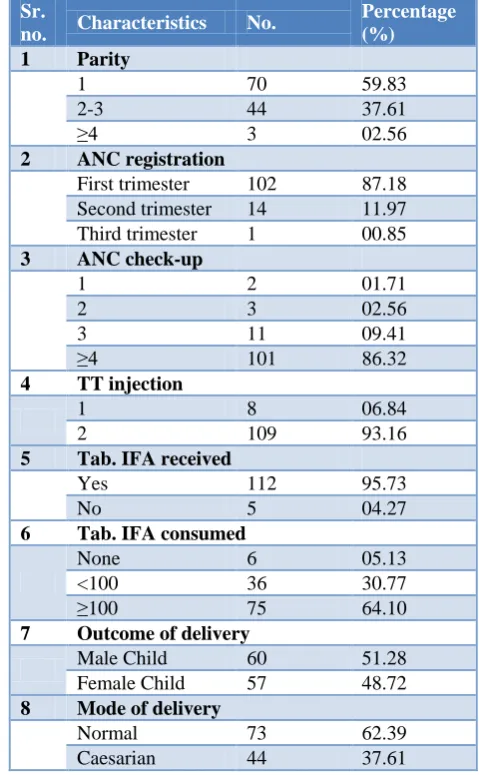
Most of the respondents were Primipara 70 (59.83%) and majority of them i.e. 102 (87.18%) had done their ANC registration in first trimester of their pregnancy, while 101 (86.32%) have done at least 4 or more times ANC
checkups in their pregnancy. Majority of respondents 109 (93.16%) had received 2 doses of TT injection during their pregnancy. While 112 (95.77%) respondents received IFA tablets but only 75 (64.10%) consumed 100 or more IFA tablets during their pregnancy. Mode of delivery was normal vaginal delivery in 73 (62.39%) while rest were having caesarian section; outcome of delivery was 57 (48.72%) female child and rest 60 (51.28%) were male child.
Table 2: Pregnancy related characteristics of study subjects (n=117).
Sr.
no. Characteristics No.
Percentage (%)
1 Parity
1 70 59.83
2-3 44 37.61
≥4 3 02.56
2 ANC registration
First trimester 102 87.18
Second trimester 14 11.97
Third trimester 1 00.85
3 ANC check-up
1 2 01.71
2 3 02.56
3 11 09.41
≥4 101 86.32
4 TT injection
1 8 06.84
2 109 93.16
5 Tab. IFA received
Yes 112 95.73
No 5 04.27
6 Tab. IFA consumed
None 6 05.13
<100 36 30.77
≥100 75 64.10
7 Outcome of delivery
Male Child 60 51.28
Female Child 57 48.72
8 Mode of delivery
Normal 73 62.39
Caesarian 44 37.61
Knowledge of danger signs
Out of 117 respondent 50 (42.73%) were eligible for financial assistance under Janani Suraksha Yojana but only 6 (12.0%) had availed the financial assistance. In all of this, good thing is that all of them i.e. 117 (100%) had delivered their babies by skilled birth attendants in health facilities.
BPCR index, component indicators and demographic characters:
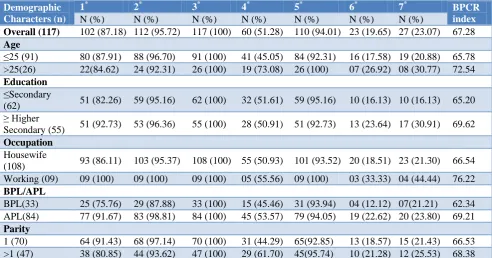
Overall BPCR index was found to be 67.28 and the proportion of indicators were ANC Registration during 1st trimester (87.18%), ANC checkup ≥3 (95.72%),
Institutional delivery (100%), saved money (51.28%), arranged vehicle for emergency (94.01%), arranged blood donor (19.65%) and knows at least 3 danger signs of pregnancy was 23.07%.
When BPCR index is compared with different demographic characters it tends to be higher when age was more than 25 years (72.54 vs 65.78), higher secondary or more education (69.62 vs 65.20), working women (76.22 vs 66.54), APL family (69.21 vs 62.34) and multi para (68.38 vs 66.53) compared to their counterparts as well as overall average BPCR Index
.
Table 3: Comparison of birth preparedness and complication readiness indicators and index with demographic characters.
Demographic Characters (n)
1* 2* 3* 4* 5* 6* 7* BPCR
index
N (%) N (%) N (%) N (%) N (%) N (%) N (%)
Overall (117) 102 (87.18) 112 (95.72) 117 (100) 60 (51.28) 110 (94.01) 23 (19.65) 27 (23.07) 67.28
Age
≤25 (91) 80 (87.91) 88 (96.70) 91 (100) 41 (45.05) 84 (92.31) 16 (17.58) 19 (20.88) 65.78
>25(26) 22(84.62) 24 (92.31) 26 (100) 19 (73.08) 26 (100) 07 (26.92) 08 (30.77) 72.54
Education
≤Secondary
(62) 51 (82.26) 59 (95.16) 62 (100) 32 (51.61) 59 (95.16) 10 (16.13) 10 (16.13) 65.20
≥ Higher
Secondary (55) 51 (92.73) 53 (96.36) 55 (100) 28 (50.91) 51 (92.73) 13 (23.64) 17 (30.91) 69.62
Occupation
Housewife
(108) 93 (86.11) 103 (95.37) 108 (100) 55 (50.93) 101 (93.52) 20 (18.51) 23 (21.30) 66.54
Working (09) 09 (100) 09 (100) 09 (100) 05 (55.56) 09 (100) 03 (33.33) 04 (44.44) 76.22
BPL/APL
BPL(33) 25 (75.76) 29 (87.88) 33 (100) 15 (45.46) 31 (93.94) 04 (12.12) 07(21.21) 62.34
APL(84) 77 (91.67) 83 (98.81) 84 (100) 45 (53.57) 79 (94.05) 19 (22.62) 20 (23.80) 69.21
Parity
1 (70) 64 (91.43) 68 (97.14) 70 (100) 31 (44.29) 65(92.85) 13 (18.57) 15 (21.43) 66.53
>1 (47) 38 (80.85) 44 (93.62) 47 (100) 29 (61.70) 45(95.74) 10 (21.28) 12 (25.53) 68.38
*1= ANC Registration during 1st trimester, 2= ANC check up ≥3, 3=Institutional delivery, 4=Saved money, 5=Arranged vehicle for
emergency, 6=Arranged blood donor, 7=Knows 3 danger signs of pregnancy.
DISCUSSION
Until recently main indicator for maternal health widely used was maternal mortality ratio, still it is relevant but this indicator alone could not depict different facets of maternal health like preparedness for child birth and emergency arising out of it. However, by using different indicators for birth preparedness and complication readiness and summarising in an index, could effectively depict the overall picture of maternal health as well as of birth preparedness and complication readiness.10
Our present study revealed that proportion of birth preparedness and complication readiness was 67.28% which indicated that birth preparedness was at good level in this the study area as compared to other studies like Agarwal et al reported 47.8% in Indore city of Madhya
Knowledge of at least one key danger sign of pregnancy, during delivery and newborn child was 59.83%, 26.50% and 17.10% respectively in our study subjects, Mukhopadhyay et al reported these findings 23.5%, 18.1% and 41.2% respectively in his study, in this respect our study subjects had comparatively high knowledge of danger signs during pregnancy and delivery but lagging
behind in danger signs of new born child.12 Since BPCR
index of our study is comparably high, it seems that though pregnant women visiting health facility frequently but counseling and health education regarding danger signs given by health care providers might be poor.
Regarding availment of financial assistance under Janani Suraksha Yojana, from our study 12% of beneficiary got it, compared to only 7.5% in NFHS-4 data for Nanded district.11
Our study subjects reported 100% institutional delivery with skilled birth attendant while NFHS-4 data for Nanded district shows 84.5%, it is higher in our study, may be because study has been done in urban area and that too hospital based.11
When BPCR indicators and index were compared with socio-demographic factors, in our study it found to be higher when age is more than 25 years, higher secondary or more education, working women, APL family and multi-para compared to their counterparts as well as overall average BPCR Index. Similar findings had been shown by many different studies.6,10
In present study, it was found that 51.28% study subjects had saved money, arranged vehicle for emergency by 94.01% and 19.65% arranged blood donor; apart from identification of skilled birth attendant and identifying health facility in emergency, these factors play crucial role in constructing BPCR index. When we compared saving money with other socio-demographic factors, it is found that more women aged 25 years and above saved money compared to whose age was less than that (73.08% vs 45.05%). Women belonging to APL category tends to save money compared to BPL category (53.57% vs 45.46%) and women with multi-para also tend to save money compared to primi-para (61.70% vs 44.29%). From these points we can compelled to say that decision making in women regarding saving money increases as age advances and by things they learnt from previous pregnancy might have helped them in saving money. It also lays the importance of financial assistance from either government or community is needed for BPL category people, as they could not save money in such matters. Only one fifth of them have done arrangement of blood donor, which is very low, this is common in such society because people’s belief regarding blood donation. When we compared these findings with other studies, similar findings of saving money had been shown by Nandan et alin Rewa (45.7%) and Mukhopadhyay et al (45.8%) but studies done by Agarwal et al (76.9%) and Mazumdar et al(84.6%) showed more number of their
study subjects saved money, while study done by Saha R et al showed only 35.7% study subjects have saved money for child birth.6,7,10,12,13 Overall (94.01%) of the study subjects, 100% study subjects aged more than 25 and 100% working women said they had made arrangement of vehicle for emergency, while Nandan et al, and Saha et al observed that their study subjects made arrangement of vehicle for emergency in 78.7% and 61% respectively, while these figure were very low in studies
done by Agarwal et al 29.5% and Mukhopadhyay et al
25.6%, high percentage in our study may be because study was done in urban area and because of easy availability of public as well as private transport.6,7,12,13 Regarding arrangement of blood donors this study fared well compared to other studies like Mazumdar et al 12.9% and 11.3% in Mukhopadhyay et al, indeed it is need of hour to educate and convince pregnant women and their family members to remain prepare for any kind of untoward event including identification of blood donor.10,12
CONCLUSION
With certain limitations like small sample size, hospital based study and inclusion of only one stakeholder of BPCR Matrix, authors like to conclude that inclusion of health education regarding danger signs of pregnancy during every ANC check-up might increase the awareness and perception of danger signs during
pregnancy, delivery and newborns.8 To avoid
complications and to make people readiness for implementation of all elements of BPCR index, all kind of efforts should be made so that each and every mother and babies will be safe.
ACKNOWLEDGEMENTS
The authors would like to acknowledge post-graduate students, nursing and supporting staff working at Immuno-Prophylaxis Centre, Dr. Shankarrao Chavan Government Medical College, Nanded, for their immense support during data Collection. Author would also like to acknowledge study subjects for participating in this study, without which this study will not be possible.
Funding: No funding sources Conflict of interest: None declared
Ethical approval: The study was approved by the Institutional Ethics Committee
REFERENCES
1. World Health Organization. Maternal mortality.
Available at
https://www.who.int/en/news-room/fact-sheets/detail/maternal-mortality. Accessed 2 May 2019.
2. Suryakantha AH. Community Medicine with recent
3. World Health Organization. Global Health Observatory data repository. Maternal mortality data by country. Available at http://apps.who.int/gho/ data/node.main.15?lang=en. Accessed 2 May 2019.
4. World Health Organization. Global Health
Observatory data repository. Child Mortality.
Available at http://apps.who.int/gho/data/node.
main.525?lang=en. Accessed 2 May 2019.
5. United Nations Inter-agency Group for Child
Mortality Estimation (2018). Available at
https://childmortality.org/data. Accessed 1 May 2019.
6. Nandan D, Kushawa SS, Dubey DK, Singh G,
Shivdasani JP, Adhish V. A study for assessing birth preparedness and complication readiness intervention in Rewa district of Madhya Pradesh.
Available at http://www.nihfw.org/Rahi2.aspx.
Accessed 2 May 2019.
7. Agarwal S, Sethi V, Srivastava K, Jha PK, Baqui
AH. Birth Preparedness and Complication
Readiness among Slum Women in Indore City, India. J Health Popul Nutr. 2010;28(4):383-91.
8. Maternal and Neonatal Health Program. Birth
preparedness and complication readiness: a matrix
of shared responsibilities. Baltimore, MD:
JHPIEGO, 2001. Available at www.commonhealth. in/neonatal-pdf/145.pdf. Accessed 2 May 2019.
9. JHPIEGO: Maternal and Neonatal Health.
Monitoring Birth Preparedness and Complication Readiness, Tools and Indicators for Maternal and Newborn Health. Johns Hopkins Bloomberg, school of Public Health. Center for communication
programs, Family Care International, 2004.
Available at http://pdf.usaid.gov/pdf_docs/
pnada619.pdf. Accessed 2 May 2019.
10. Mazumdar R, Mukhopadhyay DK, Kole S, Mallik
D, Sinhababu A. status of birth preparedness and complication readiness in a rural community: a study from West Bengal, India. Al Ameen J Med Sci. 2014;7(1):52-7.
11. Government of India, Ministry of Health and Family
Welfare. National Family Health survey-4 District. Fact sheet: Nanded Maharashatra, International Institute for Population Sciences, Mumbai. 2015-16.
Available at http://rchiips.org/nfhs/MH.shtml.
Accessed 2 May 2019.
12. Mukhopadhyay DK, Mukhopadhyay S,
Bhattacharjee S, Nayak S, Biswas AK, Biswas AB. Status of birth preparedness and complication readiness in Uttar Dinajpur District, West Bengal. Indian J Public Health. 2013;57(3):147-54.
13. Saha R, Sarkar AP, Saha I, Misra R, Dasgupta S, Chatterjee S. The status of birth preparedness and complication readiness among rural Indian mothers. Int J Public Health Res. 2014;4(2):510-8.
Cite this article as: Sonkar VK, InamdarIF, Gadekar
RD.Birth Preparedness and Complication Readiness